Reducing Congestion in Two-tier Cellular Network
Using Multi-Relay D2D Communications
Bhed Bahadur Bista, Shingo Sasaki, Kanayo Ogura and Toyoo Takata
Abstract—Due to the large increase of mobile devices called User Equipments (UEs), that connect to cellular networks, it may be impossible for a user to satisfy data communication if a large number of them are connected to a Base Station (BS). We propose a congestion mitigation method as one solution to this problem. Our proposed method transfers traffic to neighboring non-congested Base Stations using Device-to-Device (D2D) com-munications. As a result, the number of UE connections within the coverage area of the BS can be increased. In this paper, we propose a method for two-tier cellular networks composed of a macrocell and picocells which are within the coverage area of the macrocell. When the macrocell BS is congested, some of the UE connections to the macrocell BS are forwarded to a non-congested picocell BS using multi-relay D2D communications. We evaluated the performance of our proposed method by simulation. The simulation results have shown that the number of UEs that can be connected to BSs can be increased using multi-relay D2D communications.
Index Terms—User Equipment, D2D communication, multi-relay, congestion, cellular network.
I. INTRODUCTION
T
HE most widely used high performance mobile wireless devices in the world are smartphones and tablets, whose number is increasing year by year. The proliferation of these devices and constant use of them to access the Internet have strained the wireless access points specially cellular network access points called Base Stations (BSs). Almost all these devices are frequently used to upload and download videos, photos, audio files or access SNS services generating a huge amount of data traffic which is increasing year by year [1]. The GSMA real time tracker puts that the number of mobile devices are more than the world population and will be double the world population soon [2].In order to satisfy ever increasing number of UEs connec-tions to BSs, wireless cellular networks are also evolving and increasing their network capacity by integrating new technologies and shifting their paradigms. Currently, the cel-lular network is in fourth generation (4G) which is replacing 3G around the world. The 4G is being actively developed and is well-known by 3GPP LTE-Advanced [3],[4]. Besides providing higher channel capacity by introducing multi-antenna technology and carrier aggregation, LTE-Advanced is shifting its paradigm of communication model known as Device-to-Device (D2D) communication by taking advan-tages of high performance wireless devices [5], [6]. D2D improves resource utilization of wireless cellular networks by letting a pair of D2D devices which are in proximity of each other to communicate directly instead of communicating via
Manuscript received on December 8, 2017; revised on January 10, 2018. B.B. Bista, S. Sasaki, K. Ogura and T. Takata are with the Department of Software and Information Science, Iwate Prefectural University, Iwate Ken, JAPAN, 020-0693
Base Station (know as evolved Node (eNB) Base Station in LTE).
In D2D communication, two devices called User Equip-ments (UEs), which are in proximity of each other, can establish a direct communication link using the licensed band. Because of their proximity, there is limited interference from other users even if they use the same licensed band. Since D2D communication can be established by sharing channel, the eNB can provide service to other UEs using the same channel thereby increasing the throughput and the number of UE connections of the network.
Another approach to mitigate the traffic overload and accommodate ever increasing mobile devices in 4G networks are heterogeneous networks which are being deployed in various places [3], [7]. In heterogeneous networks, there are small cells – picocells, femto-cells and relay cells – within the larger coverage area of a macrocell. UEs within the coverage area of a small cell are linked to the BS of the small cell instead of the BS of the macrocell, effectively reducing the congestion at the macrocell BS and increasing the node density to further improve the network capacity [8]. Combining D2D communications and heterogeneous networks, the network capacity of the macrocell can be further improved if the traffic from the congested BS is forwarded to a non-congested small cell BS within the coverage area of the macrocell using D2D communications. In this paper, we propose a multi-relay D2D communi-cation in which connection requesting UEs and/or already connected UEs at the macrocell BS are forward to a non-congested small cell BS using multi-relay D2D, reducing the congestion at the macrocell BS and increasing the overall UEs connections to BSs.
The paper is organized as follows. In section II, we present the related works. In section III, we present our proposed multi-relay D2D scheme to mitigate congestion at the macrocell BS. In section IV, we present the performance evaluation of our proposed scheme with simulation followed by conclusion in section V.
II. RELATEDWORKS
Authors in [9] have proposed a traffic detouring method from the macrocell to small cells by establishing D2D links between UEs which are outside the coverage area of the small cells to UEs which are free and inside the coverage area of the small cells. Liu et al. [10], [11] have improved the method of [9] and have proposed a scheme in which a mobile UE selects an operation mode individually whether to establish a cellular link with the BS or a D2D link using the pilot signal strength received from its nearest BS.
are within the D2D establishment distance to UEs in the small cell. Moreover, if there are no free UEs in the small cell, the D2D link cannot be established between the UEs and the traffic cannot be detoured to the small cell.
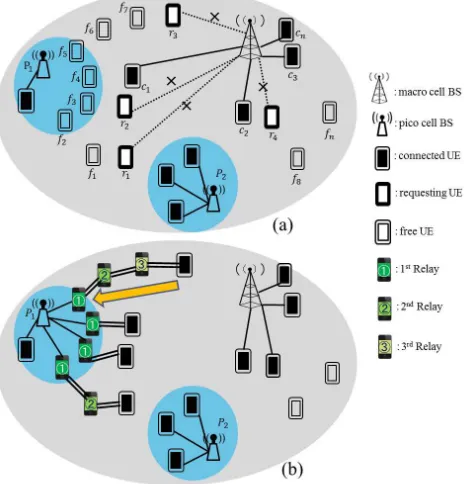
In this paper, we propose a multi-relay D2D to forward traffic from the macrocell to the small cell in a heterogeneous cellular network. With multi-relay D2D communications, an UE which is linked to or requesting link to the macrocell BS, can be forwarded to the small cell even if it is not within the D2D distance to UEs in the small cell. Furthermore, using multi-relay D2D, even if there is no free UE in the small cell, a macrocell UE can be detoured to another small cell which has free UEs as shown in Fig. 1 where r1 is within the D2D distance to a UE of the small cell P2 which has no free UEs. With multi-relay D2Dr1 can be linked to the small cell P1.
III. THEPROPOSEDMULTI-RELAYD2D SCHEME
When an UE which is outside the coverage area of a picocell (here we consider a small cell as a picocell) and is requesting connection to the macrocell BS, it will not get connection if the BS is congested or has no capacity for new connections as shown in Fig. 1(a). If some of requesting UEs or already connected UEs can be connected to a non-congested picocell BS using D2D, the number of UEs that can be connected will increase. In order to utilize the resources of BSs in a heterogeneous cellular network, we propose a method for multi-relay D2D communication to forward connections to non-congested BSs.
In Algorithm 1, we first find free UEs in a picocell. For an examplef2∼f5 in picocellP1 as shown in Fig. 1(a) are free UEs. Then we find requesting UEs or connected UEs to the BS of macrocell which are within the D2D distance from free UEs in the picocell. As an example, let us suppose,
r2 a connection requesting UE to the macrocell BS, and c1
a connected UE to the macrocell BS, are within the D2D distance from free UEs f3 andf4 respectively as shown in
Fig. 1(a). Now D2D connection is established between r2
andf3and,c1andf4. The requesting UE,r2and connected UE, c1, are connected to the BS of picocell P1 via f3
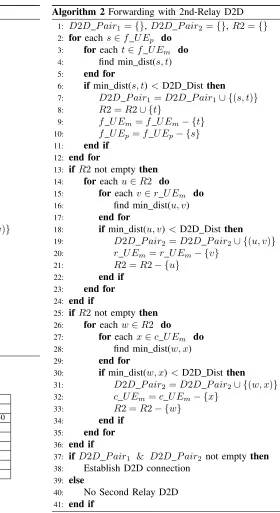
andf4 respectively as shown in Fig. 1(b). The work in [9] forms only this 1st-Relay D2D connection. The single relay D2D connections may not sufficiently utilize the resources of picocells and mitigate the congestion at the macrocell BS. In Algorithm 2, we find free UEs outside the picocell coverage area and are within the D2D distance to free UEs of the picocell. We mark them as 2nd-Relays. As an example, let us suppose,f1andf6as shown in Fig. 1(a) are such free
UEs. Next, we find requesting UEs first and then connected UEs which are within the D2D distance to 2nd-Relays. If there are such UEs, we establish D2D connections and connect requesting UEs and/or connected UEs to the BS of picocell. As an example r1 is now connected to the BS of picocell P1 in Fig. 1(b).
In Algorithm 3, we find free UEs outside the coverage area of the picocell and are within the D2D distance to the 2nd-Relays. If there are, we mark them as 3rd-Relays. Then we find if there are requesting UEs or connected UEs which are within the D2D distance to 3rd-Relays. If there are we establish D2D connections. As an example, let us suppose,
f7 is 3rd-Relay and r3 is within the D2D distance to f7
[image:2.595.308.540.107.349.2]as shown in Fig. 1(a). Then we establish D2D connections betweenr3tof7,f7tof6,f6tof5which will be connected to the BS of picocellP1 as shown in Fig. 1(b).
Fig. 1. An Overview of Our Proposal
A. Algorithms for Finding Multi-Relay D2D UEs
We define the following sets of UEs which we use in our algorithms. The BSs of picocells and the macrocell select UEs for possible D2D communications considering minimum interference if D2D is established. How a BS selects UEs, manages resources and allocate channels to UEs is beyond the scope of the paper [12], [13].
Let
f U Em: be a nonempty set of free UEs in macrocell,
r U Em: be a nonempty set of requesting UEs in macrocell,
c U Em: be a nonempty set of connected UEs in macrocell and
f U Ep: be a nonempty set of free UEs in picocell.
In Algorithms 1, 2 and 3, first requesting UEs are con-nected to the picocell BS. If there are no such requesting UEs or all possible requesting UEs are connected, only then connected UEs are connected to the picocell BS. This is reasonable because we do not want the already connected UEs to change the connection if not required.
In Algorithm 1, steps 2∼11 will find D2D pairs between requesting UEs of macrocell and free UEs of the picocell and steps 12∼23 will find D2D pairs between connected UEs and free UEs of the picocell.
Algorithm 1Forwarding with 1st-Relay D2D
1: D2D P air={}
2: foreachs∈f U Ep do
3: foreach t∈r U Em do
4: find min dist(s, t)
5: end for
6: ifmin dist(s, t)<D2D Distthen
7: D2D P air=D2D P air∪ {(s, t)}
8: f U Ep=f U Ep− {s}
9: r U Em=r U Em− {t}
10: end if
11: end for
12: iff U Ep not emptythen
13: foreach u∈f U Ep do
14: foreach v∈c U Em do
15: find min dist(u, v)
16: end for
17: if min dist(u, v)<D2D Dist then
18: D2D P air=D2D P air∪ {(u, v)}
19: c U Em=c U Em− {v}
20: f U Ep=f U Ep− {u}
21: end if
22: end for
23: end if
24: ifD2D P air not emptythen
25: Establish D2D connection 26: else
27: No First Relay D2D
[image:3.595.252.532.48.561.2]28: end if
TABLE I SIMULATIONPARAMETERS
Parameters Values
Total number of UEs 1500
Number of requesting UEs 150,300,450
Number of Picocells 1,2,3,4
Maximum D2D distance 30m
Radius of Macrocell 500m
Radius of Picocell 100m
Connection capacity of Macrocell BS 100 Connection capacity of Picocell BS 100
IV. PERFORMANCEEVALUATION
We evaluated our proposal using simulation to see how the number of connected UEs are increased using multiple D2D relays. We compare the simulation results of our proposal with non-relay D2D [9] and without any D2D, i.e., only with picocells.
A. Simulation Parameters and Procedure
The simulation parameters are as shown in the Table I. We put 1500 UEs randomly in a circular area of 500 meters radius of a macrocell with the BS at the center. We vary the number of picocells with radius of 100 meters from 1 to 4. The picocells are placed as shown in Fig. 2. The number of requesting UEs are 150, 300 and 450 which are 10%, 20% and 30% of total UEs respectively. First, we simulated without any D2D connections. Secondly, we simulated with D2D only, i.e., simulation of the related work [9]. The related work can be considered as the 1st-Relay also when an UE in the picocell is relaying traffic of an UE in the macrocell.
Algorithm 2Forwarding with 2nd-Relay D2D
1: D2D P air1={},D2D P air2={},R2 ={}
2: foreach s∈f U Ep do
3: foreacht∈f U Em do
4: find min dist(s, t)
5: end for
6: ifmin dist(s, t)<D2D Dist then
7: D2D P air1=D2D P air1∪ {(s, t)} 8: R2 =R2∪ {t}
9: f U Em=f U Em− {t}
10: f U Ep=f U Ep− {s}
11: end if
12: end for
13: if R2 not emptythen
14: foreachu∈R2 do
15: foreach v∈r U Em do
16: find min dist(u, v)
17: end for
18: ifmin dist(u, v)<D2D Distthen
19: D2D P air2=D2D P air2∪ {(u, v)}
20: r U Em=r U Em− {v}
21: R2 =R2− {u}
22: end if
23: end for
24: end if
25: if R2 not emptythen 26: foreachw∈R2 do
27: foreach x∈c U Em do
28: find min dist(w, x)
29: end for
30: ifmin dist(w, x)<D2D Dist then
31: D2D P air2=D2D P air2∪ {(w, x)}
32: c U Em=c U Em− {x}
33: R2 =R2− {w}
34: end if
35: end for
36: end if
37: if D2D P air1 & D2D P air2 not emptythen
38: Establish D2D connection
39: else
40: No Second Relay D2D
41: end if
Then we simulated our proposal with 2nd-Relay and 3rd-Relay where these relays are UEs in the macrocell. In each simulation, picocells and the number of requesting UEs are varied. The simulation was performed 10000 times for each scenarios and the results presented are the average values.
B. Performance Results
Figures 3, 4 and 5 show the percentage of UEs that get connections to the BSs of macrocell and/or the BSs of picocells when connection requesting UEs are 150, 300 and 450 respectively. The “none”, “related(1st-Relay)”, “proposal(2nd-Relay)” and “proposal(3rd-Relay)” represent without D2D, related work, our proposal with 2nd-Relay and 3rd-Relay which are outside picocells respectively.
Algorithm 3Forwarding with 3rd-Relay D2D
1: D2D P air1={},D2D P air2 ={},D2D P air3=
{},R2 ={},R3 ={}
2: Add steps 2∼12 code of Algorithm 2 to find R2 and
D2D P air1 here. 3: ifR2 not emptythen
4: foreach y∈R2 do
5: foreach z∈f U Em do
6: find min dist(y, z)
7: end for
8: if min dist(y, z)<D2D Dist then 9: D2D P air2=D2D P air2∪ {(y, z)}
10: R3 =R3∪ {z}
11: f U Em=f U Em− {z}
12: R2=R2− {y}
13: end if
14: end for
15: end if
16: Add steps 13∼36 code of Algorithm 2 replacing R2 with R3 and D2D P air2 with D2D P air3 to find D2D P air3 here.
17: if D2D P air1 & D2D P air2 & D2D P air3
not emptythen
18: Establish D2D connection
19: else
20: No Third Relay D2D
21: end if
all scenarios. This is obvious because when we increase BSs with certain number of connection capacity (here picocells with 100 connections capacity), the number of UEs that can be connected to BSs will also increase. However, if the number of requesting UEs increases, the percentage of UEs that get connection to BSs decreases because some BSs may be congested with connections requests and the number of requesting US being refused connections will also increase. We can see that in Fig. 5, the percentage of connected UEs is less than that of Fig. 4 which is less than that of Fig. 3 where the number of requesting UEs are 450, 300 and 150 respectively.
After introducing multi-relay D2D to relay requesting UEs connections from the congested BS, the macrocell BS in our case, to non-congested BSs of picocells, the percentage of connected UEs increases compared to without using D2D communications. The percentage of increase in 3rd-Relay D2D is higher than 2nd-Relay D2D which is higher than 1st-Relay D2D. This is because the multi-relay D2D can relay the connections of requesting UEs which are further away from coverage areas of picocells to BSs of picocells.
Figures 6, 7 and 8 show the ratio of connected UEs when relays are increased from 0 to 1st-Relay, 1st-Relay to 2nd-Relay and 2nd-2nd-Relay to 3rd-2nd-Relay. We see that the ratio decreases in all scenarios. This is because finding 2nd-Relays depends upon the number of 1st-Relays and the number of free UEs in the macrocell which are within the D2D distance to the 1st-Relays. Similarly finding the 3rd-Relays depends upon the number of 2nd-Relays and free UEs which are in D2D distance to 2nd-Relays. The number of relays decreases as they are multi-relays away from the picocell. Finally the number of requesting UEs or connected UEs that can be
[image:4.595.48.292.56.386.2]relayed to BSs of picocells depends upon how many of them are within the D2D distance to relaying UEs. As the number of relays decreases further away from a picocell, the number of UEs that can be relayed for connections also decreases as we can see from Figs. 6, 7 and 8. An optimum number of relays to be introduced needs further study.
Fig. 2. Placements of macrocell, picocells and UEs
68% 72% 76% 80% 84% 88% 92% 96% 100%
1 2 3 4
Pe
rcenta
ge of
c
o
nnected
U
E
s
No. of picocells
[image:4.595.306.548.138.345.2]none related(1st✄Relay) proposed(2nd✄Relay) proposed(3rd✄Relay)
Fig. 3. Percentage of connected UEs when requesting UEs are 150
36% 39% 42% 45% 48% 51% 54% 57% 60%
1 2 3 4
Pe
rcen
ta
ge
of
con
n
ect
ed
U
E
s
No. of picocells
none related(1st✄Relay)
proposed(2nd✄Relay) proposed(3rd✄Relay)
Fig. 4. Percentage of connected UEs when requesting UEs are 300
[image:4.595.305.548.392.516.2]25% 27% 29% 31% 33% 35% 37% 39% 41% 43% 45% 47%
1 2 3 4
Pe rce n ta ge o f co nn ect ed U E s
No. of picocells
none related(1st✄Relay)
[image:5.595.53.319.51.174.2]proposed(2nd✄Relay) proposed(3rd✄Relay)
Fig. 5. Percentage of connected UEs when requesting UEs are 450
0.00% 0.50% 1.00% 1.50% 2.00% 2.50% 3.00% 3.50% 4.00% 4.50% 5.00% 5.50% 6.00%
0 to 1st-Relay 1st-Relay to 2nd-Relay 2nd-Relay to 3rd-Relay
Increase in relay UEs
Rat io of c o n n e ct ed UE s
Pico Cells No. 1
Pico Cells No. 2
Pico Cells No. 3
[image:5.595.286.543.51.182.2]Pico Cells No. 4
Fig. 6. Change in connected UEs as relays increase for 150 Requesting UEs 0.00% 0.50% 1.00% 1.50% 2.00% 2.50% 3.00% 3.50% 4.00% 4.50% 5.00%
0 to 1st-Relay 1st-Relay to 2nd-Relay 2nd-Relay to 3rd-Relay
Increase in relay UEs
Rat io of conn e ct e d UEs
Pico Cells No. 1
Pico Cells No. 2
Pico Cells No. 3
Pico Cells No. 4
Fig. 7. Change in connected UEs as relays increase for 300 Requesting UEs 0.00% 0.50% 1.00% 1.50% 2.00% 2.50% 3.00% 3.50% 4.00% 4.50%
0 to 1st-Relay 1st-Relay to 2nd-Relay 2nd-Relay to 3rd-Relay
Increase in relay UEs
Ratio of c o n n ec te d UE s
Pico Cells No. 1
Pico Cells No. 2
Pico Cells No. 3
[image:5.595.49.296.203.346.2]Pico Cells No. 4
Fig. 8. Change in connected UEs as relays increase for 450 Requesting UEs
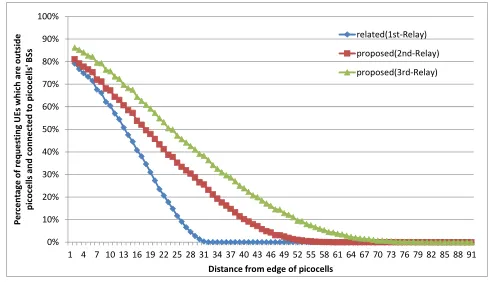
than if they are further away. Though the multi-relay D2D extends the distance of requesting UEs from the picocell
0% 10% 20% 30% 40% 50% 60% 70% 80% 90% 100%
1 4 7 10 13 16 19 22 25 28 31 34 37 40 43 46 49 52 55 58 61 64 67 70 73 76 79 82 85 88 91
Pe rc e n ta g e of re ques ting UEs whi ch ar e ou ts id e p ico ce ll s and conn ec te d to p icocell s' BS s
Distance from edge of picocells
related(1st✄Relay)
proposed(2nd✄Relay)
[image:5.595.137.537.218.357.2]proposed(3rd✄Relay)
Fig. 9. Percentage of requesting UEs which are outside picocells and connected to BSs of picocells for 150 requesting UEs and 4 picocells
0% 10% 20% 30% 40% 50% 60% 70% 80% 90% 100%
1 4 7 10 13 16 19 22 25 28 31 34 37 40 43 46 49 52 55 58 61 64 67 70 73 76 79 82 85 88 91
Pe rc e n ta g e of re que st ing UE s whi ch ar e outs ide picoc el ls an d conne ct e d to pi coce ll s' BS s
Distance from edge ot picocells
related(1st✄Relay)
proposed(2nd✄Relay)
[image:5.595.47.292.385.527.2]proposed(3rd✄Relay)
Fig. 10. Percentage of requesting UEs which are outside picocells and connected to BSs of picocells for 300 requesting UEs and 4 picocells
0% 10% 20% 30% 40% 50% 60% 70% 80% 90% 100%
1 4 7 10 13 16 19 22 25 28 31 34 37 40 43 46 49 52 55 58 61 64 67 70 73 76 79 82 85 88 91
Pe rc e n ta g e of re qu e st in g UE s whi ch ar e ou ts id e pi cocel ls an d co nn ect e d to pi co cel ls' BS s
Distance from edge of picocells
related(1st✄Relay)
proposed(2nd✄Relay)
[image:5.595.303.547.398.539.2]proposed(3rd✄Relay)
Fig. 11. Percentage of requesting UEs which are outside picocells and connected to BSs of picocells for 450 requesting UEs and 4 picocells
to be connected to the picocell, it has a limit. After some distance, no requesting UEs can be connected to picocells. From the figures, we observe that for a given distance from the picocells, the number of requesting UEs being connected to picocell BSs is higher in 3rd-Relay than 2nd-Relay which is higher than 1st-Relay. Moreover, the 3rd-Relay coverage distance from the edge of the picocells is further than the 2nd-Relay which is further than the 1st-Relay.
V. CONCLUSION
[image:5.595.47.290.567.709.2]shown that not only do we reduce the congestion at the macrocell BS, but also increase the number of UEs that can be connected to the network.
REFERENCES
[1] Cisco, “Cisco Visual Networking Index: Global Mobile Data Traffic Forecast Update, 2016-2021 White Paper,” http://www.cisco.com/c/en/us/solutions/collateral/service-provider/ visual-networking-index-vni/mobile-white-paper-c11-520862.html, March, 2017, [Online; accessed 28-April-2017].
[2] GSMA, “GSMA real-time tracker,” https://www.gsmaintelligence. com/, October, 2017, [Online; accessed 10-October-2017].
[3] 3GPP, “Specification Releases,” http://www.3gpp.org/specifications/ releases, [Online; accessed 28-April-2017].
[4] A. Ghosh, R. Ratasuk, B. Mondal, N. Mangalvedhe, and T. Thomas, “Lte-advanced: next-generation wireless broadband technology [in-vited paper],”IEEE Wireless Communications, vol. 17, no. 3, pp. 10– 22, June 2010.
[5] A. Asadi, Q. Wang, and V. Mancuso, “A survey on device-to-device communication in cellular networks,”IEEE Communications Surveys Tutorials, vol. 16, no. 4, pp. 1801–1819, Fourthquarter 2014. [6] K. Doppler, M. Rinne, C. Wijting, C. B. Ribeiro, and K. Hugl,
“Device-to-device communication as an underlay to lte-advanced networks,”IEEE Communications Magazine, vol. 47, no. 12, pp. 42– 49, Dec 2009.
[7] A. Damnjanovic, J. Montojo, Y. Wei, T. Ji, T. Luo, M. Vajapeyam, T. Yoo, O. Song, and D. Malladi, “A survey on 3gpp heterogeneous networks,”IEEE Wireless Communications, vol. 18, no. 3, pp. 10–21, June 2011.
[8] J. Liu, Y. Kawamoto, H. Nishiyama, N. Kato, and N. Kadowaki, “Device-to-device communications achieve efficient load balancing in lte-advanced networks,”IEEE Wireless Communications, vol. 21, no. 2, pp. 57–65, April 2014.
[9] Y. Kawamoto, J. Liu, H. Nishiyama, and N. Kato, “An efficient traffic detouring method by using device-to-device communication technologies in heterogeneous network,” in2014 IEEE Wireless Com-munications and Networking Conference (WCNC), April 2014, pp. 2162–2167.
[10] J. Liu, S. Zhang, H. Nishiyama, N. Kato, and J. Guo, “A stochastic geometry analysis of d2d overlaying multi-channel downlink cellular networks,” in2015 IEEE Conference on Computer Communications (INFOCOM), April 2015, pp. 46–54.
[11] J. Liu and N. Kato, “Device-to-device communication overlaying two-hop multi-channel uplink cellular networks,” inProceedings of the 16th ACM International Symposium on Mobile Ad Hoc Networking and Computing, ser. MobiHoc ’15, 2015, pp. 307–316.