CSEIT1723273 | Received : 05 June 2017 | Accepted : 11 June 2017 | May-June-2017 [(2)3: 767-771]
International Journal of Scientific Research in Computer Science, Engineering and Information Technology © 2017 IJSRCSEIT | Volume 2 | Issue 3 | ISSN : 2456-3307
306
Automatic Question Paper Generation System
Vijayalakshmi B.T, Bhavya B M
MCA Department, P.E.S. College of Engineering, Mandya, Karnataka, India
ABSTRACT
Examination process is an important activity for educational institutions to assess student performance. Thus the nature of the exam questions would determine the quality of the students produced by the institutions. Preparing the exam questions is very challenging, tedious and time consuming for the instructors. Thus with the help of this paper we present the solution in form of Automatic Question Paper Generator System (QGS) which makes use of shuffling algorithm as a Randomization technique. The design process performs the scrutiny and composes the examination paper using an efficient algorithm with a high rate of success. With this algorithm, the user needs to specify the subject, the question type and the difficulty level. From the entered input, the examination paper will be generated automatically. The editing of questions is performed using Word processor and the final paper will be stored as “.pdf” file formats. The system shows characteristics like simple operation, a great interface, good usability, immense security, and high stability along with reliability.
Keywords : Question Paper Generator System, Paper Code, Question Bank, Direct Entry, ER Diagram, PROMELA, TTP, SPIN Tool
I.
INTRODUCTION
Implementation is the process of converting a new or a revised system design into an operational one. The organization. The best method for gaining control while implanting any new system would be to use well planned test for testing all new programs. Before production files are used to test live data, text files must be created on the old system, copied over to the new system, and used for the initial test of each program.
Another factor to be considered in the implementation phase is the acquisition of the hardware and software. Once the software is developed for the system and testing is carried out, it is then the process of making the newly designed system fully operational and consistent in performance. Implementation is the most crucial stage in achieving a successful system and giving the user’s confidence that the new system is workable and effective. Implementation of a modified
application to replace an existing one. This type of conversation is relatively easy to handle, provide there are no major changes in the system.
Register
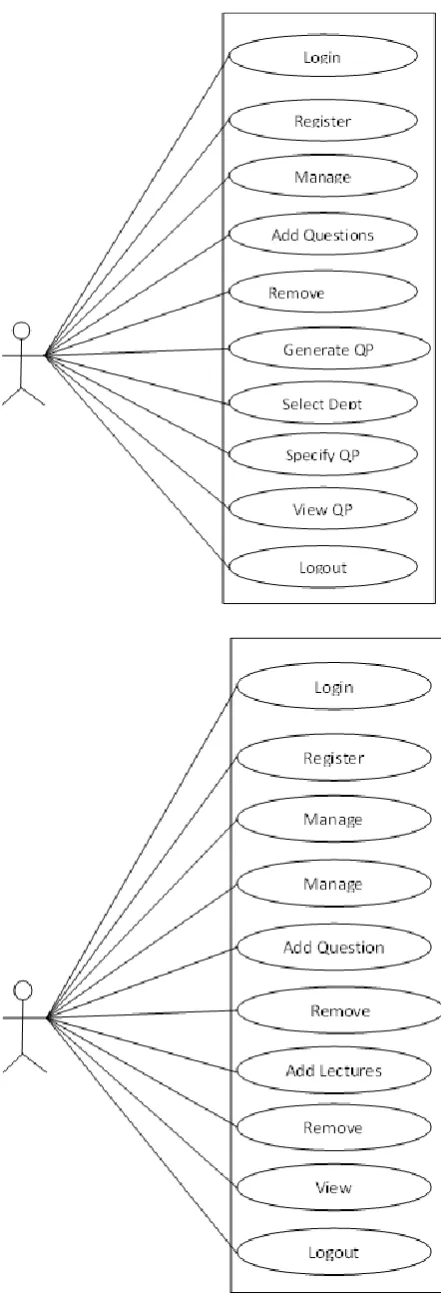
Registration page is the first page to register in this module the user will be entering the information like name password ph num cofirm password and mail id. Based on the data of details it is going to validate and to validate the registration module.
Login
If an administrator has allowed users to create accounts and turned on Portal Direct Entry, a Create Account link appears in the Login Module. This provide authentication to user by confirming the password and confirm password
Question Insertion:
Admin can insert as many questions as he can according to the syllabus requirement of the institutions. This questions will be classified according to marks allocated, level of difficulty.
Difficulty Choosing:
Admin will decide the level of difficulty i.e. Easy, Moderate, Difficult. Random Paper Generation: Questions are selected according to the level of difficulty.
Wide Chapter Coverage:
The system comprises of various topics which cover most of the part of the syllabus .
PDF File Creation:
The question generated is converted into the format of question paper and then transformed into doc file.
Emailing:
The above created doc file can be emailed to the admin.
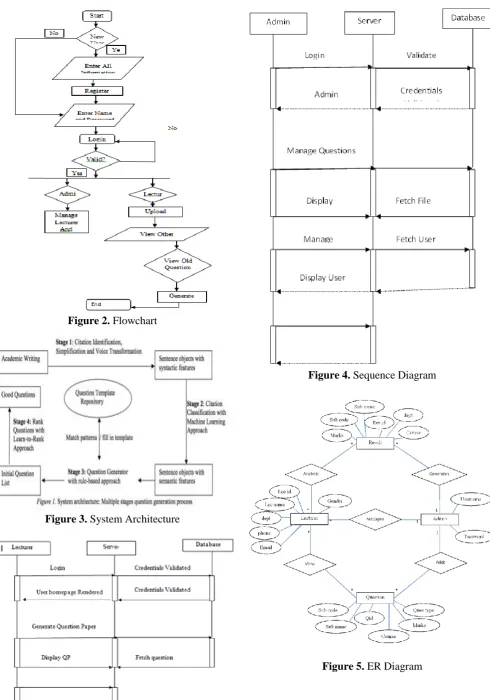
Figure 2. Flowchart
Figure 3. System Architecture
Figure 4. Sequence Diagram
III. PREVIOUS WORK
The question paper preparation is the time consuming factor for the teachers/lecturer in the educational institution.
The teachers will prepare the question papers for internals (test) / semester examination manually. Manual work is more while preparing the questions according to the marks.
The security is less while preparing question paper. The lecturer will generate different sets of question papers for a single examination because of hackers. It’s very tedious and time consuming.
IV. PROPOSED METHODOLOGY
each kind of test question quickly from the existing trial question bank to suit an examination paper developed according to the teacher’s needs. Teachers can also set the difficulty level for each question paper and also the marks for each question according to their needs. The teacher logs on the system after effective identification authentication in the browser, extracts the paper. The automatic paper generation system is a complex systematic approach to develop through the analysis of examinations in schools and colleges. To overcome the tedious work of lecturers/teachers from the preparation of question paper before the test/exams, the system will generate the questions automatically.
System can generate question randomly.
Save time in preparing paper for the examination.
The question can be added to the bank at any time.
If the auto generation is fail for certain reason, the teacher can only just drag and drop the questions and set the question paper in a few seconds.
The questions which are generated by the system is not known by anyone and even for the system also.
V.
LITERATURE SURVEY
Examination system is the pivotal point around which the whole system of education is based. Examination system comprises of number of laborious and error prone tasks, needingimmense resources and time. Numerous electronic examination systems have been designed with the intent of improving the efficiency of current examination system. However, the existing e-examination systems are usually designed with little consideration for security and legal compliance. Providing adequate security services are desired in e-examination system, especially in those e-examinations which evaluate students for grading. In this paper, we explore the use of security protocols for exchanging question paper and answer-scripts between examination authority and students in a fair and non-repudiable manner without the involvement of trusted third party (TTP). We intend to use PROMELA for formal modelling of such protocols and SPIN tool for checking the validity of the proposed protocol.
algorithm for randomization. This system is web-based as well as desktop-based application system with several features mainly producing unduplicated sets of exam paper. The result shows the potential proofs of employment of such algorithm for this type of system. Our future effort is to employ different types of randomization as well as in addition to question generation we can enhance the same software by making provision to produce questions from simple online text, which can be achieved using natural language processing algorithms.
VII.
FUTURE SCOPES
Implementation of attendance into the application Sending result SMS to the students and to their parents Classification of questions based on difficulty level.
VIII.
REFERENCES
[1]. Paul, D. V.; Naik, S. B.; Rane, P.; Pawar, J. D., "Use of an Evolutionary Approach for Question Paper Template Generation,"
[2]. Wang Aimin; Wang Jipeng, "Design and Implementation of Web-Based Intelligent Examination System," Software Engineering,
[3]. Mohd J.; Abu BakarMd Sultan; "Shuffiing