Abstract—Compressive Sensing (CS) is a new method capable of efficiently reconstructing signals by using sparse sample. However, CS algorithms require processing time very extensive especially since the amount of data is very large. In this paper, we evaluated the effect of using double CS processes either serial CS (SCS) and parallel CS (PCS) on Internet traffic matrix. We also compared two reconstruction algorithms, which are Orthogonal Matching Pursuit and Iteratively Reweighted Least Square (IRLS). SCS produces poor accuracy with longer processing time, while PCS produce accuracy similar to CS scheme with shorter processing time. We also examine the effect of subparallel on the performance results. The results show that the greater number of subparallel accelerate the processing time for IRLS, contrary to OMP, where more subparallel, decreasing accuracy.
Index Terms—compressive sensing, parallel, subparallel, serial, processing time, accuracy
I. INTRODUCTION
HE application of CS theory [1] [2] has been developed since several years ago on Internet network. For instance, CS are used to detect the occurance of anomalies in the network [3], traffic estimation [4], network monitoring [5] [6], etc. CS is capable to restore original Internet traffic matrik over less information by using low-rank transformation domain such as PCA [7], SVD [5], Wavelet [8], and employing incoherent sampling technique, such as the widely used Gaussian random [9] [10]. By considering the accuracy of reconstruction, computation time and complexity, have been studied reconstruction algorithms. According to [11], there are six methods for CS reconstruction, namely: convex relaxation, non-convex minimization, greedy, iterative thresholding, Bregmann iterative, and combinatorial.
Convex relaxation works by optimizing convex problem over linear programming for recontruction [12]. In this technique, the exact reconstruction results can be generated from a limited sample, but the computation method is more complicated and the computation time is longer. Basis Pursuit (BP) is an example that widely used in convex optimization [13]. Greedy algorithms have advantages in terms of speed because it uses a simple algorithm with the results low complexity. However, if the sparse signal can not be defined, then the recovery is less accurate. The extremely used greedy class is OMP [12]. Non-convex minimization is developed to fix things on the case on convex relaxation and greedy. For
Manuscript received December 08, 2017; revised January 29, 2018. This work was supported in part by the Telkom Foundation and LPPM ITB
Indrarini Dyah Irawati. Author is with School of Electrical and Informatics, Institut Teknologi Bandung, Indonesia (phone: 62-8122152542; fax: 62-22-7507712; e-mail: indrarini@ telkomuniversity.ac.id).
example, IRLS that able to improve over the performance of convex algorithms and competitive run time with greedy algorithms [15].
Computational time is greatly influenced by the amount of data being processed. CS has the opportunity to implement parallel processes to speed up computational time. Nowadays, parallel process on CS has evolved, for example Hao Fang et al. proposed enhanced parallel CS reconstruction using permutation and block-diagonal measurement matrix to recover all segments of 2D image [16]. Another study by Laurent implementing parallel CS to decompose sparse audio signals. He modified Matching Pursuit algorithm to work locally by chossing adjacent smooth window and frame duration [17]. The proposed parallel CS framework by adding redudant dictionary is discussed to solve mass data in Internet of Things [18]. Jin et al. [19] describe CS framework and parallel MRI based low-rank weighted Hankel matrix solution implemented on filter annihilation. In [20] reconfigured architecture with parallel OMP CS implementation to improve accuracy and to reduce complexity of hardware, power consumption.
Large Internet traffic data will involve more processes, affect the time consumption, and result in decreased accuracy. This encourages us to apply parallel CS for Internet traffic data. Parallel process has the principle to divide the work into several smaller parts so as to speed up the computing process while reducing errors. In this paper, we compare parallel CS and serial CS to process Internet traffic matrix using IRLS and OMP algorithms. We also developed a sub-parallel process to reduce computational time. System performance is measured using NMSE parameters and processing time.
II. PROPOSED METHODS
A.Serial CS (SCS)
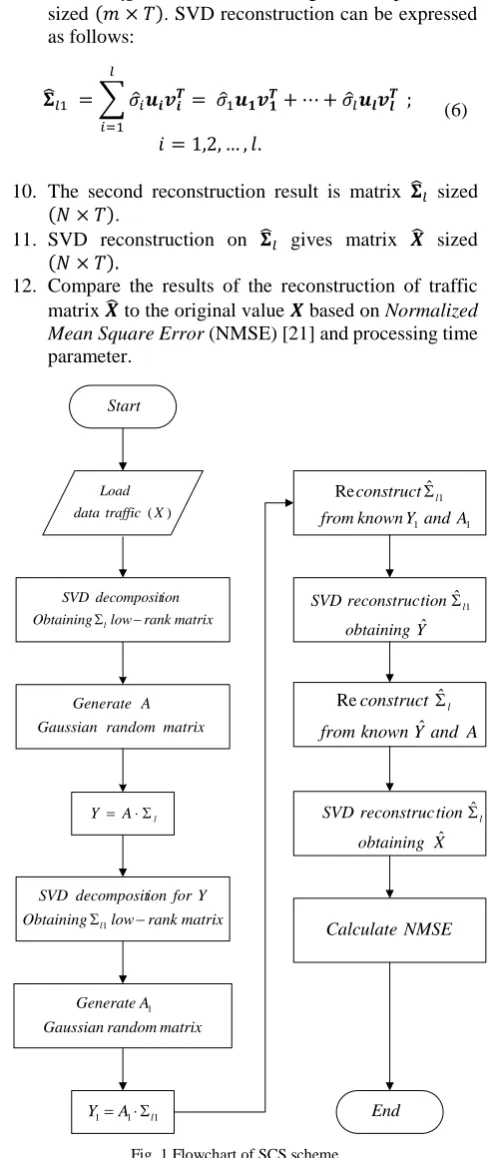
The CS processing is performed serially on the traffic matrix data. The SCS scheme flowchart is shown in Figure 1. The SCS steps are detailed below:
1. Internet traffic matrix, 𝑿𝜖ℝ𝑁×𝑇 is represented in the
matrix of size (𝑁 × 𝑇), where 𝑁 is the number of links from source to destination node and 𝑇 is the measurement time.
2. The Internet traffic matrix is not sparse. In this study, used SVD transformation to change the traffic matrix so that it becomes sparse. SVD defines the Internet
Andriyan Bayu Suksmono. Author was with School of Electrical and Informatics, Institut Teknologi Bandung, Indonesia. (e-mail: [email protected]).
Ian Joseph Matheus Edward. Author is with School of Electrical and Informatics, Institut Teknologi Bandung, Indonesia. (e-mail: [email protected]).
Comparing Serial and Parallel Compressive
Sensing for Internet Traffic Matrix
Indrarini Dyah Irawati,
Member, IAENG,
Andriyan Bayu Suksmono, and Ian Joseph Matheus Edward
traffic matrix X into three matrix, according to the following equation:
𝑿 = 𝑼𝚺𝑽𝑻, (1)
where 𝑼𝜖ℝ𝑁×𝑁and 𝑽𝜖ℝ𝑇×𝑇 express the orthogonal
matrix, with 𝚺𝜖ℝ𝑁×𝑇is a diagonal matrix that can
expressed as
𝚺 =
[
𝜎1 0 0 0 0
0 𝜎2 0 0 0
0 0 ⋱ 0 0
0 0 0 𝜎𝑟 0
0 0 0 0 0]
, (2)
Diagonal matrix 𝚺 consists of 𝚺𝒓𝜖ℝ𝑟×𝑟 and 0, where
𝚺𝒓= diag(𝜎1, 𝜎2, … , 𝜎𝑟) that arranged in descending
form 𝜎1≥ 𝜎2≥ ⋯ ≥ 𝜎𝑟> 0. This values is known
as singular value of 𝑿. The matrix sparsity is shown from the minimal use of the singular value expressed in rank 𝑿, where rank 𝑟 ≤ min(𝑁, 𝑇).
The singular matrix Σ𝑙 has rank-𝑙, where 𝑙 < 𝑟,
expressed as a low-rank singular matrix. The approximation of a matrix with rank-𝑙 yields a matrix 𝑩𝒍 approaching 𝑿 in the Euclidean (or Frobenius)
norm. The minimum matrix distance ‖𝑿 − 𝐁𝒍‖ is the
solution for obtaining the number of low-rank value with rank−𝑙. The term of minimum distance is expressed in the following equation [21]:
‖𝑿 − 𝑩𝒍‖2= √𝜎𝑙+12 + ⋯ + 𝜎𝑟2 (3)
The 𝑩𝒍 approach mathematically shown as follows:
𝑩𝒍= ∑ 𝜎𝑖𝒖𝒊𝒗𝒊𝑻= 𝜎1𝒖𝟏𝒗𝟏𝑻+ ⋯ + 𝜎𝑙𝒖𝒍𝒗𝒍𝑻 𝑙
𝑖=1
;
𝑖 = 1,2, … , 𝑙.
(4)
3. Measurement matrix, 𝑨, are generated from random Gaussian process that fulfills the Restricted Isometric Properties [2]. The size of 𝑨 is (𝑚 × 𝑁), where 𝑚 denotes the number of rows in 𝐴. The minimum number of row is defined as 𝑚 ≥ 𝑘 (𝑟 𝑙𝑜𝑔𝑛
𝑟), with
𝑘 is a constant 0 < 𝑘 ≤ 2, and 𝑟 is the rank of 𝑿 4. The CS can measured by the linear matrix equation:
𝒀 = 𝑨𝚺𝒍 (5)
The first CS yields 𝒀 sized (𝑚 × 𝑇).
5. The result of compression, 𝒀, is then decomposed back by SVD to produce low-rank singular matrik 𝚺𝑙1
sized (𝑚 × 𝑇).
6. The Gaussian random matrix is reproduced as a measurement matrix, 𝑨𝟏, sized (𝑚1× 𝑚)
7. The second CS process produces the compression result, 𝒀𝟏= 𝑨𝟏𝚺𝒍𝟏, 𝒀 sized (𝑚1× 𝑇).
8. In the reconstruction, we use OMP, and IRLS to obtain the first reconstruction result as a matrix 𝚺̂𝑙1
sized(𝑚 × 𝑇).
9. Matrik 𝚺̂𝑙1 is reconstructed using SVD to produce 𝒀̂
sized (𝑚 × 𝑇). SVD reconstruction can be expressed as follows:
𝚺̂𝑙1 = ∑ 𝜎̂𝑖𝒖𝒊𝒗𝒊𝑻= 𝜎̂1𝒖𝟏𝒗𝟏𝑻+ ⋯ + 𝜎̂𝑙𝒖𝒍𝒗𝒍𝑻 𝑙
𝑖=1
;
𝑖 = 1,2, … , 𝑙.
(6)
10. The second reconstruction result is matrix 𝚺̂𝑙 sized
(𝑁 × 𝑇).
11. SVD reconstruction on 𝚺̂𝑙 gives matrix 𝑿̂ sized
(𝑁 × 𝑇).
12. Compare the results of the reconstruction of traffic matrix𝑿̂ to the original value 𝑿 based on Normalized
Mean Square Error (NMSE) [21] and processing time
parameter. matrix rank low Obtaining ion decomposit SVD l matrix random Gaussian A Generate l A Y
matrix rank low Obtaining Y for ion decomposit SVD l 1 ) (X traffic data Load matrix random Gaussian A Generate 1 1 1
1 A l
Y
1 1 1 ˆ Re A and Y known from
constructl
[image:2.595.309.553.62.642.2]Y obtaining tion reconstruc SVD l ˆ ˆ 1 A and Y known from construct l ˆ ˆ Re X obtaining tion reconstruc SVD l ˆ ˆ Start End NMSE Calculate
Fig. 1 Flowchart of SCS scheme
B.Parallel CS (PCS)
PCS scheme flowchart shown in Fig.2. The PCS steps in detail described as follows:
1. The data input is a traffic matrix, 𝑿𝜖ℝ𝑁×𝑇 sized
(𝑁 × 𝑇)
2. SVD decomposition is done to obtain a low-rank singular traffic matrix, 𝚺𝒍, sized (𝑁 × 𝑇).
3. The process of segmentation on matrix 𝚺𝒍 corresponds
2, and 4. The segmentation performed on the rows of the matrix in order to obtain a smaller matrix size (𝑙
𝑑×
𝑙
𝑑). The result of a singular matrix segmentation
are matrix 𝚺𝑙(𝑖) with 𝑖 = 1, … , 𝑑.
4. Measurement matrix 𝑨, obtained from Gaussian random matrix. The size of matrix depends on the number of 𝑑-parallel. The dimension is (𝑚
𝑑×
𝑙
𝑑),
where 𝑚 denotes sampling rate.
5. CS processes are performed in parallel on each segment. The compression results are 𝒀(𝒊), … , 𝒀(𝒅) sized (𝑚
𝑑×
𝑙
𝑑).
6. In the reconstruction process is done in parallel for each compression result. The results are composed of 𝚺̂𝑙(1), … , 𝚺̂𝑙(𝑑), .
7. Construct 𝚺̂𝑙 which is composite of 𝚺̂𝑙(1), … , 𝚺̂𝑙(𝑑) in
the equivalent form:
𝚺̂𝑙= [ 𝚺 ̂𝑙(1)
⋮ 𝚺̂𝑙(𝑑)
] = [
𝜎̂1 0 0
0 ⋱ 0
0 0 𝜎̂𝑙
] (7)
8. SVD reconstruction of 𝚺̂𝑙 so that the 𝑿̂ is close to 𝑿.
9. Calculate NMSE(𝑿,𝑿̂) and processing time.
i ≤ d
) ( ) ( ) (iAili Y ) ( ) ( ) ( ˆ Re i A and i Y known from i constructl
d l of row row with from i
Arrange l l
() Y T Start ) (X traffic data Load matrix gular rank low obtaining ion decomposit SVD
l sin
} , 1 , , { l subparalle of number the d i of rows n Y of rows m parameter Set l ) ( , , i A obtaining d l of row column d m row matrix random Gaussian A Generate NMSE Calculate End Parallel CS th i as Y Put ) ( ˆ
ˆ from i
Constructl l
[image:3.595.65.413.52.731.2]X obtaining SVD by traffic construct ˆ , Re
Fig. 2 Flowchart of PCS scheme
III. EXPERIMENTAL RESULTS
We use Internet traffic data of the Abilene network [23]. Traffic data was taken on April 1st, 2004. Data are represented temporally as in the previous study [4] [24].
A.SCS and PCS
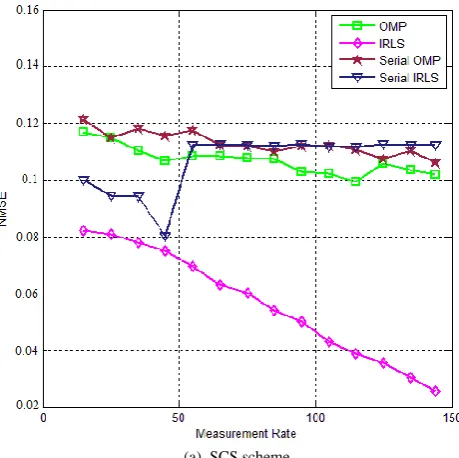
This experiment scenario used a full rank matrix 𝑿 sized (144 × 288). Fig. 3 shows the performance comparison of SCS and PCS schemes. The X-axis represents the measurement rate value and the Y-axis represents NMSE.
(a). SCS scheme
(b) PCS scheme
Fig. 3 Performance comparison between SCS and PCS scheme, (a). SCS scheme, (b). PCS scheme
[image:3.595.313.543.179.408.2]Fig. 3.(b) shows the comparison of NMSE values between Parallel CS and CS. NMSE results in the parallel scheme of the algorithm have NMSE values that are almost identical to the pure CS scheme. This is because the singular matrix in each parallel processing still has low-rank properties so that the compression results in each part can be restore to the original matrix. It encourages us to examine the application of subparallel schemes which is discussed in section B. Figure 3 explained that the parallel scheme has a lower NMSE value than the serial scheme
Table 1 Processing time comparison between SCS and PCS scheme
Reconstruction Algorithm
Serial CS (s) Paralel CS (s) CS (s)
OMP 0.40 0.08 0.21
IRLS 9.66 1.12 5.48
Table 1 shows the processing time for SCS, PCS, and CS scheme for different reconstruction algorithms. PCS schemes are faster than CS and SCS schemes. OMP algorithm is faster than IRLS.
B.The Effect of 𝑑-parallel Scheme
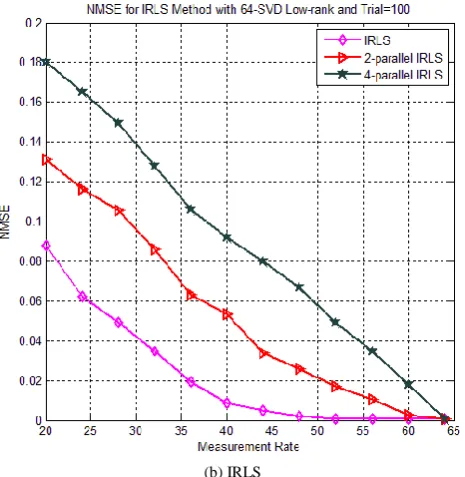
This study aims to see the effect of the number of CS parallel processes on the reconstruction results. In simulation, the number of 𝑑-parallel investigation is 2 and 4. The experiments use 𝑿-rank matrix of 64 with measurement rate starting from 20 − 𝑟 and the number of trials 100. Fig. 4 illustrates the effect of 𝑑-parallel on the performance of the reconstruction. The X-axis shows measurement rate, while Y-axis shows NMSE value.
(a) OMP
[image:4.595.310.543.53.292.2](b) IRLS
Fig. 4 The effect of 𝑑-paralel scheme, (a). OMP, (b). IRLS The simulation results show that IRLS algorithm gives better accuracy compared to OMP algorithm. The effect of 𝑑-parallel to the accuracy for the number of rank-64 indicates that there is no increase in accuracy, this is due to both the smaller low-rank matrix size and the segmentation process causes the smaller number of available samples. The more the number of 𝑑-parallel, the more its accuracy decreases.
[image:4.595.145.526.432.676.2](b) IRLS
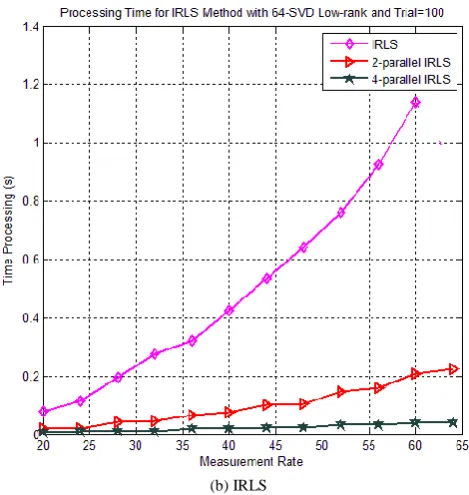
Fig. 5 Processing time of 𝑑-paralel scheme, (a). OMP, (b). IRLS The results of 𝑑-parallel test on IRLS show that the more 𝑑-parallel number, the computation time decreases, this is because the processed data is getting smaller. Sub-parallel increases the speed of processing time in IRLS. Whereas on OMP, the more the number of 𝑑-parallel, the processing time is increasing. This is because the result of singular matrix reconstruction produces many undefined values, so it is necessary to solve errors by means of linear interpolation on the singular value.
IV. CONCLUSION
In full rank traffic matrix, SCS scheme produces lower accuracy than CS method, while PCS has similar accuracy with original CS scheme. Subparallel CS can applied for Internet traffic data. The results show that on IRLS, the more the number of subparallels speeds up the processing time because the size of the data being processed are smaller. The results show that the smaller data of the traffic matrix, the less accurate the outcome of the reconstruction. While on OMP, the greater number of sub-parallel, the greater the computational time. This is due to the smoothing process recontruction imperfect results by performing linear interpolation. Further research will be focused on optimizing the reconstruction results on the SVD diagonal matrix for CS parallel.
ACKNOWLEDGMENT
The authors would like to say many thanks for LPPM ITB and Telkom Foundation of this research funding.
V. REFERENCES
[1] D. L. Donoho, "Compressed Sensing," IEEE Transaction Information Theory, vol. 52, no. 4, pp. 1289-1306, 2006.
[2] E. J. Candes, J. Romberg and T. Tao, "Robust uncertainty principles:Exact signal reconstruction from highly incomplete frequency information.," IEEE Transaction Information Theory, vol. 52, pp. 489-506, 2006.
[3] J. Chen, X. Qi and Y. Wang, "An Efficient Solution to Locate Sparsely Congested Links by Network Tomography," in IEEE International Conference on Communication (ICC), Sydney, 2014.
[4] I. D. Irawati, I. J. M. Edward and A. B. Suksmono, "Low-Rank Internet Traffic Matrix Estimation based on Compressive Sampling," Advanced Science Letters, vol. 23, no. 5, p. 3934–3938, 2017. [5] M. Roughan, Y. Zhang, W. Willinger and L. Qiu, "Spatio-Temporal
Compressive Sensing and Internet Traffic Matrices (Extended Version)," IEEE/ACM Transaction on Networking, vol. 20, no. 3, pp. 662-676, 2012.
[6] Y. C. Chen, L. Qiu, Y. Zhang, G. Xue and Z. Hu, "Robust Network Compressive Sensing," in Proceedings of the 20th annual international conference on Mobile computing and networking, 2014. [7] A. Lakhina; K. Papagiannaki; M. Crovella; C. Diot; E. Kolaczyk; N.
Taft, "Structural Analysis of Network Traffic Flows," in The Joint International Conference on Measurement and Modeling of Computer Systems, New York, 2004.
[8] J. Wang and M. Rabbat, "Wavelet-Based Traffic Matrix Modeling," in INFORMS Telecommunications Conference, Montreal, QC, 2010. [9] E. J. Candes and T. Tao, "Decoding by Linear Programming," IEEE
Transaction Inf., vol. 51, no. 12, pp. 4203-4215, 2005.
[10] E. J. Candes, J. Romberg and T. Tao, "Stable Signal Recovery from Incomplete and Inaccurate Measurements," Communications on pure and applied mathematics, vol. 59, no. 8, pp. 1207-1223, 2006. [11] S. Qaisar, R. M. Bilal, M. N. Wafa Iqbal and S. Lee, "Compressive
Sensing: From Theory to Applications, a Survey," Journal of Communications and Networks, vol. 15, no. 5, pp. 443-456, 2013. [12] Emmanuel J. Candes; Benjamin Recht, "Exact Matrix Completion via
Convex Optimization," The Journal of the Society for the Foundations of Computational Mathematics, vol. 9, pp. 717-772, 2009.
[13] E. Candes and J. Romberg, "l1-magic: Recovery of Sparse Signals via Convex Programming," available: http://www. acm. caltech. edu/l1magic/downloads/l1magic. pdf 4, 14., accessed at: october 13, 2015, 2005.
[14] J. A. Tropp, A. C. Gilbert, "Signal Recovery From Random Measurement Via Orthogonal Matching Pursuit," IEEE Transactions on Information Theory, vol. 53, no. 12, pp. 4655-4666, 2007. [15] R. Chartrand and W. Yin, "Iteratively reweighted algorithms for
compressive sampling," in IEEE International Conference on Acoustics, Speech and Signal Processing (ICASSP),, 2008. [16] H. Fang, S. A. Vorobyov and H. Jiang, "Permutation Enhanced
Parallel Reconstruction For Compressive Sampling," in IEEE 6th International Workshop on Computational Advances in Multi-Sensor Adaptive Processing (CAMSAP), Mexico, 2015.
[17] L. Daudet, "Audio Sparse Decompositions in Parallel," IEEE SIGNAL PROCESSING MAGAZINE , pp. 90-96, March 2010.
[18] Y. Zhang, G. Zhang, Y. Wang, Z. Zhu and W. Zhang, "Study on Parallel Compressed Sensing for Mass Data in Internet of Things," in Proceedings of The 2012 World Congress in Computer Science, Computer Engineering,, 2012.
[19] K. H. Jin, D. Lee and J. C. Ye, "A General Framework for Compressed Sensing and Parallel MRI Using Annihilating Filter Based Low-Rank Hankel Matrix," IEEE Transactions on Computational Imaging , vol. 2, no. 4, pp. 480 - 495, 2016.
[20] A. Kulkarni, H. Homayoun and T. Mohsenin, "A Parallel and Reconfigurable Architecture for Efficient OMP Compressive Sensing Reconstruction," in Great Lakes Symposium on VLSI, Texas, 2014. [21] S. J. Orfanidis, "SVD, PCA, KLT, CCA, and All That," Electrical &
Computer Engineering Department, Rutgers University, New Jersey, 2001.
[22] Z. Wang and A. C. Bovik, "Mean Squared Error: Love It or Leave It?," IEEE Signal Processing Magazine, pp. 98-117, 2009.
[23] -, "Network, The Abilene Research," http://abilene.Internet2.edu/.s., , Vols. accesed at: October 21,, 2015.
[24] I. D. Irawati, A. B. Suksmono and I. J. M. Edward, "Missing Internet Traffic Reconstruction using Compressive Sampling," International Journal of Communication Networks and Information Security (IJCNIS), vol. 9, no. 1, 2017.
[26] J. a. G. A. Tropp, "Signal Recovery from Random Measurement via Orthogonal Matching Pursuit," IEEE Transaction On Information Theory, vol. 53, no. 12, pp. 4655-4666, 2007.
[27] R. Chartrand and W. Yin, "Iteratively reweighted algorithms for compressive sampling," IEEE International Conference on Acoustics, Speech and Signal Processing (ICASSP),, p. 3869–3872, 2008.
Indrarini Dyah Irawati (M’17) received B.S. and M.S. degree in electrical
engineering from Sekolah Tinggi Teknologi Telkom (STTT), Bandung, Indonesia. She is a doctoral candidate in School of Electrical Engineering and Informatics, Institut Teknologi Bandung (ITB), Bandung, Indonesia. She joined as a Lecturer at Telkom Applied Science School, Telkom University, since 2007. She is currently a member of the Association for Computing Machinery (ACM). Her research interests are in the areas of computer network, signal processing, and compressive sensing.
Andriyan Bayu Suksmono (M'02–SM'08) received the B.S. degree in
physics and the M.S. degree in electrical engineering from Institut Teknologi Bandung (ITB), Indonesia, and the Ph.D. degree in engineering from the University of Tokyo, Japan, in 1990, 1996 and 2002, respectively. He joined ITB as an Instructor (1996–2005), Associate Professor (2005– 2009), and Professor (2009-present) at the School of Electrical Engineering and Informatics, ITB. His main research interests are compressive sensing, signal processing and imaging, and radar.
He is a Senior member of IEEE, and IEICE. He received the 2013 Multimedia Information Technology and Applications Best Paper Award from Korea Multimedia Society (KMMS), the 2014 Best Presenter Award from Republic of Indonesia Ministry of Research, Technology and Higher Education.
Ian Joseph Matheus Edward received the B.S. degree and the M.S. degree
in electrical engineering from Institut Teknologi Bandung (ITB), Indonesia, and Ph.D. degree in telecommunication management from Universitas Indonesia (UI), in 1992, 1996, and 2007, respectively.