For Peer Review Only
DACURA: A NEW SOLUTION TO DATA HARVESTING AND KNOWLEDGE EXTRACTION FOR THE HISTORICAL SCIENCES
Journal: Historical Methods: A Journal of Quantitative and Interdisciplinary History Manuscript ID VHIM-2017-0034.R2
Manuscript Type: Original Article
Keywords: data harvesting, RDF triplestore, database ontology, database metamodels, data curation
For Peer Review Only
DACURA: A NEW SOLUTION TO DATA HARVESTING AND
KNOWLEDGE EXTRACTION FOR THE HISTORICAL SCIENCES
Peter N. Peregrine, Lawrence University, 711 E. Boldt Way, Appleton WI 54911
and Santa Fe Institute, 1399 Hyde Park Road, Santa Fe NM, 87501
Rob Brennan, ADAPT & Knowledge and Data Engineering Group, School of
Computer Science and Statistics, Trinity College Dublin, Ireland
Thomas Currie, Department of Biosciences, University of Exeter—Penryn
Campus, Cornwall, TR10 9FE, UK ([email protected])
Kevin Feeney, Knowledge and Data Engineering Group, School of Computer
Science and Statistics, Trinity College Dublin, Ireland
Pieter François, School of Humanities, De Havilland Campus, University of
Hertfordshire, Hatfield, AL10 9EU, UK and Institute of Cognitive and
Evolutionary Anthropology, Oxford University, Oxford OX4 1QH, UK
Peter Turchin, Department of Ecology and Evolutionary Biology, University of
Connecticut, 75 N. Eagleville Road, Storrs, CT 06269-3042
For Peer Review Only
Harvey Whitehouse, Institute of Cognitive and Evolutionary Anthropology,
Oxford University, Oxford OX4 1QH, UK.
†
Corresponding author
For Peer Review Only
ABSTRACTNew advances in computer science address problems historical scientists face in
gathering and evaluating the now vast data sources available through the Internet.
As an example we introduce Dacura, a dataset curation platform designed to assist
historical researchers in harvesting, evaluating, and curating high-quality
information sets from the Internet and other sources. Dacura uses semantic
knowledge graph technology to represent data as complex, inter-related
knowledge allowing rapid search and retrieval of highly specific data without the
need of a lookup table. Dacura automates the generation of tools to help
non-experts curate high quality knowledge bases over time and to integrate data from
multiple sources into its curated knowledge model. Together these features allow
rapid harvesting and automated evaluation of Internet resources. We provide an
example of Dacura in practice as the software employed to populate and manage
the Seshat databank.
KEYWORDS
data harvesting; RDF triplestore; database ontology; database metamodels; data
curation
For Peer Review Only
Current developments in computer science provide new ways of
harvesting, storing, and retrieving data from the Internet that have the potential to
transform how literature reviews and data harvesting are undertaken in the
historical sciences. Dacura is a data curation platform that uniquely reflects three
of these developments: (1) a data-model based on a knowledge graph (as opposed
to the standard column and row data structure), (2) the use of Web Ontology
Language (OWL) for data definition, and (3) an automated process based on
sematic reasoning for weeding out the thousands of on-line and database hits not
directly related to a problem of interest and/or of dubious accuracy. Dacura was
built in tandem with the Seshat databank, which is being constructed to coordinate
quantitative historical and archaeological data to statistically test models of
historical dynamics (Turchin et al. 2015). We introduce both Dacura and Seshat
here as concrete examples of how the advances in computer science noted above
might be employed by historical researchers.
We begin with the basic problem the Dacura data curation platform is
intended to address: the overabundance of unevaluated information available to
researchers. As an example, consider a researcher who wants to gather
quantitative data to answer a specific question, let’s say whether population
increased on island of Hawaii prior to the emergence of states ca. 1500 CE, as
would be predicted by a simple population-pressure model (e.g. Diamond 1997,
284-292). If she were to simply type “ancient Hawaii population” into Google,
she would obtain nearly 250,000 results (some discussing modern demographics)
with no easy way of knowing which of the many thousands of results on ancient
For Peer Review Only
Hawaii would provide the information she needs, nor which of them would
provide reliable information (the Wikipedia page on “Ancient Hawaiian
Population”, for example, provides only high estimates and apparently from only
one source; the inability to clearly identify the source of the data is itself a serious
problem). If this researcher were to use Google Scholar instead, the results would
be fewer (around 165,000), and although she could expect somewhat better
quality, there would remain the daunting task of identifying papers and books
directly relevant to her interests. Even JSTOR, with quality-ensured content,
would proffer around 60,000 articles to churn through.
The example above illustrates a central problem in contemporary
historical research: the Internet and open-access publishing provide researchers
abundant information on virtually any topic of interest, but there is no quality
assurance, and even where quality can be assumed (as in peer-reviewed
open-access publications), the amount of information is often overwhelming. What is
needed is a tool that allows a researcher to build a dataset containing high-quality
structured information which provides specific pieces of information needed to
answer such questions. Such a search tool requires a carefully designed
hierarchical structure (ontology) to allow a scholar to easily dig down through
results to those that are directly relevant to his or her research. This search tool
also requires detailed indexing across result domains so that a search for Hawaii
population estimates, as our hypothetical researcher might perform, not only
recovers all information on Hawaii population estimates but does not also retrieve
unrelated information on other demographics or other locations. In short, such a
For Peer Review Only
search tool must be able to apply an integrated thesaurus or set of thesauri as part
of the basic search routine.
There are quite a few extant search tools that provide this functionality:
rapid retrieval of specific, quality information across domains. Considering only
archaeological search tools (the first author is an archaeologist), a good example
is eHRAF (Human Relations Area Files; hraf.yale.edu) which provides two
archives of documents (ethnographic and archaeological, respectively) organized
using detailed ontologies (the Outline of World Cultures and Outline of
Archaeological Traditions) and employing a rich thesaurus (the Outline of
Cultural Materials). Individual paragraphs from nearly three-quarters of a
million pages of archaeological and ethnographic primary and secondary source
documents are indexed in eHRAF and can be easily searched and retrieved at
varying levels of detail using hierarchical and Boolean search strategies. The
results are specific, of excellent quality and specificity, and manageable in
number. However, the range of results is limited to the documents that have been
included in the eHRAF archives. The reason eHRAF provides such excellent
information retrieval is that the information has been extensively pre-processed to
the extent that every document has been individually placed into the ontology and
every paragraph in every document individually indexed by Ph.D.-holding
anthropologists. In short, a huge amount of work is required to make search and
retrieval of high-quality data easy, and that means the data provided by eHRAF
grows slowly and eHRAF must charge a user fee.
For Peer Review Only
An alternative model of a search tool providing rapid retrieval of specific,
high-quality information across domains is tDAR (the Digital Archaeological
Record; www.tdar.org). Like eHRAF, entire documents (including raw datasets,
shapefiles, and the like) are available through tDAR, and are organized within a
basic ontology. Unlike eHRAF, these documents are not processed by tDAR staff
(although there is review of the processing to ensure it has been done correctly),
but rather the individuals who submit documents complete a metadata form which
is attached to the document (Watts 2011). This allows the number of documents
in tDAR to increase relatively rapidly, and also allows free retrieval of
information from tDAR (there are modest fees for contributing documents).
However, because contributors provide the ontological and indexing information
themselves, the level of detail and accuracy vary, meaning that searches may not
retrieve all relevant documents. And, like eHRAF, the available information is
limited to the documents within the database.
Open Context (www.opencontext.org) is another excellent data repository
that is similar to tDAR, but which provides several additional features that expand
its range beyond archaeological data. Like tDAR, archaeological data are
contributed for a modest fee. Unlike tDAR, Open Source editors work with
contributors to create the metadata and clean the data sources for publication on
the web, and the data sources themselves are evaluated for their importance; that
is, not all data sources are published, but only those that peer reviewers think will
be of use to the broader field. Once incorporated into Open Context, data sources
are linked to related data sources on the web by Linked Data standards (Kansa
For Peer Review Only
2010). This allows Open Context to expand beyond the archived data,
overcoming a limitation of both eHRAF and tDAR while providing an assurance
of data quality for those data contributed directly to Open Context, though not to
linked data, which we see as a serious limitation.
We present here what we argue is a more comprehensive approach to the
problem of retrieving specific, high-quality information across domains than the
three outlined above (and there are many other excellent programs and data
repositories we could have cited)—a set of data harvesting, evaluation, assembly,
and output processes that has been implemented in Dacura (dacura.cs.tcd.ie) and
which itself is being employed as the managing software for the Seshat databank
(seshatdatabank.info) which we introduce below. By being developed and
implemented in tandem with a data-heavy research initiative, Dacura has
benefitted from the ongoing identification of problems and shortcomings that
gathering and managing large and complex historical data entail, and thus serves
as a good example of a resource that would be of use to academic researchers.
Knowledge graph technology is increasingly being used by companies
such as Google (N.d.) and Facebook (N.d.) to manage and structure the vast and
diverse sources of information they curate. Traditional SQL storage solutions
based on tables and rows are insufficiently expressive to capture the structure or
semantics of the information that they manage and the complexity of the
relationships between things. However, to date, knowledge graph technology
remains very technical and difficult to use except by very large and technically
savvy corporations. Dacura’s design goal is to help make knowledge graph
For Peer Review Only
technology available to researchers in such a way that it does not require
tremendous expertise to use. Dacura achieves this by automating much of the
software required to harvest and curate data from the semantic model, providing
users with easy to use tools and interfaces which do not require them to
understand the underlying technology.
We do not intend this article to be simply an advertisement for Dacura, but
rather we use Dacura to illustrate an approach to harvesting, evaluating, and
retrieving data from the Internet or any “big data” source that has been made
possible by new advances in computer science and that we believe will have
profound impact on the historical sciences.
DACURA
Dacura is a data curation platform designed to assist historical researchers
in creating and curating high-quality datasets in the form of rich semantic
knowledge graphs [Endnote 1]. The basic idea is simple—the researcher starts by
defining the structure of the data that they would like to collect. The system uses
this information to support the user in discovering, harvesting, filtering, correcting,
refining and analyzing information from the Internet in order to compile the
highest quality information possible. The details provided by the researcher
include basic information such as the definition of the fundamental entities of
interest (e.g. Hawaii), the properties of those entities in which she or he is
interested (e.g. population estimates), the datatypes and desired units of each
For Peer Review Only
property (e.g. numeric), and relationships with other entities both within and
beyond the dataset itself (e.g. Hawaii is in Polynesia).
The process of defining the structure of the desired data is one of the
strengths of this approach. All historical scientists know that data must be
property questioned before they can speak. Because Dacura requires the precise
shape of the desired data to be specified before performing a search, Dacura
encourages researchers to think carefully about the nature of the desired data and
the means by which they will be questioned before starting to collect those data.
Such preparation before data collection saves time and effort in what is often the
most difficult task in historical research—identifying useful information sources.
Dacura’s simple and user friendly interface (discussed below) makes the process
of data definition easy, and, because Dacura provides a flexible search structure,
this process can be iterative, changing as data are interrogated and as questions
become more focused.
Dacura encodes the structure of the dataset defined by the researcher as a
semantic web ontology according to the Web Ontology Language (OWL)
standard of the World Wide Web Consortium (W3C), the main international
standards body for the web. OWL is a rich and flexible language which allows a
wide variety of constraints and inference rules to be specified on the data to be
collected (e.g. the population of a town should not be greater than the population
of the region that it is in). In contrast with the unstructured natural language
strings that drive most search engine results, the highly structured and precisely
specified nature of ontological dataset specifications can be exploited by the
For Peer Review Only
computer to provide much greater specificity in results. The richer the structural
specification, the easier it is for the system to automate the harvesting of data and
the generation of useful tools with which to analyze, improve and curate it over
time.
Dacura is based on semantic web technology. At its core is a Resource
Description Framework (RDF) triplestore, a specific form of graph database (as
opposed to a two-dimensional column and row database used in most
spreadsheets) in which data are identified by a subject-predicate-object
combination like “Hawaii is Polynesia”, “Hawaii has Island”, or “Polynesia has
Island” (www.w3.org/TR/rdf11-concepts/). The subject-predicate-object
structure can be understood as nodes-edges-properties within a three-dimensional
graph which represents and stores data. The graphic structure of an RDF
triplestore allows for index-free adjacency, meaning every
subject-predicate-object triple directly links to related subject-predicate-subject-predicate-object triples so that no
index lookups are necessary. In the example above, Polynesia, Hawaii, and Island
are all linked so that no indexed search is required to identify Hawaii as a
Polynesian Island.
OWL ontologies are used in Dacura to enable semantic reasoning in
quality control and data harvesting; that is, if there are conflicts between triples
Dacura identifies and marks them as conflicts for further evaluation (see
dacura.scss.tcd.ie/ontologies/dacura-130317.ttl). Dacura is designed to produce
and consume data in line with the linked open data principles. This makes it easy
to import information from existing structured information sources and to enrich
For Peer Review Only
curated datasets by interlinking them with publicly available Linked Data sources
(e.g. DBpedia or wikidata, the linked data versions of Wikipedia) and datasets
curated by Dacura can similarly be easily linked. A video example of Dacura’s
operation is provided at https://youtu.be/AEb1wF3jAgk. A key aspect of Dacura
is that harvested data, including those harvested through Linked Data, are
evaluated for quality through both automated and human evaluators as part of the
system’s workflow. Thus Dacura not only harvests data quickly and easily, it also
evaluates it for quality.
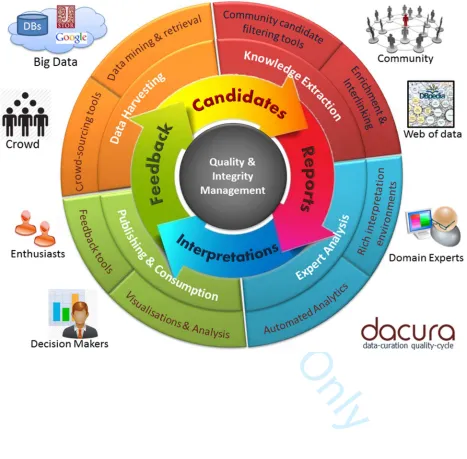
The Dacura workflow breaks the process of data creation and curation
down into 4 stages, as illustrated in Figure 1. The first stage is data harvesting:
identifying sources of high-quality information with which to populate the dataset.
Dacura supports a number of approaches to data harvesting: from identifying
relevant data in known public data sources, to deploying automated agents to
search the Internet, to manual specification of information sources by researchers.
The goal of the system is to automate, as much as possible, the identification of
the sources of information that will be needed in order to populate the dataset. In
this stage, the goal is not to find documents about the entities in which one is
interested, but to find specific sources of information which can populate the
properties and relationships that a researcher has defined in their data
specification.
[Figure 1 about here]
The second stage in the Dacura data creation and curation process is
knowledge extraction. This involves extracting the precise information from
For Peer Review Only
harvested sources into the structure required by the researcher’s data specification.
Although Natural Language Processing and other artificial intelligence
technologies continue to improve all the time, they remain error prone and thus, in
order to ensure high quality data, some human input is normally required to filter
out false positives. Dacura employs tools to support both human users and
automated agents in screening, filtering, improving, annotating and interlinking
candidate records to produce knowledge reports; that is, authoritative accounts of
the relevant knowledge contained in a source, enriched through links into the web
of data.
The third stage in the Dacura process is perhaps the most important for
ensuring data quality: expert analysis. One of Dacura’s strengths is its focus on
data quality, providing both automated and manual tools to ensure that harvesting
captures accurate and complete information that conforms to the researcher’s data
specifications. Initial data evaluation is performed through automated tools,
which use semantic consistency checking and validity testing to reconcile various
data points into a composite account that represent the tools’ best estimate of
authoritative data which accurately represents reality. These composite accounts
are reviewed by experts in the data domain (like our hypothetical researcher
interested in Hawaii population estimates), allowing the expert to correct
misinterpretations and identify disagreements between the expert and the
automated tools. Experts can create their own personal interpretations (for
example, by specifying that only particular sources should be trusted) and overlay
For Peer Review Only
this on the dataset to produce a custom dataset, representing their view on what
the data should be.
In the case of Seshat experts are solicited by the Seshat management team
based on their publication record in the area(s) they are asked to review. All have
Ph.D.s in their field and the vast majority have academic appointments. Experts
are periodically evaluated to identify individuals whose input appears inconsistent
with harvested data on a regular basis. One might be concerned that developing a
pool of experts by solicitation might not be effective, but the quality of those
currently volunteering can be seen in the list at
http://seshatdatabank.info/seshat-about-us/contributor-database/. The number (77 at the time of this writing) and
range of expertise of these volunteers illustrates that it is quite feasible to
incorporate expert evaluation into a data harvesting system like Dacura. Most
projects employing systems like Dacura will not likely be as large in scope as
Seshat, and only one expert may be required to evaluate the data—perhaps only
the researcher herself.
Finally, Dacura supports a variety of output tools to make data available to
third parties in a range of formats. Dacura publishes its curated data as Linked
Data so other users and platforms (such as Open Context, discussed above) can
readily access it. Dacura also provides a SPARQL endpoint—a query language
for RDF graphs—which supports sophisticated filtering and retrieval of data.
This allows intelligent applications to interact with the data in unforeseen ways.
For human users, Dacura can produce graphs, charts, maps and other
visualizations to provide users with easy-to-understand insights into the data.
For Peer Review Only
Data for graphs or other outputs can be browsed, searched, and selected providing
users with the ability to access the sections of datasets they find most useful.
Dacura also allows datasets or subsets of them to be exported in a wide range of
formats for external analysis, including geographic information systems and
statistical packages such as SPSS and R.
IMPLEMENTING DACURA: THE SESHAT META-MODEL
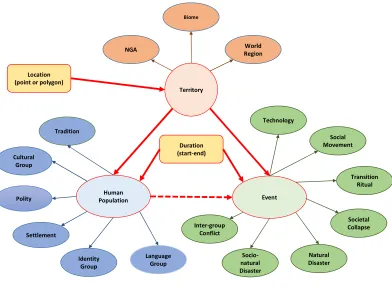
As an example of how Dacura works in practice, Figure 2 shows the meta-model
being used to implement Seshat: Global Historical Databank (Turchin et al. 2015,
Francois et al., 2016; see also dacura.scss.tcd.ie/ontologies/seshat-130317.ttl).
Seshat (seshatdatabank.info) was designed to bring together into one place a
comprehensive body of knowledge about human history and prehistory for the
purpose of empirically testing hypotheses about cultural evolution, including the
possible role of religion, ritual, warfare, agriculture and other clusters of variables
in the rise of social complexity. To date Seshat has been used to identify a single
dimension of complexity that explains about three-quarters of the variation in
human social organization (Turchin et al. 2018) and has also been used to
demonstrate that the hypothesized socio-political transformations of the Axial
Age took place at varied times across Eurasia, encompassing more than a
millennium (Mullins et al. 2018). Exploring such large-scale questions with
appropriate statistical techniques requires data that are both valid and reliable; that
For Peer Review Only
is, data that define what the researcher thinks they define and that are measured in
the same manner across cases.
Dacura, also under development when Seshat was being planned, seemed
an excellent platform for Seshat. The two groups of researchers decided to
develop Dacura and Seshat in tandem, so that both would inform the other.
Because computer scientists and historical scientists do not regularly work
together, the cooperation between the Dacura and Seshat research teams proved
extremely fruitful, allowing the Dacura team to understand the needs of historical
scientists, and the Seshat team to understand both the possibilities and limitations
of triplestore data harvesting and curation.
[Figure 2 about here]
There are two fundamental pieces of information upon which Seshat cases
are based: a Location and a Duration. A location is a point or polygon anywhere
on the earth’s surface, and defines an entity called a Territory. Three entity
classes of Territory have been defined in Seshat (more may be defined later as
Seshat expands):
(1) Natural-Geographic Areas (NGA), which are a contiguous area roughly
100 by 100 kilometers encompassing a reasonably homogenous ecological
region.
(2) Biomes, which encompass a contiguous biotic region or region of similar
climatic conditions.
(3) World Regions, which may be pre-defined entities such as nations or states,
or can be defined by other specific criteria.
For Peer Review Only
A Duration can be a single date or a date range. Adding a Duration to a Territory
entity class defines one of two temporally bounded entities: (1) a Human
Population, which is group of humans in a defined territory during a specified
period of time; and (2) an Event, defined as an occurrence taking place in a
specific territory in a specific period of time.
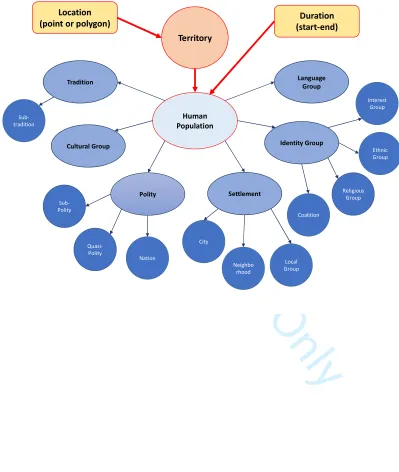
Seshat provides the ability to create entity classes within Human
Populations and Events for specific research questions. Within the Human
Population entity, current entity classes are:
(1) Tradition, which is defined as a human population “sharing similar
subsistence practices, technology, and forms of socio-political
organization that are spatially contiguous over a relatively large area and
which endure temporally for a relatively long period of time” (Peregrine
and Ember, 2001, ix). For this entity class there is a formal sampling
universe for selecting cases, the Outline of Archaeological Traditions
(hereafter OAT)
(hraf.yale.edu/online-databases/ehraf-archaeology/outline-of-archaeological-traditions-oat/) and a formal
thesaurus for coding data, the Outline of Cultural Materials (hereafter
OCM)
(hraf.yale.edu/online-databases/ehraf-world-cultures/outline-of-cultural-materials/).
(2) Cultural Group, which is a human population sharing norms, beliefs,
behaviors, values, attitudes, etc. The primary sampling universe for this
entity class is the Outline of World Cultures (hereafter OWC)(Murdock,
1983) and the thesaurus is the OCM.
For Peer Review Only
(3) Polity, which is a human population that is a politically independent unit
with a shared system of governance. This is an example of an entity class
created for a specific research project. The sample consists of 30 cases
selected for characteristics of sociopolitical organization and geographic
location (Turchin et al., 2015). The primary thesaurus for this entity class
is the OCM.
(4) Settlement, is a human population in a physical location and material
facilities ranging in size and complexity from a temporary camp to a great
metropolis. Because of the great range of settlements that could be coded,
there is no defined sampling universe for the entity class. The primary
thesaurus is again the OCM.
(5) Identity Group, which is a human population with a shared sense of being
part of the same group. Like Polity, this entity class was created for a
specific set of research projects and the sample is opportunistic (see
Whitehouse, Francois, and Turchin, 2015). There is no formal thesaurus,
though the OCM is used for some domains.
(6) Linguistic Group, which is a human population with a common language.
The sampling universe for this entity class is Ethnologue
(www.ethnologue.com), but there is no formal thesaurus (again, the OCM
is being used for some domains).
In addition, subclasses can be added to entity classes to provide for more specific
sets of data. Figure 3 shows entity subclasses that have been created for the
current entity classes listed above.
For Peer Review Only
[Figure 3 about here]
The Event entity obviously encompasses an almost infinite range of
possible entity classes and subclasses. To maintain some order the event class in
DBpedia is used (mappings.dbpedia.org/server/ontology/classes/) as a basic
ontology. As shown in Figure 2, the current entity classes for the Event entity
include:
(1) Inter-group Conflict, such as a war, a battle, a feud, or the like.
(2) Socio-Natural Disaster, such as a famine, or epidemic.
(3) Natural Disaster, such as a drought, a flood, an infestation, a volcanic
eruption, etc.
(4) Societal Collapse
(5) Transition Ritual, such as a marriage, a coronation, or an initiation.
(6) Social Movement, including physical movements like migration, but also
social movements such as revitalization, millenarianism, strikes, etc.
(7) Technological, such as inventions, discoveries, innovations, and the like.
Populating Seshat: The Dacura Workflow Model
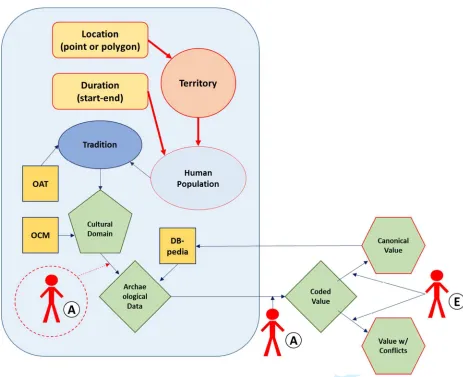
As an example of how an historical scientist might employ Dacura to populate a
dataset, Figure 4 illustrates how data for the Tradition entity class is incorporated
into the Seshat databank through Dacura. The area in the blue rectangle can be
entirely automated, while the area outside the blue rectangle requires automated
analysis and experts to ensure the Seshat data are valid and reliable. Starting at
For Peer Review Only
within a Territory. The characteristics of the Human Population entity are then
classified through the OAT thesaurus to define a Tradition entity class. Data
mining begins by automated searching of the Internet for Cultural Domain
information as classified through the OCM thesaurus. At this point a researcher
can also have Dacura search for Cultural Domain information through both
Internet and print sources. Dacura compares information on a specific Cultural
Domain, identified in Figure 4 as Archaeological Data, with values in DBpedia to
determine if linked values should be included from other sources, and then
evaluated by an automated analyst for consistency. Inconsistent data (data with
sematic or value conflicts) are output to the researcher or an expert on the Cultural
Group or Cultural Domain for evaluation. The researcher or expert either decides
upon a canonical value for the Cultural Domain or, if there are conflicts that
cannot be resolved, a non-canonical value is given. Regardless, all the harvested
values are included in Seshat and marked as either canonical or non-canonical so
that other researchers can return to those values and revise or augment their
interpretation. Canonical values are also exported to DBpedia to assist other
researchers and future searches.
[Figure 4 about here]
Researchers may also input their own data, including images, media, and
shapefiles. Incorporating new data allows other researchers to access it through
Linked Data, making it widely available. Perhaps more importantly, data
incorporated into Seshat or other Dacura-generated dataset can be continuously
improved as Dacura allows researchers to comment on and re-evaluate previously
For Peer Review Only
incorporated data. We suggest this allows Dacura to not only create and curate
large datasets, but also to ensure the continuous improvement of data quality.
Using Seshat: Outputs from Dacura
Our researcher interested in Hawaii population estimates would be able to quickly
identify accurate and fully referenced estimates through Seshat (or her own
Dacura-generated dataset). She would open Seshat through Dacura (a mock-up is
provided at http://dacura.scss.tcd.ie/seshat/) [Endnote 2], select the
Natural-Geographic Area for Hawaii, select the Polity sub-class of the Human Population
inhabiting Hawaii for the time period of interest, and then select the population
variable. A video illustrating this procedure is available at
https://youtu.be/tZNcQNq2Mp0. The data on population she would obtain in this
case would be taken from the Seshat data repository created with Dacura through
the data harvesting and verification process described above. But our researcher
could also create a new ontology using Dacura to conduct her own unique search,
as discussed above and illustrated in the video mentioned earlier at
https://youtu.be/AEb1wF3jAgk.
Our researcher would have a wide range of possible outputs from her
search, whether in Seshat or with data she employed Dacura to harvest from other
sources. As noted earlier, Dacura publishes datasets as Linked Data and employs
SPARQL for output. SPARQL is a query language for RDF graphs which can
produce documents and raw data sets but also graphs, charts, maps and other
For Peer Review Only
visualizations. Important for historical researchers, SPARQL works with
GeoSPARQL to allow data integration into geographic information system using
well-understood OGC query standards (GML, WKT, etc.). Raw textual, media,
or numeric data produced through Dacura can be browsed, searched, and selected,
allowing our researcher the ability to access the sections of texts, images, media,
or datasets she finds most useful. Dacura also allows harvested or input material
(or subsets of them) to be exported in a wide range of formats for external
analysis. For example our researcher might want numerical data on population
estimates as output for statistical analysis. Dacura would produce a
comma-delimited file that could be ported directly into a spreadsheet or statistical package
and our researcher could then run any analysis she required to answer her
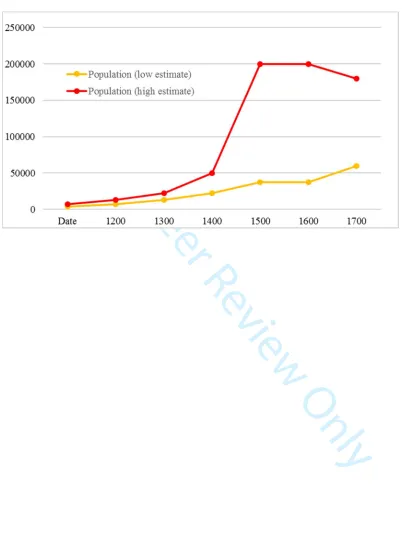
question. Figure 5 shows a simple line graph of Hawaii population estimates
derived through Dacura and Seshat with data output to a csv file and graphed
using an Excel spreadsheet.
The answer to the researcher’s initial question would be that population
indeed increased prior to the first state system on the island of Hawaii, as
expected under the population-pressure model. This is not a particularly
impressive result in itself (and would in fact be quite simplistic—see Field,
Ladefoged, and Kirch, 2011), but consider that our researcher would have been
able to compile these data in a matter of minutes, be confident of their quality,
and have access to all the metadata attached to them.
[Figure 5 about here]
For Peer Review Only
CONCLUSIONSThe Internet provides historical scientists abundant information, but often
the information is too abundant, and usually lacks quality control. Dacura was
designed to address these problems. It provides a way to harvest information
from the Internet easily, with an assurance of quality, and with a manageable
body of results. Dacura’s carefully designed ontology
(dacura.scss.tcd.ie/ontologies/dacura-130317.ttl) allows researchers to readily
identify and retrieve information directly relevant to their research. Dacura’s
integrated thesauri and RDF triplestore structure removes the need for detailed
indexing across result domains so that all information on a given subject, even
information that might not be obviously related or indexed as related, is retrieved.
And Dacura offers a wide range of possible outputs, from texts to visualizations to
spreadsheets. Dacura is not the only data harvesting and curation package
available, but because it has been developed hand-in-hand with the Seshat
databank, it provides a unique model for new computer-based methods of
historical and archaeological data handling.
In this way, Dacura represents a set of important new tools for the
historical sciences. As Kintigh et al. (2015, 3) have recently pointed out
“[historians and] archaeologists are increasingly challenged as they acquire,
manage, and analyze large volumes of disparate data.” Dacura illustrates several
responses to this problem. Specifically, Dacura incorporates (1) a semantic
knowledge graph technology based on an RDF triplestore, (2) the use of Web
For Peer Review Only
Ontology Language (OWL) for data definition, (3) semantic reasoning as the
foundation of an automated process for data evaluation, and (4) output following
Linked Data standards.
OWL data definition and knowledge graph technology allow the
enormous volume of data available to historical researchers to be quickly and
easily reduced to the most important information on a given question, and then
output in a variety of useful formats. Semantic reasoning provides mechanisms
for rapid data evaluation and ongoing curation. And Linked Data standards allow
other researchers to readily access data that has already been harvested and
evaluated.
In addition, the recent advances in computer science available in platforms
like Dacura offer a way to provide useful and accurate historical data to scholars
who are not historical scientists. It has long been a frustration among historical
researchers that data which can provide both a diachronic record of cultural
stability and change and empirical examples of practices that have been
successful or unsuccessful in human societies, has not been widely used outside
of archaeology and history. But it is also not surprising, as historical data can be
hard to access and hard to understand by non-professionals (Kintigh et al. 2015,
2). By providing an automated means of harvesting, evaluating, and exporting
historical data that has been evaluated for accuracy, platforms like Dacura offer
both a means and a model for economists, political scientists, ecologists,
geographers, and others to access and explore the rich and valuable record of
human history.
For Peer Review Only
ACKNOWLEDGEMENTSThis work was supported by a John Templeton Foundation grant to the Evolution
Institute, entitled "Axial-Age Religions and the Z-Curve of Human
Egalitarianism," a Tricoastal Foundation grant to the Evolution Institute, entitled
"The Deep Roots of the Modern World: The Cultural Evolution of Economic
Growth and Political Stability," an ESRC Large Grant to the University of Oxford,
entitled "Ritual, Community, and Conflict" (REF RES-060-25-0085), a grant
from the European Union Horizon 2020 research and innovation program (grant
agreement No 644055 [ALIGNED, www.aligned-project.eu]), and an European
Research Council Advanced Grant to the University of Oxford, entitled “Ritual
Modes: Divergent modes of ritual, social cohesion, prosociality, and conflict.”
The authors wish to thank the participants of a workshop held at the Santa Fe
Institute May 4-6, 2015 during which the needs for harvesting and integrating
quality information was discussed and the Seshat meta-model developed. We
gratefully acknowledge the contributions of our team of research assistants,
post-doctoral researchers, consultants, and experts. Additionally, we have received
invaluable assistance from our collaborators. Please see the Seshat website
(www.seshatdatabank.info) for a comprehensive list of private donors, partners,
experts, and consultants and their respective areas of expertise. Finally, we want
to thank the anonymous reviewers whose insightful comments allowed us to
substantially improve this paper.
For Peer Review Only
ENDNOTES1. The Dacura software was developed as part of the European ALIGNED
Horizon 2020 project. All of the software, as well as other useful tools for
managing semantic datasets and knowledge graphs, is available with an open
source license through the project’s web site at
http://aligned-project.eu/open-source-tools/. However, this still requires users to configure and install their own
knowledge-graph server, which remains a complex undertaking. It is our goal to
also make the system available to researchers through the web as service in such a
way that no technical knowledge is required to use it. We anticipate releasing a
pilot version of this service in the middle of 2018. In the meantime, for any
researchers who are particularly interested in seeing and using the web service,
we are running an ongoing series of trials with Seshat and other collaborators and
are open to new research collaborations. For updates check the Dacura website at
http://dacura.cs.tcd.ie/ or by email at [email protected].
2. The version of Dacura shown on the site is a mock-up that lacks full
functionality and is intended solely to give readers a sense of what the Dacura
interface and output might look like when installed on their institutional computer.
This version searches only within a portion of the Seshat databank and only
returns simple html output. As discussed in the article, the fully-functional
version of Dacura does much more than the mock-up provided here.
For Peer Review Only
REFERENCES CITEDDiamond, J. 1997. Guns, germs, and steel. New York: W.W. Norton.
Facebook, N.d. Introducing graph. https://www.facebook.com/graphsearcher/.
Accessed 1/3/2018.
Field, J. S., T. Ladefoged, and P. Kirch. 2011. Household expansion linked to
agricultural intensification during emergence of Hawaiian archaic states. PNAS,
108(18), 7327-7332.
François, P., J. Manning, H. Whitehouse, R. Brennan, et al. 2016. A macroscope
for global history: Seshat Global History Databank. Digital Humanities
Quarterly 10(4).
Google. N.d.. The knowledge graph.
https://www.google.com/intl/bn/insidesearch/features/search/knowledge.html.
Accessed 1/3/2018.
Mullins, D.A., D. Hoyer, C. Collins, T. Currie, et al. 2018. A systematic
assessment of “Axial Age” proposals using global comparative historical
evidence. American Sociological Review (in press).
For Peer Review Only
Kansa, E.C. 2010. Open Context in context: Cyberinfrastructure and distributed
approaches to publish and preserve archaeological data. SAA Archaeological
Record 10(5):12-16.
Kintigh, K.W., J. Altschul, A. Kinzig, W.F. Limp, et al.. 2015. Cultural
dynamics, deep time, and data. Advances in Archaeological Practice 3:1-15
Murdock, G.P. 1983. Outline of world cultures, 6th edition. New Haven, CT.:
Human Relations Area Files.
Peregrine, P.N. and M. Ember (editors). 2001. Encyclopedia of prehistory, 9 vols.
New York: Kluver Academic / Plenum Publishers.
Turchin, P., R. Brennan, T. Currie, K. Feeney, et al. 2015. Seshat: The Global
History Databank. Cliodynamics 6: 77-107
Turchin, P, T. Currie, H. Whitehouse, P. Francois, et al. 2018. Quantitative
historical analysis uncovers a single dimension of complexity that structures
global variation in human social organization. PNAS 115(2): E144-E151.
https://doi.org/10.1073/pnas.1708800115.
For Peer Review Only
Watts, J. 2011. Building tDAR: Review, reduction, and ingest of two reports
series. Reports in Digital Archaeology 1:1-15.
Whitehouse, H., P. François, and P. Turchin. 2015. The role of ritual in the
evolution of social complexity: Five predictions and a drum roll. Cliodynamics
6(2):199-216.
For Peer Review Only
Figure 1: The four stages of the Dacura data curation process.For Peer Review Only
Figure 2: Metamodel for Seshat: The Global History Databank.Human Population
Territory
Polity Event
Cultural Group
Tradition
Settlement
NGA
Location (point or polygon)
Duration (start-end)
Identity Group
World Region
Language Group
Biome
Socio-natural Disaster
Natural Disaster
Transition Ritual Social Movement
Societal Collapse Inter-group
Conflict
Technology
For Peer Review Only
Figure 3: Detail of the Human Population entity, showing current entity classes and subclasses.
Human Population
Quasi-Polity
Polity Religious
Group
Sub-Polity
Cultural Group Tradition
Settlement
Sub-tradition
Identity Group
City
Local Group
Coalition
Neighbo rhood
Ethnic Group
Language Group
Nation
Interest Group
Territory Location
(point or polygon) (start-end)Duration
For Peer Review Only
Figure 4: Workflow for the incorporation of numerical data for the Archaeological Tradition
entity class into Seshat through Dacura. Human characters marked “A” represent automated data
evaluators; the character marked “E” represents a human scholar or “expert” evaluator.