“Business Incubator Services &
Customer Satisfaction”
A Master Thesis by:
Full name:
Bas Job Johannes Bisschop
Student number:
S1259490
Email:
[email protected]
Date of submission:
11-01-2018
Supervisors University of Twente:
PD Dr. R. (Rainer) Harms
Dr. I.R. (Isabella) Hatak
Supervisor(s) Technical University of Berlin:
K. (Karina) Cagarman
Supervisor De Gasfabriek, Deventer:
Harry Romkema
Faculty of Behavioural, Management
and Social Sciences
University of Twente
P.O. Box 217
7500 AE Enschede
The Netherlands
Faculty of Behavioral, Management and Social
Sciences (BMS)
Management Summary
The interest in the business incubation topic is ever growing. Business incubators are mechanisms to reduce the liabilities of small and newness often attributed to start-ups. However, the literature is still inconclusive about their effectiveness (is it because of the business incubators that start-ups have a higher chance of success or do other factors play a role?). With an increasing number of business incubators worldwide, differentiation in order to be competitive is key.
Up till now, the majority of the research around the business incubation topic has been revolving around: organizational matters, success factors, performance, comparative analysis and geographical region. All from a business incubator perspective. These existing initiatives might lack an understanding where the value of the business incubators’ concepts lies. Hence, a mismatch between business incubators’ support services and the needs and expectations of the tenants can be the result. Therefore, this study takes on the perspective of the tenant, to assess the impact of the service offerings of business incubators on customer satisfaction/dissatisfaction levels. In order to highlight the preferences of the tenants, so that incubator management can adjust their service offerings accordingly. To do so, the following focal research question was constructed: “Which services lead to high levels of customer satisfaction for Business Incubator (BI) tenants?”.
This study takes on a quantitative approach by employing the Kano model. In total 24 responses were obtained from 2 different incubators; ‘De Gasfabriek’ and ‘Ace Incubator / Startup Village’. Results regarding the impact of services on satisfaction/dissatisfaction were obtained for the overall sample (all 24 responses) and for both ‘De Gasfabriek’ and ‘Ace Incubator / Startup Village’ individually. Moreover, the overall sample has also been grouped according to the tenant specific variable: ‘Entrepreneurial experience’.
Based on the overall sample used in this study, it can be concluded that on average, the services offered by business incubators have a higher impact on satisfaction than on dissatisfaction. Moreover, the services with the highest impact on satisfaction based on the overall sample were found to be: Credibility/visibility enhancement, Access to skilled workforce and Workshops, training and education. Whereas the services with the highest impact on dissatisfaction according to the overall sample were found to be: IT-related services/network support, Affordable office space and Security. Furthermore, recommendations are provided concerning which of the 42 services should be included and which should be avoided, based on the overall sample. Besides the overall findings, segmentation prior to the application of the Kano model resulted in different outcomes per incubator as well as according to the tenant specific variable ‘Entrepreneurial experience’. Hence, underlining the ability of the Kano model to account for differences within segments. All in all, this study presented easily understandable and reproducible results for theory and practice. The customer satisfaction construct has been introduced in the BI literature. The findings provide an empirical contribution by enhancing the knowledge about satisfaction levels attributed to support services of BIs. Moreover, a methodological contribution has been made by introducing the Kano model as a method in the BI context. In practice, researchers, incubator management, and other stakeholders can use this paper to assess the impact satisfaction/dissatisfaction of the services (currently provided or to be provided in the future) by business incubators for individual tenants. For practitioners, this can lead to insights as to how to allocate their effort and resources regarding their service offerings. So that ultimately the business incubator and its respective manager can: 1) offer start-ups with better and personalized assistance to facilitate successful and self-sustaining ventures and 2) stand out in doing so, thereby outperforming its rivals to attain a competitive advantage.
Preface
The submission of this master thesis marks a new beginning in my life. An educational period of 21 years has come to an end. It was just after wrapping everything up, that I reflected on my life in that way and I discovered, that with the exception of the first 4 years when I was a toddler, I have been a student my entire life. From elementary school, to high school and finally University, I developed myself to the person I am today. Although, I am aware that learning and developing is a never-ending and on-going process, I can state with confidence that graduating with 2 master degrees will be the final stop of my academic career.
Studying at the University of Twente during both the bachelor and master phase has been an eventful journey, with its ups and downs, for me as a person. Moving from Amsterdam to Enschede was quite a shock in the beginning, and it still is. However, I do not regret the decision by any means. I changed as a person and I believe in the right way. The double degree program in combination with TU-Berlin was a bonus. The practical character of Innovation Management & Entrepreneurship master in Berlin gave me a sneak peek into how my theoretical knowledge could be applied in the real world. And hence, I am more eager than ever to make the transition from University to a real company. It is here in which I want to absorb and obtain as much practical knowledge and experience as possible, so that I have all the ingredients in place to become a successful entrepreneur in the future.
The master thesis in front of you resembles a wild ride on its own. Hectic private matters, followed by a period of severe illness have delayed the process quite significantly. However, we never gave up. And with ‘we’ I mean all the persons involved in the process, who always retained their faith in me and encouraged me to push when I was facing rough times. Hence, I want to take the opportunity to thank all of them for their support.
Starting off with my 1st supervisor Rainer Harms from the University of Twente. I would like to thank him for his patience and support along the whole master thesis project. In the end, it took far longer than expected. And this can be solely attributed to me. In the beginning, I did not know what I wanted and I kept changing my subject. However, Rainer kept his cool and offered me constructive feedback when I needed it. Regardless of my sloppy communication towards him in my period of sickness. Thanks again.
Next, I would like to thank my company supervisor, Harry Romkema, from De Gasfabriek. He has been extremely supportive during the course of the project and very welcoming in every respect. I learned a lot from him, things far beyond the scope of this Master thesis, that will help my later on in my career. Also, I wish him and the other founders and tenants of the De Gasfabriek luck in their journey.
As a means of appreciation, I would also like to express my gratitude towards my 2nd supervisor Isabella Hatak and my 3rd supervisor Karina Cagarman for their availability to assist me along the graduation process on such short notice.
Furthermore, my student advisor Charlotte Röring and Uzi Wandt (office for educational affairs) have been extremely helpful in planning the graduation ceremony and making sure all administrative issues were sorted out in time. Thanks again.
Table of Contents
TABLE OF FIGURES
6
1. INTRODUCTION
7
2. LITERATURE REVIEW
10
2.1
B
USINESS INCUBATION(BI)
OVERALL ASSISTANCE10
2.1.1
G
AINING AN UNDERSTANDING OF THE SERVICES OFFERED BYBI
S THROUGH A SYSTEMATIC LITERATUREREVIEW
10
2.1.2
G
AINING A DEEPER UNDERSTANDING THROUGH A QUALITATIVE PRE-
STUDY17
2.2
C
USTOMER SATISFACTION19
2.2.1
I
MPORTANCE OF CUSTOMER SATISFACTION19
2.2.2
W
HAT IS CUSTOMER SATISFACTION?
20
2.2.3
C
USTOMER EXPECTATIONS21
2.2.4
M
EASURING CUSTOMER SATISFACTION22
2.2.5
C
USTOMER SATISFACTION IN THEBI
CONTEXT23
3. METHODOLOGY
25
3.1
R
ESEARCH DESIGN25
3.2
M
ETHOD25
3.2.1
K
ANO MODEL25
3.2.1.1
MECHANICS25
3.2.1.2
PROCESS26
3.2.1.3
KANO MODEL ADVANTAGES AND APPLICABILITY IN THE BI CONTEXT31
3.3
D
ATA COLLECTION32
3.3.1
S
ELECTION CRITERIABI
S32
3.3.1.1
DE GASFABRIEK32
3.3.1.2
ACE INCUBATOR / STARTUP VILLAGE32
3.3.2
S
ELECTION CRITERIA TENANTS33
3.3.3
I
NTERVIEW PROCESS33
4. EMPIRICAL FINDINGS
35
4.1
O
VERALL FINDINGS35
4.1.1
M
UST-
BE SERVICES36
4.1.2
A
TTRACTIVE SERVICES37
4.1.3
I
NDIFFERENT SERVICES39
4.1.4
O
NE-
DIMENSIONAL SERVICES40
4.1.5
R
EVERSE ANDQ
UESTIONABLE SERVICES40
4.1.6
A
VERAGE IMPACT OF SERVICES40
4.2
I
NCUBATOR SPECIFIC FINDINGS41
4.3
‘C
USTOMER ORIENTED VARIABLES’
47
4.3.1
E
NTREPRENEURIAL EXPERIENCE47
5 DISCUSSION
50
5.1
F
INDINGS50
5.1.1
S
UB-
QUESTION1
50
5.1.3
S
UB-
QUESTION2
51
5.2
T
HEORETICAL CONTRIBUTIONS52
5.3
P
RACTICAL CONTRIBUTIONS53
5.4
L
IMITATIONS AND FUTURE RESEARCH55
5.5
C
ONCLUSION55
REFERENCES
57
APPENDIX
62
A
PPENDIX1.
F
ULL SYSTEMATIC REFERENCE LIST.
62
A
PPENDIX2.
T
IMELINE OF LITERATURE ONBI
SERVICE OFFERINGS.
65
A
PPENDIX3.
P
ROCESS FOR THE CATEGORIZATION AND FORMULATION OF SUPPORT SERVICES.
69
S
TEP1:
C
ATEGORIZATION COUNTS69
S
TEP2:
F
ORMULATION OF SERVICES FOR THE IDENTIFIED5
SERVICE CATEGORIES BY CATEGORY70
A
PPENDIX4.
C
OMPELLING LITERATURE OVERVIEW WITHBI
TYPOLOGY.
74
A
PPENDIX5.
R
ESEARCH STUDIES AND CONCEPTUAL PAPERS INCORPORATING THEK
ANO MODEL.
76
A
PPENDIX6.
‘K
ANO-
QUESTIONNAIRE’.
77
A
PPENDIX7.
K
ANO EVALUATION TABLE COMPLETE FOR OVERALL FINDINGS.
82
A
PPENDIX8.
P
RELIMINARY TABLE OF RESULTS FOR OVERALL FINDINGS(
IN COUNTS).
83
A
PPENDIX9.
C
OMPLETE TABLE OF RESULTS FOR OVERALL FINDINGS(
INCLUDING DISTRIBUTION IN%
ANDCS
COEFFICIENTS
).
84
A
PPENDIX10.
CS
COEFFICIENTS OF ALL SERVICES FOR THE OVERALL FINDINGS.
85
A
PPENDIX11.
C
OMPLETE TABLE OF RESULTS FOR‘D
EG
ASFABRIEK’
(
INCLUDING DISTRIBUTION IN%
ANDCS
COEFFICIENTS
).
86
A
PPENDIX12.
C
OMPLETE TABLE OF RESULTS FOR‘A
CEI
NCUBATOR/
S
TARTUPV
ILLAGE’
(
INCLUDINGDISTRIBUTION IN
%
ANDCS
COEFFICIENTS).
87
A
PPENDIX13.
A
TTRIBUTE CATEGORIES ANDCS
COEFFICIENTS OF SERVICES ACROSS ALL INCUBATORS88
A
PPENDIX14.
A
TTRIBUTE CATEGORIES ANDCS
COEFFICIENTS FOR THE SEGMENTATION‘E
NTREPRENEURIALEXPERIENCE
’.
89
A
PPENDIX15.
D
IFFERENCES INCS
COEFFICIENTS OF SERVICES ACROSS BOTHG
ROUP1
ANDG
ROUP2
FORTable of Figures
F
IGURE1.
B
REAKDOWN OF THE FIRST(
SUB)-
RESEARCH QUESTION.
11
F
IGURE2.
I
NCLUSION CRITERIA.
12
F
IGURE3.
E
XCLUSION CRITERIA.
12
F
IGURE4.
S
TUDY SELECTION PROCESS OF THIS MASTER THESIS(PRISMA
FLOW DIAGRAM).
13
F
IGURE5.
S
EARCH CRITERIA EMPLOYED BY THIS MASTER THESIS.
14
F
IGURE6.
L
ITERATURE LIST AS A TIMELINE AFTER EXCLUSION CRITERION3.
15
F
IGURE7.
O
VERLAPPING AUTHORS AND INFORMATION LITERATURE.
16
F
IGURE8.
C
ATEGORIZATION AND SERVICES ACCORDING TO THE SYSTEMATIC LITERATURE REVIEW.
17
F
IGURE9.
C
HARACTERISTICS OF THE INTERVIEW SUBJECTS.
18
F
IGURE10.
C
OMPLETE LIST OFBI
SERVICE OFFERINGS.
19
F
IGURE11.
S
OURCES OF CUSTOMER EXPECTATIONS BASED ONP
ARASURAMAN,
B
ERRY ANDZ
EITHAML(1990).
21
F
IGURE12
.
D
ELIGHT RESPONSE CURVE BASED ONK
EININGHAM,
P
RUDEN ANDV
AVRA(2004).
22
F
IGURE13
.
A
GRAPHICAL REPRESENTATION OF THEK
ANO MODEL BASED ONR
ASHID ET AL.
(2010).
25
F
IGURE14.
C
ATEGORIES OF ATTRIBUTES BASED ONK
ANO,
S
ERAKU,
T
AKAHASHI ANDT
SJUI(1984)
ANDR
ASHID ET AL.
(2010).
26
F
IGURE15.
A
TYPICAL QUESTION FORMULATION IN THE‘K
ANO-
QUESTIONNAIRE’.
27
F
IGURE16.
T
HEK
ANO EVALUATION TABLE BASED ONM
ATZLER ANDH
INTERHUBER(1998).
27
F
IGURE17.
P
RELIMINARY TABLE OF RESULTS BASED ONM
ATZLER ANDH
INTERHUBER(1998).
28
F
IGURE18.
S
NAPSHOT COMPLETE TABLE OF RESULTS IN PERCENTAGES FOR ALL TENANTS.
28
F
IGURE19.
F
ORMULAS TO CALCULATE THE RESPECTIVECS
COEFFICIENT(K
ANO ET AL.,
1984).
29
F
IGURE20.
S
NAPSHOT TABLE OF RESULTS INCLUDINGCS
COEFFICIENTS FOR ALL TENANTS.
30
F
IGURE21.
CS
COEFFICIENTS FOR THE SERVICE OFFERINGS OFBI
S FOR ALL TENANTS.
30
F
IGURE22.
C
HARACTERISTICS OF ALL RESPONSES.
33
F
IGURE23.
A
SIMPLIFIED VISUAL REPRESENTATION OF THE OVERALL FINDINGS.
36
F
IGURE24.
A
SIMPLIFIED VISUAL REPRESENTATION OFCS
COEFFICIENTS OF THEM
UST-
BE SERVICES(M).
37
F
IGURE25.
A
SIMPLIFIED VISUAL REPRESENTATION OFCS
COEFFICIENTS OF THEA
TTRACTIVE SERVICES(A).
38
F
IGURE26
.
T
HE AVERAGECS
COEFFICIENTS FOR THE IMPACT ON SATISFACTION/
DISSATISFACTION FOR THEOVERALL FINDINGS
.
40
F
IGURE27.
S
IMILARITIES OF YIELDED SERVICE CATEGORIES ACROSS ALL INCUBATORS.
42
F
IGURE28.
A
LLOCATION OFK
ANO ATTRIBUTE CATEGORIES ACROSS ALL INCUBATORS.
42
F
IGURE29.
D
IFFERENCES INCS
COEFFICIENTS OF SERVICES ACROSS BOTH‘D
EG
ASFABRIEK’
AND‘A
CEI
NCUBATOR/
S
TARTUPV
ILLAGE’.
44
F
IGURE30.
T
HE AVERAGECS
COEFFICIENTS FOR THE IMPACT ON SATISFACTION/
DISSATISFACTION ACROSS ALLINCUBATORS
.
46
F
IGURE31.
A
LLOCATION OFK
ANO ATTRIBUTE CATEGORIES ACROSSG
ROUP1,
G
ROUP2
AND ALL24
RESPONSES
.
47
F
IGURE32.
S
ERVICES WITH THE LARGEST DIFFERENCES REGARDING THE IMPACT ONSATISFACTION
/
DISSATISFACTION BETWEENG
ROUP1
ANDG
ROUP2.
48
F
IGURE33.
T
HE AVERAGECS
COEFFICIENTS FOR THE IMPACT ON SATISFACTION/
DISSATISFACTION ACROSSG
ROUP1,
G
ROUP2
AND THE OVERALL FINDINGS.
49
F
IGURE34.
A
N OVERVIEW OF THE19
SERVICES WITH THE HIGHEST IMPACT ON SATISFACTION BASED ON THEOVERALL FINDINGS
.
51
F
IGURE35.
S
ERVICES WITH THE LARGEST DIFFERENCES REGARDING THE IMPACT ONSATISFACTION
/
DISSATISFACTION ACROSS BOTH‘D
EG
ASFABRIEK’
AND‘A
CEI
NCUBATOR/
S
TARTUP1. Introduction
Business incubation is a hot topic nowadays. Start-ups are seen as the source of (radical) innovation (Ahuja and Morris Lampert, 2001), however they often fail at succeeding. The clear majority of start-ups fail within a few years of their initiation (Stokes, Wilson and Mador, 2010). Researchers argue this is because small and new businesses are very fragile and vulnerable especially in the beginning phase. They for example lack: build-up credibility, have only a few network partners or their inexperience leads to information asymmetries (Phan, Siegel and Wright, 2005). These liabilities attributed to start-ups are denoted as liabilities of smallness and newness (Soetanto and Jack, 2013). To overcome such business failure, entrepreneurs often resort to support organizations such as business incubators (BIs) (Lalkaka and Bishop, 1996).
A common definition of what a BI is and what it consists of still lacks (Hackett and Dilts, 2004). However, there seems to be some consensus and overlap among the many definitions existing in the literature. For example, Al-Mubaraki and Busler (2011) state that business incubators are economic development tools. Rothaermel and Thursby (2005) go one step further in their definition, by not only mentioning the end goal, but also making an addition about the means to arrive there. According to them, BIs are mechanisms to reduce the rate of small business failure and to stimulate new business creation. Hannon (2003) shares this objective in his definition and opens up the black ‘mechanisms’ box. According to him, effective business incubation is about the construction of an encouraging learning environment in which supportive services are offered by the business incubator, so that new companies are provided with an opportunity to reach their potential. The most conclusive and commonly used definition of a BI stems from the same researchers who pointed out the lacking definition. According to Hackett and Dilts (2004) “a business incubator is a shared office-space facility that seeks to provide its incubatees (i.e. “portfolio-” or “client-” or “tenant- companies”) with a strategic, value-adding intervention system (i.e. business incubation) of monitoring and business assistance. This system controls and links resources with the objective of facilitating the successful new venture development of the incubatees while
simultaneously containing the cost of their potential failure.” (p.41). As indicated in this
definition, the client of a BI is addressed in many different ways. In order to provide consistency in this study, the term ‘tenant’ will be used from now on in the remainder of this thesis.
What becomes apparent from the above is that BIs offer various services to their tenants to facilitate them into becoming self-sustaining, successful companies. Although there seems to be some general understanding around the BI concept, it is also worth pointing out that a ‘Business Incubator’ is somewhat of an umbrella term (Barrow, 2001). Frequently other used terminologies of BIs include: ‘Research Parks’, ‘Innovation Centers’, ‘Seedbeds’, ‘Science Parks’, ‘Knowledge Parks’, ‘Industrial Parks’, ‘Technopoles’ and ‘Networked Incubators’ and ‘Business Accelerators’ (Theodorakopoulos, Kakabadse, and McGowan 2014).
The amount of BIs has grown substantially over the past few years (Mitra, 2013). From the establishment of the first officially identified BI in New York in 1956 (Lewis, 2001), it is believed that there are over 7500 BIs worldwide (Mitra, 2013). On the one hand, this increase, as in any other business, shows that there is a market for support organizations, whilst on the other hand it means more competition (Mayer, Melitz and Ottaviano, 2014). In order to attain differentiation and a (possible) competitive advantage, organizations should create customer value according to Butz and Goodstein (1996).
mismatch between business incubators’ support services and the needs and expectations of the tenants (Bruneel et al., 2012). Developing an understanding of what customers seek in a product or service is vital for a BI to align tenants’ needs and expectations with their offerings (Bruneel et al., 2012). However, the customer perceived value construct is very complex (Khalifa, 2004), in the sense that it is difficult to measure what and how valuable a product or service is to a customer (Smith and Colgate, 2007). According to the mediated impact model in the research of Eggert and Ulaga (2002), customer perceived value leads to customer satisfaction. Hence, although a distinct construct, measuring the level of customer satisfaction a product or service brings about to a customer is important and can be key to gain a sustainable competitive advantage (Matzler and Hinterhuber, 1998).
Customer satisfaction is a topic which is not touched upon very often in business incubator literature, especially in terms of tenants’ satisfaction with the assistance services provided by their incubators (Allen and McCluskey, 1990). Although a couple of studies have made a first step (Abduh et al., 2007; Robinson and Stubberud, 2014). Their methods seem to lack. For example: the study of Abduh et al. (2007) made use of an own developed satisfaction matrix (SATMAT), which calculated satisfaction by deducting the mean perceived effectiveness of service provision from the mean importance of a service. Meaning that both should be known ex ante and services must already been provided. This approach thus lacks any power to measure the satisfaction levels attributed to potential ‘new-in-the-pipeline’ and currently unknown offerings.
Hence, this study aims to fill this gap by taking on a customer satisfaction approach. Thereby focusing on services which are already provided, but also on services which are perhaps to be provided in the future. So that a better understanding can be developed around the needs and expectations of BI tenants. In order to do so, the following research questions have been developed:
The focal research question in this study is:
• Which services lead to high levels of customer satisfaction for Business Incubator (BI) tenants?
To assist in answering the main research question, the following sub-research questions have been developed:
• Which services are offered to Business Incubator (BI) tenants?
• To what extent differ the identified services in terms of the impact on customer satisfaction and dissatisfaction levels for tenants of different BIs?
To answer these questions, the following methods have been employed: first a systematic literature review in combination with a qualitative pre-study yielded a complete list of services to be offered by BIs. Second, this study employed a quantitative method in the form of the Kano model to assess satisfaction levels attributed to the services offered by BIs in order to give answer to the focal research question.
this study. Here, the Kano model will be elaborated on in depth and the arguments behind the overall methodology will be discussed. Moreover, the identified services will be tested according to the Kano model. After this quantitative analysis, the results are presented (chapter 4). Chapter 5 of the study hosts a discussion of the results, the contributions of the findings for both academics and practitioners as well as the limitations of the study. In the end of chapter 5 a brief conclusion is provided.
This study contributes to the current literature in manifold ways. First, the customer satisfaction construct has been introduced in the BI literature. And in particular, customer satisfaction levels ascribed to the service offerings of BIs from the perspective of the tenant. Second, the results of this study showed that tenants ascribe different levels of satisfaction/dissatisfaction to different services. Moreover, this study also showed that the levels of satisfaction/dissatisfaction ascribed to support services varies among different groups of tenants. And as needs and expectations prevail customer satisfaction levels (Parasuraman et al., 1990), thereby indicating that needs and expectations differ per tenant. Hence, these findings provide an empirical contribution by enhancing the knowledge about satisfaction levels attributed to support services of BIs. Moreover, these findings are relevant in the context of entrepreneurship development research, as providing insights which services lead to high levels of customer satisfaction and which services lead to high levels of dissatisfaction can act as a first step for BIs to align tenants’ needs and expectations with their offerings. Third, a methodological contribution has been made by introducing the Kano model as a method in the BI context to measure customer satisfaction levels attached to service offerings. Thereby broadening the application context of the Kano model.
In practice this study aims to yield BI managers with a direction on how to align the service offerings with the needs and expectations of their tenants. This study proposes the KANO model, in order to measure and evaluate the level of customer satisfaction attributed to BIs’ service offerings for individual tenants. This way managers can develop knowledge about the incubator services needed in a quickly to clarify and quantify way (Bhattacharyya and
Rahman, 2004). And moreover, they will gain an insight as to how to allocate their effort and resources regarding their service offerings. All in all, this might enable a BI and their
2. Literature review
This chapter hosts a systematic literature review of fundamental literature about incubation support services. Furthermore, the customer satisfaction construct will be discussed, as well as its position in the BI context. All to obtain a coherent understanding of the various concepts used throughout this study and to mark out the scope of this research. Together forming a theoretical framework which acts as the input for the quantitative part in the ‘Methodology’ chapter (3).
2.1 Business incubation (BI) overall assistance
The goal of BIs is to provide overall assistance to start-up companies (tenants) in order to overcome liabilities of small -and newness (Soetanto and Jack, 2013). However, the literature is still inconclusive about the effectiveness of the assistance offered by BIs (Williams and Tsiteladze, 2016). Effectiveness and performance are both hard to measure due to the necessity of longitudinal data (Modena and Shefer, 1998). Meaning, research must be performed over a longer period of time, and even then, results are hard to compare and generalize because of the large number of variables and tenant heterogeneity. As a result, various studies have made an attempt to take on a value creation perspective. Evaluating services on different criteria than effectiveness and performance, such as: importance of the service and satisfaction levels stemming from the service (Abduh et al., 2007; Robinson and Stubberud, 2014). Both from a tenants’ (Abduh et al., 2007; Robinson and Stubberud, 2014), as well as a BI perspective (Smilor, 1987).
By considering these ‘value creation perspective’ studies as a good starting point of this study’s literature review on BI overall assistance, two things become apparent. First, the adopted or self-made categorization and its respective services seem to differ from study to study. And second, the results of these studies seem to vary. Although inconsistency exists and comparing results may still be difficult, researchers attribute this variation in categorization and in results to the fact that the significance of added value of the services provided to tenants could be dependent on multiple other factors such as BI typology as well as tenants needs and requirements (Grimaldi and Grandi, 2005).
In order to dive deeper in the support services provided by business incubators, this subsection is divided into two parts. The next sub-section host a systematic literature review on the support services offered to BI tenants. Here, an overview of the categorization and its respective services will be provided along with the respective BI typology. Whereas the subsequent sub-section presents the outcomes of a qualitative pre-study, which is used to add support services not mentioned by the literature.
2.1.1 Gaining an understanding of the services offered by BIs through a
systematic literature review
A systematic literature review is a tool to deal with conflicting findings. It often happens that there is a difference in outcomes, although studies investigated the same matter. This can be due to differences, flaws or chance (sampling variation). Hence, the complete or overall picture is not clear. In the case of this thesis, no such systematic review has been undertaken to provide a complete picture of the support services offered by BIs. Hence, this thesis will take on a systematic approach in order to answer the first sub-question: “Which services are offered to Business Incubator (BI) tenants?”.
Systematic reviews aim to address the problems as mentioned above by identifying, critically
evaluating and integrating the findings of all ‘relevant’ studies (Kitchenham, 2004; Siddaway,
2014). And this is exactly what differentiates a systematic literature review from a normal type of literature review. In a systematic literature review, explicit inclusion and exclusion criteria path the way for the search criteria for literature and hence by the means of these criteria the researcher ends up with the ‘relevant’ studies. Moreover, since the search criteria are constructed and hence known ex ante, the search for literature and the yielded studies are repeatable for every other person who adheres to the search criteria (Kitchenham, Brereton, Li, Budgen and Burn, 2011).
Following the guide of Siddaway (2014), five key stages need to be addressed when undertaking a systematic literature review: 1) scoping, 2) planning, 3) identification (searching), 4) screening and 5) eligibility.
In the first scoping stage, a clear and narrow research question should be defined. As already indicated in the introduction of this thesis, the sub-research question that is to be answered in this sub-section is: “Which services are offered to Business Incubator (BI) tenants?”.
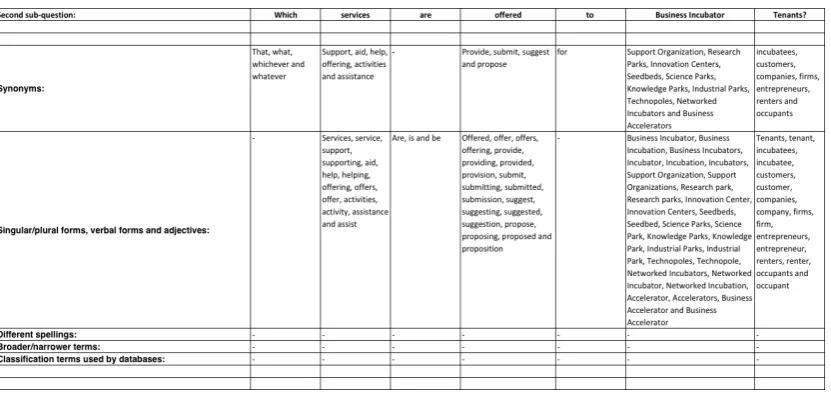
The second planning stage concerns the planning of the systematic literature review. Here the (sub)-research question is broken down into individual concepts to create search terms. Moreover, the individual concepts are checked for synonyms and singular/plural forms amongst others (see Figure 1). In this thesis, the alternative terms and concepts are constructed via two ways. The first is the individual experience with the literature around the BI construct and the second is the website for business synonyms: http://www.thesaurus.com.
[image:11.595.92.508.507.704.2]Figure 1. Breakdown of the first (sub)-research question.
criteria, the literature review is repeatable for every other person (Kitchenham, Brereton, Li, Budgen and Burn, 2011).
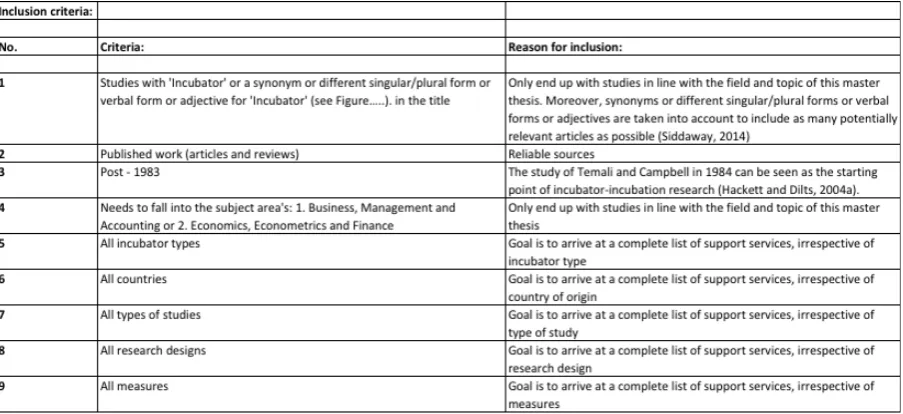
[image:12.595.92.544.255.462.2]The inclusion and exclusion criteria need to be objective and unbiased. Moreover, they set the boundaries and scope of the review (Siddaway, 2014). Inclusion criteria are the elements of an article that must be present in order for it to be eligible for inclusion in the systematic literature review. Whereas exclusion criteria are the elements of an article that disqualify the study from inclusion in the systematic literature review. Hence, the order is to first look at the inclusion criteria to make the lion share shifting and thereafter focus on the exclusion criteria. This will be explained more thoroughly in the screening stage. In Figure 2 below, the inclusion criteria of this systematic literature review on BI support services are presented, whereas in Figure 3 the exclusion criteria are presented.
Figure 2. Inclusion criteria.
Figure 3. Exclusion criteria.
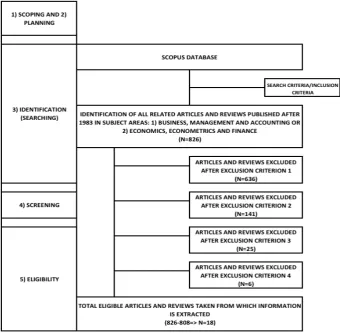
systematic reference list can be found from all articles and reviews taken into account after the search, inclusion criteria and the 1st exclusion criteria (below 20 citations).
Figure 4. Study selection process of this master thesis (PRISMA flow diagram).
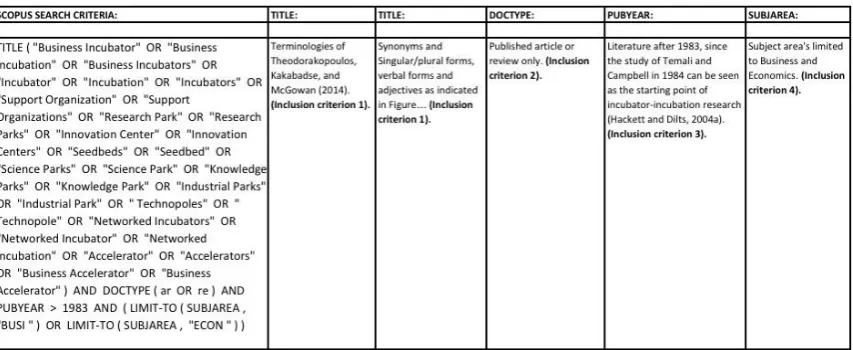
Figure 5. Search criteria employed by this master thesis.
The first lion share shifting resulting in 826 articles and reviews is made on the basis of all nine inclusion criteria, of which the first four are translated into the search criteria. As can be seen in Figure 5 above, the terminologies of Theodorakopoulos et al. (2014) and their synonyms and different forms as indicated in Figure 1 are used as search inputs for the ‘TITLE’ (inclusion criterion 1). Furthermore, inclusion criterion 2 prescribes that only reliable sources will be taken into consideration, hence the ‘DOCTYPE’ is set on articles or reviews only. Only articles or reviews from after 1983 are taken into consideration (inclusion criterion 3), because the study of Temali and Campbell (1984) can be seen as the starting point of incubator-incubation research (Hackett and Dilts, 2004). Hence the ‘PUBYEAR’ is set >1983. Finally, the ‘SUBJAREA’ is limited to: Business, Management and Accounting and Economics, Econometrics and Finance, so that the scope of the systematic literature review is in line with the scope of this master thesis (inclusion criterion 4).
As can be seen in the PRISMA flow diagram of this systematic literature review (Figure 4), this identification (searching) stage also incorporates the first exclusion criterion. This exclusion criterion prescribes that only articles and reviews with more than 20 citations on the SCOPUS database will be included and hence the rest will be excluded. The rationale behind this, is that this yields quality work as well as commonly used and referred to articles and reviews. As a result, after filtering the identified 826 articles and reviews on the basis of citation, only the first 190 results have 20 or more citations. Meaning that 636 articles and reviews are excluded. Recall from the planning stage that a full systematic reference list can be found in ‘Appendix 1’ consisting of precisely these 190 articles and reviews. This list forms the basis of literature input for this thesis. Moreover, all following exclusion criterion are also included in the list, so that the reader is able to follow all steps of this systematic literature review.
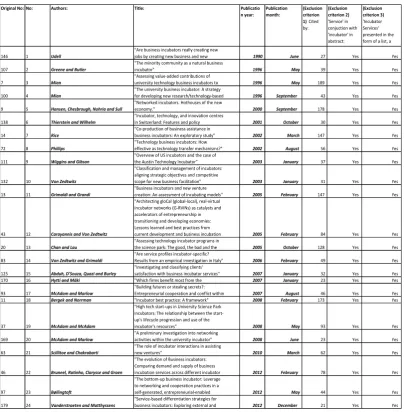
The eligibility stage is the final stage of the guide provided by Siddaway (2014). It is here in which the full text versions of all remaining articles and reviews are sifted in order to include eligible articles for the extraction of relevant information. Exclusion criterion 3 and 4 are part of this final stage. Exclusion criterion 3 prescribes that services or a synonym or different singular/plural form or verbal form or adjective for 'services' (see Figure 1) must be presented in the form of a list, a table or a figure throughout the article or review. Hence, the full text should be taken into consideration. The logic behind this is that if a list of services is provided in the text, this means that services have a prominent role in the article or review. Hence, there is a bigger chance the focus lies on support services and this in turn will potentially result in a more complete and extensive list of services, which is the main goal of this systematic literature review. After incorporating this exclusion criterion, only 24 articles and reviews remained and hence 25 were excluded. Consult to ‘Appendix 1’ to see which articles are excluded in this stage. Figure 6 provides an overview of the 24 remaining articles and reviews, filtered on the year of publication.
Figure 6. Literature list as a timeline after exclusion criterion 3.
The filtering on year of publication is chosen deliberately as a starting point for exclusion criterion 4. This final exclusion criterion prescribes that articles and reviews will be excluded on the basis of overlapping information, either written by the same author(s), or information referred to that is already taken into consideration. The reason behind this, is quite straight forward. Namely that double information does not add anything to the overall outcome.
Original No: No: Authors: Title: Publicatio n year:
Publication month:
[image:15.595.90.495.275.688.2](Exclusion criterion 1) Cited by: (Exclusion criterion 2) 'Service' in conjuction with 'incubator' in abstract: (Exclusion criterion 3) 'Incubator Services' presented in the form of a list, a table or a figure: 146 1 Udell
"Are business incubators really creating new
jobs by creating new business and new 1990 June 27 Yes Yes 107 2 Greene and Butler
"The minority community as a natural business
incubator" 1996 May 39 Yes Yes
7 3 Mian
"Assessing value-added contributions of
university technology business incubators to 1996 May 189 Yes Yes 100 4 Mian
"The university business incubator: A strategy
for developing new research/technology-based 1996 September 43 Yes Yes 9 5 Hansen, Chesbrough, Nohria and Sull
"Networked incubators. Hothouses of the new
economy." 2000 September 178 Yes Yes
138 6 Thierstein and Wilhelm
"Incubator, technology, and innovation centres
in Switzerland: Features and policy 2001 October 30 Yes Yes 14 7 Rice "Co-production of business assistance in business incubators: An exploratory study" 2002 March 147 Yes Yes 72 8 Phillips
"Technology business incubators: How
effective as technology transfer mechanisms?" 2002 August 56 Yes Yes 111 9 Wiggins and Gibson
"Overview of US incubators and the case of
the Austin Technology Incubator" 2003 January 37 Yes Yes
132 10 Von Zedtwitz
"Classification and management of incubators: aligning strategic objectives and competitive
scope for new business facilitation" 2003 January 31 Yes Yes 13 11 Grimaldi and Grandi
"Business incubators and new venture
creation: An assessment of incubating models" 2005 February 147 Yes Yes
43 12 Carayannis and Von Zedtwitz
"Architecting gloCal (global-local), real-virtual incubator networks (G-RVINs) as catalysts and accelerators of entrepreneurship in transitioning and developing economies: Lessons learned and best practices from
current development and business incubation 2005 February 84 Yes Yes 20 13 Chan and Lau
"Assessing technology incubator programs in
the science park: The good, the bad and the 2005 October 128 Yes Yes 83 14 Von Zedtwitz and Grimaldi
"Are service profiles incubator-specific?
Results from an empirical investigation in Italy" 2006 February 49 Yes Yes 125 15 Abduh, D'Souza, Quazi and Burley
"Investigating and classifying clients'
satisfaction with business incubator services" 2007 January 32 Yes Yes 170 16 Hytti and Mäki "Which firms benefit most from the 2007 January 23 Yes Yes 93 17 McAdam and Marlow
"Building futures or stealing secrets?:
Entrepreneurial cooperation and conflict within 2007 August 46 Yes Yes 11 18 Bergek and Norrman "Incubator best practice: A framework" 2008 February 173 Yes Yes
37 19 McAdam and McAdam
"High tech start-ups in University Science Park incubators: The relationship between the start-up's lifecycle progression and use of the
incubator's resources" 2008 May 93 Yes Yes 169 20 McAdam and Marlow
"A preliminary investigation into networking
activities within the university incubator" 2008 June 23 Yes Yes 63 21 Scillitoe and Chakrabarti
"The role of incubator interactions in assisting
new ventures" 2010 March 62 Yes Yes
46 22 Bruneel, Ratinho, Clarysse and Groen
"The evolution of Business incubators: Comparing demand and supply of business
incubation services across different incubator 2012 February 78 Yes Yes
97 23 Bøllingtoft
"The bottom-up business incubator: Leverage to networking and cooperation practices in a
self-generated, entrepreneurial-enabled 2012 May 44 Yes Yes 179 24 Vanderstraeten and Matthyssens
"Service-based differentiation strategies for
Filtering the remaining list of 24 articles and reviews on year of publication, eased the process of identifying overlapping information. For example: the same author could have contributed to multiple of the 24 remaining articles and reviews published in different years. And hence, he or she could have re-used a list of identified services in a later work. Figure 7 provides an overview of overlapping authors and information. As can be seen in Figure 7 there were several cases of overlapping authors. This did not result in overlapping information in all cases. Moreover, in the case of Scilitoe and Chakrabarti (2010), overlapping information was identified, although no overlapping authors were in place. Their study employed the same distinction and list of services as in Mian (1996). After consulting each source for overlapping information, 6 sources were excluded from the remaining list of 24 sources. The precise reasoning for exclusion is also provided in Figure 7.
Figure 7. Overlapping authors and information literature.
Hence, after having applied all the search criteria, inclusion and exclusion criteria 18 sources deemed eligible for the extraction of information to construct a list of services for this master thesis. These 18 sources can be seen in bold in both Figure 7 as well as in the full systematic reference list in ‘Appendix 1’.
Since all the stages of Siddaway (2014) regarding a systematic literature review have now been undertaken, it is time to extract the information from the 18 eligible sources.
All useful information from the 18 eligible sources is displayed by the means of a timeline in ‘Appendix 2’. As can be seen and as indicated before, studies use a different (pre-)categorization as well as a different formulation of services. Moreover, BI typology as the unit of analysis differs between the sources. Therefore, both categorization as well as different service formulations have been tallied and distinguished in this thesis in order to arrive at a compelling list of services.
various services under one header; e.g. Office furniture comprises a telephone, a desk, a chair etc. On the basis of my own perception all mentioned services were distributed among overarching headers. The distribution and its accompanying headers can be seen in step 2 of ‘Appendix 3’.
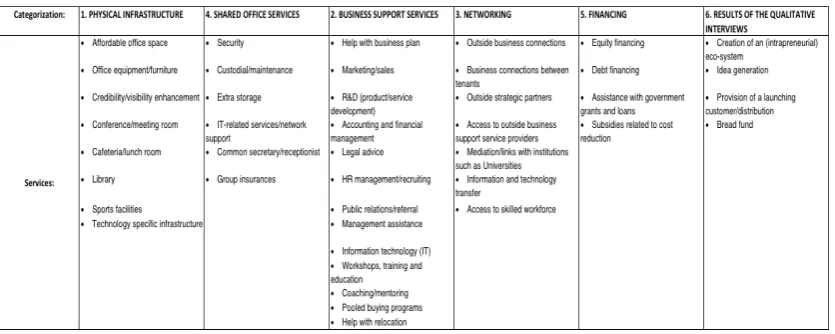
[image:17.595.89.507.218.366.2]In the end this systematic literature review on the support services of BIs yielded 5 different service categories and in total 38 different services were distinguished (see Figure 8). Moreover, the timeline of BI service offerings has been rearranged into a compelling literature overview of BI service offerings, also taking into account BI typology (see ‘Appendix 4’).
Figure 8. Categorization and services according to the systematic literature review.
A few things are worth pointing out regarding the obtained list of 38 services. When looking at the literature timeline in ‘Appendix 2’, The University related service category of Mian (1996) is deliberately left out, since no B) Academic incubators will be included as the unit of analysis in the next ‘Methodology’ chapter (3) of this thesis. Hence, the addition of this category would not add any insights to this research given the set scope.
Furthermore, it becomes apparent that some services are only provided in B) Academic and D) Technology BIs, whereas other services are offered in various types of BIs or in a general overview BIs (meaning no specific type, but various typologies have been taken into
consideration) (see ‘Appendix 4’).
In the case of the services acknowledged and offered both in the B) Academic and the D) Technology BIs: Outside business connections and Subsidies related to cost reductions, this could be the result of hosting academics/students who do not have a lot of money to spend on for example the rent of their office space (Grimaldi and Grandi, 2005). Hence, helping them out by providing them with a service to reduce rent in difficult times could be beneficial for this group (Grimaldi and Grandi, 2005).
2.1.2 Gaining a deeper understanding through a qualitative pre-study
This sub-section summarizes the findings of a qualitative pre-study in which open interviews were conducted with tenants of BI: ‘De Gasfabriek'. ‘De Gasfabriek’ is a BI in Deventer in the east part of the Netherlands. It has been originated in October 2015 and has had its official opening ceremony in October 2017. ‘De Gasfabriek’ falls under the category: A) mixed technology BI as described by Al-Mubaraki and Busler (2011). More information regarding ‘De Gasfabriek’ will be provided in the next ‘Methodology’ chapter.
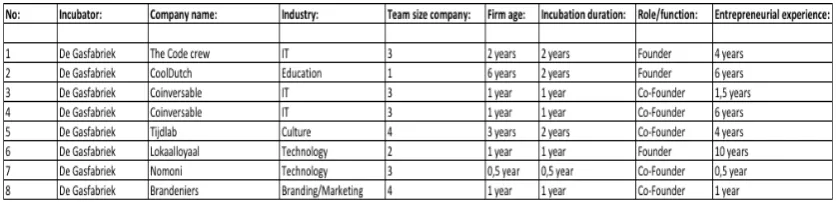
was designed beforehand, all tenants were asked beforehand to provide their name, age, company name, role/function, team size and entrepreneurial experience to provide the reader with background information. See Figure 9 for the characteristics of the interview subjects.
Figure 9. Characteristics of the interview subjects.
Questions asked differed from interview to interview and were asked on the basis of own interpretation and participation to ensure a smooth conversation and to obtain as much input regarding service offerings as possible. As a result of the pre-study, 4 new services could be added to the service offering overview:
1) Creation of an intrapreneurial ecosystem 2) Idea generation
3) Provision of a launching customer/distribution 4) Bread fund
To start off with the first service, ‘the creation of an intrapreneurial ecosystem’. From the conversations with the tenants of ‘De Gasfabriek’ it became apparent that ‘De Gasfabriek’ has a different philosophy than other more traditional BIs. Access to capital was not mentioned very often during the interview, although in the literature the opposite holds. Tenants responded that instead of paying each other with real money within the BI and hence providing each other with business, they would rather combine forces to attain synergy and come up with solutions far better than one start-up would be able to on his own. In order to keep track of the effort put in by each individual, a special ecosystem Blockchain has been created by ‘De Gasfabriek’. If for example 4 persons contribute to a project, their hours and input are directly registered in the Blockchain. So that in the case of a successful venture initiation all parties involved will be rewarded according to the effort they put in.
The second service: ‘idea generation’ is facilitated in the form of “Kansrijke Innovatie Kringen (KIKs)”. Almost all tenants highlighted the fact that ‘De Gasfabriek’ offered these special innovative sessions. These open sessions are organized by ‘De Gasfabriek’ to discuss the current state of a micro or macro problem. Everyone is welcome. Also, people who have no relation with ‘De Gasfabriek’ at all. Most often, industry experts are invited as well as the tenants of the BI. Then the problem is presented and a dialogue is started. Once the problem is formulated and the scope is clear, the group collectively comes up with ideas to solve the problem. In the end, the main idea is that the tenants have the possibility to embrace such a newly develop idea so that it can be brought to life.
than the provision of network opportunities with strategic partners in the sense that in ‘De Gasfabriek’ the contacts with the launching customer are actively provided. In other words, it is set as a goal for ‘De Gasfabriek’ to connect their tenants with a corporate and they will do their absolute best to accomplish that.
The fourth and final service to be added to the list of services is the provision of a ‘bread fund’. This is a monthly base salary to cover the basic needs of entrepreneurs, such as food. Therefore, it is called a ‘bread fund’. It is offered by ‘De Gasfabriek’ so that their tenants do not have to make any concessions regarding their distribution of time. Meaning they can fully focus on the business and do not need to take on an extra side job to earn money in order to survive.
[image:19.595.90.508.291.458.2]Figure 10 offers a complete list of 42 service offerings, stemming from both the systematic literature review on service offerings (38) as well as the pre-study (4). Hence, acting as an answer to the first sub-question of this thesis.
Figure 10. Complete list of BI service offerings.
2.2 Customer satisfaction
In order to provide an answer to the central research question: “Which services lead to high
levels of customer satisfaction for Business Incubator (BI) tenants?”. A deeper understanding
must be obtained around the customer satisfaction construct. Hence, this part of the literature review dives deeper into this matter, starting off with the importance of customer satisfaction.
2.2.1 Importance of customer satisfaction
Customers are the most important part of any company, since the business is dependent on them (Drucker, 1994). Without customers, there is no revenue and thus no return on investment. Moreover, they also influence the acquisition of new customers through word of mouth recommendations (Dube and Maute, 1996). Therefore, gaining a deep understanding of customers is of significant managerial interest.
consolidate and hence gaining a sustainable competitive proved to be nearly impossible. In a context of saturated markets with increased competition and low market growth rates, the costs of attracting new customers are assumed to be five to six times higher than the costs of retaining customers (Matzler and Hinterhuber, 1998). The defensive strategy of customer retention on the other hand was purely designed to reap a sustainable competitive advantage over the long term. It assumes that customer satisfaction positively affects customer loyalty (Choi, Seol, Lee, Cho, and Park, 2008). Meaning that when the level of customer satisfaction is high, so is the level of customer loyalty. Moreover, the level of customer satisfaction is seen as an indicator of the performance of products and services and as the best indicator of the company’s future (Kotler, 1991).
Research shows that high levels of customer satisfaction and customer loyalty leads to a healthy stream of cash flow, decreased transactions costs and a reduction of price elasticity (Anderson, Fornell, and Lehmann 1994.). Moreover, the cost of attracting new customers is lower with a high level of customer satisfaction, due to less negative word of mouth statements of customers and an increase in positive word of mouth recommendations (Anderson, 1998). Thereby stretching the importance of the customer satisfaction construct. According to Matzler and Hinterhuber (1998) the strategic intent is no longer to capture higher market shares than competitors, but to create a high level of customer satisfaction and loyalty in order to gain a sustainable competitive advantage. Or as Hanan and Karp (1989) summed it up: “Customer satisfaction is the ultimate objective for every business, not to supply, not to
sell, not to service, but to satisfy the needs that drive customers to do business” (p. 467).
2.2.2 What is customer satisfaction?
As emphasized by the above, the customer satisfaction construct is of vital importance for any business. As it can be used to assess the performance of products and services as well act as an important indicator of the business’ future (Kotler, 1991). Therefore, it is of significant managerial interest. But what does the term customer satisfaction mean? In order to answer this question, the customer satisfaction construct is first divided into two separate parts, namely ‘customer’ and ‘satisfaction’.
Everyone who buys products or services from companies is a customer (Parasuraman and Grewal, 2000). Sometimes the terms customer and consumer are used interchangeably, however, there is a subtle but important difference between the two. A customer can be a consumer, but a consumer does not necessarily have to be a customer. A customer is the one who provides payment in exchange for the offer provided to him by the organization with the aim of fulfilling expectations and to maximize satisfaction, whereas a consumer is the person who ultimately consumes the product (Solomon, Marshall and Stuart, 2016). Hence, one speaks of customer satisfaction and not of consumer satisfaction, because ultimately the customer is the one who brings in the revenue.
In a nutshell, customer satisfaction could be described as the pleasure obtained from a purchase. However, a definitive definition of customer satisfaction is still absent in the customer satisfaction literature. There are two conceptualizations of the customer satisfaction construct; transaction specific and cumulative (Andreassen, 2000). In the transaction specific view, customer satisfaction is seen as a post-purchase evaluation (Fornell, 1992; Oliver, 1980). This is highlighted by Tse and Wilton (1988) in their definition of customer satisfaction:
“the consumer’s response to the evaluation of the perceived discrepancy between prior expectations and the actual performance of the product or service as perceived after its
consumption” (p. 204). The second conceptualization pictures customer satisfaction as a
cumulative experience and hence an overall attitude towards a product or service (Sureshchander, Rajendran and Anantharaman, 2002). This overall attitude is not necessarily formed after a transaction. In line with this second school of thought, Giese and Cote (2000) formulate customer satisfaction as “a response (cognitive or affective) that pertains to a particular focus (i.e. a purchase experience and/or the associated product) and occurs at a
certain time (i.e. post-purchase, post-consumption)” (p. 15). The cumulative approach is more
useful in explaining customer behavior in the past and present and predicting it in the future (Anderson et al., 1994). Therefore, companies are more interested in cumulative customer satisfaction.
More general definitions include the one of Kotler, Armstrong, Saunders and Wong (2002) in which customer satisfaction has been defined as the extent as to which the performance of a product or services matches the buyers’ expectations. Or as delineated by Schiffman and Kanuk (2014) as: the individual’s perception of the performance of the products or services in
relation to his or her expectations” (p. 14). What becomes apparent from the above is that
expectations play an important role in almost all definitions of customer satisfaction.
2.2.3 Customer expectations
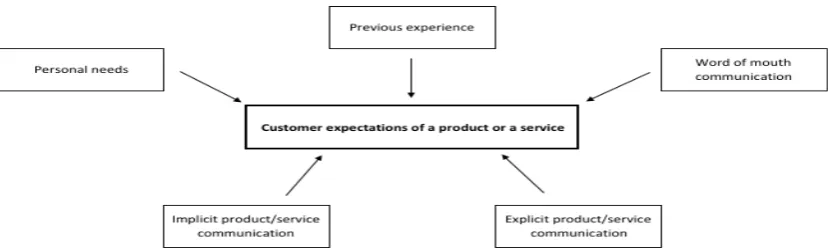
[image:21.595.91.507.504.630.2]Expectations have a central role in influencing customer satisfaction and several factors determine these expectations (Lengyel, 2012). The key factors to influence and form expectations can be seen in Figure 11.
Figure 11. Sources of customer expectations based on Parasuraman, Berry and
Zeithaml (1990).
Parasuraman et al. (1990) distinguish between five factors;
1. Personal needs: every customer has a set of key personal needs that one expects the product or service to address. These will vary from customer to customer. Hence, a clear understanding is necessary.
2. Previous experience: if a customer has had a previous experience with a product or service, this will partly influence future expectations.
4. Explicit product/service communication: statements, flyers and commercials from the provider of products or services itself.
5. Implicit product/service communication: buildings, stores and other factors of physical appearance.
Lengyel (2012) states that it becomes particularly important to understand these factors, when comparisons between products or services should be made and customer satisfaction levels with these products or services are assessed.
[image:22.595.103.479.471.597.2]Then there is the expectation confirmation/disconfirmation paradigm of customer satisfaction/dissatisfaction which forms the basis of the development of the customer satisfaction construct (Oliver, 1980). According to the paradigm customer satisfaction consists of three levels or states, as can be seen in Figure 12. A state of dissatisfaction, a state of satisfaction and a state of delight. A state of dissatisfaction occurs when there is a default or things are going wrong. In other words, a product or service did not meet a customers’ expectations (negative disconfirmation). As a result, the customer will complain about the product or service and a state of dissatisfaction is reached. In order to mitigate this state of dissatisfaction and to reach a state of satisfaction, a company needs to make sure there are zero defaults regarding their products or services. And moreover, the expectations of the customers need to be met. Hence, a state of customer satisfaction is reached when everything goes to plan and there are no surprises for the customer (confirmation). The last state of true customer satisfaction, also known as customer delight, can only be reached when the customer is positively surprised. This state of true customer satisfaction is the result of excellent and attractive features of a product or service far exceeding a customers’ expectations (positive disconfirmation). Thereby creating a positive emotional reaction, which leads to positive word of mouth recommendations. Also, worth pointing out is that the effect of negative disconfirmation on satisfaction is far greater than the effect of positive disconfirmation (Hill, 1986).
Figure 12. Delight response curve based on Keiningham, Pruden and Vavra (2004).
2.2.4 Measuring customer satisfaction
Knowledge about the state of satisfaction of customers is thus very important for companies. Because it delivers them with valuable information how to adjust certain products or services in their quest for customer delight and hence turn negative word of mouth communication into positive. This knowledge can be obtained through measuring customer satisfaction; however, this could be very difficult at times.
(Grewal, Levy and Kumar, 2009). Since the measurement is not exact, sampling or statistical analysis is required. Moreover, it is also very important to clearly define measures and parameters beforehand. These will vary per context. For example: services require different aspects to be measured than products and even the measurement between different services or different products varies according to the industry (Agbor, 2011). Over time different frameworks and models have been used as a methodological pillar to measure ‘satisfaction’. Often, they are specifically designed to measure a certain type of satisfaction. For example, the two-factor theory by Herzberg, Mausner and Snydermann (1959). In this model, motivational factors which cause satisfaction and hygiene factors which cause dissatisfaction are separated as two independent dimensions. The job satisfaction construct is obviously different than the customer satisfaction construct. However, the model which is most widespread used by academics as well as practitioners to measure customer satisfaction in both a product as a service context originates from the two-factor theory (Rashid, Tamaki, Ullah and Kubo, 2010).
The Kano model, designed by Professor Noriaki Kano in the 1980’s, is based on the two-factor theory, but suggests there are not two, but three fundamental ways to view and measure (customers) satisfaction. The Kano model provides a framework to consider, measure and implement activities that not only cause dissatisfaction or provide customer satisfaction, but result in customer delight (Anisor, Adela-Eliza and Luciana, 2010). Resort to Appendix 5 for a complete overview of studies and research settings in which the Kano model has been used. The Kano model will be further elaborated on in the next ‘Methodology’ chapter (3).
2.2.5 Customer satisfaction in the BI context
Up till now the satisfaction construct has been rather untouched in the BI literature. Although a couple of studies have made a first step (Abduh et al., 2007; Robinson and Stubberud, 2014). For example: the study of Abduh et al. (2007), in which support services offered by BIs were grouped according to satisfaction levels experienced by the tenants. They found in their study that tenants were generally more satisfied with facility related services than with counselling and business networking assistances services. Even though some comparisons with the study of Abduh et al. (2007) are provided throughout this thesis, the approach, categorization and especially the methods used have been very different between this thesis and the study of Abduh et al. (2007). The study of Abduh et al. (2007) for example made use of an own developed satisfaction matrix (SATMAT), which calculated satisfaction by
deducting the mean perceived effectiveness of service provision from the mean importance of a service. Hence, meaning that both should be known ex ante and services must already been provided. The satisfaction output measured in the study of Abduh et al. (2007) is thus merely an outcome of experienced satisfaction. In this study however, the Kano model will assess the satisfaction levels of services which are already provided, but also for services which are perhaps to be provided in the future. In other words; satisfaction levels attributed to potential ‘new-in-the-pipeline’ offerings.
What can be learned from this section so far, is that cumulative customer satisfaction is a very valuable construct to explain customer behavior in the past and present and to predict it in the future. Cumulative customer satisfaction is the state of mind that customers have about a product or service when their expectations have been met or exceeded over its lifetime. Moreover, the expectation construct contains five factors, which all have an influence on the creation of expectations. Furthermore, measuring customer satisfaction is difficult and