1
Faculty of Electrical Engineering,
Mathematics & Computer Science
Logical Structure Extraction of Electronic
Documents Using Contextual Information
M.Sc. Thesis by
Semere Kiros Bitew
Department of Computer Science Specialization of Data Science & Smart Services
August 2018
Supervisors:
University Of Twente
Masters Thesis
Logical Structure Extraction of Electronic
Documents using Contextual Information
Author:
Semere Kiros
Bitew
Supervisors:
Dr. Mariet
Theune
Dr.ir. Djoerd
Hiemstra
Dr. Sergios
Petridis
A thesis submitted in fulfillment of requirements for the degree of Master of Science
in
Computer Science
Data Science and Smart Services
Faculty of Electrical Engineering, Mathematics and Computer Science
Acknowledgement
I am thankful to many people for their support, contribution and friendship, which made two years of my Master’s studies at the University of Twente very exciting.
I would like to thank my supervisors Mariet Theune and Djoerd Hiemstra for their guid-ance, critical feedback and time reading (and re-reading) my earlier versions of this master’s thesis. I would like to thank you both for the countless meetings, email communications and constructive feedbacks, which helped me develop a research mindset. Mariet, I am grateful for helping me contact Elsevier to work on this interesting topic.
Next, I want to thank Sergios Petridis from Elsevier for the day to day supervision. His support, motivation and above all giving me freedom to pursue my own ideas; greatly helped me get a better practical understanding of NLP and machine learning. I also want to thank my colleagues in the Apollo project at Elsevier; Timos, Yi, Ehsan and Arash that made my graduation project pleasant to do. In particular, I learned a lot from Timos, who has constantly explained me how different machine learning models work.
Abstract
Logical document structure extraction refers to the process of coupling the semantic
mean-ings (logical labels) such as title, authors, affiliation, etc., to physical sections in a document.
For example, in scientific papers the first paragraph is usually a title. Logical document
structure extraction is a challenging natural language processing problem.
Elsevier, as one of the biggest scientific publishers in the world, is working on recovering
logical structure from article submissions in its project called the Apollo project. The current
process in this project requires the involvement of human annotators to make sure logical
entities in articles are labeled with correct tags, such as title, abstract, heading, reference-item
and so on. This process can be more efficient in producing correct tags and in providing high
quality and consistent publishable article papers if it is automated. A lot of research has been
done to automatically extract the logical structure of documents.
In this thesis, a document is defined as a sequence of paragraphs and recovering the labels
for each paragraph yields the logical structure of a document. For this purpose, we proposed a
novel approach that combines random forests with conditional random fields (RF-CRFs) and
long short-term memory with CRFs (LSTM-CRFs). Two variants of CRFs called linear-chain
CRFs (LCRFs) and dynamic CRFs (DCRFs) are used in both of the proposed approaches.
These approaches consider the label information of surrounding paragraphs when classifying
paragraphs.
Three categories of features namely, textual, linguistic and markup features are extracted
to build the RF-CRF models. A word embedding is used as an input to build the LSTM-CRF
models.
Our models were evaluated for extracting reference-items on Elsevier’s Apollo dataset
of 146,333 paragraphs. Our results show that LSTM-CRF models trained on the dataset
outperform the RF-CRF models and existing approaches. We show that the LSTM component
efficiently uses past feature inputs within a paragraph. The CRF component is able to exploit
the contextual information using the tag information of surrounding paragraphs.
It was observed that the feature categories are complementary. They produce the best
performance when all the features are used. On the other hand, this manual feature
extrac-tion can be replaced with an LSTM, where no handcrafted features are used, achieving a
better performance. Additionally, the inclusion of features generated for the previous and
next paragraph as part of the feature vector for classifying the current paragraph improved
Contents
Acknowledgement i
Abstract ii
1 Introduction 1
1.1 Introduction to Elsevier and Apollo project . . . 2
1.2 Research Questions . . . 3
1.3 Contribution . . . 4
1.4 Structure of the Thesis . . . 5
2 Background & Related Work 6 2.1 Document Structure Recognition . . . 6
2.2 Logical Document Structure . . . 7
2.3 Techniques for Logical Structure Extraction . . . 9
2.3.1 Rule Based Approaches . . . 9
2.3.2 Machine Learning Approaches . . . 11
2.4 Conclusion . . . 13
3 Elsevier’s Apollo Dataset 15 3.1 Article Manuscripts . . . 16
3.2 Published Articles . . . 17
3.3 Summary . . . 18
4 Methods 20 4.1 Modeling the Problem . . . 20
4.2 Feature Extraction . . . 21
4.4 Conditional Random Fields (CRF) . . . 28
4.4.1 Linear chain CRFs . . . 31
4.4.2 Dynamic CRFs . . . 31
4.5 Long Short-Term Memory (LSTM) . . . 32
4.6 Summary . . . 35
5 Experiments and Results 37 5.1 Experimental Setup . . . 37
5.1.1 Dataset Preparation . . . 37
5.1.2 Baselines . . . 39
5.1.3 Experimental setup of Linear CRFs . . . 40
5.1.4 Experimental setup of Dynamic CRFs . . . 41
5.1.5 Performance Measures . . . 42
5.1.6 Implementation Environment . . . 43
5.2 Results. . . 45
5.2.1 Baselines . . . 45
5.2.2 Linear Chain CRFs. . . 46
5.2.3 Dynamic CRFs . . . 48
5.2.4 The Effect of Using Contextual Features . . . 51
5.2.5 Conclusion . . . 51
6 Discussion 53 7 Conclusion and Future work 55 7.1 Conclusion . . . 55
7.2 Future works . . . 56
A Preliminary results of LSTM-LCRF for the whole document 58
B Source Code Listings 59
B.1 Source code for including continuous features . . . 59 B.2 Source code for predicting class labels from a trained model . . . 60
List of Figures
2.1 Sample first page of a paper (Source: Bloechle 2010) . . . 8
2.2 Tree structure and formalized XML description (Bloechle 2010) . . . 9
3.1 Initial manuscript submission with all contents and files . . . 17
3.2 Final published article . . . 18
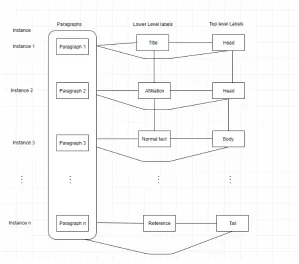
4.1 Sequence of paragraphs with possible multi-level labels . . . 21
4.2 Font family feature example . . . 25
4.3 Sample Dataset For Random Forest . . . 27
4.4 Example of Random Forest . . . 27
4.5 Text snippet from Paaß and Konya 2011 . . . 28
4.6 Word and State Vectors from Paaß and Konya 2011 . . . 28
4.7 One LSTM . . . 34
4.8 Multiple gates. . . 35
5.1 Class Label Distribution . . . 38
5.2 Two level labels for DCRF . . . 42
List of Tables
4.1 List of Extracted Features . . . 23
5.1 Performance of Random Forest classifer . . . 45
5.2 Random Forest binary classifier confusion matrix with all features . . . 46
5.3 Performance of LSTM binary classifier . . . 46
5.4 LSTM binary classifier confusion matrix . . . 46
5.5 Performance of Linear Chain CRF with direct features . . . 47
5.6 LCRF confusion matrix . . . 47
5.7 Performance of RF-LCRF . . . 47
5.8 RF-LCRF confusion matrix . . . 47
5.9 Performance of LSTM-LCRF binary classifier . . . 48
5.10 LSTM-LCRF binary classifier confusion matrix . . . 48
5.11 Performance of Dynamic CRF with direct features . . . 49
5.12 DCRF confusion matrix with all features. . . 49
5.13 Performance of RF-DCRF . . . 49
5.14 RF-DCRF confusion matrix . . . 50
5.15 Performance of LSTM-DCRF . . . 50
5.16 LSTM-DCRF confusion matrix . . . 50
5.17 The effect of using contextual features on the performance of models . . . 51
A.1 F1-scores for LSTM-LCRF . . . 58
List Of Acronyms
CRF Conditional Random Fields CSV Comma Separated Values
DCRF Dynamic Conditional Random Fields DT Decision Tree
GRMM Graphical Models for Mallet
LCRF Linear-Chain Conditional Random Fields LSTM Long-short Term Memory
ML Machine Learning NB Naive Bayes
PDF Portable Document Format PII Publisher Item Identifier POS Part Of Speech
RF Random Forest
RNN Recurrent Neural Network
SSVM Structural Support Vector Machine SVM Support Vector Machine
1
Introduction
Electronic documents are increasingly becoming an important medium of
communi-cation between humans since the introduction of computers. Electronic documents
are easy to distribute, search and store. The structure of electronic document can
be explicitly represented into physical layout and logical structure. Physical
lay-out refers to what physically exists on a document page when it is viewed. The
perceived document may be composed of a paper and ink or bits and pixels, and
these small units form larger structures that convey information to human readers
(e.g. a page consists of some blocks, a block consists of some text line, a text line
is composed of some words etc.). In contrast, logical structure refers to what the
physical layout components actually are in terms of understanding how to interpret
the contents in a page of a document. For example, a set of pixels may form a
paragraph, title and section which are logical components. Extracting such kind of
logical structural information can be very useful in many applications. For
exam-ple, such structures which enable documents to be easily reedited and restyled help
build citation-indexing systems that greatly improve indexing, retrieving and reuse
of document content. While it is easy for humans to understand the structure of
such documents, computers are only good at processing content without attaching
any interpretation to it (Mao, Rosenfeld, and Kanungo2003).
Logical document structure extraction refers to the process of extracting
log-ical components such as title, abstract, affiliation etc. from documents. Loglog-ical
structure extraction is not a trivial process. For instance, authors use different
styles and typesetting while writing papers, which results in completely different
structures. Moreover, research articles from different fields of study tend to have
different structures. For example, research articles from computer science and social
sciences have completely different structure.
In this master’s thesis the focus is on studying the problem domain, defining
what is being solved, exploring the existing research and methods, and
implement-ing machine learnimplement-ing models to achieve a high performance in extractimplement-ing logical
document structure. The logical document structure extraction is formulated as a
labels for a sequence of input data (Jurafsky 2000). For example, a document can be viewed as a sequence of paragraphs, sentences or words. By assigning labels
(classes) to these paragraphs, sentences or words the structure of a document can
be recovered.
1.1 Introduction to Elsevier and Apollo project
Elsevier1, established in 1880, is one of the biggest scientific publishers in the world.
Elsevier publishes approximately 400,000 papers annually in more than 2,500
jour-nals. The company works on different innovative projects in a quest to become a
leading information provider for the scientific and corporate research community.
One project called the Apollo project at Elsevier is working on recovering
logical structure from article submissions. This project focuses on automating the
process between first article submission of an author’s manuscripts and final
struc-tured publishable form with high quality. Starting from the author’s manuscript,
it undergoes a series of editing steps that guarantees a high-quality publication.
A typical work flow for revising the article includes preflight, auto-structuring and
copy-editing stages. In preflight, initial submissions are checked for missing files. In
the auto-structuring stage, rearranging of the content with specific structure is done.
Finally in copy-editing, final revision of the content of the article is done before the
publishable form is produced.
In the auto-structuring stage, human annotators are involved to make sure
articles are labeled with correct tags, such as abstract, heading, title, reference-item
and so on. This task can be more efficient in producing correct tags and thereby
providing high quality and consistent data if automated. However, the automatic
extraction of structure is not a trivial process. Some articles are submitted with
semi-structured information and unstructured in the worst case.
The aim of this master’s thesis is to automate the auto-structuring stage by
utilizing existing machine learning models. With present developments of machine
learning approaches, it is possible to automate the structuring process by replacing
the role of humans achieving quite a good performance.
1.2 Research Questions
The thesis work is an extension to the work done by He 2017. The author used
textual and visual information to extract logical structure of documents. My thesis
focuses on the use of models that take into account the contextual information to
improve the task of document structure extraction. In our case, documents exhibit
sequential structure at different levels such as paragraphs, sentences, words etc.
Hence, contextual information refers to the information that can be exploited from
surrounding paragraphs, words, sections to assist us in extracting structure from
documents. The thesis addresses the following research question:
Given a word document (e.g. doc, docx format), how do machine
learning approaches perform for the task of logical document structure
extraction by leveraging the textual, linguistic, markup and contextual
information?
To answer this research question it is important to consider the following
subquestions:
1. What kind of features should be extracted to apply machine learning algorithms
to the task of logical structure extraction? Feature selection is an important step
towards developing high performing machine learning models. This research
subquestion explores the set of features that should be extracted to achieve
high performance in the task of logical document structure extraction.
2. How to take into account the contextual information? Different machine
learn-ing models take contextual information into account differently. This research
subquestion will answer how contextual information is utilized for extracting
the structure of documents.
3. Given a context considering machine learning approach, what is the utility of
linguistic, textual and markup features? This research subquestion will answer
the extent markup (visual), linguistic and textual features affect performance
of machine learning models.
4. Can the feature extraction step be left out by using alternative deep
ele-ments? This subquestion will answer if the extraction and selection of manual
handcrafted features, which is a requirement for traditional machine learning
approaches, can be totally cut out by introducing deep learning methods.
1.3 Contribution
The main contributions of this thesis are grouped into categories. The first group
lists the contribution from research point of view and the second group discusses
from the company’s (Elsevier) perspective.
From a research point of view, the contribution of the thesis can be summarized as
follows:
1. We developed a novel approach that combines LSTM with CRFs, which
outper-forms existing approaches on Elsevier’s Apollo dataset of 146,333 paragraphs
for the purpose of logical structure extraction.
2. Two ways of using contextual information in building machine learning models
for logical structure extraction are proposed, which can be of a good insight for
other researchers.
3. The underlying learning code of GRMM (Graphical Models for Mallet) supports
continuous features but the interfaces provided by the software only support
bi-nary features. Hence, a modification of a Java interface in the GRMM package
of Mallet to include continuous features was done.
4. Several feature categories for the task of logical document structure extraction
are proposed, which can act as insights for other researchers.
From Elsevier’s perspective, automating the process of structuring articles with
minimal human involvement will solve the following problems:
1. The manual work of annotating sections of an article is a routine task and
susceptible to mistakes, which can lead to a drop of the quality of article
pub-lications.
2. There is inconsistency in the quality of data because article structuring is done
3. It costs time and money to manually annotate sections of articles and it is a
bottleneck to the overall work flow of publishing articles.
1.4 Structure of the Thesis
The rest of the thesis is structured as follows: Chapter 2 presents the background
and prior research works for sequential learning and logical document structure
extraction. The data that is available in the Apollo project at Elsevier is described
in Chapter 3. Chapter 4 discusses how the problem is formulated, the features used
and theoretical working principles of the models used in the thesis. In Chapter 5 the
experimental setting and results of the developed models are presented. Discussion
of the results is presented in Chapter 6. Finally, the thesis is concluded by giving
2
Background & Related Work
Several researches have been carried out in document structure recovering and
se-quential learning. Sese-quential learning refers to a type of structured prediction of
sequence of labels to a sequence of input data (Jurafsky 2000) . Document
struc-ture extraction refers to extracting structural elements from documents. This section
starts with defining document structure extraction and logical document structure.
Next, techniques for labeling sequential data are explored by discussing related works
from other researchers and how they applied them.
2.1 Document Structure Recognition
Document structure recognition also known as document understanding is defined
in different ways by different authors. Paaß and Konya (2011) define a document
understanding system as a "system that produces a complete representation of a
doc-ument’s logical structure, ranging from semantically high-level components to lowest
level components for a given text representation input." The output of a document
understanding system may range from a representation useful for document sorting
(e.g. terms and their frequency) to a structured message with attribute-value pairs
describing all aspects of communication necessary to drive particular work-flows.
Document understanding can also be thought of as the exact reverse process
of document authoring/production (Aiello et al. 2002; Bloechle 2010). Document
authoring is the process of creating documents whereby authors start with a rough
idea of the content they will write and then structure it by considering the logical
organization of the material. For example, the author may decide to organize the
document in chapters, decide its reading order and use some layout typesetting
convention such as font size, indentation etc. Therefore, it is crucial to consider the
choices the author makes while writing a document. How to include the choices
made by authors such as font size, font style etc in developing document structure
recognizing systems is discussed in section 4.2.
Document understanding may depend on readers’ interpretation but
recognition exploits these two basic sources of information from documents.
Phys-ical layout is the layout of text on the printed page and logPhys-ical layout contains the
rich set of features of the wording and contents. The physical/geometric layout gives
many clues about the relationship between different units such as headings, body
text and figures. The logical layout can be exploited to recognize the existing
in-terrelation and semantics of the text representation of the document (Rahman and
Finin 2017; Mao, Rosenfeld, and Kanungo 2003; Dengel and Shafait 2014; Mehler
et al.2011; Klink, Dengel, and Kieninger 2000; Paaß and Konya 2011).
Extraction of the layout structure from scanned documents, which is called
physical layout analysis (Geometric analysis or page segmentation) is further
dis-cussed in Klink, Dengel, and Kieninger 2000; Namboodiri and Jain 2007; Mao,
Rosenfeld, and Kanungo2003; Nagy 2000; Shafait, Keysers, and Breuel2008.
Clas-sifying the layout structure into logical structure, which is called logical labeling, will
be the point of interest in this thesis and hence will be discussed in the subsequent
sections.
2.2 Logical Document Structure
The logical document structure couples the semantic meaning (logical label) to a
physical section/zone of a document. It conveys the way information is structured
in terms of logical units (e.g. title, figure, paragraph etc.) and how these units
are interrelated with each other for example to determine the reading order. The
relationships among the logical units are presented usually in the form of hierarchical
include and sequence relations. For example, an article contains title, abstract,
affiliation and a sequence of chapters, each of them including chapter title and
sequence of section etc. The possible set of logical labels differs from document
to document. For example: title, abstract, paragraph, section, table, figure and
footnote are typical logical objects for technical papers whereas a business letter
will have a sender, receiver, date, body, logical entities (Paaß and Konya2011).
Logical structure is commonly represented as a hierarchical tree structure to
reveal the relationships among the logical units of the document. Figure2.2 shows
2010.
Figure 2.2: Tree structure and formalized XML description (Bloechle2010)
2.3 Techniques for Logical Structure Extraction
There are different approaches to extracting logical structure. Rule based approaches
and machine learning approaches are discussed in the following sections.
2.3.1 Rule Based Approaches
Niyogi and Srihari1995developed a system called DeLoS which is knowledge-based
to extract logical structure. This computational model is composed of a general
representa-tion. Rules governing document layouts are encoded to the domain knowledge base
and the system has a global data structure to store document image data and
in-cremental inferences. It has three types of rules: knowledge rules, control rules and
strategy rules. The control rules manage the application of the knowledge rules and
the strategy rules determine the use of control rules. The DeLoS system accepts
images of documents, classifies them into blocks (segments) and finally produces
the logical tree structure as an output. They tested their system on 44 binary
im-ages of newspaper pim-ages and reported their results in terms of block classification,
block grouping and read-ordering accuracy. The system achieved block classification
accuracy of 88.65%.
Summers 1995 proposed an approach to automatically classify logical
doc-ument structure based on the distance between the docdoc-uments and predefined
pro-totypes. The approach is composed of dividing a document into text zones and
assigning logical labels to these zones. These logical structures are obtained by
computing distance between a text zone and predefined prototypes. Distance
be-tween a prototype and an actual segment (text zone) is found by combining their
attribute differences. Attributes include contours, successor, context, height,
sym-bols and children. Shallow linguistic information is included to achieve higher
ac-curacy. Nine randomly selected computer science technical reports which had 196
pages were used for testing. Summers reported performance that is greater than
86% accuracy.
All the above discussed approaches are rigid rule based methods. These
methods cannot be extended to include more scenarios since all possible scenarios
should be known before rules are formulated. We need to adopt solutions that will
help us discover the rules from a variety of data. The rule based approaches are
impractical nowadays due to the existence of big data which is semi-structured or
unstructured and coming from different sources. As a result, in recent years research
has shifted away towards machine learning approaches. In the next section, related
work using machine learning approaches to logical document structure derivation is
2.3.2 Machine Learning Approaches
In this subsection, previous related works which used machine learning models to
solve their respective problems are discussed.
In the thesis by He2017, different sections of scientific articles were extracted
using machine learning models. He 2017 represented the problem of document
structure extraction as a multi-class classification problem. He used six classes
namely: "Title", "Author Group", "Affiliation", "Section Heading", "Table and figure
caption" and "Reference". Basically, each paragraph in a document was classified
as one of the classes. He used three categories of features to train his machine
learning algorithms. The first group of features were visual features which included
features like the percentage of bold, italic and underlined tokens in a paragraph.
The second group called shallow textual features contained features such as the
total number of commas, digits, words etc. found in a paragraph. The third group
called syntactic textual features had features such as POS ratio (percentage of tokens
marked with a certain POS tag) in a paragraph. He compared different machine
learning models to extract the sections discussed above on Elsevier’s Apollo dataset
of 19,000 paragraphs. Random Forest classifier was reported to have achieved over
all F1-score of 0.961. He further compared the contribution of each feature category
to the performance of the Random Forest model and concluded shallow textual
features have higher contributions.
Lopez 2009 developed a tool called GROBID (Generation of Bibliographic
data) which is based on CRFs. GROBID works only on PDF documents. It extracts
bibliographical data from scholar articles corresponding to the header information
(title, author, abstract etc. ) and to each reference-item (title, authors, journal title,
etc.). It was trained on 1000 training examples for the header information and 1200
training examples for cited references. Both of these training examples are samples
from a structured and hand curated published scientific articles. An evaluation was
done on the publicly available CORA dataset. The results indicate an accuracy of
98.6% per header field and 74.9% per complete header instance, 95.7% per citation
field and 78.9% per citation instance.
pages of scientific papers. The authors use "Title", "Abstract", "Affiliation" and
"Author" as their logical labels. The method takes a new document page segmented
into blocks as input and finds the best matching document from the set of labeled
document layouts. The method is composed of two steps. First step is to find the
best matching document from the training set to the unlabeled document. Second
step involves assigning labels to the new unlabeled blocks of the document based
on the best matching document layout. The similarity measures combined both
geometrical layout and textual features at a block-level information. They applied
their lightweight approach on a publicly available dataset called MARG database
(1553 page images) and achieved accuracy rates ranging from 94.8% to 99.6%.
Zhang et al. 2010 proposed an approach to automatically extract
biblio-graphic data from parsing references. They used the MEDLINE source of medical
journal papers as their source of references. Their goal involved extracting 7
enti-ties from a given reference, namely "Citation Number", "Author Names", "Article
Title", "Journal title", "Volume", "Pagination", "Publication Year". The rest of the
words in a reference were labeled as "Other". They extracted 14 binary features
and one normalized position feature from each of the tokens they produced after
preprocessing references. They applied CRF, Structural SVMs and SVMs to 2400
training references. Their performance shows above 98% accuracy for CRFs and
Structural SVMs, and 95% for SVMs. They claim both CRFs and Structural SVMs
high accuracy as the result of their strong sequence learning ability.
Rahman and Finin 2017 developed a framework to identify logical and
se-mantic structure from large documents. Their system architecture basically consists
of four units: pre-processing unit, annotation unit, classification unit and
seman-tic annotation unit. The pre-processing unit takes PDF documents as input and
produces CSV files where each row contains information about meta-data and text
content for each line. The meta-data information includes font information,
inden-tation, line spacing of each line etc. The annotation unit (Human Annotators) takes
the layout and text information stored in the CSV file and annotates each line as a
section-header or regular-text. The classification unit takes the annotated data and
trains different classifiers to identify sections. It has sub units for line and section
classification. The line sub unit outputs section-header or regular-text classes using
Recur-rent Neural Networks (RNN). The section classifiers module takes the section-header
as an input and classifies them as top-level, subsection or sub-subsection header
us-ing RNN. Finally the Semantic Annotation Unit labels each physically segmented
section with a descriptive semantic name. It implements a topic modeling algorithm
called Latent Dirichlet Allocation to get semantic concepts from each section and
labels it with human understandable semantic concepts. It also produces a
sum-mary of a document and table of contents. The authors tested their methods on
articles uploaded to the arXiv repository2 in the period between 2000 to 2006. They
reported their evaluation of their framework at line classification level and section
classification level. They claim RNN performs better than SVM, DT and NB in line
classification achieving an F1 score of 0.96. They also reported an F1 score of 0.81
for Section classification using RNN.
In the study by Tang et al. 2015, chemical entities embedded in the abstract
of scientific biomedical articles were extracted. They used the BIO tags, a typical
representation for named entities, where "B", "I", "O" denote beginning, inside and
outside of an entity respectively. They used different features to train their machine
learning models. Bag-of-words, Orthographical Information such as capital letters,
Morphological Information (prefixes/suffixes), POS, Domain knowledge were among
the features they used. They compared CRF (Conditional Random Field) and
SSVM (structural SVM) on their sequence learning problem. They used 10,000
manually annotated abstracts from the CHEMDNER3corpus. The data was divided
into a training set of 3,500 abstracts, a development set of 3,500 abstracts and a test
set of 3000 abstracts. They report SSVM F-measure of 85.2% as compared to CRF’s
85.05%. The authors also argue it is due to the higher recall of the SSVM-based
systems that they outperformed the CRFs.
2.4 Conclusion
Summarizing, prior works show that a lot of research has been done on document
structure extraction. We have seen that there are mainly two methods for extracting
2https://arxiv.org/
3CHEMDNER is a corpus of abstracts that contains chemical entity mentions labeled manually by expert
logical document structure. The first one is the rule based approach where rigid
predefined rules are used for extraction of entities from documents. It is impractical
to formulate all the possible rules due to the existing of a lot of data with complex
patterns. As a solution to this pitfall, a need to adopt solutions that will help us
discover the rules from a variety of data is proposed, which leads to machine learning
approaches.
Machine learning models unlike the rigid rule based methods, try to find
patterns and rules automatically from available big training data, which can be
semi-structured or unstructured and coming from different sources. The work by
He2017and Lopez 2009are two important prior works that applied machine
learn-ing methods to document structure extraction. He 2017 developed a system that
classifies paragraphs of a document into different classes, but fails to consider the
interdependence between consecutive paragraphs. On the other hand, GROBID, the
tool developed by Lopez 2009 is trained using already published PDF documents
and accepts PDFs as an input.
This thesis is different from these two prior works mainly for two reasons.
First, it considers the fact that paragraphs occur in a sequential fashion and have
dependence between each other. This sequential nature should be exploited in
docu-ment structure extraction. Second, the thesis deals with article manuscripts that are
not published yet. These documents are semi-structured or unstructured unlike the
hand curated and well structured scientific articles used to build GROBID, which
3
Elsevier’s Apollo Dataset
In chapter two we have seen several publicly available datasets, which were used for
the task of logical structure extraction. All the datasets are comprised of published
papers, which are structured. The available dataset in Elsevier’s Apollo project is,
however, composed of raw semi-structured article manuscripts that are not published
yet. This poses a greater challenge to the task of logical structure extraction. In
this chapter, the available dataset in Apollo project at Elsevier is discussed.
It is known that available data plays a vital role in building machine learning
models. As discussed in the first chapter, an author’s article manuscript submitted
to Elsevier goes through different phases before the final publishable document is
produced. The Apollo project aims at innovating the process of how structured
publishable documents are generated from raw article manuscripts. A typical work
flow in the Apollo project at Elsevier is broken down into three stages namely
preflight, auto-structuring and copy-editing. These phases each produce several
versions of the article manuscript, which are called generations. Elsevier stores
these different generations of a vast number of article manuscripts. Each article,
which has many generations, is uniquely identified by an identifier called Publisher
Item Identifier (PII). The use of the PIIs helps manage article manuscripts and
provides a transparent way of looking into the changes introduced to the accepted
article manuscripts during the several stages of the work flow. In the scope of the
Apollo project, articles are collected from many fields and disciplines including the
following journals:
• Carbon
• Journal of Molecular Structure
• Materials Chemistry and Physics
• Journal of Food Engineering
• Computers in Human Behavior
• Journal of Cleaner Production
• Journal of African Earth Sciences
• Chemosphere
• Food Hydrocolloids
• Journal of Cereal Science
• Food Microbiology
• Superlattices and Microstructures
The list of journals covers quite a broad area and fields of studies. This
variety of journals introduces different structures to documents and makes it
chal-lenging to recover logical structure elements. On the other hand, the existence of
such a variety can be exploited to build robust machine learning models. In the
scope of this thesis, total of 1000 PIIs are used as a dataset for building machine
learning models.
Among the several generations, the initial article submission generation and
the final published generation are of interest in this thesis. The Initial article
sub-mission is generated as an output of the preflight stage. The final published article
is generated after the whole work flow is carried out. These two generations are
specifically important because what the thesis intends to do is, given the initial
sub-mission, to extract the document structure and produce the final publishable article,
bypassing all the generations produced by the human involvement in between. In
the next sections these two datasets (generations) are discussed.
3.1 Article Manuscripts
In the preflight step, the author’s initial article submission to Elsevier is checked
for missing files through an iterative process of communication between the author
and a clerk called Apollo Data Administrator (ADA). During these iterative
com-munications several versions of the article manuscript are produced and recorded in
Elsevier.
The preflight process culminates in a stable generation of the submitted
refer to this stable generation as initial manuscript submission generation. There
is no standard to how authors provide their articles and the type of the files they
submit. For example, the main body of the article can be provided in a doc, docx
or PDF format. Figures can be provided as separate image files or embedded within
the Word file. In other cases, the title, affiliation and abstract can be provided in a
different Word file. A typical folder which contains one initial manuscript submission
is shown below in figure3.1.
Figure 3.1: Initial manuscript submission with all contents and files
In the context of the thesis, document structure extraction from articles
sub-mitted to Elsevier in MS-WORD format are of highest importance. Word documents
have both layout information and rich textual and visual mark up features that can
facilitate extraction of structure. Moreover, the other files such as image files and
PDFs are disregarded because roughly more than 95% of the total submissions are
submitted in Word files.
3.2 Published Articles
In the auto-structuring stage, human annotators are involved in rearranging the
content of the initial submission to a specific acceptable structure. They manually
label each section of the article, which produces many versions of the submissions.
The final stage of the process, which is the copy-editing stage, the final revision of
the content of the article such as spelling checking is done. The published article
generation is produced as the result of this final stage. Figure 3.2 shows one PII
which contains all the image files, final publishable PDF and the corresponding XML
Figure 3.2: Final published article
The XML file stores all the article information in a tree like structure. It
represents the hierarchical structure that exists in an article in terms of different
entities and their relationship. For example, the "Head" element has child elements
such as the "title", "affiliation","authors-group" and "keyword". The "Body" element
contains elements like "section-title", and many "simple-paragraphs" since the body
section is expected to have most of the content. The "Tail" element contains many
"Reference-Item" elements within it. Figure 2.2 depicts a typical XML meta-data
representation of an article.
To build supervised machine learning models, having a labeled dataset is
obligatory. The labels in the published articles should be mapped into the initial
article manuscript submissions. The Apollo team at Elsevier has done this
trans-ferring of labels which is called alignment task and produced an annotated dataset.
The team produced a total of annotated 1000 PIIs that are used for our experiments.
3.3 Summary
Several versions of the same article submitted to Elsevier are produced, which are
machine learning models in this thesis. The first one is the complete package of
initial submission which contains all the required contents and files. There is no
standard to the number of files submitted per author’s article and the formats of
these files. The second one is a final publishable article which exists as an XML
format. This XML contains correct labels for each section of a given article in a tree
4
Methods
In this chapter, we start by explaining how the problem of document structure
extraction is modeled in the context of the thesis. The features used to develop
our machine learning models are discussed next. Finally, a brief explanation of the
theoretical working principles of Random Forest (section4.3), Conditional Random
Fields (section 4.4) and Long short-term memory (section 4.5) are presented.
Ran-dom forest is chosen because it was the best performing model reported by He2017,
who used the same dataset (Elsevier’s Apollo dataset) for the purpose of logical
structure extraction. It serves as a baseline model. The choice behind CRFs lies on
their suitability for this type of problem. They have been successfully applied by
other researchers (Lopez2009; Councill, Giles, and Kan 2008). LSTMs are selected
because they don’t require manual feature extraction. Moreover, they achieve state
of the art performance in sequential learning problems (Huang, Xu, and Yu 2015).
The details about these models are discussed at the end of this chapter.
4.1 Modeling the Problem
There are many different ways of describing a document structure as discussed in
Chapter 2. He2017 in his thesis defined a document as a list of paragraphs, where
the order of the paragraphs is disregarded. In our context, a document is seen as
a sequence of paragraphs. Other than in He 2017’s research, the interdependence
between paragraphs (context) in a given document is taken into account. He 2017
clearly leaves out the dependence between consecutive paragraphs while representing
the problem of document structure extraction. In this thesis, the problem of logical
document structure extraction is formulated as a sequential learning problem. For
example, if the previous paragraph is classified as a "reference-item", it is unlikely
that the current paragraph will be classified as "abstract" because "reference-items"
are found at the end of a document while "abstract" is found at the beginning
of a document. He 2017 does not take into account this unlikely transition from
"reference-item" to "abstract" while classifying paragraphs into classes. In contrast,
in this thesis we exploit the sequential structure of paragraphs by considering the
Figure 4.1 shows the representation of a document as a sequence of para-graphs. Each paragraph can have multiple labels forming a hierarchical structure.
The labels are categorized into levels. For example, in the figure there are two levels,
lower and top level labels. The top level labels can be used to segment a document
into "Head", "Body" and "Tail". The lower level labels can be used to classify
para-graphs into structural elements such as "Title", "Abstract" ,"Reference-item" and
so on. The labels at a given level are dependent with each other. For example,
"Abstract" comes after "Title" in a document. The labels at different levels are also
dependent on each other. For example, "Reference-item" is usually found at the last
part of a document, in this case the "Tail" label as depicted in figure 4.1. Jancsary
2008 refers to these dependencies as the in-chain and between-chain dependencies
respectively.
Figure 4.1: Sequence of paragraphs with possible multi-level labels
4.2 Feature Extraction
Feature extraction or feature generation is an important step in building high
per-formance machine learning models such as RFs and CRFs. Features are extracted
and fed to models in a way computers can understand. Features need to be
[image:32.595.148.448.339.603.2]features are expected to indicate as strongly as possible which class labels need to
be assigned to which paragraphs. Random Forests and CRFs try to find out which
features typically occur in conjunction with which class labels; this is the foundation
for predicting class labels of unseen paragraphs in article documents.
A lot of feature extraction strategies and grouping feature sets into categories
has been proposed and used by other researchers. For example, Jancsary2008 used
n-gram features, textual features, syntactic features, relative position features of
entities to segment medical reports into different sections. Bloechle 2010 proposed
two categories of features, self-related features and cross-related features in his work
to recover structure from PDF documents. The self-related features are features such
as the height of a paragraph, the number of tokens in a text-block, the percentage of
spaces in a text-block. The cross-related features were features like the font-size of
adjacent blocks, the position of the text-block in relation with the whole page etc.
He2017 proposed three categories of features, shallow textual, visual and syntactic
features in his document structure extraction task. He used features such as total
number of dots in a paragraph and if a paragraph starts with a capital letter from
the shallow textual category. In the visual feature category, features like average
font size of a paragraph and italic percentage of tokens in a paragraph were used.
In the syntactic features category, noun percentage, verb percentage and adverb
percentage of tokens in a paragraph were among the features he used. Inspired by
these prior researchers we propose our own set of features. The extracted features
are categorized into three groups; textual, markup and linguistic features as shown
in table4.1 along with a short description for each extracted feature.
• Textual features: these are features related to the statistical properties of the
tokens inside a paragraph (e.g., count of tokens, percentage of commas from all
tokens in a paragraph) and information that is obtained by a shallow checking
of the appearance of tokens in a paragraph (e.g., if the first token of a paragraph
is capitalized). For example, reference-items usually are part of an enumerated
list of paragraphs. So, features such as Begins_digit and Begins_bracket can
be important to encode such information.
A new feature we came up with in this thesis is theauthor_in_list feature. For
Feature Name Description
Textual Features
Paragraph_length The total number of tokens in a paragraph
Is_first_token_title A binary feature indicating if the first letter of a paragraph is a capital letter
Is_first_token_capital A binary feature indicating if the first token of a paragraph is all capitalized
Paragraph_len_norm Normalized number of tokens in a paragraph in a given document
Begins_with_bracket Binary feature indicating if a paragraph starts with a round bracket or a square bracket
Comma_per_paragraph Percentage of commas from total number of tokens in a paragraph
Comma_doc_norm The number of commas in a paragraph normalized by total commas in a document
Comma_count Total count of commas in a paragraph
Dot_per_paragraph Percentage of dots from total number of tokens in a paragraph
Dot_doc_norm The number of dots in a paragraph normalized by total dots in a document
Dot_count Total count of dots in a paragraph
Begins_with_digit Binary feature indicating if a paragraph starts with a number
author_name_in_list Binary feature that indicates if the any of the first ten tokens in a paragraph are found in a list of author names for specific document.
Mark up Features
background-color A normalized feature that indicates how different is the background-color of the paragraph with respect to the document
color A normalized feature that indicates how different the color of the text in the paragraph with respect to the document
font-family A normalized feature that indicates how different the font family of the text in the paragraph with respect to the document
font-size A normalized feature that indicates how different the font size of the text in the paragraph with respect to the document
font-style A normalized feature that indicates how different the font style (i.e italics) of the text in the paragraph with respect to the document
font-weight A normalized feature that indicates how different the font weight of the text in the paragraph with respect to the document
text-align A normalized feature that indicates how different the text alignment of the text in the paragraph with respect to the document
text-decoration A normalized feature that indicates how different the text decoration (i.e underline, strike-through) of the text in the paragraph with respect to the document
Linguistic Features
Noun_percentage Percentage of noun tokens in a paragraph
Verb_percentage Percentage of verb tokens in a paragraph
Adjective_percentage Percentage of adjective tokens in a paragraph
Adverb_percentage Percentage of adverb tokens in a paragraph
Conjunction_percentage Percentage of conjunction tokens in a paragraph
Determiner_percentage Percentage of determiner tokens in a paragraph
be a corresponding entry in the reference-items list. This feature is introduced
by looking closely into how these reference-items are structured.
Reference-items usually start with the names of the authors, then title of the article etc.
The author names occurring at the beginning part of these reference-items
usu-ally are cited elsewhere in the body of the article. Hence, the author_in_list
feature is a regular expression based feature that indicates if a paragraph
con-tains an author name which is cited in the document. This regular expression
first looks for the in-text citations of author names in the article. It produces
a dictionary that contains all the author names cited in an article. This binary
feature is activated if the first 10 tokens of a given paragraph contains an author
name which already exists in the dictionary produced by the regular expression
for an article.
Textual features proposed by He 2017 such as comma_per_paragraph and
dot_per_paragraph, which are normalized by the total number of tokens found
in a paragraph are also used. In addition to these features, we introduced new
features such comma_doc_norm and dot_doc_norm, which are commas and
dots found in a paragraph but are normalized at a document level. This way of
normalizing gives an indication of how different a paragraph is in relation with
the other paragraphs in that specific document.
• Markup features: Authors apply specific formatting styles to different
en-tities of their document while editing their articles. To emphasize a part of
text authors use bold, different font family, different font size etc. A typical
example is the title of an article. The title is often bold, underlined and has
bigger font size when compared to the rest of the paragraphs in an article.
Another example is, journal/conference names found in reference-items can be
italic. To accommodate such information markup features that are listed in
table 4.1 are used in this thesis. All these visual markup features indicate how
much emphasis is given to a paragraph by an author with respect to the whole
document. The normalization of these features is done per document to reflect
that the choices made by authors are specific to documents. The font size used
for title and section headings can be consistent in a document but is usually
inconsistent among documents (for example one author can use 12 points of
all the paragraphs) . To have a consistent feature representation throughout all
the documents, we devised a method to compute the feature values as explained
below.
Let us take the Font-family feature as an example. Let us assume a document
is written 10% with Times New Roman and 90% with Courier New.
Figure 4.2: Font family feature example
The paragraph shown in figure 4.2 contains 16 characters where 4 characters
are Courier New and 12 characters areTimes New Roman. The Font-family
feature value for the paragraph is calculated by taking the weighted average of
the count of letters in each font-family subtracted from one.
feature_value= 1−
4×0.9
16 +
12×0.1 16
= 0.7 (1)
The weighted average as shown in the parenthesis in equation 1 calculates
how similar the paragraph is with the whole document. The feature value is
then calculated by subtracting the weighted average from one to show how
different the paragraph is (i.e emphasis given to the paragraph) from the whole
document. Therefore, a feature value closer to one indicates high emphasis and
a feature value closer to zero encodes lower emphasis is given to the paragraph.
• Linguistic features: these are features that provide possible syntactic
cat-egories of tokens in a paragraph. These features are introduced to encode
information for families of tokens. For instance, one can argue that
reference-items contain more noun phrases than the other document structure elements
because there will be names of authors and journals, which convinces us that
the POS tags contain useful information to help our machine learning models
learn from the data.
The above discussed three categories are adopted from He2017. The features
in each category are a combination of features from prior works and new features we
based author_in_list feature and the computation of the visual markup feature
values are among the new features.
All the features are generated for each paragraph instance. However, the
features generated for surrounding paragraphs can also be used to predict the class of
the current paragraph instance. To include such an information from the neighboring
paragraphs in classifying the current paragraph instance, the features generated
for the previous and next paragraphs are used in this thesis. This implies that
the feature vector used for each instance will be 3 times bigger since the features
generated for the previous, current and next paragraph are concatenated. This
combination of the features will be referred to as contextual features in the rest of
the thesis.
4.3 Random Forest
Random forests are an ensemble learning method for classification. For classification
tasks, random forests construct several decision trees at training time and produce
the class label based on the majority decisions of these individual trees. A random
forest classifier creates a set of decision trees from a randomly selected subset of the
training set. It then aggregates the votes from different decision trees to decide the
final class. Random forests are called random because they randomness in selecting
the subset of training instances and also in selecting subset of features the algorithm
will train on. Let’s consider the task of binary classification of paragraphs into a
reference-item or other paragraph. Let the matrix M in Figure4.3be a training data
set which has a total number of N paragraph instances as rows and K number of
features extracted from each paragraph as columns. The last column in the matrix
shows the possible class labels for each paragraph (i.e for example reference-item or
normal paragraph). To build a random forest from this matrix the following steps
are done.
First, three parameters; the percentage of N paragraph instances, the
per-centage of K features and the total number of decision trees to be built are specified.
Next, based on the first two parameters the random forest algorithm randomly
M=
f11 f12 f13 . . . f1K L1 f21 f22 f23 . . . f2K L2 . . . .
fN1 fN2 fN3 . . . fN K LN
Figure 4.3: Sample Dataset For Random Forest
decision tree. This process is done several times until the required number of
deci-sion trees have been built based on the third parameter.
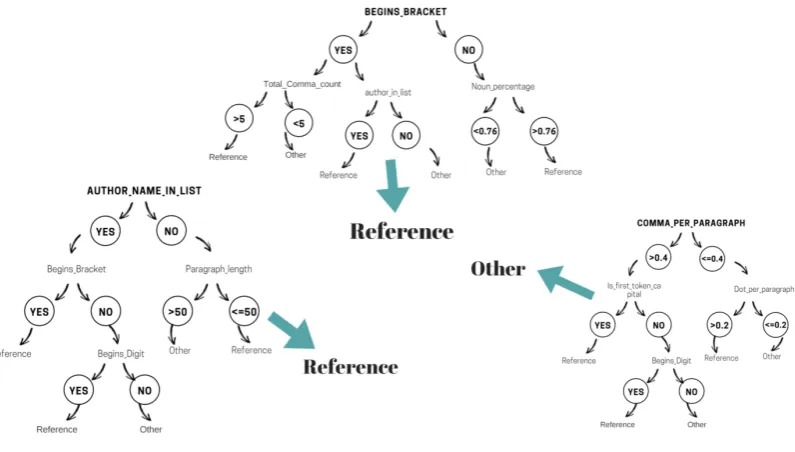
Each of these built decision trees predict if a paragraph is a reference-item or
normal text. Finally, a prediction is given based on the aggregation of the predictions
from the individual grown decision trees.
Figure 4.4: Example of Random Forest
Figure4.4shows three decision trees built on a randomly selected set of four
features. Based on this random forest the class label prediction will be
reference-item, since two of the grown decision trees predicted reference-item as the class label
for the given paragraph instance.
Random Forest has been proven to be a robust and easy to use algorithm in
classification tasks. It is easy to understand because the number of hyper-parameters
are not that high and default parameters often produce a good prediction result, as
[image:38.595.93.491.334.560.2]the problem of overfitting, which is one big problem in machine learning, doesn’t
apply to Random Forest if there is enough data and enough trees are built. Since
we have a considerable amount of data, overfitting will not be an issue in this
work. It is important to note that random forests does not take into account the
dependency that exists among sequential instances for example the dependency that
exists between consecutive reference-items that are found at the end of a document.
4.4 Conditional Random Fields (CRF)
Conditional Random Fields (CRFs) were proposed as a framework for building
prob-abilistic models to segment and label sequence data by Lafferty, Andrew McCallum,
and Pereira 2001. To understand how CRFs work let us consider the problem of
identifying the author and title from the text snippet in figure4.5.
Figure 4.5: Text snippet from Paaß and Konya2011
We can rewrite this text snippet in terms of words with their respective tags.
For simplicity let us mark the words including newlines with T if they belong to a
the title, with A if they belong to the authors, and with O if they don’t belong to
author name or title of the text snippet. This results with two vectors: xwords and
y labels as shown below in figure 4.6.
Figure 4.6: Word and State Vectors from Paaß and Konya2011
To infer the unknown labels one approach can be to use generative models.
Generative models such as Hidden Markov models explicitly attempt to model the
joint probability p(x, y) over the input (words) and output (states) sequence. This
a word we want to use can be like its identity, capitalization, prefixes, neighboring
words, and category in semantic databases like WordNet4. Modeling these kind of
input features leads to two important limitations. First, the dimensionality of x
(input features) can be very large. Second, the features can have complex
inter-dependencies. Constructing a probability distribution over such kind of features
becomes very difficult. Modeling the dependencies can lead to intractable models
and leaving them out can lead to performance reduction (Sutton, Andrew
McCal-lum, and Rohanimanesh2007).
Another approach is discriminative approach which directly models the
con-ditional distributions p(y|x) over the input and output sequences. This is the
ap-proach taken by CRFs. CRFs can model multivariate outputs with the ability to
leverage a large number of input features used for prediction. The advantage of
conditional models such as CRFs is that dependencies that involve only the input
features play no role for prediction and hence are not modeled.
CRFs are represented by undirected graphs. In these undirected
graphi-cal models, nodes represent random variables and edges indicate the dependency
between them. The dependencies between variables are expressed in the form of
po-tential functions (factors). These factors are non-negative functions of the variables
they are defined over. These factors are defined over cliques5 in the graph.
Having introduced the general principle and advantage of CRFs in
sequen-tial learning, let us formally describe how p(y|x) is defined by Lafferty, Andrew
McCallum, and Pereira2001.
Let G be undirected graph model over a set of random variables y and a
fixed observed variablex. A CRF is then a conditional distribution p(y|x), where :
p(y|x) = 1
Z(x) Y
ψAG
ψA(yA, xA;θ) (2)
and the factorsψA of the undirected graph model Gare parameterized as :
ψA(xA, yA;θ) =exp( K(A)
X
k=1
λAkfAk(xA, yA)) (3)
K(A) is the number of feature functionsfAk defining factorψA, andθ RN = {λAk}
are real valued parameters of the CRF. The normalization functionZ(x) is defined
4https://wordnet.princeton.edu/
as:
Z(x) =X
y
Y
ψAG
ψA(yA, xA;θ) (4)
and it sums over all possible assignments of y.
The factors above can be partitioned into set of clique templates C =
{C1, C2...Cp} , where each of the clique templates Cp is a set of factors whose
pa-rameters θp RN are tied (i.e. factors from the same template share the same
parameters ). Hence the equation to CRF can be rewritten as:
p(y|x) = 1
Z(x) Y
CpC
Y
ψcCp
ψc(yc, xc;θp) (5)
and the normalization function Z(x) is defined accordingly as:
Z(x) =X
y
Y
CpC
Y
ψcCp
ψc(yc, xc;θp) (6)
Let us further discuss from the formal definitions of CRF the important
points that are related with the sequential labeling task this thesis intends to solve.
The following points are inherited from comments stated in the thesis by Jancsary
2008 and apply to our case.
• In sequence labeling x is typically a sequence of input data. Here, the input
data is sequence of paragraphs that forms a document.
• A separate random variable yi y is linked with each node in the undirected
graphical model G. The random variables are discrete for the purpose of
se-quential labeling since the outcomes of these variables correspond to the labels
that can be assigned to the input sequences. If variables are adjacent in the
graph Gthen there is a dependency between them.
• Factors ψc are defined over cliques c of G. These factors assign potential to
variables of a clique. If G is a pairwise graph, there are only univariate or
bivariate factors. Bivariate factors define potentials for the joint outcomes of
the two vertex variables in a two node clique.
• The feature functions fck for a clique template Cp determine the value of
vari-ables of factor ψc over the clique c. Typically G has a repetitive structure
Feature functions are often binary which depend on the local context xc and
the variable assignment yc of clique c. A typical example of a feature function
can be a binary test that has value of 1 if and only if the previous label is
"adjective", current label is "proper noun", and the current word begins with a
capital letter. It can be defined as follows:
fck(yc, xc) =
1 if yc= (ADJ,NNP)and xc= ( begins with a capital letter , ...)
0 otherwise
(7)
Having introduced the general working principles of CRFs let us briefly
de-scribe the two types of CRFs that are used in this thesis.
Many families of CRFs are described in Andrew McCallum, Rohanimanesh,
and Sutton2003in detail. The different families are identified based on the structure
of the graphical model and the form in which the parameters are tied. Among these
families, Linear CRFs and Dynamic CRFs are applied in this thesis and hence are
discussed next.
4.4.1 Linear chain CRFs
Linear chain CRFs are one well known type of CRFs and are similar to HMMs.
Linear chain CRFs have only one connected chain of labels where their parameters
are tied across time. Factors are typically defined over single-node and two-node
cliques. These factors capture the local probabilities and transition probabilities
respectively. In section 4.1 we discussed the possible multi-level labels a sequence
of paragraphs can have. The linear-chain CRFs have only one level of labels. For
example, from figure 4.1 only the lower level labels are used to build a linear-chain
CRF.
4.4.2 Dynamic CRFs
Dynamic CRFs are sequence models which allow multiple labels at each time step,
rather than single labels as in linear-chain CRFs. Dynamic CRFs are generalizations
extraction is used. Each instance (i.e. paragraph) has two class labels. For example,
the first category of labels identifies if a paragraph is a reference-item or not. The
second category can further group paragraphs and identify if a paragraph is found
in the first part of the document, middle part or the end of the document.
Dynamic CRFs learn the dependencies between the categories of labels
rather than learning two different classifiers for each category. Ghamrawi and
An-drew McCallum 2005 shows that improved classification performance is achieved
using dynamic CRFs than using different classifiers for each category.
4.5 Long Short-Term Memory (LSTM)
Long Short-Term Memory (LSTM) is one variant of recurrent neural networks. To
get better understanding of LSTMs let us first discuss artificial neural networks
and recurrent neural networks. Artificial neural networks (ANNs) are weighted
directed graphs in which artificial neurons are nodes and weighted directed edges are
connections between neuron outputs and neuron inputs. Based on the architecture,
ANNs are grouped into two types. (Jain, J. Mao, and Mohiuddin1996)
• Feed-forward neural networks - graphs with no loop and neurons have
unidi-rectional connections between them.
• Recurrent (Feedback) neural networks (RNNs) - loops occur because of
feed-back connections. These loops allow information to persist unlike Feed-forward
networks.
In theory RNNs can be applied to connect contextual information from any
time in the past (also known as long-term dependency) to a present task since their
feedback loops allow information to persist. However in practice they suffer a
prob-lem called error back-flow probprob-lem. Error signals flowing backwards in time tend to
either blow up or vanish. Before discussing the two types of error back-flow
prob-lems let’s discuss how RNNs are trained. Training of RNNs is an iterative process.
Both the inputs and outputs are provided to the network. The network processes
the inputs and compares the actual outputs with the predicted outputs. The