Cues to deception in the eyes
Examining eye contact and self-dissociation with eye tracking
Master thesis
Branda Wolters
Enschede, 2019
University of Twente
Psychology of Conflict, Risk and Safety
Faculty of Behavioral, Management and Social sciences
Supervisors:
Dr. ir. P. W. de Vries
2
Abstract
Detecting deception is an important factor in several professional contexts. However,
people perform at chance level when detecting deception based on subjective indicators of
deception and this becomes only slightly better when trained. Therefore, more objective
technologies for detecting deception, such as polygraphs, have been developed. In the current
study, there has been made use of eye tracking technology in combination with subjective
cues to deception regarding the eyes as a new version of the polygraph in order to
differentiate liars from truth tellers in interrogation settings. An experiment was conducted in
which participants were asked to lie about witnessing a good friend committing an armed
robbery. Based on participants’ gaze behavior, it was examined whether liars made less eye
contact with the interrogator than truth tellers and whether they dissociated themselves from
the lie. Also, cognitive load was manipulated with a secondary task in order to check whether
these effects became stronger. The findings provided insufficient evidence to support the
hypotheses. So, in the current study, eye tracking technology could not differentiate liars from
truth tellers in interrogation settings. Nevertheless, the current study provides a basis for
future research on eye tracking technology in which recommendations have been made and
more can be learned about differentiating liars from truth tellers with regard to cues to
3
Introduction
In general, detecting deception is an important factor in several contexts, for example
in the forensic field. However, people perform at chance level when detecting deception based
on subjective indicators of deception; a 54% average of correctly classifying truths and lies
(Riggio & Friedman, 1983; Vrij, Granhag, Mann & Leal, 2011). Even when trained, people
perform only 4% better (Frank & Feeley, 2003). Because people are not good in accurately
detecting deception based on subjective cues to deception, more objective technologies have
been developed in an attempt to achieve higher lie detection accuracy. Physiological response
measurements such as polygraphs are frequently used. Furthermore, a new method has
evolved using eye tracking technology (Kovalev, Luniakova, & Menshikova, 2016) which is
the main focus in the current study.
Polygraphs are methods used to detect deception in a psychophysiological manner by
measuring physiological responses as skin conductance, heart rate, voice frequency, breathing
patterns, and facial expressions (Andreassi, 2000). The assumption is that lying and deceptive
behaviors reflect in these physiological responses and that, therefore, responses of liars are
different from those of truth tellers (Grubin & Madsen, 2007). Two main types of polygraphs
are the Comparison Question Test (CQT) and the Concealed Information Test (CIT), both
used in settings in which an interviewer poses questions to an interviewee. The CQT operates
by asking questions which are relevant for the issue under investigation and comparison
(control) questions which are nonspecific. The CIT operates using multiple choice questions
with answers which contain one crime-relevant answer and non-crime-relevant control
answers for the remainder. The assumption for both tests is that guilty subjects will react
stronger to the relevant questions and answers than to the control questions and answers and
4 Nevertheless, for both polygraphs, the accuracy is debatable. In case of the CQT, the
accuracy rate of correctly classifying guilty subjects is moderately high (87-98%). However,
the accuracy rate of correctly classifying innocent subjects is rather low (55-56%), which
means a quite high rate of falsely classifying innocent subjects as guilty (Patrick & Iacono,
1989; Patrick & Iacono, 1991). For the CIT, it is the other way around. Here, the rate of
innocent subjects being correctly classified is quite high (94-98%) and the rate of guilty
subjects being correctly classified relatively low (42-76%) (Elaad, 1990; Elaad, Glinton &
Jungman, 1992). Therefore, the accuracy of these polygraphs is debatable.
Another, quite new, objective technology in distinguishing liars from truth tellers with
similar intentions as the polygraph is eye tracking. An eye tracking device measures a
person’s exact point of gaze or eye movement when performing a task. It provides
information about people’s gaze behavior. Eye trackers are mostly using video-based methods
which enable measuring eye movements to be non-invasive (Borys, Plechawska-Wójcik,
2017). Eye tracking has been applied interdisciplinary such as in fields of psychology,
marketing, industrial engineering, and computer science (Duchowski, 2017). The most
commonly measured concepts in eye tracking that can give insight into people’s gaze
behavior are eye fixations and saccades. An eye fixation is formed when multiple gaze points
on a certain object, which are close to each other regarding time and space, form a cluster. A
fixation describes a period of time in which the eyes are locked towards a specific object. In
between fixations, the eyes make saccades which are quick movements of the eyes in which
the eyes jump from one object to another (iMotions, 2017). Gaze behavior is formed by
fixations as well as saccades and can demonstrate to which stimuli the attention of the eyes is
drawn to. It can give an indication of what the attention of a person is focused on (Frischen,
5 Applied to detection of deception, eye tracking has similar intentions as polygraphs.
The same setting can be applied as well in which an interviewer poses questions to an
interviewee. However, now, the focus is on people’s gaze behavior instead of on their
physiological responses. For example, people could be interrogated or could be shown
incriminating footage wearing eye tracking glasses in order to check where one is fixated on
or gazing at. Previous studies, which focused on detecting concealed information using eye
tracking technology, already found that it is possible to distinguish liars from truth tellers
based on people’s gaze behavior (Derrick, Moffitt, & Nunamaker, 2011; Schwedes &
Wentura, 2011). Furthermore, there are cues to deception that can differentiate liars from truth
tellers based on their gaze behavior (Sporer & Schwandt, 2007; DePaulo, Lindsay, Malone,
Muhlenbruck, Charlton & Cooper, 2003; Vrij, Mann, Leal, & Fisher, 2010). The combination
of eye tracking with these cues to deception might form a new, and perhaps improved, version
of the polygraph. In this study, it is going to be examined whether it is possible to detect liars
in interrogation settings using eye tracking in combination with cues to deception concerning
gaze behavior. The following research question is formed: To what extent can eye tracking
technology be used in differentiating liars from truth tellers in interrogation settings?
Theoretical Framework
An often used definition of deception according to DePaulo (1988) is: “(…) an act of
purposefully conveying to others information the deceiver believes to be false. Deceivers are
(…) deliberately misleading others; they are not doing so mindlessly or mistakenly” (p. 155).
When misleading others, deceivers do not want to be caught. Therefore, they try to hide and
control verbal and nonverbal cues that might lead to the detection of their lies (DePaulo,
6 There are three main approaches in predicting people’s behavior when they are lying.
These approaches are the emotional approach, the attempted control approach, and the
cognitive load approach. According to the emotional approach, lying causes physiological
reactions due to increased arousal. The approach emphasizes that lying comes with stress
caused by feelings of guilt or fear. Liars experience guilt because they are aware that they act
against common values, and fear of being caught (Zuckerman, DePaulo & Rosenthal, 1981;
Riggio & Friedman, 1983). Therefore, liars leak experienced emotions due to increased
tension and nervousness. Actual indicators of detecting these experienced emotions are
through verbal behaviors as a higher pitch of voice and speech disturbances (Zuckerman,
DePaulo & Rosenthal, 1981; Ekman, 1992).
In addition to verbal behaviors, there are also nonverbal behaviors through which liars
may leak cues to deception. The attempted control approach argues that liars attempt to hide
any leakage of cues to deception through nonverbal behaviors by controlling these nonverbal
behaviors. In general, (lay) people assume that liars show an increase in the frequency or
intensity of nonverbal behaviors such as body movements. Therefore, liars try to show the
opposite behavior – fewer body movements – in order to hide a lie and to appear credible
(Sporer & Schwandt, 2007; DePaulo et al., 2003). However, this leads to showing unusual
inhibition in body movements which then actually gives away that they are lying (DePaulo,
Kirkendol, Tang, O’Brien, 1988, Vrij & Semin, 1996). Also, when controlling their nonverbal
behaviors, liars will appear less involved, less spontaneous, less convincing, and more tense
(DePaulo et al., 2003; Sporer & Schwandt, 2007).
Further, according to the cognitive load approach it is cognitively more demanding to
lie than to tell the truth (Vrij, Fisher, Mann, & Leal, 2006; Vrij et al., 2010; Vrij et al., 2011;
Vrij & Granhag, 2012). With lying, it is cognitively demanding to formulate and remember a
7 monitor and control their behaviors in order to appear honest and to monitor the reaction of
the person that has been lied to in order to assess credibility of the lie. In addition, activating a
lie is more cognitively demanding than activating the truth as activating the truth usually
happens automatically. Moreover, suppressing the truth requires cognitive demands (Vrij et
al., 2011). Due to this cognitive load, liars might show verbal cues to deception as longer
pauses between question and answer, within statements, slower speech rates, and more speech
disturbances (Vrij & Semin, 1996; Zuckerman, DePaulo & Rosenthal, 1981). Furthermore,
the cognitive demands when lying cause nonverbal cues as fewer body movements (Ekman,
1992) and a reduction in eye contact with the person to be deceived (Sporer & Schwandt,
2007; Zuckerman, DePaulo & Rosenthal, 1981).
Applied to eye tracking, cues to deception regarding liars’ eyes can be examined rather
precisely with eye tracking technology. Therefore, reducing eye contact with the person to be
deceived as a cue to deception will be elaborated on. Less eye contact with the person lied to
is caused by cognitive load as well as by feelings of guilt and fear (Sporer & Schwandt, 2007;
Zuckerman, DePaulo & Rosenthal, 1981). In research of Vrij et al. (2010), it was found that
requesting mock suspects to maintain eye contact with the interviewer during a staged
interrogation increased the presence of other nonverbal cues to deception due to increased
cognitive load. Therefore, liars look away in order to manage their cognitive load.
Furthermore, liars show less eye contact when a lie involves feelings compared to when there
has been lied about facts only (Sporer & Schwandt, 2007). Also, in the meta-analysis of
DePaulo et al. (2003), it was shown that liars who were motivated to make the lie succeed
made less eye contact than liars who were less motivated and truth tellers because the
necessity to make a lie succeed already increases cognitive load. However, in general, the
relationship between eye contact and deception is found to be quite weak or even non-existent
8 examined multiple times, it has not yet been examined using eye tracking techniques which
would give a much more precise location of where the eyes of the liar are fixated on in the
face of the person lied to. Therefore, in the current study, the relationship between eye contact
and deception will again be examined using eye tracking technologies:
H1. Liars will show less eye contact with their collocutor than truth tellers.
Next to verbal and nonverbal behaviors, the words liars are using for their deceptive
stories can also be an indicator for deception. Liars have a certain control over the choice of
words. However, as liars are also human, a lie may become transparent through the way the
words are used. First of all, liars may have feelings of guilt and discomfort which could lead
to using more negative emotion words in telling their lies. Second, liars tell less complex
stories due to cognitive load. It is less cognitively demanding to compile a story with simple,
concrete actions and leave out all the additional (also false) information (Newman,
Pennebaker, Berry & Richards, 2003). Third, liars tend to use fewer first-person pronouns.
They do so because they have a lack of personal experience in their story (Knapp, Hart &
Dennis, 1974) or because they want to dissociate themselves from the lie in order to avoid
self-incrimination and responsibility for the lie (Taylor, Larner, Conchie & Menacere, 2017).
So actually, by using fewer first-person pronouns, liars will get the feeling that they
are less confronted with their own lies. Another reason why liars are less confronted with their
own lies is because they usually do not receive accurate feedback on their lying behavior (e.g.
in face and body) because they do not see themselves (Ekman, 1992). When placing a mirror,
liars have the possibility to look at their self-image. Consequently, they will be confronted
with their own lying behavior because, now, they do receive feedback and will, therefore,
9 the mirror might increase tension and therefore impede deceiving (DePaulo et al., 2003). That
is why it is expected that liars will avoid looking at their self-image when deceiving. This is
also something that can be examined rather precisely with eye tracking technologies:
H2. Liars will glance less at their self-image compared to truth tellers.
Increasing cognitive load
One way to find out whether or not someone is lying is by manipulating cognitive
load. As described above, lying is cognitively demanding. It increases activation of executive
areas in the brain such as in the prefrontal cortex. The prefrontal cortex is important for
adaptive behaviors in difficult situations. Liars need to remember the lie, need to keep their
stories straight, need to withhold the truth, and have to monitor themselves and the person lied
to all at the same time. As a result of executing multiple cognitive tasks simultaneously, liars
will show reductions in other behaviors which are, at that moment, perceived by the brain as
less necessary (Spence, Hunter, Farrow, Green, Leung, Hughes, & Ganesan, 2004). Examples
are cues to deception as fewer body movements, longer pauses between answers and
questions, slower speech rates, and more speech disturbances (Ekman, 1992; Vrij & Semin,
1996; Zuckerman, DePaulo & Rosenthal, 1981). Also, less eye contact with the person lied to
(H1) and less looking at one’s self-image (H2) when that is possible (e.g. when there is a
mirror present) are behaviors that might occur when lying is cognitively demanding due to an
increased activation of the executive areas in the prefrontal cortex.
A way to enhance the detection of lies is by increasing cognitive load to make it even
more demanding for liars to maintain their lie consistent. This can be achieved by making
additional requests. In interrogation settings, interviewees could be asked to tell their story in
10 interviewees (Vrij & Granhag, 2012). Another way to deplete liars’ cognitive resources is to
require them to execute a secondary task during the interrogation (Vrij et al., 2006). For
example, interviewees could be instructed to avoid mentioning a certain commonly used word
out loud. The expectation is that liars will behave differently in reaction to the secondary task
compared to truth tellers and that, therefore, behavioral differences between liars and truth
tellers become even more clear. Subsequently, there can be discriminated more adequately
between liars and truth tellers (Vrij & Granhag, 2012).
So, the aim with increasing the cognitive load is to intensify liars’ already shown
behaviors. Telling the truth is cognitively little demanding because a story is based upon real,
not made up, experiences. It is expected that truth tellers, therefore, will show the same
behaviors (e.g. regular eye contact with the interviewer) when cognitive load is increased as
when it is not. Lying, on the other hand, depletes cognitive resources. Hence, as described
previously, people will show inhibitions in certain behaviors when lying (e.g. less eye contact
with the interviewer). So, when cognitive load is increased, lying will be even more
cognitively demanding. Then, inhibitions in these behaviors will be reduced even more. For
example, liars will then make even less eye contact with the interviewer. In the current study,
increasing cognitive load can be added to the first and second hypothesis. It will be expected
that increasing cognitive load will cause liars to make even less eye contact with their
collocutor and glance even less at their self-image compared to truth tellers:
H3. The difference in gaze behavior, eye contact with the collocutor, between liars and truth tellers will be enlarged when increasing cognitive load.
11
Method Participants & design
A total of 129 participants took part in the experiment. Three participants were
excluded from the sample size due to badly trackable pupil movement, hence, 126 participants
remained. The participants were recruited using the researcher’s social circle and the test
subjects pool SONA of the University of Twente. The experiment was conducted in either a
clubhouse in Wijtgaard, Friesland (45.2%) or in a research room at the University of Twente
in Enschede, Overijssel (54.8%). The sample size consisted of 35.7% males and 64.3%
females with a mean age of 31.6 (SD = 15.3; range 16 – 74 years). Further, 81% was Dutch
and 19% was German with various educational backgrounds (secondary education: 8.7%;
vocational education (MBO): 13.5%; higher education (HBO): 36.5%; university education
(WO): 41.3%). All participants had normal or corrected-to-normal vision. The study had a 2
(Lying: yes vs. no) x 2 (Cognitive Load: high vs. low) x 2 (Stage: baseline vs. experiment)
mixed-participant factorial design with Lying and Cognitive Load as between-participant
variables and Stage as within-participant variable. The dependent variables were total fixation
duration and fixation count on the eyes of the interrogator and on participants’ self-image.
Procedure
The experiment took place in individual sessions of approximately 15 minutes. Before
the experiment, participants received an informed consent which they needed to sign in order
to participate to the experiment (appendix A). Then, the Tobii eye tracker glasses (see figure
1) were placed over the participants’ eyes and subsequently calibrated. The Tobii eye tracker
glasses were connected to a tablet which recorded the gaze behavior of the participants
throughout each session. Next, the participants were instructed to take place in front of a
12 participants needed to read instructions on the laptop, followed by watching a video, followed
by a short questioning about the video via Skype, an online video chat platform, with an
interrogator (a fellow student of the researcher) asking the same questions to each participant.
The reason for Skype was because then the cues to deception – making eye contact and
glancing at the self-image – from the hypotheses could be examined at once in one setting
(see figure 2). In order to minimalize external variables of cognitive load, the interrogation
questions were asked in either Dutch or German, depending on the nationality of each
participant. In total, two different interrogators contributed to the research; one in Friesland,
who only spoke Dutch, and one in Overijssel, who spoke both Dutch and German.
[image:12.595.277.523.329.468.2]
Figure 1. Tobii eye tracking glasses Figure 2. Skype interface
Stage
First, the baseline Stage took place. A baseline was created in order to filter out
personal differences between participants. First, the participants had to read instructions (see
appendix B.2). Then, a video of approximately two minutes of wild animals in nature was
shown to the participants (see figure 3). Subsequently, a short interrogation about the video
took place via Skype with the interrogator who was in front of a computer screen in another
room. All participants were asked the same questions about the shown video (e.g. Which
animals did you see?). See appendix G for all the questions. After the questions were posed
13 Next, the experimental Stage took place. The participants again had to read
instructions followed by a video of approximately two minutes about a person committing an
armed robbery in a gas station (see figure 4). The participants were told that the police wanted
to question everybody that was near the crime scene and that the concerning participant was
up next. This interrogation was again a short questioning via Skype in either Dutch or German
administered by the same interrogator. All participants were asked the same questions about
the crime (see appendix H). First, a couple of general questions (e.g. What do you think of the
crime you just witnessed?) followed by a couple of crime specific questions (e.g. How many
persons were committing the crime?). The participants were told that the interrogator did not
see the video just as in a real investigation in order to stimulate the participants to participate
seriously. After all the questions were posed and answered, the Skype session was shut down.
[image:13.595.73.521.388.555.2]
Figure 3. Screenshot baseline video Figure 4. Screenshot experimental video
Lying and Cognitive Load
The baseline Stage was for all participants the same. However, in the experimental
Stage, the participants were randomly instructed to either lie (i.e. Lying: yes) or tell the truth
(i.e. Lying: no). Participants in the lying condition were instructed to perceive the person in
the video who committed the crime as a close friend who needed to be protected. Therefore,
14 possible with the truth and to do this in a way in which the interrogator would not notice. It
was also emphasized that the interrogator was a police officer in order to motivate the
participants to appear credible. In order to motivate the participants in this condition even
further to participate seriously, it was mentioned that the participant who appeared most
credible would win a smartwatch. See appendix C for the instruction form.
Participants in the truth telling condition were instructed to answer every question with
the truth. If a participant would not know an answer to a question, they were instructed to
mention that they did not know the answer instead of making up an answer. See appendix E
for the instruction form. Further, a manipulation was added (i.e. Cognitive Load: high vs.
low). In both conditions (i.e. Lying: yes and Lying: no), half of the participants were
randomly assigned a secondary task to increase cognitive load. They were instructed to avoid
mentioning filler words as “um” or “uh”. See appendixes D and F for the instruction forms.
Post-experiment questionnaire
Lastly, after finishing the experimental Stage, participants had to fill out a
questionnaire which measured three variables (see appendix I for all the items). First, the
perceived cognitive state of the participants was measured consisting of eight statements (e.g.
During the interrogation I tried to hide my nerves.) with a 5-point Likert scale (strongly
disagree – strongly agree). De Cronbach’s alpha for perceived cognitive state was α = .66
which indicates a reasonable reliability for this scale. Second, the perceived cognitive load of
the participants was measured consisting of five statements (e.g. I experienced the experiment
as cognitively demanding.) with a 5-point Likert scale (strongly disagree – strongly agree).
This variable was derived from de NASA-TLX (Task Load Index), a multidimensional
assessment tool aimed at rating subjective experiences of workload to assess various aspects
15 was α = .72 which indicates a reasonable to good reliability for this scale. Third, it was
measured how participants perceived their own gaze behavior towards the eyes of the
interrogator and their self-image. Perceived gaze behavior was measured by means of two
statements (i.e. I tried to avoid looking into the eyes of the interrogator/at the frame of my
self-image in Skype) with a 5-point Likert scale (strongly disagree – strongly agree). There
was a strong, positive, statistically significant correlation between the both statements of
perceived gaze behavior, rs(124) = .230, p = .009.
After the questionnaire, a short debriefing was held in which the researcher explained
the real purpose of the research, thanked the participants for their participation and asked if
they still had questions about or negative feelings towards the experiment. Further, the
researcher indicated that the participants could contact the researcher for any further
questions. Also, it was emphasized that the participants could not discuss the experiment with
other participants.
Tobii Pro Lab
In order to detect whether participants were having eye contact with the interrogator
and were glancing at their self-image during the experiment, areas of interest (AOI) were
created in the Skype interface (see figure 5) with Tobii Pro Lab (64x), the software that
belongs to the Tobii eye tracking glasses. AOIs were created on the eyes of the interrogator in
the center of the screen (AOI 1) and on the little frame of participants’ self-image in the upper
right corner (AOI 2). In order to gather accurate results in Tobii Pro Lab, the AOIs needed to
be static frames. However, in contrast to AOI 2, AOI 1 was a dynamic frame. So, in order to
make AOI 1 a static frame, the interrogator was placed on a static chair and was instructed to
sit still in a static position during each interrogation. In this way, Tobii Pro Lab could
16 By means of automatic mapping, Tobii Pro Lab mapped the participants’ eye fixations
from the recordings onto snapshots that were made from the point of view of the participants
(see figure 5). Tobii Pro Lab needed to map an average duration of 82.18 seconds for the
baseline Stage and an average duration of 115.69 seconds for the experimental Stage. On each
day of conducting the experiment, a new snapshot was made to correct for differences in the
interrogator’s clothing and hairstyle. In this way, it was made sure that Tobii Pro Lab could
compare the snapshots with the recordings. Each automatically mapped fixation was also
checked manually by the researcher. When an automatically mapped fixation was wrongly
placed, the fixation was manually corrected by the researcher. After mapping all the
recordings, Tobii Pro Lab converted the data of the metrics – total fixation duration and
fixation count – into an Excel file, which subsequently was being implemented into IMB
[image:16.595.71.315.416.567.2]SPSS Statistics 25 in order to conduct data analyses.
Figure 5. AOI 1 (red) and AOI 2 (green)
Dependent variables
The dependent variables of the experiment were total fixation duration (in seconds)
and fixation count on the eyes of the interrogator and on the participants’ self-image in Skype.
The eyes of the interrogator (AOI 1) were important for hypothesis 1 and 3 and the little
17 The post-experiment questionnaire included three dependent variables. First, perceived
cognitive state, in which participants rated their experienced tension and nervousness. Second,
perceived cognitive load, in which participants rated their experienced mental effort. Third,
perceived gaze behavior, in which participants rated their own gaze behavior towards the eyes
of the interrogator and towards their own self-image to get an idea about how the participants
perceived AOI 1 and AOI 2.
Results
Several analyses have been performed. First, the main areas of interest of the
hypotheses, the eyes of the interrogator and participants’ self-image, were examined. Then,
the variables of the post-experiment questionnaire were examined. Last, explorative areas of
interest in the Skype interface, besides the interrogator’s eyes and participants’ self-image,
were looked into.
Main areas of interest
It was examined whether lying and increasing cognitive load had effects on
participants’ gaze behavior towards the eyes of the interrogator and towards their self-image.
All hypotheses were analyzed by means of 2 (Lying: yes vs. no) x 2 (Cognitive Load: high vs.
low) x 2 (Stage: baseline vs. experiment) repeated measures MANOVA tests. The results are
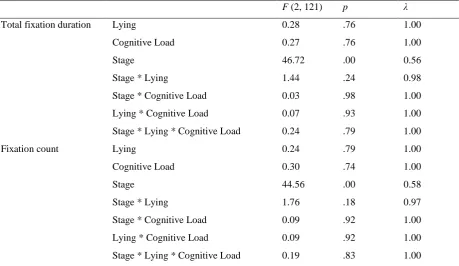
displayed in table 1.
Total fixation duration
A repeated measures MANOVA test analyzed total fixation duration (in seconds) on
both AOI 1 and AOI 2 for Lying and Cognitive Load over both Stages. The results showed
18 = 0.28, p = .76; Wilks’ λ = 1.00, and for Cognitive Load on AOI 1 and AOI 2, F(2, 121) =
0.27, p = .76; Wilks’ λ = 1.00. However, there was a statistically significant main effect for
Stage on AOI 1 and AOI 2 as a group, F(2, 121) = 46.72, p < .01; Wilks’ λ = 0.56. Univariate
analyses revealed that participants’ total fixation duration on AOI 1 was significantly longer
in the experimental Stage (M = 30.08, SD = 23.88) than in the baseline Stage (M = 16.50, SD
= 13.41), F(1, 122) = 92.29, p < .01. Yet, Stage has no statistically significant effect on AOI
2, F(1, 122) = 0.62, p = .43.
Further, there was no statistically significant interaction effect between Lying and
Stage on AOI 1 and AOI 2, F(2, 121) = 1.44, p = .24; Wilks’ λ = 0.98, between Cognitive
Load and Stage on AOI 1 and AOI 2, F(2, 121) = 0.03, p = .98; Wilks’ λ = 1.00, between
Lying and Cognitive load on AOI 1 and AOI 2, F(2, 121) = 0.07, p = .93; Wilks’ λ = 1.00,
and between Lying, Cognitive Load, and Stage on AOI 1 and AOI 2, F(2, 121) = 0.24, p =
.79; Wilks’ λ = 1.00.
Fixation count
A repeated measures MANOVA test analyzed fixation count on both AOI 1 and AOI
2 for Lying and Cognitive Load over both Stages. The results showed that there was no
statistically significant main effect for Lying on AOI 1 and AOI 2, F(2, 121) = 0.24, p = .79;
Wilks’ λ = 1.00, and for Cognitive Load on AOI 1 and AOI 2, F(2, 121) = 0.30, p = .74;
Wilks’ λ = 1.00. However, again for Stage, a statistically significant main effect was found on
AOI 1 and AOI 2 as a group, F(2, 121) = 44.56, p < .01; Wilks’ λ = 0.58. Univariate analyses
revealed that participants’ fixation count on AOI 1 was significantly higher in the
experimental Stage (M = 79.14, SD = 64.05) than in the baseline Stage (M = 47.66, SD =
38.06), F(1, 122) = 88.21, p < .01. Yet, Stage has no statistically significant effect on AOI 2,
19 Further, a close to statistically significant interaction effect was found between Lying
and Stage on AOI 1 and AOI 2 as a group, F(2, 121) = 1.76, p = .18; Wilks’ λ = 0.97.
Pairwise comparisons revealed that liars’ (p < .01) as well as truth tellers’ (p < .01) fixation
count on AOI 1 was significantly higher in the experimental Stage (liars: M = 82.62, SD =
8.10; truth tellers: M = 75.26, SD = 8.21) than in the baseline Stage (liars: M = 48.94, SD =
4.81; truth tellers: M = 46.05, SD = 4.88). For AOI 2, there was no statistically significant
difference between the baseline and experimental Stage for liars (p < .53). For truth tellers,
fixation count was higher (yet not significant, p < .11) in the experimental Stage (M = 4.32,
SD = 1.09) than in the baseline Stage (M = 3.02, SD = 0.54). Further, no statistically
significant interaction effect was found between Cognitive Load and Stage on AOI 1 and AOI
2, F(2, 121) = 0.09, p = .92; Wilks’ λ = 1.00, between Lying and Cognitive load on AOI 1 and
AOI 2, F(2, 121) = 0.09, p = .92; Wilks’ λ = 1.00, and between Lying, Cognitive Load, and
Stage on AOI 1 and AOI 2, F(2, 121) = 0.19, p = .83; Wilks’ λ = 1.00. Hence, hypotheses 1,
[image:19.595.70.530.502.768.2]2, 3, and 4 are not confirmed.
Table 1. MANOVA table with effects for Lying, Cognitive Load, and Stage on AOI 1 and AOI 2.
F (2, 121) p λ
Total fixation duration Lying 0.28 .76 1.00
Cognitive Load 0.27 .76 1.00
Stage 46.72 .00 0.56
Stage * Lying 1.44 .24 0.98
Stage * Cognitive Load 0.03 .98 1.00
Lying * Cognitive Load 0.07 .93 1.00
Stage * Lying * Cognitive Load 0.24 .79 1.00
Fixation count Lying 0.24 .79 1.00
Cognitive Load 0.30 .74 1.00
Stage 44.56 .00 0.58
Stage * Lying 1.76 .18 0.97
Stage * Cognitive Load 0.09 .92 1.00
Lying * Cognitive Load 0.09 .92 1.00
20
Post-experiment questionnaire
As mentioned in the method section, two variables, perceived cognitive state and
perceived cognitive load, were found reliable to use. The third variable, perceived gaze
behavior, with a strong correlation between the two measured statements, was taken into
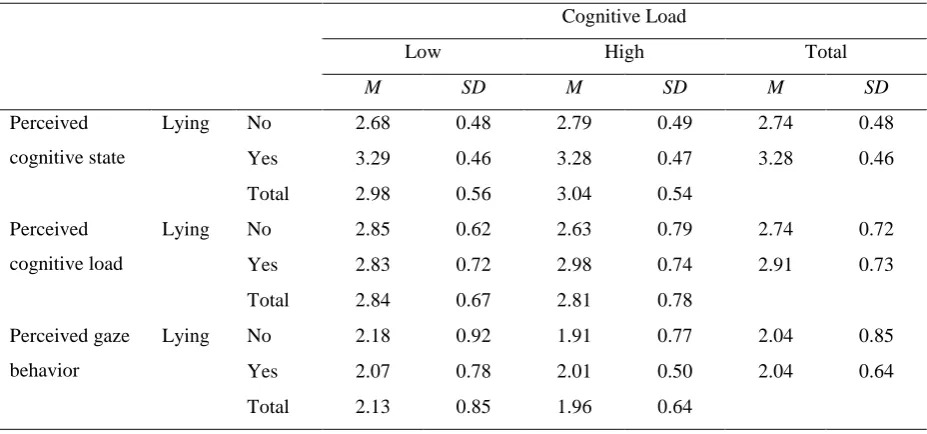
account in order to get an idea about how the participants perceived AOI 1 and AOI 2. Table
2 shows the descriptive statistics, mean and standard deviation, of all variables for Lying and
Cognitive Load. A one-way MANOVA test has been conducted on perceived cognitive state,
perceived cognitive load, and perceived gaze behavior for Lying and Cognitive Load.
The results showed a statistically significant main effect for Lying on perceived
cognitive state, perceived cognitive load, and perceived gaze behavior as a group, F(3, 120) =
14.90, p < .01; Wilks’ λ = 0.73. Univariate analyses revealed that perceived cognitive state
was significantly higher for liars (M = 3.28, SD = 0.46) than for truth tellers (M = 2.74, SD =
0.48), F(1, 122) = 41.56, p < .01. No statistically significant effect was found on perceived
cognitive load, F(1, 122) = 1.64, p = .20, and perceived gaze behavior, F(1, 122) = 0.01, p =
.98. Further, the results showed that there was no statistically significant main effect found for
Cognitive Load on perceived cognitive state, perceived cognitive load, and perceived gaze
behavior as a group, F(3, 120) = 0.83, p = .48; λ = 0.98. Also, there was no statistically
significant interaction effect found between Lying and Cognitive Load, F(3, 120) = 1.51, p =
.22; λ = 0.96. However, when looking into the pairwise comparisons between liars and truth
tellers, it appeared that for perceived cognitive load, liars with high Cognitive Load (M =
2.98, SD = 0.12) experienced significantly more cognitive load (p = .04) during the
21 Table 2. Descriptive Statistics of the variables perceived cognitive state, perceived cognitive load, and perceived gaze behavior for Lying and Cognitive Load.
Cognitive Load
Low High Total
M SD M SD M SD
Perceived
cognitive state
Lying No 2.68 0.48 2.79 0.49 2.74 0.48
Yes 3.29 0.46 3.28 0.47 3.28 0.46
Total 2.98 0.56 3.04 0.54
Perceived
cognitive load
Lying No 2.85 0.62 2.63 0.79 2.74 0.72
Yes 2.83 0.72 2.98 0.74 2.91 0.73
Total 2.84 0.67 2.81 0.78
Perceived gaze
behavior
Lying No 2.18 0.92 1.91 0.77 2.04 0.85
Yes 2.07 0.78 2.01 0.50 2.04 0.64
Total 2.13 0.85 1.96 0.64
Explorative areas of interest
It is expected that liars avoid gazing at the eyes of the interrogator and at their
self-image. Consequently, they must be gazing at other areas. When conducting the experiment, it
was notable that participants were also gazing at the mouth and bottom part of the nose of the
interrogator, as well as to areas beyond the interrogator. Hence, there have also been made
AOIs in Tobii Pro Lab on these areas in order to test hypothesis 1, 2, 3, and 4 as substitute
hypotheses on these AOIs, but then for substitute hypothesis 1 and 2 the other way around
(i.e. whether liars will gaze more instead of less at these AOIs than truth tellers). The AOIs
were created on the mouth and nose of the interrogator (AOI 3, see figure 6) for substitute
hypothesis 1 and 3 and on the total screen minus the face of the interrogator and minus the
participant’s self-image (AOI 4, see figure 7) for substitute hypothesis 2 and 4. All hypotheses
were again analyzed by means of 2 (Lying: yes vs. no) x 2 (Cognitive Load: high vs. low) x 2
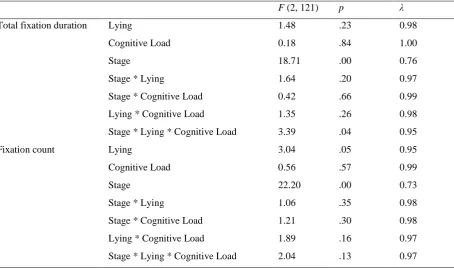
(Stage: baseline vs. experiment) repeated measures MANOVA tests. The results are displayed
22
[image:22.595.74.529.302.570.2]Figure 6. AOI 3 (yellow) Figure 7. AOI 4 (orange)
Table 3. MANOVA table with effects for Lying, Cognitive Load, and Stage on AOI 3 and AOI 4.
F (2, 121) p λ
Total fixation duration Lying 1.48 .23 0.98
Cognitive Load 0.18 .84 1.00
Stage 18.71 .00 0.76
Stage * Lying 1.64 .20 0.97
Stage * Cognitive Load 0.42 .66 0.99
Lying * Cognitive Load 1.35 .26 0.98
Stage * Lying * Cognitive Load 3.39 .04 0.95
Fixation count Lying 3.04 .05 0.95
Cognitive Load 0.56 .57 0.99
Stage 22.20 .00 0.73
Stage * Lying 1.06 .35 0.98
Stage * Cognitive Load 1.21 .30 0.98
Lying * Cognitive Load 1.89 .16 0.97
Stage * Lying * Cognitive Load 2.04 .13 0.97
Total fixation duration
A repeated measures MANOVA test analyzed total fixation duration (in seconds) on
both AOI 3 and AOI 4 for Lying and Cognitive Load over both Stages. The results showed
that there was no statistically significant main effect for Lying on AOI 3 and AOI 4, F(2, 121)
= 1.48, p = .23; Wilks’ λ = 0.98, and for Cognitive Load on AOI 3 and AOI 4, F(2, 121) =
23 Stage on AOI 3 and AOI 4 as a group, F(2, 121) = 18.71, p < .01; Wilks’ λ = 0.76. Univariate
analyses revealed that participants’ total fixation duration on both AOI 3, F(1, 122) = 35.90, p
< .01, and AOI 4, F(1, 122) = 6.30, p = .01, was significantly longer in the experimental Stage
(AOI 3: M = 25.19, SD = 18.62; AOI 4: M = 12.57, SD = 12.90) than in the baseline Stage
(AOI 3: M = 18.75, SD = 12.61; AOI 4: M = 10.44, SD = 9.45).
Further, there was no statistically significant interaction effect between Lying and
Stage on AOI 3 and AOI 4, F(2, 121) = 1.64, p = .20; Wilks’ λ = 0.97, between Cognitive
Load and Stage on AOI 3 and AOI 4, F(2, 121) = 0.42, p = .66; Wilks’ λ = 0.99, and between
Lying and Cognitive load on AOI 3 and AOI 4, F(2, 121) = 1.35, p = .26; Wilks’ λ = 0.98. A
statistically significant interaction effect was found between Lying, Cognitive Load, and
Stage on AOI 3 and AOI 4 as a group, F(2, 121) = 3.39, p = .04; Wilks’ λ = 0.95. Pairwise
comparisons between liars and truth tellers revealed that for AOI 4, total fixation duration in
the experimental Stage was significantly longer (p = .01) for truth tellers with high Cognitive
Load (M = 16.60, SD = 2.24) than for liars with high Cognitive Load (M = 8.36, SD = 2.18).
Pairwise comparisons between the baseline and experimental Stage revealed that for AOI 3,
total fixation duration was significantly longer in the experimental Stage compared to the
baseline Stage for liars with high Cognitive Load (p < .01; experimental: M = 27.09, SD =
3.22; baseline: M = 19.34, SD = 2.15), for truth tellers with high Cognitive Load (p < .01;
experimental: M = 22.46, SD = 3.31; baseline: M = 15.85, SD = 2.22), and for truth tellers
with low Cognitive Load (p < .01; experimental: M = 26.62, SD = 3.42; baseline: M = 17.92,
SD = 2.29). For AOI 4, total fixation duration for truth tellers with high Cognitive Load was
significantly longer (p = .01) in the experimental Stage (M = 16.60, SD = 2.24) compared to
24 Fixation count
A repeated measures MANOVA test analyzed fixation count on both AOI 3 and AOI
4 for Lying and Cognitive Load over both Stages. The results showed that there was a close to
statistically significant main effect for Lying on AOI 3 and AOI 4 as a group, F(2, 121) =
3.04, p = .05; Wilks’ λ = 0.95. Univariate analyses revealed that for AOI 3, fixation count in
both baseline and experimental Stage was significantly higher for liars (baseline: M = 44.61,
SD = 23.76; experimental: M = 56.38, SD = 35.25) than for truth tellers (baseline: M = 34.55,
SD = 20.19; experimental: M = 48.68, SD = 26.55), F(1, 122) = 3.78, p = .05. However, for
AOI 4, fixation count in both baseline and experimental Stage was higher (yet not significant)
for truth tellers (baseline: M = 50.02, SD = 35.14; experimental: M = 60.90, SD = 44.89) than
for liars (baseline: M = 42.92, SD = 33.54; experimental: M = 44.50, SD = 46.81), F(1, 122) =
3.01, p = .09. Further, no statistically significant main effect was found for Cognitive Load on
AOI 3 and AOI 4, F(2, 121) = 0.56, p = .57; Wilks’ λ = 0.99. For Stage, again a statistically
significant main effect was found on AOI 3 and AOI 4 as a group, F(2, 121) = 22.20, p < .01;
Wilks’ λ = 0.73. Univariate analyses revealed that fixation count on both AOI 3, F(1, 122) =
44.00, p < .01, and AOI 4, F(1, 122) = 4.09, p = .05, was significantly higher in the
experimental Stage (AOI 3: M = 52.59, SD = 31.39; AOI 4: M = 52.57, SD = 46.43) than in
the baseline Stage (AOI 3: M = 39.66, SD = 22.56; AOI 4: M = 46.41, SD = 34.39).
Further, there was no statistically significant interaction effect between Lying and
Stage on AOI 3 and AOI 4, F(2, 121) = 1.06, p = .35; Wilks’ λ = 0.98, between Cognitive
Load and Stage on AOI 3 and AOI 4, F(2, 121) = 1.21, p = .30; Wilks’ λ = 0.98, and between
Lying and Cognitive load on AOI 3 and AOI 4, F(2, 121) = 1.89, p = .16; Wilks’ λ = 0.97. A
close to statistically significant interaction effect was found between Lying, Cognitive Load,
and Stage on AOI 3 and AOI 4, F(2, 121) = 2.04, p = .13; Wilks’ λ = 0.97. Pairwise
25 to) significantly higher for liars with high Cognitive Load than for truth tellers with high
Cognitive Load in both baseline Stage (p = .04; liars: M = 46.85, SD = 3.81; truth tellers: M =
35.28, SD = 3.92) and experimental Stage (p = .06; liars: M = 62.85, SD = 5.34; truth tellers:
M = 48.06, SD = 5.50). However, fixation count on AOI 4 was (close to) significantly higher
for truth tellers with high Cognitive Load than for liars with high Cognitive Load in both
baseline Stage (p = .08; liars: M = 40.53, SD = 5.89; truth tellers: M = 55.28, SD = 6.07) and
experimental Stage (p = .01; liars: M = 35.47, SD = 7.82; truth tellers: M = 65.78, SD = 8.06).
Overall, for the explorative areas of interest, substitute hypothesis 1 can be confirmed with
caution. However, the other substitute hypotheses are not confirmed.
Discussion
The aim of this study was to explore whether it is possible to use eye tracking
technology in differentiating liars from truth tellers in interrogation settings. Based on
participants’ eye movements, it was examined whether liars would make less eye contact with
the interrogator and would spend less time glancing at their self-image compared to truth
tellers. Further, cognitive load was manipulated in order to find out whether these effects
would become stronger.
Lying
In contrast to what was expected in hypothesis 1, liars did not make significantly less
(or more) eye contact with the interrogator than truth tellers. These findings contradict theory
in which was stated that liars avoid eye contact due to cognitive load and feelings of guilt or
fear (Vrij et al., 2010; DePaulo & Rosenthal, 1981). However, the findings are in line with the
findings of Sporer and Schwandt (2007) and DePaulo et al. (2003) that the relationship
26 to theory, liars who are motivated to make the lie succeed make less eye contact than liars
who are less motivated and truth tellers (DePaulo et al., 2003). It could be that in the current
study’s experiment, liars were not that motivated to make the lie succeed and could, therefore,
not be distinguished from truth tellers regarding eye contact. Therefore, hypothesis 1 was not
confirmed. Later on, the issue of motivation will be discussed further.
When examining hypothesis 2, it appears that the results were again in contrast to
what was expected. Liars did not glance significantly less (or more) at their self-image than
truth tellers. Research suggests when watching their self-image, liars become more self-aware
because they are being confronted with their own lying behavior which leads to increased
tension and, therefore, impedes deception (Lawson et al., 2013; DePaulo et al., 2003).
However, the frame of the self-image in Skype was quite small (see figure 5, 6, and 7).
Therefore, participants might not have been able to watch their own behavior properly which
might explain why it was found that liars did not significantly glance less at their self-image
than truth tellers. Therefore, hypothesis 2 was not confirmed.
Cognitive Load
When manipulating Cognitive Load, the difference between liars and truth tellers
regarding eye contact and glancing at their self-image did not significantly increase.
According to the cognitive load approach, it is cognitively more demanding to lie than to tell
the truth which might lead to showing cues to deception when lying (Vrij et al., 2006; Vrij et
al., 2010; Vrij et al., 2011; Vrij & Granhag, 2012). Furthermore, when increasing this
cognitive load, these behavioral differences between liars and truth tellers might become even
more clear (Vrij & Granhag, 2012). However, the results on hypothesis 3 and 4 showed no
significant differences between liars and truth tellers when Cognitive Load was manipulated
27 Also, when taking a look at the results of the perceived cognitive load variable from
the post-experiment questionnaire, it was measured that participants who had to lie did not
experience significantly more cognitive load than participants who told the truth. This
contradicts the cognitive load approach. A possible explanation might be that liars received
rather unconfined instructions to answer all questions with a lie. Therefore, they were free to
give their own twist to the lies. This might have led to liars telling lies which contained a
white lie character. In general, people tell white lies on daily basis to protect others’ feelings
or to protect one’s own expenses in situations in which there is not much at stake for the
person telling the lies (Erat & Gneezy, 2012; Rigoulot, Fish & Pell, 2014; Griffith, Lee,
Peterson & Zickar, 2011). Due to the daily use of white lies, people are well trained in
credibly transmitting these lies to other persons. Therefore, it makes it difficult to distinguish
the liars from the truth tellers (DePaulo, 2003; Rigoulot, Fish & Pell, 2014). The lies told in
the current research might have had a nature of white lies in which there was not much at
stake for the participants. Liars might just have changed small details in their story. According
to theory, this does not require more mental effort than telling the truth (Vrij et al., 2000;
Sporer & Schwandt, 2007). This might have led to liars not experiencing more cognitive load
than truth tellers during the experiment.
However, when manipulating Cognitive Load, perceived cognitive load became
significantly higher for liars than for truth tellers. In contrast to the results on hypothesis 3 and
4, this is in line with the cognitive load approach. So, for perceived cognitive load, the
Cognitive Load manipulation did have positive effects. However, for hypothesis 3 and 4, the
manipulation did not result in what was expected. Therefore, hypothesis 3 and 4 were not
confirmed.
Besides perceived cognitive load, it was also examined in the post-experiment
28 cognitive state variable). It was found that liars indeed felt more tense and nervous than truth
tellers, also when Cognitive Load was manipulated. The attempted control approach argues
that liars attempt to appear credible and hide any leakage of cues to deception by controlling
their behavior. Research shows that deliberately controlling one’s own behavior can cause
tension and nervousness (DePaulo et al., 2003; Sporer & Schwandt, 2007; Vrij, Semin, &
Bull, 1996). This in combination with the fact that the participants were told that they had to
watch a crime and would be interrogated by a police officer afterwards, might be the reason
that participants who had to lie indicated that they experienced a higher perceived cognitive
state than truth tellers.
Explorative areas of interest
Further, explorative analyses have been conducted on other areas of interest. It was
examined whether liars gazed more than truth tellers at the mouth and the bottom part of the
nose of the interrogator and the area beyond the interrogator as substitute hypothesis 1 and 2,
and whether these effects would become stronger when Cognitive Load was manipulated as
substitute hypothesis 3 and 4. First, it was found that in multiple aspects total fixation
duration and fixation count on these areas of interest were higher in the experimental Stage
compared to the baseline Stage. This can be explained by the fact that the average duration of
the experimental Stage was longer than the average duration of the baseline Stage. Therefore,
participants were able to gaze for a longer period of time to the areas of interest. Second,
results on the area of interest of the mouth and nose of the interrogator supported the
substitute hypothesis 1 that liars gazed more at this area of interest compared to truth tellers.
However, this difference was on a close to significant level, therefore, interpretation must be
29 In contrast to substitute hypothesis 1, the results on the area of interest of the area
beyond the interrogator contradict substitute hypothesis 2 that liars gazed more at this area of
interest as well. The results showed the opposite, namely, that truth tellers gazed more at the
area beyond the interrogator than liars. According to theory, gaze aversion improves
answering moderately difficult questions associated with remembering because it suppresses
visual environmental, attention attracting, stimulations (e.g. another person). Averting gaze
from these stimulations facilitates diversion of cognitive resources toward remembering
(Glenberg, Schroeder & Robertson, 1998; Doherty-Sneddon & Phelps, 2005). Applied to
substitute hypothesis 2, truth tellers needed to remember information from the video of the
crime in order to answer the interrogation questions correctly. This is in contrast with liars
who could forge any answer they wanted because they did not need to remember actual true
information. Therefore, truth tellers averted their gaze from the visual, attention attracting
interrogator and gazed more at the area beyond the interrogator in order to better recall the
asked information. So, liars did not gaze more at the area of interest beyond the interrogator
than truth tellers. Therefore, substitute hypothesis 2 was not confirmed.
Third, when manipulating Cognitive Load with a secondary task, the difference
between liars and truth tellers regarding glancing at the mouth and the bottom part of the nose
of the interrogator and the area beyond the interrogator did not significantly increase.
Therefore, substitute hypothesis 3 and 4 were not confirmed.
Motivation
Next, returning to the topic of motivation, the motivation to be convincing with the
lies might have been relatively low. First, participants knew beforehand that they participated
in an experiment. Therefore, no strings were attached. Before conducting the experiment, this
30 implemented in an attempt to motivate participants somehow, as described in the paragraph
‘Procedure’. It might be possible that despite these attempts participants were still not
motivated enough.
Second, the participants were watching the committed crime in a video instead of in
real life. In an attempt to make it as real as possible, participants were instructed to try
envision that the video was not a video but a real life situation and that they were physically
present in the store of the gas station. Some of the participants mentioned during the
debriefing of the experiment that they had a hard time imagining themselves being physically
present in the store. Further, participants in the lying condition were instructed to envision the
person in the video who was committing the crime as their good friend who had asked them to
lie against the police in order to protect him. However, in real life, the person committing the
crime was not a familiar person to the participants. It was mentioned by some participants that
they found it difficult to imagine this person as their good friend. Therefore, despite the
attempts to make participants imagine that the video is not a video and that the person
committing the crime is their good friend, the motivation to lie might be relatively low
compared to a real life situation when the person committing the crime would have been an
actual good friend.
Third, participants were lying for another person (i.e. other-oriented) and not for
themselves (i.e. self-serving). In the set-up of the experiment, it was deliberately chosen to
make participants lie for another person, their so-called good friend, instead of for themselves.
The reason for this is that in the video of the committed crime, participants see another person
committing the armed robbery. It was expected that participants might found it difficult to
imagine that they would symbolize this person because, first, they do not look alike and might
not even have the same gender as this person and, second, they would then be watching
31 were sitting in a chair in front of a laptop in a different building than the gas station.
Therefore, it was expected that it would make more sense if the participants had to imagine
the person committing the crime not to be themselves but someone else; their good friend in
this case. However, then they were lying for someone else and not for themselves which
might have made participants less motivated to be convincing with their lies. When a lie
might not be convincing enough for the interrogator, it would not matter that much because it
would not incriminate themselves but only their supposedly good friend. There were no
consequences for their actions.
The three above-mentioned reasons for motivation might explain why the differences
between liars and truth tellers were found not significant in the current study. In the
experiment of this study, an attempt has been made to motivate the participants as much as
possible. The results of the post-experiment questionnaire have shown that liars experienced
higher levels of perceived cognitive state compared to truth tellers. However, this does not
mean that liars were more motivated than truth tellers. In this study, the degree of
participants’ motivation has not been measured. In future research, it would be recommended
to measure the degree of participants’ motivation during the experiment. For example, by a
self-report questionnaire. Further, to make participants more motivated to take part in the
experiment, a real life setting of the crime video in which participants have to make
self-serving lies might expand participants’ imagination. However, real life settings also come
with uncontrollable factors. Therefore, in this study, a video has been used. In future research,
it would be advised to find the right balance between a lab setting and a real life setting in
32
Skype
Also not entirely real life is the used communication medium Skype. Skype is an
indirect and digital form of communication. The interrogator was not physically present in the
same room as the participants. The participants were interrogated by a digital version of the
interrogator via the screen of the laptop. According to the social distance theory, people are
more likely to lie in settings where a social distance can be maintained. For example, people
are more likely to lie via indirect settings as text-messaging than in direct face-to-face settings
(Whitty, Buchanan, Joinson & Meredith, 2011). Skype is a sort of face-to-face setting, but
then digital in which a social distance still can be maintained and is, therefore, less direct and
less intense than a real life face-to-face setting. Therefore, participants might have found it
less hard to lie because of the social distance between them and the interrogator which might
explain why the differences between liars and truth tellers were not significant.
Further, the frame of the self-image in Skype was quite small as described previously.
Also, there were some participants who did not yet had experience with Skype or did not even
know what Skype was. Therefore, besides the written instructions, extra verbal instructions
were made to all participants during the experiment before each Skype interrogation. In these
verbal instructions, the written instructions were repeated shortly, but also the Skype interface
was explained. Nevertheless, during the debriefing of the experiment, some participants
claimed that they had not noticed the frame of their self-image. This might be due to the fact
that the frame of the self-image was small and that, therefore, participants could not see
themselves clearly. This might be a reason why the difference between liars and truth tellers
regarding glancing at their self-image were not significant.
The choice to use Skype as communication medium was made with a reason. It was a
live conversation with both the self-image and the eyes of the interrogator in one static
33 the data of the Tobii eye trackers onto one snapshot with both the self-image and the eyes of
the interrogator recognized as static frames. A real life face-to-face interrogation would make
it more direct and more intense and would probably make participants more motivated. Also,
adding an actual mirror, or something in which participants can see themselves more
life-sized and more clearly, would lead to participants being able to watch their behaviors more
properly. However, such real life settings also come with uncontrollable factors. Therefore, in
this study, it has been decided to use Skype as interrogation medium. For a follow-up study, it
would be advised to find the right balance between a lab setting and a real life setting in
which participants will be sufficiently motivated in order to obtain the best possible results.
Conclusion
In conclusion, an answer will be given to the research question: To what extent can eye
tracking technology be used in differentiating liars from truth tellers in interrogation
settings? In the current study, there was insufficient evidence found to support the hypotheses.
With the current setup of the experiment, eye tracking technology could not differentiate liars
from truth tellers in interrogation settings. Hence, the main recommendation will be to make
the experiment more realistic and more direct in order to make participants more motivated to
participate intensively. Further, it will be advised to experiment with other types of increasing
cognitive load as well as to make use of various settings, besides the criminal investigation
setting which was used in the current study, to explore whether other effects arise. Despite the
not confirmed hypotheses, the current study provides a basis for future research on eye
tracking technology in which more can be learned about differentiating liars from truth tellers
34
References
Andreassi, J. L. (2000). Pupillary response and behavior. Psychophysiology: human behavior
& physiological response, 218-233.
Borys, M. & Plechawska-Wójcik, M. (2017). Eye-tracking metrics in perception and visual
attention research. European Journal of Medical Technologies 3(16), 11-23.
Bradley, M. T. & Rettinger, J. (1992). Awareness of crime-relevant information and the
Guilty Knowledge Test. Journal of Applied Psychology, 77(1), 55.
DePaulo, B. M. (1988). Nonverbal aspects of deception. Journal of Nonverbal Behavior,
12(3), 153-161.
DePaulo, B. M., Kirkendol, S. E., Tang, J., & O’Brien, T. P. (1988). The motivational
impairment effect in the communication of deception: Replications and extensions.
Journal of Nonverbal Behavior, 12(3), 177-202.
DePaulo, B. M., Lindsay, J. J., Malone, B. E., Muhlenbruck, L., Charlton, K., & Cooper, H.
(2003). Cues to deception. Psychological Bulletin, 129(1), 74-118.
Derrick, D. C., Moffitt, K., & Nunamaker J. F. (2011). Eye gaze behavior as a guilty
knowledge test: Initial exploration for use in automated, kiosk-based screening.
Proceedings of the Hawaii International Conference on System Sciences, Poipu, HI.
Doherty-Sneddon, G. & Phelps, F. G. (2005). Gaze aversion: A response to cognitive or
social difficulty? Memory & Cognition, 33(4), 727-733.
Elaad, E. (1990). Detection of guilty knowledge in real-life criminal investigations. Journal of
Applied Psychology, 75(5), 521.
Elaad, E., Ginton, A, & Jungman, N. (1992). Detection measures in real-life criminal guilty
knowledge tests. Journal of Applied Psychology, 77(5), 757.
Ekman, P. (1992). Telling lies. New York: Norton. (Original work published 1985).
35 Frischen, A., Bayliss, A. P., & Tipper, S. P. (2007). Gaze cueing of attention: visual attention,
social cognition, and individual differences. Psychological bulletin, 133(4), 694.
Frank, M. G. & Feeley, T. H. (2003) To Catch a Liar: Challenges for Research in Lie
Detection Training. Journal of Applied Communication Research, 31(1), 58-75.
Glenberg, A. M., Schroeder, J. L., & Robertson, D. A. (1998). Averting the gaze disengages
the environment and facilitates remembering. Memory & Cognition, 26(4), 651-658.
Griffith, R. L., Lee, L. M., Peterson, M. H., & Zickar, M. J. (2011). First dates and little white
lies: A trait contract classification theory of applicant faking behavior. Human
Performance, 24(4), 338-357.
Grubin & Madsen (2007). Lie detection and the polygraph: A historical review. The Journal
of Forensic Psychiatry & Psychology, 16(2), 357-369.
Hart, S. G. & Staveland L. E. (1988). Development of NASA-TLX (Task Load Index):
Results of Empirical and Theoretical Research. In P. A. Hancock & N. Meshkati
(Eds.), Advances in Psychology, 52. Human mental workload (pp. 139-183). Oxford,
England: North-Holland.
iMotions (2017). Eye tracking: The complete pocket guide [E-book]. Retrieved from:
https://imotions.com/eyetracking-guide-ebook/
Knapp, M. L., Hart, R. P., & Dennis, H. S. (1974). An exploration of deception as a
communication construct. Human Communication Research, 1, 15-29.
Kovalev, A., Luniakova, E., & Menshikova, G. (2016). Using eye movement characteristics
for detecting deception. International Journal of Psychophysiology, 108, 161.
Lawson, G., Stedmon, A. W., Zhang, K., Eubanks, D. L., & Frumkin, L. A. (2013). The
effects of self-awareness on body movement indicators of the intention to deceive.
Applied Ergonomics 44(5), 687-693.