A Thesis Submitted for the Degree of PhD at the University of Warwick
http://go.warwick.ac.uk/wrap/2047
This thesis is made available online and is protected by original copyright.
Please scroll down to view the document itself.
Andreas Tsolakis
Globalisation and the reform of the Bolivian state, 1985-2005
Submitted for the degree of Doctor of Philosophy
Department of Politics and International Studies
University of Warwick
Table of Contents
Illustrations and tables 3
Acknowledgments 5
Abbreviations and acronyms 6
Abstract 10
Chapter 1: Introduction 12
Chapter 2: The state as contradictory organisation of subjection 59
Chapter 3: The National Revolution, state capitalism and crisis 92
Chapter 4: The transnational historic bloc and global restructuring 125
Chapter 5: The internationalisation of the Bolivian state, 1985-2005 172
Chapter 6: Polyarchy in Bolivia, 1985-2005 221
Chapter 7: Conclusion 267
Appendix 1: Selected economic indicators 279
Appendix 2: Bolivian state map 286
Appendix 3: List of interviewees 287
Notes 289
Illustrations and Tables
Tables:
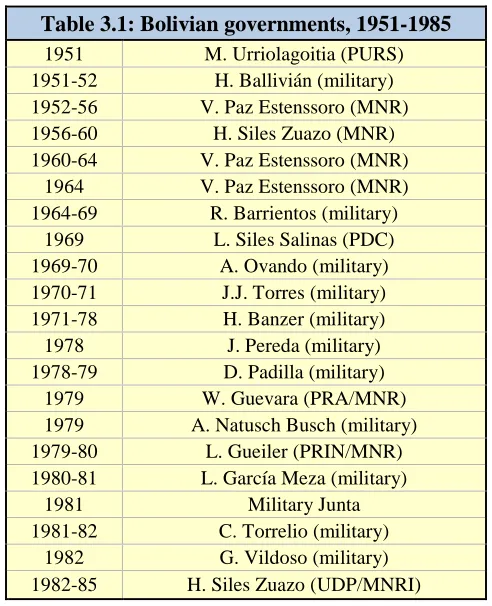
1.1 Bolivian governments, 1985-2005. 3.1 Bolivian governments, 1951-1985.
3.2 Capital flight during Banzerato and democratic transition era. 3.3 Fixed investment, as percentage of GDP 1970-1985.
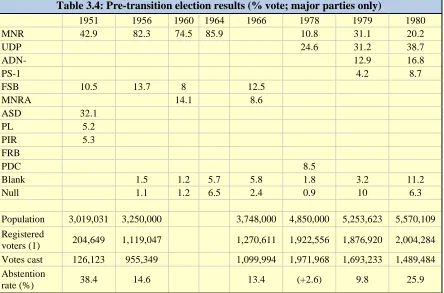
3.4 Pre-transition election results (% vote; major parties only). 4.1 Relative importance of major state-owned enterprises 1990.
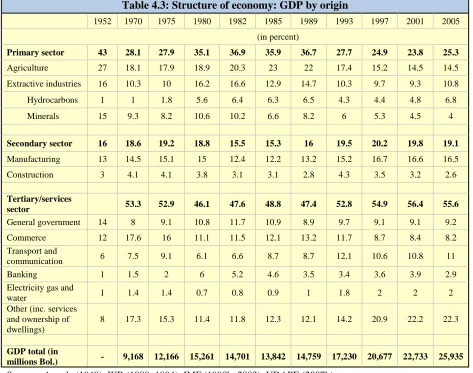
4.2 Relative importance of categories of state-owned enterprises 1990, 1991 (percentage). 4.3 Structure of economy: GDP by origin.
4.4 Average growth rate by sector, 1956-1984 (percentage annual change). 4.5 Contribution of companies to GDP and employment by size, 1999. 4.6 Employment in mining (1980-1987).
4.7 The tin crash and its fiscal effects: contribution of mining sector to government revenues (in US$ million).
4.8 Bolivia: volume of mining production.
4.9 Foreign investment in Bolivia’s banking sector (1998).
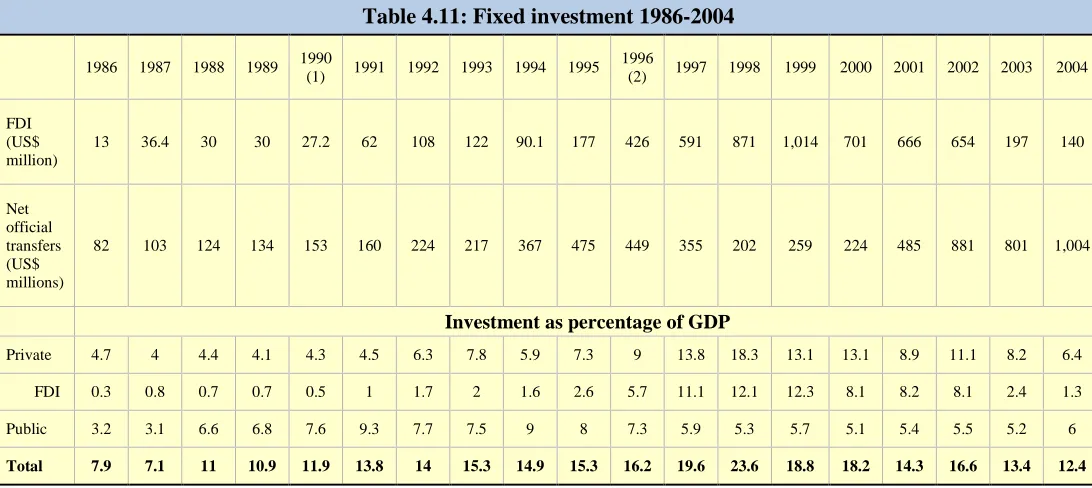
4.10 Statement of IFC's Committed and Disbursed Portfolio as of March 1998 (US$ millions). 4.11 Fixed investment 1986-2004.
4.12 Number of foreign firms involved in oil and gas exploration.
4.13 The transnational bloc in Bolivia: prominent businessmen and technocrats.
5.1 Dependence of the state on external financing: Public Investment Expenditure by Source of Financing, 1989-1998 (in US$ thousands).
5.2 Official Development Assistance in US$ to selected countries, 1996. 5.3 External financing - Credits VS Grants 1989-1998 (in US$ thousands). 5.4 Overall external financing (in US$ millions) to 1999.
5.6 Foreign debt relief 1999-2006 (in US$ millions). 5.7 Employment by the state (in thousands), 1951-2003.
5.8 Investment in capitalised companies through 2001 (US$ million). 5a Projected and actual pension costs (US$ millions).
6.1 National elections results, 1985-2005 (major parties only). 6.2 General elections, 1985-2005: Upper House Seats.
6.3 General elections, 1985-2005: Lower House Seats. 6.4 Financial developments, 1987-2003.
6.5 Capitalisation and direct employment creation. 6.6 Labour and employment, 1960-2005.
6.7 Wages, 1982-2005.
6.8 Coca farming and the illegal economy.
6.9 The fiscal effects of decentralisation and capitalisation: Investment by administration levels (in percent).
6.10 Poverty and inequality in Bolivia 1970-2005. 6a Referendum 2004: questions and results.
Figures:
4.1 FDI by sectors (in US$ millions).
4.2 Gas production, Exports and Consumption 2005 (in millions of cubic feet). 4.3 Investments in the hydrocarbons sector (US$ millions).
5.1 Distribution of foreign debt stock by creditor type (public and publicly guaranteed only), in percent.
Acknowledgments
This thesis would not have been possible without the continued support and trust of my parents, of Isabel, my brothers and my friends. I am grateful to them for bringing me happiness and conviction when I needed them most.
I also want to thank my supervisors, Shirin Rai and Iain Pirie, who have not doubted the value of my research, and the Politics and International Studies department at Warwick for its institutional and financial support.
I finally want to express my thanks to Iván Mollinedo who fuelled my passion for Bolivia and helped me with the logistics of my research in La Paz, as well as the people who gave access to relevant material and who accepted to give their time for interviews to a stranger like me. I am particularly grateful to Guido Riveros, Teresa Ossío and the staff at the libraries of Congress and of the UDAPE for offering me their assistance at crucial moments of my fieldwork.
Abbreviations and Acronyms
ADN: Acción Democrática Nacionalista (Nationalist Democratic Action).
ANMM: Asociación Nacional de Mineria Mediana (National Association of Medium-sized Mining). ASOBAN: Asociación de Banqueros de Bolivia (Bolivian Bankers’ Association).
BCB: Banco Central de Bolivia (Central Bank of Bolivia). BWS: Bretton Woods System.
CAINCO: Cámara de Industria y Comercio de Santa Cruz (Chamber of Industry and Commerce of Santa Cruz).
CAO: Cámara Agropecuaria del Oriente (Chamber of Agriculture of the East). CEAL: Consejo Empresario de América Latina (Business Council of Latin America).
CEPAL: Comisión Económica para América Latina y el Caribe (Economic Commission for Latin America and the Caribbean).
CEPB: Confederación de Empresarios Privados de Bolivia (Confederation of Private Entrepreneurs of Bolivia).
CIDOB: Confederación de Pueblos Indígenas de Bolivia (Confederation of Indigenous Peoples of Bolivia).
CNE: Corte Nacional Electoral (National Electoral Court).
COB: Central Obrera Boliviana (Bolivian Worker Central/Confederation). COMIBOL: Corporación Minera de Bolivia (Bolivian Mining Corporation).
CONAMAQ: Consejo Nacional de Ayllus y Markas del Qullasusyu (Kollasuyo Ayllu and Marka National Council).
CONDEPA: Conciencia de Patria – Movimiento Patriótico (Conscience of Fatherland – Patriotic Movement).
CSUTCB: Confederación Sindical Única de Trabajadores Campesinos de Bolivia (Unique Confederation of Rural Workers of Bolivia).
DAC: Development Assistance Committee. DC: Development Committee.
DPC: Delegación Presidencial Para la Revisión y Mejora de la Capitalización (Presidential Delegation for the Revision and Improvement of Capitalisation).
DS: Decreto Supremo (Supreme Decree).
ENAF: Empresa Nacional de Fundición (National Smeltering Enterprise). ENDE: Empresa Nacional de Electricidad (National Electricity Enterprise). ENFE: Empresa Nacional de Ferrocarriles (National Railroad Enterprise). ESAF: Enhanced Structural Adjustment Facility.
ESF: Emergency Social Fund. EU: European Union.
FDI: Foreign Direct Investment.
FSB: Falange Socialista Boliviana (Bolivian Socialist Falange).
FSTMB: Federación Sindical de Trabajadores Mineros de Bolivia (Union Federation of Mining Workers of Bolivia).
GES: Grupo Especial de Seguridad (Special Security Group). GDP: Gross Domestic Product.
HIPC: Heavily Indebted Poor Country Initiative.
IBRD: International Bank for Reconstruction and Development. IDB: Inter-American Development Bank.
IFC: International Finance Corporation. IMF: International Monetary Fund. IPE: International Political Economy. IR: International Relations.
IU: Izquierda Unida (United Left). LAB: Lloyd Aereo Boliviano.
MDIs: Multilateral Development Institutions.
MAS: Movimiento Al Socialismo (Movement Towards Socialism). MBL: Movimiento Bolivia Libre (Movement Free Bolivia). MIGA: Multilateral Investment Guarantee Agency.
MNR: Movimiento Nacionalista Revolucionario (Revolutionary Nationalist Movement).
MNRH: Movimiento Nacionalista Revolucionario Histórico (Historic Revolutionary Nationalist Movement).
MNRI: Movimiento Nacionalista Revolucionario de Izquierda (Left Revolutionary Nationalist Movement).
MRTK: Movimiento Revolucionario Tupac Katari (Revolutionary Tupac Katari Movement). MITK: Movimiento Indio Tupac Katari (Indian Tupac Katari Movement).
MSM: Movimiento Sin Miedo (Movement Without Fear). NEP: New Economic Policy.
NFR: Nueva Fuerza Republicana (New Republican Force). NR: National Revolution.
ODA: Official Development Assistance.
OECD: Organisation for Economic Cooperation and Development. OM: Open Marxism.
PCB: Partido Comunista de Bolivia (Communist Party of Bolivia). PDC: Partido Demócrata Cristiano (Christian Democratic Party). POR: Partido Obrero Revolucionario (Revolutionary Workers’ Party). PP: Popular Participation.
PR: Proportional Representation. PSD: Private Sector Development. PFP: Policy Framework Paper.
RDC: Regional Development Corporation. RN: Revolutionary Nationalism.
SAFCO: Administracíon y Control Gubernamental (Administration and Government Control). SAP: Structural Adjustment Programme.
SBEF: Superintendencia de Bancos y Entidades Financieras de Bolivia (Superintendency of Banks and Financial Entities of Bolivia).
SIDA: Swedish International Development Agency.
SIRESE: Sistema de Regulación Sectorial (System of sector regulation). THM: transnational historical materialism.
WB: World Bank.
WBG: World Bank Group.
UCS: Unión Cívica Solidaridad (Civic Solidarity Union).
UDAPE: Unidad de Análisis de Políticas Económicas y Sociales (Unit for the Analysis of Economic and Social Policies).
UDP: Unión Democrática y Popular (Democratic and Popular Union). UJC: Unión Juvenil Cruceñista (Cruceñista Youth Union).
UNDP: United Nations Development Programme. US: United States of America.
USAID: United States Agency for International Development.
Abstract
The present study theorises and empirically investigates the transformations of the Bolivian state between 1985 and 2005, from a historical materialist perspective. It argues that state transformations have formed part of the latest phase of capital globalisation, and hypothesises that these transformations are captured effectively by concepts of ‘internationalisation’, ‘polyarchy’ and ‘depoliticisation’. Relying on substantive dialectical logic and qualitative methods (documentary analysis and interviewing), the thesis investigates reflexively whether, how and why processes of internationalisation and liberalisation of the Bolivian state, concurrent to the depoliticisation of economic management, have been taking place in the period under focus.
I argue that the internationalisation of the Bolivian state was not superimposed upon an ‘endogenous’ process of political and economic liberalisation by external forces; rather, by consolidating a transnationalised elite fraction in Bolivia and the depoliticisation of economic management, the internationalisation of the state sustained polyarchy after the hyperinflationary crisis of 1985. The engagement of Multilateral Development Institutions (MDIs) and transnational private banks by a nucleus of competitive and ‘denationalised’ Bolivian elites in 1985, and in turn their unconditional integration into an expanding transnational historic bloc of elite social forces drove the internationalisation of the Bolivian state. Internationalisation, in turn, consolidated the structural power of the transnational bloc in Bolivia by concurrently locking-in the depoliticisation of central government agencies and polyarchy. Polyarchy was an attempt to legitimise elite domination and the restructuring of society and state through a procedural conception of democracy.
Following the more ‘open’ tradition of historical materialist thinking, the research conceptualises the state as a contradictory organisation of subjection, a social relation embedded in broader production relations, which both reflects and constitutes a particular configuration of forces within the social space bound by its institutions. The state is a terrain of intra-elite and class struggle. Aforementioned processes of state transformation have thus been shaped by the confrontation between a transnational elite bloc, domestically-oriented elites and labour forces, in ‘civil society’ but also within the institutions of the Bolivian state itself.
Los nadies
Sueñan las pulgas con comprarse un perro y sueñan los nadies con salir de pobres, que algún mágico día llueva de pronto la buena suerte, que llueva a cántaros la buena suerte; pero la buena suerte no llueve ayer, ni hoy, ni mañana, ni nunca, ni en lloviznita cae del cielo la buena suerte, por mucho que los nadies la llamen y aunque les pique la mano izquierda, o se levanten con el pie derecho, o
empiecen el año cambiando de escoba.
Los nadies: los hijos de nadie, los dueños de nada.
Los nadies: los ningunos, los ninguneados, corriendo la liebre, muriendo la vida, jodidos, rejodidos:
Que no son, aunque sean.
Que no hablan idiomas, sino dialectos.
Que no profesan religiones, sino supersticiones. Que no hacen arte, sino artesanía.
Que no practican cultura, sino folklore.
Que no son seres humanos, sino recursos humanos. Que no tienen cara, sino brazos.
Que no tienen nombre, sino número.
Que no figuran en la historia universal, sino en la crónica roja de la prensa local.
Los nadies, que cuestan menos que la bala que los mata.
Eduardo Galeano
Chapter 1: Introduction
Introduction
Bolivia was part and parcel of the global debt crisis of the early 1980s (Pastor 1987; Pastor 1987*; Kuczinski 1988), which plunged the country into an uncontrollable hyperinflationary and fiscal crisis (Morales and Sachs 1990). In November 1984, total outstanding debt had reached US$4.1 billion (110 percent of a declining Gross Domestic Product [GDP]), including a $3.2 billion public sector debt; the Siles government declared a moratorium on debt servicing before calling elections half a year later. By then, inflation had reached 23,500 percent in annualised terms.1 Virtually bankrupt, the Paz Estenssoro government elected in August 1985 reversed the long-standing state capitalist model of development by vowing to stimulate privatised accumulation and maintain monetary stability (Malloy and Gamarra 1987; Dunkerley 1990; Morales and Sachs 1990). Its economic team, constituted by leaders of the Bolivian business confederation, the Confederación de Empresarios Privados de Bolivia (CEPB) and monetarist economists, elaborated a radical stabilisation plan
behind closed doors (Supreme Decree 21060, dubbed ‘New Economic Policy’ [NEP]), before resuming cooperative relations with Multilateral Development Institutions (MDIs), thereby re-engaging with private and public creditors, and renewing the Bolivian state’s commitment to debt servicing (Conaghan 1990, Conaghan and Malloy 1995; Climenhage 1999).
By 2005, the optimism that had characterised specialist circles in the late 1980s, 1990s and even early 2000s regarding economic stabilisation, Private Sector Development (PSD) and ‘democratic’ transition/consolidation/viability (Mayorga 1988, 1999; Lavaud 1990, 1991; Morales and Sachs 1990; Mayorga et al. 1991; Mansilla 1994; Campero Prudencio et al. 1999; Grindle 1999; Van Cott 2000; Crabtree, Whitehead et al. 2002; Klein 2003; Grindle, Domingo et al. 2003) had manifestly waned (Crabtree 2005; Crabtree and Whitehead 2008). Subaltern violence had become monnaie courante, lack of ‘business confidence’ was prompting capital flight, corruption and nepotism in the
state were flourishing, and indianist discourses advocating a ‘clash of Andean and Western civilizations’ and the creation of a sovereign indigenous republic in the historic territory of Kollasuyu were undermining the ‘multi-ethnic/national democracy’ hailed a decade earlier (Huntington 2002[1996]; Gustafson 2002; Kohl 2003; Mamani 2005, 2007). Sustained restructuring efforts had evidently failed to transform Bolivia into a hub of social progress, and Evo Morales, achieving the feat of congealing nationalist and indigenist ‘currents of opinions’ (Gramsci 1971) in the Movimiento Al Socialismo (MAS) and his person (Do Alto and Stefanoni 2006, 2008; Dunkerley 2007), was
elected to the Bolivian Presidency in a climate of intense social conflict and disorder.2
and by redistributing Bolivia’s social surplus to its ‘subalterns’. Morales promised a ‘dual’ decolonisation of Bolivia, by challenging external ‘neo-colonialism’ generated by bilateral and multilateral development agencies (instruments of ‘the Empire’), and by ending the ‘internal’ colonialism perpetuated by criollo elites (white, of Spanish descent) through the defence of indigenous sovereignties (Crabtree 2005; Dunkerley 2007; Do Alto and Stefanoni 2008; Webber 2008).
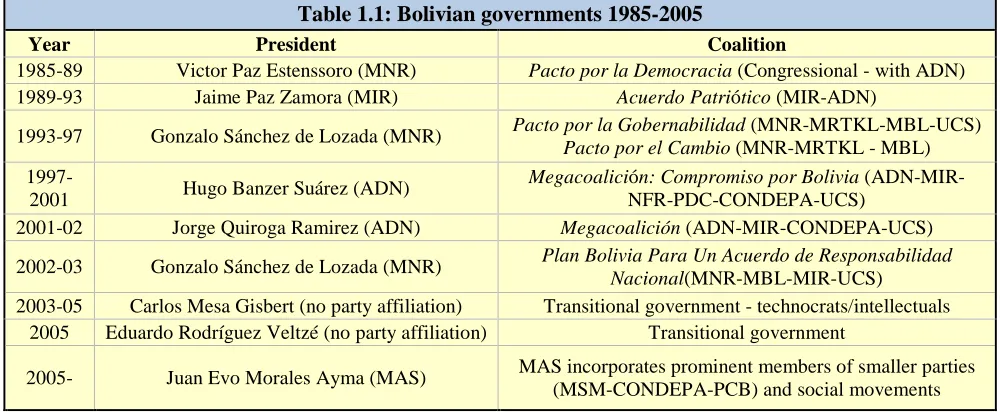
Table 1.1: Bolivian governments 1985-2005
Year President Coalition
1985-89 Victor Paz Estenssoro (MNR) Pacto por la Democracia (Congressional - with ADN) 1989-93 Jaime Paz Zamora (MIR) Acuerdo Patriótico (MIR-ADN)
1993-97 Gonzalo Sánchez de Lozada (MNR) Pacto por la Gobernabilidad (MNR-MRTKL-MBL-UCS) Pacto por el Cambio (MNR-MRTKL - MBL)
1997-2001 Hugo Banzer Suárez (ADN)
Megacoalición: Compromiso por Bolivia (ADN-MIR-NFR-PDC-CONDEPA-UCS)
2001-02 Jorge Quiroga Ramirez (ADN) Megacoalición (ADN-MIR-CONDEPA-UCS)
2002-03 Gonzalo Sánchez de Lozada (MNR) Plan Bolivia Para Un Acuerdo de Responsabilidad Nacional(MNR-MBL-MIR-UCS)
2003-05 Carlos Mesa Gisbert (no party affiliation) Transitional government - technocrats/intellectuals 2005 Eduardo Rodríguez Veltzé (no party affiliation) Transitional government
2005- Juan Evo Morales Ayma (MAS) MAS incorporates prominent members of smaller parties (MSM-CONDEPA-PCB) and social movements
Source: Presidencia de Bolivia
(Morales and Sachs 1990, Sachs 1999),5 inducing ‘undemocratic’ subaltern worldviews (Mansilla 1994; Gamarra 1996; Lavaud 2007); and the ‘cultural’ discrepancies between bureaucratised and stagnant highland and modern, dynamic and democratically-oriented lowland regions (Roca 1980; 2008).
The ‘Critical’ side of the academic spectrum has, in turn, been imbued with dependency and world-system theory critiques of the market and imperialism (Frank 1975, 1978; Wallerstein 1989[1974]). Critical researchers have conventionally incriminated the International Monetary Fund (IMF), the World Bank (WB), the United States Agency for International Development (USAID) and the Drug Enforcement Agency (DEA) for imposing ‘neoliberal’ restructuring onto Bolivia and for coercing coca farmers (cocaleros) and indigenous people into abandoning their ancestral ways of life, with the collusion of corrupt and racist criollo (white) elites (García et al. 2000, 2002; Patzi 2001; Fernández 2003; Kohl and Farthing 2005; Petras and Veltmeyer 2005; Mamani 2005, 2007; Webber 2008). They have attributed neoliberal reforms, in a logic of inquiry characterised by Cartesian dualism, either to structural necessity (chiefly determined by the ‘law’ of polarisation between core and periphery through the control of terms of trade by the former and ever-unstable market price of agricultural and extractive commodities) or to autonomous agency (‘actors’ such as the United States superpower or the IMF and WB) (Lora 1995, Garcia 2001, 2005, Fernández 2003).
the historical developmental paths of society can only be achieved by explaining state polity. This, however, cannot be analysed merely through the prism of the ‘nation-state’, because the internal relationship between state and social forces is constituted by and constitutive of transnational and interstate relations (Gill 1993; Van der Pijl 1998; Overbeek 2000; Van Apeldoorn 2004).
More specifically, the research analyses whether, how and why processes of state transformations that are commonly dissociated or ignored in the academic literature (i.e., liberal ‘democratisation’, internationalisation and depoliticisation) have, in reality, been internally related and mutually supportive in Bolivia since 1985. Whilst the story of ‘democratisation’ or, to be more accurate, the emergence, consolidation and recent unravelling of Bolivian ‘polyarchy’ from 1985 to 2005 has been told and retold ad nauseam (Mayorga 1991; Gamarra 1991, 1994, 1996, 2002; Morales 1994; O’Donnell 1992, 1993; Domingo 1993; Van Cott 2000; Crabtree, Whitehead et al. 2002, among numerous others), processes of depoliticisation and internationalisation have on the whole been overlooked. This scholarly gap needs to be bridged if a more nuanced and sophisticated analysis of the Bolivian state is to be made. This study therefore offers an in-depth analysis of the internationalisation, depoliticisation and liberalisation of the state. I hypothesise that these processes have not only taken place but were correlated. The internationalisation of the Bolivian state was not superimposed upon an ‘endogenous’ process of political and economic liberalisation by external forces; rather, by consolidating a transnationalised elite fraction in Bolivia and the depoliticisation of economic management, the internationalisation of the state sustained polyarchy after the hyperinflationary crisis of 1985. The engagement of MDIs and private banks by a nucleus of competitive and ‘denationalised’ Bolivian elites in 1985 and in turn their unconditional integration into an expanding transnational historic bloc of elite social forces drove the internationalisation of the Bolivian state. Internationalisation, in turn, consolidated the structural power of the transnational bloc in Bolivia by concurrently depoliticising central government agencies and promoting polyarchy. Polyarchy was an attempt to legitimise elite domination and the restructuring of society and state through a procedural conception of democracy.
between 1985 and 2005. This dialectic helps to explain the constraints under which the transnational bloc acted to liberalise the Bolivian social space. Liberalisation is interpreted as an attempt, by an ‘enlightened’ transnational fraction of Bolivian elites, to generate ‘development’ in Bolivia by grafting polyarchy, neoliberal hegemony and the ‘business perspective’ onto a corrupt, nepotistic, and statist social organism, with the active support of MDIs. Transnational elites were nonetheless part of and dependent on clientelistic social networks for the implementation of liberal reforms, which helps to explain their failure to generate neoliberal hegemony and legitimise the high social costs of Bolivia’s deepening integration into the world market.6 The re-composition of labour and indigenist forces in the late 1990s, manifested in the intensification of street violence (Water Wars, Febrero Negro, Gas Wars) and the eventual election of Evo Morales in 2005, expressed the gradual unravelling of restructuring efforts in Bolivia.
This study builds on the results of four years of research, including four months of field work undertaken between May and September 2007 in La Paz, Bolivia, and is based on both primary and secondary sources (Burnham et al. 2004). As primary sources, the study relies on classified and publicly available WB, IMF, Development Committee (DC) and Development Assistance Committee (DAC) documents on the reforms of the Bolivian state in the period under study, as well as twenty-two interviews with Bolivian government ministers, business leaders and high-level civil servants. A significant proportion of these interviewees were simultaneously businessmen, technocrats (in government and MDIs) and organic intellectuals over two decades of radical social and state restructuring. Many of them have now distanced, or been forced to distance themselves from policymaking, but remain informed observers of recent processes of change currently pursuing private business or consulting activities. The information that they agreed to provide to me was triangulated through documentary analysis and other interviews (Richards 1996; Lilleker 2003; Burnham et al. 2004). The reliability of the empirical evidence used to reflect on the validity of my hypothesis should therefore secure an adequate measurement (in a qualitative sense) of the concepts employed here (Adcock and Collier 2001).
existing academic literature on liberal democratisation, and on the relationship between MDIs and successive Bolivian governments.
1.‘Democratisation’ and polyarchy
‘Problem solving’ scholarship (Cox 1981: 88) has extensively analysed the institutional and legal reforms accompanying liberal democratisation in Bolivia since 1978 – expressed in concepts of democratic ‘transition’, ‘governability’ (gobernabilidad) (Toranzo 1991; Mayorga 1991; Lazarte 1993; Malloy and Gamarra 1988), ‘modernisation’ (Mayorga 1988; 1999), ‘consolidation’ (Domingo 1993; Conaghan 1992; Gamarra 1996; Van Cott 2000), ‘viability’ (Crabtree 2002, Whitehead 2002a), and of a seemingly accomplished, consensual ‘multiethnic democracy’ (Klein 2003; Grindle 1999). Until the early 2000s, when the contradictions of liberalisation had become too manifest to be brushed aside, a generalised optimism and positive appraisal of institutional change had characterised specialist academic circles. It was broadly accepted that ‘Despite a history of political instability and a tumultuous transition process, Bolivia, since 1985, offers an example of a relatively stable political and economic post-transition environment’ (Domingo 1993: 1; Domingo 2001), and demonstrated ‘that neo-liberal economic reforms can be harmonised with political democratization’ (Whitehead 1997: 71).
Institutional reforms in Bolivia after 1985 have been measured according to minimalist, procedural conceptualisations of democracy, understood as polyarchy, the most sophisticated exponent of which arguably remains Robert Dahl (1971). Democracy has been measured in terms of representation and participation (universal suffrage and equality of rights in voting), and competition (freedom of
Scholarship focusing on democratisation in Bolivia has been overwhelmingly informed by problématiques restricted by a closed system of meaning and norms (Howarth 2000; Gramsci 1971;
Cox 1981, 1987; Gill 1993, 2003). ‘Problem-solving’ appraisals and prescriptions are in line with hegemonic developmental discourses informed by Parsonian evolutionism (Parsons 1977). Democracy in a liberal representative form (based on heuristic measurements of the rule of law, of the existence of representative institutions of governance, of a ‘cold’ and rational bureaucratic apparatus, of a balance of power between the executive, legislative and judicial organs of the state, and last but not least, of the necessary retreat of the state from the naturalised ‘invisible hand’ of the market) hence becomes the institutional device necessary to solve the combined challenges of growth, poverty reduction and stability (Morales and Sachs 1990; Toranzo 1991; O’Donnell 1992; Valenzuela 1992; Morales 1994; Crabtree et al. 2002; Van Cott 2000).
political predispositions and convenience) take them as a starting-point for the purpose of empirical measurement (Domingo 1993; Gamarra 1994, 1996; Whitehead 2002a; Van Cott 2000; Grindle 1999).7 Some have gone as far as advocating that ‘democratic consolidation ... be linked ... to a minimalist, not maximalist, conception of democracy’ because, after all, ‘even long established democracies rarely have all the attributes that can ideally be associated with such regimes’ (Valenzuela 1992: 60; O’Donnell 1992).8 These approaches may appropriately be criticised for ascribing autonomy to ‘state life’, i.e. for their ‘statolatry’, to use Gramsci’s terminology (Gramsci 1971: 268).
In methodological terms, problem-solving studies of Bolivia’s political ‘system’ explicitly or implicitly rely on Weberian pluralism or structural-functionalism (Durkheim 1982; Weber 1991), which are informed by a positivistic epistemology.9 Structural variability in Weberian pluralism alludes to the inexistence of an underlying historical structure and to the absolute autonomy of the factors (economy, society, the state) constituting a specific social order; it therefore justifies the historical contingency of empirical evidence. As pointed out by Burnham (1991) this approach systematically lapses in empiricism (begging the question why a particular fact has been given more importance than another in a specific historical setting) and in methodological atomism – the simple starting-point is individual ‘world views’ and motivated behaviour, which has systematically failed to pierce surface market relations. In Weberian pluralism, the historically specific value, commodity, money, and capital forms of production are consciously or unwittingly presented as natural and hence trans-historical social laws: thus the essence of these forms (i.e. the particular manner in which propertied classes historically control the production process to extract surplus, itself the foundation of their social power and supremacy), is occulted (Burnham 1995: 97).10
Critiques of minimalist definitions of Bolivian democracy abound in specialist circles (García 2001, 2004; García et al. 2000, 2002; Assies and Salman 2003; Kohl and Farthing 2005; McNeish 2006; Hylton and Thomson 2007; Dunkerley 2007, 2007[1998]; Webber 2008). These critiques are often, and not surprisingly, rooted in the historical materialist tradition. Antonio Gramsci had exposed in the 1930s the classical liberal ‘ideal-type’ form of state-society relations construed as ‘laissez-faire’ (the ‘nightwatchman’ state above/beside ‘self-regulating’ capital) as a legally and ideologically buttressed form of governance subjecting labour to capital: ‘one cannot speak of the power of the state but only of the camouflaging of power’ (Gramsci 1995:217). William Robinson (1996) effectively reinterpreted the meaning of polyarchy by integrating it into a neo-Gramscian analysis of transnational elite domination in Latin America within the structural constraints of global capital. He defined polyarchy as the liberal democratic form of social organisation, ‘in which a small group actually rules and mass participation in decision-making is confined to leadership choice in elections carefully managed by competing elites’ (Robinson 1996:49).11
2.‘Deepening democracy’: decentralisation, popular participation and multiethnic representation
An institutional process interpreted in the literature as integral to the consolidation or ‘viability’ of polyarchy is the ‘audacious’ administrative and fiscal decentralisation of the state in the mid-1990s (Grindle 1999; Van Cott 2000; Gray 2001; Faguet 2002, 2003). Decentralisation was among the central measures implemented by the Sánchez de Lozada government (1993-1997), and resulted in the territorial reorganisation of the state into 311 municipalities (including the creation of 187 new municipalities), mandated the assignment of 20 percent of tax revenues to local governments (including ‘autonomous indigenous communities’, dubbed Organizaciones Territoriales de Base [OTB]), and organised ‘local democracy’ through the establishment of electoral rules for local government (Grindle 1999; Gray 2001). Decentralisation has been one of the most debated themes in the academic literature, in part because it relates directly to issues of democratisation (more specifically, the territorial expansion and intensification of democratic governance, elemental to democratic ‘consolidation’ or ‘viability’), the redistribution of state resources (from cities to countryside, from wealthier to poorer municipalities), and the relationship between the state and indigenous nations.
flexible, and turned a blind eye to (if only for its political survival) patronage and corruption in the state (see chapters 4, 5 and 6)?
Problem-solving research has generally been impervious to the concurrence of government policies – and interpreted decentralisation as a largely autonomous policy response to excessive centralisation, lack of democratic practice, corruption and patronage. The intent of agents devising and managing decentralisation reforms remain largely unquestioned: ‘deliberate acts by beneficiaries of political power to divest themselves of some of that power are “puzzling phenomena”’ (Grindle 1999: 2). Did President Gonzalo Sánchez de Lozada (1993-1997), interviewed by Grindle (1999), really take the ‘audacious’ decision to reduce his government’s hold on the institutions of the state by ‘redistributing power downward’ and ‘opening political competition to new voices, new interests and new demands’ (via local representation) (Grindle 1999: 2)?15 For aforementioned commentators, Sánchez de Lozada and his Popular Participation (PP) team genuinely aimed to ‘democratize access to political and economic power’ (Gray 2001: 63) by satisfying the demands (organisational autonomy) of indigenous peoples, and by increasing ‘transparency’ and ‘administrative efficiency’ for social and welfare investment (by divesting responsibility for a welfare and productive oriented-infrastructure to municipalities). PP was aimed to enhance the legitimacy of representative democracy by ‘appeas(ing) divergent interests and maintain political stability’ (Grindle 1999: 3).
The intensification of indigenous resistance against agro-business encroachment in the early 1980s – which intersected with resistance to ecological degradation in the tropical rainforest in Bolivia, Brazil, Ecuador, Peru and central America – has been bolstered by an international climate combining environmentalism and a renewed idealisation of Rousseau’s ‘noble savage’ in the European and US left-wing (see Van Cott et al. 1994). Furthermore, media-friendly indigenous marches and the increasing efficiency of nationalist Quechua, Aymara and Guarani organisations in the early and late 1990s against ‘neoliberal globalisation’, for the defence of the ‘autonomy’ of the ayllu and communal ownership and production, of traditional coca-production and of indigenous
languages, for the improvement of welfare services in rural areas and for the reduction of poverty have been regarded as legitimate and unquestionable requests. Much emphasis has been placed on the increasing influence of indigenous movements on policymaking, expressed in part by the incorporation of indigenous discourses and their more palatable demands (all of them excluding, notably, redistribution of privately-owned fallow land to ayllus) in the programmes of dominant political parties until 2005. These processes informed the notion that Bolivia is and should be a ‘pluri-ethnic and multicultural’ nation, and that administrative decentralisation and educational reform (incorporating bilingual education) are the main policy instruments to secure this ideal (Gustafson 2002).
seen as a central reason for the ‘bold’ alliance between indigenist leaders and the neoliberal political party MNR in the 1993 elections (Albó 1994; Van Cott 2000).
In contrast to these broadly positive appraisals of decentralisation, Gustafson (2002) and Kohl (2003, 2006) offer more critical understandings of its purpose and implementation. In their compelling analyses of the law of PP (1994), they rebuke complacent interpretations of decentralisation by arguing that decentralisation and the inclusion of a ‘multi-ethnic and pluri-cultural’ definition of the Bolivian ‘nation’, rather than concretely ‘including’ previously excluded indigenous populations, rather constitute:
‘contradictory shifts of political languages institutions that seek to reorder and legitimate changing expressions of social difference, citizen identity, and hierarchical forms of participation. These new tactics of governance represent a transformative renewal of discourses and institutions through which elites seek to insulate centralized power (spatially, conceptually and institutionally) from various forms of ‘indigenous’ and other ‘popular’ forms of political engagement. Certainly laudable for a reformist sensibility, interculturalist reforms do not, however, pursue robust versions of indigenous rights or overhaul structures of economic inequality’ (Gustafson 2002: 270).
Gustafson rightly emphasised the MNR’s lip service to the notion of interethnic ‘equality’ rather than active legal and administrative struggles for a meaningful transformation of hierarchical relations of domination. Nevertheless, his approach is ethnographic – and tendentiously state-centric – rather than defined by a holistic approach to social relations. He overlooks intra-elite struggles, transnational elite formation, and struggles within the institutions of the state – as well as the contradictions between Marxist discourses and indigenous nationalism, and rather focuses specifically on the contradictory relationships between the MNR government and indigenous movements, – in particular their two principal institutional crystallisations, i.e. the Confederación Sindical Única de Trabajadores Campesinos de Bolivia (CSUTCB), dominant in the Altiplano and
More importantly, the analysis of depoliticisation cannot be restricted to decentralisation. Other crucial elements included the very implementation of the DS 21060 in the wake of hyperinflation in 1985; the granting of legal autonomy to the BCB, and civil service reform. Furthermore, the present research offers another dimension to Gustafson’s analysis of the ‘insulation’ of central organs of the state: the process of depoliticisation is, I argue here, internally related to polyarchy and state internationalisation. Each process unfolded as part of, and were reciprocal with, others processes – generating new political opportunities but also constraints that are increasingly apparent under the Morales administration. As demonstrated effectively by Gustafson, the process of depoliticisation has not achieved the strategic objectives of Goni’s government by effectively opening the Pandora’s Box of indigenous nationalism.
Kohl’s (2003) analysis, on its side, is undermined by a definition of neoliberalism as an economic ‘system’ based on market-based growth, rather than an ideological underpinning of underlying relations of domination and production. I will return to Kohl’s work in the coming section. Like Gustafson, his research is tendentiously state-centric, and does not relate processes of decentralisation and internationalisation.
3.The transition to a ‘neoliberal economy’ and the relationship between MDIs and the Bolivian state.
monetarist instruments of economic management, and restraints on public spending; 2) the reduction of tariff and non-tariff barriers to trade and investment; 3) an increase in the flexibility of the labour market (eliminating the preceding government’s indexation of wages to inflation; freezing the wages of state employees, and facilitating the hiring and firing of workers in both private and public companies); 4) changes in state practices which affected the balance of payments, such as the simplification of tax regulations (including the introduction of an indirect tax on consumption) and the improvement of tax collection; the decentralisation (transfer to Regional Development Corporations [RDCs])21 of loss-making corporations, and their decapitalisation (reduction of investment by the Treasury); and 5) the elimination of ‘imbalances’ between the national price system and global market prices. The elimination of imbalances involved the removal of subsidies to businesses, the elimination of price distortions – aligning commodity prices, in particular energy and food prices, with global market prices. It was assumed by MDIs that first-generation reforms would encourage private investment.
These policies perpetuated, if not accentuated, the social costs caused by the debt and monetary crisis, as they antagonised the hitherto protected, domestically-oriented manufacturing fraction of capital, and deflated real wages and the purchasing power of labour (WB 1989b, 1989c, 1991c). Although arguments for the privatisation of accumulation were increasingly influential in the late 1970s and early 1980s, and numerous governments were beginning to withdraw the state from the production process, MDIs and governments in the 1980s focused primarily on restructuring or liquidating loss-making state-owned corporations rather than strictly conditioning financial assistance on privatisation – in part a realisation of the further social and political destabilisation that privatisation would generate (WB 1989b, 1992a, 1998a).
comprehensiveness of ‘second-generation’ reforms. They are centred essentially on PSD. PSD was formalised as a blueprint of MDIs in 1989, but several of its central elements had already been adopted prior to its formalisation (DAC 1989; IBRD 1993; Miller-Adams 1999). The WB and IMF regarded PSD as a continuation of measures implemented in the mid-1980s. The IBRD thus argued in 1993 that:
'relative price reform and macroeconomic stabilization are not sufficient conditions for restoring (or launching) efficient private sector growth. The World Bank Group's (WBG) strategy for supporting PSD reflects a move toward a "second generation" of efforts which integrate institutional changes with policy reforms. The approach aims to help countries overcome legal and institutional obstacles affecting the business environment and relax constraints to firms at the day-to-day operating level' (IBRD 1993: i, 2).
Improving the day-to-day environment in which private businesses operate required a dynamic, reflexive and holistic approach in order to understand the dynamics of capital accumulation. It required understanding that 'The business environment is shaped by a complex interaction of formal policies and laws, informal practices, institutions and infrastructure' (IBRD 1993: 4); it required ‘learn(ing) from successful country experiences in implementing PSD reforms', and 'forg(ing) linkages between the various local institutions critical to PSD' (IBRD 1993: iii; 16).
However, despite regular mentions in the literature of external ‘leverage’ or ‘influence’ on domestic reforms, the institutional connections between the Bolivian state and MDIs has only been superficially addressed until now. Surprisingly few researchers have taken the pains to undertake an in-depth analysis of this relationship (Climenhage 1999; Fernández 2003; Kohl and Farthing 2005), and those who have done so either contend that MDIs imposed neoliberal reforms onto Bolivian society, thereby lapsing into a structuralist critique of ‘neocolonialism’, focusing in particular on US dominance (Kohl and Farthing 2005; Fernández 2003),23 or argue that the WB and the IMF remained ‘at a distance’, reactively offering encouragement and financial support for government reform initiatives (Climenhage 1999). Allusions to ‘global governance’ institutions are made to emphasise US and European imperialism in Bolivia and the rest of Latin America (García et al. 2000, 2002; Fernández 2003; Webber 2008),24 without considering the theoretical implications of transnational production and organisational networks for ‘North-South’, inter-state but also intra-elite relations (Van der Pijl 1998; Overbeek 2004; Robinson 2005).
On their side, Robert Cox’s (1981, 1987) original propositions and their reformulation by William Robinson (2002, 2005) have rarely been employed in empirical research. Exceptions include the work of Andrew Baker (1999) and Stuart Shields (2004) with reference to, respectively, the British and Polish states. Baker’s (1999: 80) contention that ‘the concept of the “internationalization of the state” suffers from a lack of empirical grounding’ remains painfully true to this day. The central purpose of this manuscript is therefore to ground the concept of ‘internationalisation’ in empirical evidence, by engaging critically with Cox’s original understanding of the term, weaving theoretical and empirical elements of research into one reflexive whole.
The World Bank, the IMF and the Bolivian state
instrumentalist, and the empirical evidence used to justify his contention is all too often anecdotal. MDIs are considered as tools of colonial powers (led by the US) acting in concert to ‘impose’ restructuring on developing countries by attaching neoliberal policy conditions on multilateral loans for the extraction of wealth from Bolivia, which perpetuates, if not increases poverty for the majority (see also Chossudovsky 1998: 33). Fernández presents Bolivia’s managerial elite as a group of ‘comprador lackeys’ who subserviently implemented the emerging ‘Washington’ dogma. His argument is typically ‘Latin Americanist’ in exuding a profound structuralist nationalism, imbued (however implicitly) by work of Raúl Prebisch and of the United Nations’ Economic Commission for Latin America (CEPAL) in the 1950s. It idealises both state capitalism – state-ownership of ‘strategic’ means of production, Import Substitution Strategies defined by protectionism, price controls and subsidies for nascent industries – and locates squarely the causes of Bolivia’s underdevelopment in ‘imperialism’ and ‘neo-colonialism’ (for an effective, class-analysis critique of structuralism, see Pastor 1987). It offers a relatively myopic and superficial historical analysis, which conveniently overlooks the profound contradictions of state capitalism that led to the hyperinflationary crisis of 1985. The validation of his hypothesis – i.e. the IMF and WB are institutional instruments of Western neo-colonialism, and by extension, so is the debt-ridden Bolivian state – is thus a priori undermined by inadequate conceptualisations and historical contextualisation.
and the relationship between governments and MDIs – systematically lapsing, like Fernández (2003) in a structuralist critique of neo-colonialism mediated by MDIs in Bolivia.
In contrast, Climenhage’s (1999) analysis of transnational networks and the emergence of a neoliberal epistemic community in Bolivia offers a compelling theoretical model, founded on Haas’s (1992) notion of ‘epistemic community’, and employs it reliably in her empirical study of transnational forces. It identifies transnationalised elements of the Bolivian business and policymaking elite and analyses effectively how they internalised the neoliberal approach to economic management through a learning process in think tanks (UDAPE, Fundación Milenio), workshops (Foros Económicos) and transnational policy and educational networks. It offers an inspiring reflection on the potential emergence of a ‘Harvard school’ and ‘Harvard boys’ who devised economic policy in Bolivia (paralleling Chile’s ‘Chicago boys’) (see also Conaghan 1990). It appropriately rejects the relevance of a ‘Harvard school’, emphasising that Jeffrey Sachs’s role as an advisor of the Bolivian government for orthodox macro-economic stabilisation in 1985-90 and Bolivia’s debt buyback programme in 1988 was certainly influential, but that it has been vastly exaggerated in the literature (see for example Kohl and Farthing 2005). Sachs was only one ‘organic intellectual’ among others within a transnational elite social movement: collective action by monetarist economists in key governmental and private policy advice institutions was far more meaningful in creatively implementing neoliberal reforms adapted to Bolivian conditions. Nevertheless, her overreliance on interviews with WB and IMF staff has led her to argue inappropriately that the initiative for restructuring always lay in Bolivian governments; the IMF and WB merely offered post-factum, reactive fiscal and ideological support to Bolivian elements of the transnational ‘epistemic community’, rather than systematic, policy-related dialogue and collaboration. Reliance on secondary, rather than primary WB and IMF documents precluded any in-depth analysis of the institutional articulation of MDIs with central government agencies, which is at the core of the internationalisation of the Bolivian state.25
on the restructuring of peripheral states have either been misled by their over-reliance on interviews (in the Bolivian case, Climenhage 1999; Van Cott 2000; Grindle 2000; Bauer and Bowen 1997) or by the restrictions and distortions generated by the reliance on secondary material (Kohl and Farthing 2005; Petras and Veltmeyer 2005).26 The present research analyses both secondary (publicly available) and primary (recently declassified) documents by the DAC, the DC, the WB and IMF as well as semi-structured and unstructured interviews. These primary sources help to explain the global centralisation of authority and decision-making since the 1970s and the strategic shifts informing MDIs’ ‘development agenda’ since the early 1980s. Inferential treatment of the evidence can be achieved because these documents allude to a global strategic blueprint for capital sustainability in ‘first- and second-generation’ reforms, centred initially on stabilisation and structural adjustment, and subsequently on PSD. Issues of ‘generalisation’ and ‘contextualisation’ (respectively valued by quantitative and qualitative researchers) are jointly resolved here by analysing both multilateral policy documents informing the global implementation of structural reforms and declassified IMF and WB documents on restructuring in the Bolivian case (King, Keohane and Verba 1994; Adcock and Collier 2001; Brady and Collier 2004).
The evidence indicates the emergence of new patterns of multilateral coordination since the early 1980s, including 1) the enhancement of ideological cohesion and institutional coordination between ‘national’ and ‘multilateral’ technocrats, as national development strategies and programmes began to be devised jointly by governments, the WB, the IMF and the UNDP to facilitate aid coordination, which became the responsibility of the recipient government (DAC 2006: 23); 2) increasing coordination and division of labour between MDIs, originally between the IMF and the WB, and extended through the mediation of the DAC to the UNDP, regional development banks such as the Inter-American Development Bank (IDB) and bilateral development agencies; 3) a consciously holistic and reflexive approach to problem-solving, within the structural constraints of global
WB-IMF coordination was formalised in 1966 in a memorandum on Fund-Bank collaboration (IMF/WB 2001: 19),27 consolidated at the strategic decision-making level by the establishment of the DC in 1974, upgraded by the introduction of the Policy Framework Paper (PFP) in 1987,28 and reconfigured by the signing of a 1989 Concordat on aid coordination between the two institutions.29 In the early 1980s, ‘as the two institutions moved to overlapping fields of economic activity, collaboration intensified and produced positive results. However, at times collaboration between the two institutions ran into problems, prompting further periodic reviews of existing practices… When the Bank began making structural adjustment loans (SALs) for medium-term balance of payments financing in 1980, it had to reconcile that activity with the Fund’s “primary responsibility” for the balance of payments’ (IMF/WB 2001: 18-19).
The crystallisation of a coordinated approach to restructuring in the 1980s between the two institutions, supported empirically by the Bolivian case (see chapter 5), contradicts Joseph Stiglitz’s (2002) contention that the WB and the IMF engineered diametrically opposed approaches to development in the 1990s, and that the IMF’s ‘other approach’ founded on ‘a curious blend of ideology and bad economics, dogma that sometimes seemed to be thinly veiling special interests’, undermined the WB’s ‘balanced’ perspective (Stiglitz 2002: xiii). Indeed, the donor community must not be conceptualised as a ‘bloc’ or ‘unit’ devoid of internal contradictions, as disputes regularly arise in relation to overlapping responsibilities and parallel development projects (Taylor 2005; see also chapter 5).30 Nevertheless, MDIs’ overall strategic approach to development, crystallised in PSD reforms and buttressed by the authority of the DC and DAC, indicates ideological convergence and the consolidation of a transnational historic bloc, in part through the activities of MDIs. Efforts by the DC and DAC since the mid-1980s to generate a harmonious and efficient coordination of development activities culminated in the 2005 Paris Declaration on Aid Effectiveness (DAC 2005; 2006).
‘imposed in large part’ a ‘neoliberal hegemonic regime’ upon Bolivia ‘in collusion with national elites’ (Kohl and Farthing 2005: 7). They eschew an in-depth analysis of the process of integration into a globally-oriented institutional complex, focusing more specifically on an analysis of an externally imposed ‘neoliberal globalisation’ and ‘neoliberal hegemony’. Despite the use of enlightening empirical evidence and an excellent concluding chapter, Kohl and Farthing’s analysis is founded on blurry conceptual foundations and (primarily) tertiary sources.31 So many inconsistent meanings are given to the two central concepts of the book, neoliberalism and hegemony, that meaning is effectively obscured and lost. Kohl and Farthing equates neoliberalism indiscriminately to a ‘global system that privileges the market’ (2005: 2), to a ‘regime’ (2005: 7), to a ‘project’ (2005: 8), or a set of ‘policies that subordinate the broader public interest by privileging the private sector while minimizing the role of government in production’ (2005: 2; 12). The concept of hegemony, on its side, is applied equally to ‘a regime’ (2005: 7) or a ‘state’ (2005: 7) or indeed to a ‘set of ideological assumptions’ (2005: 15). By referring to nebulous notions of ‘neoliberal system’ and ‘neoliberal globalization’, Kohl and Farthing provide the image of an independent ‘ideational’ variable associated indiscriminately with the ‘state’, the ‘market’, and an overbearing US hegemon.
4.Broader limitations in the academic literature on Bolivia
Analyses of Bolivia’s political economy have been suffused with concepts of democracy, globalisation and neoliberalism. Yet these analyses have generally suffered from interrelated shortcomings, which need to be redressed: Smithian logic, state-centrism, state-market and domestic-foreign dichotomies.
Globalisation as Smithian ‘magic’?
Globalisation’ has been on the lips of many International Relations theorists since the collapse of the Soviet Union, used and abused to the point of lapsing in an ‘empty circularity’ whereby ‘the explanandum – globalisation as the developing outcome of some historical process – is progressively
transformed into the explanans: it is globalisation which now explains the changing character of the modern world – and even generates “retrospective discoveries” about past epochs in which it must be presumed not to have existed’ (Rosenberg 2001: 2-3). Globalisation is consequently interpreted as the ‘unprecedented’ world-wide extension of an impersonal force (an ‘independent’ ‘transnational’ economic ‘variable’, or ‘relatively autonomous’ infra-structure) undermining the capacity of national states to manage their hitherto autonomous, well-protected social economies (Cox 1987; Gill 2003; Robinson 2005).
2002, 2003; Lacher and Teschke 2007). The a-spatial and expansionary development of capital since the eighteenth century from its transnational ‘Lockean’ heartland (defined by a form of social regulation based on the ‘rule of law’ and the protection of private property, and in which political power has tended to operate consensually rather than through direct coercion) has gradually accentuated the historical contradiction between transnational and international relations.34
From that perspective ‘globalisation’ accompanied the birth of capital, and capital determines the global essence of contemporary ‘society’. Van der Pijl (1998: 38) suggests that the expansion of capital ‘into uncharted territory’ has occurred both in temporal and spatial, ‘concentric’ phases, causing the contemporary perpetuation of processes of primitive accumulation. The rhythmic, non-linear expansion and intensification of capitalist relations of production has equally generated variegated forms of ‘primitive’ commodified labour, ‘semi-proletarianised’ peasants, vagrants hired on a temporary basis into workhouses, employed in small family enterprises (‘putting-out systems’), or suffering the dissolution of artisan guilds and forced to work in new factories.
Dependency and underdevelopment
Processes of capital globalisation and transnational elite formation, if seen in this light, problematise dependency and world-system theories, which have conditioned analyses of the ‘post-colonial’ state and of its ‘weakness’ or ‘strength’ (Frank 1975; 1978; Wallerstein 1989[1974], 2000; with reference to the Bolivian formation, see Vandycke 1987; Espasandín and Iglesias [2007]; Gray 2008). World-system theorists define capital as the appropriation, by metropolitan states, of the surplus of the entire world economy through a ‘system of hierarchical economic organisation Centre/Periphery/Semi-Periphery, recognisable ... since the first agrarian/colonial capitalism’ (Espasandín and Iglesias 2007: 44; Boswell and Chase-Dunn 2000; Wallerstein 1989[1974]). These ‘chains’ of dependency and hence domination are founded on a conception of capital as a world market of exchange, i.e. as circulation of commodities.35 The attempt to unveil the ‘magic’ of the world market is immediately veiled by reducing capital relations to commercial circuits: relations of production have been turned into relations of exchange between core and peripheral states (Rupert 1995, Robinson 1996). The circulationist definition also implies that the mercantile and chiefly agrarian economic ‘structure’ of sixteenth century Europe and Americas was essentially capitalist. This loose definition could (and has) lapse(d) into an understanding of slave, feudal or hacienda structures of production as capitalist. I will rather follow in the historical materialist tradition by arguing that capital emerged as a ‘complete’ structure of production in England during the eighteenth century, where the imposition of land rents onto peasants triggered early forms of (primitive) accumulation and the development of an urban-based, industrial circuit of capital as the central axis of capitalist social relations (Marx 2003: ‘Capital Vol.1’; Hobsbawm 1995; Meiksins Wood 1981, 2002a; Van der Pijl 1998).
organisation’), which implicitly veil the underlying class content of worldwide production relations (Roseberry 1989: 17). From that perspective, the essential problem of constructed peripheral ‘nations’ and of the states ‘protecting’ them is the unfair trade regime that defines their relations with the capitalist metropolis. Consequently, the only viable and justifiable political course of action for them to take is ‘national’ emancipation either through ‘delinking’, or through state capitalism involving import-substitution strategies (Amin 1990; Antezana 1983; Fernández 2003).
State-centrism and ‘neoliberalism’ as tools of the US government
The ‘empty circularity’ of globalisation theory has all too often been resolved by understanding globalisation as world-wide Americanisation – i.e. the global imposition, by US administrations and US-based multi-national corporations, of (neoliberal) capitalism and epiphenomenally, of American ‘culture’ (Jameson 1998; Augelli and Murphy 1988; Chomsky 2003).36 Within this global metaphor, prevalent in world-system and dependency theory but also in Gramscian thought,37 one national ‘hegemonic state’, or the metropolis as a whole dominates the world system by suppressing the development of the periphery through imbalanced commodity trading. From that perspective, global governance institutions are perceived as instruments of metropolitan elites (see Cammack 2003 for a Marxist critique). While understanding globalisation as explanans reproduces Adam Smith’s understanding of market forces as an ‘invisible hand’ enjoying magical qualities that cannot be comprehended (Van der Pijl 1998), perceiving neoliberalism as a tool of the US is fundamentally state-centric.
between market and state (Kohl and Farthing 2005; Climenhage 1999; Fernández 2003; Hirst and Thompson 1995; Strange 1996; Krasner 1999, 2001). It also is a fertile breeding ground for national starting-points.
National and local starting-points: creating internal-external dichotomies
Scholarship on Bolivia has been predominantly informed by a national epistemological and ontological starting-point (Lora 1977; Zavaleta 1983, 1987; Grebe 1983, 2002; García et al. 2000, 2001, 2004, 2005; Tapia 2002a). The research core here is the peculiar national or local essence of social relations, which may or may not be influenced by external constraints (capital, changing world prices, ‘globalisation’, ‘neoliberalism’). On the one hand, the fact that a majority of the Bolivian population appears ‘still deeply enmeshed in an ancient autochthonous culture’ (Dunkerley 1984: xiii), has favoured an anthropological focus upon rural, pre-capitalist forms of social organisation and their articulation with the capitalist mode of production, rather than holistic historical analyses of its political economy; a problem identified by anthropologists themselves in the late 1980s (Orlove 1989; Orlove and Foley 1989; Foley and Lambert 1989; Parkerson 1989). This issue has prompted anthropologists to broaden their methodological horizons towards urban-rural linkages (Assies 2003), as well as ‘regional’ or ‘national’ spaces (Assies and Salman 2003; Salman 2006, 2007; McNeish 2006). Yet they continue to see the ‘national’ as a valid object of study in and of itself. On the other hand, Realist and Pluralist theories of International Relations and Political Science have predisposed researchers to assign an a priori, absolute primacy to the national ‘unit’, even if seen as part of an anarchic international system (Waltz 1990-1). Bolivia, with its peculiar ‘indigenous’ makeup and relative geographical ‘isolation’ is all too often wrapped with eternal qualities reminiscent of Niebuhr’s (1932: 83) assertion that the nation is ‘the most absolute of all human associations’.
superpower in international relations through veto rights in the IMF and its bilateral leverage on Latin American governments to lower existing barriers to trade and investments (Fernández 2003; Kohl and Farthing 2005; Webber 2008; De La Cueva 1983).
This tendency has been evident in much classical Marxist analysis, including Gramscian thought.38 Neo-Gramscian approaches’ most important departure from Gramsci is their revival of Marx’s (2003: 386-7) holistic starting-point (world-wide relations of production), which posits that the social whole is greater than the sum of its parts. They have accordingly focused their inquiry on global relations of production, rather than the internal/domestic political struggles and ‘hegemonies’ defining national formations (Cox 1981, 1987; Gill 1993, 2003; Van der Pijl 1998; Van Apeldoorn 2004; Overbeek 2000, 2004). In doing so, they have consciously opened up Gramscian thought by breaking away from its contention that domestic hegemonies and domestic economic relations between social forces should be the prior, essential level of analysis, from which external interactions between national ‘state-society complexes’ unfold. In other words, the Bolivian or Aymara ‘nation’ is not an ‘ontology’ – it does not exist as an entity defined by essential and exclusive attributes – and is not worthy of study in and of itself but always as constitutive of global social relations.
States VS markets
State-centrism, globalisation theory, statolatry and national starting-points are correlated to the ‘states-VS-markets’ dichotomy (Strange 1995; Krasner 199). Statolatric analyses of democratisation have, for example, systematically sought to rigidify the state, the market and society into absolute, autonomous structures or factors (Holloway 1995a). National starting-points inevitably perceive the world market – or indeed globalisation – as an external and somehow overbearing force. It is important to problematise the distinction between ‘market-based’ (pre-1952 and post-1985) and ‘state-led’ (1952-1985) development as ontologically distinct in the literature on Bolivia. This has contemporary political relevance, as the Morales administration is seeking to revive state capitalism through the renationalisation of corporations privatised in the 1990s.
democracy (the ‘political’ sphere) and the world market of commodity exchange (the ‘economic’ realm), concurrently veiling the worldwide, underlying structure of capital accumulation defining the contemporary social world (Crabtree 1987; Dunkerley 1984, 1990; Conaghan and Malloy 1995; Kohl and Farthing 2005). Nevertheless it persists in assuming a zero-sum relationship between state and market. In the specialist literature on Bolivia, either growth is ‘market-based’ (a ‘neoliberal’ system/economy) or effected via the state (‘state-based economies’, ‘state capitalism’, ‘state socialism’) and these two forms of growth are defined by distinct, mutually exclusive, if not contradictory logics.39 Kohl and Farthing (2005), as already pointed out, refer to notions of market-led ‘neoliberal system’ and ‘neoliberal globalization’. Climenhage begins her work with these words: ‘In the last two decades, nations all over the world have been undergoing transitions to neoliberal, market-based economies’ (Climenhage 1999: 1). Lesley Gill (2000) borrows Susan Strange’s (1996) conceptual framework to describe the implementation of Bolivia’s ‘neoliberal’ reforms as a militarised ‘retreat of the state’.40 Herbert Klein (2003), Fernando Mayorga (1991), and Pilar Domingo (1993), on their side, refer to the occurrence of a ‘structural revolution’ in 1985, just as sympathetic analysts with a privileged access to the MAS leadership have explained Evo Morales’s investiture as heralding a ‘revolutionary’ change of Bolivian society and economy (Stefanoni and Do Alto 2006).41 One should be reminded of Malloy’s (1991: 54) wise suggestion: ‘What was new in Bolivia was not the neoliberal program of the New Economic Policy but the political creativity that backed it up’.
5.A historical materialist alternative