A Thesis Submitted for the Degree of PhD at the University of Warwick
http://go.warwick.ac.uk/wrap/4491
This thesis is made available online and is protected by original copyright. Please scroll down to view the document itself.
Andrew James Roger Dale MSc BSc(Hons) FHSM
The University of Warwick
Submitted as a thesis for the degree of Doctor of Philosophy in the
Department of Health Information Sciences School of Postgraduate Medical Education
SUMMARY
DEFINITIONS
TABLES
FIGURES
Page
CHAPTER ONE: INTRODUCTION
Introduction I
Background - a brief history of NHS development II
Rationale for research 20
Summary 26
CHAPTER TWO: LITERATURE REVIEW
Introduction 27
Organisation 28
The concept of organisation 29
Summary 32
Effectiveness 33
Summary 35
Organisational Effectiveness 36
A Model for Analysing Organisational Dynamics 40
Summary 43
Organisational Framework 43
Synthesis of a model of organisational framework 44
Formal organisational arrangements 44
Environmental responsiveness 56
Employees and other tangible assets 63
Organisational and personal competencies 63
Social systems 69
71 77 85 90 90 97 97 Knowledge Relationships Self-reference Summary Intellectual Capital Summary Review Summary
Theories of motivation
The relationship between organisational forms and motivation
The Psychological Contract
Summary
Defensive Routines
Theory of Defensive Routines
Summary
Conclusion
CHAPTER 3: METHODOLOGY Introduction
Development of the Questionnaire
Research Methodology
Consideration of method
Research families
Research approaches
Research techniques
Key aims in the design of the questionnaire
Ethical issues, Confidentiality, Anonymity
Legality, Professionalism
Physical layout of questionnaire
The survey
Correlations
Limitations of the research and confounding factors
CHAPTER 4: RESULTS
Introduction 170
Questionnaire categories 171
Post-survey review of questionnaire 174
Outcomes 182
Biographical data 190
Question responses 191
Organisational arrangements 191
Environmental responsiveness 195
Information and knowledge 201
Relationships 205
Self-reference 208
Personal standards 212
Factor analysis and the theoretical construct 222
Psychological contract component correlations 230
Case studies 252
Summary 261
CHAPTER 5: DISCUSSION
The theoretical construct 264
Organisation 265
Outcomes - Win or lose. To share or not to share information? 268
Defensive behaviours 270
Biographical influences 276
Organisational framework 277
Organisational arrangements 277
Environmental responsiveness 283
Competencies 284
Information and knowledge 284
Relationships 286
Self-reference 287
308 317 292 293 293 294 295 303 Sub-group variance
Clinicians Non-clinicians CEO/Directors
Below CEO/Director level Summary
CHAPTER 6: CONCLUSION
Subsequent research opportunities
REFERENCES
ANNEX A
I would like to thank Dr Mike Graveney who gave me the enthusiasm to embark on this venture. I would also like to thank, and acknowledge the help, support and understanding of Leicester Gill who, as my supervisor of this research maintained my motivation and enthusiasm against all the odds.
My thanks go to Jeanette Pratt the departmental secretary who managed to maintain communications between me and everyone else.
The author has used no material in this thesis before and none of the material in this thesis has been published anywhere.
Direct patient care requires knowledge sharing between clinical
professionals. However, clinicians have often been suspicious of managers'
motives, this lack of trust often resulting in reluctance to share knowledge for
managerial purposes.
Trust is one component of the psychological contract - an unwritten set of expectations between employees and employer. There are strong links between
components of the psychological contract and defensive behaviours. There is
much theory to support these links but little research evidence to support and
explain these links.
To overcome defensive behaviours requires an understanding of how they
have developed, and particularly the role played by the psychological contract.
This research builds on research first undertaken by Argyris in the 1960s,
enhanced and made relevant to the current business environment and
organisational arrangements currently prevailing in the NHS. A model and an
analytical framework were developed for this research to assess organisational,
professional and employee health in two health authorities.
This research concludes that organisational ill-health, and failure to ensure the psychological contract is intact, result in employees displaying defensive
behaviours and keeping knowledge to themselves. Components of the
psychological contract were found to have strong links with organisational
arrangements. Subtle variances were found between clinical and non-clinical
employees, and between Chief Executives/Directors and those below this level.
This research adds to our knowledge by identifying the different ways in
which these groups develop paradigms that are often in conflict, sometimes
intangible, and usually difficult to change. This added knowledge will allow
organisational, team and personal development to have a sharper focus,
particularly with reference to development of the psychological contract in the
NHS, overcoming defensive behaviours, and breaking down barriers to knowledge
sharing. This will support the development of infrastructures, teams and individuals
Adhocracy A form of sophisticated organizational structure that typically uses teams and is designed to survive in complex, dynamic (organisational environment...It is temporary, adaptive and creative. form) Adhocracy is similar to the concepts of organic and integrative
organizational styles.
Buchanan & Huczynski (1997) Authority Managing to get things done because one's orders are seen by
others as justified or legitimate. The right to guide the actions of others and extract from them responses which are appropriate to the attainment of an organization's goals
Buchanan & Huczynski (1997) Behaviour The things that people do that can be directly observed by
others.
Buchanan & Huczynski (1997) Bureaucracy The legal-rational type of authority characterised by a specialization of labour, a specific authority hierarchy, a formal (organisational set of rules and rigid promotion and selection criteria... form) Bureaucracy equates to mechanistic and segmentalist
approaches.
Buchanan & Huczynski (1997)
Corporate The pattern of basic assumptions that a given group has culture invented, discovered or developed in learning to cope with its problems of external adaption and internal integration, and that have worked well enough top be considered valid, and therefore to be taught to new members as the correct way to perceive, think and feel in relation to those problems.
Schein (1984)
Data Raw numbers or anecdotes which in themselves are not
revealing.
Rajan, Lank and Chapple (1998) Divisional Very large organisations broken down into smaller, quite formal, product or service based sections that have moderate levels of (organisational autonomy.
form)
minimum group of co-operating employees who oversee the organisation as a whole and control its basic policy making.
Kotter (1978)
Effectiveness Effectiveness of an organisation can broadly be defined as one that makes best use of its resources to attain high levels of performance, thus successfully achieving its purpose and objectives while also meeting its responsibilities to its stakeholders.
Armstrong (1994)
Elicitation Refers to behaviour that is not spontaneously produced by an organism but is 'drawn out' by the presentation of the appropriate stimulus.
Reber (1985)
Employees and The size (or number) and internal characteristics of an other tangible organisation's employees, plant and offices, equipment and assets tools, land inventories and money.
I_____________ Kotter (1978)
Entrepreneurial! One person as leader with a legitimate power base. Often with a Simple single product or process, the organisational arrangements are (organisational simple, dynamic and there is little formalisation.
form)
Adapted from Mintzberg
Environment Those internal and external forces that act upon an organisation, those forces that an organisation places upon its internal and external environments.
Adapted from Zairi and Leonard
External An organisation's task environment can be defined as all environment possible suppliers (of labour, information, money, and materials, and so on), markets, competitors, regulators and associations that are relevant in light of the organisation's current products and services... The wider environment.., can be defined by such indicators as public attitudes, the state of technological development, the economy, the occupational system, the political system, the demographic characteristics of people and organisations, the society's social structure, current price levels,
laws and so on.
Explicit Transmittable, informal, systematic language. Making sense of Knowledge information in order to propose action.
Rajan, Lank and Chapple (1998)
Formal 1 The collection of work groups that have been consciously
organisation designed by senior management to maximize efficiency and achieve organizational goals.
Buchanan & Huczynski (1997)
Future shock The stress and disorientation suffered by people when they are subjected to excessive change.
Buchanan & Huczynski (1997)
Group The adequacy of a group in performing its functions as an effectiveness organized system and achieving its task-related goals.
Buchanan & Huczynski (1997)
Group The interaction within and between groups and the stable relationships arrangements that result from such interactions.
Buchanan & Huczynski (1997)
Informal The network of relationships that spontaneously establish organisation themselves between members of the organization in the basis
of their common interest and friendships.
Buchanan & Huczynski (1997)
In formation The key messages from the data once they are analysed for their meaning.
Rajan, Lank and Chapple (1998)
Intellectual Skills, competencies and knowledge that are in demand and capital unique to an individual or, at most, available from just a limited
number of people.
Dale (unpublished 1998)
Internal The total physical, organizational and social surroundings of an environment individual in their organization.
After Reber (1985)
Interpersonal The simplest social bonds which occur when two people stand relationships in some relation to each other.
informal, systematic language in order to propose action. Some knowledge will be personal, context-specific but hard to formalise and communicate (in oral or written form) because it comprises insights, hunches and intuitions.
Rajan, Lank and Chapple (1998) Leadership The creation of a vision about a shared future state which seeks
to enmesh all members of an organization in its net. A social process in which one individual influences behaviour of others without the use of threat or violence.
Buchanan & Huczynski (1997) Learning The process of acquiring knowledge through experience which
leads to an enduring change in behaviour.
Buchanan & Huczynski (1997) Machine Possessing all the characteristics of a bureaucracy and bureaucracy additionally the important decisions are made at the strategic apex of the organizational pyramid; whilst at the bottom, (organisational standardised procedures are used which have been developed
form) by specialists at headquarters. There are many support staff, and many layers of hierarchy between the apex and the bottom operating levels.
Buchanan & Huczynski (1997) Matrix structure A type of organizational design that combines two different, traditional types of structure and a project structure, which (organisational results in an employee being part of both a functional
form) department and a project team, and in consequence, having two reporting relationships.
Buchanan & Huczynski (1997) Motivation The cognitive decision-making process through which the individual chooses desired outcomes, and sets in motion the actions appropriate to their achievement.
Birchall & Lyons (1995) Organisational A tendency to respond in a certain way (favourably or attitude unfavourably) to objects, persons or situations.
about the organization and the situation within it.
Buchanan & Huczynski (1997)
Organisational
That blend of technologies, understanding of clients/customerscompetence
and product/service knowledge that uniquely apply to thatorganisation and which give it a commercial edge.
Birchall and Lyons (1995)
Organisational
I Anything that has personal worth or meaning. Values arevalues
typically based on moral, societal or religious precepts that arelearned in childhood and modified through life. Shared values produce beliefs.
Buchanan & Huczynski (1997)
Organisation
All formal systems that have been explicitly designed to regulatestructure/form!
the actions of an organization's employees (and machines).arrangements
Kotter (1978)
Organisation
An organisation is the planned co-ordination of the activities of anumber of people for the achievement of some common, explicit purpose or goal, through the division of labour and function, and through a hierarchy of authority and responsibility
Buchanan & Huczynski (1997)
Organisational
Derived, expected modes of behaviour. They are based onnorms
organization's values and beliefs, and they provide guidelines for individual and group behaviour. These in turn produce outcomes that reinforce shared values and beliefs.Buchanan & Huczynski (1997)
Organisational
The major information gathering, communication,decision-processes
making, matter/energy transport, and matter/energy-convertingactions of the organization's employees and machines.
Kotter (1978)
Organisational
The values, beliefs, attitudes and norms of an organisation.standards
IDale
Personal
The qualities that an individual brings to a job in order tocompetence
perform its various aspects at the required standard ofperformance.
Professional bureaucracy
(organisational form)
Buchanan & Huczynski (1997)
Possesses all the characteristics of a bureaucracy. Decision-making is decentralized, and there are few levels between the strategic apex and the operating staff (professors, doctors, nurses). Control of staff is achieved by the professional indoctrination of its members.
Buchanan & Huczynski (1997)
Psychological 1. The degree to which their (the employee's) expectations of contract what the organisation will provide them and what they owe the
organisation in return matches the organisation's expectations of what it will get in return.
2. The nature of what is actually to be exchanged (assuming there is some agreement) - money in exchange for time at work; social need satisfaction and security in exchange for hard work and loyalty; opportunities for seif-actualisation and challenging work in exchange for high productivity; high quality work and creative effort in the service of organisational goals; or various combinations of these and other things.
Schein (1988) Relationship Developing specific skills in managing relationships and management I identifying/managing conflict in order to maximise the potential
benefits of working in matrix and organic/network structures, and maximising opportunities for information seeking, sharing and use.
Responsibility An obligation placed on a person who occupies a certain position in an organisation structure to perform a task, function or assignment.
Buchanan & Huczynski (1997) Self-fulfilling An expectation that leads to a certain pattern of behaviour prophecy whose consequences confirm the expectation.
Buchanan & Huczynski (1997) Self-Reference Being aware of personal values, beliefs and culture and of those
employees (or sub-groups of employees). Social structure is defined as the relationship that exists among employees in terms of such variables as power, affiliation, and trust.
Kotter (1978) Stake holder Anyone who is likely to be affected, directly or indirectly, by an
organizational change or programme of changes.
Buchanan & Huczynski (1997) Systems Something that functions by virtue of the interdependence of its
component parts.
Buchanan & Huczynski (1997) Tacit knowledge Insights, hunches and intuitions that are personal, context-specific and consequently hard to formalise and communicate in oral or written form.
Rajan, Lank and Chapple (1998) Technology the major techniques (and their underlying assumptions about cause and effect) that are used by an organisation's employees while engaging in organisational processes, and that are programmed into machines.
Kotter (1978) Universalism The concept that principles of human behaviour can be studied as a technical question irrespective of the purpose of the enterprise. As a result, the proposal that organizational design (and organisational effectiveness) can be arrived at by the application of these principles to the allocation of tasks, control of work being done and the motivation and reward of those doing it.
After Buchanan & Huczynski (1997) Values Incorporating values and norms, they define what is 'good' and 'bad' and together constitute what is acceptable behaviour and why.
Buchanan & Huczynski (1997) Wisdom The combination of all categories of knowledge to the extent that its deployment requires mental and emotional intelligence, learning and experience, thinking and doing.
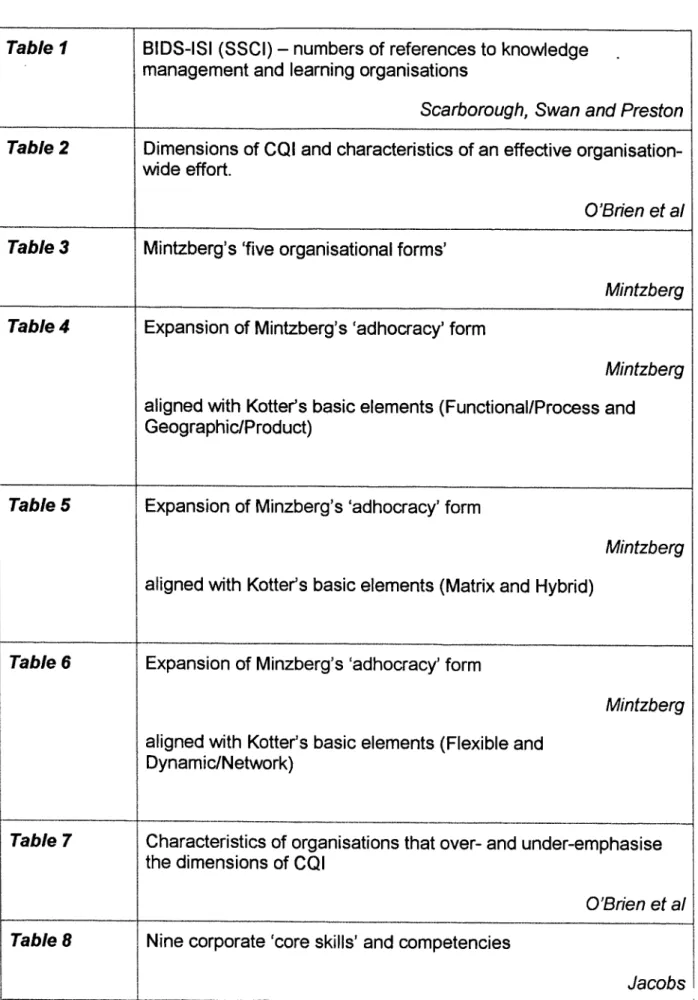
Table I BIDS-ISI (SSCI) - numbers of references to knowledge management and learning organisations
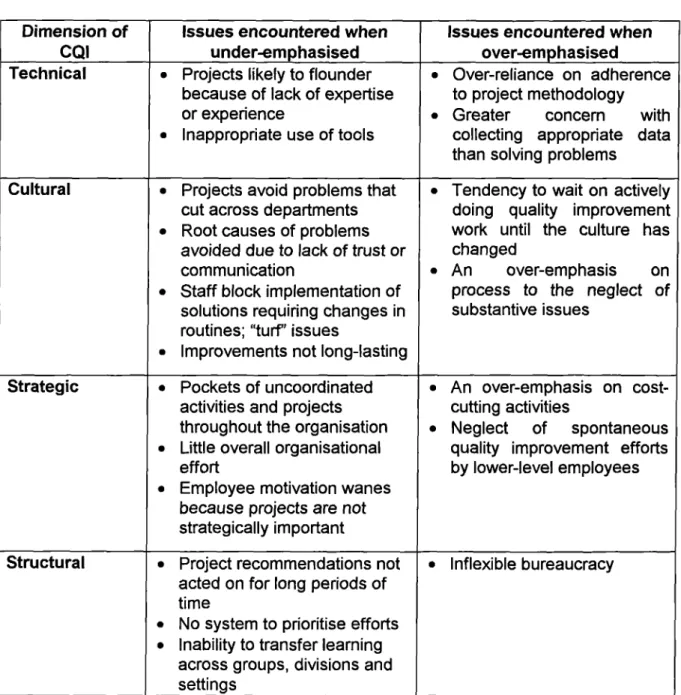
Scarborough, Swan and Preston Table 2 Dimensions of CQI and characteristics of an effective
organisation-wide effort.
O'Brien eta! Table 3
Table 4
Table 5
Mintzberg's 'five organisational forms'
Mintzb erg Expansion of Mintzberg's 'adhocracy' form
Mintzberg aligned with Kotter's basic elements (Functional/Process and Geographic/Product)
Expansion of Minzberg's 'adhocracy' form
Mintzb erg aligned with Kotter's basic elements (Matrix and Hybrid)
Table 6 Expansion of Minzberg's 'adhocracy' form
Mintzb erg aligned with Kotter's basic elements (Flexible and
Dynamic/Network)
Table 7 Characteristics of organisations that over- and under-emphasise the dimensions of CQI
O'Brien et a! Table 8 Nine corporate 'core skills' and competencies
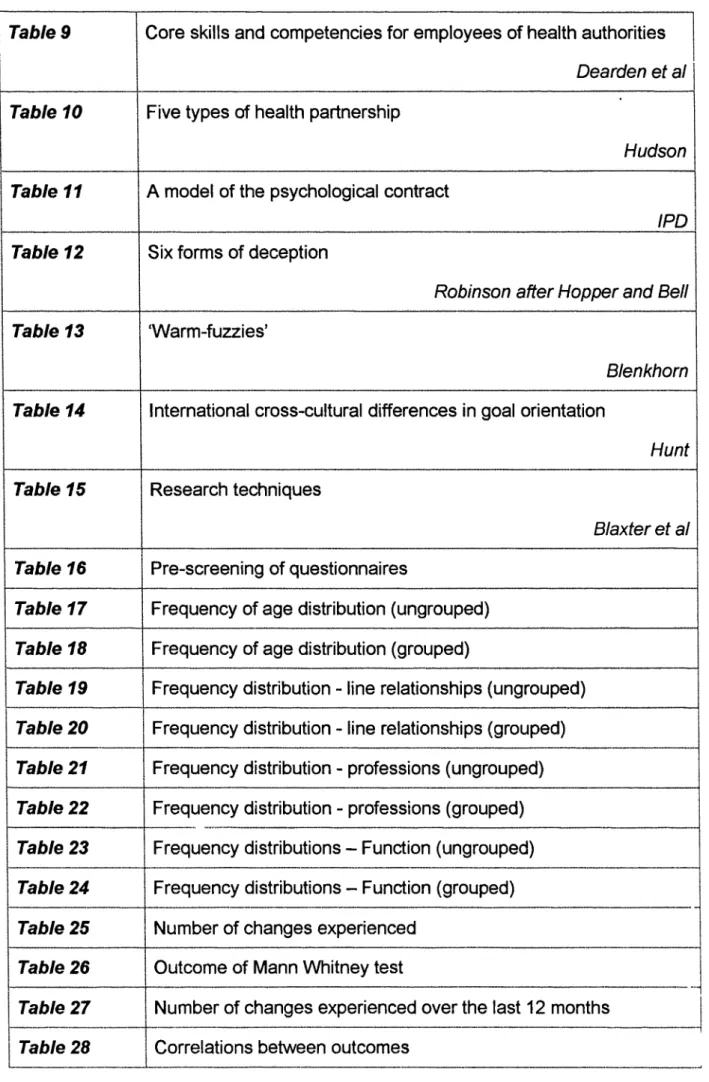
Dearden et a!
Table 10 Five types of health partnership
Hudson
Table 11 A model of the psychological contract
IPD Table 12 Six forms of deception
Table 13 'Warm-fuzzies'
Robinson after Hopper and Bell
Blenkhorn
Table 14 International cross-cultural differences in goal orientation
Hunt
Table 15 Research techniques
Blaxter et al
Table 16
Table 17
Table 18
Table 19
Table 20
Table 21
Table 22
Table 23
Table 24
Table 25
Table 26
Table 27
Table 28
Pre-screening of questionnaires
Frequency of age distribution (ungrouped) Frequency of age distribution (grouped)
Frequency distribution - line relationships (ungrouped) Frequency distribution - line relationships (grouped) Frequency distribution - professions (ungrouped) Frequency distribution - professions (grouped) Frequency distributions - Function (ungrouped) Frequency distributions - Function (grouped) Number of changes experienced
Outcome of Mann Whitney test
Table 30 Correlations between outcomes - Below CEO/Director level Table 31 Correlations between outcomes - clinical group
Table 32 Correlations between outcomes - non-clinical group Table 33 Mean ranking of espoused theory outcomes by sub-group Table 34 Mean ranking of Theories-in-use outcomes by sub-group Table 35 Frequency distribution - organic organisational structure Table 36 Perceptions of power base
Table 37 Frequency distribution - organisational achievement Table 38 Frequency distribution - decision level
Table 39 Frequency distribution - frequency decision level too high Table 40 Frequency distribution - attention paid to obtaining users' views Table 41 Frequency distribution - organisational reaction to change Table 42 Frequency distribution - influence on strategic planning and
annual objectives
Table 43 Frequency distribution - stakeholder confidence Table 44 Frequency distribution - knowledge levels Table 45 Frequency distribution - skill levels
Table 46 Frequency distribution - opportunities to develop knowledge and skills
Table 47 Frequency distribution - employee motivation
Table 48 Frequency distribution - are information professionals integrated with other teams
Table 49 Frequency distribution - are information/IT strategic plans clear Table 50 Frequency distribution - Focus on IT/information training and
development?
Table 53 Frequency distribution - information supports review process? Table 54 Frequency distribution - seeing others keeping knowledge to
themselves
Table 55 Frequency distribution - keeping knowledge to yourself Table 56 Frequency distribution - stakeholders know and understand
organisational values, beliefs and views
Table 57 Frequency distribution - stakeholders share organisational values, beliefs and views
Table 58 Frequency distribution - success recognised by key people in organisation
Table 59 Frequency distribution - failure visible outside organisation? Table 60 Frequency distribution - personal standards match your
organisation?
Table 61 Frequency distribution - personal standards match function you work in?
Table 62 Frequency distribution - do others have different standards to yours?
Table 63 Frequency distribution - do you know standards of others you work with?
Table 64 Frequency distribution - are people aware of your personal/professional standards?
Table 65 Frequency distribution - employees understanding what the organisation is seeking to achieve
Table 66 Frequency distribution —job security
Table 67 Frequency distribution - conflict resolution of standards Table 68 Frequency distribution - priority standards
Table 69 Frequency distribution - observing others seeking to 'win' at cost of someone else 'losing'
Table 72 Frequency distribution - employee involvement in decision .making
Table 73 Frequency distribution - emphasis on meaningful work
Table 74 Frequency distribution - responsibility for individual employees
Table 75 Frequency distribution - the number of managers
Table 76 Frequency distribution - the number of self-managing teams
Table 77 Frequency distribution - investment in training/skills development
Table 78 Frequency distribution - an atmosphere that encourages trust/mutual respect
Table 79 Frequency distribution - protection of personal rights
Table 80 Frequency distribution - encouragement to learn and be creative
Table 81 Frequency distribution - recognition and reward for superior performance
Table 82 Frequency distribution - size of managerial groups
Table 83 Factor analysis components
Table 85 Inter-group Factor Analysis component correlations
Table 86 Psychological Contract component correlations
Table 87 Correlations with job security
Table 88 Correlations with staff motivation
Table 89 Sub-group correlations for components of the psychological contract, components of factor analysis, Mann Whitney components, and outcomes
IFigure 1 Adaptation of Kotter's model of organisational dynamics
Schein Figure 2 cybemetric model or organisational control
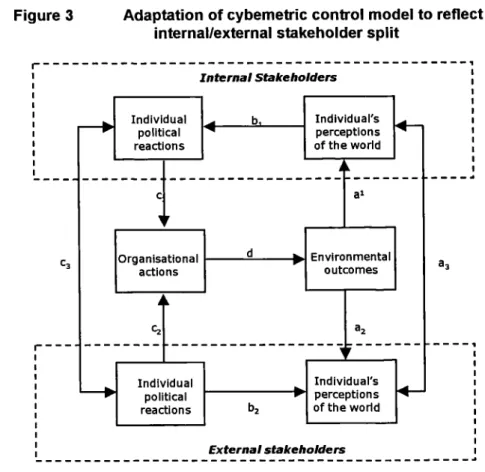
Hofstede Figure 3 Adaptation of cybemetric control model to reflect internal/external
stakeholder split
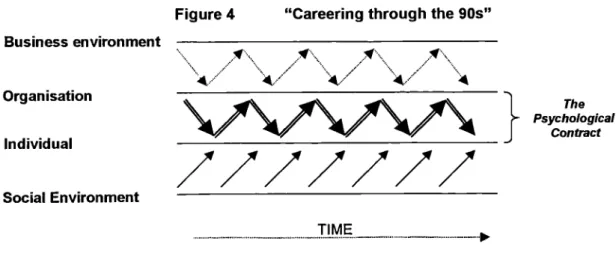
Figure 4 "Careering through the 90's"
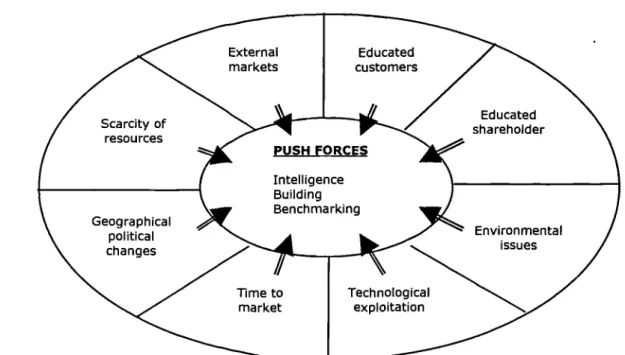
Herriott Figure 5 Push-pull environmental model - stage I :Demand
Zairi and Leonard Figure 6 Push-pull environmental model - stage 2:The Offering
Zairi and Leonard Figure 7 Job performance model
Birchall and LyQns Figure 8 Skills and competencies framework
Fritchie and Leary Figure 9 A hierarchy of knowledge
Rajan, Lank and Chapple Figure 10 Alignment model for values, systems and behaviours
Rajan, Lank and Chapple Figure 11 Matrix model for measuring key information dimensions of NHS
organisations
Farendon Figure 12 McGrath model of group process
Birchall and Lyons FigUre 14 tSystems thinking' model
_____________ Senge
Figure 15 Model of inter-relationships of preferences, talents, intellectual capital and motivation
Figure 16 Model of organisational dimensions and defensive routines as barriers to knowledge and information sharing
Figure 17 Matrix of peripheral and pivotal norms
Schein Figure 18 Kotter's mis-match model for the effect of the psychological
contract
____________ Kotter
Figure 19 Model of individual-individual and individual-organisational interactions
Robinson Figure 20 Inter-cultural differences toward work-related values
Goffee Figure 21 Model of prisoners' dilemma
Tucker
Figure 22 Model I : theories-in-use
Argyris Figure 23 Model 0-I
Argyris Figure 24 Model of defensive reasoning
Argyris Figure 25 Single- and double—loop learning
____________ Argyris Figure 27 Model of organisational dimensions, the psychological contract
and defensive routines as barriers to knowledge and information sharing
Figure 28 Correlation of factor analysis components aligned with theoretical construct
Figure 29 Interrelation of psychological contract components, outcomes, factor analysis components, job security and staff motivation
Figure 30 Generic components of correlation matrices
Figure 31 Clinical respondents correlation matrix
Figure 32 Non-clinical respondents' correlation matrix
Figure 33 CEO/Director respondents' correlation matrix
Figure 34 Below CEO/Director respondents' correlation matrix
Figure 35 Matrix of organisational arrangements and links to outcomes
Figure 36 Example of self-sealing defensive behaviour following violation of the psychological contract
Figure 37 Linkage of core components with each other and with Staff Motivation
CHAPTER ONE
INTRODUCTION
No task is so difficult To set about
No leadership so delicate No venture so hazardous As the attempt to introduce A new order of things Those who change Find as their adversaries All those who succeeded well
Under the old order
And no more than lukewarm Supporters among those who Might function under the new"
Machiavelli 16th century
Introduction
In 1988 Drucker described the typical business in 2008 as:
knowledge-based, an organisation composed largely of specialists who direct and discipline their own performance through organised feedback from colleagues and headquarters. For this reason, it will be what I call an information based organisation...We can perceive, though perhaps only dimly, what this organisation will look like, but the job of building information-based organisations is the managerial challenge for the future.
people to readily and freely share their knowledge is clear, and yet the reasons for it are still not fully understood.
Like most modern organisations the NHS is increasingly dependent on information and knowledge for direct patient care, for planning of health interventions, and for assessing efficiency and effectiveness. Supported by their professional ethics, clinicians have developed comprehensive, world-wide mechanisms for sharing information and knowledge that benefits direct patient care. However, clinicians have continued to be wary of sharing patient related information with non-clinicians, or sharing information and knowledge that may, in their view, compromise their ability to provide comprehensive services to patients. Patient confidentiality has often been cited as the reason for not sharing knowledge and information and is supported by recommendations of the Caldicott Report.,)<' Clinicians have been sceptical about the motives of non-clinicians who they see as having kept planning and commissioning of health services within the bureaucratic sphere of the NHS, often to the detriment of patients. This has created elements of distrust in the past between clinicians and non-clinicians in the NHS, as well as between health authorities, local Trusts and General Practitioners (GPs).
The NHS introduced an internal market in 1990. Hospitals and community units were encouraged to become self-governing Trusts, and GPs were encouraged to become fund holders with responsibility for planning and commissioning a defined range of services for their patients.
health service authority (FHSA) with whom they merged in April 1996. These
merged health authorities thus became the sole NHS organisation responsible for strategic planning and commissioning of local health services other than those commissioned by GP Fund holders.
Managing the New NHS - Functions & Responsibilities in the NHS (1993)
summarised the new overall responsibilities of health authorities as strategy, support and monitoring and stated that the new focus of health authorities needed
to be on:
evaluating the health and health care needs of the local population establishing a local strategy to implement national priorities and meet local health needs, in collaboration with GPs (fund holders and non-fund holders), local people, providers, other statutory and non-statutory organisations
implementing the local health strategy by:
- ensuring hospital and community health services are secured through contracts with NHS and other providers
- developing primary care, including the regulation, management and development of the services provided through the Family Health Service contractors
- working with GPs (fund holders and non-fund holders) to achieve locally agreed targets
- communicating with local people, seeking and responding to their views, improving their understanding of health and health services, and acting as advocates for their health interests
- working with existing and potential NHS and non-NHS providers to shape delivery of service within the health services market to seek improved value for money
- improving the quality and clinical effectiveness of care
monitoring and evaluating changes in health and the delivery of health services to ensure strategic objectives are achieved, refining the strategy as appropriate in the light of performance achieved
developing the capability locally to achieve the strategy both within the organisation and outside
discharging other corporate and statutory responsibilities
These were refined into six key tasks:
1. setting a strategic framework 2. securing and allocating resources 3. human resource management 4. working with clinical staff
5. performance management and accountability 6. developing and regulating the market
Public health professionals were given the responsibility for preparing the necessary targets, strategies and monitoring arrangements. Public Health roles and responsibilities were to be a key focus at health authority level. They included statutory roles such as: communicable disease control, implementation of the Health of the Nation national programme, contributing to the assurance of clinical
effectiveness in health care contracts, health promotion, assessment of health need and development of relationships with GPs and clinicians in Trusts. The responsibilities of Public Health were also summarised in Managing the New NHS -Functions & Responsibilities in the NHS (1993) as:
monitoring the health of the population
ensuring the public health considerations drove the health authority's purchasing and health commissioning activities
monitoring health outcomes of interventions
improving the effectiveness and value for money of clinical and non-clinical interventions
developing local health strategies and the alliances necessary to implement these; developing and sustaining effective relationships with local clinicians including those working in primary care and community-based health programmes
collaborating with local authorities and other agencies as appropriate to monitor and control communicable disease and non-communicable environmental exposures, and in their prevention
continual threat of redundancy.
ensuring that local GP fund holders and all providers of primary, hospital and community care, including those in the voluntary and private sectors, have access to adequate and appropriate public health advice
Health authorities, GP fund holders, and Trusts required new information to plan and commission health services. Public health in particular needed, for example, details of patient episodes in hospital and more importantly needed information from GPs about morbidity in order to assess need and link health
events.
The sharing of this information, even at professional level, was slow to happen for a number of reasons including incompatibility of computer systems, distrust between GPs and health authorities, the business ethic between fund holders and Trusts, and competition between fund holders.
Since 1994 there has been intense pressure from the NHS Executive on health authorities to prove they are effective (delivering promised change and associated health improvements) and pressures to reduce the costs of managing health authorities. Every year new, lower targets were set for these management
costs and this meant that many of the staff working in health authorities felt the
as bestowing power upon the holder, any personal threat to the physical or mental wellbeing of the individual is likely to result in people becoming defensive. A sign of this defensive behaviour would be knowledge being held as a personal asset by the individual and used as a bargaining tool. Perceived threats to personal or professional status, or threats to personal standing in a community or profession, are likely to evoke the same response.
However, those responsible for planning and commissioning local health services have been at a different hierarchical level to those who provide direct patient care services. These hierarchical levels (district, area and regional health authorities) have been perceived by many clinicians as being run by administrators who have obstructed progress. A good example would be the imposition of financial limits upon expenditure, the rationale for which did not convince some clinicians.
Some GPs saw the introduction of fund holding as a golden opportunity to ridc\ themselves of the historic burden of bureaucracies to which they had been subjected. Some developed an arm's length relationship with their local health authority whilst others enthusiastically embraced the new developments and began to work more closely with their local health authority.
as GPs are seen as part of this". Wall (1996) saw the introduction of locality commissioning as a way of overcoming differences of culture, values and beliefs but both Wall, and Hudson (1995), recognised that this could cause more problems than it would solve. Wall believed commissioning organisations (health authorities) had difficulty in knowing how much to delegate their authority - too much and they removed their own purpose, too little and locality managers just became post boxes. The NHS confederation hosted a conference in May 1998 at which 81 people attended a focus group to discuss these issues. The group included 15 GPs, 29 managers from health authorities, 13 practice managers and 4 managers from provider organisations. The level of interest from health authorities indicated the unanswered questions they had about making the new arrangements work. Whilst cautiously optimistic about the benefit to patients, the group concluded there were major barriers to be overcome.
PCG boards and the Royal College of Midwives said they were 'concerned' about many issues.
The whole process of change was seen as having yet another destabilising effect but by Hunter (1998a) also believed that there was a very real danger that as managers and professionals were swept up in yet more organisational turbulence, the less glamorous structural issues of public health, health gain, health
improvement and inequalities would be forgotten. The early indications were that this research would be as valid for PCGs as it was for health authorities.
Organisations have increasingly become more dissociated and employment become a portfolio of projects and tasks rather than one single 'job'. Organisations and individuals need to be constantly aware of how these new dynamics will affect them and where the focus for organisational and personal development should be. Currently emerging are organisational dynamics relating to:
• the rapid developments in the information/knowledge cultures of organ isations
the impact of more dissociated organisational structures on the need for people to acquire skills in the management of relationships
• the need in the current climate of 'portfolio' careers for individuals to develop a reference framework for themselves from which they develop skills associated with moving from team to team, working co-operatively with many other disciplines and professions, and being confident in their own skills and knowledge.
those in public health), and Primary Care Groups, secure planned improvements in health gain and the health status of individuals and local populations.
There has been research into why people become defensive but little is known about how this relates to barriers to knowledge sharing. Even the work that has been done on examining defensive mechanisms has yet to fu'ly assess the impact of the organisational dynamics that are now emerging.
An influential researcher and author in the field of defensive behaviour is Argyris. Argyris (1985) found that whilst efforts can be made to overcome these defensive behaviours (Argyris called these defensive routines), personal opportunity or threat was the over-riding motivation for people to be overtly and/or covertly supportive, or to be defensive towards proposals which they found threatening to deeply held personal or professional values, culture or beliefs. To overcome these defensive routines Argyris suggested that people needed to be educated in a new ways of working in which individuals had to develop their own information and own it, receive feedback positively and receive feedback in ways that encouraged the individual to act 'appropriately'.
in working arrangements. These latter expectations form part of less tangible psychological contracts. When contractual or psythological contracts are broken then working relationships deteriorate, trust is lost and individuals become nervous about their personal futures.
Organisations are now intensively information and knowledge based, but information and knowledge will only flow and be shared more freely if relationships are managed well. Relationships will only improve if those seeking to elicit knowledge prove themselves to be trustworthy, understanding, responsive and effective. Health care organiations need to prove themselves by entering into real partnerships with each other. For health authorities this means partnerships with local GPs and local Trusts. However, many of these potential partners of health authorities can be sceptical and mistrusting of the motives of those in health authorities. As a result there. can be a reluctance to share information and knowledge, and so the specious argument could go on. In order to be effective this circle needs to be broken.
It was believed that through the research carried out for this thesis there would be a significant contribution to knowledge by exploring the extent to which maintaining the psychological contract could overcome defensive behaviours towards knowledge sharing and facilitate the development of the NHS at local, and perhaps national levels.
Background -
A brief history of NHS developmentThe Beveridge Report published in 1942 contained far-reaching recommendations for the formation of a National Health Service. One of its central assumptions was that a comprehensive system of healthcare was essential to any scheme for improving health standards. Comprehensive was described as medical treatment available for every citizen, at home and in hospital, available as and when they should need them.
However, the initial proposal to have GPs as full-time employees was received by them with scepticism about the Government's real intentions. The British Medical Association (BMA), the professional organisation representing medical practitioners, withdrew from discussions that were then halted.
The White Paper, A National Health Service, was finally published in 1944 and by the time negotiations were completed GPs had the opportunity to remain independent practitioners.
GPs were thus an integral part, but not an integrated part, of the NHS. An early opportunity to integrate the three arms of the NHS - hospital services, community services and Family Practitioner Services - had been lost. GPs remained strenuously opposed to being made employees of the NHS, seeing their separation from hospital services as necessary to retain their professional autonomy.
The compromises made in order to establish the NHS were contributory to the problems the NHS encountered in the period up to 1974. Failure to meet original hopes of a fully unified, comprehensive service were exemplified by the introduction of compulsory payment by patients for certain services, e.g. prescriptions. When NHS contributions were introduced the principle of a free service was lost for ever.
The major problem, however, was that demand quickly outstripped the available supply of funding. Reviews published in 1956 (Guillebaud Report) again identified the weakness of the NHS having its three parts operated by three governing bodies with no effective link between them. Between 1956 and 1962 various reports (Porritt, Gillie and Cranbrook) addressed the issues of unification.
From 1948 to 1967 little further attention was paid to the organisational arrangements of the Family Health Services, and the effectiveness or relationships with other related service providers. The complexity of the NHS meant that by 1967 there were 15 Regional Hospital Boards, 36 Boards of Governors, 336 Hospital Management Committees and 134 Executive Councils separately administering the services of 20,000 general practitioners who functioned as independent contractors. 175 local authorities independently ran the community services.
In 1968 Kenneth Robinson (Minister of Health) published The Administrative Structure of Medical and Related Seivices in England and Wales which had a
central theme of unifying health services under 40-50 Area Boards serving populations between 750,000 and 2-3 million. In February 1970 The Future>.' Structure of the National Health Seniice was published. The main themes were
. the new Area Health Authorities would be independent of local government and directly responsible to the central department
. the public health and personal social services would continue to be the responsibility of local government
• the boundaries of the new health authorities would match those of local government.
The new arrangements for the NHS were planned in the context of new arrangements for local authority personal social services. The First Green Paper again recommended to jointly administered health and local authorities. The Second Green Paper favoured the separate administration of health services but within the same geographical areas as those defined for local authorities.
Regional inequalities in health care were by now being identified. These inequalities have been attributed to a number of factors including unemployment, overcrowding and low wages but the failure of the tripartite structure to iron out these inequalities was partly due to the disparate nature of hospital, community and family practitioner services. The inception of Area Health Authorities (AHA5) was an attempt to provide the necessary infrastructure to overcome this obstacle. The 99 AHAs set up in England were largely co-terminus with local authority boundaries and covered populations of a quarter of a million to over one million.
large, sub-division was made into District Health Authorities (DHA5) whose role was primarily to implement policy.
The major reorganisation in 1974 was implemented over severaF years. Almost immediately a Royal Commission was set up under the Chairmanship of Sir Alec Merrison to review managerial and financial arrangements. Reporting in 1979 the report was critical of management of the NHS - too many tiers, too many
managers and failure to make swift decisions being cited.
The Government's response was Patients First (1980) which focused on structural change and proposed the abolition of AHAs and strengthening the role of DHAs. Patients First also suggested streamlining professional consultative machinery and planning systems. Unit management of hospitals rather than functional management was also proposed.
Following consultation, the NHS was re-organised in 1982. This was seen as the opportunity to resolve dissatisfaction, which had surfaced almost immediately the 1974 re-organisation had started. The premise that AHAs would be sensitive enough to local needs and that the DHAs would not have their own ideas about the shaping of health services was poorly founded. Differences of viewpoint were inevitable. District Management Teams (DMTs) were not accountable to the Area Teams of Officers (ATOs) but could be monitored by them. The opportunities for resenting such arrangements should have been clear.
These new arrangements still left no clear point of accountability in a District Management Team since they worked by consensus. Critical of this, the Secretary of State appointed Sir Roy Griffiths, seconded from Sainsbury PLC, to lead a team to advise him. The report, NHS Management Enquiry, confirmed this lack of clear leadership and accountability. The resultant appointment of General Managers did much to set the NHS on a course for more accountable management, less ambiguity and tighter control. Even so, the Government remained concerned, particularly with financial demands. Abolition of AHAs in 1982 also left Family Practitioner Committees (FPC5) and health authorities non-coterminous and encouragement for joint working was consequently reduced.
By the late I 980s financial pressures resulted in service cuts and closure of wards on a significant scale. The factors leading to these pressures were coming from growing public expectations, advances in medicine and an ageing population.
Increasingly there was a belief in the Government that a market economy would encourage greater efficiency if adopted by the NHS. This had many attractions not least of which was an opportunity for patients to influence the way in which services were bought and a perceived ability to abstractly manage financial pressures as a result.
A greater focus on primary care came with Promoting Better Health a Green Paper (1987), which had three main objectives:
• Improving general standards of primary care • Giving consumers greater choice
Increasing the emphasis on health promotion
resultant National Health Service and Community Care Act came into being in October 1990. This Act introduced the NHS Management Executive (latterly the NHS Executive). Led by a Chief Executive the group has membership of civil servants and NHS managers together with other professionals with specialist knowledge.
Health Authority arrangements changed so that there were equal numbers of executive and non-executive directors together with a Chair. The Secretary of State now appointed the non-executive officers who appointed the executive officers with the Chief Executive. This model was similar to that used in commercial organisations. Hospitals and Community Units became self-governing Trusts. This gave them new latitudes of self-governance within an overall framework and the ability to develop their 'market'. Trusts had their own boards of management with a Chair and Chief Executive and the new family health service authorities (FHSA5) had a greater role in planning.
One of the distinctive features of the new arrangements was the principle that money should follow patients wherever they were treated. In this way Districts were funded for their resident population. Contracts with Trusts allowed funds to flow with the patients to the Trusts. Where no contract existed then Extra Contractual Referrals (ECR5) were arranged. Costs of emergency treatments were absorbed by each Trust as part of their business plans and pricing structures.
These arrangements encouraged GPs to be critical of their assessment of need and use of financial resources.
The changes from FPC to FHSA marked some significant changes in approach, characterised as moving from administration to management. FHSAs were tasked with reducing drugs budgets and introducing 'competition' between GPs. The latter permitted advertising and encouraged GPs to group together for economies of scale.
Administrators of FPCs had hitherto been on salaries considerably below those of corresponding peers, especially at district levels. This had caused considerable resentment and whilst introduction of general managers for FHSAs on salaries comparable with DHA General Managers gave potential for improvement, the resentment of years of lagging behind remained with many for some time.
Further structural changes were announced by the Secretary of State in Managing the New NHS on 21 October 1993. This identified functions to be carried
out at local level - by Trusts, GPs and other primary care providers, and health authorities - and those which were to be the responsibility of the NHS Executive either at its headquarters or in regional offices. The framework was shaped by the twin objectives of maximising the responsiveness to local people and achieving best value for money for patients and the public.
The organisational changes that took place in April 1994 were aimed at encouraging co-operation, efficiency and effectiveness by overcoming organisational barriers. These new arrangements required people to work open'y with each other in partnerships, sharing their skills and knowledge in pursuit of
improved services for patients and improved health status of local populations.
Considerable unease accompanied the early days of these changes. Fears of the NHS losing its public accountability were, at the margins, heightened by fears that this was the start of privatising the NHS. These fears have, to date, been groundless. However, the increased need to ensure effective use of resources had prompted GPs and Health Authorities to seek closer working arrangements. This has been seen by many of the general public as rationing and further undermining a comprehensive service.
The introduction of GP fund holding, and the general move towards a primary care-based NHS, were directed at making the provision of healthcare increasingly more responsive to the needs of patients and the more equitable provision of local services. The formal integration of DHAs and FHSAs was the first real opportunity for an integrated approach to the achievement of health gain for local populations.
A strong public health function would be needed in each new health authority, led by a Director of Public Health (DPH) as a senior member of the corporate management team. The DPH was also to have ready access to advice from clinicians, including GPs and from other professionals. It was likely that, as the authority evolved into a public health organisation, public health skills would become disseminated more widely throughout the organisation and the DPH would function increasingly as a matrix manager, working in their professional functional
Rationale for the Research
In general, the current experiences of the NHS follow general trends being experienced in European health care. These were summarised by Brazil (1996) as:
• a move away from universalism
• greater reliance on family and friends
• insufficient resources to fund public service demand
• acceptance of need for explicit rationing of public services
Additionally Brazil foresaw a blurring of professional boundaries Mth associated multi-skilling, faster changing technology and greater user involvement. Brazil identified five issues that European health care needed to address:
• how is the funding for health care to be organised?
• how is the work of professionals to be organised?
• what, in consequence, is the structure required?
• what outcomes are required?
• how are service providers to be held accountable?
Individuals, teams and organisations usually set out to be effective - visions are agreed, strategies are developed, targets are set for excellent performance, and people trained for the tasks ahead and yet over time many organisations are often faced with a puzzle: why do apparently well-intentioned, well-motivated people set
out to be effective but end up dealing with each other in ways that result in
mediocrity or failure?
Buchanan & Huczynski (1997) saw this organisational dilemma as one of reconciling the potential inconsistency between individual needs and aspirations on the one hand, and the collective purpose of the organisation on the other. Buchanan & Huczynski acknowiedged that organisations could not be treated as just logical or mechanistic since there were political systems in which individuals strive to achieve control over each other, to gain wealth, status and power.
One of the most basic of human instincts is survival and to ensure survival one of the basic human reactions to a threat is flight or fight. This reaction is instinctive and hard to keep under our own control. These threats may be to life or to livelihood. Either way, our reaction tends to be one of personal survival or to ensure survival of those to whom we have very close personal bonds.
In our working lives threats may arise from fears about job security, status, professional opinion or a number of other reasons. In a rapidly changing work environment the threats, real or perceived, may arise simply because of change itself and the general uncertainty it brings. There are many peop'e who see change as providing new opportunities. There are also those who, seeing this change as a threat, form safety barriers around themselves and put promote themselves as being indispensable to safeguard their continued employment. To achieve this they are likely to regard knowledge as power - intellectual capital with which they can trade.
People may be able to overcome these barriers fully or partially if they have the motivation to do so. However, if they feel personally threatened in any way they will probably become defensive and develop defensive routines to safeguard themselves. The issues may be sufficiently sensitive that people are reluctant to discuss them and the issues then re-occur and behaviour becomes reinforced. These defensive routines are most likely to manifest themselves in interpersonal
relationships and, if knowledge is felt by individuals to give them power, a reluctance to share knowledge for fear of jeopardising their own position.
Governments have introduced many important imperatives over the last few years e.g. Health of the Nation, and reduction in waiting times. These have inspired achievement in some parts of the NHS and abject failure to meet even basic standards in others. Good practice has been identified and shared at numerous conferences and seminars as well as being written up in journals. Task forces have been established and yet these spectres come back to haunt us as measures of performance and effectiveness often show that little has changed.
Changes in the NHS have been aimed both at making the NHS more 'competitive' and developing partnerships - alternately creating and then seeking to dismantle barriers. Hunter (1998) noted that the competitive market was to be replaced because of the dysfunctional behaviour and perverse incentives it had spawned. The local driving force for these changes within the NHS (as opposed to civil service channels) is usually through health authorities. Partnership is now a key theme in the government's plans for change and this puts a considerable burden upon a layer of management that has no direct control over the delivery of health care either through GPs, hospitals, community services or social services. This means that unless the organisation itself, and its relationships with partners are good, the chances of success are much reduced.
Summary
C
/
This research was planned to:
• use Argyris' theories to identify the critical issues which might act as barriers to knowledge sharing and cause people to develop defensive behaviours toward knowledge sharing
• use theories relating to the psychological contract to assess the extent to which components of the psychological contract might influence defensive behaviours
• adapt an established framework for analysing organisational dynamics to account for emergent organisational dynamics
• develop a questionnaire that enables answers to the relevant research questions to be sought
• secure the commitment of one (or two) health authorities to applying the questionnaire to their organisation(s)
• use responses to the questionnaire to assess the extent to which barriers to knowledge sharing exist, and determine how these barriers have developed or been overcome
• use the outcomes of the research to inform organisational development needs and especially how knowledge sharing can be successfully encouraged
• assess the potential of the research outcome to inform the developmental needs of Primary Care Groups
Summary
The NHS gives high levels of political, top-down direction to Regional Offices
as civil service outposts of the NHS Executive and to health authorities (and latterly
Primary Care Groups) as the lead in long and medium-term strategic health
development and improvement. Operational service delivery and decision-making
continues to reside with Trusts and General Practice. Models of planning, primary
care delivery and influencing secondary care provision continue to focus on the
primary care setting. Health authorities (and latterly Primary care Groups) therefore
find themselves at the crossroads of primary care and secondary care planning and
provision, whilst retaining responsibility for achieving longer term improvements in
health gain, health improvement and redressing inequalities in provision.
Health authorities will need to ensure that they are 'healthy' organisations
where all efforts can be focused on ensuring the future success of PCG5 and other
initiatives. Because health authorities are not direct patient care providers they
have, arguably, they greatest need to acquire, share and use knowledge and
in formation as their primary asset.
To achieve the necessary high levels of knowledge sharing it will be essential
to identify and understand the barriers to knowledge sharing and then be able to
develop individuals, teams and organisations accordingly. The psychological
contract is a relatively new concept to the NHS, and Its potential to overcome
barriers to knowledge sharing, and facilitate knowledge elicitation needs to be
CHAPTER TWO
LITERATURE REVIEW
Introduction
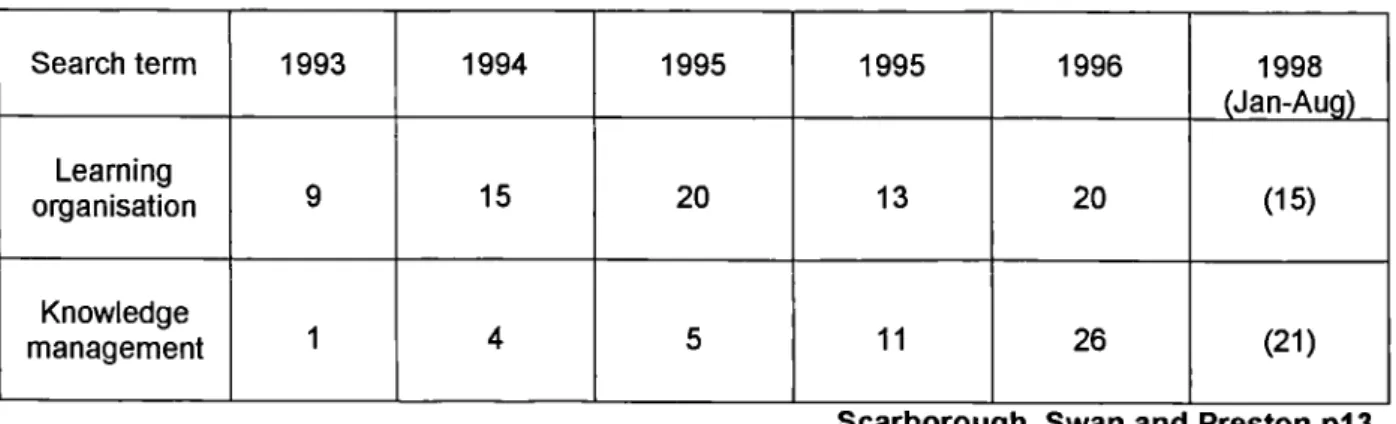
In 1995 when this research was started there was very little published literature on barriers to sharing knowledge as an aspect of knowledge management. What was found focused on the technological aspects of storing and disseminating of knowledge. This technical focus was not that which was required for the research, the focus needing to be on knowledge elicitation and the barriers to sharing knowledge. This shortage of literature was confirmed by Scarborough, Swan and Preston (1999) when they undertook a literature review on knowledge management for the Institute of Personnel and Development (Table 1)
Table I BIDS-ISI (SSCI) - numbers of references to knowledge management and learning organisations
Search term 1993 1994 1995 1995 1996 1998
_______________ __________ _____________ ____________ _____________ ____________ (Jan-Aug)
Learning
organisation 9 15 20 13 20 (15)
Knowledge
management 1 4 5 11 26 (21)
Scarborough, Swan and Preston p13
reference to information technology or information systems and even in those with a strategic management or human resource management 44 (24%), Scarborough eta/found that there was "a rather narrow IS (Information Systems) perspective".
The result has been that the 'people issues' and associated barriers to knowledge sharing have been poorly researched. This was surprising as Scarborough et a! were later to describe this as "the bedrock of KM (knowledge management) initiatives". However, this researcher was encouraged, as the ability
to add to knowledge was evident. In particular there were no specific references found by Scarborough et a! or this researcher on topics directly addressing this area of research.
Organisation
This section defines 'organisationç introduces the four basic ideas that
underlie the concept of 'an organisation' and the interrelation of these four ideas
explored. A working definition of 'effectiveness' applicable to the NHS is developed
and the concept of organisational effectiveness introduced.
Frameworks are then developed and used to analyse organisational forms
and organisational dynamics applicable for the NHS. Barriers to the sharing and
use of knowledge and information are explored and potential interventions for
The Concept of 'Organisation'
Most people would probably be able to name an organisation familiar to them e.g. NHS, football supporters club or neighbourhood watch, but what makes a corporate body different from a club or just a group of people? Koontz, O'Donnell and Weihrich (1980) described an organisation as:
an enterprise itself
co-operation of two or more persons
the internal structure of roles in a formally organised enterprise
a system or pattern of any set of relationships in any kind of undertaking all behaviour of all participants in a group
Reber (1985) used the description:
a characteristic of any complex system that reflects the degree to which it's several, structurally distinguishable parts are functionally co-ordinated and interrelated
• the process that operates so as to bring about such a co-ordinated system • the system itself as it displays such properties
Buchanan & Huczynski defined organisation as:
"social arrangements for achieving controlled performance in pursuit of collective goals"
within which there is co-ordination of effort. Each individual has unique skills, knowledge and experiences that when combined with those of other individuals, creates a situation where the whole is greater than the sum of the parts. Although implied, these definitions do not reflect this division of labour. Similarly there seems to be an assumption that those people working together are doing so in the pursuit of a common goal or purpose to which they are individually committed.
Individuals usually lack the ability to satisfy all of their own needs and wishes. However, when skills, knowledge and experience are pooled, and individual efforts are co-ordinated, outputs and outcomes can be achieved that individuals would have been unable to achieve on their own. This is the first of four basic ideas underlying the concept of organisation that Schein (1988) proposed. The idea of co-ordination of effort in the service of mutual help, implies that those working together are doing so willingly and have a shared vision of why they are working together.
The second basic idea Schein proposed was that people work together for the achievement of common goals (purpose or objectives) to be achieved through co-ordination of effort.
To achieve these common goals reliance is placed upon individuals with different skills, expertise and knowledge being grouped into small units within the organisation that satisfy particular needs of the organisation. These smaller units may be functionally and/or geographically separated. This division of labour is the third idea that Schein suggested was common to organisations.
goals, purpose or objective (Schein). This fourth idea defines an organisation and implies that the smaller units submit to some sort of authority for the greater good of the organisation as a whole, most typically through a hierarchy of authority.
The ideas and concepts proposed by Schein address the issues implied but not reflected in the earlier definitions of organisation and were summarised by Schein and formed the definition of organisation that has been used during the course of this research.
It should be recognised that the concept of organisation does not imply that it is actually achieves what it set out to achieve, nor does it imply that what it sets out to achieve actually benefits those inside or outside the organisation. It also assumes that organisational and individual competencies have been assessed and are adequate to achieve the desired outputs or outcomes. For example, it assumes that human beings have the requisite skills to interrelate perfectly. Personal experiences suggest this is not always the case and yet relationships have not formed a major part of social analysis until comparatively recently (Schlutter & Lee, 1993). Cooper & Williams (1994) found that healthy organisations were not created by accident. However, many of the theories for change, organisational development and programmes for organisational audit appear not to adequately address these issues and explore why people act defensively with each other and with organisations of which they are part.