A DYNAMIC MACROECONOMETRIC MODEL FOR
SHORT-RUN STABILISATION IN INDIA
*Sushanta K. MALLICK Department of Economics
University of Warwick Coventry CV4 7AL, UK
Email: [email protected]
ABSTRACT
This paper presents a small macroeconometric model examining the determinants of Indian trade and inflation to address the effects of a reform policy package similar to those implemented in 1991. This is different from previous studies along one important dimension that we explicitly incorporate the non-stationarity of the data into our model and estimation procedures, which suggest that the stationarity assumption may be a source of misspecification in previous work. So the model has been estimated using the data from 1950 to 1995 employing fully-modified Phillips-Hansen Method of estimation to obtain the cointegrating relations and short-run dynamic model. Policy simulations using dynamic simulations method compare the dynamic responses to devaluation with the responses to tight credit policy. It is shown that the trade balance effects of tight credit policy are more enduring than those of devaluation. The simulations demonstrate that the devaluation has actually worsened the trade balance and hence devaluation is not an option in response to a negative trade shock, whereas the reduction in domestic credit produces a desirable improvement in the trade balance.
JEL Classification: C51, E17
Key Words: dynamic modelling, cointegration, inflation, devaluation and tight credit policy
*
A DYNAMIC MACROECONOMETRIC MODEL FOR
SHORT-RUN STABILISATION IN INDIA
ABSTRACT
This paper presents a small macroeconometric model examining the determinants of Indian trade and inflation to address the effects of a reform policy package similar to those implemented in 1991. This is different from previous studies along one important dimension that we explicitly incorporate the non-stationarity of the data into our model and estimation procedures, which suggest that the stationarity assumption may be a source of misspecification in previous work. So the model has been estimated using the data from 1950 to 1995 employing fully-modified Phillips-Hansen Method of estimation to obtain the cointegrating relations and short-run dynamic model. Policy simulations using dynamic simulations method compare the dynamic responses to devaluation with the responses to tight credit policy. It is shown that the trade balance effects of tight credit policy are more enduring than those of devaluation. The simulations demonstrate that the devaluation has actually worsened the trade balance and hence devaluation is not an option in response to a negative trade shock, whereas the reduction in domestic credit produces a desirable improvement in the trade balance.
1. INTRODUCTION
(Murty and Prasuna, 1994; Paul, 1994; Verma, 1994). Krishnamurty and Pandit (1996) is a very recent model of India’s trade flows, which is a part of the on-going project “Macroeconometric Modelling for India” supported by the National Science Foundation, USA, but suffers from the same criticism as the above studies (i) by not paying any attention to the new econometric literature, not even the equation diagnostics of a dynamic model (ii) model specifications are very conventional by adding a lagged dependent variable in the export and import equations to allow for slow adjustment. However, it is now well known that traditional ways of estimating time series models may suffer from the spurious regression problem (Granger and Newbold, 1974) and attention should be paid to the potential non-stationarity of the time series.
2. ANALYTICS OF THE STABILISATION MODEL
The official quantitative modelling exercises to back-up the Government policies in India on determining the impact of fiscal deficit and exchange rate instruments are virtually non-existent. The policies being currently employed in India are known to be based on a CGE Model that is available with the IMF and the World Bank1, and they stand on global structural adjustment experiences gathered by the IMF and the World Bank Staff. Further we feel that while there exists extensive literature on the experience of structural adjustment policies in various DEs there is no econometric model following the new time series literature to analyse the current account deficit problems facing India. Hence we limit the scope of this paper to build an aggregate macroeconometric model to explain the BoP and general price level.
Our model derives its analytical starting point from VS, a quantitative economic policy model. VS employed the standard Monetary Approach to BoP which is the basis of the IMF’s policy framework. VS model is based on a fairly standard economic paradigm with little or no role for supply-side factors. Hence we need to emphasise both money and supply-side factors in price formation along with the incorporation of some of the recent developments on structural adjustment experiences in India by updating the database. Since the role of prices is important in determining trade flows and thereby trade balance, we need to know exactly how best to model the price formation process. In our view, the best way to model inflation is by bringing together both the demand and supply factors as determinants of inflation. The basic econometric model we use here is an adaptation of the model proposed by VS to compare the dynamic responses to devaluation with the responses to tight credit policy, which does not model the price formation process in India. The VS model is described as follows:
2.1 The VS Model
1. Price Equation
ln ln( ) ln( )
( ) ln( )
t t t t i t i
n
t
P = M YM + +
M − + − − − − −
∑
να να να σ π να σ π
ν
0 1 2 0 2
1 1
1
[2.1]
2. Definition of inflation t = P - t Pt
π ln( ) ln( −1) [2.2]
3. Definition of desired real balances
ln(MP t)d ln( t) t i ti
n
YM
=α0+α1 −α σ π2 0 −α2
∑
σ π1
[2.3]
4. Unit value of exports
ln( ) [ln( ) ln( )] ln( ) ln( )
ln( ) ln( ) [( ) ( ) ( . ) ]
PX P E S PW Y
YW X
t t t t t t
t t MP td MP t D KP t
= + − + − −
+ + − − − − −
β β β β
β β β
0 1 2 3
4 5 1 6 1 ∆
[2.4]
5. Export demand
ln(X =t) δ0−δ1ln(PW tPX) +δ2ln(Y W +t) δ3lnXt-1 [2.5]
6. Imports
[
]
[
]
t 0
PM E T
P 2 t t MP td MP t
D K P KI X PX
PM t t
I = + + Y + EI
+ R I
t t t t
t t t
t t t
t
φ φ φ φ φ
φ φ φ
1 3 4 1
5 6 1 7 1
( ) . . ( ) ( ) ( + − + − − + − − + + ∆ [2.6]
7. Money supply identity: M = K Rt t( t +Dt) [2.7]
8. Balance of payments identity
t t -1 t t t t t t t t
R = R + X PX E - I PM E. . . . +KI E. [2.8] Endogenous Variables:
Pt is the price level (represented by the wholesale price index), πt is the rate of inflation, Mt is
the nominal money supply (M3), (M/P) d
is the desired real balances, PX is the unit value of exports in US dollars, Xt is the export volume, It is the import volume, Rt represents the
foreign exchange reserves in rupees.
Exogenous Variables:
YM is the marketed output, Yt is the national income at constant prices, YW is the real GNP
(Rs per US$1), Tt is unit import duties (Rs per US$1), PW is world price level (in US$), PMt
is the import unit value in US$, KIt refers to net foreign assets of the non-banking sector (in
US$), EIt is the essential imports, Dt is net domestic assets of the Reserve Bank of India, Kt is
the money multiplier.
2.2 Critiques of the VS Model
The VS model is a semidynamic model with traded and nontraded goods and one asset -money. There are no explicit equations for the non-traded goods market. The level of real output is exogenous. The model was used to compare the dynamic responses of devaluation and tight credit policy on inflation and trade balance. The following points are pertinent in this regard:
1. The model does not describe the price formation process. Instead it derives a model of price determination by simply inverting the real money balances equation, which is indeed ambigious as to what explains inflation except money. Hence we need to provide a model of price determination by following the literature on Indian inflation.
2. VS considered only temporary shocks to evaluate the dynamics of devaluation and tight credit policy, what actually happens during an economic crisis is a permanent shock, hence there is a need to consider both temporary and permanent shocks.
3. The model is not truly dynamic in the sense of assuming all the variables to follow a dynamic process, and thus the approach to dynamics needs the respecifying equations: (a) The actual stock of real balances in VS model assumed to have a partial adjustment
mechanism that adjusts proportionally the difference between the demand for real money balances and the actual stock in the previous period, but we abandon this assumption and instead we add an interest rate variable in the money demand relation that makes the excess money demand a stationary process and the error correction term resulting from this money demand relation would be the adjusting variable. Hence the specification of the lagged adjustment of real money stock is no longer important.
(c) The actual level of imports was assumed in VS as a distributed lag function of the permitted level of imports with Koyck type geometrically declining lag coefficients, which we have abandoned assuming that the permitted level is equal to the actual level of imports. Moreover our assumption excludes the introduction of lagged imports variable in the long-run imports equation unlike the traditional specifications that combine a long run relation with short-run adjustment.
(d) When all the equations in the VS model are log-linear except import equation which is linear, we have made the import function as log-linear because they are traditionally estimated in log-linear form (see Sedgley and Smith, 1994).
(e) Other aspects of the model are left as in VS including the exogeneity of Y, barring a few other empirical issues that need investgation in section 4.
2.3 Monetary Disequilibrium
The demand for money equation is fairly standard as in VS, but it includes interest rate as an additional argument. The desired stock of real money balances (M/P)d is related to marketed output2 rather than real national income, interest rate (IR), and the expected rate of inflation (πe
) that follows a general distributed lagged process:
ln( )M ln( ) ln( )
P t d
t t t
e
YM IR
=α0 +α1 −α2 −α π3 [2.9]
where πt σ π σ π e
t i t i
i n
= + −
=
∑
01
with 0 ≤σ≤ 1, implying that the weights sum upto unity. This can
also be written recursively as πt σπ σ π e
t e
t
= −1 + −(1 ) −1 or πt π σ π π
e t e
t t
e
− −1 = −(1 )( −1 − −1) which is a first-order adaptive expectations model. We have generated the expected rate of inflation (πe) series numerically using the optimal estimate of σ obtained by Rao (1997) which is defined as: πe = 0.617 πet-1 + 0.383 πt-1. The expected and actual rates of inflation are shown
in Graph 1.1. The expected inflation seems to follow the actual inflation with a lag.
The money supply equation is modelled within the framework of money multiplier theory of money stock. Supply of money is a definitional relation which links the reserve or
2
powered money through the money multiplier as shown in equation 2.7 above. The excess flow demand for real money balances (ED) can now be defined as EDt = (M/P)
d
t - (M/P)t-1 -∆
(D*K/P)t. It is a measure of the excess flow demand for money in which (M/P) d
t - (M/P)t-1
measures the gap between desired real balances and the existing stock of real balances, and (D*K/P)t measures the stock of real balances supplied domestically either through fiscal
deficits or through the Central Bank’s net lending to the commercial sectors.
2.4 Export Function
The volume of exports depends on the relative price of exports which exhibits the profitability of producing and selling exports [captured by the ratio of export prices (inclusive of export subsidies) to domestic prices - (PX(E+S)/P)], real output and excess flow demand for real balances:
ln Xst = ϕ0+ϕ1 ln (PX(E+S)/P)t+ϕ2 lnYt+ ϕ3 EDt
The world demand for India’s exports is specified as a function of a trade-weighted average of real output in other countries and the real exchange rate or the competitiveness, defined as the ratio of prices of Indian exports relative to foreign prices.
ln(Xt ) ln(PX PW) ln(YW) ln( )E d
t t t
=δ0 −δ1 +δ2 +δ3 [2.10]
Equating export supply with export demand, the reduced form equation for the unit value of exports can be derived as shown below:
lnPXt =β0 +β1[lnPt −ln(Et +St)]−β2lnPWt −β3lnYt +β4lnYWt +β5EDt [2.11]
2.5 Import Function
The long-run desired import demand (Id) is influenced by competitiveness or the relative price of imports, real national income, and the excess flow demand for real balances:
ln Idt = γ0 - γ1 ln((PM(E+T)/P))t+γ2 ln(Y)t+γ3 ln(IF)t - γ4 EDt [2.12]
Actual imports in India were subject to a considerable degree of control and the volume of imports permitted by the authorities were through the import licensing system. Hence it is assumed that the import policy had two competing objectives: to allow the level of imports to be as close as possible to the desired import level, and to maintain real reserves as close as possible to the desired reserve level.3 The two objectives are necessarily in conflict and a compromise is reached through a linear decision rule.
lnItP = −(1 η) lnIdt +η[lnFt −(lnR*t −lnRt)] [2.13]
where IP is the permitted volume of imports, F is the foreign exchange receipts in the form of net capital inflows, R* is the desired reserve level.
The desired level of reserves is specified as a function of long run exchange receipts as perceived by the authorities.
lnR* =κ0 +κ1lnF* [2.14]
where F* is the long-run exchange receipts. Thus the actual level of imports is equal to the permitted level of imports. We have made a few modifications to the VS model from an empirical point of view: (a) we have replaced R-1 with real foreign exchange assets such as
(R/PM) in the imports equation, as it is a real import demand equation. (b) Since the data on R includes foreign exchange earnings through exports, we do not include this again while defining the real capital inflows variable, i.e., (KI/PM) in the import demand equation. Assuming for simplicity the long-run exchange receipts can be approximated by the current exchange receipts (i.e., F*=F), and substituting eqs. [2.13], [2.14] into [2.12], we get the following import function:
3
[ ]
( )
t 0
PM E T
P t t t
KI PM
R PM
I = t t t + Y + EI ED +
t
t t
t t
( )
− 1 2 3 − 4 + 5 6 [2.15]
where
3. DYNAMICS OF INDIAN INFLATION
Research on the nature and sources of Indian inflation has been guided by competing theoretical explanations. There is no clear view about which variables determine prices at the macroeconomic level. The Monetarist proposition on the acceleration of inflation stresses the quantum and cost of money, whereas the Structuralist explanation of inflation stresses wage cost, raw material cost, and capacity utilisation (see Agenor and Montiel, 1996). Further, it has been argued and well established that cost-push phenomena play a more vital role in determining the course of price movements than the demand-pull factors. Nevertheless, it has been observed that the studies incorporating structural factors in causing inflation have not taken due note of the demand pull factors and studies which emphasise monetary factors have not given adequate attention to the cost-push factors (Mallick and Kumar, 1995). Hence there is difference of opinion and evidence regarding price formation in the Indian economy. A more complete model explaining inflation should incorporate both demand and supply side factors. To the extent that these two types of studies do not incorporate adequately both these factors, each one of them may be overstating the influence of either the demand-pull or the cost-push factors. It is quite possible that certain prices are affected more by one type of factor than the other. There is therefore a need for a detailed analysis on price formation behaviour prior to considering its stabilisation through various possible policy responses.
Deadman (1989), Balakrishnan (1991), Ghani (1991), Joshi and Little (1994), and Sen and Vaidya (1995), Rao (1997)].4 In VS model, the re-arranged price equation assumes a monetarist model where a reduction in money supply may control inflation. But a monetary squeeze may not reduce rates of inflation if price formation is determined by structural rigidities or real disproportionalities, and based on mark-ups, administered-pricing and cost-indexation (Nayyar, 1995). Among non-monetary factors, food supply and government buffer stock operation through public distribution system and import price are other determinants of the inflation rate. The relative disparity between agricultural and non-agricultural income is an important factor behind inflation. In recent years however, the importance of this factor has declined due to lower elasticity of employment with respect to non-agricultural income. There is also a possibility of an increasing inflation rate due to a wider discrepancy between service income and commodity output growth, especially in the eighties (Bhattacharya and Lodh, 1990). However, the existing models are not capable of forecasting the path of future inflation satisfactorily.
The model that has guided specification of the price equations in this paper is discussed in Corbo (1985). Let the index of the general price level be decomposed into a weighted average of the price of tradables and nontradables. This distinction is important since a large chunk of goods in India are non-tradables. The price of tradables can be defined as the weighted average of the price of homogeneous tradables and differentiated tradables.
Defining the general price level, P, a weighted average of the prices of traded goods, PT, and prices of nontraded goods, PN with weights θ and (1-θ), it can be written in logs as
lnPt lnPtT ( ) lnP t
N
=θ + −1 θ
We assume that the price of traded goods is a weighted average of the price of agricultural tradables, PA, and industrial tradables, PI:
lnPtT =µlnPtA + −(1 µ) lnPtI.
4
For homogeneous agricultural tradables, we assume that there is law of one price. The law of one price states that in the absence of transport costs and market imperfections, free trade delivers an unique market-clearing price for a homogeneous commodity, such that further arbitrage is uneconomic. Conventionally, agricultural price has been visualised to be a
flex-lnPt lnIPA lnE A
t t
= +
= + − + − + +
lnPtN (lnWN lnQN ) ( )(lnIPRM lnE ) ED
t t t t t
λ0 λ1 1 λ1 λ2
WM =WN
lnPt =ω0 +ω1(lnIPAt +lnEt)+ω2(lnWMt −lnQMt)+ω3(lnIPRMt +lnEt)+ω4EDt [3.1]
where, ω θ µ τ θ λ ω θµ ω θ µ τ θ λ ω θ µ τ
θ λ ω θ µ τ θ λ ω ω ω
0 0 0 1 2 1 1 3 1
1 4 3 3 1 2 3
1 1 1 1 1 1
1 1 1 1 1
= − + − = = − + − = − − +
− − = − + − + + =
( ) ( ) , , ( ) ( ) , ( )( )
( )( ), ( ) ( ) ,and .
In this model, ∂P∂
E≈1 which means that the model is homogeneous in prices, but the continuous depreciation of the currency would not give rise to an equal change in the permanent rate of inflation as wage is exogenous. However, the idea of long-run homogeneity in the price equations has been accepted as very important in many supply-side models of inflation (For example, see Church and Wallis, 1994). Thus the idea is, once the link between demand and supply factors in price formation process are properly taken into account, the effect of devaluation becomes crucial to understanding the transmission mechanism of policy shocks to the price level. We demonstrate empirically, in the next section, both static (long-run) and dynamic (short-(long-run) homogeneity in prices.
4. MODEL ESTIMATION
Dynamic specifications based on the Error Correction Mechanism (ECM) have been widely applied in empirical analysis of single equation models. Recent developments in cointegration theory (Banerjee et.al., 1993; Hendry, 1995) have provided formal justifications for the use of such formulations in economic modelling. ECM specifications are then interpreted as modelling the short-run dynamics of the data around a long-run equilibrium relation among the
5
variables. The very stylized model for the long-run relations which contain our structural hypotheses on the working of the system consists of a price equation [3.1], a money demand equation [2.9], exports price equation [2.11], export and import demand equations [2.10 & 2.15]. To verify that whether the included variables yield valid long-run equilibrium relations, we would subject each of the five equations to univariate cointegration anlysis6 and test whether they yield economically plausible parameters. The parameters of these equations have been estimated by the fully-modified OLS (FM-OLS) procedure proposed by Phillips and Hansen (1990). Model estimation is carried out on the basis of a sample of 46 annual obsevations pertaining to the period 1950 to 1995. The basic data are compiled from various sources which are given in the Appendix along with the notes.
4.1 Pretests for Integration and Cointegration
An informal examination of the data may be useful to give a preliminary idea of the time series properties of the variables. Graph 1.2 plots the (logarithms of) levels of all the variables and Graph 1.3 plots the first differences of the logarithms of the variables. The Graphs confirm that non-stationarity is apparent in all the series. Data on ED has been generated using its definition in Section 2.3. The spike in ED in the year 1989 is due to the positive excess money demand, which is due to the decline in domestic credit.
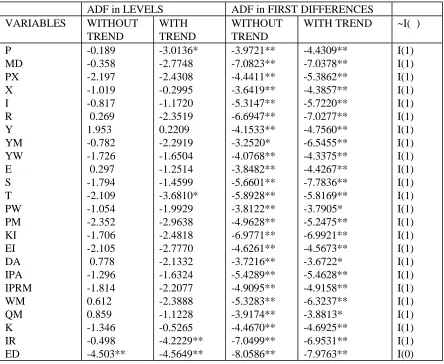
The starting point is to test for integration properties of the individual series using the Augmented Dickey-Fuller (ADF) tests with/without trend. These tests allow us to test formally the null hypothesis that a series is I(1) against the alternative that it is I(0). In order to determine the order of integration, we must apply the test to the levels of the variables and then to the first differences of the variables. These results, which are reported in Table 1.1, clearly show that the null hypothesis of a unit root cannot be rejected except ED even at the 10% level of significance. Critical values for tests were computed using the response surface estimates given by MacKinnon (1991). We therefore conclude that the variables under consideration are well characterised as non-stationary or integrated of order I(1). Based on
6
the unit root tests for all the variables, the existence of long-run cointegrating equilibria can be tested in the next step.
4.2 Empirical Results
The central features of macroeconomic modelling consists of specifying and estimating contemporaneous and intertemporal linkages between economic variables. It is well known that in order to avoid the flaws in econometric modelling, which ignore the non-stationary nature of the data, we need a modelling representation that could capture both the long- and short-run dynamics by taking into consideration the potential co-movement of the series. The cointegration approach of Phillips-Hansen (1990) provides an ideal framework for this representation.7 So the equations are estimated employing FM-OLS estimation method as this method enables us to obtain consistent estimates of the parameters of the regression model.
When the series are I(1) and some of the regressors are endogenous, the OLS estimator is asymptotically second order biased (estimation in finite samples is biased and hypothesis testing over-rejects the null). This is why IV methods can be used. However, IV approaches, although better than OLS in term of efficiency, do not provide asymptotically efficient estimators. The FM-OLS method of Phillips-Hansen has specially been developed to deal with the presence of endogeneity in the regressors. The Phillips-Hansen estimator is asymptotically efficient (i.e., the best for estimation and inference) and does not require the use of instruments. The semi-parametric corrections used in the FM estimator (these are transformations involving the long run varaince and covariance of the residuals) deal with endogeneity of the regressors and potential serial correlation in the residuals. In other words, Phillips-Hansen method is the best method that should be used in estimating a single cointegrating relation. Estimation is carried out using Microfit version 4.00 (see Pesaran and Pesaran, 1997).
7
Table 1.3 presents parameter estimates of the long run cointegrating regressions. The residuals from these regressions are interpreted as disequilibrium terms measuring the discrepancies between actual values of the variables and their long-run equilibrium values. Such residuals are tested for stationarity or cointegration by employing ADF and PP tests, which are reported in Table 1.2. These test statistics allow us to reject the null hypothesis of no cointegration at 1% and 5% levels. These results suggest that the variables under study form a valid cointegrating relationships. In other words, the FM-OLS cointegration estimates suggest that all the equations are an adequately well specified long-run model of inflation and trade balance and no other variables are required to capture its long-run stochastic trend.
Overall, the coefficient estimates are of correct sign and of plausible magnitude and the tests cofirm strongly that the variables are cointegrated. The residuals are denoted as equilibrium correction (EC) terms, such as, EC1, EC2, EC3, EC4, EC5 for each equation respectively. These EC terms may be important in affecting the short run dynamics of the model and are included (lagged one period) in the formulation of an ECM consisting of five dynamic (first difference) equations corresponding to the five long run relations. The ECM regresses the current value of the dependent variable, in stationary form, onto its own lagged values, current and lagged values of the stationary forms of the independent variables, and the lagged error term from the CR. The general to specific method is used to find a parsimonious representation of the relationship; that is, variables are deleted from the most general specification using the F-test of jointly zero coefficients. The results of the dynamic system estimates along with the equation diagnostics are also reported in Table 1.3. The test results are in favour of the congruency of the unrestricted system. Each EC term is assumed to enter its own equation with a negative sign supporting the EC interpretation.8 The diagnostic test statistics indicate that there is no evidence of serial correlation, of heteroscedasticity, of non-normality of the residuals. These tests broadly confirm that the estimated equations do not show evident sign of misspecification.
8
Now we are going to discuss each equation in turn. Our empirical finding for the question as to whether prices are determined by excess demand for money or by cost-push in India indicates that the cost-push factors are more important in causing price level than the excess demand as the magnitude of its impact is very negligible. Price level, measured by the wholesale price index is positively and significantly affected by the domestic unit labour costs and the cost of imported inputs (measured in US dollars). The cost-push factors satisfy the unit long-run homogeneity restriction in the price equation and the parameter estimates are statistically significant with correct apriori expected signs. Homogeneity of degree one is easily accepted by the data. The changes in import prices being significant implies that inflation, indeed seems to have been imported which is consistent with the analysis of Dalal and Schachter (1988) that has adopted an input-output framework. The money market disequilibrium is not significant in the price equation in the short-run, though it is so in the static equation. In a monetarist framework Sundararajan (1992) has shown that in the case of India the coefficients of money supply are not statistically significant, whereas in a structuralist framework the import price coefficients are significant. So our model that combines both demand and supply factors suggests a weak role of money in its influence on prices in India in the short-run. Within VS’s framework, the monetary disequilibrium concept is not stationary statistically [ED≠I(0)], whereas including interest rate in the money demand equation, we show ED=I(0) justifying it as a disequilibrium variable in statistical terms. The income elasticity of demand for real balances is 1.95 in the long run and 1.45 in the short-run. This finding is in line with some of the money demand functions for India that the income elasticity of demand has always been higher than unity. The speed of adjustment of actual real balances is 0.26 as seen from the significant EC2 term.
lower non-agricultural growth and higher inflation (Goyal, 1997). The coefficient of the error correction term in the dynamic price equation is negative and significant. It implies relatively high adjustment since 32 per cent of the deviations from the long run equilibrium are reversed in the following year.
The major determinants of real import demand in the long run are net national income, real foreign exchange assets, real capital inflows and excess flow demand for money. The inelasticity of imports with respect to relative price of imports is that the imported goods were mostly essential goods and imports were largely determined by non-price factors such as import licenses in the long run, whereas the short run elasticity of imports is negatively significant with respect to relative price of imports. The effect of income is highly significant in the long run, though it is not so in the short-run. Import demand is significantly negatively related to the price of imports only in the short-run. Our result stands in contrast with that of Sinha (1996) who found no cointegrated relationship among import, import price, domestic price and real income, as we have additional variables in the long-run relation. The level of foreign exchange receipts was also highly significant in explaining the level of imports. An increase in monetary disequilibrium variable strongly depresses imports as it has the statistically significant negative coefficient, but of a low magnitude. The magnitude was very high in VS because he did not have a log-linear equation for imports. Moreover, excess demand for real balances is not always caused due to unfavourable trade balance, it could also arise because of an increase in the fiscal deficit. This may provide another reason why the impact of monetary disequilibrium on trade is of a very low magnitude. Another difference is that in VS the coefficient of lagged reserve variable was not statistically significant, whereas in our model both the reserve and capital inflows variable are highly significant in the long-run. All these differences in our model with VS may be attributed to the model misspecification and updated database.
5. MODEL SIMULATION
This section attempts to answer the main question raised in this paper. In order to evaluate the overall performance of the complete model, we use simulation techniques, particularly the deterministic dynamic simulation method. First, for each period, actual values of all the exogenous data from 1963 to 1995 are imposed on the model estimated in section 4, yielding baseline series for the simulated variables. Second, the model is simulated by adding to the exogenous variables shocks as designed in the VS model. The magnitudes of these shocks are: a temporary depreciation of the exchange rate by 10 per cent in the first year, and a temporary reduction in domestic credit by 1 per cent. The model solutions have been obtained using WINSOLVE (Pierse, 1997). The percentage change resulting from the deviation of dynamically simulated values from the base for inflation and trade balance are exhibited in Chart 1.1. Dynamic simulations indicate that the model is stable.
So in the first year of devaluation, price rises and declines in the second period due to the negative liquidity effect.
Trade balance has been calculated as X*PX-I*PM. As far as the impact on trade balance is concerned, a 10% devaluation gives rise to a phenomenon where the price increase gives rise to export price increase by 0.36 per cent leading to a decline in exports demand by 0.04 per cent. Moreover, a 10 per cent devaluation results in an imports decline by 0.61 per cent due to the relative price increase, so in the first year trade balance is negative. In the subsequent year due to the negative liquidity effect and price effect, export price increases leading to further deterioration in trade balance. Afterwards, the trade balance improves due to the positive relative price effect being stronger than the liquidity effect in going back to the steady state in the long-run. Alternatively, since devaluation leads to an increase in the relative price of tradables that usually follows a decline in aggregate expenditures (Dornbusch, 1980)9, which leads to a price decline and an increase in ED. Export price being positively related to ED with a coefficient of 0.002 in the short-run, an increase in ED leads to export price increase and hence export demand declines (see Table 1.3, Eqn.4) and price decline gives rise to import increase (see Table 1.3, Eqn.5), thus trade balance deteriorates until it goes to the steady state through the dominant relative price effect.
When the credit policy is being tightened by a 1 per cent reduction, price declines in the same period by 0.01 per cent due to decline in money supply by 0.89 per cent, and then such price decline leads to increases in real money balances giving rise to decline in excess demand for money that has a relative price effect in improving the trade balance which can be seen from the exports price equation. In the subsequent years the price level increases by such a small magnitude that trade balance will not deteriorate. Though in the case of credit shock, there is no direct relative price effect, there is an indirect effect which comes through the liquidity effect through price change that makes trade balance positive. Since devaluation is usually taken as an immediate solution to BoP crisis, it worsens trade balance, not tight credit policy (see Figs.2 & 4, Chart 1.1). Despite the short-run effects of these two policies being quite
9
different, the improvement in trade balance due to tight credit policy is more enduring than the improvement resulting from devaluation.
Since the actual devaluation is a permanent one, we simulate the impact of permanent shocks such as 10 per cent devaluation and 1 per cent credit contraction on price level and trade balance, which is depicted in figs.5 to 8 in Chart 1.1. In case of temporary shock, once the shock is removed, the model starts to go back to the original steady state. Clearly, the temporary shock dies out rather quickly and the long-run cumulative effect is zero. But a 10 per cent permanent devaluation results in about the same percentage change initially which gradually converges to the steady state of 5 per cent, whereas a 1 per cent change in domestic credit declines the price level by 0.3 per cent in the long-run. A permanent devaluation and credit shocks show trade balance an oscillatory pattern (Figs.7 & 8), but a deterioration in trade balance which can be looked at through the price response because the adjustment mechanism is mainly the change in price. In case of permanent devaluation shock, price increases leading to export price increase and fall in export demand, whereas in case of credit shock the effect is negligible. Permanent devaluation gives rise to a huge deterioration in trade balance as compared to a permanent tight credit policy. The permanent effects dominate in the long-run whereas the temporary shocks prevail only in the short-run.
subsidies do have a positive impact on foreign reserves. In this joint simulation, the devaluation impact on price dominates (see fig.9) and there is a decline in foreign reserves (as defined in Eq.6 in Table 1.3) in the first year (see fig.10), which improves in the subsequent years until it goes to the steady state.
6. CONCLUSION
This paper focuses on the inflationary impacts of the devaluations and the tight credit policy associated with the 1991 crisis, and India’s trade balance during 1950-95. A supply-side model of inflation determination in addition to the standard demand framework has been estimated on Indian data. The short-run dynamics have been obtained from error correction models. Price dynamics responds not only to the movement of international prices, but also to other cost components, and to internal demand. The model has then been simulated to evaluate the dynamic responses to devaluation and tight credit policy. We argue that devaluation is not the most efficient policy instrument, whereas short-run solutions like credit control would be the better solution for temporary and exogenously generated disequilibria. There is a clear distinction between temporary and permanent reponses, as in the case of temporary shock, the overall effect of the policy shock is neutral in the long-run. In this model we abstract from output changes to highlight the complex dynamic interactions between inflation and trade balance. However the model’s assumption of exogenous output is clearly restrictive, because of likely output effects of devaluation and the effects of credit conditions on investment. Thus an explicit link between monetary sector, external sector, and output is essential if this model is to be useful in studying the effects of medium and long term trade policy choices on the economy.
REFERENCE
Agenor, Pierre-Richard, and Peter J Montiel, 1996, Development Macroeconomics, Princeton University Press, Princeton, New Jersey.
Banerjee, A., J.J. Dolado, J.K.Galbraith, and D.F. Hendry, 1993, Co-integration, error correction and the econometric analysis of non-stationary data, Oxford : Oxford University Press.
Bhattacharya, B.B., and M. Lodh, 1990, Inflation in India: An Analytical Survey, Artha Vijnana, 32, March, 25-68.
Church, Keith B., and Kenneth F. Wallis, 1994, Aggregation and Homogeneity of Prices in Models of the UK Economy, in S. Holly (ed.), Money, Inflation and Employment, Edward Elgar, 194-221.
Corbo, V., 1985, International Prices, Wages and Inflation in an Open Economy: A Chilean Model, Review of Economics and statistics, 67, June, 564-73.
Dalal, Meenakshi N., and G. Schachter, 1988, Transmission of International Inflation to India: A Structural Analysis, Journal of Developing Areas, 23(1), Oct., 85-104.
Dornbusch, R., 1980, Open Economy Macroeconomics, Basic Books, New York.
Engle, R.F. and Granger, C.W.J., 1987, Cointegration and Error Correction: Representation, Estimation and Testing, Econometrica, 55, 251-76.
Ghani, E., 1991, Rational Expectations and Price Behavior: A Study of India, Journal of Development Economics, 36, 295-311.
Ghatak, Subrata and Derek Deadman, 1989, Money, Prices and Stabilization Policies in Some Developing Countries, Applied Economics, 21 (7), 853-65.
Goyal, Ashima, 1995, The Simple Analytics of Aggregate Supply, Demand and Structural Adjustment, Indian Economic Review, 30(2), 167-86.
Goyal, Ashima, 1997, Inflation, Exchange and Interest Rates: A Macroeconomic Rashomon, in Kirit Parikh (ed.) India Development Report, Oxford University Press, 41-60.
Granger, C.W.J. and Newbold, P., 1974, Spurious Regressions in Econometrics, Journal of Econometrics, 2, 111-20.
Hendry, David F., 1995, Dynamic Econometrics, Oxford: Oxford University Press.
Joshi, V., and I.M.D. Little, 1994, India: Macroeconomics and Political Economy, 1964-1991, The World Bank, Washington, D.C.
Krishnamurty, K., and V. Pandit, 1996, Exchange Rate, Tariff and Trade Flows: Alternative Policy Scenarios for India, Indian Economic Review, 31(1), Jan-June, 57-89.
MacKinnon, J.G., 1991, Critical Values for Cointegration Tests, Ch.13, in Long-Run Economic Relationships: Readings in Cointegration, eds. R.F. Engle and C.W.J. Granger, Oxford University Press, Oxford.
Mallick, S.K., and T.K. Kumar, 1995, Macroeconomic Adjustment in India: Policy and Performance in the Recent Years, Journal of Indian School of Political Economy, Jan-Mar, 7 (1).
Murty, K.N., and C. A. Prasuna, 1994, A Model of Balance of Payments: Some Policy Simulations for India, Journal of Foreign Exchange and International Finance, 8(2), 195-208.
Nayyar, Deepak, 1995, Macroeconomics of Stabilisation and Adjustment: The Indian Case, Economie Appliquee, tome 68, no 3, 5-37.
Paul, M.T., 1994, A Structural Model of Trade and Inflation: Exchange Rate and Credit Policy Effects on Indian Economy, Journal of Quantitative Economics, 10 (2), July, 375-392. Pesaran, M. H., and Pesaran, B., 1997, Microfit 4.0 for Windows, Oxford University Press. Phillips, P.C.B. and B.E.Hansen, 1990, Statistical Inference in Instrumental Variables Regression with I(1) Processes, Review of Economic Studies, 57, 99-125.
Pierse, Richard, 1997, WinSolve Version 2.42: A computer package for solving nonlinear macroeconomic models, Department of Economics, University of Surrey, UK.
Prasad, Ajit, 1992, A Respecification of the Export Demand and Supply Functions for India, in Helen Hughes (ed.) The Dangers of Export Pessimism, International Centre for Economic Growth Publication, ICS Press, San Francisco, 322-33.
Rao, M.J.M., 1997, Monetary Economics: An Econometric Investigation, in K.L. Krishna (ed.) Econometric Applications in India, Oxford University Press, Delhi.
Sedgley, Nigel, and Jeremy Smith, 1994, An Analysis of UK Imports using Multivariate Cointegration, Oxford Bulletin of Economics and Statistics, 56 (2), 135-50.
Sen, Kunal and R R Vaidya, 1995, The Determination of Industrial Prices in India: A Post-Keynesian Approach, Journal of Post Keynesian Economics, 18 (1): 29-52.
Sinha, Dipendra, 1996, An Aggregate Import Demand Function for India, International Review of Economics and Business, 43(1), Jan-Mar, 163-73.
Sundararajan, V., 1986, Exchange Rate Versus Credit Policy: Analysis with a Monetary Model of Trade and Inflation in India, Journal of Development Economics, 20, 75-105.
Varma, Sona, 1994, The Effects of Policy Refrom on the Indian Economy: A Macroeconometric Analysis, The Indian Journal of Economics, 74 (294), Jan., 373-394. Wallis, K.F., 1993, Comparing Macroeconometric Models: A Review Article, Economica, 60 (238), May, 225-37.
World Bank, 1996, India: Five Years of Stabilization and Reform and the Challenges Ahead, The World Bank, Washington, D.C.
APPENDIX : NOTES ON DATA SOURCES AND DEFINITIONS
Most of the series have been presented in Rupees crores (1 crore = 10 million).
1. Data on Net National Product at market prices (constant prices with respect to base 1980-81 = 100) are taken from from NAS-New Series, 1989, CSO, Min. of Planning, GOI; From 1989-92, the source is National Accounts Statistics, 1992. Data on marketed output has been derived by following the procedure as in VS.
2. Data on Money Supply (M3), Foreign Exchange Reserves, domestic credit, money multiplier, and capital inflows of the non-banking sector have been compiled from (a) Report on Currency and Finance, Volume II: statistical statements (various issues), RBI; (b) RB Bulletin - Monthly, RBI. M3 consists of currency with the public, deposit money of the public, time deposits with banks. Due to several definitional changes in 1978, the RBI, which till then had carried out most of its analysis with respect to narrow money (M1), was compelled to conduct its accounting of money supply in terms of M3, because the data on M1 for the post-1978 period was no longer comparable with those in the earlier years. Hence, in this study we have carried out our empirical analysis in terms of M3. MD is defined as M/P. The measure of excess demand for real balances has been constructed from the estimated money demand function and data on domestic credit and money multiplier (M3/Reserve Money).
3. Wholesale Price Index (new series) - Index Numbers of Wholesale Prices in India, Office of the Economic Adviser, Min. of Industry, GOI. Wholesale Prices data are taken as a surrogate for General price level which are compiled for the base year 1980-81 = 100 from H.L. Chandhok and The Policy Group, India Database - The Economy, Volume I, 1990, pp.286-287. In fact, we have checked that wholesale price index data from this source is consistent with the original source. The index for the calender years 1953, 1962 and 1971 relate to averages of 9 months (April- December). Data on average per capita earnings in the manufactuing sector is taken from Statistical Abstract of India (Annual), CSO, Ministry of Planning, Goverrnment of India. Average labour productivity in the manufacturing sector is calculated by dividing industrial production (CSO, Monthly Statistics of Production of Selected Industries) by the labour force (World Bank Database, and Economic Survey).
of India, Ministry of Commerce, pp. S-80. Indices of Unit Value of Imports and Exports (in US $) have been obtained from IMF CD-ROM database (Base 1990=100).
5. The source for unit value of raw material imports is DGCIS, Calcutta - the original source. From 1957-58 to 1968-69, the base is 1958-59=100 and 1968-69 is the overlapping year for conversion. From 1968-69 to 1978-79, the base is 1968-69=100 and 1978-79 is the overlapping point. From 1978-79 onwards, the base is 1978-79=100. Data was not available from 1950 onwards. So we took the unit value of raw material imports data (1968-69=100) from Balakrishnan (1991) [Table A3.7, Col.5] for the years 1950-51 to 1956-57. After converting the two time series to a comparable base (1981-82=100), we have taken a weighted average of both the time series to get a series of unit value of raw material imports.
6. Data on Customs (Imports) duties have been compiled from Report on Currency and finance, Vol.II Statistical Statements (various issues). For 1975-76, there is no separate figure for Exports and Imports duties. There is only one figure which is the combination of Imports, Exports & other revenues less refunds & drawbacks, i.e., Rs.1498 Crores. So in order to get separate figures, we had to take the Customs duties (which is the combination of Imports (gross), Exports (gross), other revenue less Refunds & drawbacks for the preceding and succeeding years of 1975-76, out of which we got the percentage of Export and import duties for the two years. This proportion was multiplied with the total for the year 1975-76. As a result, we got two different figures for both Exports and imports duties respectively. Accordingly, the average of these two different values for exports and imports duties gave rise to a single figure for Exports and Imports duties respectively. Moreover, due to the non-availability of accounts data on imports and exports duties for the year 1977-78, we have taken Budget Estimates data.
GRAPH 1.1
Expected and Actual Rate of Inflation
ππ ππe Years -0.05 -0.10 -0.15 0.00 0.05 0.10 0.15 0.20 0.25
1951 1956 1961 1966 1971 1976 1981 1986 1991 1995
GRAPH 1.2:
Plot of (log) Levels of the Variables
1960 1980 2000 3
4 5 6
P
1960 1980 2000 5
6 7 8
MD
1960 1980 2000 3
4
5 PX
1960 1980 2000 8
9 10 X
1960 1980 2000 9
10 11
I
1960 1980 2000 7.5
10 12.5
R
1960 1980 2000 11
12 Y
1960 1980 2000 11
12 YM
1960 1980 2000 10
10.5
11 YW
1960 1980 2000 2
3 4
E
1960 1980 2000 2.5
5 7.5 S
1960 1980 2000 3
3.5
4 T
1960 1980 2000 3.5
4
4.5 PW
1960 1980 2000 3
4 5
PM
1960 1980 2000 10
12
14 KI
1960 1980 2000 4
6
8 EI
1960 1980 2000 7.5
10 12.5
DA
1960 1980 2000 -1
-.5 0
IPA
1960 1980 2000 -.5
0
.5 IPRM
1960 1980 2000 7
8 9
10 WM
1960 1980 2000 .5
1 QM
1960 1980 2000 .5
.75 1 1.25
K
1960 1980 2000 1
2
IR
1960 1980 2000 0
250 500
GRAPH 1.3:
Plot of first differences of the (log) Variables
1960 1980 2000 -.1
0 .1 .2
P
1960 1980 2000 0
1
MD
1960 1980 2000 0
.25 .5
PX
1960 1980 2000 0
.2 X
1960 1980 2000 -.25
0 .25
I
1960 1980 2000 0
.5 R
1960 1980 2000 0
.1 .2 Y
1960 1980 2000 -.2
-.10 .1
YM
1960 1980 2000 -.05
0 .05 .1
YW
1960 1980 2000 0
.2 .4
E
1960 1980 2000 -1
0 1
2 S
1960 1980 2000 -.5
0 .5 T
1960 1980 2000 0
.2 .4
PW
1960 1980 2000 0
.5 PM
1960 1980 2000 -1
0
1 KI
1960 1980 2000 -1
0 1 2
EI
1960 1980 2000 0
.2 .4
DA
1960 1980 2000 -.2
0
.2 IPA
1960 1980 2000 0
.5 IPRM
1960 1980 2000 0
.25
.5 WM
1960 1980 2000 -.2
0 .2
QM
1960 1980 2000 -.05
0 .05
.1 K
1960 1980 2000 -.2
0 .2
IR
1960 1980 2000 0
500
ED
GRAPH 1.4:
Plot of cointegrating relations
-0.15 -0.10 -0.05 0.00 0.05 0.10 0.15 0.20
50 55 60 65 70 75 80 85 90 95 EC2 -0.08 -0.04 0.00 0.04 0.08
50 55 60 65 70 75 80 85 90 95 EC1 -0.4 -0.2 0.0 0.2 0.4
50 55 60 65 70 75 80 85 90 95 EC3 -0.3 -0.2 -0.1 0.0 0.1 0.2 0.3
50 55 60 65 70 75 80 85 90 95 EC4 -0.3 -0.2 -0.1 0.0 0.1 0.2
Table 1.1: Unit-root tests
ADF in LEVELS ADF in FIRST DIFFERENCES
VARIABLES WITHOUT TREND WITH TREND WITHOUT TREND
WITH TREND ~I( )
P MD PX X I R Y YM YW E S T PW PM KI EI DA IPA IPRM WM QM K IR ED -0.189 -0.358 -2.197 -1.019 -0.817 0.269 1.953 -0.782 -1.726 0.297 -1.794 -2.109 -1.054 -2.352 -1.706 -2.105 0.778 -1.296 -1.814 0.612 0.859 -1.346 -0.498 -4.503** -3.0136* -2.7748 -2.4308 -0.2995 -1.1720 -2.3519 0.2209 -2.2919 -1.6504 -1.2514 -1.4599 -3.6810* -1.9929 -2.9638 -2.4818 -2.7770 -2.1332 -1.6324 -2.2077 -2.3888 -1.1228 -0.5265 -4.2229** -4.5649** -3.9721** -7.0823** -4.4411** -3.6419** -5.3147** -6.6947** -4.1533** -3.2520* -4.0768** -3.8482** -5.6601** -5.8928** -3.8122** -4.9628** -6.9771** -4.6261** -3.7216** -5.4289** -4.9095** -5.3283** -3.9174** -4.4670** -7.0499** -8.0586** -4.4309** -7.0378** -5.3862** -4.3857** -5.7220** -7.0277** -4.7560** -6.5455** -4.3375** -4.4267** -7.7836** -5.8169** -3.7905* -5.2475** -6.9921** -4.5673** -3.6722* -5.4628** -4.9158** -6.3237** -3.8813* -4.6925** -6.9531** -7.9763** I(1) I(1) I(1) I(1) I(1) I(1) I(1) I(1) I(1) I(1) I(1) I(1) I(1) I(1) I(1) I(1) I(1) I(1) I(1) I(1) I(1) I(1) I(1) I(0)
Notes: All variables are measured in natural logarithms; ADF unit root test is based on two lags; Critical values are: 5%=-2.956, 1%=-3.65 (without trend)
5%= -3.516, 1% = -4.184 (with trend)
Table 1.2:
Tests for Cointegration
Regression ADF t-statistic Phillips-Perron test
P Residuals -3.477769* -3.624318**
PX Residuals -4.564763** -4.352857**
X Residuals -3.804824** -3.057466*
I Residuals -3.570913* -4.174702**
Md Residuals -3.454182* -3.315874*
Table 1.3:
Estimation of the Model Equations
**************************************************************************** Long-run model is based on Fully Modified Phillips-Hansen regression
1.Price equation:
Long-run:
Ln(P)= 0.828 + 0.73*(Ln(IPA)+Ln(E)) + 0.16*(Ln(WM)- Ln(QM))
(2.669) (13.291) (4.00)
+0.11*(Ln(IPRM)+Ln(E)) - 0.0003*ED
(4.48) (-5.15)
Wald test of long-run homogeneity restriction imposed on parameters χ2( 1) = .1666E-3 [.990]
Short-run:
∆ln(P) = -0.002 + 0.84*(∆ln(IPA)+∆ln(E)) +0.07*(∆ln(W)-∆ln(Q))
(1.12) (21.05) (2.84)
+(1-0.84-0.07)*(∆ln(IPRM)+ ∆ln(E))-0.00003*∆ED + 0.06*∆ln(P(-1)) - 0.35*EC1(-1)
(-0.78) (0.84) (-3.05)
Adj. R2=0.792; BG = 1.66 [0.205]; BJ = 1.108 [0.575]
ARCH = 0.048 [0.83]; Chow = 1.13 [0.367]; WHT = 31.25 [0.306]
2.Desired real Balances:
Long-run:
ln(MD)=-14.95+1.96*ln(YM)-1.03 πe - 0.56*ln(IR) (-25.83) (31.25) (-2.25) (-6.497)
Short-run:
∆ln(MD)=0.012+1.45*∆ln(YM)-0.32*∆πe -0.34*∆ln(IR) -0.26*EC2(-1) (0.71) (4.23) (-1.08) (-3.93) (-2.31)
Adj.R2=0.49; BG = 0.288 [0.59]; ARCH = 2.14 [0.13]
JB=1.25 [0.54]; WHT = 21.29 [0.09]; CHOW = 0.667 [0.65]
3.Unit value of exports:
Long-run:
Ln(PX)=-11.80 + 0.03*(Ln(P)-Ln(E+S)) + 0.657*Ln(PW) + 1.89*Ln(Y)
(-5.405) (0.504) (5.896) (6.28)
-0.86*Ln(YW) + 0.0012*ED
(-1.91) (4.75)
Short-run:
∆Ln(PX) = -0.007 + 0.048*(∆Ln(P(-1))-∆Ln(E(-1)+S(-1))) + 0.367*∆Ln(PW(-1)) (-0.255) (1.57) (2.51)
(1.94) (1.399) (1.469) (1.946) (-2.025)
Adj. R2=0.26; BG = 2.13 [0.135]; BJ = 1.24 [0.537]
ARCH = 1.14 [0.29]; Chow = 1.21 [0.329]; WHT = 36.45 [0.269]
4.Export demand:
Long-run:
Ln(X)= -1.66 - 0.58*Ln(PX/PW) + 0.68*Ln(YW) + 1.18*Ln(E)
(-1.19) (-2.64) (3.96) (4.91)
Short-run:
∆Ln(X) = 0.07 - 0.12*∆Ln(PX/PW) + 0.72*∆Ln(YW)+0.18*∆Ln(X(-1)) - 0.298*EC4(-1)
(3.54) (-1.08) (1.565) (1.14) (-2.88)
Adj. R2=0.14; BG = 2.14 [0.13]; BJ = 3.48 [0.18]
ARCH = 1.26 [0.295]; Chow = 2.72 [0.037]; WHT = 28.38 [0.20]
5.Imports:
Long-run:
Ln(I)=-5.20 - 0.17*Ln((PM*(E+T))/P) +1.00*Ln(Y) + 0.002*Ln(EI)
(-7.34) (-2.95) (11.70) (0.102)
+0.32*Ln(KI/PM) +0.16*Ln(R/PM)-0.0003*ED
(10.65) (7.11) (-2.56)
Short-run:
∆Ln(I) = 0.02 - 0.12*∆Ln((PM*(E+T))/P) +0.22*∆Ln(Y(-1)) + 0.06*∆Ln(EI) (1.48) (-2.74) (0.74) (3.00)
+ 0.30*∆Ln(KI/PM) +0.05*∆Ln(R(-1)/PM(-1))+0.07*∆Ln(I(-1))-0.0003*ED-0.598*EC5(-1)
(12.39) (1.32) (0.96) (-2.92) (-4.53)
Adj. R2=0.83; BG =2.08 [0.14]; BJ = 0.45 [0.798]
ARCH = 0.259 [0.61]; Chow = 1.92 [0.12]; WHT = 39.33 [0.41]
6.Balance of payments: R = R(-1)+X-I+KI
7.Money supply: M = k*(R+D)
****************************************************************************