Increasing space efficiency
within a Vertical Lift Module
at Benchmark Electronics, Inc.
Bachelor thesis Industrial Engineering and Management
Cyrelle Tenhagen
Industrial Engineering and Management Bachelor year 3
Increasing space efficiency
within a Vertical Lift Module
at Benchmark Electronics, Inc.
Bachelor thesis Industrial Engineering and Management
Author:
Cyrelle Tenhagen
BSc Industrial Engineering and Management
Benchmark Electronics, Inc. Universiteit Twente
Lelyweg 10 Drienerlolaan 5
7602EA Almelo 7522NB Enschede
The Netherlands The Netherlands
Supervisor Benchmark Electronics, Inc. Supervisors Universiteit Twente
Mr. P. Hagen Mr. J.M.G. Heerkens
Table of Contents
Preface ... 5
Management summary ... 6
Reader’s guide ... 8
Glossary ... 10
1. Introduction ... 11
1.1 Company information ... 11
1.2 The problem ... 11
1.3 Motivation for investigation ... 12
1.4 Project approach... 15
2. Theoretical framework ... 17
2.1 Applied theories during research... 17
2.2 Applied theory to assign parts to a location ... 19
3. Current situation ... 20
3.1 Current warehouses ... 20
3.2 Storage assignment in Kardex ZKDX1001 ... 22
3.3 Space management problem in Kardex ZKDX1001 ... 28
4. The PDCA-cycle ... 29
4.1 Causes of the unnecessary bins ... 29
4.2 Choosing the focus of the PDCA-cycle ... 31
4.3 Plan: Identification of the problem ... 32
4.4 Approaching problem: Developing plan for solution ... 34
5. Literature review... 35
5.1 Alternative FIFO storing methods in a VLM ... 35
5.2 Storing assignment methods ... 39
5.3 Classification methods ... 48
6. Do: Implementing improvement ... 50
6.1 Preferences of the company ... 50
6.2 Results of reduction ... 52
6.3 Results of reducing only a selection of bins ... 52
6.4 Optimal classification method for class-based storage assignment ... 54
7. Plan for implementation ... 56
7.1 Storing parts in bins already occupied in the VLM... 56
7.2 Relocating parts ... 60
7.4 Implementing class-based storage assignment ... 65
8. Discussion of possibilities ... 67
8.1 Optional solutions ... 67
8.2 Remaining solution ... 67
8.3 Discussion of how to apply FIFO ... 68
8.4 Storage assignment methods ... 68
8.5 Classification methods ... 69
9. Conclusion, recommendations and limitations ... 70
References ... 72
10. Appendix ... 76
10.1 MPSM Phase one: Problem identification ... 76
10.2 Classifying parts ... 78
10.3 Entering dimensions of parts in Baan ... 82
10.4 Entering dimensions of locations in Baan ... 84
Preface
This thesis about space efficiency within a dynamic storing system is performed to complete
my bachelor’s program of Industrial Engineering and Management, at the Universiteit Twente.
I would like to thank some people for helping me during the performance of this investigation. First, I would like to thank Paul Hagen for the opportunity to do a bachelor assignment at Benchmark Electronics, Inc. I would also like to thank Ronald, John and Henri for supporting me by answering questions and providing feedback. I can certainly say that I learned a lot during the twenty weeks of performing my research at the company.
Furthermore, I would like to thank my supervisor from the University, Hans Heerkens. He gave me the support and confidence that I needed to successfully fulfill my thesis. I would also like to thank Peter Schuur for providing me with valuable feedback.
Lastly, I would like to thank Anouk and Robert, my buddies from the University. They were conducting research at Benchmark Electronics, Inc. at the same time as I was and provided the necessary distraction, feedback and coffee.
Cyrelle Tenhagen September 1, 2018
There appear to be two kinds of thinking in management research. These two ways of thinking are about how knowledge is actually accumulated. You have first the rationalists, thinking that
knowledge is gained by exercise of reason and logic, and second the empiricists, who think that perception is the way to knowledge (Grayling, as cited in Shea). The two kinds of thinking
causes managers and workers to think differently about things and thereby may come to different conclusions (Trought, as cited in Shea). This may lead recommendations in this report
Management summary
IntroductionBenchmark Electronics, Inc. produces parts and subassemblies to companies all over the world. Their site located in Almelo has expanded significantly the last few years caused by increasing demand. Due to inefficient use of the space in current warehouses, there is not enough space anymore to store all incoming goods. One of the warehouses stores goods in a Vertical Lift Module, named Kardex ZKDX1001. This system uses bins to store parts. Every time a new delivery order is received, parts have to be stored inside a new bin. The Kardex is programmed this way to be able to apply FIFO. This storing procedure causes many bins to contain little content and at the same time having multiple bins occupied for identical parts. The maximum number of bins for one identical part has been set to two in this project. Data investigation showed that in this case 9% of the currently occupied bins should not contain content. In this thesis, an approach has been provided that could reduce the 9% of superfluous bins to 0%.
Approach
To develop a way to reduce the number of superfluous bins, the following tasks have been performed:
- Data investigation to superfluous bins;
- Visualizing the warehousing processes in the main warehouse; - Performing a literature review;
- Conducting interviews with warehouse employees, supply chain analyzers, program managers, planners and purchasers;
- Provide questionnaires to employees with potential solutions.
Conclusion & Recommendations
Three options to reduce the number of bins per part are provided in this thesis: Placing identical parts in fewer bins, placing different parts in fewer bins, or implementing a new type of adjustable bins. All options are designed to enable FIFO picking based on MBA-number.
The first option to reduce the number of bins is preferred by Benchmark according to the provided questionnaire. This option can be performed with help of two approaches. The first is to locate parts in fewer bins in the storing stage and the second to relocate parts over fewer bins once every couple of weeks. Both approaches have its own pros and cons, but can reduce the number of superfluous bins from 9% to 0%.
The class-based storage assignment method requires classification of parts to function appropriately. According to the AHP that was performed, the MC ABC classification method should enable the best results in maintaining space efficiency and low travel times of the VLM. A drawback of the MC ABC is that the company has to think about important criteria for the classification, which causes this method to require more work on forehand then other discussed methods. The OOS could be a good alternative classification method. This method scored just a little lower in the AHP and does not require the company to think about criteria.
Reader’s guide
Chapter 1: Introduction
The first chapter provides an introduction of the company, the problem the company deals with and the motivation for this study. The analysis of the core problem of space issues that was found during preliminary investigation is further explained. Finally, the research goal and questions of this study together with an approach to achieve the goal are established.
Chapter 2: Theoretical Framework
In the theoretical framework, an approach is presented as a guideline for the study. Theories that are used during the research will be presented and elaborated in this chapter.
Chapter 3: Current situation
The current situation of the company is outlined in chapter 3. The core problem will be described in more detail and current warehousing processes are analyzed.
Chapter 4: Plan: The first PDCA-cycle
In the beginning of this chapter, causes of the core problem are provided to be able to make a choice for the PDCA-cycle. Thereafter, the first step of the PDCA-cycle, the “Plan”, is outlined.
The chosen cause is investigated in more detail and possibilities to develop improvements are presented.
Chapter 5: Literature review
The literature review serves as an approach for finding solutions. First, possibilities to increase the number of locations in a VLM without increasing in physical floor space are outlined. Thereafter, methods to decrease throughput and increase travel time while maintaining space efficiency are investigated for a VLM in specific and AS/RS in general. Finally, possible classification methods for the most suitable storage method are presented.
Chapter 6: Do: Implementing improvement
The Do step of the PDCA-cycle will be performed in this chapter. The formula to determine the possible reduction is presented for the preferred solution of the employees. Two optional categories are presented by which the number of unnecessary bins can be reduced. Of which one of them having to sacrifice the degree of reduction.
Chapter 7: Plan for implementation
Two implementation possibilities are outlined:
1. Locating parts in bins already occupied bins in the VLM, after receiving 2. Relocating parts over fewer bins, once in a couple of weeks
Both possibilities can be realized with help of the following approaches: a. Let Baan calculate the amount of free space within a bin
b. Export of inventory from the VLM c. Physical checking of inventory
Chapter 8: Discussion of possibilities
In this chapter, the potential solutions will be analyzed further by discussing the pros and cons of each possibility.
Chapter 9: Conclusion, recommendations, and limitations
Glossary
AS/RS Automated storage and retrieval system: In literature, dynamic storing systems in general are known as AS/RS. These systems usually consist of racks served by cranes running through aisles between the racks. The AS/RS in use by Benchmark is a Vertical Lift Module
Baan Vendor of ERP software. The software they supply is also called Baan. In this thesis, Baan always refers to the software. Baan is a specially designed for manufacturers in the aerospace and defense, automotive, high tech and electronics, and industrial machinery, which enables the system to meet the unique standards of Benchmark
Batching The process of storing particular parts together at a location
BOM Bill of Materials
Bridgelogix A software used at receiving to confirm the receiving of parts in Baan and to print labels. The system is easier to work in than directly working in Baan
COI Cube per Order Index: A classification method used to assign locations to products. Assigned locations are based on how frequently an order is picked
ERP-system Enterprise Resource Planning: Software system that manages and integrates business processes
I/O points Point where the picking and storing happens in a dynamic storing system
Kardex A supplier of dynamic storing systems, among others the VLM in this thesis
OEM Original Equipment Manufacturer: A company that manufactures parts and subsystems that may be used in another companies end-product
Multiple In a VLM, bins are often retrieved for multiple items in one order without being command able to store parts in-between. This is called multiple command
Parts Another word for products that is used in this thesis to enable distinguishing between end-products and products used in the end-products
PowerPick The software Kardex Remstar provides to manage processes within the dynamic storing systems
Superfluous This wording is used in this thesis to define that there are multiple bins in use Bins for the same part and containing free storage space
1. Introduction
1.1 Company informationBenchmark Electronics, Inc. was in 1979 founded in Clute, Texas, and has plants all over the world. Benchmark currently has eighteen locations, of which two are located in Europe. This research was performed at the location in Almelo, The Netherlands. The plant in Almelo has grown a lot in the last few years and currently employs around 550 people.
Benchmark is a global contract electronics
manufacturer and delivers parts and subassemblies to companies all over the world. Key market sectors Benchmark is serving includes industrial controls, defense & aerospace, test & instrumentation, and medical. The site in Almelo focusses on design engineering and manufacturing. Currently, the company serves as a supplier for around thirteen customers, including large companies such as Thales, ASML and Airbus. The products Benchmark produces for their customers are rather complex and exist of many parts. Besides that, the operations the company delivers are very customer oriented, causing every customer to need a separate managed operation. To manage this, every customer has their own program manager and their own planners and purchasers. Partly caused by the diversity of customers, there are a few major departments within the company that can be distinguished. These departments are known as the SMD-lines (Surface-Mounting-Device), HMT-department (Hand-Mounting), BB-HMT-department (BoxBuild) and the CR (Clean Room).
1.2 The problem
The reason for this study is that the warehouse of Benchmark becomes overfull. In the past few years, the company went through a major growth. This growth has its upsides and its downsides, of which a downside is the increasing number of parts that arrives at the company every day. The space in the warehouse of the company was not expanded simultaneously with the growth, causing the warehouse to become fuller and fuller. While the number of parts grew, the physical space did not, causing a physical storage problem. The company acknowledges this problem, but does not want to physically expand their warehouse at the moment. Therefore, this study focusses on presenting a way to store all incoming goods again, without increasing the warehouse in m2.
1.3 Motivation for investigation
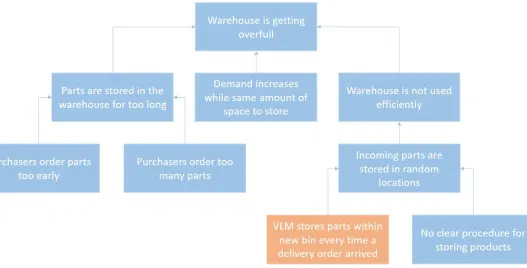
In this thesis, the management problem solving method (MPSM) from the book Geen Probleem is applied. This is a systematic approach for solving a managerial problem. In this approach, there are seven phases. The first phase is to identify the core problem (Heerkens & van Winden, 2012), which is one of the problems in the problem cluster. The core problem is identified during preliminary investigation (marked orange in figure 5). To see how the core problem was chosen as the best problem to solve, a discussion about the possible core problems can be found in appendix 10.1. The rest of this thesis walks through the remaining six phases in the background. Besides that, a PDCA-cycle will be applied to monitor the improvements which is preferred within Kaizen (see chapter 2 for explanation).
The company wants to optimize the use of space within the warehouse. This helps the company to deal with future demand and a growing number of incoming materials. The problem this project focusses on is that one type of part is often divided over multiple bins in the VLM of the main warehouse (Kardex ZKDX1001). This is declared to be a problem since these bins are rarely fully filled, and thereby occupy a superfluous number of storing locations. Two factors will be used in this project to verify if the superfluous space in use in Kardex ZKDX1001 is eliminated. Space within a bin in the VLM is called superfluous if the bin has free storage space available1.
The factors that are used to determine the extent to which the amount of superfluous space reduces are:
1. The number of bins in use in the Kardex ZKDX1001 2. The number of part types in the Kardex ZKDX1001
[image:13.595.39.566.239.507.2]1 Superfluous bins: Bins are called superfluous in this thesis, if there are multiple bins of the same part containing free storage space
Figure 5: Problem cluster
1.3.1 Core problem
After specifying the core problem with a norm, the problem is described as follows:
Around 20 percent of the bins in the VLM systems of the main warehouse is in use by one part type that is assigned to more than two locations that are not fully filled,
causing superfluous space of the VLM to be filled
This percentage was determined by dividing the number of bins (factor 1) by the number of part types (factor 2) in Kardex ZKDX1001. The number of bins containing part types that occupy more than two bins turned out to be approximately 20 percent. The reason for a maximum of two bins is explained below.
1.3.2 Goal of the project
The goal of this project is to identify the optimal space efficiency solution for Benchmark to be able to solve the core problem. To achieve this goal, this study will present an answer to the following question:
How can the superfluous space in use by parts stored in more than two bins in Kardex ZKDX1001 at Benchmark Electronics, Inc., be reduced from 9% to 0%?
The norm of 9% in the goal described above is calculated based on a maximum number of two bins per part type. This maximum is deliberated with Benchmark. Benchmark thinks that in a perfect world the number of bins per part type would always be one. However, some parts may need to be stored in a second bin due to for example not fitting in one bin
occasionally. Taking this into account, Benchmark deliberated that the norm of maximum bins per part will for now be set to two. The 9% in the research goal could then be reduced to 0%. In this case 879 of the 9755 occupied bins will be released, which is explained below.
Calculating the percentage of superfluous space in use
To be able to calculate the percentage of superfluous space in use, the number of bins in use by a specific part type has to be known. Table 1 shows the total number of bins and the number of part types, with the corresponding number of bins per part in the Kardex.
By dividing the total number of bins (column 2) by the number of bins for one part type (column 1), the total number of part types (column 3) can be calculated. The three variables together can be used to calculate the possible bin reduction. In this case, the maximum number of bins for one part type is set to two, which leads to the following calculation:
Possible bin reduction = Total number of bins – (2 * total number of part types)
The summation of the calculation for 3 to 15 bins from column one results in 879 superfluous bins, which is a reduction of (879/9761) = 9%. When superfluous bins would be released, around 9% of all locations in Kardex ZKDX1001 could be released.
Table 1: Number of bins and number of part types in Kardex ZKDX1001; Data is exported from PowerPick
Number of bins (locations) for a specific part type
Total number
of bins Total number of part types
1 4928 4928
2 2832 1416
3 1173 391
4 392 98
5 220 44
6 84 14
7 28 4
8 40 5
11 22 2
12 12 1
15 30 2
Total 9761 6905
Benchmark could in the future want to adjust the maximum number of bins for a part type. In
this case, the “2” in the calculation can be replaced with the new maximum number of bins
1.4 Project approach
1.4.1 How to achieve the goal
The goal of this project will be achieved by performing several actions. Data was investigated in section 1.3 first, to quantify the problem and determine the goal of the study. In the upcoming chapters, the current situation within Kardex ZKDX1001 is outlined to get a clear picture of it. Since the current situation may change when the solution is implemented, and to find out where the current situation may change, a process flowchart is used to depict the current receiving and storing process and the receiving and storing process after
implementation of the solution. A Pareto analysis will be applied to find out if there are customers who influence the problem more than others. The outcome of this analysis is used to narrow the focus of this research to fewer customers.
Thereafter, possibilities to improve the current situation are developed by conducting literature research, by discussing with people from different sections of the company and by properly thinking and walking through the warehouse myself. The developed possibilities are discussed with the company and an implementation plan of the preferred solution is
provided. Lastly, a conclusion, recommendations, and limitations of the study are presented.
1.4.2 Deliverables
To be able to provide Benchmark sufficient information about how to achieve the research goal in 1.3, the following deliverables will be provided:
1. Quantification of the problem
2. Possibilities to reduce the number of unnecessary bins from 9% to 0% 3. Possibilities to assign parts to a location in the VLM system
4. Possibilities to distinguish parts 5. Discussion of all possibilities
6. Plan for implementation of the preferred solution 7. Conclusion, recommendations and limitations
1.4.3 Research questions
Research questions are defined that help to reach the goal of this project. Sub-questions are defined to reach a more specific direction in the research. All questions will be answered in this thesis.
1) What does the current situation look like?
a. How are parts received, stored and picked in Kardex ZKDX1001? b. How are parts assigned to a storage location in Kardex ZKDX1001? c. Why does the current storing method cause parts to be stored in more
than two bins?
d. Could parts be distinguished within the problem or the solution if necessary?
e. To what extend is the current storing method sufficient for all parts stored in Kardex ZKDX1001?
2) What alternative methods can reduce the number of superfluous bins in Kardex ZKDX1001, while maintaining efficiency?
a. What alternative FIFO storing methods do there exist for Vertical Lift Modules? b. How can the optimal storage assignment method be determined?
c. What classification possibilities are there to be able to classify parts?
Answering these questions discovers which improvements concerning storage possibilities there exist in literature databases. These possibilities will be assessed on their applicability.
3) What does Benchmark think about the alternatives to optimize use of space in the Kardex? a. What are the requirements of the solution, according to the company
b. What are the pros and cons of the current method? c. What are the pros and cons of alternative methods? d. What do employees think of the alternative methods?
e. What are the expected results when applying the preferred method?
In this question, the requirements of Benchmark are answered and the optimal solution is studied by looking to pros and cons of every presented method. Besides, the opinion of employees is taken into account and the expected results of the preferred method are established.
4) How can the preferred method be implemented at Benchmark?
This question is answered to enable the optimal solution to become successful.
Preferences of the company
To be able to take into account the opinion of warehouse employees, they are asked about their view on the gathered possibilities for solving the problem. These opinions together with literature research and common sense returns recommendations for improvement at the end of the project. Since the last two weeks of this research the company was closed, some people were not able to give their opinion. Which may slightly bias the results.
Conclusion
In this chapter, the core problem is quantified by determining the possible reduction of superfluous space with a maximum of two bins for one part type. The research questions and
project approach of this thesis are presented to enable the solving of the core problem. To see what theories are used in the continuing of this thesis, the theoretical framework is
2. Theoretical framework
A specific problem can be solved by providing a well-structured approach with a theoretical framework. To be able to improve the current situation, an approach is needed as a guideline. To clarify this approach, the theoretical framework that is maintained in this thesis will be elaborated in this chapter. This includes theories the company is already pursuing as well.
2.1 Applied theories during research
The methods that are applied in this research are explained and discussed here. This serves as a foundation for the choice that a PDCA-cycle, a Pareto analysis and an Analytic Hierarchy Process are applied. Hereby the question of how to get an optimal solution is answered.
Benchmark is continuously working on improving processes within the company to achieve the best products for their customers. The method that Benchmark applies to achieve continuous improvement is Kaizen, which is a method to improve processes within a
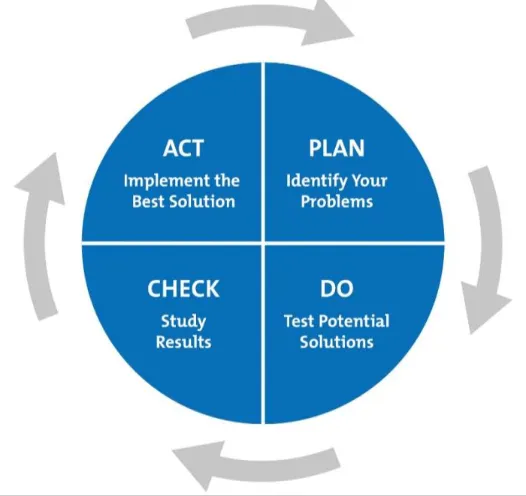
company. One element of Kaizen is a PDCA-cycle. This cycle can be applied to enable making improvements in the storing problem, with Kaizen in mind.
PDCA-cycles
Benchmark wants to make improvements based on the theory Kaizen, also described as
“continuous improvement” (Berger, 1997). The best practice to reach continuous
[image:18.595.166.429.462.710.2]improvements is by making small improvement steps. Plan-Do-Check-Act (PDCA) cycles are a tool to keep track of these improvements (see figure 3). In these cycles, Plan stands for description of the problem and suggested improvement, Do is the implementation of the improvement, Check is to check if the intended results are reached and Act is to transform the implementation into a routine (“Plan-Do-Check-Act,” 2006).
The current problem at the Benchmark warehouse is caused by more than one constraint, which is further explained in section 4.1 and appendix 10.1. Tackling all constraints at once would become complicated. Hence, one constraint is improvement is this thesis.
Pareto analysis
In section 3.3, a Pareto analysis is performed to simplify data analysis and at the same time keeping reliability high. Since approximately 20% of the causers is responsible for 80% of the problem, tackling these 20% can have a significant influence on the outcome of the solution.
Pareto analysis is based on the observation that economic wealth and results from operations are not equally distributed. Some inputs can contribute more than others, meaning a pattern of imbalance is observed. When applying Pareto, improvements in the 20% of causers ,who are responsible for around 80% of the negative effects, can compensate for the rest of the causers. Therefore the method is also known as the 80/20 rule (Powell & Sammut-Bonnici, 2014). Applying the Pareto analysis could result in a solution that is only applicable for 20% of the causers. At the end of this thesis, evaluation can reveal if the solution is applicable for the other 80% too.
Analytic Hierarchy Process
In this thesis, AHP will be applied to choose the best alternative classification method for the system when the company decides to implement the class-based storage assignment
method. The AHP is chosen, because a previous thesis that was executed at the company about the optimal storage assignment method applied this method to make a decision, with approval of the company. Besides, literature shows it is a sufficient method for decision making. The AHP will be applied in section 6.4.
The Analytic Hierarchy Process, in literature known as AHP, is a multicriteria approach for decision making. Factors are arranged into a hierarchic structure in this process. The most important factors that have to be taken into consideration when making a decision will be included. The hierarchy is built up with the overall goal on top, underneath the criteria, eventually sub-criteria below the criteria, and at the bottom the alternatives. In figure 4 an example of the AHP is visualized. In the model, weights are given to each (sub)criteria. The weights are calculated for each (sub)criteria, by which a score for each alternative can be generated. The highest score that is generated implies the best alternative (Saaty, 1990).
2.2 Applied theory to assign parts to a location
Benchmark is currently applying the First in First out method to assign stock to a location. To find out what this method implies and what other possibilities there exist to assign stock, the First in First out method was studied. Question 1c is hereby partly answered.
First in First out
The company is trying to achieve First in First out (FIFO) picking of parts to ensure the quality of products and subassemblies. Since the necessity of the company to apply FIFO is not established, this theory will be taken into doubt in this thesis.
First in First out (FIFO) is known as a memory methodology in inventory. This method is getting the product that came in first as inventory, first out of the warehouse for production. The method should ensure the oldest product to always be used first. Many companies apply this method to be able to ensure quality to the highest.
According to Janssen, Claus, and Sauer (2016), there are three inventory issue policies. These policies are FIFO, Last in First out (LIFO) and Random Retrieval (RR). The FIFO policy is always optimal (Nahmias, as cited in Janssen et al.), but the relevance of the policies is different, depending on the situation of the company. In healthcare FIFO would apply best, whereas LIFO or a combination of FIFO and LIFO would be more relevant in food retail for example (Janssen et al., 2016). For an item with fixed life, issuing the oldest items first is the best method to minimize expected outdating. LIFO issuing is more convenient when the user choses the issuing policy. According to literature, customers typically prefer LIFO (Silver, as cited in Janssen et al.). For perishable products this is not desired, due to their fixed lifetime. Next to FIFO and LIFO, products can be picked at random. Random retrieval does not take into account the age of a product at all. The article of Janssen et al. (2016), tells RR is most applicable for products with infinite lifetime. The main conclusion that can be drawn is that customers have most influence on the choice of retrieving products. Altogether, the customer is the one who is paying and using the product.
Since parts are customer specific at Benchmark, it is not recommended to use LIFO. Using LIFO would make the state of end products more diverse, which is not what the customer wants. The quality of products has to be equal as possible, with less chance on picking old parts. Now LIFO already falls off, only FIFO and random picking are left.
Conclusion
The theoretical framework serves as a guideline for research. The methods that are applied in this study are outlined, to give an impression of how these methods work. The thesis walks through one PDCA-cycle to solve the chosen cause of the core problem. The Pareto analysis is
applied in chapter 3 to simplify data while keeping accuracy high. The AHP is applied in chapter 6 to be able to provide the best classification method to Benchmark. And last, the FIFO method was explained and taken into doubt. Alternatives for this method are provided
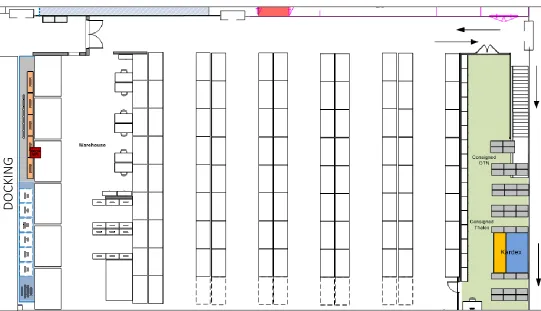
Figure 5: Floorplan of main warehouse at Benchmark
3. Current situation
To be able to improve the operational strategy, it is necessary to investigate the current situation. The provided information focusses on identifying the current situation in the main warehouse of Benchmark and of Kardex ZKDX1001 in specific. The information in this chapter provides insight in the current receiving, storing and picking processes. These processes are subject to change when improvements are applied to optimize utilization of space. Next to that this information serves as input for the PDCA-cycle in chapter 4. First, to give a little impression of the warehousing circumstances, the warehouse in general is explained.
3.1 Current warehouses
The products and subassemblies Benchmark produces consist of a great variety of parts. All these parts arriving at Benchmark, first have to be stored in the warehouse. There are multiple warehouses within Benchmark, of which the major two are known as the main warehouse and the SMD-warehouse. The SMD-warehouse is used for storing SMD-reels. These reels are used for manufacturing in the printed circuit board assembly hall. Most of the parts in the SMD-warehouse are needed once in a couple of years, because demand of the customer is recurrent and can to a certain extend be forecasted. The main warehouse is storing mostly durable parts for which the necessity of FIFO is not established. The scope of this project focusses on the main warehouse.
Main warehouse
Parts that are stored outside the main warehouse are quite dependent on their lifetimes. Parts and products that are stored inside the main warehouse on the other hand, have a far more flexible lifetime. Incoming parts and finished products in the main warehouse are stored on shelves or in the VLM systems.
DO
CK
IN
Kardex ZKDX1001
Most of the incoming parts are stored in the VLM systems, located on the left side of the warehouse in the floorplan (figure 5). They arrive from the docking department, located outside the warehouse on the backside of the VLM systems (“docking”). Finished products or
parts that cannot be stored in the VLM are mostly stored in the shelves (all white rectangles in the middle of the floorplan).
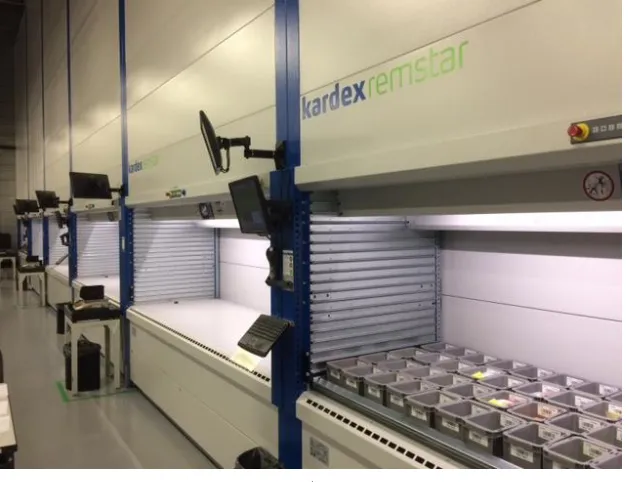
In figure 6, a few of the VLM systems are depicted. All parts that have to be stored in the VLM systems are placed inside a bin at the docking department of the warehouse. With help of the display hanging on the front edge of the VLM, the right plateau can be requested and bins can be placed or parts can be picked.
The company currently has seven VLM systems in use in their main warehouse. All VLM systems in the main warehouse are together known as ZKDX1001. This name is used in all software tools the company uses. Around the end of May 2018, a new VLM was placed in the main warehouse to temporarily solve the problem of not being able to store incoming parts. Since demand is still growing and space in the VLM systems is not always used efficiently, the warehouse manager thinks the space problem will probably return within half a year.
Benchmark programmed the ZKDX1001 to store parts according to the FIFO method, meaning that the parts that came in first will also be picked first. By conducting this method,
[image:22.595.143.457.165.406.2]Benchmark is able to serve their customers with products containing parts that are as new as possible. To be able to achieve FIFO, identical parts that arrived on a different moment are stored in an empty bin in the VLM systems. For this reason, bins are not always fully filled while particular parts occupy multiple locations. The consequence of this method is that some parts occupy much superfluous space due to their number of storing locations.
3.2 Storage assignment in Kardex ZKDX1001
Usually the movements of a product in a warehouse are divided in several processes: receiving, storing, order picking and shipping (Li, Moghaddam, & Nof, 2016). Just like an average warehouse, movements of the parts at Benchmark can be divided in these four processes. Normally, all four warehousing processes together take around two days.
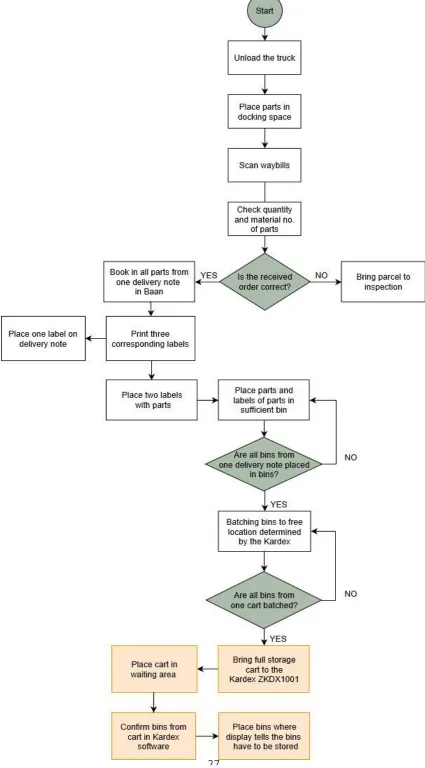
This chapter focusses on the receiving, storing, and picking processes, since only these three processes effect the problem of superfluous space in the VLM. To give a clear view of how the receiving, storing, and picking of parts proceeds within Benchmark, all three activities will be outlined. The explanation mostly focusses on Kardex ZKDX1001, since this represents the scope of the project. A visual overview of how parts get a location assigned in the system is provided in the process flowchart in figure 11.
1) Receiving
Warehouse management starts when parts arrive at the company. Trucks with parts arrive at the docking department every day. The trucks are unloaded and the parts from the trucks are placed at the docking part of the warehouse. To be able to discover if and when parts were received afterwards, the waybills of all boxes are scanned and kept record of. The parts then wait until they are confirmed as received in the ERP-system Baan. Before this happens, parts have to be checked on their quantity and material code. Most parts are received in cardboard boxes or plastic bags, so that individual parts like screws stay together. When the wrong parts or wrong quantities have been received, parts are transferred to inspection for a second check. If received parts are ready to be stored, they will be placed in a bin and put on a storage cart.
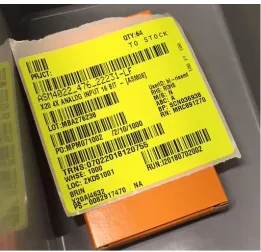
When the check is positive, parts receive a label with information (see figure 7). The information on the label among others shows the material number, MBA-number, and the warehouse location (e.g. Kardex ZKDX1001). The labels are printed with a software called
[image:23.595.168.429.502.754.2]“Bridgelogix”.
For every orderline on a delivered order, three labels are printed. One for the bin the parts are placed in, one to put on the delivery note and one for the warehouse employees to let them know which parts have to be stored in the VLM of the main warehouse. After
confirming all parts from one delivered order in Baan, the receiving process can continue. The parts will be placed into the bin size that is most applicable. In this case, applicable means that all parts from one orderline fit in one bin with little free space in the bin as possible.
Bin types
There are six different bin sizes. The applicable size depends on the dimensions of the parts altogether. The warehouse employees working in the docking department determine the applicable size of bin for the parts. They always try to make sure that parts exactly fit into one bin, with leaving little free space as possible. The following sizes of bins are available
(dimensions attached):
Table 2: Dimensions of storage bins in use at Benchmark
In exceptional cases (e.g. when all parts together do not fit within one bin) two bins may be used. It might also occur that a particular size of bin is not available, because all bins of this size are already in use. If this is the case, other bin sizes have to be used. Nevertheless, warehouse employees always make sure that only parts for a particular MBA-number are placed within one bin to achieve FIFO picking.
Batching
After putting all parts from one delivery note into bins, the bins need to be batched in order to connect bins to a location in the VLM. This is executed with software provided by Kardex Remstar, called PowerPick. PowerPick is installed to automatically search for empty bins in Kardex ZKDX1001. When all bins from one storage cart are batched, the full cart will be transferred to the main warehouse. PowerPick labels the carts in the stage between receiving and storing as “carts to be stored”. In Baan this is indicated with “ZKDS1001”.
Briefly described
In short, the receiving process for parts that are stored in Kardex ZKDX1001 consists of: 1. Unpacking received orders
2. Checking orders
3. Processing received orders in Bridgelogix and Baan
4. Printing labels and placing parts with corresponding label in appropriate, empty bin 5. Batching bins to assign a location to the parts in Kardex ZKDX1001
6. Transfer storage cart to Kardex ZKDX1001 in the main warehouse
Length Width Height CM3
B001 200 148 117 3463200
B002 300 200 170 10200000
B003 400 300 220 26400000
B004 600 400 320 76800000
B005 600 400 120 28800000
2) Storing
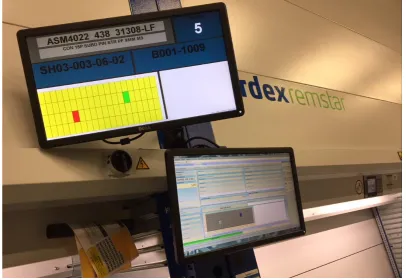
All bins on a storage cart have to be confirmed in PowerPick before storing can start. PowerPick shows all carts in location ZKDS1001, the stage between batching and storing. When a cart is confirmed in PowerPick, the display of the VLM (see figure 8) shows all material numbers of the parts (ASM4022_438_31308-LF) from the confirmed cart
consecutively, the location the bin has to get in the Kardex (SH03-003-06-02), the quantity that has to be stored (5), and the bin the parts have to be stored in (B001-1009). When one bin has been stored, the following in line will be displayed after the storing is confirmed with a barcode scanner. To minimize mistakes during storing or picking, a display shows the location to store a bin in red (figure 8). Locations are depicted in green when bins are empty.
[image:25.595.95.501.225.505.2]To confirm storing, the barcode in the bin has to be scanned (see figure 9). The empty bin that is swapped with the new bin after storing will be transferred to the receiving department again. This means that the storing process influences the number of available bins for a certain bin size in the docking department.
Assigning location
The location a bin gets assigned in the VLM depends on the size of the bin. Bins are located in a random empty space on a plateau with corresponding bin sizes. PowerPick searches for these empty locations during the batching of parts. PowerPick only searches on a plateau where bins of the same size are stored. As a result, parts in a B001 bin can only be placed on a plateau with other B001 bins. This is a way to optimize the use of space in the VLM systems. For example, B001 bins are only 11,7 cm high and require less height in the VLM then B003. Placing only B001 bins in one plateau can this way saves room for other plateaus. This would not be possible if the plateau also contained some higher bins.
Briefly described
In short, the storing process for parts that are stored in Kardex ZKDX1001 consists of: 1. Confirm storage cart in PowerPick
2. Store bin that is indicated on display in front of the shuttle 3. Pick empty bin from the location the new bin was stored 4. Confirm the storing by scanning barcode of bin
5. Store next bin that is indicated on display
3) Picking
Before the start of a production process, all parts that are needed are picked at once. This is in most cases done with help of workorders. The workorder tells what parts and attached quantities are needed in the end-product. Powerpick knows where the picker has to pick after confirming the workorder in the software. When the picker starts picking, the VLM
automatically transfers the requested plateau with the right bin to the picker. The picker knows the bin he has to pick parts from, based on the information on the display (figure 8), from signs on the requested plateau and from the workorder. Since parts in one bin are all originating from the same batch lot, warehouse employees do not have to think about which parts to pick first from the bin. The picker only has to request the desired plateau the display is showing and pick the right number of parts. However, a disadvantage of storing only one batch lot number into one bin is that the picker might have to pick from multiple bins in different VLM’s. As a result, the picker might lose overview of the parts to be picked in order to complete the workorder, according to warehouse employees (Renske, July 26).
After all parts from one workorder have been picked and placed in a transfer box (figure 10), the transfer boxes are placed on a cart. Full carts can be transferred to the work floor when all parts for the production process are picked. Sometimes workorders require more parts that are stored in other warehouses of the company. Nevertheless, the main warehouse is always the first warehouse where parts for one workorder are picked.
Briefly described
In short, the picking process for parts in Kardex ZKDX1001 consists of: 1. Confirm incoming workorder in Baan
2. Pick the parts from the location the display in front of the VLM is showing 3. Count the parts and put them in a transfer bin
4. Put a paper (see figure 10) with information with the parts that were picked 5. Confirm the picking by scanning the barcode of the bin
6. Pick next parts the display of the VLM is showing
Process flowchart
In this chapter, a process flowchart is used to clarify the current receiving and storing
processes. Process flowcharting is a technique to analyze a process and to enable solving of a problem. The idea of a process flowchart is to give an overview of a process with help of figures like rectangles or circles. The flowchart should show core processes and their linkages (Krajewski, Ritzman, & Malhotra, 2013).
[image:27.595.169.426.70.330.2]In figure 11, the process flowchart for the current situation is presented. The flowchart depicts only the receiving and storing process within Kardex ZKDX1001, because these two activities have influence on the storage location parts get assigned. In chapter 7, a process flowchart is used to clarify the receiving and storing processes when the improvement is implemented.
3.3 Space management problem in Kardex ZKDX1001
In section 3.2, the storage assignment method within Kardex ZKDX1001 is clarified. With this information in mind, we zoom in on the problem. The problem is that one type of part is often divided over multiple bins in the VLM and this way occupying an superfluous number of storing locations. In section 1.3, the possible reduction of bins was determined when the maximum number of bins per part type is set to two. This resulted in a required reduction of 879 bins, equal to a reduction of 9% of all location in the Kardex.
The Pareto analysis is applied to see if there are customers that influence the space problem more than others and if so, who these customers are.
3.3.1 Pareto analysis
The Pareto analysis tells that 20% of the causers is responsible for 80% of the effects, as was explained in the theoretical framework (chapter 2). According to data from Kardex ZKDX1001, two customers are responsible for around 90% of the superfluous bins. In graph 1, these two are shown as ASM (ASML) and THL (Thales). This is interesting and the reason that the focus of this study shifts to only these two customers. At the end, evaluation can discover if the solution could be applicable for other customers too.
Conclusion
This chapter described the current situation within the VLM systems in the main warehouse. Explanation of the receiving, storing and picking processes showed that the FIFO way of
assigning parts to a location in the VLM influences the amount of superfluous space. Furthermore, a Pareto analysis was applied to be able to simplify data while maintaining
accuracy. Finding a solution for the two main causers of the problem can improve the problem significantly. In chapter 4, the necessity of FIFO storing will be studied for these main
causers by conducting interviews. First, the Plan step of the PDCA-cycle is performed to identify causes of the superfluous space inside bins and to develop a plan.
0 100 200 300 400 500 600 700
AIB ASM BEI ELK OTN SEN SIR SMS THL
NUMBER OF SUPERFLUOUS
BINS PER CUSTOMER
4. The PDCA-cycle
In the theoretical framework, the concept Plan-Do-Check-Act cycles was briefly explained. This method picks one of the causes of the problem and attempts to improve it. The focus of the cycle and the Plan of the cycle will be treated in this chapter. After the Do and Check of the cycle, evaluation (Act) can find out if the improvement works for Benchmark.
4.1 Causes of the unnecessary bins
In principle, FIFO picking of parts would not immediately have to mean that identical parts are stored in an superfluous number of bins. Nevertheless, there are two reasons this still occurs. These reasons were established in deliberation with Benchmark. The reasons are:
1. Parts stay in the VLM longer than expected
2. Different MBA-numbers always have to be stored in different bins to reach FIFO
1. Parts stay in the VLM longer than expected
Just in Time is a philosophy and a technique that guides manufacturing companies in the organization and management of processes. This method can help to achieve manufacturing at a high velocity. The method smoothens material flows from the supplier to the customer (Hong-Mo, n.d.). Just in Time suggests parts to arrive just before the start of production.
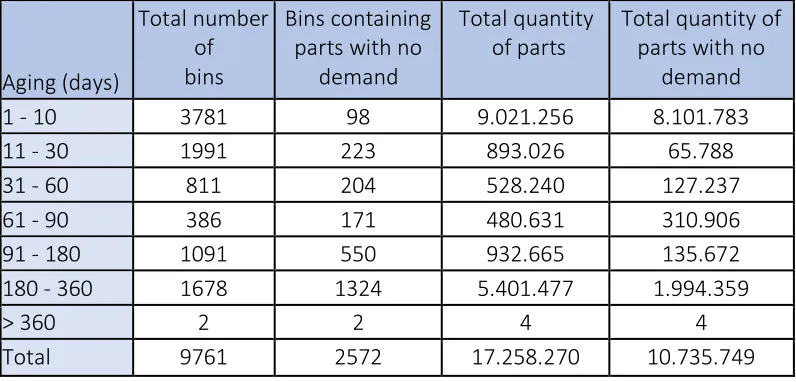
[image:30.595.99.497.506.697.2]Benchmark is trying to achieve Just in Time incoming of parts. In a perfect situation, this would mean that parts stay in the warehouse for a couple of days and then leave to be used in production. One bin would generally be enough to store all parts. In exceptional cases, two bins are necessary when production time is long and the time between demand of two products is short. At the moment, this is not the case (see table 3). Of the total bins in use in Kardex ZKDX1001 (9761), 1678 bins (17% of the total) are in use for more than half a year. Moreover, 2572 (26%) of the bins are occupied by parts that do not have demand.
Table 3: Number of locations and quantity of parts in Kardex ZKDX1001 (total versus without demand) Data from 16 July
Aging (days) Total number of bins Bins containing parts with no
demand
Total quantity
of parts Total quantity of parts with no demand
1 - 10 3781 98 9.021.256 8.101.783
11 - 30 1991 223 893.026 65.788
31 - 60 811 204 528.240 127.237
61 - 90 386 171 480.631 310.906
91 - 180 1091 550 932.665 135.672
180 - 360 1678 1324 5.401.477 1.994.359
> 360 2 2 4 4
2. Different MBA-numbers always have to be stored in different bins to reach FIFO The percentage of superfluous bins in use in Kardex ZKDX1001 is 9% of the total bins. All these parts in the VLM are generalized as required to be picked based on batch lot number. This number is recognized by the corresponding MBA-number. The oldest MBA-numbers are always picked first.
Assigning MBA-numbers
The MBA-number of a part is assigned to parts during batching. According to the warehouse manager, there are three reasons for difference in the MBA-number of identical parts. Since Benchmark acknowledges this as the causes for difference in MBA-numbers, these three reasons will be outlined and studied:
1) Identical parts arrive on a different moment
2) Identical parts arrive on the same moment in a different batch lot, and 3) Identical parts with a different material number
1) Identical parts arrive on a different moment
MBA-numbers are assigned to parts during batching in the receiving stage. A logical consequence is that identical parts that arrive on a different moment, receive a different MBA-number. When demand is regular and production processes occur often, parts also arrive often in case of Just in Time purchasing. If production processes would always start on the planned moment, this would not be a problem because parts then stay in the warehouse for only a short period. By the time a new batch arrives, the old batch will almost or already be used in production and the number of bins stays low. Since this is not the case, the number of bins for identical parts arriving on a different moment accumulates.
2) Identical parts arrive on the same moment in a different batch lot
Benchmark thinks it is important to know in what batch lot the parts arrived. The supplier indicates the batch lot number of parts, by which Benchmark is able to trace the batch lot parts came from. This can be helpful in retrieving the reason for possible problems that occur in the production process at the supplier or at Benchmark, but also causes the number of bins for identical parts to accumulate.
3) Identical parts with a different material number
Some products Benchmark produces change in BOM during the year. After this change, the customer demands the newer version of a product and together with that the newer versions of parts. These new versions of parts can be the same as older versions, with only a new material number as difference. Since orders are picked based on the material numbers in a BOM, parts with old material numbers stay in the warehouse and new versions will be picked. The difference in versions of one part can be recognized by the material number of the part. This material number influences the MBA-number assigned to parts and therefore causes the number of bins for the same parts (but of a different version) to accumulate.
4.2 Choosing the focus of the PDCA-cycle
The amount of time that parts are stored in the VLM systems is partly influenced by
purchasing dates and purchasing quantities. During preliminary investigation, the choice has been made to not focus on Just in Time incoming of parts (see appendix 10.1). However, since this is an important influencer of the space management problem, improving Just in Time incoming of parts is recommended to study in the future (see chapter 9).
4.3 Plan: Identification of the problem
In this section, the Plan of the cycle will be performed. This is the identification of the chosen cause. Every MBA- number is currently generalized as needing to be picked FIFO and consequently to be stored in an individual bin. Below the necessity of this procedure is discussed for the two customers identified in the Pareto analysis.
The following three causes for difference in MBA-numbers of identical parts were established in the previous section:
1) Identical parts arrive on a different moment
2) Identical parts arrive on the same moment in a different batch lot 3) Identical parts with a different material number
The first two causes are presented to the program managers of the two customers, to discuss for which of the purposes placement in different bins is required. The last cause, identical parts of other versions, is not discussed since these parts are considered to be different parts.
4.3.1 Investigating problem: Necessity of FIFO storing
The place a bin is stored in the VLM system depends on the MBA-number of the parts in a bin. The reason this method is maintained is to achieve the delivery of products with an equal quality of parts. Moreover, it is used to prevent having one product that contains very old parts and the other with very new ones. Benchmark is currently applying this method to all parts in the warehouse, but the necessity of this method has not been established.
According to conversations with planners, the necessity of storing every MBA-number in a different bin in Kardex ZKDX1001 is low for many parts. This statement has to be verified to be able to quantify the number of parts for which FIFO picking is not particularly necessary. Talking to program managers from ASML and Thales about this procedure gave the required information. Interviews with Program Manager of ASML and Thales leaded to the following findings about the necessity of FIFO storing:
ASML
According to Marc Kunst, Program Manager of ASML, most of the parts from customer ASML do not have to be stored FIFO with great necessity. However, parts are preferred to be FIFO picked based on arrival date and batch lot number. He mentioned that only PCBA’s have
restricted lifetime, causing the importance of storing PCBA’s FIFO. Almost all PCBA’s are
stored in the VLM systems outside the main warehouse. PCBA (parts) that are stored in Kardex ZKDX1001 can be counted on one hand.
All parts from ASML in three or more bins are summed 1495. Of them, 661 are superfluous and could be removed. As a result, around 7% of all bins could be released from Kardex ZKDX1001 only for ASML.
Thales
According to Mark Rikmanspoel, Program Manager of Thales, FIFO picking of every different MBA-number is required. He thinks this way because Thales always wants to be able to retrieve the batch lot of parts. He also thinks that it is not necessary to store every MBA-number a different bin. It is an easy way to recognize the batch lot, but there are other ways to retrieve batch lot numbers too.
All parts from Thales in three or more bins are summed 311. Of them, 145 could be removed. As a result, around 1,5% of all bins could be released from Kardex ZKDX1001 only for Thales.
Conclusion from interviews
In the theoretical framework, the Random Retrieval of parts was provided as an alternative to store parts inside a bin. This is not the best method to pick parts according to the program managers. From the interviews with program managers of customer ASML and Thales, it can be concluded that program managers prefer all parts in the VLM to be stored FIFO. Besides, not every MBA-number has to be stored in a different bin. This information leads to the following criteria for a solution that will be taken into account when developing a plan for the solution:
• For all parts it has to be possible to pick parts FIFO based on the batch lot number (recognized by MBA-number)
4.4 Approaching problem: Developing plan for solution
In section 4.3, interviews and data determined the focus of the solution. In the continuing of the Plan, possibilities to make the number of superfluous bins reduce while keeping the opportunity to apply FIFO have to be studied. A literature review can help in obtaining ideas of how to achieve reduction of superfluous bins without reducing warehouse efficiency and while maintaining optimal use of space. The literature review is outlined in chapter 5.
Initial possibilities for how to achieve bin reduction are listed below. These initial possibilities were established in deliberation with the operations department of Benchmark.
The three possibilities are:
1) Reducing the number of bins per part by placing identical parts in fewer bins, with FIFO picking based on MBA-number
2) Reducing the number of bins by placing different parts in fewer bins, with FIFO picking based on MBA-number
3) Alternative FIFO storing methods for in Kardex ZKDX1001
For option three, a literature study will be performed in chapter 5 to find out alternative FIFO storing methods. The other two possibilities are alternatives that can already be applied. These two possibilities can be applied in two ways:
•
Placing parts in occupied bins in the storing stage•
Placing parts in occupied bins by relocating parts once in a few weeksThese options to put possibilities 1 and 2 into practice are established in deliberation with Benchmark.
Remarks
According to the warehouse manager, placing parts in occupied bins in the storing stage will take a lot of time and is not efficient. He believes that if parts have to be stored in a bin that is already located in the VLM, warehouse employees have to conduct more work and
inefficiency of the receiving process increases. To prevent reducing efficiency, optimization possibilities are studied in the literature research by investigating storage assignment methods.
Conclusion
This chapter identified that the current method to store every MBA-number in a different bin is not optimal. It is clear that the assignment of maximum one MBA-number to an individual
bin is one of the main causes for having a superfluous number of bins in use in Kardex ZKDX1001. Two criteria for reducing the number of superfluous bins were established: For all
parts it has to be possible to pick FIFO based on MBA-number and it is not necessary to put every MBA-number in a different bin. The literature review in chapter 5 will help to find ways that satisfy these criteria. Besides, literature is reviewed to prevent reduction in efficiency by
5. Literature review
The main purpose of this chapter is to find an answer to some of the knowledge questions. The questions that will be answered are:
• What is a Kardex Remstar Vertical Lift Module and how does it work?
• What alternative FIFO storing methods do there exist for Vertical Lift Modules? • What possibilities are there in the literature to optimize space utilization in a VLM
system while having low travel times?
• What classification methods do there exist to distinguish parts for different purposes?
The answers on questions above can help to reduce the number of superfluous bins and to optimize the operational strategy. To be able to achieve this, a literature review is performed to find answers to the questions above.
5.1 Alternative FIFO storing methods in a VLM
Benchmark is encountering troubles with storing parts in their VLM systems due to lack of space. This first section will provide possibilities to reduce the amount of superfluous space in use while keeping FIFO storing possible and without placing parts in the same location.
To start with a good foundation of this section, the Kardex Remstar VLM will be outlined first. After that, the possibilities for FIFO storage within a VLM system are described.
5.1.1 Kardex Remstar
Kardex Remstar is a producer of dynamic storing systems. These systems can be implemented in warehouses, production plants or distribution centers. Dynamic storing systems
automatically store products. The level of automation can be adjusted to preferences customer. Next to that the density and performance can be adjusted to customer’s
requirements too. All these settings depend on the business processes within a company, and the items that have to be stored.
Next to the storing system, Kardex provides flexible and modular software packages. These software packages can be adjusted to the needs of the customer and integrated into an existing ERP.
The worker can request the plateau with bins where the worker has to store or pick parts. In figure 13 is depicted how this looks like. Kardex offers multiple options of interfaces to improve warehousing processes even more. One of these is the barcode scanner that can be used for order confirmation, picking and confirming (Kardex Remstar, 2018).
[image:37.595.223.375.71.321.2]Figure 13: [Vertical Lift Modules]. Reprinted from Kardex Remstar website. Retrieved from https://www.kardex-remstar.nl/nl/opslag-magazijnbeheer-materiaalbeheer-solutions/verticale-liftsystemen.html
Figure 12: Vertical Lift Module from the inside. Reprinted from “A throughput model for a dual-tray Vertical Lift Module with a human order-picker” by G. Dukic et al., 2015,
[image:37.595.73.526.495.697.2]5.1.2 Alternatives to store parts FIFO in VLM systems
A VLM is on itself known to make optimal use of space. This may be a reason that storing parts in a VLM while maintaining FIFO picking and increasing the number of locations offers little possibilities in literature. Maintaining FIFO storing can be performed in two ways. The method by which parts are stored inside the system (currently applied by using separate bins) or the use of adjustable bin sizes. Alternatives for the second approach are studied below.
1) The use of dividers within bins
Storing parts in a Kardex VLM can be organized by putting parts in bins. These bins are typically made of durable plastic and can be reused. As mentioned before in section 3.2, bins are available in specific dimensions. Next to the bins, Kardex Remstar provides dividers to create smaller compartments within a bin. One type of dividers is depicted in figure 14.
Dividers in a bin have several advantages. They help to streamline operations, save space and supply a simple overview. Small parts like screws can easily be divided over one bin which will make utilization of bin use higher. The dividers are particularly effective for holding bulk quantities of very small parts, which can be sorted and handled more easily in dedicated bins. The second advantage is protection of parts. Open storing in the Kardex will increase the chance of exposure to dust and dirt, which may decrease the useful life of a part. The third advantage of the use of dividers is increased accuracy. Many bins offer a spot where labels can be placed to identify contents. These labels on the dividers in the bin make it easier for pickers to know which parts in the bin they have to pick. Furthermore, accuracy and
productivity can be increased since only one bin has to be retrieved instead of two when not all parts for one item are stored in the same location (Dube, 2018).
Figure 14: [bin dividers]. Reprinted from Kardex Remstar website. Retrieved from https://www.kardex-
[image:38.595.195.400.259.507.2]By using dividers, the exact number of locations required can be created. Reconfiguration of dividers can be performed at any time to accommodate changes in the quantity or the size of products. Kardex Remstar states the following about the dividers they supply (Kardex
Remstar, 2018):
• Perfect fit for the Kardex Remstar Vertical Lift Module Family • Flexible in height
• Flexible in bin size layout • More efficiency
• Easy to configure with the Kardex Remstar software • Light and robust construction
• Superior filling rate • Better pick accuracy • Looks clean and organized
2) Other types of part dividers
Kardex Remstar is not the only one who supplies possibilities to divide parts in a VLM. Another supplier is Flexcontainer, who delivers dividers that can be adjusted to customer needs. In figure 15 and 16 you can see how this alternative looks like. The partitions can be replaced at any time (Flexcontainer, 2018).
Conclusion of alternatives to store parts FIFO in VLM systems
There exist a few alternatives to apply FIFO within the VLM by using adjustable bin sizes. These alternatives are to use bin dividers or to use a type of adjustable bins. The necessary number of locations can this way be created at any time.
In the following section, storage assignment methods are investigated. Mainly to maintain or even increase the efficiency within the VLM when parts are placed into fewer bins, which are intial possibilities 1 and 2 from section 4.4.
Figure 15: [Dividers from Flexcontainer]. Reprinted from Flexcontainer website. Retrieved from
http://flexcontainer.com/divider-systems/
Figure 16: [Picker with dividers from Flexcontainer]. Reprinted from Flexcontainer website. Retrieved from
[image:39.595.47.545.384.565.2]5.2 Storing assignment methods
The method by which parts are currently stored inside the VLM is by assigning bins to a random location in the VLM. Benchmark appears to be very firm in this method to assign stock to a location. The company informally mentioned that the currently applied storage assignment method is sufficient. An example by which this objective was confirmed, was the referral to other theses performed at the company. Meanwhile, the company is dealing with space management problems. These two things together make it seem like a good moment to take the applied storage assignment method into doubt.
In this section, a thesis about the implementation of VLM systems at Benchmark performed a couple of years ago will shortly be discussed first. This thesis already investigated the optimal storage assignment method once. After that, possibilities for optimal storage assignment are investigated with help of literature. This will be done by searching for methods that reduce storing and picking time, while maintaining efficient use of space in an AS/RS in general and in VLM systems in specific. Lastly a conclusion will be based on the information altogether.
Motivation from literature
Several authors wrote about why it is important to investigate the optimal storage assignment method. A few of these reasons are written below:
For a warehouse to be efficient, it should take into account the reduction in traveled distance, in costs, and in amount of space used. This means the required space should be small as possible and the total traveled distance and time should be minimized when searching for the “best” location for stock (Liu, 1999)
In a typical warehouse management system, the order-picking usually costs are around 55% of total warehousing operating costs and exists of around 55% traveling time. Hence, how to reduce the travelling distance when receiving a picking order becomes an important issue (Geng, Li, & Lim, 2005)
Generally, it appears that the distance the AS/RS has to travel to place products in the warehouse, is not influenced by the size of the orders. It is the storage assignment method that influences it (Derickx, 2012)
5.2.1 Thesis about implementation of Kardex at Benchmark
In 2014, A.J. Jansman performed a study about the implementation of Kardex VLM in the warehouse of Benchmark Electronics. This was around the same time the Kardex systems were implemented at the company. To find out how Jansman came to the optimal storage assignment method, the results are presented and discussed. In his investigation, he answered the following question:
How do logistic processes at Benchmark have to be designed to be able to in the future work with the VLM systems and increase efficiency and reliability in the warehouse?
Jansman compared three different methods. The first one was to assign fixed locations to all products, the second to use free locations that are tracked by the Kardex software PowerPick and the third was the use of fixed locations when the Kardex determines an optimal route in the system to make sure the Kardex has to make little movements as possible during the storing process. The last method was implemented at VDL, a company in Almelo that produces comparable products as Benchmark (Jansman, 2014).
Jansman concluded that the second method was the best method for Benchmark, which is also the method that Kardex Remstar recommended. He based his choice on the outcome of the AHP-method (Analytic Hierarchical Process). In this method, he used the following criteria and weights to determine the best option:
Table 4: Criteria and weights from AHP of thesis Jansman
Criteria Weight
Number of actions 0.06
Probability of human mistakes 0.58
Speed of storing 0.10
Speed of picking 0.14
Flexibility and Use of space 0.12
Consistency ratio2 18.29 (Relatively good)
The use of free locations seemed to score best on the criteria: • Reduce probability of errors during picking
• Flexibility and use of space • Speed of storing
Conclusion of the thesis
Jansman did not take into consideration optional storing assignments from literature, while literature could provide useful information about how to choose the optimal storing
assignment method. To find out if the use of free (random) locations is the best storage assignment method, storage assignment methods will be studied in section 5.2.2.
2 The consistency ratio: The lower this ratio, the better the reliability of the assessment. Below 10, the ratio is
“very reliable”. Between 10 and 33 the ratio is “reasonably reliable”. The score of 18 was seen as sufficient in the