University of Warwick institutional repository:
http://go.warwick.ac.uk/wrap
A Thesis Submitted for the Degree of PhD at the University of Warwick
http://go.warwick.ac.uk/wrap/56229
This thesis is made available online and is protected by original copyright.
Please scroll down to view the document itself.
An Analysis of the Determinants of Pay and
Well-being using Employer-Employee
Data
Jonathan Gardner
A thesis submitted in partial fulfilment of the requirements for
the degree of Doctor of Philosophy in Economics
Table of Contents
Acknowledgements viii
Declaration ix
Abstract X
Chapter 1: Introduction 1
Chapter 2: Do Firms Share Rents? An analysis using Linked
Employer-Employee Data 9
2.1 Introduction 11
2.2 Models of a wage-rents correlation 13
2.2.1 A bargaining model 14
2.2.2 Competitive frictions 16
2.2.3 Performance-related-pay 17
2.3 Existin g Empirical Evidence 18
2.3.1 Industry and Establishment effects upon Worker wages 18
2.3.2 The Employer's `ability to pay' and Employee wages 20
2.3.3 Recent Research using Linked Employer-Employee data 26
2.4 Data 27
2.4.1 Properties of the Linked Employer-Employee Data 28
2.5 Results 30
2.5.1 Summary Statistics 30
2. S. 2 Estimation Strategy 31
2.5.3 Further Econometric Issues 33
2.5.4 Profits per employee, Worker skill and Worker wages 35
2. S. 5 Profits per employee and Performance Related Pay 36
2.5.6 Is rent-sharing limited to the union sector? 38
2.5.7 Is the rent-wage correlation a result of short-run competitive frictions? 39
2.5.8 The
effect
of lagged
pmfitability
39
2.5.9 Firm profitability and US Product Market Influences 41
2.5.10 Alternative Measures of Pay and Firm Prosperity 44
2.5.11 Worker-Firm Fixed Effects 45
2.6 Conclusions 49
Appendix 1 Non-response and Attrition Bias in the BHPS 62
Appendix 2 Sample Selectivity within the BHPS-DB Linked Data 63
Chapter 3: Employer Size, Wages and Worker Well-being 66
3.1 Introduction 68
3.2 The Employer Size-Wage Relation: Theories and Explanation 70
3.2.1 D Terences in Productivity 70
3.2.2 A Compensating Differentia! 72
3.2.3 Institutional Explanations 73
3.3.1 Differences in Productiviy 76 3.3.2 A Compensating Differential 79
3.3.3 Institutional Explanations 80
3.4 Data 81
3.4.1 The Job Satisfaction Data 83
3.4.2 Comparison of Satisfaction Responses: Interpersonal and over time 84
3.5 Results 85
3. S. 1 Summary Statistics 85
3.5.2 Estimation strategy 86
3.5.3 Employer Site and Wages 87
3.5.4 Comparability with previous evidence 88 3.5.5 LabourQualiy Differences. - Correlates of Productiviy 89
3.5.6 LabourQuality Differences. Fixed Effects Estimates 91
3.5.7 Alternative Explanations of the Employer Site Wage Correlation 95
3.5.8 Job satisfaction and Worker Wel! -tieing 97
3.5.9 Can employee dissatisfaction explain The employer size-wage premium? 101
3.6 Conclusion 102
Appendix 1 Non-response and Attrition Bias in the BHPS 117
Appendix 2 Sample Selectivity within the WERS 118
Chapter 4: Race, Wages and Worker Well-being 121
4.1 Introduction 123
4.2 The Racial Wage Differential: Theories and Hypotheses 124
4.2.1 D Terences in Productiviy 125
4.2.2 Taste based models of discrimination 125
4.2.3 Statistical discrimination 129
4.2.4 Occupational crowding 131
4.3 Existing Empirical Evidence 132
4.3.1 UK Evidence 132
4.3.2 US Evidence 133
4.3.3 Racial differences in worker well-being 137
4.4 Data 138
4.4.1 The Job Sati faction Data 139
4.4.2 Comparison of Satisfaction Responses: Interpersonal and over time 139
4.5
Results
140
4.5.1 Summary Statistics 140
4.5.2 Estimation strategy 141
4. S. 3 Results be Ethnic group 142
4.5.4 Immigration and the wage differential 143
4.5.5 The Ethnic composition of the workforce 144
4.5.6 Occupation and Establishment Effects 150
4. S. 7 Job satisfaction 151
4.5.8 Turnover, Tenure and Absenteeism 156
4.5.9 The determinants of the ethnic composition of the workforce 160
4.6 Conclusion 162
Chapter 5: Does Money Buy Happiness? A Longitudinal Study
using Data on Windfalls 180
5.1 Introduction 182
5.2 Well-being Patterns 183
5.3 Data 185
5.4 Results 189
5.4.1 Estimation strategy 196
5.4.2 Lottery Wins 196
5.4.3 Inheritances 200
5.5 Conclusions 203
Chapter 6: The Decline in Well-being amongst Britain's Public
Sector Workers 215
6.1 Introduction 217
6.2 Subjective measures of worker well-being 218
6.3 Data 220
6.4 Results 223
6.4.1 Estimation strategy 224
6.4.2 The trend in public sector well-being and the business cycle 227 6.4.3 The trend in public sector well-being by worker characteristics 228 6.4.4 The changing composition of public sector employment 231
6.4.5 An alternative measure of mental distress 234
6.4.6 Job satisfaction 235
6.5 Conclusions 238
Appendix Definition of Public Sector Occupations 248
Chapter 7: Conclusions 249
References 256
List of Tables
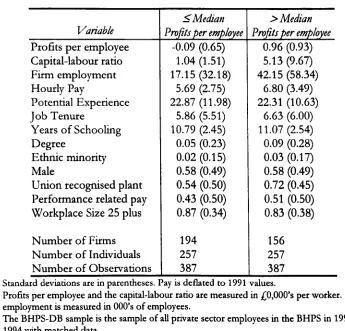
Table 2.1 Sample Means: A comparison of the data 51
Table 2.2 Sample Means: Above and below median profitability 52
Table 2.3 The number of worker-firm groups 52
Table 2.4 The effect of firm profitability upon pay: The impact of
controlling for worker skill 53
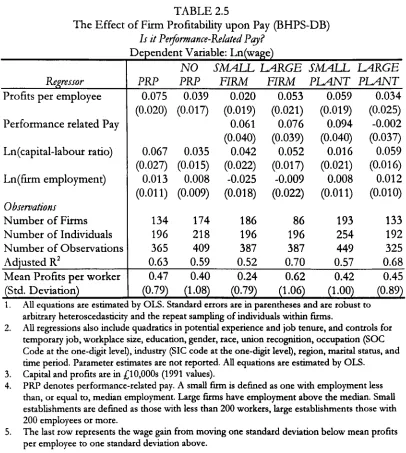
Table 2.5 The role of performance-related pay 54
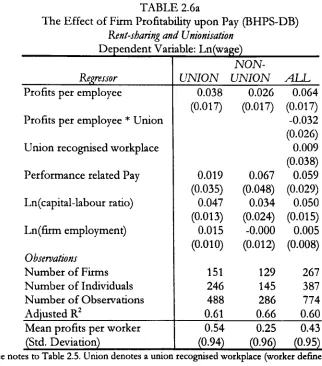
Table 2.6a Rent-sharing and Unionisation 55
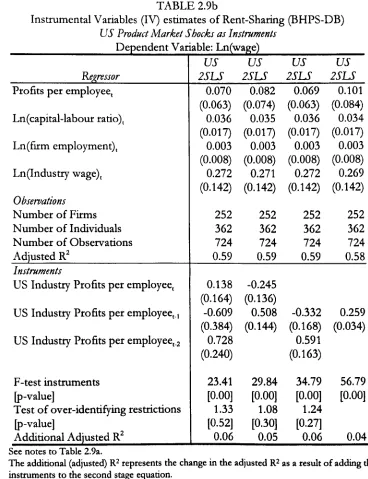
Table 2.6b Results by Occupation 55
Table 2.7 The effect of lagged profitability upon pay 56
Table 2.8 Sample Means: The sample with non-missing US Industry data 57
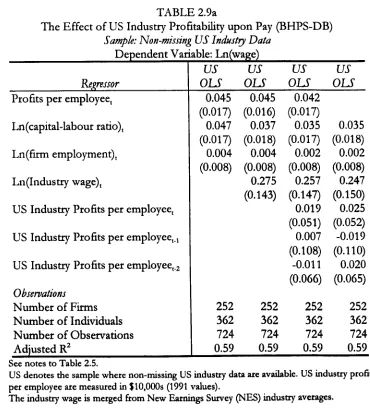
Table 2.9a The effect of US Industry profitability upon pay 57
Table 2.9b Instrumental variable estimates of Rent-sharing: US product
market shocks as instruments 58
Table 2.10 The effect of the firm's `ability to pay' upon wages: A
comparison of estimates 58
Table 2.11 a The level of pay as the dependent variable 59
Table 2.11 b Sales per worker as the measure of firm wealth 59
Table 2.12 Worker-Firm Fixed Effects and IV estimates of Rent-sharing:
Hourly pay
60
Table 2.13 Worker-Firm Fixed Effects and IV estimates of Rent-sharing:
Weekly Pay 61
Table 2.14 Worker-Firm Fixed Effects and IV estimates of Rent-sharing:
Lagged Profitability and Hourly pay 61
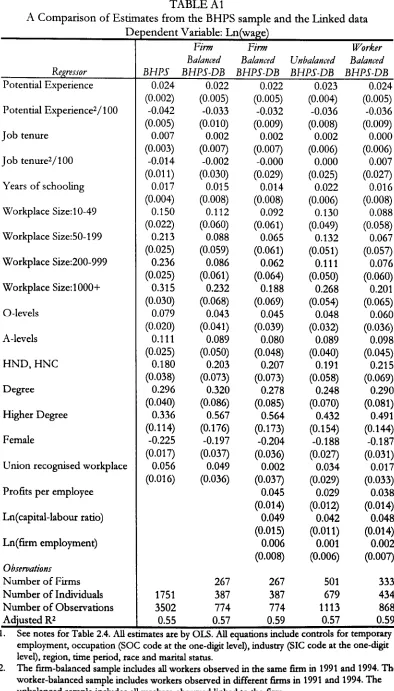
Table Al A comparison of estimates from the BHPS and linked data 65
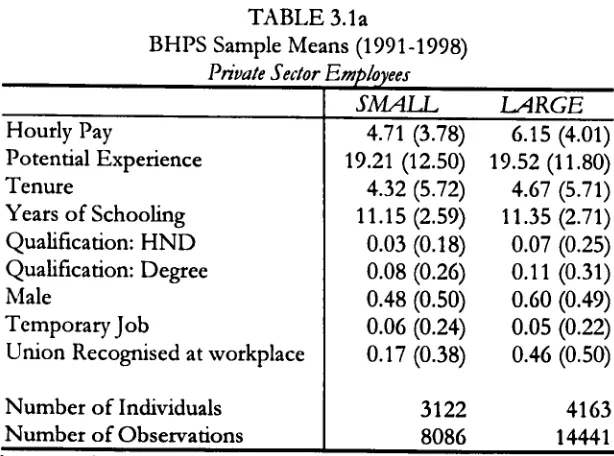
Table 3.1 a BHPS Sample Means 105
Table 3.1
b
WERS Sample
Means
105
Table 3.1 c NCDS Sample Means 105
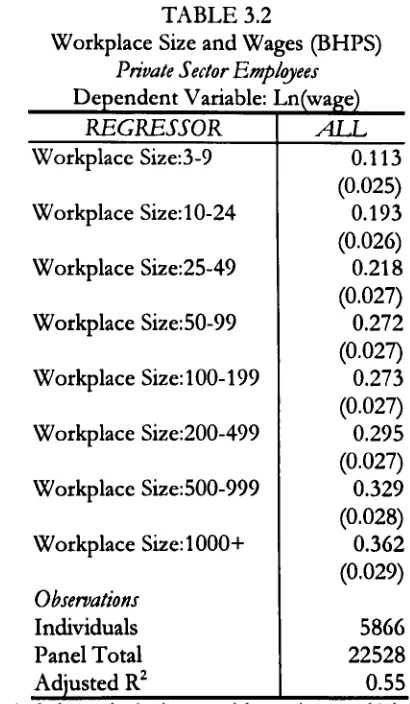
Table 3.2 Workplace size and wages (BHPS) 106
Table 3.3 Employer size and wages (WERS) 107
Table 3.4
The effect of worker skill (NCDS)
108
Table 3.5 Proxies for worker skill (WERS) 109
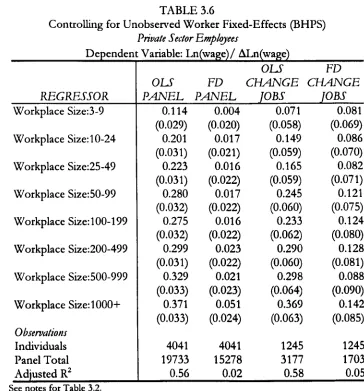
Table 3.6 Controlling for unobserved worker fixed-effects (BHPS) 110
Table 3.7
The Role of Employer Characteristics
(BHPS-DB)
111
Table 3.8 Monitoring and the Employer size-wage relationship (WERS) 112
Table 3.9a Workplace size and Overall Job Satisfaction (BHPS) 113
Table 3.9b Marginal Effects 113
Table 3.10 Workplace size and job Satisfaction (BHPS): 114
Table 3.11a Employer size and job Satisfaction (WERS) 115
Table 3.11b Employer size and job Satisfaction
(WERS)
115
Table 3.12a Employer size and the characteristics of employment (WERS) 116
Table 3.12b Employer size and the influence over the job (WERS) 116
Table Al A comparison of weighted and unweighted estimates (BHPS) 120
Table 4.1 a QLFS Sample Means 166
Table 4.1 b WERS Sample Means 166
Table 4.2 Regression results by Ethnic Group (QLFS) 167
Table 4.3 Regression results by Ethnic Group (WERS) 168
Table 4.4 The effect of Immigration (QLFS) 169
Table 4.5 Wages and the Racial Composition of the Plant (WERS) 169
Table 4.6 Wages and the Racial Composition of the Plant: The
London Sample
(WERS)
169
Table 4.7 The Ethnic Wage Differential by the Ethnic Composition of
the Workforce (WERS) 170
Table 4.8 Occupation and Establishment Effects (WERS) 170
Table 4.9 Satisfaction and the Ethnic Composition of the Workforce
(WERS) 171
Table 4.10a job Satisfaction and Race (WERS) 172
Table 4.10b Marginal Effects of Race upon job Satisfaction 172
Table 4.11 Job Satisfaction, Race and Pay (WERS) 173
Table 4.12 Job Satisfaction and Race (WERS): Results by different
estimation techniques 173
Table 4.13 Workforce Ethnic Composition and Turnover (WERS) 174
Table 4.14 Tenure and the Racial Composition of the Plant (WERS) 174
Table 4.15 Workforce Ethnic Composition and Absenteeism (WERS) 175
Table 4.16a The determinants of Workforce Ethnic Composition (WERS) 176
Table 4.16b Marginal Effects 176
Table Al A comparison of weighted and unweighted estimates (WERS) 179
Table 5.1a The Effect of Windfalls upon GHQ Stress 205
Table 5.1b The Effect of Windfalls upon GHQH Unhappiness 205
Table 5.2a Summary Statistics by whether had a Win on the Lottery 206
Table 5.2b Summary Statistics by whether had an Inheritance 206
Table 5.3 Summary Statistics by Amount of Win on the Lottery 207
Table 5.4 Summary Statistics by Amount of Inheritance 208
Table 5.5a
The Effect of a Lottery Win upon GHQ Stress
209
Table 5.5b
The Effect of a Lottery Win upon GHQH Unhappiness
209
Table 5.6a Lottery Wins and GHQ Stress: Non-linear income effects 210
Table 5.6b Lottery Wins and GHQH Unhappiness: Non-linear income
effects 210
Table 5.7a Lottery Wins and GHQ Stress: Robustness checks 211
Table 5.7b Lottery Wins and GHQH Unhappiness: Robustness checks 211
Table 5.8a The Effect of an Inheritance upon GHQ Stress 212
Table 5.8b The Effect of an Inheritance upon GHQH Unhappiness 212
Table 5.8a Inheritance and GHQ Stress: Robustness checks 213
Table 5.8b Inheritance and GHQH Unhappiness: Robustness checks 213
Table 5.8a Inheritance and GHQ Stress: First differences 214
Table 5.8b Inheritance and GHQH Unhappiness: First differences 214
Table 6.1 Mean GHQ Mental Stress Scores over Time 239
Table 6.2a The Trend in GHQ Scores over Time: Year dummies 240
Table 6.2b The Trend in GHQ Scores over Time: A time trend 241
Table 6.4a The Trend in GHQ: By union recognition, gender, and region 242
Table 6.4b The Trend in GHQ: By education 242
Table 6.5 The Trend in GHQ: The effect of composition change 243
Table 6.6 The Change in GHQ Mental Stress Scores 243
Table 6.7 Proportion of Respondents with High Mental Stress 244
Table 6.8a Yearly High Mental Stress Equations: The Public Sector Effect 244
Table 6.8b Yearly High Mental Stress Equations: The `Stayers' 244
Table 6.9 Mean Job Satisfaction Scores over Time 245
Table 6.10a Yearly Job Satisfaction Equations: The Public Sector Effect 246
Table 6.1 Ob Yearly Job Satisfaction Equations: Marginal Effects 246
List of Graphs
Figure 6.1 GHQ Mental Stress Scores of UK workers over Time 239 Figure 6.2 Job Satisfaction Levels of UK workers over Time 245
Acknowledgements
I am very grateful to my supervisor Andrew Oswald whose guidance and advice have assisted considerably in the direction and completion of this thesis. His support has been greatly appreciated.
My work has benefited from the advice and comments of Mark Stewart, Andrew Benito, Andrew Hildreth, Andrew Clark, Ben Knight and Ian Walker. Discussions with Gaelic Pierre and Reamonn Lydon have also proved fruitful in improving the
content of this thesis.
I would like to acknowledge financial support from the Teaching Assistantship scheme in my first year of study and in particular from the Economic and Social Research Council during the rest of my years at Warwick.
The British Household Panel Survey data were made available through the ESRC Data Archive. The data were originally collected by the ESRC Research Centre on Micro-social Change at the University of Essex (now incorporated within the Institute for Social and Economic Research).
The author acknowledges the Department of Trade and Industry, the Economic and Social Research Council, the Advisory, Conciliation and Arbitration Service and the Policy Studies Institute as the originators of the 1998 Workplace Employee Relations Survey data, and the Data Archive at the University of Essex as the distributor of the data.
The National Child Development Study data were originally collected by City University Social Statistics Research Unit and made available through the ESRC Data Archive.
Material from the Quarterly Labour Force Survey is Crown Copyright; has been made available by the Office for National Statistics in the UK through the ESRC
Data Archive and has been used by permission.
Neither the original collectors of the data nor the Archive bear any responsibility for the analyses or interpretations presented here.
Declaration
I declare the following:
The material contained in this thesis is my own work, except for chapters 5 and 6 which are based upon joint work with my supervisor, Professor Andrew Oswald. In both these chapters my individual contribution was at least 50 percent and was principally concerned with empirical analysis.
No material in this thesis has been used before or has been published previously.
Abstract
This thesis studies the determinants of pay and well-being. The first three chapters use new British employer-employee data to study the determinants of pay. Chapters three and four are also interested in the determinants of job satisfaction, whilst chapters five and six analyse factors that shape reported well-being.
Chapter two tests whether firms share product market rents with their employees. After controlling for worker and firm fixed effects, we observe evidence in support of rent-sharing upon weekly earnings, but no robust positive effect upon hourly pay.
The third chapter analyses the observed positive relationship between employer size and wages. It designs a test as to whether this relationship reflects a compensating differential. This is not found to offer a good explanation as to why wages are greater in large establishments. Instead, correlates of worker skill and person fixed effects are most successful in explaining the plant size-wage
differential.
There has been very little research on racial differences in job satisfaction levels. Chapter 4 examines the relationship between race, pay and well-being. Workplaces that employ more ethnic minority employees are associated with lower levels of job satisfaction, for both white and non-white workers. Non-white employees are paid less than otherwise similar white employees, and are less satisfied with their pay even when pay is held constant.
One of the most fundamental ideas in economics is that money makes people happy. Chapter 5 constructs a test. In the spirit of a natural experiment, it shows individuals who receive windfalls have higher mental well-being in the following year. It calculates the size of the effect.
Chapter One
Introduction
This thesis studies the determinants of pay and well-being. These outcomes are
likely to be the product of complicated interactions between workers and
employers. Understanding these interactions, and how they shape behaviour, is
crucial to our understanding of the working of the labour market. The need for a
more complete picture of the labour market, and the relationship between
individuals and firms, has been known for some time. Data sufficiently rich to allow
us to study such situations have, however, only recently become available.
This study uses such data, with detailed information about both the worker
and the firm, to analyse the determinants of pay. These data allow a fuller
examination of the relationship between employer and employee characteristics, and
their impact upon pay. Simply put, what determines wages? Is it education or skill,
or the type of employer for which an individual works? Chapter two analyses
whether more profitable firms pay higher wages, whilst chapter three examines
competing hypotheses for the existence of a positive relationship between employer
size and pay. The role of the employer in explaining the racial wage differential, and
in particular the effect of the sorting of ethnic minority workers into different types
of workplaces, is analysed in chapter four. This work provides a new examination
of the effect of the employer upon pay, and adds to the recent research that has
studied linked employer-employee data. ' By implication this questions whether
wage determination is, to some degree, non-competitive.
This thesis also examines the determinants of worker well-being, using self-
reported measures of job satisfaction and mental health. Some economists have
been wary of studying such subjective outcomes. Yet workers' perceptions of their
jobs are likely to be an important determinant of behaviour. A more satisfied
Introduction
worker, even when compared to an otherwise identical employee, is less likely to
quit their job. Job satisfaction is negatively correlated with absenteeism, non- and
counter-productive work. 3 Subjective measures of well-being are also correlated, in
the expected direction, with objective characteristics, such as unemployment, and
with assessments of the person's happiness by others. 4 These subjective measures
may then allow us to infer, albeit with some error, the relative well-being of
different types of individuals.
This thesis uses these subjective measures of well-being to provide new tests
of economic hypotheses. Chapter three uses these data to examine whether
working conditions are inferior within large employers. In chapter four measures of
job satisfaction are used to provide a new analysis as to whether ethnic minority
employees are economically disadvantaged. Arguably the central tenet of economics
is that money makes people happy. Chapter five constructs a test. It studies
whether the recipients of financial windfalls have higher mental well-being in the
following year. Finally, the well-being of British public sector workers over the
1990s is examined in chapter six, and outcomes contrasted with those in the private
sector. This work adds to a recent literature, on the border between economics and
5
psychology, which has attempted to understand the patterns in well-being data.
Chapter two uses new British employer-employee data to examine the effect
of the financial conditions of the firm upon worker pay. It tests whether firms, for
some reason, share product market rents with their employees. The elasticity of
wages with respect to firm profits per worker is estimated, at the mean, to be
2
See Freeman (1978). 3
See Clark and Oswald (1996). 4
See Konow and Earley (1999). S
For example: Blanchflower and Freeman (1997), Blanchflower and Oswald (1999), Clark (1996), Di Tella and MacCulloch (1999), Frank (1985,1997) and Frey and Stutzer (1998).
Introduction
approximately 0.02, after controlling for observed firm and worker characteristics.
This positive effect is found to be robust to controlling for formal profit-sharing
schemes, within occupations where labour supply difficulties should be limited, with
respect to past firm profitability, and to not be limited to the union sector.
After controlling for worker and firm fixed effects, we observe statistically
significant evidence in support of rent-sharing upon weekly earnings, with an
estimated elasticity of 0.01, but no robust positive effect upon hourly pay, in a
sample that potentially favours the rent-sharing hypothesis. A key issue with
estimation is endogeneity: an increase in worker pay will reduce firm profitability,
other things being equal. The estimated coefficient upon firm profitability may then
be downward biased. Firm profitability is therefore instrumented by measures of
overseas product market shocks, here captured by movements in US industry
profitability. The resulting estimates of the parameter upon firm profitability are,
however, either incorrectly signed or statistically insignificant. The evidence in
favour of the rent-sharing hypothesis is then, at best, modest and limited to weekly
earnings.
The third chapter tests competing explanations for the famous positive
correlation between employer size and wages. Wages are observed to be
monotonically increasing in workplace size, whilst firm size is found to exert a
positive, but concave, effect upon pay, holding constant the size of the
establishment. The addition of more refined controls for employer characteristics
(the capital to labour ratio, the intensity of monitoring, and firm profitability) leave
the establishment size-wage premium largely unperturbed.
The role of unobserved differences in labour productivity is analysed in two
ways. Correlates of worker skill, such as the use of information technology and the
Introduction
plant size-wage differential, and up to 30 percent of the firm size-wage premium.
Secondly, controls for person fixed-effects are found to reduce the estimated effect
of workplace size upon wages by over a half. Nevertheless, wages are still observed
to be significantly greater in large establishments.
One of the contributions of the chapter is to design a novel test, using job
satisfaction data, as to whether the relationship between employer size and worker
pay reflects a compensating differential (perhaps for inferior working conditions).
Job satisfaction is found to be superior in the smallest plants, yet differences in
satisfaction between medium-sized and large establishments are not pronounced. A
compensating-differential-for-size theory cannot then explain why pay is observed
to be higher in the largest plants, relative to medium-sized workplaces.
Establishment size is, furthermore, found not to exert a robust influence upon
worker satisfaction once we hold constant the size of the firm. In contrast, wages
are statistically significantly greater in large plants, holding firm size constant.
On this evidence, employee distaste for employer size does not offer a
strong explanation for the existence of a plant size-wage premium, though it may
help to explain the firm size-wage premium. Correlates of worker skill and person
fixed effects are, here, found to offer the most convincing avenue from which to
explain the establishment size-wage differential.
Chapter four investigates the role of the employer in explaining racial
differentials in pay and job satisfaction. The effect of the ethnic composition of the
plant's workforce is extensively examined. Non-white workers are found to earn
lower wages in plants with a higher proportion of ethnic minority co-workers.
White wages, on the other hand, are only weakly related to the racial composition of
the workforce. The difference between the wages of white and ethnic minority
workers is then greatest in workplaces that hire a large proportion of minority staff.
Introduction
The racial differential in wages is found to be robust for workers within the same
occupation and establishment. The source of the racial wage gap is then, chiefly, not
that ethnic minority workers are `crowded' into low-pay plants but, rather, they are
paid less well in any given workplace.
Workers in plants that employ more non-white workers are found to have
lower levels of job satisfaction. This is found for white males and females, and for
ethnic minority women. Results are, however, more mixed for non-white men. The
plant's rates of quits, separations, and absenteeism, are also positively related to the
ethnic minority employment share. The evidence then suggests workplaces with a
large proportion of minority workers are, here, associated with inferior working
conditions. This is consistent with, both, models of discrimination and unobserved
worker quality differences, where non-white workers are, for some reason, less
productive (possibly due to pre-labour market discrimination).
Evidence is also observed consistent with ethnic minority employees trading
off lower pay to work with more fellow minority co-workers, where they may
perhaps encounter less prejudice and racism. Non-white pay is lower, and tenure
higher, in plants with a greater proportion of ethnic minority staff. Nevertheless,
ethnic minority employees, both male and female, are less satisfied with their pay,
compared to otherwise similar white workers, even when pay is held constant.
Results remain when we hold constant the establishment's effect upon satisfaction.
This provides new evidence that would appear consistent with discrimination within
the workplace.
One of the most fundamental ideas in economics is that money makes
people happy. Chapter five constructs an empirical test. Its approach seems to have
three advantages. First, we follow a group of individuals longitudinally, and hence
Introduction
time. Second, these data provide information on two sources of financial windfalls -
inheritances and lottery wins. In the spirit of a natural experiment, they are probably
as close as can be achieved to randomly occurring events in which some individuals
receive money while others, in a control group, do not. Third, information is
available on two measures of well-being: mental stress using a standard
psychological health measure, and happiness using a simple four-point question.
We find that, as theory would suggest, a windfall of money is followed by
lower mental stress and higher reported happiness. A windfall of 50,000 pounds is
predicted to improve mental well-being by between 0.1 and 0.3 standard deviations.
In the early 1990s, the British government embarked on a process of
reform, with the objective of improving the provision of public services. The public
sector was subjected to greater scrutiny and the introduction of market forces, and
tough budgetary limits imposed. Chapter six seeks to examine the well-being of
British public sector workers, and contrasts outcomes with those in the private
sector. At the start of the 1990s, levels of psychological health, as measured by a
General Health Question score, for public sector workers were similar to those
within the private sector, but by 1998 are noticeably worse. Consistent with this, a
relative decline in public sector job satisfaction is also observed over the decade.
These effects are found whichever way the data are cut and irrespective of
the estimation method used. It is not possible to be completely certain as to why
stress has risen with the public sector. The evidence suggests it cannot be
satisfactorily explained by the changing composition of public sector employment,
by the relative decline in public sector pay, or by aggregate movements in economic
conditions. What can be said, however, is that the evidence points to an
unambiguous reduction in well-being amongst Britain's public sector workers.
Introduction
Finally, the seventh chapter summarises the conclusions from the research
Chapter Two
Do Firms Share Rents? An analysis using Linked
Rent-S
Abstract
This chapter uses new British linked employer-employee data to test whether firms
share product market rents with their employees. We find OLS estimates, of the
effect of firm profitability on worker wages, to be positive and statistically
significant. Results are robust to controlling for formal profit-sharing schemes,
within occupations where labour supply difficulties should be limited, with respect
to past firm profitability, and are not limited to the union sector. After controlling
for worker and firm fixed effects, we observe statistically significant evidence in
support of rent-sharing upon weekly earnings, but no robust positive effect upon
hourly pay. These results remain when firm profitability is instrumented by
international product market shocks. The evidence in favour of the rent-sharing
Rent-Sharing
2.1 Introduction
This chapter examines the effect of the financial conditions of the firm upon
employee pay. By implication this questions whether wage determination is, in
some way, non-competitive. Do firms, for some reason, share product market
rents' with their employees? In the textbook competitive, employees receive
compensation equal to the opportunity cost of their time, and pay is independent of
firm profitability. Yet, in less simplified frameworks, alternative competitive models
do allow a positive correlation between pay and profitability. An essentially
competitive model, but one which allows for lags in adjustment, may predict such a
relationship, albeit only in the short-run. Alternatively, principal-agent problems
may lead firms to directly link pay to performance, producing a correlation between
wages and firm prosperity, but one linked to worker productivity.
New employer-employee data are used to attempt to distinguish between
the competing hypotheses for the existence of a positive relationship between
profitability and pay. These data match individual responses from a nationally
representative panel survey, the BHPS, to the company accounts information of the
employing firm. Such data should allow a fuller examination of the relationship
between employer and employee characteristics, and their impact upon pay.
Additionally, these data have the advantage that they are not constrained to
manufacturing, publicly quoted or unionised employers, though large firms are
heavily represented.
The elasticity of wages with respect to firm profits per worker is estimated,
at the mean, to be approximately 0.02, after controlling for observed firm and
1 The term `rents' here denotes super-normal returns, that is a return to the entrepreneur in excess of the competitive market level.
Rent-Sharing
worker characteristics. Moving from one standard deviation below mean
profitability to one standard deviation above is predicted to increase wages by
approximately 8 percent. This positive effect is found to be robust to controlling
for any explicit performance pay, and remains statistically well determined within a
sample of low-skill occupations where `thin' labour markets, and hiring difficulties,
should be least likely. This suggests the relationship between wages and profitability
cannot be simply explained by a competitive framework with hiring frictions, or by
performance pay. Evidence is also presented that rent-sharing is not limited to the
unionised sector.
After the addition of controls for worker and firm fixed effects, OLS
estimates of the rent-sharing parameter are attenuated, from 0.045 to 0.013, and are
no longer robust, in a sample that potentially favours the rent-sharing hypothesis.
When weekly, rather than hourly, pay is examined as the dependent variable, OLS
estimates remain positive and statistically significant, at 0.026, despite potential
downward endogeneity bias.
A key issue is endogeneity: when wages increase, other things being equal,
firm profits will fall. Such a feedback effect may cause the estimated parameter upon
firm profitability, in a wage equation, to be downward biased. It is then desirable to
instrument the profitability variable. Profits per worker are here instrumented by
measures of international product market shocks, captured by movements in US
industry profitability. The cross-section estimates of the rent-sharing parameter then
increase by between 50 and 100 percent but are, however, not statistically robust.
Where models include controls for unobserved heterogeneity, instrumentation
results, both for weekly and hourly pay, in incorrectly signed or statistically
insignificant coefficients.
Rent-S
More profitable firms are then found to pay higher wages, other things
being equal. Yet, with respect to hourly pay this result is not robust to the inclusion
of controls for worker and firm fixed effects. Such models are, generally, to be
preferred. Whilst we find no robust positive effect of firm profitability upon hourly
pay we do, however, find evidence in support of rent-sharing upon weekly pay. This
may yet reflect unobserved differences in the hours of work. The evidence in favour
in the rent-sharing hypothesis is then, for these data, moderate and confined to
weekly pay.
The plan of the chapter is as follows. In section two, models that can
explain a positive correlation between firm profitability and worker pay are outlined.
Section three documents previous empirical evidence. Section four outlines the
data, whilst section five discusses the econometric strategy and presents results.
Finally, section six concludes.
2.2 Models of a wage-rents correlation
In a textbook model of a competitive labour market, firms are wage-takers, wages
fully reflect workers' opportunity costs, and pay is independent of firm
characteristics. On this view, an observed correlation between wages and firm
profitability is then an artefact of unobserved, to the researcher, differences in
worker productivity. Alternative models do though predict a positive relationship
between profitability and pay. Three models are here studied. The first, a non-
competitive model of wage setting, examines a process where bargaining determines
wages, and implies rents are divided between the firm and its employees. The
second, a modified competitive framework, retains the assumption that workers are
wage takers but posits that firms may face short-run labour supply constraints. In
Rent-S
the face of a demand shock the wage can then be, temporarily, bid above its
competitive level. Finally, firms may link pay to performance, as an incentive
mechanism to induce greater worker effort. Wages determined in this way, whilst
related to profits, reflect productivity. These models are discussed, in turn, below.
2.2.1 A bargaining model
Bargaining over wages, either explicit or implicit, may provide a link between the
profitability of the firm and the wages of its employees. The union (or bargaining
unit) is assumed to maximise a Utilitarian utility function2 (Oswald, 1982), it then
maximises the `total' utility (U) of its members: max U= nu(w) + (m - n)u(w*);
where u(w) is the representative worker's utility derived from wage w, w* is the
alternative wage available outside the firm, m is the union's membership and n is
employment within the firm (n<m).
The firm is assumed to maximise profits: max it = pf(n) - wn; where lt is the
firm's profits, p is a demand shock or output price variable and the firm's
production function, f(. ) is assumed dependent only on labour, n. As a
simplification we assume no adjustment costs to labour.
The employer is assumed to bargain with workers over both wages and
employment - an efficient bargain - and the Nash maximand' is expressed:
Max
u,,,, [U - U*]0[7t- 7T*]'
0 (1)
where 0 can be viewed as the relative bargaining power of the unions or employees,
and U* and it* are the threat points of workers and firms respectively. In the event
2 This is equivalent to the expected utility form of McDonald and Solow (1981) when union membership is fixed.
Rent-Sharing
of a breakdown in negotiation, we assume the firm earns zero profits (It* = 0) and
all the union members receive the alternative wage (U* = mu(w*)). The Nash
maximand is then:
Max, [nu(w) + (m - n)u(w*) - mu(w*)] o[ pf(n) - wn]' -0 (2)
Cancelling the mu(w*) terms and restricting attention to interior optimum, the first
order conditions are:
w: u1 (w) -(1-0)n _0 (3)
[u(w)
- u(w*)]
n: e+
(1 - 0)
pf1(n) w=0
(4)
n 7l
Re-arranging the first order condition with respect to wages implies:
[u(w)
- u(w*)]
_0'
(5)
ü (w)
1-0
n
This result can be simplified by using the first order Taylor approximation:
u(w*) = u(w) + (w* - WM W) (6)
substituting this expression into (5) and re-arranging implies:
W=W*+
1-OI'ý
n(7)
The equilibrium wage is then an increasing function of the outside wage, the
bargaining strength of the union (or worker group), and profits per employee. ' As
this relationship is derived from only the first of the first order conditions it holds
irrespective of the exact form of the employment function. Conditional on
efficiency, it allows employment to be located on the labour demand function, if
Kent-Sharing
indifference curves are locally horizontal (Oswald, 1993), or on an upward sloping
contract curve (McDonald and Solow, 1981). 5
This model lays the foundation for much of the subsequent empirical
discussion. Given the union bargaining framework, from which it is derived, one
may expect it to offer a poor description of behaviour in a non-union setting. Yet
there are arguments to suggest such a relationship may still apply. If insiders derive
bargaining power from skill shortages or costs in labour adjustment, and act as a de
facto union, then the model may generalise to one of implicit bargaining. ` Frictions
upon job mobility, either due to search costs or informational lags regarding job
opportunities, may generate rents and worker bargaining (see Pissarides, 1990).
Equity concerns may lead to bargaining in a non-union setting, if the concept of
`fair' treatment depends upon the employer sharing some of its profits. It may then
be optimal for the firm to bargain with its employees, who may otherwise withhold
effort. However, it remains controversial as to whether convincing models of rent-
sharing can be constructed within competitive labour markets.
2.2.2 Competitive frictions
A rent-wage correlation can also occur in a competitive model, where workers are
wage takers, if there are temporary supply constraints on labour. ' If we assume, in
the short run, there exists impediments to the mobility of labour or skill shortages,
the (short run) labour supply curve will slope upwards. A positive shock to firm
revenue, that generates super-normal returns, can then cause firms to bid up wages,
5 Nickell and Wadhwani (1990) develop an alternative right-to-manage model, where wages lie strictly upon the labour demand curve. The resulting wage is a convex combination of insider factors, relating to the firm's ability to pay and union power, and outside pay.
Rent-Sharing
and produce a positive correlation between wages and profits. ' The model then
suggests the correlation between profits and pay should be strongest within `thin'
labour markets, where constraints on hiring are most severe. Nevertheless, this can
only be a temporary phenomenon, workers will migrate to the high wage firm or
industry, bid down the wage and restore competitive conditions.
2.2.3 Performance-related-pay
An alternative explanation for a positive correlation between wages and profits lies
in contract theory, and is linked to the research into principal-agent models. `' Here
employers link pay to performance to provide workers with incentives to supply
effort. In a typical hidden action model the risk averse worker is assumed to provide
effort (e) at convex cost, c(e). This effort is translated into output (y) through a
stochastic production function, y=e+E, where E is a normally distributed random
error, with mean zero and variance a2. Firms are risk neutral, and pay a wage
conditional upon worker output, w(y). We assume this contract takes the linear
form, "' w=s+ by, where s is the fixed salary and b the pay-performance sensitivity.
The optimal wage contract, that maximises output subject to worker behaviour, is
characterised by a sharing rate (b*) which is decreasing in the risk aversion of the
agent, in the random variation in output, and where the disutility of effort increases
at a faster rate. Intuitively, employees dislike variability in their income and prefer
more stable wage contracts.
8 This result requires the profit function to be homogeneous of degree one.
For a review of the literature studying executive compensation see Murphy (1999). For non- executive employees see Baker et al (1988) and Burgess and Metcalfe (1999). The risk-sharing contract model (Baily, 1974, and Azariadis, 1975) is not here discussed.
10 The linearity assumption has some theoretical support in that non-linear contracts may lead
Rent-Sharing
This pay structure predicts a positive relationship between wages and
output. Yet it is not obvious why there should be a strong link between pay and
profits. The increased productivity induced is compensated with greater pay. A
further question is; how prevalent are performance based wage contracts? Baker,
Jensen and Murphy (1988) suggest the compensation system, "appears to be one
with little or no pay for performance" (p. 599). Difficulties in setting and evaluating
(the correct) targets, difficulties in up-rating standards, and in horizontal equity
problems of fairness amongst employees, are suggested as reasons for this lack of,
non-executive, performance pay.
Whilst performance pay does not appear pervasive, profit-sharing, in which
an individual's compensation is tied to the performance of the firm, either through
shares scheme or bonuses, has seen a marked growth in the UK in the 1990s. Booth
and Frank (1999) document evidence that the number of employees in such
schemes rose from 232,000 in March 1990 to 2,438,000 in March 1995. This was
probably in part due to tax exemptions, which were subsequently phased out in
1997. Such schemes were felt to raise worker productivity, possibly due to feelings
of greater involvement in firm success. Yet in large organisations the free-rider
problem is considerable, an individual bears the full cost of increased effort but
gains only a fraction of the increased profits. Peer pressure may, however, act to
mitigate this externality. Profit-sharing schemes, for incentive reasons, should then
be less likely in large plants or firms, or in plants or firms where there are a large
number of managers (monitoring offsets the need to provide incentives).
2.3 Existing Empirical Evidence
Rent-Sharing
Some of the earliest evidence as to whether more profitable firms pay higher wages
is that of Slichter (1950), who documented empirical regularities in the inter-
industry wage structure for the United States in the early 1940s. Whilst highly
aggregated, the evidence suggested a positive relationship between industry profit
margins and wages. The data also revealed a strong correlation between the pay of
skilled and unskilled labour within industries, and that the inter-industry wage
structure remained relatively stable over time.
More modem research by Dickens and Katz (1987) and Krueger and
Summers (1987,1988) analysed these empirical regularities using more rigorous
regression techniques. The unexplained inter-industry wage differentials is found to
be relatively stable across time and between countries, and for workers of different
age, gender, skill type and occupation. In line with Slichter's earlier findings, the
estimated US industry wage differentials are positively correlated with industry
profitability, and Krueger and Summers (1987,1988) suggest these wage
differentials represent some form of rent-sharing. Subsequent research has, mainly,
focussed upon whether the competitive model can explain these results.
That inter-industry wage differences reflect different working conditions
would appear unlikely as, Dickens and Katz (1987) have shown, industry wage
differences are present within detailed occupation groups. For example, secretaries,
for whom presumably working conditions are generally very similar, are paid more
in highly profitable industries. Krueger and Summers (1988), using a sample of
displaced workers and employing a correction for false industry transitions, examine
whether the inter-industry wage differential is robust to controls for unobserved
worker fixed effects. The estimated industry effects are found to be very similar to
those estimated in the cross-section. Gibbons and Katz (1992), who study a sample
of workers specifically displaced by plant closure, find similar evidence. Blackburn
Rent-S
and Neumark (1992) instead proxy the effect of unobserved worker skill by IQ
scores and find ability, as measured by test scores, has little impact upon the
industry wage differential.
In contrast, Murphy and Topel (1987) find only a third of the wage change
predicted, for a worker moving between industries, by cross-section estimates is
actually captured by employees when they change jobs. However, pay is defined by
annual earnings and so is liable to include the effect of both the pre- and post-
mobility industry. Estimates may then be biased downwards. Abowd, Kramarz and
Margolis (1999) and Goux and Maurin (1999), studying distinct French employer-
employee panel data, also find individual effects to be the primary force behind
inter-industry wage differentials. "
The evidence as to whether the inter-industry wage differential represents
unobserved worker skill is then, at best, mixed. Furthermore, evidence at the
industry level may be biased, due to omitted market characteristics (such as the state
of technology) or the aggregation assumptions implicit in industry analysis. Together
these suggest analysis should be, within industries, at the level of the firm. Groshen
(1991), in one of the first studies to examine data with information regarding the
worker and their workplace, finds significant wage variation within industries is
attributable to establishment wage differentials, after controlling for occupation,
gender and region. Abowd, Kramarz and Margolis (1999) and Goux and Maurin
(1999) also find evidence of substantial firm heterogeneity in wages.
2.3.2 The Employer's `ability to pay' and Employee
wages
11 Hamermesh (1999) has suggested that with limited controls for observed worker characteristics
Rent-S,
Subsequent to the research of Dickens and Katz (1987) and Krueger and Summers
(1987,1988) a second generation of studies has sought to test the rent-sharing
hypothesis more directly, by estimating versions of (7) using firm or establishment
data.
Blanchflower, Oswald and Garett (1990) use the 1984 Workplace Industrial
Relations Survey (WIRS), of establishments with 25 employees or more, to examine
insider and outsider influences upon pay. Employer effects, as measured by the
extent of product-market competition and (manager-rated) firm performance, are
found to be significant determinants of the pay of skilled employees, but not that of
unskilled workers. Stewart (1990), using the same data, examines the factors that
determine the union's ability to extract rents. Where competitive market conditions
are present the union mark up is estimated to be close to zero. In contrast, where a
firm has market power the union wage differential is estimated to be 8 percent.
Even when unions are not present, plants with market power are estimated to pay
significantly higher wages than plants in competitive product markets.
Nevertheless, as cross-section evidence, results are potentially contaminated
by unobserved differences in employee skill. Subsequent studies have then, largely,
examined wage equations using company or establishment panels, and controlled
for unobserved heterogeneity by including employer fixed effects. Typically the
measure of earnings is the average annual pay per employee, and the external wage
is captured by region and industry effects. Econometric analysis of the effect of
employer `ability to pay' upon wages then faces two main problems. Firstly, wages
and profits may be endogenously related. An increase in wages, ceteris paribus, will
cause profits to fall, and the parameter upon profits per worker may then be biased
downwards. Secondly, as the dependent variable is the average pay per worker and
the key variable of interest profits per worker, any measurement error in firm
Rent-S
employment will cause a spurious positive correlation between pay and profitability.
In response to these problems some authors have replaced, or instrumented, the
profitability term by its lag. These variables are assumed to be pre-determined, and
so uncorrelated with the wage equations error term. Other studies have sought to
identify exogenous shifts in firm profits.
Nickell and Wadhwani (1990) estimate firm-level earnings equations using a
panel of 219 publicly quoted UK manufacturing companies from 1972 to 1982. The
firm's ability to pay is measured by its sales per worker which, due to potential
endogeneity and measurement error, is instrumented by its lagged values. The long
run elasticity of wages with respect to sales per worker is then estimated to be 0.11.
Currie and McConnell (1992) observe similar results for the US. Using a large panel
of union contracts the authors estimate a positive and statistically significant effect
of sales upon wages. Nickell, Vainiomaki and Wadhwani (1994) extend the earlier
work of Nickell and Wadhwani (1990). They study a sample of 800 manufacturing
firms, and examine the role of market power upon pay. Market share is found to
enter the wage equation positively and statistically significantly, with an estimated
long run elasticity of 0.08. This effect is found to be more pronounced for large,
non-unionised, and non-competitive firms.
Christofides and Oswald (1992) examine the effects of lagged company
profitability on wages, in a sample of some 600 Canadian union labour contracts
from 1978 to 1984. The long run elasticity of wages with respect to profits per
employee is estimated to be 0.006, and statistically significant. A 100 percent
increase in firm profitability is predicted to increase worker wages by 0.6 percent.
This effect is small but non-negligible. A movement from mean to maximum profits
per worker is predicted to increase pay by some 14 percent. Denny and Machin
Rent-Sharing
further lags), using a sample of 436 British manufacturing firms for the period 1976
to 1986. The estimated long run elasticity is very similar to that of Christofides and
Oswald (1992) at 0.005, and again statistically well determined.
Hildreth and Oswald (1997), using company and establishment panels for
the UK, examine long lags upon profits per employee. Current profitability is also
included, and is again instrumented by its past values. The long run elasticity is
estimated to lie between 0.02 and 0.04. Blanchflower, Oswald and Sanfey (1996)
instead use CPS individual-level data from 1964 to 1985, for full-time workers in US
manufacturing, merged with industry profitability data. Lagged profitability and the
cost of energy are used to instrument industry profits per employee, and the
estimated elasticity is 0.04. There are, however, no controls for unobserved worker
heterogeneity. The authors then examine a panel of industries, by taking cell-means
of individual characteristics, profitability is entered in lags (but not instrumented)
and equations include controls for industry fixed effects. The elasticity of wages
with respect to profits per worker is estimated to be 0.08.
These studies of rent-sharing, examining plants, firms and industries, predict
a long run effect of profits per worker upon wages ranging between 0.005 and 0.08.
Abowd and Lemieux (1993) criticise such estimates as characterising a `trivial'
amount of rent-sharing. Oswald (1996) counters by demonstrating that, given the
volatility in the profit data, even relatively small point estimates can generate large
variations in pay. A more damaging critique is applied to the choice of lagged
profitability as an instrument. Past values are at best ad-hoc instruments, and may
be weak predictors of the growth in profitability. Results may then underestimate
the true extent of rent-sharing, and Abowd and Lemieux assert exogenous
instruments are required. The authors study a panel of some 1100 Canadian union
contracts from 1963 to 1985 and adopt industry import and export prices as
Rent-Sharing
instruments, assumed to capture foreign competition shocks upon the domestic
product market. These should be correlated with demand shifts but not, directly,
with the error term in the wage equation. In the authors' preferred specification the
estimated effect of quasi-rents12 per employee increases more then ten-fold after
instrumentation, from 0.018 to 0.195, implying a long run elasticity of wages with
respect to quasi-rents of 0.283.
Van Reenen (1996) instead examines technology shocks, in the form of firm
and industry innovations, as instruments for firm profitability using a panel of 600
large British manufacturing companies. These instruments should cause positive
shocks to firm profits. They may, however, also raise the productivity of employees,
and then be an independent shifter of wages. The majority of innovations are
though associated with products rather than processes, and tests do not reject
instrument validity. The long run elasticity of wages with respect to profits per head
is then estimated to be 0.365. Teal (1996) presents similar evidence for a sample of
Ghanaian manufacturing firms from the early 1990s. The amount of foreign
borrowing per employee and the share of intermediate costs in total output are used
to instrument profits, and the rapid decline in Ghana's exchange rate, in the period,
is assumed to generate exogenous shifts in profitability. The elasticity of wages with
respect to firm profits is then 0.200. Estevao and Tevlin (2000) study a panel of US
manufacturing industries from 1958-1994, and instrument profitability by output
movements in the sector to which an industry sells. The comparable elasticity is
estimated to be 0.143.
Whilst the exogenous approach to instrumentation is preferred, estimates of
the magnitude observed appear implausibly large. A four standard deviation increase
12 Quasi-rents are defined as `profits' per employee when the wage is set equal to the alternative,
Rent-S
in firm profitability is predicted to raise wages by between 90 and 120 percent. "
These estimates may potentially be biased due to the pay measure commonly
employed. A product market shock, that increases profits, could induce an
expansion in worker hours, satisfied by overtime, increasing the wage bill but not
necessarily employment. The authors may then capture increased overtime hours.
Also, where workers do capture a share of firm rents employers may seek to
upgrade the quality of their workforce. Whilst firm fixed-effects will capture the skill
of workers that remains constant over time, skill upgrading may cause the rent-
sharing effect to be overstated. These factors indicate the benefits to analysing the
firm's effect on pay at the individual level, incorporating the hours of work and
personal characteristics.
Black and Strahan (1999) offer an interesting, alternative, approach to
estimating whether rents are shared with employees. The authors analyse the impact
of the deregulation of the US banking industry upon pay levels. They hypothesise
regulation impeded competition and generated product market rents. Deregulation
is assumed to act as a negative shock upon bank profitability, and to be exogenous
to the labour market. Post-deregulation, banking wages are estimated to fall, on
average, by 6 percent. This reduction in wages was observed to be greater in states
that had more restrictive legislation ex-ante. The evidence suggests these phenomena
cannot be explained by demand shocks or changes in the observed skill of banking
employees, but rather are consistent with rent-sharing. These results are of
particular interest as unions are largely absent from the US banking industry.
13 These figures are based upon Abowd and Lemieux (1993), Van Reenen (1996) and Teal (1996). The comparable calculation was not possible for Estevao and Tevlin (2000). Estimates of this size are logically possible, if high wage (skill) workers are disproportionately employed in unprofitable firms (see Oswald, 1996).
Rent-S,
2.3.3 Recent Research using Linked Employer-Employee data
One of the first studies to analyse linked individual-firm panel data is that of
Abowd, Kramarz, and Margolis (1999). They examine a large French panel to
estimate the unobserved worker and firm fixed-effects on wages, assuming
exogenous job mobility and conditional orthogonality between the unobserved
worker and firm heterogeneity. Firms that hire high-wage (skill) workers are found
to be more productive and capital intensive, but not more profitable. High-wage
firms are both more productive and more profitable. This latter evidence is
potentially consistent with rent-sharing, but cannot distinguish cause and effect. In
contrast, the evidence for the US, in Abowd et al (1998), is that high-wage firms are
associated with reduced profitability. Interestingly, the authors find only a weak
correlation between the (unobserved) worker and firm fixed-effects. Goux and
Maurin (1999) using alternative French data, and a different estimation technique,
observe a similar result.
Studies that have used employer-employee data to analyse the rent-sharing
model are, as yet, relatively scarce. Troske (1999) studies a cross-section of
employees with linked establishment data and examines whether rent-sharing can
explain the employer size-wage differential. The firm's market share is found to
enter negatively, but statistically insignificantly, industry concentration with a
positive and well-determined effect. The author also mentions that, in results not
reported, profits per head and value added per head entered positively and
statistically significantly.
Hildreth (1998) studies a cross-section of British manufacturing
establishments, where detailed information concerning two employees (the most
recent hire and a randomly selected employee) is recorded. Profits per head are
Rent-Sharing
elasticity (at the mean) of 0.02. When firm profitability is instrumented by foreign
price shocks this estimate increases to 0.168, when instead profitability is
instrumented by product or process innovations the estimate is 0.251. These
estimates are comparable to those observed by Abowd and Lemieux (1993) and Van
Reenen (1996). Nevertheless, some caution should be attached to the results, as
cross-section estimates unobserved person-specific effects may be captured. With
respect to innovation, Doms et al (1997) find that plants that introduce new
technology employ more skilled workers both pre- and post-adoption. Whilst,
Entorf et al (1999) find that workers in `new technology' jobs were already more
highly paid in previous employment spells.
This chapter adds to this, currently, relatively limited literature that studies
rent-sharing using employer-employee data.
2.4
Data
The data used in this study come from the British Household Panel Survey (BHPS).
The BHPS is nationally representative sample of more than 5,000 British
households, containing over 10,000 adult individuals, conducted late each year since
1991 (see Appendix 1 for discussion). These data include detailed information
concerning earnings, education, employment characteristics, and demographics.
Attention is here restricted to those individuals aged less than 65 and in private
sector employment at the survey date, approximately 3,500 respondents in any one
year.
In 1991 and 1994 the BHPS included a question, asking respondents:
"What is the exact name of your employer or the trading name if one is used"
Rent-Sharing
Responses to this question produced a list of company names used to merge in firm
data, held in the Dun and Bradstreet (DB) database of UK enterprises. 14 This is a
privately run database that seeks to sample the universe of `large' firms, in the UK.
All enterprises that have 60 employees or more, a sales turnover in excess of £3.5
million, or total assets in excess of L10 million are contacted (there is the possibility
of missing companies if no details are held at Company House, or with DB
themselves). Enterprises that do not fulfil these criteria may still be sampled if they
volunteer, or if previously sampled. Of the firms contacted, generally only one
percent refuses to respond. The database then includes some 50,000 companies, and
has the advantage of not being limited to publicly listed companies or the
manufacturing sector. For the key firm variables studied, the disclosure rate is
approximately 89 percent with respect to firm employment, and 84 percent for
company profits.
However, in linking the BHPS employee data to the DB company data,
attrition is likely, as a result of non-response and coding error with respect to the
employer name, and due to the limited coverage of small enterprises within the DB
data. This is examined in more detail below.
2.4.1 Properties of the Linked Employer-Employee Data
Taking as the starting point the employee data, there are 2092 responses to the
question regarding company name. Of these 596 could not be located within the
DB database, leaving 1496 matched worker-firm pairs. Cleaning the data and
conditioning on non-missing observations of the variables of interest left 1113
observations. For this sample there are a maximum of two waves of data for each
individual present, here 868 observations are recorded for respondents observed