Proceedings of the Thirteenth Workshop on Innovative Use of NLP for Building Educational Applications, pages 254–263
A Semantic Role-based Approach
to Open-Domain Automatic Question Generation
Michael Flor and Brian Riordan Educational Testing Service
660 Rosedale Road, Princeton, NJ 08541, USA
{mflor, briordan}@ets.org
Abstract
We present a novel rule-based system for au-tomatic generation of factual questions from sentences, using semantic role labeling (SRL) as the main form of text analysis. The system is capable of generating bothwh-questions and yes/no questions from the same semantic anal-ysis. We present an extensive evaluation of the system and compare it to a recent neural net-work architecture for question generation. The SRL-based system outperforms the neural sys-tem in both average quality and variety of gen-erated questions.
1 Introduction
Automatic generation of questions (AQG) is an important and challenging research area in natural language processing. AQG systems can be useful for educational applications such as assessment of reading comprehension, intelligent tutoring, dia-logue agents, and instructional games. Most of the research on AQG focuses on factoid questions – questions that are generated from reading passages and ask about information that is expressed in the text itself (as opposed to, e.g., readers’ opinions of the text or external knowledge related to the text). Traditional architectures for AQG involve syn-tactic and semantic analysis of text, with rule-based and template-rule-based modules for converting linguistic analyses into questions. Many of these systems employ semantic role labeling (SRL) as an important analytic component (Mazidi and Ta-rau,2016;Huang and He,2016). Recently, neural network architectures have also been proposed for the AQG task (Du et al.,2017;Serban et al.,2016). In this paper we present an automatic question generation system based on semantic role label-ing. The system generates questions directly from semantic analysis, without templates. Our system includes two innovations. While previous SRL-based AQG systems generated onlywh-questions,
ours is the first reported system that also gener-ates yes/no questions from SRL analysis. It is also the first system that generates questions for copu-lar sentences from their SRL analysis (both yes/no andwh-questions).
To evaluate the performance of our system, we compare the quality of its output with that of a state-of-the-art neural network AQG system, over the same set of texts. To the best of our knowl-edge, ours is the first direct comparison of SRL-based and neural AQG systems.
The rest of this paper is structured as follows. Section 2 presents related work on AQG. Section 3 describes our SRL-based system and section 4 outlines the neural network AQG system. Section 5 describes the annotation study. Results are pre-sented in section 6 and error analysis in section 7.
2 Related work
The bulk of research on automatic question gener-ation from text takes one of two basic approaches: transforming sentences into questions using var-ious intermediate representations, or generating questions from predefined templates, where the appropriate template for each question is selected based on analysis of the text. In both approaches, the analysis of text plays a major role. Text analy-sis is focused on primarily syntax-based methods or more semantics-based methods.
Syntax-based methods apply a parser to deter-mine the syntactic structure of a sentence, then apply syntactic transformation rules and question word placement (e.g., “where”). The earliest such system was proposed by Wolfe (1976). Contem-porary systems use constituent and dependency parsing (Heilman and Smith, 2010a; Varga and Ha, 2010; Kalady et al., 2010; Ali et al., 2010). Yao et al. (2012) proposed a system based on HPSG parsing with semantic analysis. A recent
example of the syntax-based approach is the sys-tem of Danon and Last (2017).
Semantics-based methods place greater empha-sis on semantic analyempha-sis of texts, although they typically also use some syntactic analysis. Huang and He (2016) present an AQG system that uses the Lexical Functional Grammar representation, including syntactic and semantic layers. Araki et al. (2016) present a study of AQG from richly an-notated sources. Many AQG systems rely on se-mantic role labeling as the main driver of linguis-tic analysis (Rodrigues et al., 2016; Mazidi and Tarau,2016;Mazidi and Nielsen,2015;Lindberg et al.,2013;Mannem et al.,2010), or as a support-ing subsystem (Huang and He,2016).
With recent advances in neural networks, some approaches forgo most linguistic analysis and train neural networks to generate questions from se-quences of word tokens (Du et al., 2017;Serban et al.,2016). Using large quantities of paired texts and human-generated questions and the encoder-decoder neural network framework, these sys-tems learn to map from sentences to questions in a manner similar to neural machine transla-tion approaches. Further detail on neural network systems for question generation and the specific benchmark system we use is provided in Section
4.
2.1 Common issues in AQG research
Most research on AQG systems needs to address the following set of common issues: 1) content se-lection; 2) target identification; 3) simplification; 4) question formulation, and 5) evaluation.
Content selection refers to picking sections of the source text (typically single sentences) for which questions should be generated, i.e. what parts of the text are worth asking a question about (Vanderwende, 2008). Prior research em-braced the working assumption that content se-lection should focus on the most important and salient information in a text. Hence, some AQG systems used automatic extractive summarization for sentence selection (Becker et al.,2012; Agar-wal and Mannem,2011). Recently, Du and Cardie (2017) described a neural architecture for the con-tent selection task in AQG.
Target selectiondefines what exactly should be asked about the selected content. For example, given a sentence likeThe executive arrived at 5pm in a black limousine, we could ask who arrived,
when, or in what kind of vehicle. Clearly, a vari-ety of questions can be posed, and their selection may heavily depend on the educational task, e.g. assisting in reading comprehension (Gates,2008), writing literature reviews (Liu et al.,2012), learn-ing online (Lindberg et al.,2013).
Simplification of text has two aspects. Texts often use complex and long sentences, but ques-tions are rarely very long. For a human reader, shorter questions are easier to process. From the perspective of AQG, simplification of the original text is sometimes necessary for applying transfor-mation or matching to predefined templates ( Lind-berg et al., 2013;Yao et al., 2012;Heilman and Smith,2010a).
Question formulation involves the actual pro-cess of generating a question and producing the final surface-form realization. Systems differ widely in this respect. For factoid questions, syn-tactic transformations or semantic analysis are of-ten sufficient for question formulation. Template-based methods allow asking questions that can go beyond the explicit information in a text (Mazidi and Tarau,2016;Lindberg et al.,2013).
Evaluation of AQG systems is a complex task in itself. Common criteria for sentence-based questions are grammaticality (syntactic correct-ness), relevance to the input sentence, the variety of question types produced, and semantic appro-priateness (Godwin and Piwek, 2016; Chali and Golestanirad,2016;Heilman and Smith, 2010b). Lindberg et al. (2013) add the notion of learning value (pedagogical usefulness) for question eval-uation. However, the pedagogical value of ques-tions is tightly related to the goals of the question use (Mazidi and Nielsen,2014).
3 SRL-based system
Our SRL-based AQG system uses a mostly stan-dard NLP pipeline structure with the following steps: 1) tokenization and sentence boundary de-tection; 2) POS tagging; 3) detection of verbal groups; 4) semantic role labeling; 5) postprocess-ing; 6) question generation.
For POS-tagging we use OpenNLP.1 We use
the SENNA system (Collobert et al.,2011) for se-mantic role labeling, similar to some previous re-search in AQG (Mazidi and Nielsen,2015; Lind-berg et al.,2013).
Given a sentence, SENNA produces semantic role labels according to the Propbank 1.0 specifi-cations (Palmer et al.,2005). Verbs in a sentence are considered as predicates. Semantic roles in-clude the generalized core arguments of verbs – labeled A0, A1, etc. – and a set of adjunct modi-fiers. Table1provides an overview.
Label Role
A0 proto-agent
(often grammatical subject)
A1 proto-patient
(often grammatical object)
A2 instrument, attribute,
benefactive, amount, etc.
A3 start point or state
A4 end point or state
AM-LOC location
AM-DIR direction
AM-TMP time
AM-CAU cause
AM-PNC purpose
AM-MNR manner
AM-EXT extent
AM-DIS discourse
AM-ADV adverbial
AM-MOD modal verb
[image:3.595.84.280.164.448.2]AM-NEG negation
Table 1: Semantic roles per PropBank 1.0 specification.
Detection of verbal groups. In an English lan-guage clause, a verbal group consists of the main lexical verb and its related modifiers – negation, auxiliary verbs, and modals (Palmer, 1987). A sentence with multiple clauses may have several verbal groups. The verbal group does not in-clude the semantic roles or their fillers, although there is some overlap with the Propbank defini-tions, since Propbank includes Modal and Nega-tion as semantic arguments. Our quesNega-tion genera-tion system includes a rule-based module for de-tection and analysis of verbal groups in sentences. The module uses POS and lexical patterns to iden-tify verbal groups and analyze tense, grammatical aspect, verb negation, modality, and grammatical voice (passive/active). All of this information is necessary for adequate formulation of questions.
Postprocessing. In the postprocessing step, we correct several issues in the SRL output. The SENNA system tends to assign the A1 role for subjects instead of A0. For example, forJohn
ar-rived today, ‘John’ is assigned A1. This also often happens for copula sentences, e.g. SENNA pro-duces:[A1John] is [A1a painter]. Since we want to treat A1 assignments as direct objects, we auto-matically remap A1 in objectless clauses to a spe-cially devised category, A01, which, for question generation, is treated the same as A0 arguments (i.e., as grammatical subjects).
Another step in postprocessing is linking the verbal group to the verb of the detected predicate. In the presence of auxiliary verbs, SENNA pro-duces multiple analyses for the same chunk of text, and some of them are systematically incorrect. We are able to correct this by utilizing the separately detected verbal group. For example, for Joe has sold his house, SENNA produces both [A0 Joe]
[P redicate has] [A1 sold his house]and [A0 Joe]
has [P redicatesold] [A1his house]A verbal group would indicate that ‘has’ is an auxiliary of ‘sold’, and our system would pick up the second analysis.
3.1 Generating constituent questions
Constituent questions (CQ, a.k.a. wh-questions) are the most common type of question in AQG re-search. Semantic role labeling is a natural choice for CQ generation, since SRL basically analyzes a sentence into who did what to whom, how and when. . .. Producing CQ from SRL involves three main steps: a) focusing, b) producing the question word(s), and c) formulating the question.
Focusing. To generate a question for a predi-cate, we need to choose the focal argument – the argument about which the question will be asked. We create questions from all of the major ments, and also for the following adjunct
argu-ments:2 TMP, MNR, CAU,
AM-LOC, AM-PNC, AM-DIR. The text of the chosen focal argument becomes the expected answer to the question.
Producing question words involves some in-tricate decisions. There are at least three broad issues: 1) selecting the appropriate question word for the semantic argument, 2) deciding on What
vs.Who, and 3) handling prepositions.
Selecting the appropriate wh-word is aided by the identity of the focused argument. Manner (AM-MNR) invitesHowand location (AM-LOC) invitesWhere. However, the situation is not quite so simple. Consider, for example, semantic role
2Selecting question focus by semantic roles may be useful
A4, which is often used for the ‘end point’ of com-plex locative constructions. A sentence likeThey can fly from here [A4to any country], should gen-erate a question with Where. However, a similar construction in Antarctica doesn’t belong [A4 to
any country] should not produce a Where ques-tion.
A major issue is deciding on whether to use
Who or What (for subject, direct object, and some other cases). Currently we make a rule-based decision, rule-based on examining the POS of the argument, presence of pronouns, a check in a large gazetteer of first and last person names (about 130K entries), and a lookup into a list of person-denoting words derived from WordNet su-persenses3 (Fellbaum,1998) (e.g., king, senator,
etc.). If the argument is a whole phrase, a careful analysis is required. For example,king of the land
is aWho, buta hat for a ladyis aWhat.
The complexity of generating adequate question words is well illustrated with the case of temporal arguments. It is not the case that everything tagged as AM-TMP can have a question withWhen gen-erated for it. Essentially, an SRL designation of AM-TMP is too general. It does not distinguish between time points, durations, and sets (repeti-tive temporal specifications). (For detailed tem-poral nomenclature, see, for example, Verhagen et al. (2010)). This is the minimal distinction that is necessary forWhen-questions, as opposed toHow long andHow often. As an illustration, consider the following sentences:
1. [A0Peter]called[AM−T M P on Monday].
2. [A0Peter]called[AM−T M P for six hours].
3. [A0Peter]called[AM−T M P every day].
Their corresponding proper questions are: 1)
When did Peter call?(A: on Monday); 2)For how long did Peter call? (A: for six hours); 3)How often did Peter call?(A: every day).
Inspired by research on rule-based handling of time-expressions (Chang and Manning, 2013;
Strotgen and Gertz, 2010), we designed a rule-based algorithm for subclassification of temporal expressions. Prepositions in time expressions are major clues in this task. For example, ‘every’ and ‘each’ hint at How often, ‘for’ hints at Duration,
3Supersenses were also used for this pupose by prior
systems, e.g., Huang and He (2016), Heilman and Smith (2010a).
while many other prepositions hint at a time point (or time range) description, which is asked about with When. Some prepositions of temporal ex-pressions are retained to be used in the questions, for examplefrom/until Monday→from/until
when?,for five minutes→for how long?.
Prepositions are sometimes retained for the for-mation of question word-sequences also for non-temporal semantic arguments. For example The bird sat on the branch → On what did the
bird sit?. The who/what distinction can
ap-pear in this context as well. For example: They rely on him/it → On whom/what do they rely?
For question formationwe need to select and rearrange the remaining arguments of the predi-cate. While SRL is a type of semantic analy-sis, for question formulation we need at least ap-proximate grammatical information, such as the subject and direct object of the clause. For ex-ample, for[A0Danny] dropped [A1 the package], with a focus on ‘the package’, we need to intro-duce do-support: What did Danny drop?. In the current implementation, we presume A0 ar-guments are subjects and A1 arar-guments are direct objects. Question formation also checks whether the verbal group is in active or passive voice, to adjust the placing of auxiliary verbs. Presently we do not convert passive sentences into active-voice questions.
3.2 Generating Yes/No questions
We generate a simple yes/no question (YNQ) for every predicate that has a finite verb (thus exclud-ing bare and to-infinitives, and gerunds). If a sen-tence contains multiple predicates, we generate multiple yes/no questions – one for each predicate. First, the system selects from a clause all chunks that are role-fillers for the current predicate. Next, the sequential position of SRL arguments may need to be rearranged. For yes/no questions, the standard declarative word order (usually SOV) is preserved. Do-support is provided when needed, based on the analysis of the verbal group (con-structions that do not require do-support include copular, modals, and cases when an auxiliary
be/have/dois already present). Adjunct arguments may be moved relative to the main verb (e.g. he quickly ate→did he eat quickly ?).
The analyzed verbal group of the predicate will have information about explicit negation of the main verb, including contracted negation, such as ‘didn’t’ and ‘couldn’t’. The question gener-ation process then avoids transferring the nega-tion into the quesnega-tion, but it also registers that the correct answer is flipped from ‘yes/no’ to ‘no/yes’. For example, from Johnny didn’t know the song, we derive Did Johnny know the
song? + Answer=‘no’. For the copula The
tea isn’t sweet enough, we deriveIs the tea
sweet enough?+ Answer=‘no’.
4 Neural network benchmark system The neural network system we used for compari-son during evaluation is the LSTM-based system described by Du et al. (2017)4. The system is
trained on a large corpus of question-answer pairs from Wikipedia. Given an input sentence, the sys-tem generates a question based on the encoded input and what the model has learned from the training data about plausible question content and form.
The network employs the encoder-decoder framework. An encoder network encodes an input sentence with a bidirectional LSTM. The network uses the encoded sentence to initialize a decoder network for question generation. The decoder generates a question token-by-token. At each time stept, the decoder employs a global bilinear atten-tion mechanism (Luong et al.,2015) over the en-coder representation, allowing the network to fo-cus the encoded representation on tokens that are more salient for that time step. The network gen-erates the next token using the decoder’s state and the attention-weighted encoding of the input att.
We use the sentence-oriented model5 from Du
et al. (2017), where only the input sentence is en-coded. We use their code without modification.
We trained the network on the preprocessed ver-sion of the SQuAD dataset (Rajpurkar et al.,2016) provided by Du et al. (2017). SQuAD consists of 536 articles with more than 100,000 question-answer pairs generated by crowd workers. The corpus was processed with Stanford CoreNLP, and question-answer pairs without any non-stop words in common were filtered out. The model is trained on 80% of the data split at the article level.
4https://github.com/xinyadu/nqg
5Du et al. (2017) also propose a paragraph-oriented
model.
The source vocabulary is 45,000 tokens and the target vocabulary is 28,000 tokens. Pretrained GloVe embeddings (Pennington et al., 2014) are used to initialize the token representations and are fixed during network training. The LSTM encoder used 2 layers with 600 dimensions. The decoder uses beam search with a beam size of 3. Of note, in Du et al.’s implementation, generated questions are post-processed by replacing any<UNK> to-kens with the token from the input with the highest attention score.
5 Evaluation study
We evaluate the SRL and neural network systems’ capacity to produce generally good questions, fo-cusing only on question-generation capabilities. In this respect, our evaluation study differs from some previous studies in which the AQG system was tasked with performing both content selection (picking the ‘important’ sentences for which ques-tions would be generated) and the question gener-ation process itself. We believe that content selec-tion depends very much on the goals of the educa-tional task for which questions are generated, and should be seen as a separate task. For a similar perspective, see Rus et al. (2010).
Since our focus is on question generation for ed-ucational applications, we selected five expository texts. Three of the texts consist of several initial paragraphs from Wikipedia articles6 and two are
complete short articles from an educational web-site7. From those texts, we retained only
declar-ative sentences that have at least five words and do not include conditional (if. . . then) clauses. Our corpus consists of 171 sentences, with a maximum sentence length of 50 tokens and an average of 17. Both the neural and the SRL-based systems were tasked with generating questions for each of the 171 sentences.
The SRL-based system generated at least one question for 165 sentences and failed to provide an output for 6 sentences. Overall, the SRL-based system generated 890 questions, with an average of 5.4 questions per sentence. There are two rea-sons for this abundance. First, the system attempts to generate a yes/no question for each predicate in each sentence. As a result, it generated 236 yes/no questions. Next, the system attempts to generate a constituent question for almost every argument
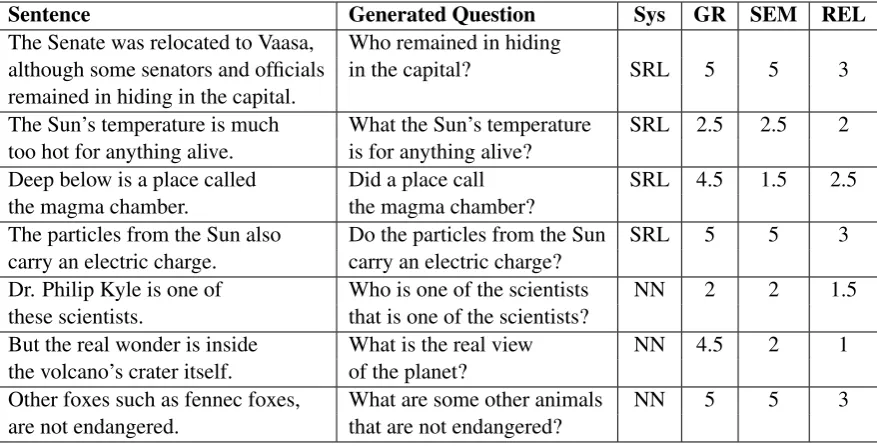
Sentence Generated Question Sys GR SEM REL The Senate was relocated to Vaasa, Who remained in hiding
although some senators and officials in the capital? SRL 5 5 3
remained in hiding in the capital.
The Sun’s temperature is much What the Sun’s temperature SRL 2.5 2.5 2
too hot for anything alive. is for anything alive?
Deep below is a place called Did a place call SRL 4.5 1.5 2.5
the magma chamber. the magma chamber?
The particles from the Sun also Do the particles from the Sun SRL 5 5 3
carry an electric charge. carry an electric charge?
Dr. Philip Kyle is one of Who is one of the scientists NN 2 2 1.5
these scientists. that is one of the scientists?
But the real wonder is inside What is the real view NN 4.5 2 1
the volcano’s crater itself. of the planet?
Other foxes such as fennec foxes, What are some other animals NN 5 5 3
[image:6.595.80.519.62.285.2]are not endangered. that are not endangered?
Table 2: Examples of sentences, generated questions and evaluation ratings (average of two raters).
of every predicate. If a sentence contains multi-ple predicates, even more questions are generated. The system generated 654 constituent questions.
The neural system generated one question for each of 169 sentences (and failed for two sen-tences). All questions generated by the system re-semble constituent questions because the SQuAD dataset does not contain yes/no questions. We investigated whether it was possible to generate more than one question per sentence by retrieving hypotheses from the beam search, but the hypothe-ses are not fully formed and are small variants of the best question for each sentence.
5.1 Annotation
In total 1,060 questions were automatically gen-erated for evaluation. The questions were anno-tated by two annotators with expertise in linguis-tic annotation of English Learning Arts materials and student-produced writing. Each question was rated on three scales: grammar, semantics and rel-evance.
The grammar scale is a five-point scale: 5) grammatically formed; 4) mostly well-formed, with slight problems; 3) has grammatical problems; 2) seriously disfluent; 1) severely man-gled. The five-pointsemantic scale was intended to check to what extent the question ‘understood’ the semantics of the original sentence: 5) seman-tically adequate; 4) mostly semanseman-tically adequate, with slight problems; 3) has semantic problems; 2) serious misunderstanding of the original
sen-tence; 1) severely mangled and makes no sense. Therelevancescale was designed to check to what extent the generated question is about information that was conveyed in the original sentence. This scale had just four levels: 3) is about the sentence; 2) goes beyond the information in the sentence; 1) veers away, is unrelated to the sentence; 0) too mangled to make a reasonable judgment.
The annotators completed a training session with 272 questions that were generated from a sep-arate set of texts.
Upon completion of training, the annotators re-ceived the 1060 questions of the main data set (with corresponding sentences, and access to orig-inal texts). Each annotator completed annotations individually. We measured inter-annotator agree-ment with Quadratically-weighted Kappa (QWK). Agreement was high: grammar = 0.75, semantics = 0.77, relevance = 0.488.
In our analysis we used the average ratings on each question for each of the categories. In addi-tion, for each question we also computed atotal
rating, which is the sum of grammar, semantics, and relevance ratings. Samples of sentences with corresponding generated questions and ratings are presented in Table2.
8The low agreement on relevance stemmed from the
6 Results
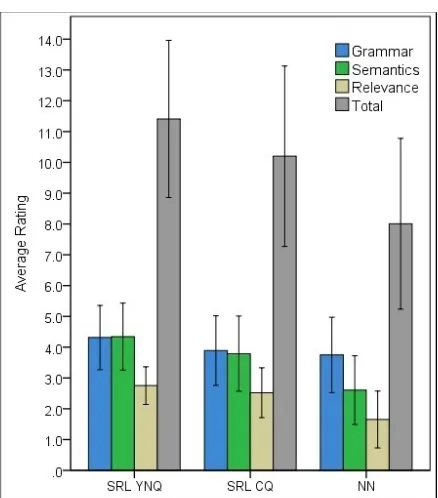
To estimate the quality of the various questions, we compared the average ratings for three groups of questions: yes/no and constituent questions from the based system (YNQ and SRL-CQ), and questions from the neural system (NN). We conducted ANOVA analyses for each of the three rating scales and for the total score (with Bonferrroni adjustment for pairwise contrasts). Results are presented in Table3and in Figure 1.
SRL-YNQ questions (n=236), are rated signif-icantly higher than SRL-CQ (n=654), which, in turn, are rated significantly higher than questions from the neural system (n=169). All comparisons are statistically significant (p < .001), except for
SRL-CQ vs. NN on grammar. In other words, the neural system-generated questions achieved a sim-ilar level of grammaticality judgment as the SRL system’s constituent questions.
Scale SRL-YNQ SRL-CQ NN
Grammar 4.32 3.89 3.75
Semantics 4.34 3.79 2.61
Relevance 2.75 2.52 1.65
[image:7.595.307.526.57.306.2]Total 11.41 10.20 8.01
Table 3: Average ratings for SRL system yes/no ques-tions (SRL-YNQ), constituent quesques-tions (SRL-CQ), and neural network questions (NN).Total is the sum of grammar, semantics, and relevance.
We also looked at the 163 sentences that have both a NN question and at least one SRL-CQ ques-tion. We picked the best scoring SRL-CQ question for each sentence (using total score values). The mean rating of the best SRL-CQ question per sen-tence is 12.2, while the mean rating of NN ques-tions is 8.1. The difference is statistically sig-nificant (t-test, p < .0001). Thus, if we had to
pick just one CQ question for each sentence, SRL-based questions are on average much better than NN-generated questions.
We also investigated to what extent the automat-ically generated questions might be potentially us-able in a learning context (e.g. for reading com-prehension assessment). We consider apotentially usefulquestion to be one that has reasonably good grammar (rating≥ 4), is semantically sensible in
context (rating≥4) and is relevant to the
informa-tion conveyed in the text (rating≥ 2). We
[image:7.595.73.278.342.412.2]opera-tionalize these criteria with two measures. First, we look at what proportion of questions have a
Figure 1: Average ratings and standard deviations for automatically generated questions, by system and ques-tion type. Note that score range is 1-5 for Grammar and Semantics, 0-3 for Relevance and 2-13 for Total.
total rating ≥ 10. Among the SRL-YNQ ques-tions, 81% are potentially useful, compared to 64% among SRL–CQ questions, and 29% among questions generated by the neural network. Our second, more stringent, measure is to require that a question meet the criteria above on each of the three scales, i.e. grammar≥4, semantics≥4, and relevance≥2. With this measure, the proportion of potentially useful questions is 71% for SRL-YNQ questions, 50% for SRL-CQ questions, and 15% for the neural network-generated questions.
7 Error analysis
We analyzed patterns of errors in SRL-based ques-tions that received ratings below 4 on grammar and semantics and below 2 on relevance.
Among the constituent questions generated by the SRL-based system, we randomly sampled 30 questions. The most common reason for errors (33%) was incorrect handling of longer and more complicated sentences, including incorrect han-dling of arguments in subordinate clauses. For ex-ample, for the sentence Red foxes have been in-troduced into Australia, which lacks similar car-nivores. . ., one of the generated questions was
What lacks?This question misses the subject,
Incorrect handling of subordinate clauses is also one of the common reasons for errors among the SRL-based yes/no questions. For example, for the sentenceIt’s a little like the sound waves bats and dolphins use to find objects in the air and water., the system generated Do bats and dolphins use to find objects
in the air and water?. The proper
question should have been: Do bats...use
sound waves...to find...?. The
nec-essary direct object, sound waves, is outside the reduced relative clause and was missed in question generation.
7.1 Analysis of NN system errors
The patterns of ratings for errorful questions from the neural system differed from the SRL sys-tem. One pattern, of high grammaticality but low semantic coherence and relevance (22.7%), was attributable to strange substitutions of words in the original sentence. For example, for the sentence Greater Helsinki has eight univer-sities and six technology parks, the generated
question was: How many universities
does greater Strasbourg have?
An-other common pattern was repetition of a word or phrase in the question. For
ex-ample: What type of birds do birds
usually live? Word repetition caused poor
ratings on all scales. Another notable pattern was high grammaticality but low semantic co-herence and relevance. This pattern is some-times characterized by word substitutions but more generally a lack of analysis of the origi-nal sentence. For example, for the sentence De-spite the tumultuous first half of the 20th century, Helsinki continued to develop steadily, the sys-tem generated:When did the first half of the 20th century occur?
We also analyzed a sample of sentences that were rated highly across all categories. Many of these sentences were simple declarative sen-tences. For the most part, the network reused words from the original sentence and created grammatical questions. In a few instances, the network gave hints of an ability to generalize lex-ical items. For example, for the sentence, In fact, as the inside walls of the igloo start to melt, they come into contact with..., the gener-ated question was: What do the walls of the igloo begin to do?
8 Discussion
The SRL-based system generates a relatively high percentage of questions that are potentially us-able as-is in an application, achieving good ratings for grammaticality, semantic coherence, and rele-vance. The SRL system was able to generate par-ticularly high quality yes/no questions, as demon-strated by the strong scores from the human raters. Another strength demonstrated by the SRL-based system was the ability to systematically generate multiple constituent questions by focusing on each argument of a predicate in a clause.
The average quality of yes/no questions gener-ated by the SRL system is significantly higher than the average quality of the generated constituent questions. The reason for this is mostly due to the fact that, while both types of questions are gener-ated based on the same SRL analysis, yes/no ques-tions require less complicated processing for gen-eration.
While the questions produced by the SRL sys-tem show a promising level of quality, one area where the system falters is in handling long and complicated sentences, particularly those that in-volve subordinated clauses.
Although we did not focus on augmenting the neural network system for this study, our results demonstrate that the basic neural architecture of LSTM and attention already shows a surprising ability to produce readable questions, as indicated by reasonably high average grammaticality rat-ings. At the same time, the neural system had dif-ficulty producing semantically adequate and rele-vant questions. These results point to the need for improved semantic analysis in neural AQG sys-tems.
9 Conclusions
applica-tions such as quiz generators or automated scoring of responses.
We presented a detailed evaluation of the sys-tem and compared it to a state-of-the-art neu-ral network architecture for question generation. The SRL-based system produced questions with greater variety and higher average quality than the neural system. In future work, we will explore methods for combining the strengths of rule-based and neural methods for text analysis and question generation.
Acknowledgments
Many thanks to our raters, Jennifer Wain and Jeremy Lee. The paper benefited much from the comments of three anonymous BEA reviewers and comments by Aoife Cahill, Ikkyu Choi, Beata Beigman Klebanov, and David Pautler.
References
Manish Agarwal and Prashanth Mannem. 2011. Auto-matic gap-fill question generation from text books. In Proceedings of the 6th Workshop on Innovative Use of NLP for Building Educational Applications, pages 56–64, Portland, OR, USA. Association for Computational Linguistics.
Husam Ali, Yllias Chali, and Sadid A. Hasan. 2010. Automation of question generation from sentences. InProceedings of QG2010: The Third Workshop on Question Generation, pages 58–67.
Jun Araki, Dheeraj Rajagopal, Sreecharan Sankara-narayanan, Susan Holm, Yukari Yamakawa, and Teruko Mitamura. 2016. Generating questions and multiple-choice answers using semantic analysis of texts. InProceedings of COLING 2016, the 26th In-ternational Conference on Computational Linguis-tics: Technical Papers, pages 1125?–1136. Associa-tion for ComputaAssocia-tional Linguistics.
Lee Becker, Sumit Basu, and Lucy Vanderwende. 2012. Mind the gap: Learning to choose gaps for question generation. In Proceedings of the 2012 Conference of the North American Chapter of the Association for Computational Linguistics: Human Language Technologies, pages 742–751, Montr´eal, Canada. Association for Computational Linguistics.
Yllias Chali and Sina Golestanirad. 2016. Rank-ing automatically generated questions usRank-ing com-mon human queries. In Proceedings of The 9th International Natural Language Generation confer-ence, pages 217–?231. Association for Computa-tional Linguistics.
Angel Chang and Christopher D. Manning. 2013. SU-Time: Evaluation in TempEval-3. InSecond Joint
Conference on Lexical and Computational Seman-tics (*SEM), Volume 2: Proceedings of the Sev-enth International Workshop on Semantic Evalua-tion (SemEval 2013), pages 78–82, Atlanta, Geor-gia, USA. Association for Computational Linguis-tics.
Ronan Collobert, Jason Weston, Leon Bottou, Michael Karlen, Koray Kavukcuoglu, and Pavel Kuksa. 2011. Natural language processing (almost) from scratch. The Journal of Machine Learning Re-search, 2011:2493–2537.
Guy Danon and Mark Last. 2017. A syntactic ap-proach to domain-specific automatic question gen-eration. InlinguisarXiv:1712.09827v1.
Xinya Du and Claire Cardie. 2017. Identifying where to focus in reading comprehension for neural ques-tion generaques-tion. In Proceedings of the 2017 Con-ference on Empirical Methods in Natural Language Processing, pages 2067–2073, Copenhagen, Den-mark. Association for Computational Linguistics. Xinya Du, Junru Shao, and Claire Cardie. 2017.
Learn-ing to ask: Neural question generation for readLearn-ing comprehension. In Proceedings of the 55th An-nual Meeting of the Association for Computational Linguistics (Volume 1: Long Papers), pages 1342– 1352, Vancouver, Canada. Association for Compu-tational Linguistics.
Chrisiane Fellbaum, editor. 1998. WorNet: an elec-tronic lexical database. The MIT Press, Cambridge, MA, USA.
Donna M. Gates. 2008. Generating look-back strategy questions from expository texts. InThe Workshop on the Question Generation Shared Task and Evalu-ation Challenge, Arlington, VA, USA.
Keith Godwin and Paul Piwek. 2016. Collecting reli-able human judgements on machine-generated lan-guage: The case of the qg-stec data. InProceedings of The 9th International Natural Language Gener-ation conference, pages 212?–216. Association for Computational Linguistics.
Michael Heilman and Noah A Smith. 2010a. Good question! Statistical ranking for question generation. In Proceedings of the 2010 Annual Conference of the North American Chapter of the Association for Computational Linguistics, pages 609–?617. Asso-ciation for Computational Linguistics.
Michael Heilman and Noah A Smith. 2010b. Rating computer-generated questions with mechanical turk. In In Proceedings of the NAACL HLT 2010 Work-shop on Creating Speech and Language Data with Amazon?s Mechanical Turk, pages 35?–40. Associ-ation for ComputAssoci-ational Linguistics.
Saidalavi Kalady, Ajeesh Elikkottil, and Rajarshi Das. 2010. Natural language question generation using syntax and keywords. InProceedings of QG2010: The Third Workshop on Question Generation, pages 1–10.
David Lindberg, Fred Popowich, John Nesbit, and Philip Winne. 2013. Generating natural language questions to support learning on-line. In Proceed-ings of the 14th European Workshop on Natural Lan-guage Generation, pages 105?–114. Association for Computational Linguistics.
Ming Liu, Rafael A. Calvo, and Vasile Rus. 2012. G-asks: an intelligent automatic question generation system for academic writing support. Dialogue and Discourse, 3(2):101–124.
Thang Luong, Hieu Pham, and Christopher D. Man-ning. 2015. Effective approaches to attention-based neural machine translation. InProceedings of the 2015 Conference on Empirical Methods in Natu-ral Language Processing, pages 1412–1421, Lis-bon, Portugal. Association for Computational Lin-guistics.
Prashanth Mannem, Rashmi Prasad, and Aravind Joshi. 2010. Question generation from paragraphs at UPenn: QGSTEC system description. In Proceed-ings of QG2010: The Third Workshop on Question Generation, pages 84–91.
Karen Mazidi and Rodney D Nielsen. 2014. Pedagog-ical Evaluation of AutomatPedagog-ically Generated Ques-tions. In Stefan Trausan-Maru, Kristy Elizabeth Boyer, Martha Crosby, and Kitty Panourgia, edi-tors, Proceededngs of the 12th international con-ference on Intelligent Tutoring Systems, pages 294– 299. Springer, Honolulu, HI, USA.
Karen Mazidi and Rodney D Nielsen. 2015. Lever-aging multiple views of text for automatic question generation. In TBD, editor,Artificial Intelligence in Education, LNCS, pages 0–0. Springer, TBD.
Karen Mazidi and Paul Tarau. 2016. Infusing nlu into automatic question generation. In Proceedings of The 9th International Natural Language Generation conference, pages 51?–60. Association for Compu-tational Linguistics.
Frank R. Palmer. 1987. The English Verb, 2nd edition. Longman, London, UK.
Martha Palmer, Daniel Gildea, and Paul Kingsbury. 2005. The proposition bank: An annotated cor-pus of semantic roles. Computational Linguistics, 31(1):71?106.
Jeffrey Pennington, Richard Socher, and Christo-pher D. Manning. 2014. Glove: Global Vectors for Word Representation. InEmpirical Methods in Nat-ural Language Processing (EMNLP), pages 1532– 1543.
Pranav Rajpurkar, Jian Zhang, Konstantin Lopyrev, and Percy Liang. 2016. Squad: 100,000+ questions for machine comprehension of text. InProceedings of the 2016 Conference on Empirical Methods in Natu-ral Language Processing, pages 2383–2392, Austin, Texas. Association for Computational Linguistics.
Hugo Rodrigues, Luisa Coheur, and Eric Nyberg. 2016. Qgasp: a framework for question generation based on different levels of linguistic information. In Pro-ceedings of The 9th International Natural Language Generation conference, pages 242?–243. Associa-tion for ComputaAssocia-tional Linguistics.
Vasile Rus1, Brendan Wyse, Paul Piwek, Mihai Lin-tean, Svetlana Stoyanchev, and Cristian Moldovan. 2010. Overview of The First Question Generation Shared Task Evaluation Challenge. InProceedings of QG2010: The Third Workshop on Question Gen-eration, pages 45–57.
Iulian Vlad Serban, Alberto Garcia-Duran, Caglar Gulcehre, Sungjin Ahn, Sarath Chandar, Aaron Courville, and Yoshua Bengio. 2016. Generat-ing factoid questionswith recurrent neural networks: The 30m factoid question-answer corpus. In Pro-ceedings of the 54th Annual Meeting of the Associa-tion for ComputaAssocia-tional Linguistics, pages 588?–598. Association for Computational Linguistics.
Jannik Strotgen and Michael Gertz. 2010. Heideltime: High quality rule-based extraction and normaliza-tion of temporal expressions. InProceedings of the 5th International Workshop on Semantic Evaluation, pages 321–324, Uppsala, Sweden. Association for Computational Linguistics.
Lucy Vanderwende. 2008. The importance of being important: Question generation. InWorkshop on the Question Generation, Shared Task and Evaluation Challenge, pages 1342?–1352.
Andrea Varga and Le An Ha. 2010. WLV: A ques-tion generaques-tion system for the QGSTEC 2010, task b. InProceedings of QG2010: The Third Workshop on Question Generation, pages 80–83.
Marc Verhagen, Roser Sauri, Tommaso Caselli, and James Pustejovsky. 2010. Semeval-2010 task 13: Tempeval-2. InProceedings of the 5th International Workshop on Semantic Evaluation, pages 57–62, Uppsala, Sweden. Association for Computational Linguistics.
John H. Wolfe. 1976. Automatic question genera-tion from text - an aid to independent study. ACM SIGCUE Outlook, 10:104–112.