This paper is made available online in accordance with
publisher policies. Please scroll down to view the document
itself. Please refer to the repository record for this item and our
policy information available from the repository home page for
further information.
To see the final version of this paper please visit the publisher’s website
.
Access to the published version may require a subscription.
Author(s): B Hill, WS Kendall and E Thonnes
Article Title: A Gradient Field Approach to Modelling Fibre-Generated
Spatial Point Processes
Year of publication: 2011
Link to published article:
http://www2.warwick.ac.uk/fac/sci/statistics/crism/research/2011/paper
11-18
A Gradient Field Approach to Modelling Fibre-Generated Spatial
Point Processes
(La mod´
elisation des processus ponctuels spatiaux g´
en´
er´
es par les
fibres: une m´
ethode de champ de gradient)
Hill, Bryony
University of Warwick, Department of Statistics Coventry CV4 7AL, UK
E-mail: [email protected]
Kendall, Wilfrid S.
University of Warwick, Department of Statistics Coventry CV4 7AL, UK
E-mail: [email protected]
Th¨onnes, Elke
University of Warwick, Department of Statistics Coventry CV4 7AL, UK
E-mail: [email protected]
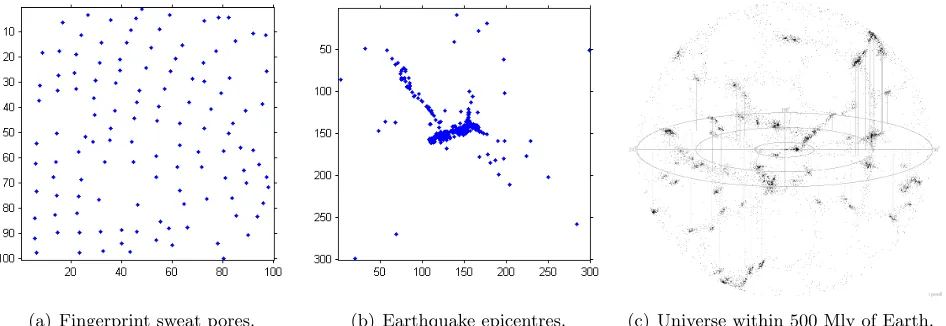
(a) Fingerprint sweat pores. (b) Earthquake epicentres. (c) Universe within 500 Mly of Earth.
Figure 1: (a) Fingerprint data extracted from a portion of fingerprint a002-5 from NIST Special Database 30 (Watson, 2001). (b) Earthquake data: epicentres in New Madrid region, taken from CERI (Center for Earthquake Research and Information). (c) Universe image: Richard Powell
(atlasoftheuniverse.com/nearsc.html: Creative Commons Attribution-ShareAlike 2.5 License).
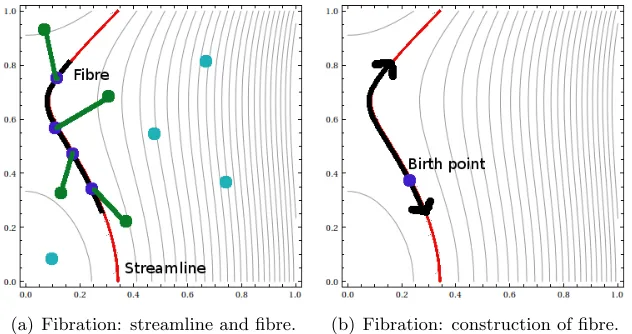
[image:2.612.76.549.381.544.2]paper which introduced non-standard clustering ideas related to Diffusion Tensor Imaging (Suet al, 2008; Su, 2009). The work described briefly here is being written up for the PhD thesis of the first author (Hill, 2011), and will also be expounded in detail and at greater length in a forthcoming paper. Here we report on work which uses the clustering approach of Su et al (2008) and Su (2009) to build an Empirical Bayes approach to the inferential problem. In the first place we suppose that the 2-d or 3-d window of observation is decomposed into a (random) fibration (a disjoint union of a whole continuum family of one-dimensional smooth curves – think of streamlines in a fluid). As illustrated in Figure 2, a finite random collection of continuous segments of these curves or streamlines is used to model the unobserved fibres generating the latent curvilinear structure of the observed point pattern. For each of the fibres, a random choice is made of a sequence ofmark points along the fibre; the observed point set is formed by the union of random perturbations of these mark points (these perturbations forming the set of signal points) together with a further random scattering of points unattached to fibres (the set ofnoise points).
(a) Fibration: streamline and fibre. (b) Fibration: construction of fibre.
Figure 2: (a) Filtration with specified streamline and fibre. Mark points are indicated along the fibre and used to generate perturbed signal points. Other noise points are scattered over the entire window. (b) Construction of fibre using birth point together with random lengths in both directions of the fibre.
Some care is required if we are to make good mathematical and statistical sense of this con-struction. Given the random fibration by curves (“streamlines”), one might model the set of fibres by a random selection of a finite number of connected fragments obtained by breaking each of the streamlines into pieces using independent Poisson point processes along the streamlines. However that would entail the mathematically precarious construction of an uncountable number of independent Poisson point processes (one for each streamline); a hazardous probabilistic activity needing extreme measure-theoretic care. So we suppose instead that the fragments are formed by picking a finite number of “birth points” from the observation window; and, for each such birth point, proceeding in either direction of the fibre by random lengths so as to generate a fibre as a connected fragment of the streamline. (We make no attempt to control biases that might be introduced by this procedure – indeed, it would require a careful treatment to make consideration even of what “bias” might mean in this context; we plan to return to this matter at a later date.) The advantage of the “birth point” construction is that it is easily represented as the equilibrium state of a reversible Markov chain Monte Carlo algorithm, in which fibres die at random, and are born according to the construction above.
[image:3.612.153.469.273.440.2]are modelled by an independent spatial Poisson point process.
Conditional on the fibration, and extending our remark concerning the construction of the fibres, the entire construction may be represented as the equilibrium state of a reversible Markov chain Monte Carlo algorithm. Moreover this construction may be augmented to allow Gibbs’ updates of various parameters, to introduce latent variables expressing the probabilities of specified observed points being signal or noise, and to improve mixing by allowing movement and splitting and joining of fibres (implemented by manipulating the fibre birth points and upstream/downstream lengths). Finally, it is possible to run the algorithm without allowing the observed point locations to alter, thus simulating the conditional distribution of fibres and other parameters. However this conditional distribution is in fact conditional on the fibration as well as on the observed point locations, and we need to deal with this extra conditioning in order to produce a useful inferential procedure.
In principle one might address this issue by positing a prior distribution on the space of all fibrations. However this forms a challenging prospect, especially as one would also need to produce a reversible Markov chain Monte Carlo algorithm which possessed this distribution as a stationary state and exhibited good mixing under conditioning. Therefore we resort to an empirical Bayes procedure; we estimate the fibration based on the pattern of observed points. We do this in the manner described by Su et al (2008) and Su (2009), by creating a local orientation at each observed point x. This is done as follows. Let (r, θ) be the location of an observed point in polar coordinates usingx as origin. Map (r, θ) to points (±exp(−r2/σ2), θ) (for a given scale parameterσ); calculate the (2×2) inertia tensor for the set of transformed observed points, weighted by the corresponding probabilities for those points to be signal rather than noise, and use the tensor’s principal eigenvector to generate the orientation of the fibration at that point. The orientation field of the fibration can then be viewed as a gradient field, and integrated to produce the fibration.
Two points should be noted here. Firstly, we smooth the resulting tensor field and interpolate it over the entire observation window by using tensor means with local weighting factors (a statistically motivated introduction to tensor means can be found in Drydenet al, 2009). Secondly, computation of the tensor mean additionally weights each observed point according to the probability of it being signal rather than noise; thus computation of both the tensor means and the inertial tensors themselves will change every time these probabilities change. It follows that the fibration itself changes when changes occur in the observed point probabilities of noise versus signal. This mitigates to some extent against the circular nature of the empirical Bayesian treatment of the prior for the fibration.
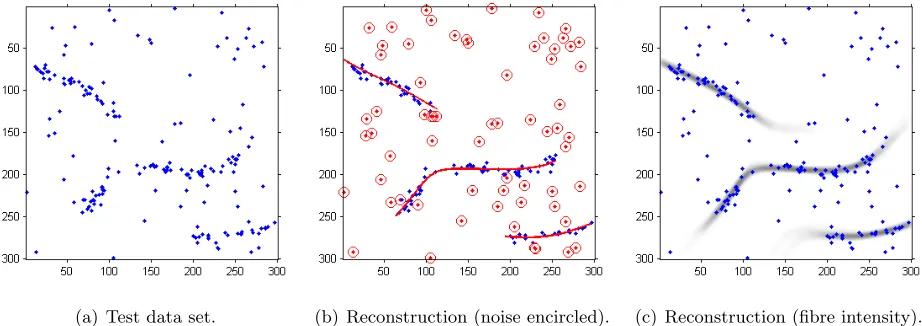
[image:4.612.79.540.545.708.2](a) Test data set. (b) Reconstruction (noise encircled). (c) Reconstruction (fibre intensity).
Figure 3: Illustration of results obtained for a test data set.
(Figure 3). Image (a) illustrates the unprocessed dataset; image (b) presents a typical reconstruc-tion, in which points classified as noise are circled, and modelled fibres are included; while image (c) indicates the empirical intensity of the random set composed of the modelled fibres, averaged over a long Markov chain Monte Carlo sequence. A major advantage of our approach is that we can derive statistical summaries including highest posterior probability density intervals for measures of interest (number of fibres, total length of fibres, . . . ). Figure 3(c) illustrates this graphically by indicating the length intensity for fibre estimates. Details of reconstructions of real datasets, including statistical summaries, will be found in our forthcoming paper.
REFERENCES
Dryden IL, Koloydenko A, Zhou D (2009), “Non-Euclidean statistics for covariance matrices, with applications to diffusion tensor imaging”. Annals of Applied Statistics;3(3):1102–1123.
Hastie T, Stuetzle W (1989), “Principal curves”. Journal of the American Statistical Association;84(406):502– 516.
Stanford DC, Raftery AE (2000), “Finding curvilinear features in spatial point patterns: principal curve clus-tering with noise”. IEEE Transactions on Pattern Analysis and Machine Intelligence;22(6):601–609.
Stoica RS, Mart´ınez VJ, Saar E (2007), “A three-dimensional object point process for detection of cosmic filaments”. Journal of the Royal Statistical Society: Series C (Applied Statistics);56(4):459–477.
Su J (2009),A Tensor Approach to Fingerprint Analysis, PhD Thesis, University of Warwick.
Su J, Hill B, Kendall WS, Th¨onnes E (2008), “Inference for point processes with unobserved, one-dimensional reference structure”. University of Warwick Department of StatisticsCRiSM Working Paper No.8–10.
Watson, C (2001), NIST Special Database 30: Dual Resolution Images from Paired Fingerprint Cards. National Institute of Standards and Technology, Gaithersburg, Md, USA. 2001.
R ´ESUM ´E
On introduit un nouveau mod`ele bruit´e non param´etrique pour les processus ponctuels, qui se rassemblent autour des courbes ou des fibres. Le mod`ele identifie les courbes al´eatoires comme ´etant les lignes int´egrales d’un champ de gradient. En principe, ceci permet l’inclusion de toute courbe qui ne s’intersecte pas, avec seule une contrainte de continuit´e sous-jacente. On m´elange une m´ethode de Monte-Carlo avec une proc´edure empirique de Bayes, afin de fournir une proc´edure pratique d’estimation des propri´et´es de la distribution sous-jacente des fibres, proc´edure bas´ee sur les motifs observ´es dans les donn´ees ponctuelles. On fait des comparaisons avec les diff´erentes techniques de la litt´erature. Finalement, on illustre la mthodologie par des applications aux empreintes digitales, aux tremblements de terre et aux galaxies.
ABSTRACT