Grounded Semantic Role Labeling
Shaohua Yang1,Qiaozi Gao1,Changsong Liu1,Caiming Xiong2, Song-Chun Zhu3, andJoyce Y. Chai1
1Department of Computer Science and Engineering, Michigan State University, East Lansing, MI 48824 2Metamind, Palo Alto, CA 94301
3Center for Vision, Cognition, Learning, and Autonomy, University of California, Los Angeles, CA 90095
{yangshao,gaoqiaoz,cliu,jchai}@cse.msu.edu [email protected], [email protected]
Abstract
Semantic Role Labeling (SRL) captures se-mantic roles (or participants) such asagent, patient, andthemeassociated with verbs from the text. While it provides important in-termediate semantic representations for many traditional NLP tasks (such as information ex-traction and question answering), it does not capture grounded semantics so that an arti-ficial agent can reason, learn, and perform the actions with respect to the physical envi-ronment. To address this problem, this pa-per extends traditional SRL to grounded SRL where arguments of verbs are grounded to participants of actions in the physical world. By integrating language and vision process-ing through joint inference, our approach not only grounds explicit roles, but also grounds implicit roles that are not explicitly mentioned in language descriptions. This paper describes our empirical results and discusses challenges and future directions.
1 Introduction
Linguistic studies capture semantics of verbs by their frames of thematic roles (also referred to as semantic roles or verb arguments) (Levin, 1993). For example, a verb can be characterized byagent
(i.e., the animator of the action) and patient
(i.e., the object on which the action is acted upon), and other roles such as instrument, source,
destination, etc. Given a verb frame, the goal of Semantic Role Labeling (SRL) is to identify lin-guistic entities from the text that serve different the-matic roles (Palmer et al., 2005; Gildea and Jurafsky,
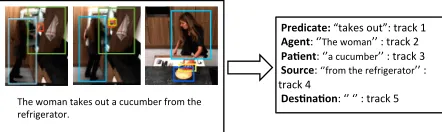
The woman takes out a cucumber from the refrigerator.
Predicate: “takes out”: track 1
Agent: ‘’The woman’’ : track 2
Pa.ent: ‘’a cucumber’’ : track 3
Source: ‘’from the refrigerator’’ : track 4
[image:1.612.316.537.242.308.2]Des.na.on: ‘’ ‘’ : track 5
Figure 1: An example of grounded semantic role labeling for the sentencethe woman takes out a cucumber from the refrig-erator. The left hand side shows three frames of a video clip with the corresponding language description. The objects in the bounding boxes are tracked and each track has a unique identi-fier. The right hand side shows the grounding results where each role including the implicit role (destination) is grounded to a track id.
2002; Collobert et al., 2011; Zhou and Xu, 2015). For example, given the sentence the woman takes
out a cucumber from the refrigerator., takes out is
the main verb (also calledpredicate); the noun phrasethe womanis theagentof this action;a
cu-cumberis thepatient; andthe refrigeratoris the
source.
SRL captures important semantic representations for actions associated with verbs, which have shown beneficial for a variety of applications such as infor-mation extraction (Emanuele et al., 2013) and ques-tion answering (Shen and Lapata, 2007). However, the traditional SRL is not targeted to represent verb semantics that are grounded to the physical world so that artificial agents can truly understand the on-going activities and (learn to) perform the specified actions. To address this issue, we propose a new task on grounded semantic role labeling.
Figure 1 shows an example of grounded SRL.
The sentence the woman takes out a cucumber
from the refrigerator describes an activity in a
visual scene. The semantic role representation from linguistic processing (including implicit roles such asdestination) is first extracted and then grounded to tracks of visual entities as shown in the video. For example, the verb phrase take out
is grounded to a trajectory of the right hand. The roleagentis grounded to the person who actually does the take-out action in the visual scene (track 1) ; the patient is grounded to the cucumber taken out (track 3); and the source is grounded to the refrigerator (track 4). The implicit role of
destination(which is not explicitly mentioned in the language description) is grounded to the cut-ting board (track 5).
To tackle this problem, we have developed an ap-proach to jointly process language and vision by in-corporating semantic role information. In particular, we use a benchmark dataset (TACoS) which con-sists of parallel video and language descriptions in a complex cooking domain (Regneri et al., 2013) in our investigation. We have further annotated sev-eral layers of information for developing and eval-uating grounded semantic role labeling algorithms. Compared to previous works on language ground-ing (Tellex et al., 2011; Yu and Siskind, 2013; Krish-namurthy and Kollar, 2013), our work presents sev-eral contributions. First, beyond arguments explic-itly mentioned in language descriptions, our work simultaneously grounds explicit and implicit roles with an attempt to better connect verb semantics with actions from the underlying physical world. By incorporating semantic role information, our ap-proach has led to better grounding performance. Second, most previous works only focused on a small number of verbs with limited activities. We base our investigation on a wider range of verbs and in a much more complex domain where object recognition and tracking are notably more difficult. Third, our work results in additional layers of anno-tation to part of the TACoS dataset. This annoanno-tation captures the structure of actions informed by seman-tic roles from the video. The annotated data is avail-able for download1. It will provide a benchmark for
future work on grounded SRL.
1http://lair.cse.msu.edu/gsrl.html
2 Related Work
Recent years have witnessed an increasing amount of work in integrating language and vision, from earlier image annotation (Ramanathan et al., 2013; Kazemzadeh et al., 2014) to recent image/video caption generation (Kuznetsova et al., 2013; Venu-gopalan et al., 2015; Ortiz et al., ; Elliott and de Vries, 2015; Devlin et al., 2015), video sentence alignment (Naim et al., 2015; Malmaud et al., 2015), scene generation (Chang et al., 2015), and multi-model embedding incorporating language and vi-sion (Bruni et al., 2014; Lazaridou et al., 2015).
What is more relevant to our work here is re-cent progress on grounded language understanding, which involves learning meanings of words through connections to machine perception (Roy, 2005) and grounding language expressions to the shared vi-sual world, for example, to vivi-sual objects (Liu et al., 2012; Liu and Chai, 2015), to physical land-marks (Tellex et al., 2011; Tellex et al., 2014), and to perceived actions or activities (Tellex et al., 2014; Artzi and Zettlemoyer, 2013).
learn-ing has been applied to ground phrases to image re-gions (Karpathy and Fei-Fei, 2015).
3 Method
We first describe our problem formulation and then provide details on the learning and inference algo-rithms.
3.1 Problem Formulation
Given a sentenceSand its corresponding video clip V, our goal is to ground explicit/implicit roles as-sociated with a verb in S to video tracks in V. In this paper, we focus on the following set of semantic
roles: {predicate, patient, location,
source, destination, tool}. In the cook-ing domain, as actions always involve hands, the
predicate is grounded to the hand pose repre-sented by a trajectory of relevant hand(s). Normally
agentwould be grounded to the person who does the action. As there is only one person in the scene, we thus ignore the grounding of theagentin this work.
Video tracks capture tracks of objects (including hands) and locations. For example, in Figure 1, there are 5 tracks: human, hand, cucumber, refrigerator and cutting board. Regarding the representation of locations, instead of discretization of a whole image to many small regions(large search space), we cre-ate locations corresponding to five spatial relations (center, up, down, left, right) with respect to each object track, which means we have 5 times number of locations compared with number of objects. For instance, in Figure 1, the source is grounded to
s2 s1 s6 s3 s4 s5
φ5
[image:3.612.74.300.538.663.2]The person
[Agent] Takes out [Predicate] The drawer [Source] From
[Source] A cuAng board [PaCent] [DesCnaCon]
φ4
φ3
φ6
φ1
φ2
v2
v1
v6
v3 v4
v5
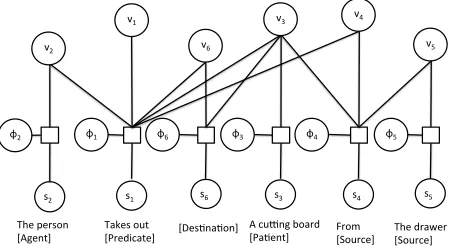
Figure 2:The CRF structure of sentence “the person takes out a cutting board from the drawer”. The text in the square bracket indicates the corresponding semantic role.
the center of the bounding boxes of the refrigerator track; and the destination is grounded to the center of the cutting board track.
We use Conditional Random Field(CRF) to model this problem. An example CRF factor graph is shown in Figure 2. The CRF structure is cre-ated based on information extracted from language. More Specifically, s1, ..., s6 refers to the observed
text and its semantic role. Notice thats6 is an
im-plicit role as there is no text from the sentence de-scribingdestination. Also note that the whole prepositional phrase “from the drawer” is identified as thesourcerather than “the drawer” alone. This is because the prepositions play an important role in specifying location information. For example, “near the cutting boarding” is describing a location that is near to, but not exactly at the location of the cutting board. Here v1, ..., v6 are grounding random
vari-ables which take values from object tracks and lo-cations in the video clip, and φ1, ..., φ6 are binary
random variables which take values {0,1}. When φi equals to 1, it means vi is the correct
ground-ing of correspondground-ing lground-inguistic semantic role, oth-erwise it is not. The introduction of random vari-ablesφifollows previous work from Tellex and
col-leagues (Tellex et al., 2011), which makes CRF learning more tractable.
3.2 Learning and Inference
In the CRF model, we do not directly model the ob-jective function as:
p(v1, ..., vk|S, V)
whereS refers to the sentence,V refers to the cor-responding video clip and vi refers to the
ground-ing variable. Because the gradient based learnground-ing method needs the expectation of v1, ..., vk, which
is infeasible, we instead use the following objective function:
P(φ|s1, s2, . . . , sk, v1, v2, . . . , vk, V)
whereφ is a binary random vector [φ1, ..., φk],
Gradient ascent with L2 regularization was used for parameter learning to maximize the objective function:
∂L
∂w=PiF(φi, si, vi, V)−PiEP(φi|si,vi,V)F(φi, si, vi, V)
whereF refers to the feature function. During the training, we also use random grounding as negative samples for discriminative training.
During inference, the search space can be very large when the number of objects in the world in-creases. To address this problem we apply beam search to first ground roles including patient,
tool, and then other roles including location,
source,destinationandpredicate.
4 Evaluation
4.1 Dataset
We conducted our investigation based on a sub-set of the TACoS corpus (Regneri et al., 2013). This dataset contains a set of video clips paired with natural language descriptions related to sev-eral cooking tasks. The natural language descrip-tions were collected through crowd-sourcing on top of the “MPII Cooking Composite Activities” video corpus (Rohrbach et al., 2012). In this paper, we
Table 1: Statistics for a set of verbs and their semantic roles in our annotated dataset. The entry indicates the number of ex-plicit/implicit roles for each category. “–” denotes no such role is observed in the data.1
Verb Patient Source Destn Location Tool take 251 / 0 102 / 149 2 / 248 – –
put 94 / 0 – 75 / 19 – –
get 247 / 0 62 / 190 0 / 239 – – cut 134 / 1 64 / 64 – 3 / 131 5 / 130
open 23 / 0 – – 0 / 23 2 / 21
wash 93 / 0 – – 26 / 58 2 / 82
slice 69 / 1 – – 2 / 68 2 / 66 rinse 76 / 0 0 / 74 – 8 / 64 – place 104 / 1 – 105 / 7 – –
peel 29 / 0 – – 1 / 27 2 / 27
remove 40 / 0 34 / 6 – – –
1For some verbs (e.g.,get), there is a slight discrepancy
be-tween the sum of implicit/explicit roles across different
cate-selected two tasks “cutting cucumber” and “cutting bread” as our experimental data. Each task has 5 videos showing how different people perform the same task. Each video is segmented to a sequence of video clips where each video clip comes with one or more language descriptions. The original TACoS dataset does not contain annotation for grounded se-mantic roles.
To support our investigation and evaluation, we had made a significant effort adding the follow-ing annotations. For each video clip, we anno-tated the objects’ bounding boxes, their tracks, and their labels (cucumber, cutting board, etc.) using VATIC (Vondrick et al., 2013). On average, each video clip is annotated with 15 tracks of objects. For each sentence, we annotated the ground truth pars-ing structure and the semantic frame for each verb. The ground truth parsing structure is the represen-tation of dependency parsing results. The seman-tic frame of a verb includes slots, fillers, and their groundings. For each semantic role (including both explicit roles and implicit roles) of a given verb, we also annotated the ground truth grounding in terms of the object tracks and locations. In total, our anno-tated dataset includes 976 pairs of video clips and corresponding sentences, 1094 verbs occurrences, and 3593 groundings of semantic roles. To check an-notation agreement, 10% of the data was annotated by two annotators. The kappa statistics is 0.83 (Co-hen and others, 1960).
From this dataset, we selected 11 most frequent verbs (i.e., get, take, wash, cut, rinse, slice, place,
peel, put, remove, open) in our current investigation
for the following reasons. First, they are used more frequently so that we can have sufficient samples of each verb to learn the model. Second, they cover dif-ferent types of actions: some are more related to the change of the state such astake, and some are more related to the process such aswash. As it turns out, these verbs also have different semantic role patterns as shown in Table 1. Thepatientroles of all these verbs are explicitly specified. This is not surprising as all these verbs are transitive verbs. There is a large variation for other roles. For example, for the verb
guistic expressions (i.e., only 2 instances), however it can be inferred from the video. For the verbcut, thelocationand thetoolare also rarely spec-ified by linguistic expressions. Nevertheless, these implicit roles contribute to the overall understanding of actions and should also be grounded too.
4.2 Automated Processing
To build the structure of the CRF as shown in Fig-ure 2 and extract featFig-ures for learning and inference, we have applied the following approaches to process language and vision.
Language Processing. Language processing
con-sists of three steps to build a structure containing syntactic and semantic information. First, the Stan-ford Parser (Manning et al., 2014) is applied to cre-ate a dependency parsing tree for each sentence. Second, Senna (Collobert et al., 2011) is applied to identify semantic role labels for the key verb in the sentence. The linguistic entities with seman-tic roles are matched against the dependency nodes in the tree and the corresponding semantic role la-bels are added to the tree. Third, for each verb, the Propbank (Palmer et al., 2005) entries are searched to extract all relevant semantic roles. The implicit roles (i.e., not specified linguistically) are added as direct children of verb nodes in the tree. Through these three steps, the resulting tree from language processing has both explicit and implicit semantic roles. These trees are further transformed to the CRF structures based on a set of rules.
Vision Processing.A set of visual detectors are first
trained for each type of objects. Here a random forest classifier is adopted. More specifically, we use 100 trees with HoG features (Dalal and Triggs, 2005) and color descriptors (Van De Weijer and Schmid, 2006). Both HoG and Color descriptors are used, because some objects are more structural, such as knives, human; some are more textured such as towels. With the learned object detectors, given a candidate video clip, we run the detectors at each 10th frame (less than 0.5 second), and find the can-didate windows for which the detector score corre-sponding to the object is larger than a threshold (set as 0.5). Then using the detected window as a starting point, we adopt tracking-by-detection (Danelljan et al., 2014) to go forward and backward to track this
object and obtain the candidate track with this object label.
Feature Extraction.Features in the CRF model can
be divided into the following three categories:
1. Linguistic features include word occurrence
and semantic role information. They are ex-tracted by language processing.
2. Track label features are the label information
for tracks in the video. The labels come from human annotation or automated visual process-ing dependprocess-ing on different experimental set-tings (described in Section 4.3).
3. Visual featuresare a set of features involving
geometric relations between tracks in the video. One important feature is the histogram compar-ison score. It measures the similarity between distance histograms. Specifically, histograms of distance values between the tracks of the
predicateand other roles for each verb are first extracted from the training video clips. For an incoming distance histogram, we calculate its Chi-Square distances (Zhang et al., 2007) from the pre-extracted training histograms with the same verb and the same role. its histogram comparison score is set to be the average of top 5 smallest Chi-Square distances. Other vi-sual features include geometric information for single tracks and geometric relations between two tracks. For example, size, average speed, and moving direction are extracted for a single track. Average distance, size-ratio, and rela-tive direction are extracted between two tracks. For features that are continuous, we discretized them into uniform bins.
To train the model, we randomly selected 75% of annotated 976 pairs of video clips and corresponding sentences as training set. The remaining 25% were used as the testing set.
4.3 Experimental Setup
Comparison. To evaluate the performance of our
approach, we compare it with two approaches.
• Baseline: To identify the grounding for each
semantic role, the first baseline chooses the most possible track based on the object type conditional distribution given the verb and se-mantic role. If an object type corresponds to multiple tracks in the video, e.g., multiple drawers or knives, we then randomly select one of the tracks as grounding. We ran this baseline method five times and reported the average per-formance.
• Tellex (2011): The second approach we
com-pared with is based on an implementa-tion (Tellex et al., 2011). The difference is that they don’t explicitly model fine-grained se-mantic role information. For a better compar-ison, we map the grounding results from this approach to different explicit semantic roles ac-cording to the SRL annotation of the sentence. Note that this approach is not able to ground implicit roles.
More specifically, we compare these two approaches with two variations of our system:
• GSRLwo V: The CRF model using linguistic features and track label features (described in Section 4.2).
• GSRL: The full CRF model using linguistic features, track label features, and visual fea-tures(described in Section 4.2).
Configurations.Both automated language
process-ing and vision processprocess-ing are error-prone. To fur-ther understand the limitations of grounded SRL, we compare performance under different configurations along the two dimensions: (1) the CRF structure is built upon annotated ground-truth language parsing
versus automated language parsing; (2) object track-ing and labeltrack-ing is based on annotation versus auto-mated processing. These lead to four different ex-perimental configurations.
Evaluation Metrics.For experiments that are based
on annotated object tracks, we can simply use the traditionalaccuracythat directly measures the per-centage of grounded tracks that are correct. How-ever, for experiments using automated tracking, evaluation can be difficult as tracking itself poses significant challenges. The grounding results (to tracks) cannot be directly compared with the an-notated ground-truth tracks. To address this prob-lem, we have defined a new metric called
approxi-mate accuracy. This metric is motivated by previous
computer vision work that evaluates tracking per-formance (Bashir and Porikli, 2006). Suppose the ground truth grounding for a role is trackgtand the predicted grounding is trackpt. The two tracks gt andpt are often not the same (although may have some overlaps). Suppose the number of frames in the video clip isk. For each frame, we calculate the distance between the centroids of these two tracks. If their distance is below a predefined threshold, we consider the two tracks overlap in this frame. We consider the grounding is correct if the ratio of the overlapping frames betweengtandptexceeds 50%. As can be seen, this is a lenient and an approximate measure of accuracy.
4.4 Results
Table 2:Evaluation results based on annotated language parsing.
Accuracy On the Gold Recognition/Tracking Setting
Methods Predicate Patient Source Destination Location Tool ExplicitAll ImplicitAll All
explicit implicit explicit implicit explicit implicit explicit implicit explicit implicit
Baseline 0.856 0.372 NA 0.225 0.314 0.311 0.569 NA 0.910 NA 0.853 0.556 0.620 0.583
Tellex(2011) 0.865 0.745 – 0.306 – 0.763 – NA – NA – 0.722 – –
GSRLwo V 0.854 0.794∗+ NA 0.375∗ 0.392∗+ 0.658∗ 0.615∗+ NA 0.920+ NA 0.793+ 0.768∗+ 0.648∗+ 0.717∗
GSRL 0.878∗
+ 0.839∗+ NA 0.556∗+ 0.684∗+ 0.789∗ 0.641+∗ NA 0.930+ NA 0.897∗+ 0.825∗+ 0.768∗+ 0.8∗
Approximated Accuracy On the Automated Recognition/Tracking Setting
Methods Predicate Patient Source Destination Location Tool ExplicitAll ImplicitAll All
explicit implicit explicit implicit explicit implicit explicit implicit explicit implicit
Baseline 0.529 0.206 NA 0.169 0.119 0.236 0.566 NA 0.476 NA 0.6 0.352 0.393 0.369
Tellex(2011) 0.607 0.233 – 0.154 – 0.333 – NA – NA – 0.359 – –
GSRLwo V 0.582∗ 0.244∗ NA 0.262∗+ 0.126+ 0.485∗+ 0.613∗+ NA 0.467+ NA 0.714∗+ 0.410∗+ 0.425∗+ 0.417∗
GSRL 0.548 0.263∗ NA 0.262∗
+ 0.086+ 0.394∗ 0.514+ NA 0.456+ NA 0.688∗+ 0.399∗+ 0.381+ 0.391∗
Upper Bound 0.920 0.309 NA 0.277 0.252 0.636 0.829 NA 0.511 NA 0.818 0.577 0.573 0.575
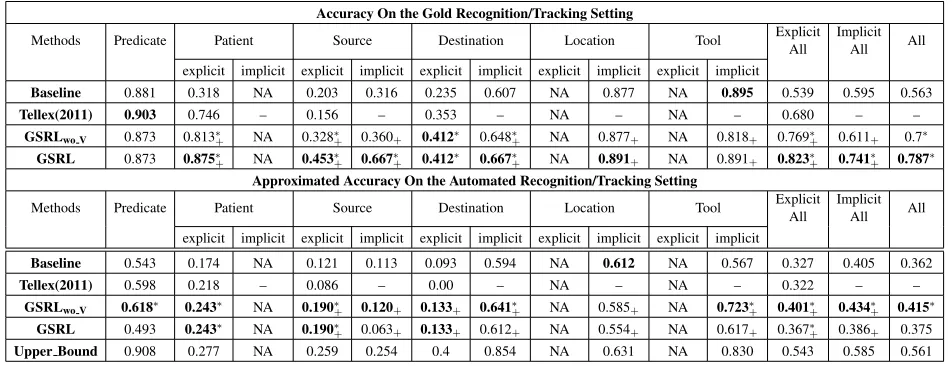
Table 3:Evaluation results based on automated language parsing.
Accuracy On the Gold Recognition/Tracking Setting
Methods Predicate Patient Source Destination Location Tool ExplicitAll ImplicitAll All
explicit implicit explicit implicit explicit implicit explicit implicit explicit implicit
Baseline 0.881 0.318 NA 0.203 0.316 0.235 0.607 NA 0.877 NA 0.895 0.539 0.595 0.563
Tellex(2011) 0.903 0.746 – 0.156 – 0.353 – NA – NA – 0.680 – –
GSRLwo V 0.873 0.813∗+ NA 0.328∗+ 0.360+ 0.412∗ 0.648∗+ NA 0.877+ NA 0.818+ 0.769∗+ 0.611+ 0.7∗
GSRL 0.873 0.875∗
+ NA 0.453∗+ 0.667∗+ 0.412∗ 0.667∗+ NA 0.891+ NA 0.891+ 0.823∗+ 0.741∗+ 0.787∗
Approximated Accuracy On the Automated Recognition/Tracking Setting
Methods Predicate Patient Source Destination Location Tool ExplicitAll ImplicitAll All
explicit implicit explicit implicit explicit implicit explicit implicit explicit implicit
Baseline 0.543 0.174 NA 0.121 0.113 0.093 0.594 NA 0.612 NA 0.567 0.327 0.405 0.362
Tellex(2011) 0.598 0.218 – 0.086 – 0.00 – NA – NA – 0.322 – –
GSRLwo V 0.618∗ 0.243∗ NA 0.190∗+ 0.120+ 0.133+ 0.641∗+ NA 0.585+ NA 0.723∗+ 0.401∗+ 0.434∗+ 0.415∗
GSRL 0.493 0.243∗ NA 0.190∗
+ 0.063+ 0.133+ 0.612+ NA 0.554+ NA 0.617+ 0.367∗+ 0.386+ 0.375
Upper Bound 0.908 0.277 NA 0.259 0.254 0.4 0.854 NA 0.631 NA 0.830 0.543 0.585 0.561
it is statistically significant (p <0.05) compared to the approach (Tellex et al., 2011).
For experiments based on automated object track-ing, we also calculated anupper boundto assess the best possible performance which can be achieved by a perfect grounding algorithm given the current vision processing results. This upper boundis cal-culated based on grounding each role to the track which is closest to the ground-truth annotated track. For the experiments based on annotated tracking,
the upper bound would be 100%. This measure
provides some understandings about how good the grounding approach is given the limitation of vi-sion processing. Notice that the grounding results in
the gold/automatic language processing setting are not directly comparable as the automatic SRL can misidentify frame elements.
4.5 Discussion
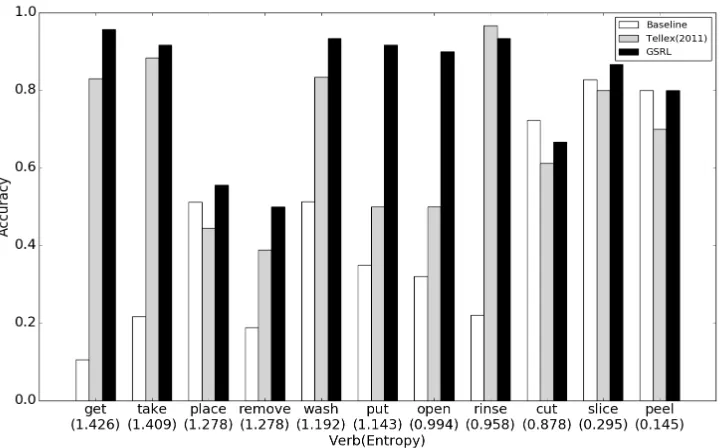
Figure 3:The relation between the accuracy and the entropy of each verb’s patient from the gold language, gold visual recogni-tion/tracking setting. The entropy for the patient role of each verb is shown below the verb.
object recognition/tracking. So the GSRL model was trained with gold recognition/tracking data and tested with automated recognition/tracking data.
By comparing our method with Tellex (2011), we can see that by incorporating fine grained seman-tic role information, our approach achieves better performance on almost all the explicit role (except for thepatientrole under the automated tracking condition).
The results have also shown that some roles are easier to ground than others in this domain. For example, the predicate role is grounded to the hand tracks (either left hand or right hand), there are not many variations such that the simple base-line can achieve pretty high performance, especially when annotated tracking is used. The same situation happens to the locationrole as most of the lo-cations happen near thesinkwhen the verb iswash, and near the cutting board for verbs like cut, etc. However, for the patient role, there is a large difference between our approach and baseline ap-proaches as there is a larger variation of different types of objects that can participate in the role for a given verb.
For experiments with automated tracking, the
up-per bound for each role also varies. Some roles
(e.g., patient) have a pretty low upper bound.
The accuracy from our full GSRL model is already quite close to the upper bound. For other roles such aspredicateanddestination, there is a larger gap between the current performance and the upper bound. This difference reflects the model’s capability in grounding different roles.
Figure 3 shows a close-up look at the grounding performance to thepatientrole for each verb un-der the gold parsing and gold tracking configuration. The reason we only show the results ofpatient
more uncertain situations. For the verb cut, The GSRL model performs slightly worse than the base-line. One explanation is that the possible objects that can participate as a patient forcutare relatively con-strained where simple features might be sufficient. A large number of features may introduce noise, and thus jeopardizing the performance.
We further compare the performance of our full GRSL model with Tellex (2011) (also shown in Fig-ure 3) on thepatientrole of different verbs. Our approach outperforms Tellex (2011) on most of the verbs, especiallyputandopen. A close look at the results have shown that in those cases, thepatient
roles are often specified by pronouns. Therefore, the track label features and linguistic features are not very helpful, and the correct grounding mainly de-pends on visual features. Our full GSRL model can better capture the geometry relations between differ-ent semantic roles by incorporating fine-grained role information.
5 Conclusion and Future Work
This paper investigates a new problem on grounded semantic role labeling. Besides semantic roles ex-plicitly mentioned in language descriptions, our ap-proach also grounds implicit roles which are not explicitly specified. As implicit roles also cap-ture important participants related to an action (e.g., tools used in the action), our approach provides a more complete representation of action seman-tics which can be used by artificial agents for fur-ther reasoning and planning towards the physical world. Our empirical results on a complex cook-ing domain have shown that, by incorporatcook-ing se-mantic role information with visual features, our ap-proach can achieve better performance compared to baseline approaches. Our results have also shown that grounded semantic role labeling is a challenging problem which often depends on the quality of au-tomated visual processing (e.g., object tracking and recognition).
There are several directions for future improve-ment. First, the current alignment between a video clip and a sentence is generated by some heuristics which are error-prone. One way to address this is to treat alignment and grounding as a joint problem. Second, our current visual features have not shown
effective especially when they are extracted based on automatic visual processing. This is partly due to the complexity of the scene from the TACoS dataset and the lack of depth information. Recent advances in object tracking algorithms (Yang et al., 2013; Mi-lan et al., 2014) together with 3D sensing can be explored in the future to improve visual processing. Moreover, linguistic studies have shown that action verbs such ascutandsliceoften denote some change of state as a result of the action (Hovav and Levin, 2010; Hovav and Levin, 2008). The change of state can be perceived from the physical world. Thus an-other direction is to systematically study causality of verbs. Causality models for verbs can potentially provide top-down information to guide intermediate representations for visual processing and improve grounded language understanding.
The capability of grounding semantic roles to the physical world has many important implications. It will support the development of intelligent agents which can reason and act upon the shared phys-ical world. For example, unlike traditional ac-tion recogniac-tion in computer vision (Wang et al., 2011), grounded SRL will provide deeper under-standing of the activities which involve participants in the actions guided by linguistic knowledge. For agents that can act upon the physical world such as robots, grounded SRL will allow the agents to ac-quire the grounded structure of human commands and thus perform the requested actions through plan-ning (e.g., to follow the command “put the cup on the table”). Grounded SRL will also contribute to robot action learning where humans can teach the robot new actions (e.g., simple cooking tasks) through both task demonstration and language in-struction.
6 Acknowledgement
References
Yoav Artzi and Luke Zettlemoyer. 2013. Weakly su-pervised learning of semantic parsers for mapping in-structions to actions. TACL, 1:49–62.
Faisal Bashir and Fatih Porikli. 2006. Performance evaluation of object detection and tracking systems. In Proceedings 9th IEEE International Workshop on PETS, pages 7–14.
Elia Bruni, Nam-Khanh Tran, and Marco Baroni. 2014. Multimodal distributional semantics. J. Artif. Intell. Res.(JAIR), 49:1–47.
Angel Chang, Will Monroe, Manolis Savva, Christopher Potts, and Christopher D Manning. 2015. Text to 3d scene generation with rich lexical grounding. arXiv preprint arXiv:1505.06289.
David L Chen and Raymond J Mooney. 2008. Learning to sportscast: a test of grounded language acquisition. InProceedings of the 25th international conference on Machine learning, pages 128–135. ACM.
Jacob Cohen et al. 1960. A coefficient of agreement for nominal scales. Educational and psychological mea-surement, 20(1):37–46.
Ronan Collobert, Jason Weston, L´eon Bottou, Michael Karlen, Koray Kavukcuoglu, and Pavel Kuksa. 2011. Natural language processing (almost) from scratch.
The Journal of Machine Learning Research, 12:2493– 2537.
Navneet Dalal and Bill Triggs. 2005. Histograms of ori-ented gradients for human detection. InComputer Vi-sion and Pattern Recognition, 2005. CVPR 2005. IEEE Computer Society Conference on, volume 1, pages 886–893. IEEE.
Martin Danelljan, Fahad Shahbaz Khan, Michael Fels-berg, and Joost van de Weijer. 2014. Adaptive color attributes for real-time visual tracking. InComputer Vision and Pattern Recognition (CVPR), 2014 IEEE Conference on, pages 1090–1097. IEEE.
Jacob Devlin, Hao Cheng, Hao Fang, Saurabh Gupta, Li Deng, Xiaodong He, Geoffrey Zweig, and Margaret Mitchell. 2015. Language models for image cap-tioning: The quirks and what works. arXiv preprint arXiv:1505.01809.
Bradley Efron and Robert J Tibshirani. 1994. An intro-duction to the bootstrap. CRC press.
Desmond Elliott and Arjen de Vries. 2015. Describ-ing images usDescrib-ing inferred visual dependency repre-sentations. InProceedings of the 53rd Annual Meet-ing of the Association for Computational LMeet-inguistics and the 7th International Joint Conference on Natural Language Processing (Volume 1: Long Papers), pages 42–52, Beijing, China, July. Association for Computa-tional Linguistics.
Bastianelli Emanuele, Giuseppe Castellucci, Danilo Croce, and Roberto Basili. 2013. Textual inference and meaning representation in human robot interac-tion. In Joint Symposium on Semantic Processing., page 65.
Daniel Gildea and Daniel Jurafsky. 2002. Automatic la-beling of semantic roles. Computational linguistics, 28(3):245–288.
Malka Rappaport Hovav and Beth Levin. 2008. Re-flections on manner/result complementarity. Lecture notes.
Malka Rappaport Hovav and Beth Levin. 2010. Reflec-tions on Manner / Result Complementarity. Lexical Semantics, Syntax, and Event Structure, pages 21–38. Andrej Karpathy and Li Fei-Fei. 2015. Deep
visual-semantic alignments for generating image descrip-tions. June.
Sahar Kazemzadeh, Vicente Ordonez, Mark Matten, and Tamara Berg. 2014. Referitgame: Referring to ob-jects in photographs of natural scenes. InProceedings of the 2014 Conference on Empirical Methods in Nat-ural Language Processing (EMNLP), pages 787–798, Doha, Qatar, October. Association for Computational Linguistics.
Jayant Krishnamurthy and Thomas Kollar. 2013. Jointly learning to parse and perceive: Connecting natural lan-guage to the physical world.Transactions of the Asso-ciation for Computational Linguistics, 1:193–206. Polina Kuznetsova, Vicente Ordonez, Alexander C Berg,
Tamara L Berg, and Yejin Choi. 2013. Generalizing image captions for image-text parallel corpus. InACL (2), pages 790–796. Citeseer.
Angeliki Lazaridou, Nghia The Pham, and Marco Ba-roni. 2015. Combining language and vision with a multimodal skip-gram model. arXiv preprint arXiv:1501.02598.
Beth Levin. 1993.English verb classes and alternations: A preliminary investigation. University of Chicago press.
Changsong Liu and Joyce Y. Chai. 2015. Learning to mediate perceptual differences in situated human-robot dialogue. InThe Twenty-Ninth Conference on Artificial Intelligence (AAAI-15). to appear.
Changsong Liu, Rui Fang, and Joyce Chai. 2012. To-wards mediating shared perceptual basis in situated di-alogue. InProceedings of the 13th Annual Meeting of the Special Interest Group on Discourse and Dialogue, pages 140–149, Seoul, South Korea.
Christopher D. Manning, Mihai Surdeanu, John Bauer, Jenny Finkel, Steven J. Bethard, and David McClosky. 2014. The Stanford CoreNLP natural language pro-cessing toolkit. InProceedings of 52nd Annual Meet-ing of the Association for Computational LMeet-inguistics: System Demonstrations, pages 55–60.
Anton Milan, Stefan Roth, and Kaspar Schindler. 2014. Continuous energy minimization for multitarget track-ing. Pattern Analysis and Machine Intelligence, IEEE Transactions on, 36(1):58–72.
Iftekhar Naim, Young C. Song, Qiguang Liu, Liang Huang, Henry Kautz, Jiebo Luo, and Daniel Gildea. 2015. Discriminative unsupervised alignment of nat-ural language instructions with corresponding video segments. InProceedings of the 2015 Conference of the North American Chapter of the Association for Computational Linguistics: Human Language Tech-nologies, pages 164–174, Denver, Colorado, May– June. Association for Computational Linguistics. Luis Gilberto Mateos Ortiz, Clemens Wolff, and Mirella
Lapata. Learning to interpret and describe abstract scenes. InProceedings of the 2015 Conference of the North American Chapter of the Association for Com-putational Linguistics: Human Language Technolo-gies, pages 1505–1515.
Martha Palmer, Daniel Gildea, and Paul Kingsbury. 2005. The proposition bank: An annotated corpus of semantic roles. Computational linguistics, 31(1):71– 106.
Vignesh Ramanathan, Percy Liang, and Li Fei-Fei. 2013. Video event understanding using natural language de-scriptions. InComputer Vision (ICCV), 2013 IEEE In-ternational Conference on, pages 905–912. IEEE. Michaela Regneri, Marcus Rohrbach, Dominikus
Wet-zel, Stefan Thater, Bernt Schiele, and Manfred Pinkal. 2013. Grounding action descriptions in videos. Trans-actions of the Association for Computational Linguis-tics (TACL), 1:25–36.
Marcus Rohrbach, Michaela Regneri, Mykhaylo An-driluka, Sikandar Amin, Manfred Pinkal, and Bernt Schiele. 2012. Script data for attribute-based recog-nition of composite activities. In Computer Vision– ECCV 2012, pages 144–157. Springer.
Deb Roy. 2005. Grounding words in perception and ac-tion: computational insights. TRENDS in Cognitive Sciences, 9(8):389–396.
Dan Shen and Mirella Lapata. 2007. Using seman-tic roles to improve question answering. In EMNLP-CoNLL, pages 12–21.
Stefanie Tellex, Thomas Kollar, Steven Dickerson, Matthew R Walter, Ashis Gopal Banerjee, Seth J Teller, and Nicholas Roy. 2011. Understanding natu-ral language commands for robotic navigation and mo-bile manipulation. InAAAI.
Stefanie Tellex, Pratiksha Thaker, Joshua Joseph, and Nicholas Roy. 2014. Learning perceptually grounded word meanings from unaligned parallel data. Machine Learning, 94(2):151–167.
Kewei Tu, Meng Meng, Mun Wai Lee, Tae Eun Choe, and Song-Chun Zhu. 2014. Joint video and text pars-ing for understandpars-ing events and answerpars-ing queries.
MultiMedia, IEEE, 21(2):42–70.
Joost Van De Weijer and Cordelia Schmid. 2006. Col-oring local feature extraction. In Computer Vision– ECCV 2006, pages 334–348. Springer.
Subhashini Venugopalan, Huijuan Xu, Jeff Donahue, Marcus Rohrbach, Raymond Mooney, and Kate Saenko. 2015. Translating videos to natural language using deep recurrent neural networks. InProceedings of the 2015 Conference of the North American Chapter of the Association for Computational Linguistics: Hu-man Language Technologies, pages 1494–1504, Den-ver, Colorado, May–June. Association for Computa-tional Linguistics.
Carl Vondrick, Donald Patterson, and Deva Ramanan. 2013. Efficiently scaling up crowdsourced video an-notation. International Journal of Computer Vision, 101(1):184–204.
Heng Wang, Alexander Kl¨aser, Cordelia Schmid, and Cheng-Lin Liu. 2011. Action recognition by dense trajectories. InComputer Vision and Pattern Recogni-tion (CVPR), 2011 IEEE Conference on, pages 3169– 3176. IEEE.
Yezhou Yang, Cornelia Fermuller, and Yiannis Aloi-monos. 2013. Detection of manipulation action con-sequences (mac). In Proceedings of the IEEE Con-ference on Computer Vision and Pattern Recognition, pages 2563–2570.
Haonan Yu and Jeffrey Mark Siskind. 2013. Grounded language learning from video described with sen-tences. InACL (1), pages 53–63.
Jianguo Zhang, Marcin Marszałek, Svetlana Lazebnik, and Cordelia Schmid. 2007. Local features and ker-nels for classification of texture and object categories: A comprehensive study. International journal of com-puter vision, 73(2):213–238.