Route planning at Bolscher
meer dan vlees
INTRODUCING ROUTE PLANNING SOFTWARE TO IMPROVE THE
ROUTE PLANNING PROCESS
UNIVERSITY OF TWENTE
Master thesis
Jolien Morsinkhof
I Author
J.B. (Jolien) Morsinkhof
University
University of Twente
Master Programme
International Business Administration
Supervisory Committee
Internal supvervisors
Dr. P.C. Schuur
Faculty of Behavioural, Management and Social sciences (BMS), Industrial Engineering & Business Informations Systems (IEBIS)
Dr. Ir. A. al Hanbali
Faculty of Behavioural, Management and Social sciences (BMS), Industrial Engineering & Business Informations Systems (IEBIS)
External Supervisor
G. ten Kate
Commercial and logistic manager at Bolscher meer dan vlees
University of Twente Bolscher meer dan vlees
Drienerlolaan 5 Strootsweg 40
7522 NB Enschede 7547 RW Enschede
II
Management summary
In the context of completing the master programme Business Administration at the University of Twente, this thesis is the final product of a six months internship at Bolscher meer dan vlees, a growing meat supplier for the food industry. The company owns its own vans to supply all its customers and is still planning all the routes for these vans manually. As the company is growing, management thinks that this way of planning is not suitable anymore. Route planning became a very complex task, because the number of customers grew rapidly over the last years.
Because route planning became such a complex task, management wants to introduce route planning software. Already, some introductory meetings have taken place between EVO-it and Bolscher. EVO-it supplies the software package ‘Ritplan’: route planning software for smaller companies with their own fleet of vehicles. These meetings were experienced as positive by the management of Bolscher, and they asked the researcher to further investigate the possibilities of Ritplan for the company. Management’s goal is to be able to deal with the following three logistic issues by using Ritplan:
1. Time windows demanded by customers
Many customers request deliveries in certain time-windows. That makes planning a very complicated task.
2. Manual route design
Right now, routes are designed manually. This takes a lot of time and effort, and management suspect that the routes are far from optimal.
3. The fact that customers can order last-minute
At Bolscher, customers can order and receive products at the same day. This makes route planning even more complicated.
The management of Bolscher does not want to change that customers can order last-minute, because it is one of the reason that makes customers prefer Bolscher over other suppliers. Management is also convinced that by introducing route planning software, routes do not have to be designed manually anymore, and it will be easier to deal with time windows as well. But also, they expect to use Ritplan, some organizational limitations must be overcome.
The central research question of this thesis is:
How can Ritplan improve route planning at Bolscher meer dan vlees?
The central research questions is answered by using tree types of research:
1. Consulting literature on route planning software
2. Interviewing the management of Bolscher meer dan vlees
III
With all sub question answered, it becomes clear that although Ritplan fits the requirements for proper route planning software, introducing it at Bolscher will cause some problems. The limitations that have to be dealt with are:
1. The fact that customers can order last-minute and routes cannot be planned the day before
This benefit for the customers is at the same time a real complication for the planning department, as it cannot plan routes the day before delivery date.
2. Certain procedures at the production department
The production department produces to routes right now. A customer is always in the same route, and the van that supplies that customer is always leaving at the same time, so the department has a fixed planning. When route planning software is used, routes will not be the same every day, so this fixed schedule of producing will not be possible anymore.
3. A complex link between Bolscher’s ERP system and Ritplan
Matching Bolscher’s ERP system Reflex to Ritplan (and planning software in general) is a real challenge. The version of Reflex used by Boslcher is meanwhile dated system that does not have all the wished possibilities for matching it to planning software.
IV
Preface
This thesis is the final product of fulfilling the Masters programme International Business Administration at the University of Twente. From the end of 2015 until the summer of 2016, I conducted research at Bolscher meer dan vlees. I ended up at Bolscher because of my passion for the food industry and the special interest for logistics. At the first meeting with the
company, Gerben immediately brought up the fact that the company’s management wanted to implement route planning software, but did not have the time and resources for it. I knew that such challenge would demand a high degree of self-dependence, as well as organizational and communicational skills. That, together with the fact that from the start, I was enthusiastic about Bolscher, made me accept the challenge.
Now, one and a half year later, the end-result is finally here. My time at Bolscher was over before I knew it. Becoming management Trainee at HST however, made finishing the thesis itself take a little longer.
First, I would like to thank my supervisors at Bolscher meer dan vlees and at the University of Twente. In particular Gerben ten Kate and Roy Bolscher, who gave me the opportunity to be part of a fantastic organization for six months. Although not everything went smoothly from the beginning, you never stopped advising me or stopped believing in a valuable outcome for Bolscher. Many thanks to Peter Schuur as well, for giving some down-to-earth advises when needed.
Also, I would like to thank HST, my employer, for hiring me so quickly that finishing this thesis took me a little longer than expected. The experiences in the last eight months not only delayed my study, but also enabled me to look at this thesis with a different, more
experienced knowledge of the world of transportation.
Last, but not least, I would like to thank my boyfriend Joost for his never ending patience and encouragement.
V
Table of contents
Management summary ... II Preface ... IV Table of contents ... V
1. Introduction ... 1
1.1 This thesis ... 1
1.2 History ... 1
1.3 Mission and vision ... 2
1.4 Products ... 3
1.5 Market ... 3
1.5.1 Meat industry ... 3
1.5.2 Food industry ... 4
1.6 Organisation ... 4
1.6.1 Purchasing department ... 5
1.6.2 Financial/administrative department ... 5
1.6.3 Production department ... 5
1.6.4 Commercial (sales) department ... 6
1.6.5 Quality department ... 6
2. Problem statement ... 7
2.1 Logistic processes at Bolscher meer dan vlees ... 7
2.2 Issues concerning logistic processes at Bolscher ... 8
2.2.1 Problem 1: time windows ... 9
2.2.2 Problem 2: route design ... 9
Figure 2.3: route design problem ... 9
2.2.3 Problem 3: customer order policy ... 9
2.3 How the problems effect daily business ... 10
2.3.1 Problem 1: time windows ... 10
2.3.2 Problem 2: route design ... 10
2.3.3 Problem 3: customer order policy ... 10
2.4 Management ’s goals ... 10
2.5 Research scope ... 11
2.6 Central research question and sub questions ... 11
2.7 Deliverables ... 12
VI
4. What are the requirements for route planning software these days? ... 15
4.1 Critical factors ... 15
4.2 Objective factors ... 16
4.3 Subjective factors ... 17
4.4. Other requirements ... 19
5. How does Ritplan plan routes when there are no significant complicating limitations? ... 21
5.1 How route planning software works ... 21
5.2 How Ritplan works ... 22
6. To what extent does Ritplan meet the requirements for route planning software? ... 23
6.1 Critical factors ... 23
6.2 Objective factors ... 24
6.3 Subjective factors ... 24
6.4 Other requirements ... 25
6.5 Conclusion ... 26
7. What are the limitations for Bolscher concerning working with Ritplan and how can these limitations be overcome? ... 27
7.1 Limitations ... 27
7.1.1 Customer order policy ... 27
7.1.2 Procedures at production department ... 27
7.1.3 Complex link with ERP system ... 28
7.2.1 Customer order policy ... 28
7.2.2 Procedures at production department ... 29
7.2.3 Complex link with ERP-system ... 29
8. Conclusions and recommendations ... 31
8.1.1 Plan with historical data ... 32
8.1.2 Planning with Ritplan early in the morning ... 33
8.2. Recommendations ... 33
8.2.1 Planning with historical data or planning early in the morning? ... 33
8.2.2 Additional recommendations ... 34
8.3 Roadmap for Bolscher ... 34
9. Bibliography ... 37
Appendix A: The route schedule of Bolscher on a random day ... 39
1
1. Introduction
In this chapter, my thesis will be introduced by starting with a brief explanation of content and goal of it. It provides some background information about Bolscher meer dan vlees (its history and the current organization) and about the market in which Bolscher meer dan vlees is
operating.
1.1 This thesis
In the framework of completing my master Business Administration at the University of Twente I performed research at Bolscher meer dan vlees, situated in Enschede, into problems regarding route planning. The management of the company instructed me to introduce route planning software and improve the route planning at Bolscher meer dan vlees.
The goal of my term at Bolscher meer dan vlees is to introduce the route planning software and to advise the management about whether or not this software is beneficial to the company and where the biggest improvements for their route schedules can be made.
This thesis starts with an introduction of Bolscher meer dan vlees. The history of the company is discussed and also its mission, vision and products are mentioned. To get a better view of the segment the company is operating in, the most important markets of Bolscher meer dan vlees are discussed. Also, by using the organogram of Bolscher, its management structure and various different departments will be mentioned. After that, the main problems concerning logistic processes (effecting the route planning) as well as a problem statement will be introduced. This problem statement leads to a central research question with several sub questions that will be answered in the subsequent chapters. Finally, a conclusion is drawn by delivering some options and guidelines to the management of Bolscher meer dan vlees to enable them to make the route planning manageable in the future.
1.2 History
After being a butcher’s servant for some years, Harry Bolscher decided on March 1, 1978 to found Bolscher butchery together with his wife Ria. Harry started with just one employee at the Kottendijk in Enschede and built his own butchery at the Richtersweg in Enschede after eight years. When this site became too small, the family decide to buy its current location, the building at the Strootsweg in Enschede. The location was and is perfect: close to the highest concentration of customers and very close to the highway. Since then, Bolscher has been a supplier of meat to professional companies as well as some private customers. It delivered fresh meat as well as frozen of processed meat but the real strength of the company has always been its knowledge of and the quality of red meat. Bolscher grew rapidly and the management decided to buy the building of its neighbour as well to be able to facilitate its office practices.
2
than meat, from now on: Bolscher), to be able to sell other food related products than meat alone and to be able to serve private customers as well. Right now, Bolscher also supplies fish, dairy, cheese and even entire meals to their customers. This made Bolscher one of the biggest suppliers in its market segment in the Netherlands (Bolscher meer dan vlees, 2016).
Image 1.1: from vleesbedrijf Bolscher to Bolscher meer dan vlees
To be able to supply all of their customers, Bolscher owns a fleet of ten Mercedes-Benz Sprinters.
1.3 Mission and vision
In its mission and vision, the management of Bolscher states how they see Bolscher in the future and what values the company and its employees stand for.
The vision of Bolscher is:
The consumer in The Netherlands will be eating healthier and be more aware of the consequences of his eating habits. He will purchase more expensive food and eat out more often.
Grocery stores will evolve into huge hyper markets and the wholesalers and institutions will evolve into gigantic conglomerates.
The food industry will demand more local and integrated supply of products and services. Nationally, quality and specialisation of a supplier will be crucial.
Specialised web shops will grow exponentially, also in the food industry.
The mission of Bolscher is:
3
institutions and wholesalers. Bolscher will still be recognisable for its quality of its products and services as well as its craftsmanship.
Bolscher has an open entrepreneurial culture in which initiation and involvement of every employee is stimulated.
1.4 Products
Bolscher offers a wide and balanced range of products. The main product of Bolscher is obviously meat. Bolscher offers a wide variety of different meats to its customers: beef meat, pork meat, lamb meat, veal meat, turkey meat, venison and poultry. Besides meat, Bolscher also supplies fish, cheeses, dairy, salads, complete meals and sauces.
Bolscher handles a range of concepts to categorize all their products:
: high-quality meat, known in all of Twente and its surroundings
: prepared and long-preservable products
: fish products
: biological products
: specially prepared products that remain tender even a long time after heating
: meat that is aged in a customized fridge to achieve a better taste and tenderness
: mince products. Bolscher took over the company in 2010
1.5 Market 1.5.1 Meat industry
Bolscher is mainly operating in the meat industry within The Netherlands.
4
years, there was a decrease of 2 kilos of meat per person (Verhoog, Wijsman, & Terluin, 2015).
In the meat industry, five trends can be distinguished: (1) Consumers want buying and cooking meat to be easy (2) the quality and taste of meat are most important, (3) the focus on the effect of meat on health in increasing, (4) Biological meat becomes more popular and (5) consuming locally produces meat becomes more popular and (6) the focus on sustainability continues to grow (Alles over vlees 2016).
1.5.2 Food industry
For Bolscher it is important to look at the food industry market in The Netherlands as well. Customers of Bolscher are mainly restaurants and cafes, so the developments in the food industry are important for Bolscher. The perspectives for the food industry in the Netherlands are positive. The industry is expected to grow by 3.0 per cent in 2016 and entrepreneurs in the food industry are positive. Especially restaurants are performing well; with an overall grow of 3.5 per cent in 2016 (and 6 per cent in 2015). Also the revenues of fast service companies are growing, although not as fast as revenues of restaurants. Except for cafes; their revenues maintain the same as in 2015 (ING Economisch Bureau 2016).
Also, Koninklijke Horeca Nederland (KHN) developed a fact sheet of trends in the Dutch food industry. According to the KHN, these trends are: (1) Eating pure and aware, (2) Customer don not just want a product, they want an experience, (3) Consumers turn away from big institutions and the time of mass consumption is over, (4) Consumers have a
hyperactive lifestyle, they do not want to wait, (5) working together becomes more important than competition and (6) a healthy lifestyle becomes more and more important (Koninklijke Horeca Nederland, 2016).
1.6 Organisation
After Roy and Chiel took over Bolscher from their parents, they changed the management structure of the company. Because Bolscher was growing rapidly, they decided to introduce a management team to be able to delegate tasks and to have a clearer organisation. The
5 Figure 1.1: Organisation structure of Bolscher
1.6.1 Purchasing department
The purchasing department takes care of purchasing the products and services needed within the company. On the one hand the products that are directly related to the end-products (meat, packages, spices) and on the other hand the supporting products (cleaning articles, clothes).
The most important goal of the production department is maintaining the stock at such a level that the production can continue its processes without interruptions. The employees in this department are taking care for the stocks, delivery of products in time, checking the quality of incoming products and the registration of incoming products. The purchasing department also selects suppliers.
1.6.2 Financial/administrative department
At the financial department, the financial manager and two financial employees are taking care of all affairs concerning cash flows. Every month a financial period ends and the financial department displays the results of this period in a balance and a profit and loss account. Also, the financial department is taking care of the payment administration.
The HR department is also part of the financial/administrative department. The aim of this department is to advise, inform and assist employees about employment issues. Tasks of the HR department are interviewing potential new employees, discuss performance of employees with them, assist employees in their development etc.
1.6.3 Production department
The production department is divided into several sub-departments. These departments are:
Packaging department: all the fresh meat gets vacuum prepacked. Also, other products are prepacked in a protected environment.
Deboning department: carcasses are deboned and processed into well-known cuts of meat. The deboning department also cuts meat into the right size and weight.
6
Meat preparation department: meat that needs a certain treatment is treated here. For example: pork filets are injected or meat gets marinated. Also, meat is minced at this department.
Processed meat department: the broadest department at Bolscher. Everything concerning freezing, baking, roasting and snacks is produced or cooked. Schnitzels are prepared and frozen, meat is roasted, marinades are developed, and soups and stews are cooked.
1.6.4 Commercial (sales) department
The commercial or sales department is the first contact for customers. This department maintains contact with customers, approaches potential new customers and receives orders. The department is divided into a front office and a back office. The front office visits the customer of potential new customers on site, and the back office is the first contact of
customers that contact Bolscher. The back office also functions as the call centre of Bolscher.
The expedition department is also a part of the sales department. Here, the outgoing orders are checked for the final time (the packaging, expiration date etc.). Orders are sorted and placed in the right route. Drivers load these routes into their vans and deliver them to the customers.
1.6.5 Quality department
The main task of the quality department is meeting the customer’s expectations concerning quality and taste. It is very important that products are safe for consumption and they do not harm customers. To guarantee good quality, the HACCP-code is used. This plan made according to this code describes the different sources of danger at Bolscher and how big their potential risks are. Measures are made to be able to cope with these risks.
7
2. Problem statement
The problems concerning route planning that the management of Bolscher wants to be solved are mainly related to the logistic department. Several issues make the day-to-day business at the logistic department complicated. First, the day to day business at the logistic department is described to be able to understand de problems occurring at the department. After that, the three main issues of Bolscher’s logtistic processes are discussed. In chapter 2.4, clear cases are presented to show how these issues effect day-to-day business. Chapter 2.5 explains what management’s goals are and what they want to achieve to be able to make a clear research proposal. From there on, the research questions of this this thesis are revealed.
2.1 Logistic processes at Bolscher meer dan vlees
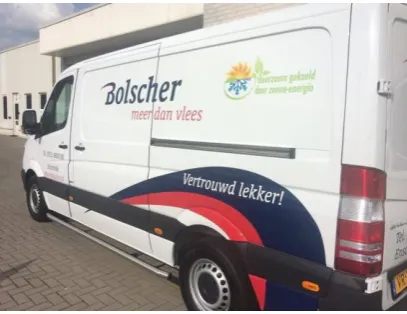
[image:15.595.71.275.314.471.2]To supply all its customers, Bolscher owns eight Mercedes Benz Sprinter vans equipped with a cooling system. Drivers load the products into their vans, drive to customers and unload on the spot. Drivers follow a pre-set route to deliver all customers. These routes are fixed.
Figure 2.1: the sun-cooled vans owned by Bolscher
The management of Bolscher experiences that customers require more and more of the capabilities of the company. They order more and they require a high flexibility, for example by ordering today and requesting that the order will be delivered today. This means that orders come in close to the departure time of the vans. Bolscher is doing everything in its possibilities to meet these demands and to satisfy the customer. In this dynamic market Bolscher wants to be as competitive as possible by being very flexible when it comes to the wishes of the customers. This means that Bolscher, in contrast to its competitors, has no outer order time (for example: a customer must order before 4 p.m. if it wants to be supplied the next day).
8 Figure 2.1: The current situation at Bolscher: a customer calls to place an order (or places its order online). This customer is placed in the standard routes that are green, the same way that all other customers are placed in certain routes. The order of the customer will be transported in the first route available for that customer, in this case route 3 on Monday.
The situation described in figure 2 means that all customers are in standard routes, whether or not they have placed an order. This means that a route can contain 100 customers, but that only 20 customers have to be supplied. This is a result of the fact that customers can order whenever they want: every customer needs to be in a route to be able to be supplied in case they do place an order.
For example: Route number 811 is a fixed route on Monday containing 80 customers. These customers are situated in Haaksbergen, Eibergen, Groenlo, Winterswijk and Neede. All 80 customers either order or they do not. Customer X, situated in Groenlo, places its order for next Monday, as well as 27 other customers of route 811. An hour before the van that will supply route 811 leaves, customer Y calls. Customer Y is situated in Winterswijk and really needs 20 pork filets today. This is only possible if customer Y is already assigned to a route, otherwise all last-minute orders have to be assigned to a van by the expedition department, an impossible job when there are as many last-minute orders as Bolscher receives. So the 20 pork filets of customer Y are loaded into the van with the 28 other customers of route 811 and the van is ready to leave. This is why Bolscher works with standard routes: because of the high amount of last-minute orders, every customer is already assigned to several routes. An example of a route schedule on a random day at Bolscher is provided in Appendix A.
Bolscher receives approximately 40 per cent of the total amount of orders the day before. This means that 60 per cent of their customers order after closing time, during the night or even during the day of delivery. This results in a very ad hoc production schedule. In some cases, products are produced and leave the company a couple of minutes later. Also, all the vans cannot leave at the same time early in the morning, because a lot of the products ordered still have to be produced and a lot of orders are still coming in during the day.
2.2 Issues concerning logistic processes at Bolscher
9
(3) the fact that customers can order whenever they want, even during the day they want to receive their orders.
2.2.1 Problem 1: time windows
[image:17.595.77.439.216.275.2]Many customers of Bolscher want to receive their order in a certain time window. This means that the customer wants to receive its order before, after, or between certain times. This makes delivering products and designing routes more complicated. More than hundred customers have certain time window demands, and Bolscher has to meet all of them to keep the customers satisfied.
Figure 2.2: time window problem
2.2.2 Problem 2: route design
[image:17.595.73.484.417.472.2]When Bolscher started to deliver products to its customers, the company was small enough to be able to design all its routes manually. Customers in the same area were put together into a route and are delivered by one driver in one ride. However, over the last years Bolscher grew rapidly while the route design policy stayed the same. Customers are still put in a route manually. The management of Bolscher suspects that these routes are not optimal.
Figure 2.3: route design problem
2.2.3 Problem 3: customer order policy
Bolscher handles the policy that it wants its customer to be able to order whenever and whatever they want. Besides great customer service, this policy yields difficulties within the logistic department. Many competitors of Bolscher demand customers to order before a certain time the day before they want to be supplied. This makes planning relatively easy: the routes can be designed the day before and will not change anymore. Because of the late change in route schemes at Bolscher, it is very difficult to design routes. That is the main reason Bolscher works with fixed routes: all customers have to have a place in a certain route to be able to deliver that customer in case it orders last-minute.
Figure 2.4: customer order policy problem Customers
demand time windows
A lot of time windows to meet
Difficult to design routes
Certain number of customers
All customer must be in a
route
Routes are hand-made
Routes are not optimal
Custumers order last minute
Routes change the at the last moment
[image:17.595.72.455.663.724.2]10 2.3 How the problems effect daily business
2.3.1 Problem 1: time windows
Customer X is situated in Deventer. This customer demands to be supplied every Tuesday between 9 and 10 a.m. Customer Y is also a customer of Bolscher and also situated in
Deventer. This customer demands to be supplied after 3 p.m. This situation creates a problem for the logistic department. It means that there are two options: meeting these demands and driving to Deventer twice a day or not serving one of the customers (in time). Most of the times there are some customers near Deventer that also want to be supplied. Then the logistic department can decide to first, supply Deventer, then its surrounding and after that again Deventer. Whatever the solution of the logistic department is, it stays difficult to meet all the time windows and still deliver customers the most optimal way.
2.3.2 Problem 2: route design
Yesterday, a Bolscher salesperson contracted customer X. Today, the same salesperson contracted customer Y. These new customers have to be supplied. They are placed into a route that fits best to their zip-codes: in routes that supply the areas these customers are in. The routes these customers are placed in however are also manually designed. There is a substantial change that these routes are far from optimal.
2.3.3 Problem 3: customer order policy
At 4 p.m. on Tuesday, the time the production department stops producing, 160 orders that have to be supplied next day are in. For many logistic companies, this is the time to plan and design the routes for Wednesday. However, at Bolscher, 160 orders is approximately 40 per cent of the number of orders to be delivered on Wednesday. This means that 240 orders are still coming in during the night or during the next day. This means that Bolscher is never able to plan routes the day before and always has to plan routes ad-hoc.
2.4 Management ’s goals
The management of Bolscher would like to make the process of route design within the company easier for several reasons. The main purposes are to reduce the time that the head of the logistic department is busy figuring out the routes and to save costs by making the routes more efficient. The idea was to make this possible by buying route planning software: a decision support system that plans the most optimal routes for the company. Management thinks that by using route planning software the problem of time windows will be easier to deal with as well, because customers with time windows are placed into a route by the software rather than by hand.
Furthermore, management does not want to change the flexibility of Bolscher. So problem 3, the ordering policy, will not be changed. This means that the fact that customers can order whatever whenever they want is a fixed circumstance that has to be dealt with in the route planning.
11
of Bolscher that, although the ‘limitation’ of its customer ordering policy, Ritplan can be very beneficial to the company. Management was pretty optimistic about Ritplan, but did not have the time to gather all the needed information to implement Ritplan and to get familiar with the software package.
Management asked me to implement Ritplan within Bolscher, to get familiar with the package and to find out how much Ritplan can really improve the route planning at Bolscher.
2.5 Research scope
Before introducing the research question, it is important to clarify the research scope. This thesis investigates the possibilities of Ritplan within Bolscher meer dan vlees. Research will be conducted before and during the try-out period of Ritplan and will end by providing the management of Bolscher with information about how to introduce planning software. The thesis will examine if and how planning software is suitable for Bolscher. This means that this research will not draw one conclusion and also definitively implementing Ritplan will not be part of it. It will provide some clear guidelines and insights for the management to make its own choices regarding Ritplan.
2.6 Central research question and sub questions
The management of Bolscher wants to introduce route planning software to be able to plan routes more optimal and safe time and costs. As mentioned before, it wants to know hoe beneficial such software, in particular Ritplan, can be for Bolscher. Considering the wishes of the management, the central research question of this thesis is:
How can Ritplan improve route planning at Bolscher meer dan vlees?
To find an answer to this question, the following sub questions will be answered:
1. What are the benefits of route planning software?
Two answer this sub question, up-do-date literature regarding route planning software is used to get a clear insight of the real benefits of it.
2. What are the requirement for route planning software these days?
By using in-depth literature on route planning requirement, a clear framework for requirements is provided.
3. How does Ritplan plan when there are no significant complicating limitations?
This sub question is answered by combining literature, own experiences with Ritplan and information provided by EVO-it.
4. To what extent does Ritplan meet the requirements for route planning software?
The information gathered about Ritplan in sub question three is compared to the requirements for route planning software mentioned in chapter four.
12
These limitations are mainly gathered from consulting the management and the employees of Boslcher and from my own experiences at the company.
6. How can be dealt with these limitations to be able to plan with Ritplan?
This sub question is answered by interviewing the Management of Bolscher, talking to employees, using my own experiences at Bolscher and with Ritplan, and by using the insight of the literature used in previous sub questions.
When it is clear how the specific limitations for Bolscher concerning working with route planning software can be overcome, it becomes clear if, and to what extent the software can be beneficial to Bolscher.
2.7 Deliverables
At the end of this thesis, the following deliverables are expected to provide to the management of Bolscher meer dan vlees:
1. A clear view of what problems Bolscher can expect when using route planning software like Ritplan.
2. Recommendations how to be able to overcome these problems and describing the impact these will cause within Bolscher.
13
3. What are the benefits of route planning software?
A decision support system for route planning purposes is developed to solve the fleet planning problem from the company that purchased the software. It is designed to assist managers or planners in every stage of the planning process: forecasting demand, determine relevant criteria, generate alternative plans, and choosing the best plan. The system is able to answer all sorts of ‘what if’ questions and it can show the corresponding cost impacts (Keenan, 1998).
In scientific literature, a lot of benefits of using a decision support system for route planning can be found. The most important and most often mentioned benefits are (Gayalis &
Tatsiopoulos, 2004):
• Better utilisation of the distribution resources (utilisation of fixed costs)
Because the aim of decision support software for route planning is to use resources as optimal as possible and at the lowest possible costs, a better utilisation of distribution resources will occur. Vehicles can be used longer, because the distances they have to cover will be reduced when still being as productive (deliver the same amount of goods) as before.
• Reduction of the cost of owned vehicles and hired vehicles (major distribution cost)
Because route planning software will distribute resources at the lowest possible costs, many times the outcome will be that the minimum number of vehicles will be used for distributions. This means that the cost of owned vehicles and hired vehicles can often be reduced.
• Reduction of the labour costs
When less vehicles are needed for distribution or when these vehicles spent less time on the road, the operating time of drivers will decrease as well. This will lead to a reduction of labour costs. The same amount of drivers can be used to supply more customers, or the amount of drivers can be reduced to serve the same amount of customers.
• More effective processes
Proper route planning software will make a lot of processes more effective. Not only the distribution process, but also planning processes as the software package will take on the task of planning. Planners will spent less time planning routes they planned by hand before. Also client-related processes will be more effective because clients can be informed about the whereabouts of their orders because many route planning software is equipped with GPS capabilities.
• Customers service level improvement
14
receive information about when they can expect their order or they can follow their order on line. Customers can even be digitally informed when the estimated arrival time of a driver changes.
• Support of the operational decisions
On operational level, decision making can become easier by using route planning software. Planning and scheduling of routes becomes clearer so operational planning becomes clearer as well. Different scenarios on the road can be solved quicker, because many planning
programmes can give an insight in the whereabouts of drivers. • A strategic and tactical decision support tool
15
4. What are the requirements for route planning software these days?
Because of the increasing number of decision support software systems for planning purposes, evaluation and selection of these systems has become increasingly difficult. Not only are there more software systems available, the variety and of features they offer is getting bigger and choosing the right system is hard for the management of wholesalers like Bolscher meer dan vlees.To be able to make the right choice concerning what route planning software package to choose, clear selection criteria are needed. These criteria can be obtained from literature on route planning software.
The problem of route planning has been subject of many articles for a long period of time already. Route planning became easier because of the introduction of route planning software. With a growing number and the growing capabilities of such software packages, also the number of requirements for these packages increased. Multiple articles describe these requirements, for example the article of Drexl (2012). His article mentions multiple criteria for route planning software: such as being able to plan routes within five minutes and the automatic assignment of vehicles and drivers to routes. Most articles however, mention five or six general criteria and don’t afford an extensive list of specific criteria. In this chapter, the article from Smirlis, Zeimpekis & Kaimakamis (2012) is used because these authors do provide a clear and in-depth description of requirements for route planning software. The article of Smirlis et al. (2012) combines the literature about general decision support software with the problem of vehicle routing. It provides the most in-depth information and also explains why certain requirements are important. It divides them into three clear categories and enable organizations to prioritize the requirements from very important until only important if demanded by de company.
According to Smirlis et al. (2012), selection criteria can be classified into three categories: critical factors, objective factors and subjective factors. Each category contains sub-criteria. The criteria are mentioned in the tables below.
Mentioning these criteria are important because they can be used to investigate whether Ritplan meets these requirements and is a suitable software package for Bolscher. Chapter 6 will examine whether Ritplan meets the requirements mentioned in this chapter.
4.1 Critical factors
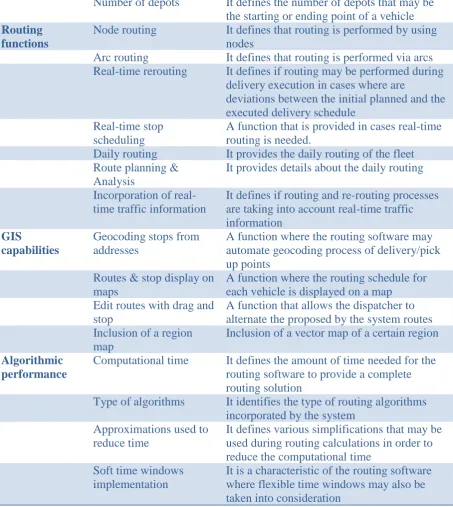
Critical factors: a factor that can exclude a software package in the evaluation process, regardless other conditions may be satisfied. These factors are mentioned in Table 4.1 below:
Main category Critical factors Description
Problem size Number of stops It defines the maximum number of stops during a route
Number of vehicles It defines the maximum number of vehicles to
whom customers may be assigned
16
Number of depots It defines the number of depots that may be
the starting or ending point of a vehicle
Routing functions
Node routing It defines that routing is performed by using
nodes
Arc routing It defines that routing is performed via arcs
Real-time rerouting It defines if routing may be performed during
delivery execution in cases where are
deviations between the initial planned and the executed delivery schedule
Real-time stop scheduling
A function that is provided in cases real-time routing is needed.
Daily routing It provides the daily routing of the fleet
Route planning & Analysis
It provides details about the daily routing
Incorporation of real-time traffic information
It defines if routing and re-routing processes are taking into account real-time traffic information
GIS
capabilities
Geocoding stops from addresses
A function where the routing software may automate geocoding process of delivery/pick up points
Routes & stop display on maps
A function where the routing schedule for each vehicle is displayed on a map
Edit routes with drag and stop
A function that allows the dispatcher to alternate the proposed by the system routes Inclusion of a region
map
Inclusion of a vector map of a certain region
Algorithmic performance
Computational time It defines the amount of time needed for the
routing software to provide a complete routing solution
Type of algorithms It identifies the type of routing algorithms
incorporated by the system Approximations used to
reduce time
It defines various simplifications that may be used during routing calculations in order to reduce the computational time
Soft time windows implementation
[image:24.595.75.529.77.585.2]It is a characteristic of the routing software where flexible time windows may also be taken into consideration
Table 4.1: Critical factors for choosing transportation planning software (Smirlis et al., 2012)
Route planning software packages must contain these factors to even be considered using. When one factor is absent, this can already lead to rejection of the software package.
Therefore it is very important to verify whether all these factors are present before deciding to use a certain software package.
4.2 Objective factors
Objective factors: factors that can typically be expressed in money and are easily quantifiable. These factors are mentioned in Table 4.2 below:
17
Total price Amount for purchasing It includes the fees paid to acquire the standardized software package
Network/site licenses cost
It measures the cost in case of involving a number of users, a network version and an appropriate number of users licenses if needed
Installation & support cost
[image:25.595.71.547.380.734.2]It includes any extra cost for installing the routing software and the training of users/administrators
Table 4.2: Objective factors for choosing transportation planning software (Smirlis et al., 2012)
The mentioned objective factors are mainly cost-related factors. It is up to the user how much money to spend on the software, but it can be a very important factor in choosing a software package. Also, it is important to take all three types of costs into account. For example: the costs for purchasing can be relatively cheap, but when the licensing costs are very high, it is probably better to choose software with higher purchasing costs and lower licensing costs because this will be cheaper in the long term.
4.3 Subjective factors
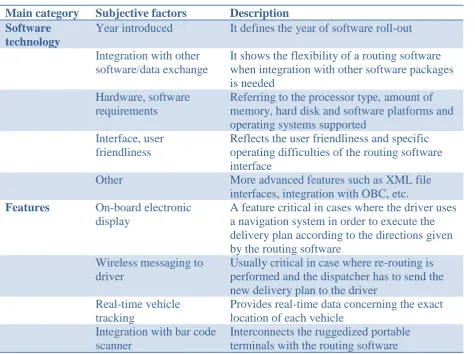
Subjective factors: factors characterized by the fact that they are qualitative measures that typically cannot be quantified. These factors are mentioned in Table 4.3 below:
Main category Subjective factors Description Software
technology
Year introduced It defines the year of software roll-out
Integration with other software/data exchange
It shows the flexibility of a routing software when integration with other software packages is needed
Hardware, software requirements
Referring to the processor type, amount of memory, hard disk and software platforms and operating systems supported
Interface, user friendliness
Reflects the user friendliness and specific operating difficulties of the routing software interface
Other More advanced features such as XML file
interfaces, integration with OBC, etc.
Features On-board electronic display
A feature critical in cases where the driver uses a navigation system in order to execute the delivery plan according to the directions given by the routing software
Wireless messaging to driver
Usually critical in case where re-routing is performed and the dispatcher has to send the new delivery plan to the driver
Real-time vehicle tracking
Provides real-time data concerning the exact location of each vehicle
Integration with bar code scanner
18 Online Proof of delivery Shows the exact time of delivery, important
when companies want to know the exact time of delivery
Supply chain management
Integration with other logistics software
Customer order processing
Allows the processing of customer orders via the routing software
Computer aided dispatch Applicable usually for emergency services such as police, fire and so fourth
Assignment of individual drivers
Gives the ability to the dispatcher to assign a delivery plan based on the available drivers Turn-by-turn route
instructions
Provides navigation services to the driver
Automatic forecasts of delivery
Is provided by routing software that embraces travel-time algorithms used in order to estimate the arrival in the following customers
Load manifest The software may process the load manifests
for each delivery plan Loading plan for
truckload
Provides the optimal way a driver may load the truck
Cell phone, PDA integration
Describes the capability of planned route visibility and real-time communication with cell phones, PDA’s
Other It includes features such as complex route
support, user controlled road network criteria, etc.
Installations/cr edibility
Number of installations It gives the number of installations as an indicator of the credibility and the popularity of the routing software package
Most significant installations
The type of companies that the software has been installed and operates
Fleet use Local pick-up and delivery
Most helpful for retailers, courier services, 3PL firms etc.
Long-haul less than truckload
It is the case where vehicle has to visit more than one customer
Long-haul truckload It is the case where vehicles are used for
national or international transportation.
Other services Courier, Buses, Taxis, service fleets and
[image:26.595.68.540.101.612.2]emergency services
Table 4.3: Subjective factors for choosing transportation planning software (Smirlis et al., 2012)
19 4.4. Other requirements
Also, logistics experts recommend choosing a route planning software system that offers the following capabilities (Salter, 2016):
1. It schedules and routes trucks daily 2. It enhances fixed routes and schedules 3. It optimizes deliveries continually 4. It supports clients
5. It links with live vehicle tracking 6. It considers “what-if” scenarios 7. It uses multi-period planning
8. It creates software developments plans 9. It combines central scheduling
10.It pays attention to reporting
21
5. How does Ritplan plan routes when there are no significant
complicating limitations?
This chapter describes how route planning software, and Ritplan in particular, operates. First, it describes route planning software in general to give some insight in the basics of this software. Chapter 5.2 will provide some in-depth information about Ritplan. It will provide general information about Ritplan and about how it plans routes when the complicating limitations that exist at Bolscher are not present.
5.1 How route planning software works
Route planning software usually contains three important components: the algorithm, a network of roads and all kinds of conditions a certain route or transport has to meet. These three components form the basis of the software package (Waenink, 2016).
The algorithm can be described as the data center of the software package. It calculates the best route, most of the times based on the lowest possible costs (Delling, Sanders, Schultes, & Wagner, 2009).
Some data have to be entered in the system to enable the algorithm to calculate the best possible routes with the lowest possible costs. The most common data are:
• The order characteristics (kind of goods, size, numbers, weights) • The load times and unload times (stopping times)
• The addresses of the load and unload addresses (including possible restrictions like opening hours or other time windows and accessibility of the address)
• The loading restrictions
• The available vehicles and their characteristics • The available employees
• The costs per hour and per kilometer • The average speed
All these data are taken into account by the algorithm. The data mentioned above form the conditions routes or transports have to meet. The algorithm uses these data combined with the third component, a network of roads, to calculate routes (Waenink, 2016).
Most of the times, the data that has to be entered into the software are imported from the ERP/order management system and it is very important that these data are imported very accurately. Well-operating route planning software relies on the quality of the data entered. When the data is inaccurate the software package will not be able to plan route optimally (Waenink, 2016).
22 5.2 How Ritplan works
Essentially, Ritplan works the same as described in the previous section. The software
package also contains an algorithm that needs data and a network of roads to plan routes. This algorithm also uses the lowest possible costs as the basis for route planning.. However, it is nearly impossible for a software package like Ritplan to plan the perfect routes. Especially for a company like Bolscher, serving many customers with fixed time windows, planning perfect routes is impossible. The main goal is to provide good quality solutions in a relatively short computing time.
Ritplan offers two modules to choose from: the international module (for planning routes internationally) or the national module (for planning routes in The Netherlands only) (EVO Informatietechnologie, 2014). On top of one of these modules a customer can choose from several expansion modules to enlarge the software package. For example: import and export modules, employee management module, multi user module or an SMS module so customers receive a text message when to expect their orders. This gives a customer of Ritplan the opportunity to build a software package that fits to its wishes without paying for software that is not relevant for him. To operate Ritplan, there are some requirements for the computers the software packages runs on. The PC has to be modern, with a fast processor, it has to have a hard disk with at least 15 GB space, a video card with preferably two monitors and some other requirements. These requirements are conditions to be able to run Ritplan smoothly. Ritplan plans the best routes when as much information as possible is entered into the software package and when all customers that have to be supplied are known. All internal (organizational) data that must be entered are mentioned in appendix B. This appendix does not mention external data, like customer time windows or speed limits. The more data is entered into Ritplan, the more accurate the routes will be (EVO informatietechnologie, 2014). Also, a good linkage with the ERP system of the company that works with Ritplan is
important. When Ritplan planned all routes, the routes can be displayed in stops, but also on a map. Also, both options can be used. Figure 5.2.1 shows how Ritplan displays every stop of the various routes in text, and also shows the routes on a map.
[image:30.595.73.528.539.730.2]
23
6. To what extent does Ritplan meet the requirements for route
planning software?
This chapter clarifies whether or not the specifications of Ritplan meet the requirements for proper route planning software mentioned in chapter 4. For this, the critical factors, objective factors and subjective factors from chapter four are used.
6.1 Critical factors
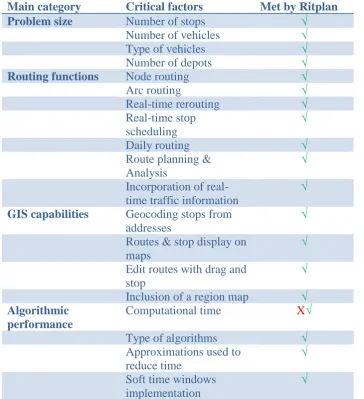
As mentioned before, all critical factors have to be met to be able to work optimally with a route planning software package. For this reason, all critical factors mentioned in chapter four are taken into account. Table 6.1 mentions the factors and shows whether or not they are met by Ritplan.
Main category Critical factors Met by Ritplan Problem size Number of stops √
Number of vehicles √
Type of vehicles √
Number of depots √
Routing functions Node routing √
Arc routing √
Real-time rerouting √
Real-time stop scheduling
√
Daily routing √
Route planning & Analysis
√
Incorporation of real-time traffic information
√
GIS capabilities Geocoding stops from addresses
√
Routes & stop display on maps
√
Edit routes with drag and stop
√
Inclusion of a region map √
Algorithmic performance
Computational time X√
Type of algorithms √
Approximations used to reduce time
√
Soft time windows implementation
[image:31.595.69.434.259.659.2]√
Table 6.1: Comparison Ritplan with the critical factors
All critical factors are met by Ritplan. Computational time was a little bit difficult to judge because Ritplan does not tell the exact amount of time needed to finish planning, but
24 6.2 Objective factors
Before the management of Bolscher decided to implement Ritplan, they were well aware of the costs of the software package. In the case of Bolscher the same three categories of costs as mentioned in chapter 4 exist: the amount of money for purchasing, network/licenses costs and installation and support costs.
Ritplan can be purchased in two ways. The first option is to buy the software package and pay for annual maintenance. The second option is to buy a Ritplan-license; this license includes maintenance. For both options, the implementation costs are € 3,980. With these
implementations costs a one-month testing period is included. The remainder of the costs for both options are stated in Table 6.2.1 an 6.2.2 below:
Buy-option
Software package € 9,000
Yearly maintenance € 1804
Table 6.2.1: Costs of buy-option
Licence-option
Licence and maintenance € 359.98 per month
Table 6.2.2: Costs of license-option
When Ritplan turns out to be suitable for Bolscher, the preference of the management is to use the buy-option. The costs related to Ritplan are not much higher or lower than the costs
related to competing and comparable software packages. The opinion of the management is when Ritplan turns out to be beneficial for the company, it will be worth the investment. € 3,980 for the implementation and testing period will be spent anyway to find out whether or not Ritplan is beneficial for Bolscher.
Main category Objective factors Met by Ritplan Total price Amount for purchasing √
Network/site licenses cost √
[image:32.595.71.427.679.767.2]Installation & support cost √
Table 6.2.3: Comparison Ritplan with objective factors
6.3 Subjective factors
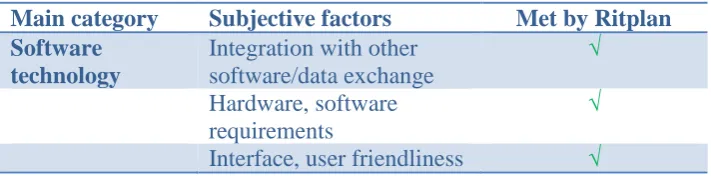
To find out what subjective factors are important for Bolscher meer dan vlees, an interview with the management is conducted. The most important subjective factors, according to the management, are in the table below. Concerning the category installations/credibility: the management of Bolscher visited a similar company that was using Ritplan as well to see how that company was working with the software and to find out that for a similar company Ritplan is beneficial. For that company, Ritplan was indeed very beneficial.
Main category Subjective factors Met by Ritplan Software
technology
Integration with other software/data exchange
√
Hardware, software requirements
√
25
Features On-board electronic display
√
Real-time vehicle tracking √
Customer order processing √
Turn-by-turn route instructions
√
Automatic forecasts of delivery
√
Load manifest √
Cell phone, PDA integration
√
Installations/cre dibility
Most significant installations
√
[image:33.595.75.426.68.269.2] [image:33.595.70.432.405.561.2]Fleet use Local pick-up and delivery √ Table 6.3: Comparison Ritplan with subjective factors
Table 6.3 show that all subjective factors that, according to the management of Bolscher, are important are met by Ritplan.
6.4 Other requirements
In the ideal situation, Ritplan also meets the requirements mentioned by Salter (2016). These requirements are found most important by logistic experts. Table 6.4 shows that all these factors are met by Ritplan.
Requirements Met by Ritplan
Schedules and routes trucks daily √
Enhances fixed routes and schedules √
Optimizes deliveries continually √
Supports clients √
Links with live vehicle tracking √
Considers “what-if” scenarios √
Uses multi-period planning √
Creates software development plans √
Combines central scheduling √
Pays attention to reporting √
[image:33.595.72.427.406.560.2]26 Figure 4.4 total cost of buying vs. licensing
Figure 4.4 shows how long it will take for the buy-option to be cheaper than the license-option. It takes 43 months for the buy-option to be cheaper. This means that the buy-option is only interesting when Ritplan is really beneficial for Bolscher and if the plan is to use Ritplan for the long term.
6.5 Conclusion
Ritplan owns all the features a route planning decision support software has to meet these days. The critical and objective factors are met and the subjective factors (cost factors) are not expected to be a big problem. Also, the requirements mentioned by logistic experts are met by Ritplan.
The only questionable outcome is the computational time. When Ritplan is planning, the software tells the planner how long it is planning already, but it does not give the planner the amount of time needed to finish planning. This is a critical factor, so a possible deal breaker. But after experiencing that making a planning for one day does not take longer than a couple of minutes (also, when the process of planning is interrupted, not all results are lost. Ritplan then gives the routes it planned so far) and that the management of Bolscher does not think of it as a big problem, it will not lead to a rejection of Ritplan.
0 2000 4000 6000 8000 10000 12000 14000 16000 18000 20000
Costs buy/license
27
7. What are the limitations for Bolscher concerning working with
Ritplan and how can these limitations be overcome?
This chapter describes the three main issues that will yield difficulties for Bolscher if the company decides to use Ritplan. It will also mention guidelines to overcome these problems. These guidelines are obtained by consulting EVO-it as well as interviewing the management of Bolscher, my own experiences at the company from the literature used earlier.
7.1 Limitations
7.1.1 Customer order policy
As described in chapter 2, Bolscher allows customers to order whenever they want and supply them as soon as possible. Even when a customer places its order today, it is likely that it will be supplied today. Bolscher does not obligate customers to place their order before a certain time the day before delivery.
Chapter 5.2 makes clear that Ritplan (and other transportation planning software) operates optimally when it can plan routes when all orders are known. For most companies this means that they will run their transportation planning software after their deadline for ordering is expired. Bolscher will never be able to run Ritplan when all orders are known because
management does not intend to change the fact that customers can order whenever they want. So for that reason, Bolscher is unable to use Ritplan to its full maximum.
7.1.2 Procedures at production department
Right now, routes at Bolscher meer dan vlees are fixed: customers are always in the same route. This means that the production department can produce to route: the finished orders of customers in the same route are put together. For example: all products from the 50 customers in route 811 are placed together by the production department. This makes it easy for the expedition department and for the drivers to put a route together and load all the orders into vans.
When an order of a customer comes in, a sticker is printed for all departments that have to produce something for that customer. When multiple stickers are collected in a certain department, they are placed into order of routes. This means that this department produces first the products for early routes and later the products for the later routes. This enables the production department to produce all day, because they do not have to finish all products before opening hours but before the van supplying that particular route leaves. That is why the production department starts producing relatively late compared to other production
companies: at 7:00 am. The department stops producing at 4:00 pm.
There is a possibility that Ritplan can be used when (almost) all orders are known. At 6:00 am, 90 per cent of all orders for that day are in. It is possible to run Ritplan than and use the van that Ritplan possibly saves for the delivery of emergency orders. This option will be discussed in detail in chapter 9.2.
28
impossible for the production department to operate as they do now. The products of
customers X, normally receiving its order at 4:00 pm, have to be ready before opening hours because Ritplan can decide that this customer will receive its orders at 9:00 am. If the
production department start producing at 7:00, they do not have enough time to have all products ready before they possibly have to leave.
7.1.3 Complex link with ERP system
Chapter 5.2 states that Ritplan operates best when the link with the ERP system of the company that uses the software package runs smoothly. Also, some literature states that this can be an important factor for using transportation planning software in the best way possible (Meyr, Wagner, & Rohde, 2015)
Bolscher uses the ERP system Reflex Systems. This ERP system is designed specifically for the food industry. The problem concerning automatic route planning however, is that the system does not have a perfect coupling to transportation planning software. In the optimal situation, an ERP system would have a license for data export to other software and these data would be clear enough for the other software to read. Reflex does have such a data export license and Bolscher purchased it, but the license turned out to be too simplistic to be able to export all data needed from Reflex to Ritplan. For example: it is possible to export the total weight of an order from Reflex to Ritplan, but not to export packing information. So Ritplan knows how many kilos a customer ordered, but does not know how many crates are needed for this order and how much space these orders will need in a van. Also, Reflex can only export the order from the customer to Ritplan. Because some of the meat is sliced by employees of Bolscher and some pieces of meat are a little heavier of lighter than the
customer ordered, the real weight of an order can deviate from the initial customer order. This cannot be taken into account by Ritplan.
7.2 Overcoming the limitations 7.2.1 Customer order policy
The best option concerning Ritplan to deal with this limitation would be changing the policy that customers can order last-minute. However, this is not an option for the management of Bolscher.
When the representative of Ritplan visited Bolscher for the first time, he mentioned that the second best option for Bolscher would be using historical data and that historical orders can be used to make improvements to the current route situation.
29
For example: customer X, situated in Lochem, is placed in route 912 on Tuesday. Last Tuesday, this customer placed an order and was supplied together with other customers placed in that standard route situated in Delden, Goor and Rijssen. Ritplan however, may plan this customer in a route together with customers situated in Haaksbergen, Groenlo and
Diepenheim because as described in section 5.2, it plans route based on the lowest total costs. When this happens, the expedition department can consider to place customer X into another standard route.
The big advantage of this method is that no major changes have to be made in the production department and in the ordering policy of Bolscher. However, there are some disadvantages as well. The biggest disadvantage is that there is no real consistency in how Ritplan plans orders. For example: the orders of last Thursday and the Thursday before are planned quite
differently because of some customers with time constraints that do or do not order and simply because different customers place orders. This makes it hard for the expedition department to find real structural improvements.
Another disadvantage is even though some improvement will definitely be found; the software package will not be used in its optimal way. This raises the question whether or not the improvements Ritplan yield outweigh the costs of the software package.
7.2.2 Procedures at production department
One thing that has to happen when Bolscher decides to let Ritplan plan routes at 6:00 am (when 90 per cent of all order are known so a decent planning can be made), is for the
production department to start producing earlier than it does now to have all products finished before they have to be loaded. Another possibility is for the production department to produce until after 4:00 (the current point of time production stops) to finish more products for the next day. Off course, these two options can be combined as well. Only then it is possible to run Ritplan in the morning and supply customers in the order Ritplan calculates.
7.2.3 Complex link with ERP-system
After some time of trying to import data from Reflex, it turned out to be impossible to do this perfectly. This complex link is discussed in chapter 7.1.3. The first step to improve the
linkage between Reflex and Ritpan was to make sure that the information in Reflex was right. All addresses had to be unload addresses and not post addresses and other contact information had to be right to be able to export it to Ritplan.
It was impossible to enter time windows in Reflex and export them to Ritplan, so all time windows had to be entered into Ritplan manually.
30
31
8. Conclusions and recommendations
By having answered the questions in the last chapter, the central research question can be answered. In chapter 8.1, the conclusions of this research are presented and several possibilities Bolscher can introduce to be able to work with route planning software are presented. Chapter 8.2 recommends the possibility that is the most suited to Bolscher in the opinion of the researcher. It will also include some additional recommendations for the management of Bolscher to keep route planning manageable in the future.
8.1. Conclusions
The logistic department of Bolscher is dealing with three main concerns regarding their route planning:
1. Customers want to receive their orders within certain time windows
Many customers request deliveries in certain time-windows. That makes planning a very complicated task.
2. Current route planning is manual
Right now, routes are designed manually. This takes a lot of time and effort, and management suspect that the routes are far from optimal.
3. Customers can order until just before departure time of the delivering vehicle so current routes are fixed
At Bolscher, customers can order and receive products at the same day. This makes route planning even more complicated.
The management of Bolscher had introductory meeting with EVO-it and wants to find out whether this software package for route-planning would improve the first two issues, without compromising the flexibility Bolscher offers to its customers (issue 3).
The central research question of this research is:
“To what extent can route planning software improve route planning at Bolscher meer dan vlees?”
Most route planning software is designed to plan routes the day before, when all orders, customers, and time windows for the next day are known. This is also the best way to use Ritplan. However, because customers of Bolscher can order last minute, that is no option. Despite this fact, the task for the researcher was to figure out how Ritplan could be beneficial to Bolscher anyway.
By making sure Ritplan fits all the requirements for route planning software, and by