Exploiting Out-of-Domain Parallel Data through Multilingual Transfer
Learning for Low-Resource Neural Machine Translation
Aizhan Imankulova† Raj Dabre‡ Atsushi Fujita‡ Kenji Imamura‡ †Tokyo Metropolitan University
6-6 Asahigaoka, Hino, Tokyo 191-0065, Japan [email protected]
‡National Institute of Information and Communications Technology
3-5 Hikaridai, Seika-cho, Soraku-gun, Kyoto, 619-0289, Japan
{raj.dabre, atsushi.fujita, kenji.imamura}@nict.go.jp
Abstract
This paper proposes a novel multilin-gual multistage fine-tuning approach for low-resource neural machine translation (NMT), taking a challenging Japanese– Russian pair for benchmarking. Al-though there are many solutions for low-resource scenarios, such as multilingual NMT and back-translation, we have em-pirically confirmed their limited success when restricted to in-domain data. We therefore propose to exploit out-of-domain data through transfer learning, by us-ing it to first train a multilus-ingual NMT model followed by multistage fine-tuning on in-domain parallel and back-translated pseudo-parallel data. Our approach, which combines domain adaptation, multilin-gualism, and back-translation, helps im-prove the translation quality by more than 3.7 BLEU points, over a strong baseline, for this extremely low-resource scenario. 1 Introduction
Neural machine translation (NMT) (Cho et al., 2014; Sutskever et al., 2014; Bahdanau et al., 2015) has enabled end-to-end training of a trans-lation system without needing to deal with word alignments, translation rules, and complicated de-coding algorithms, which are the characteristics of phrase-based statistical machine translation (PB-SMT) (Koehn et al., 2007). Although NMT can be significantly better than PBSMT in resource-rich scenarios, PBSMT performs better in low-resource scenarios (Koehn and Knowles, 2017).
c
2019 The authors. This article is licensed under a Creative Commons 4.0 licence, no derivative works, attribution, CC-BY-ND.
Only by exploiting cross-lingual transfer learn-ing techniques (Firat et al., 2016; Zoph et al., 2016; Kocmi and Bojar, 2018), can the NMT per-formance approach PBSMT perper-formance in low-resource scenarios.
However, such methods usually require an NMT model trained on a resource-rich language pair like French↔English (parent), which is to be fine-tuned for a low-resource language pair like Uzbek↔English (child). On the other hand,
multi-lingual approaches (Johnson et al., 2017) propose to train a single model to translate multiple lan-guage pairs. However, these approaches are effec-tive only when the parent target or source language is relatively resource-rich like English (En). Fur-thermore, the parents and children models should be trained on similar domains; otherwise, one has to take into account an additional problem of do-main adaptation (Chu et al., 2017).
In this paper, we work on a linguisti-cally distant and thus challenging language pair Japanese↔Russian (Ja↔Ru) which has only 12k
lines of news domain parallel corpus and hence is extremely resource-poor. Furthermore, the amount of indirect in-domain parallel corpora, i.e., Ja↔En
and Ru↔En, are also small. As we demonstrate in
Section 4, this severely limits the performance of prominent low-resource techniques, such as mul-tilingual modeling, back-translation, and pivot-based PBSMT. To remedy this, we propose a novel multistage fine-tuning method for NMT that com-bines multilingual modeling (Johnson et al., 2017) and domain adaptation (Chu et al., 2017).
RQ1. What kind of translation quality can we ob-tain in an extremely low-resource scenario?
CT1. We have made extensive comparisons with multiple architectures and MT paradigms to show how difficult the problem is. We have also explored the utility of back-translation and show that it is ineffective given the poor performance of base MT systems used to gen-erate pseudo-parallel data. Our systematic exploration shows that multilingualism is ex-tremely useful for in-domain translation with very limited corpora (see Section 4). This type of exhaustive exploration has been miss-ing from most existmiss-ing works.
RQ2. What are the effective ways to exploit out-of-domain data for extremely low-resource in-domain translation?
CT2. Our proposal is to first train a multilin-gual NMT model on out-of-domain Ja↔En
and Ru↔En data, then fine-tune it on in-domain Ja↔En and Ru↔En data, and fur-ther fine-tune it on Ja↔Ru data (see
Sec-tion 5). We show that this stage-wise fine-tuning is crucial for high-quality translation. We then show that the improved NMT mod-els lead to pseudo-parallel data of better qual-ity. This data can then be used to improve the performance even further thereby enabling the generation of better pseudo-parallel data. By iteratively generating pseudo-parallel data and fine-tuning the model on said data, we can achieve the best performance for Japanese↔Russian translation.
To the best of our knowledge, we are the first to perform such an extensive evaluation of ex-tremely low-resource MT problem and propose a novel multilingual multistage fine-tuning approach involving multilingual modeling and domain adap-tation to address it.
2 Our Japanese–Russian Setting
In this paper, we deal with Ja↔Ru news trans-lation. This language pair is very challenging because the languages involved have completely different writing system, phonology, morphology, grammar, and syntax. Among various domains, we experimented with translations in the news do-main, considering the importance of sharing news between different language speakers. Moreover, news domain is one of the most challenging tasks,
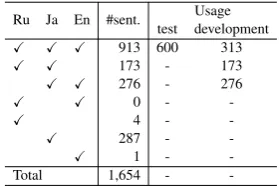
Ru Ja En #sent. test developmentUsage
X X X 913 600 313
X X 173 - 173
X X 276 - 276
X X 0 -
-X 4 -
-X 287 -
-X 1 -
-Total 1,654 -
-Table 1: Manually aligned News Commentary data.
due to large presence of out-of-vocabulary (OOV) tokens and long sentences.1 To establish and
eval-uate existing methods, we also involved English as the third language. As direct parallel corpora are scarce, involving a language such as English for pivoting is quite common (Utiyama and Isahara, 2007).
There has been no clean held-out parallel data for Ja↔Ru and Ja↔En news translation. There-fore, we manually compiled development and test sets using News Commentary data2 as a source.
Since the given Ja↔Ru and Ja↔En data share many lines in the Japanese side, we first compiled tri-text data. Then, from each line, correspond-ing parts across languages were manually identi-fied, and unaligned parts were split off into a new line. Note that we have never merged two or more lines. As a result, we obtained 1,654 lines of data comprising trilingual, bilingual, and monolingual segments (mainly sentences) as summarized in Ta-ble 1. Finally, for the sake of comparability, we randomly chose 600 trilingual sentences to create a test set, and concatenated the rest of them and bilingual sentences to form development sets.
Our manually aligned development and test sets are publicly available.3
3 Related Work
Koehn and Knowles (2017) showed that NMT is unable to handle low-resource language pairs as opposed to PBSMT. Transfer learning approaches (Firat et al., 2016; Zoph et al., 2016; Kocmi and Bojar, 2018) work well when a large helping par-allel corpus is available. This restricts one of the source or the target languages to be English which, in our case, is not possible. Approaches involving bi-directional NMT modeling is shown to
drasti-1News domain translation is also the most competitive tasks
in WMT indicating its importance.
2http://opus.nlpl.eu/News-Commentary-v11. php
[image:2.595.345.485.71.164.2]cally improve low-resource translation (Niu et al., 2018). However, like most other, this work focuses on translation from and into English.
Remaining options include (a) unsupervised MT (Artetxe et al., 2018; Lample et al., 2018; Marie and Fujita, 2018), (b) parallel sentence mining from non-parallel or comparable corpora (Utiyama and Isahara, 2003; Tillmann and Xu, 2009), (c) generating pseudo-parallel data (Sennrich et al., 2016), and (d) MT based on pivot languages (Utiyama and Isahara, 2007). The linguistic dis-tance between Japanese and Russian makes it ex-tremely difficult to learn bilingual knowledge, such as bilingual lexicons and bilingual word embed-dings. Unsupervised MT is thus not promising yet, due to its heavy reliance on accurate bilingual word embeddings. Neither does parallel sentence mining, due to the difficulty of obtaining accu-rate bilingual lexicons. Pseudo-parallel data can be used to augment existing parallel corpora for train-ing, and previous work has reported that such data generated by so-called back-translation can sub-stantially improve the quality of NMT. However, this approach requires base MT systems that can generate somewhat accurate translations. It is thus infeasible in our scenario, because we can obtain only a weak system which is the consequence of an extremely low-resource situation. MT based on pivot languages requires large in-domain parallel corpora involving the pivot languages. This tech-nique is thus infeasible, because the in-domain par-allel corpora for Ja↔En and Ru↔En pairs are also extremely limited, whereas there are large parallel corpora in other domains. Section 4 empirically confirms the limit of these existing approaches.
Fortunately, there are two useful transfer learn-ing solutions uslearn-ing NMT: (e) multillearn-ingual model-ing to incorporate multiple language pairs into a single model (Johnson et al., 2017) and (f) domain adaptation to incorporate out-of-domain data (Chu et al., 2017). In this paper, we explore a novel method involving step-wise fine-tuning to combine these two methods. By improving the translation quality in this way, we can also increase the like-lihood of pseudo-parallel data being useful to fur-ther improve translation quality.
4 Limit of Using only In-domain Data This section answers our first research question, [RQ1], about the translation quality that we can achieve using existing methods and in-domain
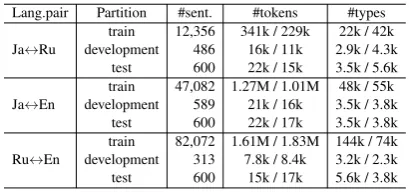
par-Lang.pair Partition #sent. #tokens #types
Ja↔Ru developmenttrain 12,356486 341k / 229k16k / 11k 2.9k / 4.3k22k / 42k test 600 22k / 15k 3.5k / 5.6k
Ja↔En
train 47,082 1.27M / 1.01M 48k / 55k development 589 21k / 16k 3.5k / 3.8k
test 600 22k / 17k 3.5k / 3.8k
Ru↔En
[image:3.595.313.518.70.166.2]train 82,072 1.61M / 1.83M 144k / 74k development 313 7.8k / 8.4k 3.2k / 2.3k test 600 15k / 17k 5.6k / 3.8k
Table 2: Statistics on our in-domain parallel data.
allel and monolingual data. We then use the strongest model to conduct experiments on gener-ating and utilizing back-translated pseudo-parallel data for augmenting NMT. Our intention is to em-pirically identify the most effective practices as well as recognize the limitations of relying only on in-domain parallel corpora.
4.1 Data
To train MT systems among the three languages, i.e., Japanese, Russian, and English, we used all the parallel data provided by Global Voices,4more
specifically those available at OPUS.5 Table 2
summarizes the size of train/development/test splits used in our experiments. The number of par-allel sentences for Ja↔Ru is 12k, for Ja↔En is 47k, and for Ru↔En is 82k. Note that the three
corpora are not mutually exclusive: 9k out of 12k sentences in the Ja↔Ru corpus were also included in the other two parallel corpora, associated with identical English translations. This puts a limit on the positive impact that the helping corpora can have on the translation quality.
Even when one focuses on low-resource lan-guage pairs, we often have access to larger quan-tities of in-domain monolingual data of each lan-guage. Such monolingual data are useful to im-prove quality of MT, for example, as the source of pseudo-parallel data for augmenting training data for NMT (Sennrich et al., 2016) and as the train-ing data for large and smoothed language mod-els for PBSMT (Koehn and Knowles, 2017). Ta-ble 3 summarizes the statistics on our monolingual corpora for several domains including the news domain. Note that we removed from the Global Voices monolingual corpora those sentences that are already present in the parallel corpus.
4https://globalvoices.org/
Corpus Ja Ru En Global Voices5 26k 24k 842k
Wikinews6 37k 243k
-News Crawl7 - 72M 194M
Yomiuri (2007–2011)8 19M -
-IWSLT9 411k 64k 66k
Tatoeba10 5k 58k 208k
Table 3: Number of lines in our monolingual data. Whereas the first four are from the news corpora (in-domain), the last two, i.e., “IWSLT” and “Tatoeba,” are from other domains.
We tokenized English and Russian sentences us-ingtokenizer.perlofMoses(Koehn et al., 2007).11
To tokenize Japanese sentences, we usedMeCab12
with the IPA dictionary. After tokenization, we eliminated duplicated sentence pairs and sentences with more than 100 tokens for all the languages.
4.2 MT Methods Examined
We began with evaluating standard MT paradigms, i.e., PBSMT (Koehn et al., 2007) and NMT (Sutskever et al., 2014). As for PBSMT, we also examined two advanced methods: pivot-based translation relying on a helping language (Utiyama and Isahara, 2007) and induction of phrase tables from monolingual data (Marie and Fujita, 2018).
As for NMT, we compared two types of encoder-decoder architectures: attentional RNN-based model (RNMT) (Bahdanau et al., 2015) and the Transformer model (Vaswani et al., 2017). In addition to standard uni-directional modeling, to cope with the low-resource problem, we examined two multi-directional models: bi-directional model (Niu et al., 2018) and multi-to-multi (M2M) model (Johnson et al., 2017).
After identifying the best model, we also exam-ined the usefulness of a data augmentation method based on back-translation (Sennrich et al., 2016).
PBSMT Systems
First, we built a PBSMT system for each of the six translation directions. We obtained phrase
6https://dumps.wikimedia.org/ backup-index.html(20180501)
7http://www.statmt.org/wmt18/ translation-task.html
8https://www.yomiuri.co.jp/database/ glossary/
9
http://www.cs.jhu.edu/˜kevinduh/a/ multitarget-tedtalks/
10http://opus.nlpl.eu/Tatoeba-v2.php 11https://github.com/moses-smt/ mosesdecoder
12http://taku910.github.io/mecab, version
0.996.
tables from parallel corpus using SyMGIZA++13
with thegrow-diag-finalheuristics for word alignment, andMoses for phrase pair extraction. Then, we trained a bi-directional MSD (mono-tone, swap, and discontinuous) lexicalized reorder-ing model. We also trained three 5-gram language models, usingKenLM14on the following monolin-gual data: (1) the target side of the parallel data, (2) the concatenation of (1) and the monolingual data from Global Voices, and (3) the concatenation of (1) and all monolingual data in the news domain in Table 3.
Subsequently, using English as the pivot lan-guage, we examined the following three types of pivot-based PBSMT systems (Utiyama and Isa-hara, 2007; Cohn and Lapata, 2007) for each of Ja→Ru and Ru→Ja.
Cascade: 2-step decoding using the source-to-English and source-to-English-to-target systems.
Synthesize: Obtain a new phrase table from syn-thetic parallel data generated by translating English side of the target–English training parallel data to the source language with the English-to-source system.
Triangulate: Compile a new phrase table com-bining those for the source-to-English and English-to-target systems.
Among these three, triangulation is the most com-putationally expensive method. Although we had filtered the component phrase tables using the sta-tistical significance pruning method (Johnson et al., 2007), triangulation can generate an enormous number of phrase pairs. To reduce the computa-tional cost during decoding and the negative ef-fects of potentially noisy phrase pairs, we retained for each source phrases only the k-best
transla-tionstaccording to the forward translation
proba-bilityφ(t|s)calculated from the conditional
prob-abilities in the component models as defined in Utiyama and Isahara (2007). For each of the re-tained phrase pairs, we also calculated the back-ward translation probability, φ(s|t), and lexical translation probabilities,φlex(t|s)andφlex(s|t), in
the same manner asφ(t|s).
We also investigated the utility of recent ad-vances in unsupervised MT. Even though we be-gan with a publicly available implementation of
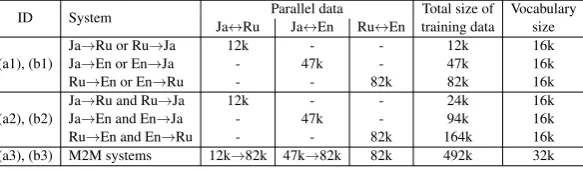
ID System Ja Parallel data Total size of Vocabulary ↔Ru Ja↔En Ru↔En training data size
(a1), (b1)
Ja→Ru or Ru→Ja 12k - - 12k 16k Ja→En or En→Ja - 47k - 47k 16k Ru→En or En→Ru - - 82k 82k 16k
[image:5.595.155.447.72.157.2](a2), (b2) JaJa→→Ru and RuEn and En→→JaJa 12k- 47k- -- 94k24k 16k16k Ru→En and En→Ru - - 82k 164k 16k (a3), (b3) M2M systems 12k→82k 47k→82k 82k 492k 32k
Table 4:Configuration of uni-, bi-directional, and M2M NMT baseline systems. Arrows in “Parallel data” columns indicate the over-sampling of the parallel data to match the size of the largest parallel data.
unsupervised PBSMT (Lample et al., 2018),15 it
crashed due to unknown reasons. We therefore fol-lowed another method described in Marie and Fu-jita (2018). Instead of short n-grams (Artetxe et al., 2018; Lample et al., 2018), we collected a set of phrases in Japanese and Russian from respec-tive monolingual data using the word2phrase
algorithm (Mikolov et al., 2013),16 as in Marie
and Fujita (2018). To reduce the complexity, we used randomly selected 10M monolingual sen-tences, and 300k most frequent phrases made of words among the 300k most frequent words. For each source phrase s, we selected 300-best
tar-get phrases t according to the translation
prob-ability as in Lample et al. (2018): p(t|s) =
exp(βcos(emb(t),emb(s)) P
t0exp(βcos(emb(t0),emb(s)), where emb(·) stands for a bilingual embedding of a given phrase, ob-tained through averaging bilingual embeddings of constituent words learned from the two mono-lingual data using fastText17 and vecmap.18
For each of the retained phrase pair, p(s|t) was
computed analogously. We also computed lexical translation probabilities relying on those learned from the given small parallel corpus.
Up to four phrase tables were jointly ex-ploited by the multiple decoding path ability of
Moses. Weights for the features were tuned us-ing KB-MIRA (Cherry and Foster, 2012) on the development set; we took the best weights after 15 iterations. Two hyper-parameters, namely, k for
the number of pivot-based phrase pairs per source phrase anddfor distortion limit, were determined
by a grid search on k ∈ {10,20,40,60,80,100}
andd∈ {8,10,12,14,16,18,20}. In contrast, we used predetermined hyper-parameters for phrase table induction from monolingual data, following
15https://github.com/facebookresearch/ UnsupervisedMT
16https://code.google.com/archive/p/ word2vec/
17https://fasttext.cc/
18https://github.com/artetxem/vecmap
the convention: 200 for the dimension of word and phrase embeddings andβ = 30.
NMT Systems
We used the open-source implementation of the RNMT and the Transformer models in
tensor2tensor.19A uni-directional model for
each of the six translation directions was trained on the corresponding parallel corpus. Bi-directional and M2M models were realized by adding an ar-tificial token that specifies the target language to the beginning of each source sentence and shuf-fling the entire training data (Johnson et al., 2017). Table 4 contains some specific hyper-parameters20 for our baseline NMT models.
The hyper-parameters not mentioned in this table used the default values in tensor2tensor. For M2M systems, we over-sampled Ja→Ru and Ja→En training data so that their sizes match the
largest Ru→En data. To reduce the number of unknown words, we used tensor2tensor’s internal sub-word segmentation mechanism. Since we work in a low-resource setting, we used shared sub-word vocabularies of size 16k for the uni- and bi-directional models and 32k for the M2M models. The number of training iterations was determined by early-stopping: we evaluated our models on the development set every 1,000 updates, and stopped training if BLEU score for the development set was not improved for 10,000 updates (10 check-points). Note that the development set was created by concatenating those for the individual translation directions without any over-sampling.
Having trained the models, we averaged the last 10 check-points and decoded the test sets with a beam size of 4 and a length penalty which was
19https://github.com/tensorflow/ tensor2tensor, version 1.6.6.
20We compared two mini-batch sizes, 1024 and 6144 tokens,
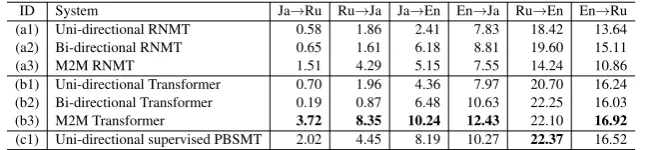
ID System Ja→Ru Ru→Ja Ja→En En→Ja Ru→En En→Ru (a1) Uni-directional RNMT 0.58 1.86 2.41 7.83 18.42 13.64 (a2) Bi-directional RNMT 0.65 1.61 6.18 8.81 19.60 15.11 (a3) M2M RNMT 1.51 4.29 5.15 7.55 14.24 10.86 (b1) Uni-directional Transformer 0.70 1.96 4.36 7.97 20.70 16.24 (b2) Bi-directional Transformer 0.19 0.87 6.48 10.63 22.25 16.03 (b3) M2M Transformer 3.72 8.35 10.24 12.43 22.10 16.92
[image:6.595.138.461.71.146.2](c1) Uni-directional supervised PBSMT 2.02 4.45 8.19 10.27 22.37 16.52
Table 5:BLEU scores of baseline systems.Boldindicates the best BLEU score for each translation direction.
tuned by a linear search on the BLEU score for the development set.
Similarly to PBSMT, we also evaluated “Cas-cade” and “Synthesize” methods with uni-directional NMT models.
4.3 Results
We evaluated MT models using case-sensitive and tokenized BLEU (Papineni et al., 2002) on test sets, using Moses’s multi-bleu.perl. Statistical significance (p < 0.05) on the difference of
BLEU scores was tested by Moses’s bootstrap-hypothesis-difference-significance.pl.
Tables 5 and 6 show BLEU scores of all the models, except the NMT systems augmented with back-translations. Whereas some models achieved reasonable BLEU scores for Ja↔En and Ru↔En
translation, all the results for Ja↔Ru, which is our main concern, were abysmal.
Among the NMT models, Transformer models (b∗) were proven to be better than RNMT models (a∗). RNMT models could not even outperform the
uni-directional PBSMT models (c1). M2M mod-els (a3) and (b3) outperformed their corresponding uni- and bi-directional models in most cases. It is worth noting that in this extremely low-resource scenario, BLEU scores of the M2M RNMT model for the largest language pair, i.e., Ru↔En, were
lower than those of the uni- and bi-directional RNMT models as in Johnson et al. (2017). In con-trast, with the M2M Transformer model, Ru↔En
also benefited from multilingualism.
Standard PBSMT models (c1) achieved higher BLEU scores than uni-directional NMT mod-els (a1) and (b1), as reported by Koehn and Knowles (2017), whereas they underperform the M2M Transformer NMT model (b3). As shown in Table 6, pivot-based PBSMT systems always achieved higher BLEU scores than (c1). The best model with three phrase tables, labeled “Syn-thesize / Triangulate / Gold,” brought visible BLEU gains with substantial reduction of OOV tokens (3047→1180 for Ja→Ru, 4463→1812 for
System Ja→Ru Ru→Ja PBSMT: Cascade 3.65 7.62 PBSMT: Synthesize 3.37 6.72 PBSMT: Synthesize / Gold 2.94 6.95 PBSMT: Synthesize + Gold 3.07 6.62 PBSMT: Triangulate 3.75 7.02 PBSMT: Triangulate / Gold 3.93 7.02 PBSMT: Synthesize / Triangulate / Gold 4.02 7.07 PBSMT: Induced 0.37 0.65 PBSMT: Induced / Synthesize / Triangulate / Gold 2.85 6.86 RNMT: Cascade 1.19 6.73 RNMT: Synthesize 1.82 3.02 RNMT: Synthesize + Gold 1.62 3.24 Transformer NMT: Cascade 2.41 6.84 Transformer NMT: Synthesize 1.78 5.43 Transformer NMT: Synthesize + Gold 2.13 5.06
Table 6:BLEU scores of pivot-based systems. “Gold” refers to the phrase table trained on the parallel data.Boldindicates the BLEU score higher than the best one in Table 5. “/” in-dicates the use of separately trained multiple phrase tables, whereas so does “+” training on the mixture of parallel data.
Ru→Ja). However, further extension with phrase tables induced from monolingual data did not push the limit, despite their high coverage; only 336 and 677 OOV tokens were left for the two translation directions, respectively. This is due to the poor quality of the bilingual word embeddings used to extract the phrase table, as envisaged in Section 3. None of pivot-based approaches with uni-directional NMT models could even remotely rival the M2M Transformer NMT model (b3).
4.4 Augmentation with Back-translation
Given that the M2M Transformer NMT model (b3) achieved best results for most of the translation di-rections and competitive results for the rest, we further explored it through back-translation.
ID System Pseudo JaParallel data Total size of ↔Ru Ja↔En Ru↔En training data
#1–#10
[image:7.595.129.471.72.129.2]Ja∗→Ru and/or Ru∗→Ja 12k→82k 12k→82k 47k→82k×2 82k×2 984k Ja∗→En and/or En∗→Ja 47k→82k 12k→82k×2 47k→82k 82k×2 984k Ru∗→En and/or En∗→Ru 82k 12k→82k×2 47k→82k×2 82k 984k All All of the above 12k→82k 47k→82k 82k 984k
Table 7:Over-sampling criteria for pseudo-parallel data generated by back-translation.
ID Ja Pseudo-parallel data involved BLEU score
∗→Ru Ru∗→Ja Ja∗→En En∗→Ja Ru∗→En En∗→Ru Ja→Ru Ru→Ja Ja→En En→Ja Ru→En En→Ru (b3) - - - 3.72 8.35 10.24 12.43 22.10 16.92 #1 X - - - •4.59 8.63 10.64 12.94 22.21 17.30 #2 - X - - - - 3.74 •8.85 10.13 13.05 22.48 17.20 #3 X X - - - - •4.56 •9.09 10.57 •13.23 22.48 •17.89 #4 - - X - - - 3.71 8.05 •11.00 12.66 22.17 16.76 #5 - - - X - - 3.62 8.10 9.92 •14.06 21.66 16.68 #6 - - X X - - 3.61 7.94 •11.51 •14.38 22.22 16.80 #7 - - - - X - 3.80 8.37 10.67 13.00 22.51 •17.73 #8 - - - X 3.77 8.04 10.52 12.43 •22.85 17.13 #9 - - - - X X 3.37 8.03 10.19 12.79 22.77 17.26
[image:7.595.95.507.157.279.2]#10 X X X X X X •4.43 •9.38 •12.06 •14.43 •23.09 17.30
Table 8:BLEU scores of M2M Transformer NMT systems trained on the mixture of given parallel corpus and pseudo-parallel data generated by back-translation using (b3). Six “X∗→Y” columns show whether the pseudo-parallel data for each translation direction is involved.Boldindicates the scores higher than (b3) and “•” indicates statistical significance of the improvement.
First, we selected sentences to be back-translated from in-domain monolingual data (Ta-ble 3), relying on the score proposed by Moore and Lewis (2010) via the following procedure.
1. For each language, train two 4-gram language models, using KenLM: an in-domain one on all the Global Voices data, i.e., both parallel and monolingual data, and a general-domain one on the concatenation of Global Voices, IWSLT, and Tatoeba data.
2. For each language, discard sentences contain-ing OOVs accordcontain-ing to the in-domain lan-guage model.
3. For each translation direction, select the T -best monolingual sentences in the news do-main, according to the difference between cross-entropy scores given by the in-domain and general-domain language models.
Whereas Niu et al. (2018) exploited monolin-gual data much larger than parallel data, we main-tained a 1:1 ratio between them (Johnson et al., 2017), setting T to the number of lines of
paral-lel data of given language pair.
Selected monolingual sentences were then translated using the M2M Transformer NMT model (b3) to compose pseudo-parallel data. Then, the pseudo-parallel data were enlarged by over-sampling as summarized in Table 7. Finally, new NMT models were trained on the concatenation of the original parallel and pseudo-parallel data from
scratch in the same manner as the previous NMT models with the same hyper-parameters.
Table 8 shows the BLEU scores achieved by several reasonable combinations of six-way pseudo-parallel data. We observed that the use of all six-way pseudo-parallel data (#10) significantly improved the base model for all the translation di-rections, except En→Ru. A translation direction
often benefited when the pseudo-parallel data for that specific direction was used.
4.5 Summary
We have evaluated an extensive variation of MT models21 that rely only on in-domain parallel and
monolingual data. However, the resulting BLEU scores for Ja→Ru and Ru→Ja tasks do not exceed
10 BLEU points, implying the inherent limitation of the in-domain data as well as the difficulty of these translation directions.
5 Exploiting Large Out-of-Domain Data Involving a Helping Language
The limitation of relying only on in-domain data demonstrated in Section 4 motivates us to explore
21Other conceivable options include transfer learning using
Domain\language pair Direct One-side shared in-domain A,X B,X
[image:8.595.315.520.70.110.2]out-of-domain C,× D,X
Table 9:Classification of parallel data.
other types of parallel data. As raised in our sec-ond research question, [RQ2], we considered the effective ways to exploit out-of-domain data.
According to language pair and domain, parallel data can be classified into four categories in Ta-ble 9. Among all the categories, out-of-domain data for the language pair of interest have been ex-ploited in the domain adaptation scenarios (C→A) (Chu et al., 2017). However, for Ja↔Ru, no of-domain data is available. To exploit out-of-domain parallel data for Ja↔En and Ru↔En pairs instead, we propose a multistage fine-tuning method, which combines two types of transfer learning, i.e., domain adaptation for Ja↔En and
Ru↔En (D→B) and multilingual transfer (B→A), relying on the M2M model examined in Section 4. We also examined the utility of fine-tuning for iter-atively generating and using pseudo-parallel data.
5.1 Multistage Fine-tuning
Simply using NMT systems trained on out-of-domain data for in-out-of-domain translation is known to perform badly. In order to effectively use large-scale out-of-domain data for our extremely low-resource task, we propose to perform domain adaptation through either (a) conventional fine-tuning, where an NMT system trained on out-of-domain data is fine-tuned only on in-out-of-domain data, or (b) mixed fine-tuning (Chu et al., 2017), where pre-trained out-of-domain NMT system is fine-tuned using a mixture of in-domain and out-of-domain data. The same options are available for transferring from Ja↔En and Ru↔En to Ja↔Ru.
We inevitably involve two types of transfer learning, i.e., domain adaptation for Ja↔En and Ru↔En and multilingual transfer for Ja↔Ru pair. Among several conceivable options for managing these two problems, we examined the following multistage fine-tuning.
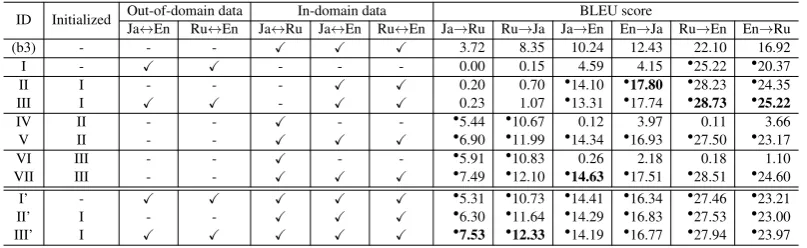
Stage 0. Out-of-domain pre-training: Pre-train a multilingual model only on the Ja↔En and Ru↔En out-of-domain parallel data (I), where the vocabulary of the model is determined on the basis of the in-domain parallel data in the same manner as the M2M NMT models examined in Section 4.
[image:8.595.101.263.71.101.2]Lang.pair Corpus #sent. #tokens #types Ja↔En ASPEC 1,500,000 42.3M / 34.6M 234k / 1.02M Ru↔En YandexUN 2,647,243 90.5M / 92.8M320,325 8.51M / 9.26M 757k / 593k617k / 407k
Table 10: Statistics on our out-of-domain parallel data.
Stage 1. Fine-tuning for domain adaptation:
Fine-tune the pre-trained model (I) on the in-domain Ja↔En and Ru↔En parallel
data (fine-tuning, II) or on the mixture of in-domain and out-of-domain Ja↔En and Ru↔En parallel data (mixed fine-tuning, III).
Stage 2. Fine-tuning for Ja↔Ru pair: Further fine-tune the models (each of II and III) for Ja↔Ru on in-domain parallel data for this
language pair only (fine-tuning, IV and VI) or on all the in-domain parallel data (mixed fine-tuning, V and VII).
We chose this way due to the following two rea-sons. First, we need to take a balance between sev-eral different parallel corpora sizes. The other rea-son is division of labor; we assume that solving each sub-problem one by one should enable grad-ual shift of parameters.
5.2 Data Selection
As an additional large-scale out-of-domain paral-lel data for Ja↔En, we used the cleanest 1.5M sentences from the Asian Scientific Paper Excerpt Corpus (ASPEC) (Nakazawa et al., 2016).22 As
for Ru↔En, we used the UN and Yandex cor-pora released for the WMT 2018 News Transla-tion Task.23 We retained Ru↔En sentence pairs
that contain at least one OOV token in both sides, according to the in-domain language model trained in Section 4.4. Table 10 summarizes the statistics on the remaining out-of-domain parallel data.
5.3 Results
Table 11 shows the results of our multistage fine-tuning, where the IDs of each row refer to those described in Section 5.1. First of all, the final mod-els of our multistage fine-tuning, i.e., V and VII, achieved significantly higher BLEU scores than (b3) in Table 5, a weak baseline without using any monolingual data, and #10 in Table 8, a strong baseline established with monolingual data.
22http://lotus.kuee.kyoto-u.ac.jp/ASPEC/ 23http://www.statmt.org/wmt18/
ID Initialized Out-of-domain dataJa In-domain data BLEU score
[image:9.595.98.502.71.195.2]↔En Ru↔En Ja↔Ru Ja↔En Ru↔En Ja→Ru Ru→Ja Ja→En En→Ja Ru→En En→Ru (b3) - - - X X X 3.72 8.35 10.24 12.43 22.10 16.92 I - X X - - - 0.00 0.15 4.59 4.15 •25.22 •20.37 II I - - - X X 0.20 0.70 •14.10 •17.80 •28.23 •24.35 III I X X - X X 0.23 1.07 •13.31 •17.74 •28.73 •25.22 IV II - - X - - •5.44 •10.67 0.12 3.97 0.11 3.66 V II - - X X X •6.90 •11.99 •14.34 •16.93 •27.50 •23.17 VI III - - X - - •5.91 •10.83 0.26 2.18 0.18 1.10 VII III - - X X X •7.49 •12.10 •14.63 •17.51 •28.51 •24.60 I’ - X X X X X •5.31 •10.73 •14.41 •16.34 •27.46 •23.21 II’ I - - X X X •6.30 •11.64 •14.29 •16.83 •27.53 •23.00 III’ I X X X X X •7.53 •12.33 •14.19 •16.77 •27.94 •23.97
Table 11:BLEU scores obtained through multistage fine-tuning. “Initialized” column indicates the model used for initializing parameters that are fine-tuned on the data indicated byX. Boldindicates the best BLEU score for each translation direction. “•” indicates statistical significance of the improvement over (b3).
The performance of the initial model (I) depends on the language pair. For Ja↔Ru pair, it can-not achieve minimum level of quality since the model has never seen parallel data for this pair. The performance on Ja↔En pair was much lower than the two baseline models, reflecting the cru-cial mismatch between training and testing do-mains. In contrast, Ru↔En pair benefited the most and achieved surprisingly high BLEU scores. The reason might be due to the proximity of out-of-domain training data and in-out-of-domain test data.
The first fine-tuning stage significantly pushed up the translation quality for Ja↔En and Ru↔En pairs, in both cases with fine-tuning (II) and mixed fine-tuning (III). At this stage, both models per-formed only poorly for Ja↔Ru pair as they have not yet seen Ja↔Ru parallel data. Either model had a consistent advantage to the other.
When these models were further fine-tuned only on the in-domain Ja↔Ru parallel data (IV and VI),
we obtained translations of better quality than the two baselines for Ja↔Ru pair. However, as a re-sult of complete ignorance of Ja↔En and Ru↔En
pairs, the models only produced translations of poor quality for these language pairs. In contrast, mixed fine-tuning for the second fine-tuning stage (V and VII) resulted in consistently better mod-els than conventional fine-tuning (IV and VI), ir-respective of the choice at the first stage, thanks to the gradual shift of parameters realized by in-domain Ja↔En and Ru↔En parallel data. Un-fortunately, the translation quality for Ja↔En and Ru↔En pairs sometimes degraded from II and III.
Nevertheless, the BLEU scores still retain the large margin against two baselines.
The last three rows in Table 11 present BLEU scores obtained by the methods with fewer fine-tuning steps. The most naive model I’, trained
on the balanced mixture of whole five types of corpora from scratch, and the model II’, obtained through a single-step conventional fine-tuning of I on all the in-domain data, achieved only BLEU scores consistently worse than VII. In contrast, when we merged our two fine-tuning steps into a single mixed fine-tuning on I, we obtained a model III’ which is better for the Ja↔Ru pair than VII. Nevertheless, they are still comparable to those of VII and the BLEU scores for the other two lan-guage pairs are much lower than VII. As such, we conclude that our multistage fine-tuning leads to a more robust in-domain multilingual model.
5.4 Further Augmentation with Back-translation
Having obtained a better model, we examined again the utility of back-translation. More pre-cisely, we investigated (a) whether the pseudo-parallel data generated by an improved NMT model leads to a further improvement, and (b) whether one more stage of fine-tuning on the mix-ture of original parallel and pseudo-parallel data will result in a model better than training a new model from scratch as examined in Section 4.4.
Given an NMT model, we first generated six-way pseudo-parallel data by translating monolin-gual data. For the sake of comparability, we used the identical monolingual sentences sampled in Section 4.4. Then, we further fine-tuned the given model on the mixture of the generated pseudo-parallel data and the original pseudo-parallel data, fol-lowing the same over-sampling procedure in Sec-tion 4.4. We repeated these steps five times.
orig-No Initialized BT Ja BLEU score
[image:10.595.161.439.70.157.2]→Ru Ru→Ja Ja→En En→Ja Ru→En En→Ru #10 - (b3) 4.43 9.38 12.06 14.43 23.09 17.30 new #10 - VII •6.55 •11.36 •13.77 •15.59 •24.91 •20.55 VIII VII VII •7.83 •12.21 •15.06 •17.19 •28.49 •23.96 IX VIII VIII •8.03 •12.55 •15.07 •17.80 •28.16 •24.27 X IX IX •7.76 •12.59 •15.08 •18.12 •28.18 •24.67 XI X X •7.85 •12.97 •15.26 •17.83 •28.49 •24.36 XII XI XI •8.16 •13.09 •14.96 •17.74 •28.45 •24.35
Table 12:BLEU scores achieved through fine-tuning on the mixture of the original parallel data and six-way pseudo-parallel data. “Initialized” column indicates the model used for initializing parameters and so does “BT” column the model used to generate pseudo-parallel data. “•” indicates statistical significance of the improvement over #10.
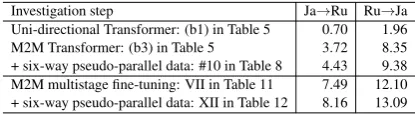
Investigation step Ja→Ru Ru→Ja Uni-directional Transformer: (b1) in Table 5 0.70 1.96 M2M Transformer: (b3) in Table 5 3.72 8.35 + six-way pseudo-parallel data: #10 in Table 8 4.43 9.38 M2M multistage fine-tuning: VII in Table 11 7.49 12.10 + six-way pseudo-parallel data: XII in Table 12 8.16 13.09
Table 13:Summary of our investigation: BLEU scores of the best NMT systems at each step.
inal parallel data. It achieved higher BLEU scores than #10 in Table 8 thanks to the pseudo-parallel data of better quality, but underperformed the base NMT model VII. In contrast, our fine-tuned model VIII successfully surpassed VII, and one more it-eration (IX) further improved BLEU scores for all translation directions, except Ru→En. Although further iterations did not necessarily gain BLEU scores, we came to a much higher plateau com-pared to the results in Section 4.
6 Conclusion
In this paper, we challenged the difficult task of Ja↔Ru news domain translation in an extremely low-resource setting. We empirically confirmed the limited success of well-established solutions when restricted to in-domain data. Then, to incor-porate out-of-domain data, we proposed a multilin-gual multistage fine-tuning approach and observed that it substantially improves Ja↔Ru translation by over 3.7 BLEU points compared to a strong baseline, as summarized in Table 13. This paper contains an empirical comparison of several exist-ing approaches and hence we hope that our paper can act as a guideline to researchers attempting to tackle extremely low-resource translation.
In the future, we plan to confirm further fine-tuning for each of specific translation directions. We will also explore the way to exploit out-of-domain pseudo-parallel data, better domain-adaptation approaches, and additional challenging language pairs.
Acknowledgments
This work was carried out when Aizhan Imankulova was taking up an internship at NICT, Japan. We would like to thank the review-ers for their insightful comments. A part of this work was conducted under the program “Promo-tion of Global Communica“Promo-tions Plan: Research, Development, and Social Demonstration of Mul-tilingual Speech Translation Technology” of the Ministry of Internal Affairs and Communications (MIC), Japan.
References
Artetxe, Mikel, Gorka Labaka, and Eneko Agirre. 2018. Unsupervised statistical machine translation. In Proceedings of the 2018 Conference on Empiri-cal Methods in Natural Language Processing, pages 3632–3642, Brussels, Belgium.
Bahdanau, Dzmitry, Kyunghyun Cho, and Yoshua Ben-gio. 2015. Neural machine translation by jointly learning to align and translate. InProceedings of the 3rd International Conference on Learning Represen-tations, San Diego, USA.
Cherry, Colin and George Foster. 2012. Batch tuning strategies for statistical machine translation. In Pro-ceedings of the 2012 Conference of the North Amer-ican Chapter of the Association for Computational Linguistics: Human Language Technologies, pages 427–436, Montr´eal, Canada.
Cho, Kyunghyun, Bart van Merri¨enboer, C¸aglar G¨ulc¸ehre, Dzmitry Bahdanau, Fethi Bougares, Hol-ger Schwenk, and Yoshua Bengio. 2014. Learning phrase representations using RNN encoder–decoder for statistical machine translation. InProceedings of the 2014 Conference on Empirical Methods in Nat-ural Language Processing, pages 1724–1734, Doha, Qatar.
[image:10.595.77.285.215.272.2]Cohn, Trevor and Mirella Lapata. 2007. Machine translation by triangulation: Making effective use of
multi-parallel corpora. In Proceedings of the 45th
Annual Meeting of the Association of Computational Linguistics, pages 728–735, Prague, Czech Repub-lic.
Firat, Orhan, Kyunghyun Cho, and Yoshua Bengio. 2016. Multi-way, multilingual neural machine
trans-lation with a shared attention mechanism. InNAACL
HLT 2016, The 2016 Conference of the North Amer-ican Chapter of the Association for Computational Linguistics: Human Language Technologies, pages 866–875, San Diego, USA.
Johnson, Howard, Joel Martin, George Foster, and Roland Kuhn. 2007. Improving translation
qual-ity by discarding most of the phrasetable. In
Pro-ceedings of the 2007 Joint Conference on Empirical Methods in Natural Language Processing and Com-putational Natural Language Learning, pages 967– 975, Prague, Czech Republic.
Johnson, Melvin, Mike Schuster, Quoc Le, Maxim Krikun, Yonghui Wu, Zhifeng Chen, Nikhil Thorat, Fernanda Vi´egas, Martin Wattenberg, Greg Corrado, Macduff Hughes, and Jeffrey Dean. 2017. Google’s multilingual neural machine translation system: En-abling zero-shot translation. Transactions of the As-sociation for Computational Linguistics, 5:339–351. Kocmi, Tom and Ondˇrej Bojar. 2018. Trivial transfer learning for low-resource neural machine translation. InProceedings of the Third Conference on Machine Translation: Research Papers, pages 244–252, Brus-sels, Belgium.
Koehn, Philipp and Rebecca Knowles. 2017. Six
chal-lenges for neural machine translation. In
Proceed-ings of the First Workshop on Neural Machine Trans-lation, pages 28–39, Vancouver, Canada.
Koehn, Philipp, Hieu Hoang, Alexandra Birch, Chris Callison-Burch, Marcello Federico, Nicola Bertoldi, Brooke Cowan, Wade Shen, Christine Moran, Richard Zens, Chris Dyer, Ondrej Bojar, Alexandra Constantin, and Evan Herbst. 2007. Moses: Open source toolkit for statistical machine translation. In
Proceedings of the 45th Annual Meeting of the As-sociation for Computational Linguistics Companion Volume Proceedings of the Demo and Poster Ses-sions, pages 177–180, Prague, Czech Republic. Lakew, Surafel M, Quintino F. Lotito, Matteo Negri,
Marco Turchi, and Marcello Federico. 2017. Im-proving zero-shot translation of low-resource
lan-guages. In Proceedings of the 14th International
Workshop on Spoken Language Translation, pages 113–119, Tokyo, Japan.
Lakew, Surafel M, Mauro Cettolo, and Marcello Fed-erico. 2018. A comparison of transformer and re-current neural networks on multilingual neural ma-chine translation. InProceedings of the 27th Inter-national Conference on Computational Linguistics, pages 641–652, Santa Fe, USA.
Lample, Guillaume, Myle Ott, Alexis Conneau, Lu-dovic Denoyer, and Marc’Aurelio Ranzato. 2018. Phrase-based & neural unsupervised machine
trans-lation. In Proceedings of the 2018 Conference on
Empirical Methods in Natural Language Processing, pages 5039–5049, Brussels, Belgium.
Marie, Benjamin and Atsushi Fujita. 2018. Unsuper-vised neural machine translation initialized by
un-supervised statistical machine translation. CoRR,
abs/1810.12703.
Mikolov, Tomas, Ilya Sutskever, Kai Chen, Greg Cor-rado, and Jeffrey Dean. 2013. Distributed represen-tations of words and phrases and their composition-ality. InProceedings of the 26th International Conference on Neural Information Processing Systems -Volume 2, pages 3111–3119, Lake Tahoe, USA. Cur-ran Associates Inc.
Moore, Robert C. and Will Lewis. 2010. Intelligent se-lection of language model training data. In Proceed-ings of the 48th Annual Meeting of the Association for Computational Linguistics (ACL) Short Papers, pages 220–224, Uppsala, Sweden.
Nakazawa, Toshiaki, Manabu Yaguchi, Kiyotaka Uchi-moto, Masao Utiyama, Eiichiro Sumita, Sadao Kurohashi, and Hitoshi Isahara. 2016. ASPEC:
Asian scientific paper excerpt corpus. In
Proceed-ings of the Tenth International Conference on Lan-guage Resources and Evaluation, pages 2204–2208, Portoroˇz, Slovenia.
Niu, Xing, Michael Denkowski, and Marine Carpuat. 2018. Bi-directional neural machine translation with
synthetic parallel data. In Proceedings of the 2nd
Workshop on Neural Machine Translation and Gen-eration, pages 84–91, Melbourne, Australia. Papineni, Kishore, Salim Roukos, Todd Ward, and
Wei-Jing Zhu. 2002. BLEU: A method for automatic
evaluation of machine translation. In Proceedings
of the 40th Annual Meeting on Association for Com-putational Linguistics, pages 311–318, Philadelphia, USA.
Sennrich, Rico, Barry Haddow, and Alexandra Birch. 2016. Improving neural machine translation
mod-els with monolingual data. In Proceedings of the
54th Annual Meeting of the Association for Compu-tational Linguistics (Volume 1: Long Papers), pages 86–96, Berlin, Germany.
Sutskever, Ilya, Oriol Vinyals, and Quoc V. Le. 2014. Sequence to sequence learning with neural networks. InProceedings of the 27th International Conference on Neural Information Processing Systems, pages 3104–3112, Montr´eal, Canada.
Tillmann, Christoph and Jian-ming Xu. 2009. A sim-ple sentence-level extraction algorithm for
compara-ble data. InProceedings of Human Language
Utiyama, Masao and Hitoshi Isahara. 2003. Reliable measures for aligning japanese-english news articles
and sentences. In Proceedings of the 41st Annual
Meeting of the Association for Computational Lin-guistics, pages 72–79, Sapporo, Japan.
Utiyama, Masao and Hitoshi Isahara. 2007. A com-parison of pivot methods for phrase-based statistical
machine translation. InHuman Language
Technolo-gies 2007: The Conference of the North American Chapter of the Association for Computational Lin-guistics; Proceedings of the Main Conference, pages 484–491, Rochester, USA.
Vaswani, Ashish, Noam Shazeer, Niki Parmar, Jakob Uszkoreit, Llion Jones, Aidan N. Gomez, Łukasz Kaiser, and Illia Polosukhin. 2017. Attention is all
you need. InProceedings of 30th Advances in
Neu-ral Information Processing Systems, pages 5998– 6008.
Zoph, Barret, Deniz Yuret, Jonathan May, and Kevin Knight. 2016. Transfer learning for low-resource
neural machine translation. In Proceedings of the