18
Lightly-supervised Representation Learning with Global Interpretability
Andrew Zupon, Maria Alexeeva, Marco A. Valenzuela-Esc´arcega, Ajay Nagesh,andMihai Surdeanu
University of Arizona, Tucson, AZ, USA
{zupon, alexeeva, marcov, ajaynagesh, msurdeanu}
@email.arizona.edu
Abstract
We propose a lightly-supervised approach for information extraction, in particular named en-tity classification, which combines the bene-fits of traditional bootstrapping, i.e., use of limited annotations and interpretability of ex-traction patterns, with the robust learning ap-proaches proposed in representation learning. Our algorithm iteratively learns custom em-beddings for both the multi-word entities to be extracted and the patterns that match them from a few example entities per category. We demonstrate that this representation-based ap-proach outperforms three other state-of-the-art bootstrapping approaches on two datasets: CoNLL-2003 and OntoNotes. Additionally, using these embeddings, our approach outputs a globally-interpretable model consisting of a decision list, by ranking patterns based on their proximity to the average entity embedding in a given class. We show that this interpretable model performs close to our complete boot-strapping model, proving that representation learning can be used to produce interpretable models with small loss in performance. This decision list can be edited by human experts to mitigate some of that loss and in some cases outperform the original model.
1 Introduction
One strategy for mitigating the cost of super-vised learning in information extraction (IE) is to bootstrap extractors with light supervision from a few provided examples (or seeds). Tra-ditionally, bootstrapping approaches iterate be-tween learning extraction patterns such as wordn -grams, e.g., the pattern “@ENTITY , former
president” could be used to extract person
names,1and applying these patterns to extract the desired structures (entities, relations, etc.) ( Carl-son et al.,2010;Gupta and Manning,2014,2015,
1In this work we use surface patterns, but the proposed algorithm is agnostic to the types of patterns learned.
inter alia). One advantage of this direction is that these patterns are interpretable, which mit-igates the maintenance cost associated with ma-chine learning systems (Sculley et al.,2014).
On the other hand, representation learning has proven to be useful for natural language pro-cessing (NLP) applications (Mikolov et al.,2013;
Riedel et al.,2013;Toutanova et al.,2015,2016, inter alia). Representation learning approaches of-ten include a component that is trained in an unsu-pervised manner, e.g., predicting words based on their context from large amounts of data, mitigat-ing the brittle statistics affectmitigat-ing traditional boot-strapping approaches. However, the resulting real-valued embedding vectors are hard to interpret.
Here we argue that these two directions are complementary, and should be combined. We pro-pose such a bootstrapping approach for informa-tion extracinforma-tion (IE), which blends the advantages of both directions. As a use case, we instanti-ate our idea for named entity classification (NEC), i.e., classifying a given set of unknown entities into a predefined set of categories (Collins and Singer,1999). The contributions of this work are:
(1) We propose an approach for bootstrapping NEC that iteratively learns custom embeddings for
boththe multi-word entities to be extracted and the patterns that match them from a few example enti-ties per category. Our approach changes the objec-tive function of a neural network language models (NNLM) to include a semi-supervised component that models the known examples, i.e., by attract-ing entities and patterns in the same category to each other and repelling them from elements in different categories, and it adds an external iter-ative process that “cautiously” augments the pools of known examples (Collins and Singer, 1999). In other words, our contribution is an example of combining representation learning and bootstrap-ping.
learn-ing approach is suitable for semi-supervised NEC. We compare our approach against several state-of-the-art semi-supervised approaches on two datasets: CoNLL-2003 (Tjong Kim Sang and De Meulder,2003) and OntoNotes (Pradhan et al.,
2013). We show that, despite its simplicity, our method outperforms all other approaches.
(3)Our approach also outputs an interpretation of the learned model, consisting of a decision list of patterns, where each pattern gets a score per class based on the proximity of its embedding to the av-erage entity embedding in the given class. This interpretation is global, i.e., it explains the entire model rather than local predictions. We show that this decision-list model performs comparably to the complete model on the two datasets.
(4)We also demonstrate that the resulting system can be understood, debugged, and maintained by non-machine learning experts. We compare the decision-list model edited by human domain ex-perts with the unedited decision-list model and see a modest improvement in overall performance, with some categories getting a bigger boost. This improvement shows that, for non-ambiguous cat-egories that are well-defined by the local contexts captured by our patterns, these patterns truly are interpretable to end users.
2 Related Work
Bootstrapping is an iterative process that alternates between learning representative patterns, and ac-quiring new entities (or relations) belonging to a given category (Riloff, 1996;McIntosh, 2010). Patterns and extractions are ranked using either formulas that measure their frequency and asso-ciation with a category, or classifiers, which in-creases robustness due to regularization (Carlson et al., 2010; Gupta and Manning, 2015). While semi-supervised learning is not novel (Yarowsky,
1995; Gupta and Manning, 2014), our approach performs better than some modern implementa-tions of these methids such asGupta and Manning
(2014).
Distributed representations of words ( Deer-wester et al., 1990; Mikolov et al., 2013; Levy and Goldberg, 2014) serve as underlying repre-sentation for many NLP tasks such as information extraction and question answering (Riedel et al.,
2013;Toutanova et al., 2015, 2016;Sharp et al.,
2016). Mrkˇsi´c et al. (2017) build on traditional distributional models by incorporating synonymy
and antonymy relations as supervision to fine tune word vector spaces, using an Attract/Repel method similar to our idea. However, most of these works that customize embeddings for a spe-cific task rely on some form of supervision. In contrast, our approach is lightly supervised, with a only few seed examples per category. Batista et al.(2015) perform bootstrapping for relation ex-traction using pre-trained word embeddings. They do not learn custom pattern embeddings that apply to multi-word entities and patterns. We show that customizing embeddings for the learned patterns is important for interpretability.
Recent work has focused on explanations of machine learning models that are model-agnostic but local, i.e., they interpret individual model pre-dictions (Ribeiro et al.,2018,2016a). In contrast, our work produces a global interpretation, which explains the entire extraction model rather than in-dividual decisions.
Lastly, our work addresses the interpretability aspect of information extraction methods. Inter-pretable models mitigate the technical debt of ma-chine learning (Sculley et al.,2014). For example, it allows domain experts to make manual, gradual improvements to the models. This is why rule-based approaches are commonly used in industry applications, where software maintenance is cru-cial (Chiticariu et al., 2013). Furthermore, the need for interpretability also arises in critical sys-tems, e.g., recommending treatment to patients, where these systems are deployed to aid human decision makers (Lakkaraju and Rudin, 2016). The benefits of interpretability have encouraged efforts to either extract interpretable models from opaque ones (Craven and Shavlik,1996), or to ex-plain their decisions (Ribeiro et al.,2016b).
As machine learning models are becoming more complex, the focus on interpretability has become more important, with new funding pro-grams focused on this topic.2 Our approach for exporting an interpretable model (§3) is sim-ilar to Valenzuela-Esc´arcega et al. (2016), but we start from distributed representations, whereas they started from a logistic regression model with explicit features.
2DARPA’s Explainable AI program:
http://www.darpa.
3 Approach
Bootstrapping with representation learning
Our algorithm iteratively grows a pool of multi-word entities (entPoolc) and n-gram patterns
(patPoolc) for each category of interest c, and learns custom embeddings for both, which we will show are crucial for both performance and inter-pretability.
The entity pools are initialized with a few seed examples (seedsc) for each category. For
exam-ple, in our experiments we initialize the pool for
aperson namescategory with 10 names such
asMother Teresa. Then the algorithm iteratively
applies the following three steps forT epochs:
(1) Learning custom embeddings: The algorithm
learns custom embeddings for all entities and pat-terns in the dataset, using the current entPoolcs as
supervision. This is a key contribution, and is de-tailed in the second part of this section.
(2) Pattern promotion: We generate the patterns
that match the entities in each pool entPoolc,
rank those patterns using point-wise mutual in-formation (PMI) with the corresponding category, and select the top ranked patterns for promotion to the corresponding pattern pool patPoolc. In this work, we use use surface patterns consist-ing of up to 4 words before/after the entity of in-terest, e.g., the pattern “@ENTITY , former
president” matches any entity followed by the
three tokens ,, former, and president. However, our method is agnostic to the types of patterns learned, and can be trivially adapted to other types of patterns, e.g., over sytactic dependency paths.
(3) Entity promotion: Entities are promoted to
entPoolc using a multi-class classifier that
esti-mates the likelihood of an entity belonging to each class (Gupta and Manning,2015). Our feature set includes, for each categoryc: (a) edit distance over characters between the candidate entityeand cur-rent ecs ∈ entPoolc, (b) the PMI (with c) of the
patterns in patPoolcthat matchedein the training documents, and (c) similarity betweeneandecs in
a semantic space. For the latter feature group, we use the set of embedding vectors learned in step (1). These features are taken fromGupta and Man-ning(2015). We use these vectors to compute the cosine similarity score of a given candidate entity
eto the entities in entPoolc, and add the average
and maximum similarities as features. The top 10 entities classified with the highest confidence
for each class are promoted to the corresponding entPoolcafter each epoch.
Learning custom embeddings
We train our embeddings for both entities and pat-terns by maximizing the objective functionJ:
J =SG+Attract+Repel (1)
where SG, Attract, and Repel are individual com-ponents of the objective function designed to model both the unsupervised, language model part of the task as well as the light supervision coming from the seed examples, as detailed below. A sim-ilar approach is proposed by (Mrkˇsi´c et al.,2017), who use an objective function modified with At-tract and Repel components to fine-tune word em-beddings with synonym and antonym pairs.
The SG term is formulated identically to the original objective function of the Skip-Gram model of Mikolov et al. (2013), but, crucially, adapted to operate over multi-word entities and contexts consisting not of bags of context words, but of the patterns that match each entity. Thus, in-tuitively, our SG term encourages the embeddings of entities to be similar to the embeddings of the patterns matching them:
SG=X
e
[log(σ(Ve>Vpp))+
X
np
log(σ(−Ve>Vnp))]
(2)
whereerepresents an entity,pprepresents a posi-tive pattern, i.e., a pattern that matches entityein the training texts,nprepresents a negative pattern, i.e., it has not been seen with this entity, andσis the sigmoid function. Intuitively, this component forces the embeddings of entities to be similar to the embeddings of the patterns that match them, and dissimilar to the negative patterns.
The second component, Attract, encourages en-tities or patterns in the same pool to be close to each other. For example, if we have two entities in the pool known to be person names, they should be close to each other in the embedding space:
Attract=X
P
X
x1,x2∈P
log(σ(Vx>1Vx2)) (3)
Lastly, the third term, Repel, encourages that the pools be mutually exclusive, which is a soft version of the counter training approach of Yan-garber (2003) or the weighted mutual-exclusive bootstrapping algorithm ofMcIntosh and Curran
(2008). For example, person names should be far from organization names in the semantic embed-ding space:
Repel=
X
P1,P2ifP16=P2 X
x1∈P1 X
x2∈P2
log(σ(−Vx>1Vx2))
(4)
whereP1, P2are different pools, and x1andx2 are entities/patterns inP1, andP2, respectively.
We term the complete algorithm that learns and uses custom embeddings asEmboot(Embeddings for bootstrapping), and the stripped-down ver-sion without them asEPB(ExplicitPattern-based
Bootstrapping). EPB is similar toGupta and Man-ning(2015); the main difference is that we use pre-trained embeddings in the entity promotion classi-fier rather than Brown clusters. In other words, EPB relies on pretrained embeddings for both pat-terns and entities rather than the custom ones that Emboot learns.3
Interpretable model
In addition to its output (entPoolcs), Emboot
pro-duces custom entity and pattern embeddings that can be used to construct a decision-list model, which provides a global, deterministic interpreta-tion of what Emboot learned.
This interpretable model is constructed as fol-lows. First, we produce an average embedding per category by averaging the embeddings of the enti-ties in each entPoolc. Second, we estimate the
co-sine similarity between each of the pattern embed-dings and these category embedembed-dings, and convert them to a probability distribution using a softmax function; probc(p) is the resulting probability of
patternpfor classc.
After being constructed, the interpretable model is used as follows. First, each candidate entity to be classified,e, receives a score for a given class
cfrom all patterns in patPoolcthat match it. The entity score aggregates the relevant pattern proba-bilities using Noisy-Or:
3For multi-word entities and patterns, we simply average word embeddings to generate entity and pattern embeddings for EPB.
Score(e, c) =
1− Y
{pc∈patP oolc|matches(pc,e)}
(1−probc(pc))
(5)
Each entity is then assigned to the category with the highest overall score.
4 Experiments
We evaluate the above algorithms on the task of named entity classification from free text.
Datasets: We used two datasets, the CoNLL-2003 shared task dataset (Tjong Kim Sang and De Meulder,2003), which contains 4 entity types, and the OntoNotes dataset (Pradhan et al.,2013), which contains 11.4 These datasets contain
marked entity boundaries with labels for each marked entity. Here we only use the entity bound-aries butnotthe labels of these entities during the training of our bootstrapping systems. To simulate learning from large texts, we tuned hyper param-eters on development, but ran the actual experi-ments on thetrainpartitions.
Baselines: In addition to the EPB algorithm, we compare against the approach proposed byGupta and Manning (2014)5. This algorithm is a sim-pler version of the EPB system, where entities are promoted with a PMI-based formula rather than an entity classifier.6 Further, we compare against label propagation (LP) (Zhu and Ghahra-mani, 2002), with the implementation available in thescikit-learnpackage.7 In each boot-strapping epoch, we run LP, select the entities with the lowest entropy, and add them to their top cate-gory. Each entity is represented by a feature vector that contains the co-occurrence counts of the entity and each of the patterns that matches it in text.8
Settings: For all baselines and proposed models, we used the same set of 10 seeds/category, which were manually chosen from the most frequent en-tities in the dataset. For the custom embedding
4
We excluded numerical categories such asDATE. 5
https://nlp.stanford.edu/software/patternslearning.shtml
6
We did not run this system on OntoNotes dataset as it uses a builtin NE classifier with a predefined set of labels which did not match the OntoNotes labels.
7
http://scikit- learn.org/stable/modules/generated/ sklearn.semi_supervised.LabelPropagation.html
20 10 0 10 20 20
10 0 10 20
(a) Embeddings initialized randomly
40 30 20 10 0 10 20 30 20
10 0 10 20 30
(b) Bootstrapping epoch 5
40 30 20 10 0 10 20 20
10 0 10 20 30 40
[image:5.595.106.499.51.203.2](c) Bootstrapping epoch 10
Figure 1: t-SNE visualizations of the entity embeddings at three stages during training. Legend: =LOC. =ORG. =PER. =MISC. This figure is best viewed in color.
MISC PER
LOC
ORG PER performersMostly
Mostly politicians
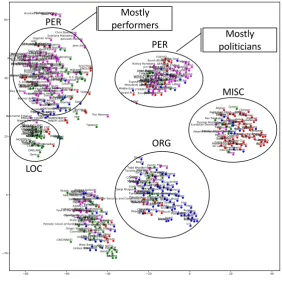
Figure 2: t-SNE visualizations of the entity embeddings learned by Emboot after training completes. Legend: =LOC. =ORG. =PER. =MISC.
features, we used randomly initialized 15d em-beddings. Here we consider patterns to be n -grams of size up to 4 tokens on either side of an entity. For instance, “@ENTITY , former
President” is one of the patterns learned for
the class person. We ran all algorithms for 20 bootstrapping epochs, and the embedding learning component for 100 epochs in each bootstrapping epoch. We add 10 entities and 10 patterns to each category during every bootstrapping epoch.
5 Discussion
Qualitative Analysis
[image:5.595.158.441.265.551.2]grouped together. In particular, Figure 1c shows five clusters, four of which are dominated by one category (and centered around the corresponding seeds), and one, in the upper left corner, with the entities that haven’t yet been added to any of the pools.
Figure 2 shows a more detailed view of the t-SNE projections of entity embeddings after Em-boot’s training completes. Again, this demon-strates that Emboot’s semi-supervised approach clusters most entities based on their (unseen) cate-gories. Interestingly, Emboot learned two clusters for the PER category. Upon a manual inspection of these clusters, we observed that one contains mostly performers (e.g., athletes or artists such as Stephen Ames, a professional golfer), while the other contains many politicians (e.g., Arafat and Clinton). Thus, Emboot learned correctly that, at least at the time when the CoNLL 2003 dataset was created, the context in which politicians and performers were mentioned was different. The cluster in the bottom left part of the figure contains the remaining working pool of patterns, which were not assigned to any category cluster after the training epochs.
Quantitative Analysis
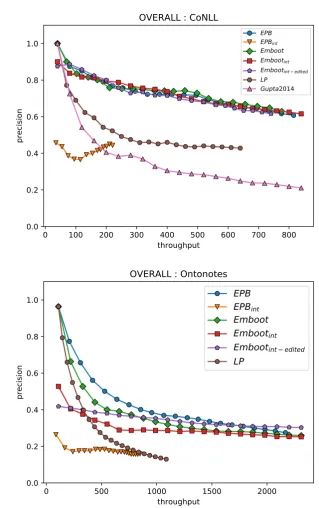
A quantitative comparison of the different models on the two datasets is shown in Figure3.
Figure 3shows that Emboot considerably out-performs LP andGupta and Manning(2014), and has an occasional improvement over EPB. While EPB sometimes outperforms Emboot, Emboot has the potential for manual curation of its model, which we will explore later in this section. This demonstrates the value of our approach, and the importance of custom embeddings.
Importantly, we compare Emboot against: (a) its interpretable version (Embootint), which is
con-structed as a decision list containing the pat-terns learned (and scored) after each bootstrapping epoch, and (b) an interpretable system built simi-larly for EPB (EPBint), using the pretrained Levy
and Goldberg embeddings9rather than our custom ones. This analysis shows that Embootintperforms
close to Emboot on both datasets, demonstrating that most of the benefits of representation learning are available in an interpretable model. Please see
9For multi-word entities, we averaged the embeddings of the individual words in the entity to create an overall entity embedding.
the discussion on the edited interpretable model in the next section.
Importantly, the figure also shows that EPBint,
which uses generic entity embeddings rather than the custom ones learned for the task performs con-siderably worse than the other approaches. This highlights the importance of learning a dedicated distributed representation for this task.
Interpretability Analysis
Is the list of patterns generated by the interpretable model actually interpretable to end users? To in-vestigate this, we asked two linguists to curate the models learned by Embootint, by editing the
list of patterns in a given model. First, the ex-perts performed an independent analysis of all the patterns. Next, the two experts conferred with each other and came to a consensus when their independent decisions on a particular pattern dis-agreed. These first two stages took the experts 2 hours for the CoNLL dataset and 3 hours for the OntoNotes dataset. The experts did not have ac-cess to the original texts the patterns were pulled from, so they had to make their decisions based on the patterns alone. They made one of three de-cisions for each pattern: (1) no change, when the pattern is a good fit for the category; (2) changing the category, when the pattern clearly belongs to a different category; and (3) deleting the pattern, when the pattern is either not informative enough for any category or when the pattern could occur with entities from multiple categories. The experts did not have the option of modifying the content of the pattern, because each pattern is associated with an embedding learned during training. Ta-ble1 shows several examples of the patterns and decision made by the annotators. A summary of the changes made for the CoNLL dataset is given in Figure4, and a summary of the changes made for the OntoNotes dataset is given in Figure5.
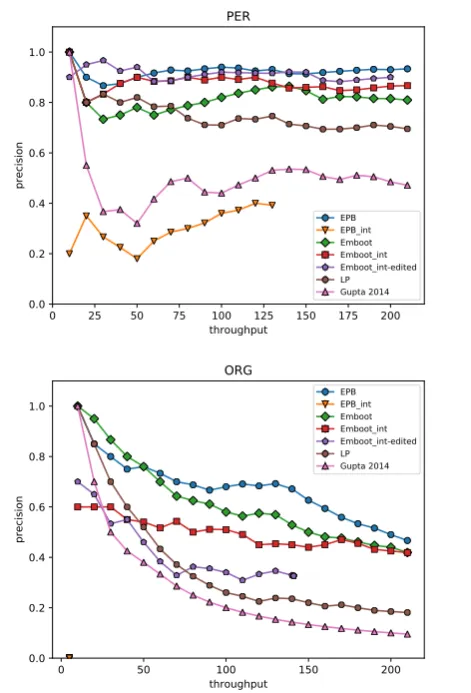
As Figure 3 shows, this edited interpretable model (Embootint-edited) performs similarly to the
enti-0
100
200
300
400
500
600
700
800
throughput
0.0
0.2
0.4
0.6
0.8
1.0
precision
OVERALL : CoNLL
EPB EPBint Emboot Embootint Embootint edited LP
Gupta2014
0
500
1000
1500
2000
throughput
0.0
0.2
0.4
0.6
0.8
1.0
precision
OVERALL : Ontonotes
EPB
EPB
intEmboot
Emboot
intEmboot
int edited [image:7.595.124.444.69.578.2]LP
Figure 3: Overall results on the CoNLL and OntoNotes datasets. Throughput is the number of entities classified, and precision is the proportion of entities that were classified correctly. Please see Sec.4for a description of the systems listed in the legend.
Pattern Original Label Decision Rationale
@ENTITY was the LOC delete the pattern is too broad
@ENTITY ) Ferrari LOC delete the pattern is uninformative
citizen of @ENTITY MISC change to LOC the pattern is more likely to
occur with a location
According to @ENTITY officials ORG no change the pattern is likely to occur
with an organization
[image:7.595.71.526.639.742.2]Figure 4: Summary of expert decisions when editing the Embootintmodel, for the CoNLL dataset by original category. Dark blue (bottom) is no change, medium blue (middle) is deletions, light blue (top) is change of category.
Figure 5: Summary of expert decisions when edit-ing the Embootintmodel, for the OntoNotes dataset by original category. Dark blue (bottom) is no change, medium blue (middle) is deletions, light blue (top) is change of category.
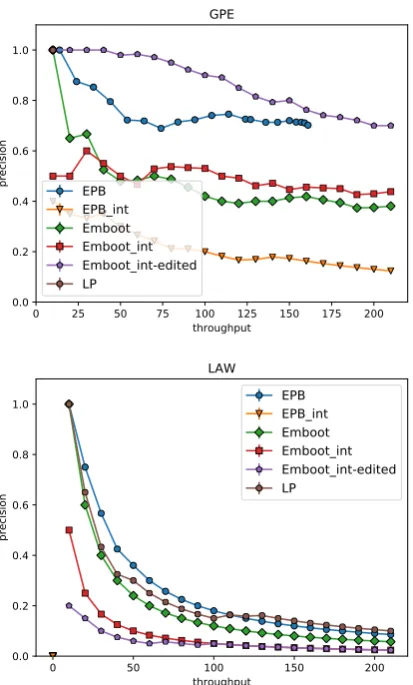
ties (Figure6). We observe a similar pattern with the OntoNotes dataset, where the Embootint-edited
model outperforms the Embootint model greatly
for GPE but not for LAW (Figure 7). Over-all, for OntoNotes, Embootint-edited outperforms
Embootintfor 5 categories out of 11. For the
cat-egories where Embootint-editedperforms worse, the
data is sparse, so few patterns are promoted (30 FAC patterns compared to 200 GPE patterns), and many of them were deleted or changed by the two linguists (14 FAC deletions and 13 FAC changes, with only 3 FAC patterns remaining).
This difference in outcome partially has to do with the amount of local vs. global informa-tion available in the patterns. For example,
lo-0 25 50 75 100 125 150 175 200 throughput
0.0 0.2 0.4 0.6 0.8 1.0
precision
PER
EPB EPB_int Emboot Emboot_int Emboot_int-edited LP
Gupta 2014
0 50 100 150 200
throughput 0.0
0.2 0.4 0.6 0.8 1.0
precision
ORG
EPB EPB_int Emboot Emboot_int Emboot_int-edited LP
Gupta 2014
Figure 6: CoNLL results for PER and ORG. The Embootint-edited model generally outperforms the Embootintmodel when it comes to PER entities, but not for ORG entities. This discrepancy seems to relate to the amount of local information available in PER pat-terns versus ORG patpat-terns that can aid human domain experts in correcting the patterns. The EPBint model (incorrectly) classifies very few entities as ORG, which is why it only shows up as a single point in the bottom left of the lower plot.
cal patterns are common for the PER and MISC categories in CoNLL, and for the GPE category in OntoNotes, e.g., the entity “Syrian” is cor-rectly classified as MISC (which includes de-monyms) due to two patterns matching it in the CoNLL dataset: “@ENTITY President” and
“@ENTITY troops”. In general, the majority
of predictions are triggered by 1 or 2 patterns, which makes these decisions explainable. For the CoNLL dataset, 59% of Embootint’s predictions
are triggered by 1 or 2 patterns; 84% are generated by 5 or fewer patterns; only 1.1% of predictions are generated by 10 or more patterns.
[image:8.595.77.290.322.481.2]0 25 50 75 100 125 150 175 200 throughput
0.0 0.2 0.4 0.6 0.8 1.0
precision
GPE
EPB EPB_int Emboot Emboot_int Emboot_int-edited LP
0 50 100 150 200
throughput 0.0
0.2 0.4 0.6 0.8 1.0
precision
LAW
[image:9.595.84.291.73.416.2]EPB EPB_int Emboot Emboot_int Emboot_int-edited LP
Figure 7: OntoNotes results for GPE and LAW. The Embootint-edited model greatly outperforms both Em-boot and EmEm-bootintmodels when it comes to GPE enti-ties, but not for LAW entities. This discrepancy seems to relate to the amount of local information available in GPE patterns versus LAW patterns that can aid human domain experts in correcting the patterns. EPBintdoes not classify any entities as LAW.
make an accurate judgment on the validity of some patterns—for instance, while the pattern
@ENTITY and Portugal clearly indicates a
geo-political entity, the pattern @ENTITY has been(labeledfacilityoriginally when train-ing on OntoNotes documents) can co-occur with entities from any category. Such patterns are com-mon for the LAW category in OntoNotes, and for the ORG category in CoNLL (due to the focus on sport events in CoNLL, where location names are commonly used as a placeholder for the corre-sponding team), which partially explains the poor curation results on these categories in Figures 6
and7. Additionally, lower performance on certain categories can be partially explained by the small amount of data in those categories and the fact that the edits made by the experts drastically changed
the number of patterns that occur with some cate-gories (see Figures4and5).
6 Conclusion
This work introduced an example of representa-tion learning being successfully combined with traditional, pattern-based bootstrapping for infor-mation extraction, in particular named entity clas-sification. Our approach iteratively learns custom embeddings for multi-word entities and the pat-terns that match them as well as cautiously aug-menting the pools of known examples. This ap-proach outperforms several state-of-the-art semi-supervised approaches to NEC on two datasets, CoNLL 2003 and OntoNotes.
Our approach can also export the model learned into an interpretable list of patterns, which hu-man domain experts can use to understand why an extraction was generated. These patterns can be manually curated to improve the performance of the system by modifying the model directly, with minimal effort. For example, we used a team of two linguists to curate the model learned for OntoNotes in 3 hours. The model edited by human domain experts shows a modest improvement over the unedited model, demonstrating the usefulness of these interpretable patterns. Interestingly, the manual curation of these patterns performed better for some categories that rely mostly on local con-text that is captured by the type of patterns used in this work, and less well for categories that re-quire global context that is beyond then-gram pat-terns used here. This observation raises opportu-nities for future work such as how to learn global context in an interpretable way, and how to adjust the amount of global information depending on the category learned.
7 Acknowledgments
We gratefully thank Yoav Goldberg for his sugges-tions for the manual curation experiments.
References
David S Batista, Bruno Martins, and M´ario J Silva. 2015. Semi-supervised bootstrapping of relation-ship extractors with distributional semantics. InIn Empirical Methods in Natural Language Process-ing. ACL.
Andrew Carlson, Justin Betteridge, Richard C Wang, Estevam R Hruschka Jr, and Tom M Mitchell. 2010. Coupled semi-supervised learning for information extraction. InProceedings of the third ACM inter-national conference on Web search and data mining, pages 101–110. ACM.
Laura Chiticariu, Yunyao Li, and Frederick R Reiss. 2013. Rule-based information extraction is dead! long live rule-based information extraction systems! InEMNLP, October, pages 827–832.
Michael Collins and Yoram Singer. 1999. Unsuper-vised models for named entity classification. In Pro-ceedings of the Conference on Empirical Methods in Natural Language Processing.
Mark W Craven and Jude W Shavlik. 1996. Extracting tree-structured representations of trained networks.
Advances in neural information processing systems, pages 24–30.
Scott Deerwester, Susan T Dumais, George W Fur-nas, Thomas K Landauer, and Richard Harshman. 1990. Indexing by latent semantic analysis. Jour-nal of the American society for information science, 41(6):391–407.
Sonal Gupta and Christopher D Manning. 2014. Im-proved pattern learning for bootstrapped entity ex-traction. InCoNLL, pages 98–108.
Sonal Gupta and Christopher D. Manning. 2015. Dis-tributed representations of words to guide boot-strapped entity classifiers. In Proceedings of the Conference of the North American Chapter of the Association for Computational Linguistics.
Himabindu Lakkaraju and Cynthia Rudin. 2016. Learning cost-effective treatment regimes using markov decision processes.CoRR, abs/1610.06972.
Omer Levy and Yoav Goldberg. 2014. Dependency-based word embeddings. In ACL (2), pages 302– 308.
Laurens van der Maaten and Geoffrey Hinton. 2008. Visualizing data using t-sne. The Journal of Ma-chine Learning Research, 9(2579-2605):85.
Tara McIntosh. 2010. Unsupervised discovery of nega-tive categories in lexicon bootstrapping. In Proceed-ings of the 2010 Conference on Empirical Methods in Natural Language Processing, pages 356–365. Association for Computational Linguistics.
Tara McIntosh and James R Curran. 2008. Weighted mutual exclusion bootstrapping for domain indepen-dent lexicon and template acquisition. In Proceed-ings of the Australasian Language Technology Asso-ciation Workshop, volume 2008.
Tomas Mikolov, Ilya Sutskever, Kai Chen, Greg S Cor-rado, and Jeff Dean. 2013. Distributed representa-tions of words and phrases and their compositional-ity. InAdvances in neural information processing systems, pages 3111–3119.
Nikola Mrkˇsi´c, Ivan Vuli´c, Diarmuid ´O S´eaghdha, Ira Leviant, Roi Reichart, Milica Gaˇsi´c, Anna Korho-nen, and Steve Young. 2017. Semantic special-ization of distributional word vector spaces using monolingual and cross-lingual constraints. Transac-tions of the Association for Computational Linguis-tics, 5:309–324.
Sameer Pradhan, Alessandro Moschitti, Nianwen Xue, Hwee Tou Ng, Anders Bjrkelund, Olga Uryupina, Yuchen Zhang, and Zhi Zhong. 2013. Towards ro-bust linguistic analysis using ontonotes. In Proceed-ings of the Seventeenth Conference on Computa-tional Natural Language Learning, pages 143–152, Sofia, Bulgaria. Association for Computational Lin-guistics.
Marco Tulio Ribeiro, Sameer Singh, and Carlos Guestrin. 2016a. ”why should i trust you?”: Ex-plaining the predictions of any classifier. In Knowl-edge Discovery and Data Mining (KDD).
Marco Tulio Ribeiro, Sameer Singh, and Carlos Guestrin. 2016b. Why should i trust you?: Explain-ing the predictions of any classifier. InProceedings of the 22nd ACM SIGKDD International Conference on Knowledge Discovery and Data Mining, pages 1135–1144. ACM.
Marco Tulio Ribeiro, Sameer Singh, and Carlos Guestrin. 2018. Anchors: High-precision model-agnostic explanations. InAAAI Conference on Ar-tificial Intelligence (AAAI).
Sebastian Riedel, Limin Yao, Andrew McCallum, and Benjamin M Marlin. 2013. Relation extraction with matrix factorization and universal schemas. In Pro-ceedings of NAACL-HLT.
Ellen Riloff. 1996. Automatically generating extrac-tion patterns from untagged text. In Proceedings of the national conference on artificial intelligence, pages 1044–1049.
D. Sculley, Gary Holt, Daniel Golovin, Eugene Davy-dov, Todd Phillips, Dietmar Ebner, Vinay Chaud-hary, and Michael Young. 2014. Machine learning: The high interest credit card of technical debt. In
SE4ML: Software Engineering for Machine Learn-ing (NIPS 2014 Workshop).
minimal supervision. In Proceedings of the Con-ference on Empirical Methods in Natural Language Processing (EMNLP).
Erik F. Tjong Kim Sang and Fien De Meulder. 2003. Introduction to the CoNLL-2003 shared task: Language-independent named entity recognition. In
Proceedings of CoNLL-2003, pages 142–147. Ed-monton, Canada.
Kristina Toutanova, Danqi Chen, Patrick Pantel, Hoi-fung Poon, Pallavi Choudhury, and Michael Gamon. 2015. Representing text for joint embedding of text and knowledge bases. InEMNLP, volume 15, pages 1499–1509. Citeseer.
Kristina Toutanova, Xi Victoria Lin, Wen-tau Yih, Hoi-fung Poon, and Chris Quirk. 2016. Compositional learning of embeddings for relation paths in knowl-edge bases and text. InProceedings of the 54th An-nual Meeting of the Association for Computational Linguistics, volume 1, pages 1434–1444.
Marco A Valenzuela-Esc´arcega, Gus Hahn-Powell, Dane Bell, and Mihai Surdeanu. 2016. Snaptogrid: From statistical to interpretable models for biomed-ical information extraction. In Proceedings of the 15th Workshop on Biomedical Natural Language Processing, pages 56–65.
Roman Yangarber. 2003. Counter-training in discovery of semantic patterns. InProceedings of the Annual Meeting of the Association for Computational Lin-guistics.
David Yarowsky. 1995. Unsupervised word sense dis-ambiguation rivaling supervised methods. In Pro-ceedings of the Annual Meeting of the Association for Computational Linguistics.