Proceedings of NAACL-HLT 2019: Demonstrations, pages 66–71 66
LeafNATS: An Open-Source Toolkit and Live Demo System
for Neural Abstractive Text Summarization
Tian Shi Virginia Tech
Ping Wang Virginia Tech
Chandan K. Reddy Virginia Tech
Abstract
Neural abstractive text summarization (NATS) has received a lot of attention in the past few years from both industry and academia. In this paper, we introduce an open-source toolkit, namely LeafNATS, for training and evalua-tion of different sequence-to-sequence based models for the NATS task, and for deploy-ing the pre-trained models to real-world appli-cations. The toolkit is modularized and ex-tensible in addition to maintaining competi-tive performance in the NATS task. A live news blogging system has also been imple-mented to demonstrate how these models can aid blog/news editors by providing them sug-gestions of headlines and summaries of their articles.
1 Introduction
Being one of the prominent natural language generation tasks, neural abstractive text summa-rization (NATS) has gained a lot of popular-ity (Rush et al., 2015; See et al., 2017; Paulus et al., 2017). Different from extractive text sum-marization (Gambhir and Gupta,2017;Nallapati et al., 2017; Verma and Lee, 2017), NATS re-lies on modern deep learning models, particularly sequence-to-sequence (Seq2Seq) models, to gen-erate words from a vocabulary based on the rep-resentations/features of source documents (Rush et al., 2015;Nallapati et al.,2016), so that it has the ability to generate high-quality summaries that are verbally innovative and can also easily in-corporate external knowledge (See et al., 2017). Many NATS models have achieved better perfor-mance in terms of the commonly used evalua-tion measures (such asROUGE(Lin,2004) score) compared to extractive text summarization ap-proaches (Paulus et al., 2017;Celikyilmaz et al.,
2018;Gehrmann et al.,2018).
We recently provided a comprehensive survey of the Seq2Seq models (Shi et al.,2018), includ-ing their network structures, parameter inference methods, and decoding/generation approaches, for the task of abstractive text summarization. A va-riety of NATS models share many common prop-erties and some of the key techniques are widely used to produce well-formed and human-readable summaries that are inferred from source articles, such as encoder-decoder framework (Sutskever et al., 2014), word embeddings (Mikolov et al.,
2013), attention mechanism (Bahdanau et al.,
2014), pointing mechanism (Vinyals et al.,2015) and beam-search algorithm (Rush et al., 2015). Many of these features have also found applica-tions in other language generation tasks, such as machine translation (Bahdanau et al., 2014) and dialog systems (Serban et al., 2016). In addition, other techniques that can also be shared across different tasks include training strategies ( Good-fellow et al., 2014; Keneshloo et al.,2018; Ran-zato et al.,2015), data pre-processing, results post-processing and model evaluation. Therefore, hav-ing an open-source toolbox that modularizes dif-ferent network components and unifies the learn-ing framework for each trainlearn-ing strategy can ben-efit researchers in language generation from var-ious aspects, including efficiently implementing new models and generalizing existing models to different tasks.
In the past few years, different toolkits have been developed to achieve this goal. Some of them were designed specifically for a single task, such as ParlAI (Miller et al., 2017) for dialog re-search, and some have been further extended to other tasks. For example, OpenNMT (Klein et al.,
has achieved state-of-the-art performance for ab-stractive text summarization, is implemented in OpenNMT. There are also several other general purpose language generation packages, such as Texar (Hu et al., 2018). Compared with these toolkits, LeafNATS is specifically designed for NATS research, but can also be adapted to other tasks. In this toolkit, we implement an end-to-end training framework that can minimize the ef-fort in writing codes for training/evaluation proce-dures, so that users can focus on building models and pipelines. This framework also makes it easier for the users to transfer pre-trained parameters of user-specified modules to newly built models.
In addition to the learning framework, we have also developed a web application, which is driven by databases, web services and NATS models, to show a demo of deploying a new NATS idea to a real-life application using LeafNATS. Such an ap-plication can help front-end users (e.g., blog/news authors and editors) by providing suggestions of headlines and summaries for their articles.
The rest of this paper is organized as follows: Section 2 introduces the structure and design of LeafNATS learning framework. In Section3, we describe the architecture of the live system demo. Based on the request of the system, we propose and implement a new model using LeafNATS for headline and summary generation. We conclude this paper in Section4.
2 LeafNATS Toolkit1
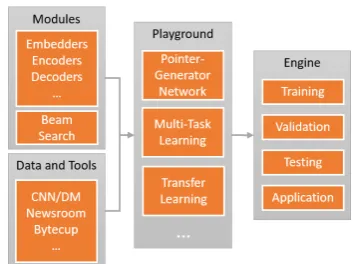
In this section, we introduce the structure and de-sign of LeafNATS toolkit, which is built upon the lower level deep learning platform – Py-torch (Paszke et al., 2017). As shown in Fig. 1, it consists of four main components, i.e., engines, modules, data and tools and playground.
Engines: In LeafNATS, an engine represents a training algorithm. For example, end-to-end training (See et al., 2017) and adversarial train-ing (Goodfellow et al., 2014) are two different training frameworks. Therefore, we need to de-velop two different engines for them.
Specifically for LeafNATS, we implement a task-independent end-to-end training engine for NATS, but it can also be adapted to other NLP tasks, such as NMT, question-answering, senti-ment classification, etc. The engine uses ab-stract data, models, pipelines, and loss functions
[image:2.595.325.502.60.192.2]1https://github.com/tshi04/LeafNATS
Figure 1: The framework of LeafNATS toolkit.
to build procedures of training, validation, test-ing/evaluation and application, respectively, so that they can be completely reused when imple-menting a new model. For example, these proce-dures include saving/loading check-point files dur-ing traindur-ing, selectdur-ing N-best models durdur-ing val-idation, and using the best model for generation during testing, etc. Another feature of this engine is that it allows users to specify part of a neural network to train and reuse parameters from other models, which is convenient for transfer learning.
Modules: Modules are the basic building blocks of different models. In LeafNATS, we provide ready-to-use modules for constructing re-current neural network (RNN)-based sequence-to-sequence (Seq2Seq) models for NATS, e.g., pointer-generator network (See et al., 2017). These modules include embedder, RNN encoder, attention (Luong et al., 2015), temporal atten-tion (Nallapati et al., 2016), attention on decoder (Paulus et al.,2017) and others. We also use these basic modules to assemble a pointer-generator de-coder module and the corresponding beam search algorithms. The embedder can also be used to realize the embedding-weights sharing mecha-nism (Paulus et al.,2017).
Data and Tools: Different models in Leaf-NATS are tested on three datasets (see Table 1), namely, CNN/Daily Mail (CNN/DM) (Hermann et al.,2015), Newsroom (Grusky et al.,2018) and Bytecup2. The pre-processed CNN/DM data is available online3. Here, we provide tools to pre-process the last two datasets. Data modules are used to prepare the input data for mini-batch opti-mization.
Playground:With the engine and modules, we can develop different models by just assembling
2
https://biendata.com/competition/ bytecup2018/
3https://github.com/JafferWilson/
Dataset Train Validation Test CNN/DM 287,227 13,368 11,490 Newsroom 992,985 108,612 108,655
[image:3.595.78.291.62.107.2]Bytecup 892,734 111,592 111,592
Table 1: Basic statistics of the datasets used.
these modules and building pipelines in play-ground. We re-implement different models in the NATS toolkit (Shi et al.,2018) to this framework. The performance (ROUGE scores (Lin,2004)) of the pointer-generator model on different datasets has been reported in Table 2, where we find that most of the results are better than our previous im-plementations (Shi et al.,2018) due to some minor changes to the neural network.
Dataset Model R-1 R-2 R-L Newsroom-S Pointer-Generator 39.91 28.38 36.87 Newsroom-H Pointer-Generator 27.11 12.48 25.47
CNN/DM Pointer-Generator 37.02 15.97 34.18 +coverage 39.26 17.21 36.16 Bytecup Pointer-Generator 40.50 24.57 37.63
Table 2: Performance of our implemented pointer-generator network on different datasets. Newsroom-S and -H represent Newsroom summary and headline datasets, respectively.
3 A Live System Demonstration4
In this section, we present a real-world web appli-cation of the abstractive text summarization mod-els, which can help front-end users to write head-lines and summaries for their articles/posts. We will first discuss the architecture of the system, and then, provide more details of the front-end design and a new model built by LeafNATS that makes automatic summarization and headline generation possible.
3.1 Architecture
This is a news/blog website, which allows people to read, duplicate, edit, post, delete and comment articles. It is driven by web-services, databases and our NATS models. This web application is developed with PHP, HTML/CSS, and jQuery fol-lowing the concept of Model-View-Controller (see Fig.2).
In this framework, when people interact with the front-end views, they send HTML requests to controllers that can manipulate models. Then, the views will be changed with the updated informa-tion. For example, in NATS, we first write an ar-ticle in a text-area. Then, this arar-ticle along with
[image:3.595.321.510.68.156.2]4http://dmkdt3.cs.vt.edu/leafNATS
Figure 2: The architecture of the live system.
the summarization request will be sent to the con-troller via jQuery Ajax call. The concon-troller com-municates with our NATS models asynchronously via JSON format data. Finally, generated head-lines and summaries are shown in the view.
3.2 Design of Frontend
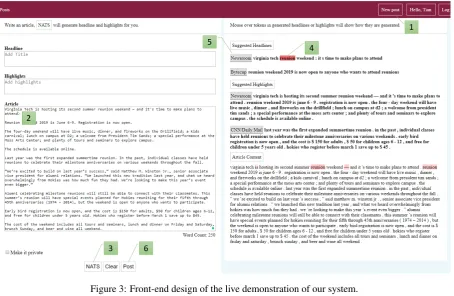
Fig. 4 presents the front-end design of our web application for creating a new post, where labels represent the sequence of actions. In this website, an author can first click on “New Post” (step 1) to bring a new post view. Then, he/she can write content of an article in the corresponding text-area (step 2) without specifying it’s headline and high-lights, i.e., summary. By clicking “NATS” but-ton (step 3) and waiting for a few seconds, he/she will see the generated headlines and highlights for the article in a new tab on the right hand side of the screen. Here, each of the buttons in gray color denotes the resource of the training data. For example, “Bytecup” means the model is trained with Bytecup headline generation dataset. The tokenized article content is shown in the bottom. Apart from plain-text headlines and highlights, our system also enables users to get a visual under-standing of how each word is generated via at-tention weights (Luong et al.,2015). When plac-ing the mouse tracker (step 4) on any token in the headlines or highlights, related content in the ar-ticle will be labeled with red color. If the author would like to use one of the suggestions, he/she can click on the gray button (step 5) to add it to the text-area on the left hand side and edit it. Fi-nally, he/she can click “Post” (step 6) to post the article.
3.3 The Proposed Model
mod-Figure 3: Front-end design of the live demonstration of our system.
Figure 4: Overview of the model used to generate head-lines and summaries.
ules provided in LeafNATS toolkit to assemble a new model (see Fig.4), which has a shared embed-ding layer, a shared encoder layer, a task specific encoder-decoder (Bi-LSTM encoder and pointer-generator decoder) layer and a shared output layer.
To train this model, we first build a multi-task learning pipeline for Newsroom dataset to learn parameters for the modules that are colored in or-ange in Fig.4, because (1) articles in this dataset have both headlines and highlights, (2) the size of the dataset is large, and (3) the articles come from a variety of news agents. Then, we build a trans-fer learning pipeline for CNN/Daily and Byte-cup dataset, and learn the parameters for modules labeled with blue and green color, respectively. With LeafNATS, we can accomplish this work ef-ficiently.
The performance of the proposed model on the
Dataset Model R-1 R-2 R-L
Newsroom-S multi-task 39.85 28.37 36.91 Newsroom-H multi-task 28.31 13.40 26.64
[image:4.595.74.529.62.358.2]CNN/DM transfer 35.55 15.19 33.00 +coverage 38.49 16.78 35.68 Bytecup transfer 40.92 24.51 38.01
Table 3: Performance of our model.
corresponding testing sets are shown in Table 3. From the table, we observe that our model per-forms better in headline generation tasks. How-ever, the ROUGE scores in summarization tasks are lower than the models without sharing embed-ding, encoder and output layers. It should be noted that by sharing the parameters, this model requires less than 20 million parameters to achieve such performance.
4 Conclusion
[image:4.595.84.279.368.469.2]Acknowledgments
This work was supported in part by the US Na-tional Science Foundation grants IIS-1619028, IIS-1707498 and IIS-1838730.
References
Dzmitry Bahdanau, Kyunghyun Cho, and Yoshua Ben-gio. 2014. Neural machine translation by jointly learning to align and translate. arXiv preprint arXiv:1409.0473.
Asli Celikyilmaz, Antoine Bosselut, Xiaodong He, and Yejin Choi. 2018. Deep communicating agents for abstractive summarization. In Proceedings of the 2018 Conference of the North American Chapter of the Association for Computational Linguistics: Hu-man Language Technologies, Volume 1 (Long Pa-pers), volume 1, pages 1662–1675.
Mahak Gambhir and Vishal Gupta. 2017. Recent auto-matic text summarization techniques: a survey. Ar-tificial Intelligence Review, 47(1):1–66.
Sebastian Gehrmann, Yuntian Deng, and Alexander Rush. 2018. Bottom-up abstractive summarization. In Proceedings of the 2018 Conference on Empiri-cal Methods in Natural Language Processing, pages 4098–4109.
Ian Goodfellow, Jean Pouget-Abadie, Mehdi Mirza, Bing Xu, David Warde-Farley, Sherjil Ozair, Aaron Courville, and Yoshua Bengio. 2014. Generative ad-versarial nets. In Advances in neural information processing systems, pages 2672–2680.
Max Grusky, Mor Naaman, and Yoav Artzi. 2018. Newsroom: A dataset of 1.3 million summaries with diverse extractive strategies. In Proceedings of the 2018 Conference of the North American Chapter of the Association for Computational Linguistics: Hu-man Language Technologies, Volume 1 (Long Pa-pers), volume 1, pages 708–719.
Karl Moritz Hermann, Tomas Kocisky, Edward Grefenstette, Lasse Espeholt, Will Kay, Mustafa Su-leyman, and Phil Blunsom. 2015. Teaching ma-chines to read and comprehend. InAdvances in Neu-ral Information Processing Systems, pages 1693– 1701.
Zhiting Hu, Haoran Shi, Zichao Yang, Bowen Tan, Tiancheng Zhao, Junxian He, Wentao Wang, Xingjiang Yu, Lianhui Qin, Di Wang, et al. 2018. Texar: A modularized, versatile, and extensi-ble toolkit for text generation. arXiv preprint arXiv:1809.00794.
Yaser Keneshloo, Tian Shi, Chandan K Reddy, and Naren Ramakrishnan. 2018. Deep reinforcement learning for sequence to sequence models. arXiv preprint arXiv:1805.09461.
Guillaume Klein, Yoon Kim, Yuntian Deng, Jean Senellart, and Alexander Rush. 2017. Opennmt: Open-source toolkit for neural machine translation. Proceedings of ACL 2017, System Demonstrations, pages 67–72.
Chin-Yew Lin. 2004. ROUGE: A package for auto-matic evaluation of summaries. Text Summarization Branches Out.
Thang Luong, Hieu Pham, and Christopher D Man-ning. 2015. Effective approaches to attention-based neural machine translation. In Proceedings of the 2015 Conference on Empirical Methods in Natural Language Processing, pages 1412–1421.
Tomas Mikolov, Ilya Sutskever, Kai Chen, Greg S Cor-rado, and Jeff Dean. 2013. Distributed representa-tions of words and phrases and their compositional-ity. InAdvances in neural information processing systems, pages 3111–3119.
Alexander Miller, Will Feng, Dhruv Batra, Antoine Bordes, Adam Fisch, Jiasen Lu, Devi Parikh, and Jason Weston. 2017. Parlai: A dialog research soft-ware platform. In Proceedings of the 2017 Con-ference on Empirical Methods in Natural Language Processing: System Demonstrations, pages 79–84.
Ramesh Nallapati, Feifei Zhai, and Bowen Zhou. 2017. Summarunner: A recurrent neural network based se-quence model for extractive summarization of docu-ments. InThirty-First AAAI Conference on Artificial Intelligence.
Ramesh Nallapati, Bowen Zhou, Cicero dos Santos, C¸ a glar Gulc¸ehre, and Bing Xiang. 2016. Abstrac-tive text summarization using sequence-to-sequence RNNs and beyond. CoNLL 2016, page 280.
Graham Neubig, Matthias Sperber, Xinyi Wang, Matthieu Felix, Austin Matthews, Sarguna Pad-manabhan, Ye Qi, Devendra Singh Sachan, Philip Arthur, Pierre Godard, et al. 2018. Xnmt: The ex-tensible neural machine translation toolkit. Vol. 1: MT Researchers Track, page 185.
Adam Paszke, Sam Gross, Soumith Chintala, Gre-gory Chanan, Edward Yang, Zachary DeVito, Zem-ing Lin, Alban Desmaison, Luca Antiga, and Adam Lerer. 2017. Automatic differentiation in pytorch.
Romain Paulus, Caiming Xiong, and Richard Socher. 2017. A deep reinforced model for abstractive sum-marization.arXiv preprint arXiv:1705.04304.
Marc’Aurelio Ranzato, Sumit Chopra, Michael Auli, and Wojciech Zaremba. 2015. Sequence level train-ing with recurrent neural networks. arXiv preprint arXiv:1511.06732.
Abigail See, Peter J. Liu, and Christopher D. Manning. 2017. Get to the point: Summarization with pointer-generator networks. InProceedings of the 55th An-nual Meeting of the Association for Computational Linguistics (Volume 1: Long Papers), pages 1073– 1083. Association for Computational Linguistics.
Iulian Vlad Serban, Alessandro Sordoni, Yoshua Ben-gio, Aaron C Courville, and Joelle Pineau. 2016. Building end-to-end dialogue systems using gener-ative hierarchical neural network models.
Tian Shi, Yaser Keneshloo, Naren Ramakrishnan, and Chandan K Reddy. 2018. Neural abstractive text summarization with sequence-to-sequence models. arXiv preprint arXiv:1812.02303.
Ilya Sutskever, Oriol Vinyals, and Quoc V Le. 2014. Sequence to sequence learning with neural net-works. InAdvances in neural information process-ing systems, pages 3104–3112.
Rakesh M. Verma and Daniel Lee. 2017. Extractive summarization: Limits, compression, generalized model and heuristics. Computaci´on y Sistemas, 21.