USAAR-CHRONOS: Crawling the Web for Temporal Annotations
Liling Tan and Noam Ordan
Universit¨at des Saarlandes
Campus A2.2, Saarbr¨ucken, Germany
[email protected], [email protected]
Abstract
This paper describes the USAAR-CHRONOS participation in the Diachronic Text Evalua-tion task of SemEval-2015 to identify the time period of historical text snippets. We adapt a web crawler to retrieve the original source of the text snippets and determine the publi-cation year of the retrieved texts from their URLs. We report a precision score of>90% in identifying the text epoch. Additionally, by crawling and cleaning the website that hosts the source of the text snippets, we present
Daikon, a corpus that can be used for fu-ture work on epoch identification from a di-achronic perspective.
1 Introduction
”Time changes all things: there is no reason why language should escape this universal law” (De Saussure, 1959). Traditionally, there are two ways to collect linguistic data to explore how words change over time, viz. (i) the ‘armchair’ method and (ii) the ‘tape-recorder’ method (Aitchison, 2001). In the first, the linguist cross-examines numerous doc-uments from bygone years and in the latter, the lin-guist goes around recording language and studies the changes as they happen.
With the ingress of historical data provided by Google (Michel et al. 2011), the ‘armchair’ method goes into warp speed as computational linguists ex-plore the different facets of lexical changes in En-glish (Mihalcea and Nastase, 2012; Popescu and Strapparava, 2013; Niculae et al., 2014).
This paper presents the Saarland University (USAAR-CHRONOS) participation in the Di-achronic Text Evaluation task in SemEval-2015. We participated in Subtask 1 that requires participants to identify the year of publication for texts with clear reference to time anchors (i.e. explicit references to famous persons or events).
1.1 Task Definition
In Subtask 1 of the Diachronic Text Evaluation par-ticipants are required to identify the epoch (i.e. time period) of a text snippet with clear reference to cer-tain famous persons or events. The text snippets may not necessarily contain temporal information such as year or date but it has clear reference to a historical event that can be identified from external knowledge bases. For instance, given the following text, partic-ipants are required to identify its epoch:
“Dictator Saddam Hussein ordered his troops to march into Kuwait. After the invasion is condemned by the UN Security Council, the US has forged a coalition with allies. Today American troops are sent to Saudi Arabia in Operation Desert Shield, protecting Saudi Arabia from possible attack.”
The text has clear temporal evidence with refer-ence to a historical figure (“Saddam Hussein”), a notable organization (“UN Security Council”) and a factual event (“Operation Desert Shield”). Histori-cally, we know that Saddam Hussein lived between 1937 to 2006, that the UN Security Council has ex-isted since 1946 and that Operation Desert Shield (i.e. the Gulf War) occurred between 1990-1991. Given the specific chronic deicticity (“today”) that indicates that the text is published during the Gulf
War, we can conceive that the text snippet should be dated 1990-1991.
For each text snippet, different epoch choices are provided at three granularity levels; fine, medium and coarse graded epochs, and they are assigned the time periods of 3, 6 and 12 years, respectively. For the given example above, the correct epochs are 1990-1992, 1988-1993 and 1985-1995 for the three granularity levels respectively.
2 Related Work
Michel et al. (2011) launch the field of culturo-nomicsto study changes in human culture through language change; for this, they release ngrams taken from millions of digitized books; they show, for ex-ample, that censorship and suppression can be de-termined by comparing the frequencies of proper names in multilingual ngrams in this dataset.
Mihalcea and Nastase (2012) explore word sense disambiguation over time using snippets from Google Books; they add a semantic dimension on top of lexical frequency to conduct word epoch dis-ambiguation based on the fact that words change their neighbors throughout time.
The Google Ngram corpus has spawned several related studies. To create a sense pool, Yu et al. (2007) extract pairs of ngrams and filter them with an appropriate statistical test using their frequen-cies, where the resulting sense pool is manually ver-ified. Interestingly, their experiments conflate the ngrams across time, yet it is unclear whether the resulting sense pool contains ngrams across differ-ent epochs. Juola (2013) uses the bigrams from the Google Books Ngram dataset to measure changes in the Kolmogorov complexity of American culture at ten-year intervals between 1900 and 2000. Related to this, ˇStajner and Zampieri (2013) show, for Por-tuguese, that lexical richness, average word length and lexical density increase over a span of 400 years. Topic models are also applied to study topical changes across epochs (e.g. (Blei and Lafferty, 2007; Wijaya and Yeniterzi, 2011)). Related to epoch identification, Wang and McCallum (2006) develop time-specific topic models to a time stamp prediction task.
With the renaissance of neural nets, recent stud-ies are using deep neural language models to detect
diachronic lexical changes from several text types ranging from published books (Kim et al., 2014) to Twitter microblogs and Amazon movie reviews (Kulkarni et al., 2014).
3 Approach
We take a different approach compared to previous studies that treat epoch identification as a classifica-tion task. We see it as an informaclassifica-tion retrieval task where we want to know whether we can get the tem-poral information of the text snippets from the Inter-net.
In the age where there is a contest (known as “Googlewhack”) for finding one-hit results on Google since they are so rare , it is clear that a great deal of the information we are looking for is just “out there” for us to search. It is recommended to use ma-chine learning classifiers for cases where test data is supposedly unknown, but more often than not it can be known by those who know how to retrieve, clean and harvest systematically.
Prior to the days of Google and search engines, historians and librarians1had to cross-reference
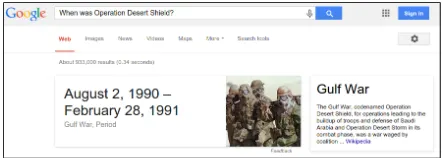
[image:2.612.312.533.449.528.2]his-tory books and newspaper archives to identify the text epoch. The Internet is vast and infinite. Given the advent of Wikipedia and Google, epoch identifi-cation can be as simple as searching “When was Op-eration Desert Shield?” on Google2(see Figure 1).
Figure 1: Google Result for “When was Operation Desert Shield?”.
search- and crawl-system for the purpose of knowl-edge extraction.
Surprisingly, the source of the all the text snippets of Subtask 1 is found on
http://freepages.genealogy.rootsweb
.ancestry.com/∼dutillieul and
http://archive.spectator.co.uk/.
Moreover, these webpages contain dates in their URL, so we extract the publication year with regex pattern matching. Since the task requires an epoch (time period) instead of a discrete publication year, we perform some minor integer manipulation to fit the publication year to the expected epoch3.
4 Results
Out of the 267 text snippets, our system correctly identifies 243, 248, 252 epochs for the fine, medium and coarse epoch granularities.
Fine Medium Coarse AMBRA 0.0374 0.0711 0.0749 IXA-EHUDIAC 0.0225 0.0413 0.0902 USAAR-CHRONOS 0.9288 0.9101 0.9438
Table 1: Precision scores on Subtask 1.
Table 1 presents the precision scores of the partic-ipating teams in subtask 1. Our system scores best on all three granularity levels.
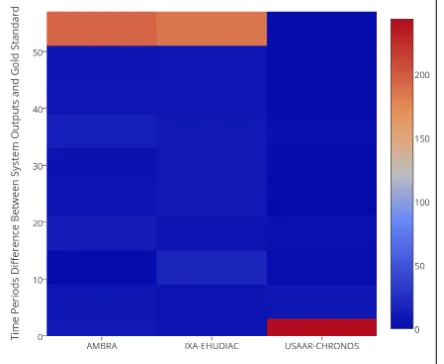
Figure 2 shows a heatmap of the fine graded epochal (6 years interval) differences between the outputs and the gold standard4. The warm colors
in-dicate higher values within the interval. Looking at the orange region of the heatmap, the other systems were way off in the epoch identification where re-spectively, AMBRA and IXA-EHUDIAC have 195 and 186 predictions that are 54 years off from the gold standards. We have a total of 24 predictions different from the gold standard and 9 out 24 were 6 years off from the gold standards.
5 Discussion
We have manually checked our epoch predictions and the years encoded in the URL to check whether they correspond to the date of the source articles.
3Details on http://goo.gl/TcZ9z0
[image:3.612.314.536.65.247.2]4An interactive version of the heatmap can be viewed on https://plot.ly/ alvations/21/epochs-differential/
Figure 2: Fine Graded Epoch Differential between Sys-tems outputs and Gold Standards (warmer colors indi-cates higher values).
Some of our predictions are dated older than the gold standards and vice versa.
For instance, the following text refers to theBattle of Salamancaon 22 July 1812 and the text snippet is from a battle report written on 16 August 1812 and published on 24 August 1812 in the Salisbury and Winchester Journal; the gold annotation records the epoch as 1813-1815 whereas our system reports 1810-1812.
“On Thursday last, the 69th Annual Conference of the people called Methodists, was concluded. It had been held by adjournment in Leeds from the 27th ult. About 309 Itinerant Preachers were present from various parts of the United Kingdom, who gave very gratifying accounts of the success with which their ministry have been crowned.”
In this case, the gold standard source is clearly a different source and the assumption that there are hard boundaries in epoch identification should be re-laxed. One should consider different granularity lev-els of the epochs involved when evaluating the sys-tem’s accuracy.
6 Daikon Corpus
After the SemEval task, we crawled the full articles from
http://archive.spectator.co.uk/,
cleaned the corpus and annotated it with the exact publication date of the article, its title and the URL from which it was retrieved. The Daikon Corpus is made up of articles from the British Spectator news magazine from year 828 to 2008.
The Daikon corpus can be used for future di-achronic studies and epoch identification tasks; it provides a complementary dataset to the gold stan-dard provided by task. The corpus is saved in JSON format. An excerpt from the corpus looks like this:
Figure 3: An Excerpt from the Daikon Corpus.
Each item in the body list is a paragraph embed-ded within the<p>...</p>tags of the webpage. The corpus contains 24,280 articles with 19 million tokens; the token count is calculated by summing the number of whitespaces plus 1 for each paragraph.
To clean the corpus, the encodings are converted to Unicode (UTF8) and XML escape tokens are con-verted to its Unicode counterparts automatically5.
However, the current version still contains minor to-kenization errors such as the hyphenation error seen in Figure 3. Probably, a character language model could be developed to identify lexical items bounded by the r‘\w+- \w+’ regex.
7 Conclusion
In this paper, we have described our submission to the Diachronic Text Evaluation for SemEval-2015. 5The cleaning tool used is a compilation of web cleaning scripts (Emerson et al., 2014; Tan et al., 2014b; Tan and Bond, 2011)
We have adapted a web crawler to search for the source of the text snippets used for the evaluation and achieved the highest precision score. Addi-tionally, we have crawled and cleaned the source articles of the snippets and produced the Daikon
corpus that can be used for future research in di-achronic/temporal analysis and epoch identification.
Acknowledgements
The research leading to these results has received funding from the People Programme (Marie Curie Actions) of the European Union’s Seventh Frame-work Programme FP7/2007-2013/ under REA grant agreement n◦317471. In addition, we received
sup-port from Deutsche Forschungsgemeinschaft (DFG) through grants from the Cluster of Excellence – Multimodal Computing and Interaction (EXC-MMCI) and SFB 1102. We thank Elke Teich for her encouraging input.
References
Jean Aitchison. 2001. Language Change: Progress or
Decay? Cambridge University Press.
Marco Baroni and Silvia Bernardini. 2004. BootCaT: Bootstrapping Corpora and Terms from the Web. In
Proceedings of the Fourth International Conference on
Language Resources and Evaluation (LREC’04).
David M Blei and John D Lafferty. 2007. A Correlated Topic Model of Science.The Annals of Applied Statis-tics, pages 17–35.
Ferdinand De Saussure. 1959. Course in General
Lin-guistics. New York:McGrawHill.
Guy Emerson, Liling Tan, Susanne Fertmann, Alexis Palmer, and Michaela Regneri. 2014. SeedLing: Building and Using a Seed corpus for the Human Lan-guage Project. InProceedings of the 2014 Workshop on the Use of Computational Methods in the Study
of Endangered Languages, pages 77–85, Baltimore,
Maryland, USA, June.
Patrick Juola. 2013. Using the Google N-Gram corpus to Measure Cultural Complexity. Literary and linguistic computing, 28(4):668–675.
Yoon Kim, Yi-I Chiu, Kentaro Hanaki, Darshan Hegde, and Slav Petrov. 2014. Temporal Analysis of Language through Neural Language Models. arXiv preprint arXiv:1405.3515.
Jean-Baptiste Michel, Yuan Kui Shen, Aviva Presser Aiden, Adrian Veres, Matthew K Gray, Joseph P Pick-ett, Dale Hoiberg, Dan Clancy, Peter Norvig, Jon Or-want, et al. 2011. Quantitative Analysis of Cul-ture using Millions of Digitized Books. science, 331(6014):176–182.
Rada Mihalcea and Vivi Nastase. 2012. Word Epoch Disambiguation: Finding how Words Change over Time. InProceedings of the 50th Annual Meeting of the Association for Computational Linguistics: Short Papers-Volume 2, pages 259–263.
Vlad Niculae, Marcos Zampieri, Liviu P. Dinu, and Alina Maria Ciobanu. 2014. Temporal Text Ranking and Automatic Dating of Texts. InProceedings of the 14th Conference of the European Chapter of the Asso-ciation for Computational Linguistics (EACL 2014). Octavian Popescu and Carlo Strapparava. 2013. Behind
the Times: Detecting Epoch Changes using Large Cor-pora. InProceedings of 6th International Joint Con-ference on Natural Language Processing (IJCNLP). Sanja ˇStajner and Marcos Zampieri. 2013. Stylistic
Changes for Temporal Text Classification. In Pro-ceedings of the 16th International Conference on Text Speech and Dialogue (TSD2013), Lecture Notes in Artificial Intelligence (LNAI), pages 519–526, Pilsen, Czech Republic. Springer.
Liling Tan and Francis Bond. 2011. Building and An-notating the Linguistically Diverse NTU-MC (NTU-Multilingual Corpus). InProceedings of the 25th Pa-cific Asia Conference on Language, Information and Computation, pages 362–371, Singapore.
Liling Tan, Anne Schumann, Jose Martinez, and Fran-cis Bond. 2014a. Sensible: L2 Translation Assis-tance by Emulating the Manual Post-Editing Process. InProceedings of the 8th International Workshop on Semantic Evaluation (SemEval 2014), pages 541–545, Dublin, Ireland.
Liling Tan, Marcos Zampieri, Nikola Ljubeˇsic, and J¨org Tiedemann. 2014b. Merging Comparable Data Sources for the Discrimination of Similar Languages: The DSL Corpus Collection. InProceedings of The 7th Workshop on Building and Using Comparable
Corpora (BUCC).
Xuerui Wang and Andrew McCallum. 2006. Topics over Time: A Non-Markov Continuous-Time Model of Topical Trends. In Proceedings of the 12th ACM SIGKDD international conference on Knowledge dis-covery and data mining, pages 424–433.
Derry Tanti Wijaya and Reyyan Yeniterzi. 2011. Under-standing Semantic Change of Words over Centuries. InProceedings of the 2011 international workshop on DETecting and Exploiting Cultural diversiTy on the social web, pages 35–40.
Liang-Chih Yu, Chung-Hsien Wu, Andrew Philpot, and EH Hovy. 2007. OntoNotes: Sense Pool Verification using Google N-gram and Statistical Tests. In Pro-ceedings of the OntoLex Workshop at the 6th