540
What Goes Into A Word: Generating Image Descriptions
With Top-Down Spatial Knowledge
Mehdi Ghanimifard Simon Dobnik
Centre for Linguistic Theory and Studies in Probability (CLASP) Department of Philosophy, Linguistics and Theory of Science (FLoV)
University of Gothenburg, Sweden
{mehdi.ghanimifard,simon.dobnik}@gu.se
Abstract
Generating grounded image descriptions re-quires associating linguistic units with their corresponding visual clues. A common method is to train a decoder language model with attention mechanism over convolutional visual features. Attention weights align the stratified visual features arranged by their lo-cation with tokens, most commonly words, in the target description. However, words such as spatial relations (e.g. next to and under) are not directly referring to geometric arrange-ments of pixels but to complex geometric and conceptual representations. The aim of this pa-per is to evaluate what representations facil-itate generating image descriptions with spa-tial relations and lead to better grounded lan-guage generation. In particular, we investigate the contribution of four different representa-tional modalities in generating relarepresenta-tional re-ferring expressions: (i) (pre-trained) convolu-tional visual features, (ii) spatial attention over visual features, (iii) top-down geometric re-lational knowledge between objects, and (iv) world knowledge captured by contextual em-beddings in language models.
1 Introduction
Spatial recognition and reasoning are essential bases for visual understanding. Automatically generating descriptions of scenes involves both recognising objects and their spatial configuration. This project follows up on recent attempts to im-prove language generation and understanding in terms of using spatial modules in the fusion of vi-sion and language (Xu et al.,2015;Johnson et al., 2016;Lu et al., 2017;Hu et al., 2017;Anderson et al.,2018) (see also Section6).
Generating spatial descriptions is an important part of the image description task which requires several types of knowledge obtained from differ-ent modalities: (i) invariant visual clues for object identification, (ii) geometric configuration of the
scene representing relations between objects rel-ative to the size of the environment (iii) object-specific functional relations that capture interac-tion between them and are formed by our knowl-edge of the world for examplean umbrella is over a man is true if the referring umbrella serves its function, protecting the man from the rain (Coven-try et al., 2001), and (iv) for projective relations (e.g. “to the left of” and “above”) but not topo-logical relations (e.g. “close” and “at”), the frame of reference which can be influenced from other modalities such as scene attention and dialogue in-teraction (Dobnik et al.,2015). Work in cognitive psychology (Logan,1994,1995) argues that while object identification may be pre-attentive, identi-fication of spatial relations is not and is accom-plished by a top-down mechanisms of attention af-ter the objects have been identified. It is also the case that we do not identify all possible relations between objects but only those that are attended by such top-down mechanisms considering differ-ent kinds of high-level knowledge.
Experiments on training neural recurrent lan-guage models in a bottom-up fashion from data1 demonstrated that spatial relations are frequently not learned to be grounded in visual inputs (Lu et al.,2017;Tanti et al.,2018a;Ghanimifard and Dobnik,2018) which has been attributed to the de-sign choices of these models that primarily focus on identification of objects (Kelleher and Dobnik, 2017). Therefore, targeted integration of differ-ent modalities is required to capture the properties from (i) to (iv). We can do this top-down (Ander-son et al.,2018;Hu et al.,2017;Liu et al.,2017). However, it is not immediately obviouswhatkind of top-down spatial knowledge will benefit the bottom-up models most. Therefore, in this paper we investigate the integration of different kind of
1A bottom-up learning acquires higher level
representa-tions from examples of local features rather than using an
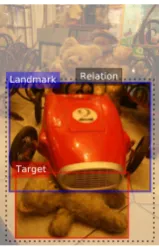
h“teddy bear”, “partially under”, “go cart”i Figure 1: hTARGET,RELATION,LANDMARKi
annota-tion of bounding boxes in VisualGenome 2318741a
aRaSeLaSeD Il Pinguino(2008): CC BY-SA 2.0.
top-down spatial knowledge beyond object locali-sation represented as features with the bottom-up neural language model.
The paper is organised as follows. In Sec-tion 2, we discuss how spatial descriptions are constructed and what components are required to generate descriptions. In Section3, the neural net-works’ design is explained. In Section4, we ex-plain what dataset is used for this study, what pre-processing was applied on it and how the mod-els are trained. Then the experiments and evalu-ation results are presented in Section 5. The re-lated work in relation to our methods and findings is discussed in Section6. The conclusion is given in Section7.
2 Generating Spatial Descriptions
When describing a scene, there are several ways to construct spatial descriptions referring to objects and places and their relation with each other. A spatial description has three parts: aTARGET and
aLANDMARKreferring to objects or places and a
RELATIONdenoting the location of the target in
re-lation to the landmark (Logan and Sadler,1996).2 These are in the example in Figure1as follows: There isa teddy bear
TARGET
partially under
RELATION
a go cart
LANDMARK
.
Therefore generating such description requires (a) identification of objects and their locations: the target is what we want to describe and the land-mark is what we will relate the target to; the salience of the landmark is important for the hearer. (b) Grounding of the relation in
geomet-2Sometimes these are also known asreferentandrelatum
(Miller and Johnson-Laird,1976),figureandground(Talmy,
1983) orthe located objectand the reference object ( Her-skovits,1986;Gapp,1994;Dobnik,2009).
ric space: the spatial relation is expressed relative to the landmark which grounds a 3-dimensional coordinate system; furthermore, for projective re-lations, the coordinate system is aligned with the orientation of the external viewpoint which de-termines the frame of reference (Maillat, 2003). (Viewpoint may also be the landmark object itself in which case the coordinate system is oriented in the same way as the landmark). (c) Grounding in function: a spatial relation may be selected also based on the functional properties between target and landmark objects, e.g. the difference between “the teapot is over the cup” and “the teapot is above the cup” (Coventry et al.,2001).
Generating spatial descriptions requires know-ing the intended target object and how we want to convey its location to the listener. The bottom-up approach in image captioning is focused on learn-ing the salience of objects and events to generate captions expressed in the dataset (e.g. Xu et al. (2015)). The combination of bottom-up and top-down approaches for generating descriptions use modularisation in order to improve the generation of descriptions of different kind (e.g. You et al. (2016)). However, as we have seen in the preced-ing discussion, the generation of spatial descrip-tions requires a highly specific geometric knowl-edge. How is this knowledge approximated by the bottom-up models? To what degree can we integrate this knowledge with the top-down mod-els? In this paper, we investigate these questions in a language generation task by comparing differ-ent variations of included top-down spatial knowl-edge. More specifically, for each image, we gener-ate a description for every pair of objects that are localised in the image. We consider a variety of top-down spatial knowledge representations about objects as inputs to the model: (a) explicit ob-ject localisation and extraction of visual features; (b) explicit identification of the target-landmark by specifying their order in the feature vector; and (c) explicit geometric representation of objects in a 2D image. We investigate the contribution of each of these sets of features to generation of image de-scriptions.
3 Neural Network Design
configura-tions. There are several design choices with small effects on the performance but costly in terms of parameter size (Tanti et al.,2018b). Therefore, if there is no research question related to that choice, we take the simplest choice as reported in the pre-vious work such as (Lu et al., 2017; Anderson et al.,2018). We use the following configurations:
1. Simple bottom-up encoder-decoder;
2. Bottom-up object localisation with attention; 3. Top-down object annotated localisation; 4. Top-down target and landmark assignment; 5. Two methods of top-down representation of
geometric features (s-features).
These five configurations give us 10 variations of the model design as shown in Table 1. A de-tailed definition of each module is given in the Ap-pendixAin the supplementary material.
Generative language model We use a simple forward recurrent neural model with cross-entropy loss in all model configurations.
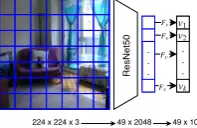
Simple encoder-decoder An encoder-decoder architecture without spatial attention shown in Figure3a and similar to (Vinyals et al., 2015) is the simplest baseline for fusing vision and lan-guage. The input to the model is an image and the start symbol<s>of a description and the output is produced by the language model decoder. The embeddings are randomly initialised and learned as a parameter set of the model. The visual vec-tors are produced by a pre-trained ResNet50 (He et al.,2016). A multi-layer perceptron module (Fv
in Figure2) is used to fine-tune the visual features.
224 x 224 x 3 49 x 2048 49 x 100 . . .
. . .
R
e
sN
e
t5
[image:3.595.130.229.527.591.2]0
Figure 2: Visual features are obtained from the pre-trained ResNet50, then translated to a low dimensional vector with a dense layerFv.
Bottom-up localisation With visual feature rep-resenting all regions of the image as in Figure2, the attention mechanism is used as a localisation module. We generalised the adaptive attention in-troduced in (Lu et al.,2017) to be able to fuse the modalities. As shown in Figure 3b, the interac-tion between the atteninterac-tion mechanism and the lan-guage model is more similar to (Anderson et al., 2018): two layers of stacked LSTM, the first stack
(LSTMa) to produce the features for the attention
model and the second stack (LSTMl) to produce
contextualised linguistic features which are fused with the attended visual features. This design is easier to extend with additional top-down vectors. Top-down localisation Unlike the bottom-up unsupervised localisation, the top-down method includes a provision of a list regions of inter-est (ROI) from external procedures. For exam-ple, the region proposals can come from another bottom-up task as in (Anderson et al.,2018; John-son et al.,2016) which use a Faster R-CNN (Ren et al.,2015) to extract possible regions of interest from the ConvNets regions in Figure2. Here, as shown in Figure4we use the bounding box anno-tations of objects in images as the top-down local-isation knowledge and then extract ResNet50 vi-sual features from these regions. In the first stage the top-down visual representation only proposes visual vectors of the two objects in a random order without their spatial role as targets and landmarks in the descriptions. The model is shown in Fig-ure3d.
Top-down target-landmark assignment In the second iteration of the top-down localisation mod-ule we assign semantic roles to regions as targets and landmarks. This is directly related to locali-sation as spatial relations are asymmetric. We en-code this top-down knowledge by fixing the order of the regions in the feature vector. The first object is the target and the second object is the landmark. Otherwise, the model is the same as in the previ-ous iteration shown in Figure3d.
rep-Model name Regions Of Interest TARGET-LANDMARK s-features Architecture
simple - - - Figure3a
bu49 Bottom-up (7⇥7 grid) Bottom-up attention - Figure3b
bu49+mask Bottom-up (7⇥7 grid) Bottom-up attention Multi-hot 98 Figure3c
bu49+VisKE Bottom-up (7⇥7 grid) Bottom-up attention Dense 11 Figure3c
td Top-down (2 bbox) Bottom-up attention - Figure3d
td+mask Top-down (2 bbox) Bottom-up attention Multi-hot 98 Figure3e
td+VisKE Top-down (2 bbox) Bottom-up attention Dense 11 Figure3e
td order Top-down (2 bbox) Top-down assignment - Figure3d
td order+mask Top-down (2 bbox) Top-down assignment Multi-hot 98 Figure3e
[image:4.595.109.487.61.174.2]td order+VisKE Top-down (2 bbox) Top-down assignment Dense 11 Figure3e
Table 1: The 10 variations of the neural network model after incrementally adding modules and features.
(a)
Attention ...
(b)
Attention
...
(c)
Attention
(d)
Attention
[image:4.595.88.506.206.342.2](e)
Figure 3: Five architectures: (a) simple encoder-decoder (simple). (b) bottom-up localisation with adaptive at-tention on 49 regions (bu49). (c) bottom-up localisation with explicit spatial vectors of the bounding boxes bu49+mask/bu49+VisKE. (d) top-down localisation with attentions on two bounding boxes (td). (e) top-down
localisation augmented with explicit spatial vectors of the bounding boxes (td+mask/td+VisKE).
R
e
sN
e
t5
0
A
vg
R
e
sN
e
t5
0
A
vg
[image:4.595.114.244.408.480.2]224 x 224 x 3 2048 100
Figure 4: Top-down localisation of objects with bound-ing boxes whose visual features are extracted and trans-lated to lower dimensions withFv.
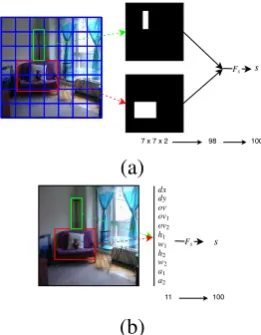
resentations of the top-down geometric features shown in Figure5: Multi-hot mask over 49 vec-tors independently for target and landmark (Mask) over 49 locations (Figure5a) andVisKE(Sadeghi et al.,2015) dense representations with 11 geomet-ric features (Figure5b) wheredx,dyare changes
in the coordinates of the centres, ov,ov1,ov2 the overlapping areas (total, relative to the first, and the second bounding box), h1,h2 heights, w1,w2 widths anda1,a2 areas. Note thatMask features provide geometric information about the size and the location of objects relative to the picture frame andVisKEfeature provide more detailed geomet-ric information that expresses the relation between the objects. The latter therefore more closely match the features that were identified in spatial cognitive models. A feed-forward network with
two layers (Fs) is used to project geometric
fea-tures into a vector with the same dimensionality as the Fv outputs so that different modalities are
comparable in weighted sum model of attention.
7 x 7 x 2 98 100
(a)
11 100
(b)
Figure 5: (a) Each bounding box is converted to a mask of multi-hot vector on 49 regions. (b) The geometric re-lation between the two bounding boxes are represented with features from (Sadeghi et al.,2015).
4 Dataset and Training
[image:4.595.350.481.471.639.2]hsubject,predicate,objecti on 108K images. Un-like image captioning datasets such as MSCOCO (Chen et al.,2015) and Flickr30K (Plummer et al., 2015) where only 5 captions are given for each im-age, each image in this dataset is annotated with 50 phrases. The annotators were asked to anno-tate relations between two given bounding boxes of subject and object by freely writing the text for each of the three parts of the annotation. The bounding boxes produced by another annotation procedure which detected objects in the images. In total, there are 2,316,104 annotations of 664,805
unique triplets, 35,744 unique labels of subjects
and 21,299 unique labels of objects most of which
consist of multiple tokens. We omit all repeti-tions of triplets on each image, this leaves total 1,614,055 annotations.3
Spatial relations Based on the lists of spatial prepositions in (Landau, 1996) and (Herskovits, 1986), we have created a dictionary of spatial re-lations and their possible multi-word variants in-cluding their composite forms. This dictionary contains 7,122 entries of 235 relations (e.g. right
to represent both on the right hand side of and
to the right of). Of these only 202 are found in Visual Genome dataset covering 79 spatial rela-tions. 328,966 unique triplets in Visual Genome
are based on exactly one of these terms which cov-ers 49.4% of all possible relationships.4
Bounding boxes Each bounding box is a tuple of 4 numbers(x,y,w,h). We normalise the num-bers to the range of(0,1)relative to the image size to create geometric feature vectors (Section 3). The image is split into a grid with 7x7 cells to which bounding boxes are mapped, one bounding box potentially covering more than one cell. With this bounding box granularity, there are exactly 308,330 possible bounding boxes. However, only
151,974 are observed in the relationships dataset.
3The repetitions include reflexive expressions (e.g. horse
next to horse), annotations of several objects of the same type
(e.g. cup on table), and repetitions due to several bounding
box annotations of the same objects with different sizes.
4Other triplets in Visual Genome also have spatial
con-tent. Some of them include modifiers such aspartially under
as in Figure1and some of them are descriptions of an event
or an action such assitting onandjumping over. Some
anno-tated relationships are verbs such asflyingwith less obvious
spatial denotation. The spatial bias in the dataset was studied in (Collell et al.,2018). The most frequent spatial relation in
the dataset is “on” (over 450K instances), the second place
is “in” (150K instances), then “with”, variations of “behind”,
“near”, “top”, “next”, “under”, “front”, and “by” (less than 10K instances each).
The spatial distribution of paired objects reflects how natural pictures are framed and how related objects are understood by annotators.
Pre-processing We first removed duplicate triplets describing the same image. Then we converted each triplet into a word sequence by concatenating the strings and de-tokenising them with the white space separator. This produced a corpus with a vocabulary of 26,530 types with
a maximum sequence length of 16 tokens and on average 15 referring expressions per image. We use 95% of the descriptions for training and 5% for validation and testing (5,230 images with 80,231 triplets).
Training We use Keras (Chollet et al., 2015) with TensorFlow backend (Abadi et al., 2015) to implement and train all of the neural network ar-chitectures in Section 3. The models are trained with the Adam optimiser (Kingma and Ba,2014) (a =0.001, b1 =0.9, b2=0.999) with a batch size of 128 and 15 epochs.
5 Evaluation
All implementations are available online5.
5.1 Qualitative Examples
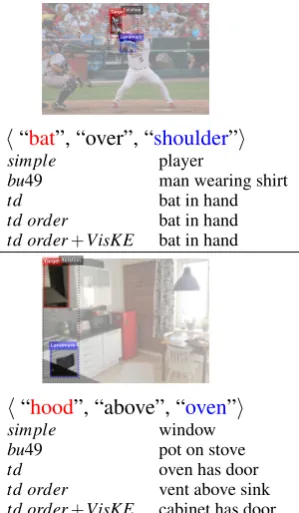
Figure6shows generated descriptions for two ex-amples of unseen pictures from the test dataset by five models. The generated word sequence is that with the lowest loss using beam search withk=5. The first example shows exactly how top-down lo-calisation of objects is important especially if the goal is to refer to specific objects in the scene. In the second example, the visual features inside the bounding box are confusing for all 5 models. More examples are in Figure13in the Appendix.
5.2 Overall Model Performance
Hypothesis Top-down spatial knowledge im-proves the model performance. We consider three categories of down spatial knowledge: (i) down localisation of regions of interest; (ii) top-down assignment of semantic roles to regions; and (iii) two kinds of geometric feature vectors. Method After training the models we evaluate them by calculating the average word level cross-entropy loss on held out instances in the test set6.
5https://gu-clasp.github.io/generate_
spatial_descriptions/
h“bat”, “over”, “shoulder”i
simple player
bu49 man wearing shirt
td bat in hand
td order bat in hand
td order+VisKE bat in hand
h“hood”, “above”, “oven”i
simple window
bu49 pot on stove
td oven has door
td order vent above sink
[image:6.595.309.524.62.280.2]td order+VisKE cabinet has door
Figure 6: From VisualGenome: 2412051a2413282b
aHerholz(2005): CC BY-SA 2.0. bjuanjogasp(2013): CC BY-NC-SA 2.0.
We also calculate the loss on descriptions contain-ing specific spatial relations for qualitative under-standing of the effects of each type of top-down knowledge.
Results The overall loss of each model on the unseen descriptions of images is shown in Fig-ure7. The fully bottom-up model with no spatial attention (simple) has the highest loss. The loss in the variations of the model with bottom-up local-isation inbu49 is higher than the one in the mod-els with top-down localisation. The modmod-els with the top-down assignment ofTARGET-LANDMARK
[image:6.595.118.268.63.320.2]achieves the best results. The effect of top-down geometric features is not significant.
Figure 7: Cross-entropy loss of different model config-urations on evaluation data.
Figure8 shows the performance of the models on a selection spatial relations.
Figure 8: Cross-entropy loss of different model con-figurations on 40 descriptions for each relation: near, inside,aboveandbelow.
Discussion The top-down localisation (td) cer-tainly improves the performance of the language models compared to purely bottom-up representa-tions. However, additional top-down assignment
of TARGET-LANDMARK (td order) and their
ad-ditional geometric arrangement of bounding box features (maskandVisKe) has a small positive ef-fect on overall performance. The overall perfor-mance is not a representative of how these con-figurations effect the grounding of spatial rela-tions. More specifically, the imbalance of certain groups of relations (especially a generally lower proportion of geometrically biased relations such as “left” and “right” in this dataset and the pres-ence of relations with a minimum spatial content such ashas,wearing) makes it harder to make con-clusions about overall performance of the models. We further examine two groups of some frequent spatial relations. The relations such asinsideand
near represent one group and above and below
represent the other. Some top-down knowledge (as represented by our features) is less informa-tive for the first group but is informainforma-tive for the second group. For exampleneardoes not require the assignment ofTARGET-LANDMARKroles. We
observe thattd orderis not performing better than
td. On the other hand,insideis sensitive toTAR
-GET-LANDMARKassignment. However, since the
relation is also restricted by a choice of objects (only certain objects can be inside others) their
[image:6.595.113.250.602.691.2]inferred without such top-down knowledge from a language model. For the second group, the top-down knowledge about the semantic role of ob-jects is important. However, left and right are among the least frequent relations in the dataset which is demonstrated by the fact that their de-scriptions have a higher loss than above and be-low. For these relations the loss of the simple
model is much higher than other configurations. It can be seen thattdis performing better thanbu
andtd orderis contributing overtdbut geometric features have a lesser effect than identification of semantic roles (td order).
5.3 Grounding in features
Hypotheses With the aim to evaluatewhat top-down information contributed to grounding of words we examine the following hypotheses:
H1 s-features contribute to predicting spatial
re-lation words.
H2 Without top-downTARGET-LANDMARKrole
assignments to each region, attention is uni-formly distributed over region choices at the beginning of a sequence generation.
Method In order to check the contribution of each feature from different modalities in predic-tion of each word, we look at the adaptive atten-tion on each feature at the point of predicting the word7. Since feature vectors are not normalised against the number of features of each modality, we first multiply each attention measure with the magnitude of the feature vector, and then we nor-malised it to sum to 1 again:
t,fi=
↵t,fi||fi||
Âj↵t,fj||fj||
(1)
wheret refers to the time in the word sequence, and fiis the feature the attention of which↵t,fi is
applied to it. We report the average t,fi over the
instances in the validation dataset.
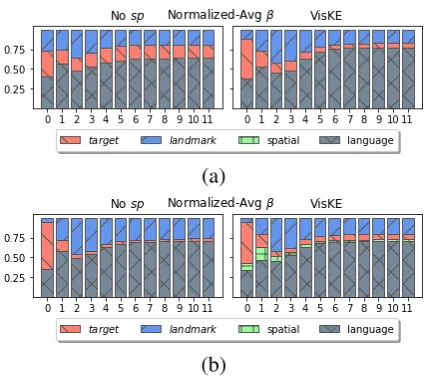
Figure 9 shows on two examples in three models. For each word, the bar chart is divided between four features (in Figure 3e): (1) target
vob j1 (2) landmarkvob j2 (3)s-features for bound-ing boxes (4) contextualized embeddbound-ingshl.
7In this experiment, we do not check if the estimated
[image:7.595.308.524.59.303.2]like-lihood for the correct word is the highest predicted score. The generated descriptions may still be acceptable with an alter-native spatial relation. Furthermore, in the following analysis we report the attention over semantic roles and not individual words.
Figure 9: is plotted in bar charts for each word. (a) td order+VisKE(b)td+VisKE(c)td. The values of for each word that constitute description referring to each bounding box region is given in images.
After measuring the normalised attention on each feature according to Equation 1, we report the average of attentions on each token at that time step of the word sequence. We also group the to-kens based on their semantic role in the triplets and report the average on these tokens for a given role.
Results The average of attentions over triplets of tokens is plotted in Figure10. The behaviour of attentions on word sequences in the four models in given in Figure11.
[image:7.595.308.524.547.701.2](a)
[image:8.595.74.287.63.251.2](b)
Figure 11: The average of attentions of top-down models over sequences of words 1. . . 11 (a) compar-ingtdandtd+VisKEand (b) comparingtd orderand
td order+VisKE.
Discussion The comparison of 6 models in Fig-ure 10 shows that geometric mask s-features
are not contributing as well as dense VisKE s
-features. In the models without top-down seman-tic role assignment only the model with+VisKE features has the expected attention on target and landmark, but there is no attention on the s
-features. In the models with top-down semantic role assignment, the model withVisKEs-features
has higher attention ons-features when predicting
a relation word (H1). A similar situation is observ-able over word sequences in Figure11. Without prior semantic role assignment the model is more confused how to attend target or landmark (H2). Finally, note that geometricVisKEs-features help
predicting the TARGET-LANDMARK roles when
these are not assigned top-down.
6 Related Work
Generating referring expressions Generating locative expressions is part of the general field of generating referring expressions (Dale and Re-iter,1995;Krahmer and van Deemter,2011) with applications such as describing scenes (Viethen and Dale, 2008) and images (Mitchell et al., 2012). The research on describing visible objects (Mitchell et al., 2013) and human-robot dialogue (Kelleher and Kruijff,2006) raised question about grounding relations in hierarchical representation of context. Application of neural language models and using convolutional neural networks for en-coding visual features is an open question in inter-active GRE tasks.
Encoder-decoder models with attention Re-cently several methods focused on finding better neural architectures for generating image descrip-tions based on pre-trained convolutional neural networks have been introduced.Karpathy and Fei-Fei(2015) align descriptions with images. Vinyals et al.(2015) introduce an encoder-decoder frame-work.Xu et al.(2015) improve this approach with spatial attention. Lu et al.(2017) introduce adap-tive attention that balances language and visual embeddings. The attention measure provides an explanation of encoder-decoder architectures on how each modality contributes to language gen-eration. Based on the attended features the per-formance of these models can be examined (Liu et al., 2017;Ghanimifard and Dobnik,2018). In our paper, we develop a model similar to the adap-tive attention which exploits its expressive aspects as a degree of grounding in different features.
differ-ent spatial information is facilitating as a top-down knowledge to generate descriptions of scenes with neural language models.
Modular design Our paper examines strategies that can demonstrate language grounding within a neural architecture. The studies of neural archi-tectures such as (Tanti et al.,2018b) provide ana-lytical insight on differences between multimodal architectures for language generation. The modu-lar design is mostly used in language parsing tasks such as (Hu et al.,2017) where object recognition, localisation and relation recognition are separate modules for grounding different parts of image de-scriptions in images in order to solve tasks such as visual question answering. In our paper, the mod-ularity of the neural architecture is not focused on parsing text but used to incrementally demonstrate the contribution of each introduced modality to language generation.
Multimodal embeddings There are related studies on learning multimodal embeddings (Kiros et al.,2014;Lazaridou et al.,2015) to represent vi-sion and language in the same semantic space. The focus of our paper is to investigate how these dif-ferent modalities complement each other in neural language generation. In our models, the semantic representations of spatial relations are considered as a separate modality extending both the language and visual embeddings. There are related studies on encoding spatial knowledge in feature space in order to predict spatial prepositions (Ramisa et al.,2015) or on prepositional embeddings which can predict regions in space (Collell and Moens, 2018). In our paper, we investigate the degree in which each embedding contributes to language generation within the neural language model.
7 Conclusions
We explored the effects of encoding top-down spa-tial knowledge in a bottom-up trained generative neural language model for the image description task. The findings of the experiments in this paper are as follows:
(1) Overall, integration of top-down knowledge has a positive effect on grounded neural language models for this task. (2) When combining bottom-up language grounding with top-down knowledge representation as different features, different types of top-down knowledge have different contribu-tion to grounded language models. The general
picture is further complicated by the fact that dif-ferent spatial relations have difdif-ferent bias to differ-ent knowledge. (3) The performance gain from the geometric features extracted from bounding boxes (s-features) is smaller than initially expected, with
two possible explanations related to the nature of the corpora of image descriptions: (i) The corpus contains images of typical scenes where the rela-tion of objects with each other is predictable from the description and therefore is captured in the lan-guage model; (ii) As annotators are focused on describing “what is in the image” rather “where things are spatially in relation to each other”, de-scriptions of geometric spatial relations which re-fer to the locational information are rare in the cor-pus. (4) The majority of attention is placed on the language model which demonstrates that this pro-vides significant information when generating spa-tial descriptions. While this may be a confound-ing factor if the visual features are ignored, the language model also encodes useful information about spatial information as discussed in (Kulka-rni et al.,2011;Dobnik et al.,2018).
The results open several questions about grounded language models. Firstly, the degree to which the system is using each modality can be affected by dataset biases and this should be taken into account in the forthcoming work. Given this bias, learning a single common language model for descriptions of spatial scenes is insufficient as different kinds of knowledge may come to focus in different interactional scenarios. This further sup-ports the idea that top-down integration of knowl-edge is required where we hope that the models will learn to attend to the appropriate features. Secondly, our investigation leaves open the ques-tion whether the representaques-tions both visual and geometric that we use are good representations for learning spatial relations. Further work will in-clude a focused investigation of what kind of geo-metric relations they encode.
Acknowledgements
References
Mart´ın Abadi, Ashish Agarwal, Paul Barham, Eugene Brevdo, Zhifeng Chen, Craig Citro, Greg S. Cor-rado, Andy Davis, Jeffrey Dean, Matthieu Devin, Sanjay Ghemawat, Ian Goodfellow, Andrew Harp, Geoffrey Irving, Michael Isard, Yangqing Jia, Rafal Jozefowicz, Lukasz Kaiser, Manjunath Kudlur, Josh Levenberg, Dandelion Man´e, Rajat Monga, Sherry Moore, Derek Murray, Chris Olah, Mike Schus-ter, Jonathon Shlens, Benoit Steiner, Ilya Sutskever, Kunal Talwar, Paul Tucker, Vincent Vanhoucke, Vijay Vasudevan, Fernanda Vi´egas, Oriol Vinyals, Pete Warden, Martin Wattenberg, Martin Wicke, Yuan Yu, and Xiaoqiang Zheng. 2015. TensorFlow: Large-scale machine learning on heterogeneous sys-tems. Software available from tensorflow.org.
Peter Anderson, Xiaodong He, Chris Buehler, Damien Teney, Mark Johnson, Stephen Gould, and Lei Zhang. 2018. Bottom-up and top-down attention for image captioning and visual question answering. CVPR, 3(5):6.
Xinlei Chen, Hao Fang, Tsung-Yi Lin, Ramakr-ishna Vedantam, Saurabh Gupta, Piotr Doll´ar, and C Lawrence Zitnick. 2015. Microsoft coco captions: Data collection and evaluation server. arXiv preprint arXiv:1504.00325.
Franc¸ois Chollet et al. 2015. Keras. https://keras. io.
Michael Coghlan. 2011. Tony cook. VisualGenome image id 2413371.
Guillem Collell and Marie-Francine Moens. 2018. Learning representations specialized in spatial knowledge: Leveraging language and vision. Trans-actions of the Association of Computational Linguis-tics, 6:133–144.
Guillem Collell, Luc Van Gool, and Marie-Francine Moens. 2018. Acquiring common sense spatial knowledge through implicit spatial templates. In Thirty-Second AAAI Conference on Artificial Intel-ligence.
Kenny R Coventry, Merce Prat-Sala, and Lynn Richards. 2001. The interplay between geometry and function in the comprehension of over, under, above, and below. Journal of memory and language, 44(3):376–398.
Robert Dale and Ehud Reiter. 1995. Computational interpretations of the Gricean maxims in the gen-eration of referring expressions. Cognitive science, 19(2):233–263.
Simon Dobnik. 2009. Teaching mobile robots to use spatial words. Ph.D. thesis, University of Oxford: Faculty of Linguistics, Philology and Phonetics and The Queen’s College, Oxford, United Kingdom.
Simon Dobnik, Mehdi Ghanimifard, and John D. Kelleher. 2018. Exploring the functional and ge-ometric bias of spatial relations using neural lan-guage models. InProceedings of the First Interna-tional Workshop on Spatial Language Understand-ing (SpLU 2018) at NAACL-HLT 2018, pages 1– 11, New Orleans, Louisiana, USA. Association for Computational Linguistics.
Simon Dobnik, Christine Howes, and John D. Kelle-her. 2015. Changing perspective: Local alignment of reference frames in dialogue. InProceedings of goDIAL – Semdial 2015: The 19th Workshop on the Semantics and Pragmatics of Dialogue, pages 24– 32, Gothenburg, Sweden.
Desmond Elliott and Frank Keller. 2013. Image de-scription using visual dependency representations. In Proceedings of the 2013 Conference on Empiri-cal Methods in Natural Language Processing, pages 1292–1302.
Desmond Elliott and Arjen de Vries. 2015. Describ-ing images usDescrib-ing inferred visual dependency repre-sentations. InProceedings of the 53rd Annual Meet-ing of the Association for Computational LMeet-inguistics and the 7th International Joint Conference on Natu-ral Language Processing (Volume 1: Long Papers), volume 1, pages 42–52.
Klaus-Peter Gapp. 1994. Basic meanings of spatial re-lations: computation and evaluation in 3D space. In Proceedings of the twelfth national conference on Artificial Intelligence (AAAI’94), volume 2, pages 1393–1398, Menlo Park, CA, USA. American Asso-ciation for Artificial Intelligence, AAAI Press/MIT Press.
Mehdi Ghanimifard and Simon Dobnik. 2018. Know-ing when to look for what and where: EvaluatKnow-ing generation of spatial descriptions with adaptive at-tention. In Proceedings of the 1st Workshop on Shortcomings in Vision and Language (SiVL’18), ECCV, 2018.
Kaiming He, Xiangyu Zhang, Shaoqing Ren, and Jian Sun. 2016. Deep residual learning for image recog-nition. In Proceedings of the IEEE conference on computer vision and pattern recognition, pages 770– 778.
Dave Herholz. 2005. Wide stance. VisualGenome im-age id 2412051.
Annette Herskovits. 1986. Language and spatial cog-nition: an interdisciplinary study of the preposi-tions in English. Cambridge University Press, Cam-bridge.
Sepp Hochreiter and J¨urgen Schmidhuber. 1997. Long short-term memory. Neural computation, 9(8):1735–1780.
relationships in referential expressions with compo-sitional modular networks. In Proceedings of the IEEE Conference on Computer Vision and Pattern Recognition, pages 1115–1124.
Justin Johnson, Andrej Karpathy, and Li Fei-Fei. 2016. Densecap: Fully convolutional localization net-works for dense captioning. InProceedings of the IEEE Conference on Computer Vision and Pattern Recognition, pages 4565–4574.
juanjogasp. 2013. Baltic trip. VisualGenome image id 2413282.
Andrej Karpathy and Li Fei-Fei. 2015. Deep visual-semantic alignments for generating image descrip-tions. In Proceedings of the IEEE conference on computer vision and pattern recognition, pages 3128–3137.
John D. Kelleher and Simon Dobnik. 2017. What is not where: the challenge of integrating spatial represen-tations into deep learning architectures. In Proceed-ings of the Conference on Logic and Machine Learn-ing in Natural Language (LaML 2017), Gothenburg, 12 –13 June, volume 1 of CLASP Papers in Com-putational Linguistics, pages 41–52, Gothenburg, Sweden. Department of Philosophy, Linguistics and Theory of Science (FLOV), University of Gothen-burg, CLASP, Centre for Language and Studies in Probability.
John D. Kelleher and Geert-Jan M. Kruijff. 2006. In-cremental generation of spatial referring expressions in situated dialog. In Proceedings of the 21st In-ternational Conference on Computational Linguis-tics and 44th Annual Meeting of the Association for Computational Linguistics, pages 1041–1048, Syd-ney, Australia. Association for Computational Lin-guistics.
Diederik P Kingma and Jimmy Ba. 2014. Adam: A method for stochastic optimization. arXiv preprint arXiv:1412.6980.
Ryan Kiros, Ruslan Salakhutdinov, and Rich Zemel. 2014. Multimodal neural language models. In In-ternational Conference on Machine Learning, pages 595–603.
Emiel Krahmer and Kees van Deemter. 2011. Compu-tational generation of referring expressions: A sur-vey. Computational Linguistics, 38(1):173–218. Ranjay Krishna, Yuke Zhu, Oliver Groth, Justin
John-son, Kenji Hata, Joshua Kravitz, Stephanie Chen, Yannis Kalantidis, Li-Jia Li, David A Shamma, et al. 2017. Visual genome: Connecting language and vision using crowdsourced dense image anno-tations. International Journal of Computer Vision, 123(1):32–73.
Girish Kulkarni, Visruth Premraj, Sagnik Dhar, Sim-ing Li, Yejin Choi, Alexander C Berg, and Tamara L Berg. 2011. Baby talk: Understanding and generat-ing image descriptions. InProceedings of the 24th CVPR. Citeseer.
Barbara Landau. 1996. Multiple geometric representa-tions of objects in languages and language learners. Language and space, pages 317–363.
Angeliki Lazaridou, Marco Baroni, et al. 2015. Com-bining language and vision with a multimodal skip-gram model. In Proceedings of the 2015 Confer-ence of the North American Chapter of the Associ-ation for ComputAssoci-ational Linguistics: Human Lan-guage Technologies, pages 153–163.
Chenxi Liu, Junhua Mao, Fei Sha, and Alan Yuille. 2017. Attention correctness in neural image cap-tioning. In Thirty-First AAAI Conference on Arti-ficial Intelligence.
Gordon D Logan. 1994. Spatial attention and the ap-prehension of spatial relations. Journal of Experi-mental Psychology: Human Perception and Perfor-mance, 20(5):1015.
Gordon D Logan. 1995. Linguistic and conceptual control of visual spatial attention. Cognitive psy-chology, 28(2):103–174.
Gordon D. Logan and Daniel D. Sadler. 1996. A com-putational analysis of the apprehension of spatial re-lations. In Paul Bloom, Mary A. Peterson, Lynn Nadel, and Merrill F. Garrett, editors,Language and Space, pages 493–530. MIT Press, Cambridge, MA.
Jiasen Lu, Caiming Xiong, Devi Parikh, and Richard Socher. 2017. Knowing when to look: Adaptive at-tention via a visual sentinel for image captioning. In Proceedings of the IEEE Conference on Computer Vision and Pattern Recognition (CVPR), volume 6.
Didier Maillat. 2003. The semantics and pragmat-ics of directionals: a case study in English and French. Ph.D. thesis, University of Oxford: Com-mittee for Comparative Philology and General Lin-guistics, Oxford, United Kingdom.
George A. Miller and Philip N. Johnson-Laird. 1976. Language and perception. Cambridge University Press, Cambridge.
Margaret Mitchell, Kees van Deemter, and Ehud Reiter. 2013. Generating expressions that refer to visible
objects. InProceedings of the 2013 Conference of
the North American Chapter of the Association for Computational Linguistics: Human Language Tech-nologies, pages 1174–1184, Atlanta, Georgia. Asso-ciation for Computational Linguistics.
Bryan A Plummer, Liwei Wang, Chris M Cervantes, Juan C Caicedo, Julia Hockenmaier, and Svetlana Lazebnik. 2015. Flickr30k entities: Collecting region-to-phrase correspondences for richer image-to-sentence models. In Proceedings of the IEEE international conference on computer vision, pages 2641–2649.
Arnau Ramisa, JK Wang, Ying Lu, Emmanuel Del-landrea, Francesc Moreno-Noguer, and Robert Gaizauskas. 2015. Combining geometric, textual and visual features for predicting prepositions in im-age descriptions. InProceedings of the 2015 Con-ference on Empirical Methods in Natural Language Processing, pages 214–220. Association for Com-putational Linguistics.
RaSeLaSeD Il Pinguino. 2008. Killer bear. Visu-alGenome image id 2318741.
Shaoqing Ren, Kaiming He, Ross Girshick, and Jian Sun. 2015. Faster r-cnn: Towards real-time ob-ject detection with region proposal networks. In Advances in neural information processing systems, pages 91–99.
Fereshteh Sadeghi, Santosh K Kumar Divvala, and Ali Farhadi. 2015. Viske: Visual knowledge extraction and question answering by visual verification of re-lation phrases. In Proceedings of the IEEE con-ference on computer vision and pattern recognition, pages 1456–1464.
Jared Schmidt. 2010. Desk 2010-08-08. Visu-alGenome image id 2413204.
Leonard Talmy. 1983. How language structures space. In Herbert L. Pick Jr. and Linda P. Acredolo, editors, Spatial orientation: theory, research, and applica-tion, pages 225–282. Plenum Press, New York.
Marc Tanti, Albert Gatt, and Kenneth P Camilleri. 2018a. Quantifying the amount of visual informa-tion used by neural capinforma-tion generators. In Proceed-ings of the European Conference on Computer Vi-sion (ECCV), pages 0–0.
Marc Tanti, Albert Gatt, and Kenneth P Camilleri. 2018b. Where to put the image in an image cap-tion generator. Natural Language Engineering, 24(3):467–489.
Jette Viethen and Robert Dale. 2008. The use of spa-tial relations in referring expression generation. In Proceedings of the Fifth International Natural Lan-guage Generation Conference, pages 59–67. Asso-ciation for Computational Linguistics.
Oriol Vinyals, Alexander Toshev, Samy Bengio, and Dumitru Erhan. 2015. Show and tell: A neural im-age caption generator. InComputer Vision and Pat-tern Recognition (CVPR), 2015 IEEE Conference on, pages 3156–3164. IEEE.
Kelvin Xu, Jimmy Ba, Ryan Kiros, Kyunghyun Cho, Aaron Courville, Ruslan Salakhudinov, Rich Zemel, and Yoshua Bengio. 2015. Show, attend and tell: Neural image caption generation with visual at-tention. In International Conference on Machine Learning, pages 2048–2057.
Brian Yap. 2008. New england highway. Visu-alGenome image id 2417890.