ORIGINAL ARTICLE
Improved Ant Colony-Genetic Algorithm
for Information Transmission Path Optimization
in Remanufacturing Service System
Lei Wang
1,2, Xu‑Hui Xia
1*, Jian‑Hua Cao
1,2, Xiang Liu
2and Jun‑Wei Liu
1Abstract
The information transmission path optimization (ITPO) can often affect the efficiency and accuracy of remanufactur‑ ing service. However, there is a greater degree of uncertainty and complexity in information transmission of remanu‑ facturing service system, which leads to a critical need for designing planning models to deal with this added uncer‑ tainty and complexity. In this paper, a three‑dimensional (3D) model of remanufacturing service information network for information transmission is developed, which combines the physic coordinate and the transmitted properties of all the devices in the remanufacturing service system. In order to solve the basic ITPO in the 3D model, an improved 3D ant colony algorithm (Improved AC) was put forward. Moreover, to further improve the operation efficiency of the algorithm, an improved ant colony‑genetic algorithm (AC‑GA) that combines the improved AC and genetic algorithm was developed. In addition, by taking the transmission of remanufacturing service demand information of certain roller as example, the effectiveness of AC‑GA algorithm was analyzed and compared with that of improved AC, and the results demonstrated that AC‑GA algorithm was superior to AC algorithm in aspects of information transmission delay, information transmission cost, and rate of information loss.
Keywords: Remanufacturing service, Information transmission, Path optimization, Ant colony algorithm, Genetic algorithm
© The Author(s) 2018. This article is distributed under the terms of the Creative Commons Attribution 4.0 International License (http://creat iveco mmons .org/licen ses/by/4.0/), which permits unrestricted use, distribution, and reproduction in any medium, provided you give appropriate credit to the original author(s) and the source, provide a link to the Creative Commons license, and indicate if changes were made.
1 Introduction
As a key line in reversed supply chain, remanufactur-ing is an important approach to realize the recyclremanufactur-ing of retired products and economy sustainable develop-ment [1]. Since Lund proposed remanufacturing concept [2], researchers from home and abroad have conducted many researches on remanufacturing technology [3, 4], remanufacturing planning and scheduling [5, 6], reman-ufacturing evaluation and decision [7] and achieved substantial findings. Remanufacturing service (RMS) [8] is a web-based remanufacturing and service model based on information technology and cloud manufac-turing technology [9]. Remanufacturing service process involves various types of massive data including demand
information, manufacturing and processing informa-tion, logistics information. The main information flow is shown in Figure 1.
As remanufacturing service process is a highly cus-tomized process involving information in various types and large amount, a series of problems will be gener-ated in construction of information platform and information service process. For example, there is sig-nificant difference in type, usage degree, and remanu-facturability of waste products, which increases the difficulty degree in information preprocessing, waste product resource classification and remanufacturable product information collection. The customer demand of remanufacturing service is of diversity and random-ness, and the incoming time and initial status of reman-ufacturable products are uncertain. All these factors lead to the challenge to demand information matching, process information matching, and decision informa-tion processing mechanism; Since remanufacturing
Open Access
*Correspondence: [email protected]
1 Hubei Key Laboratory of Mechanical Transmission and Manufacturing
Engineering, Wuhan University of Science and Technology, Wuhan 430081, China
service system enjoys a enterprise and cross-region information network, seeking proper informa-tion transmission nodes and paths in such network and realizing information source cross transmission to secure the real-time and accurate transmission of information resource are issues to be addressed for the establishment of informatizational service platform of remanufacturing service system.
Regarding above problems, researchers have conducted large amounts of researches on information collection technology, information data structure processing tech-nology, and information matching technology [10, 11], and have built information service modes that suitable for various areas [12]. However, in the aspect of infor-mation transmission, researches are insufficient. As we know that an accurate and reliable information transmis-sion plays a vital role in realizing the information service of remanufacturing service system [13], if information network fails to secure the integrity in transmission and exchanging of collected and matched information, will not the information service quality be secured. On this basis, this paper proposed an optimization method of 3D information transmission path based on improved ant colony-genetic algorithm (AC-GA), moreover the effec-tiveness of such method was analyzed based on the case
study of the remanufacturing service demand informa-tion transmission of a certain roller.
2 Related Works
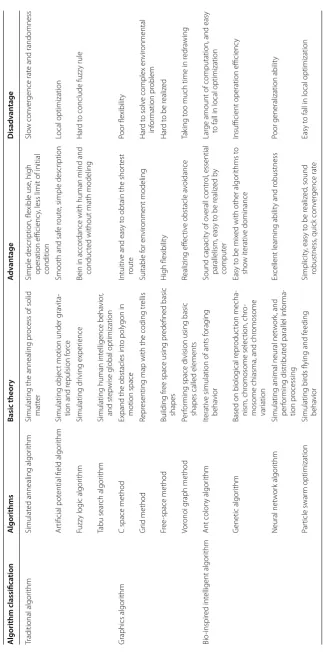
Information path planning thought is originated with path planning problem. Path planning technology has long been used in fields such as obstacle avoiding and penetration flight of aircraft [14], GIS-based path plan-ning [15], robot path planning [16], and communication route optimization [17]. The core of route planning is the design of route planning algorithm [18], which currently can be categorized into three types, such as traditional algorithm, graphics algorithm, Bio-inspired intelligent algorithm [17–19]. The advantages and disadvantages of these algorithms are shown in Table 1.
According to the characteristics of different informa-tion route planning algorithms, ant colony algorithm is regarded of significant advantage in remanufacturing service system information route optimization, because it has large amount of information resource involved in remanufacturing service system, numerous information transmission network nodes, and 3D distribution space. Being often introduced in 3D route planning problem of robot under complex environment [20], ant colony algorithm can divide the space between robot location remanufacturing
service provider
dismantling service provider
consumer
recycling service provider
inventory/transport service provider
distributors
manufacturing service provider
harmless processing service provider
requirements informatio
n
logistics requirement information
Remanufacturing spare parts information Remanufacturing
production demand information
feedback information
recycling requirement information
product/service supply informatio n
logistics information
Remanufacturing information
marketing informatio
n
requirements information
processing requirement information
processing requirements
information
logistics information logistics
information logistics requirement information
logistics requirement information logistics
requirement information
Parts requirement information recycling
information recycling requirement information
recycling information
recycling information
Remanufacturing requirement information
product/service requirements information
Table
1
C
omparison of pa
th planning algorithms
A lgorithm classifica tion A lgorithms Basic theor y A dv an tage D isadv an tage Traditional algor ithm Simulat
ed annealing algor
ithm
Simulating the annealing pr
ocess of solid
matt
er
Simple descr
iption, flexible use
, high
operation efficienc
y, less limit of initial
condition
Slo
w con
ver
gence rat
e and randomness
Ar
tificial pot
ential field algor
ithm
Simulating objec
t motion under g
ra
vita
‑
tion and r
epulsion f
or
ce
Smooth and saf
e r
out
e, simple descr
iption Local optimization Fuzz y log ic algor ithm Simulating dr iving exper ience
Bein in accor
dance with human mind and
conduc
ted without math modeling
Har
d t
o conclude fuzz
y rule
Tabu sear
ch algor
ithm
Simulating human int
elligence beha
vior
,
and st
ep
wise global optimization
Graphics algor
ithm
C space method
Expand the obstacles int
o poly
gon in
motion space
Intuitiv
e and easy t
o obtain the shor
test rout e Poor flexibilit y Gr id method Repr
esenting map with the coding tr
ellis Suitable f or en vir onment modeling Har d t o solv
e complex en
vir onmental inf or mation pr oblem Fr ee ‑space method Building fr
ee space using pr
edefined basic shapes H igh flexibilit y Har d t
o be r
ealiz ed Vor onoi g raph method Per for
ming space division using basic
shapes called elements
Realizing eff
ec
tiv
e obstacle a
voidance
Tak
ing t
oo much time in r
edra wing Bio ‑inspir ed int elligent algor ithm Ant colon y algor ithm Iterativ
e simulation of ants f
orag
ing
beha
vior
Sound capacit
y of o
verall contr
ol
, essential
parallelism, easy t
o be r
ealiz ed b y comput er Lar
ge amount of computation, and easy to fall in local optimization
G
enetic algor
ithm
Based on biolog
ical r epr oduc tion mecha ‑ nism, chr omosome selec tion, chr o‑
mosome chiasma, and chr
omosome
var
iation
Easy t
o be mix
ed with other algor
ithms t o sho w it erativ e dominance
Insufficient operation efficienc
y Neural net w or k algor ithm
Simulating animal neural net
w or k, and per for ming distr ibut
ed parallel inf
or ma ‑ tion pr ocessing Ex cellent lear ning abilit
y and r
obustness
Poor generalization abilit
y
Par
ticle swar
m optimization
Simulating bir
ds flying and f
eeding
beha
vior
Simplicit
y, easy t
o be r
ealiz
ed
, sound
robustness
, quick con
ver
gence rat
e
Easy t
(original point) and destination point into three-dimen-sional grids and calculate the shortest optimized route between original point and destination point [21]. With strong robustness, ant colony algorithm can realize par-allel calculation and is easy to be combined with other algorithms, which is more suitable for solving large-scale dynamic optimization problem [22, 23]. Some research-ers have introduced ant colony algorithm in functional optimization and solution of continuous space and fast optimization problem of proliferative process route [24,
25]. The application of ant colony algorithm in self-organ-ized service recommendation network further proved that such algorithm can effectively improve the success rate and recall ratio of service discovery [26]. However due to the large computation amount of ant colony rithm, this paper proposed an improved ant colony algo-rithm (Improved AC) by combining normal ant colony algorithm with genetic algorithm than features sound convergence, less computation time, higher robustness, and iterative advantages, and applied the improved AC to solve information transmission route optimization prob-lem of remanufacturing service system.
3 Framework of Information Transmission Network
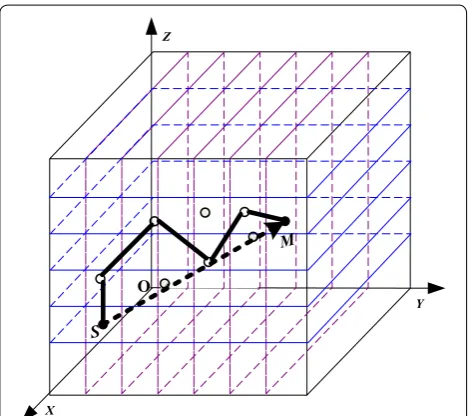
RMS includes both remanufacturing servitization and productive service. Remanufacturing servitization pro-vides overall solution of remanufacturing engineering and remanufacturing products for customers. Productive ser-vice provides professional serser-vices for remanufacturing enterprises, such as disassembling of machinery, clean-ing and detection of parts, remanufacturclean-ing processclean-ing, assembling, running and information-based remanufac-turing [8]. RMS involves resource, organization, service value during interaction process [27]. To describe the coordinates of the information conversion devices, a three-dimensional (3D) model of remanufacturing ser-vice information network for information transmission was developed. This model combines the physic coordi-nate and the transmitted properties of all the devices in the network, as shown in Figure 2.
In Figure 2, X axis, Y axis and Z axis is the physic coor-dinate of the network N(V, E). In N(V, E), V is the collec-tion of all network nodes (exchangers, routers and hosts), E is the collection of all edges in the figure, where in each edge represents a direct communication path between two adjacent points. Each routing node in information trans-mission routing network N(V, E) is corresponded to an only routing node coordinate p(u, ω, i). Each p(u, ω, i) ∈ V has three attributes: including information transmission delay(p), information communication cost(p) and informa-tion packet_loss(p), the attribute parameter can be repre-sented by <delay(p), cost(p), packet_loss(p)>. Moreover, the
attribute parameter of each edge e ∈E can be represented by <delay(e), cost(e), packet_loss(e)>. The 3D map of rout-ing nodes that corresponds with remanufacturrout-ing service information transmission network N(V, E) in Figure 2 is shown in Figure 3.
4 Problem Statement
High-efficiency space routing planning is the guarantee for space information transmission [28]. Remanufacturing ser-vice information transmission routing planning is to seek an optimal remanufacturing service information commu-nication path from route starting point S ∈ V to target rout-ing point M ∈ {V − {s}} in the 3D information transmission routing network N(V, E), as shown in Figure 3, where the disabled nodes (information transmission nodes in Load/ fault) are distributed. The communication service is guar-anteed to meet constraint conditions, such as information delay, commutation cost, information packet_loss.
Suppose the network N(V, E) is symmetrical and there is only one edge between two adjacent joints. Dur-ing information communication T(S, M) process from original point S to target point M, there are 3 attributes including information transmission delay (T(S, M)), information communication cost (T(S, M)), and informa-tion packet_loss(T(S, M)):
where delay (T(S, M)) is the information transmission delay, i.e., the mean transit time from information origi-nal point to information receiving user (μs). ns is the
number of originating node. tdi is the time interval from sending data at originating node i to information receiv-ing user (μs). cost(T(S, M)) is information communica-tion cost, i.e., the total unit energy consumpcommunica-tion for information communication transmission. ei is the unit
energy consumed by routing node i in receiving and sending data. N is the number of all routing nodes that are involved in T(S, M) transmission path. packet_ loss(T(S, M)) is the probability that information fails to be transferred to user nodes under the condition where the average load factor of the route k=N
i=1ki
N. ki is
the load factor of the ith routing node in the information
(1)
delay(T(S, M))=
ns
i tdi
ns,
(2)
cost(T(S, M))= N
i
ei,
(3)
packet_loss(T(S,M))=1−Ds
N
transmission route. N
i=1Di is the total amount of data sent from all routing nodes in T(S, M) transmission path, Di is the amount of data sent from the node i. Ds is the
total amount of data received by user node M.
5 Optimization Method for Information Transmission Path
5.1 The Improved Ant Colony Algorithm (Improved AC) for Path Planning
Basic ant colony algorithms are only suitable for 2D path planning problem [26]. However, regarding the 3D path planning problem in 3D map of information transmis-sion routing network N(V, E) shown in Figure 3, this paper proposes a 3D path optimization AC algorithm for remanufacturing service information transmission by referring the thought of 3D space robot path planning ant colony algorithm, and concrete steps are shown below.
Step 1: Coordinate transformation. As shown in Fig-ure 3, the straight-line distance from information original Figure 2 3D model of remanufacturing service information network N(V, E)
Z
Y
X
O
S
M
point S to target point M is L, and obstacles O1, O2,…, OK
are distributed between S and M.
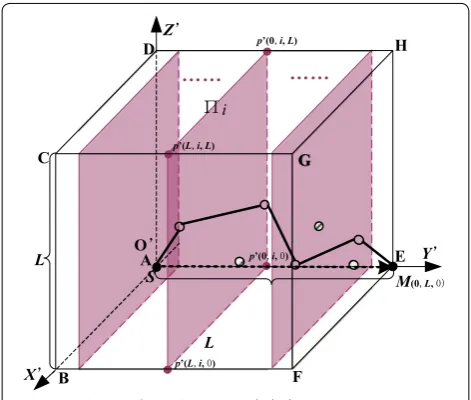
(1) Through parallel moving coordinate O-XYZ in the network N(V, E) shown in Figure 3, point O can coincide with S point and the original point O′ of the new coor-dinate can be obtained. In addition, the three original axes of XYZ are rotated by angle of εX, εY, εZ,
respec-tively, making O′Y′ axis coincide with SM [29]. Thus the new coordinate system O′-X′Y′Z′ is obtained as shown in Figure 4.
The transformation relation between coordinate O′ -X′Y′Z′ and O-XYZ is:
where [X,Y,Z]T is translation matrix, Eq. (5) is rotation matrix R:
(2) In coordinate system O′-X′Y′Z′, the cube ABCD-EFGH is established, which constructs the information space network N′(V′, E′) shown in Figure 4. In the net-work, the ABCD surface of the cube, which is basically a square plane with side length of L, is on X′Z′ plane. Side AB coincides with X′ axis, side BC//Z′ axis, and the original point O′ and point A are in the same position.
(4)
X Y Z
=R
X′ Y′ Z′
+
X Y Z
(5)
R=
cosεYcosεZ−sinεYsinεXsinεZ −cosεYsinεZ−sinεYsinεXcosεZ −sinεYcosεX
cosεXsinεZ cosεXcosεZ −sinεX
sinεYcosεZ+cosεYsinεXsinεZ −sinεYsinεZ+cosεYsinεXcosεZ cosεYcosεX
.
The cube side AE =L, and the coordinate of point M is (0, L, 0). The O′M is divided into (n + 1) equal segments. Through each equal diversion point, n planes Πi (i = l, 2,
…, n) which are parallel to ABCD can be obtained. The square plane Πi (i = l, 2, …, n) is divided into m × m equal
little squares. Therefore, the real coordinate of the point p(u, ω, i) ∈V (u, ω = 0, l, …, m) on square plane Πi in
coordination system O′-X′Y′Z′ is
Step 2: Allow list calculation and goal conversion. Sup-pose there are totally W = (w1, w2,…) items of
remanu-facturing service information on network space N′(V′, E′) to be simultaneously transmitted from original point S(0,0,0).
Calculate the allowed(u, i, ω) (u, ω = 0, l, …, m) of all
points on plane Πi(i = l, 2, …, n − 1): suppose p(u, ω, i) is
a certain point on plane Πi(i = l, 2, …, n − 1), regarding
a random point p(k, i + 1, q)(k, q = 0, l, …, m) on plane Πi+1, if p(k, i + 1, q) is fault-free, the information on
line segment p(u, i, ω)p(k, i + 1, q) can be successfully transmitted, therefore point p(k, i + 1, q) can be added
into allowed(u, i, ω). Based on such method, all allowed reachable points of p(u, i, ω) can be calculated and stored in allowed(u, i, ω). Remove all nodes outside of allowed list as well as links that dissatisfy bandwidth constraints.
Suppose the properties of path form point p(u, i, ω) to point p(k, i + 1, q) is <delay(T(pi, pi+1)), cost(T(pi, pi+1)),
packet_loss(T(pi, pi+1))>, thus the problem of information
transmission path optimization can be transformed into calculating the minimum of the weighted path proper-ties, that is MIin O(pi, pi+1) = [delay(T(pi, pi+1)) cost(T(pi,
pi+1)) packet_loss (T(pi, pi+1))] W(pi, pi+1). W(pi, pi+1) is
weight matrix of the path properties.
Step 3: Initialization of the pheromone list. Initial-ize the pheromone list τuωi of all points p(u, i, ω) (u, ω = 0, l, …, m) on plane Πi(i = l, 2, …, n − 1):
phero-mone list is an array, where each data is used to repre-sent the joint strength of pheromone between p(u, i, ω) and p(k, i + 1, q). Suppose the initialized pheromone τuωi (0)=A �τuωi (0)=0 (A is a certain constant).
Step 4: Calculation of transition probability. Accord-ing to heuristic information value and pheromone value, in each procedure of information transmission path establishment in coordinate system O′-X′Y′Z′,
p′
−L
2 +
u·L m ,
i·L n ,−
L
2+
ω·L m
∈V′.
ĂĂ ĂĂ
Zÿ
Yÿ
Xÿ
A
B C
E
F G
H
i
p’(Li, ) L
D
Oÿ
p’(0i, )
p’(Li, L)
p’(0i, L)
M(0L,
S
L
the next node of p(u, i, ω) in information transmission is determined based on Eq. (6). J is a random variable produced according to probability distribution shown in Eq. (7). r is a constant within [0, 1], and r0 is
even-distributed random number within [0, 1].
Regarding the to-be-transmitted information of ran-dom point p(u, i, ω) on plane Πi(i = l, 2, …, n), the
prob-ability of p(k, i + 1, q) on plane Πi+1 is selected, which is
shown as Eq. (7):
where τi+1 is the amount of pheromone stored on point
p(k, i + 1, q), ηi,i+1=1
d(pi,pi+1) is heuristic function,
β=
(4t−2r)/t, 0≤r≤t
2,t≤q (t is the critical time) is heu-ristic value, β reflects the level of emphasis that has been placed on total heuristic information in selection of information transmission paths during information transmission process.
Step 5: Select the next node and perform partial updating. At each node, to which information is trans-ferred, Eq. (8) will be immediately used to perform real time updating of partial pheromone. If information arrives at certain node where no proper next node can be sought, such information is regarded invalid.
where τuωi is pheromone of the note p(u, i, ω), μ is a
certain parameter between 0–1, τ0 is the initial value of
pheromone of each feasible point.
Step 6: Judge whether arriving at target node or not. In judging whether the transmitted information meet with each other at certain point, if there exists informa-tion meeting, then meeting strategy operainforma-tion will be performed and new path will be generated according to Eq. (9) and placed into path table. After that, the updat-ing process is performed accordupdat-ing to Eq. (10). Other-wise, transit to procedure (4).
where Lnew represents the length of the new path that
is generated when path length L(w1) meets path length
L(w2), Δτ = 1/Lnew.
(6)
pi+1=
arg max
(k,i+1,q)∈allowed(u,i,ω)[τi+1
·ηi,i+1], r <r0, J, r >r0.
(7)
pi,i+1=
τi+1·ηiβ,i+1 �
τi+1·ηβi,i+1
, p(k,i+1,q)∈allowed,
0, p(k,i+1,q) /∈allowed,
(8)
τuωi =(1−µ)τuωi+µτ0,
(9)
Lnew=L(w1)+L(w2)(w1meetsw2),
(10)
τ =(1−µ)·τ+µ·�τ,
Step 7: Global updating. Perform global pheromone updating according to Eq. (11):
where ρ(0 < ρ < l) is the pheromone volatility; 1 − ρ is attenuation degree of pheromone with time;
�τuωi=Wi=1�τuwωi is the information gain of each path
after performing iteration ( �τuwωi=1
Lw, the wth infor-mation goes through the node p(u, i, ω) in current trans-mission process; otherwise �τuwωi=0).
Step 8: Judge stop condition. Judge whether the algo-rithm meets the stop condition. If the stop condition is met, the optimized results can be output, otherwise turn to step 4. After all information to be transferred go through step 1 to step 8, the path from S to M is sought successfully.
5.2 The Further Improved Ant‑Genetic Algorithm (AC‑GA) for Path Planning
Since optimization method of 3D information transmis-sion path based on improved AC in Section 5.1 is inferior for its large computation amount and over long time con-suming, a further improved algorithm combing AC with GA (Genetic Algorithm) was proposed. The first step is to produce multiple paths produced by less amount of ants and collect network information by referring the ant distribution feature. The second step is to regard each successful path as an individual of GA and perform fur-ther optimization at sink node, so as to determine route table eventually. The operation flow of AC-GA-based 3D path optimization is shown in Figure 5.
According to the operation flow of AC-GA-based 3D path optimization, and based on initial population established by genetic algorithm and collected node
(11)
τuωi =(1−ρ)·τuωi+ρ·�τuωi
Population initialization
Calculation of individual fitness degree
Selection operation
Crossover and mutation operation
Elimination operation
Stop? Condition
assumptions and constraints Calculation of the allow
list
Initialization of the pheromone list Setting Ants at the
source point Calculation of transition probability Select the next node and perform partial updating
Global updating arrive at target node?
Whether stop Output the optimal path Coordinate
transformation
N
N
Y
N Y
Y
GA
information, the optimized route can be determined, where the calculation steps are shown from step 9 to step 14.
Step 9: Population initialization. Each ant reaching sink node in stipulated cycle (an alternate path) is regarded as an individual of population P(t). The individual coding is conducted by using ID number of node as gene code. When the stipulated population size is met, the AC algo-rithm is finished, otherwise turn to step 4.
Step 10: Calculation of individual fitness degree. Through population initialization, each individual fit-ness degree F can be calculated by Eq. (12), and then F is ranked in the order from big value to small value, N indi-viduals (N < M):
where Ei+1 is the communication cost of node i + 1, i + 1
is the selected next node. Ri,i+1 is the signal strength
received by node i + 1. x is the path from original point to sink node; nx is the hop count of x. α, β, λ are weight
constants. Such function is designed to balance routing efficiency and cost, thus realizing relatively higher cost-benefit ratio.
Step 11: Selection operation. The population P(t) was subjected to proportional selection as well as probability selection using Eq. (13). Therefore, some individuals with larger fitness degree are more likely to be preserved to the next generation.
Step 12: Crossover and mutation operation. The indi-vidual was subjected to single-point crossover operation, where the crossover point will be selected between two individuals with the same gene. If both individuals share two pairs of the same genes, then either pair of gene can be selected, otherwise cancel the crossover operation.
Individual i was subjected to mutation operation. Mutant gene was selected from collection Ω, Ω = Nb{i}
{i − 1}∩Nb{i}{ i+ 1}; i − 1 and i + 1 respectively represent
both neighbours of node i; Nb{i} represents the collection
of nodes which are of effective communication. If Ω ∊ Φ, mutation operation can be avoided, otherwise evolution-ary algorithm is performed for such individual to remove the same genes, and thus avoid being trapped into end-less loop.
Step 13: Elimination operation. By mixing M individu-als with N individuindividu-als, a new population including M + N individuals in step 9 and step 12 can be obtained. After
(12)
F(x)=
nx−1
i=1
Ei+α1Riβ,i+1/n
x
(13)
p1=F/ M
i=1
Fi,i=1, 2, 3,· · ·,M.
that the individuals with lower fitness degree were multi-plied with penalty factor, which can be shown in Eq. (14):
where μ ∈ (0, 1) is penalty factor, Fmin(x) is the individuals
with lower fitness degrees.
Step 14: Judge whether the algorithm is finished or not. The change rate ξ of fitness degree is defined as:
where δ is a threshold value of change rate of fitness degree. j is the number of iterations from n to n − j. n is
the current number of iterations. When ξ > δ, it turns to step 10, otherwise the algorithm is finished.
6 Numerical Study 6.1 Illustrative Example
Taking the certain roller remanufacturing service demand information transmission of certain roller as example, suppose the coordinate of real-time routing node where user submits service demand is S(3, 1, 9), while the coordinate of routing node where the platform accepts demand information of remanufacturing service is M(16, 16, 6). The network for sending the information in remanufacturing service system is 100 Mbit/Ethernet.
The experimental simulation constraint condition is: after coordinate transformation, the S′M′ in the Y′ direction was divided into 16 equal segments. After non-dimensionalization, the 2D plane was divided into 16 × 16, each grid’s length was set to 1. The designed
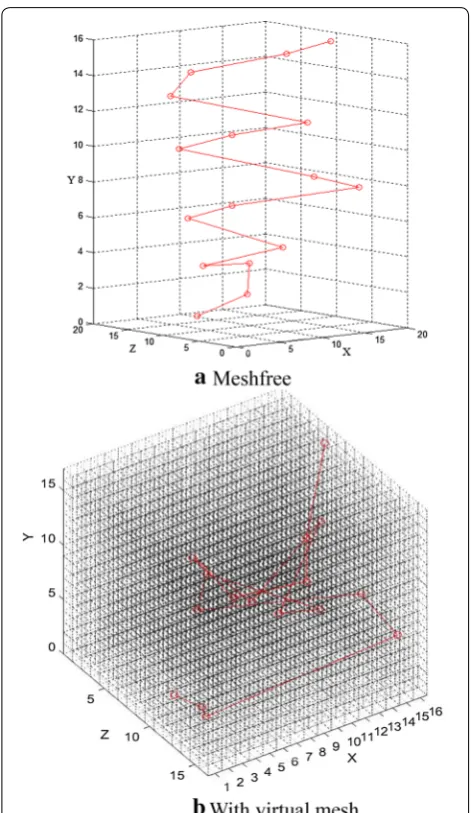
3D path planning AC-GA algorithm was programmed using MATLAB R2012a. The optimized communica-tion path from original point S(3, 1, 9) to M(16, 16, 6) was simulated, resulting in the optimized 3D path sim-ulation results in O′-X′Y′Z′ (Figure 6(a)) and in O-XYZ (Figure 6(b)) and path coordinate table (Table 2). Accord-ing to Eqs. (1) and (2), along such optimized path, the information transmission delay is 206.5148 μs and the communication cost is 20.0588. According to Eq. (3), information packet_loss is 7.7375% while the average information load factor is 53.4723%. Finally, the roller remanufacturing service demand information was trans-ferred along the optimized path specified in Table 2.
6.2 Performance Results and Discussion 6.2.1 Result Validation
Through calculating the optimal fitness degree of AC-GA algorithm, it can further verify the superiority of the optimized 3D path, as shown in Table 2. According to Eq. (12), the changing process of cost effectiveness fit-ness of AC-GA algorithm during the process of 3D path
(14)
F(x)=µ·Fmin(x),
(15)
ξ =
n
i=n−j
Fi(x)− n
i=n−j Fi(x)/j
optimization can be obtained, shown in Figure 7. The initial cost effectiveness fitness was 101.2841, which was then processed by 17 iterations, reaching a steady value of 86.292. As shown in Figure 7 it can be seen that the initial fitness degree of AC-GA algorithm is relatively large and the alternative paths of route information nodes are in a considerable quantity, which should be further screened.
With increased number of iterations of AC algorithm, the fitness degree of GA algorithm changes accordingly, which means the number of alternative paths is gradually decreased. When the fitness degree tends to be steady, i.e., the number of alternative path is 0, the optimized path in Table 2 can be sought.
6.2.2 Performance Analysis of AC‑GA Algorithm
Through comparative analysis between improved AC in Section 5.1 and AC-GA in Section 5.2 in terms of delay(T(S, M)), cost(T(S, M)), packet_loss(T(S, M)) dur-ing the optimization process of information transmission path planning, the performance analysis of AC-GA algo-rithm can be realized.
(1) Analysis of information transmission delay
Suppose the unquantified distances between the adja-cent nodes in the information transmission path are 1 km, 5 km, 10 km, 15 km and 20 km. According to Eq. (1), the information transmission delays (T(S, M)) of improved AC and AC-GA algorithm during the optimi-zation process of information transmission path planning can be calculated, respectively. The comparison results are shown in Figure 8.
As shown in Figure 8, when the transmission distance is relatively short, there is no significant difference in delay between the improved AC and AC-GA algorithm; how-ever with the increase of transmission distance, AC-GA algorithm gradually shows its significant advantages, which indicates that the longer the transmission distance is, the more superior the transmission path established by AC-GA algorithm is.
(2) Analysis of information communication cost (T(S,
M))
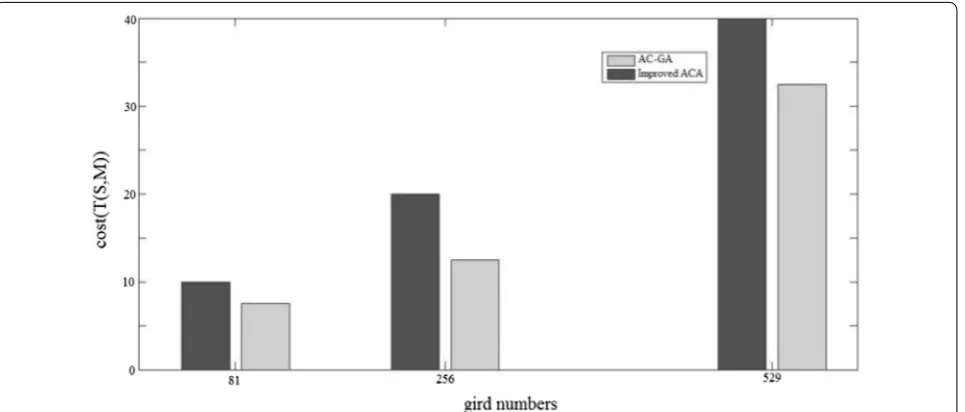
According to Eq. (2), the information communication costs (T(S, M)) of improved AC and AC-GA algorithm under 3 different meshing situations of 9 × 9, 16 × 16, 23 × 23, can be calculated respectively. The comparison results of both total communication costs under 3 differ-ent meshing situations are shown in Figure 9. It can be seen that with the increase of network scale, the commu-nication cost of AC-GA algorithm is significantly lower than that of improved AC.
(3) Analysis of information packet_loss (T(S, M))
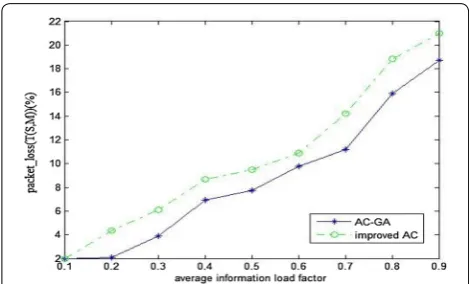
According to Eq. (3), the information packet_loss(T(S, M)) of two algorithms when network node average load factor is 10%, 20%, 30%, 40%, 50%, 60%, 70%, 80%, 90% can be calculated, respectively, and the results are shown Figure 6 Optimized 3D path selected by information route nodes
Table 2 Node coordination of optimized 3D path
(3, 1, 9) (8, 2, 8) (11, 3, 13) (2, 4, 7)
(16, 5, 10) (6, 6, 7) (13, 7, 14) (9, 8, 12)
(10, 9, 1) (3, 10, 11) (4, 11, 11) (10, 12, 2)
in Figure 10. It can be seen that the higher the informa-tion load factor is, the higher the informainforma-tion packet_ loss(T(S, M)) will be.
7 Conclusions
The 3D information transmission path optimization for remanufacturing service system network framework plays a vital role in quickly and accurately selecting the optimal information transmission path as well as in decreasing information transmission delay and informa-tion packet_loss.
(1) By referring the service-oriented manufacturing thought and combining the features of remanufac-turing and service, the concept of remanufactur-ing service was proposed and a 3D framework for remanufacturing service information transmission network was built.
(2) Since the traditional ant colony algorithm (AC) is only suitable for two-dimensional path planning but not applicable for three-dimensional path planning, an improved 3D ant colony algorithm (Improved AC) was proposed to solve the problem of 3D path optimization in the information network.
(3) To further improve the convergence of the algo-rithm and decrease the number of iterations, this paper proposed an improved ant colony-genetic algorithm (AC-GA) by combining ant colony algo-rithm and genetic algoalgo-rithm to realize the 3D infor-Figure 7 Optimization process of cost effectiveness fitness in AC‑GA
algorithm
Figure 8 Comparison of information transmission delays (T(S, M)) between improved AC and AC‑GA algorithm
mation transmission path optimization in remanu-facturing service system.
(4) Taking the remanufacturing service demand infor-mation transmission of certain roller as example, the effectiveness of such algorithm was analyzed. Through comparative analysis of performances, it can be demonstrated that the AC-GA algorithm has good operation efficiency in information transmis-sion path optimization. In addition, AC-GA algo-rithm has advantages over improved AC in aspects of information transmission delay, information communication cost and information pakect_loss. This study lays foundation for remanufacturing ser-vice system research, and provides the basic theo-ries on the system information transmission as well as references for the research and application of remanufacturing service in other industries.
Authors’ Contributions
X‑HX was in charge of the whole trial; LW wrote the manuscript; J‑HC, XL and J‑WL assisted with sampling and laboratory analyses. All authors read and approved the final manuscript.
Author Details
1 Hubei Key Laboratory of Mechanical Transmission and Manufacturing Engi‑
neering, Wuhan University of Science and Technology, Wuhan 430081, China.
2 Center for Service Science and Engineering, Wuhan University of Science
and Technology, Wuhan 430065, China.
Authors’ Information
Lei Wang, born in 1987, is currently a lecturer at Hubei Key Laboratory of Mechanical Transmission and Manufacturing Engineering, Wuhan University of Science and Technology, China. Her main research interests include manufac‑ turing/remanufacturing systems engineering, reverse supply chain manage‑ ment, knowledge management and engineering.
Xu‑Hui Xia, born in 1966, is currently a professor and PhD candidate super‑ visor at Wuhan University of Science and Technology, China. His main research interests include manufacturing systems engineering, supply chain manage‑ ment, optimization and decision with application in manufacturing industry. Jian‑Hua Cao, born in 1989, is currently an assistant engineer and PhD can‑ didate at Wuhan University of Science & Technology, China. His main research
interests include manufacturing/remanufacturing systems engineering and reverse supply chain management.
Xiang Liu, born in 1983, is currently an engineer at Wuhan University of Sci-ence and Technology, China. His main research interests include image process‑ ing, computer vision and its application in manufacturing engineering.
Jun‑Wei Liu, born in 1983, is currently a lecturer at Wuhan University of Science and Technology, China. His research interests are in the areas of manu‑ facturing informatization and intelligent manufacturing.
Competing Interests
The authors declare that they have no competing interests.
Funding
Supported by National Natural Science Foundation of China (Grant Nos. 51805385, 71471143), Hubei Provincial Natural Science Founda‑ tion of China (Grant No. 2018CFB265), and Center for Service Science and Engineering of Wuhan University of Science and Technology (Grant No. CSSE2017KA04).
Publisher’s Note
Springer Nature remains neutral with regard to jurisdictional claims in pub‑ lished maps and institutional affiliations.
Received: 3 May 2017 Accepted: 13 December 2018
References
[1] L Wang, X H Xia, Y Q Xiong, et al. Architecture of reverse supply chain service system. Computer Integrated Manufacturing Systems, 2015, 21(10): 2720‑2731. (in Chinese)
[2] R T Lund. Remanufacturing: The experience of the United States and implications for developing countries. Technology Review, 1984, 87(2): 18‑23.
[3] P Goodall, E Rosamond, J Harding. A review of the state of the art in tools and techniques used to evaluate remanufacturing feasibility. Journal of Cleaner Production, 2014(81): 1‑15.
[4] B Su, X M Huang, Y H Ren, et al. Research on selective assembly method optimization for construction machinery remanufacturing based on ant colony algorithm. Journal of Mechanical Engineering, 2017, 53(5): 60‑68. (in Chinese)
[5] M Mitsutaka, K Shingo. Demand forecasting for production planning in remanufacturing. International Journal of Advanced Manufacturing Technology, 2015(79): 161‑175.
[6] M Z Liu, X Zhang, C H Liu, et al. Optimization method of remanufactur‑ ing reprocessing shop scheduling under uncertain conditions. Journal of Mechanical Engineering, 2014, 50 (10): 206‑212. (in Chinese)
[7] Y J He. Acquisition pricing and remanufacturing decisions in a closed‑ loop supply chain. International Journal of Production Economics, 2015(163): 48‑60.
[8] L Wang, X H Xia, Y Q Xiong, et al. Modular method of remanufacturing service resources. Computer Integrated Manufacturing Systems, 2016, 22(9): 2204‑2216. (in Chinese)
[9] W J Xu, S S Tian, Q Liu, et al. An improved discrete bees algorithm for correlation‑aware service aggregation optimization in cloud manufactur‑ ing. International Journal of Advanced Manufacturing Technology, 2016(84): 17‑28.
[10] D Lottridge, M Chignell, S E Straus. Requirements analysis for customiza‑ tion using subgroup differences and large sample user testing: A case study of information retrieval on handheld devices in healthcare. Interna-tional Journal of Industrial Ergonomics, 2011, 41(3): 208‑218.
[11] S Liaskos, S M Khan, M Litoiu., et al. Behavioral adaptation of information systems through goal models. Information Systems, 2012, 37(8): 767‑783. [12] G C S Lin, F F Yang, F Z Y Hu. The new geography of information and
consulting services in China: Comparing Beijing and Guangzhou. Habitat International, 2012, 36(4): 481‑492.
[13] S H Ma, L Tian. A web service‑based multi‑disciplinary collaborative simulation platform for complicated product development. International Journal of Advanced Manufacturing Technology, 2014(73): 1033‑1047. [14] X Gao, Y W Fang, Y L Wu. Fuzzy Q learning algorithm for dual‑aircraft path
planning to cooperatively detect targets by passive radars. Journal of Systems Engineering and Electronics, 2013, 24(5): 800‑810.
[15] S M Mohammad, D A Saeed, E Farshid, et al. An ant colony algorithm (ACA) for solving the new integrated model of job shop scheduling and conflict‑free routing of AGVs. Computers & Industrial Engineering, 2015, 86: 2‑13.
[16] Y Shi, B Liang, X Q Wang, et al. Cartesian non‑holonomic path planning of space robot based on quantum‑behaved particle swarm optimiza‑ tion algorithm. Journal of Mechanical Engineering, 2011, 47(23): 65‑73. (in Chinese)
[17] Y C Zhou, Y F Dong, H M Xia, et al. Routing optimization of intelligent vehicle in automated warehouse. Discrete Dynamics in Nature and Society, 2014, 2014(1): 1‑14.
[18] J Berger, N Lo. An innovative multi‑agent search‑and‑rescue path plan‑ ning approach. Computers & Operations Research, 2015(53): 24‑31. [19] B C Zhang, W Q Liu, Z L Mao, et al. Cooperative and geometric learning
algorithm (CGLA) for path planning of UAVs with limited information.
Automatica, 2014, 50(3): 809‑820.
[20] H Hu, X S Cai. Improved ant colony algorithm‑based three‑dimensional robot path planning. Computer Systems & Applications, 2011, 20(11): 95‑98. (in Chinese)
[21] Z Q Wang, X G Zhu, Q Y Han. Mobile robot path planning based on parameter optimization ant colony algorithm. Procedia Engineering, 2011(15): 2738‑2741.
[22] L R Li, L Wang, Y B Gao, et al. A dynamic path planning model based on the optimal ant colony algorithm. Journal of Guangxi University: Nat. Sci. Ed., 2013, 38(2): 359‑367. (in Chinese)
[23] M N Li. Efficiency improvement of ant colony optimization in solving the moderate LTSP. Journal of Systems Engineering and Electronics, 2015, 26(6): 1301‑1309.
[24] F Y Chen, H W Wang, C Qi, et al. An ant colony optimization routing algo‑ rithm for two order pickers with congestion consideration. Computers & Industrial Engineering, 2013, 66(1): 77‑85.
[25] F Yu, W H Liao, Y N Xie, et al. Application of continuous space ant colony algorithm to proliferative process route optimization. Journal of Computer-Aided Design & Computer Graphics, 2013, 20(7): 952‑956. (in Chinese)
[26] P P Maglio, S L Vargo, N Caswell, et al. The service system is the basic abstraction of service science. Information Systems and e-Business Man-agement, 2009, 7(4): 395‑406.
[27] G Yu, C J Zhong, X Y Lan, et al. Research of multi‑path routing based on network coding in space information networks. Chinese Journal of Aero-nautics, 2014, 27(3): 663‑669.
[28] Z S Zhong. Ant colony algorithm based on path planning for mobile agent migration. Procedia Engineering, 2011(23): 1‑8.