A Shallow Neural Network for Native Language Identification with
Character
N
-grams
Yunita Sari
Department of Computer Science University of Sheffield, UK [email protected]
Muhammad Rifqi Fatchurrahman and Meisyarah Dwiastuti Department of Computer Sciences and Electronics
Universitas Gadjah Mada, Indonesia
{muh.rifqi.fatchurrahman, meisyarah.dwiastuti}@gmail.com
Abstract
This paper describes the systems sub-mitted by GadjahMada team to the Na-tive Language Identification (NLI) Shared Task 2017. Our models used a continuous representation of charactern-grams which are learned jointly with feed-forward neu-ral network classifier. Charactern-grams have been proved to be effective for style-based identification tasks including NLI. Results on the test set demonstrate that the proposed model performs very well on es-say and fusion tracks by obtaining more than 0.8 on both F-macro score and accu-racy.
1 Introduction
Native Language Identification (NLI) is the task of identifying the native language (L1) of the speak-ers in which English is usually their second lan-guage (L2). GivenF ={f1, f2, ..., f3}be a set of written or speech responses andK={k1, k2, km} a pre-defined set of native languages (L1), the NLI task is to assign L1 to each of the responses inF. This task is often considered as a subset of au-thor profiling task which currently focuses more on age and gender identification (Lopez-Monroy et al.,2014;Johannsen et al.,2015;Rangel Pardo et al.,2016).
The growing interest in this field is due to the applicability of this task to support language learn-ers by providing a tailored feed-back about their errors. Swan and Smith(2001) argued that speak-ers of different native languages tend to make dif-ferent mistakes. Thus, targeted feed-back is
ex-pected to improve the process of language learn-ing (Tetreault et al.,2013).
The NLI Shared Task 2017 (Malmasi et al., 2017) is the continuation of the first task that has been held in 2013 (Tetreault et al., 2013). This year’s task aims to combine written responses (es-say) and spoken responses (speech transcript and i-vector acoustic features) for identifying 11 native language classes.
To address the NLI Shared Task 2017 problem, we adopted an approach that has been applied for authorship attribution task (Sari et al.,2017). In this approach, continuous representations of char-acter n-grams are used jointly with feed-forward neural network classifier. The methods performed very well on essay and fusion tracks by obtaining more than 0.8 on both F-macro score and accu-racy. However, due to the poor hyper-parameter setting and the limitation of training data, we only managed to get around 0.5 on speech track for both evaluation scores, using only the speech tran-scripts.
The paper is organised as follows: Section 2 provides a review of relevant work in NLI. We then explain our methodology in Section 3. The next section describes our experiments including the description of the dataset and the details of training and hyper-parameter tuning. Result and discussion are presented in Section 5. Finally, con-clusion and future work are drawn in Section 6.
2 Related Work
The first NLI shared task (Tetreault et al., 2013) was introduced in 2013 with a total of 29 teams participated across three different subtasks. The dataset for the task was TOEFL11 corpus (
· · ·
x2
x1 xN−1 xN
embedding layer average pool
output layer
(a) Model for essay and speech tracks
output layer
hidden layer
xI
max pool max pool
embedding layer embedding layer
xS
xE
(b) Model for fusion track
chard et al.,2013) consists of 11,000 essays writ-ten by a high-stakes college-entrance test taker. Same as this year’s task, there are 11 native lan-guages covered. Tetreault, et. al reported that majority of the participant addressed the problem by utilising powerful machine learning algorithms such as Support Vector Machine (SVM) and Lo-gistic Regression. In term of features, word, char-acter and POS n-grams were the most common used features.
One of the interesting findings from the first NLI task is simple features such as words, word forms, sequential word combinations, and sequen-tial POS combinations turn out to be effective in-dicators for identifying L1. Jarvis et al. (2013) who implemented those features successfully se-cured the best systems in the first NLI task by ob-taining 10-fold cross-validated accuracy of 84.5% and overall accuracy of 83.6% on the test set. In addition, they reported that a model with charac-tern-grams achieved similar accuracy to the best model involving lexical and POSn-grams.
Following the first NLI task, Ionescu et al. (2014) extended their submission system by implementing character n-grams with two ker-nel classifiers namely Kerker-nel Ridge Regression (KRR) and Kernel Discriminant Analysis (KDA). Their result outperformed Jarvis, et. al by 1.7% on the overall accuracy. Character n-grams have been known for its impressive performance in style-based text analysis task such as authorship attribution (Peng et al., 2003; Stamatatos, 2013; Schwartz et al.,2013). It has advantages of captur-ing stylistic and morphological information ( Kop-pel et al., 2011; Sapkota et al., 2015) regardless of the language. This has motivated us to utilised charactern-grams in our system.
In addition to written responses, recent trend starts to consider spoken responses (speech tran-scripts and audio features) for NLI task. Incor-porating spoken responses has produced good re-sult for dialect identification (Malmasi et al.,2016; Zampieri et al., 2017). However compared to audio features, speech transcripts are less useful since ambiguity is more pronounced in written transcripts.
3 Methodology
In this section, we describe our models and fea-tures used in our NLI system. First, we present the details of the features. Then we explain our model architectures which use shallow feed-forward neu-ral network.
3.1 Features
There are two types of features used in our system: character n-grams and i-vectors. We used only character n-grams features in essay and speech tracks and combined them with i-vectors for fu-sion track. The details of the features are ex-plained as follows:
• Character n-grams: This substring takes
from three to six grams.
• i-vectors:i-vector or identity vector is one of feature representation that commonly used in speech processing. It is a low-dimensional vector derived from mapping sequence of speech frames (Dehak et al., 2011). The i-vectors correspond to the speech transcrip-tions and have a length of 800. We used the provided i-vectors without any additional pre-processing.
3.2 Model Architecture
Our model adopted fastText architecture which was proposed by Joulin et al. (2017). FastText represents a document with an average of feature embeddings for the features present. The proba-bility distribution over the labels then is simply predicted using softmax function. However, in-stead of working on word level, we chose to work on character level, since it is found to be more suitable for the task. Figure1a shows the model that we used for both essay and speech tracks. In that figure, xn represents a single charactern -gram, while N is the maximum sequence which the value is fixed. In our experiment, feature em-beddings are learned during training.
For fusion track, we extended the first model with an auxiliary input to accommodate i-vectors as presented in Figure1b. We also added one hid-den layer with the size of 128 right before the out-put layer. Slightly different with the first model, in the fusion track we used max pooling as it pro-duced higher performances. Both of the mod-els were implemented using Keras (Chollet et al., 2015) with Tensorflow backend.
3.3 Baseline Systems
As a benchmark, the organiser developed baseline systems which use SVM as the classifier. Essay and speech transcript are represented as bag-of-words (BoW). The baseline results on the test set are presented in the Table1.
4 Experiments 4.1 Dataset
The dataset provided by Educational Testing Ser-vice (ETS) contains test responses from a stan-dardised assessment of English proficiency for academic purposes. It consists of 13,200 En-glish essays (written responses) and 13,200 of 45
seconds English speech transcriptions (spoken re-sponses). In addition to that, i-vectors of the speech audios are generated in lieu of the audio files. The essays typically range in length from 300 to 400 words and the transcriptions typically contain approximately 100 words.
The test responses are from 13,200 different test takers. Each test taker contributed one essay and one speech transcription. There are 11 native languages (L1) covered, including Arabic (ARA), Chinese (CHI), French (FR), German (GER), Hindi (HIN), Italian (ITA), Japanese (JPN), Ko-rean (KOR), Spanish (SPA), Telugu (TEL), and Turkish (TUR). The organiser set the 11,000 sam-ples from the dataset for training purpose, 1,100 for development and the rest as the test set.
4.2 Hyper-parameter Tuning and Training Details
During training, we tried different combinations of hyper-parameter configurations. However, only the configurations of the best run are reported in this paper.
Feature hyper-parameters. For essay and speech tracks, we only used character n-grams features. We set the range ofn-gram values from 2 to 5. The sequence lengths were set to 6,000 for essay and 4,000 for speech. Meanwhile, for fusion track in addition to the character n-grams, i-vectors were used. The n-grams range was set to 3 to 5. In order to reduce the input dimen-sions, we decreased the length of the sequence to 1,500 for essays and 300 for speech transcriptions.
Model hyper-parameters. The best run for essay and speech tracks used embedding size of 25 with dropout rate of 0.75. For fusion model, embedding size for both essay and speech representation was set to 128. Between the layers, we put dropout with the probability of 0.5.
Track F1-score Accuracy F1-score (macro) AccuracyBaseline System GadjahMada System
Essay 0.7104 0.7109 0.8107 0.8109
[image:4.595.76.524.62.132.2]Speech (transcription only) 0.5435 0.5464 0.5084 0.5073 Fusion (essay, speech transcripts, i-vectors) 0.7901 0.7909 0.8414 0.8409
Table 1: Submission Results
While fusion track used learning rate of 0.0002, higher rates did not make any improvement.
5 Results and Discussion
Table 1 shows our submission results for all the sub-tracks. We participated in closed- training subtask in which we only used provided train-ing data to train our models. Results on the ta-ble present that our systems performed very well on the essay and fusion tracks. Our systems out-performed the baseline systems with accuracy of 0.8109 and 0.8409 on the essay and fusion tracks respectively. However, the system failed to pro-duce similar performances on speech track. Our system produced accuracy of 0.5073 which is lower than the baseline. This might happen due to the poor hyper-parameter tuning. Note that on speech track, we only utilised speech transcripts.
Similar to the previous NLI shared task re-sults, character n-grams demonstrate their effec-tiveness for capturing style in written responses. We believe that speakers of each native language have their own learning experiences which are re-flected in their responses. The speaker’s charac-teristics are better captured in written responses than speech transcripts. Written responses are sig-nificantly longer compared to speech transcripts which make it better on providing information about the speaker. In addition to that, speech tran-scripts are less useful since ambiguity is more pro-nounced (Malmasi et al.,2016). Audio features in the form of i-vectors help to improve the perfor-mance. Our results on the fusion track are higher than the results on other tracks.
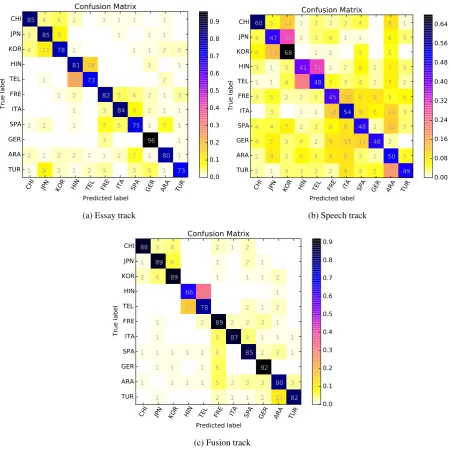
In order to get more insight into the classifica-tion results, confusion matrices for the best run in each sub-track are presented in Figure 2. In the essay and fusion tracks, it can be seen that Ger-man (GER) speaker are the easiest class to identify with more than 90% on the accuracy. It is also in-teresting to highlight that the system is mistakenly identified several native language classes that have morphological and lexical similarities, for
exam-ple: Chinese (CHI), Japanese (JPN) and Korean (KOR); Hindi (HIN) and Telugu (TEL); French (FRE), Italian (ITA) and Spanish (SPA). However in the speech track as shown in Figure2b, in most classes the system made correct predictions no more than 50% of the total samples. It demon-strates that spoken response in the form of speech transcripts is not good enough to be used as fea-ture.
6 Conclusion and Future Work
This paper presents our submission approaches for NLI Shared Task 2017. Results on the test set show our model that utilises shallow feed-forward neural network with character n-grams features could effectively identify the native lan-guage (L1) of the speaker. Our proposed model performed very well on the essay and fusion tracks but failed to achieve similar scores on the speech track. It is interesting to note that character n -grams mostly works for any style-based classifica-tion tasks including NLI. More details analysis on the languages with similar lexical and morpholog-ical forms can be an interesting work to explore. Indicative features for those languages are essen-tial since most incorrect predictions were made on those groups.
References
Daniel Blanchard, Joel Tetreault, Derrick Higgins, Aoife Cahill, and Martin Chodorow. 2013. Toefl11: A corpus of non-native english. Technical report, Educational Testing Service.
Franc¸ois Chollet et al. 2015. Keras. https:// github.com/fchollet/keras.
Najim Dehak, Pedro A Torres-Carrasquillo, Douglas Reynolds, and Reda Dehak. 2011. Language recog-nition via i-vectors and dimensionality reduction. In Twelfth Annual Conference of the International Speech Communication Association.
CHI JPN KOR HIN TEL FRE ITA SPA GER ARA TUR Predicted label
CHI JPN KOR HIN TEL FRE ITA SPA GER ARA TUR
True label
85 4 5 2 1 1 1 1
3 85 9 1 1 1
4 11 78 1 1 1 2 2
81 16 2 1
1 24 73 2
1 2 82 5 4 2 1 3 1 3 84 8 2 1 1 1 2 1 7 5 75 1 7 1
3 96 1
2 1 2 2 1 1 2 7 1 80 1 1 9 2 1 2 3 3 5 1 73
Confusion Matrix
0.0 0.1 0.2 0.3 0.4 0.5 0.6 0.7 0.8 0.9
(a) Essay track
CHI JPN KOR HIN TEL FRE ITA SPA GER ARA TUR Predicted label
CHI JPN KOR HIN TEL FRE ITA SPA GER ARA TUR
True label
60 5 12 1 3 2 3 4 9 1 4 47 30 1 3 4 1 1 6 3 6 14 68 1 1 5 5 3 1 3 41 31 1 2 6 2 7 3 1 1 4 23 48 5 3 4 2 7 2 3 5 2 2 3 45 12 8 9 5 6 3 1 1 12 54 9 6 11 3 4 4 7 2 3 6 9 48 2 12 3 4 7 3 4 2 9 10 11 48 2 2 8 3 6 4 8 9 3 2 50 5 2 1 3 3 3 2 9 4 5 19 49
Confusion Matrix
0.00 0.08 0.16 0.24 0.32 0.40 0.48 0.56 0.64
(b) Speech track
CHI JPN KOR HIN TEL FRE ITA SPA GER ARA TUR Predicted label
CHI JPN KOR HIN TEL FRE ITA SPA GER ARA TUR
True label
88 3 4 2 1 2 1 89 6 1 2 1 2 4 89 1 1 1 2
66 33 1
17 78 2 1 2 1 2 89 2 2 3 1 1 5 87 4 1 1 1 1 1 1 1 1 4 85 2 3 1
1 1 1 5 92
1 1 1 1 5 2 3 3 80 3 1 2 1 1 2 11 82
Confusion Matrix
0.0 0.1 0.2 0.3 0.4 0.5 0.6 0.7 0.8 0.9
[image:5.595.76.528.177.627.2](c) Fusion track
language identification. InProceedings of the 2014 Conference on Empirical Methods in Natural
Lan-guage Processing (EMNLP). Association for
Com-putational Linguistics.
Scott Jarvis, Yves Bestgen, and Steve Pepper. 2013. Maximizing Classification Accuracy in Native Lan-guage Identification. InProceedings of the Eighth Workshop on Innovative Use of NLP for Building Educational Applications. Association for Compu-tational Linguistics, Atlanta, Georgia, pages 111– 118.
Anders Johannsen, Dirk Hovy, and Anders Søgaard. 2015. Cross-lingual syntactic variation over age and gender. In Proceedings of the Nineteenth Confer-ence on Computational Natural Language Learning. Association for Computational Linguistics, Beijing, China, pages 103–112.
Armand Joulin, Edouard Grave, Piotr Bojanowski, and Tomas Mikolov. 2017. Bag of tricks for efficient text classification. In Proceedings of the 15th Confer-ence of the European Chapter of the Association for Computational Linguistics: Volume 2, Short Papers. Association for Computational Linguistics, Valen-cia, Spain, pages 427–431.
Diederik P. Kingma and Jimmy Ba. 2015. Adam: A method for stochastic optimization. In Proceed-ing of the 3rdInternational Conference for Learning
Representations, ICLR 2015. San Diego, CA.
Moshe Koppel, Jonathan Schler, and Shlomo Arga-mon. 2011. Authorship attribution in the wild. Lan-guage Resources and Evaluation45(1):83–94.
A. Pastor Lopez-Monroy, Manuel Montes Gomez, and Hugo Jair-Escalante. 2014. Using Intra-Profile In-formation for Author Profiling. In Notebook for
PAN at CLEF 2014.
Shervin Malmasi, Keelan Evanini, Aoife Cahill, Joel Tetreault, Robert Pugh, Christopher Hamill, Diane Napolitano, and Yao Qian. 2017. A Report on the 2017 Native Language Identification Shared Task.
In Proceedings of the 12th Workshop on Building
Educational Applications Using NLP. Association
for Computational Linguistics, Copenhagen, Den-mark.
Shervin Malmasi, Marcos Zampieri, Nikola Ljubeˇsi´c, Preslav Nakov, Ahmed Ali, and J¨org Tiedemann. 2016. Discriminating between Similar Languages and Arabic Dialect Identification: A Report on the Third DSL Shared Task. InProceedings of the Var-Dial Workshop. Osaka, Japan.
Fuchun Peng, Dale Schuurmanst, Vlado Kesel, and Shaojun Wan. 2003. Language Independent Author-ship Attribution using Character Level Language Models. In Proceedings of the 10th Conference on
European Chapter of the Association for Computa-tional Linguistics, EACL 2003. Budapest, Hungary.
Francisco Manuel Rangel Pardo, Paolo Rosso, Ben Verhoeven, Walter Daelemans, Martin Potthast, and Benno Stein. 2016. Overview of the 4th Author Pro-filing Task at PAN 2016: Cross-Genre Evaluations.
InWorking Notes Papers of the CLEF 2016
Evalua-tion Labs. CLEF and CEUR-WS.org, CEUR
Work-shop Proceedings.
Upendra Sapkota, Steven Bethard, Manuel Montes, and Thamar Solorio. 2015. Not all character n-grams are created equal: A study in authorship at-tribution. InProceedings of the 2015 Conference of the North American Chapter of the Association for Computational Linguistics: Human Language Tech-nologies, ACL HLT 2015. Association for Computa-tional Linguistics, Denver, Colorado, pages 93–102. Yunita Sari, Andreas Vlachos, and Mark Stevenson. 2017. Continuous n-gram representations for au-thorship attribution. InProceedings of the 15th Con-ference of the European Chapter of the Associa-tion for ComputaAssocia-tional Linguistics: Volume 2, Short Papers. Association for Computational Linguistics, pages 267–273.
Roy Schwartz, Oren Tsur, Ari Rappoport, and Moshe Koppel. 2013. Authorship attribution of micro-messages. InProceedings of the 2013 Conference on Empirical Methods in Natural Language
Pro-cessing, EMNLP 2013. Association for
Computa-tional Linguistics, Seattle, Washington, USA, pages 1880–1891.
Efstathios Stamatatos. 2013. On the Robustness of Authorship Attribution Based on Character n-gram Features. Journal of Law and Policy21(2):421–439. Michael Swan and Bernard 1937 Smith. 2001.Learner English : a teacher’s guide to interference and other
problems. Cambridge (U.K.) Cambridge University
Press, 2nd ed edition. :A Teacher’s Guide to Inter-fernce and Other Problems.
Joel Tetreault, Daniel Blanchard, and Aoife Cahill. 2013. A report on the first native language identi-fication shared task. InProceedings of the Eighth Workshop on Innovative Use of NLP for Building Educational Applications. Association for Compu-tational Linguistics, Atlanta, GA, USA.
Marcos Zampieri, Shervin Malmasi, Nikola Ljubeˇsi´c, Preslav Nakov, Ahmed Ali, J¨org Tiedemann, Yves Scherrer, and No¨emi Aepli. 2017. Findings of the VarDial Evaluation Campaign 2017. InProceedings of the Fourth Workshop on NLP for Similar Lan-guages, Varieties and Dialects (VarDial). Valencia, Spain, pages 1–15.
Xiang Zhang, Junbo Zhao, and Yann LeCun. 2015. Character-level convolutional networks for text clas-sification. InProceedings of the 28thInternational
Conference on Neural Information Processing
Sys-tems, NIPS 2015. MIT Press, Cambridge, MA, USA,