SemEval-2012 Task 5: Chinese Semantic Dependency Parsing
Wanxiang Che†, Meishan Zhang†, Yanqiu Shao‡, Ting Liu† †Research Center for Social Computing and Information Retrieval
Harbin Institute of Technology, China
{car, mszhang, tliu}@ir.hit.edu.cn
‡Beijing City University, China
Abstract
The paper presents the SemEval-2012 Shared Task 5: Chinese Semantic Dependency Pars-ing. The goal of this task is to identify the de-pendency structure of Chinese sentences from the semantic view. We firstly introduce the motivation of providing Chinese semantic de-pendency parsing task, and then describe the task in detail including data preparation, data format, task evaluation, and so on. Over ten thousand sentences were labeled for partici-pants to train and evaluate their systems. At last, we briefly describe the submitted systems and analyze these results.
1 Introduction
Semantic analysis is a long-term goal of Natural Language Processing, and as such, has been re-searched for several decades. A number of tasks for encoding semantic information have been devel-oped over the years, such as entity type recognition and word sense disambiguation. Recently, sentence-level semantics – in particular, semantic role label-ing – has received increaslabel-ing attention. However, some problems concerning the semantic representa-tion method used in semantic role labeling continue to exist (Xue and Palmer, 2005).
1. Semantic role labeling only considers predicate-argument relations and ignores the semantic relations between a noun and its modifier.
2. The meaning of semantic roles is related to spe-cial predicates. Therefore, there are infinite se-mantic roles to be learned, as the number of
predicates is not fixed. Although the Prop-Bank (Xue and Palmer, 2003) normalizes these semantic roles into certain symbols, such as Arg0-Arg5, the same symbol can have different semantic meanings when paired with different predicates, and thus cannot be learned well.
Semantic dependency parsing is therefore pro-posed to solve the two problems above for Chinese. Firstly, the proposed method analyzes all the words’ semantic roles in a sentence and specifies the con-crete semantic relation of each word pair. After-ward, this work analyzes and summarizes all the possible semantic roles, obtaining over 100 of them, and then uses these semantic roles to specify the se-mantic relation for each word pair.
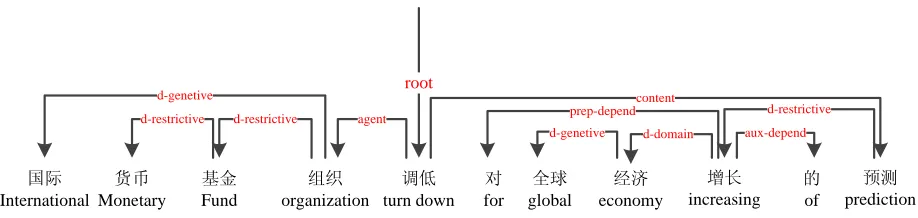
Dependency parsing (K¨ubler et al., 2009) is based on dependency grammar. It has several advantages, such as concise formalization, easy comprehension, high efficiency, and so on. Dependency parsing has been studied intensively in recent decades, with most related work focusing on syntactic structure. Many research papers on Chinese linguistics demon-strate the remarkable difference between semantics and syntax (Jin, 2001; Zhou and Zhang, 2003). Chinese is a meaning-combined language with very flexible syntax, and semantics are more stable than syntax. The word is the basic unit of semantics, and the structure and meaning of a sentence consists mainly of a series of semantic dependencies between individual words (Li et al., 2003). Thus, a reason-able endeavor is to exploit dependency parsing for semantic analysis of Chinese languages. Figure 1 shows an example of Chinese semantic dependency parsing.
国际 International
货币 Monetary
基金 Fund
组织 organization
调低 turn down
对 for
全球 global
经济 economy
增长 increasing
的 of
预测 prediction d-genetive
d-restrictive d-restrictive agent prep-depend
d-genetive d-domain aux-depend d-restrictive content
[image:2.612.77.536.59.168.2]root
Figure 1: An example of Chinese Semantic Dependency Parsing.
Figure 1 shows that Chinese semantic dependency parsing looks very similar to traditional syntax-dominated dependency parsing. Below is a compar-ison between the two tasks, dealing with three main points:
1. Semantic relations are more fine-grained than syntactic ones: the syntactic subject can either be the agent or experiencer, and the syntactic object can be the content, patient, possession, and so on. On the whole, the number of seman-tic relations is at least twice that of syntacseman-tic relations.
2. Semantic dependency parsing builds the depen-dency structure of a sentence in terms of se-mantics, and the word pairs of a dependency should have a direct semantic relation. This criterion determines many sizeable differences between semantics and syntax, especially in phrases formed by “XP+DEG”, “XP+DEV” and prepositional phrases. For example, in “美
丽 的 祖国” (beautiful country), the head of “美丽” (beautiful) is “祖国” (country) in se-mantic dependency parsing, whereas the head is “的” (de) in syntax dependency parsing.
3. Semantic relations are independent of position. For example, in “空气 被 污染” (the air is contaminated) and “污染 了 空气” (contami-nate the air), the patient “空气” (the air) can be before or behind a predicate “污染” (contami-nate).
The rest of the paper is organized as follows. Sec-tion 2 gives a short overview of data annotaSec-tion. Section 3 focuses on the task description. Section 4 describes the participant systems. Section 5
com-pares and analyzes the results. Finally, Section 6 concludes the paper.
2 Data Annotation
2.1 Corpus Section
10,068 sentences were selected from the Penn Chi-nese Treebank 6.01(Xue et al., 2005) (1-121, 1001-1078, 1100-1151) as the raw corpus from which to create the Chinese Semantic Dependency Parsing corpus. These sentences were chosen for the anno-tation for three reasons. First, gold syntactic depen-dency structures can be of great help in semantic de-pendency annotation, as syntactic dede-pendency arcs are often consistent with semantic ones. Second, the semantic role labels in PropBank2 can be very
use-ful in the present annotation work. Third, the gold word segmentation and Part-Of-Speech can be used as the annotation input in this work.
2.2 Semantic Relations
The semantic relations in the prepared Chinese se-mantic dependency parsing corpus came mostly from HowNet3 (Dong and Dong, 2006), a fa-mous Chinese semantic thesaurus. We also referred to other sources. Aside from the relations from HowNet, we defined two kinds of new relations: re-verse relations and indirect relations. When a verb modifies a noun, the relation between them is a re-verse relation, and r-XXX is used to indicate this kind of relation. For instance, in “打篮球的小男
孩” (the little boy who is playing basketball), the se-mantic relation between the head word “男孩” (boy)
1
http://www.ldc.upenn.edu/Catalog/ catalogEntry.jsp?catalog\\Id=LDC2007T36
2
http://verbs.colorado.edu/chinese/cpb/
3
and “打” (playing) is the r-agent. When a verbal noun is the head word, the relation between it and the modifier is the indirect relation j-XXX. For in-stance, in “企业管理” (business management), the head word is “管理” (management) and the modifier is “企业” (business), their relation is j-patient.
Finally, we defined 84 single-level semantic re-lations. The number of multi-level semantic rela-tions that actually appear in the labeled corpus in this work is 39.
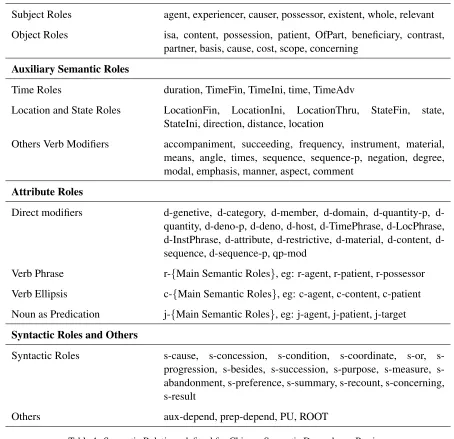
Table 1 summarizes all of the semantic relations used for annotation.
2.3 Annotation Flow
Our corpus annotation flow can be divided into the following steps.
1. Conversion of the sentences’ constituent struc-tures into dependency strucstruc-tures according to a set of rules similar with those used by the syntactic community to find the head of a phrase (Collins, 1999).
2. Labeling of the semantic relations for each de-pendency relation according to another set of rules using the functional tags in the Penn Chi-nese Treebank and the semantic roles in the Chinese PropBank.
3. Six human annotators are asked to check and adjust the structure and semantic relation errors introduced in Step 2.
The first two steps were performed automatically using rules. A high accuracy may be achieved with dependency structures when semantic labels are not considered. However, accuracy declines remarkably when the semantic label is considered. Unlabeled Attachment Score (UAS) and Labeled Attachment Score (LAS) can be used to evaluate the perfor-mance of the automatic conversion. Table 2 gives the detailed results.
UAS LAS
Conversion Result 90.53 57.38
Table 2: Accuracy after conversion from gold ProbBank.
3 Task Description
3.1 Corpus Statistics
We annotated 10,068 sentences from the Penn Chi-nese TreeBank for Semantic Dependency Parsing, and these sentences were divided into training, velopment, and test sections. Table 3 gives the de-tailed statistical information of the three sections.
Data Set CTB files # sent. # words. 1-10; 36-65;81-121; 8301
Training 1001-1078; 250311 1100-1119;
1126-1140
Devel 66-80; 1120-1125 534 15329 Test 11-35; 1141-1151 1233 34311 Total 1-121; 1001-1078 10068 299951
1100-1151
Table 3: Statistics of training, development and test data.
3.2 Data Format
The data format is identical to that of a syntactic de-pendency parsing shared task. All the sentences are in one text file, with each sentence separated by a blank line. Each sentence consists of one or more to-kens, and each token is represented on one line con-sisting of 10 fields. Buchholz and Marsi (2006) pro-vide more detailed information on the format. Fields are separated from each other by a tab. Only five of the 10 fields are used: token id, form, pos tagger, head, and deprel. Head denotes the semantic depen-dency of each word, and deprel denotes the corre-sponding semantic relations of the dependency. In the data, the lemma column is filled with the form and the cpostag column with the postag. Figure 2 shows an example.
3.3 Evaluation Method
Main Semantic Roles
Subject Roles agent, experiencer, causer, possessor, existent, whole, relevant
Object Roles isa, content, possession, patient, OfPart, beneficiary, contrast, partner, basis, cause, cost, scope, concerning
Auxiliary Semantic Roles
Time Roles duration, TimeFin, TimeIni, time, TimeAdv
Location and State Roles LocationFin, LocationIni, LocationThru, StateFin, state, StateIni, direction, distance, location
Others Verb Modifiers accompaniment, succeeding, frequency, instrument, material, means, angle, times, sequence, sequence-p, negation, degree, modal, emphasis, manner, aspect, comment
Attribute Roles
Direct modifiers genetive, category, member, domain, quantity-p, d-quantity, d-deno-p, d-deno, d-host, d-TimePhrase, d-LocPhrase, InstPhrase, attribute, restrictive, material, content, d-sequence, d-sequence-p, qp-mod
Verb Phrase r-{Main Semantic Roles}, eg: r-agent, r-patient, r-possessor
Verb Ellipsis c-{Main Semantic Roles}, eg: c-agent, c-content, c-patient
Noun as Predication j-{Main Semantic Roles}, eg: j-agent, j-patient, j-target
Syntactic Roles and Others
Syntactic Roles s-cause, s-concession, s-condition, s-coordinate, s-or, progression, besides, succession, purpose, measure, s-abandonment, s-preference, s-summary, s-recount, s-concerning, s-result
Others aux-depend, prep-depend, PU, ROOT
Table 1: Semantic Relations defined for Chinese Semantic Dependency Parsing.
ID FORM LEMMA CPOS PPOS FEAT HEAD REL PHEAD PREL 1 钱其琛 钱其琛 NR NR 2 agent
2 谈 谈 VV VV 0 ROOT
3 香港 香港 NR NR 4 d-genetive
4 前景 前景 NN NN 7 s-coordinate
5 和 和 CC CC 7 aux-depend
6 台湾 台湾 NR NR 7 d-genetive
[image:4.612.78.532.84.523.2]7 问题 问题 NN NN 2 content
4 Participating Systems
Nine organizations were registered to participate in the Chinese Semantic Dependency Parsing task. Fi-nally, nine systems were received from five different participating teams. These systems are as follows:
1. Zhou Qiaoli-1, Zhou Qiaoli-2, Zhou Qiaoli-3 These three systems propose a divide-and-conquer strategy for semantic dependency parsing. The Semantic Role (SR) phrases are identified (Cai et al., 2011) and then replaced by their head or the SR of the head. The orig-inal sentence is thus divided into two types of parts that can be parsed separately. The first type is SR phrase parsing, and the second in-volves the replacement of SR phrases with ei-ther their head or the SR of the head. Finally, the paper takes a graph-based parser (Li et al., 2011) as the semantic dependency parser for all parts. These three systems differ in their phrase identification strategies.
2. NJU-Parser-1, NJU-Parser-2
The NJU-Parser is based on the state-of-the-art MSTParser (McDonald, 2006). NJU-Parser applies three methods to enhance semantic de-pendency parsing. First, sentences are split into sub-sentences using commas and semi-colons: (a) sentences are split using only com-mas and semicolons, as in the primary sys-tem, and (b) classifiers are used to determine whether a comma or semicolon should be used to split the sentence. Second, the last character in a Chinese word is extracted as the lemma, since it usually contains the main sense or se-mantic class. Third, the multilevel-label is in-troduced into the semantic relation, for exam-ple, the r-{Main Semantic Roles}, with NJU-Parser exploiting special strategies to handle it. However, this third method does not show pos-itive performance.
3. Zhijun Wu-1
This system extends the second-order of the MSTParser by adding third-order features, and then applying this model to Chinese semantic dependency parsing. In contrast to Koo and Collins (2010) this system does not implement
the third-order model using dynamic program-ming, as it requiresO(n4)time. It first first
ob-tained the K-best results of second-order mod-els and then added the third-order features into the results.
4. ICT-1
The ICT semantic dependency parser employs a system-combining strategy to obtain the de-pendency structure and then uses the classifier from Le Zhang’s Maximum Entropy Model-ing Toolkit4to predict the semantic relation for
each dependency. The system-combining strat-egy involves three steps:
• Parsing each sentence using Nivre’s arc standard, Nivre’s arc eager (Nivre and Nilsson, 2005; Nivre, 2008), and Liang’s dynamic algorithm (Huang and Sagae, 2010);
• Combining parses given by the three parsers into a weighted directed graph;
• Using the Chu-Liu-Edmonds algorithm to search for the final parse for each sen-tence.
5. Giuseppe SVM-1-R, Giuseppe Attardi-SVM-1-rev
We didn’t receive the system description of these two systems.
5 Results & Analysis
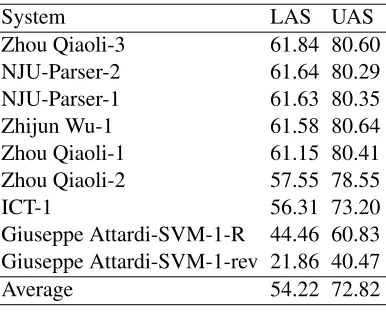
LAS is the main evaluation metric in Chinese Se-mantic Dependency Parsing, whereas UAS is the secondary metric. Table 4 shows the results for these two indicators in all participating systems.
As shown in Table 4, the Zhou Qiaoli-3 system achieved the best results with LAS of 61.84. The LAS values of top systems are very closely. We per-formed significance tests5 for top six results. Table 5 shows the results , from which we can see that the performances of top five results are comparative (p > 0.1) and the rank sixth system is significantly (p <10−5) worse than top five results.
4http://homepages.inf.ed.ac.uk/s0450736/
maxenttoolkit.html
5
NJU-Parser-2 NJU-Parser-1 Zhijun Wu-1 Zhou Qiaoli-1 Zhou Qiaoli-2
Zhou Qiaoli-3 ∼ ∼ ∼ ∼ >
NJU-Parser-2 – ∼ ∼ ∼ >
NJU-Parser-1 – – ∼ ∼ >
Zhijun Wu-1 – – – ∼ >
Zhou Qiaoli-1 – – – – >
Table 5: Significance tests of the top five systems. ∼denotes that the two systems are comparable (p >0.1), and>
means the system of this row is significantly (p <10−5) better than the system of this column.
System LAS UAS
Zhou Qiaoli-3 61.84 80.60 NJU-Parser-2 61.64 80.29 NJU-Parser-1 61.63 80.35 Zhijun Wu-1 61.58 80.64 Zhou Qiaoli-1 61.15 80.41 Zhou Qiaoli-2 57.55 78.55
ICT-1 56.31 73.20
[image:6.612.90.283.198.354.2]Giuseppe Attardi-SVM-1-R 44.46 60.83 Giuseppe Attardi-SVM-1-rev 21.86 40.47 Average 54.22 72.82
Table 4: Results of the submitted systems.
The average LAS for all systems was 54.22. Chinese Semantic Dependency Parsing performed much more poorly than Chinese Syntactic Depen-dency Parsing due to the increased complexity brought about by the greater number of semantic re-lations compared with syntactic rere-lations, as well as greater difficulty in classifying semantic relations.
In general, all the systems employed the tradi-tional syntax-dominated dependency parsing frame-works. Some new methods were proposed for this task. Zhou Qiaoli’s systems first identified the semantic role phrase in a sentence, and then employed graph-based dependency parsing to ana-lyze the semantic structure of the sentence. NJU-Parser first split the sentence into sub-sentences, then trained and parsed the sentence based on these sub-sentences; this was shown to perform well. In addition, ensemble models were also proposed to solve the task using ICT systems.
6 Conclusion
We described the Chinese Semantic Dependency Parsing task for SemEval-2012, which is designed to
parse the semantic structures of Chinese sentences. Nine results were submitted by five organizations, with the best result garnering an LAS score of 61.84, which is far below the performance of Chinese Syn-tax. This demonstrates that further research on the structure of Chinese Semantics is needed.
In the future, we will check and improve the anno-tation standards while building a large, high-quality corpus for further Chinese semantic research.
Acknowledgments
We thank the anonymous reviewers for their help-ful comments. This work was supported by Na-tional Natural Science Foundation of China (NSFC) via grant 61133012 and 61170144, and the Na-tional “863” Leading Technology Research Project via grant 2012AA011102.
References
Sabine Buchholz and Erwin Marsi. 2006. Conll-x shared task on multilingual dependency parsing. In Proceed-ings of the Tenth Conference on Computational Nat-ural Language Learning (CoNLL-X), pages 149–164, New York City, June. Association for Computational Linguistics.
Dongfeng Cai, Ling Zhang, Qiaoli Zhou, and Yue Zhao. 2011. A collocation based approach for prepositional phrase identification. IEEE NLPKE.
Michael Collins. 1999. Head-Driven Statistical Models for Natural Language Parsing. Ph.D. thesis, Pennsyl-vania University.
Zhendong Dong and Qiang Dong. 2006.Hownet And the Computation of Meaning. World Scientific Publishing Co., Inc., River Edge, NJ, USA.
Uppsala, Sweden, July. Association for Computational Linguistics.
Guangjin Jin. 2001. Theory of modern Chinese verb se-mantic computation. Beijing University Press. Terry Koo and Michael Collins. 2010. Efficient
third-order dependency parsers. InProceedings of the 48th Annual Meeting of the ACL, number July, pages 1–11. Sandra K¨ubler, Ryan McDonald, and Joakim Nivre. 2009. Dependency Parsing. InSynthesis Lectures on Human Language Technologies.
Mingqin Li, Juanzi Li, Zhendong Dong, Zuoying Wang, and Dajin Lu. 2003. Building a large chinese corpus annotated with semantic dependency. InProceedings of the second SIGHAN workshop on Chinese language processing - Volume 17, SIGHAN ’03, pages 84–91, Stroudsburg, PA, USA. Association for Computational Linguistics.
Zhenghua Li, Min Zhang, Wanxiang Che, Ting Liu, Wen-liang Chen, and Haizhou Li. 2011. Joint models for chinese pos tagging and dependency parsing. In Pro-ceedings of the 2011 Conference on Empirical Meth-ods in Natural Language Processing, pages 1180– 1191, Edinburgh, Scotland, UK., July. Association for Computational Linguistics.
Ryan McDonald. 2006. Discriminative learning and spanning tree algorithms for dependency parsing. Ph.D. thesis, University of Pennsylvania.
Joakim Nivre and Jens Nilsson. 2005. Pseudo-projective dependency parsing. InProceedings of the 43rd An-nual Meeting of the Association for Computational Linguistics (ACL).
Joakim Nivre. 2008. Algorithms for deterministic incre-mental dependency parsing. Computational Linguis-tics, 34(4):513–553.
Nianwen Xue and Martha Palmer. 2003. Annotating the propositions in the penn chinese treebank. In Pro-ceedings of the Second SIGHAN Workshop on Chinese Language Processing.
Nianwen Xue and Martha Palmer. 2005. Automatic se-mantic role labeling for chinese verbs. InProceedings of the 19th International Joint Conference on Artificial Intelligence.
Nianwen Xue, Fei Xia, Fu-Dong Chiou, and Martha Palmer. 2005. The penn chinese treebank: Phrase structure annotation of a large corpus. Natural Lan-guage Engineering, 11(2):207–238.