Unsupervised Multi-Domain Adaptation with Feature Embeddings
Yi Yang and Jacob Eisenstein School of Interactive Computing Georgia Institute of Technology
Atlanta, GA 30308
{yiyang+jacobe}@gatech.edu
Abstract
Representation learning is the dominant tech-nique for unsupervised domain adaptation, but existing approaches have two major weak-nesses. First, they often require the spec-ification of “pivot features” that generalize across domains, which are selected by task-specific heuristics. We show that a novel but simplefeature embeddingapproach provides better performance, by exploiting the feature template structure common in NLP problems. Second, unsupervised domain adaptation is typically treated as a task of moving from a single source to a single target domain. In reality, test data may be diverse, relating to the training data in some ways but not oth-ers. We propose an alternative formulation, in which each instance has a vector of do-main attributes, can be used to learn distill the domain-invariant properties of each feature.1
1 Introduction
Domain adaptation is crucial if natural language processing is to be successfully employed in high-impact application areas such as social media, pa-tient medical records, and historical texts. Unsuper-vised domain adaptation is particularly appealing, since it requires no labeled data in the target domain. Some of the most successful approaches to unsu-pervised domain adaptation are based on representa-tion learning: transforming sparse high-dimensional surface features into dense vector representations, 1Source code and a demo are available at https://
github.com/yiyang-gt/feat2vec
1800 1750 1700 1650 1600 1550 1500 Narrative s
Letters
Dissertation t
Theatre
Figure 1: Domain graph for the Tycho Brahe cor-pus (Galves and Faria, 2010).Suppose we want to adapt from 19th Century narratives to 16th Century disser-tations: can unlabeled data from other domains help?
which are often more robust to domain shift (Blitzer et al., 2006; Glorot et al., 2011). However, these methods are computationally expensive to train, and often require special task-specific heuristics to select good “pivot features.”
A second, more subtle challenge for unsupervised domain adaptation is that it is normally framed as adapting from a single source domain to a single tar-get domain. For example, we may be given part-of-speech labeled text from 19th Century narratives, and we hope to adapt the tagger to work on academic dissertations from the 16th Century. This ignores text from the intervening centuries, as well as text that is related by genre, such as 16th Century narra-tives and 19th Century dissertations (see Figure 1). We address a new challenge ofunsupervised multi-domain adaptation, where the goal is to leverage this additional unlabeled data to improve performance in the target domain.2
2Multiple domains have been considered insupervised
do-main adaptation (e.g., Mansour et al., 2009), but these ap-proaches are not directly applicable when there is no labeled data outside the source domain.
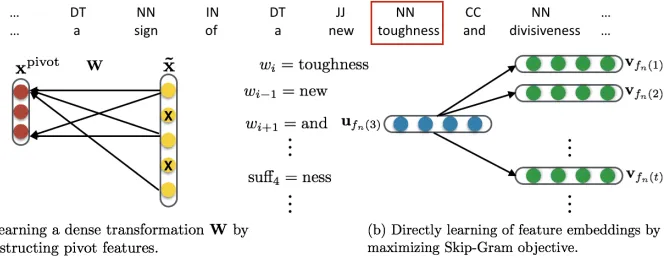
[image:1.612.312.547.250.324.2]Figure 2: Representation learning techniques in structured feature spaces
We present FEMA(FeatureEMbeddings for do-main Adaptation), a novel representation learning approach for domain adaptation in structured feature spaces. Like prior work in representation learning, FEMAlearns dense features that are more robust to domain shift. However, rather than performing rep-resentation learning by reconstructing pivot features, FEMA uses techniques from neural language mod-els to obtain low-dimensional embeddings directly. FEMAoutperforms prior work on adapting POS tag-ging from the Penn Treebank to web text, and it eas-ily generalizes to unsupervised multi-domain adap-tation, further improving performance by learning generalizable models across multiple domains.
2 Learning feature embeddings
Feature co-occurrence statistics are the primary source of information driving many unsupervised methods for domain adaptation; they enable the induction of representations that are more similar across the source and target domain, reducing the error introduced by domain shift (Ben-David et al., 2010). For example, both Structural Correspon-dence Learning (SCL; Blitzer et al., 2006) and De-noising Autoencoders (Chen et al., 2012) learn to reconstruct a subset of “pivot features”, as shown in Figure 2(a). The reconstruction function — which is learned from unlabeled data in both domains — is then employed to project each instance into a dense representation, which will hopefully be better suited to cross-domain generalization. The pivot features are chosen to be both predictive of the label and gen-eral across domains. Meeting these two criteria re-quires task-specific heuristics; for example,
differ-ent pivot selection techniques are employed in SCL for syntactic tagging (Blitzer et al., 2006) and senti-ment analysis (Blitzer et al., 2007). Furthermore, the pivot features correspond to a small subspace of the feature co-occurrence matrix. In Denoising Autoen-coders, each pivot feature corresponds to a dense feature in the transformed representation, but large dense feature vectors impose substantial computa-tional costs at learning time. In SCL, each pivot fea-ture introduces a new classification problem, which makes computation of the cross-domain representa-tion expensive. In either case, we face a tradeoff between the amount of feature co-occurrence infor-mation that we can use, and the computational com-plexity for representation learning and downstream training.
This tradeoff can be avoided by inducing low dimensional feature embeddings directly. We ex-ploit the tendency of many NLP tasks to divide fea-tures into templates, with exactly one active fea-ture per template (Smith, 2011); this is shown in the center of Figure 2. Rather than treating each instance as an undifferentiated bag-of-features, we use this template structure to inducefeature embed-dings, which are dense representations of individual features. Each embedding is selected to help pre-dict the features that fill out the other templates: for example, an embedding for the current word feature is selected to help predict the previous word feature and successor word feature, and vice versa; see Fig-ure 2(b). The embeddings for each active featFig-ure are then concatenated together across templates, giving a dense representation for the entire instance.
in which dense representations are learned for indi-vidual words based on their neighbors (Turian et al., 2010; Xiao and Guo, 2013), but rather than learning a single embedding for each word, we learn embed-dings for eachfeature. This means that the embed-ding of, say, ‘toughness’ will differ depenembed-ding on whether it appears in thecurrent-wordtemplate or theprevious-wordtemplate (see Table 6). This pro-vides additional flexibility for the downstream learn-ing algorithm, and the increase in the dimensional-ity of the overall dense representation can be off-set by learning shorter embeddings for each feature. In Section 4, we show that feature embeddings con-vincingly outperform word embeddings on two part-of-speech tagging tasks.
Our feature embeddings are based on the skip-gram model, trained with negative sam-pling (Mikolov et al., 2013a), which is a simple yet efficient method for learning word embeddings. Rather than predicting adjacent words, the training objective in our case is to find feature embeddings that are useful for predicting other active features in the instance. For the instance n ∈ {1. . . N} and feature templatet ∈ {1. . . T}, we denotefn(t) as the index of the active feature; for example, in the in-stance shown in Figure 2,fn(t) =‘new’ whent in-dicates theprevious-wordtemplate. The skip-gram approach induces distinct “input” and “output” em-beddings for each feature, writtenufn(t)andvfn(t),
respectively. The role of these embeddings can be seen in the negative sampling objective,
`n=T1 T X
t=1
T X
t06=t
h
logσ(u>fn(t)vfn(t0))
+kEi∼P(n)
t0 logσ(−u
>
fn(t)vi)
, (1)
wheret andt0 are feature templates, kis the num-ber of negative samples,Pt(0n)is anoise distribution
for templatet0, andσis the sigmoid function. This objective is derived from noise-contrastive estima-tion (Gutmann and Hyv¨arinen, 2012), and is cho-sen to maximize the unnormalized log-likelihood of the observed feature co-occurrence pairs, while min-imizing the unnormalized log-likelihood of “nega-tive” samples, drawn from the noise distribution.
Feature embeddings can be applied to domain adaptation by learning embeddings of all features
on the union of the source and target data sets; we consider the extension to multiple domains in the next section. The dense feature vector for each in-stance is obtained by concatenating the feature em-beddings for each template. Finally, since it has been shown that nonlinearity is important for generating robust representations (Bengio et al., 2013), we fol-low Chen et al. (2012) and apply the hyperbolic tan-gent function to the embeddings. The augmented representationx(aug)n of instancenis the concatena-tion of the original feature vector and the feature em-beddings,
x(aug)
n =xn⊕tanh[ufn(1)⊕ · · · ⊕ufn(T)],
where⊕is vector concatenation.
3 Feature embeddings across domains
We now describe how to extend the feature em-bedding idea beyond a single source and target do-main, to unsupervised multi-attribute domain adap-tation (Joshi et al., 2013). In this setting, each in-stance is associated with M metadata domain at-tributes, which could encode temporal epoch, genre, or other aspects of the domain. The challenge of domain adaptation is that the meaning of features can shift across each metadata dimension: for ex-ample, the meaning of ‘plant’ may depend on genre (agriculture versus industry), while the meaning of ‘like’ may depend on epoch. To account for this, the feature embeddings should smoothly shift over do-main graphs, such as the one shown in Figure 1; this would allow us to isolate the domain general aspects of each feature. Related settings have been consid-ered only for supervised domain adaptation, where some labeled data is available in each domain (Joshi et al., 2013), but not in the unsupervised case.
More formally, we assume each instance n is augmented with a vector of M binary domain at-tributes,zn ∈ {0,1}M. These attributes may over-lap, so that we could have an attribute for the epoch 1800-1849, and another for the epoch 1800-1899. We definezn,0 = 1 as a shared attribute, which is
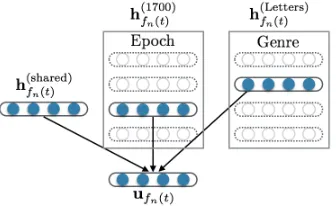
Figure 3: Aggregating multiple embeddings.
in Figure 3. The local “input” feature embedding
ufn(t) is then defined as the summation, ufn(t) = PM
m=0zn,mh(fmn()t).
The role of the global embeddingh(0)i is to cap-ture domain-neutral information about the feacap-ture i, while the other embeddings capture attribute-specific information. The global feature embed-dings should therefore be more robust to domain shift, which is “explained away” by the attribute-specific embeddings. We therefore use only these embeddings when constructing the augmented rep-resentation,x(aug)n . To ensure that the global embed-dings capture all of the domain-general information about each feature, we place an L2 regularizer on the attribute-specific embeddings. Note that we do not learn attribute-specific “output” embeddingsv; these are shared across all instances, regardless of domain.
The attribute-based embeddings yield a new train-ing objective for instancen,
`n =T1 T X
t=1 T X
t06=t
"
logσ([XM
m=0
zn,mh(fmn()t)]
>v
fn(t0))
+kEi∼P(n)
t0 logσ(−[ M X
m=0
zn,mh(fmn()t)]>v
i) #
. (2)
For brevity, we omit the regularizer from Equa-tion 2. For feature fn(t), the (unregularized) gra-dients ofh(fmn()t)andvfn(t0)w.r.t`n,tare
∂`n,t
h(fmn()t) = 1
T T X
t06=t
zn,mh(1−σ(u>
fn(t)vfn(t0)))vfn(t0)
−kEi∼P(n)
t0 σ(u >
fn(t)vi)vi i
(3)
∂`n,t
vfn(t0)
=T1
T X
t06=t
(1−σ(u>
fn(t)vfn(t0)))ufn(t). (4)
For each featureidrawn from the noise distribu-tionPt(0n), the gradient ofviw.r.t`n,tis
∂`n,t
vi =−
1
Tσ(u>fn(t)vi)ufn(t). (5) 4 Experiments
We evaluate FEMAon part-of-speech (POS) tagging, in two settings: (1) adaptation of English POS tag-ging from news text to web text, as in the SANCL shared task (Petrov and McDonald, 2012); (2) adap-tation of Portuguese POS tagging across a graph of related domains over several centuries and gen-res, from the Tycho Brahe corpus (Galves and Faria, 2010). These evaluations are complementary: En-glish POS tagging gives us the opportunity to eval-uate feature embeddings in a well-studied and high-impact application; Portuguese POS tagging enables evaluation of multi-attribute domain adaptation, and demonstrates the capability of our approach in a morphologically-rich language, with a correspond-ingly large number of part-of-speech tags (383). As more historical labeled data becomes available for English and other languages, we will be able to evaluate feature embeddings and related techniques there.
4.1 Implementation details
Component Feature template
Lexical (5) wi−2=X, wi−1=Y, . . .
Affixes (8) Xis prefix ofwi,|X| ≤4 Xis suffix ofwi,|X| ≤4
[image:5.612.76.293.63.124.2]Orthography (3) wicontains number, uppercase char-acter, or hyphen
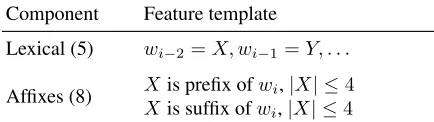
Table 1: Basic feature templates for tokenwi.
adding dense features from FEMA(and the alterna-tive representation learning techniques) to a set of basic features.
4.1.1 Basic features
We apply sixteen feature templates, motivated by by Ratnaparkhi (1996). Table 1 provides a summary of the templates; there are four templates each for the prefix and suffix features. Feature embeddings are learned for all lexical and affix features, yield-ing a total of thirteen embeddyield-ings per instance. We do not learn embeddings for the binary orthographic features. Santos and Zadrozny (2014) demonstrate the utility of embeddings for affix features.
4.1.2 Competitive systems
We consider three competitive unsupervised do-main adaptation methods. Structural Correspon-dence Learning (Blitzer et al., 2006, SCL) creates a binary classification problem for each pivot fea-ture, and uses the weights of the resulting classifiers to project the instances into a dense representation. Marginalized Denoising Autoencoders (Chen et al., 2012, mDA) learn robust representation across do-mains by reconstructing pivot features from artifi-cially corrupted input instances. We use structured dropout noise, which has achieved state-of-art re-sults on domain adaptation for part-of-speech tag-ging (Yang and Eisenstein, 2014). We also directly compare with WORD2VEC3 word embeddings, and with a “no-adaptation” baseline in which only sur-face features are used.
4.1.3 Parameter tuning
All the hyperparameters are tuned on develop-ment data. Following Blitzer et al. (2006), we con-sider pivot features that appear more than 50 times in
3https://code.google.com/p/word2vec/
all the domains for SCL and mDA. In SCL, the pa-rameterKselects the number of singular vectors of the projection matrix to consider; we try values be-tween 10 and 100, and also employ feature normal-ization and rescaling. For embedding-based meth-ods, we choose embedding sizes and numbers of negative samples from {25,50,100,150,200} and
{5,10,15,20} respectively. The noise distribution Pt(n) is simply the unigram probability of each fea-ture in the templatet. Mikolov et al. (2013b) argue for exponentiating the unigram distribution, but we find it makes little difference here. The window size of word embeddings is set as 5. As noted above, the attribute-specific embeddings are regularized, to encourage use of the shared embedding h(0). The
regularization penalty is selected by grid search over
{0.001,0.01,0.1,1.0,10.0}. In general, we find that the hyperparameters that yield good word embed-dings tend to yield good feature embedembed-dings too.
4.2 Evaluation 1: Web text
Recent work in domain adaptation for natural lan-guage processing has focused on the data from the shared task on Syntactic Analysis of Non-Canonical Language (SANCL; Petrov and McDonald, 2012), which contains several web-related corpora (news-groups, reviews, weblogs, answers, emails) as well as the WSJ portion of OntoNotes corpus (Hovy et al., 2006). Following Schnabel and Sch¨utze (2014), we use sections 02-21 of WSJ for training and sec-tion 22 for development, and use 100,000 unlabeled WSJ sentences from 1988 for learning representa-tions. On the web text side, each of the five target domains has an unlabeled training set of 100,000 sentences (except theANSWERSdomain, which has 27,274 unlabeled sentences), along with develop-ment and test sets of about 1000 labeled sentences each. In the spirit of truly unsupervised domain adaptation, we do not use any target domain data for parameter tuning.
Target baseline MEMM SCL mDA word2vec FLORS FEMA NEWSGROUPS 88.56 89.11 89.33 89.87 89.70 90.86 91.26 REVIEWS 91.02 91.43 91.53 91.96 91.70 92.95 92.82 WEBLOGS 93.67 94.15 94.28 94.18 94.17 94.71 94.95 ANSWERS 89.05 88.92 89.56 90.06 89.83 90.30 90.69 EMAILS 88.12 88.68 88.42 88.71 88.51 89.44 89.72
[image:6.612.126.487.197.296.2]AVERAGE 90.08 90.46 90.63 90.95 90.78 91.65 91.89
Table 2: Accuracy results for adaptation from WSJ to Web Text on SANCL dev set.
Target baseline MEMM SCL mDA word2vec FLORS FEMA
NEWSGROUPS 91.02 91.25 91.51 91.83 91.35 92.41 92.60 REVIEWS 89.79 90.30 90.29 90.95 90.87 92.25 92.15 WEBLOGS 91.85 92.32 92.32 92.39 92.42 93.14 93.43 ANSWERS 89.52 89.74 90.04 90.61 90.48 91.17 91.35 EMAILS 87.45 87.77 88.04 88.11 88.28 88.67 89.02
[image:6.612.317.534.341.469.2]AVERAGE 89.93 90.28 90.44 90.78 90.68 91.53 91.71
Table 3: Accuracy results for adaptation from WSJ to Web Text on SANCL test set.
weights of the pivot feature predictors. The mDA method does not include any such matrix factor-ization step, and therefore generates a number of dense features equal to the number of pivot features. Memory constraints force us to choose fewer pivots, which we achieve by raising the threshold to 200, yielding 2754 pivot features.
Additional systems Aside from SCL and mDA, we compare against published results of FLORS (Schnabel and Sch¨utze, 2014), which uses distributional features for domain adaptation. We also republish the baseline results of Schnabel and Sch¨utze (2014) using the Stanford POS Tagger, a maximum entropy Markov model (MEMM) tagger.
Results As shown in Table 2 and 3, FEMA outper-forms competitive systems on all target domains ex-ceptREVIEW, where FLORS performs slightly bet-ter. FLORS uses more basic features than FEMA; these features could in principle be combined with feature embeddings for better performance. Com-pared with the other representation learning ap-proaches, FEMA is roughly 1% better on average, corresponding to an error reduction of 10%. Its training time is approximately 70 minutes on a 24-core machine, using an implementation based on
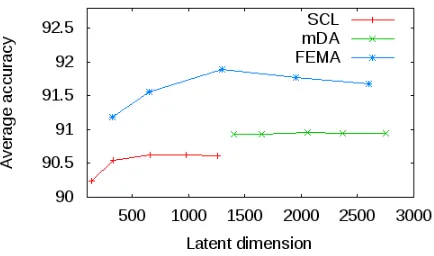
Figure 4: Accuracy results with different latent dimen-sions on SANCL dev sets.
gensim.4 This is slightly faster than SCL, although slower than mDA with structured dropout noise.
Figure 4 shows the average accuracy on the SANCL development set, versus the latent dimen-sions of different methods. The latent dimension of SCL is modulated by the number of singular vec-tors; we consider sizes 10, 25, 50, 75, and 100. In mDA, we consider pivot feature frequency thresh-olds 500, 400, 300, 250, and 200. For FEMA, we consider embedding sizes 25, 50, 100, 150, and 200. The resulting latent dimensionality multiplies these sizes by the number of non-binary templates
Task baseline SCL mDA word2vec FEMA single
embedding attributeembeddings from 1800-1849
→1750 88.74 89.31 90.11 89.24 90.25 90.59
→1700 89.97 90.41 91.39 90.51 91.61 92.03
→1650 85.94 86.76 87.69 86.22 87.64 88.12
→1600 86.21 87.65 88.63 87.41 89.39 89.77
→1550 88.92 89.92 90.79 89.85 91.47 91.78
→1500 85.32 86.82 87.64 86.60 89.29 89.89
AVERAGE 87.52 88.48 89.37 88.30 89.94 90.36
from 1750-1849
→1700 94.37 94.60 94.86 94.60 95.14 95.22
→1650 91.49 91.78 92.52 91.85 92.56 93.26
→1600 91.92 92.51 93.14 92.83 93.80 93.89
→1550 92.75 93.21 93.53 93.21 94.23 94.20
→1500 89.87 90.53 91.31 91.48 92.05 92.95
[image:7.612.116.498.61.294.2]AVERAGE 92.08 92.53 93.07 92.80 93.56 93.90
Table 4: Accuracy results for adaptation in the Tycho Brahe corpus of historical Portuguese.
13. FEMA dominates the other approaches across the complete range of latent dimensionalities. The best parameters for SCL are dimensionalityK = 50
and rescale factor α = 5. For both FEMA and WORD2VEC, the best embedding size is100and the best number of negative samples is5.
4.3 Evaluation 2: Historical Portuguese
Next, we consider the problem ofmulti-attribute do-main adaptation, using the Tycho Brahe corpus of historical Portuguese text (Galves and Faria, 2010), which contains syntactic annotations of Portuguese texts in four genres over several centuries (Figure 1). We focus on temporal adaptation: training on the most modern data in the corpus, and testing on in-creasingly distant historical text.
Settings For FEMA, we consider domain attributes for 50-year temporal epochs and genres; we also cre-ate an additional attribute merging all instances that are in neither the source nor target domain. In SCL and mDA, 1823 pivot features pass the threshold. Optimizing on a source-domain development set, we find that the best parameters for SCL are dimension-ality K = 25 and rescale factor α = 5. The best embedding size and negative sample number are50
and15for both FEMAandWORD2VEC.
Results As shown in Table 4, FEMAoutperforms competitive systems on all tasks. The column “sin-gle embedding” reports results with a sin“sin-gle feature embedding per feature, ignoring domain attributes; the column “attribute embeddings” shows that learn-ing feature embeddlearn-ings for domain attributes further improves performance, by 0.3-0.4% on average.
5 Similarity in the embedding space
The utility of word and feature embeddings for POS tagging task can be evaluated through word simi-larity in the embedding space, and its relationship to type-level part-of-speech labels. To measure the label consistency between each word and its topQ closest words in the vocabulary we compute,
Consistency= P|V|
i=1
PQ
j=1β(wi, cij)
|V| ×Q (6)
where|V|is the number of words in the vocabulary, wi is the i-th word in the vocabulary, cij is the j -th closest word towiin the embedding space (using cosine similarity),β(wi, cij)is an indicator function that is equal to1if wi andcij have the same most common part-of-speech in labeled data.
Embedding Q= 5 Q= 10 Q= 50 Q= 100 WORD2VEC 47.64 46.17 41.96 40.09 FEMA-current 68.54 66.93 62.36 59.94 FEMA-prev 55.34 54.18 50.41 48.39 FEMA-next 57.13 55.78 52.04 49.97 FEMA-all 70.63 69.60 65.95 63.91 Table 5: Label consistency of theQ-most similar words in each embedding. FEMA-all is the concatenation of the
current, previous, and next-word FEMAembeddings.
also used to obtain the most common tag for each word. Table 5 shows that the FEMA embeddings are more consistent with the type-level POS tags than WORD2VEC embeddings. This is not surpris-ing, since they are based on feature templates that are specifically designed for capturing syntactic reg-ularities. In simultaneously published work, Ling et al. (2015) present “position-specific” word em-beddings, which are an alternative method to induce more syntactically-oriented word embeddings.
Table 6 shows the most similar words for three query keywords, in each of four different embed-dings. The next-wordandprevious-word embed-dings are most related to syntax, because they help to predict each other and thecurrent-wordfeature; thecurrent-wordembedding brings in aspects of or-thography, because it must help to predict the affix features. In morphologically rich languages such as Portuguese, this can help to compute good embed-dings for rare inflected words. This advantage holds even in English: the word ‘toughness’ appears only once in the SANCL data, but the FEMA-current em-bedding is able to capture its morphological simi-larity to words such as ‘tightness’ and ‘thickness’. InWORD2VEC, the lists of most similar words tend to combine syntax and topic information, and fail to capture syntactic regularities such as the relationship between ‘and’ and ‘or’.
6 Related Work
Representation learning Representational differ-ences between source and target domains can be a major source of errors in the target domain (Ben-David et al., 2010). To solve this problem, cross-domain representations were first induced via auxil-iary prediction problems (Ando and Zhang, 2005), such as the prediction of pivot features (Blitzer et
‘new’
FEMA-current nephew, news, newlywed, newer,
newspaper
FEMA-prev current, local, existing,
interna-tional, entire
FEMA-next real, big, basic, local, personal WORD2VEC current, special, existing, newly,
own ‘toughness’
FEMA-current tightness, trespass, topless, thick-ness, tenderness
FEMA-prev underside, firepower, buzzwords,
confiscation, explorers
FEMA-next aspirations, anguish, pointers,
or-ganisation, responsibilities
WORD2VEC parenting, empathy, ailment, rote,
nerves ‘and’
FEMA-current amd, announced, afnd, anesthetized,
anguished
FEMA-prev or, but, as, when, although
FEMA-next or, but, without, since, when WORD2VEC but, while, which, because,
practi-cally
Table 6: Most similar words for three queries, in each embedding space.
al., 2006). In these approaches, as well as in later work on denoising autoencoders (Chen et al., 2012), the key mechanism is to learn a function to predict a subset of features for each instance, based on other features of the instance. Since no labeled data is re-quired to learn the representation, target-domain in-stances can be incorporated, revealing connections between features that appear only in the target do-main and features that appear in the source dodo-main training data. The design of auxiliary prediction problems and the selection of pivot features both in-volve heuristic decisions, which may vary depend-ing on the task. FEMAavoids the selection of pivot features by directly learning a low-dimensional rep-resentation, through which features in each template predict the other templates.
learning by Ganchev and Das (2013). This approach requires a forward-backward computation for repre-sentation learning, while FEMArepresentations can be learned without dynamic programming, through negative sampling.
Word embeddings Word embeddings can be viewed as special case of representation learning, where the goal is to learn representations for each word, and then to supply these representations in place of lexical features. Early work focused on discrete clusters (Brown et al., 1990), while more recent approaches induce dense vector representa-tions; Turian et al. (2010) compare Brown clus-ters with neural word embeddings from Collobert and Weston (2008) and Mnih and Hinton (2009). Word embeddings can also be computed via neu-ral language models (Mikolov et al., 2013b), or from canonical correlation analysis (Dhillon et al., 2011). Xiao and Guo (2013) induce word em-beddings across multiple domains, and concate-nate these representations into a single feature vec-tor for labeled instances in each domain, following EasyAdapt (Daum´e III, 2007). However, they do not apply this idea to unsupervised domain adapta-tion, and do not work in the structured feature setting that we consider here. Bamman et al. (2014) learn geographically-specific word embeddings, in an ap-proach that is similar to our multi-domain feature embeddings, but they do not consider the applica-tion to domain adaptaapplica-tion. We can also view the dis-tributed representations in FLORS as a sort of word embedding, computed directly from rescaled bigram counts (Schnabel and Sch¨utze, 2014).
Feature embeddings are based on a different phi-losophy than word embeddings. While many NLP features are lexical in nature, the role of a word towards linguistic structure prediction may differ across feature templates. Applying a single word representation across all templates is therefore sub-optimal. Another difference is that feature embed-dings can apply to units other than words, such as character strings and shape features. The tradeoff is that feature embeddings must be recomputed for each set of feature templates, unlike word embed-dings, which can simply be downloaded and plugged into any NLP problem. However, computing fea-ture embeddings is easy in practice, since it requires
only a light modification to existing well-optimized implementations for computing word embeddings.
Multi-domain adaptation The question of adap-tation across multiple domains has mainly been ad-dressed in the context of supervised multi-domain learning, with labeled data available in all do-mains (Daum´e III, 2007). Finkel and Manning (2009) propagate classification parameters across a tree of domains, so that classifiers for sibling do-mains are more similar; Daum´e III (2009) shows how to induce such trees using a nonparametric Bayesian model. Dredze et al. (2010) combine clas-sifier weights using confidence-weighted learning, which represents the covariance of the weight vec-tors. Joshi et al. (2013) formulate the problem of multi-attribute multi-domain learning, where all at-tributes are potential distinctions between domains; Wang et al. (2013) present an approach for automat-ically partitioning instances into domains according to such metadata features. Our formulation is related to domain learning, particularly in the multi-attribute setting. However, rather than partitioning all instances into domains, the domain attribute for-mulation allows information to be shared across in-stances which share metadata attributes. We are unaware of prior research on unsupervised multi-domain adaptation.
7 Conclusion
Feature embeddings can be used for domain adap-tation in any problem involving feature templates. They offer strong performance, avoid practical drawbacks of alternative representation learning ap-proaches, and are easy to learn using existing word embedding methods. By combining feature em-beddings with metadata domain attributes, we can perform domain adaptation across a network of in-terrelated domains, distilling the domain-invariant essence of each feature to obtain more robust rep-resentations.
References
Rie Kubota Ando and Tong Zhang. 2005. A framework for learning predictive structures from multiple tasks and unlabeled data. The Journal of Machine Learning Research, 6:1817–1853.
David Bamman, Chris Dyer, and Noah A. Smith. 2014. Distributed representations of geographically situated language. InProceedings of the Association for Com-putational Linguistics (ACL), pages 828–834, Balti-more, MD.
Shai Ben-David, John Blitzer, Koby Crammer, Alex Kulesza, Fernando Pereira, and Jennifer Wortman Vaughan. 2010. A theory of learning from different domains. Machine learning, 79(1-2):151–175. Yoshua Bengio, Aaron Courville, and Pascal Vincent.
2013. Representation learning: A review and new per-spectives. IEEE Transactions on Pattern Analysis and Machine Intelligence, 35(8):1798–1828.
John Blitzer, Ryan McDonald, and Fernando Pereira. 2006. Domain adaptation with structural correspon-dence learning. In Proceedings of Empirical Meth-ods for Natural Language Processing (EMNLP), pages 120–128.
John Blitzer, Mark Dredze, and Fernando Pereira. 2007. Biographies, bollywood, boom-boxes and blenders: Domain adaptation for sentiment classification. In Proceedings of the Association for Computational Lin-guistics (ACL), pages 440–447, Prague.
Peter F. Brown, Vincent J. Della Pietra, Peter V. deSouza, Jenifer C. Lai, and Robert L. Mercer. 1990. Class-Based N-Gram models of natural language. Computa-tional Linguistics, 18:18–4.
Minmin Chen, Z. Xu, Killian Weinberger, and Fei Sha. 2012. Marginalized denoising autoencoders for do-main adaptation. InProceedings of the International Conference on Machine Learning (ICML).
Ronan Collobert and Jason Weston. 2008. A unified ar-chitecture for natural language processing: Deep neu-ral networks with multitask learning. InProceedings of the International Conference on Machine Learning (ICML), pages 160–167.
Hal Daum´e III. 2007. Frustratingly easy domain adapta-tion. InProceedings of the Association for Computa-tional Linguistics (ACL), Prague.
Hal Daum´e III. 2009. Bayesian multitask learning with latent hierarchies. InProceedings of the Twenty-Fifth Conference on Uncertainty in Artificial Intelligence, pages 135–142. AUAI Press.
Paramveer Dhillon, Dean P Foster, and Lyle H Ungar. 2011. Multi-view learning of word embeddings via cca. In Advances in Neural Information Processing Systems, pages 199–207.
Mark Dredze, Alex Kulesza, and Koby Crammer. 2010. Multi-domain learning by confidence-weighted pa-rameter combination. Machine Learning, 79(1-2):123–149.
E. Eaton, M. Desjardins, and T. Lane. 2008. Model-ing transfer relationships between learnModel-ing tasks for improved inductive transfer. Machine Learning and Knowledge Discovery in Databases, pages 317–332. Jenny R. Finkel and Christopher Manning. 2009.
Hier-archical bayesian domain adaptation. InProceedings of the North American Chapter of the Association for Computational Linguistics (NAACL), pages 602–610, Boulder, CO.
Charlotte Galves and Pablo Faria. 2010. Tycho Brahe Parsed Corpus of Historical Portuguese.
http://www.tycho.iel.unicamp.br/
˜tycho/corpus/en/index.html.
Kuzman Ganchev and Dipanjan Das. 2013. Cross-lingual discriminative learning of sequence models with posterior regularization. InProceedings of Em-pirical Methods for Natural Language Processing (EMNLP), pages 1996–2006.
Kuzman Ganchev, Joao Grac¸a, Jennifer Gillenwater, and Ben Taskar. 2010. Posterior regularization for struc-tured latent variable models. The Journal of Machine Learning Research, 11:2001–2049.
Xavier Glorot, Antoine Bordes, and Yoshua Bengio. 2011. Domain adaptation for large-scale sentiment classification: A deep learning approach. In Pro-ceedings of the International Conference on Machine Learning (ICML), Seattle, WA.
Michael U Gutmann and Aapo Hyv¨arinen. 2012. Noise-contrastive estimation of unnormalized statisti-cal models, with applications to natural image statis-tics. The Journal of Machine Learning Research, 13(1):307–361.
Eduard Hovy, Mitchell Marcus, Martha Palmer, Lance Ramshaw, and Ralph Weischedel. 2006. Ontonotes: the 90% solution. InProceedings of the North Ameri-can Chapter of the Association for Computational Lin-guistics (NAACL), pages 57–60, New York, NY. Fei Huang and Alexander Yates. 2012. Biased
represen-tation learning for domain adaprepresen-tation. InProceedings of Empirical Methods for Natural Language Process-ing (EMNLP), pages 1313–1323.
Mahesh Joshi, Mark Dredze, William W. Cohen, and Car-olyn P. Ros´e. 2013. What’s in a domain? multi-domain learning for multi-attribute data. In Proceed-ings of the North American Chapter of the Association for Computational Linguistics (NAACL), pages 685– 690, Atlanta, GA.
syntax problems. InProceedings of the North Ameri-can Chapter of the Association for Computational Lin-guistics (NAACL), Denver, CO.
Yishay Mansour, Mehryar Mohri, and Afshin Ros-tamizadeh. 2009. Domain adaptation with multiple sources. In Neural Information Processing Systems (NIPS), pages 1041–1048.
Tomas Mikolov, Kai Chen, Greg Corrado, and Jeffrey Dean. 2013a. Efficient estimation of word representa-tions in vector space. InProceedings of International Conference on Learning Representations.
Tomas Mikolov, Ilya Sutskever, Kai Chen, Greg S Cor-rado, and Jeff Dean. 2013b. Distributed represen-tations of words and phrases and their composition-ality. In Advances in Neural Information Processing Systems, pages 3111–3119.
Andriy Mnih and Geoffrey E Hinton. 2009. A scalable hierarchical distributed language model. In Neural Information Processing Systems (NIPS), pages 1081– 1088.
Slav Petrov and Ryan McDonald. 2012. Overview of the 2012 shared task on parsing the web. In Notes of the First Workshop on Syntactic Analysis of Non-Canonical Language (SANCL), volume 59.
Adwait Ratnaparkhi. 1996. A maximum entropy model for part-of-speech tagging. InProceedings of Empirical Methods for Natural Language Processing (EMNLP), pages 133–142.
Cicero D. Santos and Bianca Zadrozny. 2014. Learning character-level representations for part-of-speech tag-ging. InProceedings of the International Conference on Machine Learning (ICML), pages 1818–1826. Tobias Schnabel and Hinrich Sch¨utze. 2014. Flors: Fast
and simple domain adaptation for part-of-speech tag-ging. Transactions of the Association of Computa-tional Linguistics, 2:51–62.
Noah A Smith. 2011. Linguistic structure prediction. Synthesis Lectures on Human Language Technologies, 4(2):1–274.
Joseph Turian, Lev Ratinov, and Yoshua Bengio. 2010. Word Representation: A Simple and General Method for Semi-Supervised Learning. In Proceedings of the Association for Computational Linguistics (ACL), pages 384–394, Uppsala, Sweden.
Di Wang, Chenyan Xiong, and William Yang Wang. 2013. Automatic domain partitioning for multi-domain learning. InProceedings of Empirical Meth-ods for Natural Language Processing (EMNLP), pages 869–873.
Min Xiao and Yuhong Guo. 2013. Domain adaptation for sequence labeling tasks with a probabilistic lan-guage adaptation model. In Proceedings of the In-ternational Conference on Machine Learning (ICML), pages 293–301.