Original Article
The effects of partial hip replacement surgery after hip
fractures on complete blood count parameters in elderly
Emrah Sayit1, Yüksel Terzi2
1Department of Orthopaedics, Samsun Education and Research Hospital, Ilkadim, Samsun, Turkey; 2Department
of Statistics, Ondokuz Mayis University Faculty of Arts and Sciences, Atakum, Samsun, Turkey
Received January 25, 2017; Accepted February 28, 2017; Epub April 15, 2017; Published April 30, 2017
Abstract: The aim of this study is to assess the complete blood cell parameters of patients undergoing partial hip replacement surgery due to hip fractures and to analyze and compare the changes in these parameters upon ad-mission to the hospital, after surgery, and before discharge. Twenty-two complete blood count parameters of the 40 patients who underwent partial hip replacement surgery due to hip fracture upon admission to the hospital, 12 hours after surgery, and prior to discharge from the hospital were analyzed and compared. When we compared the hemoglobin, hematocrit, red blood cell (RBC) counts, and the red blood cell distribution width (RDW) between the groups, we found significant differences (P < 0.05). Of the parameters relating to the white blood cell (WBC) counts and percentages, most parameters had significant differences (P < 0.05). There was a significant difference in only the results of the platelet counts after surgery, and prior to discharge (P < 0.05). Analyzing the complete blood count parameters during partial hip replacement surgery due to fractures may help in understanding the physiological effects of the fracture and the procedure. While fractures and hip replacement surgery each cause some changes, hip replacement surgery after fractures does not cause any secondary changes in most blood cells.
Keywords:Hip replacement, complete blood count, hip, hip fracture
Introduction
Partial hip replacement is one of the treatment options for hip fractures in elderly. Efforts to understand the physiology of hip replacements are critical to increasing the success of this type of surgery and to understand and effec-tively treat complications.
Some changes in the blood parameters may occur as a result of hip replacement surgery [1, 2]. Analyzing these changes may contribute to a number of preventive and protective strate-gies [3].
A complete blood count is a laboratory test that instantly analyzes the number, percentage, and volume of cells and hemoglobin in the blood. Affected cells and systems can be detected by examining the changes revealed by this test. Some changes occur in the complete blood cell parameters after hip replacement surgery; this is common in all orthopedic surgeries [4]. These changes may be related to the erythrocyte and
hemoglobin values due to blood loss or may be related to the white blood cells due to inflam -mation and infection.
If we evaluate the complete blood count pa- rameters in three main headings: red blood cell (RBC) count, hemoglobin, hematocrit, mean corpuscular hemoglobin (MCH), mean corpus-cular volume (MCV), mean corpuscorpus-cular hemo-globin concentration (MCHC), and red blood cell distribution width (RDW) are related to the red blood cells. WBC, neutrophil, lymphocyte, monocyte, eosinophil, and basophil counts and percentages are related to WBCs. The platelet count, mean platelet volume (MPV), plateletcrit (PCT), and platelet distribution width (PDW) are related to megakaryocytes.
Materials and methods
This retrospective study was approved by our institutional review board. The study involves 40 randomly selected patients who underwent partial hip replacement surgery due to hip frac-ture at our hospital. Patients with more than one fracture, developmental hip dysplasia, and any perioperative complications such as thro- mboembolisms, infections, and iatrogenic frac-tures were excluded. Priority was given to pa- tients who were operated on at different times by different surgeons.
The complete blood count parameters of the patients upon admission to the hospital, 12 hours after surgery, and before discharge from the hospital were analyzed and compared.
parameters. Analysis of variation (ANOVA) with repeated measures was used for the compari-son of the WBC, Hb, Hct, Platelet, RBC, and neutrophil values. A value of P < 0.05 was con-sidered significant in all statistical analyses. All data were expressed as mean value ± standard deviation.
Results
[image:2.612.95.523.98.204.2]The mean age of the patients with hip fractures was 78.85 (± 9.00); 28 patients were female and 12 were male. Twenty-one patients had the surgery on the right side, and 19 patients had the surgery on the left side. The average length of hospitalization for these patients was 8.45 (± 2.95) days; the average waiting time before surgery was 2.9 (± 2.12) days; and the average length of stay after surgery was 5.55 (± 1.94)
Table 1. The mean (± sd) level of the parameters related with red blood cells and hemoglobin at the admission, after the surgery, and at the discharge
At the Admission After the Surgery At the Discharge Hemoglobin (g/dl) (12-16) 11.28 (± 2.69) 10.67 (± 1.59) 10.10 (± 0.74) Hematocrit (%) (36-46) 34.95 (± 5.99) 32.40 (± 4.35) 30.95 (± 2.60) RBC (10^6/µl) (3.85-5.22) 3.97 (± 0.83) 3.65 (± 0.58) 3.47 (± 0.55)
MCV (Fl) (80-95) 88.20 (± 7.74) 88.47 (± 6.20) 88.37 (± 5.78)
MCH (pg) (27-34) 29.15 (± 3.53) 28.95 (± 2.66) 28.72 (± 2.10)
MCHC (g/dl) (32-36) 33.00 (± 1.82) 32.72 (± 1.08) 32.50 (± 0.85)
RDW (%) (35.1-46.3) 44.12 (± 4.28) 45.02 (± 5.25) 46.05 (± 5.68)
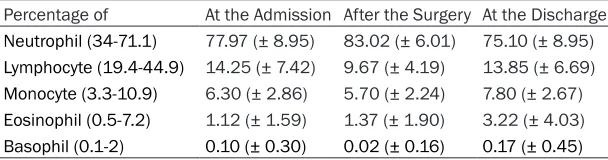
Table 3. The mean (± sd) percentage of white blood cells at the admis-sion, after the surgery, and at the discharge
Percentage of At the Admission After the Surgery At the Discharge Neutrophil (34-71.1) 77.97 (± 8.95) 83.02 (± 6.01) 75.10 (± 8.95) Lymphocyte (19.4-44.9) 14.25 (± 7.42) 9.67 (± 4.19) 13.85 (± 6.69) Monocyte (3.3-10.9) 6.30 (± 2.86) 5.70 (± 2.24) 7.80 (± 2.67) Eosinophil (0.5-7.2) 1.12 (± 1.59) 1.37 (± 1.90) 3.22 (± 4.03) Basophil (0.1-2) 0.10 (± 0.30) 0.02 (± 0.16) 0.17 (± 0.45)
Statistical analysis
[image:2.612.90.523.250.343.2]The SPSS statistical so- ftware package (SPSS, version 20 for Windows; SPSS Inc., Chicago, IL, USA) was used to per-form all statistical analy-ses. Independent t-test was used for the statisti-cal comparison of the
Table 2. The mean (± sd) count of white blood cells at the admission, after the surgery, and at the discharge
Count of At the Admission After the Surgery At the Discharge
WBC (10^3/µl) (3.7-9.7) 9.55 (± 3.14) 10.35 (± 3.09) 8.40 (± 3.26)
Neutrophil (1.56-6.13) 7.57 (± 2.94) 8.60 (± 2.83) 6.35 (± 2.89)
Lymphocyte (1.3-3.6) 1.22 (± 0.62) 1.00 (± 0.39) 1.15 (± 0.58)
Monocyte (0.2-0.96) 0.62 (± 0.63) 0.57 (± 0.63) 0.62 (± 0.54)
Eosinophil (0-0.5) 0.05 (± 0.22) 0.05 (± 0.22) 0.10 (± 0.38)
[image:2.612.91.395.390.470.2]days. The average erythrocyte suspension tr- ansfusion was 1.55 (± 1.26) units.
We separated the whole blood parameters into three major groups to make a systematic analy-sis. For the first group, we examined the para-meters related to RBCs and hemoglobin (Table 1). For the second group, we examined the pa- rameters related to WBCs (Tables 2 and 3). For
phil counts, showed significant differences (P < 0.05) (Table 6).
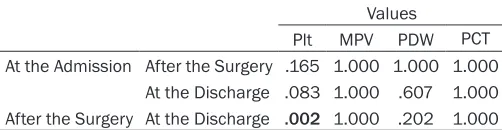
[image:3.612.89.524.98.165.2]The results of the platelet counts, the MPV, and the PDW upon admission to the hospital, after surgery, and prior to discharge had significant differences, as well (P < 0.05). No significant differences were found for the PCT values (P > 0.05) (Table 7).
Table 4. The mean (± sd) level of the parameters related with platelets at the admission, after the surgery, and at the discharge
At the Admission After the Surgery At the Discharge Platelet (10^3/µl) (140-400) 201.82 (± 59.79) 188.07 (± 66.74) 235.40 (± 98.00)
MPV (fL) (9.4-12.6) 9.75 (± 1.19) 9.75 (± 1.29) 9.75 (± 1.37)
PCT (0.12-0.38) 0.00 (± 0.00) 0.00 (± 0.00) 0.00 (± 0.00)
[image:3.612.95.524.224.289.2]PDW (9-17) 14.97 (± 1.73) 15.00 (± 1.91) 14.75 (± 2.02)
Table 5. The comparison of the hemoglobin, hematocrit, red blood cell count, red blood cell distribu-tion width, mean corpuscular volume, mean corpuscular hemoglobin, and mean corpuscular hemo-globin concentration levels at the admission, after the surgery, and at the discharge
p values
Hgb Htc RBC RDW MCV MCH MCHC
At the Admission After the Surgery .667 .040 .078 .503 1.000 1.000 .933
At the Discharge .021 .000 .000 .033 1.000 .698 .281
After the Surgery At the Discharge .064 .086 .440 .029 1.000 .389 .423
The significant differences are indicated in bold. Hgb: Hemoglobin, Htc: Hemotocrit, RBC: Red blood cell, RDW: Red blood cell
distribution width, MCV: Mean corpuscular volume, MCH: Mean corpuscular hemoglobin, MCHC: Mean corpuscular hemoglobin concentration.
Table 6. The comparison of the white blood cell count, neutrophil, lymphocyte, monocyte, basophil, and eosinophil count and percentage levels at the admission, after the surgery, and at the discharge
p values
WBC Neut (%) Lym (%) Mono (%) Baso (%) Eos (%) Neut (#) Lym (#) Mono (#) Baso (#) Eos (#)
At the Admission After the Surgery .301 .017 .003 .416 .249 1.000 .117 .144 1.000 1.000 1.000 At the Discharge .136 .496 1.000 .001 .786 .003 .120 1.000 1.000 1.000 .970 After the Surgery At the Discharge .001 .000 .000 .000 .170 .001 .000 .170 1.000 1.000 .970
Significant differences are indicated in bold. WBC: White blood cell count, Neut: Neutrophil, Lym: Lymphocyte, Mono: Monocyte, Baso: Basophil, Eos: Eosinophil. %: Percentage, #: Number.
Table 7. The comparison of the platelet, mean platelet volume, platelet distribution width, and plateletcrit levels at the admission, after the surgery, and at the discharge
Values
Plt MPV PDW PCT
At the Admission After the Surgery .165 1.000 1.000 1.000 At the Discharge .083 1.000 .607 1.000 After the Surgery At the Discharge .002 1.000 .202 1.000
Significant differences are indicated in bold. Plt: Platelet, MPV: Mean
platelet volume, PDW: Platelet distribution width, PCT: Plateletcrit.
the third group, we examined the pa- rameters related to platelets (Table 4).
[image:3.612.88.522.369.440.2] [image:3.612.90.341.522.587.2]baso-Discussion
Many studies have investigated the basic pa- rameters of complete blood counts, such as hemoglobin or WBC counts. However, this study not only analyzed all the parameters of the complete blood count for partial hip replace-ment surgery patients but also elaborate ana- lysis of all peripoerative blood parameters de- termined the effects of fracture and hip repla- cement surgery together.
Hip replacement was associated with one of the most frequent RBC transfusion procedures [5]. In a study by Chen et al., 38.5% of hip re- placement patients received an RBC transfu-sion. They received an average of 1.97 ± 0.14 RBCs [6]. The average erythrocyte suspension transfusion was found 1.55 ± 1.26 units in this study. The hemoglobin, and the hematocrit val-ues were both lower than the normal levels, but RBC was found within normal levels at the admission. They decreased after the surgery as expected, but only the decrease in hemato-crit was found significant. They continued to decrease after the surgery until the discharge, but none of them was significant. However, the total decrease from admission to discharge was found significant for all, despite the trans -fusions. It is revealed that hip surgery after fracture did not cause a secondary fall in these parameters except the hematocrit value, or the fall was balanced with the transfusions. In a study investigating the clinical importance of the RDW, it was found to be independently associated with an increased risk of short- and long-term mortality following a hip fracture [7]. In this study, it was found that the RDW, which is a marker for hematopoiesis, showed a rising after the fracture from the time of admission until discharge. The increase was only signifi -cant after the surgery, but the RDW value never pass the normal levels at any time. It signifi -cantly increased at the discharge when com-pared to the admission. The more increasing in the RDW value after the surgery reveals that the fracture and the surgery together had a syn-ergic affect on inducing new red blood cells, but this process did not occur at the early period. The MCV, MCH and MCHC levels were not affected by the fracture or the surgery and stayed between normal levels at all time. Although an increase in the WBC count is con-sidered a sign of infection, leukocytosis is
com-mon after hip replacement surgery; its specific -ity is low in terms of infection [8, 9]. In a meta-analysis by Berbari, the WBC count was report-ed to be at least diagnostically accurate for prosthetic joint infections [10]. An increased WBC count is a risk factor for early mortality, and anemia is a risk factor for late mortality [11]. On the other hand, the lack of an increase in the WBC count may be a risk factor for post-operative delirium in hip fracture patients [12]. The WBC values were found to be elevated after the fracture, but it did not exceed the nor-mal level. It also did not show any significant increase after surgery, but mildly passed over the upper limit. However, it showed a significant decrease after the surgery until the discharge. This situation reveals that the elevated WBC count after the fracture did not have a second peak after the hip replacement surgery. The surgery eliminated the effects that increased the WBC count and made a regression beneath the initial level.
The netrophil levels had a similar course like WBC because nearly 80% of all WBC were neutrophils. Interestingly, the lymphocyte lev-els were not affected at any time. The neutro-phil-to-lymphocyte ratio has been investigated in many studies, and was detected as one of four risk factors for mortality after surgery for hip fractures. Higher risk of infection was found to be associated with a neutrophil-to-lympho-cyte ratio higher than five at day five after sur -gery [13]. This study revealed that patients reacted to the surgery with an increase in neu-trophils and a decrease in lymphocytes, which means an increase in the neutrophil-to-lympho-cyte ratio. However, at the time of discharge both levels came back to lower values than the admission. When we examined the monocytes, the eosinophils, and the basophils, both of these cells demonstrated a horizontal course. The percentage of the cells showed different characteristics. Where the percentage of lym-phocytes, monocytes and basophils decreased with surgery and increased at the discharge, the percentage of neutrophils increased with surgery and decreased at the discharge. Inter- estingly, the percentage of eosinophils increa- sed with surgery and keeped increasing at the time of discharge.
neutro-phil counts. The lymphocyte, monocyte, eosin-ophil and baseosin-ophil counts were not affected perioperatively. This reveals that the numbers of white blood cells do not increase or decrease symmetrically. The reason for these different patterns may be the different blood levels of the mediators related to the white blood cells after fracture and surgery.
Many studies have been focused on the plate-let counts and its clinical importance. Wong and colleagues found no correlation between platelet count and postoperative deep vein thrombosis [14]. Another study revealed that patients with low or high platelet counts had a higher risk of major or fatal bleeding after acute venous thromboemboli [15]. Monreal claimed that the platelet count levels could be useful to reliably indicate pulmonary embolisms in the very early stages [16]. This study revealed the changes of platelet count and related parame-ters in complete blood count. We found that the platelet count decreased after surgery but rapidly increased to higher levels than the ad- mission. There was only a significant differen-ce between the post operative values and the values at the discharge. Two different reasons for stress, fracture, and surgery may contribute to a more rapid improvement. Partial hip repla- cement surgery did not cause any significant fall in the platelets, and the platelet counts never passed the normal limits even after the fracture or the surgery.
There are different views on the clinical impor-tance of the MPV, PCT, and the PDW parame-ters. One study found that MPV is related to obesity [17]. Li showed that MPV is negatively correlated with bone mineral density in post-menopausal women [18]. In our study, these parameters showed horizontal courses, and did not affected perioperatively. Interestingly, the RDW showed more significant changes than the PDW which meaned the red blood cells gave more rapid response to trauma than the megakaryocytes.
This study investigated and compared the ef- fects of partial hip replacement surgery on 22 complete blood count parameters in elderly patients with hip fractures. Every single blood cell has a unique pattern after fracture and sur-gery. Exploring the complete blood count para- meters as related to hip replacement surgery due to fractures will help to understand the
physiological effects of the procedure. While fractures and hip replacement surgery individu-ally cause some changes, hip replacement sur-gery after a fracture did not cause any second-ary changes in most blood cells. More, larger case studies will help us to better understand and manage these processes and to find inno -vative solutions to the problems.
Disclosure of conflict of interest
None.
Address correspondence to: Dr. Emrah Sayit, De- partment of Orthopaedics, Samsun Education and Research Hospital, Ilkadim, Samsun 55100, Turkey. Tel: +90 0362 311 15 00; Fax: +90 362 277 88 65; E-mail: [email protected]
References
[1] Deirmengian GK, Zmistowski B, Jacovides C, O’Neil J, Parvizi J. Leukocytosis is common af-ter total hip and knee arthroplasty. Clin Orthop Relat Res 2011; 469: 3031-3036.
[2] Watt DG, Horgan PG, McMillan DC. Routine clinical markers of the magnitude of the sys-temic inflammatory response after elective operation: a systematic review. Surgery 2015; 157: 362-380.
[3] Nielsen K, Johansson PI, Dahl B, Wagner M, Frausing B, Børglum J, Jensen K, Stürup J, Hvolris J, Rasmussen LS. Perioperative trans-fusion threshold and ambulation after hip re- vision surgery-a randomized trial. BMC Anes- thesiol 2014; 14: 89.
[4] Theusinger OM, Kind SL, Seifert B, Borgeat L, Gerber C, Spahn DR. Patient blood manage-ment in orthopaedic surgery: a four-year fol-low-up of transfusion requirements and blood loss from 2008 to 2011 at the Balgrist Uni- versity Hospital in Zurich, Switzerland. Blood Transfus 2014; 12: 195-203.
[5] Maxwell EL, Metz J, Haeusler MN, Savoia HF. Use of red blood cell transfusions in surgery. ANZ J Surg 2002; 72: 561-526.
[6] Chen AF, Klatt BA, Yazer MH, Waters JH. Blood utilization after primary total joint arthroplasty in a large hospital network. HSS J 2013; 9: 123-128.
[7] Garbharran U, Chinthapalli S, Hopper I, George M, Back DL, Dockery F. Red cell distribution width is an independent predictor of mortality in hip fracture. Age Ageing 2013; 42: 258-261. [8] Deirmengian GK, Zmistowski B, Jacovides C,
[9] Itasaka T, Kawai A, Sato T, Mitani S, Inoue H. Diagnosis of infection after total hip arthro-plasty. J Orthop Sci 2001; 6: 320-6.
[10] Berbari E, Mabry T, Tsaras G, Spangehl M, Erwin PJ, Murad MH, Steckelberg J, Osmon D. Inflammatory blood laboratory levels as mark -ers of prosthetic joint infection: a systematic review and meta-analysis. J Bone Joint Surg Am 2010; 92: 2102-2109.
[11] Schiper L, Sadigursky D, Rosario DA, Schiper SP, Passos LC, Faintuch J. Hip fracture prog- nosis: could bioimpedance be an alternative to conventional nutritional assessment? Nutr Hosp 2011; 26: 904-906.
[12] Zakriya KJ, Christmas C, Wenz JF Sr, Francko- wiak S, Anderson R, Sieber FE. Preoperative factors associated with postoperative change in confusion assessment method score in hip fracture patients. Anesth Analg 2002; 94: 1628-1632.
[13] Forget P, Moreau N, Engel H, Cornu O, Boland B, De Kock M, Yombi JC. The neutrophil-to-lym-phocyte ratio (NLR) after surgery for hip frac-ture (HF). Arch Gerontol Geriatr 2015; 60: 366-371.
[14] Wong KL, Daruwalla ZJ, Lan CJ, Tan SH, Shen L, Chua W, Manohara R, Lingaraj K. Postoper- ative venous thrombotic events in Asian elderly patients with surgically treated hip fractures with and without chemoprophylaxis. Hip Int 2014; 24: 650-655.
[15] Di Micco P, Ruiz-Giménez N, Nieto JA, Aujesky D, del Molino F, Valle R, Barrón M, Maestre A, Monreal M; RIETE investigators. Platelet count and outcome in patients with acute venous thromboembolism. Thromb Haemost 2013; 110: 1025-1034.
[16] Monreal M, Lafoz E, Roca J, Granero X, Soler J, Salazar X, Olazabal A, Bergqvist D. Platelet count, antiplatelet therapy and pulmonary em-bolism-a prospective study in patients with hip surgery. Thromb Haemost 1995; 73: 380-385. [17] Furman-Niedziejko A, Rostoff P, Rychlak R,
Golinska-Grzybala K, Wilczynska-Golonka M, Golonka M, Nessler J. Relationship between abdominal obesity, platelet blood count and mean platelet volume in patients with meta-bolic syndrome. Folia Med Cracov 2014; 54: 55-64.