Combined Tree Kernel-based classifiers for Assessing Quality of Scientific
Text
∗Liliana Mamani Sanchez Trinity College Dublin
Hector Franco-Penya Dublin Institute of Technology
Abstract
This document describes Tree Kernel-SVM based methods for identifying sentences that could be improved in scientific text. This has the goal of contributing to the body of knowl-edge that attempt to build assistive tools to aid scientist improve the quality of their writings. Our methods consist of a combination of the output from multiple support vector machines which use Tree Kernel computations. There-fore, features for individual sentences are trees that reflect their grammatical structure. For the AESW 2016 Shared Task we built systems that provide probabilistic and binary outputs by using these models for trees comparisons.
1 Introduction
The system described in this article was submitted to the Automated Evaluation of Scientific Writing (AESW) Shared Task (Daudaravicius et al., 2016).
English is the most common language used for scientific writing across the world. Other things be-ing equal, many scientific writers are non-native En-glish speakers, what leads to a demand for assisting tools that employ “grammar error correction tech-nologies” to compose scientific articles (Daudaravi-cius, 2015).
Several competitions similar to the one this article addresses have been organized, namely: the Help-ing Our Own (HOO) Shared Task (Dale and Kil-garriff, 2011; Dale et al., 2012), The CoNLL-2014 shared task on Grammatical Error Correction (Ng et ∗Both authors contributed equally to the contents and
ex-periments described in this paper.
al., 2014). Those evaluations make use of human annotated examples of correct and incorrect gram-mar (Dahlmeier et al., 2013; Yannakoudakis et al., 2011).
Particularly, Leacock et al. (2010) provide a com-prehensive overview of various aspects related to grammar error detection research.
This paper is organized as follows: Section 2 briefly describes the goals of the task our models attempt to address, Section 3 describes our experi-ments including the proposed Tree Kernel models, whose results are reported in Section 4. Section 5 further comments on the results, and Section 6 con-cludes with some summarizing remarks.
2 The task
The task consists in identifying sentences that need improvement or correction. This is done by classi-fying sentences into ones that do need amendments and those that do not. The training dataset pro-vided by the organizers comprises sentences pairs (So, Se), whereSo is a sentence presented as writ-ten by a non-native individual, these senwrit-tences con-tain at least one grammatical or lexical mishap that can be corrected. The corresponding Se has been edited as to makeSoto look as a sentence with good academic style. For instance, example (2), shows a sentence that is an improved version of the one in example (1).
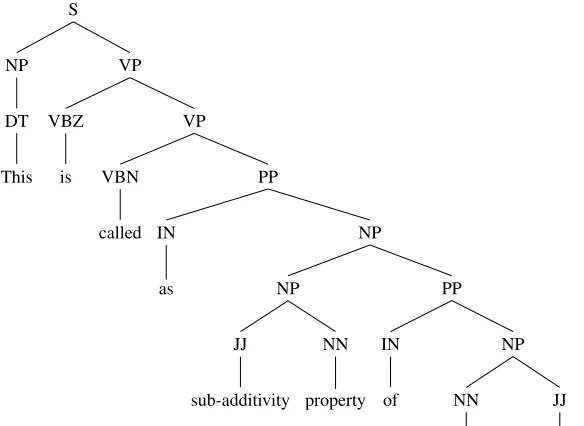
(1) This is called as sub-additivity property of von-Neumann entropy.
(2) This is called a sub-additivity property of von Neumann entropy.
The intuition behind this task is that systems that automatically identify sentence candidates for im-provement may be built. The core solution would be provided by keeping track of common pitfalls com-mitted by non-native individuals in their writing as in (1). Subsequently, such a system would learn how these pitfalls have been addressed as to emulate text produced by native writers.
The training dataset also comprises a set of sen-tences written by native English academics; they constitute a body of text that is representative of good academic writing style.
3 Experiments
For our experiments we used constituent trees corre-sponding to the examples from the training dataset. This dataset provided by the shared task organizers comprises parse tree structures which were gener-ated by using the Stanford parser (Klein and Man-ning, 2003).
3.1 Tree Kernels
The tree structures were used to train Support Vec-tor Machines using the SVM-light implementation by Joachims (1999) and SubSet Tree kernel (SST) computation tool (Collins and Duffy, 2002a; Mos-chitti, 2004; MosMos-chitti, 2006) built on top of the for-mer.
In essence, a Tree Kernel classifier computes a kernel function between two trees by comparing subtrees extracted from them. Since the number of possible comparisons between subtrees is exponen-tial, we restricted the choice of subtrees to SubSet Trees (SSTs) (Collins and Duffy, 2002b). A SST is a tree where the leaves may comprise non-terminal symbols and the rules that these trees reflect should be well formed according to the rules of the target language grammar, in this case English.
Tree Kernel methods over Support Vector Ma-chine have been successfully used on many other natural language processing applications, such as Semantic Role Labelling (Moschitti et al., 2008), question answer classification (Moschitti et al., 2007) or relational text categorization (Moschitti, 2008).
Figure 1b illustrates some SubSet trees1extracted
1For reasons of brevity, the whole set of SubSet Trees that is
by the SST kernel from the full syntactic tree struc-ture for (2), which is shown in Figure 1a. Such sub-trees will be used as features for the Support Vector Machine model.
Our intuition behind using parse trees compar-isons to identify candidate text for correction is that non-native writers will regularly use spurious lexical grammatical structures across their writings. There-fore, given a new sentence to classify, its underlying grammatical structure will be compared to a collec-tion of tree structures built out of a training dataset.
3.2 Models for sentence quality assessment
Our overall strategy was to build models that use tree representations of sentences to be used in Support Vector Machines-based systems for sentence qual-ity assessment. SVMs work with training exam-ples labelled as either positive (1) or negative (-1). Therefore, sentences in need of edition are labelled as positive examples while sentences which do not need edition are labelled as negative examples. A machine learning system trained on these examples aims to predict a positive one.
Labelling examples as either positive or negative was translated into labelling tree structures corre-sponding to these examples with the respective la-bel; for instance, the tree in Figure 1a is deemed a positive example. Internally, the SST tree tool as-signs these labels to the corresponding subtrees: fol-lowing from this, features such as the subtrees in 1b, are labelled as positive examples for the kernel com-putation.
To prepare the datasets for the training stage, we divided the dataset provided by the organizers in tree groups:Do: sentences as written by non-native speakers and need edition; De are sentences that have a counterpart inDowhich were edited to have an improvement in good academic writing style; and
Dn: sentences written by native English academic writers which do not have counterparts inDoand do not need edition.
We wanted to experiment with different condi-tions on how the identification of sentences in need of improvement may occur. Therefore, considering these three subdatasetsDo, DeandDn, three mod-els were built.
S
VP
VP
PP
NP
PP
NP
JJ
entropy NN
von-Neumann IN
of NP
NN
property JJ
sub-additivity IN
as VBN
called VBZ
is NP
DT
This
(a) Constituent tree from the sentence in exam-ple (1).
VP
PP
NP IN
as VBN
called
NP
PP
NP IN NP
NN JJ
NP
JJ
entropy NN
von-Neumann
NN
von-Neumann
[image:3.612.215.507.141.354.2](b) SubSet Trees (SST) extracted from (a).
• MO: uses uniquely sentences inDoas positive examples, and sentences fromDe as negative examples.
• ZM: uses sentences from Do as positive ex-amples, and sentences fromDnas negative ex-amples.
• ZMO: uses sentences from Do as positive
samples and sentences from bothDe andDn as negative samples.
MO depicts a scenario where the identification would be better for sentence that keep close sim-ilarity to the sentences in the training dataset and high precision is paramount. ZM favours situa-tions where sentences to be assessed do not keep high similarity to the set of positive training exam-ples but the model is able to generalize by contrast-ing with sentences with good academic style. Ulti-mately,ZMOshould enclose advantages of the two previous models.
The training dataset of parse trees provided by the organizers contained 475,473 trees forDo, 476,142 trees forDeand 725,374 forDn. Due to their length some sentences were unsuitable for processing by the TK-SVMLight tool, therefore examples whose length was above 1,400 characters were dropped out from the training set. This meant dropping 1,489 examples from Do, 1,433 from De, and 283 from
Dn. Thus, 948,693 training examples were used for
MO, 1,199,075 examples forZM, and 1,673,784 examples forZMO.
Another reason why we chose Tree Kernels com-putation as a basis for our systems is that we think this sort of classification task should rely uniquely on sentence-level features. Other non-linguistic can-didate features could have been taken into account such as the relative position of an individual sen-tence within a paragraph or document. However, a system built comprising such a feature might not work properly on individual sentences that need classification.
3.3 Training and evaluation procedures
Unfortunately, the computation of kernels for all SubSet Trees is highly demanding in terms of com-putation time. Due to hardware limitations, for all three models the training data set was split into 100
sub-datasets, and a Support Vector Machine model was trained for each sub-dataset. Then, predic-tions were computed by using each of those hdred Support Vector Machine models over the un-labelled test dataset provided by the task organiz-ers. The overall numerical categorization value for a system was calculated by averaging over these pre-dictions. This categorization value was normalized to generate the probability of a sentence needing improvementOutputP robusing formula(1), where
OutputSV Mmodeli∈[−1,1].
OutputP rob=
P100
i=1OutputSV Mmodeli 200 + 0.5
(1) Because the formula aims to estimate probabili-ties, ifOutputP rob > 1then it is floored down to one, ifOutputP rob < 0, then it is rounded up to zero.
Some issues related to the use Stanford parser emerged during the evaluation stage. The parsing procedure for examples from the testing set was ex-pected to produce a parse tree per example, which thereafter would be formatted properly for testing our systems. However, the parser failed to iden-tify the boundaries of some sentences, particularly if there was an abbreviation with a period or a colon symbol occurring in them. For instance, abbrevia-tions such as “etc.” or “i e.” caused the parser pro-duce two parse trees for a single sentence.
This issue was overcame by running a script that matches the tree structure with the original sentence if the tree structure contained at least 50% of the words in the original sentence, for which no more than 10 consecutive sentences or consecutive trees can be unmatched.
This procedure left 188 sentences without a match (which is negligible amount of the total testing set: 0.13%). For these sentences a probability of 0.5 or a label ‘false’ was assigned.
4 Results
Table 1 shows the results for the systems submitted to the task organizers.
Table 1: Results in terms of Precision, Recall and F-measure for systems that produce either a probabilis-tic (prob) or binary (bin) prediction. The number in parenthesis points to the relative ranking compared to other systems.
System Precision Recall F1 ZMbin 0.4482 (4) 0.7279 (6) 0.5548 (3)
ZMprob 0.7062 (6) 0.8182 (2) 0.7581 (3)
MObin 0.3960 (8) 0.6970 (7) 0.5051 (7)
MOprob 0.6576 (8) 0.8014 (3) 0.7224 (3)
ZMO results are not reported as the system did not produce any positive prediction (F1= 0).
For the competition of binary output systems, our
ZMsystem performs better than MO system for
F−score, resulting ranked in third place. This is 0.073 points behind the best system score (HU), but 0.1041 points better than the baseline system from the task organizers.
Regarding the probabilistic output systems com-petition, our MO-based system was ranked third. Similarly, this system is 0.073 points behind the best system (HITS) and 0.1073 points above the baseline. Also, this system’s results seem to keep correlation with the results from the systems provided by the team NTNU-YZU.
5 Discussion
It is unfortunate the dataset size prompted us to split the training set into a hundred sub-datasets to train their corresponding Support Vector Machine mod-els. This split was done according to the order in which sentences appear on the training set, expect-ing that indirectly each modified sentence will pro-vide the negative and the positive examples (this is the sentence before and after being edited, So and
Serespectively ) is likely to fall within same sub-set. While this is a simplified strategy to split the train-ing set, the effectiveness of other methods is an open research question to explore. Clustering algorithms could provide a better split.
The distribution of positive and negative examples forMOwas perfectly balanced as 50% of samples were positive while the other 50% were negative. TheZMmodel was fairly balanced, theZMOwas not balanced (475,473 positive examples in contrast to 952,284 negative examples) and this lead to the
corresponding systems produce only negative pre-dictions.
It seems that the F1 measure is proportional to how well balanced each data set is, this could be due to not using the development set to tune the thresh-old for binary predictions, or to re-arrange probabil-ities.
Systems trained using the ZM perform better than the ones using MO. We think a reason for this is that inMO a positive example shares vari-ous subtrees with its corresponding negative exam-ple. Therefore, this may affect the classifier ability to calculate predictions for some examples in the test set. It would be ideal to make use of the test set gold standard to have more conclusive insights in this re-spect.
6 Conclusions
We described in this paper machine learning-based systems for identifying sentences that need amend-ments to improve their academic style. Our four sys-tems have a Support Vector Machines computations as a core, they were built having tree representations of target sentences as features. The best systems of these four are the ones that use a model where sen-tences needing improvement are deemed as positive examples, and as negative examples sentences that were not edited and do not correspond to the positive examples are taken into account. This may be due to various reasons such as the distribution of positive and negative examples, or entropy of the datasets. We intend to address these and other issues in our systems in future work.
We think these systems’ performance can be im-proved by modifying: the combination of models, and the software implementation, the representation of features. So far, we have implemented an em-pirical combination of sub-models output to have a global prediction output.
Making changes in the implementation of tree kernels computation may help to create models that meet scalability requirements. The final prediction would benefit of having less sub-models while keep-ing computation time reasonable.
References
Michael Collins and Nigel Duffy. 2002a. New rank-ing algorithms for parsrank-ing and taggrank-ing: Kernels over discrete structures, and the voted perceptron. In Pro-ceedings of the 40th annual meeting on association for computational linguistics, pages 263–270. Association for Computational Linguistics.
Michael Collins and Nigel Duffy. 2002b. New rank-ing algorithms for parsrank-ing and taggrank-ing: Kernels over discrete structures, and the voted perceptron. In Pro-ceedings of 40th Annual Meeting of the Association for Computational Linguistics, pages 263–270, Philadel-phia, Pennsylvania, USA, July. Association for Com-putational Linguistics.
Daniel Dahlmeier, Hwee Tou Ng, and Siew Mei Wu. 2013. Building a large annotated corpus of learner en-glish: The nus corpus of learner english. In Proceed-ings of the Eighth Workshop on Innovative Use of NLP for Building Educational Applications, pages 22–31. Robert Dale and Adam Kilgarriff. 2011. Helping Our
Own: The HOO 2011 Pilot Shared Task. the Gener-ation Challenges Session at the 13th European Work-shop on Natural Language Generation,, pages 242– 249.
Robert Dale, Ilya Anisimoff, and George Narroway. 2012. HOO 2012: A report on the Preposition and Determiner Error Correction Shared Task. the Seventh Workshop on Building Educational Applications Us-ing NLP, pages 54–62.
Vidas Daudaravicius, Rafael E. Banchs, Elena Volodina, and Courtney Napoles. 2016. A report on the auto-matic evaluation of scientific writing shared task. In
Proceedings of the Eleventh Workshop on Innovative Use of NLP for Building Educational Applications, San Diego, CA, USA, June. Association for Compu-tational Linguistics.
Vidas Daudaravicius. 2015. Automated Evaluation of Scientific Writing: AESW Shared Task Proposal. Sil-ver Sponsor, pages 56–63.
Thorsten Joachims. 1999. Making large scale svm learn-ing practical. Technical report, Universit¨at Dortmund. Dan Klein and Christopher D. Manning. 2003. Accurate Unlexicalized Parsing. Proceedings of the 41st Annual Meeting on Association for Computational Linguistics - ACL ’03, 1:423–430.
Claudia Leacock, Martin Chodorow, Michael Gamon, and Joel Tetreault. 2010. Automated grammatical er-ror detection for language learners. Synthesis lectures on human language technologies, 3(1):1–134. Alessandro Moschitti, Silvia Quarteroni, Roberto Basili,
and Suresh Manandhar. 2007. Exploiting syntactic and shallow semantic kernels for question answer clas-sification. InAnnual meeting-association for compu-tational linguistics, volume 45, page 776.
Alessandro Moschitti, Daniele Pighin, and Roberto Basili. 2008. Tree kernels for semantic role labeling.
Computational Linguistics, 34(2):193–224.
Alessandro Moschitti. 2004. A study on convolution ker-nels for shallow semantic eing. Proceedings of the 42nd Annual Meeting on Association for Computa-tional Linguistics - ACL ’04, pages 335–es.
Alessandro Moschitti. 2006. Making tree kernels prac-tical for natural language learning. InEACL, volume 113, page 24.
Alessandro Moschitti. 2008. Kernel methods, syntax and semantics for relational text categorization. In Pro-ceedings of the 17th ACM conference on Information and knowledge management, pages 253–262. ACM. Hwee Tou Ng, Siew Mei Wu, Yuanbin Wu, Christian
Hadiwinoto, and Joel Tetreault. 2014. Shared Task on Grammatical Error Correction.