Socially-Informed Timeline Generation for Complex Events
Lu Wang Claire Cardie Galen Marchetti
Department of Computer Science Cornell University
Ithaca, NY 14853
{luwang, cardie}@cs.cornell.edu [email protected]
Abstract
Existing timeline generation systems for com-plex events consider only information from traditional media, ignoring the rich social con-text provided by user-generated content that reveals representative public interests or in-sightful opinions. We instead aim to gen-erate socially-informed timelines that con-tain both news article summaries and selected user comments. We present an optimization framework designed to balance topical cohe-sion between the article and comment sum-maries along with their informativeness and coverage of the event. Automatic evaluations on real-world datasets that cover four com-plex events show that our system produces more informative timelines than state-of-the-art systems. In human evaluation, the asso-ciated comment summaries are furthermore rated more insightful than editor’s picks and comments ranked highly by users.
1 Introduction
Social media sites on the Internet provide increas-ingly more, and increasincreas-ingly popular, means for people to voice their opinions on trending events. Traditional news media — the New York Times and CNN, for example — now provide online mecha-nisms that allow and encourage readers to share re-actions, opinions, and personal experiences relevant to a news story. For complex emerging events, in particular, user comments can provide relevant, in-teresting and insightful information beyond the facts reported in the news. But their large volume and tremendous variation in quality make it impossible
* Comment A: The “Crimean Parliament”, headed by an ethnic Russian separatist who was elected leader of parliament AFTER pro-Russian armed forces occupied the parliamentary chambers, has voted for Crimea to be annexed into Russia… * Comment B: Does the West and US have a policy at all? The Obama administration has warned of “increasingly harsh sanctions”, but it is unlikely that Europe will comply…
* Comment C: Sanctions are effective and if done in unison with the EU…
- Crimeans vote in a referendum to rejoin Russia or return to its status under the 1992 constitution.
March 16th, 2014
- The Crimean parliament officially declared independence and requested full accession to the Russian Federation. - Obama declared sanctions on Russian officials considered responsible for the crisis.
- The leader of the pro-Russian organization “Youth Unity” was arrested.
- President Obama warned Vladimir Putin that further provocations by Russia could isolate and diminish its influence. - One pro-Russian soldier was killed in the Simferopol incident.
March 17th, 2014
March 18th, 2014
[image:1.612.309.552.244.397.2]… summaries for other dates …
Figure 1:A snippet of the event timeline on Ukraine Cri-sis is displayed on the left. On the right, we display a set of representative comments addressing the article sum-mary of March 17th. Comment A (underlined) brings a
perspective on “Crimean parliament passes declaration of independence” (the article sentence is also underlined on the left). Comments B and C focus on Obama’s sanctions on Ukrainian and Russian officials. Sentences linked by edges belong to the same event thread, which is centered on the entities with the same color.
for readers to efficiently digest the user-generated content, much less integrate it with reported facts from the dozens or hundreds of news reports pro-duced on the event each day.
In this work, we present asocially-informed time-line generation systemthat jointly generates a news article summary and a user comment summary for each day of an ongoing complex event. A sample (gold standard) timeline snippet for Ukraine Crisis is shown in Figure 1. The event timeline is on the left; the comment summary for March17this on the right.
While generating timelines from news articles and summarizing user comments have been studied as separate problems (Yan et al., 2011; Ma et al., 2012), their joint summarization for timeline generation raises new challenges. Firstly, there should be a tight connection between the article and comment por-tion of the timeline. By definipor-tion, users comment on socially relevant events. So the important part of articles and insightful comments should both cover these events. Moreover, good reading experience re-quires that the article summary and comment sum-mary demonstrate evident connectivity. For exam-ple, Comment C in Figure 1 (“Sanctions are effec-tive and if done in unison with the EU”) is obscure without knowing the context that “sanctions are im-posed by U.S”. Simply combining the outputs from a timeline generation system and a comment sum-marization system may lead to timelines that lack cohesion. On the other hand, articles and comments are from intrinsically different genres of text: arti-cles emphasize facts and are written in a professional style; comments reflect opinions in a less formal way. Thus, it could be difficult to recognize the con-nections between articles and comments. Finally, it is also challenging to enforce continuity in timelines with many entities and events.
To address the challenges mentioned above, we formulate the timeline generation task as an opti-mization problem, where we maximize topic cohe-sion between the article and comment summaries while preserving their ability to reflect important
concepts and subevents, adequatecoverageof men-tioned topics, andcontinuity of the timeline as it is updated with new material each day. We design a novel alternating optimizing algorithm that allows the generation of a high quality article summary and comment summary via mutual reinforcement. We demonstrate the effectiveness of our algorithm on four disparate complex event datasets collected over months from the New York Times, CNN, and BBC. Automatic evaluation using ROUGE (Lin and Hovy, 2003) and gold standard timelines indicates that our system can effectively leverage user comments to outperform state-of-the-art approaches on timeline generation. In a human evaluation via Amazon Me-chanical Turk, the comment summaries generated by our method were selected as the best in terms of informativeness and insightfulness in 66.7% and
51.7% of the evaluations (vs. 26.7% and 30.0% for randomly selected editor’s-picks).
Especially, our optimization framework relies on two scoring functions that estimate the importance of including individual article sentences and user comments in the timeline. Based on the observa-tion that entities or events frequently discussed in the user comments can help with identify summary-worthy content, we show that the scoring functions can be learned jointly by utilizing graph-based reg-ularization. Experiments show that our joint learn-ing model outperforms state-of-the-art ranklearn-ing algo-rithms and other joint learning based methods when evaluated on sentence ranking and comment rank-ing. For example, we achieve an NDCG@3 of 0.88 on the Ukraine crisis dataset, compared to 0.77 from Yang et al. (2011) which also conducts joint learning between articles and social context using factor graphs.
Finally, to encourage continuity in the gener-ated timeline, we propose an entity-centered event threading algorithm. Human evaluation demon-strates that users who read timelines with event threads write more informative answers than users who do not see the threads while answering the same questions. This implies that our system constructed threads can help users better navigate the timelines and collect relevant information in a short time.
For the rest of the paper, we first describe data collection (Section 2). We then introduce the joint learning model for importance prediction (Sec-tion 3). The full timeline genera(Sec-tion system is pre-sented in Section 4, which is followed by evaluations (Section 5). Related work and conclusion are in Sec-tions 6 and 7.
API. 1 NYT comments come with information on
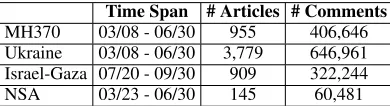
whether a comment is an editor’s-pick. The statis-tics on the four datasets are displayed in Table 1.2
Time Span # Articles # Comments
[image:3.612.85.280.113.166.2]MH370 03/08 - 06/30 955 406,646 Ukraine 03/08 - 06/30 3,779 646,961 Israel-Gaza 07/20 - 09/30 909 322,244 NSA 03/23 - 06/30 145 60,481
Table 1:Statistics on the four event datasets.
We extract parse trees, dependency trees, and coreference resolution results of articles and com-ments with Stanford CoreNLP (Manning et al., 2014). Sentences in articles are labeled with times-tamps using SUTime (Chang and Manning, 2012).
We also collect all articles with comments from NYT in 2013 (henceforth NYT2013) to form a training set for learning importance scoring func-tions on articles sentences and comments (see Sec-tion 3). NYT2013 contains 3,863 articles and
833,032comments.
3 Joint Learning for Importance Scoring We first introduce a joint learning method that uses
graph-based regularizationto simultaneously learn two functions — a SENTENCE scorer and a COM-MENT scorer — that predict the importance of in-cluding an individual news article sentence or a par-ticular user comment in the timeline.
We train the model on the aforementioned NYT2013 dataset, where 20% of the articles and their comments are reserved for parameter tuning. Formally, the training data consists of a set of ar-ticles D = {di}i|D=0|−1. Each article di contains a
set of sentences xsdi = {xsdi,j}
|sdi|−1
j=0 and a set of
associated comments xcdi = {xcdi,k}
|cdi|−1
k=0 , where |sdi|and|cdi|are the numbers of sentences and
com-ments fordi. For simplicity, we usexsorxcto
de-note a sentence or a comment wherever there is no ambiguity.
In addition, each article has a human-written ab-stract. We use the ROUGE-2 (Lin and Hovy, 2003) score of each sentence computed against the associ-ated abstract as its gold-standard importance score.
1BBC comment volume is low, so we do not collect it. 2The datasets are available at http://www.cs.
cornell.edu/˜luwang/data.html.
Each comment is assigned a gold-standard value of
1.0if it is an editor’s pick, or0.0otherwise.
The SENTENCE and COMMENT scorers rely on two classifiers, each designed to handle the special characteristics of news and user comments, respec-tively; and a graph-based regularizing constraint that encourages similarity between selected sentences and comments. We describe each component below. Article SENTENCE Importance. Each sentence
xsin a news article is represented as ak-dimensional
feature vectorxs ∈ Rk, with a gold-standard label
ys. We denote the training set as a feature matrix
˜
Xs, with a label vector Y˜s. To produce the
SEN-TENCE scoring function fs(xs) = xs ·ws, we use
ridge regression to learn a vectorws that minimizes ||X˜sws−Y˜s||22+βs· ||ws||22. Features used in the
model are listed in Table 2. We also impose the following position-based regularizing constraintto encode the fact that the first sentence in a news arti-cle usually conveys the most essential information: λs·Pdi
P
xsdi ,j,j6=0||(xsdi,0−xsdi,j)·ws−(ysdi,0−
ysdi,j)||22 , wherexsdi,j is thej-th sentence in
doc-umentdi. Term (xsdi,0−xsdi,j)·ws measures the
difference in predicted scores between the first sen-tence and any other sensen-tence. This value is expected be close to the true difference. We further construct
˜ X0
sto contain all difference vectors(xsdi,0−xsdi,j),
with Y˜0
s as label difference vector. The objective
function to minimize becomes Js(ws) =
||X˜sws−Y˜s||22+λs· ||X˜s0ws−Y˜s0||22+βs· ||ws||22
(1)
User COMMENT Importance. Similarly, each commentxcis represented as anl−dimensional
fea-ture vectorxc∈Rl, with labelyc. Comments in the training data are denoted with a feature matrixX˜c
with a label vectorY˜c. Likewise, we learnfc(xc) = xc·wcby minimizing||X˜cwc−Y˜c||22+βc· ||wc||22.
Features are listed in Table 3. We apply apairwise preference-based regularizing constraint(Joachims, 2002) to incorporate a bias toward editor’s picks: λc·Pdi
P
xcdi ,j∈Edi,xcdi ,k∈/Edi||(xcdi,j−xcdi,k)·wc−
1||2
2, whereEdi are the editor’s picks for di. Term
(xcdi,j−xcdi,k)·wc enforces the separation of
ed-itor’s picks from regular comments. We further constructX˜0
(xcdi,j−xcdi,k). Y˜c0 is a vector of same size asX˜0c
with each element as1. Thus, the objective function to minimize is:
Jc(wc) =
||X˜cwc−Y˜c||22+λc· ||X˜c0wc−Y˜0c||22+βc· ||wc||22
(2)
Graph-Based Regularization. The regularizing constraint is based on two mutually reinforcing hy-potheses: (1) the importance of a sentence depends partially on the availability of sufficient insightful comments that touch on topics in the sentence; (2) the importance of a comment depends partially on whether it addresses notable events reported in the sentences. For example, we want our model to bias
ws to predict a high score for a sentence with high
similarity to numerous insightful comments. We first create a bipartite graph from sentences and comments on the same articles, where edge
weightsare based on the content similarity between a sentence and a comment (TF-IDF similarity is used). LetR˜ be anN×M adjacency matrix, where
N and M are the numbers of sentences and com-ments.Rscis the similarity between sentencexsand
commentxc. We normalizeR˜ byQ˜ =D˜−12R ˜˜D0− 1 2, whereD˜ andD˜0 are diagonal matrices:D˜ ∈RN×N,
Di,i = PMj=1Ri,j; D˜0 ∈ RM×M,D0j,j = PNi=1Ri,j. The interplay between the two types of data is en-coded in the following regularizing constraint:
Js,c(ws,wc) =
λsc·
X
di
X
xs∈xsdi,xc∈xcdi
Qxs,xc·(xs·ws−xc·wc)2
(3)
Full Objective Function. Thus, the full objective function consists of the three parts discussed above: J(ws,wc) =Js(ws) +Jc(wc) +Js,c(ws,wc) (4)
Furthermore, using the following notation,
˜
X=
˜
Xs 0
0 ˜Xc
˜
Y=
˜
Ys ˜ Yc
˜
X0=X˜0s 0 0 ˜X0
c
˜
Y0=Y˜s0 ˜ Y0
c
˜
β=
βsIk 0 0 βcIl
˜
λ=
λsI|X0 s| 0
0 λcI|X0 c|
˜L=
λscI|Xs| −λscQ˜ −λscQ˜TλscI|Xc|
w=
ws wc
we can show aclosed form solutionto Equation 4 as follows:
ˆ
w=
(X˜T˜L˜X+X˜TX˜+X˜0Tλ˜X˜0+ ˜β)−1(X˜TY˜ +X˜0Tλ˜Y˜0) (5)
Basic Features Social Features
[image:4.612.313.538.241.371.2]- num of words - avg/sum frequency of - absolute/relative position words appearing in comment - overlaps with headline - avg/sum frequency of - avg/sum TF-IDF scores dependency relations - num of NEs appearing in comment
Table 2:Features used for sentence importance scoring.
Basic Features Readability Features
- num of words - Flesch-Kincaid Readability - num of sentences - Gunning-Fog Readability - avg num of words Discourse Features
per sentence - num/proportion of connectives - num of NEs - num/proportion of hedge words - num/proportion of Article Features
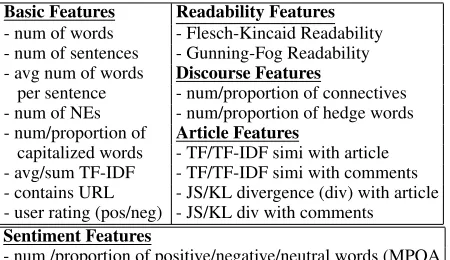
capitalized words - TF/TF-IDF simi with article - avg/sum TF-IDF - TF/TF-IDF simi with comments - contains URL - JS/KL divergence (div) with article - user rating (pos/neg) - JS/KL div with comments
Sentiment Features
- num /proportion of positive/negative/neutral words (MPQA (Wilson et al., 2005), General Inquirer (Stone et al., 1966)) - num /proportion of sentiment words
Table 3:Features used for comment importance scoring.
4 Timeline Generation
Now we present an optimization framework for timeline generation. Formally, for each day, our sys-tem takes as input a set of sentencesVsand a set of commentsVc to be summarized, and the (automati-cally generated) timelineT (represented as threads) for days prior to the current day. It then identifies a subsetS⊆Vsas the article summary and a subset
C⊆Vcas the comment summary by maximizing the following function:
Z(S, C;T) =Squal(S;T)+Cqual(C)+δX(S, C) (6)
whereSqual(S;T)measures the quality of the article summaryS in the context of the historical timeline represented as event threadsT; Cqual(C)computes the quality of the comment summaryC; andX(S, C) estimates the connectivity betweenSandC.
in Section 4.4. In general, we alternately search for a better article summary S with hill climbing search and a better comment summaryCwith Ford-Fulkerson algorithm until convergence.
In the rest of this section, we first describe an
entity-centered event threading algorithm to con-struct event threadsT which are used to boost article timeline continuity. Then we explain how to com-pute Squal(S;T) and Cqual(C) in Section 4.2, fol-lowed byX(S, C)in Section 4.3.
4.1 Entity-Centered Event Threading
We present an event threading process where each thread connects sequential events centered on a set of relevantentities. For instance, the following thread connects events about Obama’s action towards the annexation of Crimea byRussia:
Day1:Obamadeclared sanctions onRussian officials. Day2:President ObamawarnedRussian.
Day3:ObamaurgesRussianto move back its troops. Day4:ObamacondemnsRussianaggression in Ukraine.
We first collect relation extractions as (entity, re-lation, entity) triples from OLLIE (Mausam et al., 2012), a dependency relation based open informa-tion extracinforma-tion system. We retain extracinforma-tions with confidence scores higher than 0.5. We further de-sign syntactic patterns based on Fader et al. (2011) to identify relations expressed as a combination of a verb and nouns. Each relation contains at least one event-related word (Ritter et al., 2012).
The entity-centered event threading algorithm works as follows: on the first day, each sentence in the summary becomes an individual cluster; there-after, each sentence in the current day’s article sum-mary either gets attached to an existing thread or starts a new thread. The updated threads then be-come the input to next day’s summary generation process. On dayn, we have a set of threadsT ={τ:
s1,s2,· · ·,sn−1} constructed from previous n−1
days, where si represents the set of sentences
at-tached to threadτ from dayi. Thecohesionbetween a new sentences ∈ S and a thread τ is denoted as
cohn(s, τ). s is attached to τˆ if there exists τˆ = maxτ∈Tcohn(s, τ)andcohn(s,τˆ)>0.0. Otherwise,
s becomes a new thread. We define cohn(s, τ) = minsi∈τ,si6=∅tfsimi(si, s), where tfsimi(si, s)
mea-sures the TF similarity betweensi ands. We
con-sider unigrams/bigrams/trigrams generated from the entities of our event extractions.
4.2 Summary Quality Measurement
Recall that we learned two separate importance scor-ing functions for sentences and comments, which will be denoted here asimps(s) andimpc(c). With an article summaryS and threadsT ={τi}, the ar-ticle summary qualityfunctionSqual(S;T)has the following form:
Squal(S;T) =Ps∈Simp(s)
+θcovPs0∈Vsmin(Ps∈Stfidf(s, s0), αPˆs∈Vstfidf(ˆs, s0)) +θcontPτ∈Tmaxsk∈Scohn(sk, τ)
tfidf(·,·) is the TF-IDF similarity function.
Squal(S;T)captures three desired qualities of an ar-ticle summary: importance (first item), coverage
(second item), and thecontinuityof the current sum-mary to previously generated summaries. The cov-erage function has been used to encourage summary diversity and reduce redundancy (Lin and Bilmes, 2011; Wang et al., 2014). The continuity function considers how well article summary S can be at-tached to each event thread, thus favors summaries that can be connected to multiple threads.
Parameters θcov and α are tuned on multi-document summarization dataset DUC 2003 (Over and Yen, 2003). Experiments show that system per-formance peaks and is stable for θcont ∈ [1.0,5.0]. We thus fixθcont to1.0. We discard sentences with more than 80% of content words covered by histor-ical summaries. We use BASIC to denote a system that only optimizes on importance and coverage (i.e. first two items inSqual(S;T)). The system optimiz-ingSqual(S;T)is henceforth called THREAD.
Thecomment summary qualityfunction simply takes the formCqual(C) =Pc∈Cimpc(c).
4.3 Connectivity Measurement
We encode two objectives in the connectivity func-tionX(S, C): (1) encouraging topical cohesion (i.e. connectivity) between article summary and com-ment summary; and (2) favoring comcom-ments that cover diversified events.
Letconn(s, c)measure content similarity between a sentences∈Sand a commentc∈C. Connectivity between article summaryS and comment summary Cis computed as follows. We build a bipartite graph
We then find an edge setM, the best matching ofG.
X(S, C)is defined as the sum over edge weights in
M, i.e.X(S, C) =Pe∈Mweight(e). An example is illustrated in Figure 2.
C0: The “Crimean Parliament”,
headed by an ethnic Russian separatist, has voted for Crimea to be annexed into Russia… S0: The Crimean
parliament officially declared independence and requested full accession to the Russian Federation.
Article Summary Comment Summary
C1: The Obama administration has
warned of "increasingly harsh sanctions", but it is unlikely that Europe will comply…
C2: Sanctions are effective and if
done in unison with the EU… S1: Obama declared
sanctions on Russian officials considered responsible for the crisis.
0.8 0.1 0.1
[image:6.612.311.540.222.417.2]0.3 0.8 0.5
Figure 2: An example on computing the connectivity between an article summary (left) and a comment sum-mary (right) via best matching in bipartite graph. Num-ber on each edge indicates the content similarity between a sentence and a comment. Solid lines are edges in the best matching graph. For this example, the connectivity
X(S, C)is0.8 + 0.8 = 1.6.
We consider two options for conn(s, c). One is
lexical similarity which is based on TF-IDF vec-tors. Another is semantic similarity. Let Rs =
{(as, rs, bs)} and Rc = {(ac, rc, bc)} be the sets of dependency relations insandc.conn(s, c)is calcu-lated as:
P
(as,rs,bs)∈Rsmax(ac,rc,bc)∈Rc
rs=rc
simi(as, ac)×simi(bs, bc)
where simi(·,·) is a word similarity function. We experiment with shortest path based similar-ity defined on WordNet (Miller, 1995) and Co-sine similarity with word vectors trained on Google news (Mikolov et al., 2013). Systems using the three metrics that optimize Z(S, C;T) are henceforth called THREAD+OPTTFIDF, THREAD+OPTWordNet and THREAD+OPTWordVec.
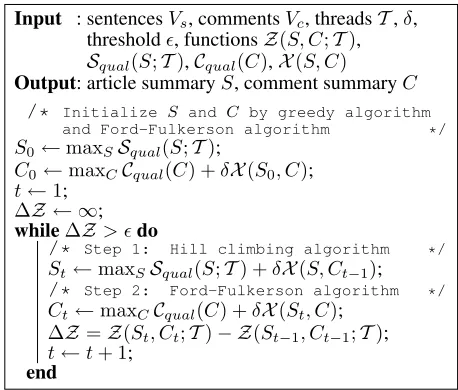
4.4 An Alternating Optimization Algorithm To maximize the full objective functionZ(S, C;T), we design a novel alternating optimization algorithm (Alg. 1) where we alternately find betterSandC.
We initialize S0 by a greedy algorithm (Lin and
Bilmes, 2011) with respect to Squal(S;T). Notice that Squal(S;T) is a submodular function, so that the greedy solution is a 1−1/e approximation to the optimal solution ofSqual(S;T). FixingS0, we
model the problem of finding C0 that maximizes
Cqual(C) +δX(S0, C)as a maximum-weight
bipar-tite graph matching problem. This problem can be reduced to a maximum network flow problem, and then be solved by Ford-Fulkerson algorithm (de-tails are discussed in (Kleinberg and Tardos, 2005)). Thereafter, for each iteration, we alternately find a better St with regard to Squal(S;T) +δX(S, Ct−1)
using hill climbing, and an exact solution Ct to
Cqual(C)+δX(St, C)with Ford-Fulkerson algorithm. Iteration stops when the increase ofZ(S, C)is below threshold(set to0.01). System performance is sta-ble when we varyδ∈[1.0,10.0], so we setδ= 1.0.
Input : sentencesVs, commentsVc, threadsT,δ,
threshold, functionsZ(S, C;T),
Squal(S;T),Cqual(C),X(S, C)
Output: article summaryS, comment summaryC
/* Initialize S and C by greedy algorithm and Ford-Fulkerson algorithm */
S0←maxSSqual(S;T);
C0←maxCCqual(C) +δX(S0, C);
t←1; ∆Z ← ∞;
while∆Z > do
/* Step 1: Hill climbing algorithm */
St←maxSSqual(S;T) +δX(S, Ct−1); /* Step 2: Ford-Fulkerson algorithm */
Ct←maxCCqual(C) +δX(St, C); ∆Z=Z(St, Ct;T)− Z(St−1, Ct−1;T);
t←t+ 1;
end
Algorithm 1:Generate article summary and com-ment summary for a given day via alternating opti-mization .
Algorithm 1 is guaranteed to find a solution at least as good asS0andC0. It progresses only if Step
1 findsStthat improves uponZ(St−1, Ct−1;T), and
Step 2 findsCtwhereZ(St, Ct;T)≥ Z(St, Ct−1;T).
5 Experimental Results
5.1 Evaluation ofSENTENCEandCOMMENT Importance Scorers
We test importance scorers (Section 3) on single documentsentence rankingandcomment ranking.
For both tasks, we compare with two previ-ous systems on joint ranking and summarization of news articles and tweets. Yang et al. (2011) em-ploy supervised learning based on factor graphs to model content similarity between the two types of data. We use the same features for this model.
tweets, which is estimated by an unsupervised topic model.3 We also consider two state-of-the-art
rankers:RankBoost(Freund et al., 2003) and Lamb-daMART (Burges, 2010). Finally, we use aposition baselinethat ranks sentences based on their position in the article, and arating baselinethat ranks com-ments based on positive user ratings.
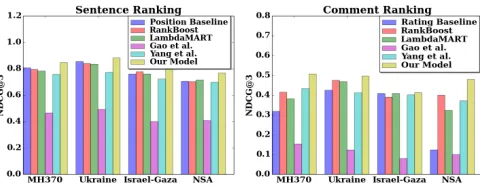
We evaluate using normalized discounted cumu-lative gain at top 3 returned results (NDCG@3). Sentences are considered relevant if they have ROUGE-2 scores larger than0.0(computed against human abstracts), and comments are considered rel-evant if they are editor’s picks.4 Figure 3
[image:7.612.66.306.328.423.2]demon-strates that our joint learning model uniformly out-performs all the other comparisons for both rank-ing tasks. In general, supervised learnrank-ing based ap-proaches (e.g. our method, Yang et al. (2011), Rank-Boost, and LambdaMART) produce better results than unsupervised method (e.g. Gao et al. (2012)).5
Figure 3: Evaluation of sentence and comment ranking on the four datasets by using normalized discounted cu-mulative gain at top 3 returned results (NDCG@3). Our joint learning based approach uniformly outperforms all the other comparisons.
5.2 Leveraging User Comments
In this section, we test if our system can leverage comments to produce better article-based summaries for event timelines. We collectgold-standard time-lines for each of the four events from the corre-sponding Wikipedia page(s), NYT topic page, or BBC news page.
We consider two existing timeline creation sys-tems that only utilize news articles, and a timeline generated from single-article human abstracts: (1) CHIEU ANDLEE(2004) select sentences with high
3We thank Zi Yang and Peng Li for providing the code. 4We experiment with all articles for sentence ranking, and
NYT comments (with editor’s picks) for comment ranking.
5Similar results are obtained with mean reciprocal rank.
“interestingness” and “burstiness” using a likelihood ratio test to compare word distributions of sentences with articles in neighboring days. (2) YAN ET AL. (2011) design an evolutionary summarization sys-tem that selects sentences based on on coverage, co-herence, and diversity. (3) We construct a timeline from the human ABSTRACTs provided with each ar-ticle: we sort them chronologically according to arti-cle timestamps and add abstract sentences into each daily summary until reaching the word limit.
We test on five variations of our system. The first two systems generate article summaries with no comment information by optimizing
Squal(S;T)using a greedy algorithm: BASICignores
event threading; THREAD considers the threads. THREAD+OPTTFIDF, THREAD+OPTWordNet and THREAD+OPTWordVec (see Section 4.3) leverage user comments to generate article summaries as well as comment summaries based on alternating optimization of Equation 3. Although comment summaries are generated, they are not used in the evaluation.
For all systems, we generate daily article sum-maries of at most 100 words, and select 5 com-ments for the corresponding comment summary. We employ ROUGE (Lin and Hovy, 2003) to automat-ically evaluate the content coverage (in terms of ngrams) of the article-based timelines vs. gold-standard timelines. ROUGE-2 (measures bigram overlap) and ROUGE-SU4 (measures unigram and skip-bigrams separated by up to four words) scores are reported in Table 4. As can be seen, under the al-ternating optimization framework, our systems, em-ploying both articles and comments, consistently yield better ROUGE scores than the three baseline systems and our systems that do not leverage com-ments. Though constructed from single-article ab-stracts, baseline ABSTRACT is found to contain re-dundant information and thus limited in content cov-erage. This is due to the fact that different media tend to report on the same important events.
MH370 Ukraine Israel-Gaza NSA
R-2 R-SU4 R-2 R-SU4 R-2 R-SU4 R-2 R-SU4
CHIEU ANDLEE 6.43 10.89 4.64 8.87 3.38 7.32 6.14 9.73 YAN ET AL. 6.37 10.35 4.57 8.67 2.39 5.78 3.99 7.73 ABSTRACT 6.16 10.62 3.85 8.40 2.21 5.42 7.03 8.65
-Greedy Algorithm
BASIC 6.59 9.80 5.31 9.23 3.15 6.20 3.81 7.58 THREAD 6.55 10.86 5.73 9.75 3.16 6.16 6.29 10.09
-Alternating Optimization (leveraging comments)
THREAD+OPTTFIDF 8.74 11.639.10 12.59 3.78 6.45 8.07 10.31
THREAD+OPTWordNet 8.73 11.878.67 12.10 4.11 6.64 8.63 11.12
[image:8.612.70.308.59.173.2]THREAD+OPTWordVec 9.29 11.639.16 12.72 3.75 6.38 8.29 10.36 Table 4: ROUGE-2 (R-2) and ROUGE-SU4 (R-SU4) scores (multiplied by 100) for different timeline gener-ation approaches on four event datasets. Systems that statistically significantly outperform the three baselines (p <0.05, pairedt−test) are initalics. Numbers inbold
are the highest score for each column.
RANDOMly selected comments, USER’S-PICKS (ranked by positive user ratings),randomlyselected EDITOR’S-PICKS and timelines produced by the THREAD+OPTWordVecversion ofOUR SYSTEM. We also include one noisy comment summary (i.e. irrel-evant to the question) to avoid spam. We display two comments per day for each system.6
Turkers are asked to rank the comment summary variations according toinformativenessand insight-fulness. For informativeness, we ask the Turkers to judge based only on knowledge displayed in the timeline, and to rate each comment summary based on how much relevant information they learn from it. For insightfulness, Turkers are required to focus on insights and valuable opinions. They are requested to leave a short explanation of their ranking.
15 five-day periods are randomly selected. We so-licit four distinct Turkers located in the U.S. to eval-uate each set of timelines. An inter-rater agreement of Krippendorff’s α of 0.63 is achieved for infor-mativeness ranking andα is 0.50 for insightfulness ranking.
Table 5 shows the percentage of times a partic-ular method is selected as producing the best com-ment portion of the timeline, as well as the micro-average rank of each method, for both informative-ness and insightfulinformative-ness. Our system is selected as the best in 66.7% of the evaluations for informative-ness and 51.7% for insightfulinformative-ness. In both cases, we statistically significantly outperform (p < 0.05 us-ing a Wilcoxon signed-rank test) the editor’s-picks
6For our system, we select the two comments with highest
importance scores from the comment summary.
Informativeness Insightfulness
[image:8.612.314.532.61.130.2]% Best Avg Rank % Best Avg Rank Random 1.7% 3.67 3.3% 3.58 User’s-picks 5.0% 2.83 15.0% 2.55 Editor’s-picks 26.7% 2.05 30.0% 2.22 Our system 66.7% 1.45 51.7% 1.65
Table 5:Human evaluation results on the comment por-tion of socially-informed timelines. Boldfaceindicates statistical significance vs. other results in the same col-umn using a Wilcoxon signed-rank test (p < 0.05). On average, the output from our system is ranked higher than all other alternatives.
and user’s-picks. Turkers’ explanations indicate that they prefer our comment summaries mainly because they are “very informative and insightful to what was happening”, and “show the sharpness of the commenter”. Turkers sometimes think the sum-maries randomly selected from editor’s-picks “lack connection”, and characterize user’s-picks as “the information was somewhat limited”.
Figure 4 shows part of the timeline generated by our system for the Ukraine crisis.
Article Summary Comment Summary
2014-03-17 Obama administra-tion froze the U.S. assets of seven Russian officials, while similar sanctions were imposed on four Ukrainian officials.. . .
Theodore Roosevelt said that the worst possible thing you can do in diplomacy is “soft hitting”. That is what the US and the EU are doing in these timid “sanctions” against people without any over-seas accounts. . .
2014-03-18 Ukraine does not rec-ognize a treaty signed in Moscow on Tuesday making its Crimean peninsula a part of Russia. . .
Though there were many in Crimea who supported annexa-tion, there were certainly some who did not. what about those people?. . .
2014-03-19 The head of NATO warned on Wednesday that Rus-sian President Vladimir Putin may not stop with the annexation of Crimea. . .
If you look at a real map , Crimea is an island and has always been more connected to Russia than to Ukraine. . .
2014-03-20 The United States on Thursday expanded its sanctions on Russians. . .
The US and EU should follow up economic sanctions with concrete steps to strengthen NATO. . .
Figure 4: A snippet of timeline generated by our sys-tem THREAD+OPTWordVecfor the Ukraine crisis. Due to space limitations, we only display partial summaries.
5.4 Human Evaluation of Event Threading Here we evaluate on the utility of event threads for high-level information access guidance: can event threads allow users to easily locate and absorb in-formation with a specific interest in mind?
variation of our system. We designed one ques-tion for each timeline. Sample quesques-tions are: “de-scribe the activities for searching for the missing flight MH370”, and “describe the attitude and action of Russian Government on Eastern Ukraine”. We re-cruited 10 undergraduate and graduate students who are native speakers of English. Each student first read one question and its corresponding timeline for 5 minutes. The timeline was then removed, and the student wrote down an answer for the question. We asked each student to answer the question for each of four timelines (one for each event dataset). Two timelines are displayed with threads, and two with-out threads. We presented threads by adding a thread number in front of each sentence.
We then used Amazon Mechanical Turk to evalu-ate the informativeness of students’ answers. Turk-ers were asked to read all 10 answTurk-ers for the same question, with five answers based on timelines with threads and five others based on timelines without threads. After that, they rated each answer with an informativeness score on a 1-to-5 rating scale (1 as “not relevant to the query”, and 5 as “very informa-tive”). We also added two quality control questions. Table 6 shows that the average rating for answers written after reading timelines with threads is 3.29 (43%are rated≥4), higher than the2.58for the time-lines withno threadexhibited (30%are rated≥4).
Answer Type Avg±STD Rated 5 (%) Rated 4 (%)
No Thread 2.58±1.20 7% 23% With Threads 3.29±1.28 17% 26% Table 6: Human evaluation on the informativeness of answers written after reading timelineswith threadsvs. withno thread. Answers written with access to threads are rated higher (3.29) than the ones with no thread (2.58).
6 Related Work
There is a growing interest in generating article summaries informed by social context. Existing work focuses on learning users’ interests from com-ments and incorporates the learned information into a news article summarization system (Hu et al., 2008). Zhao et al. (2013) instead estimate word dis-tributions from tweets, and bias a Page Rank algo-rithm to give higher restart probability to sentences with similar distributions. Generating tweet+article summaries has been recently investigated in Yang et
al. (2011). They propose a factor graph to allow sen-tences and tweets to mutually reinforce each other. Gao et al. (2012) exploit a co-ranking model to iden-tify sentence-tweet pairs with complementary infor-mation estimated from a topic model. These efforts handle a small number of documents and tweets, while we target a larger scale of data.
In terms of timeline summarization, the Chieu and Lee (2004) system ranks sentences according to “burstiness” and “interestingness” estimated by a likelihood ratio test. Yan et al. (2011) explore an op-timization framework that maximizes the relevance, coverage, diversity, and coherence of the timeline. Neither system has leveraged the social context. Our event threading algorithm is also inspired by work on topic detection and tracking (TDT) (Allan et al., 1998), where efforts are made for document-level link detection and topic tracking. Similarly, Nalla-pati et al. (2004) investigate event threading for ar-ticles, where they predict linkage based on causal and temporal dependencies. Shahaf et al. (2012) in-stead seek for connecting articles into one coherent graph. To the best of our knowledge, we are the first to study sentence-level event threading.
7 Conclusion
We presented a socially-informed timeline gener-ation system, which constructs timelines consist-ing of article summaries and comment summaries. An alternating optimization algorithm is designed to maximize the connectivity between the two sets of summaries as well as their importance and infor-mation coverage. Automatic and human evaluations showed that our system produced more informative timelines than state-of-the-art systems. Our com-ment summaries were also rated as very insightful.
Acknowledgments
References
J. Allan, J. Carbonell, G. Doddington, J. Yamron, and Y. Yang. 1998. Topic detection and tracking pi-lot study: Final report. In Proceedings of the DARPA Broadcast News Transcription and Under-standing Workshop, pages 194–218, Lansdowne, VA, USA, February. 007.
Christopher J. C. Burges. 2010. From RankNet to Lamb-daRank to LambdaMART: An Overview. Technical report, Microsoft Research.
Angel X. Chang and Christopher Manning. 2012. Sutime: A library for recognizing and normaliz-ing time expressions. In Nicoletta Calzolari (Con-ference Chair), Khalid Choukri, Thierry Declerck, Mehmet Uur Doan, Bente Maegaard, Joseph Mar-iani, Asuncion Moreno, Jan Odijk, and Stelios Piperidis, editors, Proceedings of the Eight Interna-tional Conference on Language Resources and Eval-uation (LREC’12), Istanbul, Turkey, may. European Language Resources Association (ELRA).
Hai Leong Chieu and Yoong Keok Lee. 2004. Query based event extraction along a timeline. In Proceed-ings of the 27th Annual International ACM SIGIR Conference on Research and Development in Informa-tion Retrieval, SIGIR ’04, pages 425–432, New York, NY, USA. ACM.
Anthony Fader, Stephen Soderland, and Oren Etzioni. 2011. Identifying relations for open information extraction. In Proceedings of the Conference on Empirical Methods in Natural Language Processing, EMNLP ’11, pages 1535–1545, Stroudsburg, PA, USA. Association for Computational Linguistics. Yoav Freund, Raj Iyer, Robert E. Schapire, and Yoram
Singer. 2003. An efficient boosting algorithm for combining preferences. J. Mach. Learn. Res., 4:933– 969, December.
Wei Gao, Peng Li, and Kareem Darwish. 2012. Joint topic modeling for event summarization across news and social media streams. In Proceedings of the 21st ACM International Conference on Information and Knowledge Management, CIKM ’12, pages 1173– 1182, New York, NY, USA. ACM.
Meishan Hu, Aixin Sun, and Ee-Peng Lim. 2008. Comments-oriented document summarization: Under-standing documents with readers’ feedback. In Pro-ceedings of the 31st Annual International ACM SIGIR Conference on Research and Development in Informa-tion Retrieval, SIGIR ’08, pages 291–298, New York, NY, USA. ACM.
Thorsten Joachims. 2002. Optimizing search engines us-ing clickthrough data. In Proceedings of the Eighth ACM SIGKDD International Conference on
Knowl-edge Discovery and Data Mining, KDD ’02, pages 133–142, New York, NY, USA. ACM.
Jon Kleinberg and Eva Tardos. 2005. Algorithm De-sign. Addison-Wesley Longman Publishing Co., Inc., Boston, MA, USA.
Hui Lin and Jeff Bilmes. 2011. A class of submodu-lar functions for document summarization. In Pro-ceedings of the 49th Annual Meeting of the Associa-tion for ComputaAssocia-tional Linguistics: Human Language Technologies - Volume 1, HLT ’11, pages 510–520, Stroudsburg, PA, USA. Association for Computational Linguistics.
Chin-Yew Lin and Eduard Hovy. 2003. Automatic evalu-ation of summaries using n-gram co-occurrence statis-tics. In Proceedings of the 2003 Conference of the North American Chapter of the Association for Com-putational Linguistics on Human Language Technol-ogy - Volume 1, pages 71–78.
Zongyang Ma, Aixin Sun, Quan Yuan, and Gao Cong. 2012. Topic-driven reader comments summarization. In Proceedings of the 21st ACM International Con-ference on Information and Knowledge Management, CIKM ’12, pages 265–274, New York, NY, USA. ACM.
Christopher Manning, Mihai Surdeanu, John Bauer, Jenny Finkel, Steven Bethard, and David McClosky. 2014. The stanford corenlp natural language process-ing toolkit. InProceedings of 52nd Annual Meeting of the Association for Computational Linguistics: System Demonstrations, pages 55–60, Baltimore, Maryland. Association for Computational Linguistics.
Mausam, Michael Schmitz, Robert Bart, Stephen Soder-land, and Oren Etzioni. 2012. Open language learn-ing for information extraction. InProceedings of the 2012 Joint Conference on Empirical Methods in Natu-ral Language Processing and Computational NatuNatu-ral Language Learning, EMNLP-CoNLL ’12, pages 523– 534, Stroudsburg, PA, USA. Association for Compu-tational Linguistics.
Tomas Mikolov, Kai Chen, Greg Corrado, and Jeffrey Dean. 2013. Efficient estimation of word represen-tations in vector space.CoRR, abs/1301.3781. George A. Miller. 1995. Wordnet: A lexical database for
english.Commun. ACM, 38(11):39–41, November. Ramesh Nallapati, Ao Feng, Fuchun Peng, and James
Al-lan. 2004. Event threading within news topics. In
Proceedings of the Thirteenth ACM International Con-ference on Information and Knowledge Management, CIKM ’04, pages 446–453, New York, NY, USA. ACM.
Alan Ritter, Mausam, Oren Etzioni, and Sam Clark. 2012. Open domain event extraction from twitter. In Proceedings of the 18th ACM SIGKDD Interna-tional Conference on Knowledge Discovery and Data Mining, KDD ’12, pages 1104–1112, New York, NY, USA. ACM.
Dafna Shahaf, Carlos Guestrin, and Eric Horvitz. 2012. Trains of thought: Generating information maps. In
Proceedings of the 21st International Conference on World Wide Web, WWW ’12, pages 899–908, New York, NY, USA. ACM.
Philip J. Stone, Dexter C. Dunphy, Marshall S. Smith, and Daniel M. Ogilvie. 1966. The General Inquirer: A Computer Approach to Content Analysis. MIT Press, Cambridge, MA.
Lu Wang, Hema Raghavan, Claire Cardie, and Vittorio Castelli. 2014. Query-focused opinion summarization for user-generated content. InProceedings of COL-ING 2014, the 25th International Conference on Com-putational Linguistics: Technical Papers, pages 1660– 1669, Dublin, Ireland, August. Dublin City University and Association for Computational Linguistics. Theresa Wilson, Janyce Wiebe, and Paul Hoffmann.
2005. Recognizing contextual polarity in phrase-level sentiment analysis. In Proceedings of the Confer-ence on Human Language Technology and Empirical Methods in Natural Language Processing, HLT ’05, pages 347–354, Stroudsburg, PA, USA. Association for Computational Linguistics.
Rui Yan, Xiaojun Wan, Jahna Otterbacher, Liang Kong, Xiaoming Li, and Yan Zhang. 2011. Evolution-ary timeline summarization: A balanced optimization framework via iterative substitution. InProceedings of the 34th International ACM SIGIR Conference on Re-search and Development in Information Retrieval, SI-GIR ’11, pages 745–754, New York, NY, USA. ACM. Zi Yang, Keke Cai, Jie Tang, Li Zhang, Zhong Su, and Juanzi Li. 2011. Social context summarization. In
Proceedings of the 34th International ACM SIGIR Conference on Research and Development in Informa-tion Retrieval, SIGIR ’11, pages 255–264, New York, NY, USA. ACM.