Enhancing Instructor-Student and Student-Student Interactions with
Mobile Interfaces and Summarization
Wencan Luo, Xiangmin Fan, Muhsin Menekse, Jingtao Wang, Diane Litman University of Pittsburgh
Pittsburgh, PA 15260 USA
{wel55, xif14, muhsin, jingtaow, dlitman}@pitt.edu
Abstract
Educational research has demonstrated that asking students to respond to reflection prompts can increase interaction between in-structors and students, which in turn can im-prove both teaching and learning especially in large classrooms. However, administer-ing an instructor’s prompts, collectadminister-ing the students’ responses, and summarizing these responses for both instructors and students is challenging and expensive. To address these challenges, we have developed an ap-plication called CourseMIRROR (MobileI n-situReflections andReview with Optimized
Rubrics). CourseMIRROR uses a mobile interface to administer prompts and collect reflective responses for a set of instructor-assigned course lectures. After collection, CourseMIRROR automatically summarizes the reflections with an extractive phrase sum-marization method, using a clustering algo-rithm to rank extracted phrases by student cov-erage. Finally, CourseMIRROR presents the phrase summary to both instructors and stu-dents to help them understand the difficulties and misunderstandings encountered.
1 Introduction
In recent years, researchers in education have demonstrated the effectiveness of using reflection prompts to improve both instructors’ teaching qual-ity and students’ learning outcomes in domains such as teacher and science education (Boud et al., 2013; Menekse et al., 2011). However, administrating an instructor’s prompts, collecting the students’ reflec-tive responses, and summarizing these responses for
instructors and students is challenging and expen-sive, especially for large (e.g., introductory STEM) and online courses (e.g., MOOCs). To address these challenges, we have developed CourseMIRROR, a mobile application1for collecting and sharing
learn-ers’ situ reflections in large classrooms. The in-stant on, always connected ability of mobile de-vices makes the administration and collection of re-flections much easier compared to the use of tra-ditional paper-based methods, while the use of an automatic summarization algorithm provides more timely feedback compared to the use of manual sum-marization by the course instructor or TA.
From a natural language processing (NLP) per-spective, the need in aggregating and displaying re-flections in a mobile application has led us to modify traditional summarization methods in two primary ways. First, since the linguistic units of student in-puts range from single words to multiple sentences, our summaries are created from extracted phrases rather than from sentences. Phrases are also easy to read and browse, and fit better on small devices when compared to sentences. Second, based on the assumption that concepts (represented as phrases) mentioned by more students should get more in-structor attention, the phrase summarization algo-rithm estimates the number of students semantically covered by each phrase in a summary. The set of phrases in a summary and the associated student coverage estimates are presented to both the
instruc-1CourseMIRROR homepage: http://www. coursemirror.com; free download link in Google Play Store: https://play.google.com/store/apps/ details?id=edu.pitt.cs.mips.coursemirror
tors and the students to help them understand the difficulties and misunderstandings encountered from lectures.
2 Demonstration
One key challenge for both instructors and students in large classes is how to become aware of the dif-ficulties and misunderstandings that students are en-countering during lectures. Our demonstration will show how CourseMIRROR can be used to address this problem. First, instructors use the server side in-terface to configure a set of reflection prompts for an associated lecture schedule. Next, students use the mobile client to submit reflective responses to each assigned prompt according to the schedule. Finally, after each submission deadline, both students and in-structors use CourseMIRROR to review an automat-ically generated summary of the student responses submitted for each prompt. The whole functionality of CourseMIRROR will be demonstrated using the scenario described below. In this scenario, Alice is an instructor teaching an introduction to engineering class and Bob is one of her students.
In order to use CourseMIRROR, Alice first logs in to the server and sets up the lecture schedule and a collection of reflection prompts.
Bob can see all the courses he enrolled in af-ter logging into the CourseMIRROR client applica-tion2. After selecting a course, he can view all the
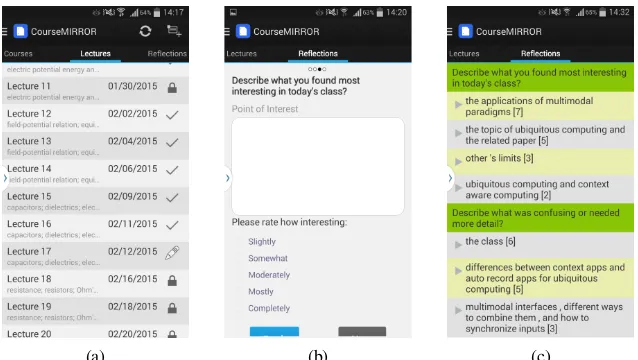
lectures of that course (Fig. 1.a).
After each lecture, Bob writes and submits re-flections through the reflection writing interface (Fig. 1.b). These reflections are transmitted to the server and stored in the database. In order to collect timely and in-situ feedback, CourseMIRROR im-poses submission time windows synchronized with the lecture schedule (from the beginning of one lec-ture to the beginning of the next leclec-ture, indicated by an edit icon shown in Fig. 1.a). In addition, to encourage the students to submit feedback on time, instructors can send reminders via mobile push no-tifications to the students’ devices.
After the reflection collection phase for a given lecture, CourseMIRROR runs a phrase summariza-2Only Android client is provided. The iOS version is under development. Non-Android users now can use an isomorphic web client, optimized for mobile browsers.
tion algorithm on the server side to generate a sum-mary of the reflections for each prompt. In the CourseMIRROR interface, the reflection prompts are highlighted using a green background, and are followed by the set of extracted phrases constituting the summary. The summary algorithm is described in Section 3; the summary length is controlled by a user-defined parameter and was 4 phrases for the example in Fig. 1.c.
For Bob, reading these summaries (Fig. 1.c) is as-sumed to remind him to recapture the learning con-tent and rethink about it. It allows him to get an overview of the peers’ interesting points and confu-sion points for each lecture. To motivate the students to read the summaries, CourseMIRROR highlights the phrases (by using light-yellow background) that were included or mentioned by the current user. This functionality is enabled by the proposed summa-rization technique which tracks the source of each phrase in the summary (who delivers it). We hypoth-esize that highlighting the presence of one’s own re-flections in the summaries can trigger the students’ curiosity to some extent; thus they would be more likely to spend some time on reading the summaries. For Alice, seeing both text and student cover-age estimates in the summaries can help her quickly identify the type and extent of students’ misunder-standings and tailor future lectures to meet the needs of students.
3 Phrase Summarization
(a) (b) (c)
Figure 1: CourseMIRROR main interfaces; a) Lecture list; b) Reflection writing; c) Summary display: the numbers shown in square brackets are the estimated number of students semantically covered by a phrase and a student’s own phrase is highlighted in yellow.
3.1 Candidate Phrase Extraction
To normalize the student reflections, we use a parser from the Senna toolkit (Collobert, 2011) to extract noun phrases (NPs) as candidate phrases for sum-marization. Only NP is considered because all re-flection prompts used in our task are asking about “what”, and knowledge concepts are usually repre-sented as NPs. This could be extended to include other phrases if future tasks suggested such a need.
Malformed phrases are excluded based on Marujo et al. (2013) due to the noisy parsers, including sin-gle stop words (e.g. “it”, “I”, “we”, “there”) and phrases starting with a punctuation mark (e.g. “’t”, “+ indexing”, “?”).
3.2 Phrase Clustering
We use a clustering paradigm to estimate the number of students who mention a phrase (Fig. 1.c), which is challenging since different words can be used for the same meaning (i.e. synonym, different word or-der). We use K-Medoids (Kaufman and Rousseeuw, 1987) for two reasons. First, it works with an ar-bitrary distance matrix between datapoints. This gives us a chance to try different distance matrices. Since phrases in student responses are sparse (e.g., many appear only once), instead of using frequency-based similarity like cosine, we found it more useful to leverage semantic similarity based on SEMILAR (Rus et al., 2013). Second, it is robust to noise and outliers because it minimizes a sum of pairwise
dis-similarities instead of squared Euclidean distances. Since K-Medoids picks a random set of seeds to ini-tialize as the cluster centers and we prefer phrases in the same cluster are similar to each other, the clus-tering algorithm runs 100 times and the result with the minimal within-cluster sum of the distances is retained.
For setting the number of clusters without tun-ing, we adapted the method used in Wan and Yang (2008), by lettingK =√V, whereKis the number of clusters andV is the number of candidate phrases instead of the number of sentences.
3.3 Phrase Ranking
to the student coverage until the length limit of the summary is reached.
4 Pilot Study
In order to investigate the overall usability and effi-cacy of CourseMIRROR, we conducted a semester-long deployment in two graduate-level courses (i.e., CS2001 and CS2610) during Fall 2014. These are introductory courses on research methods in Com-puter Science and on Human ComCom-puter Interaction, respectively. 20 participants volunteered for our study; they received $10 for signing up and in-stalling the application and another $20 for complet-ing the study. Both courses had 21 lectures open for reflections; 344 reflections were collected overall. We used the same reflection prompts as the study by Menekse et al. (2011), so as to investigate the impact of mobile devices and NLP on experimental results. Here we only focus on interesting findings from an NLP perspective. Findings from a human-computer interaction perspective are reported elsewhere (Fan et al., 2015).
Reflection Length. Students type more words than they write. The number of words per reflec-tion in both courses using CourseMIRROR is sig-nificantly higher compared to the handwritten re-flections in Menekse’s study (11.6 vs. 9.7, p <
0.0001 for one course; 10.9 vs. 9.7, p < 0.0001 for the other course) and there is no significant dif-ference between the two CourseMIRROR courses. This result runs counter to our expectation because typing is often slow on small screens. A potential confounding factor might be that participants in our study are Computer Science graduate students while Menekse’s participants are Engineering undergradu-ates at a different university who had to submit the reflection within a few minutes after the lecture. We are conducting a larger scale controlled experiment (200+ participants) to further verify this finding.3
Questionnaire Ratings. Students have positive experiences with CourseMIRROR. In the closing lecture of each course, participants were given a Likert-scale questionnaire that included two ques-tions related to summarization (“I often read
reflec-3Due to a currently low response rate, we are also deploying CourseMIRROR in another engineering class where about 50 out of 68 students regularly submit the reflection feedback.
tion summaries”and“I benefited from reading the reflection summaries”). Participants reported posi-tive experiences on both their quantitaposi-tive and qual-itative responses. Both questions had modes of 3.7 (on a scale of 1-5,σ= 0.2). In general, participants felt that they benefited from writing reflections and they enjoyed reading summaries of reflections from classmates. For example, one comment from a free text answer in the questionnaire is“It’s interesting to see what other people say and that can teach me something that I didn’t pay attention to.”The partic-ipants also like the idea of highlighting their own viewpoints in the summaries (Fig. 1.c). Two ex-ample comments are“I feel excited when I see my words appear in the summary.” and “Just curious about whether my points are accepted or not.”
5 Conclusion
Our live demo will introduce CourseMIRROR, a mobile application that leverages mobile interfaces and a phrase summarization technique to facili-tate the use of reflection prompts in large class-rooms. CourseMIRROR automatically produces and presents summaries of student reflections to both students and instructors, to help them capture the difficulties and misunderstandings encountered from lectures. Summaries are produced using a combination of phrase extraction, phrase clustering and phrase ranking based on student coverage, with the mobile interface highlighting the students’ own viewpoint in the summaries and noting the student coverage of each extracted phrase. A pilot deploy-ment yielded positive quantitative as well as quali-tative user feedback across two courses, suggesting the promise of CourseMIRROR for enhancing the instructor-student and student-student interactions. In the future, we will examine how the students’ re-sponses (e.g., response rate, length, quality) relate to student learning performance.
Acknowledgments
References
David Boud, Rosemary Keogh, David Walker, et al. 2013. Reflection: Turning experience into learning. Routledge.
Jaime Carbonell and Jade Goldstein. 1998. The use of mmr, diversity-based reranking for reordering doc-uments and producing summaries. In Proceedings of the 21st Annual International ACM SIGIR Confer-ence on Research and Development in Information Re-trieval, SIGIR ’98, pages 335–336.
Ronan Collobert. 2011. Deep learning for efficient dis-criminative parsing. In International Conference on Artificial Intelligence and Statistics, number EPFL-CONF-192374.
G¨unes Erkan and Dragomir R. Radev. 2004. Lexrank: Graph-based lexical centrality as salience in text sum-marization.J. Artif. Int. Res., 22(1):457–479.
Xiangmin Fan, Wencan Luo, Muhsin Menekse, Diane Litman, and Jingtao Wang. 2015. CourseMIRROR: Enhancing large classroom instructor-student interac-tions via mobile interfaces and natural language pro-cessing. InWorks-In-Progress of ACM Conference on Human Factors in Computing Systems. ACM. Leonard Kaufman and Peter Rousseeuw. 1987.
Clus-tering by means of medoids. Statistical Data Analy-sis Based on theL1-Norm and Related Method, pages 405–416.
Luis Marujo, M´arcio Viveiros, and Jo˜ao Paulo da Silva Neto. 2013. Keyphrase cloud generation of broadcast news. arXiv preprint arXiv:1306.4606.
Muhsin Menekse, Glenda Stump, Stephen J. Krause, and Michelene T.H. Chi. 2011. The effectiveness of stu-dents daily reflections on learning in engineering con-text. InProceedings of the American Society for Engi-neering Education (ASEE) Annual Conference. Dragomir R. Radev, Hongyan Jing, Małgorzata Sty´s,
and Daniel Tam. 2004. Centroid-based summariza-tion of multiple documents. Inf. Process. Manage., 40(6):919–938, November.
Vasile Rus, Mihai C Lintean, Rajendra Banjade, Nobal B Niraula, and Dan Stefanescu. 2013. Semilar: The se-mantic similarity toolkit. InACL (Conference System Demonstrations), pages 163–168.
Xiaojun Wan and Jianwu Yang. 2008. Multi-document summarization using cluster-based link analysis. In