On Order Effects in Analogical Mapping:
Predicting Human Error Using IAM
Mark T. Keane
Department of Computer Science, University of Dublin, Trinity College,
Dublin 2, IRELAND [email protected]
Abstract
The Incremental Analogy Machine (IAM) predicts that the order in which parts of an analogy are processed can affect the ease of analogical mapping. In this paper, the predictions of this model are tested in two experiments. Previous work has shown that such order effects can be found in attribute-mapping problems. In the first experiment, it is shown that these effects generalise to relational-mapping problems, when subjects' error performance (incorrect mappings) is considered. It is also found that relational-mapping problems are significantly harder than attribute-mapping problems. In the second experiment, it is shown using relational-mapping problems, that order effects can be demonstrated for doubles (two sentences about two indiviudals) in these problems. Throughout the paper it is shown that these results are best approximated by IAM's measure of the complexity of global mappings (the remaps-complexity measure), and not as has been found previously, by a measure using frequency of remaps (the re-maps measure). The empirical and theoretical significance of these results are discussed.
Introduction
The importance of analogy to problems solving, creativity and learning is well-documented (see e.g., Koestler, 1964). Now, the theoretical basis of analogy is better understood than it was 30 years ago, with the elaboration of the subprocesses underlying the phenomenon; that is, representation, retrieval, mapping, adaptation and induction. Many empirical studies now substantiate these theories (see e.g., Clement & Gentner, 1991; Gentner & Toupin, 1985; Gick & Holyoak, 1980; Holyoak & Koh, 1987; Keane, 1985, 1987, 1988, 1994; Novick & Holyoak, 1991). The distinctive, core sub-process in analogy is analogical mapping; it establishes the correspondences between the concepts in a base domain of knowledge and a target domain, performing any analogical inferences that follow from these correspondences. For example, in drawing an analogy between the solar sytem and the atom, it is analogical mapping that determines the correspondences between, say, the revolution of the planets around the sun and the revolution of the electrons around the nucleus (see Gentner, 1983).
In performing analogical mapping subjects resolve many ambiguities in the mappings between the two domains, ambiguities that are highlighted in Holyoak & Thagard's (1989) attribute-mapping problem (see e.g., singletons-crossed problem in Table 1). In attribute-mapping problems, subjects are asked to say which things in list A correspond to which things in list B (ignoring the meaning
of the words); they have to discover a one-to-one mapping between all the individuals and attributes in list A and list B. This mapping is difficult because many ambiguous matches have to be resolved. For example, smart may match hungry or friendly or frisky and the correct match can only be determined by eliminating the inconsistent matches that follow from all but one of these matches. The unique one-to-one mapping which solves the problem is to match Steve and Fido, Bill and Rover, Tom and Blackie, smart and hungry, tall and friendly, and timid and frisky.
This paper examines people's performance on this type of mapping problem. In particular, I test the predictions of one analogy model, the Incremental Analogy Machine, with a view to selecting its best predictor of the empirical data. Unlike much previous analogy research the emphasis here is on predicting subjects' specific, error performance rather than simply characterising their broad analogical competence.
Theories and Models of Analogical Mapping There is some theoretical consensus as to the nature of analogical mapping, although the models used to instantiate this theory differ considerably. The basic view is that analogical mapping is a matching process that is sensitive to three main sets of informational constraints (see Keane, Ledgeway & Duff, 1994, for more details):
• structural constraints - which establish isomorphic
matches between entities of the same type in both domains (e.g., objects with objects, relations with relations), enforce structural consistency [if the relation
hit(x, y) and hit(a, b) are matched then their arguments
must be placed in correspondence (x with a, y with b)], and take the systematicity of the mapping into account (see Gentner, 1983)
• similarity constraints - that in deciding between
alternative matches, matches that are semantically similar to one another should be preferred over ones that are less similar,
• pragmatic constraints - that matches that are
goal-relevant or pragmatically important in the task context (e.g., because an experimenter has indicated them to be so) should be preferred over alternative matches
Keane et al. (1994) pointed out that these constraints constitute a competence-type theory or computational-level theory of analogy (see Marr, 1982; Palmer, 1989), that had to be extended to include algorithmic-level or behavioural
constraints to characterise performance aspects of analogy
Table 1: Examples of mapping problems used in Experiment 1
_________________________________________________________________________________
Attribute-Mapping Problems
Singletons-Aligned Singletons-Crossed
A B A B
Steve is smart.* Fido is hungry.* Bill is smart. Fido is hungry.* Bill is tall. Blackie is friendly. Bill is tall. Blackie is friendly. Bill is smart. Blackie is frisky. Tom is timid. Blackie is frisky. Tom is tall. Rover is hungry. Tom is tall. Rover is hungry. Tom is timid. Rover is friendly. Steve is smart.* Rover is friendly.
Relational-Mapping Problems
Singletons-Aligned Singletons-Crossed
A B A B
Joe motivates Steven.* Lisa hugs Jenny.* Mark is beside Ronan. Lisa hugs Jenny.* Mark is beside Ronan. Laura employs Ruth. Mark motivates Ronan. Laura employs Ruth. Mark motivates Ronan. Laura hugs Ruth. Conor is beside Paul. Laura hugs Ruth. Conor is beside Paul. Mary sees Ali. Conor fears Paul. Mary sees Ali. Conor fears Paul. Mary employs Ali. Joe motivates Steven.* Mary employs Ali.
__________________________________________________________________________________
* indicates the singleton
All of the computational models in the literature capture
analogical competence by implementing the above
informational constraints. Falkenhainer, Forbus & Gentner (1989; Forbus & Oblinger, 1990) Structure Mapping
E n g i n e (SME) implements the three informational
constraints in a serial fashion finding all possible legal matches between two domains and combining these into alternative mapping interpretations (or global mappings) of the analogy. Holyoak & Thagard's (1989) Analogical
Constraint Mapping Engine (ACME) uses parallel
constraint satisfaction in an interactive network to find a single global mapping between two domains. Keane's (1990; Keane & Brayshaw, 1988; Keane, et al., 1994)
Incremental Analogy Machine (IAM) uses serial
constraint-satisfaction to form a single, optimal interpretation based on a subset of the possible matches between the two domains. IAM builds this global mapping incrementally by selecting a part of the base domain for mapping, mapping it and then moving on to map another part1. IAM was designed to include behavioural constraints, to capture people's
performance on analogy tasks.
The IAM model makes the novel prediction that the order in which parts of a domain are processed could affect the ease of the analogical mapping. Keane et al. demonstrated such order effects using the two versions of the attribute-mapping problem shown in Table 1. An important property of these attribute-mapping problems is that each list has two individuals (e.g., Bill and Tom) with two attributes (termed
1 Different forms of incrementality have been proposed in analogy. Burstein (1986) proposed that multiple base domains could be combined incrementally over time when learning by analogy, but this model does not apply to complex analogies. Falkenhainer (1987) proposed a mechanism for the incremental revision of analogical inferences after they had been tested by a simulation method. Neither model performs incremental mapping of a single analogy. IAM is the first general-purpose, incremental analogical-mapping engine.
doubles) and a remaining individual (i.e., Steve) who has
just one attribute (a singleton). Matching up the singletons ("Steve is smart" and "Fido is hungry") helps to achieve the isomorphic mapping because the singletons disambiguate the set of matches between the two lists (this argument also applies to the single attribute in both lists). Taking this property of the problem into account, IAM predicted that if the singletons were placed at the beginning of both lists (see singletons-aligned problem) then the problem should easier than when the singletons are ordered in a misaligned or crossed fashion (see singletons-crossed problem). Keane et al. (1994) found that people were almost twice as fast at mapping aligned problems than singletons-crossed problems.
These order effects show that an incremental account of analogy is psychologically plausible. In part, as a response these findings Forbus, Ferguson & Gentner (1994) produced an incremental version of SME (I-SME). I-SME can also account for the order effects in attribute-mapping problems. Forbus et al. have also demonstrated that incremental analogising is important to model the successive learning by analogy over time.
The Problem
However, these order effects might not generalise to mapping problems involving relations. Most analogies do not hinge on mappings between one-place predicates [e.g.,
timid(x), hungry(x)], but rather involve multi-place
predicates [e.g., hit(x, y), hurt(y, z)]. Keane et al. produced singletons-aligned and singleton-crossed versions of a new relational-mapping problem and noted that IAM predicted similar order effects for these problems (see Table 1). However, this prediction has never been substantiated empirically.
performance, with a view to identifying the most predictive measure. In each experiment, I first report a computational experiment using IAM before testing these predictions with subjects.
Experiment 1: Order and Problem Type
IAM predicts that the order effects found for attribute-mapping problems should also hold for relational-attribute-mapping problems. So, singletons-aligned versions of both problems should be easier than singletons-crossed versions of both problems (see Table 1). IAM should also predict problem-type effects; that is, relational-mapping problems should be harder than the attribute-mapping problems because they involve more complex predicate structures (taking two arguments). However, the difficulty of an analogy can be measured in several different ways in IAM. In the simulation experiment, two such measures are examined in assessing the predictions of IAM.Experiment 1A: Simulating Order & Problem-Type Effects in IAM
In the simulation experiment using IAM, the exact same problems were presented to the model that were later given to the human subjects (see Keane et al., 1994, for a full description of IAM). In previous studies, the measure used was the number of alternative global-mappings generated before the problem was solved; the re-maps measure. This is a good measure of problem difficulty because it is common to IAM, SME, ACME and I-SME (see Keane et al., 1994). It also makes accurate predictions for the order effects found in attribute-mapping problems. However, it is a very gross measure, because it does not take the contents of these global mappings into account. For instance, it should be clear that a global mapping involving three entities is less difficult than a global mapping involving 300 entities. Yet, the remaps measure would never reveal this difference. The remaps measure is unlikely to manifest problem-type differences because they hinge on the number of entities involved. A finer-grained measure is possible using the number of mappings involved in each remap: the remaps-complexity measure. This measure tells us how many maps (predicate and object) were
constructed across all the global mappings generated before the solution is reached. We adopted these difficulty measures in our following tests rather than direct tests of error in the model because there are no strong guidelines for making the model produce errors. I could have stopped the model after a certain length of time, before the correct answer in reached; this would give us numbers of incorrect mappings but any proposals on how long the model should run seem arbitrary (see Keane, 1995, for details and other possible measures).
Method
Materials & Design. The materials presented to IAM
in the computational experiment were predicate calculus representations of the problems shown in Table 1. The problems given to the program corresponded to the individual problems given to subjects in the subsequent psychological experiment (see Keane, 1995). The materials thus consisted of four sets problems, one for each condition; the attribute-aligned (11 problems), attribute-crossed (13 problems), aligned (12 problems), and relational-crossed conditions (9 problems).
Procedure & Measures. Each problem was run on IAM
(see Keane et al., 1994, Appendix A for settings used). Two measures were used: (i) remaps, the number of alternative global mappings generated; (ii) r e m a p s
-complexity, the number of maps (both relational and object)
that were formed on successive remaps.
Results & Discussion
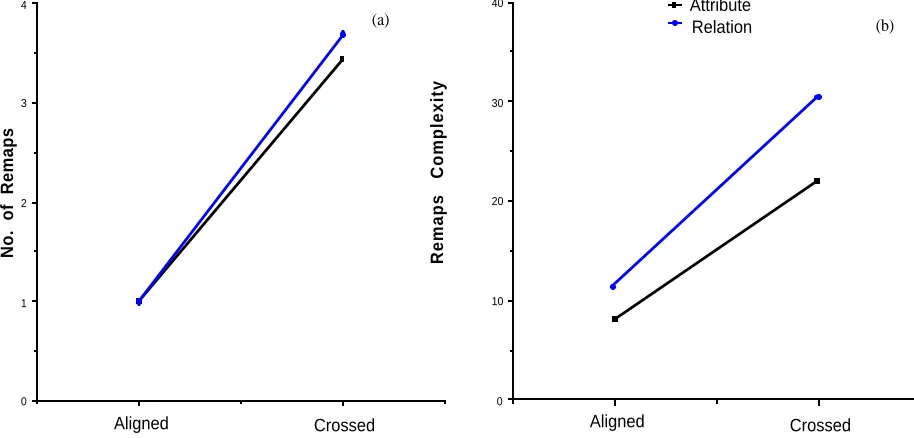
Figure 1 shows the mean number of remaps (Figure 1a) and the mean remaps-complexity scores (Figure 1b) for the different conditions in the experiment. Both measures predict that singletons-aligned problems should be easier than the singletons-crossed problems, but only the complexity measure predicts a difference between attribute-and relational-mapping problems.
A 2 x 2 analysis of variance, with between-subject factors for order (aligned or crossed) and problem-type (attribute or relational), of the computational results reveals the number
Aligned Crossed
0 1 2 3 4
Relation Attribute
No. of Remaps
Aligned Crossed
0 10 20 30 40
(a) (b)
Remaps Complexity
[image:3.595.58.515.549.768.2]of remaps measure only shows a reliable main effect of order [F (1, 41) = 72.83, p < .0001; MSe = 38.99]. However, the remaps-complexity measure shows reliable main effects for both order [F(1, 41) = 55.79, p < .001; MSe = 54.18] and problem type [F(1, 41) = 7.36, p < .01]. There were no reliable interactions for either measure.
The results of the computational experiment show that the previously-used, remaps measure appears to be too blunt to be useful. It merely counts the number of different interpretations produced for the analogy and says nothing about the complexity of these interpretations. The remaps-complexity measure was, therefore, used to predict subjects' performance.
Singletons-Aligned Singletons-Crossed
0.00 0.10 0.20 0.30 0.40 0.50
Attribute Relation
Proportion Incorrect Mappings
Figure 2: The mean proportion of incorrect-mappings produced in Experiment 1B
Experiment 1B: Psychological Tests of Order and Problem Type
We have seen the sorts of predictions produced by the computational tests in Experiment 1A. Here these predictions are tested in a parallel psychological experiment.
Method
Materials. We used the four types of problem shown in
Table 1: two sets of attribute-mapping problems and two sets of relational-mapping problems. For each problem-type there was a set of aligned problems (in which the singletons were first in both lists) and a set of crossed problems (in which the singleton in list A was last and the singleton in list B was still in the first position). The remaining sentences in each list were randomised with the constraint of keeping attributes (or relations) about the same individual (or pair of individuals) together.
Procedure. Subjects were instructed in writing that their
"task is to figure out what in the left set corresponds to what in the right set of sentences". A single column below list A listed the names of the individuals and attributes/relations in that list (in the order in which they appeared in the list of sentences). Next to each was a space for subjects to write the corresponding name or attribute/relation from list B. Subjects were first shown the instructions and problem and were asked to read them carefully. They were timed until they produced the correct answer to the problem (the clock was stopped after 15 minutes).
Subjects & Design. Forty-five undergraduates
attending Trinity College Dublin took part voluntarily in
the experiment. One subject was excluded prior to data analysis because he misunderstood the experimental instructions (failed to produce even one correct mapping). Data analysis was carried out on the remaining 44 subjects who were assigned randomly to the four conditions; the attribute-aligned (n = 11), attribute-crossed (n = 13), relational-aligned (n = 12), and relational-crossed conditions (n = 9).
Measures. Keane et al. (1994) used solution-time as
the dependent measure in their experiments. However, solution time proved to be unsuitable here because many subjects found the relational-mapping problems very difficult; 75% of subjects failed to solve them (or gave up) before the 15 minutes deadline. The dependent measure was, therefore, the proportion of incorrect-mappings produced by subjects to a problem (the attribute mapping problem has six correct mappings and the relational-mapping problems has nine such relational-mappings).
[image:4.595.56.271.225.377.2]Results & Discussion
Figure 2 shows the mean number of incorrect-mappings produced by subjects in the different conditions of Experiment 1. Order effects were demonstated in relational-mapping problems as well as in attribute-relational-mapping problems. The effect of problem type was also marked; overall only 25% of subjects solved relational mapping problems (i.e., got no incorrect mappings) whereas 67% of subjects solved the attribute-mapping problems. The results corroborate the predictions of the IAM model based on the remaps-complexity measure (compare Figures 1b and 2).
The 2 x 2 analysis of variance, with between-subject factors for order (aligned or crossed) and problem-type (attribute or relational), revealed reliable main effects of order [F(1, 41) = 4.17, p < .05; MSe = .055] and problem-type
F (1, 41) = 9.25, p < .01; MSe = .055]. There was no
significant interaction. The results thus demonstrate that the remaps measure is, in itself, insufficient to distinguish problem-type differences in analogical mapping. Rather, we need a measure that takes into account the complexity of these remaps.
Table 2: Examples of the mapping problems used in Experiment 2*
___________________________________________________________________________________
Doubles-Aligned Doubles-Crossed
A B A B
Jim is beside Fred. Ruth motivates Ali. Mark employs Ronan. Ruth motivates Ali. Jim employs Fred. Ruth sees Ali. Mark pays Ronan. Ruth sees Ali. Joe pays Sam. Lisa hugs Jenny. Joe pays Sam. Lisa hugs Jenny. Mark employs Ronan. Laura hugs Debra. Jim is beside Fred. Laura hugs Debra. Mark pays Ronan. Laura motivates Debra. Jim employs Fred. Laura motivates Debra.
___________________________________________________________________________________
Aligned Crossed
10 20 30 40 50
[image:5.595.67.282.146.423.2]Remap Complexity
Figure 3a: The mean remap complexity scores produced by IAM in Expt. 2B
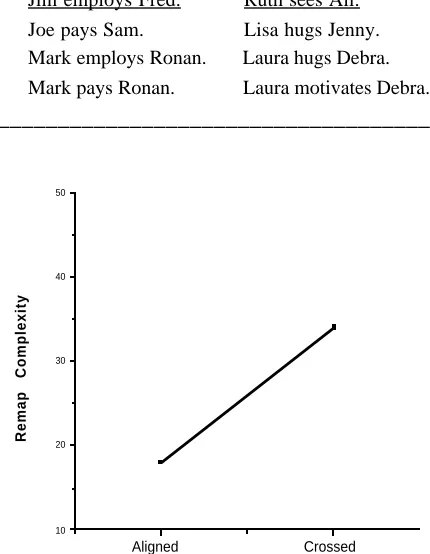
Experiment 2A: Computational Tests on Doubles The materials presented to IAM in the computational experiment were predicate calculus representations of the problems shown in Table 2. The materials corresponded to the two types of problem given to subjects in the subsequent experiment. Each of the problems were run on IAM. After running a problem the remap-complexity measure was noted (as defined in Experiment 1A).
Results & Discussion
Figure 3a shows the predicted differences for these problems. The group-complexity measure clearly shows an effect of order. A dependent t-test revealed a reliable difference between the doubles-aligned (M = 18, SD = 3.10) and doubles-crossed conditions [M = 34, SD = 7.23; t(15) = -15.49, p < .0001].
Experiment 2B: Psychological Tests of Doubles
Materials & Procedure. We used two versions of the
relation-mapping problem, examples of which are shown in Table 2. In these problems, the singleton sentence was always the third sentence in both lists, while the order of the doubles was varied around them. The procedures and instructions were as in Experiment 1B except for two changes. First, we reduced the amount of time given to subjects to solve the problem from 15 minutes to five minutes. In Experiment 1B, we found that those people who solved the problem tended to do so in under 5 minutes. Finally, we also added the following sentence to the instructions: "There is a one-to-one
correspondence between the relations and objects in list A and list B". This was designed to provide a little more guidance as to the task demands.
Subjects, Design & Measures Thirty-four students in
Department of Computer Science at Trinity College Dublin took part voluntarily in the experiment. Two subjects were dropped from the experiment prior to data analysis because they misunderstood the experimental instructions (failed to produce even one correct mapping). The remaining 32 subjects were assigned randomly to the two conditions: the doubles-aligned (n=16), and doubles-crossed conditions (n=16). As before, The dependent measure was the proportion of incorrect mappings generated by subjects to a problem.
Aligned Crossed
0.00 0.10 0.20 0.30 0.40 0.50
[image:5.595.332.542.382.568.2]Proportion of Incorrect Mappings
Figure 3b: The mean proportion of incorrect mappings produced by subjects in Expt. 2B
Results & Discussion
Figure 3b shows the mean number of incorrect mappings produced by subjects in the different conditions of Experiment 2B. The results correspond well to the remap-complexity measures found in IAM (compare Figures 3a and 3b). A dependent t-test carried out on the two conditions revealed that that difference between the doubles-aligned (M=.09, SD = .17) and doubles-crossed (M = .43, SD = .28) conditions was statistically relaible [t(15) = -3.9, p < .001]. The results thus reveal that the positioning of doubles as well as the positioning of singletons can lead to order effects in these mapping problems.
Conclusions
previously demonstrated in attribute-mapping problems can be replicated and extended to relational-mapping problems. They show that relational-mapping problems are considerably more difficult than attribute-mapping problems. Finally, they show that order effects are not just to be found for the positioning of singletons, but are also sensitive to the position of doubles. These experiments are among the first to predict specific error rates in analogical mapping and to show systematic differences in these rates over different types of analogy problems.
Keane et al. (1994) argued that analogy models have to approximate subjects' performance, not just characterise the sort of analogies they can or cannot do (i.e., their analogical competence). In this paper IAM has demonstrated a good approximation to subjects' performance. The previously-used measure - the remaps measure -- has been shown here to be insensitive to processing differences caused by the complexity of the predicates involved in a mapping (i.e., whether there are attributes or relations). To approximate subjects' error performance in these experiments a new measure was required based on the complexity of the remaps being processed. This complexity measure provides a good account of both order and problem-type effects.
However, these findings raise the issue of whether the other models in the literature can be shown to make similar predictions. It is known already that ACME does not predict any order effects; these effects run counter to the parallel spirit of that model (see Keane et al., 1994). I-SME can model order effects using a remaps measure but its predictions for these experiments are not known (awaiting results). I-SME constructs its remaps in a completely different way to IAM. The number of remaps it produces to different problems differs to the number generated by IAM. I would assume, however, that this remaps measure will not capture problem-type effects and therefore some complexity measure might be required. So, to the best of my knowledge, at present, IAM is unique in its ability to approximate the human behaviour discovered here.
Acknowledgements
The author would like to thank Karen Looney running some of the subjects and the AI Group at Trinity College. Thanks go to Ruth Byrne for commenting on the paper. This reasearch has been aided by funding from the Hitachi Dublin Laboratory at Trinity College Dublin.
References
Burstein, M.H. (1986). Concept formation by incremental analogical reasoning and debugging. In R.S. Michalski, J.G. Carbonell & J.M. Mitchell (Eds.),
Machine Learning II: An Artificial Intelligence Approach . Los Altos, Calif.: Kaufmann.
Clement, C.A., & Gentner, D. (1991). Systematicity as a selection constraint in analogical mapping. Cognitive
Science, 15, 89-132.
Falkenhainer, B. (1987). An examination of the third stage in the analogy process: Verification-based analogical learning. In Proceedings of the Tenth International
Joint Conference on Artificial Intelligence. Los Altos:
Morgan Kaufmann.
Falkenhainer, B., Forbus, K.D., & Gentner, D. (1989). Structure-mapping engine. Artificial Intelligence, 41, 1-63.
Forbus, K.D., & Oblinger, D. (1990). Making SME greedy and pragmatic. In Twelfth Annual Conference
of the Cognitive Science Society. Hillsdale: Erlbaum.
Forbus, K.D., Ferguson, R.W., & Gentner, D. (1994). Incremental structure mapping. In Sixteenth Annual
Conference of the Cognitive Science Society.
Hillsdale, NJ: Erlbaum.
Gentner, D. (1983). Structure-mapping: A theoretical framework for analogy. Cognitive Science, 7, 155-170.
Gentner, D. & Toupin, C. (1986). Systematicity and surface similarity in the development of analogy.
Cognitive Science, 10, 227-300.
Gick, M.L., & Holyoak, K.J. (1980). Analogical problem solving. Cognitive Psychology, 12, 306-355.
Holyoak, K.J. & Koh, K. (1987). Surface and structural similarity in analogical transfer. Memory & Cognition , 15, 332-340.
Holyoak, K.J., & Thagard, P. (1989). Analogical mapping by constraint satisfaction.Cognitive Science, 13, 295-355.
Keane, M.T. (1985). On drawing analogies when solving problems. British Journal of Psychology, 76 , 449-458.
Keane, M.T. (1987). On retrieving analogues when solving problems. Quarterly Journal of Experimental
Psychology, 39A , 29-41.
Keane, M.T. (1988). Analogical Problem Solving. Chichester: Ellis Horwood.
Keane, M.T. (1990). Incremental analogising: Theory and model. In K.J. Gilhooly, M.T. Keane, R. Logie & G. Erdos (Eds.), Lines of Thinking. Vol. 1. Chichester: John Wiley.
Keane, M.T. (1994). Adaptation as a selection constraint on analogical mapping. In Sixteenth Annual Conference of
the Cognitive Science Society. Hillsdale, NJ:
Erlbaum.
Keane, M.T. (1995). On order effects in analogy. TCD-CS-TR-95-04. May.
Keane, M.T., & Brayshaw, M. (1988). The Incremental Analogy Machine. In D. Sleeman (Ed.), T h i r d
European Working Session on Machine Learning.
Calif.: Morgan Kaufmann.
Keane, M.T., Ledgeway, T, & Duff, S. (1994). Constraints on analogical mapping: A comparison of three models.
Cognitive Science, 18, 287 - 334.
Koestler, A. (1964). The Act of Creation . London: Picador.
Marr, D. (1982). Vision. San Francisco: Freeman. Novick, L.R. & Holyoak, K.J. (1991). Mathematical
problem solving by analogy. Journal of Experimental
Psychology: Learning, Memory and Cognition, 17,
398-415.
Palmer, S.E. (1989). Levels of description in information processing theories of analogy. In S. Vosniadou & A. Ortony (Eds.), Similarity and Analogical