http://wrap.warwick.ac.uk
Original citation:Stephenson, David, Patronis, Alexander, Holland, David M. and Lockerby, Duncan A.. (2015) Generalizing Murray's law : an optimization principle for fluidic networks of arbitrary shape and scale. Journal of Applied Physics, 118 (17). 174302
http://dx.doi.org/10.1063/1.4935288
Permanent WRAP url:
http://wrap.warwick.ac.uk/76019
Copyright and reuse:
The Warwick Research Archive Portal (WRAP) makes this work of researchers of the University of Warwick available open access under the following conditions.
This article is made available under the Creative Commons Attribution 4.0 International license (CC BY 4.0) and may be reused according to the conditions of the license. For more details see: http://creativecommons.org/licenses/by/4.0/
A note on versions:
The version presented in WRAP is the published version, or, version of record, and may be cited as it appears here.
Generalizing Murray's law: An optimization principle for fluidic networks of arbitrary
shape and scale
David Stephenson, Alexander Patronis, David M. Holland, and Duncan A. Lockerby
Citation: Journal of Applied Physics 118, 174302 (2015); doi: 10.1063/1.4935288
View online: http://dx.doi.org/10.1063/1.4935288
View Table of Contents: http://scitation.aip.org/content/aip/journal/jap/118/17?ver=pdfcov
Published by the AIP Publishing
Articles you may be interested in
Effect of presence of salt on the dynamics of water in uncharged nanochannels
J. Chem. Phys. 138, 054504 (2013); 10.1063/1.4789586
Effects of thermal creep and high order slip/jump on natural convection in microchannels
AIP Conf. Proc. 1501, 757 (2012); 10.1063/1.4769618
Comparison of some approximation schemes for convective terms for solving gas flow past a square in a microchannel
AIP Conf. Proc. 1487, 79 (2012); 10.1063/1.4758944
Gas-flow animation by unsteady heating in a microchannel
Phys. Fluids 22, 062001 (2010); 10.1063/1.3437602
Kinetic theory and molecular dynamics simulations of microscopic flows
Generalizing Murray’s law: An optimization principle for fluidic networks
of arbitrary shape and scale
DavidStephenson,a)AlexanderPatronis,b)David M.Holland,c)and Duncan A.Lockerbyd)
School of Engineering, University of Warwick, Coventry, CV4 7AL, United Kingdom
(Received 17 August 2015; accepted 26 October 2015; published online 6 November 2015)
Murray’s law states that the volumetric flow rate is proportional to the cube of the radius in a cylindrical channel optimized to require the minimum work to drive and maintain the fluid. However, application of this principle to the biomimetic design of micro/nano fabricated networks requires optimization of channels with arbitrary cross-sectional shape (not just circular) and smaller than is valid for Murray’s original assumptions. We present a generalized law for symmetric branch-ing that (a) is valid for any cross-sectional shape, providbranch-ing that the shape is constant through the net-work; (b) is valid for slip flow and plug flow occurring at very small scales; and (c) is valid for networks with a constant depth, which is often a requirement for lab-on-a-chip fabrication proce-dures. By considering limits of the generalized law, we show that the optimum daughter-parent area ratioC, for symmetric branching intoNdaughter channels of any constant cross-sectional shape, is
C¼N2=3 for large-scale channels, andC¼N4=5 for channels with a characteristic length scale much smaller than the slip length. Our analytical results are verified by comparison with a numerical optimization of a two-level network model based on flow rate data obtained from a variety of sour-ces, including Navier-Stokes slip calculations, kinetic theory data, and stochastic particle simulations.
VC 2015 AIP Publishing LLC. [http://dx.doi.org/10.1063/1.4935288]
I. INTRODUCTION
In 1926, Murray1posited that there were two competing factors contributing to the energy cost of blood flow through the arterial system: (1) the energy required to drive the flow, which increases as the vessel radius decreases; and (2) the energy required to metabolically maintain the fluid, which increases with increasing vessel radius. Thus, to minimize the total power requirement, the vessel could be neither too large nor too small. Using the Hagen-Poiseuille law to describe the flow through a cylindrical vessel (i.e., assuming the flow is laminar, Newtonian, steady, and fully devel-oped), the powerWf required for the flow to overcome the
viscous drag is
Wf ¼fDP¼
8lLf2
pr4 ; (1)
where DP is the pressure drop over the vessel, l is the dynamic viscosity of the fluid,Lis the vessel length,fis the volumetric flow rate, andris the vessel radius. This is offset by the maintenance “cost of blood”Wmwhich increases
line-arly with the blood volume:
Wm¼mLpr2; (2)
where m is an all-encompassing metabolic coefficient that includes the chemical cost of keeping the blood constituents fresh and functional, and the general cost owing to the
weight of the blood and the vessel. The total power require-mentWt¼WfþWmis thus
Wt¼
af2
r4 þbr
2; (3)
where a¼8lL/p and b¼mpL. For a constant volumetric flow rate, and given values of aandb, the total power will be a function of a single variable—the vessel radiusr—and the minimum power is found by differentiating with respect torand equating to zero:
dWt
dr ¼
4af2
r5 þ2br¼0: (4)
Rearranging Eq.(4)gives
f ¼ Kr3; (5)
where K ¼pffiffiffiffiffiffiffiffiffiffib=2a. Thus for any vessel considered inde-pendently, Eq. (5) describes the optimal relation between volumetric flow rate and vessel radius, such that the power requirement is minimized. If the fluid viscosity and meta-bolic coefficient are constant throughout a network, then
Kis constant. It was surmised that in this instance, Eq.(5)
should hold for all vessels in a network operating at maximum efficiency, which tacitly assumes that the local losses through the junction (due to bends and channel con-tractions) are negligible compared to the pressure losses over the channel lengths; this limits the applicability of Murray’s law to networks of high-aspect-ratio channels. By applying the conservation of mass at a branching point, we retrieve the ubiquitous principle known as Murray’s law:
a)
b)
rp3¼
XN
i¼1
r3di; (6)
where the subscripts panddi denote the parent and the ith
daughter (ofN), respectively. In the common case of sym-metrical branching, Eq.(6)reduces to
r3p¼Nr3d: (7)
Murray’s law has been shown to be a good approxima-tion for a diverse range of biological networks whose pri-mary function is fluidic transport, for example, in the cardiovascular systems of multiple animals;2–9in the bron-chial trees of lungs;10–12and in the leaf veins of plants.13–15 Murray’s law can also be applied to inorganic systems5and has been adapted for networks with rectangular, trapezoi-dal,16 and elliptical cross sections.17 The applicability of Murray’s law to moderately rarefied gas flows has also been investigated18 and a departure from Eq.(7)has been noted. These developments indicate that some version of Murray’s law could be applied as a biomimetic design principle for microfluidic and nanofluidic networks, such as lab-on-a-chip devices for microreactors19or tissue engineering,20or micro/ nanoscale heat exchangers for high performance fuel cells21 or the cooling of electronic devices.22,23
Since the original derivation of Murray’s law, it has been noted that the application of other optimization princi-ples (not just that of minimum work) result in Eq.(7): mini-mizing the total mass of the network,24minimizing volume for a constant pressure drop and flow rate,25 keeping the shear stress constant in all channels,26or minimizing flow re-sistance for a constant volume.5,27
As noted in Ref.16, in some circumstances, it is desira-ble or necessary for the cross-sectional shape to vary between the parent and daughter channels of a branching net-work. In many lab-on-a-chip fabrication procedures (e.g., photolithograpy, wet or dry etching, or surface micromachin-ing), the depth remains constant throughout the device, and thus the shape (i.e., aspect ratio) of the cross section must vary. A multi-depth approach to fabrication does exist,28but it is relatively complex.
Despite many developments to Murray’s law, there are three major barriers that prevent it from being relevant to the design of many artificial fluidic networks: (1) it is not demonstrably applicable to cross sections of any arbitrary shape; (2) it is not applicable at the micro/nanoscale, where a fluid can no longer be accurately described as a continuous material;29 and (3) it is not applicable to networks which maintain a constant depth through branching, wherein the cross-sectional shape changes between the parent and daugh-ter channels.
II. ANALYTICAL SOLUTIONS
Although Murray’s original optimization concerns the minimization of work, the principle can be generalized as a maximization of flow conductance per unit volume for a va-riety of constraint combinations. For a two-level network
(consisting of a single parent channel branching into multiple daughter channels), this can be expressed as
arg max
C2½0;1
Q
DPV
subject to fixed
Q;DP V;DP V;Q; 8 <
: (8)
where Q is the mass flow rate through the parent channel,
DPis the total pressure drop (from inlet of the parent to the outlet of the daughters),Vis the network volume, and
C¼Ad
Ap
(9)
is the daughter-parent cross-sectional area ratio. Note, the three constraint options (pressure-drop minimization, volume minimization, and flow-rate maximization) all lead to the same optimal daughter-parent area ratio. For our optimiza-tion, we assume that the channel lengths L are large com-pared to the size of the parent-daughters junction so that (1) the localized pressure losses through the junction are negligi-ble compared to the pressure drops over individual channels (as in Murray’s law) and (2) the volume of the network can be considered to be the sum of the channel volumes:
V¼ApLpþNAdLd: (10)
This means that the channel lengths are treated as being in-dependent of the branching angle.30The channel lengths are also treated as being independent of the optimal daughter-parent area ratio (as found in Murray’s optimization1), i.e., dL/dC¼0. This will be verified later. Inserting Eq.(10)into the fitness function of Eq.(8), differentiating with respect to
C, and equating to zero, gives
d dC
DPV Q
¼Lp
dAp
dC þNLd
dAd
dC ¼0; (11)
noting that, for all constraint combinations, d(DP)/dC¼0 and dQ/dC¼0. The pressure drop over the parent and daughter channels can be expressed in terms of the mass flow rate:
DPp¼QLpkp; (12)
DPd¼
QLdkd
N ; (13)
where L is the channel length and k is flow resistance per unit length, e.g.,kp¼DPp/(QLp). The pressure drop over the
entire networkDP¼DPpþDPdis then
DP¼Q Lpkpþ
Ldkd
N
: (14)
As d(DP)/dC¼0 and dQ/dC¼0, differentiating Eq. (14)
with respect toCgives
Lp
dkp
dCþ
Ld
N
dkd
dC ¼0: (15)
Substituting Eq.(15)into Eq.(11), via the chain rule, gives the generalized optimal area relation for symmetric branching:
dA
dk
p
¼N2dA
dk
d
: (16)
For brevity, this will be referred to as thegeneralized lawto distinguish it from Murray’s law. This expression is not a function of L which suggests that the optimal daughter-parent area ratio is independent of the channel lengths (and thus branching angle). Note this generalized law is valid for any Reynolds number (e.g., for turbulent flow) and for any fluid (e.g., non-Newtonian)31 as long as local losses in the junction remain negligible. In this paper, we restrict our attention to laminar and Newtonian flows, and we now con-sider some important cases whereAcan be expressed easily as an analytical function ofk.
A. The continuum-flow limit
We begin with the steady incompressible Navier-Stokes momentum equation for laminar flow through a long channel with an arbitrary cross-sectional shape, i.e.,
DP
L ¼ lr
2
u; (17)
where u is the streamwise channel velocity. We can non-dimensionalize this usingDP/L,land cross-sectional areaA, such that
1¼ r~2u~; (18)
where
u¼uA~ DP
L
1
l; r
2¼r~ 2
A ; (19)
and tilde denotes a dimensionless quantity or operator. We also definey,zas the axes of the cross-sectional plane, and
y¼y~pffiffiffiA; z¼~zpffiffiffiA: (20)
Provided the boundary conditions are fixed (which is the case for the continuum-flow limit, where the no-slip bound-ary condition applies), the solution of Eq.(18),u~ðy~;~zÞ, is in-dependent ofA,DP,L, andl, and is thus a property of the cross-sectional shape alone. Similarly, so is
S¼
ð ð
A
~
uð~y;~zÞd~yd~z: (21)
An expression for the mass flow rate is obtained by integrat-ing the fluid momentum over the cross-sectional area
Q¼q ð ð
A
udydz; (22)
whereqis the mass density. Substitution of Eqs. (19)–(21)
into (22) gives the mass flow rate for an arbitrary cross-sectional shape
Q¼qA2 DP L
S
l; (23)
and the flow resistance per unit length
k¼ l
qSA2 : (24)
It is assumed that the pressure drop over the network is small such that the viscosity and density are constants. For cylin-drical channels,S¼1/(8p) and Eq.(23)becomes the Hagen-Poiseuille flow rate.
1. Constant-shape networks
If the cross-sectional shape is constant throughout the network (i.e.,S¼const), substituting Eq.(24)into the gener-alized law (Eq.(16)) gives
C¼N2=3: (25)
Equation(25)relates the area of the parent channel to the area of the daughter channel in an optimized symmetric network. Other studies have found that Murray’s law holds for some specific cross-sectional shapes (i.e., rectangles and trape-zoids,16 and ellipses17), but this demonstrates that Murray’s law for symmetric branching is in fact applicable to any cross-sectional shape, provided the shape is constant through the network. Note this means that if the cross-sectional areas are expressed in terms of a hydraulic radius, Murray’s law can be expressed in its original form (i.e., Eq.(7)) for any shape— however, this is only applicable for symmetric branching at the continuum-flow limit.
2. Constant-depth networks
For a constant-depth network, the optimal branching behavior depends on the change in shape between the parent and daughter channels, which is a function of the aspect ratio
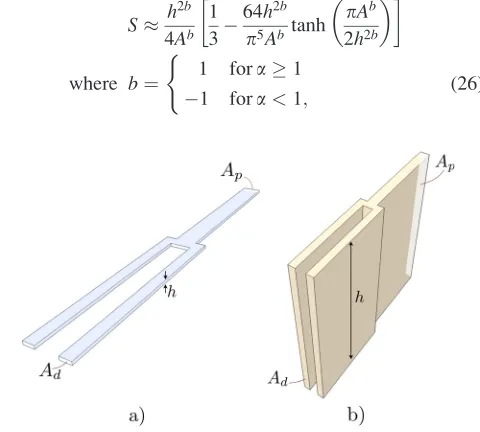
a¼A/h2for rectangular channels. This leads to two aspect-ratio limits forC(at the continuum-flow limit), as illustrated in Fig. 1. An accurate approximation of the channel shape propertySfor a rectangle32is
S h
2b
4Ab
1
3
64h2b p5Ab tanh
pAb
2h2b
where b¼ 1 fora1
1 fora<1; (
[image:5.612.319.559.526.742.2](26)
FIG. 1. Schematic showing the symmetric bifurcation of constant-depth rectan-gular channels of (a) high aspect ratio (a1) and (b) low aspect ratio (a1).
whereh is the constant network depth. Equation (26) only includes the first term of an infinite series, but as the denomi-nators of higher terms increase exponentially, the expression is sufficient. It is clear from Eq.(26)that at the aspect ratio limits, the shape property reduces to
S¼ h
2
12A; fora1; (27)
S¼ A
12h2; fora1: (28)
AsSis no longer a constant, the generalized law must con-sider the change in shape between parent and daughter channels
dS
dA¼
bh2b
4Abþ1 1
3
128h2b p5Ab tanh
pAb
2h2b
þ32
p4sech 2 pA
b
2h2b
:
(29)
At the aspect ratio limits, Eq.(29)reduces to
dS
dA¼
h2
12A2;fora1; (30)
dS
dA¼
1
12h2;fora1: (31)
Equations (30) and (31) can also be derived directly from Eqs.(27)and(28), respectively. Substituting Eqs.(24),(27), and(30) into the generalized law (Eq. (16)), via the chain rule, gives the high-aspect-ratio continuum-flow limit:
C¼N1: (32)
Incidentally, this limit is equal to da Vinci’s rule of tree branching.33 Similarly, substituting Eqs. (24), (28), and
(31) into the generalized law gives the low-aspect-ratio continuum-flow limit:
C¼N1=2: (33)
B. The plug-flow limit
For the other limiting case of scale, the flow becomes dominated by non-continuum and non-equilibrium effects, for liquids and dilute gases, respectively. For more informa-tion, see the reviews by Gad-el-Hak,29 Karniadakiset al.,34 and Conlisk.35 The complexity of channel flow increases dramatically in such conditions, e.g., density layering can occur near to the bounding surface in nanoscale liquid chan-nel flows36and Knudsen layers (kinetic boundary layers) can occur in rarefied-gas channel flows.37Furthermore, the state-of-the art simulation techniques for such flows—molecular dynamics for liquid and dense gas flows,38 and the direct simulation Monte Carlo method for dilute gas flows39— although accurate, are extremely computationally expensive. Therefore, for the purpose of generating a simple analytical relation, we make use of the general approximate observa-tion that at very small scales (i.e., small channel cross sec-tions or high degrees of rarefaction), the channel velocity
profile assumes a “plug-like” form, wherein the average ve-locity approximates the veve-locity of the fluid at the walls (the slip velocity). Navier’s slip condition (which is only approxi-mate for these conditions, as discussed in Section II C) allows us to express the wall shear stress sw as a function
of the slip velocity us, which must be nearly constant
around the perimeter of the cross section, given the plug-flow profile:
sw¼
usl
g ; (34)
wheregis the slip length determined by the fluid-solid inter-action. Note the value of gdoes not affect the optimal area ratio solution at the plug-flow limit, and thus accurate know-ledge of it is not required. As the flow tends to the plug-flow limit, the mass flow rate is simply
Q¼qAus; (35)
and a force balance relates the pressure drop to the wall shear, i.e.,
ADP¼LswP; (36)
where P is the perimeter of the section. Combining Eqs.
(34)–(36)gives the mass flow rate
Q¼qgA3=2 DP L
R
l; (37)
and the flow resistance per unit length
k¼ l
qgRA3=2; (38)
whereR¼pffiffiffiA=P is a property of the cross-sectional shape (likeS).
1. Constant-shape networks
If we consider the case where the shape remains the same throughout the network, Eq. (38) can be substituted into the generalized law(16)to get the plug-flow limit for an arbitrary cross-sectional shape:
C¼N4=5: (39)
2. Constant-depth networks
For networks of rectangular cross section with a con-stant depth, Eq.(38)can be rewritten as
k¼2lhðaþ1Þ
qgA2 ; (40)
where the perimeter is
P ¼2hðaþ1Þ: (41)
Noting again thata¼A/h2, it can be seen from Eq.(40)that at the aspect-ratio limits,kreduces to
k¼ 2l
qghA;fora1; (42)
k¼ 2lh
qgA2; fora1: (43)
Substituting Eq.(42)into the generalized law gives
C¼N1 (44)
for the high-aspect-ratio plug-flow limit. Interestingly, the high-aspect-ratio limits are the same for continuum- and plug-flow. Similarly, substituting Eq.(43) into the general-ized law gives
C¼N2=3 (45)
for the low-aspect-ratio plug-flow limit.
C. A slip flow approximation
In certain regimes, between the continuum- and plug-flow limits, it is sufficiently accurate to model the channel flow using Navier-Stokes equations with modified boundary conditions accounting for the velocity slip at wall bounda-ries—such solutions are referred to asslip solutions. There are number of types of slip boundary condition (see, e.g., those in Refs.34and40), but the most common is Navier’s slip condition (for which Maxwell’s slip boundary condi-tion41 is a special case for gas flows). Slip solutions using Navier’s condition (sw¼usl/g) have shown to yield accurate
results, as compared to molecular dynamics predictions, for liquid flows in channels as small as1–2 nm for water42and
2–3 nm for Lennard Jones fluids.43,44 For gases, provided the Knudsen number (the ratio of the mean free path to the channel height) is small, the slip solution is also a well-known and good approximation.
A further approximation to the exact slip solution, for any cross section, can be obtained by assuming that the shear stress, and thus the velocity slip, is constant around the pe-rimeter, i.e.,
QqDPA
2
LlP ðSP þgÞ: (46)
This gives the exact mass flow rate of the slip solution for a circular cross section (which has a uniform shear stress) and accurate approximations for rectangles of any aspect ratio (within 3% of results from a finite-difference slip solver). Note that the slip solution is itself an approximation, and par-ticularly for gas flows must be treated with caution, as dis-cussed later. Equation (46) can be rearranged to give the flow resistance per unit length
k¼ lP
qA2ðSP þgÞ: (47)
Inserting Eq.(47)into the generalized law (Eq.(16)) for par-ent and daughter channels produces the general slip solution for the optimal daughter-parent area ratio for all cross-sectional shapes across all length-scales
C3
g 2PpAp
dP dA p !
þ P2 p Ap
dS dA p
þ2Sp
!
SpPpþg
ð Þ2
2 6 6 4 3 7 7 5
¼N2
g 2PdAd
dP dA d !
þ P2 d Ad
dS
dA
dþ2Sd
!
SdPdþg
ð Þ2
2 6 6 4 3 7 7 5: (48)
1. Constant-shape networks
For all networks with a constant shape,Sp¼Sdand dS/
dA¼0. For a circular cross section, A¼pR2;S¼1=ð8pÞ;
P ¼2pffiffiffiffiffiffipA, and dP=dA¼pffiffiffiffiffiffiffiffiffip=A. Substituting these values into Eq.(48)and simplifying produces
C5=2 ¼N2 ~rp
ffiffiffiffi C
p þ3 ~
rpþ3
!
~
rpþ4
~ rp ffiffiffiffi C p þ4 !2 ; (49)
where~rp¼rp=g. For rectangular cross sections,P ¼2ðaþ1Þh
and dP=dA¼ ðaþ1Þh=A. A constant shape means a variable depthhand a constant aspect ratioa¼A/h2. Substituting these values into Eq.(48)and simplifying gives an optimal area rela-tion of
C5=2¼
N2 4Ch~p
ffiffiffiffi C
p þ3 4Ch~pþ3
!
Ch~pþ1
Ch~p
ffiffiffiffi C p þ1 !2 ; (50)
where S is calculated using Eq. (26) h~p¼hp=g and
C¼2S(aþ1) is a constant.
2. Constant-depth networks
For rectangular cross sections of a constant depth and variable aspect ratio, substituting the expression for dS/dA
(from Eq.(29)) into Eq.(48), along the rectangle parameters previously outlined, gives
C3
2h~ðapþ2Þ þ4h~ 2
apþ1
ð Þ Ap
dS
dA
pþ2Sp
!
2hS~ pðapþ1Þ þ1
2 2 6 6 6 4 3 7 7 7 5
¼N2
2h~ðadþ2Þ þ4h~ 2
adþ1
ð Þ Ad
dS
dA
dþ2Sd
!
2hS~ dðadþ1Þ þ1
2 2 6 6 4 3 7 7 5: (51)
III. NUMERICAL VERIFICATION AND DISCUSSION
An accurate numerical optimization procedure is now described to demonstrate the following: (a) the generalized law (Eq.(16)) is applicable to networks with arbitrary cross-sectional shape and for all scales; (b) the limits of the gener-alized law, identified as the continuum-flow limit (Eqs.(25),
(32), and (33)) and the plug-flow limit (Eqs. (39), (44),
and (45)), are valid and precise for all shapes considered; and (c) the approximate slip solutions to the generalized law (Eqs.(49)–(51)) provide reasonable accuracy, even for rare-fied gas flows.
The numerical optimization procedure is based on calcu-lations that use non-dimensional mass flow rates, i.e.,
~
Q¼ QlL
qA2DP: (52)
These mass flow rate are obtained either from published sources, from high-resolution finite-difference slip solutions, from exact analytical expressions, or from stochastic particle calculations (for dilute gases). The numerical model of the network also assumes that channels are sufficiently long such that pressure losses at the parent-daughters junction are negligible compared to the pressure drops over the channels themselves. This allows a model for a two-level network to be constructed from predictions of mass flow rate through individual channels, constrained by a common branching pressure and the requirement for mass continuity. For each shape and physical model, an interpolant is constructed that provides the non-dimensional mass flow rate for any given area,Q~ðAÞ. From this, Eq.(52)can be evaluated for parent and daughter channels
DPp ¼
QlLp
~
Q Að pÞqA2p
; (53)
DPd¼
QlLd
NQ A~ð dÞqA2d
: (54)
Combining Eqs.(53)and(54), and substituting for the total pressure drop DP¼DPpþDPd, produces a model of the
mass flow rate through a two-level network for a particular cross-sectional shape and physical model:
Q¼qDP
l
Lp
~
Q Að pÞAp2
þ Ld
NQ A~ð dÞA2d
" #1
: (55)
For symmetric branching, the volume constraint requires that LpAp¼VNAdLd. The numerical procedure uses an
interior-point constrained optimization algorithm45 in
MATLABVR
to find the parent and daughter areas that, in combination, maximize the mass flow rate through the net-work (as predicted by Eq.(55)) for arbitrarily fixed total vol-ume, total pressure drop, channel lengths, and fluid properties. Alternatively, the same result can be obtained via a brute force approach to ensure that the numerical optimiza-tion finds a global, not local, maximum.
A. Different shapes and sizes
Murray’s original derivation was for circular channel sections at the continuum-flow limit. The first set of optimiza-tion results are presented to verify that the generalized law is valid for a variety of cross-sectional shapes across all length scales, with the shape remaining constant through branching. The numerical optimization uses non-dimensional mass flow rates calculated from a standard central-difference solution of
the laminar Navier-Stokes equations with a Navier slip boundary condition.46The results from the analytical and nu-merical optimizations, for symmetric bifurcations, are pre-sented in Fig.2.
For large parent areas, relative to the square of the slip length g, the optimum daughter-parent area ratio converges to the continuum-flow limit of the generalized law (Eq.(25)) for all shapes considered. The same is true for the other extreme of scale: the optimum area ratio for all shapes con-verges to the plug-flow limit of the generalized law (Eq. (39)) for small parent areas. In the transition between these limits, the approximate slip solutions of the generalized law are also highly accurate. The difference between the slip approximations of the generalized law and the numerical optimization is less than 0.1% across the entire range of scales for all shapes tested. Clearly, predictions for the optimum dimensions are not particularly sensitive to errors introduced by the approximation in Eq. (46). These results are consistent regardless of the daughter and parent channel length magnitudes, demonstrating that the optimal daughter-parent area ratio is independent of the lengths, as was asserted in the analytical solution.
In Fig. 2, it is observed that for networks of channels with rectangular cross sections, the aspect ratio affects the range of areas for whichCis in the transition period between the continuum- and plug-flow limits. This occurs because the influence of slip is governed by the size of the smallest
[image:8.612.316.560.515.711.2]cross-sectional length scale (hereon referred to as the charac-teristic lengthL) relative to the slip length. So, for the same cross-sectional area, the characteristic length of a rectangle with a high-aspect-ratio is less than the characteristic length of a low-aspect-ratio rectangle. This means that optimal branching of high-aspect-ratio channels will depart from the continuum-flow limit and approach the plug-flow limit at larger parent areas than optimal branching in low-aspect-ratio channels.
FIG. 2. Optimal daughter-parent area ratioCagainst non-dimensional parent area for networks with a constant shape. Comparison of the approximate slip solution to the generalized law (Eqs.(49)and(50)) and the numerical opti-mization using data from a Navier-Stokes slip solver. Plotted for circles, squares, and rectangles of aspect ratioa¼5,a¼10, anda¼100 atN¼2.
B. Rarefied gas flow
The numerical optimization is now performed for sym-metric branching of rarefied gas flows. The mass-flow-rate data are obtained from a variety of sources, including our
own simulations47 computed using a version of
low-variance deviational simulation Monte Carlo (LVDSMC).48 Additional mass-flow-rate data are procured from solutions of the linearized Boltzmann equation49,50to verify the accu-racy of the LVDSMC results. For dilute gases, the slip length can be related to the mean free path kvia g¼Csk,
where Cs¼1.11 is the first-order slip coefficient for the
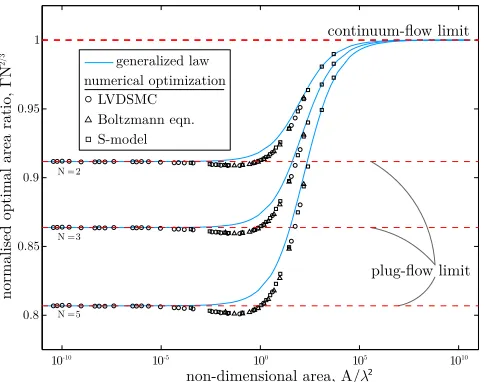
hard-sphere model of gases with purely diffuse molecular reflection at walls.51 The results for the analytical and nu-merical optimizations, for circular cross sections, are pre-sented in Fig.3. To demonstrate that the generalized law is valid for any number of daughter branches (N2), C is plotted forN¼2, N¼3 and N¼5 and, for clarity, is nor-malized with respect to the continuum-flow limit (N2=3).
Again, the agreement between the numerical optimiza-tion and the plug-flow limit of the generalized law is excel-lent for each case considered. It is perhaps unexpected that a slip solution to the generalized law should converge to the same result as that of kinetic theory and LVDSMC at the free-molecular limit, given the approximate nature of slip boundary condition at such scales. However, as~rp!0,Cin
Eq. (49) becomes independent of the slip length g, and is thus unaffected by any inaccuracy in the slip model. Due to computational cost, molecular simulations are not performed for sufficiently large areas to see the solution meet the continuum-flow limit; but, since the results from kinetic theory converge to the solution of the slip model, agreement at the continuum-flow limit is also expected. It is well known
that when the Knudsen number Kn¼k=L is greater
than0.1, slip solutions become inaccurate, explaining the departure in C between the limits. The kinetic theory and
LVDSMC results all show a minimum in C beneath the
plug-flow/free-molecular limit. This is possibly a manifesta-tion of the Knudsen minimum,52a rarefied gas phenomenon that occurs when the diffusive flux starts to dominate the convective flux as the length scale decreases.53
Note although Eq.(49)is approximate between the scale limits, the precise result of the numerical optimization can be reclaimed by expressing the interpolated dimensionless mass flow rate, Q~ðAÞ, as a flow resistance per unit length,
k(A). This allows the evaluation of the generalized law in
(16), but, of course, does not afford an analytical relation.
C. Constant-depth rectangles
Finally, we perform a numerical optimization for a sym-metrically bifurcating network of rectangular channels with a constant depth and variable aspect ratio, mimicking the condi-tions of a micro-fabricated fluidic network. Here, we have used non-dimensional mass-flow-rate data obtained from the two-dimensional Navier-Stokes slip solver. Figure 4 shows the optimum daughter-parent area ratio against dimensionless area (A/h2; incidentally, this is equal to the aspect ratio,a) for rectangles of a constant dimensionless depthh~¼h=g.
Agreement between the numerical optimization and the approximate slip solution to the generalized law (Eq.(51)) is excellent for all cases, with the difference being less than 0.5% across the entire range of scales. The results also show convergence to the limits derived in Eqs. (32), (33), (44), and (45). It can be seen that when the non-dimensional depth h~is small, such that the slip length is relatively large,
Cvaries only between the plug-flow limits for high and low aspect ratios (Eqs. (44) and (45), respectively). The high-aspect-ratio limits are the same for continuum- and plug-flow. When h~ is large and the aspect ratio decreases, C
[image:9.612.314.560.507.701.2]first tends to the low-aspect-ratio limit continuum-flow (Eq.(33)), until the area gets sufficiently small that the vari-able width is comparvari-able to the slip length, at which point
FIG. 3. Normalized optimal daughter-parent area ratio against non-dimensional parent area. Comparison of the analytical slip solution to the generalized law (Eq.(49)) and the numerical optimization using data from kinetic theory49,50and LVDSMC. Plotted for circles atN¼2,N¼3, and
[image:9.612.53.295.518.709.2]N¼5.
FIG. 4. Optimal daughter-parent area ratioCagainst non-dimensional parent areaA/h2(equal to aspect ratioa) for rectangles of a constant dimensionless
depthh~. Comparison of the approximate slip solution to the generalized law (Eq.(51)) and the numerical optimization using data from a Navier-Stokes slip solver. Plotted for rectangles of depthh~¼1;10;102;103;104, and 105,
atN¼2.
the solution converges again to the low-aspect-ratio plug-flow limit (Eq.(45)).
For constant-depth networks,Cbehaves very differently compared to constant-aspect-ratio networks. For the most part, when the depth is constant, the optimal daughter-parent area ratio increases with decreasing cross-sectional area— the opposite to the trend found in Figs.2and3. In addition, the range ofC values is wider, the minimum C is smaller, and the maximumC is larger for constant-depth networks:
0.5 C 0.71 compared to 0.57 C 0.63. However, there
are some similarities. At the low-aspect-ratio limits, the trend for constant-depth networks is the same as for constant-as-pect-ratio networks, with the optimal daughter-parent area ratio decreasing as cross-sectional area decreases.
IV. CONCLUSION
We have derived a generalized optimization principle that leads to analytical expressions for the optimum daughter-parent area ratioCfor any shape, at any scale, and for any number of daughter branches. We have shown that at the continuum-flow limit, Murray’s law is reclaimed (C¼N2=3) for networks of any cross-sectional shape, as long as the shape is constant through branching. The general-ized law presented is also valid for slip flows and plug flows (C¼N4=5) that occur at smaller length scales, as well as for networks with a constant depth, which is often a require-ment for lab-on-a-chip devices due to limitations in fabrica-tion procedures. The new optimal design relafabrica-tion we propose will allow the original biomimetic design principle of Murray to be applied to a variety of micro and nanofluidic networks that require non-circular geometry, due to manufacturing constraints, and are designed for increasingly smaller scales in order to achieve a greater degree of control, functionality, and analytical and economic efficiency. Future work will include determining optimal branching angles and optimum channel lengths for arbi-trary cross-sectional shapes, across all physical scales.
ACKNOWLEDGMENTS
We would like to thank Professor David Emerson for useful discussions and Professor Nicolas Hadjiconstantinou for providing the original LVDSMC source code. This work is financially supported in the UK by EPSRC Programme Grant Nos. EP/I011927/1 and EP/K038664/1.
1
C. D. Murray,Proc. Natl. Acad. Sci. U.S.A.12, 207 (1926).
2
G. M. Hutchins, M. M. Miner, and J. K. Boitnott, Circ. Res. 38, 572 (1976).
3
G. S. Kassab and Y. B. Fung,Ann. Biomed. Eng.23, 13 (1995).
4
M. LaBarbera,Science249, 992 (1990).
5T. F. Sherman,J. Gen. Physiol.78, 431 (1981). 6M. Zamir and N. Brown,Am. J. Anat.
163, 295 (1982).
7
M. Zamir and J. A. Medeiros,J. Gen. Physiol.79, 353 (1982).
8
M. Zamir, J. A. Medeiros, and T. K. Cunningham,J. Gen. Physiol.74, 537 (1979).
9M. Zamir, S. M. Wrigley, and B. L. Langille,J. Gen. Physiol. 81, 325
(1983).
10
T. A. Wilson,Nature213, 668 (1967).
11
K. Horsfield and G. Cumming,Bull. Math. Biophys.29, 245 (1967).
12K. Horsfield, F. G. Relea, and G. Gumming,Respir. Physiol.26, 351 (1976). 13
K. A. McCulloh, J. S. Sperry, and F. R. Adler,Nature421, 939 (2003).
14K. A. McCulloh, J. S. Sperry, and F. R. Adler, Funct. Ecol. 18, 931
(2004).
15
K. A. McCulloh and J. S. Sperry,Am. J. Bot.92, 985 (2005).
16D. R. Emerson, K. Cieslicki, X. Gu, and R. W. Barber,Lab Chip6, 447
(2006).
17
K. Tesch, Task Quarterly14, 227 (2010).
18L. Gosselin and A. K. da Silva,J. Appl. Phys.101, 114902 (2007). 19C. Renault, S. Colin, S. Orieux, P. Cognet, and T. Tzedakis,Microsyst.
Technol.18, 209 (2012).
20A. Dıaz Lantada, B. Pareja Sanchez, C. Gomez Murillo, and J. Urbieta
Sotillo,Expert Rev. Med. Devices10, 629 (2013).
21
S. M. Senn and D. Poulikakos,J. Power Sources130, 178 (2004).
22Y. Chen and P. Cheng,Int. J. Heat Mass Transfer45, 2643 (2002). 23
X. Wang, A. S. Mujumdar, and C. Yap, Int. J. Therm. Sci.45, 1103 (2006).
24H. R. Williams, R. S. Trask, P. M. Weaver, and I. P. Bond,J. R. Soc.
Interface5, 55 (2008).
25
A. Kamiya and T. Togawa,Bull. Math. Biophys.34, 431 (1972).
26M. Zamir,J. Gen. Physiol.69, 449 (1977). 27
A. Bejan, L. A. O. Rocha, and S. Lorente,Int. J. Therm. Sci.39, 949 (2000).
28D. Lim, Y. Kamotani, B. Cho, J. Mazumder, and S. Takayama,Lab Chip
3, 318 (2003).
29M. Gad-el-Hak,J. Fluids Eng.121, 5 (1999).
30To find the optimal branching angle, a second optimization should be
per-formed with the parent inlet and daughter outlets fixed, so the channel lengths and branching angle are functions of the branching point.
31
In both of these cases, there is a non-linear relationship between the pres-sure gradient and the mass flow rate, however as at least one of these quan-tities must be constant in the optimization (see Eq.(8)), Eq.(16)is still valid.
32F. M. White,Viscous Fluid Flow(McGraw-Hill, 1974). 33
C. Eloy,Phys. Rev. Lett.107, 258101 (2011).
34
G. Karniadakis, A. Beskok, and N. Aluru, Microflows and Nanoflows: Fundamentals and Simulation(Springer, 2005).
35
A. T. Conlisk,Essentials of Micro- and Nanofluidics With Applications to the Biological and Chemical Sciences (Cambridge University Press, 2012).
36
C. Y. Soong, T. H. Yen, and P. Y. Tzeng,Phys. Rev. E76, 036303 (2007).
37D. A. Lockerby, J. M. Reese, and M. A. Gallis,Phys. Fluids17, 100609
(2005).
38
M. P. Allen and D. J. Tildesley, Computer Simulation of Liquids (Clarendon Press, 1987).
39
G. A. Bird,Molecular Gas Dynamics and the Direct Simulation of Gas Flows, Oxford Engineering Science Series Vol. 42 (Clarendon Press, 1994).
40D. A. Lockerby, J. M. Reese, D. R. Emerson, and R. W. Barber,Phys.
Rev. E70, 017303 (2004).
41
J. C. Maxwell,Philos. Trans. R. Soc.170, 231 (1879).
42L. Bocquet and E. Charlaix,Chem. Soc. Rev.39, 1073 (2010). 43K. P. Travis, B. D. Todd, and D. J. Evans,Phys. Rev. E
55, 4288 (1997).
44
C. Huang, P. Y. K. Choi, K. Nandakumar, and L. W. Kostiuk,J. Chem. Phys.126, 224702 (2007).
45R. A. Waltz, J. L. Morales, J. Nocedal, and D. Orban,Math. Program.
107, 391 (2006).
46Our numerical solver is an in-house code written in MATLABVR
, which uses matrix inversion to calculate the mass flow rates. All simulations use a 100100 mesh, which has been shown (via a grid resolution study) to provide mass flow rate solutions to within 1% of the values obtained using a 200200 and 300300 mesh.
47
For our LVDSMC simulations, periodic boundary conditions were used in the streamwise direction, 10 deviational particles were used per cell, and the cell sizeDxwas chosen to bek/5. The time-stepDtwas set toDx=c, wherecis the most probable thermal velocity.
48G. A. Radtke, N. G. Hadjiconstantinou, and W. Wagner,Phys. Fluids23,
030606 (2011).
49
S. K. Loyalka and S. A. Hamoodi,Phys. Fluids A2, 2061 (1990).
50F. Sharipov,J. Vac. Sci. Technol. A14, 2627 (1996). 51
T. Ohwada, Y. Sone, and K. Aoki,Phys. Fluids1, 1588 (1989).
52
M. Knudsen,Ann. Phys.333, 75 (1909).
53
S. K. Mitra and S. Chakraborty,Microfluidics and Nanofluidics Handbook (CRC Press, 2012).