CM-5 Active Message Layer
NAME
CMAM - Introduction to the CM-5 Active Message communication layer. DESCRIPTION
The CM-5 Active Message layer CMAM (<see-mam>) provides a set of communication primitives intended to expose the communication capabilities of the hardware to the programmer and/or compiler at a reasonably high level. A wide variety of programming models, ranging from send&receive mes-sage passing to variants of shared memory, can be implemented efficiently on top of CMAM without performance compromise. The basic communication primitive of CMAM is the Active Message: a sage where the first word points to the message handler. On reception of an Active Message, the mes-sage handler is called with the remainder of the mesmes-sage as argument. The role of the mesmes-sage handler is to integrate the message data into the computation, by storing it, accumulating it, or whatever makes sense in the overlaying programming model. Its execution is atomic relative to other message handlers, thus long message handlers tend to back-up the network. Note that while Active Messages might be viewed as a restricted form of RPC (Remote Procedure Call), this is not the intent message handlers should only integrate message data into the computation or, alternatively, reply to a simple request. They should not perform arbitrary computational tasks.
The CMAM library provides primitives to send Active Messages to remote nodes, to transfer bulk data to pre-arranged communication segments, and to synchronize processors using the CM-5 control net-work. Functions to initialize and control the usage of hardware message tags within the CMAM library allow it to co-exist with other message layers. Over all, the CMAM library should be viewed as a "machine language for communication" and not as an end-user communication library.
Sending Active Messages
The most important communication primitive is CMAM(3) which sends an Active Message to a remote node. It takes a pointer to a C function to call on the remote node and a buffer to pass as argument.
CMAM is built on top of CMAM_4(3) which calls a remote function with 4 32-bit words as argu-ments. CMAM 4 sends exactly one CM-5 network packet and passes the arguments from registers on the source node to registers on the destination node. In contrast, CMAM sends a header packet and one packet per 12 bytes of buffer and requires allocation of a temporary buffer on the destination node. Bulk data transfer
The bulk data transfer function CMAM_xfer(3) augments CMAM by providing efficient bulk data transfer to pre-arranged communication segments. Before data transfer can occur, the recipient must allocate a communications segment using CMAM open segment(3), specifying a base address, a byte count and an end-of-transfer function. The sender (or multiple senders) can then transfer data to memory relative to the base address. When count bytes have been transferred, the end-of-transfer func-tion is called on the recipient node. CMAM_xfer transfers a contiguous byte buffer sending 16 bytes in each CM-5 packet.
"Gather-transfer-scatter" can be implemented using CMAM_xfer_Ni(3) (N=1..4) which send a packet with N 32-bit words of data to a segment-base + offset on the remote node. (The next version of CMAM will provide more efficient gather-scatter through two functions, CMAM xfer ivec and CMAM_xfer_dvec transfering 32-bit element vectors (32-bit elements) and 64-bit element vectors with stride.)
Sending Indirect Active Messages
The function CMAM indirect 4(3) is nearly identical to CMAM 4 but performs an indirect function call on the remote node: a pointer to a pointer to a function (i.e. (**fun)()) is transmitted in the mes-sage. In some circumstances this allows one pointer to refer to both the function to be invoked and its
CM-5 Active Message Layer
requiring explicit polling is when a node busy-waits for the reception of specific messages. For this purpose, CMAMwait(3) waits (while polling) on a synchronization flag (a volatile int) to reach a given value, resets the flag to zero and returns. Other wait mechanisms may be implemented using CMAMpoll(3).
Sending and replying
All CMAM functions sending messages come in two variants to avoid deadlock in two-way communi-cation. The send variant (CMAM, CMAM_4, CMAM_xfer, ...) sends messages on the "left" CM-5 data network and polls both the "left" and the "right" networks. The reply variant (CMAM_reply, CMAM_reply4, CMAM_reply _xfer, ...) sends messages on the "right" network and only polls that network. Messages sent from the computation proper should use the send variant whereas message handlers wishing to send replies must use the reply variant. Reply-message handlers cannot send any messages themselves. Failure to follow these rules may result in a stack overflow: a handler using the send variant to reply and finding the outgoing network backed-up will accept messages from the net-work to drain it, nesting the appropriate handlers on the stack. Given that these handlers may attempt to send, the stack may grow arbitrarily. By using the reply variant, only messages on the reply network need to be accepted and, given that their handlers may not reply themselves, the stack will not grow arbitrarily.
Communicating with the host (control) processor
Individual processing nodes may send messages to the host ("control processor" in CM-5 terminology) using special variants of all communication functions (e.g. CMAM_host(3), CMAM_host_4(3), CMAMhostreply(3), CMAMhost_xfer(3), CMAM_host_reply_xfer(3), ...). The host can send to any processing node using the normal functions.
The difficulty in communication with the host lies in the separate address spaces: addresses of message handlers are different on the host than on the processing nodes. See CMAM_host(3) on possibilities to deal with the situation.
Initialization
CMAM_enable(3) must be called on the control processor before using CMAM. It initializes data structures on all nodes and sets-up default message tag usage. CMAM_disable(3) may be called on the control processor at the end of the program to wait for all processing nodes to return to the idle loop. Barrier synchronization
CMAM provides access to the "synchronous global OR" of the CM-5 control network in the form of a fuzzy barrier. CMAM startbarrier(3) signals the arrival of a processing node at the barrier and CMAM_end_barrier(3) blocks until all processing nodes have called CMAMstartbarrier. CMAM_barrier(3) implements a traditional barrier. When starting the barrier, processing nodes may enter a 1-bit value into the global OR computation which is returned at the end of the barrier. This value is sometimes useful for termination detection. Note that CMAM_enable barrier(3) must be called on the host before the barrier functions can be used on the nodes.
Mixing message layers
CMAM has been designed such that it can be mixed with other message layers. However, the only other message layer available, CMMD, does not (yet?) co-operate. The node-to-node communication primitives of CMAM and CMMD cannot be mixed (although a program could alternate phases of CMAM use with phases of CMMD use). The global operations of CMMD which use the control net-work may be used simultaneously with CMAM node-to-node operations (in particular, the integer scan operations in CMMD are compatible with CMAM). However, the initialization of CMAM barrier opera-tions interferes with CMMD global operaopera-tions. Note that reportedly CMMD 3.0 will include Active Messages.
CMAM can share the network interface with other message layers (or with user additions to CMAM) by using different hardware message tags and by co-operating in the message tag-handler dispatch. The function CMAMset tags(3) lets the user specify which hardware message tags CMAM should use. Other message layers may use free tags provided that a handler is registered with CMAM using CMAMset_handler(3) and CMAM_set_reply_handler(3).
Last change: November 1992
cmam (3) cmam (3)
CM-5 Active Message Layer
The CMAM header files assume the use of gcc(1) and contain ANSI-C function prototypes and gcc inline definitions. Conversion to cc(1) is certainly possible, but not provided. All programs using CMAM should (assuming U.C. Berkeley installation):
include #include <cmam/cmam.h>
be compiled with gcc-2.1 -I/usr/cm5/local/include ...
be linked with cmld -gld2 -L/usr/cmS/local/lib ... -pe -L/usr/cmS/local/lib
(The -gld2 option to cmld loads the library necessary for programs compiled with gcc-2.x.) SEE ALSO
CMAM_enable(3), CMAM(3), CMAM_4(3), CMAM indirect(3), CMAM_opensegment(3), CMAM_xfer(3), CMAM_xfer_N(3), CMAMbarrier(3), CMAM_set tags(3), CMAM host(3), CMAM_host_indirect(3), CMAMhost_indirect_4(3), CMAMhost_xfer_N(3), CMAM_host_xfer_4i(3),
CMAMindirect_4(3), CMAMxfer_4i(3),
CMAM_host_4(3), CMAMhostxfer(3),
Thorsten von Eicken, David E. Culler, Seth Copen Goldstein, and Klaus Erik Schauser, Active Mes-sages: a Mechanism for Integrated Communication and Computation. Proc. of the 19th Int'l Sympo-sium on Computer Architecture, Gold Coast, Australia. May 1992. (Also available as Technical Report UCB/CSD 92/675, CS Div., University of California at Berkeley.)
AUTHOR
Thorsten von Eicken, [email protected] USAGE
CM-5 Active Message Layer
NAME
CMAMenable, CMAMdisable - CMAM initialization
SYNOPSIS
#include <cmam/cmam.h>
void CMAM enable (void); void CMAM disable (void);
DESCRIPTION
CMAM enable must be called on the host ("control processor" in CM-5 terminology) before any other CMAM functions are used. It runs an initialization function on all processing nodes to set the default packet tag assignments (see CMAM set tags(3)) and to initialize other CMAM data structures. CMAM enable does not change the state of the network interface and therefore does not conflict with other message layers. Note that the CMAM barrier functions (e.g. CMAMbarrier(3)) require separate initialization (conflicting with CMMD global operations) performed by CMAMenablebarrier(3).
CMAM disable runs an echo function on all processing nodes to ensure that they are all in the "idle loop".
SEE ALSO
cmam(3), CMAM set tags(3), CMAM enable barrier(3), CMAM(3).
AUTHOR
Thorsten von Eicken, [email protected]
Last change: November 1992
CMAM enable (3) CMAM enable (3)
CM-5 Active Message Layer
NAME
CMAM, CMAM_reply - Send Active Message SYNOPSIS
#include <cmam/cmam.h>
typedef void CMAM_handler (void *buffer, int byte_count);
void CMAM (int node, CMAM handler *fun, void *buffer, int byte count); void CMAM reply (int node, CMAM_handler *fun, void *buffer, int byte_count);
void CMAMset size (int maxbuffersize);
DESCRIPTION
CMAM sends an Active Message to the remote node, calling the handler fun and passing the buffer as argument. The call
CMAM(node, foo, buf, buf len);
will allocate a buffer of size buf len bytes on the remote node, transfer the source buffer into the allo-cated buffer packing 12 bytes per CM-5 network packet, invoke
foo(allocated_buffer, buf len)
and finally deallocate the buffer. Note that since the buffer is deallocated after the handler returns all data must be copied to its final destination. Transferring large amounts of data is best performed using CMAM xfer(3) which avoids the copy and packs more data into each CM-5 packet.
At initialization time a small number (typ. 16) of buffers of size CMAM SZ are pre-allocated for CMAM. If needed, additional buffers are allocated using malloc(3). The current implementation lim-its the message size to the size of the pre-allocated buffers. CMAMset size may be used to change the size of the buffers used. CMAMsetsize must be called while no messages are partially received. CMAM sends the Active Message on the left data network and polls both, the left and right networks. CMAM_reply is identical to CMAM, but uses the right data network and polls only the right side. CMAM_reply should be used within message handlers for replies to avoid the danger of stack overflow (see cmam(3)). Neither CMAM nor CMAM reply may be used from within a reply-message handler. CMAM may be used to send Active Messages from the host ("control processor" in CM-5 terminol-ogy) to the processing nodes. However, note that the executable running on the host is different from the one running on the processing nodes, therefore the address of functions differ. The linker cmld(l) arranges for functions named CMPE_... or cmpe_... on the processing nodes to be resolved correctly on the host. To send Active Messages to the host from processing nodes, see CMAM_host(3).
PERFORMANCE
CMAM is built on top of CMAM_4(3) and sends three 32-bit words of data per message. SEE ALSO
cmam(3), CMAM_xfer(3), CMAM_host(3), CMAM_4(3). AUTHOR
Thorsten von Eicken, [email protected]
CM-5 Active Message Layer
NAME
CMAM_open segment, CMAM_open_this_segment, CMAM_shortensegment, CMAM_querysegment, CMAMkill segment - Manipulate data transfer segments
SYNOPSIS
#include <cmam/cmam.h>
typedef int CMAM_end_xfer (void *info, void *base_address); int CMAM_open segment (void *base_address, int byte count,
CMAM end xfer *end xfer fun, void *info);
int CMAM_open_this segment (int segment_num, void *base_address, int byte_count, CMAM end xfer *end xfer fun, void *info); void CMAM_shorten segment (int segment id, unsigned int delta_count); void CMAM kill segment (int segment id);
int CMAM_query_segment (int segment id);
DESCRIPTION
CMAM segments are used in conjunction with CMAM_xfer(3) and its many variants to transfer bulk data between nodes. A segment is opened by the recipient of the data using CMAM opensegment, specifying a base address relative to which received data is stored and the number of bytes to be received. CMAM_open segment returns a segment identifier for the highest free segment or -1 if no segments are available (note that segment identifiers can be negative, thus check for "!= -1"). After byte count bytes have been received, the end_xfer_fun is called with base-address and info as argu-ments. The end_xfer_fun should return a new byte count or 0 if the segment is to be closed.
CMAM_open_thissegment is similar to CMAM open segment, but specifies which segment should be opened. It returns -1 if the requested segment is already in use. CMAM_openthissegment can be used in all-to-all communication to open the same segment on all nodes. CMAM_opensegment always allocates the highest free segment, so it is best to use low segment numbers with CMAM_open_this_segment.
Notes: The segment identifiers returned by CMAM_open segment and CMAM open this segment encode the segment number and the alignment of the base_address. More precisely: segment-id = (segment_num << CMAMSEGSHIFT) I (base_address & 7).
Currently, there are 256 segments available.
The base_address of closed segments is set to -1. As a result, transferring data to a closed seg-ment typically raises an unaligned-store exception inside of a CMAM handler.
If CMAM_open segment is called with a 0 bytecount, endxferfun is called immediately. CMAM_shorten_segment reduces the remaining byte count of the specified segment. If the count becomes <0, end-of-xfer is called. CMAMshortensegment is useful, for example, when the sender cannot provide as much data as the recipient asked for.
CMAM_query segment returns the remaining byte count of the specified segment. It returns 0 for a closed segment.
CMAM kill segment closes the segment without calling the end of transfer function. Note that due to the reordering of packets in the network it is only safe to call CMAMkill segment on a segment for which it is known that no packets are underway.
PERFORMANCE
The overhead in opening and closing a segment (including the call to end-of-xfer) is about 10us. SEE ALSO
cmam(3), CMAM_xfer(3), CMAM_xfer_4(3), CMAM(3).
Last change: November 1992
CMAMpopensegment (3) CMAM~open_segment (3 )
CM-5 Active Message Layer
NAME
CMAM_xfer, CMAM_reply_xfer - Transfer data block to segment SYNOPSIS
#include <cmam/cmam.h>
void CMAMxfer (int node, int seg_addr, void *buff, int byte_count); void CMAM_reply_xfer (int node, int seg_addr, void *buff, int byte count);
DESCRIPTION
CMAMxfer transfers the block of data at address buff and of length byte count to a segment on the remote node previously opened with CMAM_open_segment(3). The destination address for the data on node is specified as a segment plus an unsigned byte offset. The segment and the offset are encoded in seg_addr which is the sum ('+') of the remote segment id (as returned by CMAM_open segment) and the unsigned byte offset. This encoding limits the offset to 24 bits.
On arrival at the destination node, the data is stored in memory and the byte count associated with the segment is decremented. If the count becomes zero, the end-of-xfer function is called as described in CMAM_open segment(3).
CMAMxfer sends packets on the left data network and polls both, the left and right networks. CMAM_reply_xfer is identical to CMAM xfer but sends packets on the right data network and polls only the right side. CMAM_reply_xfer should be used within message handlers to send replies to avoid the danger of stack overflow (see cmam(3)).
CMAM_xfer can handle arbitrary block sizes and aligments of source and destination buffers. CMAM_xfer transfers most of the block in special XFER packets with 16 bytes of data each. These packets must be stored at a double-word boundary on the destination node. The pre-amble and post-amble necessary to reach this aligment is handled by CMAMxfer.
PERFORMANCE
If the source and the destination buffers have the same aligment relative to double-words (i.e. (src_buff&7) == ((base_address+offset)&7)) most of the data is transferred with CMAM_xferN at 10Mb/s.
If the aligments differ by a word (i.e. (src_buff^(base_address+offset))&7 == 4) most of the block is transferred by CMAM xfer No at 7Mb/s.
If the source and destination buffers are badly mis-aligned (i.e. (srcbuff^ (baseaddress+offset))&3 != 0) the transfer rate is low...
SEE ALSO
cmam(3), CMAM_open_segment(3), CMAM_xfer_N(3), CMAM_xfer_4(3), CMAM(3).
AUTHOR
Thorsten von Eicken, [email protected]
Last change: November 1992
CMAM xfer (3) CMAM xfer(3)
CM-5 Active Message Layer
NAME
CMAM_ wait, CMAMpoll_wait, CMAMpoll, CMAMrequest poll, CMAMreplypoll - Explicit check for pending messages
SYNOPSIS
#include <cmam/cmam.h>
void CMAMwait(volatile int *flag, int value);
void CMAMpoll wait(volatile int *flag, int value);
void CMAM_poll(void);
void CMAM_requestjpoll(void); void CMAMreplypoll(void);
DESCRIPTION
The current implementation of CMAM does not use interrupts on message arrival, thus, to receive mes-sages, the network interface status register must be polled periodically. All CMAM functions sending messages poll the network so that a node sending messages automatically handles incoming ones. The most common situation requiring explicit polling is when a node busy-waits for the reception of specific messages (e.g. signalling the completion of a communication step). For this purpose, CMAM_wait polls both (left and right) data networks while waiting on a synchronization flag to reach value (i.e. *flag > value), then subtracts value from flag before returning. (This scheme supposes that, in general, handlers increment a flag to signal when they have executed.) The difference between CMAM wait and CMAM_poll wait is that the former does not poll at all if *flag > value at entry, while the latter polls at least once.
Other wait mechanisms may be implemented using CMAMpoll which polls both data networks, han-dling all pending messages. CMAM requestpoll and CMAM_reply poll are similar, but poll only one network.
PERFORMANCE SEE ALSO
cmam(3), CMAM(3), CMAM_xfer(3). AUTHOR
Thorsten von Eicken, [email protected]
CM-5 Active Message Layer
NAME
CMAMenablebarrier, CMAMdisable barrier, CMAMstart barrrier, CMAMend barrier, CMAM barrier - Global barrier synchronization
SYNOPSIS
#include <cmam/cmam.h>
void CMAM enable barrier (void); void CMAM disable barrier (void);
void CMAM start barrier (int bit); int CMAM end barrier (void); int CMAM_query barrier (void); int CMAM barrier (int bit);
DESCRIPTION
These functions provide access to the "synchronous global OR" of the CM-5 control network in the form of a fuzzy barrier. Before using the CMAM barrier functions, the network interface must be ini-tialized from the host ("control processor" in CM-5 terminology) by calling CMAM enable_barrier. Note that this conflicts with the initialization required by CMMD's global operations (CMAM turns host participation off whereas CMMD turns it on by default). CMAM_disable barrier reverts the initiali-zation performed by CMAM_enable_barrier.
Calling CMAMstartbarrier signals to all other nodes that the current node "entered the barrier". A call to CMAM end barrier blocks until all nodes have called CMAM startbarrier. While
busy-waiting on the barrier, CMAMend_barrier polls and services the network.
CMAM_query_barrier returns true if all nodes have called CMAMstart barrier (i.e. if a call to CMAM end barrier would not block). CMAM_query_barrier does not poll the network.
CMAM barrier provides a traditional barrier: it blocks until all other nodes call CMAM_barrier as well.
Both, fuzzy and traditional barriers provide a one-bit global OR in addition to the synchronization. When starting the barrier, each processor injects a 1-bit value (the LSB of bit). When ending the bar-rier, all processors receive the global OR of all 1-bit values.
Note that the host is not involved in any of these barriers. PERFORMANCE
A call to CMAM_barrier when all processors are already in synch takes 5us. SEE ALSO
cmam(3). AUTHOR
Thorsten von Eicken, [email protected]
Last change: November 1992
CMAM enable barrier ( 3 CMAM enable barrier (3
CM-5 Active Message Layer
NAME
CMAM4, CMAM_reply 4 - Send single-packet Active Messages SYNOPSIS
#include <cmam/cmam.h>
void CMAM 4 (int node, void (*fun)(), ... ); void CMAM_reply4 (int node, void (*fun)(),...);
DESCRIPTION
CMAM 4 sends a single-packet Active Message to the remote node, calling the handler fun and pass-ing up to 4 32-bit word arguments. The call
CMAM(node, foo, il, i2, i3, i4);
sends a single CM-5 network packet to node and causes foo(il, i2, i3, i4);
to be invoked. CMAM 4 is declared as a varargs function, but really takes up to four words of argu-ments in addition to node and fun, and passes them into the remote function. Due to SPARC calling conventions, these arguments can be any combination of integer and floating-point values (i.e., passed in registers i2 through i5). Note that CMAM 4 always transmits a full CM-5 packet, thus there is no performance advantage in passing less than four words of arguments to the remote function.
CMAM 4 sends the Active Message on the left data network and polls both, the left and right net-works. CMAM_reply_4 is identical to CMAM_4, but uses the right data network and polls only the right side. CMAM reply_4 should be used within message handlers for replies to avoid the danger of stack overflow (see cmam(3)). Neither CMAM_4 nor CMAM_reply 4 may be used from within a reply-message handler.
CMAM may be used to send Active Messages from the host ("control processor" in CM-5 terminol-ogy) to the processing nodes. However, note that the executable running on the host is different from the one running on the processing nodes, therefore the address of functions differ. The linker cmld(l) arranges for functions named CMPE_... or cmpe_... on the processing nodes to be resolved correctly on the host. To send Active Messages to the host from processing nodes, see CMAMhost(3).
PERFORMANCE
CMAM_4 takes 2us, CMAM_reply 4 takes 1.6us. Handling either one at arrival takes 2us.
SEE ALSO
CMAM(3) extends CMAM_4 in that it sends an Active Message of arbitrary length, passing a buffer as argument. CMAM_indirect_4(3) is similar to CMAM_4 but may cram an additional word of infor-mation into the CM-5 packet in certain circumstances.
cmam(3), CMAM(3), CMAM_xfer(3), CMAM_host(3), CMAM indirect 4(3). AUTHOR
Thorsten von Eicken, [email protected]
CM-5 Active Message Layer
NAME
CMAMxfer_N, CMAMreplyxfer_N, CMAM_xfer_No, CMAM_replyxfer_No, CMAM xfer Nb, CMAM_reply_xfer_Nb - Transfer aligned data block to segment
SYNOPSIS
#include <cmam/cmam.h>
void CMAM_xfer_N (int node, int seg_addr, void *buff, int byte_count);
void CMAM_xferNo (int node, int seg_addr, void *buff, int byte_count); void CMAM_xferNb (int node, int seg_addr, void *buff, int byte_count);
void CMAM_reply_xfer_N (int node, int seg_addr, void *buff, int byte count); void CMAM_reply_xfer_No (int node, int seg_addr, void *buff, int byte_count); void CMAM reply_xferNb (int node, int seg_addr, void *buff, int byte count);
DESCRIPTION
CMAM_xfer_N transfers the block of quadwords at address buff and of length byte count to a seg-ment on the remote node previously opened with CMAM open segseg-ment(3). The destination address for the data on node is specified as a segment plus an unsigned byte offset. The segment and the offset are encoded in seg_addr which is the sum ('+') of the remote segment id (as returned by CMAM_open segment) and the unsigned byte offset. This encoding limits the offset to 24 bits.
On arrival at the destination node, the data is stored in memory and the byte count associated with the segment is decremented. If the count becomes zero, the end-of-xfer function is called as described in CMAM_open_segment(3).
On arrival at the destination node, the data is stored in memory and the byte count associated with the segment is decremented. If the count becomes zero, the end-of-xfer function is called as described in CMAM_opensegment(3).
CMAM_xfer_N sends packets on the left data network and polls both, the left and right networks. CMAM_reply xfer_N is identical to CMAMxfer_N but sends packets on the right data network and polls only the right side. CMAM reply_xfer_N should be used within message handlers to send replies to avoid the danger of stack overflow (see cmam(3)).
CMAM_xfer _N requires the source and the destination block the be doubleword aligned (i.e. (addr&7) == 0) and transfers floor(byte_count/16) quadword packets.
CMAM xfer No and CMAMreply_xferNo are similar to CMAMxferN respectively CMAM_replyxfer N but require only word-aligment of the source data block (i.e. (buff&3) == 0).
CMAMxfer_Nb and CMAM_reply_xfer_Nb transfer up to 8 bytes of any aligment to a remote seg-ment.
All six function described in this man page are intended to be building blocks for more convenient block transfer functions such as CMAM_xfer(3).
PERFORMANCE
CMAM_xfer N transfers data at up to 10Mb/s. A node sending and receiving xfers at the same time typically sends at 5Mb/s and receives at 5Mb/s. A node receiving two xfers to different segments accepts data at about 7.5Mb/s due to overhead incurred when switching between the two segments. CMAM xfer No transfers data at most at 7Mb/s.
SEE ALSO
cmam(3), CMAM_open segment(3), CMAM_xfer(3), CMAM_xfer_4(3), CMAM(3) AUTHOR
Thorsten von Eicken, [email protected]
Last change: November 1992
CMAM xfer N (3) CMAM-xferN(3)
CM-5 Active Message Layer
NAME
CMAM_ xfer_[1234]i, CMAM_reply_xfer_[1234]i, CMAMxfer_[12]d, CMAM reply_xfer[12]d-Transfer single data packet to segment
SYNOPSIS
#include <cmam/cmam.h>
void CMAM xfer _li (int node, int segment id, unsigned int offset, int dl); void CMAM xfer 2i (int node, int segment_id, unsigned int offset, int dl, int d2); void CMAM_xfer_3i (int node, int segment_id, unsigned int offset, int dl, int d2, int d3); void CMAMxfer_4i (int node, int segment_id, unsigned int offset, int dl, int d2, int d3, int d4);
void CMAMxfer_ld (int node, int segment_id, unsigned int offset, double dl);
void CMAM_xfer_2d (int node, int segmentid, unsigned int offset, double dl, double d2); void CMAM reply_xfer_li (int node, int segment id, unsigned int offset, int dl);
void CMAM_reply_xfer_2i (int node, int segment id, unsigned int offset, int dl, int d2); void CMAM_reply_xfer_3i (int node, int segment_id, unsigned int offset, int dl, int d2, int d3); void CMAM reply_xfer_4i (int node, int segment id, unsigned int offset, int dl, int d2, int d3, int d4);
void CMAM_reply_xfer_d (int node, int segment id, unsigned int offset, double dl);
void CMAM_reply_xfer_2d (int node, int segmentid, unsigned int offset, double dl, double d2); DESCRIPTION
These functions transfer one CM-5 packet with 1 to 4 32-bit words of data to a segment on the remote node previously opened with CMAM open_segment(3). The destination address for the data on node is specified as a segment plus an unsigned byte offset segmentid (as returned by CMAM_open segment) specifies the segment and offset specifies an unsigned 24-bit byte offset within the segment.
On arrival at the destination node, the data is stored in memory and the byte count associated with the segment is decremented. If the count becomes zero, the end-of-xfer function is called as described in CMAM_open segment(3).
The CMAM_xfer * functions send packets on the left data network and poll both, the left and right networks. The CMAM_reply_xfer_* functions are identical, but send packets on the right data net-work and poll only the right netnet-work. CMAM_reply_xfer_* should be used within message handlers to send replies to avoid the danger of stack overflow (see cmam(3)).
CMAM xfer 4i and CMAM xfer 2d require the destination to be doubleword aligned (i.e. (addr&7) == 0). The other functions transfering less than 4 32-bit words require word alignment of the destina-tion.
PERFORMANCE SEE ALSO
cmam(3), CMAM_opensegment(3), CMAM_xfer(3), CMAM_xfer_N(3), CMAM(3). AUTHOR
Thorsten von Eicken, [email protected]
CM-5 Active Message Layer
NAME
CMAM_host, CMAM host reply, CMAM_host_4, CMAM_host reply 4 - Send Active Messages to host
SYNOPSIS
#include <cmam/cmam.h>
void CMAM_host (void (*fun)(), void *buffer, int byte count);
void CMAM_host_reply (void (*fun)(), void *buffer, int bytecount); void CMAM host 4 (void (*fun)(), ...);
void CMAM_host_reply_4 (void (*fun)(), ...);
DESCRIPTION
CMAM_host, CMAM_host_reply, CMAM_host_4, and CMAM_host reply 4 are similar to CMAM(3), CMAM_reply(3), CMAM_4(3), respectively CMAM reply_4(3), but send an Active Mes-sage to the host processor ("control processor" in CM-5 terminology) instead of a processing node. Note that the executable running on the host is different from the one running on the processing nodes and therefore the address of functions differ. While the linker cmld(l) arranges for functions named CMPE... or cmpe_... on the processing nodes to be resolved correctly on the host, no similar symbol resolution is provided the other way around. One solution is to broadcast the address of all host handlers to the processing nodes at the beginning of a program. Alternatively, a table of handlers may be set-up on the host, its base address broadcast to the processing nodes and CMAM_host indirect(3) used to send Active Messages to the host. Finally, the cmld shell script could be modifed to include resolution of host symbols within the processing node executable.
PERFORMANCE
These functions are very slow because an O.S. trap is required for every packet. SEE ALSO
cmam(3), CMAM(3), CMAM4(3), CMAMindirect(3).
AUTHOR
Thorsten von Eicken, [email protected]
Last change: November 1992
CMAM host(3) CMAMhost(3)
CM-5 Active Message Layer
NAME
CMAMhost xfer, CMAMhost_reply_xfer - Transfer data block to segment on host SYNOPSIS
#include <cmam/cmam.h>
void CMAM_hostxfer (int seg_addr, void *buff, int byte count); void CMAM_host_reply_xfer (int segaddr, void *buff, int byte_count);
DESCRIPTION
CMAMhost_xfer and CMAM_hostreply_xfer are similar to CMAM_xfer(3) respectively CMAM_reply_xfer(3) but transfer data to the host processor ("control processor" in CM-5 terminol-ogy) instead of a processing node.
PERFORMANCE
These functions are very slow because an O.S. trap is required for every packet. SEE ALSO
cmam(3), CMAM_xfer(3), CMAM host(3). AUTHOR
Thorsten von Eicken, [email protected]
CM-5 Active Message Layer
NAME
CMAM_hostxferN, CMAMreply_host xfer_N, CMAM_hostxfer_No, CMAM reply_hostxfer_No, CMAM_hostxfer_Nb, CMAM_reply_host xfer_Nb - Transfer aligned data block to segment on host SYNOPSIS
#include <cmam/cmam.h>
void CMAM_hostxfer_N (int seg_addr, void *buff, int byte count); void CMAM_hostxferNo (int seg_addr, void *buff, int byte count); void CMAM_hostxfer_Nb (int seg addr, void *buff, int byte count); void CMAM_host_reply_xfer N (int seg_addr, void *buff, int bytecount); void CMAM_hostreply _xferNo (int seg_addr, void *buff, int bytecount); void CMAM_host_reply_xfer Nb (int seg_addr, void *buff, int byte count); DESCRIPTION
CMAM_hostxfer_N, CMAM_host_xfer_No, CMAM_hostxfer_Nb, CMAM_host_replyxfer_N, CMAMhost reply_xfer_No and CMAM host reply_xfer Nb are similar to CMAMxfer_N(3), CMAMxfer_No(3), CMAM_xfer_Nb(3), CMAM reply_xfer _N(3), CMAMreply_xferNo(3) respectively CMAM_reply_xfer_Nb(3) but transfer data to the host processor ("control processor" in CM-5 terminology) instead of a processing node.
PERFORMANCE
These functions are very slow because an O.S. trap is required for every packet. SEE ALSO
cmam(3), CMAM_xferN(3), CMAMhost(3).
AUTHOR
Thorsten von Eicken, [email protected]
Last change: November 1992
CMAM host xfer N (3) CMAM-host xfer-N(3)
CM-5 Active Message Layer
NAME
CMAM_hostxfer[1234]i, CMAM reply_hostxfer[ [1234]i, CMAM_hostxfer_[12]d, CMAMreply host xfer_[12]d - Transfer single data packet to segment on host
SYNOPSIS
#include <cmam/cmam.h>
void CMAMhostxferli (int segmentid, unsigned int offset, int dl); void CMAM_hostxfer_2i (int segment id, unsigned int offset, int dl, int d2); void CMAM_hostxfer_3i (int segment id, unsigned int offset, int dl, int d2, int d3);
void CMAMhostxfer_4i (int segmentid, unsigned int offset, int dl, int d2, int d3, int d4);
void CMAM_host_xfer_ld (int segment id, unsigned int offset, double dl);
void CMAMhostxfer_2d (int segment id, unsigned int offset, double dl, double d2);
void CMAM_host_reply_xfer_li (int segment_id, unsigned int offset, int dl);
void CMAM_hostreply_xfer_2i (int segment_id, unsigned int offset, int dl, int d2); void CMAM_host_reply_xfer 3i (int segment_id, unsigned int offset, int dl, int d2, int d3); void CMAM_host_reply_xfer_4i (int segmentid, unsigned int offset, int dl, int d2, int d3, int d4); void CMAM_host_reply_xfer_ld (int segmentid, unsigned int offset, double dl);
void CMAM_host_replyxfer_2d (int segment_id, unsigned int offset, double dl, double d2); DESCRIPTION
CMAM_host_xfer_[1..4]i, CMAMhostxfer_[1..2]d, CMAMhost_reply_xfer_[1..4]i and CMAM host reply_xfer_[1..2]d are similar to CMAMxfer_[1..4]i(3), CMAM xfer_[1..2]d(3),
CMAM reply xfer_[1..4]i(3) respectively CMAMreply_xfer_[1..2]d(3) but transfer data to the host processor ("control processor" in CM-5 terminology) instead of a processing node.
PERFORMANCE
These functions are very slow because an O.S. trap is required for every packet. SEE ALSO
cmam(3), CMAMxfer(3), CMAM host(3). AUTHOR
Thorsten von Eicken, [email protected]
CM-5 Active Message Layer
NAME
CMAM settags, CMAM_sethandler, CMAM_set_reply handler - Control hardware message tag usage
SYNOPSIS
#include <cmam/cmam.h>
void CMAM_set tags (int CMAM tag, int CMAM indirecttag, int CMAM_xfer_tag);
typedef void CMAMtag_handler (void *NI_base);
void CMAM_set_handler (int tag, CMAM tag_handler *handler); void CMAMset reply_handler (int tag, CMAM_tag_handler *handler);
DESCRIPTION
CMAM has been designed such that it can be mixed with other message layers or extended by the user: CMAM can be directed to use any of the available hardware packet tags and handlers for non-CMAM packets can be registered with CMAM.
The CMAM initialization function CMAMenable(3) sets CMAM up to use hardware tags 1, 2, and 3 for CMAM, CMAM indirect, and CMAM_ xfer, respectively, packets. After initialization, these tag assignments can be changed by calling CMAMset_tags on the host ("control processor" in CM-5 ter-minology) while the processing nodes are idle. As of version 7.1.4 of CMOST, only tags 0 through 3 are available to user message handlers. The remaining tags 4 through 15 are reserved (but not all used) by CMOST. Please complain to Thinking Machines Corp. for not leaving more tags to the user!
For multiple message layers to operate concurrently, a certain amount of coordination in handling incoming packets is necessary. Whenever CMAM polls the network and discovers the arrival of a packet, it dispatches to the appropriate tag-handler based on the hardware packet tag. The dispatch is performed by branching into a table indexed by the tag, each table "entry" holding 64 SPARC instruc-tions. CMAM_sethandler takes a pointer to a tag-handler and copies 64 instructions into the appropriate entry in the left data network table. Similarly, CMAM_set_reply_handler copies into the right data network table. While copying the instructions, both functions adjust the PC-relative offsets of CALL instructions. The offsets of branch instructions are not modified (the offsets are too small to be adjustable in most cases). When called, the tag-handler receives the base address of the Network Inter-face chip (e.g. 0x20000000 on the PNs) as argument.
CMAM does not export any of its handlers for other message layers to call when they receive a CMAM packet. Several existing functions could be used, please contact the author if you need this type of func-tionality.
SEE ALSO
cmam(3), CMAM_enable(3), CMAM(3), CMAM indirect(3), CMAM_xfer(3), CMAMhost(3).
AUTHOR
Thorsten von Eicken, [email protected]
Last change: November 1992
CMAM-setags (3) CMAM-settags (3)
Active Messages: a Mechanism for
Integrated Communication and Computation
Thorsten von Eicken
David E. Culler
Seth Copen Goldstein
Klaus Erik Schauser
{tve,culler,sethg,schauser }@c s.berkeley.edu
Report No. UCB/CSD 92/#675, March 1992
Computer Science Division - EECS
University of California, Berkeley, CA 94720
Abstract
The design challenge for large-scale multiprocessors is (1) to minimize communication overhead, (2) allow communication to overlap computation, and (3) coordinate the two without sacrificing processor cost/performance. We show that existing message passing multiprocessors have unnecessarily high com-munication costs. Research prototypes of message driven machines demonstrate low comcom-munication overhead, but poor processor cost/performance. We introduce a simple communication mechanism, Active
Messages, show that it is intrinsic to both architectures, allows cost effective use of the hardware, and
offers tremendous flexibility. Implementations on nCUBE/2 and CM-5 are described and evaluated using a split-phase shared-memory extension to C, Split-C. We further show that active messages are sufficient to implement the dynamically scheduled languages for which message driven machines were designed. With this mechanism, latency tolerance becomes a programming/compiling concern. Hardware support for active messages is desirable and we outline a range of enhancements to mainstream processors.
1 Introduction
two is easily achieved. In this paradigm, the hardware designer can meaningfully address what balance is required between processor and network performance.
1.1 Algorithmic communication model
The most common cost model used in algorithm design for large-scale multiprocessors assumes the program alternates between computation and communication phases and that communication requires time linear in the size of the message, plus a start-up cost[9]. Thus, the time to run a program is T = Tcompute +Tcommunicate
and Tcommunicate = Nc(Ts + LcTb), where T8is the start-up cost, Tb is the time per byte, Lc is the message
length, and Nc is the number of communications. To achieve 90% of the peak processor performance, the programmer must tailor the algorithm to achieve a sufficiently high ratio of computation to communication that Tcompute > 9Tcommunicate. A high-performance network is required to minimize the communication time, and it sits 90% idle!
If communication and computation are overlapped the situation is very different. The time to run a program becomes T = max(Tco,,mpte + N N L Tb). Thus, to achieve high processor efficiency,
the communication and compute times need only balance, and the compute time need only swamp the communication overhead, i.e., Tcomput, > NTs. By examining the average time between communication phases (Tcompute /N) and the time for message transmission, one can easily compute the per-processor
bandwidth through the network required to sustain a given level of processor utilization. The hardware can be designed to reflect this balance. The essential properties of the communication mechanism are that the start-up cost must be low and that it must facilitate the overlap and co-ordination of communication with on-going computation.
1.2 Active Messages
Active Messages is an asynchronous communication mechanism intended to expose the full hardware flexibility and performance of modem interconnection networks. The underlying idea is simple: each message contains at its head the address of a user-level handler which is executed on message arrival with the message body as argument. The role of the handler is to get the message out of the network and into the computation ongoing on the processing node. The handler must execute quickly and to completion. As discussed below, this corresponds closely to the hardware capabilities in most message passing multiprocessors where a privileged interrupt handler is executed on message arrival, and represents a useful restriction on message driven processors.
Under Active Messages the network is viewed as a pipeline operating at a rate determined by the communication overhead and with a latency related to the message length and the network depth. The sender launches the message into the network and continues computing; the receiver is notified or interrupted on message arrival and runs the handler. To keep the pipeline full, multiple communication operations can be initiated from a node, and computation proceeds while the messages travel through the network. To keep the communication overhead to a minimum, Active Messages are not buffered except as required for network transport. Much like a traditional pipeline, the sender blocks until the message can be injected into the network and the handler executes immediately on arrival.
Tolerating communication latency has been raised as a fundamental architectural issue[ 1]; this is not quite correct. The real architectural issue is to provide the ability to overlap communication and computation, which, in-tum, requires low-overhead asynchronous communication. Tolerating latency then becomes a programming problem: a communication must be initiated sufficiently in advance of the use of its result. In Sections 2 and 3 we show two programming models where the programmer and compiler, respectively, have control over communication pipelining.
Active Messages is not a new parallel programming paradigm on par with send/receive or shared-memory: it is a more primitive communication mechanism which can be used to implement these paradigms (among others) simply and efficiently. Concentrating hardware design efforts on implementing fast Active Messages is more versatile than supporting a single paradigm with special hardware.
1.3 Contents
In this paper, we concentrate on message-based multiprocessors and consider machines of similar base technology representing the architectural extremes of processor/network integration. Message passing machines, including the nCUBE/2, iPSC/2, iPSC/860 and others, treat the network essentially as a fast
I/VO
device. Message driven architectures, including Monsoon[18, 17] and the J-Machine[5], integrate the network deeply into the processor. Message reception is part of the basic instruction scheduling mechanism and message send is supported directly in the execution unit.Section 2 examines current message passing machines in detail. We show that send/receive programming models make inefficient use of the underlying hardware capabilities. The raw hardware supports a simple form of Active Messages. The utility of this form of communication is demonstrated in terms of a fast, yet powerful asynchronous communication paradigm. Section 3 examines current message driven architectures. We show that the power of message driven processing, beyond that of Active Messages, is costly to implement and not required to support the implicitly parallel programming languages for which these architectures were designed. Section 4 surveys the range of hardware support that could be devoted to accelerating Active Messages.
2 Message passing Architectures
In this section we examine message passing machines, the one architecture that has been constructed and used on a scale of a thousand high-performance processors. We use the nCUBE/2 and the CM-5 as primary examples.
The nCUBE/2 has up to a few thousand nodes interconnected in a binary hypercube network. Each node consists of a CPU-chip and DRAM chips on a small double-sided printed-circuit board. The CPU chip contains a 64-bit integer unit, an IEEE floating-point unit, a DRAM memory interface, a network interface with 28 DMA channels, and routers to support cut-through routing across a 13-dimensional hypercube. The processor runs at 20 Mhz and delivers roughly 5 MIPS or 1.5 MFLOPS.
The CM-5 has has up to a few thousand nodes interconnected in a "hypertree" (an incomplete fat tree). Each node consists of a 33 Mhz Sparc RISC processor chip-set (including FPU, MMU and cache), local DRAM memory and a network interface to the hypertree and broadcast/scan/prefix control networks. In the future, each node will be augmented with four vector units.
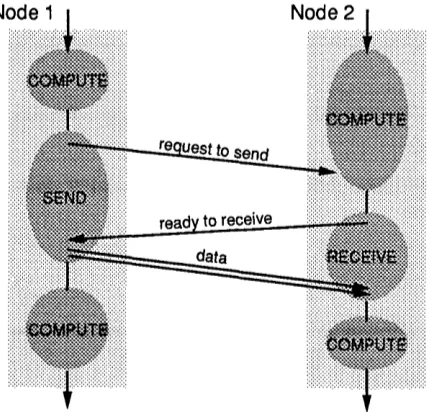
Blocking send/receive communication exacerbates the effects of network latency on communication latency2: in order to match a send with a receive a 3-phase protocol, shown in Figure 1, is required: the sender first transmits a request to the receiver which returns an acknowledgement upon executing a matching receive operation and only then is data transferred. With blocking send/receive, it is impossible to overlap communication with computation and thus the network bandwidth cannot be fully utilized.
KIS4 IN
-'141
Figure 1: Three-phase protocol for synchronous send and receive. Note that the communication latency is
at best three network trips and that both send and receive block for at least one network round-trip each.
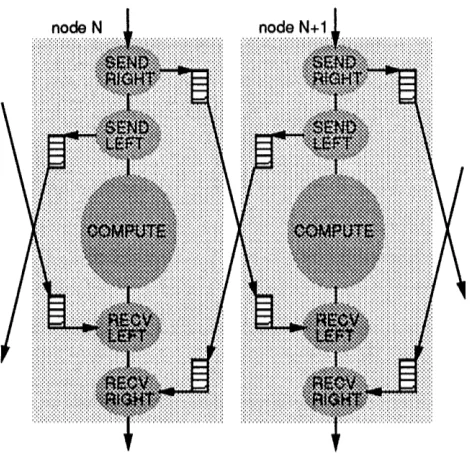
To avoid the three-phase protocol and to allow overlap of communication and computation, most message passing implementations offer non-blocking operation: send appears instantaneous to the user program. The message layer buffers the message until the network port is available, then the message is transmitted to the recipient, where it is again buffered until a matching receive is executed. As shown in the ring communication example in Figure 2, data can be exchanged while computing by executing all sends before the computation phase and all receives afterwards.
Table 1 shows the performance of send/receive on several current machines. The start-up costs are on the order of a thousand instruction times. This is due primarily to buffer management. The CM-5 is blocking and uses a three-phase protocol. The iPSC long messages use a three-phase protocol to ensure that enough buffer space is available at the receiving processor. However, the start-up costs alone prevent overlap of communication and computation, except for very large messages. For example, on the nCUBE/2 by the time a second send is executed up to 130 bytes of the first message will have reached the destination. Although the network bandwidth on all these machines is limited, it is difficult to utilize it fully, since this requires multiple simultaneous messages per processor.
2
We call communication latency the time from initiating a send in the user program on one processor to receiving the message in the user program on another processor, i.e., the sum of software overhead, network interface overhead and network latency.
Figure 2: Communication steps required for neighboring processors in a ring to exchange data using
asynchronous send and receive. Data can be exchanged while computing by executing all sends before the computation phase and all receives afterwards. Note that bufferspace for the entire volume ofcommunication must be allocated for the duration of the computation phase!
Machine Ts Tb Tfp
[ps/mesg] [pts/byte] [s/flop]
iPSC[8] 4100 2.8 25
nCUBE/10[8] 400 2.6 8.3
iPSC/2[8] 700 0.36 3.4
390t 0.2
nCUBE/2 160 0.45 0.50
iPSC/860[13] 160 0.36 0.033[7]
60t 0.5
CM-5+ 86 0.12 0.33[7]
2.2 Active Messages
Although the hardware costs of message passing machines are reasonable, the effectiveness of the machine is low under traditional send/receive models due to poor overlap of communication and computation, and due to high communication overhead. Neither of these shortcomings can be attributed to the base hardware: for example, initiating a transmission on the nCUBE/2 takes only two instructions, namely to set-up the DMA3. The discrepancy between the raw hardware message initiation cost and the observed cost can be explained by a mismatch between the programming model and the hardware functionality. Send and receive is not native to the hardware: the hardware allows one processor to send a message to another one and cause an interrupt to occur at arrival. In other words the hardware model is really one of launching messages into the network and causing a handler to be executed asynchronously upon arrival. The only similarity between the hardware operation and the programming model is in respect to memory address spaces: the source address is determined by the sender while the destination address is determined by the receiver4 .
Active Messages simply generalize the hardware functionality by allowing the sender to specify the address of the handler to be invoked on message arrival. Note that this relies on a uniform code image on all nodes, as is commonly used (the SPMD programming model). The handler is specified by a user-level address and thus traditional protection models apply. Active Messages differ from general remote procedure call (RPC) mechanisms in that the role of the Active Message handler is not to perform computation on the data, but to extract the data from the network and integrate it into the ongoing computation with a small amount of work. Thus, concurrent communication and computation is fundamental to the message layer. Active Messages are not buffered, except as required for network transport. Only primitive scheduling is provided: the handlers interrupt the computation immediately upon message arrival and execute to completion.
The key optimization in Active Messages compared to send/receive is the elimination of buffering. Eliminating buffering on the receiving end is possible because either storage for arriving data is pre-allocated in the user program or the message holds a simple request to which the handler can immediately reply. Buffering on the sending side is required for the large messages typical in high-overhead communication models. The low overhead of Active Message makes small messages more attractive, which eases program development and reduces network congestion. For small messages, the buffering in the network itself is typically sufficient.
Deadlock avoidance is a rather tricky issue in the design of Active Messages. Modem network designs are typically deadlock-free provided that nodes continuously accept incoming messages. This translates into the requirement that message handlers are not allowed to block, in particular a reply (from within a handler) must not busy-wait if the outgoing channel is backed-up.
2.2.1 Active Messages on the nCUBE/2
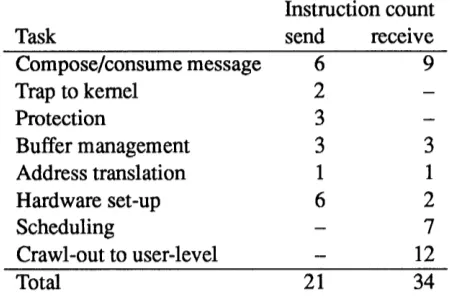
The simplicity of Active Messages and its closeness to hardware functionality translate into fast execution. On the nCUBE/2 it is possible to send a message containing one word of data in 21 instructions taking lts. Receiving such a message requires 34 instructions taking 15/is, which includes taking an interrupt on message arrival and dispatching it to user-level. This near order of magnitude reduction (To = 30/ps,
Tb = 0.45tps) in send overhead is greater than that achieved by a hardware generation. Table 2 breaks the
instruction counts down into the various tasks performed.
The Active Message implementation reduces buffer management to the minimum required for actual data transport. On the nCUBE/2 where DMA is associated with each network channel, one memory buffer
3
0n the nCUBE/2, each of the 13 hypercube channels has independent input and output DMAs with a base-address and a count register each. Sending or receiving a message requires loading the address and the count.
4Shared-memory multiprocessor advocates argue that this is the major cause of programming difficulty of these machines.
Instruction count
Task send receive
Compose/consume message 6 9
Trap to kernel 2
-Protection 3
Buffer management 3 3
Address translation 1 1
Hardware set-up 6 2
Scheduling - 7
Crawl-out to user-level - 12
Total 21 34
Table 2: Breakdown into tasks of the instructions required to send and receive a message with one word
of data on the nCUBE/2. "Message composition" and "consumption" include overhead for a function call and register saves in the handler. "Protection" checks the destination node and limits message length. "Hardware set-up" includes output channel dispatch and channel ready check. " Scheduling" accounts for
ensuring
handler atomicity and dispatch. "Crawling
out to user-level" requires setting up a stack frame and
saving state to simulate a return-from-interrupt at user-level.
per channel is required. Additionally, it is convenient to associate two buffers with the user process: one to compose the next outgoing message and one for handlers to consume the arrived message and compose eventual replies. This set-up reduces buffer management to swapping pointers for a channel buffer with a user buffer. Additional buffers must be used in exceptional cases to prevent deadlock: if a reply from within a handler blocks for "too long", it must be buffered and retried later so that further incoming messages can be dispatched. This reply buffering is not performed by the message layer itself, rather REPLY returns an error code and the user code must perform the buffering and retry. Typically the reply (or the original request) is saved onto the stack and the handlers for the incoming messages are nested within the current handler.
The breakdown of the 55 instructions in Table 2 shows the sources of communication costs on the nCUBE/2. A large fraction of instructions (22%) are used to simulate user-level interrupt handling. Hardware set-up (15%) is substantial due to output channel selection and channel-ready checks. Even the minimal scheduling and buffer management of Active Messages is still significant (13%). Note however, that the instruction counts on the nCUBE/2 are slightly misleading, in that the system call/return instructions and the DMA instructions are far more expensive than average.
1. The CM-5 provides user-level access to the network interface and the node kernel time-shares the network correctly among multiple user processes.
2. The network interface only supports transfer of packets of up to 24 bytes (including 4 bytes for the destination node) and the network routing does not guarantee any packet ordering.
3. The CM-5 has two identical, disjoint networks. The deadlock issues described above are simply solved by using one network for requests and the other for replies. One-way communication can use either.
4. The network interface does not have DMA. Instead, it contains two memory-mapped FIFOs per network, one for outgoing messages and one for incoming ones. Status bits indicate whether incoming FIFOs hold messages and whether the previous outgoing message has been successfully sent by the network interface. The network interface discards outgoing messages if the network is backed-up or if the process is time-sliced during message composition. In these cases the send has to be retried.
5. The network interface generally does not use interrupts in the current version due to their prohibitive
cost. (The hardware and the kernel do support interrupts, but their usefulness is limited due to the cost.) For comparison, on the nCUBE/2 the interrupt costs the same as the system call which would have to be used instead since there is no user-level access to the network interface.
Sending a packet-sized Active Message amounts to stuffing the outgoing FIFO with a message having a function pointer at its head. Receiving such an Active Message requires polling, followed by loading the packet data into argument registers, and calling the handler function. Since the network interface status has to be checked whenever a message is sent (to check the send-ok status bit), servicing incoming messages at send time costs only two extra cycles. Experience indicates that the program does not need to poll explicitly unless it enters a long computation-only loop.
Sending multi-packet messages is complicated by the potential reordering of packets in the network. For large messages, set-up is required on the receiving end. This involves a two-phase protocol for GET, and a three-phase protocol for PUT (discussed below). Intermediate-sized messages use a protocol where each packet holds enough header information (at the expense of the payload) that the arrival order is irrelevant.
The performance of Active Message on the CM-5 is very encouraging: sending a single-packet Active Message (function address and 16 bytes of arguments) takes 1.6ps (~ 50 cycles) and the receiver dispatch costs 1.7/s. The largest fraction of time is spent accessing the network interface across the memory bus. A prototype implementation of blocking send/receive on top of Active Messages compares favorably with the (not yet fully optimized) vendor's library: the start-up cost is TC = 23us (vs. 86,as) and the per byte cost is Tb = 0.12tps (identical). Note that due to the three-phase protocol required by send/receive, T is an order of magnitude larger than the single packet send cost. Using different programming models such as Split-C, the cost off communication can be brought down to the Active Message packet cost.
2.3 Split-C: an experimental programming model using Active Messages
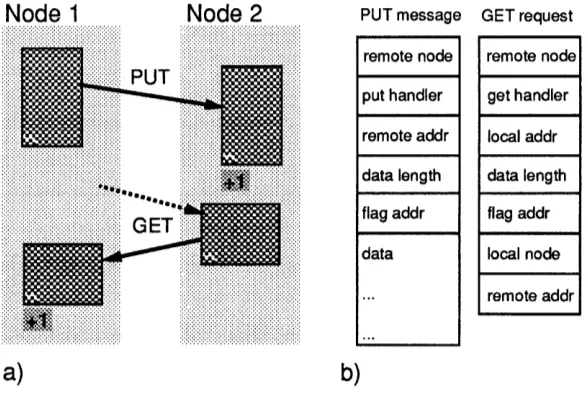
To demonstrate the utility of Active Messages, we have developed a simple programming model that provides split-phase remote memory operations in the C programming language. The two split-phase operations provided are PUT and GET: as shown in Figure 3a, PUT copies a local memory block into a remote memory at an address specified by the sender. GET retrieves a block of remote memory (address specified by sender) and makes a local copy. Both operations are non-blocking and do not require explicit coordination with the remote processor (the handler is executed asynchronously). The most common versions of PUT and GET increment a separately specified flag on the processor that receives the data. This allows simple
synchronization through checking the flag or busy-waiting. Operating on blocks of memory can yield large messages which are critical to performance on current hardware as seen below.
Node 1
Node 2
PUT message GET requestremote node remote node
put handler get handler
remote addr local addr
data length data length
flag addr flag addr
data local node
remote addr
a) b)
Figure 3: Split-C PUT and GET perform split-phase copies of memory blocks to/from remote nodes. Also shown are the message formats.
The implementations of PUT and GET consist of two parts each: a message formatter and a message handler. Figure 3b shows the message formats. PUT messages contain the instruction address of the PUT handler, the destination address, the data length, the completion-flag address, and the data itself. The PUT handler simply reads the address and length, copies the data and increments the flag. GET requests contain the information necessary for the GET handler to reply with the appropriate PUT message. Note that it is possible to provide versions of PUT and GET that copy data blocks with a stride or any other form of gather/scatter6.
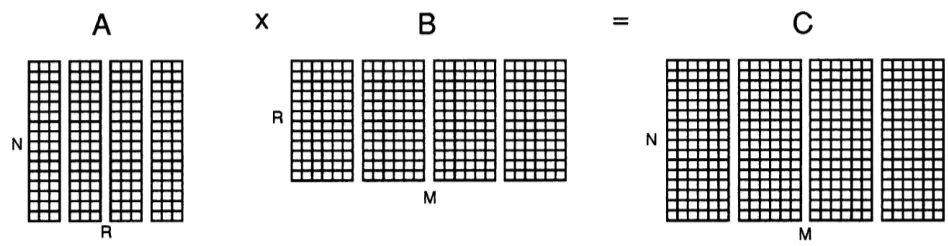
To demonstrate the simplicity and performance of Split-C, Figure 4 shows a matrix multiply example that achieves 95% of peak performance on large nCUBE/2 configurations. In the example, the matrices are partitioned in blocks of columns across the processors. For the multiplication of C = A x B each processor GETS one column of A after another and performs a rank- 1 update (DAXPY) with the corresponding elements of its own columns of B into its columns of C. To balance the communication pattern, each processor first computes with its own column(s) of A and then proceeds by getting the columns of the next processor. Note that this algorithm is independent of the network topology and has a familiar shared-memory style. The remote memory access and its completion are made explicit, however.
The key to obtaining high performance is to overlap communication and computation. This is achieved by GETting the column for the next iteration while computing with the current column. It is now necessary
A
R
X
B
1 1 H- 1 1+1 q+ +
H+- H+ - H+- H-
f llll
H+H§
IHH+
r
+ H
H + - H+H
TITIIT ThO+ H+-
llll
P~+ hH++
II
[
I+-
r-+
I I + - 11111 + H-HITITI HN
C
M
The matrices are partitioned
in blocks of columns across the processors. For the multiplication
of
CN x M =AN xR x BRx M each processor GETs one column of A after another andperforms a rank- update (DAXPY)
with its own columns of B into its columns of C. To balance the communication pattern, each processor first computes with its own column(s) of A and then proceeds by getting the columns of the next processor. This network topology independent algorithm achieves 95% of peak performance on large nCUBE/2 configurations.
int N, R, M; /* matrix dimensions (see figure) */ double A[R/P] [N], B[M/P] [R], C[M/P] [N]; /* matrices */
int i, j, k; /* indices */
int jO, dj, nj; /* initial j, delta j (j=jO+dj), next j */
int P, p; /* number of processors, my processor */
int Rp = R/P;
double VO[N], V1[N]; /* buffers for getting remote columns */
double *V=VO, *nV=Vl, *tV; /* current column, next column, temp column */ static int flag = 0; /* synchronization flag */
extern void get(int proc, void *src, int size, void *dst, int &flag);
jO = p * Rp; /* starting column */
get(p, &A[O][0], N*sizeof(double), nV, &flag); /* get first column of A */ for(dj=0; dj<R; dj++) { /* loop over all columns of A */
j = (jO+dj)%R; nj = (jO+dj+l)%R; /* this&next column index */ while(!check(1, &flag)) ; /* wait for previous get */ tV=V; V=nV; nV=tV; /* swap current&next column */
if(nj != jO) /* if not done, get next column */
get(nj/Rp, &A[nj%Rp][0], N*sizeof(double), nV, &flag);
for(k=0; k<M/P; k++) /* accum. V into every col. with scale */ for(i=0; i<N; ++) /* unroll 4x (not shown) */
C[i] [k] = C[i] [k] + V[i]*B[j] [k]; }
Figure 4: Matrix multiply example in Split-C.
10
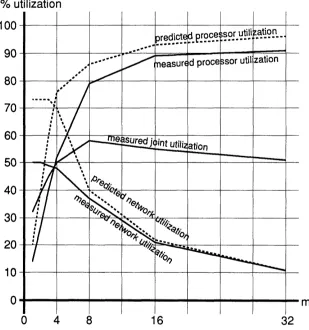
--The two top curves in Figure 5 show the performance predicted by the model and measured on a 128 node nCUBE/2, respectively, as the number of columns per processor of A is varied from 1 to 32. N
is kept constant (N = 128) and R is adjusted to keep the total number of arithmetic operations constant
(R = 262144/M). The matrix multiply in the example is computation bound if each processor holds
more than two columns of A (i.e., m > 2). The two bottom curves show the predicted and measured network utilization. The discrepancy between the model and the measurement is due to the fact that network contention is not modeled. Note that while computational performance is low for small values of m, the joint processor and network utilization is relatively constant across the entire range. As the program changes
from a communication to a computation problem the "overall performance" is stable.
% utilization
100
90
80
70
60
50
40
30
20
10
0 m
Figure 5: Performance of Split-C matrix multiply on 128 processors compared to predicted performance
example of how Active Messages can be incorporated into a coarse-grain SPMD (single-program multiple-data) programming language. It generalizes shared memory read/write by providing access to blocks of memory including simple synchronization. It does not, however, address naming issues.
Using Active Messages to guide the design, it is possible to improve current message passing machines in an evolutionary, rather than revolutionary, fashion. In the next section, we examine research efforts to build hardware which uses a different approach to provide another magnitude of performance improvement.
a) GET cost model
Proc c:0m:p4~ :::~:eiROj
qi rie:!hand l'
rProc
reiveeivi
re
b) Overlapping communication and computation
.... overlapped computation
Proc :'A:m(:'!Biii compute
J
receive ,ervic compute replY ' !c::::handleNet .... ..h .
· .... ,, .... ,. ... ... ...
...-rProc P~omPos~ send compute l rece~esei~icreply , compute receive: handle
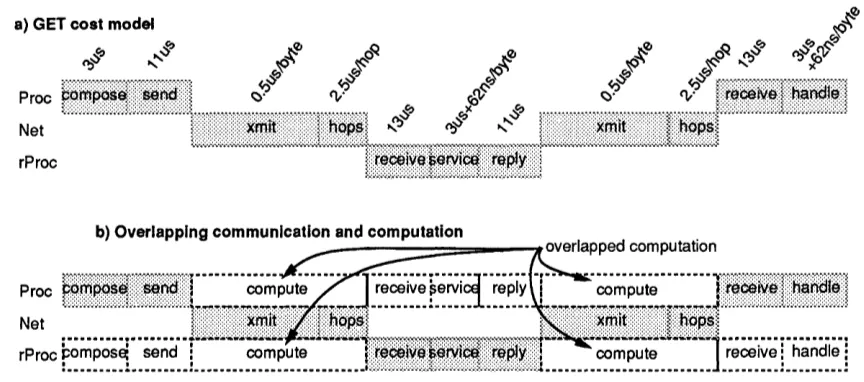
Figure 6: Performance model forGET. Compose accounts for the time to set-up the request. Xmit is the time
to inject the message into the network and hops is the time taken for the network hops. Service includes for copying the data into the reply buffer and handle for the time to copy the data into the destination memory block.