ISSN: 1816-949X
© Medwell Journals, 2020
Bow and String Animation using the Two Dimension Finite Element Methods
Dio Tri Ananda Putra, Tito Waluyo Purboyo and Anton Siswo Raharjo Ansori
Department of Computer Engineering, Faculty of Electrical Engineering,
Telkom University, Bandung, Indonesia
Abstract: Recently, a technological development is increasing, such as animation technology like 1 Dimension (1D), 2 Dimension (2D) or 3 Dimension (3D). Previously, the making of animation was still done simply and conventionally by moving a number of pictures, painting or photos quickly. Now, the process of making animation is no longer a complicated problem. Because an animator can design model with software like Blender application. To design a shape that resembles a real shape in a Blender application, a method is needed to divide a shape into several objects. Therefore, this research was carried out by applying the finite element method by implementing the Blender application. This method is used to design objects by dividing several objects to be analyzed, into several parts. These parts are called elements that each element one with other elements is given with nodal (node). Then a mathematical equation was built which became the representation of the object. The process of dividing objects into several parts is called meshing. Therefore, the aim is that each recurve bow object in the bow and string animation can be converted into elements and stains with the finite element method. The division with the infinite element method will then be solved by the equation and the result of this equation will produce the direction line which will be formed into a limit.
Key words: Development of animation, finite element method, recurve bow, bow, string animation, design
INTRODUCTION
Recently, bow has been found in the Paleolithic period or the beginning of the Mesolithic period. The arrows are made of pine wood which consists of a main shaft and a front axis of 15-20 cm or 6-8 inches with a stone dot. The bow design used in archery has evolved for thousands of years. Is not a new term but has been used a few years ago (Febryan et al., 2017). Changes in technology produce mechanical innovations and advances in material science. One significant advance in arc design is the development of a “compound” arc. The traditional bow is called a “recurve” bow. The recurve bow is usually made of wood and must be bent into a curved arc every time the user wants to attach a string bow. The recurve bow uses a single bowstring and the resistance of the bow places the bowstring in tension. Although, effective it usually takes a lot of strength to pull the bowstring back when using a recurve. There are several types of arcs that can be found, one of which is the recurve bow which will be the object of animation modeling in this study. Recurve bow or can be called an Olympic recurve is an international standard type of bow that is widely used at the Olympics. There are several types of shooting techniques on his archery sports including instinctive, gap shooting, walking strings and face walking (Edward, 2004).
Where as to make the animation, bow and string modeling is the first step in making animation. Animation
ritself has experienced many developments and also has many applications in various fields such as games, films and advertisements. There are several methods that can be used for making animation so far and using the finite element method is a new thing because the finite element method is more used to solve engineering problems and physics calculations.
Definition: Finite element method is a method that can relatively get accurate and more natural results. Finite element method is a numerical method for solving engineering problems and physics calculations. General problems related to engineering and physics can be solved using the finite element method, not only that the finite element method can also be used to solve structural analysis problems, heat transfer, fluid flow, mass transportation and electromagnetic potential (Logan, 2007). The advantages of using the finite element method are the animation results that are more natural and finer than other methods because the finite element method can provide object modeling solutions by dividing them into equivalent systems. In the sense of changing objects into small elements that are interconnected with other elements through lines or nodal points. Thus, in the finite element method does not solve the problem of all objects in one operation and combines the results of the equation for each element to get the solution of the entire object (Kooi, 1980).
\
I0 I1 y K1 F F I2 Z K2 y-z x
Blender application is one of the open source software used to create multimedia content, especially, 3D. Another reason for choosing this application is because the Blender application is an application that is very light and not too heavy during the rendering process. The convenience that is offered in using this application is also one of the considerations, so that, it is easier to be used by even a beginner (Fidelis, 2004).
Finite element method looks more complicated and accurate and gives more natural results in terms of making animation compared to other methods (Wan, 2008). So, this study will use the finite element method in making 2D.
Animations and combined with the Blender application to produce a more refined and natural animation quality.
Two-dimensional finite element method: The finite element method is a realistic method for predicting flexibility and farthest deviation from the riser and limb. The force given by the hand influences the position of the riser, limb and string where the riser, limb, string has a point of maximum flexibility or it can be called the farthest point of deviation from its original bow. In contrast, compound bows use a camming system that allows users to use less force on the bowstring to pull it (Rieckmann et al., 2012).
In addition, the development of the creative industry in the field of animated films has also become increasingly widespread and more and more animators from Indonesia are increasingly reliable in making animated films. Animation is one of the gold mines in the entertainment world (Djalle, 2006). Animated films are always able to reach a large number of viewers while at the same time giving not a few advantages. In fact, now animated films are no longer produced only for children. There are animations for teenagers, even adults. The development of technology and computers also had an impact on films in the world using 2 dimensions developed into 3D (Prakosa, 2010).
Some applications also have been very supportive to help make animation better, various methods are also used to support the theory of making animation (Gallozi, 1987). Like the two-dimensional finite element method which will be implemented in the Blender application software. Each animation will be built with mathematical equations that will represent the object.
This method is a numerical method for solving engineering problems and physical calculations. So that, it can be used to solve structural analysis problems, heat transfer, fluid flow, mass transportation and electromagnetic potential (Lula, 2014). Therefore, the use of the finite element method in this study can minimize disability in the object. So that, it can produce quality animation to be more natural and accurate to be used in the creative industry in the field of animation.
This study proposes a method for realizing the application of the finite element method in the Blender application to make the object and its animation as real as possible.
MATERIALS AND METHODS
Finite element method: Archery is a well-known sport and even played in the Olympics, there are many arrow bows models but all have similarities which consist of the same core namely riser, limb and string. Riser is the main handle of the bow while limb is the tip of the archery which is connected with a bowstring which is a source of spring energy in the arc (Edward, 2004). Bow design for use in archery sports has evolved for thousands of years, a traditional bow or recurve bow, usually made of wood and must be bent first to tie strings to the limb (Rieckmann et al., 2012). In Indonesia itself there is a narrowing of meaning where the recurve bow is a modern bow that is usually made of metal or carbon.
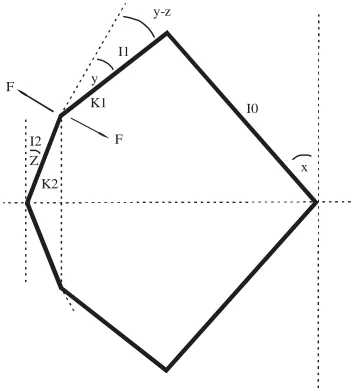
Position: To find out the maximum flexibility of the riser, limb and string must first find out the distribution of force given by the hand to the riser, limb and string (Anonymous, 2010). The equation in the finite element is shown in Fig. 1.
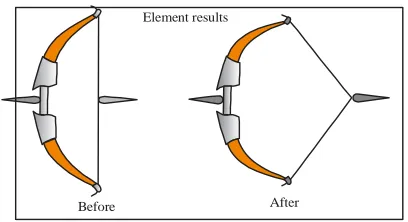
In Fig. 1 is an picture description of a bow and string whera as l0 lengs of string, l1 lengs of limbs, l2 lengs of riser and k1 flexibility moment of limbs, k2 flexibility moment of risers and F Force and axis X, Y, Z is axis of bow and string. In Fig. 2, shows that in the 0° bow position and the string is still in a perfect position and perpendicular.
[image:2.612.344.520.514.709.2]In Fig. 3, shows the position of the flexibility and slope of 40° based on observations on the degree of the slope, the shape of the bow model is increasingly curved and the greater ejection force or momentum.
Element results
Before After
Start
See animation modeling
Compare the results obtained with FEM
Finish Finish
Calculate each load and pressure of an element Rigging the
blender Dividing elements from
objects
Determine the movement of each
element
Fig. 2: Shows that in the 0° bow position
Fig. 3: The bow position and the string the pulling out The trigonometric equation is lowered as follows, looking at the risers pulling out in Fig. 3, the risers is under pressure axis z (risers). from the trigonometric calculation the following formula is obtained :
(1)
0 1 2
l cos x = l cos y+l cos z
(2)
1 2
0 l cos y l cos z x = arc cos
l
(3) = k
(4)
1 1 1 1
= k (y-z) Fl = k (y-z)
(5) 2 = k (z)2 Fl = k2 2
(6) 1 1
2 2 Fl k y z Fl k z
(7) 2 1 1 2 1 2
k l z = k l y-k l z
(8) 2 1 2 1 1 2
k l y = (k l +k l ) z
(9) 2 1 1 2
1 2 k l k l
y z
k l
[image:3.612.323.527.98.209.2]
Fig. 4: Bow and string animation design
Fig. 5: Design flowchart Formula description: l0 : Length of string l1 : Length of limbs l2 : Length of risers
k2 : Flexibility moment risers
x : Axis of string y : Axis of limbs z : Axis of risers
From the calculation above, we will know the angular value of z, the value of the flexibility from risers dan limbs and the length of risers limbs and strings, then we find the x and y axis values.
Animation bow and string design: This research will divide the object into several elements, design the Blender, then compare the results obtained with the finite element method. Where each element that has been divided will be calculated using the finite element method, after getting the results of each element, the element is input into the Blender application to do the rigging process. After the rigging then you will get the bow and string direction movements as shown In Fig. 4. In Fig. 4, draw arrow before with drawal and draw arrow after a certain degree. Following the flowchart in Fig. 5.
Rigging Element
Element Rigging
Limb
[image:4.612.168.445.93.303.2]Riser String
Fig. 6: Rigging process with animation bow and string
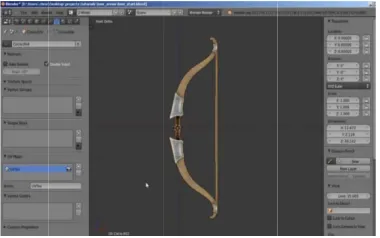
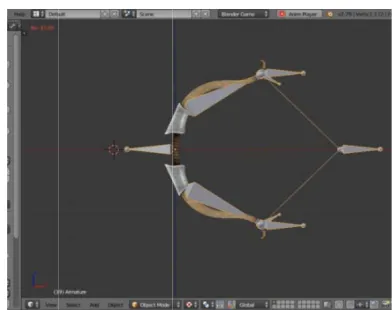
Fig. 7: Bow and string modeling in Blender applications Then calculate all the elements, so that, all elements have the results of calculations, after getting the results, then put into the modeling stage. This modeling itself uses the Blender application where the tools used are bone tools to start the rigging process in Blender. After that, it can be seen the modeling results from the bow animation and the string, then compared with the results of the calculation of the finite element method.
In Fig. 6, the rigging process can be done after getting the value of each element, so as to get the value of the flexibility of the bow and string. First the objects (bow and string) are divided into several elements, then calculate the value of each element using the finite element method. After getting the value of the calculated element, the amount of rigging/bone that can be equated with the amount of rigging/bone on the object, so that, the object can be rotated with maximum flexibility according to calculations on the finite element method.
Implementation and parameters testing: Testing uses 2 parameters, that is testing parameters through
calculations using the finite element method and testing parameters of bow and string animation quality on the Blender application.
Calculation testing using finite element method aims to see how much success using this method in bow and string modeling. This scenario will be implemented by manual calculation and by using an application. The process of counting manually will use the equation of the finite element while the success rate in this parameter will be seen from the comparison of the modeling results in the Blender application with the Calculix application. While bow and string animation quality testing aims to see how well the results of bow and string animation using the finite element method. Calculix is free and open-source finite-element analysis application that uses an input format similar to Abaqus (Dhondt and Wittig, 2018). This testing scenario will be carried out using the Blender application as a medium for modeling and movement of the model. This process will use bone tools in making rigging, so that, bow and string objects can be moved (Zikky, 2017). This rigging process can be obtained from combining elements that have been calculated using the finite element method. In testing the quality of the bow and string animation is done with the position 0E, 20E, 40E and 60E when going to launch the arrow launch movement on the string.
The following is the result of modeling the use of two-dimensional equations of the finite element method in the Blender application
[image:4.612.90.280.342.461.2]Fig. 8: Rigging process with bone on bow and string
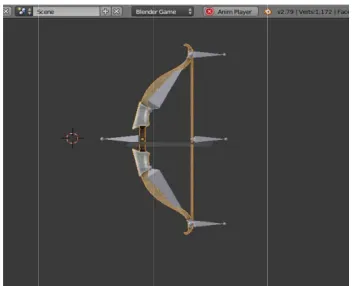
Fig. 9: Bow and string modeling in Blender applications arrow, so as to produce ejection forces with a certain range. Here, are the results of adding bone to bow and string modeling in the Blender application:
In Fig. 8, shows that the bow and string models in the Blender application can already move to follow the pull of the arrow. This is due to the rigging of the bow and string, so that, there is flexibility on each side.
RESULTS AND DISCUSSION
This section discussed about the analysis of the experiment result. The analysis discussed in this research were position of bone and string analysis.
After conducting research on modeling experiments using the Blender application and the Calculix application, the results of the analysis in the form of image quality models generated applications. The following are the results of modeling described through the Blender application.
[image:5.612.96.271.98.263.2]In Fig. 9, Blender application can determine the texture of the model in more detail starting from the size
Fig. 10: Bow and string modeling in Calculix applications
Fig. 11: Position 0° on bow and string
of the texture, the choice of color and shape of the material texture to the lighting settings on the model depicted in the application. While the results of modeling using the Calculix application are as follows:
In Fig. 10, the Calculix application bow and string modeling is not as complex as in the Blender application. This can be seen from the display and menu in the application. Blender application can determine the texture model in more detail starting from the size of the texture, the choice of color and shape of the material texture to the lighting settings on the model depicted in the application. The following are the results of bow and string animation testing at positions 0E, 20E, 40E and 60E as show in Fig. 11. In Fig. 11, shows that in the 0° bow position and the string is still in a perfect position and perpendicular.
In Fig. 12, this causes the string to stretch further because there is a force generated by the arrow in the bow.
[image:5.612.331.528.293.439.2] [image:5.612.95.271.304.447.2]Fig. 12: Position 20° on bow and string
[image:6.612.90.277.97.238.2]Fig. 13: Position 40° on bow and string
Fig. 14: Position 60° on bow and string
In Fig. 14 when the arrow is released on the bow and string, the animation shows the momentum force generated from the string, so that, it displays the alternating motion of the string effect of the momentum generated show in Fig. 15.
[image:6.612.85.277.275.409.2]In Fig. 15, the picture shows the string position being -10E due to the momentum generated in the pull of an arrow when released on the bow. In the animation shows
Fig. 15: Position -10° on bow and string
the quality of the resulting animation is quite good because it can show the flexibility of bow and string when given style by an arrow as in reality.
CONCLUSION
Based on the results of experiments and testing of two-dimensional equations with the finite element method, making objects in bow and string animations in the form of pendulum and handles on the bow and string or bowstring turned out to be able to be transformed into elements and stains with infinite element method which was then finalized. So as to produce directional lines that will be formed into boundaries and used as animations for bow and string in the Blender application or the Calculix application.
REFERENCES
Anonymous, 2010. Definision animasi. Albardon Department, San Juan, Puerto Rico.
Dhondt, G. and K. Wittig, 2018. Calculix: A free software three-dimensional structural finite element program. CalculiX Software Foundation, Inc., Cambridge, Massachusetts, USA. http://www. dhondt.de/
Djalle, Z.G., E. Purwantoro and D. Dasmana, 2006. The Making of 3D Animation Movie using 3DStudio Max. Bandung Institute of Technology, Bandung, Indonesia,.
Edward, P., 2004. Thermoplastic composite bow RISER, linm and cam. Gordon Composites Inc., Montrose, Colorado. https://patents.google.com/patent/US2007 0007689
[image:6.612.84.280.441.596.2]Fidelis, S.J., 2004. Open Source 3D Animation Blender. State University of Jakarta, East Jakarta, Indonesia,.
Gallozi, C., 1987. New method for measuring lateral arc acceleration during filming in archery. Sports Science Institute of SA., Cape Town, South Africa.
Kooi, B., 1980. Mechanics in bow and arrow with finite element. The Iron and Steel Institute, Japan.
Logan, D.L., 2007. A First Course in the Finite Element Method. 4th Edn., Cengage Brain, Boston, Massachusetts, USA., ISBN: 9780534552985, Pages: 818.
Lula, A., 2014. Analisis finite elemen transducer langevin 3D. Iron and Steel Institute, Japan.
Prakosa, G., 2010. [Animation: Basic Knowledge of Indonesian Animated Films]. Jakarta Art Institute, Jakarta, Indonesia, ISBN: 9789799939425, Pages: 406 (In Indonesian).
Rieckmann, M., J.L. Park, J. Codrington and B. Cazzolato, 2012. Modelling the 3D vibration of composite archery arrows under free-free boundary conditions. Proc. Inst. Mech. Eng. Part P. J. Sports Eng. Technol., 226: 114-122.
Wan, Y., 2008. 2-D digital filter design with coefision finite element. Department of Ellecttrical Engineering, Queen’s University Kingston, Kingston, Canada.