http://wrap.warwick.ac.uk/
Original citation:
MacDonald, Malcolm N., Homolar, Alexandra, Rethel, Lena, Schnurr, Stephanie and Vessey, Rachelle. (2015) Manufacturing dissent : the discursive formation of nuclear proliferation (2006-2012). Discourse and Communication .(In Press)
Permanent WRAP url:
http://wrap.warwick.ac.uk/64693
Copyright and reuse:
The Warwick Research Archive Portal (WRAP) makes this work of researchers of the University of Warwick available open access under the following conditions. Copyright © and all moral rights to the version of the paper presented here belong to the individual author(s) and/or other copyright owners. To the extent reasonable and practicable the material made available in WRAP has been checked for eligibility before being made available.
Copies of full items can be used for personal research or study, educational, or not-for-profit purposes without prior permission or charge. Provided that the authors, title and full bibliographic details are credited, a hyperlink and/or URL is given for the original metadata page and the content is not changed in any way.
Publisher statement: http://dcm.sagepub.com/
A note on versions:
The version presented here may differ from the published version or, version of record, if you wish to cite this item you are advised to consult the publisher’s version. Please see the ‘permanent WRAP url’ above for details on accessing the published version and note that access may require a subscription.
Journal submitted to: DISCOURSE & COMMUNICATION
Manufacturing Dissent: the discursive formation of nuclear proliferation (2006-2012)
Malcolm N. MacDonald, Alexandra Homolar, Lena Rethel, Stephanie Schnurr (University of Warwick) and Rachelle Vessey (University of Newcastle)
Centre for Applied Linguistics, Social Sciences Building University of Warwick, Coventry,
CV7 2LA
Tel: +44(0)24-76-5-24250 [email protected]
Abstract
This paper draws on the conceptualisation of 'discursive formation' to examine the particular configuration of the ‘objects, subjects, concepts and strategies’ (Foucault, 1972) which constitute
‘nuclear proliferation’ between 2006 and 2012. While previous studies have mostly explored the
discourse of nuclear proliferation through the analysis of newspaper texts, few have considered
corpora from different sites or considered the changes, transformations and contradictions that take
place when meanings are delocated from one site and relocated in another. Elements of
poststructuralist discourse theory, critical linguistics and corpus linguistics are brought together to
consider how events were constructed within two corpora: UNSC resolutions and newspaper
articles published in prominent UK and US broadsheets. WordSmith Tools (Version 5) was used to
analyse word frequencies, statistical patterns of keywords, word collocation profiles and
concordance patterns. Results indicate that the most salient lexical items refer to actors, strategic
actions and technologies. As these constituents of nuclear proliferation are delocated from the
political sphere and relocated in the public sphere, three discursive strategies unfold:
personalisation, normalisation or exceptionalisation, and reification.
Keywords: critical linguistics, corpus analysis, discourse, security, UNSC, international relations,
1. Introduction
After a glimmer of optimism at the turn of the century, the 21st century is once again emerging as
one of continuing crisis and conflict (Houtart, 2010). One way in which the sense of global crisis
has intensified over the past decade is through the proliferation of nuclear weapons which the
United Nations (UN), as well as the US and the UK media, maintain took place in Iran and North
Korea over this period. In this paper, we examine the ways in which nuclear proliferation was
discursively constituted between 2006 and 2012. Techniques of discourse analysis and corpus
analysis are combined to compare resolutions passed by the UN Security Council (UNSC), and
articles in prominent broadsheets from the US and the UK, two English speaking permanent
members of the UNSC. Specifically, we will undertake three lines of enquiry into: a) the ways in
which nuclear proliferation was discursively constituted in the international political sphere
(2006-2012); b) the ways in which nuclear proliferation was discursively constituted in the public sphere
in the UK and US (2006-2012); and, c) the ‘contradictions’, ‘changes’ and ‘transformations’ (after
Foucault, 1972) that took place as the discourse of nuclear proliferation was delocated from the
political sphere and relocated in the public sphere.
2. The discursive formation of nuclear proliferation
For some time now it has been proposed that any discrete body of knowledge is constructed not
as a set of self-evident truths made manifest through the transparency of observable data, but rather
is characterised by the particular set of objects, subjects, concepts and strategies which are
constituted within a distinctive ‘formation of discourse’ (Foucault, 1972). One way of
understanding the distinctiveness of a discursive formation is to analyse the ways in which words,
statements and texts combine systematically to bring a particular view of the world into being: “to
define a system of formation in its specific individuality is … to characterize a discourse or a group of
statements by the regularity of its practice” (ibid: 74). Arguably, no area of knowledge or interhuman
intergovernmental legal, political and economic associations are created, maintained and
transmitted across two realms: a political sphere located in national executives and
intergovernmental organizations such as the UN, and a public sphere informed by a national press
alongside electronic media such as television, the internet and social networking. It is a key
principle of this paper that the distinctive features of a particular nexus of international events such
as ‘nuclear proliferation’ is not constituted within any one particular set of texts, but in the dynamic
relations that operate between different text types which circulate within and between different
institutional sites, both national and international.
The analysis of the discourse of nuclear proliferation goes back to speeches and documents from
the ‘Cold War’, the long running nuclear stand-off which took place between the USA and the
USSR between 1947 and 1991. Using a heterogeneous approach, Mehan et al. (1980) concluded
that the Cold War was constituted in the interstices between documents generated by the US
administration, the National Council of Catholic Bishops, the Roman Catholic Church and the
speeches of Ronald Reagan. This ‘intertwined system of discourse’ (158) had material
consequences. For the USA and its allies the ‘dialogic’ process which took place between ‘strategic analysts’, ‘the Catholic Church’ and ‘peace groups’ (135) gave rise to three discursive 'strands' - the
threat of Soviet expansion, reliance on nuclear weapons to curb the threat from the USSR, and the
role of nuclear weapons – which ultimately served to deter global warfare over this period.
In studies addressing media texts more similar to our own, critical discourse analysis (CDA) has
been used to consider the cross-cultural positioning of Iran within the discourse of nuclear crisis.
Izadi and Saghaye-Biria’s (2007) analysis of editorials relating to the Iran nuclear crisis in The New
York Times, The Washington Post, and The Wall Street Journal from 1984 to 2004 revealed a range
of lexis which presented Islam as a threat and Iran’s government as untrustworthy, while failing to
acknowledge the United States' refusal along with other signatories to realise their own commitment
and Zenouz (2008) undertook a comparative analysis of articles relating to the Iran nuclear crisis
from a corpus of Iranian and British broadsheets published in 2004: the conservative Kayhan and
Telegraph, and the more progressive Iran Daily and Guardian. All four newspapers portrayed Iran
as salient within the systemic-functional transitivity system, being realised either as an Actor,
Senser or Sayer. However, papers on the left of the political spectrum in both countries gave
particular prominence to verbal process types, acknowledging that the positions described are
indeed ideological. One implication of this predominance of verbal processes in the Iranian papers is that Iran’s nuclear policy appeared to be supported by a political consensus within the country.
By contrast, right wing newspapers in both countries tended to describe events using material
processes, which bestowed them with greater facticity. British newspapers presented a
dichotomized worldview, where the EU and Iran occupied polarised positions, with Iran’s uranium
enrichment programme coming in for particular vilification (213-216).
Most recently, Rasti and Sahragard (2012) analysed the patterns of discourse in 23 articles on Iran’s nuclear programme published in the Economist between 2007 and 2010. Once again they
described a polarization at the lexical level between Iran and the West, where the western ‘we’ was
portrayed positively as supporting sanctions while an Iranian ‘they’ was represented in a negative light, particularly with regard to ‘confidence-building activities’ in relation to arguments around the
lifting of sanctions (735-736). This dichotomisation was further heightened through the use of a
range of conceptual metaphors within the periodical (737-739). For the most part, the reactions of
Iranian citizens were elided from the presentation of the arguments around sanctions and, where
they did occur, were represented as edgy, unpredictable and self-interested (740). At the level of
discourse, temporality was frequently invoked to legitimize a negative orientation towards Iran and its nuclear programme along with invocations to an ‘indeterminate’ group of international actors to
position themselves. Additionally, a range of argumentation strategies were used to legitimate
generated by using nominalisation and passivisation to elide attribution of agency, as well as
referring to many more Western than Iranian sources (745-6).
Discourse studies relating to nuclear proliferation in North Korea are less plentiful than those in
relation to Iran. An early paper (Min, 1999) undertook a critical-linguistic, cross-cultural discourse
analysis of 92 articles harvested from the New York Times and the Korea Herald relating to the first
four months’ coverage of the nuclear stand-off between North Korea and South Korea in 1994.
While headlines (or ‘macro propositions’) in the New York Times accorded the US prominence in
mediating the North Korean nuclear talks (8), headlines in the Korea Herald focused more locally
on North Korean transparency for the security of the Korean peninsula and the freezing of North
Korean nuclear activities. The New York Times positioned U.S. participants as the agents in the
negotiating processes, while the agency of the Korean participants was downplayed through a
variety of rhetorical devices (11-12). Unsurprisingly, the Korea Herald increasingly constructed the
South Korean participants as principal agents in the US-North Korean nuclear talks, with the US
being accorded agency in a less prominent fashion (14). This was realised in part through the
respective thematisation of the U.S. in the New York Times headlines (13-14) and South Korea in
the Korea Herald headlines (23-4). With regard to lexicalisation, in the New York Times there was a
considerable degree of over-wording around the vocabulary related to the notion of crisis, with the use of associated words such as ‘crackdown’, ‘breakthrough’, ‘curbs’, and the word ‘crisis’ itself
(10-11). By contrast, the Korea Herald did not exhibit such plentiful lexicalisation around the
theme of crisis; in fact it attested to portraying events on the Korean peninsula as generally less
unstable (19-21).
While the studies of the discourse of nuclear proliferation crisis in the Iran and Korea reviewed
above have yielded some interesting insights into the ways in which lexis is used for ideological
effect, they have all restricted themselves to analysing just one type of media text. Furthermore, the
approach is perhaps closest to our own study in as much as they do consider the relations between
different text types, their corpora remain relatively small and subject to manual analysis. By
contrast, our study uses corpus analysis techniques to engage critically with the constitution of the
nuclear proliferation across different text types, as a discursive formation (after Foucault, 1972). In particular we aim to problematize the ways in which the notion of ‘crisis’ is constituted as texts are
delocated from the political sphere and relocated in the public sphere.
3. Methodology
The methodological approach we take in this paper combines elements of poststructuralist
discourse theory (after Foucault, 1972), critical linguistics (after Kress and Hodge, 1979) and
corpus linguistics (after Stubbs, 1996). While the individual methodological strands we draw on are
well established in communication studies and applied linguistics, it is rare for the conceptualisation
of discursive formation to be analysed using corpus techniques; and to the best of our knowledge only Baker and McEnery’s (2005) analysis of articles about refugees and asylum seekers published
in UK newspapers and the Office of the United Nations High Commissioner for Refugees
(UNHCR) has attempted to look at the linguistic and discursive relations between texts across the
political and the public spheres. Our study arises from a multidisciplinary research project carried
out at the University of Warwick, UK that investigates the dynamics that shape the emergence,
success and failure of crisis leadership in global economic and security governance (CLiGG,
2012).1
Our corpora were compiled from two different sites: the United Nations Security Council
(UNSC); and prominent national press outlets in the UK and the US, commonly regarded as two of
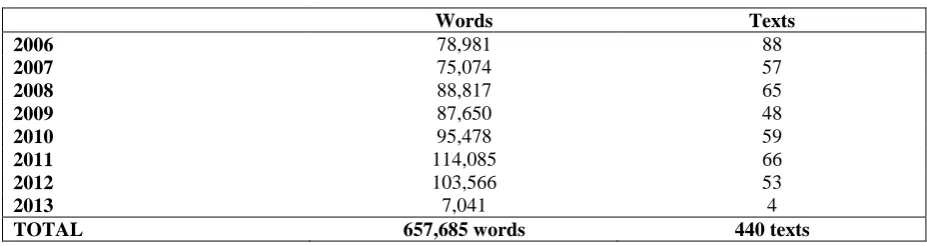
the most powerful permanent members of the UNSC. The UNSC resolutions corpus (Table 1)
comprised all UNSC resolutions between 2006 and 2012 that were available online
(http://www.un.org/en/sc/documents/ resolutions/). Between 2006 and 2012, there was a range of
48-88 resolutions per year, with an annual average of 63 resolutions and an average length of 1558
[image:9.595.50.514.147.270.2]words per resolution.
Table 1: UNSC resolutions corpus
Words Texts
2006 78,981 88
2007 75,074 57
2008 88,817 65
2009 87,650 48
2010 95,478 59
2011 114,085 66
2012 103,566 53
2013 7,041 4
TOTAL 657,685 words 440 texts
Four newspapers were selected for analysis: The Times and The Guardian from the UK; and The
New York Times and The Washington Post from the US. Not only do these papers from each
country represents a spread of political viewpoints, from the ‘left’ to the right’ of the political
spectrum, but they also are ‘broadsheets’ which are conventionally regarded as publishing more
verifiable, ‘serious-minded’ content than - for example - UK tabloids. The US/UK broadsheets
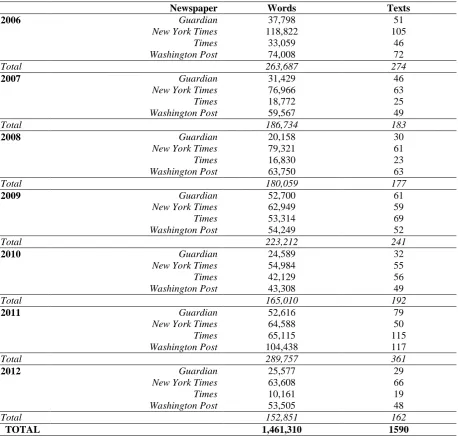
corpus (Table 2) comprised all articles containing the phrase ‘nuclear crisis’ or ‘nuclear
proliferation’ between the years 2006 and 2012 from these four papers. The data was collected
using the news database site Nexis UK. Between 2006 and 2012, the broadsheets produced 162 to
361 nuclear-related articles per year between them, with an average of 227 articles per year. The
documents in the corpus were converted from their original, varied formats to a uniform text format
amenable to machine analysis and the corpus was cleaned by inserting header, footer and body tags
Table 2: US/UK broadsheets corpus
Newspaper Words Texts
2006 Guardian 37,798 51
New York Times 118,822 105
Times 33,059 46
Washington Post 74,008 72
Total 263,687 274
2007 Guardian 31,429 46
New York Times 76,966 63
Times 18,772 25
Washington Post 59,567 49
Total 186,734 183
2008 Guardian 20,158 30
New York Times 79,321 61
Times 16,830 23
Washington Post 63,750 63
Total 180,059 177
2009 Guardian 52,700 61
New York Times 62,949 59
Times 53,314 69
Washington Post 54,249 52
Total 223,212 241
2010 Guardian 24,589 32
New York Times 54,984 55
Times 42,129 56
Washington Post 43,308 49
Total 165,010 192
2011 Guardian 52,616 79
New York Times 64,588 50
Times 65,115 115
Washington Post 104,438 117
Total 289,757 361
2012 Guardian 25,577 29
New York Times 63,608 66
Times 10,161 19
Washington Post 53,505 48
Total 152,851 162
TOTAL 1,461,310 1590
Corpus analysis techniques were used to ascertain the content of the corpora and the
comparability of one corpus with another. First, the word list programme in Wordsmith Tools
(Version 5, Scott, 2008) was used to establish basic statistical information about each corpus and
the overall frequencies of the lexis in each corpus. An analysis of lexical trends was then carried out
using the keywords programme to establish which words were salient in each corpus, using the
log-likelihood algorithm (hereafter LL) in order to determine whether words appeared more or less
often than might be expected by their observed frequency in either of the two corpora rather than
[image:10.595.56.515.84.524.2]relative frequency was statistically significant when compared with the respective reference corpus
(p<0.000001, after Baker, 2006). Since each corpus comprised a different genre and was also of
considerable difference in size, it was not appropriate to compare them directly. Not least, this
would have resulted in much of the statistically significant lexis revealing differences between the
resolution and the newspaper genres, but not necessarily the ways in which the ‘objects, subjects, concepts and strategies’ relating to nuclear proliferation were themselves constituted. Since it was
also not possible within the scope of the project to create a massive comparator corpus of all the
articles from the four broadsheets published between 2006 and 2012, the broadsheets corpus was
compared separately with the British National Corpus (BNC, 2007) as a common, baseline ‘reference’ corpus (RC).2
However, it was possible to carry out the keyword analysis of the UNSC
resolutions corpus with a greater level of precision by creating a sub-corpus of resolutions which
specifically related to nuclear proliferation, as indicated by the document titles on the UNSC
webpages. Between 2006 and 2012, there were 18 resolutions focusing on nuclear proliferation,
ranging between 1 and 4 per year. This sub-corpus was then compared with the larger corpus which
comprised all UNSC resolutions produced between 2006 and 2012.
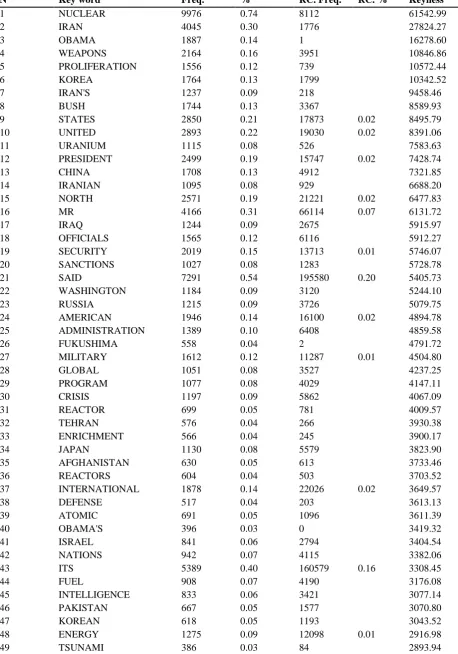
Following Baker (2010), the top 100 keywords in each corpus (Appendix 1) were subjected to
further qualitative checks and manual, context-sensitive interpretation (see also Baker and McEnery
2005; Baker 2006: 125). To do this, we used a combination of concordance and collocation data to
reveal cross-corpus variations in linguistic phenomena identified previously in the sample. Firstly,
senses and roles realised by the keywords were checked via concordance, whereby all the
occurrences of a particular search term in a corpus are presented within its linguistic context (Baker,
2006: 71). Concordance data was sorted for qualitative analysis, in particular it was ordered
2
The BNC is a monolingual, general corpus consisting of 100 million words of British English drawn from a range of different text-types produced towards the end of the 20th century. 90% of the corpus consists of written texts and 10% consists of spoken texts. Since the newspaper corpus included two US broadsheets, our analysis yielded a small number of keywords relating to stylistic differences in UK and US English, notably differences in orthography. However, while NEIGHBORS, TRAVELING, BEHAVIOR, FAVORED and HONOR occurred in the top 500 keywords in the newspaper corpus, only CENTER and PROGRAM occurred within the top 100 keywords. Of these, only PROGRAM was coded as a candidate for further analysis. In this case, it was regarded as an equivalent lexical item to
alphabetically according to other salient words which occurred to the left and to the right of the
keyword in question, in order to reveal regularities of co-occurrence within each corpus. Where it
was necessary to understand the broader context of a term, concordance lines were expanded and
longer sections of text were subjected to interpretative analysis. Secondly, data was examined
relating to the collocation of keywords, that is to say their tendency to appear in combination or in
the company of other words. Patterns of collocation occurring five words to the left and right of
each keyword were considered, and the most frequently occurring collocates were then selected in
order to consider the semantic implications of their co-occurrence with the keyword in question.
Finally, the linguistic data was grouped together under emergent themes relating to the three lines of
enquiry set out at the beginning of the paper. In the analysis that follows, keywords are set out in
capital letters (e.g. ‘IRAN’) and collocates are set in italics (e.g. said).
4. A comparison of UNSC resolutions and US/UK broadsheets
A comparative analysis of the hundred strongest keywords in each corpus revealed that most
salient lexical items fell into three categories signifying actors, strategic actions and technologies,
which therefore emerged as the principal constituents of the discourse of ‘nuclear proliferation’.
The majority of these lexical items - around half the strongest keywords in the newspaper corpus,
and around a third of those in the resolutions corpus – were constitutive of different actors,
especially nation states and human agents. The following section reports on how these two
prominent types of actor were constituted in the political and public spheres.
4.1.Actors
Twelve discrete nation states featured within the 100 strongest keywords within the newspaper
corpus. Of these, the most prominent were IRAN, KOREA, UNITED, STATES, and CHINA. By
contrast only seven discrete nations occurred within the strongest 100 keywords in the UNSC
resolutions, with IRAN and DPRK - the Democratic People's Republic of Korea - appearing as the
(n=41), activities (n=26) – often co-occurring in regularly recurring phrases describing ‘nuclear activities’. In particular, in the discourse of the UNSC resolutions, the noun ‘Iran’ is regularly
embedded within lengthy noun phrases which are the butt of some measure of a censure against the
country. For example, the idiosyncratic, technological phrase ‘Iran’s proliferation sensitive nuclear
activities‘ recurs 8 times across 5 different resolutions, e.g.
Calls upon all States to exercise vigilance regarding … individuals who are engaged in, directly associated with or providing support for Iran’s proliferation sensitive nuclear activities or for the development of nuclear weapon delivery systems.
Furthermore, compared with other countries Iran is positioned within the resolutions as the butt of
UNSC actions, especially as ‘receiver’ of verbal processes (after Halliday and Matthiessen, 2006)
as evidenced by the recurring phrases such as ‘persuade Iran…’ (n=9), ‘calls upon Iran…‘(n=7), ‘encourages Iran…’(n=6), and ‘urges Iran…’(n=1). as well as the mental process ‘review Iran’s
actions….’(n=4). Of the instances where Iran is actually accorded agency in the resolutions (n=86),
it is regularly (n=78) subject to some form of coercion or negative evaluation for non-compliance or
failure to carry out some prescribed action. For example in the concordance data extracted below
(Fig. 1), the data is sorted to display instances where IRAN co-occurs with not two places to the
right of the search term.
Figure 1 concordance data (UNSC resolutions): negative evaluation of Iranian actions
N Concordance
139 Tehran Research Reactor, regrets that Iran has not responded constructively to 140 and related materiel; 9. Decides that Iran shall not undertake any activity 141 , in the event that the report shows that Iran has not complied with resolution 142 in paragraph 23 above shows that Iran has not complied with this resolution 143 and 14 November 2006 (GOV/2006/64), Iran has not established full and
144 report of 8 June 2006 (GOV/2006/38) Iran has not taken the steps required of 145 Atomic Energy Agency (IAEA), Iran has not established full and
While there were only two UNSC resolutions relating to North Korea between 2006 and 2012,
nuclear again emerges as a collocate of the acronym ‘DPRK’ which was used to signify the state
actor (Resolution 1718, n=7; Resolution 1874, n=7) However, rather than the phrase ‘nuclear programme,’ phrases most commonly used to describe DPRK’s nuclear technology are
‘nuclear-related’ (n=4), ‘ballistic missile-related’ (n=4) and even (n=1) ‘WMD-related’, as exemplified in
the phrases ‘nuclear-related, ballistic missile-related and other weapons of mass destruction-related
programmes’. Like Iran, the DPRK is positioned in the resolutions corpus as the receiver of the
UNSC’s verbal processes, e.g.:
Calls upon the DPRK to join the Comprehensive Nuclear-Test-Ban Treaty (Resolution 1874);
Deploring the DPRK’s announcement of withdrawal from the NPT and its pursuit of nuclear weapons (Resolution 1874);
Demands further that the DPRK return to the Treaty on the Non-Proliferation of Nuclear Weapons and International Atomic Energy Agency (IAEA) safeguards (Resolution 1718).
In our broadsheets corpus, nuclear is also a collocate of IRAN (n=670), which in turn co-occurs
with North (n=244) and Korea (n=240). Nuclear appears in the phrases ‘nuclear Iran’ (n=53), ‘nuclear-armed Iran’ (n=25) and ‘nuclear-weapons-capable Iran’ (n=2), existential noun phrases
which never appear in the UNSC discourse. In the newspaper articles Iran is more often associated with the phrase ‘nuclear weapons’ (n=126) rather than the phrase ‘nuclear programme’ which is
exhibited in the UNSC discourse (n=39), as illustrated by Figure 2 below. Here, data is extracted
from concordance data relating to the collocation of nuclear with IRAN, sorted three words to the
right. It illustrates how the phrase ‘nuclear weapons’ preceded by the material processes ‘develop’, ‘achieve’, ‘get’, ‘acquire’ and ‘build’ is suggestive of a more immediate threat of attack.
Figure 2 concordance data (newspaper corpus): Iran associated with ‘nuclear weapons’
N Concordance
What is more striking, however, is the association of Iran with North Korea that takes place in
the discourse of the elite press. This stands in contrast to the UNSC discourse, which constructs
each country as an individual case. Furthermore, we can extract from concordance data several
examples where figurative language is used to achieve the ‘otherization’ of the collective adversary:
hyperbole, which projects exaggerated and unsubstantiated future actions onto these two states in
phrases such as ‘the nuclear ambitions of North Korea and Iran…’ and ‘the more potent threats of
North Korea and Iran …’; metaphor such as ‘efforts to deny gangsters in North Korea and Iran …’, ‘caught in a quagmire in North Korea and Iran …’, ‘greater threats loomed in North Korea and Iran
…’, ‘keys to the deadly puzzles of North Korea and Iran …’, ‘posturing being done by North Korea
and Iran …’; and even a touch of bathos, as in ‘small powers with small arsenals, i.e. North Korea and Iran.…’.
As well as nation states being constituted as prominent actors within the discourse of nuclear non-proliferation, named human agents are particularly salient within the broadsheets corpus, with
the two US Presidents of the period being strong keywords (OBAMA, LL 16278.6; BUSH, LL
8589.93). Our analysis suggests that the transatlantic broadsheets position the political leaders of
the principal nation states as protagonists in their accounts of nuclear proliferation. However,
non-nominalised signification of human agents also occurred, e.g. the title PRESIDENT as well as a
general category of governmental agents, OFFICIALS. Unsurprisingly, the names of the two
American leaders were collocates of PRESIDENT. However, after President the next most
frequently occurring collocate for both OBAMA and BUSH is the verbal process said (n=138,
n=178, respectively) e.g.
President Bush said Thursday that Iran has declared that it wants to be a nuclear power with a weapon to "destroy people," including others in the Middle East;
Mr. Obama said he wanted a new United Nations sanctions resolution against Iran ''that has bite''.
This suggests that, in the newspaper discourse which circulates within the public sphere, leadership
tends to be realised in terms of an agent who speaks rather than does; a leader is constituted as the
the UNSC corpus. In contrast to the public sphere, prominent actors in the UNSC documents are
collective, impersonal agents such as committees and different types of official. Of these, the IAEA
(International Atomic Energy Agency, n=255), also referred to as AGENCY (n=246) are both in the
top 100 keywords. In this respect, the IAEA is often referred to in the UNSC resolutions as the
external authorizing body tasked with providing evidence of the compliance or non-compliance of a
particular nuclear actor, e.g.:
Reaffirms that Iran shall without further delay take the steps required by the IAEA Board of Governors in its resolution GOV/2006/14, which are essential to build confidence in the exclusively peaceful purpose of its nuclear programme and to resolve outstanding questions.
However, we also find within the 100 strongest keywords GOVERNORS and BOARD – as in the formulaic phrase ‘Board of Governors’ (above), as well as other keywords invoking agents of the
‘doxa’, e.g. COMMITTEE, COMPANY, PANEL, DIRECTOR and EXPERTS. While the
anonymity of this lexis serves to evacuate these agents of any personal attributes, its technocratic
and occasionally hierarchical nature simultaneously imbues them with a certain power and authority
through their positioning within the UNSC bureaucracy.
4.2.Strategic actions
A second grouping of keywords signifies the form of strategic action typical of the different text
types which make up each corpus. At first sight, there appears to be some similarity between the
broadsheets and the UNSC resolutions, with the three strongest ‘strategic’ keywords being common
to both corpora: PROGRAMME/PROGRAM, PROLIFERATION and NON-PROLIFERATION.
Within the broadsheets, the salience of these last two words was driven in part by the fact that ‘proliferation’ was a search term to construct the corpus. However, there is one very marked
difference inasmuch as CRISIS appears as a strong keyword within the broadsheets corpus, but
does not occur at all within our sub-corpus of resolutions relating specifically to nuclear
and missile (n=15), as in the phrases ‘nuclear programme’ and ‘missile programme’. However,
intriguingly, peaceful also emerges as a collocate of PROGRAMME in the UNSC resolutions
(n=15). This combination usually occurs in the UNSC resolutions with reference to Iran in the emphatic, formulaic phrase, ‘which are essential to build confidence in the exclusively peaceful
purpose of its nuclear programme’ (n=4). Within the broadsheets corpus, collocates of PROGRAM
again signified either its apocalyptic nature - with nuclear (n=586), weapons (n=132), enrichment
(n=64), uranium (n=49), or its attribution – with Iran's (n=150), Iran (n=82), North (n=41) and
Korea's (n=35). Peaceful also featured as a collocate of PROGRAM in the broadsheets, although its
invocation is mitigated in 21 out of a total of 35 occurrences, in clauses such as such as in ‘Iran
contends that its nuclear program is for peaceful purposes…’.
While there is some blurring of the context of ‘crisis’ in the broadsheets corpus due to the
simultaneous occurrence of the financial crisis and the Fukishima nuclear accident during the
corpus period, collocates of CRISIS relevant to our enquiry include nuclear (n=626), Iran (n=72),
Iranian (n=62), global (n=49), North (n=48), Korea (n=26) and Korean (n=25). This emerges
from numerous direct attributions to specific actors, such as ‘Iranian nuclear crisis’, ‘Iran’s nuclear crisis’, ‘North Korean nuclear crisis’; however, the ‘nuclear crisis’ is also constructed as being
‘global’ in its scope: ‘…one more invasion might just do the job and solve the global crisis of
nuclear proliferation at the same time...’
Two collocates of PROLIFERATION in both corpora were not only nuclear (resolutions, n=70;
broadsheets n=1323), but also treaty (resolutions, n=22; broadsheets, n=150). However, another
subtle alteration in meaning occurs between the resolutions and the newspapers in as much as the words ‘nuclear’ and ‘proliferation’ only once combine within the resolutions corpus in the more
totalising phrase ‘nuclear proliferation’ - within a clause which militates against its existential
presence: ‘…effective IAEA safeguards are essential to prevent nuclear proliferation…’. In the
chemical and biological weapons’ and ‘proliferation-sensitive nuclear activities’ (particularly
associated with Iran). By contrast, the blunter combination ‘nuclear proliferation’ occurs regularly
within the newspaper corpus (n=1139). Even within the elite press, this phrase occurs as a collocate
(n=132) of terrorism, e.g.: ‘Terrorism and nuclear proliferation remain the predominant threats of our time…’. We suggest that this combination operates hyperbolically through yoking together two
of the threats to national security in the popular imagination into a single phrase. The broadsheets
also describe these threats as global – another collocate of PROLIFERATION (n=81) - in their
scope, e.g. here in an emphatic critique of Russia’s 2006 hosting of the G8:
… global leadership brings with it a responsibility to grapple seriously with global problems, of which nuclear proliferation is among the most pressing…
Apart from these three words, the key lexis signifying strategic action differs across the two
corpora. Within the resolutions corpus, other strong keywords which taken on their own would
appear to be relatively non-specific in their meaning, operate as the heads of complex evaluative
noun phrases when interpreted in the context of the genre. For example, ACTIVITIES regularly
co-occurs with nominalised forms that attribute minutely specified forms of NPT (Non-Proliferation
Treaty) infringements to the perpetrator, e.g. ‘enrichment-related and reprocessing activities, including research and development’, ‘Iran’s proliferation-sensitive nuclear activities or the
development of nuclear weapon delivery systems’ and ‘enrichment-related, reprocessing or heavy
water-related activities or to the development of nuclear weapon delivery systems’. PURPOSES
also combines frequently with peaceful (n=23) and nuclear (n=11) in phrases such as ‘…Iran’s
nuclear programme is for exclusively peaceful purposes,…’. By contrast with these two generalised
words, which achieve specificity through their extension and nominalisation, two other resolution
keywords SAFEGUARDS and VIGILANCE refer to procedures which become reified through
their association with institutional processes. For example, SAFEGUARDS refers to the
Comprehensive Safeguards Agreement, a contract that non-nuclear-weapon states are required to
or other explosive devices’. VIGILANCE also combines regularly with the verb exercise (n=15)
and States (n= 12) in phrases such as:
‘…calls upon all States to exercise vigilance and restraint over the supply, sale, transfer, provision, manufacture and use of all other arms and related materiel’.
By contrast, within the broadsheets corpus the theme of sanctions appears to be a recurrent topic,
while not being at all salient in the UNSC corpus. SANCTIONS often relate to Iran, which appears
as the most frequently occurring collocate (n= 175), and are regularly economic (n=73) in their nature. ‘Sanctions’ also appears in the company of a range of adversarial lexis, such as the
preposition against (n=127) and the verb ‘impose’ (impose, n=36; imposed, n=33; imposing,
n=16), as well as tougher (n=33), pressure (n=25), tough (n=18) and threat (n=13). However, part
of the reason for the greater salience of SANCTIONS within the broadsheets corpus is that much of
vocabulary surrounding it is speculative, such as the modal verb phrase in this clause, ‘The security
council could impose worldwide sanctions but such a proposal could be vetoed by Russia or China’.
SECURITY also emerges as a strong keyword, often emerging as a concept that comes reified within the proper name of organisations, not least the ‘United Nations Security Council, but also the
U.S. ‘National Security Council’. Where security is referenced existentially, it is either attributed to
the collectivity of the writer and the reader of the newspaper by being pre-modified by our (n=96), e.g. ‘It is, we are told, "rogue states" that now imperil our security’; or comes pre-modified by some
indication of its scope. The most frequent collocate of this type is global (n=48) often invoked in
the context of expressing severe concerns, here with reference to the UNSC itself: ‘the structure
created to maintain global security is failing’.
4.3.Technologies
The leitmotif of both corpora is a distinctive lexis which describes different forms of technology
relating to nuclear weapons. Within the resolutions corpus, NUCLEAR emerged as one of the two
contention. Due to its inclusion as a search term, NUCLEAR was also the strongest keyword within
the broadsheets corpus. Some collocates of NUCLEAR were common to both corpora - in
particular Iran (resolutions, n=78; broadsheets, n=1,066) often in clauses and phrases signifying it
as a perpetrator of proliferation, as well as weapons (resolutions, n=58; broadsheets, n=1,363),
programme (resolutions, n=55)/program (broadsheets, n=557) and proliferation (resolutions,
n=32; broadsheets, n=1,187). While the combination ‘nuclear weapons’ occurs regularly within
both corpora, weapons appears particularly within the resolutions in the complex nominal phrases
which often typify more technical texts such as full references to the NPT (‘Treaty on the
Non-Proliferation of Nuclear Weapons’) and repeated phrases such as ‘proliferation of nuclear, chemical
and biological weapons’. While Iran and program(me) co-occur in both corpora in a recurrent
nominalisation of the actor’s culpability, the contextualisation tends to vary across the two different
text types, e.g.
Emphasizing the importance of political and diplomatic efforts to find a negotiated solution guaranteeing that Iran’s nuclear programme is exclusively for peaceful purposes…
…weigh the risks of a failure to impede Iran's nuclear program sufficiently against the risks of a military strike.
The first excerpt above, from Resolution 1747, stresses fairly unambiguously that Iran still has the
right to develop its nuclear programme for ‘peaceful purposes’; however the second extract from a
Washington Post editorial is fairly typical of the broadsheets in engaging in a sustained
problematisation of the choice between diplomatic and military intervention, particularly by the
USA.
The differences between the collocates of NUCLEAR across the two corpora also underline the
much more measured tone of the resolutions. As we have seen, uniquely within the newspaper
corpus, we find the word crisis registering as a frequently occurring collocate of NUCLEAR
(n=626). While some of this attribution is related to the Fukishima nuclear accident, which also
(n=18), ‘the Iranian nuclear crisis’ (n=57) and ‘the North Korean nuclear crisis’ (n=19). However,
other collocates include weapons (n=1,333), proliferation (n=1,187), Iran (n=1,066) and power
(n=673). These words can occur in such blatant dramatisations of events as this extract from the
Washington Post (2009):
Ahmadinejad sat without obvious reaction as Obama chided Iran for its pursuit of nuclear weapons, saying its actions -- and similar efforts by North Korea -- "threaten to take us down this dangerous slope" that makes the world less secure.
By contrast, collocates of NUCLEAR within the resolutions corpus include more technical
language, which also conveys a greater degree of positivity than we find in the broadsheets,
development (resolutions, n=49), activities (resolutions, n=46), peaceful (resolutions, n=42) and
non-proliferation (resolutions, n=34). This emerges quite markedly in expressions of intent such as:
Our goal is to develop relations and cooperation with Iran, based on mutual respect and the establishment of international confidence in the exclusively peaceful nature of the nuclear programme of the Islamic Republic of Iran;
as well as in repeated phrases such as ‘proliferation-sensitive nuclear activities’ or ‘the development
of nuclear weapon delivery systems’, which appear relatively value-neutral through their
complexity of nominalisation.
Both corpora are distinguished by the range of lexis relating to the technology of nuclear proliferation. While ‘nuclear’ is used to typify the set of events which are unfolding, another set of
lexical items signify the material which is involved in nuclear weapons proliferation. Common
keywords relating to technology which are common to both corpora include ENERGY, MISSILE,
WEAPONS, URANIUM, ENRICHMENT, as well as WEAPON. While the three most frequently
occurring collocates of ENERGY, atomic (resolutions, n=15; broadsheets, n=357), international
(resolutions, n=13; broadsheets, n=289) and agency (resolutions, n=11; broadsheets, n=309)
combine in the nominal group ‘International Atomic Energy Agency’, it is notable that peaceful is
also a collocate in both corpora (resolutions, n=16; broadsheets, n=47), e.g.
Under the nuclear non-proliferation treaty (NPT), to which Tehran is a signatory, Iran has the right to a peaceful nuclear energy programme,… (Borger, 2010).
Along with many other articles, the Guardian echoes the resolutions in upholding Iran’s right as a signatory for the NPT to maintain a nuclear energy programme as long as it is ‘peaceful’.3
While mass (resolutions, n=18; broadsheets, n=102) and destruction (resolutions, n=17;
broadsheets, n=101) both collocate with WEAPONS, co-occurring in the phrase ‘weapons of mass destruction’, chemical (n=24) and biological (n=23) only collocate with WEAPONS in the
resolutions corpus, as shown here in the repeated clause (n=5):
Determining that proliferation of nuclear, chemical, and biological weapons, as well as their means of delivery, continues to constitute a threat to international peace and security.
However, world (n=64) only emerges as a collocate of WEAPONS in the newspaper corpus, which
can also occasionally indulge in a note of optimism not found within the resolutions, recurring regularly in the phrase ‘world free of nuclear weapons’, here in an overgeneralised
recontextualisation of Resolution 1887:
President Obama hailed the unanimous passing of an "historic" UN Security Council resolution aimed at
ridding the world of nuclear weapons.
5. Discussion: rules of formation
In the analysis above, we have uncovered some of the distinctive regularities and combinations
of lexis by which nuclear proliferation is constituted through a dynamic network of texts which
create, maintain and transmit meanings within and across the political and public spheres. Through
our comparative keyword analysis, we have identified three principal categories in each corpus:
actors, strategic actions and technologies. In many cases, our qualitative consideration of
collocation and concordance data has suggested that these categories were constituted differently in
3A comparative concord analysis of the relative frequency of ‘peaceful’ across the broadsheets in our corpus would
suggest that there is some variability in this debate. However, on a quantitative analysis, the more liberal UK paper the
Guardian does not emerge as the newspaper which is necessarily most concerned to reposition this aspect of the UN discourse. Of 1608 occurrences in the broadsheet corpus, ’peaceful’ occurs: 98 times in the New York Times, with the collocates purposes (n=26) and nuclear (n=43); 43 times in the Guardian, with the collocates purposes (n=9) and
the different types of text. We suggest that these contradictions, changes and transformations do not
indicate a lack of coherence, but rather point to certain strategies which are operationalized as these
categories are delocated from one site and relocated within another site. In this respect, our
approach resembles that of Mehan et al., who describe their (1990) analysis of multiple texts
relating to the Cold War as ‘a constitutive approach to discourse’ (158) which ‘…shows how the
meaning of events is constructed in reciprocal interaction’ (137). However, while Mehan et al. view
this multi-voicedness as a form of ‘polyphony’ (Bakhtin, 1981, Mehan et al., 1990), we rather describe the ‘rules of formation’ of nuclear proliferation discourse in terms of ‘the conditions to
which the elements of this discourse (objects, mode of statement, concepts, thematic choices) are subjected’ (Foucault, 1972: 38).
As nuclear proliferation discourse is delocated from the political sphere and relocated in the
public sphere, the roles of individual actors become more prominent. In particular, the names of
more nation states and their leaders feature more prominently in the broadsheets than in the
resolutions. We suggest that this realises the first discursive strategy, that of personalisation. In
part, it reflects the contextual positioning of the two sets of documents under scrutiny. The
resolutions are generated by the UNSC members – not least the five permanent members, China,
France, Russia, the UK and USA - and speak to those in infringement of the NPT. By contrast, the
broadsheets analysed describe relations between the most powerful players on the UNSC and the
alleged perpetrators of the proliferation of nuclear weapons, Iran and North Korea. The difference
in the occurrence of proper names reflects this relationship – the presence of the five permanent
UNSC members is presupposed and therefore remains implicit within the resolutions, whereas
China, France, Russia, the UK and USA remain actors who are external to the broadsheets and
therefore require explicit mention. We have also seen that the resolutions exercise an overwhelming
rhetorical force, and invoke the military and economic authority of the five most powerful nations
in the world against the two principal NPT infringers, Iran and the DPRK, who are both positioned
non-compliance with UNSC statements. Since even newspapers which report on political matters aim to
entertain as well as to inform (Östgaard 1965), one outcome is to describe a state of affairs in a way
which is amenable for popular consumption. An effect of this is to highlight the role of national
leaders, and constitute them as protagonists in relation to the unfolding of events. This is realised
not so much through 'material' or 'behavioural' processes (after Halliday and Matthiesen, 2006) but
rather through ‘verbal’ processes, and in particular the verbal process ‘say’. More than anything
else, a national leader is constructed in the national press as the one who speaks on the topic of the
day, here nuclear proliferation. This contrasts with the elision of the names of national leaders
within UNSC resolutions. The particular prominence given to the role of the IAEA also accords
with insights afforded by the elite interviews from the wider CliGG database, in which the IAEA
was often attributed with more authority than the UNSC itself.
Secondly, in relation to the realisation of strategic actions across the different text types, there
appears to be a dramatisation of events for consumption in the public sphere which is not supported
by the starker lexis deployed in the political sphere. The introduction of the word ‘crisis’ to describe the ‘nuclear contention’ (Rasti and Sahragard, 2012) within the broadsheets is the most striking
finding in this regard. The series of elite interviews that we undertook under the wider remit of the
CliGG project also intimated that neither professional nor elected officials working in the political
sphere believed that nuclear proliferation was regarded as a ‘crisis’ in the political sphere. However,
the broadsheets used the term, not just in relation to specifically regional events that unfolded over
this period in Iran and on the Korean peninsula, but also in relation to global events. In this respect,
not only was nuclear proliferation constructed in the public sphere as having a ‘global’ significance;
but it was also linked within the newspapers to other ‘exceptional’ phenomena such as ‘terrorism’ and ‘climate change’. In this respect, elite newspapers on both sides of the Atlantic appear to
subscribe readily to the doctrine of exceptionalism (Agamben, 2005). However on our reading, the
discursive strategy of the resolution is very much the opposite, framing nuclear proliferation in
version of nuclear proliferation, invested as it is with both the military and rhetorical power of the
five permanent members of the Security Council.
Third, descriptions of nuclear weapons technologies also appear to become reified as they move
from the political sphere to the public sphere. Within the resolutions, actions relating to nuclear
weapons technologies are nominalised in highly specific, complex phrases. By contrast, within the
public sphere the lexis of these phrases tends to become foreshortened and condensed, often to the phrase ‘nuclear proliferation’ - a singular, coagulated concept into which a more variegated
panoply of lexis is collapsed, such as the ‘development’, ‘activities’ and ‘programmes’ which are
carried out by Iran and North Korea. While this reified term detracts from the precision of the
central concept of this discursive formation, its concision and repetition renders it easier to grasp as
a focus of aggression and antipathy on the part of citizens and decision makers alike.
In conclusion, the findings of this paper appear to support our initial thesis that a convergence of
international events such as nuclear proliferation is not a static phenomenon which is constituted
within any one particular set of texts. In this respect, the exploration of corpora drawn exclusively
from a national press (e.g. Behnam and Zenouz, 2008; Izadi and Saghaye-Biria, 2007; Jiang, 2007;
Min, 1999; Rasti and Sahragard, 2012) - while useful and insightful at a particular stage in the
development of critical discourse studies - can only give a partial account of how a particular set of
events is constituted in the dynamic relations that operate within and between different text types.
By contrast, our exploration of nuclear proliferation has identified three discursive strategies which
are deployed as meanings circulate from one site to another: in relation to actors, personalisation; in
relation to strategic actions, normalisation versus exceptionalisation; and in relation to
technologies, reification. These strategies are signalled by the changes, transformations and
contradictions in the lexis which realise the ‘elements’ of nuclear proliferation as it is constituted
Acknowledgements
We would like to thank members of the Global Research Priorities (Global Governance) and the
Professional and Academic Discourse research groups at Warwick University for their advice and
encouragement. We would also like to thank Paul Baker for the judicious editorial care which he
brought to this paper. The research was supported by a University of Warwick Strategic Award
Bionotes
Malcolm N. MacDonald is Associate Professor in Applied Linguistics, University of Warwick,
England. His main research interests lie in institutional discourse, with a particular interest
in security discourse and medical discourse.
Alexandra Homolar is Associate Professor of International Security in the Department of Politics
and International Studies. Her research focuses on the political economy of security,
international security governance, and US defence and security policy.
Lena Rethel is Associate Professor in International Political Economy at the University of
Warwick. She works on global financial governance and financial development in Southeast
Asia. Her book The Problem with Banks (co-authored with Timothy J. Sinclair) was
published by Zed Books in 2012.
Stephanie Schnurr is Associate Professor in Applied Linguistics at the University of Warwick..
Stephanie is also the author of Leadership Discourse at Work. Interactions of Humour,
Gender and Workplace Culture (Palgrave Macmillan 2009) and Exploring Professional
Communication. Language in Action (Routledge 2012).
Rachelle Vessey is Lecturer in Applied Linguistics in the School of Education, Communication,
and Language Sciences at Newcastle University. Her PhD explored language ideologies and
References
Agamben, G. (2005) State of Exception. Chicago: University of Chicago Press.
Baker, P. (2006) Using Corpora in Discourse Analysis. London: Continuum.
Baker, P. and T. McEnery (2005) ‘A corpus-based approach to discourses of refugees and asylum
seekers in UN and newspaper texts’, Journal of Language and Politics 4: 197–226.
Bakhtin, M. (1981) The Dialogic Imagination. Four Essays. Austin: University of Texas Press.
Behnam, B. and R. M. Zenouz (2008) ‘A contrastive critical analysis of Iranian and British
newspaper reports on the Iran nuclear power program’. In: Nørgaard N (ed.) Systemic
Functional Linguistics in Use. Odense: University of Southern Denmark, Odense Working
Papers in Language and Communication, vol. 29, pp. 199–218.
Borger, J. (2012). Much rests on Iran's mood as UN nuclear team starts tricky task, The Guardian,
21 February, p. 21.
British National Corpus, version 3 (BNC XML Edition) (2007) Distributed by Oxford University
Computing Services on behalf of the BNC Consortium. URL: http://www.natcorp.ox.ac.uk/
Foucault, M. (1972) The Archaeology of Knowledge. London: Tavistock.
Halliday, M. A. K. and C. M. I. M. Matthiessen (2006) Construing Experience through Meaning: A
Language-Based Approach to Cognition. London: Continuum.
Houtart, F. (2010) ‘The Multiple Crisis and Beyond’, Globalizations 7: 9-15.
Izadi, F. and H. Saghaye-Biria (2007) ‘Discourse analysis of elite American newspaper editorials: The case of Iran’s nuclear program’, Journal of Communication Inquiry 31: 140–165.
Kress, G and R. Hodge (1979). Language and Ideology. Routledge.
Mehan, H., C. E. Nathanson and J. M. Skelly (1990) ‘Nuclear Discourse in the 1980s: The
Min, S. J. (1999) ‘Strategies of constructing meaning: A critical discourse analysis of news on the
North Korean nuclear threat’. I.T.L. Institut voor Togepaste Linguistik 123-24:1-35.
Östgaard, E. (1965). ‘Factors Influencing the Flow of News’. Journal of Peace Research 2: 39-63.
Rasti, A. and R. Sahragard (2012) ‘Actor analysis and action delegitimation of the participants
involved in Iran's nuclear power contention: A case study of The Economist’, Discourse and
Society 23: 729- 48.
Scott, M. (2008) Wordsmith Tools Version 5. Liverpool: Lexical Analysis Software Ltd.
Stubbs, M. (1996) Text and Corpus Analysis: Computer-Assisted Studies of Language and Culture.
Oxford: Blackwell.
United Nations Security Council (2006) Non-proliferation/Democratic People's Republic of Korea,
Resolution S/RES/1718 (14 October 2006), available from http://www.un.org/en/sc/
documents/resolutions/2006.shtml.
United Nations Security Council (2009). Non-proliferation/Democratic People's Republic of Korea.
Resolution S/RES/1874 (12 June 2009), available from http://www.un.org/en/sc/documents/
resolutions/2009.shtml.
United Nations Security Council (2010). Non-proliferation. Resolution S/RES/1929 (9 June 2010),
Appendix
Table 3 Broadsheets corpus: 100 strongest keywords
N Key word Freq. % RC. Freq. RC. % Keyness
1 NUCLEAR 9976 0.74 8112 61542.99
2 IRAN 4045 0.30 1776 27824.27
3 OBAMA 1887 0.14 1 16278.60
4 WEAPONS 2164 0.16 3951 10846.86
5 PROLIFERATION 1556 0.12 739 10572.44
6 KOREA 1764 0.13 1799 10342.52
7 IRAN'S 1237 0.09 218 9458.46
8 BUSH 1744 0.13 3367 8589.93
9 STATES 2850 0.21 17873 0.02 8495.79
10 UNITED 2893 0.22 19030 0.02 8391.06
11 URANIUM 1115 0.08 526 7583.63
12 PRESIDENT 2499 0.19 15747 0.02 7428.74
13 CHINA 1708 0.13 4912 7321.85
14 IRANIAN 1095 0.08 929 6688.20
15 NORTH 2571 0.19 21221 0.02 6477.83
16 MR 4166 0.31 66114 0.07 6131.72
17 IRAQ 1244 0.09 2675 5915.97
18 OFFICIALS 1565 0.12 6116 5912.27
19 SECURITY 2019 0.15 13713 0.01 5746.07
20 SANCTIONS 1027 0.08 1283 5728.78
21 SAID 7291 0.54 195580 0.20 5405.73
22 WASHINGTON 1184 0.09 3120 5244.10
23 RUSSIA 1215 0.09 3726 5079.75
24 AMERICAN 1946 0.14 16100 0.02 4894.78
25 ADMINISTRATION 1389 0.10 6408 4859.58
26 FUKUSHIMA 558 0.04 2 4791.72
27 MILITARY 1612 0.12 11287 0.01 4504.80
28 GLOBAL 1051 0.08 3527 4237.25
29 PROGRAM 1077 0.08 4029 4147.11
30 CRISIS 1197 0.09 5862 4067.09
31 REACTOR 699 0.05 781 4009.57
32 TEHRAN 576 0.04 266 3930.38
33 ENRICHMENT 566 0.04 245 3900.17
34 JAPAN 1130 0.08 5579 3823.90
35 AFGHANISTAN 630 0.05 613 3733.46
36 REACTORS 604 0.04 503 3703.52
37 INTERNATIONAL 1878 0.14 22026 0.02 3649.57
38 DEFENSE 517 0.04 203 3613.13
39 ATOMIC 691 0.05 1096 3611.39
40 OBAMA'S 396 0.03 0 3419.32
41 ISRAEL 841 0.06 2794 3404.54
42 NATIONS 942 0.07 4115 3382.06
43 ITS 5389 0.40 160579 0.16 3308.45
44 FUEL 908 0.07 4190 3176.08
45 INTELLIGENCE 833 0.06 3421 3077.14
46 PAKISTAN 667 0.05 1577 3070.80
47 KOREAN 618 0.05 1193 3043.52
48 ENERGY 1275 0.09 12098 0.01 2916.98
50 WAR 1833 0.14 27222 0.03 2881.52
51 FOREIGN 1410 0.10 16065 0.02 2805.42
52 PERCENT 725 0.05 2926 2699.36
53 JAPAN'S 532 0.04 958 2677.34
54 POWER 1862 0.14 31627 0.03 2548.77
55 AGENCY 868 0.06 5645 2533.20
56 TERRORISM 469 0.03 690 2503.89
57 AHMADINEJAD 286 0.02 0 2469.49
58 PLANT 967 0.07 8002 2431.42
59 CLINTON 566 0.04 1676 2398.75
60 BOMB 670 0.05 2948 2397.24
61 RADIATION 546 0.04 1712 2262.49
62 KOREA'S 315 0.02 118 2215.81
63 PUTIN 254 0.02 0 2193.18
64 KHAN 423 0.03 692 2190.87
65 HAS 6507 0.48 252703 0.25 2174.27
66 MCCAIN 265 0.02 22 2133.47
67 TOKYO 456 0.03 1031 2131.93
68 MISSILE 432 0.03 865 2102.75
69 TEPCO 245 0.02 2 2092.27
70 EARTHQUAKE 373 0.03 478 2066.80
71 CHINESE 671 0.05 4153 2014.23
72 CHINA'S 376 0.03 564 1996.50
73 COUNTRIES 1174 0.09 16575 0.02 1936.98
74 WORLD 2217 0.16 53806 0.05 1923.77
75 PAKISTANI 334 0.02 380 1907.31
76 THREAT 717 0.05 5568 1878.77
77 TALKS 768 0.06 6655 1872.10
78 INDIA 638 0.05 4295 1824.75
79 CENTRIFUGES 221 0.02 14 1802.48
80 BEIJING 335 0.02 523 1758.72
81 THAT 19421 1.44 1052259 1.06 1697.01
82 QAEDA 195 0.01 0 1683.73
83 RUSSIAN 660 0.05 5362 1679.62
84 DAIICHI 197 0.01 2 1678.67
85 NONPROLIFERATION 194 0.01 0 1675.09
86 ADMINISTRATION'S 259 0.02 179 1648.65
87 CENTER 315 0.02 503 1643.01
88 ANTI 296 0.02 378 1641.62
89 COM 274 0.02 281 1604.11
90 ENRICHED 286 0.02 352 1601.32
91 LEADERS 718 0.05 7201 1577.10
92 IRANIANS 255 0.02 209 1568.75
93 BARACK 180 0.01 0 1554.21
94 ISRAELI 406 0.03 1569 1541.09
95 DIPLOMACY 307 0.02 559 1539.70
96 KAN 195 0.01 24 1532.98
97 NATO 382 0.03 1305 1528.60
98 KIM 375 0.03 1249 1516.38
99 NON 372 0.03 1241 1503.00
Table 4 Resolutions corpus: 100 strongest keywords
N Key word Freq. % RC. Freq. RC. % Keyness
1 IRAN 340 1.02 345 0.05 1136.72
2 NUCLEAR 292 0.88 308 0.05 961.22
3 IAEA 192 0.58 208 0.03 624.85
4 OR 527 1.59 3041 0.47 497.94
5 PROGRAMME 90 0.27 220 0.03 191.11
6 DPRK 59 0.18 74 0.01 180.35
7 RESOLUTION 444 1.34 4138 0.64 177.75
8 ITEMS 60 0.18 84 0.01 174.46
9 GOV 48 0.14 49 159.74
10 GOVERNORS 46 0.14 46 154.31
11 RESEARCH 47 0.14 54 149.15
12 ENERGY 48 0.14 59 148.01
13 TECHNOLOGY 44 0.13 47 143.84
14 NPT 41 0.12 41 137.53
15 MISSILE 44 0.13 54 135.76
16 WEAPONS 83 0.25 302 0.05 129.29
17 COMMITTEE 223 0.67 1744 0.27 129.27
18 TREATY 47 0.14 76 0.01 127.28
19 STATES 261 0.79 2256 0.35 123.67
20 NON-PROLIFERATION 42 0.13 60 120.94
21 IRANIAN 36 0.11 36 120.75
22 PROLIFERATION 49 0.15 97 0.02 118.74
23 BOARD 55 0.17 135 0.02 116.42
24 MATERIALS 37 0.11 54 105.45
25 INDUSTRIES 39 0.12 65 0.01 103.96
26 COMPANY 32 0.10 37 101.27
27 WEAPON 29 0.09 30 96.00
28 TEHRAN 28 0.08 28 93.91
29 PANEL 66 0.20 265 0.04 93.74
30 THAT 454 1.37 5334 0.83 91.46
31 BALLISTIC 30 0.09 38 91.28
32 OWNED 38 0.11 81 0.01 88.08
33 DIRECTOR 30 0.09 42 87.21
34 CONTROLLED 36 0.11 75 0.01 84.62
35
ENRICHMENT-RELATED 25 0.08 25 83.85
36 DELIVERY 52 0.16 184 0.03 83.01
37 EXCLUSIVELY 29 0.09 42 82.95
38 ACTIVITIES 104 0.31 687 0.11 80.32
39 SENSITIVE 27 0.08 36 80.28
40 IS 130 0.39 1005 0.16 76.88
41 SAFEGUARDS 27 0.08 40 76.39
42 REPROCESSING 22 0.07 22 73.79
43 GOODS 28 0.08 48 73.53
44 FUEL 26 0.08 39 73.11
45 THEIR 223 0.67 2250 0.35 72.45
46 INDUSTRIAL 21 0.06 21 70.43
47 SUCH 128 0.39 1037 0.16 69.18