warwick.ac.uk/lib-publications
A Thesis Submitted for the Degree of PhD at the University of Warwick
Permanent WRAP URL:
http://wrap.warwick.ac.uk/87431
Copyright and reuse:
This thesis is made available online and is protected by original copyright.
Please scroll down to view the document itself.
Please refer to the repository record for this item for information to help you to cite it.
Our policy information is available from the repository home page.
Characterising molecular self-assembly using high-resolution
1
H solid-state NMR spectroscopy
by
Aiden James Robertson
Thesis
Submitted to the University of Warwick
for the degree of
Doctor of Philosophy
Department of Physics
Contents
List of Tables ... v
List of Figures ... vi
Acknowledgements ... x
Declarations ... xi
Abstract ... xii
Abbreviations ………...xiii
Chapter 1 : Thesis Introduction ... 1
1.1 Introduction ... 2
1.2 Introduction to solid-state NMR ... 2
1.3 Introduction to molecular self-assembly ... 7
1.3.1 Examples and solid-state characterisation of self-assembled materials ... 10
1.3.2 Noncovalent interactions and solid-state NMR ... 12
1.4 An experimental example ... 13
1.5 Introduction to DFT and the GIPAW method... 15
1.6 Thesis overview ... 16
Chapter 2 : Theoretical concepts in solid-state NMR spectroscopy ... 19
2.1 Spin angular momentum and the basics of an NMR experiment ... 20
2.1.1 Angular momentum operators ... 24
2.2 The density operator ... 26
2.2.1 The density operator at equilibrium ... 28
2.2.2 The time evolution of the density operator ... 28
2.3 Hamiltonians ... 30
2.3.1 External interactions ... 31
2.3.2 Oscillating radiofrequency magnetic fields ... 31
2.3.3 Evolution under a resonance offset ... 33
2.3.4 Product operators ... 34
2.4.1 Rotations ... 38
2.4.2 The secular approximation ... 41
2.4.3 Chemical shielding ... 41
2.4.4 Dipolar coupling ... 45
2.4.5 Interactions under magic angle spinning... 50
2.4.6 Scalar coupling ... 52
2.4.7 The quadrupolar interaction ... 53
Chapter 3 : Experimental methods in solid-state NMR spectroscopy ... 59
3.1 One-dimensional lineshapes and phase ... 60
3.2 Two-dimensional lineshapes ... 62
3.2.1 States, TPPI and States-TPPI acquisition... 64
3.2.2 Coherence transfer pathways and phase cycling ... 65
3.3 Experimental techniques in solid-state NMR – dipolar decoupling ... 67
3.3.1 Dipolar decoupling ... 67
3.3.2 Heteronuclear dipolar decoupling ... 67
3.3.3 Homonuclear dipolar decoupling ... 68
3.4 Experimental techniques in solid-state NMR – dipolar recoupling ... 69
3.4.1 Cross polarisation ... 70
3.4.2 Homonuclear dipolar recoupling: the DQ/SQ MAS experiment ... 72
3.4.3 1H – 1H spin diffusion experiment ... 74
3.4.4 Refocused INEPT ... 75
3.4.5 Heteronuclear dipolar recoupling: the HMQC MAS experiment ... 76
3.5 Experimental and computational details ... 79
3.5.1 Chemical shift referencing ... 79
3.5.2 Experimental solid-state NMR ... 79
3.5.3 GIPAW calculations ... 80
4a.2 Experimental details ... 83
4a.2.1 Sample preparation ... 83
4a.3 Results ... 83
4a.3.1 A NMR crystallographic study of 4-3 ... 83
4a.3.2 The packing of 4-4 and 4-5 in the solid state ... 90
4a.3.3 The importance of the pivaloylamide group ... 96
4a.4 Summary ... 100
4b.1 Introduction ... 101
4b.2 Experimental details ... 102
4b.2.1 Sample preparation ... 102
4b.3 Results ... 102
4b.3.1 One-pulse 1H MAS NMR results ... 102
4b.3.2 Two-dimensional 1H MAS NMR data for 4-6 ... 104
4b.3.3 A 1H – 13C CP MAS spectrum of 4-6 ... 108
4b.3.4 Two-dimensional 1H MAS NMR data for 4-7 ... 109
4b.3.5 A 1H – 13C CP MAS spectrum of 4-7 ... 114
4b.3.6 Summary ... 114
Chapter 5 : A study of the self-assembling properties of deoxycytidine analogues by 1H and 14N fast 2D MAS NMR ... 116
5.1 Introduction ... 117
5.2 Experimental details ... 118
5.2.1 Sample preparation ... 118
5.3 Results ... 118
5.3.1 An NMR crystallographic study of 5-2 ... 118
5.3.2 Solid-state structure of related precursor 5-1 ... 130
5.3.3 The helical assembly of 5-3 ... 133
5.4 Summary ... 139
Chapter 6 : A study of the hydrogen bonding propensity of pyrimidine-based systems ... 140
6.2 Experimental details ... 142
6.2.1 Sample preparation ... 142
6.3 Results ... 142
6.3.1 Aldehyde containing compounds: 6-1 and 6-2 ... 142
6.3.2 BOC protected and non-protected oxime precursors: 6-3a/6-3b ... 149
6.3.3 Nitrile precursors: 6-4 and 6-5 ... 155
6.3.4 1H – 1H DQ/SQ MAS spectrum of 6-6 ... 160
6.3.5 Synthetic challenges and compound 6-7 ... 163
6.4 Summary ... 164
Chapter 7 : The use of a selective saturation pulse to suppress t1 noise in two-dimensional 1H fast MAS solid-state NMR spectroscopy ... 165
7.1 Introduction ... 166
7.2 Experimental details ... 168
7.2.1 Sample preparation ... 168
7.2.2 Solid-state NMR experimental details ... 168
7.3 Results ... 170
7.3.1 One-dimensional 1H MAS NMR spectra under a selective pulse ... 170
7.3.2 1H – 1H spin-diffusion MAS NMR spectra ... 174
7.3.3 1H – 1H DQ/SQ MAS NMR spectra ... 176
7.3.4 14N – 1H HMQC MAS NMR spectra ... 178
7.4 Summary ... 180
Chapter 8 : Thesis Summary ... 182
8.1 Thesis summary ... 183
Chapter 9 : References ... 186
List of Tables
4.1 1H NMR/GIPAW parameters for 4-3 85
4.2 14N NMR/GIPAW parameters for 4-3 86
4.3 1H DQ correlations for 4-3 89
4.4 1H DQ correlations for 4-4 95
4.5 1H DQ correlations for 4-5 96
4.6 1H DQ correlations for 4-2 98
4.7 1H DQ correlations for 4-6 106
4.8 1H DQ correlations for 4-7 113
5.1 1H NMR/GIPAW parameters for 5-2 119
5.2 14N NMR/GIPAW parameters for 5-2 120
5.3 1H DQ correlations for 5-2 125
5.4 1H DQ correlations for 5-1 131
5.5 1H DQ correlations for 5-3 136
6.1 1H DQ correlations for 6-1 148
6.2 1H DQ correlations for 6-2 148
6.3 1H DQ correlations for 6-3a 154
6.4 1H DQ correlations for 6-3b 155
6.5 1H DQ correlations for 6-4 159
6.6 1H DQ correlations for 6-5 159
6.7 1H DQ correlations for 6-6 162
List of Figures
1.1 The basic concept of molecular self-assembly 9
1.2 Schematic representation of the structure of 1-1 13
1.3 1H – 1H DQ/SQ MAS spectrum of 1-1 14
2.1 Energy level diagram for a single spin-½ nucleus 20
2.2 The effect of an rf pulse on the magnetisation vector 22
2.3 The product operators for an isolated spin-½ nucleus 36
2.4 Vector representation of several product operators for a two-spin IS system 37
2.5 Euler angles in a Cartesian coordinate system 40
2.6 Energy level diagrams for a dipolar coupled spin-½ pair 46
2.7 Simulated lineshape for a dipolar coupled heteronuclear spin-½ pair 49
2.8 Energy level transitions in the homonuclear instance 49
2.9 A rotor aligned at the magic angle 51
2.10 The expansion of charge distribution as a series of multipoles 53
2.11 The perturbation of Zeeman energy levels for a spin-1 nucleus 56
3.1 Quadrature detection 61
3.2 DQ/SQ MAS pulse sequence 65
3.3 Cross polarisation pulse sequence 71
3.4 The BABA and BaBa-xy16 sequences 73
3.5 DQ/SQ MAS sequence alongside schematic representation of a typical spectrum 74
3.6 1H – 1H spin diffusion sequence and schematic spectrum 75
3.7 1H – 13C refocused INEPT pulse sequence 76
3.8 14N – 1H HMQC pulse sequence 77
4.1 The structures of the pterin and pterin-inspired molecular subunits 82
4.4 The major rotameric forms of 4-3 85
4.5 1H – 1H DQ/SQ MAS spectrum of 4-3 together with GIPAW calculated 1H shifts 88
4.6 14N – 1H HMQC spectrum of 4-3 together with GIPAW calculated 14N shifts 89
4.7 1H – 1H DQ/SQ MAS spectrum of 4-4 92
4.8 1H – 1H DQ/SQ MAS spectrum of 4-5 93
4.9 Comparison of 1H one-pulse spectra of 4-3, 4-4 and 4-5 94
4.10 Potential prototropic tautomers of 4-5 95
4.11 1H – 1H DQ/SQ MAS spectrum of 4-2 97
4.12 Potential dimeric arrangements of 4-2 98
4.13 1H – 1H DQ/SQ MAS and 14N – 1H HMQC spectra of 4-2 99
4.14 The structures of 4-6 and 4-7 102
4.15 Comparison of 1H one-pulse spectra of 4-3, 4-6 and 4-7 103
4.16 A CN bond rotation in 4-6 103
4.17 1H – 1H DQ/SQ MAS spectrum of 4-6 105
4.18 Higher order assemblies of 4-6 106
4.19 1H – 1H spin diffusion spectrum of 4-6 108
4.20 1H – 13C CP MAS spectrum of 4-6 109
4.21 1H – 1H DQ/SQ MAS spectrum of 4-7 112
4.22 1H – 1H spin diffusion spectrum of 4-7 113
4.23 1H – 13C CP MAS spectrum of 4-7 114
5.1 The structures of 5-1, 5-2 and 5-3 117
5.2 A single-crystal X-ray structure of 5-2 118
5.3 1H one-pulse and 1H – 1H spin diffusion spectra of 5-2 121
5.4 Stacking arrangements in the crystal structure of 5-2 122
5.5 1H – 1H DQ/SQ MAS spectrum of 5-2 together with GIPAW calculated 1H shifts 123
5.6 1H – 1H DQ/SQ MAS and 14N – 1H HMQC spectra of 5-2 126
5.8 Full crystal versus isolated molecule 1H chemical shift differences for 5-2 127
5.9 Full crystal versus isolated molecule 1H shift differences for isopropanol 128
5.10 Full crystal versus isolated molecule 13C chemical shift differences for 5-2 128
5.11 Comparison of 1H – 1H DQ/SQ MAS spectra for 5-1 and 5-2 130
5.12 1H – 1H DQ/SQ MAS and 14N – 1H HMQC spectra of 5-1 132
5.13 The asymmetric unit cell and hydrogen bonding structure of 5-3 133
5.14 The helical assembly of 5-3 134
5.15 1H – 1H DQ/SQ MAS spectrum of 5-3 135
5.16 Comparison of 1H – 1H DQ/SQ MAS spectra for 5-2 and 5-3 136
5.17 The hydrogen bonding motif in 5-3 137
5.18 14N – 1H HMQC spectrum of 5-3 138
6.1 The structures of 6-1, 6-2, 6-3a, 6-3b, 6-4, 6-5, 6-6 and 6-7 141
6.2 1H – 13C CP MAS spectrum of 6-1 143
6.3 1H – 1H DQ/SQ MAS, 14N – 1H HMQC, 1H – 13C refocused INEPT spectra of 6-1 144
6.4 The hydrogen bonding properties of 6-1 145
6.5 1H – 1H DQ/SQ MAS and 14N – 1H HMQC spectra of 6-2 146
6.6 Dimeric arrangement of 6-2 147
6.7 Potential CN bond rotation in 6-2 147
6.8 Structures of the oxime intermediates 6-3a and 6-3b 149
6.9 1H – 1H DQ/SQ MAS and 14N – 1H HMQC spectra of 6-3a 150
6.10 1H – 1H DQ/SQ MAS and 14N – 1H HMQC spectra of 6-3b 151
6.11 1H one-pulse solution-state spectra of 6-3a and 6-3b 153
6.12 Comparison of 1H one-pulse solid- and solution-state spectra for 6-3b 154
6.13 1H – 1H DQ/SQ MAS and 14N – 1H HMQC spectra of 6-4 157
6.14 1H – 1H DQ/SQ MAS and 14N – 1H HMQC spectra of 6-5 158
6.15 Potential hydrogen bonding structures of 6-5 159
6.17 1H – 1H DQ/SQ MAS spectrum of 6-6 161
7.1 1H one-pulse spectrum of 7-1 167
7.2 Modified pulse sequences utilising a selective pulse 169
7.3 Comparison of 1H one-pulse spectra with/without the selective pulse 171
7.4 Plot of the loss of signal intensity as a result of the selective pulse 172
7.5 Varying nutation frequency and selective pulse length in 1H one-pulse spectra 173
7.6 1H – 1H spin diffusion spectra at varying MAS frequencies 175
7.7 1H – 1H DQ/SQ MAS spectra with and without the selective pulse 177
Acknowledgements
First and foremost I would like to thank Professor Steven Brown, not only for his constant support and
advice over the course of this project, but for giving me the opportunity to travel, at home and abroad,
to many different places to present my research and attend workshops, and to my second supervisor, Dr
Andrew Marsh for his support in the lab and the many discussions we have had around supramolecular
chemistry. I would also like to thank Yusuke Nishiyama and Manoj Pandey at JEOL, Tokyo, for
providing me with the opportunity to travel to Japan and to carry out experiments on their facilities, as
well as allowing me access to their immeasurable expertise. Thanks also to Dr Dmytro Dudenko and
Dr Stephen Day for helping me set things up during the dark early days of my adventure into the world
of CASTEP (as well as answering my annoying questions), and to Dr Ann-Christin Pöppler for
providing help and support with regards to GIPAW calculations as well as her time and energy in
X-ray. Financial support from EPSRC is also gratefully acknowledged.
On a personal note, I would like to thank all the lost souls of the Warwick solid-state NMR group, who
have made (for the most part) the last 3 ½ years thoroughly enjoyable, to my friends back home in
Burnley, and to my family without whose love and support (and 2008-style financial bailouts)
Declarations
The work presented in this thesis is a result of my own original research carried out between October
2012 and April 2016, under the supervision of Professor Steven P. Brown and Dr Andrew Marsh at the
University of Warwick. Where contributions of others are included, these are indicated within the text.
This work has not been submitted as part of another degree. Chapter 7 presents work published by the
author:
A. J. Robertson, M. K. Pandey, A. Marsh, Y. Nishiyama and S. P. Brown. The use of a selective
saturation pulse to suppress t1 noise in two-dimensional 1H fast magic angle spinning solid-state NMR
Abstract
Supramolecular chemistry, the domain of chemistry ‘beyond the molecule’, is finding increasing application in a diverse range of scientific fields. A key concept in this field, termed molecular self-assembly, has important applications ranging from nanotechnology to medicine, and refers to the
intermolecular assembly of individual molecules via non-covalent forces, most importantly hydrogen
bonding and stacking interactions. Specifically, this thesis considers the self-assembling arrangements of synthetic pyrimidine-based heterocyclic systems, which present guanine/cytosine DDA/AAD hydrogen bonding motifs. Characterisation of such systems is well documented in the liquid phase, but there exists a general paucity of solid-state analytical data for such materials. Owing to the inherent difficulty in crystallising these systems, typically due to disordered alkyl and aryl sidechains,
high-resolution 1H MAS NMR is uniquely placed to elucidate hydrogen bonding arrangements in these
systems, given the sensitivity of the 1H chemical shift to its local atomic environment. For cases where
single-crystal X-ray structures can be obtained, a so-called NMR crystallographic approach can be used
to complement the existing single-crystal X-ray data. By comparison of GIPAW calculated 1H chemical
shielding parameters to experimentally observed chemical shifts and, more specifically, through comparison of calculated shielding values for the full crystal versus the isolated molecule, an analysis of the strength of non-covalent phenomenon present in a given system can be presented.
This thesis applies fast MAS 1H detected 2D NMR methods to a range of structural problems concerning
pyrimidine-based synthetic organic molecules. Specifically, 1H – 1H DQ/SQ MAS, 14N – 1H HMQC
and 1H – 13C techniques, such as the refocused INEPT and well-known CP MAS methods, are used,
where applicable, in conjunction with GIPAW calculated NMR parameters to provide a comprehensive study of the solid-state packing arrangements of a series of guanine/cytosine synthetic derivatives which exhibit a diverse range of self-assembling architectures, including helical and stacking trimeric motifs. It is shown that, for crystalline compounds, confirmation of chemical shift assignments via the GIPAW method can be used to infer the structure of related systems for which diffraction data is not available, through comparison of the observed experimental NMR data. In addition, it is demonstrated that, for a series of pyrimidine and pyridopyrimidine intermediates which form non-crystalline powdered solids, high-resolution 1H MAS NMR methods can be applied alone to elucidate likely hydrogen bonding
motifs in the absence of crystallographic data, thereby allowing the observer to speculate on likely modes of self-assembly in the solid state. Interestingly, this study involves the relatively novel investigation (by means of solid-state NMR) of aldehyde and, in particular, oxime containing organic
molecules, for which (in the case of the latter functional group) no published 1H MAS NMR studies
have been presented at the time of writing.
Finally, in collaboration with the spectrometer company JEOL, it is shown that a selective saturation pulse can be employed to supress excessive t1 noise in two-dimensional 1H MAS NMR spectra, at fast
Abbreviations
AAD: acceptor/acceptor/donor (hydrogen bonding)
AHT: average Hamiltonian theory
BABA: back-to-back
BOC: t-butyloxycarbonyl
CD: circular dichroism
COSY: correlation spectroscopy
CP: cross polarisation
CRAMPS: combined rotation and multiple pulse spectroscopy
CSA: chemical shift anisotropy
CW: continuous wave
DDA: donor/donor/acceptor (hydrogen bonding)
DFT: density functional theory
DNA: deoxyribonucleic acid
DOR: double rotation (spectroscopy)
DOSY: diffusion-ordered spectroscopy
DRAMA: dipolar recoupling at the magic angle
DQ/DQC: double-quantum coherence
DUMBO: decoupling under mind boggling optimisation
EFG: electric field gradient
FID: free induction decay
FSLG: frequency switched Lee-Goldburg
FT: Fourier transform
GGA: generalised gradient approximation
GIPAW: gauge-including projector augmented wave
HMQC: heteronuclear multiple-quantum coherence
INEPT: insensitive nuclei enhanced by polarisation transfer
L: laboratory frame (of reference)
LDA: local density approximation
MAS: magic angle spinning
M/k/Hz: mega/kilo/hertz
MQC: multiple-quantum coherence
NMR: nuclear magnetic resonance
NOESY: nuclear Overhauser effect spectroscopy
PAS: principal axis system
PBE: Perdew-Burke-Ernzerhof (functional)
PFG: pulsed field gradient
PMLG: phase modulated Lee-Goldburg
POST-C7: permutationally offset stabilised-C7
2Q-HORROR: double-quantum homonuclear rotary resonance
R3: rotary resonance recoupling
rf: radiofrequency
RFDR: radiofrequency driven recoupling
RNA: ribonucleic acid
SR4: supercycled R4
SQ/SQC: single-quantum coherence
T: Tesla
TIPS: triisopropylsilyl
TMS: trimethylsilyl
UV: ultra violet
WATERGATE: water suppression by gradient-tailored excitation
1.1 Introduction
This project concerns itself with the structural elucidation of a range of synthetic analogues of the
nucleobases guanine and cytosine, by means of high-resolution 1H magic angle spinning (MAS) nuclear
magnetic resonance (NMR) techniques. In section 1.2, a brief history of NMR and the development of
modern day solid-state NMR is introduced, highlighting the significant and relevant advances in the
field. Section 1.3 introduces the concepts and principles of molecular self-assembly, and discusses the
suitability of solid-state NMR for the purposes of structural characterisation of such systems.
1.2 Introduction to solid-state NMR
The foundations of nuclear magnetic resonance (NMR) were first developed in the late 19th century,
many decades before the first experiments were attempted. The discovery of the Zeeman effect, in
which an optical spectral line can be split into several components in the presence of an external
magnetic field, by the Dutch physicist Pieter Zeeman in 1896 (1902 Nobel Prize in Physics),(1) and the
subsequent attempt to explain the phenomenon by Sir Joseph Larmor in 1897,(2) resulted in the
introduction of two fundamental concepts: the Zeeman interaction and the Larmor frequency. The
subsequent development of experimental NMR was a natural consequence of the evolution of the field
of nuclear physics, which began in earnest with Rutherford’s model of the atom in 1911. The model
described a dense positive core, in which the majority of the particle’s mass resided, surrounded by
negative electrons. The subsequent discovery of the neutron by Sir James Chadwick, in 1932, was to
directly influence Isidor Isaac Rabi who, in the late 1930s, observed for the first time the resonance
effect of nuclear matter (1944 Nobel Prize in Physics).(3-5) These discoveries in the late 19th and early
20th centuries set the scene for over 70 years of progress in theoretical and experimental NMR. (Note,
the first purely magnetic experiment concerning nuclear moments was actually performed in the Soviet
Union in the late 1930’s, in which the magnetic susceptibility of liquid hydrogen was measured).(6)
The first attempts to measure an NMR signal were made some years before Rabi’s discovery, in 1936,
by two scientists, Gorter and Broer. These experiments attempted, and failed, to measure the 7Li signal
in LiF and the 1H signal in KAl(SO
4)2 12H2O. A further attempt was made in 1942, again to no avail.(7)
Indeed it was not until the conclusion of the Second World War, and benefitting from the military
technologies made during the conflict, that the first successful attempts to measure an NMR spectrum
were made. The first solid and solution state spectra were published independently by two groups, those
of Purcell (8) (Harvard) and Bloch (9-11) (Stanford) respectively. Both groups noted the importance of
relaxation in their measurements (it is widely agreed that the 1936 and 1942 experiments of Gorter and
Broer failed due to saturation of the NMR signal). Although not fully understood at the time, the two
different methods employed by each group had actually described the two ways to understand NMR as
a concept. Purcell’s method was best described by quantum mechanics, whilst Bloch’s method was
more classical in nature, relying on the theory of electromagnetic induction. Both descriptions, as will
share the Nobel Prize for physics in 1952 “for their development of new methods for nuclear magnetic
precision measurements and discoveries in connection therewith”. One year later, inspired by these
experiments, Rollin and Hatton reported the first low temperature NMR experiments, measuring both
longitudinal (T1) and transverse (T2) relaxation times in solid hydrogen and other samples.(12) These
seminal papers were to greatly influence subsequent developments in the field.
The power of the NMR method in elucidating the solid-state structure of materials derives from the
form of the spatial dependence of the magnetic dipolar interaction:(3 cos 𝜃 − 1)𝑟−3. The inverse cube dependence on the internuclear separation (𝑟) means that near neighbour interactions dominate, hence it is possible to extract distance information from the appropriate NMR experiment. The importance of
the dipolar coupling interaction, and hence the motivation for all high resolution 1H solid-state NMR,
was first described in 1948 by George Pake. In this classic experiment, performed on a single crystal of
gypsum (CaSO4 2H2O) (due to well isolated proton pairs in the water molecules), the observed pair of
doublets corresponded to the fact that each proton could ‘observe’ the two states of its coupled
neighbour, up and down (with respect to the static field).(13) Expansion of his work to powdered
samples lead to the famous Pake doublet pattern which arises from the fact that, over the whole sample
volume, the microcrystals in the powder experience all possible orientations with respect to the applied
magnetic field. Starting from these experiments, 1H solid-state NMR has grown today into an extremely
useful tool, especially in the last two decades, given the difficulty of determining proton positions with
high accuracy in other high-resolution techniques, notably single-crystal X-ray diffraction. For instance,
solid-state NMR is a particularly useful probe of hydrogen bonded systems, as will be demonstrated by
the work presented in this thesis.
The true power of NMR however, namely the chemical shift, was not realised until 1951 when Arnold,
Dharmatti and Packard observed the NMR spectrum of ethanol.(14) They observed three distinct
resonances with height ratios of 1:2:3, which provided direct evidence for the first time of the
CH3CH2OH formula. This discovery revolutionised NMR. No longer the occupation only of physicists,
the technique started to attract chemists, biologists and the wider scientific community. With this
increasing demand came more user-friendly set-ups, with the first commercial spectrometers (operating
at a proton Larmor frequency of 30 MHz corresponding to a field of 0.7 T) becoming available in the
1950s. Further developments came in the 1960s and 1970s when the first superconducting magnets
were designed.
During the same period, the traditional method of detection, continuous wave (CW) detection, which
consisted of sweeping the magnetic field over a large range to acquire the signal, gave way to more
time efficient pulsed NMR methods. This technique was heavily influenced by the accidental discovery
with this concept now underpinning the whole of modern NMR spectroscopy. The significance of the
idea was first demonstrated when Lowe and Norberg proved, in 1957, that the FID is simply the Fourier
transform (FT) of the NMR CW spectrum.(18) The proof was general and could be applied to solids,
liquids and gases. The proof is not valid at temperatures below 1 Kelvin, when the high temperature
approximation of the Boltzmann factor is no longer valid. It was Ernst and Anderson, however, who
provided the first full treatment of the FT and realised the full implications of the FID.(19)
The development of pulsed NMR techniques, actually first suggested by Bloch in his aforementioned
1946 Physical Review paper, had a massive impact on the usefulness of experimental NMR by
drastically reducing the time needed to run a simple experiment and obtain a signal. Fortunately, this
development occurred simultaneously with advances in computing facilities, where fast FT algorithms
were becoming available. These methods were applied first to solution-state NMR, and only became
applicable to solids much later. This was due to the broad nature of a solid-state spectrum, which
requires microsecond excitation pulses, and which in turn requires more technologically advanced
transmitters and receivers, which were not available until somewhat later.
At approximately the same time, a new discovery was made, independently, by Andrew and Lowe,
which was eventually to bring solid-state NMR back into the scientific mainstream. It had been evident
in the early solid-state spectra recorded in the 1940s and 50s that the broadening of lineshapes due to
anisotropic internal interactions often rendered effective analysis futile, especially with powdered
samples. Andrew (20,21) and Lowe (22) separately demonstrated that by rapidly spinning the sample
at a specific angle, the so called magic angle, it was possible to remove some of this anisotropic
broadening. They observed that, experimentally and theoretically, all sources of broadening were
described by second rank tensor interactions, which are reduced by rapid rotation by a factor
|123 cos2𝛽 − 1|, where 𝛽 is the angle between the axis of rotation and the applied field. If the angle 𝛽
is chosen to be 1/√3 (which requires 𝛽 = 54°74′) then the broadening interactions may be removed
(this concept will be described in greater detail in chapter 2).
These developments quickly combined to yield the type of complex NMR experiments routinely used
today. The spin echo discovered by Hahn in the late 1940s was the first example of a multiple pulse
NMR sequence. The experiment utilises two closely spaced pulses and has become an integral part of
many modern NMR pulse sequences, e.g., allowing transverse relaxation times to be measured. It was
not until the mid-1960s, however, that the field of pulsed NMR really gained momentum. Two
independent groups, Mansfield and Ware,(23) and Ostroff and Waugh,(24) applied a train of pulses,
thus obtaining a set of solid echoes with a prolonged envelope, which effectively narrowed the
solid-state NMR spectrum. Since these developments, much effort has been made in solid-solid-state NMR to
devise multiple pulse sequences for several key reasons: to average specific interactions to zero, as well
Another important milestone was the development of average Hamiltonian theory (AHT).(25) In
simplistic terms, AHT is a mathematical formalism which allows for the analysis of how pulse
sequences affect internal spin interactions. This theory yielded important sequences such as
WAHUHA,(26) one of the first homonuclear decoupling sequences, and, when combined with the
theory of MAS, forms the basis of the important concept of recoupling. The idea of dipolar recoupling,
which will be discussed in further detail in chapter 3, is to find a pulse sequence for which the
time-averaged dipole-dipole coupling is non-zero under MAS, whilst simultaneously averaging other terms
(e.g. CSA, heteronuclear decoupling) to zero. It is therefore a method of reintroducing, for example, the
homonuclear dipolar coupling back into the system in order to extract structural constraints. Manifold
sequences have been developed which effectively achieve this, such as the DRAMA (Dipolar Recovery
At the Magic Angle) (27), POST-C7 (Permutationally Offset STabilised C7) (28) and BABA
(BAck-to-BAck) (29-31) sequences, the latter of which plays a central role in the work presented herein.
Further advances at this time included the idea of double-resonance, i.e., at a basic level, the application
of a second irradiation field at the same time as the observing field. This led to the famous
cross-polarisation (CP) experiment. This ingenious experiment was proposed in 1962 by Hartman and
Hahn,(32) with the method being used to improve the sensitivity of a low abundance spin species S,
such as 13C, 15N, by transferring polarisation from an abundant spin I, such as 1H, whilst heteronuclear
decoupling is implemented to suppress unwanted broadening from undesired interactions.(33) In the
CP method, polarisation transfer is mediated via the heteronuclear dipolar couplings. Further
experimental work in this area was presented by Pines, Gibby and Waugh in the 1970s.(34,35) A critical
improvement of the CP method was made in 1975 when the sequence was combined with MAS to yield
the important CP MAS method,(36) now a routine solid-state experiment. Incidentally, this work
represented the first time that a multiple pulse sequence had been combined successfully with MAS.
Importantly, this idea of double-resonance underpins all heteronuclear NMR experiments.
At the same time, the concept of two-dimensional experiments was developed by Jeener who,
unfortunately, did not publish his work. What he suggested, however was what is now commonly
known as the COSY (COrrelation SpectroscopY) experiment. Jeener’s ideas were experimentally
implemented in a 1976 paper by Richard Ernst,(37) in which he laid down the basic theoretical
groundwork and discussed the potential applications. Modern NMR now relies heavily upon higher
dimensional experiments, in particular two-dimensional experiments, since exploiting multiple
dimensions allows for additional information to be obtained (for instance employment of a 2D
heteronuclear NMR experiment often means exploiting the greater chemical shift range of the second
nucleus, at the same time as revealing heteroatomic connectivities). These developments subsequently
led to quadrature detection, a method of sign discrimination in a spectrum, and lead to the evolution of
Kogler and Ernst, introduced the concept of the coherence-transfer pathway, thus greatly expanding our
understanding of how an NMR experiment works.(39)
Historically speaking, the advent of high-resolution 1H solid-state NMR is a fairly recent concept,
developing rapidly only in the last two decades. This rise has, not by coincidence, coincided with
simultaneous advances achieved in MAS technology. The strength of homonuclear 1H – 1H dipolar
couplings, of magnitude tens of kilohertz (kHz), is often such that it cannot be fully removed under
MAS due partially to its magnitude (available spinning rates are not high enough, especially for the
strongly coupled alkyl and aryl regions of the 1H spectrum) and the quantum mechanical effects of an
ensemble of coupled protons (this will be described in more detail in chapter 2). As available MAS
frequencies have increased, so too has the applicability of 1H solid-state NMR. In this respect, the 1990s
was an important decade for the development of this field. Not only did it see the development of robust
recoupling schemes (BABA etc.), but the idea of homonuclear decoupling sequences (developed much
earlier) gained significant traction, due to the intrinsic limits of MAS at the time (~30 kHz in the late
1990s). These sequences built upon the work performed by Lee and Goldburg (LG) in the mid-1960s,
in which they showed that continuous off-resonance rf irradiation could be used to effectively decouple
strong 19F homonuclear interactions in the static spectrum of CaF
2.(40) Subsequent modifications to the
LG approach yielded the frequency-switched (FSLG) and phase-modulated (PMLG)
approaches.(41,42) The important CRAMPS (Combined Rotation And Multiple Pulse Spectroscopy)
method, which was proposed in the late 1970s when decoupling schemes were initially combined with
MAS,(43) entered the forefront of the field in the mid-to-late 1990s. Indeed this method has proven
extremely useful in the study of small organic molecules.(44) More complex, high-performance,
decoupling sequences such as DUMBO (Decoupling Under Mind-Boggling Optimisation), originally
developed for broadband heteronuclear decoupling purposes, were experimentally optimised for
homonuclear decoupling at moderate MAS frequencies.(45,46) The development and theory of
decoupling shall be described in detail later.
Solution-state NMR has been central and routine to chemistry, biology and many other fields of science
for half a century and more. Solid-state NMR, and in particular high resolution 1H solid-state NMR,
despite the technical difficulties arising primarily due to the retention of internal anisotropic interactions
over the NMR timescale, is fast becoming an active area of research in the more general scientific
community. This is due to technological developments, for example the option of routinely available
MAS rates up to and exceeding 100 kHz,(47) and the evolution of complex pulse sequences, decoupling
and recoupling schemes and the availability of larger superconducting magnets (up to ~1 GHz at the
time of writing). Solid-state NMR is now perhaps the most powerful tool (alongside single-crystal
X-ray diffraction, electron microscopy etc.) with which to investigate the structure of materials in the solid
1.3 Introduction to molecular self-assembly
“The chemist finds illustration, inspiration, and stimulation in natural processes, as well as confidence
and reassurance since they are proof that such highly complex systems can indeed be achieved on the basis of molecular components.”
Jean-Marie Lehn, Nobel Laureate, 1995
The overall purpose of supramolecular chemistry “is to gain progressive control over the complex
spatial (structural) and temporal (dynamic) features of matter through self-organisation”.(48) An ever
central theme of the field, often described as “chemistry beyond the molecule”,(49) self-assembly can
be defined as the ordered, reversible and spontaneous association of building blocks (molecules, ions
etc.) into larger suprastructures and entities of high complexity, according to the information encoded
into the molecule at the design stage.(48,50) Importantly, the information encoded into the individual
molecules allows for assembly without external input i.e. it is truly spontaneous. Such materials are
built from a limited array of noncovalent interactions including hydrogen bonding, interactions,
ionic bonds, van der Waals interactions etc. Designing self-assembling systems from only one subunit
means that the “lexicon of interactions employed” is kept to a minimum, which is highly economical in
a chemical sense (especially because of the high convergence of self-assembly processes).(49) The
work in this thesis concerns only assemblies consisting of one subunit. Multi-component systems, such
as the hexameric assembly of melamine and cyanuric acid,(51) can be more complex to study,
particularly from an NMR perspective in the absence of X-ray diffraction data (the difficulty arises in
determining assignments for individual molecules). Using the basic principles of noncovalency, it is
possible to transform simple molecular ‘units’ with limited properties into highly sophisticated dynamic
structures with manifold potential materials applications (see Fig. 1.1).(52-63) Importantly these
materials are, in the overwhelming majority of cases, beyond the scope of more traditional covalent
chemistry.(64)
More broadly, the following criteria can be thought of as characteristics of self-assembly, as defined by
Fredericks and Hamilton:(65)
1. Self-assembling units are held together via noncovalent interactions.
2. The assembly of these subunits into larger suprastructures is selective, i.e., subunits bind
cooperatively to form the most stable aggregate.
3. The aggregates can be recognised by their properties which differ from those of the individual
components.
In a non-trivial manner, modern self-assembly borrows heavily from fundamental principles in
coordination chemistry, namely the concepts of cooperativity, which arises from “the interplay of two
or more interactions, so that the system as a whole behaves differently from expectations based on the
properties of the individual interactions acting in isolation” (i.e. individual hydrogen bonds are weak,
multiple hydrogen bonds acting together are strong and influence one another),(66) and more broadly
multivalency,(67) which describes the interaction between multiple sites on one entity and
complementary sites on another (such as the DDA – AAD hydrogen bonding interface between
guanosine and cytidine in DNA). Biological cooperativity is important in allosteric protein - ligand
binding for instance, where the binding of one ligand directly effects the binding of subsequent ligands.
The classic example is that of oxygen binding to haemoglobin: binding of the first oxygen increases the
oxygen affinity of the other sites.(68) From a thermodynamic perspective, when several molecules
come together to form suprastructures, the drop in entropy must be compensated for by enthalpic
contributions from noncovalent interactions (i.e. hydrogen bonds). Individually, these interactions are
not sufficient to offset the drop in entropy upon self-assembly, but taken together they promote
aggregation, i.e., multiple hydrogen bonds (for instance) offset the entropy change. Molecules may also
undergo conformational changes to drive self-assembly. In this sense, cooperativity can be thought of
as involving both multiple noncovalent interactions and conformational changes to offset the decrease
in entropy upon aggregation into more complex assemblies.
Cooperativity and multivalency are central topics in biochemistry, since they govern many important
biological processes. Both ideas are also important for understanding supramolecular self-assembly
from an energetic perspective. Multivalency is particularly interesting because it represents a pathway
to assembly that combines the favourable characteristics of the process (i.e. reversibility,
self-sorting) with the opportunity to achieve thermodynamic and/or kinetic stability of suprastructures even
at low concentrations: a fundamental principle in biological self-assembly processes in cells for
instance. Cooperativity and self-assembly, which is a non-trivial idea,(69,70) was first proposed by
Lehn et al in 1987, whilst describing the spontaneous assembly of inorganic double helicates, because
it “opens ways to the design and study of self-assembling systems presenting cooperativity and
regulation features”.(71) Since these ideas influence the thermodynamic and kinetic control of
self-assembling processes, they are beyond the scope of this project which concerns itself with synthesis
and characterisation only. However, from a synthetic perspective, these considerations are important
since, when compared to their covalent cousins, structures built from noncovalent association of several
molecular components are relatively weak and labile. Particularly for molecules which, in principle,
have multiple possible avenues to molecular self-assembly (i.e. ribbons, cyclic trimers, helices etc.)
Figure 1.1 The basic concept of molecular self-assembly, whereby single ‘building blocks’ (molecules/ions etc.) can reversibly and spontaneously form higher order discrete structures via noncovalent interactions (hydrogen bonds,
stacking etc.). The magnitude of the higher order structure i.e. dimer, trimer, hexamer etc. is determined by the intrinsic capacities for intermolecular interaction programmed into the building blocks at the design stage (for synthetic
materials).
(Note that from a design perspective, cyclic structures are more useful for the preparation of
nanostructures in solution since unlike ribbon/tape-like structures, they are more soluble and their size
and shape can be more easily defined.(64)) In response to these challenges, noncovalent synthetic
methods are gaining significant traction in the field, but require careful design of molecular building
blocks.(64,72-74)
Apart from materials science, self-assembly processes are vital in the wider world,(50) particularly in
biological systems. Cell membranes (lipid bilayer), multi-component enzymes, proteins, viruses etc. are
all examples of nature’s ability to control and tune highly complex processes and functions with a
limited number of simple noncovalent interactions, often exploiting the concepts of cooperativity and
multivalency. An interesting example is that of the tobacco mosaic virus, which is built from 2130
identical protein units assembled around an RNA strand to form a rod like structure.(75,76) The
structure can be dismantled, isolated and reconstructed in vitro to form the intact virus,(77)
demonstrating the flexible and reversible nature of self-assembly processes. The ultimate paradigm in
biological self-assembly, the formation of the DNA double helix structure, has provided much
inspiration to chemists. By exploiting the rich hydrogen bonding properties of the four DNA bases
(guanine, cytosine, adenine and thymine (note uracil replaces thymine in RNA)), it is possible to design
and synthesise novel materials. Specifically, much of the literature has focused on the guanine
nucleobase, whose corresponding nucleoside, guanosine, was first observed to form hydrogen bonded
tetrameric structures (the famous hydrogen bonded ionophore known as the G-quartet) in the early
assembled structures of polyguanylic acid and polyinosinic acid were made.(80,81) (Note, quartet
structures are typically templated by metal cations such as sodium or potassium, although examples of
non-metal templated quartet formation have also been reported.(82)) Deoxyguanosine derivatives are
also known to form liquid crystalline phases in solvents such as water, which was first reported in
1988,(83) with other studies following quickly.(84,85) Detailed studies of these phases has provided
fundamental structural information regarding the well characterised columnar species (in which several
quartets stack on top of each other via interactions). G-quartet formation and structure has
subsequently been well studied and is the topic of several reviews.(86-89) Incidentally, guanosine
derivatives had been known to form gels since the early years of the 20th century, some 52 years before
the first observation of the G-quartet, when Ivar Christian Bang published a study on concentrated
solutions of guanylic acid (guanosine monophosphate).(90) Research around nucleic acid gels is still
very active to this day, over a century after the first reports, for their bioanalytical and biomedical
applications.(91-93) In addition to tetramers, guanosine can also form hydrogen bonded molecular
ribbons,(94,95) which have additional potential applications. Synthetic guanosine derivatives remain of
interest for the tuning of structure,(96) and their (potential) use as anticancer agents,(97) gelators (98)
and components of molecular electronics,(99) amongst other diverse areas.
In the solid state, interest in self-assembly processes of synthetic guanosine derivatives (the basic
guanosine unit with synthetic additions normally to the ribose sugar moiety) has grown in the last
decade. This interest has been directly complemented by advances in high-resolution 1H MAS NMR,
which is capable of directly probing the important hydrogen bonding interactions prevalent in such
systems, with high precision. Indeed, there are now several relevant studies in the literature.(100-104)
Solid state studies of non-crystalline synthetic structural analogues however, which incorporate the
hydrogen bonding motifs of DNA bases whilst often changing the entire structural backbone of the
molecule, are underrepresented in the literature. Hence, the work contained within this thesis attempts
to address this issue, by applying high-resolution 1H MAS NMR techniques to the structural elucidation
of a range of synthetic nucleobase inspired materials. Specifically, molecules incorporating guanine
and/or cytosine hydrogen bonding motifs are presented herein, thereby taking advantage of the natural
propensity for GC hydrogen bonding interactions in structures such as DNA. Designing such molecules
from pseudo-first principles allows for even greater scope of new materials properties, whilst
simultaneously fulfilling the mandate of the bottom-up fabrication of supramolecular systems.
1.3.1 Examples and solid-state characterisation of self-assembled materials
Nucleobases are perhaps nature’s finest example of molecular hydrogen bonding units, it is therefore
logical that chemists would try to adapt such materials for their own purposes. Examples of
self-assembled systems which derive inspiration from nucleobase chemistry are manifold, particularly in
to more complex synthetic guanine/cytidine Janus-type pyridopyrimidine systems.(105-115) Other
notable examples in the literature include ditopic hydrazide-based synthons,(116) pyridine-based
trimeric structures,(117,118) self-assembled dendrimers, (119-122) self-assembled star
polymers(123,124) and hydrogel based materials.(101,102) Interest in such systems has remained
unabated despite thousands of examples because of the versatility of the individual nucleobase and the
near unlimited potential for synthetic adaptation.
Characterisation of synthetic self-assembling systems is a prerequisite of any serious discussion of the
properties of a given material. Methods for doing so are numerous in solution: gel permeation
chromatography (GPC), circular dichroism (CD), ultra-violet (UV) spectroscopy, high-resolution mass
spectrometry, calorimetry and NMR being among the most popular choices.(125) Given the simplicity
and ease of access of most of these techniques, at most academic and industrial institutions, the
overwhelming majority of self-assembling (and indeed supramolecular) systems are studied in solution.
However, it is often prudent to study such systems in their solid form, particularly in materials
chemistry. In the field of supramolecular chemistry, the solid state ‘supermolecule’ acts as a model for
the less precise more flexible solution state system, which is not bound by the strict rules of
crystal-packing. Solution state systems can be studied only indirectly by NMR or other spectroscopic methods.
In the case of solid state characterisation there exist two main ‘high-resolution’ options. The first and
(by far) most popular is single-crystal X-ray/neutron diffraction, which produces highly accurate 3D
structures, from simple organic/inorganic compounds, to large sophisticated proteins. With the advent
of ever more sophisticated computational technologies, analysis of diffraction data is now (in most
cases) a routine and simple process. The technique is well established and well trusted in the larger
academic community. However the technique is not without some serious drawbacks, most notably the
requirement for high periodic order (which depends on the nature of the system in question), preference
for particular crystal morphologies with good diffraction properties (cuboid-like crystals diffract better
than thin needle-type shapes for instance which include some orientational bias), the requirement for
recrystallization (known for its lack of reproducibility under seemingly identical conditions) and the
‘snapshot’ nature of the technique wherein static and dynamic disorder in the system are projected back
into the unit cell (it therefore becomes difficult to distinguish between different types of disorder). In
spite of these issues, in the case of small organic molecules (i.e., those below a molecular weight of
around 700 g/mol), crystallisation techniques are now well optimised and produce structures with highly
accurate bond lengths and angles, allowing for direct extraction of structural parameters. In the case of
the very large, such as large transmembrane protein complexes (molecular weight of tens of thousands
to millions of g/mol (126,127)), the process is much less accurate, sufficient for locating the positions
of individual amino acids but not atoms. Supramolecular systems, such as self-assembled materials, are
efficiently than lighter elements (due to more electrons). Therefore, systems containing only light
elements (H, C, O, N) such as many of the compounds presented in this thesis, require extremely high
periodicity in order to diffract well and produce a high quality structure. In many compounds,
particularly moderately sized organics which contain one or more flexible moieties (such as long alkyl
chains), high periodicity is often beyond reach due to the high mobility and dynamic nature of such
substituents. Finally, crystal stability plays an important role in determining a material’s suitability for
diffraction. In many systems, the recrystallization solvent is incorporated into the crystallographic
structure, or the so-called ‘mother solvent’ may protect against decomposition. It is therefore
impractical to change or optimise the laboratory conditions. In addition, self-assembled systems are
sensitive and fragile by their very definition, since the intermolecular forces which bind them can be
relatively labile (in this respect, it is also necessary to consider the solvent of recrystallization since
solvents such as H2O, DMSO and DMF are highly competitive hydrogen bond acceptors). In light of
this, much effort has been made in the field of crystal engineering,(128) incidentally developed in order
that efficient organic topochemical reactions could be designed,(129) whereby the individual
components are engineered to organise into specific crystals with desired properties (which requires an
understanding of intermolecular interactions in the broader context of crystal packing, which is
obviously nontrivial). Whole PhD theses have been dedicated to such studies and as such it is beyond
the scope of this work. As this thesis will demonstrate, in the instance of powdered or microcrystalline
samples, high-resolution 1H MAS NMR is the only other viable solid state technique capable of
providing structural information with high atomic precision.
1.3.2 Noncovalent interactions and solid-state NMR
There exist four general types of noncovalent forces: electrostatic interactions (ionic bonding, hydrogen
bonding, halogen bonding) (130-134), van der Waals forces (dipole-dipole, dipole-induced dipole,
London dispersion forces) (135,136), effects (CH,cation/anion ) (137,138) and
hydrophobic effects.(139) Note that the hydrophobic effect only influences species in solution and
hence is not directly relevant to this work. Of these various interactions the most important, at least for
the systems presented herein, are hydrogen bonding and stacking interactions. This is a
consequence of the abundance of donor/acceptor moieties in the case of the former and, in the case of
the latter, the existence of aromatic functionalities contained within the pyrimidine structural
backbones. The hydrogen bond in particular has been well studied for the past century, given its central
importance in biological and physical sciences. This interaction is remarkably complex,(132) and as
such has been redefined constantly (as recently as 2011).(140,141) The 1H chemical shift which, for
typical organic compounds, has a total range of around 20 ppm, is highly attuned to the electronic
environment about protons, this is true for systems which interact via stacking phenomena,(142) but
is particularly true for systems which form hydrogen bonds, with such protons usually being observed
phenomenon is well studied in the literature.(144-147) This chemical shift range is unique to hydrogen
bonded protons with aromatic (~6.0 – 9.0 ppm) and aliphatic (~0.0 – 6.0 ppm) protons typically
appearing at lower shifts. The introduction of NMR crystallographic methods have also seen an increase
in our understanding of the subtleties of hydrogen bonding and the relationship of distance and
calculated chemical shielding for instance.(148) Indeed, in the case of intermolecular hydrogen
bonding, the GIPAW (gauge-including projector augmented wave) approach proves useful by
comparing the calculated chemical shielding parameters for the full crystal structure versus an isolated
molecule (the idea being that isolated molecules experience no intermolecular noncovalent interactions,
although intramolecular phenomena are still encountered). This method has proven itself to be very
powerful with shift differences of several ppm being observed for various hydrogen bonding protons in
amino acids and pharmaceutical formulations.(142,149-152) Note that, as per these references, even
weak CH – O hydrogen bonds can be characterised in the solid state.
1.4 An experimental example
The theoretical and experimental concepts introduced here will be fully described in chapters 2 and 3.
Consider the structure of pyridopyrimidine derivative 1-1 which contains within it a cytosine motif.
1-1,which is non crystalline, is thought to form a hydrogen bonded dimer across the cytosine hydrogen
bonding interface, as shown by Fig. 1.2.
Figure 1.2 Schematic representation of the structure of compound 1-1 and the proposed dimeric arrangement postulated to exist in the solid state, with the cytosine moiety highlighted in red.
1-1 is an example of a DNA base analogue in that it contains the hydrogen bonding motif of, in this
case, cytosine, whilst including other interesting chemical functionalities. 1-1 is a precursor for a more
complex Janus-type molecule which forms a hexameric arrangement in solution.(105) A so-called
Figure 1.3 A 1H – 1H (Larmor frequency, 600 MHz) DQ/SQ MAS (55 kHz spinning) spectrum, with skyline
projections, of 1-1 alongside a schematic representation of the proposed dimer structure. For simplicity, only the NH protons have been assigned in this example. See Fig. 6.17 for experimental details.
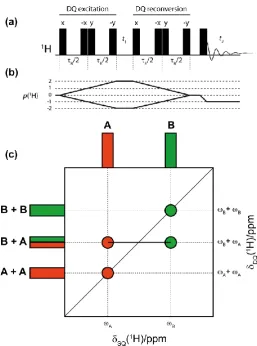
Such an experiment, recouples the 1H – 1H homonuclear dipolar coupling into the system so that it is
possible to observe 1H – 1H proximities within approximately 3.5 Å. A full description of this
experiment, as well as the phenomenon of recoupling, will be provided in chapter 3.
Only the peaks corresponding to the NH protons, namely those at 6.1 (Ha) and 10.5 ppm (Hb), are
shown for simplicity, although the rest of the spectrum yields important data regarding the larger
molecular structure (note that the relative broadness of the individual peaks, across the spectrum, but
particularly in the 3.0 – 8.0 ppm range is due primarily to the presence of multiple strongly coupled
aromatic protons in 1-1). The spectrum in Fig. 1.3 demonstrates the power of 1H solid-state NMR in
determining the molecular structure of hydrogen bonded solids, but also reveals its most significant
limitation, namely resolution (which remains a significant problem even in the intermediate to fast MAS
regime for many compounds, particularly aromatics). Two important features arise which relate to the hydrogen bonded dimeric arrangement proposed. The first is a set of strong cross peaks at DQ = 6.1 +
10.5 = 16.6 ppm, corresponding to the intramolecular contact between the two protons in the amine
NH2 functionalities. The close proximity of these protons results in intense cross-peaks, as will be
DQ = 10.5 + 10.5 = 21.0 ppm, and corresponds to the intermolecular Hb – Hb contact experienced
across the hydrogen bonding interface. Such 1H ‘signatures’ are commonly encountered in the work
presented in this thesis. The strong intramolecular coupling between the NH2 protons effectively
attenuate this intermolecular coupling in a process known as dipolar truncation.(153,154)
These features alone are consistent with the dimeric arrangement proposed for 1-1, and demonstrate the
ability of the 1H chemical shift, as revealed by a simple two-dimensional homonuclear experiment, to
probe hydrogen bonded structures in the absence of single-crystal X-ray diffraction data. As this thesis
will demonstrate, 1H based NMR MAS experiments are well suited to the study of synthetic nucleobase
analogues, especially when exploiting homo- and heteronuclear two-dimensional experiments. For
compounds which have an available high-quality diffraction structure of sufficient quality (note that
~80% of the compounds discussed in this work do not), it is possible to complement experimental NMR
data with ab initio calculations, which is described briefly at a basic level in the following section.
Compound 1-1 will be discussed in more detail in chapter 6 (compound 6-6).
1.5 Introduction to DFT and the GIPAW method
NMR crystallography, which is an area of research gaining significant prominence in the field of
solid-state NMR, can be defined as the combined use of experimental NMR methodologies and ab initio
calculations in order to provide additional insight into the structure and dynamics of molecular solids.
Specifically, the use of the GIPAW (gauge-including projector augmented wave) method,(155-158) has
been used effectively for the calculation of NMR parameters (e.g. magnetic shielding, EFG tensors, J
-coupling) on a range of inorganic and organic materials. The method is employed after the selection of
the appropriate geometry (usually by some geometry optimising procedure applied to the diffraction
structure), to provide the required calculated NMR tensors.(158) Directly relevant to the work presented
here, several NMR crystallographic studies have been conducted on guanosine derivatives within the
group of Professor Steven Brown at Warwick in the past five years.(100,103,104) The technique is
useful for confirmation of chemical shift assignments, particularly in cases where significantly
broadened 1H lineshapes prevent independent assignment. However, therein lies the drawback of this
methodology as it currently stands, i.e., the need for a high-quality single-crystal X-ray diffraction
structure of the compound in question. In this regard, the technique acts only as a confirmation of the
power of both diffraction and high-resolution solid-state NMR in providing detailed structural insights
into the system in question. However, this being said, it is possible, as will be demonstrated by this
thesis, to infer structural information in related but non-crystalline materials, for a series of compounds
in which there exists a crystal structure for one of those systems. In addition, crystallographic data may
be complemented by comparing the calculated magnetic shielding parameters for the full crystal (i.e.,