http://wrap.warwick.ac.uk/
Original citation:Brumley, Douglas R., Polin, Marco, Pedley, Timothy J. and Goldstein, Raymond E.. (2012) Hydrodynamic synchronization and metachronal waves on the surface of the colonial alga volvox carteri. Physical Review Letters, Volume 109 (Number 26). Article number 268102 .
Permanent WRAP url:
http://wrap.warwick.ac.uk/63032
Copyright and reuse:
The Warwick Research Archive Portal (WRAP) makes this work of researchers of the University of Warwick available open access under the following conditions.
This article is made available under the Creative Commons Attribution- 3.0 Unported (CC BY 3.0) license and may be reused according to the conditions of the license. For more details seehttp://creativecommons.org/licenses/by/3.0/
A note on versions:
The version presented in WRAP is the published version, or, version of record, and may be cited as it appears here.
Hydrodynamic Synchronization and Metachronal Waves
on the Surface of the Colonial Alga
Volvox carteri
Douglas R. Brumley, Marco Polin, Timothy J. Pedley, and Raymond E. Goldstein
Department of Applied Mathematics and Theoretical Physics, Centre for Mathematical Sciences, University of Cambridge, Wilberforce Road, Cambridge CB3 0WA, United Kingdom
(Received 5 August 2012; published 27 December 2012)
From unicellular ciliates to the respiratory epithelium, carpets of cilia display metachronal waves, long-wavelength phase modulations of the beating cycles, which theory suggests may arise from hydrodynamic coupling. Experiments have been limited by a lack of organisms suitable for systematic study of flagella and the flows they create. Using time-resolved particle image velocimetry, we report the discovery of metachronal waves on the surface of the colonial alga Volvox carteri, whose large size and ease of visualization make it an ideal model organism for these studies. An elastohydrodynamic model of weakly coupled compliant oscillators, recast as interacting phase oscillators, reveals that orbit compliance can produce fast, robust synchronization in a manner essentially independent of boundary conditions, and offers an intuitive understanding of a possible mechanism leading to the emergence of metachronal waves.
DOI:10.1103/PhysRevLett.109.268102 PACS numbers: 87.16.Qp, 05.45.Xt, 47.63.b, 87.18.Tt
A major evolutionary breakthrough for unicellular organisms was the incorporation of appendages for self-propulsion. In ancestral eukaryotes, these took the form of 10–20m long hairlike motile organelles known as fla-gella which, together with their shorter ciliary version, are now common to most extant eukaryotic species. Whether in ciliates likeParameciumor the lining of the respiratory tract, cilia and flagella usually appear in large groups within which their individual motions tend to synchronize in patterns known asmetachronal waves(MWs), modula-tions of the beating phase on the scale of many undulipodia [1]. Many theoretical studies [2–4] hint at a higher effi-ciency of propulsion by MWs, and suggest a possible selective advantage of mutations that stabilize their occur-rence. Yet, the mechanisms behind their emergence and the selection of wave patterns are still unclear.
Early reports of correlated changes in the directions of flagellar beating and MW propagation [5] led to the hypothesis of a mechanical origin for synchronization, and motivated theoretical studies involving hydrodynami-cally coupled filaments driven by various types of internal engines [6–9]. While these models show a general ten-dency towards metachronal coordination and help explain the generation and regulation of flagellar motion [10], their complexity prevents a simple understanding of the mecha-nism responsible for synchronization.
Minimal models of hydrodynamically coupled self-sustained oscillators with few degrees of freedom give insight into the emergence of MWs, and such
synchronization has been investigated experimentally with rotating paddles [11], microrotors [12], and colloids in optical tweezers [13,14], in simulations of rotating helices [15], and in several theoretical models of spheres driven along trajectories, either fixed [16–21] or flexible [22]. We now know that under certain circumstances [17,21] hydrodynamics alone can phase lock two simple oscillators. Whether this mechanism can account for the rapid and robust synchronization seen in biological sys-tems [23] remains unclear, although such behavior does occur when there is flexibility in the oscillators’ trajecto-ries [22]. Recent experimental evidence [24] is consistent with the hypothesis of orbit flexibility and hydrodynamic coupling as a possible origin of flagellar synchronization. At the same time, synchronization of an isolated pair is not sufficient to guarantee metachronism of an ensemble, high-lighting the need to understand better the link between local and global coordination. Progress hinges on the iden-tification of suitable experimental systems to study MWs and test the intuition developed from theory, a goal which remains unfulfilled.
Here we introduce the colonial green algaVolvox carteri
[25] as a platform to study coordination in ensembles of eukaryotic flagella. Volvox is composed of thousands of biflagellate somatic cells embedded in a spherical extracellular matrix of radius R200m, beating towards the colony posterior with a nearly planar wave-form. We report the existence of MWs in this simple, readily observable and easily manipulable system, and describe a straightforward method to quantify them. The flagella ofVolvoxare spaced relatively far apart compared to the celebrated ciliate Paramecium, and hence they are more nearly in the weak-coupling limit amenable to theory. A minimal elastohydrodynamic model describes these MWs semiquantitatively, and confirms that elasticity can Published by the American Physical Society under the terms of
the Creative Commons Attribution 3.0 License. Further
lead to robust synchronization. The model proposes a simple mechanism for the spontaneous choice of MW direction, and provides a unifying view of the synchroni-zation patterns observed by previous studies in finite chains of oscillators.
Growth conditions for Volvox carteri f. nagariensis
(strain EVE) have been described previously [26]. Individual colonies were inserted in a 25255 mm observation chamber filled with fresh medium [27] seeded at 2104 volume fraction with 0:5m polystyrene microspheres (Invitrogen, USA). Colonies were captured, oriented, and held using two micropipettes with100m diameter tips, hosted on pipette holders (World Precision Instruments, USA) held by motorized micromanipulators (Patchstar, Scientifica, UK), and connected to two manual microinjectors (Sutter Instruments Co., USA). Custom-made rotation stages mounted on each holder allowed rotation around the pipette’s axis [24]. We aligned the axis of each colony with the focal plane of a 40 Plan Fluor objective (NA 0.6) on a Nikon TE2000-U inverted microscope, and recorded 30 s long movies of the sur-rounding flow with a high-speed video camera (Fastcam SA3, Photron, USA) at 500 fps under bright field illumi-nation. A long pass interference filter with a 10 nm tran-sition ramp centered at 620 nm (Knight Optical, U.K.) prevented phototactic responses. The projection of the velocity field u onto the focal plane was reconstructed using an open source particle image velocimetry [28] tool-box for Matlab (MatPIV), and decomposed into polar coordinatesu¼urerþue as in Fig.1(c).
For each Volvox, the radial component urðr; ; tÞ at
r¼1:3R[Fig.1(c)] is used to resolve spatially the beat-ing phase of the somatic cells along the colony’s meridian
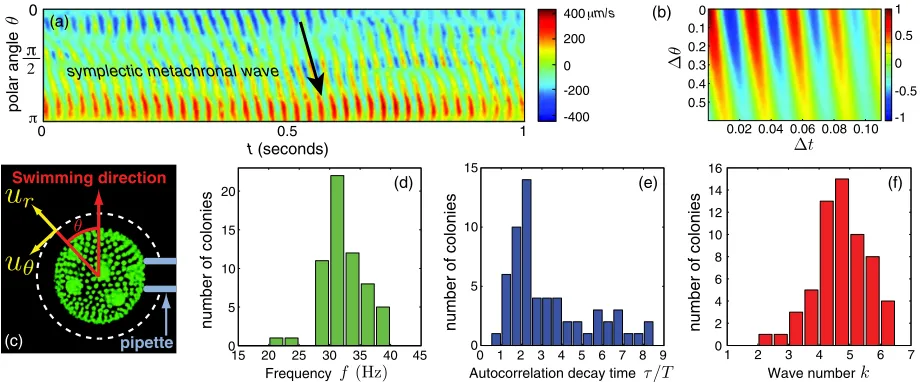
opposite to the holding pipette. As shown in Fig. 1(a) kymographs of urðr; ; tÞ reflect clearly the propagation
of a MW from the anterior towards the posterior of the colony. This is asymplecticMW, propagating in the same direction as the flagellar power stroke. Inspection of sev-eral colonies at different orientations confirms that the wave is mostly symplectic with only a minimal diaplectic (lateral) component. The wave parameters can be deter-mined from the normalized correlation function
Cð;tÞ ¼hurðr
;þ;tþtÞurðr;;tÞi hurðr;;tÞ2i
; (1)
where uðr; ; tÞ is the deviation of the measured flow from its time average, and hi denote averaging over t
and . Fitting the correlation function as Cð;tÞ ¼ et=e=Lcosðk!tÞyields the average beat
fre-quency f¼1=T ¼!=2, autocorrelation decay time, and wave number k for each colony. Averaging over 60 colonies we obtain f¼32:33:1 Hz,=T¼3:42:0,
L¼0:350:10, the correlation length, and k¼4:7 0:9, with individual data summarized in Figs. 1(d)–1(f ) [29]. The small value of=Tis surprising. Its origin is likely a combination of noisy flagellar dynamics [24] and collec-tive phase slips, and will be addressed elsewhere. We emphasize thatk >0for all colonies, indicating that despite the absence of any direct connections between somatic cells symplectic MWs are ubiquitous.
We now turn to a model for MWs. Inspired by the orbits of the flagellar tips ofVolvoxsomatic cells [Fig.2(a)], we generalize previous studies [17,18,22] and model the syn-chronous flagellar pair of an individual cell as a sphere of radius aelastically bound to a circular orbit of radiusr0,
Swimming direction
number of colonies
Autocorrelation decay time 0 1 2 3 4 5 6 7 8 9 0
5 10 15
number of colonies
Frequency 15 20 25 30 35 40 0 5 10 15 20 45
number of colonies
Wave number 1 2 3 4 5 6 7 0 2 4 6 8 10 12 14 16
t (seconds) 0 polar angle 1 5 . 0 0 400 200 0 -400 -200 m/s
symplectic metachronal wave
(a) (b) (c) ) f ( ) e ( ) d ( 1 0.5 0 -0.5 -1 0.02 0.04 0.08 0.10 0 0.1 0.2 0.3 0.4 0.5 0.06 pipette
FIG. 1 (color online). Metachronal waves of Volvox. (a) Radial component urð; tÞ of the flow, measured at r¼1:3R.
(b) Correlation functionCð;tÞin Eq. (1). (c) Confocal image ofVolvox, showing somatic cells (small dots), interior daughter colonies (large circles), colonial axis, and radius for velocity components (dashed). Histograms of beat frequencies (d), decay times of
Cð0;tÞscaled by beat period (e), and metachronal wave number (f ) for 60 colonies.
[image:3.612.77.537.472.663.2]perpendicular to a no-slip plane, with the center at x0 ¼
ðx0; y0; dÞ [Fig.2(b)]. The sphere is driven by a constant tangential forcefdre, and its velocityvfollows the
force-balance requirement of Stokes flow:
ðxÞ v¼ ðrr0Þere þfdre: (2)
Here the spring stiffnessesandin the radial (er) and transverse (e) directions determine the deformation of the trajectory in response to external stresses. The friction tensor ðxÞ ¼ 0½Iþ ð9a=16zÞðIþezezÞ þOðða=zÞ3Þ
[30] depends on the sphere’s position x¼x0þ
ðrsin;0; rcosÞ, and 0 ¼6a is the drag on the sphere in an unbounded fluid of viscosity . Because the drag is nonisotropic, the sphere deviates slightly from the prescribed circle (r=r00:5%here). For each set of parameters studied we simulate an isolated sphere, and recover the limit cycle ðrðtÞ; ðtÞ; ðtÞÞ and the orbital periodT, from which we define thephaseof the oscillator ¼ðÞwhere _¼!¼2=T[18,31], which is used to study the coupled dynamics of such spheres. The sphere’s height above the wall defines distal and proximal sections of the orbit which mimic the natural power and recovery strokes of the flagellum. As expected [17] this asymmetry induces a net flow in the direction of the power stroke.
ForNidentical oscillators at instantaneous positionsfxig the hydrodynamic drag on theith sphere isðxiÞ ½vi P
jÞiGðxj;xiÞ Fextj , where Fextj is the net external force
acting on the jth sphere [right-hand side of Eq. (2)]. Gðxi;xjÞ is the Green’s function (‘‘Blake tensor’’) in the
presence of a no-slip wall [32], which decays liker3 for displacements parallel to the wall instead of the character-isticr1for a point force in bulk. The time evolution of the system ofNmoving spheres is then given by
½RTM1R ji
ri_i
_ ri
_ i 0 B B @
1 C C
A¼
fdr
ðrjr0Þ
j
0 B B @
1 C C A: (3)
The3N3Nmatrices,M, andRare defined in terms of their constitutive 33 blocks ij¼ijðxiÞ, Mij¼
ijIþ ð1ijÞðxiÞ Gðxj;xiÞ, andRij ¼ijRi, where
the columns of the rotationRiare given by the vectorsei, eri, andei, respectively.
Taking advantage of the fact that MWs in Volvox are almost exactly symplectic, we represent the30somatic cells along a colony’s meridian as an open-ended linear chain of model oscillators. Their orbits are centered at x0
i ¼ ði‘;0; dÞ, regularly spaced a distance ‘ >0 apart,
and the driving force fdr>0turns them with an angular speed along the positive yaxis. In this configuration, the choice ofdoes not affect the dynamics. We explore the behavior of chains of 2–50 oscillators, with r0=d¼0:5, 2‘=d10, and spring stiffnesses0:01< d=fdr<10. Within this parameter range the system evolves to a steady state profile in a few tens or hundreds of beating cycles, regardless of initial conditions. This phase-locking time scale increases with increasing stiffness of the orbit, and eventually diverges for! 1(holonomic constraint), in line with previous studies of geometrically constrained oscillators [17]. The phase profiles aftert=T¼1200beats for 30 interacting spheres, representative of the general behavior, are summarized in Fig. 3. For stiff springs the phase propagates outwards from the center of the chain, creating a chevron pattern previously encountered in simi-lar systems [22,33], but as decreases the phase-locked pattern morphs into a symplectic MW (i<i18i). For these values of , we verified that 2D arrays display symplectic MWs, with wave numbers almost identical to the corresponding 1D configurations. The ability to gen-erate a robust MW in an open-ended chain, which mimics natural boundary conditions for ciliary arrays, is indeed a necessary requirement for any reasonable model of flagellar coordination.
To representVolvoxflagella, we use their bending rigid-ity ¼41022 Nm2 [22] and length L’10m, to estimate a radial spring stiffness ’4107 Nm1. Approximating the driving force asfdr¼2r
0 0=T, and taking a1m, T1=33 s, and d=r01, we obtain
d=fdr0:1. This value is indeed situated in the
symplec-ticMW regime of Fig.3. A linear array of these oscillators
er
eφ e ri
d
φi
r0 a
x y
z
(a) (b)
FIG. 2 (color online). Modeling flagella. (a) Tip trajectory over 4 beats of a flagellum of a Volvox somatic cell. (b) Model flagellum: a sphere of radius aelastically bound to a circular trajectory of radiusr0(dashed) perpendicular to a no-slip plane, driven by a constant tangential force.
sphere index symp
lectic MW
sphere index
sphere index
increasing
[image:4.612.60.288.48.142.2] [image:4.612.318.562.573.676.2]spacedl=d¼2apart develops a MW with wave number
k’2, which agrees reasonably well with the experimental values presented in Fig.1(f ).
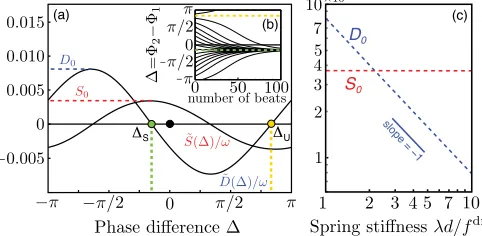
The dynamics of the chain of oscillators can be under-stood by studying the caseN ¼2. The interaction between two spheres induces only small perturbations around their limit cycles, and the coupled system can be described by the evolution of the phase difference _¼ _2 _1 ¼
!þDð;Þ and sum _¼ _2þ _1¼!þþSð;Þ, where D and S are effective coupling terms, and ! ¼ !2!1. For sufficiently stiff springs, the phase difference evolves much more slowly than the sum, and we can average over a cycle ofto obtain _¼!þD~ðÞand
_¼!þþ~
SðÞ. The functions D~ and S~[Fig. 4(a)] are calculated numerically by simulating the system for many initial conditions [Fig. 4(b)]. Over the parameter range studied we consistently find a stable equilibrium point at a negative phase lagS<0, and concurrently an increase
in the average beating frequency ðS~ðSÞ>0Þ, a
conse-quence of the lower drag at synchrony [15,22]. Nontrivial phase-locking results from the interaction between the wall-modified flows, the compliance of the orbits, and the influence of deformations on phase speed. The flow components perpendicular to the wall modify the in-phase configuration that would be stable in an unbounded fluid [22] by compressing slightly the orbit of the upstream sphere, which speeds up, and dilating the orbit of the downstream one, which slows down. The stable equili-brium is then skewed to a negative phase lag. The observed phase locking is robust against perturbations in orientation and relative position of the trajectories, or the use of more general driving forces.
Figure4(c) shows the characteristic dependence of the amplitudes D0 and S0 of the effective potentials on the spring constant, from which we recognizestiff(D0< S0) andsoft(D0> S0) regimes. Although they do not influence phase-locking for an isolated pair, these regimes lead to
different steady states in an open chain [Fig. 3]. Drag reduction induced by synchronization is more pronounced on interior oscillators within the chain, which will tend to lead, creating in the stiff regime a chevron steady-state phase profile. However, in the soft regime, where the drive towards a nonzero phase lag S is strong (D0> S0), co-operative speeding will only cause small perturbations around S, and neighboring oscillators will phase lock
with lags of the same sign as S. In the present case this
generates a symplectic MW (i<i18i). For systems in which S¼0[22], arbitrarily small perturbations can
skew the phase lag to either positive or negative values, and this precludes the emergence of a well-defined MW. We also note thatSis independent of, and scales as‘1
for large ‘=d. The amplitudes of the coupling functions scale according to D0, S0‘3 as expected from hydrodynamics.
The observation of MWs in the green algaVolvox carteri
shows that large scale flagellar coordination is possible even in weakly coupled systems, and that detailed quanti-tative information on the average wave properties can be obtained with modern fluid dynamical techniques. The manner in which these properties depend on geometric factors such as the intercellular spacing and flagellar length will be addressed elsewhere. The model discussed here, with an interplay between wall-modified flows, orbit com-pliance, and deformation-induced changes in phase speed, reproduces the coordination ofVolvoxsomatic cells in an open ended chain, which resembles a finite size array of flagella. This simple model may thus prove useful in clarifying the diverse types of MWs observed in nature. More generally, the question of whether orbital compliance is a necessary condition for metachronism will need to be addressed if we are to understand the origins of eukaryotic flagellar synchronization.
We are grateful to I. Tuval and A. I. Pesci for illuminat-ing discussions. This work was supported by The Gates Cambridge Trust (D. R. B.), an EPSRC Postdoctoral Fellowship (M. P.), the BBSRC, and ERC Advanced Investigator Grant 247333 (R. E. G.).
[1] E. W. Knight-Jones, Q. J. Microsc. Sci.95, 503 (1954). [2] S. Gueron and K. Levit-Gurevich,Proc. Natl. Acad. Sci.
U.S.A.96, 12 240 (1999).
[3] S. Michelin and E. Lauga, Phys. Fluids 22, 111901 (2010).
[4] N. Osterman and A. Vilfan,Proc. Natl. Acad. Sci. U.S.A. 108, 15 727 (2011).
[5] C. Brennen and H. Winet,Annu. Rev. Fluid Mech.9, 339 (1977).
[6] K. E. Machin,Proc. R. Soc. B158, 88 (1963).
[7] S. Gueron, K. Levit-Gurevich, N. Liron, and J. J. Blum,
Proc. Natl. Acad. Sci. U.S.A.94, 6001 (1997).
[8] B. Guirao and J.-F. Joanny, Biophys. J. 92, 1900 (2007).
FIG. 4 (color online). Phase oscillator reduction. (a) Coupling functionsD~ðÞandS~ðÞfor a pair of interacting spheres. We have used the parameters r0=d¼0:5, l=d¼2, a=d¼0:01,
d=fdr¼1. (b) Phase difference, ¼
21, for various initial conditions. (c) Amplitude of coupling functions for differ-ent spring stiffnesses.
[image:5.612.56.297.52.170.2][9] Y. Yang, J. Elgeti, and G. Gompper, Phys. Rev. E 78, 061903 (2008).
[10] I. H. Riedel-Kruse, A. Hilfinger, J. Howard, and F. Ju¨licher,HFSP J.1, 192 (2007).
[11] B. Qian, H. Jiang, D. A. Gagnon, K. S. Breuer, and T. R. Powers,Phys. Rev. E80, 061919 (2009).
[12] R. Di Leonardo, A. Bu´za´s, L. Kelemen, G. Vizsnyiczai, L. Oroszi, and P. Ormos, Phys. Rev. Lett. 109, 034104 (2012).
[13] J. Kotar, M. Leoni, B. Bassetti, M. C. Lagomarsino, and P. Cicuta,Proc. Natl. Acad. Sci. U.S.A.107, 7669 (2010). [14] G. M. Cicuta, E. Onofri, M. C. Lagomarsino, and P.
Cicuta,Phys. Rev. E85, 016203 (2012).
[15] M. Reichert and H. Stark,Eur. Phys. J. E17, 493 (2005). [16] M. C. Lagomarsino, P. Jona, and B. Bassetti,Phys. Rev. E
68, 021908 (2003).
[17] A. Vilfan and F. Ju¨licher, Phys. Rev. Lett. 96, 058102 (2006).
[18] P. Lenz and A. Ryskin,Phys. Biol.3, 285 (2006). [19] C. Wollin and H. Stark,Eur. Phys. J. E34, 42 (2011). [20] N. Uchida and R. Golestanian, Phys. Rev. Lett. 104,
178103 (2010).
[21] N. Uchida and R. Golestanian, Phys. Rev. Lett. 106, 058104 (2011); Eur. Phys. J. E (in press).
[22] T. Niedermayer, B. Eckhardt, and P. Lenz, Chaos, 18, 037128 (2008).
[23] D. M. Woolley, R. F. Crockett, W. D. I. Groom, and S. G. Revell,J. Exp. Biol.212, 2215 (2009).
[24] M. Polin, I. Tuval, K. Drescher, J. P.Gollub, and R. E. Goldstein, Science325, 487 (2009); R. E. Goldstein, M. Polin, and I. Tuval,Phys. Rev. Lett.103, 168103 (2009);
107, 148103 (2011).
[25] D. L. Kirk, Volvox: Molecular-Genetic Origins of Multicellularity and Cellular Differentiation (Cambridge University Press, Cambridge, England, 1998).
[26] K. Drescher, K. C. Leptos, I. Tuval, T. Ishikawa, T. J. Pedley, and R. E. Goldstein, Phys. Rev. Lett. 102, 168101 (2009).
[27] D. L. Kirk and M. M. Kirk,Dev. Biol.96, 493 (1983). [28] M. Raffel, C. E. Willert, S. T. Wereley, and J.
Kompenhans, Particle Image Velocimetry (Springer, Berlin, 2007), 2nd ed.
[29] See Supplemental Material at http://link.aps.org/ supplemental/10.1103/PhysRevLett.109.268102 for a video of the dependent flow field and the time-averaged velocity profile for a representative colony. [30] S. Kim and S. J. Karrila, Microhydrodynamics (Dover
Publications, Mineola, NY, 1991).
[31] A. Pikovsky, M. Rosenblum, and J. Kurths, Synchronization: A Universal Concept in Nonlinear Sciences (Cambridge University Press, Cambridge, England, 2003).
[32] J. R. Blake,Math. Proc. Cambridge Philos. Soc.70, 303 (1971).