CREATIVE
TECHNOLOGY
G
RADUATIONP
ROJECTSmart Rainwater Buffer XXL
Author
J. G
ALGENBELDSupervisor
R.G.A. BULTS
Critical Observer
J. SCHOLTEN
Abstract
Acknowledgments
Many thanks are owed to all the people that supported me during my gradua-tion project. I would like to start with thanking Richard Bults, my graduagradua-tion project supervisor, who not only supported the work I did, but also showed patience and understanding for me personally. Then I would also like to thank Hans Scholten who is always fun to talk and discuss with. The sparring ses-sions with him and Richard taught me a lot and I enjoyed them very much!
Of course none of this would have been possible without the municipality of Enschede. I think Enschede should be happy that they have Hendrik-Jan Teekens at their service. His passion for his work is genuine and his positive attitude is very inspiring and infectious. Also Jeroen Buitenweg from the wa-terboard Vechtstromen deserves a mention, during the earlier phases of the graduation project he pointed out some important aspects that I should keep in mind during my project.
Contents
1 Introduction 1
2 Background Research 3
2.1 Literature Review . . . 3
2.2 State of the Art . . . 8
2.2.1 Water Management of Enschede . . . 9
2.2.2 Water Management in the World . . . 10
3 Methods and Techniques 14 3.1 Creative Technology Design Process . . . 14
3.1.1 Ideation . . . 14
3.1.2 Specification . . . 15
3.1.3 Realization . . . 16
3.1.4 Evaluation . . . 16
4 Ideation 18 4.1 Stakeholder Identification and Analysis . . . 18
4.2 PACT Analysis . . . 19
4.3 Preliminary Requirements . . . 21
4.4 Concepts . . . 23
4.5 Selection . . . 33
5 Specification 35 5.1 System Architecture Diagrams . . . 35
5.1.1 System Architecture Diagrams - Level 0 . . . 35
5.1.2 System Decomposition - Level 1 . . . 40
5.1.3 System Decomposition - Level 2 . . . 42
5.2 Final Requirements . . . 44
6 Realization 47 6.1 Overview . . . 47
6.1.1 Controller . . . 47
6.1.2 Water Storage . . . 51
6.1.3 Badi . . . 53
6.2 Conclusion . . . 59
7 Evaluation 61 7.1 Evaluation by External Supervisor . . . 61
7.1.1 The Introduction . . . 61
7.1.2 The Presentation . . . 61
7.1.3 Unstructured Interview . . . 64
7.2 Requirements Evaluation . . . 69
7.2.1 MUST - Functional . . . 69
7.2.2 MUST - Non-Functional . . . 70
7.2.4 SHOULD - Non-Functional . . . 71
7.2.5 COULD - Functional . . . 72
7.2.6 COULD - Non-Functional . . . 72
7.2.7 WOULD - Functional . . . 72
7.2.8 WOULD - Non-Functional . . . 72
8 Conclusion and Recommendations 73 8.1 Conclusion . . . 73
8.2 Recommendations . . . 74
9 References 77
Appendices 80
A — Water Management History of Enschede — 80
B — Geological Situation of Enschede — 80
C — Sewer System of Enschede — 80
D — State Machine Diagram Brainstorm/Concept — 82
List of Abbreviations
RQ = Research Question SRB = Smart Rainwater Buffer
SRB XXL = Large Volume Smart Rainwater Buffer IoT = Internet of Things
List of Figures
1 Wadi Enschede . . . 10
2 Rainwater Buffer in Kefalonia, Greece . . . 12
3 Creative Technology Design Process . . . 17
4 Stakeholder Influence . . . 19
5 Blue Green Construction . . . 23
6 Cycle Roof Buffer . . . 24
7 The Gutter Lock . . . 25
8 Flipping Buffer . . . 26
9 Pond With Tube . . . 27
10 Smart Rainwater Buffer . . . 28
11 Staircase City Canal . . . 29
12 Street Gutter and Buffer . . . 30
13 Subterranean Collector . . . 31
14 Venschede . . . 32
15 Badi concept side view. . . 34
16 System Simple Overview . . . 35
17 System Architecture Diagram Level 0 Overview . . . 36
18 System Architecture Diagram Level 0 Input and Output . . . 37
19 System Architecture Diagram Level 0 Users . . . 39
20 System Architecture Diagram Level 0 Data . . . 40
21 System Decomposition Level 1 . . . 42
22 System Decomposition Level 2 . . . 45
23 Functional and non-functional requirements.. . . 46
24 Overview final result. . . 48
25 Controller view Badi. . . 49
26 Pump Relay Connection. . . 49
27 Pump Wiring Connection.. . . 49
28 Manual ball valve for 3/4 inch garden hose. . . 52
29 The water storage outputs. . . 52
30 Hose connectors. . . 52
31 Side view Badi. . . 53
32 Top view Badi (5 spouts marked).. . . 53
33 Badi without any attachments. . . 54
34 Badi hose with connectors. . . 55
35 Badi box connection. . . 56
36 Badi with support beams. . . 57
37 Staircase steps with markers. . . 58
38 Tubing used inside the Badi. . . 59
39 Staircase on the street level in Nijverdal. . . 62
40 Staircase sideview on the street level in Nijverdal. . . 63
41 Langestraat satellite and map view. . . 64
42 Filter materials that could potentially be used in the Badi. . . 65
43 Grondwaterpeil Enschede part 1. [1] . . . 67
45 Choke Points Sewer System Enschede . . . 81
46 Choke Points Groundwater Enschede . . . 81
47 Geohydrologisch Profiel Enschede . . . 81
48 State Machine Diagram Off or On. . . 82
49 State Machine Diagram Off or On[Initiating, Diagnosing, Operating] . 83 50 The phases of the nursing process [2].. . . 85
51 State Machine Diagram: The SRB XXL Process . . . 86
52 Verzoek page 1. . . 88
53 Verzoek page 2. . . 89
54 Verzoek page 3. . . 90
55 Verzoek page 4. . . 91
1
Introduction
Enschede is a city in the eastern part of the Netherlands with a population of approximately 160,000 people. The population is diverse. Reaching from stu-dents to seniors. The city was built on a slight slope and has expanded over the years. It expanded especially rapid during the late 1800s when the Dutch gov-ernment invested in the textile industry in the eastern part of the Netherlands. This had a major impact on the city and its environment, including the water system. Over time, the industry in Enschede started changing from manufac-turing to knowledge and distribution. In addition to the changes of the city itself, the climate change took effect as well and environmental issues began to arise. The old-fashioned water management system could no longer handle the water coming from the increasingly heavier rainfall. With floods as a result. The municipality of Enschede works to resolve these issues [3, 4], but their task is not complete yet. Enschede is not always able to fully deal with heavy rainfall and the municipality is looking for ways to include the water manage-ment aspect in a constantly evolving city. Currently the problem is a combina-tion of the lack of capacity within the water management system to hold the increasingly greater amount of rainwater runoff in short periods of time. The challenge is to implement new ways of water management that complement the existing water management system in Enschede. As mentioned before, the main problem is a combination of the lack of capacity of the current system and the increasingly heavier rainfall as a result of climate change. And since creating a weather controlling machine does not seem realistic, it makes sense to look at ways to increase or make more effective use of the current capacity. And even though the weather can not be controlled, it is still possible to control rainfall. For example, by collecting and buffering it. Or by guiding it through gutters or other infrastructure. Some of which the municipality implements already (i.e. green roofs or wadi’s). Therefor this bachelor thesis aims at the development of another iteration of a tool that helps control rainwater runoff by collecting and buffering it. Thus, effectively delaying the rainwater from running into the sewer system in Enschede. The city has determined that the tool should be able to buffer at least 20,000 liters of rainwater. These goals re-sulted in the following research question (RQ).
RQ:How to develop a smart rainwater buffer into a large volume smart rainwater buffer to delay rainwater runoff to the sewer system of Enschede?
The RQ is supported by two subquestions.
1. How are rainwater buffers used to delay rainwater runoff to the sewer system?
2. How can the characteristics of existing rainwater buffers be used in the SRB XXL?
2
Background Research
The background research consists of two parts. Firstly it has the literature re-view and secondly it has the state of the art. In the literature rere-view a rere-view of what research exists on large scale rainwater buffering is done. In the state of the art the focus lies on existing implementations and their lessons for de-veloping an SRB XXL. The two subquestions will be used as a foundation to determine the relevance of the sources used in this chapter. These two sub-questions were:
1. How are rainwater buffers used to delay rainwater runoff to the sewer system?
2. How can the characteristics of existing rainwater buffers be adapted for usage in the SRB XXL?
2.1
Literature Review
There are many different types of rainwater buffers. The goals of this litera-ture review are to learn about how rainwater buffering has been implemented and what purpose they have. Learning how rainwater buffering has been im-plemented provides a basis to answer the question what characteristics a rain-water buffer has. These characteristics are important to determine in order to know how to adapt them for use in the SRB XXL. In addition the second goal, namely the purpose of the rainwater buffers, has to be kept in mind in order to form a basis for decision making in terms of implementation. For example it would make sense that a rainwater buffer that has the main purpose of col-lecting rainwater runoff for consumption has a higher priority towards water filtering in comparison to a rainwater buffer that solely has the purpose to de-lay rainwater runoff to the sewer system. To form these two bases the literature review will start with describing some general components that the rainwater buffers have. Then the main goals of the different rainwater buffers are listed. The literature used for this literature review is either about one very specific component of a rainwater buffer or they are about large scale rainwater buffers with a capacity of 20,000 liters or more. This is because at a capacity of 20,000 liters we consider an SRB to be XXL.
Rainwater Buffer
be considered output. The output is relevant for the SRB XXL, because the purpose is to delay rainwater runoff and not to stop it.
All four of these components together form the characteristics of a rainwa-ter buffer and, but they can have different implementations. When looking at each component separately it shows that there is a strong relation between lo-cation and implementation of the components. The lolo-cation can be split into two main categories. First there are theurban areas and secondly there are
ruralareas. These locations on their turn correspond with the purpose of the rainwater buffer.
As an example we can look at Singapore and their water management. In the case of Singapore there is a growing population in a densely populated city. Not only Luan [8], but also Etezadzadeh [9] indicate that this urbaniza-tion puts pressure on available resources and necessitates measures to sustain the possibility of a good quality of life in these urban areas. Etezadzadeh [9] recommends a circular economy. And Luan [8] uses Singapore as an exam-ple. She explains that in Singapore the demand for drinking water is partially solved by using rainwater buffers. The relation between location and purpose in this case is that urbanization creates a demand for drinking water, but at the same time also puts extra pressure on the available space and that future development has to be done with those two variables in mind.
Collection Surface Characteristic
Cities have a lot of roofs, these roofs form a large impervious area that can be used as collection surfaces. But what do we consider a collection surface? A collection surface is an area that collects precipitation. This means that all these roofs could potentially be used as a component for a rainwater buffer. Both Thomas [5] and Villareal [6] who were mentioned before give roofs as an ex-ample of collection surfaces. Villareal [6] mentions the Izumo Dome in Izumo City which uses its roof as a collection surface of 13, 200m2. Another research that mentions roofs as impervious areas and thus roofs is Frazer [10].
Roofs are common in cities and can be used as a collection surface for rain-water buffers. Villareal [6] not only inspired the fourth component that helps determine the characteristics of a rainwater buffer, but also provides the exam-ple of how the Izumo Dome in Izumo City uses its roof as a collection surface of 13, 200m2. But in urban areas not only roofs are potential collection surfaces. Frazer [10] points out that there is a lot of paved area in the United States. He mentions that there is a paved area of 43,000 square miles in the United States alone and that this causes floods, because water can’t go anywhere when there is heavy rainfall. However these paved areas are also potential collection sur-faces for a rainwater buffer, but Frazer [10] also warns for disrupting the hy-drological cycle and the ecological effects that has. This means that in urban areas we can look at any surface that is impervious to water as a potential col-lection surface for a rainwater buffer, but that we have to keep in mind that this can have an effect on the hydrological cycle.
is still a demand for water. Pandey [11] shows that people have tried to find ways to have access to enough water for a long time and that some of that water supply comes from precipitation. There is evidence that as early as ca. 4500 BC people have tried to find ways to not only collect rainwater, but also to store it. Methods include the creation of storage tanks, but also irrigation. What we can see is that collection surfaces in rural areas often involve the land itself. This was not only the case back in the day, but also now. For example Sazakli [12] describes how on the Greek Island Kefalonia there is a collection surface that guides collected the rainwater runoff from the hills into ferroconcrete storage tanks and Vogel [13] describes a similar usage of gravity in Yemen. In Yemen rainwater runoff was used to irrigate terraced agriculture. So what we can see in rural areas is that in addition to collection surfaces there are areas that do not collect the precipitation, but instead steer the water towards a collection surface.
Gutter Characteristic
This brings us to the second component out of the four characteristics that are present in a rainwater buffer. The second component, as mentioned earlier, is the gutter. A gutter is a component that facilitates the movement of precipitation from one component to another. For example the terracing in Yemen described by Vogel [13], it uses underground water conduits as a gutter. Whereas Ghisi [14] describes a system that uses pumps and pipes to move the water. And another example that was mentioned before by Sazakli [12] makes use of the hills and gravity to guide water towards a collection surface and trucks to move the water from the storage tanks to where it is wanted. Luan [8] gives insight in how Singapore built a system similar to a sewer system to transport water throughout the city. All together there are many ways that water can be moved.
Storage Characteristic
The third component of a rainwater buffer is the storage component. The stor-age is a component that can hold up to a certain amount of liters of water.Of course these could be storage tanks that Sazlaki, Villareal and Thomas [5,6,12] already mentioned. But it is also possible to look at reservoirs or basins as mentioned by Querner [15] or even lakes and ponds.
Water buffers in urban areas can however impact the surrounding areas. Frazer [10] already mentioned that the pavement had an impact on the hy-drological cycle and so does Querner [15]. However Querner states that the increase of rainwater runoff that ends up in the sewer system due to the large presence of impervious surfaces in urban areas also creates more effluent water to be discharged from the sewage treatment plant. Which prevents droughts elsewhere. So a balance between keeping and discharging water is important.
When storing water there are several aspects to take into consideration. Both Villareal [6] and Heggen [7] mention a couple.
2. Accumulated rainwater runoff 3. Volume in storage
4. Consumption or output
Precipitation is about how much precipitation there is at a location over a cer-tain amount of time. The accumulated rainwater runoff is the amount of water that actually reaches the storage and does not get lost on the way. The volume in storage is about how much water is already stored in the buffer. If there is a lot of precipitation the buffer needs to be able to hold more rain in order to retain the function to delay water runoff towards the sewer system. Then there is the consumption or output, which reduces the amount of water in the buffer.
Output Characteristic
The balance of water inside the storage component can be controlled through output, which is the fourth and final component and characteristic that we describe for a rainwater buffer. An output is a tool to control discharge from the storage component. Logical examples are faucets and valves that are linked to a storage component. Also pumps might play a role to discharge water from storage [16]. It depends on the use of the water, some use it to water their crops [13] and others to wash their cars or do laundry [6]. The keyword with the output is control. In addition control over a rainwater buffer can turn it into a smart rainwater buffer. So as an extra component to turn the rainwater buffer into an SRB we added autonomy and control.
Smart Characteristic
considered asmartsystem. It needs to be able to handle data in a meaningful way. It has to be autonomous. And next to that it has to be sustainable.
Safety and Security
Sustainability also involves safety and security. To make the system reliable and secure. Ntuli [18] proposes a system architecture for water management systems that makes use of publish-secure design pattern and stateless authen-tication. Protecting the system in this way is good to make it harder for hackers to abuse the system, however there are more safety and security issues.
Public Health
When working with water and especially in urban context there are public health hazards that need to be considered. The water quality has to be good in order to prevent diseases or other ailments that come from using the SRB XXL. Beenen [19] and Schets [20] both indicate that the collected rainwater most likely contains pollutants. But Beenen [19] says there are insignificant amounts where Schets [20] says they are present in significant numbers. He points out that the lack of safety comes from the presence of fecal matter and human pathogens [20]. Some of which are caused by animals that can access the water.
Legionella
Another known hazard is that of legionella and legionnaires’ disease. Fields [21] points towards the ASHRAE guidelines to minimize the threat. In order to do so there are several considerations to keep in mind. For example stagnant areas are difficult to clean and should be avoided. The use of filters should be considered or water should be refreshed regularly. It is also possible to use a biocide to fight the biohazards present in the water. Furthermore the temper-ature of the water should avoid being between 25◦C and 55◦C in which the legionella bacteria grows best. Water droplet size is also a factor that deter-mines the threat level, smaller sized droplets are more easily picked up and inhaled. Use of condensers, evaporators, mist generators and other ways of generating small water particles should be used with caution. The risk with rainwater is also greater, because there are likely more nutrients available for bacteria to feed on. So there are plenty of things to consider when dealing with water when it might come into contact with people.
Conclusion
1. Collection surface 2. Gutter
3. Storage 4. Output
They are complemented by thesmartcharacteristic in order to form the basis of the SRB XXL. It has to be autonomous, sustainable and manage data in a meaningful way while not producing any waste. And all of these components need to consider safety and security aspects. Where abuse and legionella are considered the main threats. But there are already ways to reduce the risk. Both in the form of a guideline and system design ideas. However the literature is not specifically aimed at the purpose of the SRB XXL. But that might be caused by the fact that the SRB XXL is more or less a combination of existing technology to fulfill a new purpose. In future studies it would probably pay off to include more than one goal for the SRB XXL. Examples could be that the water stored in the buffer could be used for watering plants or cooling down an urban area.
Discussion
The characteristics of the rainwater buffer show that adaptation to the current situation plays a key role. The implementation of rainwater buffers is often on top of existing systems. However it is not clear how difficult it is to adapt to the current situation or make slight alterations to it in comparison to major alterations. None of the used research addresses this issue. It is likely that it is mostly about the costs. Minor alterations to existing structures might be less costly than major changes. In the case of Singapore there is a government who has the power to make major changes and this might not be the case in other places. To heighten the chances of success for the SRB XXL it is worth to research a location within Enschede with existing structures that are easy to adapt or adapt to at low costs. Another thing to note is that water buffers have different purposes for the water stored. Some use it to water their crops and others to do laundry or wash cars. Where the goal of the SRB XXL is to delay rainwater runoff to the sewer system. This suggests that it releases the water into the sewer system after some time while there may be more beneficial uses for the water. Research should be done to find the most effective use for the water stored in the SRB XXL in Enschede.
2.2
State of the Art
2.2.1 Water Management of Enschede
Enschede is a city that actively tries to adapt to the changing climate. When looking at the water management of Enschede there are quite some innovative projects. In appendix A, B and C a summary of the situation can be found. But in short it can be said that Enschede is built on a slope and the water often runs downhill on the streets when there is heavy rainfall, because water infiltrates into to the ground too slowly and the sewer system is also not equipped to deal with it. This is why Enschede has implemented the following technologies.
The Roombeek
TheRoombeekis an area in Enschede where there was a creek back in the old days and after a disaster that destroyed a lot in that area the creek got remade. The Roombeek has an effect on the water management system in the sense that it decouples 15ha of rainwater. Which means that it leads excess rainwater runoff out of the city through the creek instead of the sewer system. [4] So here the focus lies on stopping rainwater runoff from immediately entering the sewer system and provide an alternative way out of the city.
Wadi
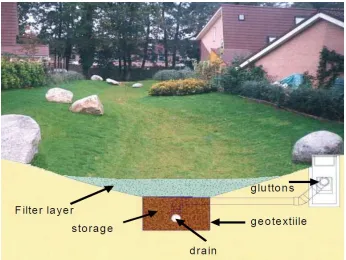
Another technology in Enschede are the wadis. A wadi is an area that col-lects excess rainwater and lets it infiltrate it into the ground. The name wadi approximately means "dry riverbed" in Arabic, but it also stands for water, afvoer(disposal), drainage and infiltration. Figure 1 shows a side view of a wadi and its components. The wadi is focused on providing room from water on the street to go off the street and into the storage of the wadi where it can slowly infiltrate and discharge into the sewer system.
Oldenzaalse Straat
A place where they implement wadis is theOldenzaalse Straat. The Oldenzaalse Straat is a street in Enschede that is being redeveloped. It will house a special type of sewer to deal with 7 million liters of water [22]. This dwarfs the 20,000 liter capacity that SRB XXL aims for, but does not make it redundant.
Green Roofs
Next to the technologies that are implemented on the ground there is also a technology that deals with rainwater before it hits the ground (more or less). On top of a shopping center in Enschede called:De Miro. There is a green roof. Greens roofs are also able to hold water and can delay rainwater runoff in that way. [4] The purpose of these green roofs are not limited to their water holding characteristic, but it can also help cool down an area during hot weather.
Smart Rainwater Buffer
Figure 1:Wadi Enschede
temperature and collect and process precipitation prediction data. On top of that there is a database that saves the data from the barrels and displays it to the user through a dashboard. [23] Jeroen describes more projects that are similar to his such as theSlimme Regenton, RainGrid, Opti, Loxone Rain Water Harvesting Project, Smart Rainwater Management System by OTA-Analytics[23]. The purpose is to include a smart element that allow the barrel to run autonomously. So that when rain is coming the barrel creates room. The precipitation prediction plays a major role to allow this behavior.
2.2.2 Water Management in the World
Water management is not new and does not only exist in Enschede. All around the world there are systems that deal with rainwater. Some of them even in-clude a smart element.
Smart Communication
multiple operations and provide them as packages so that with a higher level command a more complex sequence of operations can be executed. This can be used to handle data in a meaningful way. For example when you tell a rainwater buffer to empty 20,000 liters of water it could be that a smart system like this could empty 200 liters from 100 separate buffers units. This means it has to control multiple buffer units as if they are one.
Large Rainwater Buffers
Large rainwater buffers also exist around the world. Up next are some exam-ples of rainwater buffers from different countries.
Japan
The system at the Izumo Dome in Izumo City as described by [6] has a catch-ment area of 13,200m2 with two storage tanks that together have 270m3 of space to store water. Another place in Japan is the Kokugikan Sumo Wrestling Stadium in Tokyo. There they collect rainwater and use it for flushing the toilet and cooling the building. The collected rainwater is stored in 1,000m3reservoir in the basement and has 8,400m2roof. In an urban area like these two Japanese cities the water buffers need to be compact and fit within the limited space.
Greece
The rainwater buffers on the Greek Island of Kefalonia have a system compos-ing of three parts. It has a rainwater catchment area (that is a combination of a collection surface and a gutter), three main tanks where the water is stored and special trucks that haul the water. The capacity of the main tanks vary between 300 to 1000m3 and their catchment areas range from 600 to 3000m2. Figure 2 shows what it looks like. [12] This island is not fully buildup and still has areas where there is room for water buffers like this. In an urban area the same technology would look very different.
Conclusion
Overall the details of each system depend on the context they are implemented in. There are many more smallsmartrainwater buffer systems than there are large ones. But there are large rainwater buffers out there that can be used as an inspiration for the SRB XXL. Larger rainwater buffers put an emphasis on the collection surface size and its relation to tank size. The smaller rainwater buffers try to involve people more than the larger buffers as well. For example the dashboard that is available for the smaller buffers does not appear on the larger buffers.
Discussion
Figure 2:Rainwater Buffer in Kefalonia, Greece
No clear decision making process was described and for the larger buffers it was interpreted based on location. This state of the art review only looks at active rainwater buffers. The normal hydrological cycle and underground sys-tems are not taken into account. This is because the focus lies on the rainwater runoff before it comes into contact with those types of systems. Future research could include these extra systems for a more holistic view. Also the rest of this research should aim for a location specific solution. On top of that it might be interesting to see whether an interaction such as a dashboard would have added value for larger public rainwater buffers.
SRB XXL Research
When we look back at the research question and its two subquestions.
RQ:How to develop a smart rainwater buffer into a large volume smart rainwater buffer to delay rainwater runoff to the sewer system of Enschede?
The RQ is supported by two subquestions.
1. How are rainwater buffers used to delay rainwater runoff to the sewer system?
2. How can the characteristics of existing rainwater buffers be used in the SRB XXL?
3
Methods and Techniques
This chapter describes what methods and techniques were used to do the re-search.
3.1
Creative Technology Design Process
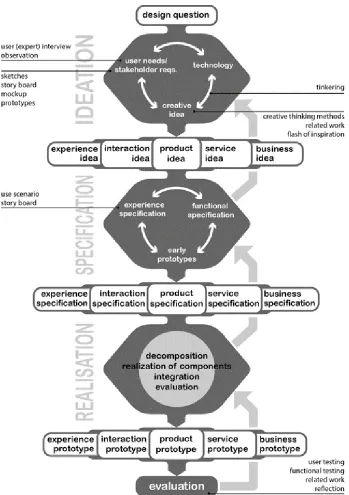
Based on the research question and the background research a design process is put to work. For this research the Creative Technology Design Process [24] is used. The Creative Technology Design Process consists of several design phases (Figure: 3).
1. Ideation
2. Specification
3. Realization
4. Evaluation
3.1.1 Ideation
Ideation is about idea generation. It can be done by tinkering, observing, con-ducting an interview and many other ways. The stakeholders and their re-quirements are determined [24]. Luan [8] and Verworn [25] emphasize the importance of a holistic approach that includes all stakeholders. The ideation phase in this research is done by first doing a stakeholder identification and analysis. Then a list of preliminary requirements is presented. Followed by a brainstorm session where 10 concepts are explained. And ultimately the final concept is chosen.
Stakeholder Identification and Analysis
In order to do a good stakeholder identification and analysis Bryson [26] de-scribed fifteen different techniques to do them. Where we focus on the tech-niques that are about proposal development. Since the SRB XXL resulting from this research is ultimately a suggestion to the municipality of Enschede.
PACT Analysis
Both Rindt [27] and Waterink [23] made use of a PACT analysis to better un-derstand the requirements. Rindt describes it as a method to unun-derstand user perspectives whereas Waterink used it as a tool to develop user centered sce-narios. So both aim at understandign user requirements. Pact stands forPeople,
about in- and output, content and communication. [27] The PACT analysis will be included in this research to support the preliminary requirement method described below.
Preliminary Requirements
The preliminary requirements were found by using the previous research done by Waterink [23] and by conducting semi-structured interviews with the rep-resentatives from the municipality of Enschede, waterboard Vechtstromen and University of Twente. The results of this interview are ordered in the so-called MoSCoW way that [28] describes. MoSCoW stands forMusthave,Shouldhave,
Couldhave andWouldhave. This ordered lists creates a priority list where the ’must have’ is the most important and the ’would have’ is the least important.
Brainstorm, concepts and final concept
The brainstorm process was done solo. The concepts were generated using pre-vious experience and by reducing and increasing constraints. This resulted in a broad variety of concepts. Then for each concept a short explanation is given with some of the ideas behind it. After that the final decision is clarified. In this case the decision was made with the supervisor and critical observer from the University of Twente. Do note that the brainstorm does not necessarily take all the preliminary requirements into account. They merely form a guideline.
3.1.2 Specification
3.1.3 Realization
The realization phase describes how the functional and experience specifica-tions were implemented and what decisions were made along the way. It shows a decomposition of the components and how they are working together in order to fulfill the requirements. [24] It starts by providing an overview of the result and then the steps taken at different stages of the realization.
3.1.4 Evaluation
4
Ideation
In this section the stakeholder identification and analysis is executed together with a PACT analysis and a set of preliminary requirements that are generated. After that the brainstorm and selection process is summarized.
4.1
Stakeholder Identification and Analysis
The stakeholders in this graduation project are limited to parties that are in-volved with the development, implementation and utilization of the project. For this thesis the prototype has multiple users. Even though the focus lies on the municipality’s water management team.
Main Stakeholders
The first stakeholder is the end user, the end user can be split into two main groups. Namely theinhabitant of Enschedethat would end up living near the SRB XXL andvisitors of Enschedewho come across and might interact with the SRB XXL.
The second stakeholder is the municipality of Enschede, their role includes: user, policy maker and advisor. Their reason of involvement is determined by their desire to meet climate goals and dealing with droughts and floods in Enschede. The municipality provides advice.
The third stakeholder is the Waterboard Vechtstromen, they are mainly con-cerned with mater management and operation of the SRB XXL. The Water-board Vechtstromen is strongly connected with the municipality of Enschede and also provides advice.
The fourth and final stakeholder for the SRB XXL is the University of Twente who want to further develop students and at the same time provide potential solutions to parties that see merit in a cooperation with students. The Univer-sity of Twente provides two supervisors to assist the student and next to that they provide the materials and space for the SRB XXL to be developed.
Stakeholder Influence
Every stakeholder has a different type and amount of influence on the devel-opment of the SRB XXL. The amount of influence is based on a combination of power and interest. The SRB developed by Waterink [23] has many of the same parties as stakeholders, but the influence is distributed differently. The result can be seen in figure: 4.
more research which are considered out of scope for this research. So this re-search focuses on presenting an idea with a proof of concept. The role of the municipality is that of a primary user. The municipality needs to be managed closely.
The University of Twente has a lot of power and continues to influence the project throughout its development, but the interest is less than the mu-nicipality’s. The role of the University is that of an advisor and investor. The University needs to be managed closely.
The waterboard Vechtstromen has medium power and medium interest. They provide information and some advice. The aim is to keep them informed. If the goal of the thesis was to generate a real large SRB XXL instead of a proof of concept, then the waterboard Vechtstromen would play a larger role.
Then last, but not least there are the citizens of Enschede. Where both the inhabitants and visitors have medium interest, but low power. Even though community plays a large role, it is out of the scope of this thesis to involve them in the development in a proof of concept. There are theses underway that are about this community aspect specifically. It is important to monitor the progress of that stakeholder group when moving forward after the proof of concept is delivered.
Figure 4:Stakeholder Influence
4.2
PACT Analysis
The PACT analysis will further describe the people involved with the SRB XXL by means of a scenario. Two scenarios will be made, one for an industrial context and one for an urban context.
Industrial
People: 55 year old investor that owns a large distribution center near the harbor district in Enschede.
Context: A large distribution center with a lot of roof at an industrial area in Enschede.
Technology: Smart Rainwater Buffer XXL, industrial style.
Scenario: Mark de Groot is the owner of a large distribution center. On a windy afternoon he received an e-mail from the municipality about partici-pating in a project about climate change. Mark never cared much for climate change and focuses on profit more than anything else. Then right as Mark is about to click away the e-mail he reads one word: ’savings’. This sparked his interest and Mark wants to know more. He takes another moment to read and finds out that the development of an SRB XXL is well underway. He reads past the water trouble that Enschede deals with, because he does not care and the buildings he owns are close to the Twentekanaal and he never experienced trouble with the large amount of water in a short time. In fact he thinks it helps him. All that water cleans the company grounds quite nicely. He wishes it would happen more often.
Then he reads about how the SRB XXL can store water that can be used to clean cars and he realizes that it must mean that it can be used to clean trucks as well! Reading further he also finds out it has potential to be used in toilets as well. But that is too much of a hassle for Mark, besides the smells are already bad enough at the employee toilets. Rainwater is probably not going to help that either.
This doesn’t stop Mark from wanting to know more and he replies to the municipality of Enschede that he is interested and wants to be kept up to date on the developments of the SRB XXL.
Not much later there is another e-mail from the municipality asking Mark if he is still interested and if so that there is a student from the University of Twente looking for a spot to test their SRB XXL. The student needs a place with a large roof and a spot where they can store a tank with a capacity of 30,000 liters.
Mark invites the municipality and student to come and visit the distribu-tion center. Surely enough, a few days later a small delegadistribu-tion of people from the university, municipality and waterboard come over and discuss the pos-sibilities. A small prototype is shown and Mark is convinced fairly quickly. The costs are low, the benefits are still marginal as well, but the publicity is priceless.
Then after a while other students got involved with the project as well. Mark has even said yes to using rainwater in the employee toilets. Not only to flush them, but also to clean them. At this point 10 percent of his water usage has been replaced by the SRB XXL and it only cost him some time and got him great publicity.
Urban
People: 34 year old shopkeeper with a shop in Enschede
Activities: Using the SRB XXL to entertain kids.
Context: A long street within the city center with many shops where the SRB XXL has been placed.
Technology: Smart Rainwater Buffer XXL, urban style.
Scenario: Two years ago Sarah wrote an e-mail to her landowner that she was thinking about taking her business elsewhere, because people were shopping online more and more and she would had no chance competing.
She had always wanted to sell toys and against all odds her shop lasted. There were still barely enough customers to keep the shop up and running, but she was still in Enschede on the Langestraat. People pass by all the time, but not many people stop to look into her shop despite all the efforts she made. At this point she is a little sad and began considering moving elsewhere again. Then to make things worse the municipality starts digging up the road in front of her shop! Now the access to her shop is even worse and things are definitely going to go wrong from here.
In her panic she writes a letter to the municipality. In that letter she basically told the municipality that they were going to have to pay for her damages and that she is very angry that she was not informed beforehand, because she would have made her decision to move much earlier.
The municipality did however try to contact her, but she missed the e-mail, the letter and the article in the newspaper. The reply response by the munici-pality told her to look at those things again and she did.
After that she learned that the new development was going to make the area more attractive to visitors. The new development is a smart rainwater buffer with an element of interaction for people to play with. In the summer it helps cool the area and it always helps to prevent floods.
The municipality made sure that the access to her store was as little ob-structed as possible and to Sarah’s joy there were even more visitors coming due to the construction of the new SRB XXL. Kids want to watch the trucks and construction machines and are interested to buy the toy version of those trucks and machines. Sarah was clever enough to put them at the front window of her store and she got a little boost in sales.
4.3
Preliminary Requirements
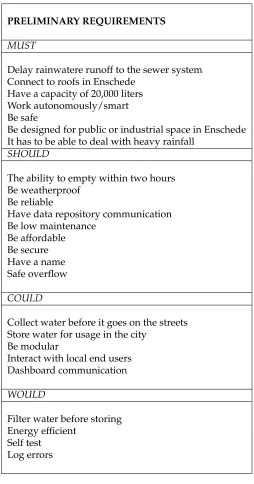
supervisor for this research was also present. These meetings resulted in the preliminary requirements that can be seen in table: 1. They are further clarified and expanded on in the specification phase.
PRELIMINARY REQUIREMENTS
MUST
Delay rainwatere runoff to the sewer system Connect to roofs in Enschede
Have a capacity of 20,000 liters Work autonomously/smart Be safe
Be designed for public or industrial space in Enschede It has to be able to deal with heavy rainfall
SHOULD
The ability to empty within two hours Be weatherproof
Be reliable
Have data repository communication Be low maintenance
Be affordable Be secure Have a name Safe overflow
COULD
Collect water before it goes on the streets Store water for usage in the city
Be modular
Interact with local end users Dashboard communication
WOULD
Filter water before storing Energy efficient
[image:32.612.179.433.169.653.2]Self test Log errors
4.4
Concepts
Ten concepts were generated to come up with a first design idea. These con-cepts were hand drawn drawings and contained comments (mostly in Dutch) that would explain certain parts. These concepts are presented in the following paragraphs with some extra comments to describe the idea behind it. Only the core functional requirements such as a the capacity were taken into account.
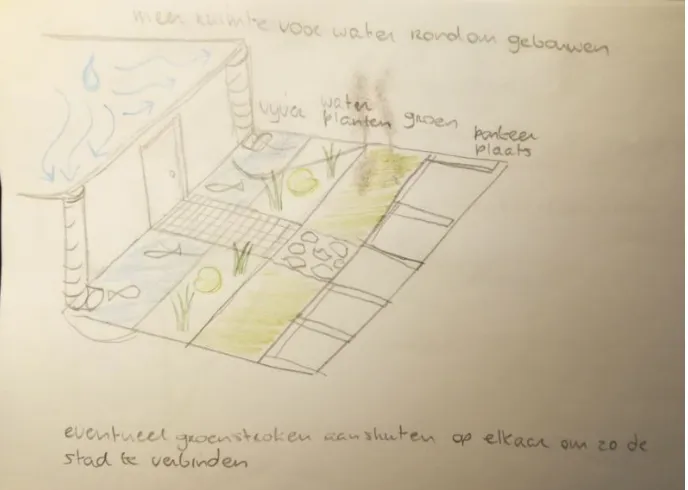
Blue Green Construction
Idea The idea behind the Blue Green Construction (Figure: 5) is about using rainwater that is collected on roofs of buildings to be directed to a pond that transitions into a stroke of vegetation. The pond contains fish that provide fertilization for the water plants and green stroke.
[image:33.612.135.479.400.645.2]The key part that drives this concept is sustainability. By using fish and plants the system would manage itself. Maintenance costs would be low. This idea would work best in less urban areas, because in city centers trash is likely to end up in the water and that might cause harm to the fish. On top of that the safety of the fish might be jeopardized when water levels are controlled at a distance. The system would need to ensure that there is always enough water for the fish to be able to live and keep the cycle of fertilization and fish food in balance.
Cycle Roof Buffer
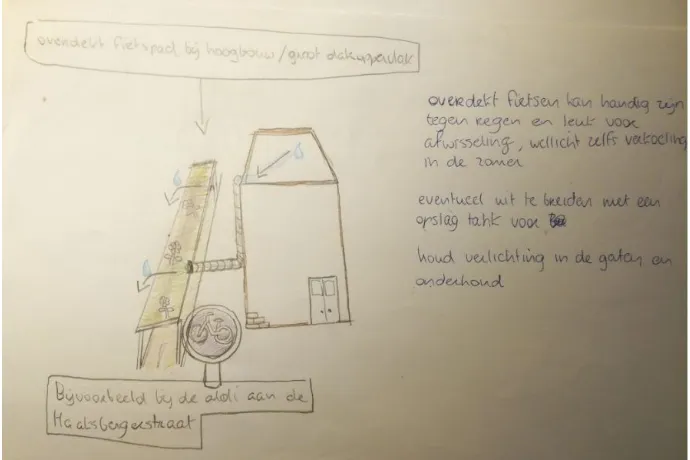
Idea The idea behind the cycle roof buffer (Figure: 6) is to build a roof above cycling paths that are common in the Netherlands. The roof is then over-grown with plants in order to delay the rainwater before it runs into the sewer system. Nearby buildings will redirect the rainwater they collect towards the green roofs above the cycling paths. This way the cyclist stays dry when it rains and rainwater does not run into the sewer system immediately. In ad-dition storage tanks could be added to collect water as well. They would be added on the side as walls or as pipes with a controllable valve. Figure: 6
[image:34.612.133.478.378.608.2]This idea tries to combine several elements in order to provide benefits for inhabitants of the city. People who dislike cycling in the rain might go by bi-cycle where they would not have otherwise. Of course it would need to be a substantial amount of roof. Also it would require lighting since it blocks the sun and moonlight. Even though these disadvantages might affect the use-fulness, it could still potentially work in some areas where tall buildings are close to each other, but still leave space for a cyclist road. Even stretches of cyclist highway could be upgraded with Cycle Roof Buffers, not only to buffer rainwater, but perhaps also to block wind so that cyclists are less hindered by that.
The Gutter Lock
Idea The gutter lock (Figure: 7) is a smart lock connected to a roof. It can be controlled remotely in order to have it participate in a larger system of gutter locks. Flat roofs store water and can be turned into water buffers in that way.
The advantage of this system is that it has the potential to work on any building top that has some type of gutter. However it might be unwise to store water on top of the buildings due to the exposure to sun and bird droppings. When implementing a system like this the water quality has to be monitored closely.
The Flipping Buffer
Idea Figure 8 shows a drawing of the flipping buffer. It is a storage unit that can collect water and release it by tilting the storage component. It is connected to a weather prediction database in order to make sure it empties at the right times. Due to the connection to the weather prediction database it can also be used as an indication of what type of weather to expect for people that can see it when it is located in a public space.
This type of water buffer has some form of communication with the people. The fact that it tilts as a way of bringing across information has potential, but also creates a few challenges. For example when the buffer is full, but there is no prediction it still needs to empty itself. Either by means of an alternative discharge method or by tilting. This concept would be best used in an urban area.
Pond With Tube
Idea Figure 9 shows a drawing of the pond with a tube. The tube is con-nected to the sewer system. When the pipe is below the water level it will let water run into the sewer system. The pipe’s height sets how much water the pond stores.
[image:37.612.135.479.257.464.2]This concept would be interesting, because it creates a nice visual of how water enters the tube. The idea is simple, but has many mechanical weaknesses and could potentially be dangerous for animals or people who might enter the tube.
Smart Rainwater Buffer
Idea The smart rainwater buffer(Figure: 10) is connected to a roof that guides collected rainwater towards it. The smart rainwater buffer has sensors to measure water quality and is connected to a database and a weather predic-tion source. The smart rainwater buffer operates autonomously. It has a small pipe to let air out so water can move properly.
This basically sums up what Waterink [23] has created. But at a larger scale this idea might still work. However it would not be a DiY, but an urban im-plementation. Either in city centers or neighborhoods. Even industrial areas could benefit from a smart rainwater buffer.
Staircase City Canal
Idea The staircase city canal(Figure: 11) is a staircase that is simultane-ously a moat or canal. It can fill up and thus hold water. This does reduce the amount of steps available on the staircase, but they aren’t as needed most likely when it rains a lot. Using controllable valves the water can be kept in the canal or let into the sewer system.
This type of SRB is very suitable for city centers. It has a purpose at all times. During wet times it is able to help delay rainwater runoff to the sewer system and during hot times it can cool down the area by using some of the water it contains. The biggest downside is that it hinders traffic due to its placement. Another potential downside is the maintenance it would require, it is likely that trash will end up in the buffer and that it might affect the water quality. The need to keep it clean will be high when it is used in areas where a lot of people go about their activities.
Street Gutter and Buffer
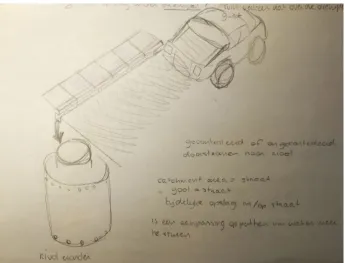
Idea The street gutter and buffer (Figure: 12) is an expansion on existing gutters in the streets. But instead of leading the rainwater runoff into the sewer system it is directed towards a storage unit under the road. These storage units are placed at logical places. Water will run on the street, but there pressure downstream is less.
[image:40.612.134.479.281.544.2]This idea is just like the Gutter Lock in the sense that it is an adaptation on existing structures. In this case it is infrastructure. Changing infrastructure is however very costly and this would be an addition on alternative to the rework that is being done at the Oldenzaalse Straat in Enschede. More open gutters would be good to keep water of the streets.
Subterranean Collector
Idea The subterranean collector (Figure: 13) is placed somewhere under-ground and can collect water from several roofs. The collected water can be used for flushing the toilet and washing clothes after filtering.
The subterranean collector is aimed at collecting rainwater in neighbor-hoods. A neighborhood could be set up to collect water in a certain tank and that people can get water there to water their plants for example. This would require a neighborhood where people are willing to work with each other. Since it is unlikely that all water would end up being provided or dis-tributed evenly across all neighbors.
Venschede
Idea Venschede (Figure: 14) is a combination of the name Enschede and the name Venice. Venice is famous for its canals and canals are what Enschede could use as well in order to manage rainwater.
Canals provide a lot of room for water and with some control elements it could easily be turned into an SRB XXL. Just like the Staircasy City Canal it would require good city planning to make sure the disturbance to traffic is not too big. The idea is simple, but requires a huge change in the city.
4.5
Selection
The selection process was done by presenting the concepts to the University and was based on the current development of the SRB that was still being de-veloped while this thesis was done. So this thesis about the SRB XXL was influenced by the development of the SRB. This makes sense, because both are being developed for the same client and they still have the same desire as be-fore as shown in the stakeholder analysis. The biggest change is the demand for a larger volume and that immediately affects the context as well. The SRB XXL is not suitable for the backyard of most people. So the aim is to change it in such a way so that it suits an industrial zone or urban area.
Choice The staircase city canal ended up becoming the most promising con-cept. The combination of canals, water buffering and interaction with the pub-lic correspond with many characteristics that the municipality and the water-board desire. The name that it got was "Badi". Due to the overlap in functions with the "Wadi" and in Dutch the word ’baden’ means "to bathe". A quick search also revealed that the word means "big" in Hindi. This also fits very well due to the fact that it is called the SRB XXL after all. It is always useful and it can be changed to fit many different urban settings.
5
Specification
In this chapter we focus on the system architecture of the SRB XXL and what requirements the SRB XXL should fulfill. Based on this chapter it should be possible for a system engineer to create their version of the SRB XXL. The chapter starts by explaining the system architecture and ends with an updated and more specified list of components that are a derived from the preliminary requirements and the system architecture. First the system architecture is ex-plained and then the requirements list is displayed.
5.1
System Architecture Diagrams
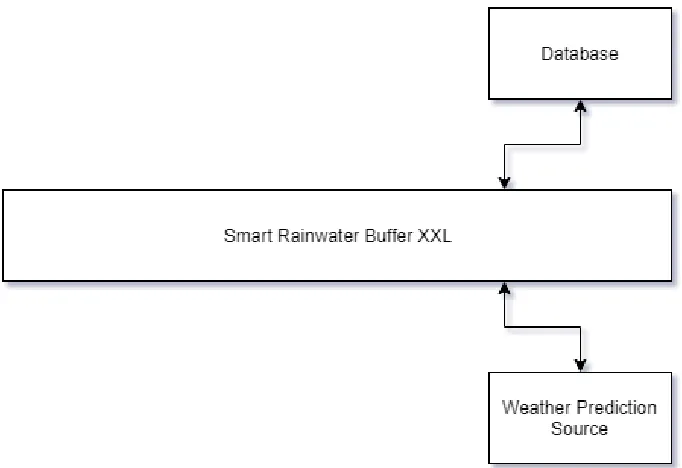
This section describes the system down in three levels. It starts with the core system. The core system’s purpose is to delay rainwater runoff to the sewer system of Enschede (Figure: 16). After that we want to look at the context from the perspective of the SRB XXL. This thesis will show the three levels as system architecture diagrams, starting at level 0, then level 1 and ending at level 2. Each level zooms in on a different part and the subsystems are explained.
Figure 16:System Simple Overview
5.1.1 System Architecture Diagrams - Level 0
In order to create that perspective from the SRB XXL point of view we create a system architecture diagram where we zoom in on several components of the SRB XXL to show the interactions of the system. We start at the level 0 overview. As seen in figure: 17, there are six external components that the SRB XXL communicates with.
Rainwater Input and Output
Figure 17:System Architecture Diagram Level 0 Overview
factors that plays a role in determining the amount of expected water. This can also assist in determining the size of the input and storage of the SRB XXL. The output is mostly determined by the input and is only used to discharge water from the storage. The size of the output has to be able to discharge the same amount of water that the SRB XXL can take via the input. This is to make sure that the SRB XXL can also be a neutral object. So that when the SRB XXL stops working it would be the same as if it did not exist. If the output is larger than the input it could mean that there is even more water being led towards the sewer system than without. That would worsen the problem that the municipality of Enschede is trying to solve.
Rainwater Input and Output Requirements
From the preliminary requirements we can find that a couple play a role when considering rainwater input and output:
1. Connect to roofs in Enschede
2. It has to be able to deal with heavy rainfall 3. The ability to empty within two hours 4. Safe overflow
Based on the system architecture and requirements we can determine what factors should play a role in the decision making of the input and output. The input size is determined by the expected input during heavy rainfall and it has to be connected to roofs so that it can receive the water coming from there. The output is determined by the maximum input of the SRB XXL. The maximum expected input is the maximum discharge rate of the roofs towards the SRB XXL. However the SRB XXL should be able to discharge within two hours, so that means that the output has a constraint in the form of a minimum, because the SRB XXL should not discharge more water than is coming in. So it needs a safe overflow. An overflow can technically be seen as another output. This means that the overflow and the controlled output must not be active at the same time or the output capacity could be larger than the input. Or the output rate needs to be controlled.
Input Location Requirements
The preliminary requirement aboutcollecting water before it goes on the streets
is the odd one out. This requirement is related to placement of the SRB XXL rather than its abilities. Because sometimes water can go on the street and end up in rainwater buffers afterwards. Wadi’s often have this issue. Even though they provide rainwater with a place to go, a wadi does not stop rainwater from getting on the streets first. To solve this, more roofs need to be connected to rainwater buffers. Blocking all rain that is directly above the streets is unre-alistic. So this means that the SRB XXL should be collecting rainwater from places before it hits the street. This means that water should be redirected into the SRB XXL. Connecting the SRB XXL to the roofs in Enschede is one solution and became a high priority preliminary requirement.
Figure 18:System Architecture Diagram Level 0 Input and Output
Users
indicate there is two-way communication and something travels in both direc-tions. But the nature of this interaction is different per user type. We will look at the requirements again to see which requirement fits with what user type. But before we do that it is important to determine what these user types mean.
End User The end user is linked to the citizens of Enschede stakeholder. They are physically near the object when they interact with it.
Manager The manager is linked to the municipality of Enschede, the water-board Vechtstromen and the University of Twente. They are the user that can change the behavior of the SRB XXL where that is not possible for the End User. For example they can toggle the output of the SRB XXL at any time.
Users Requirements
For the end user there are less requirements than for the manager. This is be-cause the end user has less options when it comes to interacting with the SRB XXL. So first come the end user requirements.
1. Be safe 2. Be affordable
3. Interact with local end users Then the manager requirements.
1. Work autonomously/smart 2. Be safe
3. Be reliable
4. Have data repository communication 5. Be low maintenance
6. Dashboard communication 7. Self test
8. Log errors
This shows that the requirements for the smart charateristic of the SRB XXL mostly come from the manager. They want to control and monitor the SRB XXL. In order to provide this ability there needs to be a controller that can deal with all sorts of output, information input and user input.
Data Management
Figure 19:System Architecture Diagram Level 0 Users
Database
For data exchange you need a place to store the data. As mentioned before there is a controller that can deal with output, information input and user in-put. But the controller is part of the SRB XXL. There is also an external database that the SRB XXL can interact with. The SRB XXL can send a request to the database for information and it can also receive information from the database. Multiple SRB XXL units can connect to the same database and even different types of SRBs could connect to it.
Database Requirements
Just like the other interactions are linked to some of the requirements, so is the database. Some of them are the same as the ones that can be found for the manager requirements as well.
1. Work autonomously/smart
2. Have data repository communication 3. Be modular
4. Dashboard communication
Modularity is established when you connect multiple modules. The SRB XXL could be a module in a larger system that has multiple SRBs. If the system is required tobe modularby adding more SRBs, then the information exchange has to be standardized. So that you do not need to create multiple information exchange protocols.
Weather Prediction Source
not predict the weather itself. It uses an external weather prediction source that the SRB XXL communicates with. It does so by sending a request to the weather prediction source and in return it receives the requested data.
Weather Prediction Source Requirements
[image:50.612.133.474.256.490.2]There is only one requirement that is linked to the weather prediction source and it is the ’work autonomously/smart’. Weather information is key for de-termining the behavior of the SRB XXL. For example if there is a prediction that says that the SRB XXL will receive 200 liters, then the SRB can create enough space by emptying before the 200 liters are on their way.
Figure 20:System Architecture Diagram Level 0 Data
5.1.2 System Decomposition - Level 1
After the level 0 overview we look at the level 1 system architecture diagram (Figure: 21). The level 1 diagram zooms in on the SRB XXL and reveals the internal subsystems:
1. Water storage 2. Discharge
5. Water Quality Measurement 6. Water Circulation
7. Controller
Each subsystem has a role to play in order for the SRB XXL to do what it needs to do. Below we describe every subsystem.
Water Storage
What we know about the water storage is that it has to be able to hold at least 20,000 liters of water in order to fulfill the SRB XXL requirement. But figure: 21 shows that the water storage receives the water from the water source. In-ternally the water storage shares its water with several other subsystems. This means that those subsystems use the water as well in one way or another. It does not mean it has to consume the water.
Controller
The only subsystem within the SRB XXL that does not come into contact with the water directly at a level 1 decomposition is the controller. The controller is a system that translates information into actions and will be further explained at the level 2 decomposition where we zoom in on the controller.
Discharge The discharge system is able to discharge water from the water storage. It waits for a request from the controller. For example the controller will request a discharge of 25 liters. Then the discharge system will operate in such a way that it discharges 25 liters.
End User Interaction
The end user interaction subsystem can make use of the water inside the wa-ter storage. The end user can place a request through an inwa-teraction which is then passed on to the controller that decides whether it is okay to return the requested interaction. Because in some situations it is unwise to bring water in contact with people. Think about legionella for example or simply when the water storage is empty.
Water Level Measurement
The water level measurement subsystem is able to measure the amount of wa-ter in the wawa-ter storage and can relay that information to the controller.
Water Quality Measurement
Water Circulation
[image:52.612.134.481.169.501.2]The water circulation subsystem is able to circulate the water in the water stor-age and can be toggled by the controller.
Figure 21:System Decomposition Level 1
5.1.3 System Decomposition - Level 2
1. Water Source Handler 2. End User Interaction Handler 3. Water Level Handler
4. Water Quality Handler 5. Water Circulation Handler 6. Discharge Handler 7. Management Handler 8. Weather Prediction Handler 9. Database Handler
Interesting to see is that the discharge, water circulator and end user interac-tion do not use a handler before toggling. They are directly controlled by the logic. This is because there are more events that can trigger these actuators. For example when the water quality handler indicates that the water is unsafe it might be that there is also a discharge action.
Water Source Handler
The water source handler is able to send a request to the water source in or-der to determine what the characteristics of the water source are. These char-acteristics are important in combination with the weather prediction source to determine what to expect during certain types of rainfall. The event that it gen-erates is about updating the status of the SRB XXL and the action it receives is a request to update the characteristics.
End User Interaction Handler
The end user interaction handler translates an interaction request into an event. This event goes to the logic that does some checks and does what it is set to do in its current state. For example when there is an end user that presses a button on the SRB XXL, then the end user interaction handler translates that button press into the ’end user wants interaction event’. Then that event goes to the logic and when the water quality is good and there is enough water, then the interaction is toggled.
Water Level Handler
The water level handler translates water level data into an event that tells the logic to update the SRB status with the new water level.
Water Quality Handler
Water Circulation Handler
The water circulation handler uses SRB status data to determine whether the water circulation action should be toggled.
Discharge Handler
The discharge handler translates SRB status data into a discharge event. If the status indicates that 25 liters need to be discharged, then the discharge handler knows how long the output should be toggled and sends the corresponding discharge event.
Management Handler
The logic can send the SRB status data to the management handler which trans-lates that data into something that the manager can understand. But the man-agement handler can also translate manager requests into events. These events could be a request to the SRB XXL to empty itself. The logic should then use the discharge handler to create a discharge action.
Weather Prediction Handler
The weather prediction data handles everything that has to do with the weather prediction. The logic can decide that new weather data is required and send an action to the weather prediction handler. The weather prediction handler then transforms the action into a request towards the the weather prediction source. If the weather prediction sends a response the weather prediction handler is able to translate that data into a status update event for the SRB XXL.
Database Handler
The database handler translates requests from the logic to update the SRB sta-tus data in the database into a request to the database in the right format. The same goes for the configuration file request. The SRB XXL sometimes wants to update the configuration file. Simply said the database handler works as a translator between the logic and the external system.
5.2
Final Requirements
6
Realization
This chapter describes the how the requirements from the specification phase are implemented. We start by showing an overview and then break it down into separate parts while providing the reasoning behind some of the imple-mentations. For the SRB XXL this means that we start with showing the end result with all the components and then decompose it into three main parts. First there is the controller. Then the water storage and finally the Badi.
6.1
Overview
The result of the realization phase is a scaled proof of concept in order to demonstrate an idea for the implementation of an SRB XXL in an urban area to the stakeholders. The overview (Figure: 24) shows three components:
1. Controller 2. Water Storage 3. Badi
Together they make up the SRB XXL. The controller is a watertight housing with space for all electronic components. It is in essence the same as the con-troller unit that Waterink [23] uses. The water storage is combined with the controller to allow the smart aspects to function. On top of that there is the ad-dition of the Badi which is able to expand upon the water storage while leaving the SRB functionality intact. The design of the Badi is that of a mirrored stair-case inside a box that allow people to sit comfortably when there is little to no water stored inside. But if there is a lot of water storage required due to heavy rainfall or any other reasons it is possible to store that inside the Badi. This way it has purpose at all times.
6.1.1 Controller
Figure 24:Overview final result.
Controller Montage
Components:
1. SRB Controller (By Waterink [23]) 2. HL-525 V1.0.2 relay module
3. (2x) Comet 1300.01.59 Low voltage submersible pump 600 l/h 5.5m 4. Mean Well GST60A12-P1J 12 V/DC 5 A 60 W Power Source
5. Software
The controller that is used was developed by Waterink [23] and only required one extra relay module to be connected in order to connect the pumps. The SRB Controller makes use of a raspberry pi zero and there were GPIO ports available for the extra actuators (pumps).
Wiring
Figure 25:Controller view Badi.
by the names PUMP 1 and PUMP 2 in Figure: 26. Furthermore the ground of the 12 volt DC adapter is connected to the ground of both pumps. In order to provide power to the pumps, the power source needs to be connected to the 230 volt power network. Which in this case is a power outlet close to the SRB XXL’s location.
Figure 26:Pump Relay Connection.
Figure 27:Pump Wiring Connection.
Software