The effects of episodic time pressure
on learning simulated surgical procedures
in novices
Bachelor Thesis
Lara Janßen
University of Twente
Department of Cognitive Psychology and Ergonomics
Abstract
Introduction: Many aspects of simulator training still seem unclear. In laparoscopic surgery both speed and accuracy are vital for a successful operation, therefore it is essential to find an
optimal balance between the two in an effort to increase speed, to keep anaesthesia times
short, but with the most amount of accuracy as the patient safety has priority. This study aims
to investigate the effects of episodic time pressure on learning minimal invasive surgical
procedures, to highlight a new area in which simulator-based training could be improved.
Method: An experimental, within-subject time-series design was employed. Participants completed a total of 70 trials on the LapSim virtual reality simulator, divided into two tasks,
namely the Cutting and the Lifting and Grasping task. The tasks are divided into three phases
with two conditions, time pressure and no time pressure. For each task a total of 35 trials is
completed.
Results: The analysis of the population-level maximum performance parameter for the two measured by Time on task and Damage rate showed an effect on episodic time pressure.
Participants were able to improve their estimated maximum performance for the measure of
time on task. For the measure of time on task, the effects of the time pressure phase can be
observed. Time pressure seems to affect the asymptotes for time on task.
The correlations for all three phases and also for the two performance parameters come with a
high uncertainty. The correlations for the Damage parameter come with a high uncertainty for
Phase 1 (95% Cl [-1,39; -0,90]), similar high uncertainty is shown for Phase 2 (95% Cl [-1,81;
-1,61]) and Phase 3 (95% Cl [-1,57; -0,95]). The correlations for Time on task all include 0,
therefore it cannot be said with certainty that they were correlated at all.
Conclusion
This study was the first attempt to investigate the effects of episodic time pressure on learning
simulated surgical procedures in novices. With the use of a multi-level non-linear mixed
effects model, learning curves were estimated to assess changes in predicted maximum
performance. Episodic time pressure showed a positive effect on execution time. The study
was able to demonstrate that training with episodic time pressure can change estimated
maximum performance. Participants are predicted to perform faster and simultaneously
maintain a good level of accuracy for the given task.
Keywords: Minimal invasive surgery; Laparoscopy; LapSim; episodic time Pressure;
Table of Contents
Abstract ... 2
1 Introduction ... 4
Theoretical Background ... 6
Cognitive Factors of MIS ... 6
Speed Accuracy Trade off ... 6
Learning under Time pressure ... 7
Learning Curves ... 7
Research Question ... 9
2. Method ... 10
2.1 Design ... 10
2.2 Participants ... 10
2.3 Apparatus... 10
2.3.1 Simulator tasks ... 11
2.3.2 Demographic Questionnaire ... 13
2.4 Measures ... 13
2.5 Procedure ... 14
2.6 Data Analysis ... 14
3. Results ... 15
3.1 Population-level Maximum Performance ... 15
3.2 Individual-level Maximum performance ... 16
3.3 Correlations of Population Maximum performance ... 18
3.3 Individual-level maximum performance scatterplots ... 19
4. Discussion ... 21
Individual differences in Maximum Performance ... 22
Internal consistency reliability of the laparoscopic tasks in the LapSim ... 23
Limitations ... 23
Further research ... 23
5. References ... 25
6. Appendix ... 27
6.1 Appendix 1 Demographic Questionnaire ... 27
6.2 Appendix 2 Instruction Guide ... 27
6.3 Scores Population level Maximum performance... 31
6.4 Individual Learning curves ... 32
1 Introduction
Surgeons today have a wide array of technology available to them which changes the way
procedures are performed. New procedures allow for better and safer ways to treat patients
and a shift from invasive surgeries to less invasive procedures (e.g. laparoscopy) can be seen
in modern operating theatres (Kopelman, Lanzafame & Kopelman, 2013). Laparoscopy is a
low risk minimally invasive surgical procedure, also known as keyhole surgery, which
requires only small incisions into the body. The procedure is performed using an instrument
called a laparoscope which is inserted into the abdominal wall. This instrument is equipped
with a high-resolution camera, of which the images can be seen on a monitor ("Laparoscopy:
Purpose, Preparation, Procedure, and Recovery", 2019). This minimal invasive procedure
offers many advantages to classical open surgery, such as a shorter recovery time for patients
and less scarring, but it poses new challenges for the surgeons performing and training this
procedure. Many problems associated with Laparoscopy are due to perceptual, spatial,
cognitive and psychomotor difficulties (Gallagher, Smith, 2003). To meet these new
challenges better ways of training are sought out and studied, as it was shown that the ability
to successfully perform MIS depends largely on the duration and quality of the training
(Gallagher, Smith,2003).
In the past the “Master-apprentice-model” was used to teach medical residents these
procedures. Here a resident would watch a ´master surgeon´ perform the procedure multiple
times and then gradually take over some of the tasks during the procedure until sufficient
proficiency is reached and the apprentice can perform the procedure without assistance
(Kramp, 2016). Now there is a shift towards a different way of teaching residents’
laparoscopic procedures with the use of Simulator training. Simulator training is attractive,
because it avoids the use of patients for skill practice and it ensures that trainees have some
experience before treating patients (Sutherland et al., 2006). Research by Aggarwal et al.
(2007) showed that a proficiency-based VR-training for Laparoscopic surgery shortened the
learning curve on real procedures compared to traditional training. Other studies showed
similar results and suggest that through Simulator based training learning curves can be
shortened and performance in the procedure can be improved without compromising patient
safety (Ali, Mowery, Kaplan & DeMaria, 2002); Kopelman, Lanzafame &Kopelman, 2013;
Most studies on simulator-based training deal with the effectiveness of the training procedure
and look for predicting factors for good performance on these procedures. A study by
McGaghie, Issenberg, Petrusa & Scalese showed that long hours of high-fidelity simulator
practice have a positive, functional relationship with standardised learning outcomes (2006).
Simulator training is beneficial for medical education, but not all aspects of this method have
been fully investigated to improve training procedures and make better predictions in future
performance in trainees. A systematic review by Cook et al. (2012) looked at the effectiveness
of instructional design features in simulation-based education. They found a few features to
be important such as multiple learning strategies, repetitive practice, range of difficulty and
feedback, but also highlighted the need for further research to clarify for whom and under
what circumstances these features are beneficial. Many aspects of simulator training still seem
unclear. In laparoscopic surgery both speed and accuracy are vital for a successful operation,
therefore it is essential to find an optimal balance between the two in an effort to increase
speed, to keep anaesthesia times short, but with the most amount of accuracy as the patient
safety has priority. Therefore, this study aims to investigate the effects of episodic time
pressure on learning minimal invasive surgical procedures, to highlight a new area in which
Theoretical Background
Cognitive Factors of MIS
A surgeon performing minimally invasive surgery faces different challenges compared to
open surgery. Laparoscopy is a complex technical skill. Surgeons need to overcome the
perceptual, spatial, cognitive and psychomotor problems associated with MIS. One such
problem comes with the use of the monitor. The surgeon is working in one direction with his
hands but is looking at the monitor, while standing in a position that can cause strain on the
arms, neck and shoulders (van Det et al., 2008) The use of the monitor causes perceptual
difficulties. During the procedure depth perception is distorted as the image is only displayed
in 2D on screen. The surgeon thus needs to fill the gap themselves, forming complex mental
models of the insides of the patient (Lin & Chen, 2013). The surgeon depends on the use
skills like Mental Rotation, which is less used in open surgery. Further, the range of motion is
limited compared to classical open surgery, due to the use of longer instruments. These
instruments also change the tactile feedback and magnifies the hands’ natural tremors (van
Det et al., 2008). However, the biggest ergonomic problem in laparoscopic procedures is the
´Fulcrum effect´: when an instrument is moved to the right on the display the working end of
the instrument appears to move to the left, this makes the motion of the instrument
counterintuitive as the instrument motion is inverted inside the abdominal wall (Gallagher et
al., 1998).
Speed Accuracy Trade off
The balance between Speed and Accuracy is an important part of any surgical procedure,
therefore the speed-accuracy trade-off should be considered.
The speed-accuracy trade-off is a phenomenon that describes that increased speed leads to an
increase in error. This was shown from a variety of tasks from low to high level of difficulty
(MacKay, 1982). In some cases, increased speed can lead to a better accuracy, but generally
accuracy is traded for speed (Fairbrother, 2010). For movements that require to be performed
rapidly, which are movements with a time under 200ms, it has been demonstrated that
increased speed can lead to better accuracy (Schmidt et al, 1979). This suggests that
increased speed could potentially lead to better accuracy for certain types of movement. By
introducing a time pressure episode during the learning process, increased errors are to be
expected, which can be explained by the speed-accuracy trade-off. An increase in errors can
also show potential benefits, as demonstrated by a study from Dyre, Tabor, Rinsted
&Tolsgaard (2016). Their research focused on the effects of error management in contrast to
make errors during simulator training showed improved transfer learning to the clinical
setting, compared to error avoiding.
Learning under Time pressure
There are no studies investigating the effects of time pressure on learning surgical procedures
directly. Time is an element in surgical training procedures but is not yet specifically
investigated as a tool to improve training (Pusic et. al,2014). There are however other fields
where time limitations were investigated. A study by Beilock, Bertenthal, Hoerger, & Carr
(2008) looked at the effect of time pressure in novice and skilled golfers. Novice golfers
performed better in conditions with unlimited time and showed increased errors in the time
pressure condition, while skilled golfers seemed to benefit from the time constraint. The
positive effect on the skilled golfers was assumed to be caused by a lack of time to reconsider
learned execution processes, which decreased the possibility of new errors (Beilock,
Bertenthal, Hoerger & Carr, 2008). Similar findings have been found in a study about expert
system-based training for emergency management. Here an improved level of decision
accuracy after expert training with time pressure was observed. It indicated that people adapt
to the time restriction by accelerating their processing of rules (Lin & Su, 1998). One study by
Gas et al. investigated how time pressure influences the speed-accuracy trade-off in surgical
training. Their results showed that medical students were able to maintain or improve their
accuracy with increased speed, but it was noted that this could have potential negative effects
in novices (2018). Further, in their study some senior residents showed negative effects to the
time pressure. This likely unmasked some technical errors that were not apparent at lower
speeds. The aforementioned studies all show different effects of time pressure on skill
acquisition and execution, but also outlines a research gap on the effects and possible benefits
time pressure can have during training.
Learning Curves
To overcome the difficulties posed by Laparoscopic procedures, extensive training is needed.
In order to evaluate candidate training features, it is necessary to measure their effects on the
learning process. Because learning is a non-linear process a non-linear model is most suitable
for its assessment. One such model comes with the application of learning curves, which can
be used to assess current learning status and predict future performance.
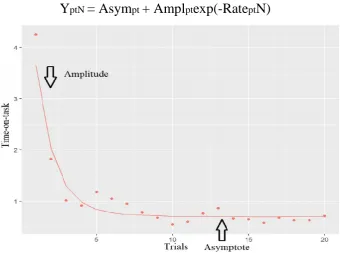
The exponential learning curve model described by Heathcote, Brown and Mewhort (2000) is
used to model the learning curves. It consists of three parameters: Amplitude, rate and
YptN = Asympt + Amplptexp(-RateptN)
Figure 1 – Exponential Learning curve model. The x-axis shows the trials, time on task is shown on the y-axis. Amplitude shows the total amount of learning; the asymptote shows the predicted maximum performance. From “Towards reliable and
valid prediction of MIS-performance with basic laparoscopic tasks in the LapSim and low-fi dexterity tasks” by Alexander
Arendt, 2017, unpublished Master Thesis. University of Twente
The amplitude shows the total amount of learning, the rate describes the learning speed and
the asymptote removes the learning process by assuming it infinite and shows predicted
maximum performance over time.
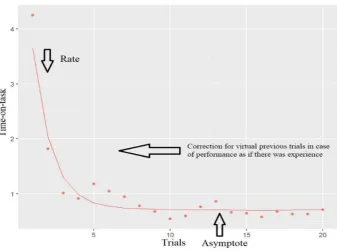
For this study the amplitude has been reparametrized into a parameter for virtual previous
trials. This can account for any previous experience of participants and is necessary for the
analysis and comparison of the different conditions in this study. Therefore, the previous trial
parameter is more meaningful than the Amplitude parameter. If a participant has had previous
experience, the function must be moved to the left on the x-axis for it to become flatter in the
observed range. Figure 2 shows a visual representation of the reparameterization. The formula
for this model is:
Figure 2 Reparametrized exponential Learning Curve model. From “Towards reliable and valid prediction of MIS
-performance with basic laparoscopic tasks in the LapSim and low-fi dexterity tasks” by Alexander Arendt, 2017, unpublished Master Thesis. University of Twente
Research Question
This study aims to investigate the effects of episodic time pressure on learning simulated
surgical procedures in novices, by introducing an episode of time pressure during the training.
As of now there has not been much research on the effects of time pressure in relation to skill
acquisition in laparoscopic surgery. Learning curves and multiple performance measures are
used to assess changes in predicted maximum performance before and after training with time
2. Method
2.1 Design
An experimental, within-subject time-series design was employed. Participants completed a
total of 70 trials on the LapSim virtual reality simulator, divided into two tasks: The Cutting
and the Lifting and Grasping task. The tasks are divided into three phases with two
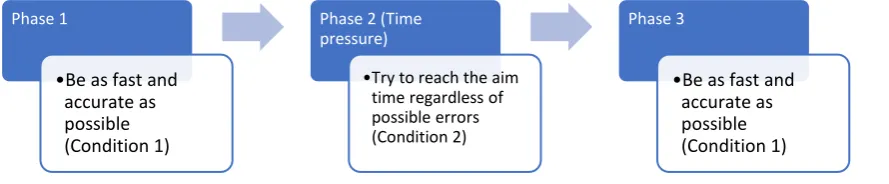
conditions. For each task a total of 35 trials is completed. For the first Phase the participant
was instructed to try to be as quick but as accurate as possible (Condition 1). After the
completion of Phase 1, the participants received a different objective: being 20% faster than in
the previous trials, time pressure phase (Phase 2; Condition 2). The aim time was calculated
by the experimenter and the participants were told to aim for this speed regardless of errors
that may occur. In the third Phase, the participant was again asked to be quick and as accurate
[image:10.595.72.517.343.435.2]as they can (Phase 3; Condition 1).
Table 1 Flowchart describing the three phases of the study with participant instructions
2.2 Participants
The study was completed by N=40 participants (18 men and 22 women) who were either
students or affiliates of the University of Twente. Participants´ mean age was 24, their
nationalities were German (37,5%), Dutch (42,5%) and Other (20%). Compensation in the
form of Course Credit (SONA Points) was provided for some participants enrolled in a
specific undergraduate study. Participants were recruited through SONA Systems, an online
platform for undergraduate Psychology Students of the University of Twente and through
direct recruitment on the University Campus and through Messengers (Facebook and
WhatsApp). All participants have signed an informed consent form, a copy of this form can
be found in Appendix 6.6.
2.3 Apparatus
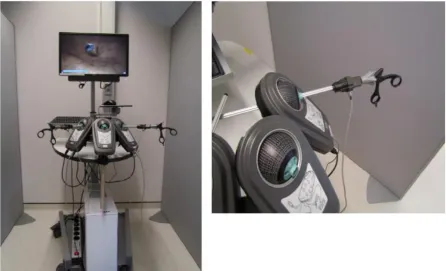
The study used the LapSim© virtual reality simulator using Virtual Laparoscopic Interface
(VLI) hardware. The simulator is used to simulate a variety of surgical task used in
laparoscopic procedures and other basic laparoscopic tasks. The simulator consists of three
SimBall-modules in which the different endoscopic tools are inserted, a desktop computer and Phase 1
•Be as fast and accurate as possible (Condition 1)
Phase 2 (Time pressure)
•Try to reach the aim time regardless of possible errors (Condition 2)
Phase 3
a 23” LC-Display (see Figure 3). The SimBall-modules represent the insertion points into the
abdominal wall. These modules are capable of detecting the movements of the inserted
endoscopic tools, which are similar to tools used in actual surgery except for the forcipes at
the end of the instrument. The modules can detect the angle in which instruments are inserted
and the degree to which they are pushed and pulled out of the modules. These movements are
then translated and displayed onto the LC-Display. The LapSim has been shown to be a
suitable tool for the assessment of laparoscopic skills and was able to show differences in
overall scores and efficiency between novice and experienced surgeons (van Dongen et al.,
2007).
2.3.1 Simulator tasks
The selected tasks for this study are the Cutting and Lifting and grasping task from the
LapSim© Basic Skills Set v3.0. These subtasks are identified as relevant subtasks in
laparoscopic procedures, such as cholecystectomy and are used in simulator training for
laparoscopic procedures (Aggarwal et. al, 2009; Wherry, Marohn, Malanoski, Hetz, & Rich,
[image:11.595.72.519.277.548.2]1996).
Figure 3 Set up LapSim; on the left complete simulator with LC-Display, computer and Sim-Ball Modules with instruments; on the right close up of Sim-Ball Modules with inserted instrument. From “Towards reliable and valid prediction of MIS -performance with basic laparoscopic tasks in the LapSim and low-fi dexterity tasks” by Alexander Arendt, 2017, unpublished
Cutting
Cutting is one of the subtasks needed for laparoscopic procedures. Here tissue is grasped with
grasping forceps and with a second pair of ultrasonic-scissor forceps the tissue can be cut and
cauterized at the same time. The purpose of the cutting task in the simulator is to grasp a vein
with one instrument and then cut the marked area of the vein with the second instrument. To
do this the instruments need to be inserted into the modules. When the graspers are close to
the vein it can be grasped by closing the handle. With the second instrument the vein needs to
be grasped at a highlighted area and then cut, by pressing a pedal on the ground. Figure 4
[image:12.595.80.441.291.512.2]shows part of the task.
Figure 4 Screenshot of the Cutting task. The left instrument shows an ultrasonic scissor. The right instrument is a grasper. The to be cut area is highlighted. From “Towards reliable and valid prediction of MIS-performance with basic laparoscopic tasks in the LapSim and low-fi dexterity tasks” by Alexander Arendt, 2017, unpublished Master Thesis. University of Twente
Lifting and Grasping
For the lifting and grasping task a probe instrument is used. This instrument is used to lift
tissues up, so the surgeon can then operate underneath. The objective of the lifting and
grasping task is to grasp a needle, which is located under a box shaped object, and then move
it to the target location. The box shaped object needs to be lifted with the probe instrument,
when this is achieved the needle like object needs to be grasped with the second instrument
and then transferred into a disposal bag shown on screen. During this task the object and
target location vary, which also results in a switch of grasper and probe instrument. A
Figure 5 Screenshot Lifting & Grasping task. Right instrument is a grasper. The left instrument is a probe, which is used to lift the tissue, which enables to grasp the target objects shown in white. From “Towards reliable and valid prediction of MIS -performance with basic laparoscopic tasks in the LapSim and low-fi dexterity tasks” by Alexander Arendt, 2017, unpublished Master Thesis. University of Twente
2.3.2 Demographic Questionnaire
A demographic questionnaire is given to the participants (see Appendix 6.1). This
questionnaire collects general demographic data and also checks for any exclusion criteria.
2.4 Measures
Simulator performance measures
The LapSim© simulator tracks the performance of the participant over a range of modalities
such as tissue damage, instrument path length, angular path length, etc. For this dataset the
parameters time-on-task and damage rate were chosen. The parameter time on task is
measured in seconds. The damage rate is measured by quantitative damage, which shows the
quantity of damage done. These two parameters show if accuracy is traded for speed. With
these values an individual learning curve can be produced for each participant and a prognosis
for maximum performance can be made.
Mental Workload
After each trial the Mental Workload of the participants is assessed. A question from the
NASA TLX - Task load index was used. This scale has been widely used for the assessment
of workload scores and has shown good reliability and validity and is therefore an appropriate
measure to assess the perceived mental workload. The participants are asked to indicate their
2.5 Procedure
Greeting and Briefing
When the participants arrive, they are welcomed and thanked for their participation. They are
then informed about the purpose, by giving an explanation about the procedure and purpose of
the study. Once all questions participants might have are answered the participants are asked
to read and sign the informed consent forms. When the consent is signed, they are asked to fill
in a short demographic questionnaire.
LapSim
After completion of the questionnaire, they are taken to the simulator. The participants are
introduced to the simulator and the researcher shows which tools to use and adjusts the table
to a comfortable height for the participant. The participants are instructed to read the
instructions and watch the additional instruction video, which is given on the screen of the
simulator.
The two tasks are performed on different days to prevent fatigue in the participants, on the
first day the Cutting task is performed and the Lifting & Grasping task on the second day. As
described earlier the participants completed 35 trials per task, divided into the three phases
with two conditions. After each trial the participants are asked about their Mental Workload
and can take a short break and are offered a refreshment.
Debriefing
After all trials are completed, participants are told about the full purpose of the study. Before
leaving they are again thanked for their participation and offered to leave their email if they
wish to receive the results of the study. For a detailed version of all instructions refer to
Appendix 2.
2.6 Data Analysis
A multi-level non-linear mixed effects model with learning curves as likelihood function was
employed to construct a non-linear regression model. The model estimates learning curves for
all participants per task and condition and bundles them together for analysis on a
population-level. The parameter asymptote previously described is needed to construct the learning
curves. For the error component a gamma distribution has been chosen assuming that error
effects are stronger in the initial learning phase for the participants. The final model used
estimate random effects for the learning curve parameters based on damage rate, time on task
3. Results
The data was analysed using a multi-level non-linear regression model to plot individual
learning curves for all participants in each condition with a total 240 learning curves (see
Appendix part 6.4). First, the population-level maximum performance parameter for the two
tasks are shown, measured by Time on task and Damage rate. Then individual learning curves
are presented to show individual differences in the population. Lastly, correlations of the
population-level maximum performance parameter of the two tasks are reported. The data of
the Mental Workload scores have not been considered in this work, as it was beyond the
scope of this thesis.
3.1 Population-level Maximum Performance
To answer the main research question, namely what effect episodic time pressure has in
learning simulated surgical procedure in novices, the Population-level maximum performance
was analysed for the three phases. A difference in maximum performance between conditions
would indicate an effect of time pressure on learning. Figure 6 shows the graphical
representation of the population level maximum performance for both tasks during the three
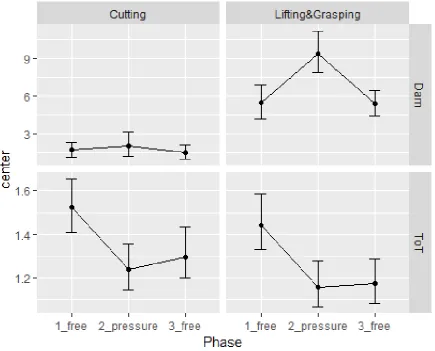
[image:15.595.80.516.406.757.2]Both tasks show similar patterns in terms of damage and time on task. The overall pattern is
the same for the Cutting and the Lifting & Grasping task, though in the Lifting & Grasping
task the range of performance scores is higher. The increase in damage from the first to the
second phase in the cutting task was not high, with an error count of 1,69 in phase 1 to 2,01 in
the time pressure phase. In the third phase an overall decrease of 1/6 in terms of damage on
the estimated maximum performance rate was achievable (Phase 1: 1.69; Phase 3: 1.46). A
bigger difference can be seen in the Lifting & Grasping task where the damage increases from
phase 1 with an error count of 5,46 to 9,35 in phase 2. After the time pressure the damage rate
decreases to 5,38, which shows a slight decrease compared to the first phase.
For the measure of time on task, the effects of the time pressure phase can be observed. Time
pressure seems to affect the asymptotes for time on task. In phase one the predicted scores for
the cutting tasks were 1,52min and 1,44 for the Lifting & Grasping task. This decreases to
1,24min for the cutting and 1,15min for the Lifting & Grasping task in Phase 2. After the time
pressure the time on task performance stays low compared to the first phase with an overall
decrease of 1/5 the original predicted time. For the cutting task from 1,52min (phase 1) to
1,30min (phase 3) and from 1,44min (phase 1) to 1,17min (phase 3) in the lifting &grasping
task. The participants responded to the time pressure with an increase in speed, but a
simultaneous increase in damage.
After the time pressure, the third phase time improved significantly compared to the first
phase while the damage stayed at a comparable level, which shows that the time pressure had
a positive effect on execution speed. Participants were able to improve their estimated
maximum performance for the measure of time on task. For a full representation of the
population-level maximum performance measure refer to Appendix 6.3.
3.2 Individual-level Maximum performance
For each participant individual learning curves were modelled. This part-level analysis is
performed to show individual differences to check if the effects of time pressure are uniform
in the population. In total 240 learning curves were modelled. The learning curves for
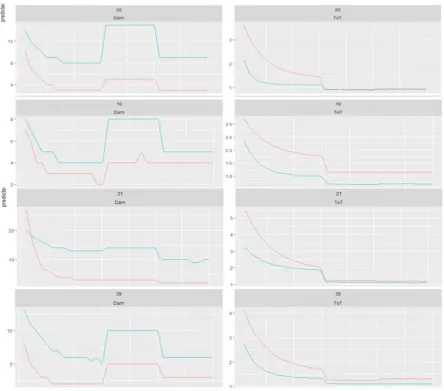
participants 05, 10, 21 and 39 are shown in Figure 7 to show individual differences of the
population. To review all learning curves, see Appendix 6.4. For all four participants time on
task and the damage rate decrease over the first 15 trials (Phase 1, condition 1). Participant
number 5 and 39 show a pattern similar to the population-level maximum performance.
Damage rate decreases in the initial 15 trials together with time. In phase 2 the damage rate
increases for both tasks, but more for the Lifting & Grasping task, while time on task
1, while time on task stays at the level of phase 2, indicating a strong effect of time pressure
on time on task performance.
In participant 10 the first two phases follow the same pattern in regards of time and damage.
In the third phase the participant is significantly faster than in Phase 1, but his damage rate is
higher than it was before in phase 1. For the cutting task the damage rate is similar to that in
the time pressure phase. Time pressure made the participant faster, but this appears to be
traded for accuracy.
In participant 21 the damage rate steadily decreases with no obvious peaks, which can be
observed in other trials. The participant does perform faster in the time pressure phase and is
able to stay on the same level of time, although this seems to have no effect on damage.
Most participants show similar effects to the time pressure with an increase of damage in the
time pressure episode and a decrease in time. In the third phase, participants are able to
perform better on time compared to the first phase and the damage rate goes back to the first
phase level. Looking at the data, individual differences can be seen and not everyone shows
Figure 7 the Individual learning curves for participant 05, 10, 21 and 39 for the tasks cutting (red) and Lifting & Grasping (Blue). The damage scores and the scores for time on task are shown on the y-axis. Each column on the x-axis shows 5 trials.
3.3 Correlations of Population Maximum performance
To assess the internal consistency reliability of the two laparoscopic tasks, pairwise
correlations were estimated on the population maximum performance for the three conditions
and for the performance parameters Damage and Time on task. The correlations are shown in
Table 2. All correlations were positive, but that does not allow for judgment regarding
Internal Consistency. To assess the certainty of the correlations, 95% credibility limits have
been calculated, this says that there is a 95% chance that the true value lies within the found
range. Great certainty can only be concluded if the credibility limits only deviate by a
maximum of 0.2. Credibility limits that include 0, but no values under -0,1 show high
uncertainty, if any effect at all.
high uncertainty. The correlations for the Damage parameter come with a high uncertainty for
Phase 1 (95% Cl [-1,39; -0,90]), similar high uncertainty is shown for Phase 2 (95% Cl [-1,81;
-1,61]) and Phase 3 (95% Cl [-1,57; -0,95]). The correlations for Time on task all include 0,
[image:19.595.69.543.203.302.2]therefore it cannot be said with certainty that they were correlated at all.
Table 2: Pairwise correlations of population maximum performance of the task Cutting and Lifting & Grasping
by Phases and performance parameters
Phase Damage Time on task
1 r =0,643, [-1,39; -0,90] r =0,583, [0,09; 0,22]
2 r =0,611, [-1,81; -1,16] r =0,501, [0,06; 0,21]
3 r =0,464, [-1,57; -95] r =0,570, [0,05; 0,19]
95% credibility limits in square brackets
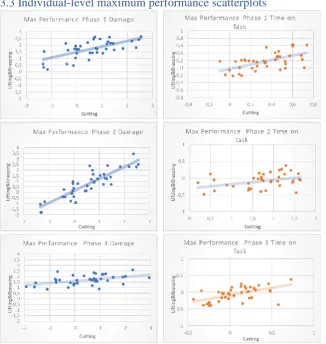
3.3 Individual-level maximum performance scatterplots
As part of the posterior
analysis of this study,
scatterplots comparing
individual
level-maximum performance
between the two tasks
were plotted. The better
the points fit in an
ascending line, the more
comparable the
parameters are with each
other. The scatterplots in
Figure 8 compare the
individual-level
maximum performance
parameters of all
participants between the
two tasks. The axis
[image:19.595.71.398.350.695.2]depicts the random effect
The points of all conditions are closely assembled. The points for Phase 3 Damage seem to be
the closest assembled on the line, followed by Time on task in phase 3. All phases show
4. Discussion
The aim of the current study was to investigate the effect of episodic time pressure on
learning simulated surgical tasks in novices, in order to fill a research gap in surgical training
and find potential new ways of training medical residents.
The results from the population level maximum performance show an effect of time pressure
on the performance measure Time on task. Participants performed faster after the time
pressure episode. In the cutting task the time improved by 16,9% in predicted max
performance. For the Lifting & Grasping task the time gain was higher; a decrease in time by
23,0% compared to the first phase, see Figure 5 in the results section. However, there is no
strong effect on the damage rate after the time pressure episode, although the damage rate
went down in the cutting task by 15,9% and for the Lifting& Grasping task only by 1,4%.
While the estimated time improves, the damage rate seems to plateau. The episodic time
pressure appears to have had a positive effect on the participants learning progress, as they
were able to improve their time without sacrificing accuracy.
Generally, the task Lifting & Grasping is more error prone than the Cutting task and
participants performed better on the cutting task, this is reflected in the damage rate for both
tasks. In regard to the Speed Accuracy Trade off it seems that an appropriate balanced in
terms of execution speed and accuracy can be reached after the episodic time pressure.
The findings of this study are in line with the findings in medical students by Gas and
colleagues (2018), as they too were able to increase their speed but maintain their accuracy.
However, this study also noted that the time pressure could have some negative effects on the
medical students. In regard to other studies mentioned before it is difficult to draw direct
comparisons with the findings of this study, due to the differences in population and analysis.
The study by Beilock, Bertenthal, Hoerger & Carr (2008) only showed an advantage in the
advanced golfer. These findings would contradict the findings of this study, as the participants
had no prior experience, but the estimated maximum performance assumes the learning to be
infinite therefore assuming a higher level of proficiency, which would in turn not be in
disagreement with the findings. Further, it was hypothesized that the advanced golfers were
able to perform faster, because they were able to rely on rule-based behaviour. The used
model does not explicitly account for rule-based behaviour, so conclusions in this regard
cannot be drawn.
This also seems to be the case for the study of Lin & Su (1998) on emergency training where
their learning process and not novices like in this study, which makes comparing these results
difficult.
In the study by Dyre, Tabor, Ringsted & Tolsgaard (2016), medical students that had no prior
experience in training ultrasound procedures on simulators were able to improve their
learning through error management and it was stated that learning from error occurred when it
was expected. The medical students in this study were instructed to deliberately make errors,
similarly to the participants in the current study, who were told to focus on reaching the time
limit and disregard for an eventual increase in errors made during the time pressure phase.
The greater occurrence of errors during the time pressure episode could be a possible
alternative explanation for the change in maximum performance of the third phase.
The time pressure episode changed the predicted maximum performance parameter, which
contradicts its interpretation as maximum performance as a fixed estimate as it appears to be
malleable. Thereafter a possible explanation for this issue is offered. The projected learning
curves are corrected for previous experience. When the third phase is used to construct new
learning curves the number of previous trials is taken into account as virtual experience. This
assumes that any single trial is a constant measure of experience. However, if the experience
gained from a trial correlates positively with the number of errors produced within that trial
then the virtual experience gained in phase two is underestimated. Which means that the x
offset of the Phase 3 data in constructing the post time pressure learning curves
underrepresents the participants actual experience. One way to investigate this issue is to
compare the slope in the Phase 3 data with that of the Phase 1 learning curve for trials 26 to
35. If the measured data shows a significantly flatter slope than predicted, that could be an
indication that the data is actually further along the learning curve.
Individual differences in Maximum Performance
To account for individual differences and to check if the observed effect was also visible on
an individual level, these were also analysed. The estimated maximum performance for time
on task changed, participants are expected to perform faster after training with episodic time
pressure. The effect of time pressure for the estimated maximum performance for the damage
measure did not show the same patterns across individuals. Some participants showed patterns
of increase in damage even after the time pressure phase (see Figure 7). This could be an
indicator that time pressure could have a negative effect on learning in some individuals,
which was also suggested by Gas et al. (2008). Alternatively, they might have developed a
time and therefore continued to make more errors, and hence did not try to be as accurate as
they can.
Internal consistency reliability of the laparoscopic tasks in the LapSim
To assess the internal consistency reliability of the two laparoscopic, pairwise correlations
were estimated on the population maximum performance for the three conditions and for the
performance parameters Damage and Time on task. This analysis of the correlations showed
high uncertainty across all Phases. The correlations for the Damage parameter come with a
high uncertainty for Phase 1 (95% Cl [-1,39; -0,90]), similar high uncertainty is shown for
Phase 2 (95% Cl [-1,81; -1,61]) and Phase 3 (95% Cl [-1,57; -0,95]). The correlations for
Time on task all include 0, therefore it cannot be said with certainty that they were correlated
at all. These findings are in line with the findings of Arendt (2017).
Limitations
The experimental paradigm of this study was good, some bias could have been introduced,
but no significant compromise could be identified. The sample of this study does not reflect
the target population, which poses a possible limitation to the findings of this study. To see if
results differ, further research is required.
Further research
The results of this study show that episodic time pressure is worth investigating. This study
could be the start of a series of new research in the field of surgical simulator training. To
further investigate this, it could be started to see if the results are replicable not just in novice
participants, but also in medical professionals, to check if the effect is stable over time.
Another point of interest is to see whether this effect can also be seen for more complex
simulated tasks, as the here tested tasks only represent a small subsection of laparoscopic
basic skills needed.
The estimated Maximum performance measures changed, as discussed above this contradicts
the interpretation of maximum performance as a fixed estimate as it appears to be malleable.
Research could look into how to approach the concept of maximum performance in the future.
Conclusion
This study was the first attempt to investigate the effects of episodic time pressure on learning
simulated surgical procedures in novices. With the use of a multi-level non-linear mixed
effects model, learning curves were estimated to assess changes in predicted maximum
maximum performance. Participants are predicted to perform faster and simultaneously
5. References
Aggarwal, R., Crochet, P., Dias, A., Misra, A., Ziprin, P., & Darzi, A. (2009). Development of a virtual reality training curriculum for laparoscopic cholecystectomy. British Journal of Surgery, 96(9), 1086-1093. doi: 10.1002/bjs.6679
Aggarwal, R., Ward, J., Balasundaram, I., Sains, P., Athanasiou, T., & Darzi, A. (2007). Proving the Effectiveness of Virtual Reality Simulation for Training in Laparoscopic Surgery. Annals of Surgery, 246(5), 771-779. doi: 10.1097/sla.0b013e3180f61b09
Ali, M., Mowery, Y., Kaplan, B., & DeMaria, E. (2002). Training the novice in
laparoscopy. Surgical Endoscopy, 16(12), 1732-1736. doi: 10.1007/s00464-002-8850-6
Beilock, S., Bertenthal, B., Hoerger, M., & Carr, T. (2008). When does haste make waste? Speed-accuracy tradeoff, skill level, and the tools of the trade. Journal of Experimental Psychology: Applied, 14(4), 340-352. doi: 10.1037/a0012859
Cook, D., Hamstra, S., Brydges, R., Zendejas, B., Szostek, J., & Wang, A. et al. (2012). Comparative effectiveness of instructional design features in simulation-based education: Systematic review and meta-analysis. Medical Teacher, 35(1), e867-e898. doi:
10.3109/0142159x.2012.714886
Dyre, L., Tabor, A., Ringsted, C., & Tolsgaard, M. (2016). Imperfect practice makes perfect: error management training improves transfer of learning. Medical Education, 51(2), 196-206. doi: 10.1111/medu.13208
Fairbrother, J. (2010). Fundamentals of motor behavior. Champaign, Ill.: Human Kinetics.
Gallagher, A., McClure, N., McGuigan, J., Ritchie, K., & Sheehy, N. (1998). An Ergonomic Analysis of the Fulcrum Effect in the Acquisition of Endoscopic Skills. Endoscopy, 30(07), 617-620. doi: 10.1055/s-2007-1001366
Gas, B., Buckarma, E., Cook, D., Farley, D., & Pusic, M. (2018). Is Speed a Desirable Difficulty for Learning Procedures? An Initial Exploration of the Effects of Chronometric Pressure. Academic Medicine, 93(6), 920-928. doi: 10.1097/acm.0000000000002167
Heathcote, A., Brown, S., & Mewhort, D. (2000). The power law repealed: The case for an exponential law of practice. Psychonomic Bulletin & Review, 7(2), 185-207. doi:
10.3758/bf03212979
Kopelman, Y., Lanzafame, R., & Kopelman, D. (2013). Trends in Evolving Technologies in the Operating Room of the Future. JSLS: Journal Of The Society Of Laparoendoscopic Surgeons, 17(2), 171-173. doi: 10.4293/108680813x13693422522196
Kramp, K. H. (2016). Education in laparoscopic surgery: All eyes towards in vivo training.
[Groningen]: Rijksuniversiteit Groningen.
Laparoscopy: Purpose, Preparation, Procedure, and Recovery. (2019). Retrieved from
https://www.healthline.com/health/laparoscopy
Luursema, J., Rovers, M., Groenier, M., & van Goor, H. (2014). Performance Variables and Professional Experience in Simulated Laparoscopy: A Two-Group Learning Curve
Study. Journal of Surgical Education, 71(4), 568-573. doi: 10.1016/j.jsurg.2013.12.005
MacKay, D. (1982). The problems of flexibility, fluency, and speed-accuracy trade-off in skilled behavior. Psychological Review, 89(5), 483-506. doi: 10.1037/0033-295x.89.5.483
McGaghie, W., Issenberg, S., Petrusa, E., & Scalese, R. (2006). Effect of practice on standardised learning outcomes in simulation-based medical education. Medical Education, 40(8), 792-797. doi: 10.1111/j.1365-2929.2006.02528.x
Pusic, M., Boutis, K., Hatala, R., & Cook, D. (2015). Learning Curves in Health Professions Education. Academic Medicine, 90(8), 1034-1042. doi: 10.1097/acm.0000000000000681
Pusic, M., Brydges, R., Kessler, D., Szyld, D., Nachbar, M., & Kalet, A. (2014). What's your best time? Chronometry in the learning of medical procedures. Medical Education, 48(5), 479-488. doi: 10.1111/medu.12395
Schmidt, R., & et al. (1979). Motor-output variability: A theory for the accuracy of rapid motor acts. Psychological Review, 86(5), 415-451. doi: 10.1037//0033-295x.86.5.415
Sutherland, L., Middleton, P., Anthony, A., Hamdorf, J., Cregan, P., Scott, D., & Maddern, G. (2006). Surgical Simulation. Annals Of Surgery, 243(3), 291-300. doi:
10.1097/01.sla.0000200839.93965.26
van Det, M., Meijerink, W., Hoff, C., Totté, E., & Pierie, J. (2008). Optimal ergonomics for laparoscopic surgery in minimally invasive surgery suites: a review and guidelines. Surgical Endoscopy, 23(6), 1279-1285. doi: 10.1007/s00464-008-0148-x
6. Appendix
6.1 Appendix 1 Demographic Questionnaire
Demographic survey for LapSim+time pressure
1. What is your gender? _male _female
2. Please enter your date of birth: Date / Time
3. Please enter your nationality: ____
4. Do You have impaired vision?
-Yes, I wear glasses
-Yes, I wear contact lenses.
-Yes, but I do not wear glasses or contact lenses.
-Yes, I am colour-blind.
-Yes, I have eye cataract (grijze staar).
-Yes, I have glaucoma (groene staar).
-No.
-Other (please explain)
5. Are you colour-blind? _Yes _No
6. Are you dyslectic? _Yes _No _I don’t know
7. Are you experienced with playing video- or computer-games? _Yes _No
8. If yes, how much time in hours do you spend in a week on average? __
9. Did you ever partake in a cognitive ability test? _Yes _No _I don’t know
6.2 Appendix 2 Instruction Guide
Session 1
Before the session:
- Set up the demographic questionnaire via survey monkey:
https://www.surveymonkey.com/r/ZVL9XKD
Prepare the observation sheet (see below), mentioning the participant number and which
LapSim is used: The left one is called red, the middle one is called blue and the right one is
called green.
During the session: At first, the participant is welcomed by the researcher and introduced to
the topic. You can introduce it by using something like this:
“This study is about “minimal invasive surgery” (MIS). Do you maybe know what it is? (Explain it if the answer is “no”, otherwise skip it). MIS is a rather new way to do surgery.
Other than in normal surgery, you go in with long surgical instruments through a small
opening, like a small cut or through mouth/nose. Also, a camera is put into the body the same
way. The surgical tasks are then performed within the body while the surgeon is looking on a
screen. MIS have the advantage that they are more efficient and less harmful to the body than
traditional surgery.
However, MIS requires a lot of skill from the surgeon and the techniques currently are trained
on virtual reality simulators like the LapSim you can see here. We want to study the learning
behaviour of trainees on the LapSim. You will therefore perform two basic tasks on the
LapSim, Cutting and Lifting& Grasping.
Next step:
“You will receive instructions on the specific tasks before you start the exercise. First, you
will have to fill out an informed consent form. This study consists of two simulator tasks as I
have just explained to you. You will receive instructions on the specific tasks before you start
the exercise. First, you will have to fill out an informed consent form. [Give informed consent
form and make sure that participant signs it. Write down participant number and name on the
front page of the informed-consent folder!] Next is a demographics questionnaire asking
about some personal information, such as your age and handedness. This is online-based and
takes about two minutes to complete. After that, you will do the cutting task 35 times. After
each time there will be a 30-second break. In this break you will have time to relax your
muscles, you can also quickly drink something. We will also ask you to rate your mental
workload by answering a short question during that pause. You can ask questions any time.
Do you have any questions thus far? Participant starts with the demographic questionnaire.
After that, the participant is introduced to the LapSim. Show them how they can change the
of the LapSim (The inner sites of the laparoscopic instruments and the “balls”). Then instruct
the participant to start with the first laparoscopic task:
“You are about to start practicing a basic laparoscopic task called cutting. You can read the
instructions for each exercise and view videos of performance of these tasks during an actual
procedure as well as in the virtual environment. You must repeat the task 35 times. Please try
to be as accurate and quick at the same time as possible. Do not falter just because you are
getting low scores – this is a very difficult task which professionals train years for, and your
actual performance does not matter as much as the progress, or the absence thereof, that we
can observe. Only make sure that you do not hurt your patient, which is indicated by the
screen flashing in red.”
During the breaks, always ask and record the mental workload of the participant.
After 15 trials, the time limit condition is introduced. Make sure you calculate the time limit x
first. x will be calculated by the time needed during the 15th trial y. x=0.8y:
“During a real surgery a whole team of specialists is present, among which is the
anaesthesiologist. His role during the surgery is to overwatch the vital signs of the patient and
to take care of the anaesthesia. Your anaesthesiologist tells you now that you have to finish
your task more quickly, within x seconds. If you fail to do so, the anaesthesiologist is forced
to insert drugs into the patient to make sure he stays unconscious. However, this may lead to
potentially harmful side-effects. Therefore, you really have to focus on being faster this time.”
After 10-time pressure trials (25 overall), we remove the time pressure condition
“I can see from your responses on the mental workload scale that your stress level has
increased. (This can be a lie) We will therefore go back to the initial instructions.
Session 2
Welcome the participant and continue with the second task, same procedure:
You will now do the lifting and grasping task 35 times. After each time there will be a
30-second break. In this break you will have time to relax your muscles, you can also quickly
drink something. We will also ask you to rate your mental workload by answering a short
them aware not to touch the sensitive parts of the LapSim (The inner sites of the laparoscopic
instruments and the “balls”). Then instruct the participant to start with the second
laparoscopic task:
“You are about to start practicing a basic laparoscopic task called lifting and grasping. You
can read the instructions for each exercise and view videos of performance of these tasks
during an actual procedure as well as in the virtual environment. You must repeat the task 35
times. Please try to be as accurate and quick at the same time as possible. Do not falter just
because you are getting low scores – this is a very difficult task which professionals train
years for, and your actual performance does not matter as much as the progress, or the
absence thereof, that we can observe. Only make sure that you do not hurt your patient, which
is indicated by the screen flashing in red.”
During the breaks, always ask and record the mental workload of the participant.
After 15 trials, the time limit condition is introduced. Make sure you calculate the time limit x
first. x will be calculated by the time needed during the 15th trial y. x=0.8y:
“During a real surgery a whole team of specialists is present, among which is the
anaesthesiologist. His role during the surgery is to overwatch the vital signs of the patient and
to take care of the anaesthesia. Your anaesthesiologist tells you now that you have to finish
your task more quickly, within x seconds. If you fail to do so, the anaesthesiologist is forced
to insert drugs into the patient to make sure he stays unconscious. However, this may lead to
potentially harmful side-effects. Therefore, you really have to focus on being faster this time.”
After 10-time pressure trials (25 overall), we remove the time pressure condition
“I can see from your responses on the mental workload scale that your stress level has
increased. (This can be a lie) We will therefore go back to the initial instructions.
After the last trial, thank the participants for their participation and debrief them:
- Tell them that we started with an initial learning phase in the beginning, introduced
time pressure in the second phase of the experiment and reduced it in the third.
- We wanted to test if the participants benefited in the third phase from their learning
6.3 Scores Population level Maximum performance
Table 3 Population level asymptotes
Outcome Phase Task center lower upper
1 Dam 1_free Cutting 1,69 1,14 2,32
2 Dam 2_pressure Cutting 2,01 1,16 3,12
3 Dam 3_free Cutting 1,46 0,934 2,1
4 Dam 1_free Lifting &Grasping 5,46 4,14 6,92
5 Dam 2_pressure Lifting &Grasping 9,35 7,86 11,1
6 Dam 3_free Lifting &Grasping 5,38 4,42 6,45
7 ToT 1_free Cutting 1,52 1,41 1,65
8 Tot 2_pressure Cutting 1,24 1,14 1,36
9 Tot 3_free Cutting 1,3 1,2 1,44
10 Tot 1_free Lifting &Grasping 1,44 1,33 1,58
11 ToT 2_pressure Lifting &Grasping 1,15 1,06 1,28
6.5 Spss Syntax Correlations
PRESERVE.
SET DECIMAL COMMA.
GET DATA /TYPE=TXT
/FILE="C:\Users\alexi\OneDrive\Desktop\T_asym_scores.csv" /ENCODING='UTF8'
/DELIMITERS=";" /QUALIFIER='"'
/ARRANGEMENT=DELIMITED /FIRSTCASE=2
/DATATYPEMIN PERCENTAGE=95.0 /VARIABLES=
Part AUTO
Dam_Cutting_1_free AUTO Dam_Cutting_2_pressure AUTO Dam_Cutting_3_free AUTO
Dam_LiftingGrasping_1_free AUTO Dam_LiftingGrasping_2_pressure AUTO Dam_LiftingGrasping_3_free AUTO ToT_Cutting_1_free AUTO
ToT_Cutting_2_pressure AUTO ToT_Cutting_3_free AUTO
ToT_LiftingGrasping_1_free AUTO ToT_LiftingGrasping_2_pressure AUTO ToT_LiftingGrasping_3_free AUTO /MAP.
RESTORE. CACHE. EXECUTE.
T-TEST PAIRS=Dam_Cutting_1_free Dam_Cutting_2_pressure Dam_Cutting_3_free ToT_Cutting_1_free
ToT_Cutting_2_pressure ToT_Cutting_3_free WITH Dam_LiftingGrasping_1_free
Dam_LiftingGrasping_2_pressure Dam_LiftingGrasping_3_free ToT_LiftingGrasping_1_free ToT_LiftingGrasping_2_pressure ToT_LiftingGrasping_3_free (PAIRED)
/CRITERIA=CI (.9500) /MISSING=ANALYSIS.
The scatterplots were made using Excel.
6.6 Informed Consent
Introduction
Hello and welcome, thank you for taking part in this research. You may talk with anyone you like about this experiment and take time to decide if you want to participate or not. If there are things that are unclear or if you have questions in general, feel free to ask. This also goes in case you have questions later.
Purpose of the research
This research focuses on improving training for surgeons who perform minimal invasive surgeries (MIS). In MIS, long surgical instruments and cameras are inserted into the patient with only small or no cuts. This approach leads to advantages like less recovery time for patients, but also is more difficult to perform and needs extensive training. Virtual reality simulators like the LapSim enable this training without putting the lives of patients in danger. Since these simulators are rather new, it is still unclear which circumstances benefit learning results. This research tries to shed some light into this.
Type of research intervention
As a participant in this research, you will do two basic tasks on the LapSim, a virtual reality simulator for MIS. Both tasks will be done 35 times with short breaks between every trial. In those breaks we will ask for a short feedback on your subjectively experienced mental workload in form of one question. The two MIS tasks don’t require medical background knowledge and can be performed by novices.
Participation selection
We have chosen to recruit participants from SONA systems to ensure that we find enough participants in a short period of time. Furthermore, we can compare the results of this research with results from another research with a similar design.
Voluntary Participation
Participation in this research is voluntary. You can decide to not participate or opt out at any time with or without giving any reasons.
After a short demographic questionnaire, you will be introduced to the LapSim. The tasks will be done while standing. You can adjust the LapSim to your preferred height before you start performing the task. There will be also an introduction on the LapSim for both tasks. We will give you specific instructions/goals for the tasks. Those instructions can slightly change after a number of trials, but the nature of the task will remain the same. After every trial you will take a 30-second break. In this break you may relax your muscles and eat or drink something. We will also ask you to quickly rate your subjectively experienced mental workload in those breaks. After you finished both tasks, you will be debriefed on this research.
Duration
We expect you to take 1 ½ hours per task/session.
Risks
It is possible that you will get physically uncomfortable since you have to stand and keep your arms and shoulders steady for a long time. The breaks are supposed to prevent that from happening. It is also possible that you will get frustrated since the LapSim will give you feedback on your performance after each trial. However, don’t be discouraged if this feedback is not positive. MIS procedures are difficult and take years to master even for experts.
Benefits
By participating in this study, you may help us by providing insights in more efficient training for surgeons. As a result of this, the quality of surgical care might improve.
Reimbursements
You will receive 1,5 points on SONA systems per session, therefore 3 points in total. If you choose to participate for only one session, you will get only 1,5 points.
Confidentiality
All data will be treated carefully. No personal information will be asked or saved, the data from the
demographic questionnaire will be saved separately from the experimental data.
Sharing the Results
If you are interested in the results of the experiment, feel free to send me an email (see: Who to
Contact?)
Right to Refuse or Withdraw
Your consent to take part into this study can be withdrawn at any time and with or without
mentioning of reasons. Note that all data provided can be used in this research until the moment of