warwick.ac.uk/lib-publications
Original citation:
Qiu, Song, Asyhari, Taufiq and Guo, Weisi (2016) Mobile molecular communications :
positional-distance codes. In: IEEE International Workshop on Signal Processing Advances in
Wireless Communications (SPAWC), Edinburgh, 3-6 Jul 2016. Published in: 2016 IEEE 17th
International Workshop on Signal Processing Advances in Wireless Communications
(SPAWC), pp. 1-5. (In Press)
Permanent WRAP URL:
http://wrap.warwick.ac.uk/78558
Copyright and reuse:
The Warwick Research Archive Portal (WRAP) makes this work by researchers of the
University of Warwick available open access under the following conditions. Copyright ©
and all moral rights to the version of the paper presented here belong to the individual
author(s) and/or other copyright owners. To the extent reasonable and practicable the
material made available in WRAP has been checked for eligibility before being made
available.
Copies of full items can be used for personal research or study, educational, or not-for profit
purposes without prior permission or charge. Provided that the authors, title and full
bibliographic details are credited, a hyperlink and/or URL is given for the original metadata
page and the content is not changed in any way.
Publisher’s statement:
“© 2016 IEEE. Personal use of this material is permitted. Permission from IEEE must be
obtained for all other uses, in any current or future media, including reprinting
/republishing this material for advertising or promotional purposes, creating new collective
works, for resale or redistribution to servers or lists, or reuse of any copyrighted component
of this work in other works.”
A note on versions:
The version presented here may differ from the published version or, version of record, if
you wish to cite this item you are advised to consult the publisher’s version. Please see the
‘permanent WRAP URL’ above for details on accessing the published version and note that
access may require a subscription.
Mobile Molecular Communications:
Positional-Distance Codes
Song Qiu
1, Taufiq Asyhari
2, Weisi Guo
1*Abstract—Molecular communications between mobile nano-robots will likely yield bit transposition errors. In such a scenario, it is important to design and test a new family of appropriate forward-error-correction codes. In this paper, we first construct a proof-of-concept robot to demonstrate how transposition errors arise. We then review state-of-the-art research in positional-distance codes and implement such codes onto the robot to achieve reliable mobile molecular communications. In order to imitate a large number of transposition errors, we model the mobile molecular communication channel as a double random walk channel. The results show that the positional-distance codes can achieve a superior performance over classical Hamming-distance codes and the performance is not sensitive to the initial starting position of the robots.
I. INTRODUCTION
Being able to communicate at the nano-scale can unlock new areas of engineering. In particular, by enabling nano-robots to communicate with each other, potential application areas such as nano-medicine and nano-sensing can be realized. In such environments, traditional notions of wave antenna design and propagation falter due to the small antenna size and transmit energy restrictions, as well as the complex propagation channels involved (i.e., viscous body fluids with biological obstacles). Inspired by biological communications, conveying data using molecules has served as an inspiration for telecommunication engineers [1]. In recent years, a number of physical layer and signal processing advances have been made in molecular communications via diffusion (MCvD) [2], [3]. Despite the fact that MCvD is likely to take place be-tween mobile nano-robots or -machines [4], mobile molecular communications has received relatively little attention at the physical layer level.
The main contribution of this paper is to show that in a mo-bile molecular communications system, the movement of the transceivers are likely to cause bits to be disordered due to the slow propagation rate relative to the transceivers’ movement speed. Therefore, traditional forward-error-correction (FEC) codes are inadequate in dealing with the transposition errors. Building on a recent review of FEC codes [3], a range of FEC codes are evaluated in the presence of transposition errors. In Section II, we first review the MCvD channel and noise model, as well as existing coding strategies. In Section III, we demonstrate how transposition errors can realistically arise in a mobile molecular system, built with a mobile robot and a proven existing molecular communication testbed [5]. In Sections IV and V, we examine how positional-distance
1University of Warwick, UK.2University of Bradford, UK.*corresponding
author email: [email protected]
R1
Molecular Receiver Molecular
Transmitter
Travel Path r
R2
Diffusion Path 1
[image:2.612.316.552.180.318.2]Diffusion Path 2
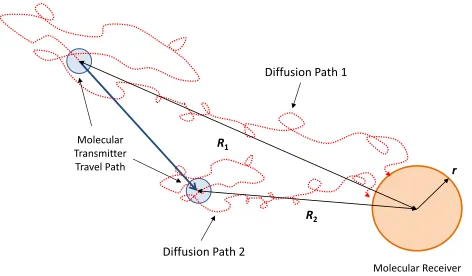
Fig. 1. Illustration of mobile molecular communications with a transmitter moving towards the receiver.
code design can achieve a superior performance compared to traditional Hamming-distance approaches, and how it can be implemented on the robotic platform by providing the pseudo-code for encoding and decoding.
II. REVIEW OFCHANNEL& CODINGSTRATEGIES
MCvD channels are based on classical Random Walk (RW) and Brownian motion models. An illustration of the channel is given in Figure 1. The generic received signal pulse can be said to bey=φx+n, where the channel gain isφ, input is x, and the additive noise isn. The channel gainφis:
φ(R, t) = r
r+R R
(4πDt3)1/2exp
− R
2
4Dt
, (1)
where R is the transmit distance, D is the diffusivity, t is time, and r is the radius of the receiver. This assumes that each molecule that falls within the radius of the receiver is permanently absorbed and converted into a signal output for detection. The detector is commonly designed to detect the peak response or a change in gradient at the peak response, which occurs at the following time and corresponding value [3]:
tmax= R2
6D, φmax∝ Dr
R2(R+r). (2)
Electromechanical Spray Chemical
Sensor & Molecular Communication Receiver Circuit
Robot Chassis Robot RF Control Circuit
[image:3.612.56.292.51.296.2]Arduino Molecular Communication Transmitter Circuit
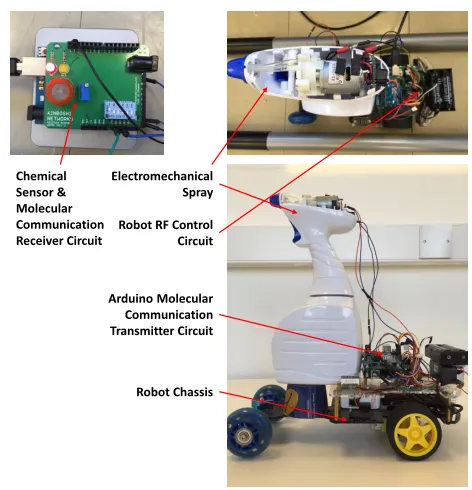
Fig. 2. The robotic molecular communication system mounted on a chassis.
distribution can be approximated to a normal or Gaussian distribution∼ N(nφ, nφ(1−φ)).
FEC coding is an important aspect of modern digital com-munications. In classical code design, one is concerned with decoding errors due to additive noise. A usual criterion of designing good codes is theHamming distanceof the code. It is widely known that Hamming distance is related to the error detection and correction capability of the code. If the code has a Hamming distance ofd, it can correct up tob(d−1)/2cbit errors. Relatively simple block codes use added parity check bits to enable the correction of errors, i.e., Hamming codes are described asn= 2m−1length codes, wheremis the number of parity check bits. A comparison of Euclidean geometry low density parity check (EG-LDPC) and cyclic Reed-Muller (C-RM) codes can be found in [6].
III. MOBILEMOLECULARCHANNEL
Traditionally, bit transposition errors have been produced by examining the arrival time of a single molecule (see inverse-Gaussian (IG) channel modeling [7]). However, in a real system, each symbol or bit is likely to be represented by a large quantity of molecules (i.e., there are6×1023molecules in 1 gram of hydrogen). Therefore, the arrival time averaged across all the molecules is unlikely to vary significantly unless either the channel varies or the transceivers move.
A. Mobile Molecular Channel
When one considers a mobile molecular channel, the dis-tance R component in Eq. (1) will vary in accordance to time. In the most extreme scenario, the transmitter will be travelling towards the receiver at a velocity that is significantly faster than the rate of diffusion. In this paper, we assume that the movement of the transmitter does not in itself disrupt the
0 5 10 15 20 25 30 35 40 45 50
0 0.2 0.4 0.6 0.8
1 Init 001
ial
iz
ati
on
Bit
-1 (
0
) (
0
)
Bit
-2 (
0
) (
1
)
Bit
-3 (
1
) (
0
)
Time [s]
Normal
ised
De
tect
ed
V
olt
ag
e [V]
010 (incorrect) 001 (correct)
Fig. 3. Plot of experimental pulse response from 1 trigger symbol and 3 sequential transmitted symbols. The transmitter transmits 001. Each of the time markers show the receiver sampling points. Each bit received is decoded for the (fixed - red) (mobile - blue) channels.
diffusion process. As shown in Figure 1, consider 2 symbols transmitted sequentially at distances R1 and R2 at times t1 andt2 respectively (symbol period of T =t2−t1). Assume that the detector uses the received pulse response’s peak for detection. For each transmitted pulse, the time to peak value tmax given in Eq. (2), will differ such that the second symbol
will arrive at a time ∆T after the first:
∆T =T+R
2
2−R21
6D . (3)
For equal distant transmissions, the time difference will simply be the symbol period T. Referring to Eq.(3), in order for bit transposition errors not to occur (∆T >0), the following must hold true: T > R21−R
2 2
6D . Certainly, as a simple observation, if the symbol period is larger than the peak response arrival time (T > R21
6D), then bit transposition errors cannot occur. However, two caveats exist with adapting the dynamic symbol period in this manner: 1) every subsequent symbol will need to wait a dynamic time period based on the current transmission distance estimated (difficult to achieve), and 2) the resulting data rate can be extremely variable and low. Hence, there is a need to implement new code designs to combat bit transposition errors.
B. Experimental Setup: Mobile Robots
In order to model the effects of mobility on bit errors, we have built a mobile molecular communication system. The system is mounted on a radio-frequency (RF) remote controlled chassis, which can move towards and away from the receiver. A photo of the transmitter and receiver molecular communication circuits can be found in Figure 2. An Arduino control circuit is used to perform the digital signal processing (DSP) elements at the transmitter and receiver sides, and the full implementation is in the original paper [5].
[image:3.612.309.562.57.176.2]followed by a decrease in gradient at the Bit-1 and Bit-2, indicating a 0 bit for both. This is then followed by an increase in gradient, indicating that Bit-3 is a 1. Hence the data of 001 is correctly received. However, in the mobile case (blue), the receiver will receive a sharp increase in the Bit-2 position and no change in the Bit-1 and Bit-3 positions, indicating a 010. That is to say, the original Bit-3 has shifted to Bit-2, which is a transposition error. By implementing the(4,2,1)-ISI-free FEC code (see Algorithms 1 and 2 in Section IV), the robot was able to combat single transposition errors.
IV. POSITIONAL-DISTANCECODEDESIGN
Consider an (n, k)-block-coding strategy that maps k-bit message inton-bit codeword and is implemented in the mobile robot. The movement of the robot causes bit transposition where earlier bits can arrive later than more recent bits, and vice-versa. Therefore, when a stream of k-bit messages are encoded using this strategy, the mobile molecular channel may exchange the bits’ positions within a codeword (Intra-Codeword Errors) and across codewords (Inter-(Intra-Codeword Interference). Reference [3] has reviewed several block-coding techniques that are aimed to mitigate errors due to bit transpo-sition. In the following, we discuss the rationales behind the development of those techniques and explore the suitability of the(4,2,1)-ISI-free code as the most superior code in [3, Sec. IV] for implementation in the mobile robot.
A. Intra-Codeword Errors
We first examine intra-codeword transposition errors that affect (n, k)-block codes to encode 2k messages. For an n -bit block, the total number of words that can be generated is
2n. As mentioned in Section II-B, existing block codes have largely been designed based on maximization of the Hamming distance from the chosen 2k out of2n possible words. This maximization is intuitively useful to correct corrupted bits due to noise/distortion. However, it is likely to be ineffective when the errors are mainly due to permutation of bits’ positions.
1) Back to Repetition Codes: In a trivial example, let us consider block length of n= 2 and two possible codebooks, both with the same Hamming distance of 2: C1 = {01,10} and C2 ={00,11}. In the event of a bit transposition error, it is clearly preferable to use codebook C2. This demonstrates that Hamming distance alone may not be the only parameter to consider. CodebookC2is precisely the repetition code forn=
2. Since the structure of a repetition code for any lengthn >0
is well preserved in the event of bits transposition, the code is effective in combating intra-codeword errors. Yet, repetition codes only achieve a code rate ofRRep. =n1, whereby a large n will yield a very small coding rate.
2) Distinct Hamming Weight (DHW) Codes: From a dif-ferent perspective, we can see that the codewords in the above repetition code C2 have the Hamming weights of 0 and 2, respectively. We can further observe that each of these Hamming weights remains unchanged under permutation of bits within a codeword. Building upon this observation, we can then construct a coding scheme in which each codeword can be identified from its Hamming weight. Such a coding
TABLE I
ASSIGNING CODEWORDS FOR THE(4,2,1) ISI-FREE CODE.
Message bits Assignment if the previous codeword has last bit ‘0’ last bit ‘1’
00 0000 1111
01 0001 1000
10 0011 1100
11 0111 1110
scheme for a length-nblock is referred to in [3] as a distinct Hamming-weight (DHW) codeof lengthn. It is worth noting that the DHW code is not unique as the distinct Hamming-weight requirement can be satisfied by more than one set of codewords. A length-nDHW code can achieve the largest rate of:
RDHW=
1
nlog2(n+ 1), (4)
which improves on repetition codes by a factor oflog2(n)for large codewords. A specific instance of length-4 DHW code is given in [3] asCDHW={0000, 1000, 1100, 1110}.
B. Inter-Codeword Errors
In order to mitigate bit transposition (both within and across codewords), the authors in [9] introduced a new cod-ing parameter, namely molecular codcod-ing (MoCo) distance, to replace Hamming distance for code design in molecular communications. Consider two possible binary codewords ci andcj. Building upon on-off keying modulation with a single molecule for each entry of ci and cj, the MoCo distance of ci andcj (with its variants for simplification) is defined by
dMoCo(ci,cj),−log Pr{cj|ci}
, (5)
where Pr{cj|ci} is the channel transition probability from ci to cj that is governed by molecular diffusion. In parallel to Hamming distance approach, the best code is thus given by a codebook that maximizes the minimum pairwise MoCo distance. An example for n = 4 is provided in [9], i.e.,
CMoCo={0000, 1000, 0010, 1110}. It was argued that from the MoCo distance maximization and the guard band indicator of bit ‘0’ at the end of each codeword inCMoCo, this coding construction addresses permutation of bits within each codeword and across codewords. This construction, however, has a significant drawback from the fact that we need to exhaustively search for the best code according to criterion in (5), and will be less suitable for practical implementation.
C. Implementation of Transposition Error Correction Code
The work in [10] recently developed a systematic step-by-step approach to construct a code that attempts to reduce bit transposition errors. The resulting code is denoted as(n, k, `)
Algorithm 1 Encoding method using (4,2,1)-ISI-free code
Input: d(vector ofN information bits), prev bit (initialized
to 0, indicating last bit of previous codeword)
Output: c(vector of coded bits: length 2N)
Assume: All vectors start with index1
1: ifN is odd then
2: d←[d 0]
3: N ←N+ 1
4: end if
5: fori from 1 toN/2 do 6: m←d[2i−1 : 2i] 7: if prev bit == 0 then
8: switch m do
9: case[0 0]
10: c[4i−3 : 4i]←[0 0 0 0]
11: case[0 1]
12: c[4i−3 : 4i]←[0 0 0 1]
13: case[1 0]
14: c[4i−3 : 4i]←[0 0 1 1] 15: case[1 1]
16: c[4i−3 : 4i]←[0 1 1 1]
17: else
18: switch m do
19: case[0 0]
20: c[4i−3 : 4i]←[1 1 1 1] 21: case[0 1]
22: c[4i−3 : 4i]←[1 0 0 0]
23: case[1 0]
24: c[4i−3 : 4i]←[1 1 0 0]
25: case[1 1]
26: c[4i−3 : 4i]←[1 1 1 0]
27: end if
28: prev bit ←c[4i]
29: end for
30: returnc
example of (4,2,1) ISI-free code is illustrated in Table I. The ISI-free code partially uses Hamming weight features of that DHW code in order to minimize the transposition errors within a codeword. The bit transposition at level ` across codewords can be corrected by ensuring that for two consecutive codewords, the first`bits of the latter are the same as the last ` bits of the former. In terms of implementation of the (4,2,1)-ISI-free FEC code in the mobile robot, the steps are presented in Algorithms 1 and 2, which include both the encoding and decoding techniques. These were used to both conduct experiments on the robot and generate BER performance results using Monte-Carlo simulations (see next section).
V. PERFORMANCECOMPARISON
A. Double Random Walk Mobility Model
In order to create103-105 bits with transposition possibili-ties, a robotic experiment would take an extremely long time, and furthermore, realistic physical boundary conditions will add bias to the results. In order to generate a sufficient number
Algorithm 2 Decoding (4,2,1)-ISI-free codewords
Input: r (vector ofN coded bits)
Output: y (vector of decoded bits: lengthN/2)
Assume: N is a multiple of4, all vectors start with index 1
1: fori from 1 toN/4 do 2: w←r[4i−3 : 4i]
3: hw←Hamming Weight(w)
4: switch hw do
5: case0
6: y[2i−1 : 2i]←[0 0]
7: case1
8: y[2i−1 : 2i]←[0 1]
9: case2
10: y[2i−1 : 2i]←[1 0]
11: case3
12: y[2i−1 : 2i]←[1 1]
13: case4
14: y[2i−1 : 2i]←[0 0]
15: end for
16: return y
of bit transposition errors and apply a range of FEC codes, we employ a RW model for the molecular movement, whereby the distance between the transmitter and the receiver also follows a RW model. We call this a double RW (double-RW) model. We first consider the movement of the transmitter’s location as a 1-dimensional Wiener process. Intuitively, the Wiener process is a continuous-time random process with independent Gaussian-distributed increments. We assume the process starts off at positionR(0) =L, whereLis the initial distance (also mean separation) distance between the transmitter and the receiver. Thereafter, the positionR(k)at discrete timekis a Gaussian random variable (r.v.) with distribution R(k) ∼N L, kσ2. The variance parameterσ2is given byσ2= 2DTxwhereDTx
can be interpreted as the movement speed of the transmitter.
We now consider molecular channel coding using binary alphabets {0,1} to construct the code of length n. Upon encoding a message m, the n-bit codeword c is modulated using a relevant sequence of molecules. For a 1 and bit-0, the transmitter emits one single molecule of two different molecule types respectively. Let the expected time of arrival be tmax, given in Eq. (2). Due to the random motion of the
molecule, the random arrival time can be treated as tmax+z,
wherez is the time noise. The noisez is IG distributed [7]:
f(z) =
r λ
2πz3exp
−λ(z−µ) 2
2µ2z
, z >0, (6)
0.5 1
1.5 2
2.5 3
0 0.05 0.1 0.15 0.2
(c) Initial Distance L [m]
BER
Reed-Muller Code (8,4) DHW Code (4,2) MoCo Code (4,2) ISI-Free Code (4,2,1)
0.2 0.4 0.6 0.8 1 1.2 1.4 1.6 1.8 10-5 100
(b) Diffusivity D [m2/s]
BER
Reed-Muller Code (8,4) DHW Code (4,2) MoCo Code (4,2) ISI-Free Code (4,2,1)
0.5 1 1.5 2
10-5 100
(a) Drift Velocity v [m/s]
BER
[image:6.612.55.286.57.445.2]Reed-Muller Code (8,4) DHW Code (4,2) MoCo Code (4,2) ISI-Free Code (4,2,1)
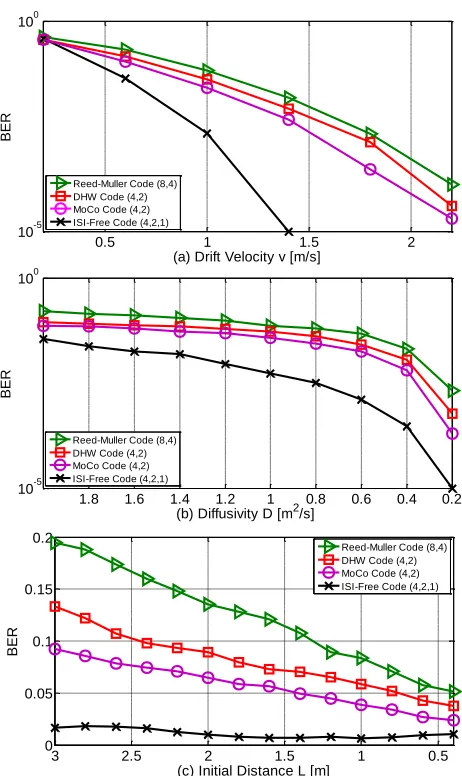
Fig. 4. BER of various coding schemes as a function of: (top) drift velocity
v, (middle) molecular diffusivity D, (bottom) initial distanceL. The static parameters used are:D= 1m2/s,L= 1m,D
Tx= 10−10×Dm2/s, and
v= 1m/s. All the coding schemes have rate of1/2.
B. Numerical Results
In Figure 4, we plot the bit-error rate (BER) of the various coding techniques in the presence of bit transposition errors introduced by the double RW model. From the three sub-figures, we can see that the initial distance plays a minor role in the BER due to the resulting movement. We can also see that the (8,4) Reed-Muller code (design based on the Hamming distance) has the worst BER performance. It can also be clearly observed that the optimal (4,2) MoCo-distance code has a better performance than the DHW code due to the fact that the MoCo distance (5) closely resembles the actual channel transition probability as opposed to the Hamming weight criterion. On the other side of the coin, the main limitation of the MoCo-distance code is the difficulties to generate codewords without resorting a full-scale search to the possible combination of bits. From Figure 4, we can further identify that the (4,2,1) ISI-free code is superior to other coding techniques in terms of BER. The ability of
always meeting the requirement of mitigating ` = 1-level transposition errors and the availability of step-by-step coding mechanism make this code to be attractive for implementation in mobile molecular communications.
Perhaps, a critique to the construction of the (4,2,1) ISI-free code is the idea that two codewords are used to represent a single group of message bits as shown in Table I. This idea leads to the inefficiency in terms of coding rate. From this type of construction, it can be further shown that for a block length ofnbits, rate beyond n−n1 is unattainable. In fact, the example above with the (4,2,1) ISI-free code has rate only 12 and increasing rates beyond 12 is challenging. The work in [10] partly addressed this, but further improvement and works are still required to enhance the coding efficiency.
VI. CONCLUSIONS
Molecular communications between mobile nano-robots will yield bit transposition errors. In this paper, we first reviewed current FEC coding strategies designed at combating additive noise that result from molecule counting discrep-ancies. However, when mobile molecular communications is considered, a far more damaging source of noise is the trans-position of bits. In such a scenario, it is important to design a new family of appropriate FEC codes. We have used mobile robots equipped with molecular communication transceivers to demonstrate how transposition errors arise. We then employ positional-distance codes and use simulation results to show a significant improvement over classical Hamming-distance coding strategies, and we show that the BER is not sensitive to the initial starting position of the robots. The positional-distance code is then implemented onto the robot to achieve reliable mobile molecular communications.
REFERENCES
[1] I. Akylidiz, F. Fekri, R. Sivakumar, C. Forest, and B. Hammer, “Monaco: fundamentals of molecular nano-communication networks,”IEEE Wire-less Communications, vol. 19, no. 5, pp. 12–18, Oct. 2012.
[2] N. Farsad, H. B. Yilmaz, A. Eckford, C. Chae, and W. Guo, “A Compre-hensive Survey of Recent Advancements in Molecular Communication,” IEEE Communications Surveys and Tutorials, 2016.
[3] W. Guo, T. Asyhari, N. Farsad, H. Yilmaz, B. Li, A. Eckford, and C.-B. Chae, “Molecular Communications: Channel Model and Physical Layer Techniques,”IEEE Wireless Communications, 2016.
[4] A. Guney, B. Atakan, and O. Akan, “Mobile ad hoc nanonetworks with collision-based molecular communication,”IEEE Transactions on Mobile Computing, vol. 11, Mar. 2012.
[5] N. Farsad, W. Guo, and A. Eckford, “Tabletop molecular communica-tion: Text messages through chemical signals,”PLOS ONE, 2013. [6] Y. Lu, M. Higgins, and M. Leeson, “Comparison of Channel Coding
Schemes for Molecular Communications Systems,”IEEE Transactions on Communications, vol. 63, no. 11, pp. 3991–4001, 2015.
[7] K. Srinivas, A. Eckford, and R. Adve, “Molecular Communication in Fluid Media: The Additive Inverse Gaussian Noise Channel,” inIEEE Transactions on Information Theory, vol. 8, Jul. 2012, pp. 4678–4692. [8] B. Li, M. Sun, S. Wang, W. Guo, and C. Zhao, “Low-complexity non-coherent signal detection for nano-scale molecular communications,” IEEE Transactions on NanoBioscience, Dec. 2015.
[9] P. Ko, Y. Lee, P. Yeh, C. Lee, and K. Chen, “A new paradigm for channel coding in diffusion-based molecular communications: Molecular coding distance function,” inProc. IEEE Global Communications Conference (GLOBECOM), 2012, pp. 1–6.