go.warwick.ac.uk/lib-publications
Original citation:
Krautgasser, Konstantin, Panosetti, Chiara, Palagin, Dennis, Reuter, Karsten and Maurer,
Reinhard J.. (2016) Global structure search for molecules on surfaces : efficient sampling
with curvilinear coordinates. Journal of Chemical Physics, 145 . 084117.
Permanent WRAP URL:
http://wrap.warwick.ac.uk/96014
Copyright and reuse:
The Warwick Research Archive Portal (WRAP) makes this work by researchers of the
University of Warwick available open access under the following conditions. Copyright ©
and all moral rights to the version of the paper presented here belong to the individual
author(s) and/or other copyright owners. To the extent reasonable and practicable the
material made available in WRAP has been checked for eligibility before being made
available.
Copies of full items can be used for personal research or study, educational, or not-for profit
purposes without prior permission or charge. Provided that the authors, title and full
bibliographic details are credited, a hyperlink and/or URL is given for the original metadata
page and the content is not changed in any way.
Publisher’s statement:
This article may be downloaded for personal use only. Any other use requires prior permission of the author and AIP Publishing.
The following article appeared Krautgasser, Konstantin, Panosetti, Chiara, Palagin, Dennis, Reuter, Karsten and Maurer, Reinhard J. (2016) Global structure search for molecules on surfaces : efficient sampling with curvilinear coordinates. Journal of Chemical Physics, 145. 084117. and may be found at https://doi.org/10.1063/1.4961259
A note on versions:
The version presented here may differ from the published version or, version of record, if
you wish to cite this item you are advised to consult the publisher’s version.
Global Structure Search for Molecules on Surfaces: Efficient Sampling with
Curvilinear Coordinates
Konstantin Krautgasser,1Chiara Panosetti,1Dennis Palagin,2Karsten Reuter,1 and Reinhard J. Maurer3,a)
1)
Department Chemie, Technische Universit¨at M¨unchen, Lichtenbergstr. 4, D-85748 Garching, Germany
2)Physical and Theoretical Chemistry Laboratory, Department of Chemistry, University of Oxford, South Parks Road,
Oxford, OX1 3QZ, United Kingdom
3)
Department of Chemistry, Yale University, New Haven, CT 06520, USA
(Dated: 31 August 2016)
Efficient structure search is a major challenge in computational materials science. We present a modification of the basin hopping global geometry optimization approach that uses a curvilinear coordinate system to describe global trial moves. This approach has recently been shown to be efficient in structure determination of clusters [Nano Letters 15, 8044–8048 (2015)] and is here extended for its application to covalent, complex molecules and large adsorbates on surfaces. The employed automatically constructed delocalized internal coordinates are similar to molecular vibrations, which enhances the generation of chemically meaningful trial structures. By introducing flexible constraints and local translation and rotation of independent geometrical subunits we enable the use of this method for molecules adsorbed on surfaces and interfaces. For two test systems, trans-β-ionylideneacetic acid adsorbed on a Au(111) surface and methane adsorbed on a Ag(111) surface, we obtain superior performance of the method compared to standard optimization moves based on Cartesian coordinates.
I. INTRODUCTION
In just 20 years the complexity of systems studied in surface science has increased by orders of magnitude.1 Whereas previous major problems where associated with the adsorption behavior of small adsorbates such as CO on Pt(111),2typical challenges that dominate surface sci-ence nowadays are associated with the structural, elec-tronic, and chemical properties of large organic adsor-bates and molecular networks on metal and semiconduc-tor surfaces.3–5Here the interaction strength and geom-etry of systems and the implications for nanoarchitec-tures, self-assembly, or atomic-scale manipulation is stud-ied by two complementary sets of techniques, namely by
in vacuo surface science experiments6andab initio elec-tronic structure simulations.7 The capabilities of both experiment and simulation have increased tremendously. On the computational side, previously unthinkable sys-tem sizes can be dealt with thanks to the immense in-crease in computational power and the numerical, as well as algorithmic efficiency of Density-Functional Theory (DFT).8 Owing to the latest advances in particular in the treatment of dispersive interactions, such calculations are nowadays able to provide a reliable description of the adsorption structure and energetics of highly complex or-ganic adsorbates on metal surfaces.9–11
An especially important aspect of theoretical surface science that should benefit from this progress is the abil-ity to conduct computational screenings of possible ge-ometries of complex interfaces, be it for determining the atomic configuration of surface reconstructions,12 topolo-gies of organic crystals,13 or identifying the manifold of
all possible compositions and adsorption sites in pro-cesses of heterogeneous catalysis and in compound mate-rials.14–16However, one thing that has not changed much in recent years is how, in simulations, optimal adsorption structures are identified. The large number of degrees of freedom in a complex adsorbate, as well as the struc-tural complexity of large surface nanostructures, necessi-tates a full global search for optimal structures and over-layer phases that includes all possible binding modes and chemical changes that can occur upon adsorption. Know-ing the geometric structure of an interface is an impor-tant prerequisite to investigating its electronic properties and level alignment, which in turn determines the per-formance in potential electronic or catalytic applications. An efficient potential energy surface (PES) sampling tool is necessary to enable this, as opposed to just conven-tional local optimization of several chemically sensible initial guesses. In general, this problem can be solved by applying global geometry optimization methods.17,18
thereby been suggested over the last two decades, ranging from simple classical statistical mechanics simulated an-nealing schemes29 to sophisticated landscape paving,30 puddle-jumping,31,32 or neural-network controlled dy-namic evolutionary approaches.33,34Two prominent and most popular families of global geometry optimization techniques include Monte-Carlo based methods, such as basin hopping (BH),35and evolutionary principles based genetic algorithms (GA).36 However, no general rule of preference to a specific algorithm exists, as the efficiency of classical global optimization methods is highly system dependent.22
There are many technical aspects that influence the performance of any global sampling technique, such as the choice of initial geometry, the ways of disturbing the configuration during the trial move, the definition of acceptance criteria, the methods employed to calcu-late potential energies and forcesetc. Many authors were concerned with the efficiency of applied sampling meth-ods and suggested various improvements.37–42Moreover, the possibility of moving from the total energy as the main sampling criterion towards observable-driven43and grand-canonical44global sampling schemes has been sug-gested. The parameter that plays the most crucial role in method performance, however, is the choice of coordi-nates suitable for representing the geometries and, most importantly, changes in geometries during the sampling,
i.e.the so-called trial moves.45The essential importance of the trial geometry generation step has already been noticed in early system-specific publications.45,46 For instance, simple group rotations within proteins47 or clusters35 already led to significant gains in sampling efficiency. Furthermore, several computationally more expensive ways to produce elementary trial moves were suggested based on short high-temperature molecular dy-namics (MD) runs.38,48For certain systems they have in-deed proven to be much more effective, allowing to e.g.
optimize large metallic clusters within atomistic mod-els.49,50
From a programmer’s point of view, the perhaps most intuitive representation of the atomic coordinates of trial moves are Cartesian coordinate (CC) displacements. It has been noted though that this most popular represen-tation is often inefficient,45,51 due to its chemical blind-ness, which may easily lead to unphysical configurations (e.g.dissociated structures). CC displacements do not account for the overall geometry and the coupling be-tween coordinates. Different approaches have been pro-posed to overcome this difficulty, such as virtual-alphabet genetic algorithms,52employing the idea that coordinates should stand as meaningful building blocks,53 or genetic algorithms with space-fixed CCs,45,46,54introducing non-traditional genetic operators. The main limitation of these methods, however, is that they remain rather sys-tem specific. The choice of suitable coordinates for global optimization should rather be system independent, while at the same time adapted to the chemical structure. Es-pecially in the case of large adsorbates the completely
un-biased way in which the structural phase space is sampled in CCs does not allow for an efficient structural search for conformational changes upon adsorption that leave the molecular connectivity intact. The chemically most intu-itive set of coordinates for such a situation would instead be internal coordinates (ICs), namely bond stretches, angle bends, or torsions. Already in the seminal work on BH of Wales and Doye, the potential usefulness of such coordinates has been noted,35 and later shown to be beneficial for structures connected by double-ended pathways.55
One of the first applications of the idea of using ICs for global geometry optimization was reported in the con-text of protein-ligand docking, which developed into the so-called Internal Coordinate Mechanics (ICM) model,56 further extending the above mentioned concept of mean-ingful building blocks.53Another example of global opti-mization in ICs was the attempt of introducing dihedral angles into the framework of the so-called determinis-tic global optimization.57Global optimization of clusters and molecules in ICs using the Z-matrix representation was suggested by Dieterich and Hartke.58 However, au-tomatic construction of a Z-matrix is close to impossible for larger, more complicated systems, especially organic molecules containing rings. Besides, it also does not elim-inate the problem of coordelim-inate redundancies, which gen-erally limits the applicability of this approach.
and for methane adsorbed on a Ag(111) surface (as an example of a small adsorbate with a shallow PES and many minima), we find that DIC trial moves increase the efficiency of BH by both a more complete sampling of the possible surface adsorption sites and by reducing the number of molecular dissociations.
The paper is organized as follows: In Chapter II we outline traditional approaches to global structure opti-mization, explain the construction of DICs and our def-inition of a complete coordinate set for adsorbates on surfaces, and how these coordinates are applied for con-formational structure searches in a global optimization framework such as basin hopping. In Chapter III we summarize the computational details of our benchmark studies on the surface-adsorbed aggregates presented in ChapterIV. We conclude our work in ChapterV. Addi-tional remarks on software and algorithms can be found in Appendix A, details on DFT calculated diol stability can be found in AppendixB.
II. METHODS
A. Global Optimization - Basin Hopping
A variety of global optimization procedures exists to date, including simulated annealing,29 genetic algo-rithms,36 BH,17,35 and many variants and combinations thereof.37–39 One reason for the success of basin hopping might be the intriguing simplicity of the approach, sum-marized as follows:
1. Displace a starting geometry with a randomglobal
Cartesian coordinate (CC) trial move ∆x normal-ized to a step width dr;
2. Perform a local structure optimization to a mini-mum energy structure with energy Ei;
3. Pick a random number and accept the new mini-mum energy structure with the probability
P(∆Ei) = exp
−Ei−Emin
kBTeff
, (1)
where Teff corresponds to an effective temperature
andEminrefers to the energy of the current lowest
energy structure;
4. If the structure is accepted, place it as a new start-ing point and proceed with point 1.
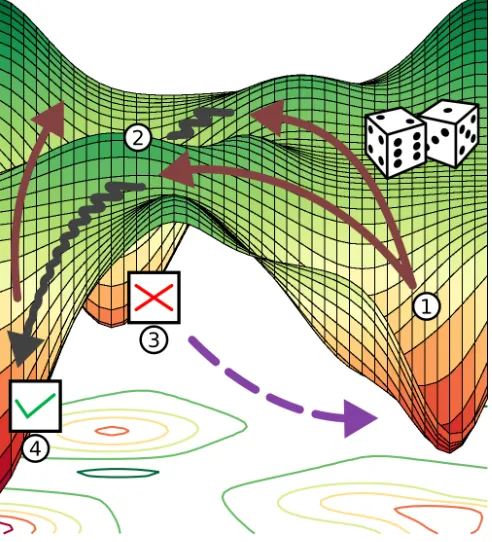
Following this procedure, as illustrated in Fig. 1, the PES is sampled until all chemically relevant minima are found. A sufficiently highTeff ensures that also
higher-lying minima are accepted with adequate probability and a large area of the PES can be sampled. The size of trial moves ∆xmust be large enough to escape the basin of attraction of the current local minimum, but small enough not to lead to regions of the PES that are of
little interest, e.g. dissociated structures or structures with colliding atoms. The corresponding displacement ∆x is constructed from random Cartesian vectors nor-malized to the chosen step width. This approach has proven highly efficient for optimization of clusters and biomolecules.20,69In the following we will discuss a mod-ification of this general algorithm only with respect to point 1 by changing the construction of the displacement vector ∆x.68
FIG. 1. Illustration of the basin hopping global optimiza-tion approach. Random trial moves ∆x (straight arrows, 1) displace the geometry towards a new basin of attraction and local optimization (zigzag arrows, 2) identifies the correspond-ing minimum energy structure. The identified minima will be rejected (3) or accepted (4) with a certain probability given by eq. 1.
B. Construction of Delocalized Internal Coordinates
ICs can be defined in many different ways. A typically employed approach is to define a set of coordinates in a body-fixed frame as a set of bond stretches, angle bends, torsional modes, and out-of-plane angles.70Any displace-ment ∆xfrom a given pointRx0in Cartesian coordinate
space can then be transformed to a set of internal coor-dinate displacements ∆qby
∆q=B∆x , (2)
where
B=dq
[image:4.612.318.564.167.438.2]The set of coordinates inq-space can be chosen to be non-orthogonal and complete (e.g. via a Z-matrix), however this is often difficult and highly system specific.
An alternative approach is the construction of a highly redundant set ofM > (3N −6) primitive ICs to repre-sent the independent degrees of freedom of an N atom system.71Pulay, Fogarasi, Baker, and others60–62,66,71,72 have shown that an orthogonal, complete set of nates can be constructed from such a redundant coordi-nate set simply by singular value decomposition (SVD) of the matrix G=B†B. By construction, matrixG is positive semi-definite and Hermitian, and satisfies
G=B†B=U
Λ 0 0 0
U† . (4)
In Eq.4,Uis a set of vectors in the space of primitive ICs qthat defines linear combinations thereof. SVD yields a subset of (3N−6) such independent vectors with non-zero eigenvalues Λ that constitute a fully orthogonal system of DICs.61 These coordinates span all primitive ICs that were previously defined in B. U is therefore nothing else than a Jacobian that transforms displacements in the space of primitive internals q into displacements in the space of DICsd
∆d=U∆q=UB
|{z}
˜ B
∆x= ˜B∆x. (5)
In the last equation we have defined the transforma-tion matrix ˜B of dimension (3N−6)×3N that trans-forms CC into DIC displacements. Unfortunately the back transformation cannot simply be done by inversion as the matrix ˜B is non-quadratic and therefore singu-lar. However, we can define a generalized inverse62 that connects displacements in CC and DIC space
∆x= ˜B−1∆d, (6)
where
˜
B−1= ˜BT( ˜BB˜T)−1
| {z }
˜
G−1
. (7)
Equation6 can easily be verified by multiplication from the left with ˜B. Utilizing the above expressions we have thus established a bijective transformation between the displacements ∆x and ∆d. However, transformation of the absolute positions of atoms in a molecule, their nu-clear gradients and second derivatives requires iterative backtransformation from DIC to CC space. This is due to the fact that ˜B is simply a linear tangential approxi-mation to the curvilinear hyperplane spanned by coordi-natesd. Further details on DIC transformation proper-ties can be found in Ref.62.
[image:5.612.319.563.51.164.2]In summary, the here presented construction allows to define displacements in terms of a random set of DICs ∆d and expression thereof as CC displacements ∆x, which can then be used to generate a new trial structure from a starting geometry (cf. basin hopping procedure, point 1).
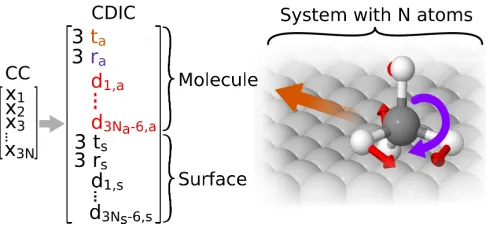
FIG. 2. Illustration of the coordinate definition for a set of complete delocalized internal coordinates (CDIC). Curvilin-ear coordinates are constructed by partitioning the system into subsystems such as molecule and surface (here shown for methane adsorbed on Ag(111)) and associating each of those with a set of translations (depicted in orange), rotations (pur-ple), and DICs (red). t,r,drefer to translation, rotation, and DIC vectors, while indices a and s refer to the adsorbate and the surface subsystem, respectively. N,Na, andNs refer to
the number of atoms in the complete system or respective subsystem.
C. Curvilinear Coordinates for Adsorbates and Aggregates
In the above presented formalism we have constructed (3N−6) DICs, which fully describe all (body-fixed) de-formations of a molecule. By construction, overall trans-lations and rigid rotations of isolated molecules and clus-ters are removed due to their invariance with respect to these coordinates. Re-introducing these degrees of free-dom can in some cases be useful, for example in the de-scription of molecules or clusters adsorbed on surfaces, in dense molecular arrangements, or organic crystals. In such systems the position and orientation of a tightly-bound subsystem, such as a molecule, with respect to the rest of the system, such as a surface or the molecular neighbors, is determined by overall weaker interactions and forces.
One can account for this specific chemistry of the sys-tem by partitioning it into two (or more) subsyssys-tems (e.g. adsorbate and surface), for each of which one con-structs a set of 3 rigid translations, 3 rigid rotations, and (3Na−6) DICs, whereNais the number of atoms in
nautical or Tait-Bryan angles. Hereby the three rota-tion angles Φ, Θ, Ψ (also called yaw, pitch, and roll) are defined around three distinct rotation axes with respect to a reference orientation. This reference orientation is given by the molecular geometry from which the DICs are constructed and establishes an Eckart frame. Changes to orientation are identified and applied by standard rigid-body superposition using Quaternions.73
In the systems where the above partitioning makes sense chemically, the concomitant decoupling of coordi-nates may be beneficial for the description of dynamics and global optimization. In cases where, for example, no significant surface reconstruction is expected upon adsorption, it may not be useful to construct DICs for the substrate, where chemical bonding is more isotropic. Instead, CDIC partitions can be constructed for arbi-trary subsets of coordinates (e.g. the adsorbate) in order to then be combined with the remaining CCs (e.g. the metal substrate). Finally, CDICs (as well as DICs) make the definition of arbitrary coordinate constraints fairly straightforward as is shown in subsectionII D.
D. Constraints on Delocalized Internal Coordinates
Starting from a set of DICs, constraints on primitive internals such as bond stretches, angle bends, or torsions can be applied by projection from the initial set of DIC vectorsU.61The constraint vectorC
iis taken as a simple unit vector in the space of primitive ICsq
Ci=
0 0
.. .
1
.. .
0 0
. (8)
Correspondingly, the projection of this constraint vector onto the eigenvector matrixU
˜ Ci=
X
j
hCi|UjiUj (9)
yields a vector ˜Ciin the space of DICsd(denoted by the tilde sign). All vectorsUjneed to be orthogonalized with respect to Ci (e.g. using Gram-Schmidt orthogonaliza-tion) to ensure that the primitive coordinateiis removed from the DICs. The resulting matrixU0 is then used to transform back to CCs using the inverse of ˜B0=BU0 in the same way as in Eq.6.
Constraints on sub-system translations or rotations in CDICs can be applied by simply removing them from the available set of coordinates in d-space. The itera-tive nature of the backtransformation to absolute CCs may require an iterative coordinate constraint algorithm such as SHAKE.74 Cartesian constraints can be applied by simply excluding atoms or CCs from the reference geometry from which the DICs are constructed, or by
projections in Cartesian spacexequivalent to the above projections inq-space.75
E. Global Optimization With Curvilinear Trial Moves
Summarizing the above, we have defined a set of com-plete, orthogonal curvilinear coordinates describing all internal motions of molecules, which can be constructed in a fully automatic manner from a set of CCs. For sys-tems with multiple molecules, aggregates, or for surface-adsorbed molecules we can supplement these with trans-lational and rotational degrees of freedom for the individ-ual subsystems. Any changes or displacements applied in these coordinates can be transformed back to CCs and be readily applied in this space.
Displacements in form of DICs or CDICs yield molecu-lar deformations that are more natural to the chemistry of the system, simply due to their construction based on the connectivity of atoms. We have recently shown that application of such coordinates in the framework of global optimization methods can largely facilitate a structure search by preferential bias towards energetically more favorable geometries.68Modification of a global op-timization algorithm in terms of DIC trial moves on the example of the BH procedure sketched above can be sum-marized as follows:
1. Displace a starting geometry with a random DIC (CDIC) trial move ∆d. Therefore:
• Construct a set of DICs (CDICs);
• Apply constraints, if necessary;
• Pick a random (sub-)set of DICs (CDICs) and normalize them to a given step widthdr;
• Transform coordinates back to Cartesian space using Eq.6and apply them to the struc-ture;
2. Perform a local structure optimization to a mini-mum energy structure with energyEi;
3. Pick a random number and accept the new mini-mum energy structure with the probability
P(∆Ei) = exp(−
Ei−Emin
kBTeff
). (10)
4. If the structure is accepted, place it as a new start-ing point and proceed with point 1.
III. COMPUTATIONAL DETAILS
We consider three test sytems: Retinoic acid (ReA,
a four-layer, (2 × 2) surface unit cell Ag(111) slab. All test systems were built using the ASE (Atomic Simulation Environment) package.77 Energetics for the global optimization runs were calculated with Density Functional-based Tight-Binding (DFTB) performed with the DFTB+ V1.1 code.78,79 To correctly account for surface-molecule interactions in the β-acid on Au(111) case, the Tkatchenko-Scheffler screened dispersion cor-rection method vdWsurf80 was applied as an a posteri-ori correction to the DFTB results. Since vdWsurf was
not available in DFTB+ at the time, we have neglected the environment-dependent rescaling of atomwise disper-sion coefficients. Environment-dependence of disperdisper-sion interactions in conjunction with tight-binding methods has been introduced recently.81As convergence criterion for the self-consistent DFTB charges, 10−7electrons was
used for all systems. DFTB parameters for interaction between C, H, O, Au, and Ag have been generated as described in Refs. 82 and83 and are available upon re-quest. Si and H parameters are described in Ref.84. We have used the refinements as described in Ref.85.
We implemented the coordinate generation as well as a BH procedure in a modular python package (winak, see Appendix A).86 The set of redundant internal coor-dinates was constructed by including bond lengths, bend-ing angles, and dihedral angles. Bond lengths were in-cluded if they were within the sum of the covalent radii of the atoms plus 0.5 ˚A. Bending angles were included if the composing atoms were bonded to each other and if the bending angle was below 170◦. Dihedral angles were included if the composing atoms were bonded and if the dihedral angle was smaller than 160◦. The effec-tive temperature in the BH procedure was set to 300 K. Trial moves in unconstrained DICs/CDICs and with all stretches constrained (constr. DICs/CDICs) were always constructed using linear combinations of a varying per-centage of all modes, e.g. 10%, 25%, 75% or 100% of all available coordinates. These subsets were randomly chosen and in the construction of the displacement vec-tor each DIC mode was scaled with a random facvec-tor in the range [−1; 1]. CC displacements were created by as-signing a random value in the range [−1; 1] to the x, y andzcoordinates of every atom. As a normalization, all displacements were divided by the single largest compo-nent in CCs, such that the maximum absolute displace-ment of an atom in x, y, or z direction was 1 ˚A. Sub-sequently the whole displacement vector was multiplied by a tunable dimensionless factordr,i.e. the step width introduced above. The global minimum was always used as initial starting geometry and local optimizations were performed until the maximum residual force was smaller than 0.025 eV/˚A. Local optimizations were performed using a standard quasi-Newton optimizer and Cartesian coordinates.
IV. RESULTS AND DISCUSSION
In our recent work we have already described the ef-ficiency of the DIC-based structure search approach for metallic and hydrogenated silicon clusters in gas phase and when adsorbed on surfaces.68 In the following we shortly review these results in the present context and proceed to evaluate the efficiency and applicability of structure search based on DIC (CDIC) trial moves for global optimization of molecules in gas phase and ad-sorbed on surfaces.
A. Performance of Delocalized Internal Coordinates for Isolated Molecules and Clusters
In our previous work68we have compared the efficiency of BH when using CCs and DICs as trial moves by per-forming a series of 500-step runs with different parame-ters (step width, percentage of DICs) for a hydrogenated silicon cluster Si16H16both in isolation and adsorbed on
a Si(001) surface. Regardless of the choice of parameters, all the runs in DICs were shown to sample a more relevant region of the PES, that is, the minima identified with DIC trial moves are more often intact and the distribution of their energies is invariably centered around lower energies compared to the corresponding CC run with equivalent parameters. Furthermore, CC-based runs almost always failed to identify the global minimum, whereas almost all DIC-based runs found it. Finally, as DIC trial moves produce less strained geometries, the local relaxation at each global step necessitates on average 30% fewer local optimization steps, which drastically reduces the overall simulation time.
We ascribe the superior performance of DICs to their collective account of the structure and chemistry of the system. DICs by construction take into account the con-nectivity of atoms to produce collective displacements that resemble vibrational modes. Such displacements are largely composed of concerted motions of groups of atoms, thus naturally suitable to explore configurational subspaces in which certain bonding patterns are pre-served. The latter condition is particularly desirable in the investigation of both the gas-phase and the adsorp-tion behavior of large funcadsorp-tional molecules, where two intertwined aspects need to be addressed: i) the struc-tural integrity is a necessary prerequisite to enable func-tionality;ii)even small conformational changes, or minor isomerizations, can determine dramatic variations of elec-tronic properties (e.g. of molecular switches). The struc-tural screening of molecules of this kind should therefore be constrained to subspaces of the PES that satisfy these aspects, while ideally retaining a sufficient degree of flex-ibility to be able to capture non-intuitive, potentially rel-evant geometries.
FIG. 3. Chemical formula (top) and ball-and-stick representa-tion (bottom) of isolated all-trans retinoic acid (ReA). Carbon atoms are colored gray, hydrogen atoms are colored white, and oxygen atoms are colored red. The global minimum geometry in gas phase is shown.
TABLE I. Number of symmetry-inequivalent, intact minima found when performing 100 global optimization steps for iso-lated ReA with step widthdr, and displacements in CCs or different amounts of DICs and DICs, where the bond stretches have been constrained (constr. DICs). Since not a single in-tact structure was already found for CC displacements with a step width of 0.70, larger step widths have not been consid-ered.
step widthdr
coords. 0.55 0.70 0.90 1.20
CC 1 0 -
-DIC 10 % 2 2 3 3
DIC 25 % 5 2 2 1
DIC 100 % 1 3 2 1
coords. 0.55 0.70 1.50 2.00 constr. DIC 10 % 2 3 8 8 coords. 0.70 0.90 1.50 2.50 constr. DIC 25 % 2 4 5 9 constr. DIC 100 % 2 6 4 9
stretch motions will for example generally not be rele-vant for a conformational structure search. To test the efficiency of the DIC-BH approach in such cases, global optimization of isolated ReA (cf. Fig. 3) has been per-formed using 100 trial moves based on random CCs and displacements along varying subsets of DICs. Table I
compiles the number of symmetry-inequivalent minima found. It is evident that random CCs are particularly ill-suited for large organic molecules. In most of the cases the molecule ended up dissociated and once the molecule is torn apart, regaining an intact structure by random CC displacements is highly improbable. For most ap-plications involving organic molecules, dissociated struc-tures are not of interest and the computing time used for the local optimization step is essentially wasted. When using random CCs, this can amount to up to 95 % of the overall computing cost.
The use of DIC displacements already greatly improves on this. Steps that lead to dissociations can be reduced to 75 % of the overall amount of steps, while still finding more relevant minima compared to random CCs. The
code responsible for creating the ICs automatically de-tects dissociations, such that they can be discarded di-rectly at runtime prior to local optimization. This shows that DICs can already be useful in their most general form. However, for an efficient search of the conforma-tional phase space of a large organic molecule this can even further be improved by removing bond stretches as explained in Chapter II. When the bond stretches are fully constrained (constr. DICs in TableI), a much finer screening of the PES is possible, and more unique and intact minima are found. Many different conformers (for example eclipsed/staggered stereochemistry) can be ob-served which would be extremely difficult to find using trial moves based on CCs or unconstrained DICs. Dis-sociation events can be reduced to as low as 33 % of all steps even at large step widths.
While in the simple example of ReA global optimiza-tion might not be necessary to identify the most relevant conformations, these results demonstrate that customiz-ing DICs with structure-preservcustomiz-ing constraints can make them more applicable to covalently-bound systems. We conclude with a note on the step width and percentage of DICs. Due to the normalization, the result of the al-gorithm is highly dependent on the percentage of DICs used. The more DICs a displacement is made up of, the less influence a single DIC has on the overall dis-placement. Individual DICs contribute more to the 10% than to the 25% DIC displacements. To find certain minima some atoms might have to be moved over a few ˚
Angstr¨om, so a large step width would be of advantage. However, for our test system CC displacements failed to find a single minimum already for a step width as small as 0.70. For DIC displacements the step width can and should be chosen much higher than that. Optimization runs using constr. DIC displacements performed best for a step width of above 2.00.
B. Performance of Delocalized Internal Coordinates for Molecules on Surfaces
We proceed to apply the here presented approach to two molecules adsorbed on surfaces, aβ-acid molecule on Au(111) and methane on Ag(111). The first case exhibits a large number of internal degrees of freedom, the second a shallow PES regarding translations and rotations on the surface.
1. trans-β-ionylideneacetic acid adsorbed on Au(111)
FIG. 4. Chemical formula (left) and ball-and-stick representa-tion (right) oftrans-β-ionylideneacetic acid (β-acid). Carbon atoms are colored gray, hydrogen atoms are colored white, and oxygen atoms are colored red. The global minimum geometry in gas phase is shown.
of key structural elements by electronic structure meth-ods is crucial. We study the performance of CDIC-based global optimization on the example of a smaller analogue of ReA, namely trans-β-ionylideneacetic acid76 (β-acid, cf. Fig.4) adsorbed on a Au(111) surface. As an initial starting geometry, the molecule in the conformation rep-resenting the global minimum in gas phase was placed flat lying at a random adsorption site on the surface, and the structure was relaxed using local optimization. No surface relaxation was allowed. This was used as a start-ing point for all BH runs. As a reference, 100 global steps were performed for step widths of 0.25, 0.5, and 1.0 using CC trial moves. This is compared to 100 global step runs using 10%, 25% and 100% mixtures of constr. CDICs, all with a step width of 1.5.
For surface-adsorbed molecules, the shortcomings of standard CC displacements become even more appar-ent as shown in Table II. In 70–90 % of all global opti-mization steps, a dissociated structure is obtained. Most commonly the cyclohexenyl ring is torn apart or the con-jugated side chain is broken. In the context of confor-mational switching, this would render this minimum ir-relevant for the process under study. Keeping impor-tant structural motifs intact is difficult with CC displace-ments. One could argue that setting a smaller step width remedies this problem; however, our results show that, as the step width decreases, the starting geometry is found with higher probability. There seems to be no optimal setting for the step width parameter: either the molecule dissociates, or the sampling is not able to escape the ini-tial basin of attraction. As a result, we did not obtain any single new geometry other than the starting point and there was almost no lateral adsorption site sampling. CC trial moves are thus not applicable to this case.
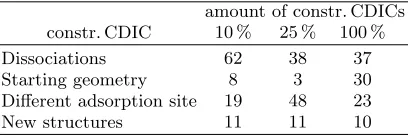
[image:9.612.55.299.55.126.2]The result of the sampling is changed dramatically by the introduction of CDIC trial moves with con-strained stretches (constr. CDIC, cf. Table III). Using 25% and 100% of available constr. CDICs reduces dis-sociation events to about 40% of all steps. For 10% constr. CDIC displacements at a step width of 1.5 the amount of dissociations is comparable to CC trial moves using a step width of 0.25, however, at largely different sampling efficiency. When fewer DICs are mixed into a displacement, the influence of each individual DIC in the
TABLE II. Number of dissociated structures, revisits of the starting geometry, sampling of new adsorption sites in the conformation of the gas-phase minimum, and new structures when performing 100 global optimization steps forβ-acid on Au(111) with different step widths using CC trial moves.
step widthdr
[image:9.612.338.542.234.303.2]CC trial moves 0.25 0.5 1 Dissociations 73 93 98 Starting geometry 24 7 2 Different adsorption site 3 0 0 New structures 0 0 0
TABLE III. Same as TableII, but when using displacements in constr. CDICs (denoted by the percentage of constr. CDICs randomly selected) with a step widthdrof 1.5.
amount of constr. CDICs constr. CDIC 10 % 25 % 100 % Dissociations 62 38 37 Starting geometry 8 3 30 Different adsorption site 19 48 23 New structures 11 11 10
final trial move is larger due to normalization. As a con-sequence and consistent with the gas-phase sampling re-sults above, 10 % constr. CDIC displacements introduce the most significant changes to the molecular geometry,
i.e. result in more dissociations. Inversely, 100% con-str. CDIC displacements sample the starting geometry more often than 10% or 25% constr. CDIC trial moves. As the number of translations and rotations in compari-son to the number of internal degrees of freedom in the overall displacement is smaller at higher percentages of CDICs, lateral sampling is less efficient than when using 25% or 10% constr. CDIC trial moves. It is not straight-forward to find the optimal position and orientation of a complex adsorbate like the one studied here, and ef-ficient lateral sampling is therefore strongly desired. In contrast to standard CC based trial moves, different ro-tations and various adsorption sites of the molecule have been sampled during all three runs. A closer analysis of this aspect will be presented in sectionIV B 2.
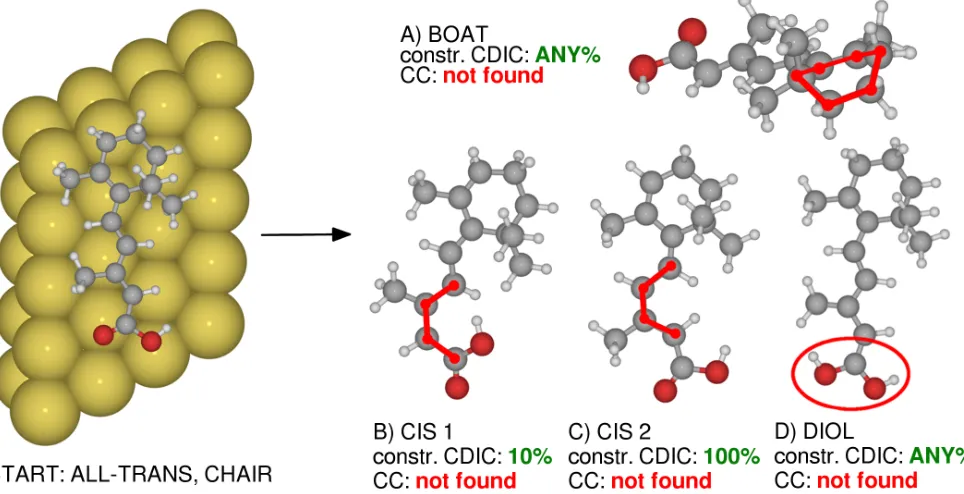
Conformational structure search forβ-acid on Au(111) serves the purpose of finding new and stable configura-tions. Especially interesting arecisisomers (cf. Fig. 5, structures B and C) since they could play an active role in a molecular switching process. These structures are particularly hard to uncover by unbiased sampling, since a concerted motion of a large number of atoms is nec-essary. We were able to find such minima in two out of three constr. CDIC based runs (10% and 100% con-str. CDIC trial moves) with a relatively short number of steps per run (25 and 88 global steps, respectively). It should be noted that CC based sampling, however, was not able to uncover any new conformations apart from the starting geometry.
finite-FIG. 5. Ball-and-stick representations of the starting geometry (left), of the boat configuration (top right, A), of thecisisomers (B and C), and of the diol structure (bottom right, D) ofβ-acid at Au(111). All were found using constr. CDIC displacements in less than 100 global optimization steps. Thecisconfigurations as well as the ring in the boat configuration have been marked in red for clarity. Also shown are the settings in CDIC runs, at which the geometries have been found. None of these structures were found using CC trial moves.
temperature geometry observed in experiment, such as different ring conformations (chair, boat, half-chair etc.) or changes in internal degrees of freedom (chain to ring angle, staggered vs. eclipsed conformations of methyl groups etc.). The broadest range of such structures has been identified using 10% constr. CDIC displacements and a step width of 1.5. Configurations were found where the ring was bent towards the surface and away from it. We have also found stuctures where the ring is in a boat configuration (cf. Fig. 5, structure A) or twisted with respect to the chain. Methyl groups both on the ring and on the chain were found in different rotations (staggered conformation). Another group of minima in-volved modifications of the acid group, rotating either the OH or the whole COOH group by 180◦. 25% con-str. CDIC trial moves found similar minima, but were not able to sample changes in the acid group. Instead, the boat configuration of the ring was sampled more often. The third setup (100% constr. CDIC displacements) did not result in a completely rotated acid group, the OH group was found flipped once. This run was the only one that sampled half-chair conformations of the ring. A somewhat unexpected result was the repeated discov-ery of a diol structure (cf. Fig. 5, structure D) in all constr. CDIC runs, while CC based runs always failed to find this structure. We have performed DFT calculations that predict a stabilizing effect of the surface by 0.22 eV on this structure as compared to the gas-phase minimum
conformation; however, the acid structure nevertheless remains the global minimum (see AppendixB). The en-ergetically most favorable structures that were found by all runs are slight variations of the global minimum con-formation found in gas phase, adsorbed such that the oxygen atoms are situated above a bridge site.
In summary, CC displacements were found to either repeatedly sample the starting geometry at small step widths or dissociated structures at larger step widths. Using CC trial moves we were not able to find any step width that is both large enough to overcome barriers on the PES and simultaneously small enough not to dis-sociate the molecule. Expressing the displacements in constr. CDICs, however, enables a finely tunable sam-pling of phase space. Indeed a small number of steps are sufficient to find a plethora of molecular configurations on the surface as well as different adsorption sites and rotations.
2. CH4 adsorbed on Ag(111)
[image:10.612.74.556.56.303.2]FIG. 6. Methane (CH4) adsorbed on Ag(111). Shown are
two neighboring primitive surface unit cells with the initial starting geometry used in the sampling runs on the left hand side, while high-symmetry adsorption sites are highlighted on the right hand side: fcc hollow site (light red circle), hcp hollow site (dark red circle), top sites (light blue star), bridge sites (dark blue star). All top sites, as well as all bridge sites, are symmetry equivalent.
the surface we next study CH4 (methane) adsorbed on
Ag(111). Different adsorption sites of CH4/Ag(111) are
found to have similar stability and the PES is dominated by small barriers and little corrugation between these sites. As a consequence, it should be an ideal test system for which we can sample all adsorption geometries in the unit cell.
Even though the system appears simpler than the pre-vious test cases, a large number of distinct minima exists. The surface has four different high-symmetry adsorption sites (cf. Fig. 6) and although the molecule is highly symmetric, CH4can adsorb in multiple rotational
orien-tations with respect to the surface. In principle, most of these minima might be found by visual inspection; however, as emphasized by Peterson,26 as soon as more than one adsorbate is introduced or if the surface fea-tures steps or defects, combinatorics makes brute-force sampling and analysis methods quickly intractable. We performed global optimization runs with Cartesian placements (step width 0.4) as well as constr. CDIC dis-placements made up of 25% and 75% of the available co-ordinates (step width 1.25) until 260 intact CH4 minima
were found. This took 600 global optimization steps with CC trial moves and 500 with constr. CDIC trial moves, respectively. Step widths were chosen according to the best performance in shorter test runs (100 steps each). As initial starting geometry, the molecule has been po-sitioned at a top site with one hydrogen atom pointing away from the surface, followed by local optimization (cf.
left hand side of Fig.6). Optimization results have been obtained for CH4 in a (2x2) unit cell to mimick a lower
coverage at the surface.
To achieve a rigorous sampling on a metal surface, the first prerequisite is a complete lateral exploration of the surface unit cell. In our test case, this means that the simulation has to traverse through all four distinct
high-25% constr. CDIC Cartesian
1 5 10 25 50
[image:11.612.56.300.51.185.2]N occurrences (log scale)
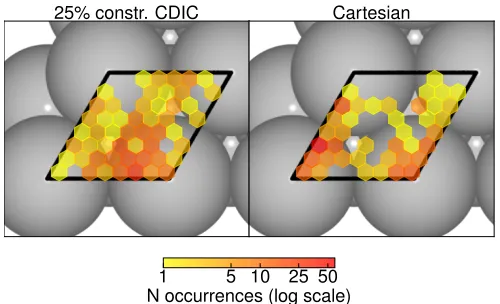
FIG. 7. 2D histogram of the x,y-position of the carbon atom in CH4in all 260 intact methane minima identified over
the course of the 25% constr. CDIC displacements (left side) and CC displacements (right side) sampling run (see text). Lighter yellow hexagons indicate a rare sampling of this po-sition in the surface unit cell, darker orange or red hexagons are shown when this position was sampled more often. No hexagons are drawn when the simulation failed to ever visit this area on the surface. Calculations were performed for a (2x2) unit cell to mimick lower coverage, but folded back into a primitive unit cell as indicated by black lines.
symmetry adsorption sites (right hand side of Fig. 6). We therefore monitor the position of the carbon atom in all intact methane minima identified over the course of the sampling run and plot the result in a 2D histogram in Fig7. It immediately stands out that CC trial moves fail to sample larger areas of the surface unit cell. This includes rare sampling of the bridge sites, the center of the fcc hollow site, as well as the surroundings of the hcp hollow site. Top sites are instead sampled repeatedly, and computational sampling time is wasted in these re-visits. In the case of constr. CDIC trial moves the distri-bution of identified minima is more homogeneous and all four high-symmetry sites are visited. An especially inter-esting finding is that the most often sampled areas are not around the starting site, but around the bridge sites. There is also a slight preference for the fcc hollow site. Since translations are explicitly included in constr. CDIC displacements on surfaces, it is not a big surprise that our trial moves perform better in this regard. In contrast, a random CC trial move is unlikely to describe a concerted molecular translation across the surface.
[image:11.612.315.565.53.205.2]at the hcp hollow site, with the hydrogen atoms rotated to lie above the ridges between silver atoms (staggered). This geometry at the hcp and fcc hollow site was found in the BH run based on CC trial moves. The constr. CDIC trial moves were instead able to find all these rotational arrangements, as well as a number of others. Both runs (25% and 75% constr. CDIC) sampled a variety of differ-ent oridiffer-entations at the bridge sites and close to the top sites as well. The 75% constr. CDIC run even found the molecule flipped around completely once, with one of the hydrogen atoms pointing towards the surface. 25% con-str. CDIC trial moves were the only ones that produced an eclipsed rotational configuration of hydrogen atoms at both hollow sites, with the H atoms oriented along the close-packed rows of the Ag(111) surface.
100 200 300 400 500
Number of global optimization steps 0
5 10 15 20
Number
of
unique
minima
found
25% constr. CDIC 75% constr. CDIC
CC
[image:12.612.324.555.53.271.2]sum of all runs
FIG. 8. 20 symmetry-inequivalent positions and orientations of CH4 on Ag(111) were found in the two CDIC (25% and
75%) and one CC displacement based BH global optimiza-tion runs combined. Depicted is the number of these minima found in each run up to a certain number of global steps. All minima that were encountered during the CC displacement based search were also discovered in at least one of the two constr. CDIC runs.
Fig. 8 shows how the discovery of new, unique CH4
minima occurred over the course of the global optimiza-tion runs. In all three runs combined, a total of 20 symmetry-inequivalent minima was found, of which the CC based run was only able to find 8. All these min-ima were also identified in either one or both of the con-str. CDIC runs. An interesting finding here is that the constr. CDIC runs found twice as many inequivalent ge-ometries as the CC run already after about 100 global optimization steps. After an initial phase of 150 steps, CC trial moves do not lead to any more new minima, whereas constr. CDIC runs continue to find more. Both effects together clearly show the superior performance of constr. CDIC trial moves compared to simple CC trial moves.
Up to this point we have focused on geometries where the CH4 molecule remained intact. However, CDIC trial
moves are equally able to efficiently sample the space of chemically different minima that involve hydrogen dis-sociations and chemical reactions on the surface. CC
constr. CDIC unconstr. CDIC CC
Method of displacement
0 20 40 60 80 100
%
of
global
optimization
steps
CH
4CH
3other
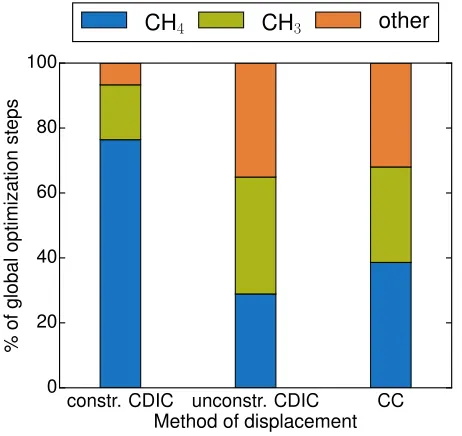
FIG. 9. Distribution of all minima found using different dis-placement methods for the first 500 global optimization steps of each run. Shown are results for 25% constrained (step width 1.25) and unconstrained CDIC runs (step width 1.6) and the CC run (step width 0.4). Intact CH4 structures are
shown in blue, CH3 in green, and all other minima (CH2, CH
and C) as orange.
displacements are completely defined by the single pa-rameter of step width dr, and there is no straightfor-ward way of fine tuning the search target, for example in terms of focusing on mainly dissociated or mainly intact geometries of CH4. CDIC displacements, however,
en-able a straightforward inclusion of constraints that con-fine configurational space, for example by constraining bond stretches. In order to analyze the distribution of dissociated and intact structures throughout a BH run, we additionally performed 500 steps of an unconstrained CDIC run using 25% of available coordinates and a step width of 1.6. Figure9 shows the distribution of intact and dissociated minima for different displacement meth-ods. As also found in the case ofβ-acid on Au(111), con-str. CDIC displacements effectively restrict the geometry search to intact CH4 molecules. More importantly,
un-constrained CDIC trial moves find a similar distribution of dissociated and intact structures as CC displacements and are therefore equally suited to sample the space of re-active intermediates at the surface. However, this comes at a higher sampling rate of unique minima than achieved with CC trial moves.
[image:12.612.57.295.236.383.2]that constr. CDIC trial moves generally generate geome-tries that are less strained compared to the ones pro-duced by CC trial moves. This is emphasized by the fact that geometries created from CC trial moves take almost twice as many steps for local convergence as ones generated by 75% constr. CDIC displacements, namely on average 528 BFGS89–92 steps compared to 267 using a force threshold of 0.025 eV/˚A. As explained in sec-tion IV B 1, using smaller percentages of constr. CDICs introduces more severe changes to the molecule. There-fore 25% constr. CDIC displacements take slightly longer for convergence as 75% constr. CDIC trial moves (309 steps). Overall this nevertheless constitutes a significant reduction in computational cost, consistent with what we already observed in our previous work on silicon clus-ters.68 In summary, we thus find that global structure search with DIC trial moves not only finds more unique minima than CC displacements, but does so at reduced computational cost as well.
V. CONCLUSIONS AND OUTLOOK
We presented a modification of the basin hopping al-gorithm by performing global optimization trial moves in chemically-motivated curvilinear coordinates that re-semble molecular vibrations. This approach has recently been shown to be efficient in structure determination of clusters68 and was here investigated and extended for the application to organic molecules both in gas phase and adsorbed on metal surfaces. The chemical nature of the collective displacements enables straightforward in-clusion of rotations, translations, as well as constraints on these and arbitrary internal degrees of freedom. This allows for a finely tunable sampling of practically rele-vant areas of phase space for complex systems that ap-pear in nanotechnology and heterogeneous catalysis, such as hybrid organic-inorganic interfaces,11organic crystals, self-assembled nanostructures, and reaction networks on surfaces. These systems feature heterogeneous chemi-cal bonding, where stiff energetichemi-cally favorable bonding moieties, such as covalent molecules, coexist with weak and flexible bonding forces such as interactions between molecules or between a molecule and a surface.
For the show cases β-acid adsorbed on Au(111) and methane adsorbed on Ag(111) we find that collective in-ternal coordinate based trial moves outperform Carte-sian trial moves in several ways: i)CDICs systematically identify a larger number of structures at equal number of global optimization steps, thus allowing to reduce the number of necessary global optimization steps; ii) con-str. CDICs are able to restrict structure searches to well defined chemically-motivated subdomains of the config-urational space and thus find more relevant structures;
iii) DICs generate less strained structures and reduce the computational cost associated with a single global optimization step.
In future work we plan to utilize the variability of
singular-value decomposed collective coordinates in the context of materials structure search to facilitate sim-ulation of surface reconstructions and defect formation, as well as crystal polymorphism and phase stability in organic crystals and layered materials. So far we have only discussed the relevance of these coordinate systems in the context of basin hopping, however displacement moves are a common element of many different stochas-tic global optimization strategies, such as, for example, minima hopping, where curvilinear constraints can help guide the MD.26 Our implementation can easily be ex-tended to feature such algorithms as well.
Appendix A:winak: a Python-based tool to construct and apply curvilinear coordinates for materials structure search and beyond
Many global optimization procedures can be divided into three steps: displacement, optimization, evaluation and analysis. In order to make DIC displacements as easily accessible as possible, we have developed a modu-lar Python-based framework calledwinak,86 where each of the three aforementioned steps can be customized. For instance, in order to change from the basin hopping method to the minima hopping method38, instead of a global optimization, an MD run can be started, and in-stead of employing a Metropolis criterion, all newly iden-tified minima are accepted.26
In order to make the code independent of a particular application, each part of the global optimization process has been encapsulated in an individual class. Exchang-ing local optimization by an MD run can easily and safely be done, independent of the coordinate generation class. The same is true for the displacement step. Logging and error handling is managed by analysis routines that work with any combination of sub classes. To ensure compat-ibility, abstract base classes and templates are provided on the basis of which custom procedures for the three above mentioned steps can be developed. This code is designed to be interfaced with ASE,77 which enables a wide range of electronic structure codes to be used in combination withwinak.
Appendix B: Density-Functional Theory calculations
(111) with a k-grid of (5×5×1). Surface atoms were not allowed to relax during optimization. Both in gas phase and on the surface the acid isomer is more stable, which aligns with chemical intuition. However, the energy dif-ference is lowered from 1.09 eV in the gas phase to 0.87 eV for the adsorbed system,i.e. the diol is stabilized.
ACKNOWLEDGMENTS
The authors would like to thank Daniel Strobusch and Christoph Scheurer for supplying the initial coordi-nate construction code and for fruitful discussions. RJM acknowledges funding from the DoE-Basic Energy Sci-ences grant no. DE-FG02-05ER15677. CP gratefully acknowledges funding from the Alexander von Hum-boldt Foundation and within the DFG Research Unit FOR1282. DP gratefully acknowledges funding from the Engineering and Physical Sciences Research Coun-cil (project EP/J011185/1).
1A. Dabrowski,Adv. Colloid Interface Sci.93, 135 (2001). 2P. J. Feibelman, B. Hammer, J. K. Nørskov, F. Wagner,
M. Scheffler, R. Stumpf, R. Watwe, and J. Dumesic,J. Phys. Chem. B105, 4018 (2001).
3S. M. Barlow and R. Raval,Surf. Sci. Rep.50, 201 (2003). 4J. V. Barth,Ann. Rev. Phys. Chem.58, 375 (2007). 5R. A. Wolkow,Annu. Rev. Phys. Chem.50, 413 (1999). 6G. Bracco and B. Holst, eds.,Surface Science Techniques
(Springer, Berlin, 2013).
7B. Hammer and J. K. Nørskov, inImpact of Surface Science on
Catalysis, Advances in Catalysis, Vol. 45, edited by H. K. Bruce C. Gates (Academic Press, 2000) pp. 71–129.
8A. D. Becke,J. Chem. Phys.140, 18A301 (2014).
9R. J. Maurer, L. Wei, I. Poltavsky, T. Stecher, H. Oberhofer,
K. Reuter, and A. Tkatchenko,Phys. Rev. Lett.116, 146101 (2016).
10G. Mercurio, R. J. Maurer, W. Liu, S. Hagen, F. Leyssner,
P. Tegeder, J. Meyer, A. Tkatchenko, S. Soubatch, K. Reuter, and F. S. Tautz,Phys. Rev. B88, 35421 (2013).
11R. J. Maurer, V. G. Ruiz, J. Camarillo-Cisneros, W. Liu,
N. Ferri, K. Reuter, and A. Tkatchenko,Prog. Surf. Sci.91, 72 (2016).
12S. L. Koch, B. J. Morgan, S. Passerini, and G. Teobaldi,J. Power Sources296, 150 (2015).
13S. L. Price,Chem. Soc. Rev.43, 2098 (2014).
14P. Strasser, Q. Fan, M. Devenney, W. H. Weinberg, P. Liu, ,
and J. K. Nørskov,J. Phys. Chem. B107, 11013 (2003).
15I. Y. Kanal, S. G. Owens, J. S. Bechtel, and G. R. Hutchison, J. Phys. Chem. Lett.4, 1613 (2013).
16A. K. Singh, K. Mathew, H. L. Zhuang, and R. G. Hennig,J. Phys. Chem. Lett.6, 1087 (2015).
17D. J. Wales, J. P. K. Doye, M. A. Miller, P. N. Mortenson, and
T. R. Walsh,Adv. Chem. Phys.115, 1 (2000).
18J. D. Pint´er, ed.,Global optimization(Springer, New York,
2006).
19D. J. Wales, M. A. Miller, and T. R. Walsh,Nature394, 758 (1998).
20D. J. Wales and H. A. Scheraga,Science285, 1368 (1999). 21R. L. Johnston,Dalton Trans.22, 4193 (2003).
22R. Ferrando, A. Fortunelli, and R. L. Johnston,Phys. Chem. Chem. Phys.10, 640 (2008).
23A. Liwo, J. Lee, D. R. Ripoll, J. Pillardy, and H. A. Scheraga, Proc. Natl. Ac. Sci.96, 5482 (1999).
24B. Hartke,Eur. Phys. J. D24, 57 (2003).
25N. Ole Carstensen, J. M. Dieterich, and B. Hartke,Phys. Chem. Chem. Phys.13, 2903 (2011).
26A. A. Peterson,Top. Catal.57, 40 (2014). 27D. J. Wales,J. Chem. Phys.142, 130901 (2015).
28A. Supady, V. Blum, and C. Baldauf,J. Chem. Inf. Model.55, 2338 (2015).
29S. Kirkpatrick, C. D. Gelatt Jr., and M. P. Vecchi,Science
220, 671 (1983).
30U. H. E. Hansmann and L. T. Wille,Phys. Rev. Lett.88, 68105 (2002).
31J. A. Rahman and J. C. Tully,J. Chem. Phys.116, 8750 (2002). 32J. A. Rahman and J. C. Tully,Chem. Phys.285, 277 (2002). 33A. Styrcz, J. Mrozek, and G. Mazur,Int. J. Appl. Math.
Comput. Sci.21, 559 (2011).
34F. H¨ase, S. Valleau, E. Pyzer-Knapp, and A. Aspuru-Guzik, Chem. Sci. (2016), 10.1039/C5SC04786B.
35D. J. Wales and J. P. K. Doye,J. Phys. Chem. A101, 5111 (1997).
36D. M. Deaven and K. M. Ho,Phys. Rev. Lett.75, 288 (1995). 37R. Gehrke and K. Reuter,Phys. Rev. B79, 85412 (2009). 38S. E. Sch¨onborn, S. Goedecker, S. Roy, and A. R. Oganov,J.
Chem. Phys.130, (2009).
39M. Sicher, S. Mohr, and S. Goedecker,J. Chem. Phys.134, (2011).
40X. Lai, R. Xu, and W. Huang,J. Chem. Phys.135, (2011). 41A. O. Lyakhov, A. R. Oganov, H. T. Stokes, and Q. Zhu,
Comput. Phys. Commun.184, 1172 (2013).
42G. G. Rondina and J. L. F. Da Silva,J. Chem. Inf. Model.53, 2282 (2013).
43J. M. Dieterich and B. Hartke,Phys. Chem. Chem. Phys.17, 11958 (2015).
44F. Calvo, D. Schebarchov, and D. J. Wales,J. Chem. Theory Comput.12, 902 (2016).
45J. A. Niesse and H. R. Mayne,J. Chem. Phys.105, 4700 (1996). 46M. Iwamatsu,J. Chem. Phys.112, 10976 (2000).
47K. Mochizuki, C. S. Whittleston, S. Somani, H. Kusumaatmaja,
and D. J. Wales,Phys. Chem. Chem. Phys.16, 2842 (2014).
48G. Rossi and R. Ferrando,J. Phys. Condens. Matter21, 84208 (2009).
49R. Ferrando, G. Rossi, F. Nita, G. Barcaro, and A. Fortunelli, ACS Nano2, 1849 (2008).
50D. Bochicchio and R. Ferrando,Nano Lett.10, 4211 (2010). 51B. Hartke,J. Phys. Chem.97, 9973 (1993).
52D. E. Goldberg,Complex Syst.5, 139 (1991).
53D. E. Goldberg,Genetic Algorithms (Addison-Wesley, Boston,
1989).
54Y. Zeiri,Phys. Rev. E51, R2769 (1995).
55D. J. Wales and J. M. Carr,J. Chem. Theory Comput.8, 5020 (2012).
56J. Fern´andez-Recio, M. Totrov, and R. Abagyan,Protein Sci.
11, 280 (2002).
57C. D. Maranas and C. A. Floudas,J. Chem. Phys.100, 1247 (1994).
58J. M. Dieterich and B. Hartke,Mol. Phys.108, 279 (2010). 59M. von Arnim and R. Ahlrichs,J. Chem. Phys.111, 9183
(1999).
60P. Pulay and G. Fogarasi,J. Chem. Phys.96, 2856 (1992). 61J. Baker, A. Kessi, and B. Delley,J. Chem. Phys.105, 192
(1996).
62J. Baker, D. Kinghorn, and P. Pulay,J. Chem. Phys.110, 4986 (1999).
63T. Bucko, J. Hafner, and J. G. Angy´an,J. Chem. Phys.122, 124508 (2005).
64M. Jahn´atek, J. Hafner, and M. Krajˇc´ı,Phys. Rev. B79, 224103 (2009).
65D. A. Egger and L. Kronik,J. Phys. Chem. Lett.5, 2728 (2014). 66G. Piccini and J. Sauer,J. Chem. Theory Comput.10, 2479
(2014).
68C. Panosetti, K. Krautgasser, D. Palagin, K. Reuter, and R. J.
Maurer,Nano Lett.15, 8044 (2015).
69D. Palagin, M. Gramzow, and K. Reuter,J. Chem. Phys.134, 244705 (2011).
70W. Caminati and E. B. Wilson,J. Mol. Spectr.81, 356 (1980). 71C. Y. Peng, P. Y. Ayala, H. B. Schlegel, and M. J. Frisch,J.
Comput. Chem.17, 49 (1996).
72P. Pulay, G. Fogarasi, F. Pang, and J. E. Boggs,J. Am. Chem. Soc.101, 2550 (1979).
73G. R. Kneller,Mol. Simulat.7, 113 (1991).
74J.-P. Ryckaert, G. Ciccotti, and H. J. Berendsen,J. Comput. Phys.23, 327 (1977).
75J. Andzelm, R. King-Smith, and G. Fitzgerald,Chem. Phys. Lett.335, 321 (2001).
76S. M. Norman, S. M. Poling, V. P. Maier, and M. D. Nelson, Agric. Biol. Chem.49, 2887 (1985).
77S. R. Bahn and K. W. Jacobsen,Comput. Sci. Eng.4, 56 (2002).
78B. Aradi, B. Hourahine, and T. Frauenheim,J. Phys. Chem. A
111, 5678 (2007).
79M. Elstner, D. Porezag, G. Jungnickel, and J. Elsner,Phys. Rev. B58, 7260 (1998).
80V. Ruiz, W. Liu, E. Zojer, M. Scheffler, and A. Tkatchenko, Phys. Rev. Lett.108, 146103 (2012).
81M. St¨ohr, G. S. Michelitsch, J. C. Tully, K. Reuter, and R. J.
Maurer,J. Chem. Phys.144, 151101 (2016).
82G. S. Michelitsch,Metal surface adsorbed retinoic acid as a Kondo switch: Ab initio investigations of isomerization and spin localization, Master’s thesis, Technische Universit¨at Graz
(2014).
83V. M¨akinen, P. Koskinen, and H. H¨akkinen,Eur. Phys. J. D
67, 1 (2013).
84T. Frauenheim, F. Weich, T. K¨ohler, S. Uhlmann, D. Porezag,
and G. Seifert,Phys. Rev. B52, 11492 (1995).
85A. Sieck,Structure and physical properties of silicon clusters and of vacancy clusters in bulk silicon, Ph.D. thesis, University of Paderborn (2000).
86winakis available under a GNU General Public License:
https://gitlab.com/reinimaurer1/winak.
87S. Karan, N. Li, Y. Zhang, Y. He, I.-P. Hong, H. Song, J.-T.
L¨u, Y. Wang, L. Peng, K. Wu, G. S. Michelitsch, R. J. Maurer, K. Diller, K. Reuter, A. Weismann, and R. Berndt,Phys. Rev. Lett.116, 027201 (2016).
88R. J. Maurer and K. Reuter,Angew. Chem. Int. Ed.51, 12009 (2012).
89G. C. Broyden,IMA J Appl Math6, 76 (1970). 90R. Fletcher,Comput. J13, 317 (1970). 91D. Goldfarb,Math. Comp24, 23 (1970). 92D. F. Shanno,Math. Comp24, 647 (1970).
93J. P. Perdew, K. Burke, and M. Ernzerhof,Phys. Rev. Let.78, 1396 (1996).
94V. Blum, R. Gehrke, F. Hanke, P. Havu, V. Havu, X. Ren,
K. Reuter, and M. Scheffler,Comp. Phys. Commun.180, 2175 (2009).