AUTHOR
J. C. BloemendalS1887866
EXAMINATION COMMITTEE
Dr. M. D. Endedijk MSc. J. V. H. Frissen23rd August 2019
The relationship between nurses’
learning conceptions and their
regulation of workplace learning
Acknowledgements
On the very outset of this thesis, I would like to express my gratitude to a few people who helped me in the process of writing this thesis. First, I would like to thank my supervisor dr. Maaike Endedijk, for the valuable feedback, her expertise and encouragement. From the very first start, you guided me and gave me helpful suggestions. Also, I would like to thank MSc. Judith Frissen, for her help and the time she took for discussing our theses. From the Spaarne Gasthuis hospital, I would like to thank Marianne Voskamp for her contagious enthusiasm, wisdom, and helpfulness every time I visited the hospital. I also want to thank Veerle Struben, for her help in starting my thesis and connect me with others in the hospital. Also, I would like to thank the participants for the time they took and the trust they had in my study. Of course, I would also like to thank the students from the peer group, who provided me with helpful feedback and lots of fun moments during studying. Thank you Nathalie, Rowan, and Jeroen!
Further, I would like to thank my parents, brothers and sisters who encouraged me to carry on during the process and who were always willing to help. Last but not least, I would like to thank my boyfriend Matthias for his patience in this process, his practical and moral support. You kept faith in me for a successful outcome and helped me with everything you could.
23rd August 2019
Abstract
Changing disease patterns and treatment methods cause a continuous need for the development of nurses. Nurses are expected to be responsible for their own professional development. To accomplish this self-responsibility, nurses need to be self-regulated in learning. Self-regulated learning is especially required in workplace learning since workplace learning enables nurses to select their own learning activities during work. According to the study of Aagten (2016), day-care nurses lack self-regulated behaviour in workplace learning. This lack could be caused by nurses’ learning conceptions. Self-regulation of learning and learning conceptions are both parts of a learner’s metacognition. If the learning conceptions, learner’s ideas of what learning is about, do not demand self-regulation, the learner is more likely to not regulate their own learning. Therefore, the purpose of this study is to explore the relationship between nurses’ learning conceptions and their regulation activities in workplace learning. To measure nurses’ regulation activities at the workplace, a multiple-event measurement of Endedijk (2012), the Learning Moments-app, was used. The app enabled participants to report multiple learning experiences in two weeks which gave insights into their regulation activities. The learning conceptions were measured by the Likert-scale COLI-questionnaire (Purdie & Hattie, 2002). These were measured twice to investigate the changeability of nurses’ learning conceptions, by the influence of learning and reflection on learning at the workplace. Nurses of various departments from the hospital the Spaarne Gasthuis in the Netherlands participated (N = 39). The results showed that a majority of the nurses featured a deep learning conception. No significant differences were found in the learning conceptions between the two measurements, which indicates that the learning conceptions are relatively stable. Nurses’ extent of self-regulation was below average, especially on the forethought-phase of self-regulated learning. In contrast, nurses scored average on the self-regulation forethought-phases performance and future planning. A relationship between nurses’ learning conceptions and their self-regulation behaviour was only found between the number of learning moments reported by the nurse and the learning conception Learning as personal Change. As a result of this research, the relationship between regulation activities and learning conceptions seems more complicated than theories claim.
Table of contents
Acknowledgements 2
Abstract 3
Table of contents 4
1. Introduction 6
2. Theoretical framework 8
2.1 Nurses’ Workplace Learning 8
2.2 Self-regulated Learning 8
2.3 The Measurement of Self-regulated Learning 10
2.4 Learning Conceptions 11
2.5 The relationship between regulation activities and learning conceptions 12
2.6 The Present Study 13
3. Method 14
3.1 Research Design 14
3.2 Context 14
3.3 Participants 14
3.4 Instrumentation 15
3.4.1 General background questionnaire 15
3.4.2 Self-regulated learning on the workplace 16
3.4.3 Learning conceptions 16
3.5 Procedure 17
3.6 Data Analysis 18
3.6.1 Analysis of the learning conceptions 19
3.6.2 Regulation of learning 20
3.6.3 The relation between nurses’ learning conceptions and their regulation of learning 22
4. Results 23
4.1 Exploration of Correlations 23
4.2 Nurses’ Learning Conceptions 26
4.3 Nurses’ Regulation Activities 28
5.4 Relationship nurses’ learning conceptions and SRL-score 32
5. Conclusion and Discussion 36
5.1 Learning conceptions 36
5.2 Regulation of learning 37
5.3 Relationship between nurses’ learning conceptions and their regulation of learning 39
6.1 Limitations 40
6.2 Practical implications. 40
7. Conclusions 42
References 43
Appendices 50
Appendix A Learning Moments-app Content 50
Appendix B Questionnaire Learning Moments-app 55
Appendix C Informed Consent Letter 57
Appendix D COLI-questionnaire 60
Appendix E Codebook Learning Content 62
Appendix F Silhouette Plots per Number of Clusters (k) 65
1. Introduction
Caused by changing disease patterns and treatment methods, nursing is a dynamic profession wherein learning is a prerequisite to guarantee the best patient care (Berings, 2006). Nurses are held accountable for their own learning as was stated in guidelines for the Dutch professional code for nurses. One of the guidelines of the professional code emphasizes personal responsibility of medical professionals to be and remain competent in their profession: ‘As a caretaker, I keep the knowledge and skills required for responsible professional practice up to standard’ (De Witte, Berkers & Visser, 2007, p. 1). As this guideline suggests, nurses are expected to regulate their own learning. The ability to
regulate one’s own learning is called self-regulated learning (SRL) and is defined as a process in which learners construct their own cognition, motivation and behaviour through regulatory processes (Pintrich, 2004). Learner’s regulation activities are concentrated on regulating the cognitive activities and therefore affect the learning outcomes (Vermunt, 1996).
Self-regulation is most important for workplace learning because this type of learning depends
on the nurses’ initiative and persistence. These abilities are needed because workplace learning is characterized as mostly informal and low degree of external regulation. Workplace learning is defined
as: “implicit or explicit mental and/or overt activities and processes, embedded in working and work-related performance, leading to relatively permanent changes in knowledge, attitude or skill” (Berings,
Doornbos, & Simons, 2006, p. 334). In a study of Aagten (2016) nurses’ workplace learning activities and
extent of regulation in learning were examined. This study revealed a positive attitude towards self-regulated learning of caretakers and nurses in daycare. However, participants showed a low degree of SRL-behaviour. It is unclear how the lack of nurses’ SRL-behaviour could be explained.
The lack of nurses’ self-regulation in learning could be caused by the lack of the right ideas of learning, the learning conceptions. In theory, learner’s regulation activities are associated with their learning conceptions. According to Vermunt (1996), these concepts form two essential parts of the metacognition. The regulation activities are considered as the behavioural part and expression of the metacognition. This means that the regulation activities depend on contextual and internal factors and could differ per learning activity. The learning conceptions are seen as the relative stable part of the metacognition. The theory of Vermunt (1996) suggests that the ideas of what learning is affects the behaviour in learning and successively the regulation activities. These ideas, the learning conceptions,
are defined as “the differing ways in which learners experience, understand and make sense of learning
in general” (Boulton-Lewis, Marton, & Wills, 2001, p. 154).
Previous research revealed multiple learning conceptions, which could be divided into two overarching learning conceptions (Marton & Säljö, 1976; Purdie and Hattie, 2002). First, the surface learning conception wherein learning is seen as the reactive acquisition, storage and reproduction of information. Second, with the deep learning conception learning is seen as the active process of construction of knowledge wherein the meaning and reflection in learning is central. In previous studies, the deep learning approach is most often associated to self-regulation in learning, whereas the surface learning conception is related to external regulation (Lonka & Lindblom-Ylänne, 1996; Rozendaal, Minnaert, & Boekaerts, 2003). For example, if learning is seen as the reactive process of reproduction of information, the learner is less inclined to regulate their own learning.
In the study of Pool, Poell, and Ten Cate (2012) nurses perceived learning mostly as gaining competence, keep knowledge up to date and improve it. Another study revealed that first year’s nursing students believed that learning was about solely remembering knowledge for a short amount of time (Eklund-Myrskog, 1997). These results could indicate that nurses feature on average a surface learning conception, yet a deep learning conception is desirable to reach self-regulation.
and their learning conceptions, it is still unclear how these concepts are related in the context of hospital nurses. As stated, the study of Aagten (2016) revealed a low extent of nurses’ self-regulation in workplace learning. The current study should give insight if nurses’ learning conceptions are truly
2. Theoretical framework
2.1
Nurses’ Workplace Learning
Workplace learning (WPL) is beneficial for both organisations and employees. For organisations, WPL contributes to the development of new knowledge and saving training costs (Guglielmino & Murdick, 1997; Rowland & Volet, 1996). For employees, WPL plays a key role in their professional development and job satisfaction (Skår, 2010). Also, it enables nurses to integrate their own experiences of their work in learning, which makes learning more meaningful. In the study of Berings, Poell, Simons, and van Veldhoven (2007) six types of learning activities on the nurses’ workplace could be
distinguished: doing one’s regular job, applying something new in the job, learning from theory, from supervision, from reflection by oneself, and by talking with others. Learning on the job in hospitals is characterized as learning from challenges in daily practice and with the involvement of other individuals (patients, colleagues, etc., Berings et al., 2007). Central arenas that challenge nurses the most to learn are the staff room, the meeting room and patient rooms (Bjørk, Tøien, & Sørensen, 2013).
WPL exists of both formal and informal learning experiences. Formal learning is planned, involves clear set learning goals and often a coach (Eraut, 2000). Informal learning is not always intentional, accumulates mainly implicit or tacit knowledge, does not involve a (formal) teacher, and takes place on daily basis (Manuti, Pastore, Scardigno, Giancaspro, & Morciano, 2015; Slotte, Tynjälä, & Hytönen, 2004). Even though employees learn mostly on the workplace from daily informal interaction (sixty to eighty per cent, Marsick & Watkins, 1990), studies that especially explore informal learning by nurses are scarce (Bjørk, Tøien, & Sørensen, 2013). Hospitals are a fruitful context for this informal learning because of the interaction between employees and the versatility of the context which encourage nurses to learn at the workplace (Ryan, Walshe, Gaffney, Shanks, Burgoyne, & Wiskin, 2010). This study focuses on workplace learning which entails both formal and informal learning activities, however informal learning activities will be more present.
According to Eraut (2004), informal learning exists from three types: implicit learning, reactive learning, and deliberative learning. First, implicit learning entails knowledge which is obtained without any conscious influence of the learner. Second, reactive learning, whereas spontaneous learning occurs in the middle of the action. Finally, deliberative learning is conscious learning with a clear learning goal. This theory suggests that only deliberative learning is self-conscious and therefore the only sort of informal learning which could be self-regulated. However, according to Endedijk (2012), reactive learning could also contain self-regulation as self-regulation is also possible during or after the learning
activity.
2.2
Self-regulated Learning
Self-regulated learning (SRL) is defined as: “an active, constructive process whereby learners set goals for their learning and attempt to monitor, regulate and control their cognition, motivation, and behaviour, guided and constrained by their goals and contextual features in the environment” (Pintrich,
2000, p. 453). SRL is often used as a synonym for self-directed learning as both concepts describe the
learner’s active role in the learning process (Niemi, 2002). SRL originates from cognitive psychology and
term of SRL will be used.
The process of SRL is illustrated with several cyclical models. Based on the model of Zimmerman (2000) and Pintrich (2004) the SRL-process exists of three phases based on previous models of Zimmerman (1989) and Bandura (1989; 1977): forethought, performance and self-reflection. The second phase, performance, was divided into two separate phases by Pintrich. However, not much separation between these phases was found in research using self-report questionnaires (Pintrich, 2000). Because in this study self-report questionnaires will be used, only the three main phases will be explained.
The first phase, forethought, concerns the planning of learning. In informal learning, levels of planning and consciousness are distinguished as deliberative, reactive or implicit learning, as stated earlier (Eraut, 2004). In this phase, activation of the learner’s perceptions and prior knowledge are
important aspects. With prior knowledge in mind, the learner is able to build new information upon that knowledge and make potential adjustments to the new learning experience. In the study of Aagten (2016), it was found that most of the learning experiences were unintended and when they were planned, it was commissioned by a supervisor. Although a self-regulated learner is expected to actively plan his own learning on beforehand (called prospective regulation), self-regulation could also take place after the learning experience (Endedijk, 2012). With this so-called retrospective regulation, the
learner’s regulation is focused on the reflection part of the learning process after learning instead of planning before their learning activity. Retrospective regulation could appear on a higher degree in informal learning as formal learning, because of the spontaneous character. The forethought phase includes also the learning goal orientation, concerning the learners’ motives for a specific learning goal
(Pintrich, 2004). These motives for learning are based on intrinsic or extrinsic factors (Endedijk, 2012). Intrinsic motives for learning, such as curiosity or personal development, are representations of self-regulation in learning. External factors, such as a demand from the organization, represent more external regulation (Endedijk, 2012). From the master’s study of Zoethout (2013), it was concluded that
nurses’ motives for learning arise from social interaction, such as receiving feedback or attend (in)formal meetings. Also, nursing proceedings (check-ups; distributing medicines) and function-related motives (extra roles as coach or manager) gave nurses the motivation to learn. This implies that in general nurses are more motivated by external factors than by internal factors.
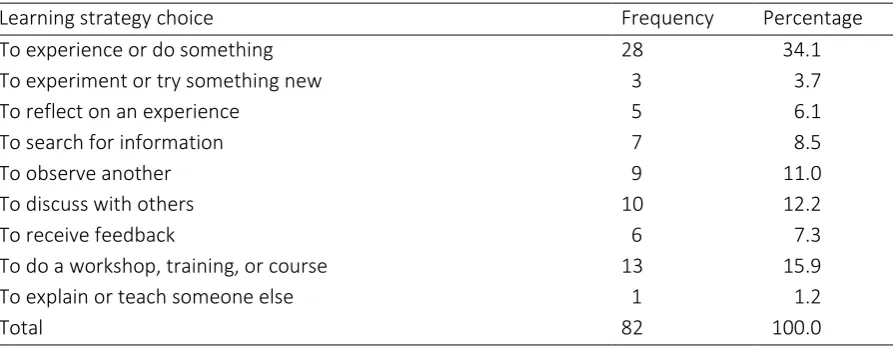
The second phase, performance, involves the learner’s (meta)cognitive awareness of several learning elements, such as strategy choice and learning strategy control. The strategy choice is about which strategy is chosen by the learner and if the strategy fits the learner’s learning goal. A number of studies have shown that nurses mostly learn by social interaction (Berings, Gelissen, & Poell, 2008; Zoethout, 2013; Aagten, 2016). They learned for example from the feedback of others, analysing a situation with colleagues, or observing others. Furthermore, nurses learned also a lot during experiences at the workplace (Zoethout, 2013; Aagten, 2016). Information about the chosen learning strategy gives insights in nurses’ learning process, however, it does not give any information about the extent of self-regulation. In contrast, learning strategy control reflects nurses’ consciousness in choosing
their learning strategy and gives information about the extent of self-regulation. If the learner thought consciously about which learning strategy to use on beforehand, he or she is characterized as self-regulated (Pintrich, 2000). From the study of Aagten (2016), it was found that nurses mostly did not deliberately choose their learning strategy (63.4 % out of 456 learning moments), which indicates a low level of self-regulation.
want to proceed with these learning profits (future planning) (Endedijk, 2012; Raemdonck, 2006). Just as the learning strategy, information of the learning outcome reflects no extent of self-regulation. However, it gives insights into the learner’s reflection skills and his learning process. From the qualitative study of Berings, Gelissen, and Poell (2008) various learning domains in nurses’ workplace learning were discovered; the technical practical domain (e.g. technical nursing skills), the organizational domain (e.g. planning patient care), the socio-emotional domain towards others (patients or family of patients) and towards oneself, the developmental domain, and a pro-active attitude at work (e.g. taking initiatives at work). For future planning, learners are featured as self-regulated if the learner has planned to actively pursue in learning, for example by setting a new goal or by improving his/her skills even further (Pintrich, 2000). No new learning plans would reflect a low degree of self-regulation (Pintrich, 2000). The three-phase model represents a time-ordered sequence, however, could be intertwined in time depending on the learner, task and context. Also, not all phases are necessary for every learning experience (Pintrich, 2004).
In addition to the phases of SRL, self-regulated learning originates also from the employees’
proactive identification and exploitation of learning moments (Raemdonck, 2006). A representation of these abilities is the number of learning moments that are acknowledged by the employee. The more learning moments are pursued, the more the learner took self-initiative and identified the moment as learning. It is plausible that employees who acknowledge a low number of learning moments have a low
extent of self-regulation in learning.
2.3
The Measurement of Self-regulated Learning
Self-regulated learning is measured as aptitude or event and both have been defined as a
contribution to the understanding of learners’ SRL (Winne & Perry, 2000). If SRL is seen as an aptitude, it is assumed that the individual possesses self-regulation in learning as a personal characteristic. In an aptitude-instrument, SRL is measured by a single measurement to identify a relative enduring attribute of a person, such as the attribution of self-regulated learning (Winne & Perry, 2000) In this single measurement, often the learner has to rate their own enduring abilities by responding to a series of statements how much they agree or disagree with. Because these measurements depend on the learner’s perspective, which is not always a true reflection of the reality, the risk of over-and
underestimating one’s own capabilities is significant (Endedijk, Brekelmans, Sleegers, & Vermunt, 2016). With an event-measurement, it is assumed that self-regulated learning is an observable behaviour, which is affected by the (workplace) context. As stated earlier, every learning experience includes another set of SRL-phases and demands another degree of self-regulation by the learner (Pintrich, 2004). In assuming this, not every learning moment is a representation of the learner’s extent of self-regulation in learning. Thus, the contextual influences and the diversity of SRL-phases are taken into account and the learner’s regulation activities are measured during multiple learning experiences. Multiple learning experiences give a better reflection of the learner’s average SRL-degree, than a single learning experience. In this study, therefore an event-measurement will be used.
Offline-measurement of self-regulated learning allows the learner to include tacit aspects of learning which need some time after the learning experience to realise (Howard-Rose & Winne, 1993). An online event measurement, during the learning performance, is difficult to realise since a lot of learning is unplanned and the hospital as workplace context could be dynamic and hectic (Tynjälä, 2008). Thus, in this study an offline multiple event-measurement will be used to take the aims of the study and the research context into account.
Such an offline multiple event-measurement is developed by Endedijk (2012) called the Learning Moments-app (LM-app). With this instrument, the self-regulated learning activities of participants could be measured, based on the SRL-phases (Pintrich, 2004; Zimmerman, 2000). For every phase, multiple questions were included. Previous studies using the first edition of the app, the Structured Learning Report, showed that SRL-activities could be measured in a valid and reliable way (Endedijk, Brekelmans, Sleegers, & Vermunt, 2016). This study will, therefore, use the LM-app, with some adaptations regarding previous research (Aagten, 2016; Endedijk, 2012; Endedijk et al., 2016; Petli, 2016).
2.4
Learning Conceptions
As earlier stated, regulation in learning and the knowledge about learning, as learning conceptions, form two essential aspects of a learner’s metacognition (Vermunt, 1998). Learning conceptions are described as the stable part of the metacognition. Research on epistemological understanding, as learning conceptions, could help understand whereon individuals base their fundamental decisions in their learning process that effects themselves as a learner and their workplace (King & Kitchener, 1994).
Säljö (1979) discovered a hierarchical set of five characteristic learning conceptions of how students conceived learning; Learning as…increase of knowledge, memorising knowledge, acquisition of facts/procedures, an abstraction of meaning and interpretative process to understand reality. Marton,
Dall’Alba and Beaty (1993) supplement these with the conception Learning as… personal change. Three learning conceptions reflect the surface learning conception, in which the quantity of learning is central (an increase of knowledge, memorising knowledge, acquisition of facts/procedures). The latter learning conceptions are defined as deep learning conceptions because they indicate a perception of learning wherein the analysis of new ideas and the linkage to existing concepts, are central (abstraction of meaning, interpretative process aimed at the understanding of reality, and personal change) (Purdie & Hattie, 2002).
Purdie and Hattie (2002) inquired the validation of these learning conceptions and subsequently developed a Likert-scale questionnaire to measure a learner’s learning conceptions (The Conceptions of Learning Inventory, COLI-questionnaire). From several studies, the items of this COLI-questionnaire remain valid, also in the context of learning adults (Campos et al., 2018; Makoe, Richardson, & Price, 2008). The questionnaire takes into account that learners could feature more than one learning conception, as claimed by Fuller (1999). She stated that learners feature multiple learning conceptions because the learning conceptions are influenced by the differences in the learning context and learning domain. How these aspects of learning influence the learner’s learning conceptions is not clear yet. For example, it could be the case that in learning about the nurses’ future career the learning conception learning as personal change is activated.
mind; understanding; applying knowledge, based on understanding; getting a new perspective; forming a conception of one’s own. These learning conceptions show many parallels with previously found conceptions of Säljö (1979) and Marton, Dall’Alba and Beaty (1993). In the study of Eklund-Myrskog (1997) most students nurses perceived learning as understanding information. After joining the educational programme, the percentage of students who perceived learning as applying information and getting a new perspective had increased. Thus, the student nurses’ learning conceptions shifted from a surface to a more deep learning conception. Students’ learning conceptions could have been developed by following courses wherein new knowledge and skills were acquired. In the interview study of Pillay, Boulton-Lewis, Wilss, & Lankshear (2003), the medical service was one of the inquired contexts. Most of the medical service employees had a conception wherein learning on the workplace was perceived as taking formal courses. It implies that nurses’ perception of learning is one where the learner is passive and dependent of formal learning courses, indicated as a surface learning conception. In an interview study of Skår (2010) nurses of different departments felt in learning the importance of improving knowledge to the expert-level instead of maintaining their previously acquired knowledge. According to the nurses, this should be done by actively searching for new knowledge and experience to develop their own practical knowledge.
From these studies, it appeared that nursing as a learning context does not identify a general learning conception. Acquirement of knowledge seems to be an important factor of learning as understanding information (Eklund-Myrskog, 1997), taking formal courses (Pillay, Boulton-Lewis, Wilss & Lankshear, 2003) or the active process to improve knowledge to the expert-level (Skår, 2010). The current study could give more insight into the actual learning conceptions of nurses.
The stability of learning conceptions seems relative as the study of Eklund-Myrskog (1997) implies. In this study, student nurses’ learning conceptions were changed after a period of learning (Eklund-Myrskog, 1997). If the learning conceptions are more influenced by the time or by learning and how long this possible change of learning conceptions takes is still unknown. This study could give more clarity in the stability of nurses’ learning conceptions and if this stability is correlated to nurses’
regulation activities in learning.
2.5
The relationship between regulation activities and learning conceptions
From previous sections, it could be concluded that both learning conceptions and regulation activities are personal characteristics influencing the learning process. As previous stated, both concepts form aspects of the metacognition (Vermetten, 1998). The relative stable learning conceptions direct the learner (un)consciously in making decisions during learning. These decisions also have an impact on how learners regulate their learning. The learning conceptions direct the cognitive processing activities, which are used to process learning contents and attain their learning goals by doing so (Vermunt, 1998). With these cognitive processing activities, the learner also directs his/her regulation activities.
meaning-making process in learning entails controlling and reshaping one´s reasoning (Endedijk et al., 2016). To carry out the learning conception of reshaping one’s reasoning, the learner is inclined to proactively regulate his own learning which results in self-regulation in learning. In contrast, if learning is perceived as acquiring and applying knowledge, information is only there to be used and no adjustments are made to the information (surface learning conception). These perceptions imply the belief that the learner is a passive actor in the learning process, and the learner is rather tended to leave regulation of learning to somebody else.
2.6
The Present Study
Research on the relation between learning conceptions and regulation activities in learning are scarce and the existing studies were on formal educational settings (Corno, 1993). Since regulation activities and learning conceptions are contextually dependent (Fuller, 1999; Pintrich, 2000), previous findings could only hypothesize the learning situation of the workplace learning of employees. This current study builds on these previous studies, to examine the relationships between nurses’ learning conceptions and their regulation activities in the workplace learning environment.
Following Fuller (1999), nurses could have more than one learning conception especially in the learning context of the workplace. Previous research did not result in an explicit learning conception for the context of nurses. It is expected that the workplace as a pluriform learning context, including informal, formal, planned, unplanned, social and individual learning, causes versatility in nurses learning conceptions. Herein the high extent of social interaction and emphasis on medical-knowledge or training will be presented in nurses’ learning conceptions, as from previous research is suggested.
For the regulation activities, from previous studies, it becomes evident that daily practice and social interaction are reflected in nurses regulation. From the study of Aagten (2016), it is expected that
the degree of nurses’ self-regulation in learning will be low. In the relation between learning conceptions and regulation activities, it is expected that nurses with deep learning conceptions will have a higher degree of self-regulation than nurses that feature a surface learning conception. Subsequently, learning conceptions are described as relatively stable, however, could be developed or changed by learning experiences (Pillemer, Picariello, Law, & Reichman, 1996). Since nurses will reflect upon their learning activities during this study, it could be that nurses with a surface learning conception will change their learning conception to a deeper one. If learners have more experience in different domains, their strategies, conceptions and motives become more differentiated (Buehl & Alexander, 2006). The aim of this study is to examine the regulation activities of nurses during workplace learning and their learning conceptions. For the measurement of the regulation activities, both the SRL-phases and the number of learning experiences are taken into account. Because those elements reflect the extent of self-regulation. The learning conceptions are measured twice to examine the influence of the reflection on regulation activities, on the nurses learning conceptions. More specifically, this research is aimed to answer the following research question and sub-questions:
a) Which learning conceptions do hospital nurses have?
b) Do hospital nurses’ learning conceptions change over time after reflecting on their daily regulation activities during workplace learning?
c) What is the nature of hospital nurses’ regulation activities at the workplace?
3. Method
3.1
Research Design
The correlation between nurses’ regulation activities and their learning conceptions is examined in this study with a quantitative correlational research design. Both constructs are inquired by quantitative instruments, except for one question in the SRL-instrument. The first three research questions have a descriptive purpose to see how the concepts of learning conceptions and regulation activities are expressed by nurses in the workplace context. Data of the learning conceptions are gathered with a Likert-scale type questionnaire, which will be quantitatively analysed. Nurses’ regulation
activities at the workplace are examined with the multiple-event measurement instrument; the Learning Moments-app. This diary log is an appropriate method to examine nurses’ learning attitudes of a large population (Babbie, 2010). The final learning question, concerning the relation between SRL and nurses’
learning conception, is correlational of nature. Further argumentation for these instruments could be found in the section of the Instrumentation.
3.2
Context
The participants in this study are employed in the Spaarne Gasthuis hospital with three locations in the West of the Netherlands. In 2017 approximately 4000 employees were active in the hospitals from which 1180 were employed as a nurse. For the educational policy, a new project has started in 2018, called Leren@Work.
In this project, the self-responsibility of nurses and other medical professionals is promoted. With broad access to learning resources and the freedom to choose their own learning activities, nurses should explore their own professional identity to manage their development and maximize their abilities. Herein, learning is a means to perform in working as a nurse instead of learning as a goal in itself. On every department, a nurse is assigned as a learning coach to help and encourage other nurses for their continuous development. The collaboration to learn with and from other colleagues is considered as important too, for example to provide others of peer review and to be critical on each other’s skills and knowledge. To put this vision into practice, every department has the freedom to complete the new learning policy within the norms and limits of the Spaarne Gasthuis. Therefore, it is likely that the progress of this policy will be different for every hospital department.
3.3
Participants
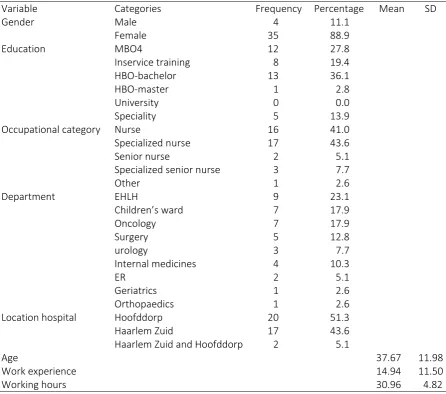
In this study, participants were nursing professionals of different department of the Dutch hospital the Spaarne Gasthuis (N = 39; see Table 1). In agreement with the educational advisor and department manager, hospital departments were approached to participate in the study. Using convenience sampling, nurses were asked to participate voluntarily. Only certificated nurses with at least one year of work experience at Spaarne Gasthuis were selected to participate in the study. If employees did not meet the study requirements, they were refused of participation by a personal email.
participated than part-time nurses (M = 30.96, SD = 4.82; 13 missings). Nurses with varied educational backgrounds participated in the study, namely 12 nurses finished a vocational education, 13 nurses finished a higher educational level (HBO), and 14 nurses were specialized in their profession (Inservice, HBO-master or Speciality). Nurses’ from two locations of the hospital participated (Hoofddorp, N = 20; Haarlem, N = 17; Haarlem Zuid and Hoofddorp, N = 2).
Table 1
Participant’ Personal Background Variables
Variable Categories Frequency Percentage Mean SD
Gender Male 4 11.1
Female 35 88.9
Education MBO4 12 27.8
Inservice training 8 19.4
HBO-bachelor 13 36.1
HBO-master 1 2.8
University 0 0.0
Speciality 5 13.9
Occupational category Nurse 16 41.0
Specialized nurse 17 43.6
Senior nurse 2 5.1
Specialized senior nurse 3 7.7
Other 1 2.6
Department EHLH 9 23.1
Children’s ward 7 17.9
Oncology 7 17.9
Surgery 5 12.8
urology 3 7.7
Internal medicines 4 10.3
ER 2 5.1
Geriatrics 1 2.6
Orthopaedics 1 2.6
Location hospital Hoofddorp 20 51.3
Haarlem Zuid 17 43.6
Haarlem Zuid and Hoofddorp 2 5.1
Age 37.67 11.98
Work experience 14.94 11.50
Working hours 30.96 4.82
3.4
Instrumentation
3.4.1 General background questionnaire
namely… was included. Answers of other, namely… could be coded for the existed codes. Only for the question concerning the nurses’ occupation level a category was added.
3.4.2 Self-regulated learning on the workplace
To measure hospital nurses´ regulation activities at the workplace, the Learning Moments-app was used. This off-line multiple-event measurement, adapted from the ‘Structured Learning Report’
(Endedijk, 2012), which included one qualitative question (What did you learn) and twelve quantitative questions. The questions represent all phases of SRL (Pintrich, 2004). The quantitative questions, with all categorical answers, were: planning, learning goal orientation, strategy choice, learning strategy control, reflection on the learning outcome, future planning, and learning evaluation. All questions were adapted from Aagten (2016) and Endedijk (2012) (see Table 18, Appendix B). The app started every time with the question Did you learn anything today?, to encourage participants to think about something they learned that day. If they hesitated, they could fill in: I don’t know, give me a hint, which released prompts of possible learning experiences. For the first time, in using this instrument, the app gave also prompts if participants filled in that they did not learn anything that day. These prompts showed nurses possible learning experiences participants maybe did not think of, for example, maybe your learned something by… trying something new, or looking up information. The routing and number of questions differed per participant, which was depended on the answers participants gave. Answers of the multiple-choice questions were based on previous studies (Aagten, 2016; Berings, Poell, Simons, & Veldhoven, 2007; Endedijk, 2012).
Some adaptations were made in the LM-app, based on the advice of the hospital’s educational
advisors and results of previous studies using this instrument. The evaluation question, concerning the learner’s satisfaction with regard to their learning experience, was removed from the instrument, because of lack of validity resulted from previous studies (Aagten, 2016; Endedijk, 2012). Namely, in the study of Aagten (2016) 80% of the participants were satisfied with their learning experience, which could indicate a lack of validity. Also, a lack of differentiation was found in earlier self-report research between the variables monitoring and learning strategy control. The variable monitoring was therefore left out, which also benefited the length of the instrument (How did you realise you learned something?). The last adaptation was made in the instrumentation, by adding a question concerning other individuals that were involved in the learning experience. Previous studies revealed the high extent of social influence on nurses’ workplace learning (Aagten, 2016; Berings, Gelissen, & Poell, 2008). The extent to which nurses include others in their learning implies something about the nature and strategy of learning, which could be interesting for this study.
The instrument enabled participants to answer daily questions about their learning activities in the workplace. The app could be installed on both Android and Apple smartphones, tablets or personal computers. It could be used two sequential weeks, and participants had the possibility to fill in the set of questions five times to ensure that contextual and personal factors were taken into account (Endedijk, 2012).
3.4.3 Learning conceptions
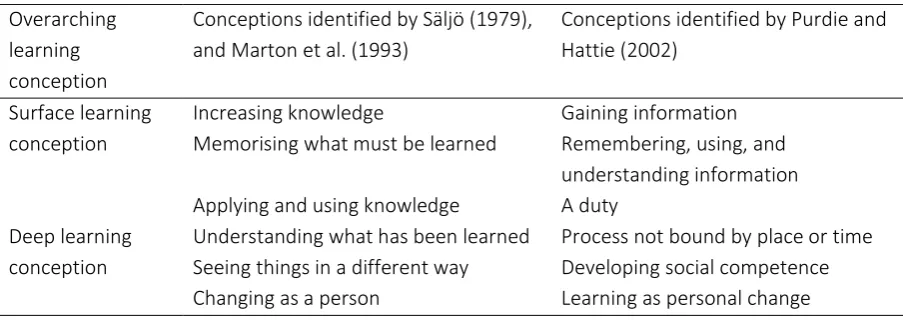
surface learning conceptions, wherein learning is perceived as the acquisition, storage, reproduction, and use of knowledge (Purdie and Hattie, 2002). The learning conceptions classified as the deep-learning conceptions are Learning as … a process not bound by time or place, developing social competence and personal change (Purdie & Hattie, 2002).
Table 2
The original and altered set of learning conceptions
Note. Original set retrieved from Säljö (1979), Marton et al. (1993) and altered by Purdie and Hattie (2002).
The 32-Likert-scale items were obtained from the original English version and were translated with the back-translation method by two independent translators (Brislin, 1970). In response to the back-translation, some adaptations were made in the Dutch-translated version to match the hospital context and approach the original items as close as possible and (see Table 19, Appendix D). For example, Learning is not only studying at school... is altered to Learning is not only attending training…, as training is a more commonly used term than the term school. The 32 items featured six learning conceptions (named subscales) with each three till nine statements. Participants indicated to what extent they (dis)agreed with the statements on a six-point scale (strongly disagree, disagree, slightly disagree, slightly agree, agree, strongly agree). For example for the learning conception Learning as Personal change, the item When I learn, I think I change as a person was included. The questionnaire was included twice, to inquire the changeability of nurses’ learning conceptions and the possible reciprocal relationship between learning conceptions and regulation activities in workplace learning.
3.5
Procedure
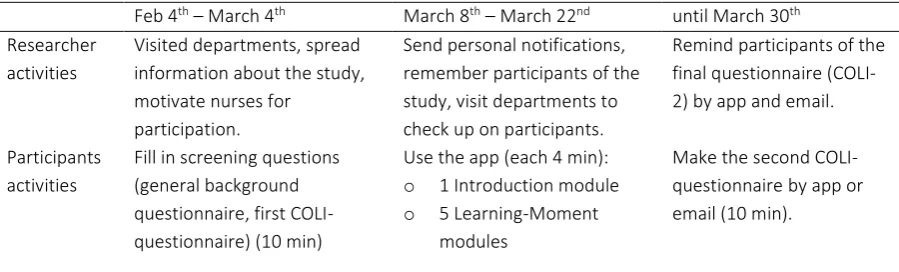
The set-up of this study consisted of three phases (see Table 3). First, participants were recruited by convenience sampling. A meeting with the educational advisors was scheduled and the advisors received a mail on February 4th, 2019. This mail contained general information, a timeline and participation criteria of the study. The advisors were asked to come up with departments which were interested to participate in the study. Because advisors were consulted, the heads of department were not bothered by the study and the study felt familiar for nurses because it was introduced by their own educational advisors. Before distributing the questionnaires, ethical approval for the study was given by the University of Twente and the Spaarne Gasthuis hospital. In the following two weeks, nurses of the appointed departments were approached for participation by e-mail and face-to-face (see emails and content of LM-app in Appendix A).
Table 3
Chronological Overview of Data Collection Procedure Overarching
learning conception
Conceptions identified by Säljö (1979), and Marton et al. (1993)
Conceptions identified by Purdie and Hattie (2002)
Surface learning conception
Increasing knowledge Gaining information
Memorising what must be learned Remembering, using, and
understanding information
Applying and using knowledge A duty
Deep learning conception
Understanding what has been learned Process not bound by place or time
Seeing things in a different way Developing social competence
Feb 4th– March 4th March 8th– March 22nd until March 30th
Researcher activities
Visited departments, spread information about the study, motivate nurses for
participation.
Send personal notifications, remember participants of the study, visit departments to check up on participants.
Remind participants of the final questionnaire (COLI-2) by app and email.
Participants activities
Fill in screening questions (general background questionnaire, first COLI-questionnaire) (10 min)
Use the app (each 4 min):
o 1 Introduction module
o 5 Learning-Moment modules
Make the second COLI-questionnaire by app or email (10 min).
Till March 4th nurses could register by filling in the screening questions, which started with a question to (dis)agree with the terms of the study (see Informed Consent, Appendix C). Herein, it was made clear that results of the study were anonymized, participation was voluntary and participants could quite their participation anytime. The informed consent-form was spread by email and could be consulted again via the app, to guarantee participants were aware of these terms. Hereafter, the personal background questionnaire and the first learning questionnaire were inserted. Participants were given the ability to choose a preferred date they wanted to start using the app, which could be adapted in the personal notifications for the participant.
Subsequently, the Learning-Moments app was introduced to the participants and their supervisors by email. In the following two weeks, participants could use the Learning Moments-app five times and fill in questions concerning their learning experiences (8 March until 22 March). They could start on a preferred date and received notifications if they want to fill in the app, on a time they preferred. They could use the app at any convenient time after they experienced a learning moment.
Weekends were included in the study to include data of nurses’ learning at weekends.
After finishing five Learning Moment-modules, participants were able to finish their participation by filling in the second COLI-questionnaire. This questionnaire was also presented in the Learning Moments-app. Because not every participant finished their five Learning Moments by March 22nd, the second COLI-questionnaire was accessible for every participant by March 22nd. Due to a low response rate for the second COLI-questionnaire, the questionnaire was also spread for remaining participants by mail. All participants were mailed in BBC, to preserve participants’ anonymity. After
analysing the data, the results were sent by mail and presented for interested parties inside the Spaarne Gasthuis Hospital.
3.6
Data Analysis
[image:18.595.73.523.70.206.2]The data analysis of this study is structured by the research questions. Both descriptive and inferential statistics were needed to present the data for this correlational study. All analysis was performed with SPSS Statistics software (Version 24). After the raw data was obtained from the Learning-Moments app the data was anonymized and transferred to an SPSS data file, by using a personal code for every subject. Table 4 shows the number of participants (N) per measurement. All results were taken into account for every analysis. For the paired-sample T-test, to investigate the stability of nurses’ scores, only 23 participants finished the second COLI-questionnaire and could be included in the analysis.
Table 4
Research question Statistics Instruments N LM
1. Learning conceptions ● K-means clustering
● ANOVA-test
● Descriptive statistics
COLI-questionnaire 62 -
2. Changeability learning conceptions
● Cross-tabulation COLI-questionnaire 62 -
● Paired sample T-test COLI-questionnaire 23 -
3. Regulation activities ● Descriptive statistics
● SRL-score
Learning-Moments app 30 82
4. Relation between
learning conceptions and SRL
● Bivariate correlation analysis
● Paired sample T-test
COLI-1 + COLI-2 + SRL-score Learning-Moments app
39 82
Note. N = the number of participants finished the concerned measurement; LM = number of Learning Moments included.
3.6.1 Analysis of the learning conceptions
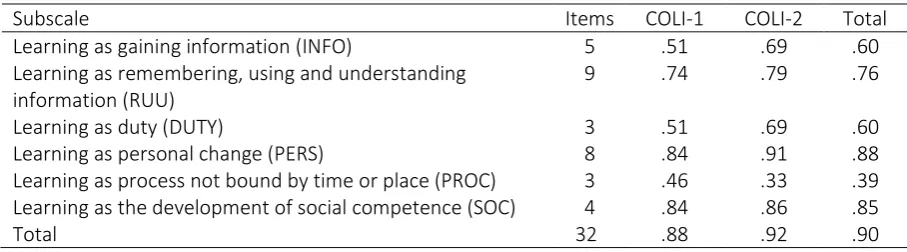
Internal consistency reliability. For nurses’ learning conceptions, the COLI-questionnaire was used twice, before and after the use of the Learning Moment-app. A reliability analysis for COLI-subscales revealed a poor score (α≤ .602) for subscales Learning as… gaining information (INFO), as duty (DUTY), and a process not bound by time or place (PROC) and were excluded from analysis (Bland & Altman, 1997, see Table 5). Subscales left, Learning as remembering, using and understanding information (RUU), as personal change (PERS), and as the development of social competence (SOC),
[image:19.595.70.524.489.615.2]revealed sufficient scores on Cronbach’s alpha (α ≥ .74). From the RUU-subscale the first item was deleted for a higher internal consistency (Total α = .76 instead of α = .73). These three subscales were sufficient internal consisted to use in further analysis.
Table 5
Cronbach’s Alpha (α) Indexes for COLI-subscales
Subscale Items COLI-1 COLI-2 Total
Learning as gaining information (INFO) 5 .51 .69 .60
Learning as remembering, using and understanding information (RUU)
9 .74 .79 .76
Learning as duty (DUTY) 3 .51 .69 .60
Learning as personal change (PERS) 8 .84 .91 .88
Learning as process not bound by time or place (PROC) 3 .46 .33 .39
Learning as the development of social competence (SOC) 4 .84 .86 .85
Total 32 .88 .92 .90
clusters (k) for the K-means clustering was two. The subscales with sufficient internal reliability (RUU/PERS/SOC) were used to classify the participants to one of the clusters. Internal and external cluster validations were considered, by examining the internal cluster information (the Silhouette-index), and external cluster criterion based on previous studies (Brock, Pihur, Datta, & Datta, 2008, Charrad, Ghazzali, Boiteau, & Niknafs, 2014, Theodoridis & Koutroumbas, 2003).
Firstly, for the internal cluster validation, the Silhouette coefficient was extracted to indicate how well the compactness of the objects in a cluster was and how separated objects from different clusters were (Struyf, Hubert, & Rousseeuw, 1997). The number of clusters (k) was evaluated by varying different parameter values for k in SPSS. In Appendix F, Silhouette plots were included for two to four clusters. The width of the clusters and Silhouette coefficient showed most validation with two clusters. Due to outliers, K-means clustering with three and four clusters resulted in very small clusters (N = 2). Higher Silhouette-scores with three or four clusters could be attributed to the fact that outliers were no longer part of another cluster. So for this study, the ideal number of two clusters was chosen. All participants were successfully assigned to one of the clusters in five iterations (ten iterations is the maximum number of iterations) (Kodinariya & Makwana, 2013).
Secondly, for the external cluster validation, clusters were compared with previous results from COLI-questionnaire. In the study of Zhu, Valcke, and Schellens (2008) the same three subscales were removed (INFO/DUTY/PROC) because of low internal reliability. The classification of clusters is based on a high or low extent of subscales (RUU/PERS/SOC). Previous studies using the COLI-questionnaire revealed more than one learning conception by participants scoring high on several learning conceptions (Peterson, Brown, Irving, 2010; Zhu et al., 2008). The external cluster validation appeared to be sufficient because the class criterion for clusters is in line with previous research.
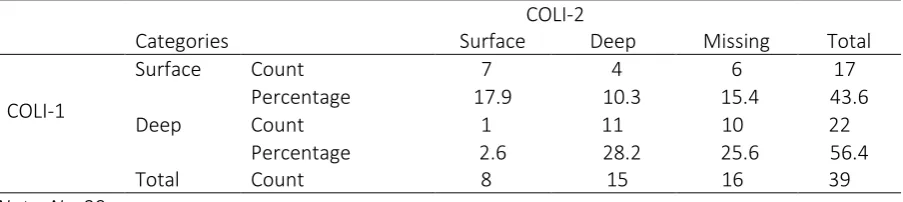
Differences in clusters. From the K-means clustering, a one-way ANOVA was extracted to have insight on which subscales the participant were classified to a certain cluster. A paired-sample T-test was examined to compare the scores COLI-1 and COLI-2 for the whole sample and test the scores on their stability. The variance of participants’ cluster membership between COLI-1 and COLI-2 were presented in a cross-tabulation. For a Chi-square analysis, the sample size was too small, therefore no Chi-square analysis was executed.
3.6.2 Regulation of learning
Qualitative data. The Learning-Moments app was used five times by the participants to measure their regulation activities at the workplace. First, the results of the only open question, concerning the learning content of the learning experiences, were coded by an existing codebook from Berings et al.
(2007) (see Appendix E). The categories of the CanMEDS competencies (Canadian Medical Education
Directions for Specialists; V&VN, 2019) to categorize (workplace) learning experiences, were also considered as a codebook. However, during coding, the categories did not seem exclusive. Wherefore the codebook of Berings et al. (2007) was used for coding (see Appendix E). The codebook was
developed to classify the content of nurses’ on-the-job learning experiences. Categories existed of the technical-practical domain, socio-emotional domain, organizational domain, developmental domain, and proactive attitude to work, with each existing of several sub-codes. The category insufficient answer was added to the codebook, for answers wherein it was not clear what was learned (e.g. instead of the learning content, the learning activity was reported). Concerning the inter-rater reliability, a second researcher coded independently 20 % of the data to gain a reliable interpretation of the Cohen’s κ. The
inter-rater reliability was strong, with a score of κ = .885. Differences between the reviews of codes of
Quantitative data. Closed-ended questions of the Learning Moments-app were used to examine how and to what extent nurses’ regulation activities were self-regulated. For every item of the Learning Moments-app, the descriptive statistics were extracted to explore the nature of nurses’
workplace learning and regulation activities.
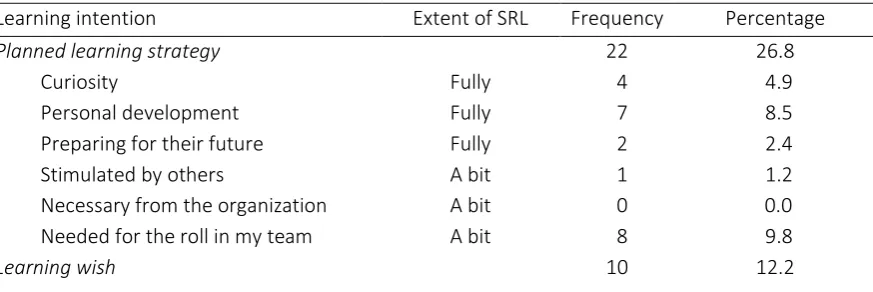
The data concerning the SRL-phases were scored to determine the extent of self-regulation in workplace learning, based on the approach of Aagten (2016) (see Table 6). For the scoring, every phase of SRL was considered: the forethought, the performance, and the self-reflection. For each of these questions, answers were marked as fully self-reflected (SRL-score of 1.0), a bit self-reflected (SRL-score of 0.5) and not self-reflected (SRL-score of 0.0). Participants could earn for every learning moment a maximum SRL-score of 3. The questions concerning planning and learning goal orientation reflected the forethought phase. Even though the regulation of the workplace learning process is less sequenced than in theories is described (Azevedo, 2009), a planned learning experience testifies of a high(er) SRL-extent (Zimmerman, 2000). If the reason to start the learning experience was internally initiated, the participant received a higher score than if the reason was externally initiated. The intrinsic motive for learning stands for self-regulation in learning (Ellinger, 2004).
The performance phase was presented by questions concerning learning strategy control. With
this question, nurses’ (un)consciousness of choosing the learning strategy was examined. From the theory, it is expected that learners consciously direct their learning activities towards their learning goals including their learning strategy (Pintrich, 2000; Winne, 1995). If the learning experience was chosen consciously, with a clear reason and without the interference of someone else, the maximum score of one was gained. If the strategy was chosen consciously, but with the help of others or the nurse was not able to point out a reason why this strategy was chosen, a half-point was gained. No consciously chosen strategy reflected no self-regulation in learning and therefore zero points were given.
Finally, the question about future planning represents the self-reflection phase. One point could be earned if the participant planned to actively continue with their learning and determine their future learning path. This proactive planning testifies of a high degree of self-regulation in learning (Guglielmino, 1971; Raemdonck, 2006). If the nurse had new plans, but less proactively, half a point could be earned. Zero points were assigned if no new plans were made because no new plans do not reflect the pro-activity of self-regulation. Questions left, concerning reflection on the learning outcome, strategy choice, and seeking social assistance were excluded from scoring because these questions were not theoretically founded for a hierarchical scoring system. For example, the learning strategies could not be classified on the scale of self-reflection whether nurses learn by looking up information or discussing a topic. However, the results of these questions gave descriptive details about the learning moments.
[image:21.595.69.527.725.757.2]Subsequently, to calculate the total SRL-score, the SRL-scores of every learning moment were added and divided by the total number of finished learning moments. The number of learning moments was considered later, in examining the correlation between self-regulated learning and learning conceptions. The variation of SRL-scores was examined with the help of descriptive statistics for the whole sample and per learning moment. Lastly, box plots should be presented for all three SRL-numerical variables to have an idea of nurses’ average self-regulation of all SRL-phases.
Table 6
SRL scoring table
Variable Answer options Extent SRL
behaviour
Learning intention Unplanned No 0.0
Learning wish, stimulated by others No 0.0
Learning wish, necessary from supervisor No 0.0
Learning wish, it was needed for the roll in my team A bit 0.5
Learning wish, personal development A bit 0.5
Learning wish, curiosity A bit 0.5
Planned, stimulated by others A bit 0.5
Planned, necessary from supervisor A bit 0.5
Planned, it was needed for the roll in my team Fully 1.0
Planned, personal development Fully 1.0
Planned, curiosity Fully 1.0
Learning strategy control
No conscious choice No 0.0
Conscious choice, but don’t know why A bit 0.5
Conscious choice, commissioned by another A bit 0.5
Conscious choice, there is no other way Fully 1.0
Conscious choice, this is the quickest and easiest way Fully 1.0
Conscious choice, this manner of learning works for me Fully 1.0
Future planning No new plans No 0.0
Try another time A bit 0.5
Continue exactly in line with what I learned A bit 0.5
Apply the learning content in practice A bit 0.5
Have a concrete plan for a similar situation Fully 1.0
Improve what is learned Fully 1.0
New learning goal Fully 1.0
4. Results
4.1
Exploration of Correlations
In Table 7, the correlations coefficients between all numerous variables of the study are presented. These correlational coefficients give an indication for further descriptive statistics. The bivariate correlation analysis was extracted from the data, including SRL-variables (forethought, strategy choice, and future planning) and COLI-variables of COLI-1 and COLI-2 (RUU, PERS, SOC). The subscales from the COLI-questionnaire were represented by the mean of the COLI-subscales. Also, the total SRL-score and the number of learning moments were included. The number of Learning Moments was considered because a higher quantity of learning experiences reflects a higher extent of learning initiative of the participant. Finally, the personal background variables were included in the bivariate correlation analysis to allow for the possibility of latent variables influencing the SRL-score or the learning conceptions.
Of all relations, twelve relations appeared to be significant. Three significant relations are evident. Work experience and age were highly positively correlated because on average older participants have been working for a longer time than younger participants (r = .895, p < .01). variables strategy choice and future planning were significantly positive correlated with the overall SRL-score because the results of these variables are part of the SRL-SRL-score (strategy choice, r = .650, p = < .01; future planning, r = .781, p < .01). This means for example, that how higher the score of future planning, the higher the total SRL-score is. The absence of the statistically significant correlation between the SRL-score and learning intention is striking.
Subsequently, there were two statistic significant relations found between the number of learning moments and another variable. Participants educational level was positive correlated with the number of learning moments (r = .330, p < .05). This implies that participants with a lower educational level included less learning moments than higher educated participants. Also, the number of learning moments and COLI-subscale Learning as personal change (COLI-2) were significantly positive correlated (r = .658, p < .01). This means that participants who have completed more learning moments in the Learning Moments-app, conceive that learning could ensure personal change. Finally, there was a significant negative correlation found between the COLI-subscale Learning as remembering, using and understanding (COLI-1) and participants’ age (r = -.376, p < .05). Participants with a younger age scored on average higher on the RUU-scale than older participants.
The bivariate correlation analysis revealed correlations for subscales of COLI-questionnaire between COLI-1 and COLI-2 (Table 7). The variables learning as personal change of COLI-1 and COLI-2 proved to be significantly highly positive correlated (r =.773; p < .001). Likewise, the variables COLI-1 and COLI-2 of learning as the development of social competence were also positive significant (r = .587; p < .001). Results of the subscale left, learning as remembering, using and understanding information, revealed no significant correlation between the COLI-1 and COLI-2. It could be caused by participants that changed their way of thinking about the RUU-learning conception, however on average, the change is negligible (COLI-1 M = 4.72 SD = 0.50; COLI-2 M = 4.65, SD = 0.45).
Then there are four correlations between COLI-subscales, which could be caused by coherence
between the subscales. Learning as remembering, using and understanding and Learning as personal
Table 7
Correlations coefficients (Pearson) between personal background variables, SRL-variables and learning conception scales
1 2 3 4 5 6 7 8 9 10 11 12 13 14 15
1. Gender
2. Age -.128
3. Work experience .053 .895**
4. Education -.179 -.153 -.066
5. RUU1 .150 -.376* -.320 .088
6. PERS1 -.105 -.145 -.196 .140 .340*
7. SOC1 -.033 -.008 -.010 .232 .305 .337*
8. RUU2 .061 .243 .228 .277 .362 .307 .478*
9. PERS2 -.095 .053 .041 .242 .209 .773** .074 .509*
10. SOC2 -.141 .091 .072 .125 .374 -.062 .587** .450* .225
11. Forethought .069 -.379 -.338 -.341 .004 -.055 -.132 .024 -.142 -.214
12. Performance .112 .009 -.097 -.129 .268 .286 -.197 .335 .651 .082 .174
13. Future planning -.249 -.104 -.080 .119 .209 .199 -.123 -.072 -.075 -.288 -.110 .106
14. Number of LM -.164 .124 .211 .330* .058 .239 .025 .406 .658** .047 -.032 .174 .015
15. SRL-score -.299 -.112 -.134 -.148 .215 .276 -.221 .135 .183 -.161 .476 .650** .781** .176
4.2
Nurses’ Learning Conceptions
For the measurement of nurses’ learning conceptions, 39 nurses participated in COLI-1 of which 26 nurses participated also in COLI-2 (response rate of 66.6%). Results of three participants of the COLI-2 were removed because no learning moment was finished. As resulted from internal consistency analysis, only subscales Learning as Remembering, Using and Understanding, Personal Change and the Development of social competencewere satisfactory reliable for further analysis. Results of the learning conceptions are presented in order of the research questions; the identification of nurses’ learning
conception and the changeability of the learning conceptions over time.
Identification of the learning conceptions. On average, participants in this study scored high on
subscales Learning as remembering, using, and understanding and Learning as personal change (see
Table 8, RUU M = 4.68, SD = 0.47; PERS M = 4.62, SD = 0.63). This means that on average the participants in this study recognized themselves in the statements concerning these learning conceptions. Nurses scored on average the lowest on the subscale Learning as development of social competence (SOC M = 4.26, SD = 0.76). This latter learning conception resulted in most differed scores.
Two homogeneous clusters were acknowledged from results of subscales COLI-1 and COLI-2. These clusters were made, to identify the nurses’ learning conceptions and compare groups of different learning conceptions in their regulation of learning. All participants in both COLI-measurements were represented in the K-means clustering (Total N = 62; COLI-1, N = 39, COLI-2, N = 23,). Originally, the second COLI contained 26 participants, however three nurses were not taken into account in the clustering because zero learning moments were included by those nurses.
[image:26.595.72.526.674.746.2]More participants were classified to the first cluster, named the deep-cluster (N = 33) than the second cluster, the surface-cluster (N = 29). An ANOVA-test gave insights into the class criterion for clustering participants. On average participants of the deep-cluster scored higher on all three COLI-subscales compared to the participants of the surface-cluster. The largest difference between the clusters could be found in average scores of subscale Learning as the development of social competence. The surface-cluster (RUU M = 3.69, SD = 0.58), differed on average MD = 1.08 on a 6-point Likert-scale from the deep-cluster (RUU M = 4.77, SD = 0.50). The subscale Learning as personal change resulted in the highest mean of all COLI-subscales for the deep-cluster (PERS M = 4.92, SD = 0.54). Contrastingly, the mean for the PERS-subscale was MD = 0.64 lower for participants of the surface-cluster (PERS M = 4.28, SD = 0.54). Between both clusters the COLI-subscale Learning as Remembering, Using, and Understanding Information resulted in most corresponding mean scores (RUU surface-cluster M = 4.47, SD = 0.48; RUU deep-cluster M = 4.86, SD = 0.37). All subscales resulted in statistical significant differences between the surface and deep-cluster (RUU, F(1,60) = 16.57, p = < .001; PERS, F(1,60) = 16.57, p = < .001; SOC, F(1,60) = 16.57, p = < .001). Thus, the class criterion for K-means clustering was based on all three subscales.
Table 8
ANOVA results of Nurses’ Learning Conceptions Between Clusters
Surface Deep Total
Learning is… M SD M SD F p M SD
RUU 4.47 0.48 4.86 0.37 13.61 < .001 4.68 0.47
PERS 4.28 0.54 4.92 0.54 21.85 < .001 4.62 0.63
SOC 3.69 0.58 4.77 0.50 61.39 < .001 4.26 0.76