1
MASTER THESIS
Collaboration and technological
innovation within Dutch elderly care
organizations
May, 2019.
Author
Student
Name: Sterre Coenen (s2021838)
Public Administration - Local and Regional Governance
Faculty: Behavioural, Management and Social sciences
First supervisor
Name: prof. dr. René Torenvlied
Public Administration - Public Management
Faculty: Behavioural, Management and Social sciences
Second supervisor
Name: dr. Minna van Gerven
Public Administration - European Public Policy
2
Preface
First of all, I want to thank prof. dr. René Torenvlied for giving me the opportunity to write my master
thesis with much academic and practical relevance. I really enjoyed to be supervised by such an
enthusiastic and inspiring leader. Second, dr. Minna van Gerven is thanked for all her effort and joy she
has brought to conducting my survey and writing my thesis. In experienced the collaboration with my
supervisors as very supporting and instructive. I am really grateful that they gave me this experience in
my academic career at the University of Twente. I would never forget this period of my life. Third, I
would like to thank all the teachers of the Public Administration master for giving me knowledge and
feedback in all of these courses. Especially in the scope of my thesis, I want to thank dr. Pieter-Jan Klok
for his feedback moments in the course Academic Writing which were really helpful for my thesis. Also,
I want to thank prof. dr. Ariana Need for her help with finding a master thesis subject.
Next, I would thank the University of Twente as a whole that they gave me the opportunity to
experience a great time here. Also, the possibility to do my second master was not possible without the
conditions, activism and events they create for their students. In my personal life, I would like to thank
my family and friends for supporting me to reach my full potential at the University of Twente. Without
their support for continuing with my academic career this would not be possible. Special thanks is given
in the light of this master thesis for Bas Koopman for providing feedback and Anouk Westerdijk for
helping me with the layout of the master thesis.
Lastly, I would like to thank for the opportunities that the region Twente has offered me. The
Student Union gave me the opportunity to develop my personal skills. Furthermore, the rowing
association Euros gave me both physical and recreational relaxation and above all, great friends. The
application for D66 gave me more knowledge about the politics within Enschede. Above all, my
internship and job at the municipality of Enschede gave me career experience, the opportunity to meet
great people, positive energy and the ability to create great things. Consequently, the Twente region
gave me a welcoming and opportunity enhancing environment in which I could reach my full potential.
Enschede, 2019.
3
Abstract
Demographic change, especially in the ageing society, is an important challenge for many countries and
organizations across the globe such as China and the Netherlands. These countries face the same
problem: a growing population of the elderly and a decline of the younger generation providing
informal care. This way, elderly care organizations as well as governments face the task of supporting
the increased flow of elderly who need care. In current society, technological innovations can support
the provision of care for the population of aged people. However, technologies can be costly and time
intensive. This way, collaborating is becoming more popular among organizations due to the use of
joint resources. The current master thesis explores how collaborative networks of managers within
Dutch elderly care organizations are constructed in order to develop, adopt and implement
technological innovations. In addition, this master thesis will elaborate why these Dutch elderly care
managers collaborate for technological innovation. Hypothesized is that differences exist in
collaborative networks of elderly care organizations when developing, adopting or implementing
technological innovations. An online survey was sent to institutionalized Dutch elderly care
organizations which allowed to explore the networks of elderly care organizations for technological
innovation (n=38). The results of the research indicate that characteristics of collaborative networks of
elderly care organizations differ between adoption and implementation looking at the strong and weak
ties within these networks. Furthermore, development activities are related to gaining knowledge,
adoption activities found to be not related to political reasons and implementation found not be based
on cost effectiveness but more in providing the needed service delivery. Technologies established
within the current collaborations are focused on the safety of the elderly and mainly access sensors
technologies. For the Public Administration science, these results gave incentives to further research
the relation between governments and elderly care organizations to stimulate the establishment of
technological innovations. Consequently, efficient decisions can be made in the light of developing
policy that is compatible for governments as well as elderly care organizations. Relating this to the
geographical changes in society, the elderly can be better supported with more advanced technological
innovations such as robotics. In addition, more information about effective policy strategies for
collaborating for technological innovation can enhance the establishment of more advanced
4
Table of contents
1. Introduction ... 5
1.1 Background... 5
1.2 Elderly care organizations and the need for change ... 5
1.3 Collaborative innovation as a solution ... 6
1.4 Research topic... 6
1.5 Research question ... 7
1.6 Goal... 7
2. Theoretical framework ... 8
2.1 Collaborative networks and the development of technological innovations ... 8
2.2 Collaborative networks and the adoption of technological innovations ...10
2.3 Collaborative networks and the implementation of technological innovations ... 12
3. Methodology ... 13
3.1 Sample and sampling ... 13
3.2 Research design and procedure ... 15
3.3 Operationalisation ... 15
3.3.1 Characteristics of collaborative networks ... 15
3.3.2 Technological innovation activities ... 17
3.3.3 Technologies in elderly care...18
3.4 Data analysis ...18
4. Results ... 20
4.1 Characteristics of collaborative networks ... 20
4.2 Technologies and technological innovation activities... 23
4.3 Characteristics of collaborative networks and technologies... 25
4.4 Characteristics of collaborative networks and technological innovation activities ... 31
5. Conclusion and Discussion ... 37
6. References... 40
7. Appendices ... 43
Appendix A ... 43
Appendix B ... 44
Appendix C ... 51
5
1.
Introduction
1.1 Background
The society in the Netherlands is shifting into an ageing and individualizing society, which is
comparable to other countries such as China. These countries face the same problem: a growing
population of the elderly and a decline of the younger generation providing informal care for them. The
Statistics Netherlands, which constructs demographic forecasts in the Netherlands, estimates that in
2040 more than one third of the Dutch population will consist of the elderly (CBS, 2015). Due to the
this shift, it is forecasted that the population share of people aged 80 and over living independent will
be doubled compared to 2015 (CBS, 2015). In line with more independent elderly people, the stake of
people aged 80 and over who live in nursing homes will decline from 30 till 8 percent in 2040 (CBS,
2015). Thus, the people are aimed to be more self-supporting whereas the needed care for them does
not change. Consequently, governments and elderly care organizations need to change in order to
adopt to the shifting society.
1.2 Elderly care organizations and the need for change
The Dutch national government reacted to the earlier mentioned shift by giving elderly care
organizations incentives by changing law, regulation and money flows in order to prevent future
societal problems of the elderly who do not receive care. In 2015, the Community Support Act (CSA)
was implemented which made elderly care organizations subject to market forces. The CSA states that
care services for needy people, like the elderly, have to be made suitable with local stakeholders like the
municipality, client, caregivers and family (WMO, 2015). Because of this, Dutch elderly care
organizations became hybrid organizations. Hybrid organizations are characterized by market
competition as well as by governmental funding and regulation (Brandsen & van Hout, 2006). This way,
since 2015 elderly care organizations had to change to keep up with the new market competition and
conform to laws and regulation. More specifically, elderly care organizations had to change their
organizational practices. In order to survive as an organization and support the growing population of
elderly, innovation is necessary. Within current society, the use of technologies in elderly care
organizations is growing since technologies can increase the quality of care, reduce the costs of care or
solve problems within the workplace (de Veer & Francke, 2009; Nictiz, 2018; Ross et al., 2016). The best
definition for technological innovation in the context of elderly care has been defined as ‘new elements
6 rendering its services to clients’ (Damanpour, Walker and Avellaneda, 2009, p.654). However,
establishing technological innovations can be costly and time intensive. Collaborating for innovation
can help to overcome by bringing relevant knowledge, ideas and resources together to produce the
intended innovation (Torfing, 2018; Ansell & Torfing, 2014). This way, organizations are able to respond
quicker to changes to gain competencies and increase their performance level (Walker 2006, p.650).
Thus, elderly care organizations can benefit from collaboration in order to establish innovations and
thus tackling the societal challenges of an increasing amount of elderly people who need care.
1.3 Collaborative innovation as a solution
Still much research towards collaborative innovation remains to be done (Ansell & Torfing, 2014;
Sørensen & Torfing, 2011; Grudinschi et al., 2014). This is remarkable since evidence is found that
collaborating increases the performance of the organization, and performance is partly determined by
their innovation practices (Meier & O’Toole, 2001; Torenvlied et al., 2012; Andrews et al., 2011). Since
elderly care organizations face market competition and are subject to laws and regulation, collaborative
innovation could support them in current society (Sørensen & Torfing, 2017). Relatively little research
is conducted on collaborative innovation in other public sector organizations, such as elderly care
organizations (Ansell and Torfing, 2014; Bommert, 2010; Sørensen & Torfing, 2011). However, an analysis
of American public innovations report that 60 percent of innovations are established through
collaboration (Borins, 2001). Collaborative innovation in elderly care only consists of case studies and
no scientific research is performed in the Netherlands at the moment of writing (Grudinschi et al., 2014;
Sørensen & Torfing, 2017). The case study of Grudinschi et al. (2014) report that it would be relevant for
further research to track down how capabilities and resources can be most effectively combined to
create (social) value. Elderly care organizations create public value (Moore, 1995) and can support the
growing population of the elderly by providing technological innovations.
1.4 Research topic
The latter gave spur for the study towards collaborative innovation in elderly care organizations. In
order to provide a deeper understanding of collaborative innovation, the current master thesis explores
the characteristics of elderly care collaborations in order to develop, adopt or implement technological
innovations. The characteristics of collaborative networks of elderly care organizations will be the
7 innovations is conceptualized as ‘’technological innovation activities’’ and entails the dependent
variable. The reason for the name of the dependent variable is because the dependent variable defines
how innovations are established within organizations with the support of collaboration. Elderly care
organizations can develop innovations with different partners since the market does not provide
specific technologies, can adopt innovations since others use it too or implement innovations because
of urgency (Rogers, 2010; Gagnon et al, 2012; de Veer et al, 2011; O’Toole, 1997). Besides that, this thesis
gives more detailed information about the type and function of collaboratively established
technological innovations. This way, detailed information about collaborative (technological)
innovation in elderly care is provided which can benefit the practical field which are current
collaboratively established technologies in elderly care. For the scientific field, the exploration of
collaborative innovation in hybrid organization adds up to current understanding of how and why
collaborative innovations takes place (Grudinschi et al., 2014; Sørensen & Torfing, 2011).
1.5 Research question
Following from above, the research question is formulated as: ‘To what extent are characteristics of
collaborative networks among Dutch elderly care organizations associated with technological innovation
activities?’. In addition, three sub-questions are defined. The first descriptive sub-question is: ‘What are
the characteristics of collaborative networks of Dutch elderly care organizations for technological
innovation?’. The second descriptive sub-question is formulated as: ‘What technologies are developed,
adopted or implemented among collaborative networks of elderly care organizations?’. Based on this, the
last causal sub-question is developed: ‘’How are these characteristics of collaborative networks related
to technologies in elderly care?’. These sub-questions serve to gain insights in how development,
adoption and implementation activities and characteristics of collaborative networks of elderly care
organizations are related to technologies. Furthermore, these sub-questions will support the ability to
answer the main research question.
1.6 Goal
The first aim of the master thesis is to provide quantitative data, instead of qualitative data, about the
network behaviour of Dutch elderly care managers in establishing technological innovations. The
reason for this is that quantitative data is recommended to support the understanding of collaborative
8 collaborative innovation in Dutch elderly care organizations. With network theories it is tried to explain
collaborative innovation in elderly care. The master thesis is conducted from October 2018 till
December 2018 and reported a study towards the relationship between collaboration and technological
innovation of Dutch institutionalized elderly care organizations. The research report 38 (location)
managers of these Dutch institutionalized elderly care organizations. The results are descriptive and
the outcomes are aimed to further research collaborative innovation in hybrid organizations.
2. Theoretical framework
Lack of understanding of Collaborative networks for the development, adoption and implementation
of innovations exist (Sørensen & Torfing, 2017). This is unfortunate since the strategy of networking
affects the performance of the organizations (Sørensen & Torfing, 2017; Schalk, Torenvlied & Allen, 2010;
Torenvlied et al., 2012). As stated in the introduction, elderly care organizations increase their
performance by collaborative technological innovations thus reducing complex problems (Sørensen &
Torfing, 2017).The following paragraph elaborates the relationship between characteristics of
collaborative networks of elderly care organizations and their technological innovations activities. The
chapter is divided into three paragraphs relating to collaborative networks and the three technological
innovation activities: development, adoption and implementation of technological innovations. Since
elderly care organizations are risk averse organizations which create public value, these organizations
relate more to public organization than private organizations (Osborne & Brown, 2013; Moore, 1995).
Consequently, the used theory in the theoretical framework will be mainly from the Public
Administration literature.
2.1 Collaborative networks and the development of technological innovations
The development of technological innovations entails ‘all the decisions, activities, and their impacts that
occur from recognition of a need or problem, through research, development, and commercialization of
an innovation, through diffusion and adoption of the innovation by users, to its consequences’ (Rogers, 2010, p.40). More specifically, the development of technological innovations is the preface of adoption
and implementation when a problem rises to high priority which needs research (Rogers, 2010, p.40).
In order to grasp the problem and solve it, the development of technological innovations is supported
when a diverse set of partners is accessible that hold a variety of perspectives and resources (Termeer
9 organizational barriers of developing the intended innovation by gaining specific knowledge, support
and skills (Termeer & Nooteboom, 2014). The other way around, continuing to collaborate with similar
partners results in exclusion of resources, competencies and knowledge that are beneficial for the
development of innovations (Sørensen and Torfing, 2017). Thus, a high partner diversity can enhance
the development of technological innovations.
In order to find a diverse set of partners to develop a technology, strong ties are more important
in the development activities than weak ties. This because weak ties are favourable to explore which
partners are appropriate for collaborating where strong ties are more beneficial for exploiting partners
with needed resources to get a desired result (Hansen & Villadsen, 2017; Granovetter, 1985; March, 1991).
Weak ties are characterized by infrequent contact with many partners in order to gain the right
resources, knowledge and competences (Hansen & Villadsen, 2017; Bekkers, Tummers & Voorberg,
2013). However, strong ties are necessary to gain trust among potential partners and result in investing
more time in having contact. Moreover, meeting partners frequently has proven to develop strong ties
(Hansen & Villadsen, 2017; Meier & O’Toole, 2001). Furthermore, strong ties are helpful for building
trust, which is beneficial for strong and cohesive partnerships when collaborating with different types
of partners (Schalk, Torenvlied & Allen, 2010). For the development of technological innovations, strong
ties enhance commitment from members to the process which is found to be an influential factor to
successfully establish innovation (Ansell & Torfing. 2014). At the same time, Bekkers, Tummers and
Voorberg (2013) indicate that both strong or weak ties offer opportunities for developing innovation.
This way, the outcome can be that strong ties as well as weak ties enhance the development of
innovation. However, since the strong ties argument is stronger the following expectation is
hypothesized (1a):
H1a: Collaborative networks of elderly care organizations with a high partner diversity and strong ties are more involved with the development of technological innovations as compared to their adoption or
implementation activities.
In current literature, technologies in elderly care are more focused on the adoption and implementation
of them (Greenhalgh et al. 2004; Cresswell & Sheikh, 2013). Available literature about development
activities and technologies states that the success of technological innovations depends on the
development with their potential users (Greenhalgh et al. 2004; Rogers, 2010; de Veer et al., 2011).
However, the involvement of many partners enhance the time and start-up costs when developing a
technology (Ross et al. 2016). Elderly care organizations are found to be risk-averse organizations which
10 elderly care organizations prefer to collaboratively develop technologies that are already presents
positive results, since this reduces costs and are not completely new. Consequently, it is expected that
more traditional technologies are developed within collaborative networks compared to the other
technological innovation activities. These traditional technologies related to development activities are
defined as: technologies that are used and familiar by the general elderly population but currently lack
support to help with for instance elderly’s visual, motor or auditory capacities (Djellal & Gallouj, 2006).
The complex part of this definition is that the traditional technologies intuitively relate to technologies
that are not advanced. However, the view in the current thesis is that traditional technologies can be
upgraded to fit elderly’s needs. This way, these traditional technologies can be seen as not completely
advanced technologies but adding new features can be the reason for development. More specific,
improving the quality of services can be the main reason. Since precise literature lacks about these
relationships, in the following thesis will be explored what technologies are developed by collaborative
networks of elderly care organizations. Hence, in hypothesis 1b is it expected that more traditional
technologies are developed within collaborative networks of elderly care organizations compared to the
other technological innovation activities:
H1b: Technologies developed in collaborative networks of elderly care organizations are more traditional than technologies adopted or implemented.
2.2 Collaborative networks and the adoption of technological innovations
Adoption of technological innovations entails ‘the initiation, all of the information gathering,
conceptualizing, and planning for the adoption of an innovation, leading up to the decision to adopt and
implementation, all of the events, actions, and decisions involved in putting an innovation into use’
(Rogers, 2010, p.48). Often, adoption of technology is a process of re-innovating a technology to a
specific context (Damanpour & Schneider, 2009). Before further elaborating the relationship between
collaborative networks and adoption of technological innovations, one can make a distinction between
adopting and implementing innovations. This is necessary since adoption and implementation are
somewhat intertwined or overlapping (de Veer et al, 2011). Besides this, the definition of Rogers mention
implementation which give aim to further define the two activities.
In this study, adoption and implementation are viewed separately since a difference exists
between taking over innovation from others and implementing innovations (Cresswell & Sheikh, 2013;
Damanpour & Schneider, 2008; Ansell & Torfing, 2014). A second reason for the separation is that health
11 Sheikh, 2013). The reason for slower progressing technology is that more stakeholders are involved than
in other industries (Cresswell & Sheikh, 2013). Besides this, elderly care organizations have found to be
adopting technological innovations by incentives from other parties like government of health
confederations (Ross et al., 2016). In addition, elderly care organization attend conferences to be for
instance inspired by technological developments in the elderly care field (Ansell & Torfing, 2014). The
latter does not mean that the technological innovation is implemented. This way, the time from
adoption to implementation is longer, making the two concepts more interesting to investigate
separately.
A review of 101 studies about adoption of innovation (Gagnon et al. 2012) showed that
organizations adopt innovations that provide a relative advantage over existing practices. This is relates
to re-innovating as stated above (Damanpour & Schneider, 2008; de Veer et al., 2011). A side note is that
a relative advantage of the technology does not directly lead to widespread adoption (Greengalgh et al.,
2004). In order to know about technologies providing an advantage over existing innovations,
collaborating with many different partners enhances the adoption of new knowledge (Simonin, 1997).
The potential of the innovation is often elaborately discussed in the adoption activity (Greengalgh et
al., 2004). Therefore, weak ties are important since these help in finding the right partners and
stakeholders, which have different knowledge and perspectives, necessary to enhance knowledge
(Hansen & Villadsen, 2017). In addition, a high partner diversity support the gaining of this knowledge
and perspectives (Termeer & Nooteboom, 2014). This way, elderly care organization can make a
thorough decision to adopt a desired technological innovation. Based on these arguments the following
hypothesis (2a) is derived:
H2a: Collaborative networks of elderly care organizations with a high partner diversity and weak ties are more involved with the adoption of technological innovations as compared to their development or
implementation activities.
The adoption of the technological innovation must include clear benefits, good usability, less costs,
trialability and have to fit to existing technologies in the organization (Gagnon et al., 2012; Creswell &
Sheikh, 2013). A more specific example of a relative advantage is replacing medical information on paper
to digital medical records since this increases the work speed (Gagnon et al, 2012). So, the quality of the
service or product increases. Most probably, elderly care organizations adopt technologies that are
more advanced because they show more relative advantage than existing technologies. Furthermore,
advanced technologies like robotics or virtual reality are expected to be collaboratively adopted. A
12 this study, these technologies will be explored and further evaluated in the chapter 4. The
corresponding hypothesis is constructed:
H2b: Technologies adopted in collaborative networks of elderly care organizations are more advanced than technologies developed or implemented.
2.3 Collaborative networks and the implementation of technological innovations
Implementation is defined as: ‘when the individual puts an innovation into use’ (Rogers, 2010 p.41). As
stated above, in health care organizations the time from adopting to implementing is extensive.
Implementation of innovations with other partners occur successful when uncertainty is small and
some institutionalization exists (O’Toole, 1997). This way, the institutional cues support organizations
since public organizations are more risk-averse and institutionalization offers rules that reduce this
uncertainty (O’Toole, 1997; Osborne & Brown, 2013). According to Sørensen and Torfing (2017)
implementing innovations within a collaboration refers to good communication who bears the costs
and benefits. The importance of good communication relates to the importance of having strong ties
since these ties create trust among members of the collaboration (Hansen & Villadsen, 2017;
Granovetter, 1985). Commitment and learning is also stated as important to successfully collaboratively
implement innovations (Ansell & Torfing, 2014). It is expected that commitment and learning is easier
with a smaller group of people who are somewhat diverse, which has been found as one of the most
influential factors in successfully implementing innovations (Ansell & Torfing, 2014). The downside of
partner diversity within a collaboration is that this raises conflict, in turn hindering innovation in terms
of time and costs. Building trust, providing joint resources and connecting can help in overcoming this
barrier (Termeer & Nooteboom, 2014). Consequently, the arguments above are defined in hypothesis
3a:
H3a: Collaborative networks of elderly care organizations with a low partner diversity and strong ties are more involved with the implementation of technological innovations as compared to their development
or adoption activities.
De Veer et al. (2011) reported that in the previous three years the most implemented technologies
reported by nursing staff in elderly care organizations were electronic information systems and distant
care technologies. Furthermore, implementation of innovations depends mostly on the complexity,
13 specifically, technologies have a higher chance to be implemented when the innovation is cost effective
(Ross et al. 2016). Cost-effective technologies implemented in collaborative networks are expected to
provide more services. Therefore, the following hypothesis 3b is formulated:
H3b: Technologies implemented in collaborative networks of elderly care organizations are relatively cost-effective than technologies developed or adopted.
3.
Methodology
3.1 Sample and sampling
This thesis consists of 394 Dutch institutionalized elderly care organizations which are member of the
confederation ActiZ. The ActiZ confederation protects the interests of Dutch elderly care organizations
and operates as a mediator between members of the confederation, politicians, stakeholders and
society. The studied elderly care organizations are hybrid organizations. Hybrid organizations are
quasi-governmental organizations. In other words, these organizations are both private and public
organizations. Moreover, elderly care organizations compete for contracts and are subject to laws and
regulations (Christensen & Lægreid, 2011). Because of this, approaching ActiZ was suiTable for the study.
ActiZ was approached in August 2018 and e-mail details from 394 Dutch elderly care organizations were
received. The data in this study was retrieved in October and November 2018 via the online program
Qualtrics. The respondents were asked to fill in the online questionnaire by e-mail. In the e-mail it was
explicitly mentioned that the questionnaire was meant for the location managers of these
institutionalized Dutch elderly care organizations. A location manager refers to a manager responsible
for a location within the elderly care. Because location managers are the most informed about
technological innovations within the organization, location managers are most suitable to be sampled
in this research. Details about the respondents in this study, the location managers, are described in
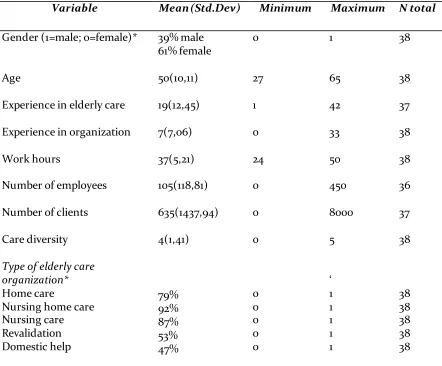
14 Table 1: Descriptive statistics of the sample: mean, standard deviation, minimum, maximum and total respondents
Variable Mean (Std.Dev) Minimum Maximum N total
Gender (1=male; 0=female)* 39% male
61% female
0 1 38
Age 50(10,11) 27 65 38
Experience in elderly care 19(12,45) 1 42 37
Experience in organization 7(7,06) 0 33 38
Work hours 37(5,21) 24 50 38
Number of employees 105(118,81) 0 450 36
Number of clients 635(1437,94) 0 8000 37
Care diversity
Type of elderly care organization* Home care
Nursing home care Nursing care Revalidation Domestic help 4(1,41) 79% 92% 87% 53% 47% 0 0 0 0 0 0 5 ‘ 1 1 1 1 1 38 38 38 38 38 38
*Note: The categorical variables (gender and type of elderly care organization) are mentioned in
percentages
Deriving from Table 1, within the sample, more females (61%) are present than males (39%). Most of
these location managers are in the age category of 40 till 60 old. These location managers are quite
experienced in elderly care because on average they have 19 years of experience in this field. However,
the experience in elderly care can range between 6 and 31 years. In contrast to earlier findings, the
average experience in the organization is 7 years and ranges between 0 and 14 years. This result indicates
that these location managers are experienced but switch between organizations. Most of the location
managers work fulltime and have an average of 105 employees and 635 clients. However, Table 1
indicates that the number of employees (σ=199) and clients (σ=1437) differ between organizations.
Furthermore, most organizations within the sample offer nursing home care (92%), nursing care (87%)
and home care (79%). The mean (µ=4) and standard deviation (σ=1,4) of care diversity indicates that
15 this sample are probably large in size. The survey had many missing respondents which resulted in 38
respondents that were reported to show clear results. Consequently, a missing value analysis is
conducted which can be found in Table A1 in Appendix A.
3.2 Research design and procedure
As mentioned before, the data was collected through an online questionnaire via Qualtrics from the
beginning of October 2018 until the end of November 2018. The questionnaire was validated by an
elderly care manager before publishing it via Qualtrics. The questionnaire (Appendix B) contained 90
times translated from Dutch to English. The survey took approximately 15 to 20 minutes to complete.
The first invitation to fill in the questionnaire resulted in 30 respondents who finalized the
questionnaire. After the reminder, the total number of respondents who finalized the survey according
to Qualtrics was 58. The first reason for the moderate response was the length of the survey because
166 respondents partly filled in the survey. In addition, a part of those respondents only opened the
survey without filling in sections, which Qualtrics also reported as partly filled in. The second reason
was that ActiZ simultaneously sent out a survey towards technologies in elderly care. This confused the
respondents causing them not to fill in the survey. In order to make the sample representative about 20
percent of the total number of respondents was needed. Although this aim could not be reached, the
dataset can nevertheless be useful for purposes of exploration.
3.3 Operationalisation
The questionnaire existed of three sections, see Appendix B. The general information about the
respondents was used for understanding the sample. The other two sections were used for answering
the main research question. In the following paragraphs, the operationalisation of the variables will be
given.
3.3.1 Characteristics of collaborative networks
In order to explore collaborations of elderly care organizations for technological innovation, the
following question was formulated: ‘Can you name two most important collaborations in which you have
developed, adopted and/or implemented one or more technological innovation(s)?’. The answer to this
question supports the rest of the survey by referring back to the specific collaboration. With the help
16 was better informed to which collaboration the question referred. The information derived from these
questions was not progressed in the results. In the light of privacy, this information could link names
of collaboration to respondents.
The characteristics of collaborative networks is measured with the theory of partner diversity
and the presence of strong and weak ties. These characteristics are conceptualised as follows. Strong tie
networking is characterised by regular contact with partners, low amount of persons and a low
geographical scale (Hansen & Villadsen, 2017; Granovetter, 1985; Huszti, David & Vajda, 2013). In
contrary to strong tie networking, weak-tie networking is characterised in measure by low contact
frequency, large number of partners and a high geographical scale (Hansen & Villadsen, 2017;
Granovetter, 1985; Huszti, David & Vajda, 2013). Partner diversity refers to the extent of collaborating
with different partners (Sørensen and Torfing, 2017; Termeer & Nooteboom, 2014). Further in the
section will be specified how contact frequency, number of partners and geographical scale exactly
relate to strong or weak ties and what a high or low partner diversity is. All these measurements relate
to the characteristics of collaborative networks.
Within the questionnaire the number of partners is measured with the question: ‘How many
persons are in collaboration?’. The survey allowed an open-ended response. After changing the answers
into numbers, the variable was constructed as a scale variable. A high number of partners in a
collaboration relates to having more than eight partners which pertains to weak ties. A low number of
partners in a collaboration relates to having less than five partners which pertains to strong ties.
Geographical scope was measured with the question ‘What is the geographical scope of the
collaboration?’. The variable had an ordinal level of measurement which ranged from (1) neighbourhood
scope to (6) international scope. The numbers 1 to 3 indicate a low geographical scope which benefits
the developing strong ties (neighbourhood, municipality, regional). In addition the numbers 4 to 6
indicate a high geographical scope which relates to developing weak ties (provincial, national and
international).
The variable contact frequency was measured with the question ‘How often do you have contact
with members of the collaboration?’. The variable had also an ordinal measurement and ranged from
never (8) to daily (1) and was recoded from never (0) to daily (7). The new scores of the variable shows
that a higher number indicate more intense contact with partners and a low number indicate little
contact. More concrete, having daily to monthly contact indicate beneficial for strong ties and a few
times a year to never indicate advantages for weak ties.
Next to strong and weak-tie networking, partner diversity was measured with the question
‘What type of partners are within the collaboration?’ and showed twenty answer opportunities (see
17 diversity indicates that the organization only works with partners that are quite similar to them. A high
partner diversity indicates that the organization has many different partners. The question allowed for
multiple responses which resulted in twenty answer options constructed as dummy variables (0=other;
1=partner X). Next, the categories had to be merged to five categories. The first category consisted of
educational organization consisting of 1=primary and secondary schools and knowledge institutions
(university, graduate school, secondary vocational education) and zero (0) indicated others. Next,
clients, health care employees and client councils were merged together into a dummy variable (1)
where 0 indicates respondents not belonging to this category. Third, public organizations was merged
together that contained 1=of municipality, province, national government, non-profit organizations and
police and 0 related to other. Fourth, private organizations consisting of consultancy, private
organizations, product developers and police (1) and 0 related to other. Lastly, health organizations
consisted of health trade association, physiotherapists and revalidation, elderly care organizations,
hospitals and health insurance companies (1) and other were referred to as 0. To indicate partner
diversity, these categories were summed and a high number indicated collaborating with much
different partners. Since the categories consist of 5 different types of partners a low partner diversity is
conceptualised as collaborating with 2 or less different partners. A high partner diversity indicate
collaborating with more than two different partners.
In order to understand why elderly care organizations collaboratively develop, adopt or
implement technologies, this research also explores the reasons for collaboration and the resources
extracted from the collaboration. The questions were formulated as follows ‘What are the three first and
foremost reasons for the collaboration?’ and ‘What are three most important resources that can be derived from the collaboration?’. The variable reasons for collaborations existed of 11 multiple choice answers
and resources of 10 answer options which are both based on literature of Rogers (2010) and de Vries et
al. (2015) and were related to innovation characteristics. In addition, other resources extracted from the
collaboration and resources were based on literature from Sørensen & Torfing (2017), Greenhalgh et al.
(2004), Gagnon et al. (2012) and Creswell & Sheikh (2013). These questions give more understanding
about hypotheses 1b, 2b and 3b since it is expected from theory that developed technologies provide
quality of services, adopted technologies add to provide specialized services and implemented
technologies create more services.
3.3.2 Technological innovation activities
The variable technology activity was conducted through the question ‘Did you develop, adopt and/or
18 and implemented. For instance, the question allowed to both adopt and implement innovations but
these were not treated as such. Furthermore, these answers were computed into three dummy variables
with state 0=no and 1=yes (developed, adopted or implemented).
3.3.3 Technologies in elderly care
Technological innovations in elderly care was measured with the question ‘What is the most important
technological innovation you developed, adopted and/or implemented’. In Appendix D an overview of
mentioned technologies per technology activity is included. The information was derived from
open-ended questions in the survey and was included in Appendix D. The aim of Appendix D is to give a
detailed overview which technologies are established within elderly care organizations.
To provide more clearance to those detailed names of technologies, the following questions
about function and type of technology followed the earlier question. These were constructed as: ‘Could
you indicate to which type of technology the technological innovation belongs?’ and ‘Could you indicate to which goal the technological innovation belongs?. The answers that could be given on these questions
were based on the overview of Tak et al. (2010), Goldwater & Harris (2011), Khan, Zia and Perera (2016)
and information from the practical field. The choice for the distinction between type and goal of
technology is that for example an organization can develop a robot but this robot can have different
functions like preventing loneliness, allowing cognitive stimulation, assisting with daily life activities
and so on. More specifically, the robot Paro helps to prevent loneliness of the elderly and the robot Zora
helps with exercise. As such, it can be seen that robots can have different functions. The categories were
translated into dummy variables. Since the research is exploratory the answer options were not merged
as for example the variable partner diversity to provide more detailed information. From theory it is
expected that traditional technologies relate to development activities. First, these traditional
technologies can relate to technologies such as access sensors, motion sensors, GPS and communication
technologies. Second, the more advanced technologies which relate to adoption activities can relate to
bio-sensor technologies, robotics, cognition training and Virtual Reality (VR). Lastly, cost-effective
technologies relate to implementation activities and can be telemedicine, communication technologies
and e-health technology.
3.4 Data analysis
The whole analysis of the data was done by the program IBM SPSS. The data analysis was focused on a
19 were used to gain insight into the first two sub-questions about the characteristics of collaborative
networks and the frequency of technologies per technology activity. This way, the information
supported the further analysis of the third and main research question. The method used for the third
and main research question is cross-tables analysis. The method was used because it calculates the
mean of characteristics of collaborative networks per technological innovation activity and per
technology. However, due to the fact the survey allowed multiple response and categories could not be
merged, the significance levels between groups could not be derived. Consequently, the relationship
between groups could not significantly be reported. Nevertheless, the thesis provides exploratory
[image:19.596.68.445.294.528.2]understanding of collaborative networks of elderly care organizations for technological innovation.
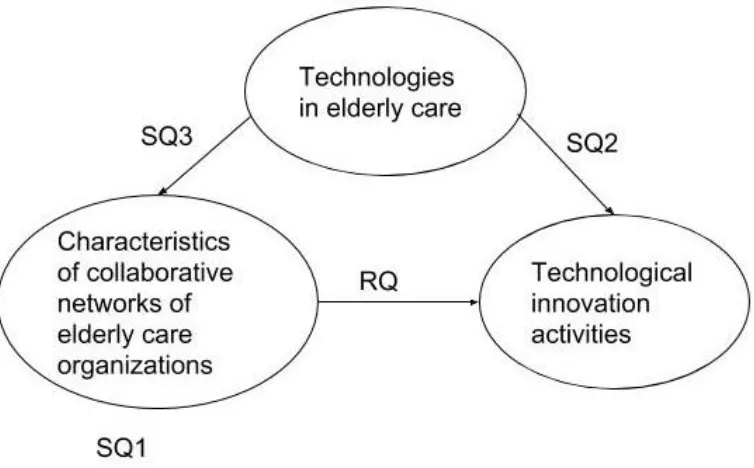
Figure 1 present the research model for the data analysis.
Figure 1. Research model for the data analysis according to the research questions
In Figure 1 it can be seen that the data analysis is structured according to the sub-questions (SQ) and
main research question (RQ). Since the structure can be difficult to understand for the reader of the
thesis, Figure 1 shows how the result section is structured to provide an answer to the RQ. Thus, first
characteristics of collaborative networks of elderly care organizations will be given (SQ1). The reason
for this is to provide understanding what the networks look like. The second sub-question will provide
understanding if technologies established in the three technological innovation activities differ (SQ2).
Next, the third sub-question support if the establishment of technologies differ for different network
20
4. Results
The first three sections are structured around the three sub-questions and the last section will provide
the answer to the main research question based on the earlier (sub)sections.
4.1 Characteristics of collaborative networks
This section will give more understanding about the characteristics of collaborative networks of elderly
care organizations. The first descriptive sub-question will be elaborated: ‘What are the characteristics
of collaborative networks of Dutch elderly care organizations for technological innovation?’. Table 2
shows the descriptive statistics with mean and standard deviation and for categorical variables
[image:20.596.52.555.372.630.2]percentages are shown.
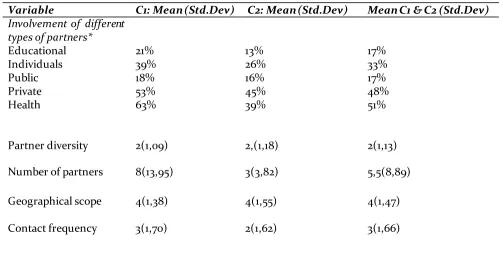
Table 2: Descriptive statistics (mean and standard deviation) of the characteristics of collaborative networks in the two most important collaborative networks (C1,C2)
Variable C1: Mean (Std.Dev) C2: Mean (Std.Dev) Mean C1 & C2 (Std.Dev)
Involvement of different types of partners*
Educational Individuals Public Private Health
21% 39% 18% 53% 63%
13% 26% 16% 45% 39%
17% 33% 17% 48% 51%
Partner diversity 2(1,09) 2,(1,18) 2(1,13)
Number of partners 8(13,95) 3(3,82) 5,5(8,89)
Geographical scope 4(1,38) 4(1,55) 4(1,47)
Contact frequency 3(1,70) 2(1,62) 3(1,66)
*Note: The categorical variable type of partners is mentioned in percentages
In Table 2, the top three partners within collaborative networks of elderly care organizations consist of
health organizations (51%), private organizations (48%) and individuals (33%) taking the mean of
21 public and educational partners (17%). Additionally, collaborative networks of elderly care
organizations consist on average out of two different types of partners (C1,C2: µ=2).
The mean number of partners within collaboration 2 (3) are less than collaboration 1 (8). This
results in having implications for the discussion paragraph. Due to the fact that the average number of
partners within a collaboration varies much between collaboration 1 (C1: σ=13,95) and collaboration 2
(C2: σ=3,82). In Appendix C, histograms are derived comparing number of partners, contact frequency
and geographical scope. This is needed because it can explain how these variables are related to say
something about strong and weak ties in general established by elderly care organizations.
Assumed is that a higher geographical scope involves a higher number of partners because they
are in a large national network with different people for instance. And this is more related to having
weak ties. Before elaborating this more, looking at the variable geographical scope in Table 2,
collaborating at the provincial scope is most evident whereas collaborating on the neighbourhood level
is not that frequent (C1: µ=4, σ=1,38; C2: µ=4, σ=1,47). Comparing this outcome with Figures C1 and C2
in Appendix C, number of partners and geographical scope, in both collaboration 1 and 2 at the regional
scope the highest number of partners are involved in the collaboration compared to the national scope.
However, it is assumed that geographical scope increases for a higher number of involved people
because this creates weak ties. Concluding from the histograms in the Appendix C, the following
assumption is not true.
The contact frequency variable can show if elderly care organizations on average have intensive
contact or not. Moreover, this can explain having strong and weak ties. The average frequency of contact
between members in the collaboration is monthly till a few times a year (C1: µ=3; C2: µ=2). Figures C3
and C4 in Appendix C show the relationship between geographical scope and contact frequency.
Deriving from the histograms, most collaborative networks at municipal scope have weekly contact,
networks at regional scope have a few times a year contact and provincial and national networks have
monthly to a few times a year contact. As such, this gives some indication that the closer the
geographical scope the more contact frequency takes place.
Additionally, contact frequency and number of partners is presented in Figures C5 and C6 in
Appendix C. The histograms show that weekly contact is more frequent with a higher number of
partners. Besides this, monthly contact is more frequent with an average number of partners and a few
times contact per year with a lowest number of partners. These results contradict the strong and weak
ties theory which indicates that a high number of partners with low contact frequency is associated
with weak ties. The results suggest that more intensive contact is needed when collaborating with a
higher number of partners. The following analysis with support from the histograms in Appendix C
22 activities, such as development, adoption and implementing activities. This is going to be further
analysed in the next sections.
In Table 3 the descriptive statistics of the reasons to collaborate and resources extracted from
[image:22.596.60.539.211.570.2]collaboration in the two most important collaborative networks is presented.
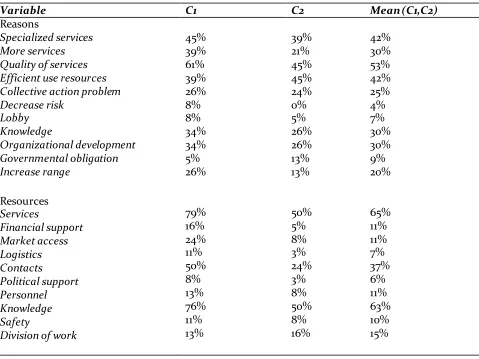
Table 3: Descriptive statistics (frequencies in percentages) of the reasons to collaborate and resources extracted from collaboration in the two most important collaborative networks (C1,C2)
Variable C1 C2 Mean (C1,C2)
Reasons
Specialized services More services Quality of services Efficient use resources Collective action problem Decrease risk Lobby Knowledge Organizational development Governmental obligation Increase range Resources Services Financial support Market access Logistics Contacts Political support Personnel Knowledge Safety
Division of work
45% 39% 61% 39% 26% 8% 8% 34% 34% 5% 26% 79% 16% 24% 11% 50% 8% 13% 76% 11% 13% 39% 21% 45% 45% 24% 0% 5% 26% 26% 13% 13% 50% 5% 8% 3% 24% 3% 8% 50% 8% 16% 42% 30% 53% 42% 25% 4% 7% 30% 30% 9% 20% 65% 11% 11% 7% 37% 6% 11% 63% 10% 15%
Table 3 shows, within collaborative networks of elderly care organizations, the three foremost reasons
for collaboration (C1,C2) are quality of services (53%), specialized services and efficient use of
resources (42%) and more services, knowledge and professional development (30%). Thus, it can be
stated that the reasons of elderly care organization to collaborate are mainly focused around service
delivery. However, it is interesting that reasons to collaborate like risk reduction (4%), lobby (7%) and
governmental obligation (9%) are far less mentioned. Besides the aforementioned reasons, the three
foremost resources extracted from the collaboration (C1,C2) are: services (65%), knowledge (63%) and
contacts (37%). Somewhat in line with the three least mentioned reasons, the least extracted
23
4.2 Technologies and technological innovation activities
This section is provided regarding the developed, adopted and implemented technologies within
collaborative networks. The descriptive sub-question that will be answered in the paragraph is: ‘What
technologies are developed, adopted or implemented among collaborative networks of elderly care
organizations?’. In Table D1 (Appendix D), a detailed overview is provided with specific names of
technologies that are collaboratively established by elderly care organizations. Table D1 in appendix D
provides more specific insights about technologies. However, in this paragraph the focus will be on the
function and type of technology in relation to the technological innovation activities. In table 4 the
descriptive statistics are presented.
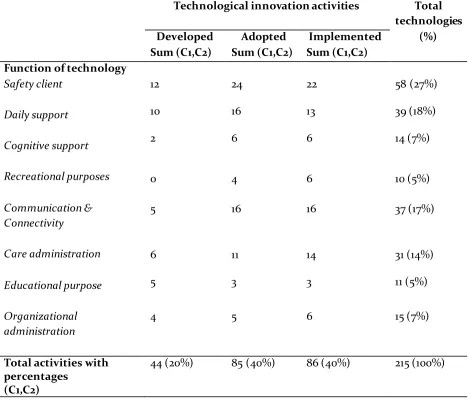
Table 4: Descriptive statistics (frequencies) ofthe three technological innovation activities and the function of their technologies in the two most important collaborative networks (C1,C2)
Technological innovation activities Total technologies
(%) Developed Adopted Implemented
Sum (C1,C2) Sum (C1,C2) Sum (C1,C2) Function of technology
Safety client
Daily support
Cognitive support
Recreational purposes
Communication & Connectivity
Care administration
Educational purpose
Organizational administration
12 24 22 58 (27%)
10 16 13 39 (18%)
2 6 6 14 (7%)
0 4 6 10 (5%)
5 16 16 37 (17%)
6 11 14 31 (14%)
5 3 3 11 (5%)
4 5 6 15 (7%)
Total activities with percentages
(C1,C2)
[image:23.596.56.525.320.720.2]24 Overall, Table 4 shows that the three most common collaboratively established functions of
technologies are safety of client (27%), daily support (18%) and communication and connectivity (17%).
First, the least common established technologies have the function of recreation and education (both
5%). Looking at the technological innovation activities, the three most common functions with regard
to development are safety of client are safety of client (12), daily support (10) and care administration
(6). Secondly, the three foremost functions regarding adoption are safety (24), daily support (16) and
communication and connectivity (16) Lastly, the three most common functions for implementation are
[image:24.596.61.499.288.752.2]safety (22), communication and connectivity (16) and care administration (14).
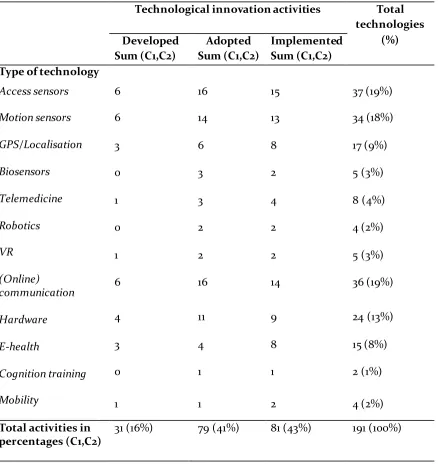
Table 5: Descriptive statistics (frequencies) of the three technological innovation activities and type of their technologies in the two most important collaborative networks (C1,C2)
Technological innovation activities Total technologies
(%) Developed Adopted Implemented
Sum (C1,C2) Sum (C1,C2) Sum (C1,C2) Type of technology
Access sensors
Motion sensors
GPS/Localisation
Biosensors
Telemedicine
Robotics
VR
(Online)
communication
Hardware
E-health
Cognition training
Mobility
6 16 15 37 (19%)
6 14 13 34 (18%)
3 6 8 17 (9%)
0 3 2 5 (3%)
1 3 4 8 (4%)
0 2 2 4 (2%)
1 2 2 5 (3%)
6 16 14 36 (19%)
4 11 9 24 (13%)
3 4 8 15 (8%)
0 1 1 2 (1%)
1 1 2 4 (2%)
Total activities in percentages (C1,C2)
25 Table 5 presents frequencies of the type of technology in relation to technological innovation activities.
In general, the three most established types of technologies are access technologies (19%),
communication and connectivity technologies (19%) and motion technologies (18%). The three least
established type of technologies are cognition training technologies (1%), robotics (2%) and mobility
technologies (2%). When analysing the technologies in table 5 per technological innovation activity,
table 5 shows that the three foremost type of technologies do not differ between th e technological
innovation activities. For all three technological innovation activities, the three common established
technologies are access technologies, (online) communication technologies and motion technologies.
Referring back to the sub-question two remarkable findings can be concluded. First, the three
foremost type of technologies do not differ between the technological innovation activities. Second, it
can be seen that the function of technologies in the area of communication are less important for
development activities compared to other technologies. For adoption activities, technologies in the
function area of care administration are less important compared to the other activities. For
implementation activities, technologies in the function area of daily support are less important
compared to other activities.
4.3
Characteristics of collaborative networks and technologies
In this section more information is given about the relation between the characteristics of collaborative
networks and technologies. The sub-question that will be answered here is: ‘How are the characteristics
of collaborative networks related to technologies in elderly care?’. Deriving from the results from the
result sections 4.1 and 4.2, the focus will be on technologies with the function of daily support,
communication and connectivity and care administration. Next to this, the relation between
characteristics of collaboration and access sensors, motion sensors and (online) communication
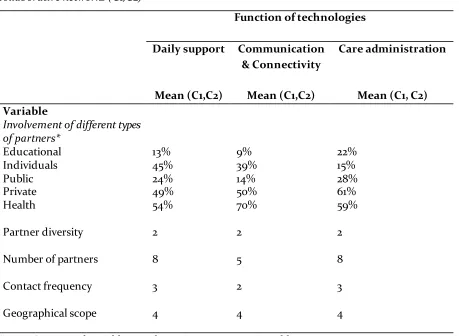
26 Table 6: Cross table of the three most important functions of technologies with the means of
characteristics of collaborative networks of elderly care organizations in the two most important
collaborative networks (C1,C2)
Function of technologies
Daily support Communication & Connectivity
Care administration
Mean (C1,C2) Mean (C1,C2) Mean (C1, C2) Variable
Involvement of different types of partners* Educational Individuals Public Private Health Partner diversity
Number of partners
Contact frequency Geographical scope 13% 45% 24% 49% 54% 9% 39% 14% 50% 70% 22% 15% 28% 61% 59%
2 2 2
8 5 8
3 2 3
4 4 4
*Note: Categorical variables are shown in percentages in Table 6
In Table 6 the characteristics of collaborative networks in relation to the function of technologies are
shown. Because geographical scope (provincial scope) and partner diversity (2 different partners) do
not differ between the functions of technologies this will not be further elaborated in the result
section.
First, analysing the type of partners in Table 5, the three foremost type of partners within
collaborative networks which establish technologies in the area of daily support and communication
and connectivity are health organizations, private organizations and individuals. However, public
organizations are found to be more important for care administration. Besides this, care
administration was found less important in adoption activities (section 4.2). Consequently, the
finding suggest that public partners are less important in the adoption activities compared to the
other activities.
Next, Table 5, which indicates that the number of partners of communication and connectivity
27 section 4.2, this suggests that in development innovation activities the number of partners is higher
due to the fact that technologies with the function of communication and connectivity are less
developed in those networks as compared to the other activities.
Lastly, contact frequency is found to be less (2: few times a year) in communication and
connectivity technologies compared to the other function of technologies (3: monthly). Two
explanations can be given for this. The first is that technologies with the function of communication
and connectivity are easier to establish within a collaboration which result in having less contact.
Second, in the development activities less contact is desirable than other activities. This is contrary to
the expectations that in the development activities strong ties are more beneficial. Further analysing
[image:27.596.64.510.330.767.2]this will provide more understanding about this relationship.
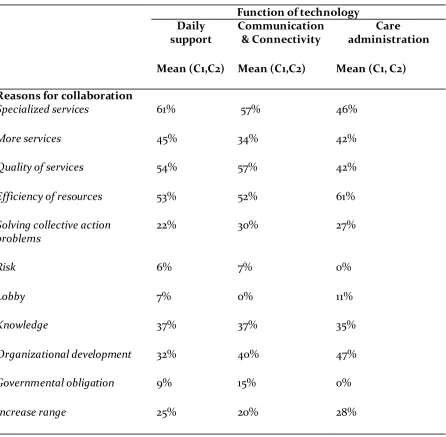
Table 7a: Cross table of the average of the three most important functions of technolog ies with reasons for collaboration in the two most important collaborative networks (C1,C2)
Function of technology Daily
support
Communication & Connectivity
Care administration Mean (C1,C2) Mean (C1,C2) Mean (C1, C2) Reasons for collaboration
Specialized services 61% 57% 46%
More services 45% 34% 42%
Quality of services 54% 57% 42%
Efficiency of resources 53% 52% 61%
Solving collective action problems
22% 30% 27%
Risk 6% 7% 0%
Lobby 7% 0% 11%
Knowledge 37% 37% 35%
Organizational development 32% 40% 47%
Governmental obligation 9% 15% 0%
28 Table 7b: Cross table of the average of the three most important functions of technologies with
resources from collaborative networks in the two most important collaborative networks (C1,C2)
Function of technology Daily support Communication &
Connectivity
Care administration Mean (C1,C2) Mean (C1,C2) Mean (C1, C2) Resources from
collaboration
Services 79% 50% 84%
Financial support 10% 0% 14%
Access to markets 15% 19% 23%
Logistics 6% 7% 7%
Contacts 47% 40% 40%
Political support 7% 0% 11%
Personnel 10% 12% 8%
Knowledge 70% 67% 70%
Security 6% 9% 17%
Division of work 22% 20% 20%
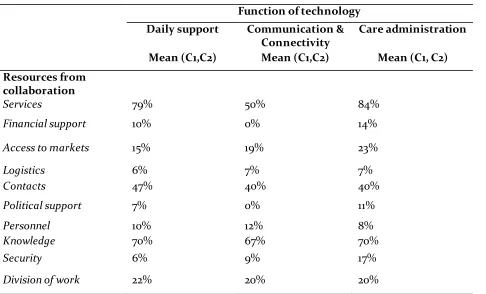
Table 7a and Table 7b shows the function of technologies in relation with the reasons for
collaboration and resources derived from those collaborations. First, collaborative networks that
establish daily support technologies collaborate because they can foremost provide specialized
services (61%), quality of services (54%) and efficiency of resources (53%). The most common
resources extracted are services (79%), knowledge (70%) and contacts (43%). Second, collaborative
networks that establish technologies in the area function of communication and connectivity
collaborate because of specialized services (57%), quality of services (57%) and efficiency of resources
(52%). The most common resources extracted are knowledge (70%), services (50%) and contacts
(40%). Lastly, collaborative networks that establish technologies in the function area of care
administration collaborate because they can foremost provide are efficient in the use of resources
(61%), specialized services (46%) and quality of services/more services (42%). The most common
resources extracted are services (84%), knowledge (70%) and contacts (40%). The least mentioned
reasons for collaborating to establish these technologies are risk reduction, lobby and governmental
obligation. However, governmental obligation (15%) is found to be an important reason when
establishing a communication and connectivity technology compared to other technologies.
Analysing the least mentioned resources extracted, the most remarkable finding is that for
29 support is withdrawn compared to the other technologies. Comparing this result to Table 4, which
shows this function of technology is least developed compared to adopted and implemented, the
finding suggest that in the development activity, political and financial support is more apparent.
Table 8: Cross table of the three most important type of technologies with the means of characteristics of collaborative networks of elderly care organizations in the two most important collaborative networks
(C1,C2)
Type of technology Access sensors Motion
sensors
(Online)communication Mean (C1,C2) Mean (C1,C2) Mean (C1,C2)
Variable
Involvement of different types of partners*
Educational Individuals Public Private Health
Partner diversity
Persons
Contact frequency
Geographical scope
17% 46% 13% 59% 53%
19% 36% 4% 65% 57%
12% 25% 25% 52% 62%
2 2 2
6 6 4
3 3 3
4 4 4
*Note: Categorical variables are shown in percentages in Table 8
Table 8 shows the most important types of technologies related to characteristics of collaborative
networks. Communication technologies are found to be established with less persons (4) compared to
access and motion sensors (6). This suggest less persons are needed to establish communication
technologies. The three most common partners of the type of technologies are private organizations,
health organizations and individuals. The result shows that the type of partners is not dissimilar
30 Table 9a: Cross table of the average of the three most important types of technologies with reasons for collaboration in the two most important collaborative networks (C1,C2)
Type of technologies
Access sensors Motion sensors (Online)communication Mean (C1,C2) Mean (C1,C2) Mean (C1,C2)
Reasons for collaboration
Specialized services 42% 36% 59%
More services 33% 29% 27%
Quality of services 67% 60% 57%
Efficiency of resources 58% 69% 35%
Solving collective action problems
11% 21% 29%
Risk 4% 0% 4%
Lobby 4% 0% 4%
Knowledge 33% 48% 27%
Organizational development 45% 40% 35%
Governmental obligation 10% 0% 5%
Increase range 20% 19% 19%
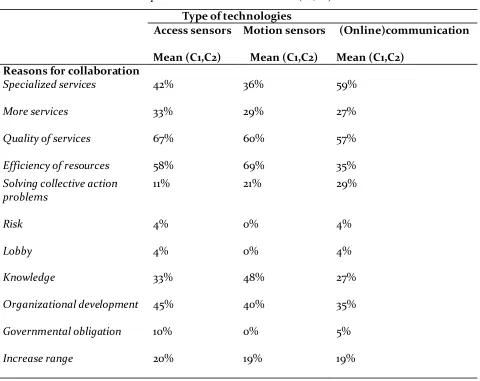
Table 9a shows the reasons to collaborative for the three most important type of technologies. The main
results from Table 9a are that a substantial reason to collaborate to produce motion sensors is the
gaining of knowledge (48%) compared to the other type of technologies. However, for motion sensors
risk, lobby and governmental obligations are not reasons to collaborate to establish motion sensors
(0%) as compared with the other technologies. Another remarkable findings from Table 9a are that
providing specialized services is more important for (online) communication technologies (59%),
providing more services (33%) is more important for access sensor technologies and providing