2018
Developing core
knowledge through
workgroup conversation
A BACHELOR STUDY OF TEACHER DESIGN TEAMS
ROBERT MIDDELBURG
Pagina 1 van 35
Contents
1. Introduction ... 2
1.1 Preface ... 2
1.2 Problem statement ... 2
1.3 Aim of the study ... 2
1.4 Reading guide ... 2
2. Theoretical framework ... 3
2.1 Core knowledge for teaching ... 3
2.1.1 Content knowledge ... 3
2.1.2 Pedagogical knowledge ... 3
2.1.3 Pedagogical content knowledge ... 4
2.2 Teacher learning in groups ... 7
2.2.1 Variety in teacher groups ... 7
2.2.2 Opportunities to learn ... 9
2.2.3 Supporting teacher group learning ... 11
2.3 Developing core knowledge through teacher group conversations ... 12
2.4 About this study ... 14
2.4.1 Aim of the study ... 14
2.4.2 Research questions... 14
2.4.3 Context of the study ... 14
3. Methods ... 15
3.1 Respondents and data collection ... 15
3.2 Data analysis ... 15
4. Results ... 19
4.1 RQ1: Aspects concerning core knowledge for teaching in teacher dialogue ... 19
4.2 RQ2: Process features of TDT’s in teacher dialogue ... 23
4.3 RQ3: The nature/richness of opportunities to learn present in teacher dialogue ... 26
5. Discussion ... 29
5.1 Conclusion ... 29
5.2 Reflection on the methods ... 32
5.3 Reflection on the findings ... 32
5.4 Closing considerations ... 32
Pagina 2 van 35
1. Introduction
1.1 Preface
Teacher collaboration is mentioned in many school improvement programs. This teacher collaboration would, according to Horn, Garner, Kane and Brasel (2017) change teachers’ professional learning. The way how is different in literature. Some would argue that collaboration could lead to richer learning opportunities (Horn et al., 2017) while others go through discourse looking for the depth of inquiry to pinpoint the kind of reasoning in these collaborative conversations (Boschman et al., 2015). Others, finally try to understand teacher teams with a framework by measuring core knowledge in the form of pedagogical content knowledge (Shulman, 1986; Binkhorst Handelzalts, Poortman et al., 2015).
1.2 Problem statement
Although teacher collaboration is being used as a way to improve school programs, it can be difficult to pinpoint what process features make for effective teacher collaboration, what richness of
opportunities to learn arise in teacher team conversation and how core knowledge for teaching teachers utilize during these conversations arise.
1.3 Aim of the study
This bachelor study sets out to understand the aspects of core knowledge in teacher conversations, while also taking into consideration that other process features influence the effectiveness of a teacher team and therefor teacher conversation. Finally, the study sets out to understand the opportunities to learn in teacher conversation.
To understand and improve teacher collaboration in teacher improvement programs, this study sought answers to the following overarching question:
“What can teacher dialogue tell us about the process features of Teacher Design Teams that support opportunities to learn for the development of core knowledge for teaching?”
To do this, three sub-questions, each answering an aspect of the overarching question, have been established:
- RQ1: Which aspects concerning core knowledge for teaching is present in teacher dialogue? - RQ2: Which process features of teacher teams that influence the effectiveness of Teacher Design Teams is present in teacher dialogue?
- RQ3: What is the nature/richness of opportunities to learn present in teacher conversations?
1.4 Reading guide
Pagina 3 van 35
2. Theoretical framework
2.1 Core knowledge for teaching
A frequently used way to framework teachers’ knowledge is describing their pedagogical content knowledge (PCK), described by Shulman (1986) as “the particular form of content knowledge that embodies the aspects of content most germane to its teachability” (p.9). Marks (1990) stated that the combination of subject matter (or content knowledge) and pedagogical knowledge leads to a course-specific PCK. Described next are operationalizations, definitions and examples from literature regarding content knowledge, pedagogical knowledge and PCK.
2.1.1 Content knowledge
Content knowledge is described as the type of teacher knowledge about the subject matter to be learned or taught (Koehler, M.J. & Mishra, 2009). The topics that teachers have knowledge on reflect the subject matter regarding the subject learned or taught (Boschman, McKenney & Voogt, 2014, Koehler, Mishra & Cain, 2013). Content knowledge includes concepts, theories, ideas, organizational frameworks, evidence and proof.
In literature, there have also been other descriptions on aspects of content knowledge. For example, some experts include the established practices and approaches toward developing such knowledge (Shulman, 1986 in Koehler et al., 2013). Boschman, Mckenney and Voogt (2014) describe a difference between substantive structures and syntactic structures, beside the general facts, concepts and procedures regarding the subject. Substantive structures are described as the way concepts, ideas, facts and principles are organized (Boschman, McKenney and Voogt, 2014; Juttner, Boone, Park, & Neuhaus, 2013). Syntactic structures are described as the rules that guide inquiry into a discipline (Grossman, 1990 in Boschman, McKenney and Voogt, 2014). An example is the way extremes as truth and falsehood are established (Juttner et al., 2013). Other literature make a distinction between declarative knowledge, (“knowing that”) procedural knowledge (“knowing how”) and conditional knowledge (“knowing how and why”) (Tepner et al., 2012 in Juttner et al., 2013).
Content knowledge is essential for teaching (Koehler, Mishra & Cain, 2013). Without enough content knowledge, teachers face difficulties crafting lessons and do not have confidence in their teaching (Finlayson et al. , 1998, Hashweh, 1987 in Shing, Saat, & Loke, 2015) . Further, teachers require deep knowledge of the fundamentals of the disciplines they teach. Students could otherwise receive incorrect information and thereby develop misconceptions about the subject (National Research Council, 2000; Pfundt & Duit, 2000 in Koehler, Mishra & Cain, 2013). Also, some teachers need an appropriate level of content knowledge to realise the need to contextualise topics to make then meaningful for children (Birdsall, 2015).
2.1.2 Pedagogical knowledge
Pedagogical knowledge is deep knowledge about the processes and practices of teaching and
learning (Koehler, M.J. & Mishra, 2009). It is described as a generic form of knowledge that applies to student learning, such as how students learn, the nature of the students and strategies for evaluating student understanding. It also includes knowledge about techniques or methods used in the
classroom, such as classroom management, assessment and lesson plan development (Koehler, M.J. & Mishra, 2009; Schmidt et al., 2009). To have pedagogical knowledge, a teacher should understand 1) cognitive, social and developmental theories of learning, but also 2) how they apply in the
Pagina 4 van 35 consists not only on the learning part (“how students learn”), but also of the teaching part (“how teachers teach”).
It is important for a teacher to have deep pedagogical knowledge to understand how students construct knowledge and acquire skills in different ways (Harris et al., 2009). This also includes how they develop habits of mind and dispositions toward learning.
2.1.3 Pedagogical content knowledge
Pedagogical Content Knowledge (PCK) represents “the blending of content and pedagogy into an understanding of how particular topics, problems, or issues are organized, represented, and adapted to the diverse interests and abilities of learners, and presented for instruction” (Shulman, 1987a). It describes “the capacity of a teacher to transform the content knowledge he or she possesses into forms that are pedagogically powerful and yet adaptive to the variations in ability and background presented by students” (Shulman, 1987 in Park & Oliver, 2008). Koehler and Mishra (2009) describe pedagogical content knowledge (PCK) as follows:
“PCK covers the core business of teaching, learning, curriculum, assessment, and reporting, such as the conditions that promote learning and the links among curriculum, assessment, and pedagogy. An awareness of common misconceptions and ways of looking at them, the importance of forging connections among different content-based ideas, students' prior knowledge, alternative teaching strategies, and the flexibility that comes from exploring alternative ways of looking at the same idea or problem” (p. 15)
Other literature describes how it is used to transform content knowledge into classroom curricular event (Carter, 1990 in Park & Oliver, 2008) and into forms more comprehensible for students (Geddis et al., 1993; Grossman, 1990; Marks, 1990 and Shulman, 1986, 1987 in Park & Oliver, 2008). It “encompasses both teachers’ understanding and their enactment” (Park & Oliver, 2008). This constant altering and adapting of a teacher’s personal knowledge to cater for learner’s needs is, in the term pedagogical content knowledge, combined with the specialised knowledge needed to cater those needs (Birdsall, 2015).
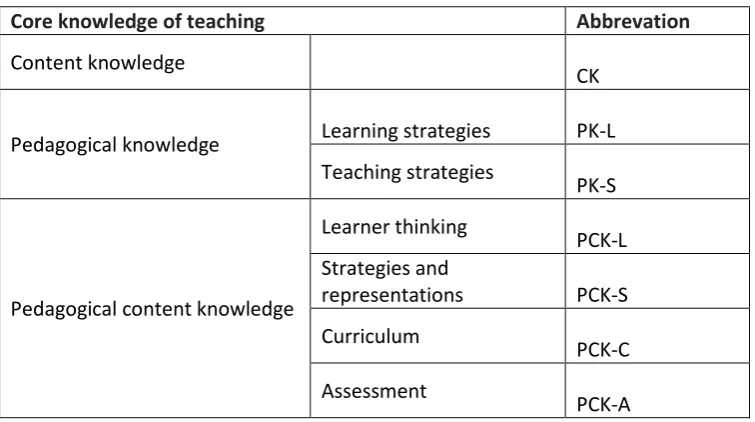
While views of PCK vary, four aspects pf PCK are commonly accepted. Described next, these are: • learner thinking and conceptions
• strategies and representations • curriculum
• assessment
Learner thinking and conceptions
Pagina 5 van 35 a discussion about differences between compounds and elements though this was a topic which the students would learn in a later unit.” (Park & Oliver, 2008, p. 269)
Strategies and representations
Another component of PCK is the knowledge about instructional strategies concerning strategies and representations (Juttner et al., 2013). With these strategies, there is a distinction to be made between subject-specific strategies and topic-specific strategies (Magnusson et al., 1999 in Park & Oliver, 2008). Subject-specific strategies are described as general approaches that are consistent with the goals of teaching in teacher’s minds. Examples are learning cycles, conceptual change strategies and inquiry-oriented instruction. Topic-specific strategies are more specific strategies that apply to teaching particular topics within a domain of subject. Juttner et al. (2013) give examples of knowledge about instructional strategy in biology, where a teacher should know the advantages and disadvantages of a model, or knowledge about different possible experiments to teach a specific topic.
Curriculum
In general, curriculum is defined as subject matter or materials like books and syllabi (Wiles, 2009). However, Wiles prefers a more dynamic and adaptive definition where curriculum is defined as “a set of goals or values that are activated through a development process and culminate in successful learning experiences for students”. (Wiles & Bondi, 2007 in Wiles, 2009, p. 2). To reach meaningful learning, for pedagogical content knowledge, it is important that teachers understand the importance of topics relative to the curriculum as a whole (Park & Oliver, 2008). Specifically, this includes the ability of teachers to identify core concepts, how to modify activities and also to eliminate those aspects that are judged to be peripheral to the targeted conceptual topics. Reviewing teacher’s curriculum knowledge, it is important to consider both the planned curriculum (f.e. school policy’s) as well as what actually takes place in the classroom; the enacted curriculum (Gehrke, Knapp, & Sirotnik, 1992). Remillard (2005) states that studying the relationship between these two is necessary to understand teachers processes containing curriculum. Processes include constructing the curriculum as well as with which resources to enact it with.
Assessment
Pagina 6 van 35 Table 1
Core knowledge of teaching abbrevations
Core knowledge of teaching Abbrevation
Content knowledge
CK
Pedagogical knowledge Learning strategies PK-L Teaching strategies
PK-S
Pedagogical content knowledge
Learner thinking
PCK-L Strategies and
representations PCK-S Curriculum
PCK-C Assessment
Pagina 7 van 35
2.2 Teacher learning in groups
The importance of pedagogical content knowledge is present in the suggestions made in literature to “teach it explicitly in the teacher training program” (Anderson & Mitchener, 1994; Geddis, Onslow, Beynon & Oesch, 1993; Shulman, 1986a, 1986b in Shing et al., 2015, p. 47). Geddis et al. (1993, in Shing et al., 2015, p. 47) “termed it crucial for student teachers to learn this knowledge of experienced teachers or “wisdom of practice” while learning to teach, and at the same time bridging the gap between the pedagogical and content aspects of science teacher preparation.” While teachers begin to develop their PCK during initial teacher education, this is a process which continues throughout professional practice, in interaction with one another. Teachers draw upon but also share and develop their core knowledge, and especially PCK through group discussion. This section describes 1) the variety in literature concerning teacher workgroups, 2) the opportunities to learn in said workgroups and 3) the means to support group learning.
2.2.1 Variety in teacher groups
There are three main forms of teacher groups which have been studied for their ability to contribute to developing the core knowledge for teaching. These are workgroups, professional learning communities, and teacher design teams. Workgroups have been defined as “… gatherings of teachers charged with collaborative work, whether or not they consider themselves a community” (Horn and Kane (2015), p. 374). In Mazereeuw, Wopereis, and McKenney (2016) groups are defined as Extended Teams, where teachers and supervisors are both responsible for the quality of the education. They consider ET’s to be workgroups, as they consist of “a collection of persons in a professional context carrying out a professional task.” (Mazereeuw et al., 2016, p. 195). In workgroups, it is stated the groups process through four phases, namely forming, storming, norming and performing. (Mazereeuw et al., 2016; Tuckman, 1965). The first phase, forming, consists of participants being constructive and social, tasks are being divided and target are formed. In the second phase, storming, there is the first sign of competition between ideas and personal ideas and beliefs come to light. In the third phase, norming, the targets from the first phase are refined and there will be interaction between what was designed and how that would work in practice. In the final stage, performing, the teams can work without external input and work competently and autonomously. While teachers in a workgroup do not have to consider themselves a community (Horn & Kane, 2015), there has to be a form of collaborative work. Mere idea sharing among teachers does not approach participation in a workgroup (Horn & Kane, 2015).
Pagina 8 van 35 data (Schildkamp, Vanhoof, van Petegem, & Visscher, 2011; Schildkamp, Visscher, & Luyten, 2009) or formative assessment (Schildkamp & Kuiper, 2010).
Another theme commonly addressed in PLCs is reflected in the Teacher Design Team (TDT) (Binkhorst et al., 2015; Binkhorst, Poortman, McKenney, & van Joolingen, 2018; Binkhorst et al., 2017; Huizinga, Handelzalts, Nieveen, & Voogt, 2015). Binkhorst et al. (2015) describe the TDTs as “a type of PLC with a specific focus on (re)designing educational materials” (p. 214). It is also described as “‘a group of at least two teachers, from the same or related subjects, working together on a regular basis, with the goal to (re)design and enact (a part of) their common curriculum” (Handelzalts, 2009, p. 7). The goal of the TDT is for teachers to share expertise and experience designing educational materials, to gain new knowledge and skills and in this way, improve their teaching skills (Binkhorst et al., 2017). Similar to PLC’s, TDT’s can be school-based or network based as well. Although in the past, most seemed to be school-based (Handelzalts, 2009), it can be argued that these network based TDT’s have more potential, as they would go beyond the knowledge that exists in one school and would lead to more fluid exchange between schools (Bryk et al., 2011 in Binkhorst et al., 2015). TDTs are sometimes initiated for the primary goal of supporting curriculum reform, with the understanding that investment in teacher learning is also necessary and collaborative design can support both (McKenney, in press). At other times TDTs are initiated for the primary goal of fostering teacher professional development, with the understanding that designing classroom resources is a practical and effective approach to this (McKenney, in press). In both cases, however, TDTs are a more specific form of the aforementioned PLC. They maintain a specific focus on (re)designing educational materials (Binkhorst et al., 2015, 2017), enacting (a part of) their common curriculum (Binkhorst et al., 2017; Handelzalts, 2009), and learning from those experiences.
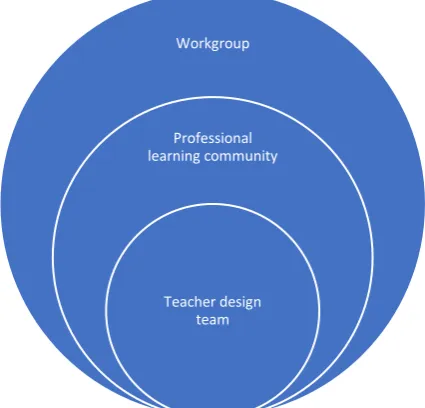
[image:9.595.172.385.539.743.2]To summarize (Figure 1), the broadest term is that of a workgroup, where participants didn’t even have to consider themselves as a community to define them as such (Horn and Kane, 2015). A more specific form of a workgroup is the Professional Learning community where teachers do have to consider themselves a community with critical reflection as a focus point in the PLC (Binkhorst et al., 2015, 2017). The most specific group mentioned in this article is the teacher design team, which is a PLC with a specific focus on (re)designing educational materials (Binkhorst et al., 2015, 2017), enacting (a part of) their common curriculum (Binkhorst et al., 2017; Handelzalts, 2009), and learning from those experiences.
Figure 1. Teacher groups that can contribute to developing the core knowledge for teaching
Workgroup
Professional learning community
Pagina 9 van 35
2.2.2 Opportunities to learn
Teacher groups offer opportunities develop new kinds of knowledge and skills, such as content knowledge and pedagogical knowledge, but also design skills and professional skills such as networking (Binkhorst et al., 2015). In the groups where this is developed, there are different ‘opportunities for learning’ (OTLs). OTLs have been described in literature as “affordances for changing participation and practice. In this view, understanding a learner’s trajectory involves hypotheses about affordances that are available to the learner to participate in particular ways” (Greeno & Gresalfi, 2008, p. 172). Other studies also state that teachers’ conversations can open up (or close) OTLs for teachers (Little, 2003; Horn & Little, 2009 in Ronfeldt, Farmer, McQueen & Grissom, 2015). If the opportunities to learn open up or close is dependent on they are structured.
There are different factors that influence the OTLs. For example, without insight into the nature of student’s understanding of the subject or enough time to design instructional means, opportunities to learn would be limited (Horn, Kane, & Wilson, 2015). Frequent linking of broad principles to specific practical instances also supported the teachers’ development (Horn & Kane, 2015). It also seems that, when it comes to collaborative learning, participants who exhibit higher levels of instructional accomplishment are able to reflect “… more complex understandings of teaching and provides more specific renderings of future work connected to those conceptions” (Horn & Kane, 2015, p. 380), leading to richer OTLs. In literature, there are two main approaches to measuring the teachers opportunities to learn, namely measuring the taxonomy of OTLS (Horn, Garner, Kan & Brasel, 2017) or the depth of inquiry (Boschman, McKenney & Voogt, 2015).
Pagina 10 van 35 Other literature concerning learning oppurtunities show similar distinctions in the depth of inquiry in workgroup meetings. Boschman, McKenney and Voogt (2015) make a distinction between shallow and deep collaborative inquiry. Shallow depth is reached by merely sharing information while collaborative engagement and critical discussion would reflect deeper levels of inquiry (Wegerif, Mercer & Dawes, 1999 in Boschman et al., 2015). Inspired by the four levels of depth by Henry (2013), Boschman et al. (2015) created four levels of depth of inquiry: “(1) no collaborative inquiry; (2) shallow inquiry by sharing knowledge and information; (3) deep inquiry that builds understanding by analysing and synthesizing new information; and (4) using understanding to achieve learning goals in novel situations by planning” (Boschman et al., 2015, p. 252).
The first level, no collaborative inquiry, is exemplified by a teacher proposing the option of a computer. With just one teacher opting something, no collaboration is reached. When a teacher would propose a different solution, one could speak of sharing, which is still defined as shallow inquiry, because “no decision is explicated” (Boschman et al., 2015, p. 252). The third level is defined as deep inquiry that builds understanding by analysing and synthesizing new information, where the teachers would plan in more detail what the learning activity should be like. When in this
collaborative inquiry, it is hypothesized by Boschman et. al. (2015, p. 252) “that collaborative inquiry reaches the deeper levels of inquiry (analyze and plan)”, reaching deeper levels while collaborating. Findings of the study included that, over time, teachers did reach deeper inquiry levels (Boschman et al., 2015).
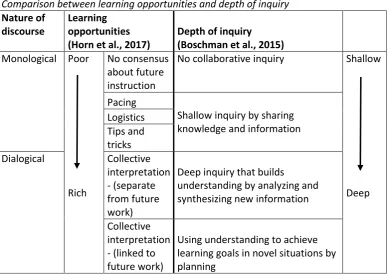
When observing the taxonomy of learning opportunities by Horn et al. (2017) and the depth of inquiry by Boschman et al. (2015), a few similarities seem to emerge. Both make a distinction between poor to rich and shallow to deep, respectively. Furthermore, in the rich and deep sections, both seem to talk about analysing information while delving deeper into a subject. Only in the richest/deepest parts, planning of steps to be taken in the future and future work are mentioned. In the poor/shallow parts, there is similarity in which both models distinctively label no collaboration and no consensus. While Boschman et al. (2015) describe shallow inquiry by only sharing
information, knowledge and information, Horn et al. (2017) make the distinction of poor rich learning opportunities of merely sharing without discussing content (pacing), while discussing content
Pagina 11 van 35
2.2.3 Supporting teacher group learning
Factors that influence effective teacher group learning include focus on concrete classroom practices, focus on content knowledge, opportunities for active learning, coherence with teachers' own (learning) goals and that the program is stretched over enough time (Garet, Porter, Desimone, Birman, & Yoon, 2001; Penuel, Fishman, Yamaguchi, & Gallagher, 2007; van Veen et al., 2010 in Binkhorst et al., 2015). Although earlier stated that time alone is not enough to improve teachers’ learning opportunities (Horn & Kane, 2015), sufficient amount of time is one of the factors for supporting group learning (Binkhorst et al., 2015, 2017; Handelzalts, 2009; Horn & Kane, 2015). Handelzalts (2009) adds to this that meetings should be held on a regular basis and that time varies per participant, depending on how much of the activities take place outside of TDT’s. Variables such as team size, previous experience and professional background should also be considered (Handelzalts, 2009).
In the process of group learning, four process features are highlighted by Binkhorst et al (2015, 2017). These features are team interaction, goal alignment, activities and organization. It should be noted that the first three features are also influenced by a team coach. Binkhorst et al. (2015, p. 222) state that “positive team interaction, a good balance of activities, a good team coach and clear alignment of the team goals contribute to the effectiveness of the TDT”.
[image:12.595.73.463.108.383.2]The first feature, team interaction, is based on several aspects. It benefits from an open atmosphere of communication, supporting each other and giving feedback, showing participation and effort and overall coherence in the TDT (Binkhorst et. al., 2017). Support is visible if participants try to help each other and give each other feedback instead of not supporting one another and merely focussing on your own task. The second feature, goal alignment, is measured based on if goals are shared among team members (Stoll et al. 2006, in Binkhorst et al., 2017) and are discussed explicitly (Binkhorst et. al., 2015). Goal sharing shows participants explicitly stating a goal in the
Table 2
Comparison between learning opportunities and depth of inquiry Nature of
discourse
Learning opportunities (Horn et al., 2017)
Depth of inquiry (Boschman et al., 2015) Monological Poor
Rich
No consensus about future instruction
No collaborative inquiry Shallow
Deep Pacing
Shallow inquiry by sharing knowledge and information Logistics
Tips and tricks Dialogical Collective
interpretation - (separate from future work)
Deep inquiry that builds
understanding by analyzing and synthesizing new information Collective
interpretation - (linked to future work)
Pagina 12 van 35 meetings, against not talking about it at all or merely stating possible activities. Having a shared goal shows in having one goal that everyone strives towards, instead of having various smaller goals. The third feature, activities, can be split into knowledge-related activities within meetings (f.e. sharing information, discussing experiences), design-related activities (f.e. designing a structure of a lesson) and activities outside of TDT meetings, such as implementing new knowledge and materials in the classroom or looking up beneficial articles for the TDT. The fourth feature, organization, is based on the planning of TDT meetings, the actual time investment and how schools support this extra time spent on the TDT. Positive forms of planning seemed to be meeting on a regular basis, since letting the team coach plan separately with participants led to more participants cancelling. The time investment can vary from person to person, but participants were told how much time (in Binkhorst et al. (2017) this was 60 hours) they would be spending on the professional development program. Finally, the composition of the group as a whole (f.e. team size and professional backgrounds (Binkhorst et. al., 2017) is a factor that influences the process. A team where teachers joined later in Binkhorst et al. (2017) reported confusion among team members. The team coach has an important role to provide structure and clarity during the process, whilst making sure the team members can also take initiative. (Binkhorst et al., 2017).
2.3 Developing core knowledge through teacher group conversations
Participants in TDT’s will always start with some existing individual characteristics. These
characteristics differ from the motivation to participate in the TDT, their reform ambitions and all their past experiences (Binkhorst et al., 2015). These factors can be seen as the input which
influences the process within the TDT (Binkhorst et al., 2015). This process is influenced by the team coach who, if they can provide structure in the process and make sure team members take initiative (Binkhorst et al., 2017), also positively influences the interactions within the TDT, their goal
alignment and their activities. These factors also contribute to the effectiveness of the TDT in general (Binkhorst et al., 2017). Finally, the organization of the TDT (f.e. team size and professional
backgrounds (Binkhorst et. al., 2017) is a factor that influences the process and with that the effectiveness of the TDT.
In the TDT, participants in use the core knowledge they possess, which can be frameworked by defining it as pedagogical content knowledge (PCK), described by Shulman (1986) as “the
particular form of content knowledge that embodies the aspects of content most germane to its teachability” (p.9). Aside from the overarching term of PCK, “the blending of content and pedagogy into an understanding of how particular topics, problems, or issues are organized, represented, and adapted to the diverse interests and abilities of learners, and presented for instruction” (Shulman, 1987a), PCK can again be split into content knowledge, described as the type of teacher knowledge about the subject matter to be learned or taught (Koehler, M.J. & Mishra, 2009), and pedagogical knowledge, described as a generic form of knowledge that applies to student learning, such as how students learn, the nature of the students and strategies for evaluating student understanding. It also includes knowledge about techniques or methods used in the classroom, such as classroom
management, assessment and lesson plan development (Koehler, M.J. & Mishra, 2009; Schmidt et al., 2009).
Pagina 13 van 35 would lead to more learning opportunities then monological discourse (Horn et al., 2017).
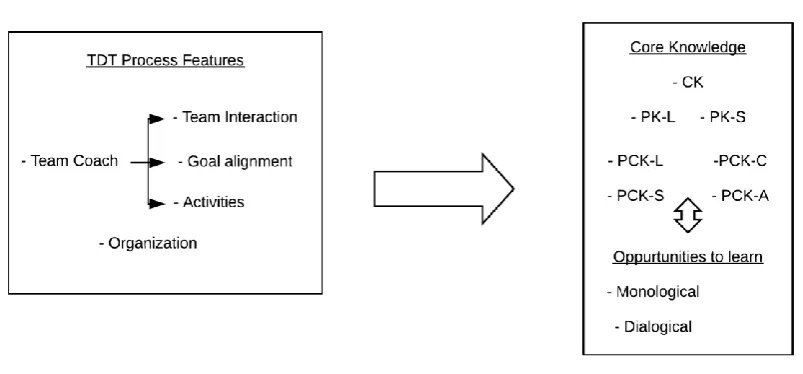
Eventually, the discourse will lead to not only designed material, which in turn can be divided into not only what the TDT perceived to use it for, but also how it is actually used in practice, but also to the professional development of participants in the TDT (Binkhorst et al., 2015). Professional development can be operationalized as the satisfaction participants had when having participated, how it influenced their teacher learning and how this made changes in practice (Binkhorst et al., 2015). This professional development and the designed material finally influences the participants as it gives them new experiences, more or less motivation to participate again, their reform ambitions (Binkhorst et al., 2015) and their core knowledge, which as aforementioned is frameworked as PCK (Shulman, 1986).
[image:14.595.84.486.297.484.2]An synthesis of these key concepts is found in figure 2.
Pagina 14 van 35
2.4 About this study
2.4.1 Aim of the study
Although teacher collaboration is being used as a way to improve school programs, it can be difficult to pinpoint what process features make for effective teacher collaboration, what richness of opportunities to learn arise in teacher team conversation and how core knowledge for teaching teachers utilize during these conversations.
This study sets out to understand the aspects of core knowledge in teacher conversations, while also taking into consideration that other process features influence the effectiveness of a teacher team and therefor teacher conversation. Finally, the study sets out to understand the opportunities to learn in teacher conversation.
2.4.2 Research questions
To understand and improve teacher collaboration in teacher improvement programs, this study sought answers to the following overarching question:
“What can teacher dialogue tell us about the process features of Teacher Design Teams that support opportunities to learn for the development of core knowledge for teaching?”
To do this, three sub-questions, each answering an aspect of the overarching question, have been established:
- RQ1: Which aspects concerning core knowledge for teaching is present in teacher dialogue? - RQ2: Which process features of teacher teams that influence the effectiveness of Teacher
Design Teams is present in teacher dialogue?
- RQ3: What is the nature/richness of opportunities to learn present in teacher conversations?
2.4.3 Context of the study
Pagina 15 van 35
3. Methods
3.1 Respondents and data collection
The TDT that was explored in this study was a TDT with a duration of a year. The team had monthly three-hour meetings, in which three were observed for this study. The TDT consisted of five chemistry teachers hailing from different schools in the east of the Netherlands. A full-time chemistry teacher at the University of Twente, who had experience with TDT’s since 2010, acted as a team coach for this team. This team was also used in other research within the University of Twente (Binkhorst et al., 2018). The first actor of that article was present for all the meetings.
During the three TDT meetings, the conversations were taped with a camera. All participants agreed with this. After the meetings, the conversations were transcribed verbatim.
3.2 Data analysis
The coding schemes were designed based on the aspects presented in the research question and, more specifically, the subquestions that were presented to answer the overarching research question. Based on these coding schemes, the transcripts were coded by labeling the text in Atlas.Ti 8, which is used for qualitative research. To ensure reliability, a fellow student who was not involved in this study coded 16,3% of the codes.
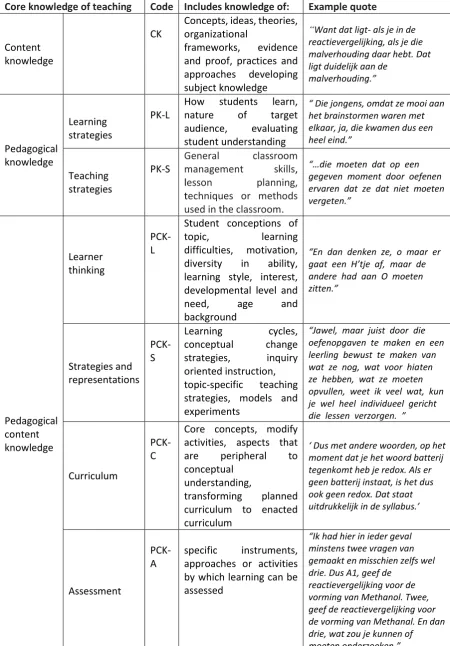
The first coding scheme designed was based on paragraph 1 of the the theoretical framework, which in turn was based on research on PCK by, among others, Boschman et al. (2015), Mishra & Koehler (2006), Park & Oliver (2008) and Shulman, 1987). In Table 3, the codes are presented with the description based on the theoretical framework and it includes an example quote from this study. This coding scheme was used to answer the sub-question concerning core knowledge for teaching in teacher dialogue. Cohen’s kappa was 0,7074.
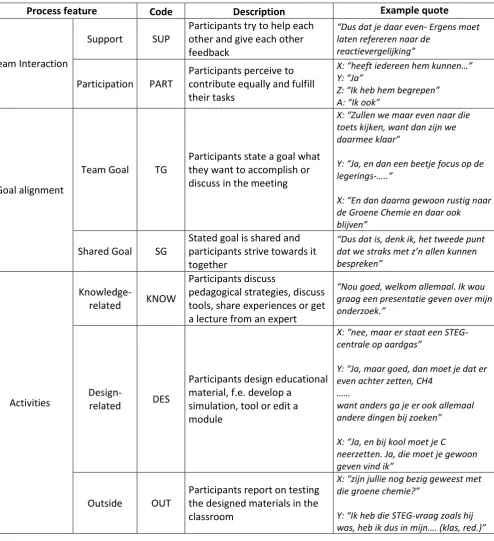
The second coding scheme was used to answer the sub-question concerning the process features or TDT’s. This coding scheme was based on paragraph 2 of the theoretical framework, more specifically paragraph 2.3 concerning the supporting of teacher group learning. The features were also used in research by Binkhorst et al. (2015, 2017). In Table 4, the codes are presented with the description based on the theoretical framework and it includes an example quote from this study. Cohen’s kappa was 0,8734.
Pagina 16 van 35 Table 3
Examples of coding pertaining to core knowledge of teaching
Core knowledge of teaching Code Includes knowledge of: Example quote
Content knowledge
CK
Concepts, ideas, theories, organizational
frameworks, evidence and proof, practices and approaches developing subject knowledge
“Want dat ligt- als je in de reactievergelijking, als je die malverhouding daar hebt. Dat ligt duidelijk aan de
malverhouding.” Pedagogical knowledge Learning strategies PK-L
How students learn, nature of target audience, evaluating student understanding
“ Die jongens, omdat ze mooi aan het brainstormen waren met elkaar, ja, die kwamen dus een heel eind.”
Teaching strategies
PK-S
General classroom management skills, lesson planning, techniques or methods used in the classroom.
“…die moeten dat op een gegeven moment door oefenen ervaren dat ze dat niet moeten vergeten.” Pedagogical content knowledge Learner thinking PCK-L
Student conceptions of topic, learning difficulties, motivation, diversity in ability, learning style, interest, developmental level and
need, age and
background
“En dan denken ze, o maar er gaat een H’tje af, maar de andere had aan O moeten zitten.”
Strategies and representations
PCK-S
Learning cycles, conceptual change strategies, inquiry oriented instruction, topic-specific teaching strategies, models and experiments
“Jawel, maar juist door die oefenopgaven te maken en een leerling bewust te maken van wat ze nog, wat voor hiaten ze hebben, wat ze moeten opvullen, weet ik veel wat, kun je wel heel individueel gericht die lessen verzorgen. ”
Curriculum
PCK-C
Core concepts, modify activities, aspects that are peripheral to conceptual
understanding,
transforming planned curriculum to enacted curriculum
‘ Dus met andere woorden, op het moment dat je het woord batterij tegenkomt heb je redox. Als er geen batterij instaat, is het dus ook geen redox. Dat staat uitdrukkelijk in de syllabus.’
Assessment
PCK-A
specific instruments, approaches or activities by which learning can be assessed
“Ik had hier in ieder geval minstens twee vragen van gemaakt en misschien zelfs wel drie. Dus A1, geef de
Pagina 17 van 35 Table 4
Description of coding pertaining to process feature that influence TDT effectiveness
Process feature Code Description Example quote
Team Interaction
Support SUP
Participants try to help each other and give each other feedback
“Dus dat je daar even- Ergens moet laten refereren naar de
reactievergelijking”
Participation PART
Participants perceive to contribute equally and fulfill their tasks
X: “heeft iedereen hem kunnen…” Y: “Ja”
Z: “Ik heb hem begrepen” A: “Ik ook”
Goal alignment
Team Goal TG
Participants state a goal what they want to accomplish or discuss in the meeting
X: “Zullen we maar even naar die toets kijken, want dan zijn we daarmee klaar”
Y: “Ja, en dan een beetje focus op de legerings-…..”
X: “En dan daarna gewoon rustig naar de Groene Chemie en daar ook blijven”
Shared Goal SG
Stated goal is shared and participants strive towards it together
“Dus dat is, denk ik, het tweede punt dat we straks met z’n allen kunnen bespreken”
Activities
Knowledge-related KNOW
Participants discuss
pedagogical strategies, discuss tools, share experiences or get a lecture from an expert
“Nou goed, welkom allemaal. Ik wou graag een presentatie geven over mijn onderzoek.”
Design-related DES
Participants design educational material, f.e. develop a
simulation, tool or edit a module
X: “nee, maar er staat een STEG -centrale op aardgas”
Y: “Ja, maar goed, dan moet je dat er even achter zetten, CH4
……
want anders ga je er ook allemaal andere dingen bij zoeken”
X: “Ja, en bij kool moet je C neerzetten. Ja, die moet je gewoon geven vind ik”
Outside OUT
Participants report on testing the designed materials in the classroom
X: “zijn jullie nog bezig geweest met die groene chemie?”
Pagina 18 van 35 Table 5
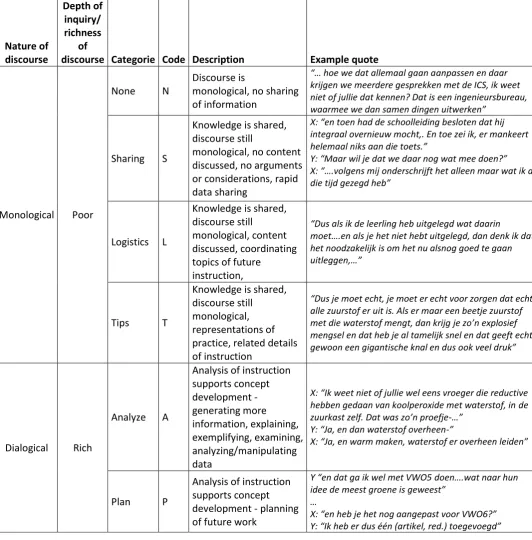
description of coding pertaining to depth of inquiry and richness of learning opportunities
Nature of discourse Depth of inquiry/ richness of
discourse Categorie Code Description Example quote
Monological Poor
None N
Discourse is
monological, no sharing of information
“… hoe we dat allemaal gaan aanpassen en daar krijgen we meerdere gesprekken met de ICS, ik weet niet of jullie dat kennen? Dat is een ingenieursbureau, waarmee we dan samen dingen uitwerken”
Sharing S
Knowledge is shared, discourse still
monological, no content discussed, no arguments or considerations, rapid data sharing
X: “en toen had de schoolleiding besloten dat hij integraal overnieuw mocht,. En toe zei ik, er mankeert helemaal niks aan die toets.”
Y: “Maar wil je dat we daar nog wat mee doen?” X: “….volgens mij onderschrijft het alleen maar wat ik al die tijd gezegd heb”
Logistics L
Knowledge is shared, discourse still
monological, content discussed, coordinating topics of future
instruction,
“Dus als ik de leerling heb uitgelegd wat daarin
moet….en als je het niet hebt uitgelegd, dan denk ik dat het noodzakelijk is om het nu alsnog goed te gaan uitleggen,…”
Tips T
Knowledge is shared, discourse still
monological, representations of practice, related details of instruction
“Dus je moet echt, je moet er echt voor zorgen dat echt alle zuurstof er uit is. Als er maar een beetje zuurstof met die waterstof mengt, dan krijg je zo’n explosief mengsel en dat heb je al tamelijk snel en dat geeft echt gewoon een gigantische knal en dus ook veel druk”
Dialogical Rich
Analyze A
Analysis of instruction supports concept development -generating more information, explaining, exemplifying, examining, analyzing/manipulating data
X: “Ik weet niet of jullie wel eens vroeger die reductive hebben gedaan van koolperoxide met waterstof, in de zuurkast zelf. Dat was zo’n proefje-…”
Y: “Ja, en dan waterstof overheen-”
X: “Ja, en warm maken, waterstof er overheen leiden”
Plan P
Analysis of instruction supports concept development - planning of future work
Y “en dat ga ik wel met VWO5 doen….wat naar hun idee de meest groene is geweest”
…
Pagina 19 van 35
4. Results
The tables in the method section of this research were used to code the teacher dialogue. Consisting of different types of code, each code will be analysed on relative quantity compared to the other aspects and, if possible, linked to aspects in the other tables. In 4.1, we address the research question concerning core knowledge of teaching. In 4.2, the process features will be centred. In 4.3, the coding pertaining to depth of inquiry and richness of learning opportunities will be presented. An overall answer of the sub-questions and the overall research question is given in 5.1.
[image:20.595.72.501.281.405.2]4.1 RQ1: Aspects concerning core knowledge for teaching in teacher dialogue
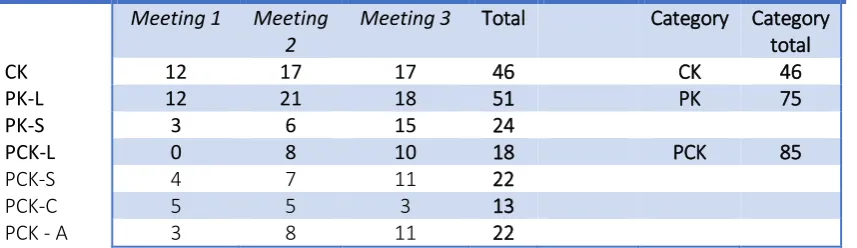
Table 6
Amount of core knowledge aspects coded in meetings
Meeting 1 Meeting 2
Meeting 3 Total Category Category total
CK 12 17 17 46 CK 46
PK-L 12 21 18 51 PK 75
PK-S 3 6 15 24
PCK-L 0 8 10 18 PCK 85
PCK-S 4 7 11 22
PCK-C 5 5 3 13
PCK - A 3 8 11 22
4.1.1 Content knowledge
Content knowledge was coded the second most of all the aspects, concerning the coding pertaining to core knowledge for teaching. It was, however the category that was least coded (Table 6). During the design-related activity, where the participants were discussing a test made by a colleague, participants showed concepts, ideas, and practices and approaches developing subject knowledge. It consisted mostly of remarks concerning the subject they were teaching, without immediate regard to how students would perceive this or how it can be taught in a classroom setting. In the first meeting, after a lecture was given on the use of language, there were mentions (among others) on how synthesis gasses work, the workings of gas turbines, what should be mentioned in a environmental effect report and the influence of temperature on certain gasses. In the second and third meeting, where the test was discussed, participants discussed (among others) connecting amine, propane and butane, membranes, redox and several types of fuel. While answering the questions of the test made by a colleague, participants would talk about the structures of certain elements:
“Y: ‘Dat is wel zo, als je een amine neemt dan is het gewoon zeg maar ik heb gewoon propaan 1,2,3, 3 amine. Dan is het geen propaan, dan is het echt-‘
X: ‘Propaan.’
Pagina 20 van 35
4.1.2 Pedagogical knowledge
As mentioned in the theoretical framework and presented in Table 3, pedagogical knowledge was split between pedagogical knowledge concerning student learning (f.e. how students learn) and pedagogical knowledge concerning the classroom strategies (f.e. techniques or methods used in the classroom). Of the three categories, PK was coded more then CK, but less than the total of PCK. It was also coded less in the first meeting (15 times) then in the second and third (27 and 33, respectively) (Table 6). Of the split within pedagogical knowledge, pedagogical knowledge concerning student learning (PL-L) were shown more than classroom strategies (PK-S)(51 versus 24) and was also coded the most concerning all the aspects of core knowledge for teaching (Table 6).
In the first meeting, where an expert gave a lecture on the use of language in tests, participants compared the reading skills of students and theorized how one student would be better at this than another. They also made comparisons between the levels students. During the second and third meeting, where a test by a colleague was discussed, participants theorized on how to approach different levels of students, how they would understand the math that’s part of chemistry. Other remarks consisted of what students would understand when a certain case, where students had to make calculations based on a lot of text in a question:
“
Y: Ik weet nu wel, leerlingen, als die deze vraag zouden, helemaal zouden- want die hebben dan zoiets van, er zit wel 95 procent CO2 bij.Y: Ja, je gaat waterstof en koolstofdioxide, dus ik denk bij B, zal er nog wel waterstof uitgaan”
In the design-related activity of reviewing a test made by a colleague, a lot of discourse was presented with how students differ from one another based on their level of education. In all the meetings remarks were made on how students in VWO (the highest level in Dutch high school) reacted and acted very differently then students in HAVO (the second-highest level in Dutch high school):
“Y: ‘Ja die vwo, die havisten moet je dat niet voorschotelen, want die zeggen meteen het is Engels en dan beginnen ze al te klagen en niet eens te lezen, maar die vwo-leerlingen vinden het eigenlijk wel heel erg leuk om te doen en ze zijn best wel aardig in staat om daar
doorheen te komen.’ ”
Pagina 21 van 35 language in teaching and tests. Some remarks were made on the use of how participants would use their past experience in a classroom and how they would make sure students would be working:
“Y: ‘Hoe dichter ik naar het eindexamen gaan, zijn het vaak oude eindexamen opgaven. En dan is het initiatief bij de leerlingen, dus als ze iets niet snappen, dan nemen ze contact op met mij en dan komen ze naar me toe en dan leg ik ze uit. Ik heb een paar goede leerlingen, maar ik heb een vierde een paar jaar geleden en die deden geen flikker. Dikke ruzies mee gehad. Tot ik op een gegeven moment tegen hun zei van, goede leerlingen, je bepaalt zelf op een gegeven moment wat je wilt. Dus die hebben eigenlijk in de vijfde en de zesde, dat was een meisje en een jongen, die hebben nooit in het klaslokaal gezeten, behalve als er op een gegeven moment als er instructie was, dan waren ze er. Die geef ik niet zoveel, dan zaten ze er en ze maakten opgaven en daar maakte ik afspraken mee. De ene had een 9,8 op het eindexamen en de ander een 10.’ ”
4.1.3 Pedagogical content knowledge
The pedagogical content knowledge code group consisted of four separate aspects, concerning learner thinking, strategies and representation, the curriculum and assessment. PCK in itself was coded the most with 85 times, more than CK and PK (Table 6).
The first aspect focussed on learner thinking, for example the student conceptions of the topic and learning difficulties concerning the topic taught. Although it’s pedagogical knowledge counterpart was coded the most concerning core knowledge of teaching, the PCK part was coded the least in teacher dialogue, with the exception of curriculum (Table 6). Participants discussed how student would understand the different elements within chemistry, such as hydrogen and oxygen, and how they would calculate with these elements. Participants also discussed students losing points when they have less knowledge of calculating within chemistry. When discussing specific power plants, participants discussed how much a student should be able to understand with context without knowing about the power plant itself. In one example, student were expected to know about the efficiency of the plant:
“Y: Kijk, hier hebben we gezet, kolenvergasser. Dit is een kolenvergasser en dit is een STEG-centrale. Wat die leerlingen wel zouden moeten kunnen bedenken, is dat die STEG-centrale maakt veel dingen een heel stuk efficiënter. Dus je haalt meer energie eruit, dus dan heb je ook minder kooldioxide-uitstoot per hoeveelheid kilowattuur energie die je levert.”
Remarks that were made were based on the difficulty of the subject, in this case a so called ‘milieueffectrapportage’ (environmental impact report), where a teacher remarked in how much the student would understand the content based on their answers:
Pagina 22 van 35 The second aspect, strategies and representations, focussed on, for example, conceptual change strategies, topic-specific strategies and models and experiments concerning the subject. This aspect was featured almost as many times as it’s pedagogical knowledge counterpart (Table 6). Remarks in teacher dialogue were mainly focussed on models and experiments in chemistry. They discussed specific steps students have to make and how to facilitate students to make these steps. A participant mentioned how he would let students discuss steps to calculate balances. Participants discussed how they would discuss concepts of content, how they link to each other. In one example, participants discussed how they would encourage students to find out how oils react to other fluids by looking for examples and trying it out themselves. This same way of challenging students to have ‘researcher mentality’ (onderzoeksmentaliteit) to find the answers of a question concerning PH-effects in a methodical fashion. In another example, about how to teach students to tackle increasingly difficult mathematical issues and stimulate their problem solving skills.
“X: ‘maar wat wij leerlingen eigenlijk proberen te leren is, we leren ze via problemen. Herkennen, herleiden tot uiteindelijk sommetjes en uiteindelijk verder met nieuwe soort probleem. Dus langzamerhand maken we het steeds ingewikkelder en we houden de verschillende domeinen bij...’ ”
The third aspect, curriculum, is based on, for example, aspects that are peripheral to conceptual understanding and means to transform the planned curriculum into the enacted curriculum. As mentioned at the first aspect of PCK, this code was least used, together with PCK-L. Remarks in teacher dialogue were mainly based on what the existing curriculum said which core concepts students should know, but there were also instances where participants showed knowledge of the curriculum, considering how other (better) projects could lead to the skipping of traditional curriculum parts:
“Y: ‘Nou ja, het mooie van het project Irresistible, en dan hebben wij het onderdeel koolhydraten in moedermelk gekozen, is dat het letterlijk ter vervanging van een hoofdstuk heeft gediend. End at is leuk, dat is interessant en dan kun je zeggen van, voor groene chemie geldt min of meer hetzelfde, als het ter vervanging van een hoofdstuk of van een aantal onderdelen kan.’ ”
In the first meeting, where an expert gave a lecture on the use of language in tests, remarks were made how much extra information given in questions and that students not always grasp this. In the second and third meeting, where a test was discussed, participants made remarks what info should be added to make a question more understandable for students. A remark was made to explain a CCGT power station (Dutch: STEG Centrale) because the concept would not be widely known among students.
Pagina 23 van 35 “Y:’ Ik had hier in ieder geval minstens twee vragen van gemaakt en misschien zelfs wel drie. Dus A1, geef de reactievergelijking voor de vorming van Methanol. Twee, geef de reactievergelijking voor de vorming van Methanal. En dan drie, wat zou je kunnen of moeten onderzoeken.’ ”
[image:24.595.65.534.254.367.2]4.2 RQ2: Process features of
TDT’s in
teacher dialogue
Table 7
Amount of TDT process features aspects coded in meetings
Meeting 1 Meeting 2 Meeting 3 Total
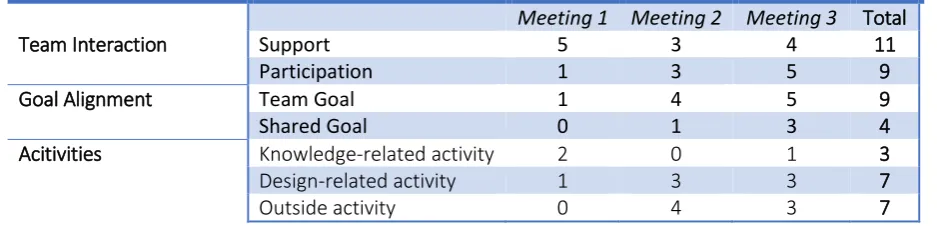
Team Interaction Support 5 3 4 11
Participation 1 3 5 9
Goal Alignment Team Goal 1 4 5 9
Shared Goal 0 1 3 4
Acitivities Knowledge-related activity 2 0 1 3
Design-related activity 1 3 3 7
Outside activity 0 4 3 7
4.2.1 Team Interaction
Concerning team interaction, two types of aspects were distinguished; support and participation. Both were coded less then codes concerning core knowledge. Support was coded eleven times and participation nine times (Table 7). Firstly, we focussed on the amount of support participants gave each other, helping each other or giving feedback. They would comment on how they would agree with certain statements made by colleagues or give a compliment if they like an addition for a question in the test discussed in the second and third meeting.. Support was shown in teacher dialogue by participants commenting on each other’s work or discussing, in case of the design-related activity of looking at a test, what aspects of the question were useful or weren’t:
“
X: Ja, ik heb toch wel een beetje van als we dit dan over koolvergasser hebben, daar nog nooit van gehoord hebben bij wijze van spreken. Dan zal ik dat eerst wel iets meer over die koolvergasser willen weten.Y: Ja, dat ben ik met je eens. Dat zal ik namelijk ook willen weten, maar het is voor de vraag niet relevant.
X: Nee, om hem te kunnen beantwoorden niet.
Y: Ja.
X: Dat ben ik met je eens.
”
Pagina 24 van 35 stating the team goal at the beginning, what participants would have prepared for the meeting. The first two meetings showed some discourse with participants stating that they prepared:
“X: ‘Heeft iedereen hem kunnen … ?’
Y: ‘Ja.’
Z: ‘Ik heb hem begrepen.’
A: ‘Ik ook.’”
However, in the third meeting, discourse was also shown where participants actively stated they didn’t do the task, and weren’t going to due to time:
“X: ‘Dit ga jij ook doen?’
B: ‘Nee, dat is dus iets waar ik geen tijd voor heb-‘
Y: ‘Wat ik dus gedaan heb.’
B: ‘Ja en dat ik dus niet ga doen.’ ”
4.2.2 Goal Alignment
The code group concerning goal alignment consisted of two aspects, namely team goal and shared goal. Team goal was coded nine times and shared goal four times. The teacher dialogue shows that participants tried to state a team goal what they wanted to discuss or accomplish in the meeting whenever they started the meeting. They also tried to state whenever an intermission was finished. Participants even looked back at the end of the meetings and tried to recall whenever they would be satisfied with the result:
“
Y:‘…
hoe ver zijn we nou echt dan met het einddoel en wanneer zijn we tevreden…?’X: ‘Ja. Nou, het einddoel is dus die praktische opdracht rondom groene chemie en het wegwijs worden in het vwo-examen en de rol van taalvaardigheid.’
Y: ‘En wanneer waren we tevreden?’
X: ‘Bij dat eerste als het praktisch toepasbaar is in de les, dus als het uitgetest is in de les. Dus,
nou ja, daar zijn we druk mee. En bij die andere staat bij, strategieën kunnen toepassen om leerlingen een nieuwe manier van vragen beantwoorden aan te leren aan de hand van
signaalwoorden.’ ”
Another important aspect of goal alignment was making sure the goal was still shared among team members. This happened less than stating a team goal. Discourse coded as shared goal mainly featured the word ‘we’ where a participant would state the goal is group effort. Discourse that shows a shared goal mainly consisted of participants promoting to tackle a subject together:
Pagina 25 van 35
4.2.3 Activities
Considering the code group of activities, three distinctions were made. The first aspect, knowledge related activities, is described as participants discussing strategies, tools or getting a lecture from an expert. Most distinguishable: in the first meeting of this study, two experts came by to present about the use of language in the classroom. Discussing the pedagogical strategies was also coded in the PCK table concerning pedagogical knowledge or even pedagogical content knowledge based on if the strategy was subject-specific.
Design-related activities is also shown in teacher dialogue when participants design educational material. In the second and third meeting, participants analysed a test made by a colleague, where they analysed and added info to some of the questions to improve it:
“
Y: ‘Nee, maar er staat een STEG-centrale op aardgas.’X: ‘Ja, maar goed, dan moet je dat er even achter zetten, CH4.’
…
Ja, ‘want anders ga je ook allemaal andere dingen bij zoeken.’
Y: ‘Ja en bij kool moet je C neerzetten. Ja, dat moet je gewoon geven, vind ik.’
”
As mentioned in 4.1, participants had shown content knowledge to answer a lot of the questions on the test, but it also gave an opportunity to show their assessment (PCK) knowledge concerning how learning can be assessed.
Outside activities, finally, is distinguished by participants reporting on testing the designed material in the classroom. In this example, a participants reports on using a designed table with twelve principles on green chemistry from the meetings, designed to be used as an exercise for students, and how the participant implemented this in the classroom:
“Y: ‘Ja, ze moeten op een gegeven moment ook, ja, inderdaad. En dit hebben ik wat aangepast en ze moeten dus alles wat ze gemeten hebben met betrekking tot verbrandingswarmte. Dat is gestandaardiseerd. Ze hebben allemaal zelf die
Pagina 26 van 35
[image:27.595.79.519.157.269.2]4.3 RQ3: The nature/richness of opportunities to learn present in teacher dialogue
Table 8
Amount of depth of inquiry aspects coded in meetings
Meeting 1 Meeting 2 Meeting 3 Total Monological /
poor
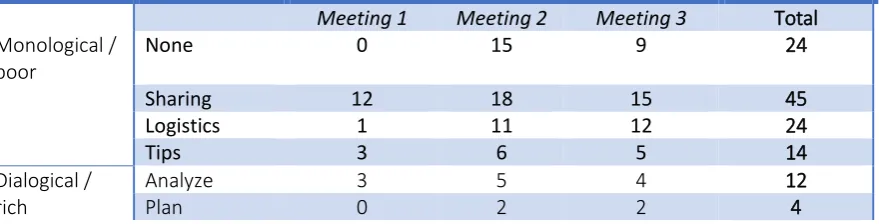
None 0 15 9 24
Sharing 12 18 15 45
Logistics 1 11 12 24
Tips 3 6 5 14
Dialogical / Analyze 3 5 4 12
rich Plan 0 2 2 4
Concerning the nature and richness of opportunities to learn in teacher dialogue, two code groups were distinguished. The first code group consisted of monological and poor discourse, consisting of four different aspects. From most poor to less poor, these are the aspects none, sharing, logistics and tips. For the seconds code group, which consisted of dialogical and rich discourse, two aspects were distinguished, with plan being the code pertaining the highest level of richness, followed by the code analyse. In 4.3.1, we will present the aspects pertaining the monological and poor discourse with examples from passes in teacher dialogue. In 4.3.2, the rich and dialogical discourse will be presented.
4.3.1 Monological/poor discourse
The first aspect, none, is exemplified by discourse being monological with no sharing of information. This was coded 24 times. The remark should be made that some of these codes were exceedingly long (sometimes 5-10 minutes). Examples of discourse consisted of participants going off track. This happened mainly at the beginning of meetings and nearing the end of meetings. Remarkable was that the code none was not coded in the first meeting where lectures were given by experts. Discourse would derail from chemistry and teaching and focus instead on getting coffee, how the curriculum was different thirty years ago (without linking it to chemistry or nowadays teaching). Random news facts as how old BMW has become were also coded ‘none’.
Pagina 27 van 35 “Y:
‘
En toen had de schoolleiding besloten dat hij integraal overnieuw mocht. En toen zei ik, maar er mankeert helemaal niks aan die toets. En toen was hier zoiets, o laat maar eens ziendan, ik zeg, nou dat is goed.’
…
X: ‘Maar, wil je dat we daar nog wat mee doen?’
Y: ‘O daar gaat, als jullie er iets mee gedaan hebben, dan hoor ik graag jullie commentaar,
maar volgens mij onderschrijft het alleen maar wat ik de hele tijd al gezegd heb’
”
The third aspect, logistics, is a richer form of discourse compared to sharing and was coded 24 times (Table 8). In this case, content is discussed and there is even some coordination of topics of future instruction. It can also be pointed out that, whenever content knowledge was involved (within either CK or PCK), there mostly was also a minimal level of logistics, considering content was discussed. Participants would ask each other if an answer given to a test question is sufficient enough. Other remarks consisted of how to progress if a student doesn’t know a concept like a CCTG plant. In 11 of 25 codes, participants would discuss something like this or other concepts without other participants chiming in. In 5 of the 25 examples discourse showed a participant opting to test content with their students on a later date, without other participants reacting to it in discourse. An example of logistics is when a participants talks about what future topics should be discussed in the classroom:
“Y: ‘Dus als je die leerling heb uitgelegd wat daarin moet, ja dan moet je daar natuurlijk op terug eisen en als je het niet hebt uitgelegd, dan denk ik dat het noodzakelijk is om het nu alsnog goed te gaan uitleggen, van wat willen we dat erin staat, want anders schiet het
natuurlijk niet hard op.’ ”
The last level for monological and poor discourse, although the least poor of the four, is tips. This aspects was coded fourteen times (Table 8). Aside from aspects described in logistics, discourse coded as tips was also full of representations of practice and more related details of instruction. Of the monological aspects, this one was least coded (Table 8) and less in the first meeting. Participants would tell how to improve a question in the test discussed in the second and third meeting, how to improve a lesson on durability in chemistry and how to motivate students to have a research mentality and that it’s okay for them to make mistakes, as long as they learn from them. An example of this coding was a participant who, although giving tips another person agreed on and giving more details of instruction, still lacked the dialogical nature of rich discourse
“Y: ‘Maar ik denk wel dat je hem had kunnen verbeteren, door in de vraag ook niet te vragen naar geef. Want, dat geef twee redenen, daar zou ik zelf ook hebben bedacht, nou ja, ik moet dus gewoon twee redenen noemen, ik hoef er verder niks aan uit te leggen. Dus als ik zou zeggen, slecht voor het milieu en minder fossiel
bijvoorbeeld-X: ‘Dat zou wel goed genoeg zijn.’
Pagina 28 van 35 uitleggen, want het gaat hier dan eigenlijk om dat je wil dat die leerlingen ook uitleggen, waarom minder fossiel beter is en waarom sowieso beter is voor het milieu door die kooldioxide kringloop. Dus dat ze dat zich gewoon realiseren, dus niet gewoon zeggen van,
we hebben de kreet huppeldepup, maar je moet die kreet ook uitleggen.’ ”
4.3.2 Dialogical/rich discourse
The aspects concerning analyse and plan were least present in teacher dialogue. This is consistent with research by Horn et al. (2017) who also stated that the richest dialogical aspect was very rarely used. Both aspects consisting of rich dialogical discourse, they are separated by the planning of future work. Analyze was coded twelve times and plan four times (Table 8). Discourse coded as analyze consisted of discourse which promoted concept development and generating more information (f.e. by exemplifying of examining data). In all twelve cases, participants would react to and add to each others statements to end with one conclusion based on those remarks. An example present in this discourse were two participants describing an existing experiment with hydrogen:
“Y: ‘Ik weet niet of jullie weleens vroeger die reductie hebben gedaan van koolperoxide met
waterstof, in de zuurkast zelf. Dat was zo’n proefje-‘
X: ‘Ja en dan waterstof overheen-‘
Y: ‘Ja en warm maken, waterstof er overheen leiden.’ ”
Plan, finally, was coded a minimal amount of times, namely four times (Table 8). It distinguished itself from the code analyse by making a clear reference of planning to future work. An example in the existing teacher dialogue that can be coded as plan was a passage in which a participant analysed and exemplified the data, in this case, several cases designed by the TDT. The participant also stated to adjust and correct the cases based on the reactions and achievements of students:
“Y: ‘En dan was het de bedoeling, en dat ga ik met V5 wel doen, dat er … hele set presenteren
van dat bijvoorbeeld, wat naar hun idee de meest groene is geweest. En dat hoeft niet die van hun te zijn, dat is een valkuil uiteraard. Dat is een valkuil. Daar moet ik in V5 ook heel duidelijk in zijn, want anders hebben ze zoiets van, wij moeten het meest groene hebben, … gewonnen. Nee, dus …, wat vinden jullie nou het beste? En nou, dat presenteerden ze dan. Maar dat doet
V6 niet meer, maar bij V5 wel.’
…
Y: ‘Dus ik ben benieuwd. En ik ga er gewoon vanuit, wat ik allemaal lees in V6, dat ik dan, ik heb nog tijd zat om dat in V5 nog te, om dingen aan te passen, te corrigeren. Want zij zijn nog
Pagina 29 van 35
5. Discussion
This study set out tounderstand the aspects of core knowledge in teacher conversations, while also taking into consideration that other process features influence the effectiveness of a teacher team and therefor teacher conversation. Finally, the study set out to understand the opportunities to learn in teacher conversation. To answer the research question, three sub-questions were established. In 5.1, these three sub-questions will be answered to establish an overall answer to the research question. In 5.2, reflections on the method and the results, respectively, are given and some closing considerations are established.
5.1 Conclusion
5.1.1 Which aspects concerning core knowledge for teaching are present in teacher dialogue?
Given the data presented in this research, it can be established that aspects concerning core knowledge for teaching in teacher dialogue can be established through coding teacher dialogue. An overview of the aspects and the amount of times they were coded are found in Table 6.
Content knowledge was coded 46 times over the course of three meetings. Participants would show their knowledge of the subject at hand (chemistry) when answering questions on the test presented by a colleague. During the lectures in the first meeting, CK was not coded that much, giving suspicion that most of the remarks were made because the test required some content knowledge to answer and discuss the questions. This is consistent with the statement that teachers require deep knowledge of the fundamentals of the disciplines they teach. Students could otherwise receive incorrect information and thereby develop misconceptions about the subject (National Research Council, 2000; Pfundt & Duit, 2000 in Koehler, Mishra & Cain, 2013). However, these remarks were primarily focussed on the content and with almost no link to the pedagogic strategies to teach this content to students.
Pedagogical knowledge was coded 75 times over the course of three meetings. Of this category, student learning were coded more (51 times) then classroom strategies (24 times). Again, like with content knowledge, both aspects arose more in the second and third meeting, suggesting that the discussing the test required more knowledge on how students learned in general then specific classroom strategies , even though Harris, Mishra and Koehler (2009) state that both aspects are important in the pedagogical knowledge of a teacher. It should be noted that, in the third meeting, the aspects were coded almost equally (18 versus 15, Table 6). Possibly, participants noticed they didn’t discuss classroom strategies or, on the other hand, the subject evolved to what participants did to facilitate the learning after discussing the students so much. These remarks had no connection to chemistry. A lot of the discourse coded as pedagogic knowledge focussed on the difference of students in the different levels of Dutch education (havo/vwo), consistent with literature to know student differences in constructing knowledge and acquiring skills in different ways (Harris et al., 2009).