Bachelor Thesis: Practicing VOM in VR – Predictors of the Intention to Use VR
Johanna Veltmann
25
thJune 2019
University of Twente
Faculty of Behavioural, Management And Social Sciences (BMS)
Department of Psychology
First Supervisor:
Dr. Sven Zebel
Second Supervisor:
2
Abstract
The study deals with factors predicting the Use of Virtual Reality (VR) as preparation for
Victim-offender Mediation (VOM). It is useful in order to remove occurring insecurities
about the process and feelings of anger and anxiety. Factors are taken from the Technology
Acceptance Model (TAM) and the Theory of Planned Behaviour (TPB). Additionally, the
factors knowledge and involvement with VR and personal innovativeness in the domain of
technology are tested which were included in neither TAM nor TPB. It was part of the
research to find out if those factors predict the intention to use VR to get acquainted with
VOM, as limited knowledge about this specific topic is known so far. The factors perceived
ease of use, perceived behavioural control, perceived usefulness, personal innovativeness and
knowledge and involvement of the user were expected to predict the intention to use VR to
get acquainted with VOM. Furthermore, an interaction effect with anxiety and anger was
predicted. An online survey was conducted with students and people from the researcher's
network (N=110). An imaginary crime scenario was presented to them, and they were
introduced to the VR application. Afterward, they had to answer questions regarding their
opinion on this technology and their intention to use the VR application and intention to
participate in VOM in general. Results were in line with the expectations, perceived ease of
use of the VR application, perceived usefulness of the VR application and personal
innovativeness in the domain of technology are positive predictors for the intention to use VR
to get acquainted with VOM. However, perceived behavioural control of the VR application
and knowledge and involvement with VR were no predictors. An interaction effect between
the knowledge and involvement and Anger and was found. A revision of the study by actually
using VR would be useful to complement other studies and add to the further development of
VOM as proper preparation is an important factor for sufficient participation in the process.
3
Already in the 1970s, many criminal justice systems offered opportunities regarding
restorative justice (RJ), which gave victims and offenders the possibility to have voluntary
contact together with a mediator who supports and leads the conversation (Hansen &
Umbreit, 2018). RJ defines a process which focuses on the victim, offender, and the
surrounding community instead of simply punishing the offender (Zehr, 2015). It should lead
to a more sustainable outcome (Zehr, 2015. One form of restorative justice is called
Victim-Offender Mediation (VOM) (Zebel, Schreurs, & Ufkes, 2017).
VOM is useful to help victims to meet the offender in a secure and organized
environment, in which the offender is made accountable for his/her behaviour (Umbreit,
Coates, & Vos, 2004). VOM reduced the chance of reoffending in cases, in which both victim
and offender were willing to meet each other for mediation (Sherman, Strang, Mayo-Wilson,
Woods, & Ariel, 2015). Sherman et al. (2015) even made clear that Victim-offender
conferencing is applicable in both minor assaults and mayor assault, as especially in more
emotional and more violent crimes (compared to property crimes), the effect size of
restorative justice increased, and the higher intensity of the process could reduce recidivism.
As conferencing and mediation have some similarities, those findings could also be used for
VOM. The positive effects for both victim and offender which are resulting from VOM are,
therefore, for example, the emotional restoration of the crime and also a decreasing danger of
reoffending (Zebel et al., 2017).
Also, it is possible to restore the victim’s sense of justice during mediation, and the
possibility is given to reach a certain degree of safety. Thus, the victim can deal with the
crime happened appropriately (Paul & Schenck-Hamlin, 2017). In addition, it can be assumed
that the offender can compensate for his behaviour in an emotional and a material manner as
it is common that VOM causes a restitution agreement or an apology (Hansen & Umbreit,
2018). According to research, over 90% of VOM sessions result in a restitution agreement
(Umbreit et al., 2004). The process itself facilitates closure and an open conversation about
what has happened. The victim might have the desire to cope with the experience, move on,
and the uncertainty about the situation through, e.g., social support can be decreased (Paul &
Schenck-Hamlin, 2017). Needs of victims might differ, and the experiences might require
different approaches.
Overall, the responses to VOM are positive, as mediation leads to mutual agreements
in 70% of the cases in the Netherlands (Doorverwijzen., n.d.). Furthermore, Hansen &
4
restorative justice process received an apology and the minority stated that they felt worse
after taking part (6-10%).
However, responses to VOM are not necessarily positive, always. Daly (2006)
declares that to conduct VOM, a set of ideals about justice based on empathy and generosity
has to be established. Additionally, it is not generalised which practices are part of the
restorative justice process, and it is difficult to define restorative justice. Therefore, responses
can differ as it might also be difficult to adapt the procedure to all the different kinds of cases
(Daly, 2006; Choi, Green, & Kapp, 2010). As victims might expect a different behaviour of
the offender, the disappointment of an unfulfilled expectation could lead to a negative
outcome of the process; reasons for this could be missing preparation for example (Daly,
2006; Choi et al., 2010). The overall process is limited by the abilities and interests of the
offender and the victim. Insensitive treatment of the victim might lead to feelings of guilt of
the victim. The victim might not show its true emotions and it should be prevented that he/she
is pressured or intimidated by the mediator, the offender or relatives (Choi et al., 2010; Choi,
Gilbert, & Green, 2013). Therefore, it is unclear if either restorative justice or conventional
justice leads to a better outcome, and further research is needed at this point (Sherman et al.,
2015). Although Hansen & Umbreit (2018) revealed that VOM is broadly effective, more
recent research has to be conducted, to get a new impression of the positive aspects for victim
and offender and the cost-effectiveness.
For example, it can be argued that it is needed to define factors influencing the
participation of victims, as the process can be adapted to those predictors, and more people
might decide to take part (Wyrick & Constanzo, 1999). Therefore, it is necessary that
participation is voluntarily, and participants should not be manipulated or forced to take part
in VOM as this could impact the process negatively (Paul & Schenck-Hamlin, 2017). Hansen
& Umbreit (2018) show that voluntariness is needed in order to ensure that the process is
victim-centered. The needs of the victims have to be researched, as they might be of
emotional and informal nature and can positively impact the victim’s further coping with the
crime, while for the offender it might cause less criminal behaviour in the future by focusing
on both victim’s and offender’s needs (Umbreit et al., 2004). The information about the needs
of the victim and offender can promote participation and adopt the process towards those
needs.
Even though the participation rates are rising, participation rates of victims are just in
the range between 40 and 60 percent (Hansen & Umbreit, 2018). Participants often consider
5
Also, levels of anxiety can be removed during the process (Doorverwijzen., n.d.). Therefore,
further effort should be made to promote this kind of restorative justice and define predictors
to participate. Additionally, other support can be useful to prepare the victim for the process,
as other factors can prevent the victim from not taking part. Those factors need to be targeted
and solved to promote easy participation. For example, Paul and Schenck-Hamlin (2017)
found out that some victim-related factors that hinder participation are uncertainty about the
process, including being nervous or angry (inability to control emotions). Also, anxiety can be
assumed to be a factor preventing victims from taking part as they are still emotionally
unstable due to the crime (Paul & Schenck-Hamlin, 2017). Another important stressor is that
feelings of anger and isolation might cause the need for social support and therefore, the
process would be needed in order to promote closure and restoration (Paul &
Schenck-Hamlin, 2017; Hansen & Umbreit, 2018; Choi et al., 2010). Hansen & Umbreit (2018) found
out that common reasons to not participate were that the crime seems too trivial to invest time,
fear, that the victim preferred a harder punishment for the offender and also, a long time gap
after the crime provided as a reason for not participating. The negative points should be
discussed and the development of VOM should be accelerated.
Insecurities might exist about the process itself as victims might be badly prepared
regarding the procedure and the possible outcomes (Daly, 2006; Choi et al., 2010). Therefore,
unachievable hopes and expectations might lead to disappointment (Hansen & Umbreit,
2018). Also, it is possible that the victim is pressured to agree or had the feeling that
emotional expressions are not accepted, and those hinder them from benefiting from the
process (Hansen & Umbreit, 2018). Thus, an in-person preparation for the mediation would
be useful to discuss the concerns and emotions of the victim, as lack of preparation might
impact the victim negatively (Hansen & Umbreit, 2018; Choi et al., 2010). This meeting
would be between the mediator and the victim and hopes, expectations, fears, and
voluntariness can be discussed (Hansen & Umbreit, 2018). Additionally, the individual
competence of the mediator is important to lead a sensitive and efficient process with good
mediation outcomes (Choi et al., 2010).
As costs for the process might occur as an issue, cost-effectivity needs to be targeted
by searching for innovative ways to prepare the victim for the mediation process. One idea
would be the use of new technologies as Virtual Reality (VR). VR describes a simulated
interactive environment (Shen, Ho, Ly, & Kuo, 2018). While using VR, the user can explore
an imaginary situation, and the understanding of otherwise unobservable circumstances might
6
VR is already commonly used in the context of psychotherapy. VR was established in
the past years as a tool for the assessment and management of psychological disorders
(Srivastava, Das, & Chaudhury, 2014). It is useful to learn new skills which can be applied
afterward in the real world. Thus, VR can be described as an interactive, three dimensional
and computer-generated environment which can focus, as it would be useful in the context of
VOM, on interaction (Srivastava et al., 2014).
Furthermore, Riva (2005) makes clear that VR has as a main advantage that the user
can interact with the interface and that a naturalistic environment is created, which the user is
part of. Also, similar to real-life conditions, different inputs and data sets can be collected and
integrated into the VR application (Riva, 2005). In the context of psycho-therapeutic
treatment the problematic, for example, anxiety related situation can be created artificially,
and the patient is feeling more secure than directly being confronted with the feared stimulus
and can show feelings and thoughts and discuss them with a (e.g.) supervisor (Riva, 2005). In
that way the needs of the victim could be targeted successfully or perhaps more specifically,
and VR can support a stable atmosphere and promote responsible dealing with the situation
(Riva, 2005). By using technology in the clinical context, the treatment of diverse mental
problems is possible, e.g. anxiety disorders, specific phobias, and fears. Therefore, there is the
possibility that also feelings of anxiety before VOM could be decreased through VR, and the
victim could be prepared sufficiently for the process.
According to research, feelings of anxiety in Post-Traumatic-Stress-Disorders could
be reduced through VR treatment, and symptoms of anxiety were lowered (Rothbaum et al.,
2001). The patient can be exposed to the causing stimulus, and a realistic situation is created
(Jerdan, Grindle, van Woerden & Boulos, 2018). Realistic reactions to the feared stimulus can
be induced and both audio and interactive visual stimuli enhance a realistic situation. Thus,
also CBT showed positive results for patients suffering from problematic psychological
behaviour (Jerdan et al., 2018). VR serves as an alternative for exposure therapy, where the
patient is confronted with the feared stimulus instead of avoiding it. This is supposed to
decrease the level of anxiety (Riva, 2005). VR is aimed to be more controlled and
cost-effective (Riva, 2005). Also, VR showed positive results as exposure therapy in most of the
cases (Jerdan et al., 2018). In Anxiety and Phobia treatment VR is already used in Virtual
Reality Exposure Therapy (VRET), in which the victim is confronted with the stimulus which
he/she is afraid of in a virtual environment (Parsons & Rizzo, 2008). The therapy is helpful
and negative affective symptoms are lowered, while anxiety and phobia symptoms are
7
However, Srivastava et al. (2014) mention that VR is rather expensive and therefore,
ways have to be established in order to integrate it in the therapeutic setting. The barrier has to
be targeted. Also, some patients suffered from VR-induced sickness and therefore, it might
not be applicable for everyone (Srivastava et al., 2014). Still, Riva (2005) views this as rather
mild for the majority of patients. Due to the positive effect of VR on phobias to treat anxiety,
it can be concluded that VR might also lower the fear of the victim to participate in VOM.
The component fear is perceived as one of the strongest inhibitors to take part in the process
as it was found out in the study of Paul & Schenck-Hamlin (2017). However, also other
factors might hinder the victim from taking part in VOM. Still, VR could be a good overall
preparation, which would also target the uncertainty about the process (Paul &
Schenck-Hamlin, 2017). As VR promotes the confrontation with strong emotions, it can be concluded
that it would also be useful to deal with feelings of anger. It can be assumed that VR is helpful
in coping with anger, as it was used in CBT where the patients were exposed to a stimulus
which caused feelings of anger and thereby, anger management was trained (Miyahira, Folen,
Stetz, Rizzo, & Kawasaki, 2010).
The VR application can be tailored to the victim, and the victim can envision the
situation better and might feel less nervous and better prepared due to the safe environment
and the support through an expert. Furthermore, VR seems more applicable than other kinds
of preparation as through VR the case can be set in a safe environment, situations which are
hard to implement in real life can be reproduced (Pan & Hamilton, 2018). It can be assumed
that through the safe setting, it might be easier for the victims to take part in VR, instead of
taking directly part in VOM. Also, because victims might not want to take part in VOM due
to different inhibiting reasons, VR could prepare them sufficiently to get acquainted with
VOM.
Still, research needs to be done on the predictors to use VR, as it might be another
challenge to convince victims to use a new kind of technology to prepare for VOM. In the
study of Garcia-Palacios, Hoffman, Kwong See, Tsai, & Botella (2001), patients were more
likely to use VR treatment over invivo exposure, being directly exposed to real-world
conditions, the stronger the fear against the stimulus was, and the number of patients who
refused to take part was lower for VR than for invivo. This could be transferred to VR in
VOM, as victims with a higher amount of fear are possibly more likely to take part in VR, as
they are not meeting the offender directly. Thus, there might also be the possibility that people
8
Therefore, the intervention might be more successful as a preparation for people who are
unsure about participating and would like to get acquainted with VOM.
Based on the explanation about the usefulness of VR to prepare for VOM, predicting
factors should be explored which promote the victim’s participation in VR. Therefore, several
theories are used, and predictors are extracted which shall be tested in the current thesis.
The Theory of Planned Behaviour (TPB) by Ajzen (1991) was used, and the
component Perceived Behavioural Control was used as a predictor in further analyses
(Venkatesh, Morris, Davis, & Davis, 2003). The model is used to predict intention and
presume behaviour in different settings and defines individual acceptance and usage of
different technologies (Venkatesh et al., 2003). It consists of the components Attitude,
Subjective Norm and Perceived Behavioural Control, of which Perceived Behavioural Control
is used to describe the perceived ease or difficulty in the performance of a behaviour
(Venkatesh et al., 2003). This includes also occurring perceived problems when carrying out
the desired behaviour (Venkatesh et al., 2003). Therefore, it can be assumed that it could be
an important predictor for the willingness to use VR to get acquainted with VOM due to the
definition of intentions and presumed behaviour, in the domain of technologies.
The second model used is the Technology Acceptance Model (TAM) by Davis (1989),
which serves to find factors facilitating the use of technology. As Venkatesh et al. (2003) say,
it is used to predict information technology acceptance and usage and should define occurring
intentions. Furthermore, it should be a theoretical model which explains the usage behaviours
in the implementation of information systems, while the attitude is excluded and it is focused
on intentions (Legris, Ingham, & Colerette, 2001). It includes the factors perceived
usefulness, perceived ease of use, and subjective norm (Legris et al., 2001). Based on this
model, the predictors perceived ease of use (TAM) and perceived usefulness are chosen.
Perceived ease of use is described by Venkatesh and Davis (1996) as the degree to which a
particular system can be used without significant effort, while the predictor perceived
usefulness (TAM) describes how a person perceives the enhancement of a particular system
on one’s (job)performance and to which amount an information system would increase one's
Job performance (Davis, 1989; Venkatesh et al., 2003). The predictors can be adapted to the
use of VR (in research TAM focuses on information systems) and therefore, can be useful for
the following research due to its universal application. This was done by Fagan, Kilmon &
Pandey (2012) who used the TAM in the context of implementing a VR simulation for
nursing students and found out that perceived ease of use and perceived usefulness predicted
9
The third predictor is taken from the User Information satisfaction (UIS) model
(Treacy, 1985). Compared to the other models, it is less popular. Knowledge and involvement
of the user are one factor of UIS, together with staff and services, the quality of the
information product (Treacy, 1985). UIS is seen as useful to look at measuring computer
system’s success or failure and how the information meets the individual expectations
towards information (Treacy, 1985). Additionally, it is said that user satisfaction is an
important criterion to define a computer systems assessment (Powers & Dickson, 1973). As
knowledge and involvement of the user are crucial for user satisfaction it is used in the current
thesis. Even though it is rather old and focused on computers, due to its broad description, it
can be easily adapted to VR.
Finally, personal innovativeness explains connections in TAM (Agarwal & Prasad,
1998). It is used to define individuals innating the trait who can perform information
technology innovations earlier compared to others (Agarwal & Prasad, 1998). Therefore, it is
useful for the process of adopting new information and technology, and it can be an essential
predictor for the use of VR (Fagan et al., 2012).
As more serious crimes caused more intense emotions, it should be tested if feelings as
anxiety or anger might have an impact on the relationship between the predictors and the
willingness to participate in VR as preparation for VOM (Sherman et al.,2015). Furthermore,
research showed that high distress would make the possibility more likely that the victim
would remain angry and fearful after the process (Daly, 2006). Victims who do not suffer
from crime as sincerely might be more easily be convinced to take part in VR to get
acquainted with VOM (Daly, 2006). Thus, it should be tested if feelings of anxiety or anger
inhibit the intention to participate. It can be assumed in line with Miyahira et al. (2010) that
VR is useful to cope with feelings of anger and therefore, it should be tested how anger
impacts the intention to participate in VR. Due to the positive impact of VR on anxiety
treatment, victims might be more likely to have the intention to participate in VR when
feelings of anxiety occur than participating directly in VOM. However, it could be assumed
that feelings of anxiety could impact the relationship negatively as anxiety might hinder
victims in taking part due to their anxiety towards the offender.
Therefore, the following research question is developed “To what extent can factors of
the TAM and TPB, UIS and personal innovativeness be used to predict whether crime victims
will participate in VR to get acquainted with VOM and how do the emotions anger and
anxiety moderate this relationship?”. Based on the just mentioned following hypotheses are
10
I. Perceived Ease of Use of the VR application about VOM positively predicts the
victim’s intention to use VR to get acquainted with VOM.
II. Perceived Behavioural Control of the VR application about VOM positively predicts
the intention to use VR to prepare for VOM.
III. Perceived Usefulness of the VR application about VOM positively predicts the
intention to use VR to prepare for VOM.
IV. Knowledge and involvement with VR of the user positively predicts the intention to
use VR.
V. Personal innovativeness in the domain of technology positively predicts the intention
to use VR to prepare for VOM.
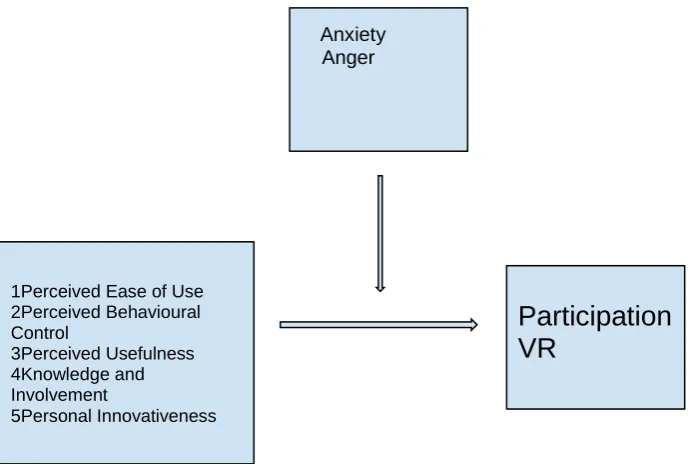
VI. The variables anxiety and anger influence the relationship between the independent
[image:10.595.73.421.344.576.2]variables and the dependent variables negatively (moderation).
Figure 1. Figure to display the assumed relationship between the independent variables and
the dependent variable intention to use VR, including the moderator's anxiety and anger.
Participation VR refers in this case to the dependent variable intention to use VR to get
acquainted with VOM.
1Perceived Ease of Use 2Perceived Behavioural Control
3Perceived Usefulness 4Knowledge and Involvement
5Personal Innovativeness
Participation
VR
Anxiety
11
Method
Design
To examine the predictors for using VR to prepare for VOM, a correlational survey study was
conducted. The dependent variable is the intention to use VR to get acquainted with VOM.
Five predictors are tested which are perceived ease of use of the VR application, perceived
behavioural control of the VR application, perceived usefulness of the VR application,
knowledge and involvement with VR of the user and personal innovativeness in the domain
of technology. Furthermore, anxiety and anger are used as moderators to explain these
relationships.
Participants
The study included a sample of 111 participants from the researcher’s network and students
from the University of Twente who took part via SONA.1 The analyses were conducted with
110 of the 111 participants. The participants had a mean age of 22.06 (SD=7.12). 27 males
(22.7%) and 83 females (75.5%) participated. Furthermore, 91 (82.7%) were German, 12
(10.9%) were Dutch and 7 (6.4%) had a different nationality. Of the 110 participants, 101
were students (91.8%), nine were working (8.2%).
Furthermore, the procedure was explained to the participants in informed consent, in
which also the confidentiality of the taken data was ensured. The study was approved by the
ethics committee (Faculty of Behavioural, Management and Social Sciences). To find out if
the participants took the study seriously and answered the question honestly, three control
questions were used at the end of the survey, e.g. “I participated seriously in the study.”.
Materials
An online study was conducted by using Qualtrics, including an informed consent.
Crime Scenario. The crime scenario described a situation, in which the participant
was on a bus and got attacked by an unknown offender by being insulted, and a beer bottle
was thrown towards him. In the end, the participant had to imagine being hit by the bottle. A
picture of a bus was included to imagine the situation more easily (Appendix 2).
Information about VOM and VR. It is explained that the offender offered VOM to
the victim, two weeks after the crime and the background and purpose of VOM was
explained, to introduce the topic to the participant. Especially, the fact that research showed
good results for this kind of restorative justice was mentioned (Appendix 3). Furthermore, a
1 To define the final data set it was checked if there was a different result of the analyses if the one person who
12
VR application was introduced. The VR application would include an imaginary scenario of a
mediation, including a head-mounted device which shows the situation with the mediator and
the offender and they are acting based on information from a database based on the suiting
kind of scenario to make it as realistic as possible.
Perceived Ease of Use of the VR Application. The predictor perceived ease of use
was measured using four items, such as “I think I could use this VR application without
consulting the User Manual.”. The scale ranged from 1 (“strongly disagree”) to 7 (“strongly
agree”). The items were taken originally from Davis (1989). However, of the 14 items, four
were used and adapted to VR, and a new scale was created measuring perceived ease of use of
the VR application. Varimax Rotation indicated an underlying construct which explains
81.08% of the variance. All the items loaded on one component (all loadings >.63, n=110).
Based on these findings, reliability was assessed (Perceived Ease of Use; α=.72, Guttman's
λ2=.73).
Perceived Behavioural Control of the VR application. The predictor perceived
behavioural control was measured using two items, such as “I think I would be capable of
using this VR application about VOM.”. The questions were based on Sheeran, Trafimow &
Armitage (2003) and adapted to fit into the VR related questionnaire. They were answered on
a 7-point-Likert scale (1 “strongly disagree” to 7 “strongly agree”). The two items correlated
significantly (r=.62, p<.01, n=110).
Perceived Usefulness of the VR application. The variable perceived usefulness of
the VR application consisted of five items in the questionnaire; for example, “Using this VR
application would save me time to get information about VOM.”. The scale was a
7-point-Likert scale and was created by adapting items of Davis (1989). Five items were created, of
which one item (Q9_4) was omitted (to increase reliability). Varimax Rotation showed a
variance of 57.56%. All the items loaded strongly on one component (all loadings >.64,
n=110). The assessed reliability was α=.74, Guttman's λ2=.75.
Knowledge and Involvement with VR. Three items were constructed, to measure
Knowledge and Involvement with VR of the user, such as “I have the feeling that I already
know a lot about VR.”. Those questions were based on the UIS model (Treacy, 1985).
Participants answered on a scale ranging from 1(“strongly disagree”) to 7(“strongly agree”).
Varimax Rotation was used. They loaded on one construct (all loadings >.85, n=110), and
75.54% of the variance can be explained. Reliability was assessed (α=.82, Guttman's λ2=.83).
Personal Innovativeness in the domain of technology. The predictor personal
13
would look for ways to experiment with it.”. The items were taken from Agarwal & Prasad
(1998). It was answered on a 7-point-Likert scale. Varimax Rotation showed that two
constructs were extracted. Construct 1 had an explained Variance of 57.29%, while construct
2 had an explained variance of 25.15%. Three items loaded on construct 1 (all loadings > .83,
n=110), whereas one item loaded on construct 2 (=.996). However, the variable which loaded
on construct 2 (Q11_3) was recoded in advance to be able to compare it with the other
variables as it was negatively worded. This could be an explanation of why two factors were
extracted. Based on these findings, reliability was tested of all items together (α=.65,
Guttman's λ2=.71), and based on this it was decided to include all items in one scale.
Anxiety. Anxiety was measured to be the moderator, and six items were taken from an
inventory measuring anxiety and were adapted to fit the current research (Beck, Epstein,
Brown & Steer, 1988). An example of an item is “I can imagine feeling unsteady because of the offender.”. Like the other items, it had to be answered on a scale ranging from 1 to 7.
Varimax Rotation showed one underlying factor (all loadings >.69, n=110) and 68.73% of the
variance could be thereby explained. The scale had a reliability of α=.91, Guttman's λ2=.92.
Anger. The second moderator included four items which were constructed by the
researcher, such as “I can imagine feeling angry towards the offender.” which was answered
on a 7-point-Likert scale. Varimax Rotation was conducted. The variables loaded strongly on
one factor (all loadings >.71, n=110), of which 70.57% of the Variance could be explained.
Reliability was very good (α=.86, Guttman's λ2=.87).
Intention to use VR to get acquainted with VOM. To measure the intention to use
VR, six items were constructed, but one item (Q14_2) was omitted because the researcher
decided that it was formulated to general. One question was for example, “I would participate in this VR application about VOM.” The participant's answers were rated on a scale between
1 and 7. Varimax Rotation showed that 63.80% of the variance could be explained by the 1
component. The 5 items loaded strongly on one factor (all loadings >.62, n=110). Reliability
was measured (α=.86, Guttman's λ2=.88).
Intention to participate in VOM. The scale should provide results on the view of the
participants towards VOM. The scale had three items, such as “At this point in time, I would
accept the mediation proposal of the offender.”. Of those items, one item was omitted
(Q15_3) (to increase reliability). The items were measured on a scale ranging from 1 to 7. The
remaining two items correlated significantly (r=.67, p<.01, n=110).
Behavioural Participation in VR to get acquainted with VOM. In order to measure
14
was included which measures the participation in VR. It is a dichotomous variable. And it was
asked for their reasons if they indicated ‘no’.
Control questions. To find out if the participants took part seriously, three control
questions were included, such as “I answered the questions honestly.”. The participant’s
answers were measured on a scale, ranging from 1 to 7. One construct was extracted (all
loadings >.71, n=110) using Varimax Rotation which explained 64.91% of the variance.
Reliability was tested (α=.68, Guttman's λ2=.68).
Demographics. The participant was asked to provide information about their
demographics, which included age, gender, nationality, and main activity.
Procedure
The study was based on an Online Questionnaire. The participants had to read an informed
consent, and by clicking on proceed, they assured their participation (Appendix 1). Afterward,
a written crime scenario was presented to the participants. On the next page, it was described
that the offender offered VOM to the victim and the procedure was explained further.
Underneath, the participant is also offered to take part in a special VR application to
get acquainted with VOM (Appendix 3). This should prepare the participant and answer
questions about VOM. Furthermore, the participant is asked to answer some questions
afterward and offered to make an appointment with the researcher at the end of the
questionnaire, in order to try out this kind of VR application. This information was deception,
which was used to make the procedure more realistic and enhance the quality of the
self-report.
After the Introductory slides, questions about the independent variables followed
(Appendix 4). Those were measured with 18 items on a 7-point-Likert scale. To find out more
about the moderators, anxiety was measured using six items, and anger was measured using
four items (Appendix 4). To measure the independent variable willingness to participate in
VR, six items were included, and additionally, the intention to participate in VOM, in general,
was measured with three items (Appendix 5). Then, the question was asked if a meeting with
the researcher should be scheduled. Three control questions regarding the seriousness of the
participation in the survey followed (Appendix 6). The participant had to choose their
demographics. Afterward, it was asked if anything about the VR application remains unclear,
and if they answered yes, they were asked to explain what. And they had to report if they also
participated in another questionnaire on SONA, which dealt with a similar topic (Appendix
15
with the researcher would take place and the purpose of the study that it aims at defining
factors facilitating the participation in VR to prepare for VOM was mentioned (Appendix 7).
Results
Descriptives and Correlations
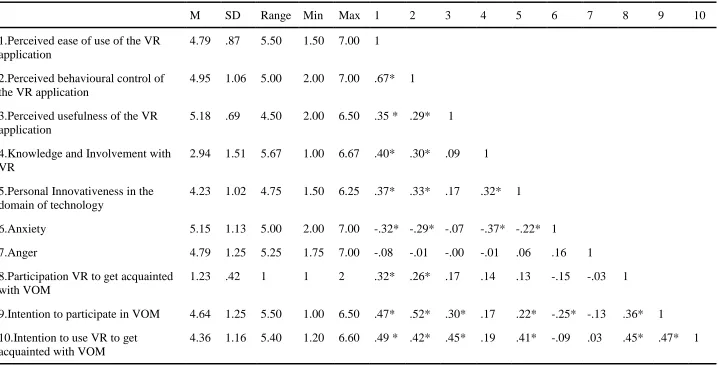
In table 1 it is visible that on the one hand, positive Correlations were found between the
variables perceived ease of use of the VR application, perceived behavioural control of the
VR application, perceived usefulness of the VR application, personal innovativeness in the
domain of technology, knowledge and involvement with VR, intention to participate in VOM,
participation in VR (scheduling a meeting) and the dependent variable intention to use VR to
get acquainted with VOM. Therefore, if one of those items increases, the intention to use VR
to get acquainted with VOM increases as well. Furthermore, positive correlations were found
between perceived ease of use of the VR application, perceived behavioural control of the VR
application, and the participation in VR. Knowledge and involvement with VR, anxiety, and
anger show no significant correlational relationship with the intention to use VR, neither with
the participation in VR.
The mean scores showed moderately high values in all the independent variables,
except for knowledge and involvement with VR. Participants did not consider themselves as
having already a lot of knowledge about VR applications in general but rated their ability to
use it as rather high. Also, the crime incident which was described caused high feelings of
anxiety and moderately high feelings of anger in the participant. The variables indicated a
moderately high intention to use VR to get acquainted with VOM and relatively high interest
16
Table 1
Descriptives and Correlations of the five Independent Variables and the Dependent Variables (intention and use of VR), Moderators, and the
variable intention to participate in VOM.
M SD Range Min Max 1 2 3 4 5 6 7 8 9 10
1.Perceived ease of use of the VR application
4.79 .87 5.50 1.50 7.00 1
2.Perceived behavioural control of the VR application
4.95 1.06 5.00 2.00 7.00 .67* 1
3.Perceived usefulness of the VR application
5.18 .69 4.50 2.00 6.50 .35 * .29* 1
4.Knowledge and Involvement with VR
2.94 1.51 5.67 1.00 6.67 .40* .30* .09 1
5.Personal Innovativeness in the domain of technology
4.23 1.02 4.75 1.50 6.25 .37* .33* .17 .32* 1
6.Anxiety 5.15 1.13 5.00 2.00 7.00 -.32* -.29* -.07 -.37* -.22* 1
7.Anger 4.79 1.25 5.25 1.75 7.00 -.08 -.01 -.00 -.01 .06 .16 1
8.Participation VR to get acquainted with VOM
1.23 .42 1 1 2 .32* .26* .17 .14 .13 -.15 -.03 1
9.Intention to participate in VOM 4.64 1.25 5.50 1.00 6.50 .47* .52* .30* .17 .22* -.25* -.13 .36* 1
10.Intention to use VR to get acquainted with VOM
4.36 1.16 5.40 1.20 6.60 .49 * .42* .45* .19 .41* -.09 .03 .45* .47* 1
17
Hypotheses Testing
Both dependent variables were used in the Analyses, measured in two different ways. One
was defining the intention to use VR to get acquainted with VOM, the other measured if the
participants would participate in VR (behavioural measure).
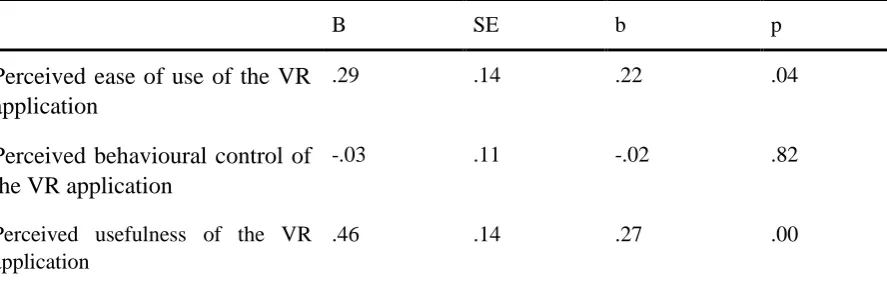
In order to test which independent variables predict the intention to use VR to get
acquainted with VOM, multiple regression analysis was conducted. A significant model was
observed. 44% of the variance in the dependent variable can be explained by the predictors.
Perceived usefulness of the VR application contributes to the greatest prediction of variance
in the dependent variable and age the least. The findings supported the hypotheses that
perceived ease of use of the VR application, perceived usefulness of the VR application and
personal innovativeness in the domain of technology predicted the intention to use VR to get
acquainted with VOM. The variables perceived ease of use (B=.29; p=.04), perceived
usefulness (B=.46; p<.001), personal innovativeness (B=.34;p<.001), age (B=.03; p=.01) and
the intention to participate in VOM (B=.26; p<.001) are significant predictors for the
dependent variable. The other variables were no significant predictors. By looking at the B
value, it is visible that the relationship between the predictors is positive. Therefore, if those
five variables increase, the willingness to participate does as well. Perceived behavioural
control and knowledge and involvement with VR, anxiety, anger, and gender are no
significant predictors for the intention to use VR to get acquainted with VOM due to a p-value
≥.05. Therefore, the hypotheses that perceived behavioural control and knowledge and
involvement with VR predict the intention to use VR to get acquainted with VOM were
[image:17.595.80.524.629.782.2]rejected.
Table 2
Regression coefficients for the independent variables, the moderator variables, the variable
for the intention to participate in VOM as predictors of the intention to use VR to get
acquainted with VOM (n=110).
B SE b p
Perceived ease of use of the VR application
.29 .14 .22 .04
Perceived behavioural control of the VR application
-.03 .11 -.02 .82
Perceived usefulness of the VR application
18 Knowledge and involvement with
VR
.02 .07 .02 .80
Personal innovativeness in the domain of technology
.34 .10 .30 .00
Anxiety .08 .08 .08 .34
Anger .05 .07 .05 .49
Gender .44 .22 .17 .05
Age .03 .01 .21 .01
Intention to participate in VOM .26 .08 .29 .00
Note. Model was found to be statistically significant [F(10,99)=9.66; p<.001], with an
adjusted RSquare of 0.44.
Further, it was found out that 25 participants (22.7%) wanted to schedule a meeting
with the researcher to try out the VR application, and 85 (77.3%) refused to schedule such a
meeting. In order to test which impact the independent variables had on this dichotomous
variable, participation in VR to get acquainted with VOM was used as a second dependent
variable, in order to test if the assumptions from the multiple regression analysis are
supported. A logistic regression analysis was used to find the effect of perceived ease of use
of the VR application, perceived behavioural control of the VR application, perceived
usefulness of the VR application, knowledge and involvement with VR, personal
innovativeness in the domain of technology, anxiety, anger, intention to participate in VOM,
age, gender on the participation in VR (0= no; 1 = yes). The model explained 37.4% of the
variance (NagelkerkeR2 ) in the dependent variable. The logistic regression model was
statistically significant. The variables intention to participate in VOM and age were
significant predictors, Exp (B) = 2.41, p = .017, and Exp (B) = 1.14, p = .013, respectively.
Therefore, the participants who were willing to participate in VOM were more like to
schedule a meeting with the researcher to try out VR and the higher the age, the more likely
was the chance to participate in the meeting. None of the other predictors was significant, all
Exp (Bs) between .80 and 2.19, ps >.14.
By comparing both the logistic regression analysis and the multiple regression
analysis, different results can be seen. In the logistic model, age and intention to participate in
VOM are extracted as Predictors for the participation in VR. However, the multiple regression
19
innovativeness, age and the intention to participate in VOM are significant predictors for the
intention to use VR.
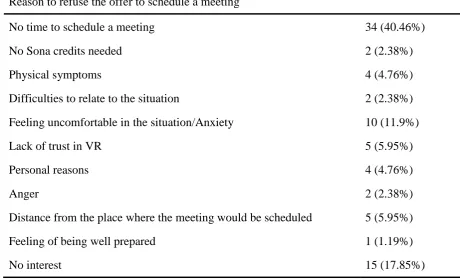
Different reasons were given why participants would not want to schedule a meeting
with the Researcher to try out VR. Answers were given as “I do not feel comfortable with VR.” The Frequencies can be seen in the table underneath. 84 responses were given. Of the 85
people who would not want to schedule a meeting, some gave no reasons and others provided
[image:19.595.67.528.290.570.2]several answers.
Table 3
Frequencies of different reasons which hindered participants from using the VR application.
Reason to refuse the offer to schedule a meeting
No time to schedule a meeting 34 (40.46%)
No Sona credits needed 2 (2.38%)
Physical symptoms 4 (4.76%)
Difficulties to relate to the situation 2 (2.38%)
Feeling uncomfortable in the situation/Anxiety 10 (11.9%)
Lack of trust in VR 5 (5.95%)
Personal reasons 4 (4.76%)
Anger 2 (2.38%)
Distance from the place where the meeting would be scheduled 5 (5.95%)
Feeling of being well prepared 1 (1.19%)
No interest 15 (17.85%)
In order to test the last hypothesis that the variables Anger and Anxiety moderate the
relation between the Independent Variables and the Dependent Variable intention to
participate in VR to get acquainted with VOM, ten Moderation Analyses were conducted by
using PROCESS (Hayes, 2012). Model 1 was used to test if the variables Anger and Anxiety
for each of the independent variables, perceived ease of use of the VR application, perceived
behavioural control of the VR application, perceived usefulness of the VR application,
knowledge and involvement with VR, and personal innovativeness in the domain of
technology moderate their relationship with the intention to use VR. Furthermore, the
20
The Moderator anxiety was tested with each of the independent variables perceived
ease of use, perceived behavioural control, perceived usefulness, knowledge and involvement
with VR and personal innovativeness in the domain of technology, and the covariates gender
and age were used additionally. Therefore, all of the variables were part of each analysis.
Also, the other moderator anger was used as a covariate. A two-way interaction was expected.
However, the findings were against the expectations as no significant Interactions were
revealed, due to p-values of the interaction effects being >.19, and b <.12. Therefore, anxiety
did not moderate the effect of the variables perceived ease of use, perceived behavioural
control, perceived usefulness, knowledge and involvement with VR and personal
innovativeness in the domain of technology on the intention to use VR to get acquainted with
VOM.
Secondly, the moderator anger was also tested with each of the independent variables
and the covariates gender and age. The other moderator anxiety was used as a covariate in
each of the five analyses, a two-way interaction was expected between the independent
variables and the moderator anger. Anger did not moderate the relationship between the
variables perceived ease of use of the VR application, perceived behavioural control of the
VR application, perceived usefulness of the VR application and personal innovativeness in the
domain of technology on the intention to use VR due to p-values >.38, b<.06 of the
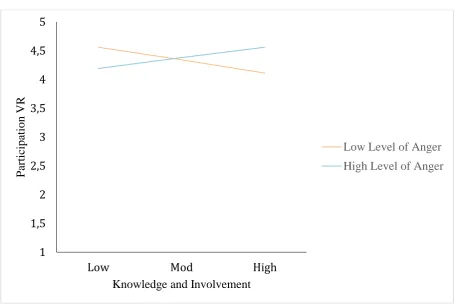
interaction effect. However, a significant interaction effect was found for the variable
knowledge and involvement with VR, and the moderator anger; F (1,99)=5.73, p<.02. Figure
2 displays the impact of anger as a moderator on the relationship between knowledge and
involvement and the intention to participate in VR. But it has to be indicated that the slopes of
knowledge and involvement at different levels of anger are not significant; effects of
knowledge and involvement at different levels of anger are significantly different from each
other but not-significant on their own. As it is visible in the figure, the slopes go in different
directions depending on the values of the moderator. Thus, it shows that no main effect exists
between knowledge and involvement with VR, and intention to use VR, moderated by anger.2
2Exploratory Analysis: A Mediation Analysis was conducted for the independent variables perceived ease of
21
Figure 2. Impact of the Moderator Anger on the Relationship of Knowledge and Involvement
with VR and the intention to use VR to get acquainted with VOM. Participation VR refers in
this case to the variable intention to use VR to get acquainted with VOM.
1 1,5 2 2,5 3 3,5 4 4,5 5
Low Mod High
P
artic
ipation
VR
Knowledge and Involvement
Low Level of Anger
22
Discussion
VOM is a worldwide more and more practiced process of restorative justice, and therefore, it
is increasingly present in the literature. However, participation rates are still not as high as
desired, even though good results could be seen after the process (Hansen & Umbreit, 2018).
Problems arise due to different reasons, ranging from anxiety and uncontrolled emotions to
insecurities concerning the process which might hinder people from participating (Paul &
Schenck-Hamlin, 2017; Daly, 2006). The occurring insecurities might lead to victims not
participating in VOM. In order to prepare victims sufficiently and decrease feelings of anger
and anxiety, VR might be useful as it is also successfully used in the domain of anxiety
disorders and treatment of anger (Miyahira et al., 2010).
Therefore, the current study was conducted to impact the effectiveness of the process
and to find ways to prepare the victim sufficiently as the persisting insecurities need to be
targeted. Due to VR, feelings of insecurity, anxiety, and anger towards meeting the offender
can be treated. In order to give victims the chance to use VR as a preparation to get
acquainted with VOM, factors need to be found which impact people on participating in VR.
It should be examined to what extent the factors from the Technology Acceptance Model
(TAM), Theory of Planned Behaviour (TPB), User Information Satisfaction (UIS) model, and
the character trait personal Innovativeness predict whether crime victims would have the
intention to use VR to get acquainted with VOM, and which impact the emotions anger and
anxiety have on these relationships. It was expected that perceived ease of use of the VR
application, perceived behavioural control of the VR application, perceived usefulness of the
VR application, knowledge and involvement with VR, personal innovativeness in the domain
of technology predict the intention to use VR.
As a result of the research, it was found out, in line with the expectations, that (1)
perceived ease of use, (2) perceived usefulness, (3) personal innovativeness predict the
intention to use VR to get acquainted with VOM. The findings are in line with the TAM
(Davis, 1989) proposing perceived ease of use and perceived usefulness as predictors for the
use of technology. Furthermore, based on Fagan et al. (2012), the just mentioned are also
predictors for the use of VR in a different context than the domain of restorative justice,
together with the predictor personal innovativeness. They found out that those three factors
predict nursing students’ intention to use a VR based simulation for practicing some
study-related practices (Fagan et al., 2012). By using the TAM, they showed that perceived ease of
use, and perceived usefulness predicted the use of VR in the study-related context of nursing
23
perceived ease of use and perceived usefulness were high (Fagan et al., 2012). Also, the
research shows, as in the findings of the current research, that personal innovativeness in the
field of technology predicted the intention to use the application (Fagan et al., 2012).
Furthermore, Herzallah & Mukhtar (2016) showed in their study on the factors predicting the
intention to use and the perception of electronic commerce (EC) services of managers, that
perceived usefulness had an impact on the intention to use the application. As the TAM was
used, it can be assumed that the study also partly goes in line with the current research, but the
different context of this study has to be taken into account. Finally, the current study adds to
the study of Fang, Shao and Lan (2009) as they tested the impact of the factor of personal
innovativeness on participants' intention to use web surveys in different kinds of fields. Fang
et al. (2009) suggest that personal innovativeness had a positive impact on the intention to
participate in web surveys. Thus, the intention to use VR to get acquainted with VOM
depends on perceived ease of use, perceived usefulness, and personal innovativeness,
respectively.
Additionally, it is found in the current study that (4) intention to participate in VOM
and (5) age are predictors for the variable intention to use VR to get acquainted with VOM
and the variable participation in VR, as in the study both intention and behaviour were tried to
be measured. Interestingly, this finding could explain that the intention to use VR to get
acquainted with VOM is given if the victim is rather willing to participate in VOM at
all. Furthermore, Czaja & Lee (2007) show that there might occur changes in cognitive
abilities which are related to age. Those are important for the design of VR applications as it
helps to make VR suitable for the majority of people. The results of Czaja & Lee (2007) say
that older people perceive more anxiety towards using these systems than younger people, and
less confidence is felt towards one’s ability to use them in a successful way (Czaja & Lee,
2007). Therefore, the attitude and technical support and other factors as the type of
application and ease of access have to be taken into account (Czaja & Lee, 2007). However,
the current study supports the opposite findings that age predicts intention to use VR
positively. According to Czaja & Lee (2007), older people would be inhibited to use
technology due to anxiety or less confidence. Different reasons could account for these
findings. On the one hand, the majority of the sample of the current study was below 25, and
thus, the factor age might be not as meaningful. Still, the predictor age on one’s willingness to
use technology as VR might need to be researched further as the cognitive difficulties of older
people should be taken into account and the system should be adapted to reach both old and
24
important predictor for the use of technology in general (Czaja & Lee, 2007). Thus, it would
be useful to define the different needs of older and younger people towards VR and adapt it
accordingly.
Contrary to the expectations, it was concluded that perceived behavioural control of
the VR application and knowledge and involvement with VR are no predictors for the
intention to use VR to get acquainted with VOM. Those hypotheses were refused, which
differs from previous research. Venkatesh et al. (2003) evaluated TPB (Ajzen, 1991) and
showed that perceived behavioural control is supposed to predict the willingness to use
information systems. Also, knowledge and involvement is assumed to predict the use of
information systems (Treacy, 1985). Possible reasons for differing results might be the focus
on information systems, which is not as specific as VR. Also, in the domain of VR, less
knowledge might be initiated from the participants, and also the lack of experience might lead
to a decrease in perceived behavioural control and usage might be perceived as rather
difficult. It can be assumed that most participants have not used VR before. Contrary findings
were also shown by Harrison, Mykytyn & Riemenschneider (1997). It was shown that
perceived behavioural control predicted if small businesses would implement some sort of
information systems (Harrison et al., 1997). No study was found which could predict
perceived behavioural control and knowledge and involvement as predictors for the use of
VR. Even though the results of the current study are negative, it might contribute to existing
knowledge and impact future studies. It needs to be mentioned that Mathieson (1991)
compares TAM with TPB which could give further insight into why perceived ease of use and
perceived usefulness predict the intention to use VR to get acquainted with VOM, while
perceived behavioural control did not. It can be concluded that TAM is focused on the domain
of technology, while TPB was initially derived to predict behaviour in general (Mathieson,
1991). Even though TPB was also used in the technological domain, it might need to be
adapted more specifically to VR by e.g. adding components focusing on specific behaviours
regarding the usage of technology. TAM which is developed from TPB shows predictors for
the intention to use VR and therefore, perceived behavioural control might show which
perceived barriers occur to the participants by using the system but should not be as
meaningful (Mathieson, 1991). The research presented was mainly conducted in the context
of information systems and more generally than it was done in the researcher’s study.
Lastly, anger and anxiety do not moderate the relationship between the predictors
perceived ease of use, perceived behavioural control, perceived usefulness, personal
25
knowledge and involvement of the user and anger. It was assumed, based on Wyrick &
Constanzo (1999), that anger might inhibit participants’ willingness to participate in VOM
and based on Paul & Schenck-Hamlin (2017) that anxiety could also show an interaction
effect. Therefore, it was concluded that the moderators impact the intention to use the VR
application to get acquainted with VOM negatively. An interaction effect was found in just
one case. It can be assumed that participants might perceive feelings of anger and anxiety but
rather saw VR as a tool to get acquainted with VOM as support. Still, anxiety and anger had
no direct effect on the intention to participate in VR. The interaction effect which was found
might explains that feelings of anger influence the relationship between the knowledge and
involvement level of the user and the intention to participate in VR. However, more research
needs to be done in order to be able to generalise those findings, taking the impact of
knowledge and involvement with VR into account. This would be also important in order to
test if the found interaction effect occurred as a coincidence.
Finally, some qualitative data was used to explore the reasons why participants
decided not to take part in VR. Those are important as this would impact the implementation
of VR and it would be easier to develop an application which would find wide support in the
society. Often it was said that the participants were afraid to feel uncomfortable in the
situation or be anxious or did not trust the VR application. This could implicate that the
participants need good support during the use of such an application and the procedure needs
to be explained carefully to them.
Limitations
Some limitations also have to be indicated, which might have an impact on the current study.
One limitation is that the participants were no real victims, and this could make it possible
that they were not able to make accurate judgments regarding the crime.
Also, the crime scenario could be hard to imagine as it was just described through a
text. The participants had to guess if they would participate, and this could differ from their
feelings towards such a decision in reality. As both, crime scenario and VR scenario did not
take place and were just described, also difficulties could evolve through misunderstanding
towards the VR application. It can be concluded that it might impact the generalizability of
the study.
An online questionnaire was implemented, which makes it difficult to control for
outside variables. Therefore, it could be possible that due to emotional arousal based on a
26
might indicate that the participants are generally more open to this kind of technology and
would answer accordingly. And concentration issues might be possible.
Finally, participants took part voluntarily by using the implemented platform SONA
of the University of Twente or were from the researcher’s social network. This could make
the initial motivation to the willingness to participate in VR higher because the participants
choose voluntarily to participate. Thus, it would be interesting to replicate the study with an
unknown sample from a different context.
Implications
It would be from great importance to replicate the studies as the research in the field of VR as
preparation for VOM is rather new. By using VR already in the study, better imagination of
VR could be produced and also by showing, for instance, a video to introduce the participant
to the crime scene might cause different results. Also, using a more diverse sample could help
to define if age is a predictor of the intention to use VR to get acquainted with VOM and
therefore, if VR is suitable preparation for VOM in general or if different approaches need to
be developed for victims. Overall, the scales of the current study showed good validity and
reliability and therefore, it would be useful to replicate the study with similar scales.
Another issue is that due to the voluntariness of VOM it might be difficult to convince
people to take part in a preparation to get acquainted with VOM as the intention to participate
in VOM seems to have an impact on the intention to use VR as a preparation. Therefore, it
might be important to gain research on how to lower the insecurities of those people, for
example through good preparation and also reach victims who are not interested in VOM or
suffer from difficulties in the use of VR.
Additionally, as it is also indicated by Fagan et al. (2012) further research is required
on how personal innovativeness in the domain of technology predicts the participation in VR,
especially in combination with perceived ease of use of the VR application and perceived
usefulness of the VR application. Thus, the current study might be a good start as it is found
out to be a predictor. Also, anger and anxiety should be more deeply taken into account, even
though they were not found to be moderators in the current study. But they are normal
consequences of a crime and definitely need to be taken into account and the victim needs to
be supported to deal with those.
Conclusion
It is important to mention that the use of VR to get acquainted with VOM is quite a new
field, and to the researcher’s knowledge, no studies were exploring this yet. However, more
27
to make VOM accessible to an increasing number of victims. The predictors of the TAM
model should be kept in mind and also the trait of personal innovativeness. The proper
implication of VR application could decrease negative feelings about the process and lower
insecurities. The positive impact of VR in the domain of VOM should be further spread in
society as it might be a huge step to increase participation rates and decrease reoffending after
28
References
Agarwal, R., & Prasad, J. (1998). A conceptual and operational definition of personal
innovativeness in the domain of information technology. Information systems research, 9(2),
204-215.
Ajzen, I. (1991). The theory of planned behavior. Organizational behavior and human
decision processes, 50(2), 179-211.
Beck, A. T., Epstein, N., Brown, G. & Steer, R. A. (1988). An inventory for
measuring clinical anxiety: Psychometric properties. Journal of Consulting and Clinical
Psychology, 56 (6), 893-897.
Choi, J. J., Green, D. L., & Kapp, S. A. (2010). A qualitative study of victim offender
mediation: Implications for social work. Journal of Human Behavior in the Social
Environment, 20(7), 857-874.
Choi, J. J., Gilbert, M. J., & Green, D. L. (2013). Patterns of victim marginalization in
victim-offender mediation: Some lessons learned. Crime, Law and Social Change, 59(1),
113-132.
Czaja, S. J., & Lee, C. C. (2007). The impact of aging on access to technology.
Universal Access in the Information Society, 5(4), 341.
Daly, K. (2006). The limits of restorative justice. Handbook of restorative justice: A
global perspective, 134-145.
Davis, F. D. (1989). Perceived usefulness, perceived ease of use, and user acceptance
of information technology. MIS quarterly, 319-340.
Doorverwijzen. (n.d.) Retrieved from: http://mediationinstrafzaken.nl/verwijzers/.
Fagan, M., Kilmon, C., & Pandey, V. (2012). Exploring the adoption of a virtual
reality simulation: The role of perceived ease of use, perceived usefulness, and personal
innovativeness. Campus-Wide Information Systems, 29(2), 117-127.
Fang, J., Shao, P., & Lan, G. (2009). Effects of innovativeness and trust on web
29
Garcia-Palacios, A., Hoffman, H. G., Kwong See, S., Tsai, A. M. Y., & Botella, C.
(2001). Redefining therapeutic success with virtual reality exposure
therapy. CyberPsychology & Behavior, 4(3), 341-348.
Harrison, D. A., Mykytyn Jr, P. P., & Riemenschneider, C. K. (1997). Executive
decisions about adoption of information technology in small business: Theory and empirical
tests. Information systems research, 8(2), 171-195.
Hansen, T., & Umbreit, M. (2018). State of knowledge: Four decades of victim‐
offender mediation research and practice: The evidence. Conflict Resolution Quarterly, 36(2),
99-113.
Hayes, A. (2012). PROCESS [Macro]. Columbus: The Ohio State University.
Herzallah, A. T., & Mukhtar, M. (2016). The Impact of Perceived Usefulness, Ease of
Use and Trust on Managers’ Acceptance of e-Commerce Services in Small and
Medium-Sized Enterprises (SMEs) in Palestine.
Jerdan, S. W., Grindle, M., van Woerden, H. C., & Boulos, M. N. K. (2018).
Head-mounted virtual reality and mental health: critical review of current research. JMIR serious
games, 6(3), e14.
Lai, P. C. (2017). The literature review of technology adoption models and theories for
the novelty technology. JISTEM, 14(1), 21-38. doi: 10.4301/S1807-17752017000100002
Legris, P., Ingham, J., & Collerette, P. (2003). Why do people use information
technology? A critical review of the technology acceptance model. Information &
management, 40(3), 191-204.
Mathieson, K. (1991). Predicting user intentions: comparing the technology
acceptance model with the theory of planned behavior. Information systems research, 2(3),
173-191.
Miyahira, S. D., Folen, R. A., Stetz, M., Rizzo, A., & Kawasaki, M. M. (2010). Use of
immersive virtual reality for treating anger. Stud Health Technol Inform, 154, 82-86.
Pan, X., & Hamilton, A. F. D. C. (2018). Why and how to use virtual reality to study
human social interaction: The challenges of exploring a new research landscape. British
30
Park, B. W., & Lee, K. C. (2011, April). The effect of users’ characteristics and
experiential factors on the compulsive usage of the smartphone. In International Conference
on Ubiquitous Computing and Multimedia Applications (pp. 438-446). Springer, Berlin,
Heidelberg.
Parsons, T. D., & Rizzo, A. A. (2008). Affective outcomes of virtual reality exposure
therapy for anxiety and specific phobias: A meta-analysis. Journal of behavior therapy and
experimental psychiatry, 39(3), 250-261.
Paul, G. D., & Schenck-Hamlin, W. J. (2017). Beliefs about Victim-Offender
Conferences: Factors Influencing Victim-Offender Engagement. Conflict Resolution
Quarterly, 35(1), 47-72. doi:10.1002/crq.21190
Powers, R. F., & Dickson, G. W. (1973). MisProject management: myths, opinions,
and reality. California Management Review, 15(3), 147-156.
Rothbaum, B. O., Hodges, L. F., Ready, D., Graap, K., & Alarcon, R. D. (2001).
Virtual reality exposure therapy for Vietnam veterans with posttraumatic stress disorder. The
Journal of clinical psychiatry.
Sheeran, P., Trafimow, D., & Armitage, C. J. (2003). Predicting behaviour from
perceived behavioural control: Tests of the accuracy assumption of the theory of planned
behaviour. British journal of social psychology, 42(3), 393-410.
Shen, C. W., Ho, J. T., Ly, P. T. M., & Kuo, T. C. (2018). Behavioural intentions of
using virtual reality in learning: perspectives of acceptance of information technology and
learning style. Virtual Reality, 1-12.
Sherman, L. W., Strang, H., Mayo-Wilson, E., Woods, D. J., & Ariel, B. (2015). Are
restorative justice conferences effective in reducing repeat offending? Findings from a
Campbell systematic review. Journal of Quantitative Criminology, 31(1), 1-24.
Srivastava, K., Das, R. C., & Chaudhury, S. (2014). Virtual reality applications in
mental health: Challenges and perspectives. Industrial psychiatry journal, 23(2), 83.
Treacy, M. E. (1985). An empirical examination of a causal model of user information
satisfaction. Center for Information Systems Research, Sloan School of Management,
31
Umbreit, M. S., Coates, R. B. & Vos, B. (2004). Victim-offender mediation: Three
decades of practice and research. Conflict Resolution Quarterly, 22 (1-2). Retrieved from:
http://onlinelibrary.wiley.com/doi/10.1002/crq.102/abstract.
Venkatesh, V., & Davis, F. D. (1996). A model of the antecedents of perceived ease of
use:Development and test.Decision Sciences,27,451–481.
Venkatesh, V., Morris, M. G., Davis, G. B., & Davis, F. D. (2003). User acceptance of
information technology: Toward a unified view. MIS quarterly, 425-478.
Wyrick, P. & Costanzo, M. (1999). Predictors of client participation in
Victim-Offender Mediation. Mediation Quarterly, 16, 253–257.
Zebel, S., Schreurs, W., & Ufkes, E. G. (2017). Crime seriousness and participation in
restorative justice: The role of time elapsed since the offense. Law and Human Behavior, 41,
385-397. DOI: 10.1037/lhb0000242.
Zehr, H. (2015). The little book of restorative justice: Revised and updated. Simon and