Instance Based Lexical Entailment for Ontology Population
Claudio Giuliano and Alfio Gliozzo
FBK-irst, Istituto per la Ricerca Scientifica e Tecnologica I-38050, Trento, ITALY
{giuliano,gliozzo}@itc.it
Abstract
In this paper we propose an instance based method for lexical entailment and apply it to automatic ontology population from text. The approach is fully unsupervised and based on kernel methods. We demonstrate the effectiveness of our technique largely surpassing both the random and most fre-quent baselines and outperforming current state-of-the-art unsupervised approaches on a benchmark ontology available in the liter-ature.
1 Introduction
Textual entailment is formally defined as a relation-ship between a coherent textT and a language ex-pression, the hypothesis H. T is said to entail H, denoted byT →H, if the meaning ofHcan be in-ferred from the meaning of T (Dagan et al., 2005; Dagan and Glickman., 2004). Even though this no-tion has been recently proposed in the computano-tional linguistics literature, it has already attracted a great attention due to the very high generality of its set-tings and to the indubitable usefulness of its (poten-tial) applications.
In this paper, we concentrate on the problem of lexical entailment, a textual entailment subtask in which the system is asked to decide whether the sub-stitution of a particular wordwwith the wordein a coherent text Hw = HlwHr generates a sentence
He = HleHr such thatHw → He, where Hl and
Hr denote the left and the right context of w, re-spectively. For example, given the word ‘weapon’ a
system may substitute it with the synonym ‘arm’, in order to identify relevant texts that denote the sought concept using the latter term. A particular case of lexical entailment is recognizing synonymy, where bothHw→HeandHe→Hwhold.
In the literature, slight variations of this problem are also referred to assense matching(Dagan et al., 2006), lexical reference (Glickman et al., 2006a) and lexical substitution (Glickman et al., 2006b). They have been applied to a wide variety of tasks, such as semantic matching, subtitle generation and Word Sense Disambiguation (WSD). Modeling lex-ical entailment is also a prerequisite to approach the SemEval-2007 lexical substitution task1, consisting of finding alternative words that can occur in given context.
In this paper, we propose to apply an approach for lexical entailment to the ontology population task. The basic idea is that if a word entails another one in a given context then the former is an instance or a subclass of the latter. This approach is intuitively appealing because lexical entailment is intrinsically an unsupervised task, therefore it does not require lexical resources, seed examples or manually anno-tated data sets. Unsupervised approaches are partic-ularly suited for ontology population, whose goal is to find instances of concepts from corpora, because both corpus and the ontology sizes can scale up to millions of documents and thousands of concepts, preventing us from applying supervised learning. In addition, the top level part of the ontology (i.e., the
Tboxin the Description Logics terminology) is very
1
http://nlp.cs.swarthmore.edu/semeval/ tasks/task10/description.shtml
often modified during the ontology engineering life-cycle, for example by introducing new concepts and restructuring the subclass of hierarchy according to the renewed application needs required by the evo-lution of the application domain. It is evident that to preserve the consistency between the Tbox and the Abox (i.e., the set of instances and their rela-tions) in such a dynamic ontology engineering pro-cess, supervised approaches are clearly inadequate, as small changes in the TBox will be reflected into dramatic annotation effort to keep instances in the Abox aligned.
The problem of populating a predefined ontol-ogy of concepts with novel instances implies a WSD task, as the entities in texts are ambiguous with re-spect to the domain ontology. For example, the en-tityWashingtonis both the name of a state and the name of a city. In the ontology population settings traditional WSD approaches cannot be directly ap-plied since entities are not reported into dictionar-ies, making the lexical entailment alternative more viable. In particular, we model the problem of on-tology population as the problem of recognizing for each mention of an entity of a particular coarse-grained type (e.g., location) the fine-coarse-grained con-cept (e.g., lake or mountain) that can be substi-tuted in texts preserving the meaning. For example, in the sentence “the first man to climb the Everest without oxygen”, “Everest” can be substituted with the word mountain preserving the meaning, while the sentence is meaningless when “Everest” is re-placed with the word lake. Following the lexical entailment approach, the ontology population task is transformed into the problem of recognizing the term from a fine-grained set of categories (e.g., city, country, river, lake and mountain) that can be substi-tuted in the contexts where the entity is mentioned (e.g., Everest in the example above).
The main contributions of this paper are summa-rized as follows. First, we propose a novel approach to lexical entailment, called Instance Based Lexi-cal Entailment (IBLE), that allows approaching the problem as a classification task, in which a given target word (i.e., the entailing word) in a particu-lar context is judged to entail a different word taken from a (pre-defined) set of (possible) candidate en-tailed words (see Section 3). Second, we exploit the IBLE approach to model the ontology population
task as follows. Given a set of candidate concepts belonging to generic ontological types (e.g., peo-ple or locations), and a set of pre-recognized men-tions of entities of these types in the corpus (e.g., Newton, Ontario), we assign the entity to the class whose lexicalization is more frequently entailed in the corpus. In particular, as training set to learn the fine-grained category models, we use all the oc-currences of their corresponding expressions in the same corpus (e.g., we collected all occurrences in context of the wordscientistto describe the concept
scientist). Then, we apply the trained model to classify the pre-recognized coarse-grained entities into the fine-grained categories.
Our approach is fully unsupervised as for training it only requires occurrences of the candidate entailed words taken in their contexts. Restricted to the on-tology population task, for each coarse-grained en-tity (e.g., location), the candidate entailed words are the terms corresponding to the fine-grained classes (e.g., lake or mountain) and the entailing words are mentions of entities (e.g., New York, Ontario) be-longing to the coarse-grained class, recognized by an entity tagger.
Experiments show that our method for recog-nizing lexical entailment is effective for the on-tology population task, reporting improvements over a state-of-the-art unsupervised technique based on contextual similarity measures (Cimiano and V¨olker, 2005). In addition, we also compared it to a supervised approach (Tanev and Magnini, 2006), that we regarded as an upper bound, obtaining com-parable results.
2 The Ontology Population Task
high accuracy, but they require a large amount of training data. However, domain specific ontologies generally contains many “fine-grained” categories (e.g., particular categories of people, such as writ-ers, scientists, and so on) and, as a consequence, su-pervised methods cannot be used because the anno-tation costs would become prohibitive.
Therefore, in the literature, the fine-grained clas-sification task has been approached by adopting weakly supervised (Tanev and Magnini, 2006; Fleis-chman and Hovy, 2002) or unsupervised methods (Cimiano and V¨olker, 2005). Tanev and Magnini (2006) proposed a weakly supervised method that requires as training data a list of terms without con-text for each class under consideration. Such list can be automatically acquired from existing ontologies or other sources (i.e., database fields, web sites like Wikipedia, etc.) since the approach imposes virtu-ally no restrictions on them. Given a generic syntac-tically parsed corpus containing at least each train-ing entity twice, the algorithm learns, for each class, a feature vector describing the contexts where those entities occur. Then it compares the new (unknown) entity with the so obtained feature vectors, assigning it to the most similar class. Fleischman and Hovy (2002) approached the ontology population problem as a classification task, providing examples of in-stances in their context as training examples for their respective fine-grained categories.
The aforementioned approaches are clearly inad-equate to recognize such fine-grained distinctions, as they would require a time consuming and costly annotation process for each particular class, that is clearly infeasible when the number of concepts in the ontology scales up. Therefore, most of the present research in ontology population is focus-ing on either unsupervised approaches (Cimiano and V¨olker, 2005) or weakly supervised approaches (Tanev and Magnini, 2006).
Unsupervised approaches are mostly based on term similarity metrics. Cimiano and V¨olker (2005) assign a particular entity to the fine-grained class such that the contextual similarity is maximal among the set of fine-grained subclasses of a coarse-grained category. Contextual similarity has been measured by adopting lexico-syntactic features provided by a dependency parser, as proposed in (Lin, 1998).
3 Instance Based Lexical Entailment
Dagan et al. (2006) adapted the classical supervised WSD setting to approach the sense matching prob-lem (i.e., the binary lexical entailment probprob-lem of deciding whether a word, such as position, entails a different word, such as job, in a given context) by defining a one-class learning algorithm based on support vector machines (SVM). They train a one-class model for each entailed word (e.g., all the oc-currences of the wordjobin the corpus) and, then, apply it to classify all the occurrences of the entail-ing words (e.g., the wordposition), providing a bi-nary decision criterion2. Similarly to the WSD case, examples are represented by feature vectors describ-ing their contexts, and then compared to the feature vectors describing the context of the target word.
In this paper, we adopt a similar strategy to ap-proach a multi-class lexical entailment problem. The basic hypothesis is that if a word w entails
e in a particular context (Hw → He), then some of the contexts Tej in which e occurs in the train-ing corpus are similar to Hw. Given a word w and an (exhaustive) set of candidate entailed words
E = {e1, e2, . . . , en}, to which we refer hereafter with the expression “substitution lexica”, our goal is to select the wordei ∈ E that can be substituted to
win the contextHw generating a sentenceHesuch thatHw → He. In the multi-class setting, super-vised learning approaches can be used. In particular, we can apply a one-versus-all learning methodology, in which each classei is trained from both positive (i.e., all the occurrences ofeiin the corpus) and neg-ative examples (i.e., all the occurrences of the words in the set{ej|j6=i}).
Our approach is clearly a simplification of the more general lexical entailment settings, where given two generic words w and e, and a context
H=HlwHr, the system is asked to decide whether
w entails e or not. In fact, the latter is a binary classification problem, while the former is easier as the system is required to select “the best” option among the substitution lexicon. Of course providing such set could be problematic in many cases (e.g., it could be incomplete or simply not available for
2
many languages or rare words). On the other hand, such a simplification is practically effective. First of all, it allows us to provide both positive and nega-tive examples, avoiding the use of one-class classi-fication algorithms that in practice perform poorly (Dagan et al., 2006). Second, the large availabil-ity of manually constructed substitution lexica, such as WordNet (Fellbaum, 1998), or the use of reposi-tories based on statistical word similarities, such as the database constructed by Lin (1998), allows us to find an adequate substitution lexicon for each target word in most of the cases.
For example, as shown in Table 1, the word job
has different senses depending on its context, some of them entailing its direct hyponymposition(e.g., “looking for permanent job”), others entailing the word task (e.g., “the jobof repairing”). The prob-lem of deciding whether a particular instance ofjob
can be replaced by position, and not by the word
place, can be solved by looking for the most simi-lar contexts where eitherpositionorplaceoccur in the training data, and then selecting the class (i.e., the entailed word) characterized by the most similar ones, in an instance based style. In the first example (see row 1), the word jobis strongly associated to the wordposition, because the contexts of the latter in the examples 1 and 2 are similar to the context of the former, and not to the wordtask, whose con-texts (4, 5 and 6) are radically different. On the other hand, the second example (see row 2) of the word
jobis similar to the occurrences 4 and 5 of the word
task, allowing its correct substitution.
It is worthwhile to remark that, due to the ambi-guity of the entailed words (e.g.,positioncould also entail eitherperspectiveorplace), not every occur-rence of them should be taken into account, in order to avoid misleading predictions caused by the irrele-vant senses. Therefore, approaches based on a more classical contextual similarity technique (Lin, 1998; Dagan, 2000), where words are described “globally” by context vectors, are doomed to fail. We will pro-vide empirical epro-vidence of this in the evaluation sec-tion.
Choosing an appropriate similarity function for the contexts of the words to be substituted is a pri-mary issue. In this work, we exploited similar-ity functions already defined in the WSD literature, relying on the analogy between the lexical
entail-ment and the WSD task. The state-of-the-art super-vised WSD methodology, reporting the best results in most of the Senseval-3 lexical sample tasks in dif-ferent languages, is based on a combination of syn-tagmatic and domain kernels (Gliozzo et al., 2005) in a SVM classification framework. Therefore, we adopted exactly the same strategy for our purposes.
A great advantage of this methodology is that it is totally corpus based, as it does not require nei-ther the availability of lexical databases, nor the use of complex preprocessing steps such as parsing or anaphora resolution, allowing us to apply it on dif-ferent languages and domains once large corpora are available for training. Therefore, we exploited ex-actly the same strategy to implement the IBLE clas-sifier required for our purposes, defining a kernel composed by n simple kernels, each representing a different aspect to be considered when estimating contextual similarity among word occurrences. In fact, by using the closure properties of the kernel functions, it is possible to define the kernel combi-nation schema as follows3:
KC(xi, xj) = n
X
l=1
Kl(xi, xj)
p
Kl(xj, xj)Kl(xi, xi)
, (1)
whereKlare valid kernel functions, measuring sim-ilarity between the objectsxi andxj from different perspectives4.
One means to satisfy both the WSD and the lex-ical entailment requirements is to consider two dif-ferent aspects of similarity: domain aspects, mainly related to the topic (i.e., the global context) of the texts in which the word occurs, and syntagmatic as-pects, concerning the lexico-syntactic pattern in the local context. Domain aspects are captured by the domain kernel, described in Section 3.1, while tagmatic aspects are taken into account by the syn-tagmatic kernel, presented in Section 3.2.
3
Some recent works (Zhao and Grishman, 2005; Gliozzo et al., 2005) empirically demostrate the effectiveness of com-bining kernels in this way, showing that the combined kernel always improves the performance of the individual ones. In ad-dition, this formulation allows evaluating the individual contri-bution of each information source.
4
Entailed job Training
position ... looking for permanent academicjobin ... 1 ... from entry-level through permanentpositions. 2 My academicposition...
3 ... put the lamp in the leftposition... task Thejobof repairing 4 Thetaskof setting up ...
[image:5.612.71.573.59.159.2]5 Repairing the engine is an hardtask. 6 ...taskbased evaluation.
Table 1: IBLE example.
3.1 The Domain Kernel
(Magnini et al., 2002) claim that knowing the do-main of the text in which the word is located is a cru-cial information for WSD. For example the (domain) polysemy among the Computer Science and the Medicinesenses of the word viruscan be solved by simply considering the domain of the con-text in which it is located. Domain aspects are also crucial in recognizing lexical entailment. For exam-ple, the termvirusentailssoftware agentin theComputer Science domain (e.g., “The lap-top has been infected by a virus”), while it entails
bacteriumwhen located in theMedicinedomain (e.g., “HIV is a virus”). As argued in (Magnini et al., 2002), domain aspects can be considered by an-alyzing the lexicon in a large context of the word to be disambiguated, regardless of the actual word order. We refer to (Gliozzo et al., 2005) for a de-tailed description of the domain kernel. The sim-plest methodology to estimate the domain similar-ity among two texts is to represent them by means of vectors in the Vector Space Model (VSM), and to exploit the cosine similarity. The VSM is a k -dimensional space Rk, in which the text tj is rep-resented by means of the vectort~j such that theith component of t~j is the term frequency of the term
wi in it. The similarity between two texts in the VSM is estimated by computing the cosine between them, providing the kernel functionKV SM that can be used as a basic tool to estimate domain similarity between texts5.
5
In (Gliozzo et al., 2005), in addition to the standard VSM, a domain kernel, exploiting external information acquired from unlabeled data, has been also used to reduce the amount of (la-beled) training data. Here, given that our approach is fully un-supervised, i.e., we can obtain as many examples as we need, we do not use the domain kernel.
3.2 The Syntagmatic Kernel
Syntagmatic aspects are probably the most impor-tant evidence for recognizing lexical entailment. In general, the strategy adopted to model syntagmatic relations in WSD is to provide bigrams and trigrams of collocated words as features to describe local con-texts (Yarowsky, 1994). The main drawback of this approach is that non contiguous or shifted colloca-tions cannot be identified, decreasing the general-ization power of the learning algorithm. For ex-ample, suppose that the word jobhas to be disam-biguated into the sentence “. . . permanent academic
job in. . . ”, and that the occurrence “We offer per-manent positions. . . ” is provided for training. A traditional feature mapping would extract the con-text words w−1:academic, w−2:permanent
to represent the former, and w−1:permanent, w−2:offerto index the latter. Evidently such
fea-tures will not match, leading the algorithm to a mis-classification.
4 Lexical Entailment for Ontology Population
In this section, we apply the IBLE technique, de-scribed in Section 3, to recognize lexical entailment for ontology population. To this aim, we cast ontol-ogy population as a lexical entailment task, where the fine-grained categories are the candidate entailed words, and the named entities to be subcategorized are the entailing words. Below, we present the main steps of our algorithm in details.
Step 1 By using a state-of-the-art supervised NER system, we recognize the named entities belonging to a set of coarse-grained categories (e.g., location and people) of interest for the domain.
Step 2 For all fine-grained categories belonging to the same coarse-grained type, we extract from a do-main corpus all the occurrences of their lexicaliza-tions in context (e.g., for the category actor, we extract all contexts where the term actor occurs), and use them as input to train the IBLE classifier. In this way, we obtain a multi-class classifier for each ontological type. Then, we classify all the occur-rences of the named entities recognized in the first step. The output of this process is a list of tagged named entities; where the elements of the list could have been classified into different fine-grained cat-egories even though they refer to the same phrase (e.g., the occurrences of the entity “Jack London” could have been classified both as writer and
actor, depending on the contexts where they oc-cur).
Step 3 A distinct category is finally assigned to the entities referring to the same phrase in the list. This is done on the basis of the tags that have been as-signed to all its occurrences during the previous step. To this purpose, we implemented a voting mecha-nism. The basic idea is that an entity belongs to a specific category if its occurrences entail a particu-lar superclass “more often than expected by chance”, where the expectation is modeled on the basis of the overall distribution of fine-grained category labels, assigned during the second step, in the corpus. This intuition is formalized by applying a statistical reli-ability measure, that depends on the distribution of positive assignments for each class, defined by the
following formula:
R(e, c) = P(c|e)−µc σc
, (2)
whereP(c|e)is estimated by the relative frequency of the fine-grained class c among the different oc-currences of the entity e, µc and σc measure the mean and the standard deviation of the distribution
P(c|E), andE is an (unlabeled) training set of in-stances of the coarse-grained type classified by the IBLE algorithm. Finally, each entity is assigned to the categoryc∗such that
c∗ =argmax
c
R(e, c). (3)
5 Evaluation
Evaluating a lexical entailment algorithm in itself is rather complex. Therefore, we performed a task driven evaluation of our system, measuring its use-fulness in an ontology population task, for which evaluation benchmarks are available, allowing us to compare our technique to existing state-of-the-art approaches.
As introduced in Section 4, the ontology popu-lation task can be modeled as a lexical entailment problem, in which the fine-grained classes are the entailed words and the named entities belonging to the coarse-grained ontological type are the entailing words.
In the following, we first introduce the experimen-tal settings (Section 5.1). Then we evaluate our tech-nique by comparing it to state-of-the-art unsuper-vised approaches for ontology population (Section 5.2).
5.1 Experimental Settings
For all experiments, we adopted the evaluation benchmark proposed in (Tanev and Magnini, 2006). It considers two high-level named entity cate-gories both having five fine-grained sub-classes (i.e.,
mountain, lake,river,city, andcountry
as subtypes ofLOCATION;statesman,writer,
athlete,actor, andinventorare subtypes of
the English CLEF corpus6. Even the evaluation task is rather small and can be perceived as an artificial experimental setting, it is the best available bench-mark we can use to compare our system to existing approaches in the literature, as we are not aware of other available resources.
To perform NER we used CRFs (Lafferty et al., 2001). We trained a first-order CRF on the MUC data set to annotate locations and people. In our experiments, we used the implementation provided in MALLET (McCallum, 2002). We used a stan-dard feature set inspired by the literature on text chunking and NER (Tjong Kim Sang and Buch-holz, 2000; Tjong Kim Sang and De Meulder, 2003; Tjong Kim Sang, 2002) to train a first-order CRFs. Each instance is represented by encoding all the following families of features, all timeshifted by -2,-1,0,1,2: (a) the word itself, (b) the PoS tag of the token, (c) orthographic predicates, such as cap-italization, upper-case, numeric, single character, andpunctuation, (d) gazetteers of locations, people names and organizations, (e) character-n-gram pred-icates for26n63.
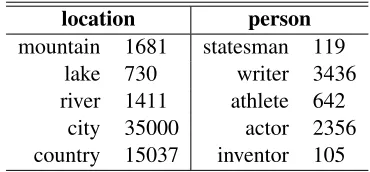
As an (unsupervised) training set for the fine-grained categories, we exploited all occurrences in context of their corresponding terms we found in the CLEF corpus (e.g., for the categoryactorwe used all the occurrences of the termactor). We did not use any prior estimation of the class frequency, adopting a pure unsupervised approach. Table 2 lists the fine-grained concepts and the number of the training examples found for each of them in the CLEF corpus.
As a reference for a comparison of the outcomes of this study, we used the results presented in (Tanev and Magnini, 2006) for the Word and Class-Example approaches. The Class-Word approach ex-ploits a similarity metric between terms and con-cepts based on the comparison of the contexts where they appear. Details of this technique can be found in (Cimiano and V¨olker, 2005). Tanev and Magnini (2006) proposed a variant of the Class-Word algo-rithm, called Class-Example, that relies on syntactic features extracted from corpus and uses as an addi-tional input a set of training examples for each class. Overall, it required 1,194examples to accomplish
6
http://www.clef-campaign.org
this task.
All experiments were performed using the SVM package LIBSVM7 customized to embed our own kernel. In all the experiments, we used the default parameter setting.
location person
mountain 1681 statesman 119 lake 730 writer 3436 river 1411 athlete 642
[image:7.612.333.518.141.227.2]city 35000 actor 2356 country 15037 inventor 105
Table 2: Number of training examples for each class.
5.2 Results
Table 4 shows our results compared with two base-lines (i.e., random and most frequent, estimated from the test data) and the two alternative ap-proaches for ontology population described in the previous section. Our system outperforms both baselines and largely surpasses the Class-Word un-supervised method.
It is worthwhile to remark here that, being the IBLE algorithm fully unsupervised, improving the most frequent baseline is an excellent result, rarely achieved in the literature on unsupervised methods for WSD (McCarthy et al., 2004). In addition, our system is also competitive when compared to super-vised approaches, being it only 5 points lower than the Class-Example method, while it does not require seed examples and syntactic parsing. This charac-teristic makes our system flexible and adaptable to different languages and domains.
System Micro F1 Macro F1 RND Baseline 0.20 0.20
Class-Word 0.42 0.33
MF baseline 0.52 NA
IBLE 0.57 0.47
[image:7.612.329.526.554.640.2]Class-Example 0.62 0.68
Table 3: Comparison of different ontology popula-tion techniques.
7
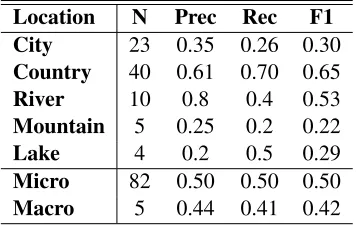
Finally, we performed a disaggregated evaluation of our system, assessing the performance for differ-ent ontological types and differdiffer-ent concepts. Re-sults show that our method performs better on larger fine-grained classes (i.e.,writerandcountry), while the results on smaller categories are affected by low recall, even if the predictions provided by the system tends to be highly accurate. Taking into consideration that our system is fully unsupervised, this behavior is highly desirable because it implies that it is somehow able to identify the predominant class. In addition the high precision on the smaller classes can be explained by our instance based ap-proach.
Person N Prec Rec F1 Inventor 11 1 0.18 0.31
Statesman 20 1.0 0.05 0.10
Writer 88 0.61 0.89 0.72
Actor 25 0.57 0.68 0.62
Athlete 20 1 0.1 0.18
Micro 164 0.61 0.61 0.61
[image:8.612.92.280.261.375.2]Macro 5 0.83 0.38 0.52
Table 4: Performance of the IBLE approach on peo-ple.
Location N Prec Rec F1 City 23 0.35 0.26 0.30
Country 40 0.61 0.70 0.65
River 10 0.8 0.4 0.53
Mountain 5 0.25 0.2 0.22
Lake 4 0.2 0.5 0.29
Micro 82 0.50 0.50 0.50
Macro 5 0.44 0.41 0.42
Table 5: Performance of the IBLE approach on lo-cations.
6 Conclusions and Future Work
In this paper, we presented a novel unsupervised technique for recognizing lexical entailment in texts, namely instance based lexical entailment, and we exploited it to approach an ontology population task. The basic assumption is that if a word is entailed by another in a given context, then some of the
contexts of the entailed word should be similar to that of the word to be disambiguated. Our tech-nique is effective, as it largely surpasses both the random and most frequent baselines. In addition, it improves over the state-of-the-art for unsupervised approaches, achieving performances close to the su-pervised rivaling techniques requiring hundreds of examples for each class.
Ontology population is only one of the possible applications of lexical entailment. For the future, we plan to apply our instance based approach to a wide variety of tasks, e.g., lexical substitution, word sense disambiguation and information retrieval. In addition, we plan to exploit our lexical entailment as a subcomponent of a more complex system to rec-ognize textual entailment. Finally, we are going to explore more elaborated kernel functions to recog-nize lexical entailment and more efficient learning strategies to apply our method to web-size corpora.
Acknowledgments
The authors would like to thank Bernardo Magnini and Hristo Tanev for providing the benchmark, Ido Dagan for useful discussions and comments regarding the connections between lexical entail-ment and ontology population, and Alberto Lavelli for his thorough review. Claudio Giuliano is sup-ported by the X-Media project (http://www. x-media-project.org), sponsored by the Eu-ropean Commission as part of the Information So-ciety Technologies (IST) program under EC grant number IST-FP6-026978. Alfio Gliozzo is sup-ported by the FIRB-Israel research project N. RBIN045PXH.
References
Philipp Cimiano and Johanna V¨olker. 2005. Towards large-scale, open-domain and ontology-based named entity classification. In Proceedings of RANLP’05, pages 66– 166–172, Borovets, Bulgaria.
I. Dagan and O. Glickman. 2004. Probabilistic tex-tual entailment: Generic applied modeling of language variability. InProceedings of the PASCAL Workshop on Learning Methods for Text Understanding and Min-ing, Grenoble.
[image:8.612.97.278.437.550.2]challenge. InProceedings of the PASCAL Challenges Workshop on Recognising Textual Entailment.
Ido Dagan, Oren Glickman, Alfio Gliozzo, Efrat Mar-morshtein, and Carlo Strapparava. 2006. Direct word sense matching for lexical substitution. In Proceed-ings ACL-2006, pages 449–456, Sydney, Australia, July.
I. Dagan. 2000. Contextual word similarity. In Rob Dale, Hermann Moisl, and Harold Somers, editors,
Handbook of Natural Language Processing, chap-ter 19, pages 459–476. Marcel Dekker Inc.
C. Fellbaum. 1998. WordNet. An Electronic Lexical Database. MIT Press.
Michael Fleischman and Eduard Hovy. 2002. Fine grained classification of named entities. In Proceed-ings of ACL-2002, pages 1–7, Morristown, NJ, USA.
William A. Gale, Kenneth W. Church, and David Yarowsky. 1992. Work on statistical methods for word sense disambiguation. In R. Goldman et al., editor,
Working Notes of the AAAI Fall Symposium on Prob-abilistic Approaches to Natural Language, pages 54– 60.
Claudio Giuliano, Alfio Massimiliano Gliozzo, and Carlo Strapparava. 2006. Syntagmatic kernels: a word sense disambiguation case study. In Proceedings of the EACL-2006 Workshop on Learning Structured In-formation in Natural Language Applications, Trento, Italy, 5-7 April.
O. Glickman, E. Shnarch, and I. Dagan. 2006a. Lexical reference: a semantic matching subtask. In proceed-ings of EMNLP 2006.
Oren Glickman, Ido Dagan, Mikaela Keller, Samy Ben-gio, and Walter Daelemans. 2006b. Investigating lexi-cal substitution scoring for subtitle generation. In Pro-ceedings of CoNLL-2006.
A. Gliozzo, C. Giuliano, and C. Strapparava. 2005. Do-main kernels for word sense disambiguation. In Pro-ceedings of ACL-2005, pages 403–410, Ann Arbor, Michigan, June.
John Lafferty, Andrew McCallum, and Fernando Pereira. 2001. Conditional random fields: Probabilistic mod-els for segmenting and labeling sequence data. In
Proceedings of ICML-2002, pages 282–289, Williams College, MA. Morgan Kaufmann, San Francisco, CA.
Dekang Lin. 1998. Automatic retrieval and clustering of similar words. InProceedings of ACL-98, pages 768– 774, Morristown, NJ, USA.
B. Magnini, C. Strapparava, G. Pezzulo, and A. Gliozzo. 2002. The role of domain information in word sense disambiguation. Natural Language Engineer-ing, 8(4):359–373.
Andrew Kachites McCallum. 2002. Mal-let: A machine learning for language toolkit. http://mallet.cs.umass.edu.
Diana McCarthy, Rob Koeling, Julie Weeds, and John Carroll. 2004. Finding predominant word senses in untagged text. In Proceedings of ACL-2004, Barcelona, Spain, July.
J. Shawe-Taylor and N. Cristianini. 2004. Kernel Meth-ods for Pattern Analysis. Cambridge University Press.
Hristo Tanev and Bernardo Magnini. 2006. Weakly su-pervised approaches for ontology population. In Pro-ceedings of EACL-2006, Trento, Italy.
Erik Tjong Kim Sang and Sabine Buchholz. 2000. In-troduction to the CoNLL-2000 shared task: Chunking. InProceedings of CoNLL-2000, Lisbon, Portugal.
Erik F. Tjong Kim Sang and Fien De Meulder. 2003. In-troduction to the CoNLL-2003 shared task: Language-independent named entity recognition. InProceedings of CoNLL-2003, pages 142–147, Edmonton, Canada.
Erik F. Tjong Kim Sang. 2002. Introduction to the CoNLL-2002 shared task: Language-independent named entity recognition. InProceedings of CoNLL-2002, pages 155–158, Taipei, Taiwan.
D. Yarowsky. 1994. Decision lists for lexical ambiguity resolution: Application to accent restoration in Span-ish and French. InProceedings of ACL-94, pages 88– 95, Las Cruces, New Mexico.