Integrating a Neutral Action Language
in a DEVS Modelling Environment
Bruno Barroca McGill University
Sadaf Mustafiz McGill University
Simon Van Mierlo University of Antwerp
Hans Vangheluwe University of Antwerp
ABSTRACT
Visual environments for the modelling and simulation of complex, software-intensive systems are increasingly popular. While visual languages have many advantages, they may not be appropriate to render all details of a Discrete EVent system Specification (DEVS) model. Textual may be more appropriate, both to completely de-scribe all details of a DEVS model (i.e., the content of transition and output functions), and to make the specification independent of the implementation platform (i.e., simulation implementation lan-guage).
In this paper, we propose two textual notations that are used as part of an integrated modelling and simulation environment for the Parallel DEVS formalism. Both notations allow the specification of DEVS functions by means of neutral action code.DEVSProuses Python-like textual syntax and supports the full power of Paral-lel DEVS. From this neutral specification, simulator-specific code is synthesized. DEVSLangsupports blended textual/visual mod-elling. It is more restricted in expressiveness to match the lim-ited expressiveness of visual notations. For example, the sequential states in an Atomic model must be explicitly enumerated.
Visual DEVSLang models are transformed to their textual form in order to carry out syntactic and semantic checks. Possible de-tected errors are fed back to the visual modelling environment al-lowing the modeller to make changes directly in the source model. DEVSLang models are further translated automatically to DEVSPro models to allow for possible combination with DEVSPro models and subsequent analysis and simulation.
Keywords
Parallel DEVS; textual syntax; neutral action code
1.
INTRODUCTION
As modern systems become more complex, they also become more and more difficult to describe and analyze. This is partly due to the high diversity in existing modelling and simulation (M&S) languages and environments. Examples of this diversity range from models (of systems and their environment), over (textual and/or vi-sual) modelling tools, to efficient simulators. The success of M&S
.
endeavours is increasingly dependent on our ability to re-use mod-elling and simulation solutions in a modular way.
Zeigler proposed the elegant DEVS formalism [21]. Models in different formalisms can be mapped onto it, making it a universal simulation “assembly language” [17]. As such, it enables the mod-ular combination of different modelling languages, as well as their simulators. DEVS models are typically encoded in a programming language or at least using an API that embodies the essential as-pects of DEVS models and their simulation semantics. Examples include ADEVS [9] which uses C++ and Python Parallel DEVS (PyPDEVS) [16].
Various solutions to standardize and support DEVS modelling and simulation interoperability have been proposed [8, 13, 3]. We postulate that modern M&S frameworks should be based on a us-able and appropriate DEVS formalism with neutral (i.e., implemen-tation platform/language-independent) action code. But what does this neutrality property really mean? Does it mean that its design should be in close relation with existing programming languages, so that it would be easier to reverse-engineer existing code and port it across platforms? Or should it instead be in close relation with Zeigler’s DEVS formalism?
In this paper, we address these questions by building an Inte-grated M&S Environment (IM&SE) that integrates two distinct tex-tual notations for the DEVS formalism, DEVSLang and DEVSPro, as presented in Figure 1. Each notation is designed for a different purpose, hence, each notation linguistically conforms to a different linguistic type model [1], simply referred metamodel throughout this paper.
While DEVSLang has restricted expressiveness in order to be generally fully renderable in a visual modelling environment, DE-VSPro provides the full expressiveness of DEVS. On the one hand, modellers can then reuse their Statechart-like models (e.g., UML StateCharts or even timed automata) by easily porting them to DE-VSLang, and then visually editing/debugging them in AToMPM. On the other hand, modellers can reuse existing libraries of DEVS models (e.g., ADEVS models) by also easily porting them to VSPro. By automatically translating DEVSLang models into DE-VSPro models, our IM&SE enables the composition and integra-tion of all the ported models in the development of new ones.
Similar to other solutions [19, 10], these languages use a neutral action code in order to express functions that we know by construc-tion are indeed DEVS transiconstruc-tion or output funcconstruc-tions. Users can define several types of DEVS functions in order to not only reuse functionality but also to guarantee correctness. For instance, it is guaranteed that all of the defined output functions are only reading atomic component states, and cannot be composed with (i.e., in-ternally call) other modifying functions, such as internal transition functions.
SIMUTOOLS 2015, August 24-26, Athens, Greece Copyright © 2015 ICST
In order to study the integration of DEVSPro with DEVSLang and in order to develop a DEVS-IM&S environment, we built two meta-models, one for each formalism. The relationship between both languages is implemented by means of automated model trans-formation.
We demonstrate our approach by building a DEVS IM&SE: not only by (conceptually) integrating/merging our two formalisms, but also (in practice) combining an existing visual DEVS modelling en-vironment built in our AToMPM (A Tool for Multi-Paradigm Mod-elling [12]), with an existing Parallel DEVS Simulator: PyPDEVS. In this IM&SE, modellers are able to visually define DEVS mod-els while using embedded textual action code in order to specify each of the DEVS transition/output functions. The consistency and conformance of the defined DEVS models can then be analyzed using our DEVS syntax and static-semantics analyzer. The DEVS models can then also be debugged and simulated within the same environment [15].
The rest of this paper is structured as follows: Section 2 gives a brief theoretical background on Parallel DEVS. Section 3 intro-duces both formalisms while describing the pertinence and prag-matics of their textual notations (DEVSLang and DEVSPro). Sec-tion 4 discusses the static-semantics and contextual analysis that is required in order to produce models that are semantically con-forming to the DEVS theory. Tool support for the analysis of the action code is described in Section 5. Finally, Section 6 presents a comparison with other related work, and Section 7 concludes by highlighting our contributions and discussing future work.
2.
BACKGROUND
The DEVS formalism was introduced by Zeigler [21, 22], as a rigorous basis for the compositional modelling and simulation of discrete event systems. This section briefly presents the Parallel DEVS formalism, a variant of the original Classic DEVS.
DEVS allows modelling at two distinct levels of abstraction:
atomicandcoupledcomponents. An atomic component model
de-scribes the discrete-event autonomous and reactive timed behaviour of system.
An atomic model is formally defined as,
aDEV S=< X, Y, S, δint, δext, δconf, λ, ta >
whereinput set Xdenotes the set of admissible input events of the model such thatX = ×m
i=1Xi withXidenoting each of them admissible inputs on porti;output set Ydenotes the set of admis-sible output events of the model such thatY = ×l
i=1YiwithYi denoting each of theladmissible outputs on porti;state set Sis the set of sequential states;internal transition functionδintdefines the next sequential state depending on the current state,δint:S→S;
output functionλmaps the sequential state set onto a bag of
out-put events, λ : S → Yb; external transition functionδext gets called whenever anexternal input event (∈ Xb) is received by the model,δext : Q×Xb → SwithQ = {(s, e)|s ∈ S,0 ≤
e < ta(s)}whereeis the elapsed time; time advance function ta
defines the simulation time the system remains in the current state before triggering itsinternal transition functionsuch thatta:S → R+0,+∞; and finally, theconfluent transition function is called if
both an internal and external transition occur at the same simula-tion time, replacing both funcsimula-tions such thatδconf :S×Xb→S. A coupled component model describes the composition of sev-eral concurrent submodels which can be either atomic or coupled. Submodels haveports, which are connected by channels defining a
transfer functionto translate output to input events. Ports and
chan-nels allow a component model to receive/send events from/to other models. A coupled DEVS model is closed under coupling, which
means its meaning can be given by “flattening” to a behaviourally equivalent atomic DEVS model.
An abstract simulator for Parallel DEVS computes the next state of the system (a “step”) until its end condition is satisfied. Each step consists of the following phases:
1. Compute the set of atomic DEVS models whose internal transitions are scheduled to fire (imminent components). 2. Execute the output function for each imminent component,
causing events to be generated on the output ports.
3. Route events from output ports to input ports, translating them in the process by executing the transfer functions. 4. Determine the type of transition to execute for the atomic
DEVS model, depending on it being imminent and/or receiv-ing input.
5. Execute, in parallel, all enabled internal, external, and con-fluent transition functions.
6. Compute, for each atomic DEVS model, the time of its next internal transition (specified by its time advance function).
3.
DEVS IM&S ENVIRONMENT
Our integrated DEVS modelling environment uses the Model-verse [14] as its model repository and model management facil-ity. The Modelverse is an infrastructure for scalable and efficient model-management. It includes a built-in meta-modelled action language to give basic execution support to various model oper-ations, such as conformance checks performed on models w.r.t. metamodels. Based on such analysis, it produces model instances. It also supports rule-based model transformations. The notion of time is not present in the currently supported action code. There-fore, the integration of time-aware formalisms such as DEVS in the Modelverse is desirable.
In our work, we make use of a visual modelling, simulation, and debugging environment for Parallel DEVS that is already avail-able in AToMPM [12] (A Tool for Multi-Paradigm Modelling), a generic visual front-end for the Modelverse.
Our initial task is to allow models, visually edited in AToMPM and stored in the Modelverse, to be retrieved, edited textually in a textual shell (and possibly imported back into the AToMPM visual view). For this purpose, we propose a language, DEVSLang, with an expressiveness equal to that of DEVS models that can be visu-ally represented. Note that not all DEVS models can be explicitly modelled visually as we can only draw a finite number of sequential states or external transition functions.
The second task is to be able to reuse the parsing and analysis features of the textual shell for the checking of the transition-, time advance- and output functions of a DEVS model.
The third task is to translate all DEVS models automatically for use in existing simulators. As an example, we compile DEVS mod-els into PyPDEVS [16], which is a DEVS-based language grafted onto the Python language, with a matching simulator. It supports various features (such as tracing, checkpointing, and real-time sim-ulation) and formalisms (classic DEVS, parallel DEVS, etc.). As PyPDEVS combines the full expressiveness of the Parallel DEVS formalism with that of the programming language Python, a lan-guage is needed at this expressiveness level too. For this purpose, we propose the language DEVSPro, from which PythonPDEVS code will be synthesized. We must ensure that DEVSPro(i)has an action code part that is as expressive as Python but yet(ii) en-ables a strictly verifiable conformance with DEVS.
Graphical + TextualGraphical + Textual TextualTextual
ADEVS
ADEVS
PythonDEVS
PythonDEVS
DEVSLangParser DEVSLangParser DEVSLang
Graphical + TextualGraphical + Textual TextualTextual DEVSProParser DEVSProParser DEVSPro
DEVSLang
Metamodel MetamodelDEVSPro
[[ ]]
Transformation Metamodel
Concrete Syntax Mapping Transformation Deployment
M
od
el
ve
rs
e
Linguistic Conformance
Figure 1: Overview of the approach.
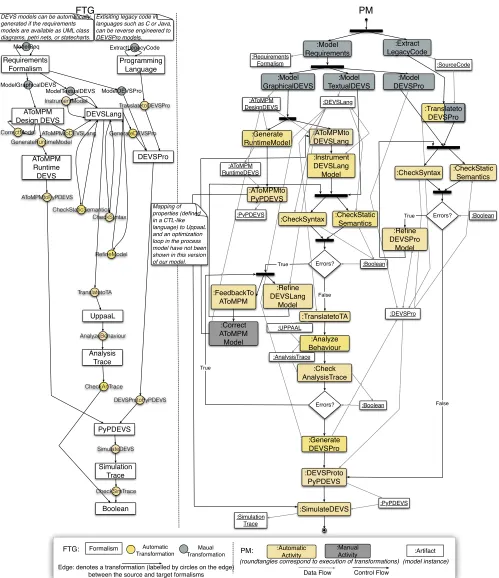
thesis, that are part of our DEVS IM&SE. The FTG describes in an explicit and precise way, formalisms, and their relationships as transformations between formalisms. The PM defines an actual Model-Based Systems Engineering process using these formalisms and transformations. As depicted in the FTG+PM, DEVSPro mod-els are transformed to PyPDEVS for simulation purposes. All DE-VSLang models need to be transformed to DEVSPro in order to allow for the synthesis of the PyPDEVS code. This transforma-tion to DEVSPro also allows models to be ported to different target platforms, and makes it possible for advanced users to adapt exist-ing DEVS models in an unrestricted manner: for instance, with-out imposing the definition of a state enumeration on each Atomic component.
3.1
DEVSPro
DEVSPro is based on DEVS theory and is at an abstraction level closer to programming languages to allow expert users to exploit the full power of DEVS while maintaining a close conformance with the DEVS theory. The formalism is conceptually identical to PyPDEVS with a specific abstract syntax and semantics.
With regards to the tool integration aspect, the semantics of DE-VSPro is given by mapping it to PyPDEVS. The formalism is com-posed of two kinds of syntactic structures: syntactic structures ex-pressing action code in DEVS functions and syntactic structures expressing the structure of DEVS models (i.e., the atomic and cou-pled components).
DEVSPro is rooted in the Modelverse by means of an action language. The textual shell allows modellers to read a file module and load it. The ‘import’ feature allow modellers to refer to and load new class definitions. In the example below, ‘statedef’ is a class being imported as a means to define the ‘ProcessorState’, that is then instantiated in the atomic component ‘Processor’ as ‘idle’.
1 top:
2 importstatedef
3 ...
4 statedef ProcessorState: 5 constructor(name, job=None): 6 self.name = name 7 self.job = job
8 ...
9 atomicProcessor: 10 constructor():
11 self.state= ProcessorState(’idle’) 12 self.outports= {’p_out’} 13 self.inports= {’p_in’} 14 ...
Listing 1: Snippet of the Producer-Consumer Example in DEVSPro
In the context of the example above, the notion of constructor (with a Python-style syntax) enables a given atomic component (in this case ‘Processor’) to bind, at instantiation phase, with a given state definition (in this case ‘ProcessorState’). The reserved word ‘state’ is used in order to refer to the concept stateS, but its type
is, by default, left underspecified. In the example, it is bound to an instance of ProcessorState of type statedef. The reserved words ‘inports’ and ‘outports’ are used to define the names of the input and output ports, respectively. Each port allows interface connec-tions and logical dependencies with other components. The chosen names for the ports typically reflect the communication usage from the point of view of the component (i.e., from an OO perspective). In our example, if it was a producer of proteins, the processor’s input port would be simply named ‘protein’ which, when assigned becomes a reserved word in the atomic component known as a type of input port.
However, in the case of complex atomic component initializa-tions, the map of typed (input/output) port names could be changed during simulation. Given that these port names can be changed in the arrival/departure of an event, we could have a conflict between out-dated instances with the subsequent modification of the ports. For now, we avoid discussions about the correct scheduling in order to avoid or mitigate these conflicts that could only happen in more complex conditions.
Notice that although we present a deployment to PyPDEVS as an example of DEVSPro semantics, we only show it in that partic-ular platform, not with its full semantics, which is to be by defini-tion platform-neutral. Following Zeigler’s formalism, the full se-mantics remains largely underspecified in what matters to concrete semantics and representations, although complete in what matters to internal consistency rules. This is enforced by construction on any DEVSPro type system, conforming with the DEVSPro’s type model.
The textual shell allows the user to define functions in many dif-ferent ways. Functions are considered to be type definitions. In this case, a function call is just an instance of a Function type. How-ever, DEVSPro Atomic components (in the example above atomic Processor) are forced to redefine a set of Function types, each of them conforming to a particular DEVSPro Function Meta-Type. From the time advance functiontato the output functionλ, each of them are semantically typed according to Zeigler’s formalism. The correct analysis of each of these function types is, of course, limited by our analysis algorithms, but if we impose semantic type-restrictions in the way the modeller composes DEVSPro models, it may be possible to assure and verify the preservation of these se-mantic types—i.e., the consistency rules inherent from each of the functions’ requirements, such as, for instance, the return type of the internal functionδintversusthe return type of the time advance functionta.
:Model TextualDEVS :Model
GraphicalDEVS
:Generate DEVSPro
:DEVSProto PyPDEVS
:AToMPMto DEVSLang :Generate
RuntimeModel
Errors? True
:TranslatetoTA
:Analyze Behaviour
False
:Correct AToMPM Model
:Boolean
:DEVSPro :DEVSLang
:AToMPM DesignDEVS
:UPPAAL
DEVSPro
CheckSyntax
Analysis Trace
AnalyzeBehaviour GenerateDEVSPro
RefineModel
AToMPM Runtime DEVS
ModelGraphicalDEVS
GenerateRuntimeModel
AToMPMtoPyPDEVS
AToMPM Design DEVS Requirements
Formalism
ModelReq
CheckAnTrace
UppaaL
ModelTextualDEVS
DEVSLang
AToMPMtoDEVSLang
PyPDEVS
DEVSProtoPyPDEVS
Simulation Trace
SimulateDEVS
Boolean
CheckSimTrace InstrumentModel
CorrectModel
DEVS models can be automatically generated if the requirements models are available as UML class diagrams, petri nets, or statecharts.
:Model Requirements
:Requirements Formalism
:AToMPMto PyPDEVS
:Instrument DEVSLang Model
:Refine DEVSLang
Model
:AToMPM RuntimeDEVS
TranslatetoTA CheckStaticSemantics
:CheckStatic Semantics
:FeedbackTo AToMPM
:AnalysisTrace
:Check AnalysisTrace
Errors? True
:Boolean :PyPDEVS
:SimulateDEVS :PyPDEVS
:Simulation Trace
Programming Language
ExtractLegacyCode
TranslatetoDEVSPro
Extisiting legacy code in languages such as C or Java, can be reverse engineered to DEVSPro models.
ModelDEVSPro
FTG PM
:Extract LegacyCode
:SourceCode
:Translateto DEVSPro :Model
DEVSPro
Errors? True
False
:Boolean
:CheckSyntax
:Refine DEVSPro
Model
:CheckStatic Semantics
Mapping of properties (defined in a CTL-like language) to UppaaL and an optimization loop in the process model have not been shown in this version of our model.
PM: :Artifact
FTG: Formalism Automatic Transformation
:Manual Activity Maual
Transformation
:CheckSyntax
:Automatic Activity
Control Flow Data Flow
Edge: denotes a transformation (labelled by circles on the edge) between the source and target formalisms
(roundtangles correspond to execution of transformations) (model instance)
Figure 2: A Formalism Transformation Graph and Process Model (FTG+PM) for DEVS: the PM is depicted as an activity diagram (on the right) and the FTG is depicted as a hypergraph (on the left) withlanguagesas nodes andtransformationsas edges).
in the example can be just an Integer).
This means that this component, when connected, since the atomic component Processor will have portp_outwith event values of type Integer, the other DEVS component must be reading events from the corresponding input port of the same type Integer.
be-1
2 atomicProcessor: 3 constructor():
4 self.state= ProcessorState(’idle’) 5 self.outports= {’p_out’} 6 self.inports= {’p_in’} 7
8 timeAdvance():
9 if self.state.name == ’idle’:
10 returnINFINITY
11 else:
12 if self.state.name == ’processing’: 13 return self.state.job.jobSize 14
15 outputFnc():
16 if self.state.name == ’idle’:
17 return{}
18 else:
19 if self.state.name == ’processing’:
20 return{self.outports[’p_out’]: [self.state.job]} 21
22 intTransition():
23 if self.state.name == ’processing’: 24 returnProcessorState(’idle’) 25
26 extTransition(inputs): 27 if self.state.name == ’idle’:
28 returnProcessorState(’processing’, / 29 job=inputs[self.inports[’p_in’]][0]) 30
31 confTransition(inputs):
32 pass
33 ...
Listing 2: Snippet of the Producer-Consumer Example in DEVSPro
cause action code is a sequence of statements. This means that in a sequence of statements, each ‘if’ or ‘while’ imposes a constraint that has more priority than the constraint on the next statement. The constraints are added to the return types on each branch of the dataflow diagram imposed on any give action code execution. It is possible, however, to override this implicit constraint-priorization by using logical connectors such as ‘and’, in order to assign the same priority, However in the case of ‘or’, we must assure that both operands are logically disjoint, otherwise we would have more type-check ambiguity (and in particular non-determinism) in the port assignments while evaluating coupled components.
1 ...
2 coupledProducerConsumer: 3 constructor(): 4 self.outports= {} 5 self.inports= {}
6 self.submodels= {’g’:Generator(), ’p’:Processor(), / 7 ’cp’:CoupledProcessor(), ’collector’:Collector()} 8 self.connectPorts(self.submodels[’g’].outports[’p_out’], / 9 self.submodels[’p’].inports[’p_in’])
10 self.connectPorts(self.submodels[’p’].outports[’p_out’], / 11 self.submodels[’cp’].inports[’p_in’])
12 self.connectPorts(self.submodels[’cp’].outports[’p_out’], / 13 self.submodels[’collector’].inports[’p_in’])
14 ...
Listing 3: Snippet of the Producer-Consumer Example in DEVSPro
In the listing above, we show a coupled DEVS model named ‘ProducerConsumer’ that instantiates its internal DEVS compo-nents during its construction, and places them in the reserved vari-able ‘submodels’. Notice that all of the instances are typed by con-struction using the user-defined DEVS component types ‘Genera-tor’, ‘Processor’, etc. Instantiating the connectPorts function en-ables the binding of input with output ports from all of the instan-tiated internal DEVS components: i.e., the channels. Not shown but, it is also possible to pass a user-defined transfer function as a parameter of the connectPorts built-in. A suitable transfer function will have exactly one parameter—i.e., a value from some source port in a connection—, and will return a value, which at simulation-time is passed to the target port on that connection. In either case, the type checker has to ensure that the type of the events on the input port, of a given component, is consistent with the type of the events on the output port, of the other component.
Finally, we present the ‘bottom’ function. Notice that
parame-1 ...
2 bottom:
3 sim = ProducerConsumer()
4 ...
5 sim.setVerbose(None) 6 sim.setTerminationTime(100)
7 sim.simulate()
Listing 4: Snippet of the Producer-Consumer Example in DEVSPro
terless functions (as mere action code labels) are always executed and cannot be used as types. At the end of the DEVSPro module file, we instantiate one of the coupled models (namely the ‘Produc-erConsumer’) and set some attributes by instantiating pre-defined simulation Function types (verbose and termination time). These must be defined for a given platform (in this case PyPDEVS). No-tice that, since the textual shell supports dynamic type operations on instances, it is possible at any moment in time to extend a given ProducerConsumer instance with a new platform-dependent func-tionality. Finally, we run the simulate function in order to produce simulation traces (not shown here).
3.2
DEVSLang
DEVSLang is a language whose expressiveness is identical to that of the DEVS formalism encoded for the visual modelling in AToMPM—i.e., the AToMPM Design DEVS in Figure 2. This means that the abstract syntax of textual DEVSLang is the same as that of the visual DEVSLang language in AToMPM. In our envi-ronment, the formalism has been associated with two different con-crete syntaxes:(i)a 100% textual concrete syntax and(ii)a blended visual and textual concrete syntax for modelling in AToMPM. The textual concrete syntax here refers to DEVSLang’s neutral action language.
The DEVSLang textual syntax primarily allows the specifica-tion of composite structures defined with coupled DEVS, and the specification of each atomic DEVS component along with its asso-ciated time advances, output function, transition functions, transfer functions, confluent functions, and port definitions. The events and state definitions are by default included as syntactic constructs in the textual model.
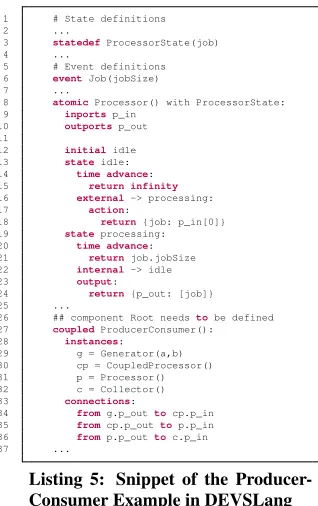
We now detail the concrete syntax for DEVSLang by partially showing (due to space constraints) the corresponding DEVSLang model (Listing 5) for the Producer-Consumer example presented in Section 3.1. An exporter in AToMPM is able to generate the DE-VSLang textual models from the visual DEVS models (Figure 8a). In comparison with the DEVSPro model of the ProducerCon-sumer shown before, this example reveals that its representation in DEVSLang becomes much more compact. This is mostly be-cause it builds on an enumeration of states that is implicitly de-fined in each atomic component. For instance, in the ‘Processor’ component, the used ‘ProcessorState’ will be a tuple containing an enumeration, with only two possible values (idleandprocessing), and a variablejob. Notice that in DEVSLang, each state definition ‘statedef’ only defines regular state variables: for instance, ‘Pro-cessorState’ definesjobas a state variable.
In the case of DEVSLang, the types of parameters are restricted to basic datatypes (String, Boolean, Integer, Float, etc.). DEVS-Lang includes pre-defined constructs for state definition (as in line 3), events (as in line 6), atomic components (as from lines 8 to line 24), and coupled components (as from line 27 to line 36).
1 # State definitions
2 ...
3 statedefProcessorState(job)
4 ...
5 # Event definitions 6 eventJob(jobSize)
7 ...
8 atomicProcessor() with ProcessorState: 9 inportsp_in
10 outportsp_out 11
12 initialidle 13 stateidle: 14 time advance: 15 return infinity
16 external-> processing:
17 action:
18 return{job: p_in[0]} 19 stateprocessing: 20 time advance: 21 returnjob.jobSize 22 internal-> idle 23 output:
24 return{p_out: [job]}
25 ...
26 ## component Root needstobe defined 27 coupledProducerConsumer(): 28 instances:
29 g = Generator(a,b) 30 cp = CoupledProcessor() 31 p = Processor() 32 c = Collector() 33 connections:
34 fromg.p_outtocp.p_in 35 fromcp.p_outtop.p_in 36 fromp.p_outtoc.p_in
37 ...
Listing 5: Snippet of the Producer-Consumer Example in DEVSLang
means of either ‘external’ transitions or ‘internal’ transitions. Each transition function points to a given state name (which will be the name of the state as defined in type ‘statedef’), and returns a map of parameters which must always conform to a user-defined ‘statedef’ type instance. The conforming implication of a given atomic com-ponent with a given ‘statedef’ type instance is set explicitly with the keyword ‘with’ (see line 8).
3.3
Mapping and Merging
In order to illustrate the commonalities between both languages, and also to compare their expressiveness, Table 1 provides a map-ping from DEVSLang to DEVSPro constructs. TheOO transla-tion functransla-tion is applied to all actransla-tionstatementsin order to make the expressions consistent with object-orientation navigation fea-tures. Similarly, theCondtranslation function is applied to an ac-tion statement block converting it into a DEVSPro condiac-tion func-tion type withreturn type Boolean, which is then directly instanti-ated in a givenif statement’s condition.
Although not mentioned in Table 1, the rule that is applied to the time advance function is also applied to the output function. The same is true for external transitions and both internal transitions and confluent transitions. Also not shown is the trivial mapping between the coupled component’s graph: theconnectionsbetween DEVSLang’sinstances(these ones mapped into the respective DE-VSPro component’ssubmodels) are mapped onto calls to the DE-VSPro reserved methodconnectPorts.
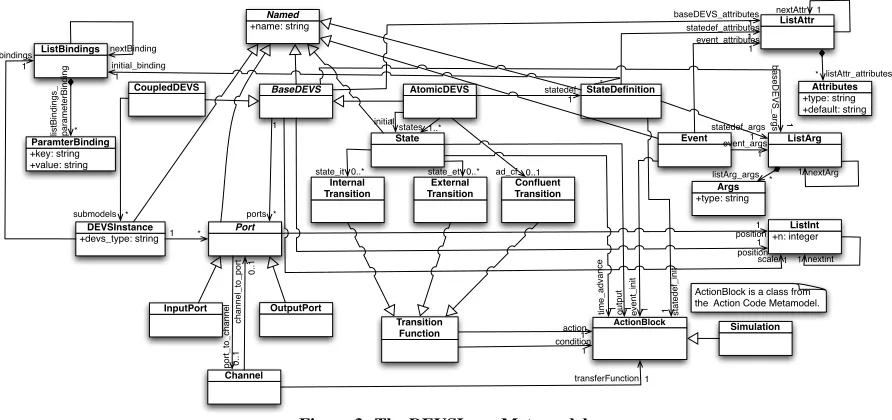
Figure 3 presents the core of the DEVSLang metamodel. If we compare this metamodel with the DEVSPro metamodel, we see that in DEVSPro there is no fixed state definition structure, and therefore DEVS functions are directly defined under the atomic component definition (instead of being under a given state decla-ration). Also, we see that unlike DEVSLang, DEVSPro allows user-defined functions, and in particular parameterless functions. Finally, it is not shown, but following DEVS theory, theelapsed
keyword is defined in both formalisms as an attribute that can be accessed inside a given atomic component.
The action code metamodel used in DEVSLang is shown in Fig-ure 4. The action code metamodel of DEVSPro is a superset of
DEVSLang Concepts DEVSPro Concepts statedef SDName:
statedef SDName(pars..) constructor(pars..): self.par1 = xpto
.. ..
atomic CName() with SDName: atomic CName:
.. constructor():
initial ISName self.state = SDName(ISName)
.. ..
atomic CName(args..) .. atomic CName: constructor(args..):
.. ..
atomic CName() ..: atomic CName:
.. constructor():
inports p, q,.. self.inports = {’p’, ’q’, ..} outports r, s,.. self.outports = {’r’, ’s’, ..}
.. ..
atomic CName()..: atomic CName:
.. ..
state SName: timeAdvance():
timeAdvance: if self.state == ’SName’: Statements.. OO(Statements..)
.. ..
atomic CName() with SDN: atomic CName:
.. ..
state SN: extTransition(inputs): external−>SON: if self.state == ’SN’
condition: and Cond(Stms..):
Stms.. OO(Stms’)..
action: return SDN(’SON’, args)
Stms’.. ..
.. ..
Table 1: Reference mapping between DEVSLang Concepts and DEVSPro Concepts.
ActionBlock
Statement
Assignment
IFElse
Declaration
name: String
While
Expression
id: String
NavigationExpression Unop
Not Binop
Parenthesis
NEqual
Add
LEThan
LThan
Div Mult
Mod
GThan
Subtract
Equal Selection GEThan AtomValue
StringValue
value: String
FloatValue
value: Float
IntegerValue
value: Intetger
BooleanValue
value: Boolean
Composite
Dict DictArgument
name: String
Array Tuple
* statement 1 whilebody
1 while_condition return_expr
1 if_condition
1 ifbody1 elsebody
0..1
0..1 1 1
binop_ right binop_ left 1 *
element
key
unop_ expression
1 1left right
Or
And Minus
Return Continue
Break PlusAssignment
PlainAssignment MinusAssignment
value 1
type 1
1
Figure 4: Neutral Action Code Metamodel used in both DEVS-Lang and DEVSPro. The DEVSPro’s Method Definition con-struct is not shown since it only represents an instantiation possi-bility in DEVSPro models.
CoupledDEVS BaseDEVS AtomicDEVS +devs_type: string DEVSInstance Port InputPort OutputPort Simulation Event StateDefinition +name: string Named Internal Transition External Transition Confluent Transition Channel ActionBlock +n: integer ListInt ListAttr ListArg +type: string +default: string Attributes +type: string Args +key: string +value: string ParamterBinding ListBindings nextBinding initial_binding 1 * bindings 1 * submodels * 1 * 0..1 0..1 1 * ports 1 1 1 position position scale nextint nextArg nextAttr listArg_args * listAttr_attributes * condition action 1 1 1 st a te d e f_ in it 1 e ve n t_ in it transferFunction 1 statedef 1 statedef_attributes 1 1 1 1 baseDEVS_attributes 1 event_attributes 1 b a se D EVS_ a rg s 1 event_args 1 list Bi n d in g s_ p a ra me te rBi n d in g statedef_args 1 p o rt _ to _ ch a n n e l ch a n n e l_ to _ p o rt 1 time _ a d va n ce 1 output
ActionBlock is a class from the Action Code Metamodel.
State
0..* 1..*
0..* states
state_it state_et ad_cf 0..1
1
initial
Transition Function
Figure 3: The DEVSLang Metamodel.
4.
ANALYSIS
The grammar specifications for the languages DEVSLang and DEVSPro drives the automated generation of their respective parsers that as shown before are able to recognize their sentences and assert their syntactic correctness. In particular, they issue syntactic errors when some grammar rule is violated.
However, the syntactic rules are not expressive enough to ensure consistency of the specified DEVS models, and more importantly their conformance to the original Parallel DEVS theory. For in-stance, it is possible to write an output function that modifies exist-ing state variables, which is incorrect under DEVS theory.
We will now observe how we can exploit the usage of textual notations to model DEVS and, most importantly, the usage of ac-tion code, in order to provide powerful mechanisms for consistency analysis.
4.1
Static Semantics
Since the information contained in context-free grammars is not sufficient to enable sophisticated evaluations of the parsed DEVS-Lang model, we need to provide additional information in order to capture all the semantic rules required for both our DEVS lan-guages. In particular, the following rules have to be specified, and dealt separately in an evaluation procedure distinct from parsing.
• Each reference marked on the ‘with’ on each atomic compo-nent definition, must point to a valid declared state definition. • Each atomic block must have exactly one initial definition. • Each external, internal or confluent function, must have at
most one condition block and one action block.
• The target pointed to by either an external, internal or con-fluent functions must be a valid defined state defined on the same atomic component.
• Function calls referenced in any expression in the action code must point to a valid Event declaration, and therefore must comply with its required parameters.
• On every two connected instances, the mapped written and read values on the respective connectedinportsandoutports names must have compatible types.
• On the expressions, any specified operation must be consis-tent w.r.t. declared types of their operands (which can again be operations).
4.2
Checking Conformance with DEVS
The contextual analysis can go deep by analyzing conditional branches, in order to check the return and parameter types of the time-advance, internal/external/confluent transition and output func-tions. It can, for instance, check the only allowed read/write vari-able access within the above functions (e.g., the elapsed varivari-able in the condition of an external function).
The action code defined in the condition part of each transition definition can be analyzed in order to check that the component’s variables are just being read: meaning that the evaluation of a con-dition cannot change the variables of a given component, or of any other defined component.
The complete set of access rules for conformance checking is presented in Table 2. It details for each function, the expected types for the condition and action blocks. Warnings are issued if the analysis is inconclusive, and errors are issued if an inconsis-tency is detected.
For the sake of brevity we omit the rules for the transfer functions on the coupled DEVS.
The DEVSPro syntax for DEVS functions does not offer any explicit distinction between the condition and action parts. There-fore, the resulting conformance checking will have to be necessar-ily weaker. However, we can reuse the analysis made for DEVS-Lang (as detailed in Table 2) for DEVSPro, with the exceptions that here we apply both the rules for conditions and actions. In the outputF unc, the checker allows read access for all the variables except theself.inportandself.elapsedvariables.
5.
ACTION CODE ANALYSIS
As outlined in the previous section, we have implemented a parser and analyzer to carry out syntactic and structural semantic checks of our DEVS models. In this section, we demonstrate these auto-mated analyses implemented in our DEVS modelling environment by means of the Producer-Consumer example.
Action Code in DEVSPro. New or existing models can be ana-lyzed by the parser/checker to identify syntactic and contextual er-rors. The Producer-Consumer example DEVSPro model presented in Section 3.1 (including errors this time) was analyzed for syntac-tic errors. Fig. 5 shows the results of the analysis (the first error detected).
Time Advance Internal Function External Function Confluent Function Output
Function Condition Action Code Condition Action Code Condition Action Code Function
Return Type Float Boolean Map Boolean Map Boolean Map Map(*)
State variables Read Only Read Only Read/Write Read Only Read/Write Read Only Read/Write Read Only
Inport variables N/A N/A N/A Read Only N/A Read Only N/A N/A
Outport variables N/A N/A N/A N/A N/A N/A N/A Write Only
Elapsed variable N/A N/A N/A Read Only N/A Read Only N/A N/A
Table 2: Contextual Analysis Rules for DEVSLang models. (*) where all labels belong to defined Outports in given Atomic Compo-nent
Figure 5: Producer-Consumer DEVSPro Model Snippet: Ex-ample Error (incomplete return statement)
Figure 6: Producer-Consumer DEVSLang Model Snippet: Ex-ample Error (incorrect state name specified)
Figure 7: Contextual Check Example Error
the action code in the defined functions can be checked for syntactic errors, conformance errors, and for contextual errors. The action code in the Producer-Consumer DEVSLang model in Listing 5 was analyzed for syntactic and semantics errors. Fig. 6 shows the initial error returned.
In Figure 7, we show the result of a contextual check. In this case, a statement in an output function is trying to change the value of a state variable. A DEVS output function should however not change a component’s state.
While this section only demonstrates validation of action code, our tool checks the entire model for syntactic errors.
Action Code in AToMPM. The DEVSLang models constructed in our visual front-end, AToMPM, includes transition functions spec-ified as DEVSLang action code. As in many current tools, these functions were originally defined using a programming language (Python in our case), which was not validated for syntax or se-mantics. The exported Python code needed to be parsed and any
changes made in the Python code were not updated in the original model (or it was updated manually which could lead to even more errors). Furthermore, the Python models were platform-dependent which restricted portability to different simulators. Using neutral action code alows the models to be validated in the front-end and also keeps the model consistent with the generated DEVSLang and DEVSPro models.
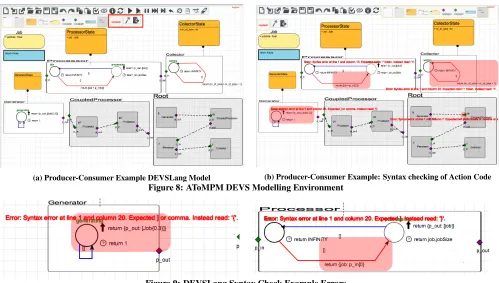
We have implemented a feedback loop such that the errors de-tected in the generated textual DEVSLang model can be fed back to the AToMPM visual modelling environment. This is based on traceability information. The user only needs to press one button (outlined in red in Fig. 8a) to validate the action code in the model. The model is then exported to textual DEVSLang and parsed, and the results are returned to AToMPM (shown in Fig. 8b). The erro-neous functions are highlighted on screen with a message next to them elaborating on the kind and location of the error. Fig. 9 shows screen shots of two such syntactic errors detected and highlighted in the visual model.
Users also have the option of exporting to textual DEVSLang with the press of a button (shown within red-outlined box in Fig. 8a) once the model is corrected.
6.
RELATED WORK
Over the years, several extensions and variants of the DEVS for-malism have been proposed [5]. One of our primary concerns in this paper was to address the specification of the DEVS functions. In the DEVS language extensions described in the literature, func-tions are typically expressed using a textual syntax strongly influ-enced by (or identical to) the existing underlying programming lan-guage onto which the simulation environments are grafted (e.g., as seen in [2]). The need to provide a platform independent specifica-tion, with the capability to specify platform-neutral code statements (i.e., action code) that can then be translated to any given program-ming language has remained unaddressed in most related work.
Yet another concern was theinteroperabilityof DEVS environ-ments along with the need for making available an integrated en-vironment for DEVS. A commonly adopted solution for this prob-lem (e.g. in [8, 13, 3]), is the usage of meta-modelling, model transformations, and their combination with textual formats such as XML, in order to rapidly interchange models between simula-tion systems. However, little reference is made to the difficulty of expressing models in XML by regular users: the common argument is that this is a problem to be solved by suitable visual modelling environments, although little support is then provided for action code editing.
anal-(a) Producer-Consumer Example DEVSLang Model (b) Producer-Consumer Example: Syntax checking of Action Code
Figure 8: AToMPM DEVS Modelling Environment
Figure 9: DEVSLang Syntax Check Example Errors
ysisin Table 3 refers to syntax checking and type checking includ-ing static semantics analysis, andsymbolic analysisrefers to model checking or behavioural analysis.
Based on the related work we have examined, we conclude that the main challenge is to tackle the need for an integrated mod-elling environment, which integrates tools for modmod-elling, analysis, simulation, optimization and execution. In our work, we have at-tempted to integrate different tools and associated meta-modelled languages, along with a textual platform-neutral action code that serves as the most appropriate format for model interchange be-tween these tools, as well as across different modelling environ-ments.
In such environments with multiple languages at different lev-els of abstraction, static analysis tools should be able to validate the consistency of the defined DEVS during the editing phase, by sending correctness feedback to the editing tool, before allowing any further advanced analysis (e.g., by translating it to timed au-tomata). This feature has also been addressed in our work.
Finally, to provide such advanced analysis, we must first include a way to express a property language based on a branching time temporal logics such as Timed CTL, which is an extension of reg-ular branching time temporal logics with clock constraints. The in-tegration of both kinds of analysis—either by scenario/case simula-tion, or by model checking’s exhaustive search—in the system’s de-sign/modelling process is probably the biggest challenge to achieve in a DEVS integrated modelling environment.
7.
CONCLUSION
We first introduced two neutral textual languages, DEVSPro and DEVSLang, made for different purposes. Unlike other existing no-tations for DEVS, these also use a neutral action code to represent transition functions, time advances, and output functions in our vi-sual DEVS modelling environment.
We then described a reference semantic metamodel (i.e., a set of mapping and type rules) in order to enable the semantic
confor-mance of DEVS models (expressed on those two DEVS notations) with Zeigler’s DEVS theory. This semantic metamodel was embed-ded in the internals of a DEVS Integrated Modelling & Simulation Environment (IM&SE), by means of: consistent automated map-pings (model transformations, translators, and exporters); and con-sistent automated (linguistic) syntax and (semantic) conformance/-contextual checkers.
The advantages of the such kind of integration are twofold. On the one hand, modellers now have the option to easily switch be-tween a completely textual (in the textual shell) or a textual/visual (in AToMPM) model representation. On the other hand, the se-mantic conformance to DEVS can now be ensured on all of these representations, by means of automated syntax and conformance checking. This is crucial in order to be able to automatically guar-antee (or check) that the deployed models (for instance into Python-PDEVS) are indeed valid DEVS models.
As future work, we intend to continue the integration of different kinds of engines in our IM&SE in order to explore existing inter-esting type systems (founded on DEVS), that may challenge the analyzability of its internal consistency.
8.
ACKNOWLEDGEMENTS
This work was partly funded by the Automotive Partnership Canada (APC) in the NECSIS project, and by PhD fellowships from the Agency for Innovation by Science and Technology in Flanders (IWT) and the Research Foundation - Flanders (FWO). The authors also acknowledge Ernesto Posse for his early work on DEVSLang.
9.
REFERENCES
[1] BARROCA, B., KÜHNE, T.,ANDVANGHELUWE, H. Integrating language and ontology engineering. In
Proceedings of the 8th Workshop on Multi-Paradigm Modeling co-located with the 17th International Conference on Model Driven Engineering Languages and Systems
DEVSpecL [4]
DEVSML [6] DEVSML 2.0 [8]
DEVSRuby [2] DEVSW [20] SimStudio [13] Meta-DEVS [3]
Our DEVS Framework
DEVS (C1/P2) C C C,P C C P C P
Meta-modelling/MT X XSL Transforma-tion
X X X X X X
DEVS Variant Theory Theory Finite
De-terministic DEVS
Theory FSA3 Theory FSA and
The-ory
FSA and The-ory
DEVS Levels X X X DSL only X X X X
Analysis
Static X X X X X X X X
Symbolic X X X X X X X X
Modelling
Graphical X Limited support X X X X X X(AToMPM)
Textual X X(XML) X(NLDEVS,
DEVSML)
X X(XML) X(XML) X(XML) X(DEVSLang,
DEVSPro)
Integrated Environment X X X X X X X X
Action code X Lisp-like JAVAML X X X(neutral) X(low
expres-siveness / rule-based)
X(neutral)
Simulation
Debugging X X X X X X X X
Execution X X X X X X X X
Target Platform C++, Java Various (PyDEVS, DEVSJava)
DEVSJava Ruby, Ruby C DEVS-Scheme
Multiple Java and Python
Python
Portability X X X X X X X X
Table 3: DEVS Environments: A Comparison (1C: Classic DEVS,2P: Parallel DEVS;3FSA: Finite State Automaton)
[2] FRANCESCHINI, R., BISGAMBIGLIA, P.-A.,
BISGAMBIGLIA, P.,ANDHILL, D. DEVS-ruby: A domain specific language for DEVS modeling and simulation (WIP).
InTMS-DEVS, SpringSim(2014), SCS, pp. 393–398.
[3] GARREDU, S., VITTORI, E., SANTUCCI, J. F.,AND BISGAMBIGLIA, P. From state-transition models to DEVS models - improving DEVS external interoperability using metadevs - A MDE approach. InSIMULTECH 2013 -Proceedings of the 3rd International Conference on Simulation and Modeling Methodologies, Technologies and
Applications, Reykjavík, Iceland, 29-31 July, 2013(2013),
pp. 186–196.
[4] HONG, K. J.,ANDKIM, T. G. DEVSpecL: DEVS specification language for modeling, simulation and analysis of discrete event systems.Inf. Softw. Technol. 48, 4 (Apr. 2006), 221–234.
[5] HWANG, M. H. Taxonomy of DEVS variants. In
TMS-DEVS, SpringSim(2014), pp. 445–450.
[6] JANOUŠEK, V., POLÁŠEK, P.,ANDSLAVÍ ˇCEK, P. Towards DEVS Meta Language. InISC(2006), pp. 69–73.
[7] LUCIO, L., MUSTAFIZ, S., DENIL, J., VANGHELUWE, H., ANDJUKSS, M. FTG+PM: An integrated framework for investigating model transformation chains. InSDL 2013:
Model-Driven Dependability Engineering, vol. 7916 of
LNCS. Springer, 2013, pp. 182–202.
[8] MITTAL, S.,ANDDOUGLASS, S. A. DEVSML 2.0: the language and the stack. InTMS-DEVS, SpringSim(2012), pp. 17:1 – 17:12.
[9] NUTARO, J. adevs.
http://sourceforge.net/projects/adevs/.
[10] SARJOUGHIAN, H. S.,ANDCHEN, Y. Standardizing DEVS models: An endogenous standpoint. InTMS-DEVS,
SpringSim(2011), SCS, pp. 266–273.
[11] SONG, H. Infrastructure for DEVS modelling and experimentation. Master’s thesis, School of Computer Science, McGill University, 2006.
[12] SYRIANI, E., VANGHELUWE, H., MANNADIAR, R., HANSEN, C., VANMIERLO, S.,ANDERGIN, H.
AToMPM: A web-based modeling environment. In
MODELS’13 Demonstrations(2013).
[13] TOURAILLE, L., TRAORÉ, M.,ANDHILL, D. A
model-driven software environment for modeling, simulation and analysis of complex systems. InTMS-DEVS, SpringSim
(2011), SCS, pp. 229–237.
[14] VANMIERLO, S., BARROCA, B., VANGHELUWE, H., SYRIANI, E.,ANDKÜHNE, T. Multi-level modelling in the modelverse.MULTI 2014 – Multi-Level Modelling Workshop
Proceedings 1286(2014), 83–92.
[15] VANMIERLO, S., VANTENDELOO, Y., MUSTAFIZ, S., BARROCA, B.,ANDVANGHELUWE, H. Explicit modelling of a Parallel DEVS experimentation environment. In
TMS-DEVS, SpringSim(2015). Accepted for publication.
[16] VANTENDELOO, Y.,ANDVANGHELUWE, H. The modular architecture of the Python(P)DEVS simulation kernel. In
TMS-DEVS, SpringSim(2014), pp. 387–392.
[17] VANGHELUWE, H. DEVS as a common denominator for multi-formalism hybrid systems modelling. InIEEE International Symposium on Computer-Aided Control
System Design(September 2000), pp. 129–134.
[18] WAINER, G. A., AL-ZOUBI, K., DALLE, O., HILL, D. R., MITTAL, S., MARTÍN, J. R., SARJOUGHIAN, H.,
TOURAILLE, L., TRAORÉ, M. K.,ANDZEIGLER, B. P.
Standardizing DEVS model representation. CRC Press,
2010, ch. 17, pp. 427–458.
[19] WAINER, G. A., AL-ZOUBI, K., MITTAL, S.,
RISCO-MARTÍN, J. L., SARJOUGHIAN, H.,ANDZEIGLER, B. P.An Introduction to DEVS Standardization. CRC Press, 2010, ch. 16, pp. 393–425.
[20] WANG, Y.,ANDWANG, L. An XML-based DEVS modeling tool to enhance simulation interoperability. In
Proceeding 14th European Simulation Symposium(2002).
[21] ZEIGLER, B. P.Multifacetted Modelling and Discrete Event
Simulation. Academic Press, 1984.
[22] ZEIGLER, B. P., PRAEHOFER, H.,ANDKIM, T. G.Theory of Modeling and Simulation, Second Edition. Integrating
Discrete Event and Continuous Complex Dynamic Systems.