Modeling Syntactic Context Improves Morphological Segmentation
Yoong Keok Lee Aria Haghighi Regina Barzilay Computer Science and Artificial Intelligence Laboratory
Massachusetts Institute of Technology
{yklee, aria42, regina}@csail.mit.edu
Abstract
The connection between part-of-speech (POS) categories and morphological properties is well-documented in linguistics but underuti-lized in text processing systems. This pa-per proposes a novel model for morphologi-cal segmentation that is driven by this connec-tion. Our model learns that words with com-mon affixes are likely to be in the same syn-tactic category and uses learned synsyn-tactic cat-egories to refine the segmentation boundaries of words. Our results demonstrate that incor-porating POS categorization yields substantial performance gains on morphological segmen-tation of Arabic.1
1 Introduction
A tight connection between morphology and syntax is well-documented in linguistic literature. In many languages, morphology plays a central role in mark-ing syntactic structure, while syntactic relations help to reduce morphological ambiguity (Harley and Phillips, 1994). Therefore, in an unsupervised lin-guistic setting which is rife with ambiguity, model-ing this connection can be particularly beneficial.
However, existing unsupervised morphological analyzers take little advantage of this linguistic property. In fact, most of them operate at the vo-cabulary level, completely ignoring sentence con-text. This design is not surprising: a typical mor-phological analyzer does not have access to
syntac-1
The source code for the work presented in this paper is available at http://groups.csail.mit.edu/rbg/code/morphsyn/.
tic information, because morphological segmenta-tion precedes other forms of sentence analysis.
In this paper, we demonstrate that morphological analysis can utilize this connection without assum-ing access to full-fledged syntactic information. In particular, we focus on two aspects of the morpho-syntactic connection:
• Morphological consistency within POS cat-egories. Words within the same syntactic cat-egory tend to select similar affixes. This lin-guistic property significantly reduces the space of possible morphological analyses, ruling out assignments that are incompatible with a syn-tactic category.
• Morphological realization of grammatical agreement. In many morphologically rich lan-guages, agreement between syntactic depen-dents is expressed via correlated morphological markers. For instance, in Semitic languages, gender and number agreement between nouns and adjectives is expressed using matching suf-fixes. Enforcing mutually consistent segmen-tations can greatly reduce ambiguity of word-level analysis.
In both cases, we do not assume that the relevant syntactic information is provided, but instead jointly induce it as part of morphological analysis.
We capture morpho-syntactic relations in a Bayesian model that grounds intra-word decisions in sentence-level context. Like traditional unsuper-vised models, we generate morphological structure from a latent lexicon of prefixes, stems, and suffixes.
In addition, morphological analysis is guided by a latent variable that clusters together words with sim-ilar affixes, acting as a proxy for POS tags. More-over, a sequence-level component further refines the analysis by correlating segmentation decisions be-tween adjacent words that exhibit morphological agreement. We encourage this behavior by encoding a transition distribution over adjacent words, using string match cues as a proxy for grammatical agree-ment.
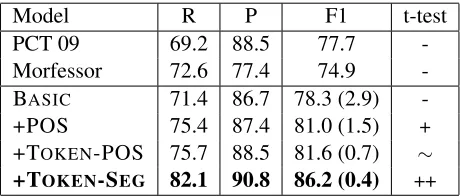
We evaluate our model on the standard Arabic treebank. Our full model yields 86.2% accuracy, outperforming the best published results (Poon et al., 2009) by 8.5%. We also found that modeling morphological agreement between adjacent words yields greater improvement than modeling syntac-tic categories. Overall, our results demonstrate that incorporating syntactic information is a promising direction for improving morphological analysis.
2 Related Work
Research in unsupervised morphological segmenta-tion has gained momentum in recent years bring-ing about significant developments to the area. These advances include novel Bayesian formula-tions (Goldwater et al., 2006; Creutz and Lagus, 2007; Johnson, 2008), methods for incorporat-ing rich features in unsupervised log-linear models (Poon et al., 2009) and the development of multilin-gual morphological segmenters (Snyder and Barzi-lay, 2008a).
Our work most closely relates to approaches that aim to incorporate syntactic information into mor-phological analysis. Surprisingly, the research in this area is relatively sparse, despite multiple results that demonstrate the connection between morphol-ogy and syntax in the context of part-of-speech tag-ging (Toutanova and Johnson, 2008; Habash and Rambow, 2005; Dasgupta and Ng, 2007; Adler and Elhadad, 2006). Toutanova and Cherry (2009) were the first to systematically study how to in-corporate part-of-speech information into lemmati-zation and empirically demonstrate the benefits of this combination. While our high-level goal is simi-lar, our respective problem formulations are distinct. Toutanova and Cherry (2009) have considered a semi-supervised setting where an initial
morpholog-ical dictionary and tagging lexicon are provided but the model also has access to unlabeled data. Since a lemmatizer and tagger trained in isolation may pro-duce mutually inconsistent assignments, and their method employs a log-linear reranker to reconcile these decisions. This reranking method is not suit-able for the unsupervised scenario considered in our paper.
Our work is most closely related to the approach of Can and Manandhar (2009). Their method also incorporates POS-based clustering into morpholog-ical analysis. These clusters, however, are learned as a separate preprocessing step using distributional similarity. For each of the clusters, the model se-lects a set of affixes, driven by the frequency of their occurrences in the cluster. In contrast, we model morpho-syntactic decisions jointly, thereby enabling tighter integration between the two. This design also enables us to capture additional linguistic phe-nomena such as agreement. While this technique yields performance improvement in the context of their system, the final results does not exceed state-of-the-art systems that do not exploit this informa-tion (for e.g., (Creutz and Lagus, 2007)).
3 Model
Given a corpus of unannotated and unsegmented sentences, our goal is to infer the segmentation boundaries of all words. We represent segmen-tations and syntactic categories as latent variables with a directed graphical model, and we perform Bayesian inference to recover the latent variables of interest. Apart from learning a compact morpheme lexicon that explains the corpus well, we also model morpho-syntactic relations both within each word and between adjacent words to improve segmenta-tion performance. In the remaining secsegmenta-tion, we first provide the key linguistic intuitions on which our model is based before describing the complete gen-erative process.
3.1 Linguistic Intuition
Morphological consistency within syntactic cate-gory. Words that belong to the same syntactic cat-egory tend to select similar affixes. In fact, the power of affix-related features has been empirically shown in the task of POS tag prediction (Habash and Ram-bow, 2005). We hypothesize that this regularity can also benefit morphological analyzers by eliminat-ing assignments with incompatible prefixes and suf-fixes. For instance, a state-of-the-art segmenter er-roneously divides the word “Al{ntxAbAt” into four morphemes “Al-{ntxAb-A-t” instead of three
“Al-{ntxAb-At” (translated as “the-election-s”.) The af-fix assignment here is clearly incompatible — de-terminer “Al” is commonly associated with nouns, while suffix “A” mostly occurs with verbs.
Since POS information is not available to the model, we introduce a latent variable that encodes affix-based clustering. In addition, we consider a variant of the model that captures dependencies be-tween latent variables of adjacent words (analogous to POS transitions).
Morphological realization of grammatical agree-ment. In morphologically rich languages, agree-ment is commonly realized using matching suffices. In many cases, members of a dependent pair such as adjective and noun have the exact same suf-fix. A common example in the Arabic Treebank is the bigram “Al-Df-p Al-grby-p” (which is trans-lated word-for-word as “the-bank the-west”) where the last morpheme “p” is a feminine singular noun suffix.
Fully incorporating agreement constraints in the model is difficult, since we do not have access to syntactic dependencies. Therefore, we limit our at-tention to adjacent words which end with similar strings – for e.g., “p” in the example above. The model encourages consistent segmentation of such pairs. While our string-based cue is a simple proxy for agreement relation, it turns to be highly effective in practice. On the Penn Arabic treebank corpus, our cue has a precision of around 94% at the token-level.
3.2 Generative Process
The high-level generative process proceeds in four phases:
(a) Lexicon Model: We begin by generating mor-pheme lexiconsLusing parametersγ. This set
of lexicons consists of separate lexicons for pre-fixes, stems, and suffixes generated in a hierar-chical fashion.
(b) Segmentation Model: Conditioned on L, we draw word types, their segmentations, and also their syntactic categories(W,S,T).
(c) Token-POS Model: Next, we generate the un-segmented tokens in the corpus and their syn-tactic classes(w,t) from a standard first-order HMM which has dependencies between adja-cent syntactic categories.
(d) Token-Seg Model: Lastly, we generate token segmentationssfrom a first-order Markov chain that has dependencies between adjacent seg-mentations.
The complete generative story can be summarized by the following equation:
P(w,s,t,W,S,T,L,Θ,θ|γ,α,β) =
P(L|γ) (a)
P(W,S,T,Θ|L,γ,α) (b) Ppos(w,t,θ|W,S,T,L,α) (c) Pseg(s|W,S,T,L,β,α) (d)
where γ,α,Θ,θ,β are hyperparameters and pa-rameters whose roles we shall detail shortly.
Our lexicon model captures the desirability of compact lexicon representation proposed by prior work by using parameters γ that favors small lexi-cons. Furthermore, if we set the number of syntac-tic categories in the segmentation model to one and exclude the token-based models, we recover a seg-menter that is very similar to the unigram Dirichlet Process model (Goldwater et al., 2006; Snyder and Barzilay, 2008a; Snyder and Barzilay, 2008b). We shall elaborate on this point in Section 4.
Lexicon Model The design goal is to encourage morpheme types to be short and the set of affixes (i.e. prefixes and suffixes) to be much smaller than the set of stems. To achieve this, we first draw each morphemeσin the master lexiconL∗according to a geometric distribution which assigns monotonically smaller probability to longer morpheme lengths:
|σ| ∼Geometric(γl)
The parameter γl for the geometric distribution is
fixed and specified beforehand. We then draw the prefix, the stem, and suffix lexicons (denoted by L−, L0, L+ respectively) from morphemes in L∗. Generating the lexicons in such a hierarchical fash-ion allows morphemes to be shared among the lower-level lexicons. For instance, once determiner “Al” is generated in the master lexicon, it can be used to generate prefixes or stems later on. To fa-vor compact lexicons, we again make use of a ge-ometric distribution that assigns smaller probability to lexicons that contain more morphemes:
prefix: |L−| ∼Geometric(γ−)
stem: |L0| ∼Geometric(γ0) suffix: |L+| ∼Geometric(γ+)
By separating morphemes into affixes and stems, we can control the relative sizes of their lexicons with different parameters.
Segmentation Model The model independently generates each word type using only morphemes in the affix and stem lexicons, such that each word has exactly one stem and is encouraged to have few morphemes. We fix the number of syntactic cate-gories (tags) toKand begin the process by generat-ing multinomial distribution parameters for the POS tag prior from a Dirichlet prior:
ΘT ∼Dirichlet(αT,{1, . . . , K})
Next, for each possible value of the tag T ∈ {1, . . . , K}, we generate parameters for a multino-mial distribution (again from a Dirichlet prior) for each of the prefix and the suffix lexicons:
Θ−|T ∼Dirichlet(α−, L−)
Θ0 ∼Dirichlet(α0, L0)
Θ+|T ∼Dirichlet(α+, L+)
By generating parameters in this manner, we allow the multinomial distributions to generate only mor-phemes that are present in the lexicon. Also, at infer-ence time, only morphemes in the lexicons receive pseudo-counts. Note that the affixes are generated conditioned on the tag; But the stem are not.2
Now, we are ready to generate each word type W, its segmentationS, and its syntactic categoryT. First, we draw the number of morpheme segments
|S|from a geometric distribution truncated to gener-ate at most five morphemes:
|S| ∼Truncated-Geometric(γ|S|)
Next, we pick one of the morphemes to be the stem uniformly at random, and thus determine the number of prefixes and suffixes. Then, we draw the syntactic category T for the word. (Note thatT is a latent variable which we recover during inference.)
T ∼Multinomial(ΘT)
After that, we generate each stemσ0, prefixσ−, and
suffixσ+independently:
σ0 ∼Multinomial(Θ0) σ−|T ∼Multinomial(Θ−|T)
σ+|T ∼Multinomial(Θ+|T)
Token-POS Model This model captures the de-pendencies between the syntactic categories of ad-jacent tokens with a first-order HMM. Conditioned on the type-level assignments, we generate (unseg-mented) tokenswand their POS tagst:
Ppos(w,t|W,T,θ)
=Y
wi,ti
P(ti−1|ti, θt|t)P(wi|ti, θw|t)
where the parameters of the multinomial distribu-tions are generated by Dirichlet priors:
θt|t∼Dirichlet(αt|t,{1, . . . , K})
θw|t∼Dirichlet(αw|t,Wt)
2
Here, Wt refers to the set of word types that are generated by tagt. In other words, conditioned on tagt, we can only generate wordwfrom the set of word types inWtwhich is generated earlier (Lee et al., 2010).
Token-Seg Model The model captures the mor-phological agreement between adjacent segmenta-tions using a first-order Markov chain. The proba-bility of drawing a sequence of segmentations sis given by
Pseg(s|W,S,T,L,β,α) =
Y
(si−1,si)
p(si|si−1)
For each pair of segmentationssi−1 andsi, we
de-termine: (1) if they should exhibit morpho-syntactic agreement, and (2) if their morphological segmenta-tions are consistent. To answer the first question, we first obtain the final suffix for each of them. Next, we obtain n, the length of the longer suffix. For each segmentation, we define theending to be the lastncharacters of the word. We then use matching endings as a proxy for morpho-syntactic agreement between the two words. To answer the second ques-tion, we use matching final suffixes as a cue for con-sistent morphological segmentations. To encode the linguistic intuition that words that exhibit morpho-syntactic agreement are likely to be morphological consistent, we define the above probability distribu-tion to be:
p(si|si−1)
=
β1 if same endings and same final suffix β2 if same endings but different final suffixes β3 otherwise (e.g. no suffix)
whereβ1+β2+β3 = 1, withβ1 > β3 > β2. By settingβ1 to a high value, we encourage adjacent tokens that are likely to exhibit morpho-syntactic agreement to have the same final suffix. And by set-ting β3 > β2, we also discourage adjacent tokens with the same endings to be segmented differently.3
4 Inference
Given a corpus of unsegmented and unannotated word tokensw, the objective is to recover values of
3
Althoughpsums to one, it makes the model deficient since, conditioned everything already generated, it places some prob-ability mass on invalid segmentation sequences.
all latent variables, including the segmentationss.
P(s,t,S,T,L|w,W,γ,α,β)
∝
Z
P(w,s,t,W,S,T,L,Θ,θ|γ,α,β)dΘdθ
We want to sample from the above distribution us-ing collapsed Gibbs samplus-ing (Θ andθ integrated out.) In each iteration, we loop over each word type Wiand sample the following latent variables: its tag
Ti, its segmentationSi, the segmentations and tags
for all of its token occurrences(si,ti), and also the
morpheme lexiconsL:
P(L, Ti, Si,si,ti|
s−i,t−i,S−i,T−i,w−i,W−i,γ,α,β) (1)
such that the type and token-level assignments are consistent, i.e. for allt∈ti we havet=Ti, and for
alls∈siwe haves=Si.
4.1 Approximate Inference
Naively sampling the lexiconsLis computationally infeasible since their sizes are unbounded. There-fore, we employ an approximation which turns is similar to performing inference with a Dirichlet Pro-cess segmentation model. In our approximation scheme, for each possible segmentation and tag hy-pothesis(Ti, Si,si,ti), we only consider one
possi-ble value forL, which we denote theminimal lexi-cons. Hence, the total number of hypothesis that we have to consider is only as large as the number of possibilities for(Ti, Si,si,ti).
Specifically, we recover the minimal lexicons as follows: for each segmentation and tag hypothesis, we determine the set of distinct affix and stem types in the whole corpus, including the morphemes intro-duced by segmentation hypothesis under considera-tion. This set of lexicons, which we call the minimal lexicons, is the most compact ones that are needed to generate all morphemes proposed by the current hypothesis.
Furthermore, we set the number of possible POS tags K = 5. 4 For each possible value of the tag, we consider all possible segmentations with at most five segments. We further restrict the stem to have no
4
more than two prefixes or suffixes and also that the stem cannot be shorter than the affixes. This further restricts the space of segmentation and tag hypothe-ses, and hence makes the inference tractable.
4.2 Sampling equations
Suppose we are considering the hypothesis with seg-mentationS and POS tagT for word typeWi. Let
L = (L∗, L−, L0, L+)be the minimal lexicons for this hypothesis (S, T). We sample the hypothesis
(S, T, s =S, t =T,L)proportional to the product of the following four equations.
Lexicon Model
Y
σ∈L∗
γl(1−γl)|σ| ×
γ−(1−γ−)|L−| ×
γ0(1−γ0)|L0| ×
γ+(1−γ+)|L+| (2) This is a product of geometric distributions involv-ing the length of each morpheme σ and the size of each of the prefix, the stem, and the suffix lexi-cons (denoted as|L−|,|L0|,|L+|respectively.) Sup-pose, a new morpheme type σ0 is introduced as a stem. Relative to a hypothesis that introduces none, this one incurs an additional cost of (1−γ0) and γl(1−γl)|σ0|. In other words, the hypothesis is
pe-nalized for increasing the stem lexicon size and gen-erating a new morpheme of length|σ0|. In this way, the first and second terms play a role similar to the concentration parameter and base distribution in a DP-based model.
Segmentation Model
γ|S|(1−γ|S|)|S| P5
j=0γ|S|(1−γ|S|)j
×
n−iT +α
N−i+αK ×
n−iσ0 +α0 N0−i+α0|L0|
×
n−iσ
−|T +α−
N−|T−i +α−|L−|
×
n−iσ
+|T +α+
N+−i|T +α+|L+|
(3)
The first factor is the truncated geometric distribu-tion of the number of segmentadistribu-tions |S|, and the second factor is the probability of generate the tag T. The rest are the probabilities of generating the stemσ0, the prefixσ−, and the suffixσ+(where the parameters of the multinomial distribution collapsed out). n−T1 is the number of word types with tagT andN−i is the total number of word types. n−iσ
−|T
refers to the number of times prefixσ−is seen in all
word types that are tagged withT, andN−|T−i is the total number of prefixes in all word types that has tag T. All counts exclude the word typeWi whose
seg-mentation we are sampling. If there is another pre-fix,N−|T−i is incremented (and alson−iσ
−|T if the
sec-ond prefix is the same as the first one.) Integrating out the parameters introduces dependencies between prefixes. The rest of the notations read analogously.
Token-POS Model
αw|t(m i)
(Mt−i+αw|t|Wt|)(mi)
×
K Y
t=1
K Y
t0=1
(m−it0|t+αt|t)
(mi t0|t)
(Mt−i+αt|t)
(mi t0|t)
(4)
The two terms are the token-level emission and tran-sition probabilities with parameters integrated out. The integration induces dependences between all token occurrences of word type W which results in ascending factorials defined as α(m) = α(α + 1)· · ·(α +m −1) (Liang et al., 2010). Mt−i is the number of tokens that have POS tagt,miis the number of tokenswi, andm−it0|tis the number of
to-kens t-to-t0 transitions. (Both exclude counts con-tributed by tokens belong to word typeWi.)|Wt|is the number of word types with tagt.
Token-Seg Model
βm
i β1
1 β
mi β2
2 β
mi β3
3 (5)
Here,miβ
1refers to the number of transitions
involv-ing token occurrences of word typeWi that exhibit
4.3 Staged Training
Although the Gibbs sampler mixes regardless of the initial state in theory, good initialization heuristics often speed up convergence in practice. We there-fore train a series of models of increasing complex-ity (see section 6 for more details), each with50 iter-ations of Gibbs sampling, and use the output of the preceding model to initialize the subsequent model. The initial model is initialized such that all words are not segmented. When POS tags are first introduced, they are initialized uniformly at random.
5 Experimental Setup
Performance metrics To enable comparison with previous approaches, we adopt the evaluation set-up of Poon et al. (2009). They evaluate segmentation accuracy on a per token basis, using recall, precision and F1-score computed on segmentation points. We also follow a transductive testing scenario where the same (unlabeled) data is used for both training and testing the model.
Data set We evaluate segmentation performance on the Penn Arabic Treebank (ATB).5It consists of about 4,500 sentences of modern Arabic obtained from newswire articles. Following the preprocessing procedures of Poon et al. (2009) that exclude certain word types (such as abbreviations and digits), we obtain a corpus of 120,000 tokens and 20,000 word types. Since our full model operates over sentences, we train the model on the entire ATB, but evaluate on the exact portion used by Poon et al. (2009).
Pre-defined tunable parameters and testing regime In all our experiments, we setγl = 12 (for
length of morpheme types) andγ|S| = 12 (for
num-ber of morpheme segments of each word.) To en-courage a small set of affix types relative to stem types, we setγ− = γ+ = 11.1 (for sizes of the af-fix lexicons) andγ0 = 10,1000 (for size of the stem lexicon.) We employ a sparse Dirichlet prior for the type-level models (for morphemes and POS tag) by settingα = 0.1. For the token-level models, we set hyperparameters for Dirichlet priorsαw|t = 10−5
5
Our evaluation does not include the Hebrew and Arabic Bible datasets (Snyder and Barzilay, 2008a; Poon et al., 2009) since these corpora consists of short phrases that omit sentence context.
Model R P F1 t-test
PCT 09 69.2 88.5 77.7
[image:7.612.310.540.57.155.2]-Morfessor 72.6 77.4 74.9 -BASIC 71.4 86.7 78.3 (2.9) -+POS 75.4 87.4 81.0 (1.5) + +TOKEN-POS 75.7 88.5 81.6 (0.7) ∼ +TOKEN-SEG 82.1 90.8 86.2 (0.4) ++
Table 1: Results on the Arabic Treebank (ATB) data set: We compare our models against Poon et al. (2009) (PCT09) and the Morfessor system (Morfessor-CAT). For our full model (+TOKEN-SEG) and its simplifica-tions (BASIC, +POS, +TOKEN-POS), we perform five random restarts and show the mean scores. The sample standard deviations are shown in brackets. The last col-umn shows results of a paired t-test against the preceding model: ++ (significant at 1%), + (significant at 5%), ∼ (not significant), - (test not applicable).
(for unsegmented tokens) and αt|t = 1.0 (for POS
tags transition.) To encourage adjacent words that exhibit morphological agreement to have the same final suffix, we setβ1 = 0.6, β2 = 0.1, β1= 0.3.
In all the experiments, we perform five runs us-ing different random seeds and report the mean score and the standard deviation.
Baselines Our primary comparison is against the morphological segmenter of Poon et al. (2009) which yields the best published results on the ATB corpus. In addition, we compare against the Mor-fessor Categories-MAP system (Creutz and Lagus, 2007). Similar to our model, their system uses latent variables to induce clustering over morphemes. The difference is in the nature of the clustering: the Mor-fessor algorithm associates a latent variable for each morpheme, grouping morphemes into four broad categories (prefix, stem, suffix, and non-morpheme) but not introducing dependencies between affixes di-rectly. For both systems, we quote their performance reported by Poon et al. (2009).
6 Results
Comparison with the baselinesTable 1 shows that our full model (denoted +TOKEN-SEG) yields a mean F1-score of86.2, compared to77.7 and74.9
Ablation Analysis To assess relative impact of various components, we consider several simplified variants of the model:
• BASIC is the type-based segmentation model that is solely driven by the lexicon.6
• +POS adds latent variables but does not cap-ture transitions and agreement constraints.
• +TOKEN-POS is equivalent to the full model, without agreement constraints.
Our results in Table 1 clearly demonstrate that modeling morpho-syntactic constraints greatly im-proves the accuracy of morphological segmentation. We further examine the performance gains arising from improvements due to (1) encouraging morpho-logical consistency within syntactic categories, and (2) morphological realization of grammatical agree-ment.
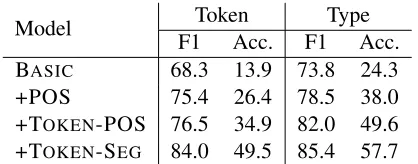
We evaluate our models on a subset of words that exhibit morphological consistency. Table 2 shows the accuracies for words that begin with the prefix “Al” (determiner) and end with a suffix “At” (plural noun suffix.) An example is the word “Al-{ ntxAb-At” which is translated as “the-election-s”. Such words make up about 1% of tokens used for eval-uation, and the two affix boundaries constitute about 3% of the all gold segmentation points. By intro-ducing a latent variable to capture dependencies be-tween affixes, +POS is able to improve segmenta-tion performance over BASIC. When dependencies between latent variables are introduced, +TOKEN -POS yields additional improvements.
We also examine the performance gains due to morphological realization of grammatical agree-ment. We select the set of tokens that share the same final suffix as the preceding token, such as the bigram “Al-Df-p Al-grby-p” (which is translated word-for-word as “the-bank the-west”) where the last morpheme “p” is a feminine singular noun suf-fix. This subset makes up about 4% of the evaluation set, and the boundaries of the final suffixes take up about 5% of the total gold segmentation boundaries.
6
The resulting model is similar in spirit to the unigram DP-based segmenter (Goldwater et al., 2006; Snyder and Barzilay, 2008a; Snyder and Barzilay, 2008b).
Model Token Type
[image:8.612.320.529.57.139.2]F1 Acc. F1 Acc. BASIC 68.3 13.9 73.8 24.3 +POS 75.4 26.4 78.5 38.0 +TOKEN-POS 76.5 34.9 82.0 49.6 +TOKEN-SEG 84.0 49.5 85.4 57.7 Table 2: Segmentation performance on words that begin with prefix “Al” (determiner) and end with suffix “At” (plural noun suffix). The mean F1 scores are computed using all boundaries of words in this set. For each word, we also determine if both affixes are recovered while ig-noring any other boundaries between them. The other two columns report this accuracy at both the type-level and the token-level.
Model Token Type
[image:8.612.321.527.254.335.2]F1 Acc. F1 Acc. BASIC 85.6 70.6 79.5 58.6 +POS 87.6 76.4 82.3 66.3 +TOKEN-POS 87.5 75.2 82.2 65.3 +TOKEN-SEG 92.8 91.1 88.9 84.4
Table 3: Segmentation performance on words that have the same final suffix as their preceding words. The F1 scores are computed based on all boundaries within the words, but the accuracies are obtained using only the final suffixes.
Table 3 reveals this category of errors persisted un-til the final component (+TOKEN-SEG) was intro-duced.
7 Conclusion
Although the connection between syntactic (POS) categories and morphological structure is well-known, this relation is rarely exploited to improve morphological segmentation performance. The per-formance gains motivate further investigation into morpho-syntactic models for unsupervised language analysis.
Acknowledgements
References
Meni Adler and Michael Elhadad. 2006. An un-supervised morpheme-based hmm for hebrew mor-phological disambiguation. In Proceedings of the ACL/CONLL, pages 665–672.
Burcu. Can and Suresh Manandhar. 2009. Unsupervised learning of morphology by using syntactic categories. InWorking Notes, CLEF 2009 Workshop.
Mathias Creutz and Krista Lagus. 2007. Unsupervised models for morpheme segmentation and morphology learning.ACM Transactions on Speech and Language Processing, 4(1).
Sajib Dasgupta and Vincent Ng. 2007. Unsuper-vised part-of-speech acquisition for resource-scarce languages. In Proceedings of the EMNLP-CoNLL, pages 218–227.
Sharon Goldwater, Thomas L. Griffiths, and Mark John-son. 2006. Contextual dependencies in unsupervised word segmentation. InProceedings of the ACL, pages 673–680.
Nizar Habash and Owen Rambow. 2005. Arabic tok-enization, part-of-speech tagging and morphological disambiguation in one fell swoop. InProceedings of the 43rd Annual Meeting of the Association for Com-putational Linguistics (ACL’05), pages 573–580, Ann Arbor, Michigan, June. Association for Computational Linguistics.
Heidi Harley and Colin Phillips, editors. 1994. The Morphology-Syntax Connection. Number 22 in MIT Working Papers in Linguistics. MIT Press.
Mark Johnson. 2008. Unsupervised word segmentation for Sesotho using adaptor grammars. InProceedings of the Tenth Meeting of ACL Special Interest Group on Computational Morphology and Phonology, pages 20–27, Columbus, Ohio, June. Association for Com-putational Linguistics.
Yoong Keok Lee, Aria Haghighi, and Regina Barzilay. 2010. Simple type-level unsupervised POS tagging. InProceedings of the 2010 Conference on Empirical Methods in Natural Language Processing, pages 853– 861, Cambridge, MA, October. Association for Com-putational Linguistics.
Percy Liang, Michael I. Jordan, and Dan Klein. 2010. Type-based mcmc. In Human Language Technolo-gies: The 2010 Annual Conference of the North Amer-ican Chapter of the Association for Computational Linguistics, pages 573–581, Los Angeles, California, June. Association for Computational Linguistics. Hoifung Poon, Colin Cherry, and Kristina Toutanova.
2009. Unsupervised morphological segmentation with log-linear models. In Proceedings of HLT-NAACL 2009, pages 209–217, Boulder, Colorado, June. As-sociation for Computational Linguistics.
Benjamin Snyder and Regina Barzilay. 2008a. Crosslin-gual propagation for morphological analysis. In Pro-ceedings of the AAAI, pages 848–854.
Benjamin Snyder and Regina Barzilay. 2008b. Unsuper-vised multilingual learning for morphological segmen-tation. InProceedings of ACL-08: HLT, pages 737– 745, Columbus, Ohio, June. Association for Computa-tional Linguistics.
Kristina Toutanova and Colin Cherry. 2009. A global model for joint lemmatization and part-of-speech pre-diction. InProceedings of the Joint Conference of the 47th Annual Meeting of the ACL and the 4th Interna-tional Joint Conference on Natural Language Process-ing of the AFNLP, pages 486–494, Suntec, Singapore, August. Association for Computational Linguistics. Kristina Toutanova and Mark Johnson. 2008. A bayesian