Proceedings of the 2019 Conference on Empirical Methods in Natural Language Processing 2370
Tree-structured Decoding for Solving Math Word Problems
Qianying Liu∗1, Wenyu Guan∗23, Sujian Li2and Daisuke Kawahara1 1Graduate School of Informatics, Kyoto University
2 Key Laboratory of Computational Linguistics, MOE, Peking University 3 School of Software and Microelectronics, Peking University
[email protected]; [email protected]; [email protected]; [email protected]
Abstract
Automatically solving math word problems is an interesting research topic that needs to bridge natural language descriptions and for-mal math equations. Previous studies intro-duced end-to-end neural network methods, but these approaches did not efficiently consider an important characteristic of the equation, i.e., an abstract syntax tree. To address this problem, we propose a tree-structured decod-ing method that generates the abstract syntax tree of the equation in a top-down manner. In addition, our approach can automatically stop during decoding without a redundant stop to-ken. The experimental results show that our method achieves single model state-of-the-art performance on Math23K, which is the largest dataset on this task.
1 Introduction
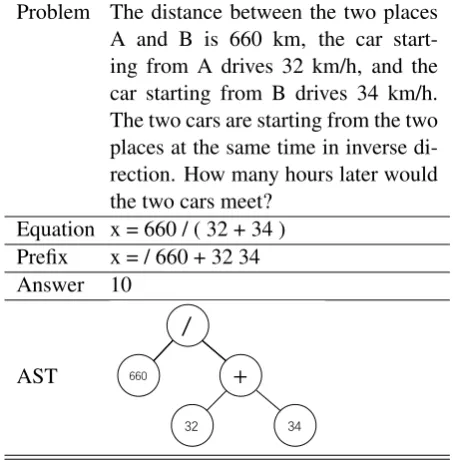
Math word problem (MWP) solving is the task of obtaining a solution from math problems that are described in natural language. One example of MWP is illustrated in Figure 1. Early approaches rely on either predefined rules or statistical ma-chine learning-based methods to map the prob-lems into several predefined templates in classifi-cation style or retrieval style. The major drawback of these approaches is that they are inflexible for new templates and require extra effort to design rules, features and templates.
Modeling the tree structure of math equations has been considered as an important factor when building models for MWP. As shown in Figure 1, each equation could be transformed into an ab-stract syntax tree (AST). Roy and Roth (2017) built an expression tree and combined two classi-fiers for quantity relevance prediction and operator classification.Koncel-Kedziorski et al.(2015) de-signed a template ranking function based on the
∗
This denotes equal contribution.
Problem The distance between the two places A and B is 660 km, the car start-ing from A drives 32 km/h, and the car starting from B drives 34 km/h. The two cars are starting from the two places at the same time in inverse di-rection. How many hours later would the two cars meet?
Equation x = 660 / ( 32 + 34 ) Prefix x = / 660 + 32 34 Answer 10
AST
/
660
+
[image:1.595.305.532.225.458.2]34 32
Figure 1: One example of MWP. Problem refers to the natural language descriptions. Equation refers to the formal math equation. Prefix refers to the prefix nota-tion of the equanota-tion. Answer refers to the final quantity solution. AST refers to the AST of the equation.
AST of the equations. However, these approaches are based on traditional methods and require fea-ture engineering.
(e.g., parent and siblings of each node), despite of their promising results. Thus, their model has to use extra effort to memorize various pieces of aux-iliary information such as the sibling node of the current step and learn the implicit tree structure in the sequence.
Meanwhile, in similar tasks such as semantic parsing and code generation, which also try to convert natural language into a well-formed ex-ecutable tree structured output, they first decode the function or operator at the root node before decoding the variables. Such top-down decoding matches with the Polish notation, also called the prefix order of the AST of math equations, shown in Figure 1. Human also does reasoning and refer-ence in a similar order, usually first determines the function before filling in the variables, but not the inverse. Thus we present a top-down hierarchical sequence-to-tree (seq2tree) model which explic-itly models the tree structure. This decoder con-siders the prefix order of the equation and feeds the information of the parent and sibling nodes during decoding.
Another advantage of this system is that it can use a stack to monitor the decoding process and automatically end. By pushing in new generated nodes to the stack and popping out the completed subtrees, the decoding process can naturally end when the tree is completed and the stack is empty. There is no need for a special redundant end-of-sequence (EOS) token which is used in ordinary text sequence generation. Without the EOS token, the model has a higher possibility to generate valid equation answers.
In summary, the contributions of this work are as follows:
1. We design a hierarchical seq2tree model that can better capture information of the AST of the equation.
2. We are the first to use prefix order decoding for MWP.
3. We abandon the EOS token for end-to-end equation generation.
4. Our model outperforms previous systems for solving math word problems. On the large-scale dataset Math23K, we achieve state-of-the-art sin-gle model performance.
2 Related Work
Our work synthesizes two strands of research, which are math word problems and seq2tree
encoder-decoder architectures.
2.1 Math Word Problems
Early approaches hand engineered rule-based sys-tems to solve MWPs (Mukherjee and Garain,
2008). The rules could only cover a limited do-main of problems, while math word problems are flexible in real-world settings.
There are currently three major research lines in solving MWPs. The first research line maps a problem text into logical forms, and then uses the logical forms to obtain the equation (Shi et al.,
2015; Roy and Roth, 2015; Huang et al., 2017;
Roy and Roth,2018). Shi et al.(2015) defined a Dolphin language to connect math word problems and logical forms. The major drawback is that it requires extra human annotation for the logic forms.
Another research line uses either a retrieval or classification model to maintain a template, and then fills in the slots with quantities. Kushman et al.(2014) first introduced the idea of ‘equation template’. For example, x = 6*7 and x = 10*5 belong to the same template x =n1*n2. They col-lected the first dataset of this task, ALG514, which contained 514 samples. They brought out a two-step pipeline model, which first used a classifier to select a template and then mapped the numbers into the slots. One major drawback is that it cannot solve problems beyond the templates in the train-ing data. This two-step pipeline model was further extended with tree-based features, ranking style retrieval models and so on (Upadhyay and Chang,
2017;Roy and Roth,2017). Huang et al. (2016) released the first large-scale dataset Dophin18K and trained a similar system on it.
mechanism to improve the semantic representa-tion of quantities. However, in these work the model needs extra effort to learn the implicit tree structure and memorize tree information in the sequence. Wang et al. (2019) proposed a two-step pipeline method that first generates a template with unknown operators, and then uses a recursive neural network to combine tree structure informa-tion and predict the operators. However, the topol-ogy of the AST is determined in the first step with-out tree structure information. To our best knowl-edge, we are the first to explicitly give the model guidance of parent and sibling nodes.
2.2 Seq2Tree Architectures
Seq2Tree-style encoder-decoder is mainly used in two fields both of which try to bridge natural lan-guage and a tree structured output.
Semantic parsing is the task that translates natu-ral language text to formal meaning logical forms or structured queries. Code generation maps a piece of program description to programming lan-guage source code. Dong and Lapata (2016) first used recurrent neural networks (RNNs) based seq2tree for semantic parsing and out performed the seq2seq model. One drawback is that their generation is at token level so it cannot guaran-tee the result is syntactically correct. Grammar rules were used to solve this problem. Another drawback is that they needed special tokens for predicting branches, which are not necessary for MWPs because all operators are binary opera-tors. The similar framework is also used in code generation (Zhang et al., 2016; Yin and Neubig,
2017). Alvarez-Melis and Jaakkola (2017) pre-sented doubly recurrent neural networks to predict tree topology explicitly. Rabinovich et al.(2017) presented a abstract syntax network that combines edge information for code generation. Convolu-tion neural networks (CNNs) were used for code generation decoding because the output program is much longer than semantic parsing and MWPs, and RNNs suffer from the long dependency prob-lem (Sun et al.,2018).
3 Model
Our model consists of two stages as shown in Fig-ure 2: the encoder stage that encodes the input natural language into a sequence of representation vectors and the decoder stage that receives these vectors and decodes the AST of the equation with
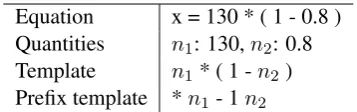
[image:3.595.327.506.61.117.2]Equation x = 130 * ( 1 - 0.8 ) Quantities n1: 130,n2: 0.8 Template n1* ( 1 -n2) Prefix template *n1- 1n2
Table 1: One example of prefix template
the help of an auxiliary stack.
3.1 Preprocessing
Significant Number Identification A Signifi-cant Number Identification (SNI) unit is used for reducing the noise in the input numbers. Signif-icance refers to whether the number appears in the equation. In MWPs, it is very common that the input text contains irrelevant numbers, such as date or descriptive text such as ‘third grade stu-dent’. We followWang et al.(2017) and simply use whether the numbers appear in the equation as gold labels and build an LSTM-based binary clas-sification model to determine the significance of the input numbers. The accuracy of this unit is 99% and thus it can efficiently reduce the noise.
Prefix Order Equation Template For the out-put equations, we first turn them into prefix order equation templates before using them to train the model. In Table 1 we show one example of prefix templates. Given a problem-equation pair, we first build the mapping between numbers in the prob-lem and equation,nidenotes the ith number in the problem after SNI. We use this mapping to convert the equation into a template by replacing the num-bers with ni tokens, and at last convert the tem-plate into prefix order.
To be noticed, equations can be mapped to more than one AST. For example,n1 +n2 +n3could be mapped to an AST with either the first + or the second + as the root node, and in that case the prefix order notation would also be different. We assume the first operator is the root node of the AST here. Further details are shown in the appendix.
ℎ" ℎ# ℎ$ ℎ%
𝑒" 𝑒# 𝑒$ 𝑒%
ℎ"'
ℎ#'
*
ℎ('
ℎ$' ℎ)'
Alice has 10. …… ?
[image:4.595.144.460.61.192.2]-
n"Figure 2: Framework of our seq2tree model. The blue blocks refer to the encoder. The yellow blocks refer to the decoder. The green blocks refer to the auxiliary stack.
to alleviate the equation duplication problem. The rules are listed below.
• If one long equation template could be con-verted into a shorter one, then it should be shortened. For example,n1+n2+n3+n3−
n3 andn1+n2+n3 are equivalent. In this case the former one should be normalized as the latter one.
• The order of number tokens in the template should follow their occurrence order in the problem text as much as possible. For ex-ample,n1+n3+n2should be normalized as
n1+n2+n3.
3.2 Encoder
Bi-directional Long Short Term Memory Network (BiLSTM) is an efficient method to encode se-quential information. Formally, given an input math word problem sentence x = {xt}nt=1 , we first embed each word into a vectoret. Then these embeddings are fed into a BiLSTM layer to model the sequential information.
ht= (LST M(hft−1, et);LST M(hbt−1, et)), (1) wherehtis the concatenation of the hidden states
hft andhbt, which are from both forward and back-ward LSTMs. These representation vectors are then fed into the following decoder stage.
3.3 Tree-structured Decoder
For decoding, we followDong and Lapata(2016) and build a top-down hierarchical tree-structured decoder. However, their model is built for se-mantic parsing and some components are unnec-essary and redundant for equation template decod-ing. Benefited by the fact that operator nodes must
+ 𝑛#
*
(
( <s>
0
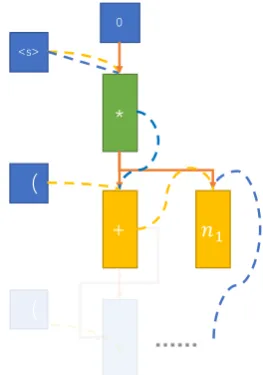
Figure 3: Framework of the tree structured decoder. The yellow dotted line refers to sibling feeding. The blue dotted line refers to previous token feeding. The orange solid line refers to parent feeding. The dotted line means it uses embedding information, while the solid line means it uses the hidden state information.
have two children and number nodes must be leaf nodes, we build a decoder which is specialized for math equation AST, as shown in Figure 3. It ex-tends a vanilla sequence-based LSTM decoder by using tree-based information feeding as the input, and also an auxiliary stack to help the model know which is the next token to decode and automati-cally end the decoding process without a special token.
3.3.1 Tree-based Information Feeding
The input of each time step consists of three parts: parent feeding, sibling feeding and previous token feeding.
[image:4.595.350.482.243.431.2]-+
𝑛" 𝑛#
-+𝑛"𝑛#
-+𝑛"𝑛#
𝑛$
-+𝑛"𝑛#𝑛$
pop and push
push 𝑛$ pop
Ans:-+𝑛"𝑛#𝑛$ Generate 𝑛$
pop and push
-+
𝑛" 𝑛#
-+
𝑛" 𝑛# 𝑛$
-+
𝑛" 𝑛#
-+
𝑛" 𝑛# 𝑛$
-+
[image:5.595.126.481.65.227.2]𝑛" 𝑛# 𝑛$ ?
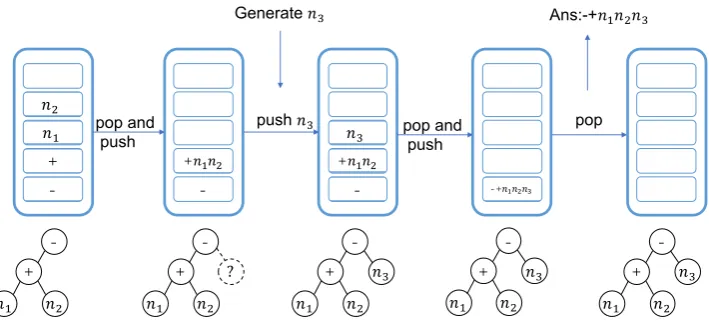
Figure 4: One example of tree-structured decoding with the auxiliary stack.
the orange solid line in Figure 3. This can let the model be informed of the parent node status. For the root node, this part of the input is padded as zeros.
The sibling feeding esibling refers to using the embedding of the left sibling node as the input when decoding the right sibling node, which is shown as the yellow dotted line in Figure 3. This can let the model be informed whether we are de-coding the left or right sibling. For the root node, we use a special tokenhsifor sibling feeding. For the left-most node, we use a special token ( for sibling feeding.
The previous token feeding eprev refers to us-ing the previous token in prefix order as the input when decoding the next token, which is shown as the blue dot line in Figure 3. This can let the model be informed of what part is already decoded by the tree. For the root node, we also use the special to-kenhsifor previous token feeding.
At time stept, the inputedt of the LSTM unit is the concatenation of these three components.
edt = (hparent;esibling;eprev). (2)
3.3.2 Tree-Structured LSTM
The tree-structured decoder uses LSTM to gener-ate the equation templgener-ate in a top-down manner, as the grey solid line in Figure 3, and use an auxiliary stack to guide the decoding process. Given the in-putedt shown in the previous section, we generate the output tokenytwith one LSTM layer and one Multi-layer Perceptron (MLP) layer.
hdt =LST M(hdt−1, edt) (3)
yt=argmax(M LP(hdt)) (4)
Algorithm 1:The algorithm of using the aux-iliary stack to guide tree decoding.
Input:Encoder Outputhn
Output: The Predicted Prefix Notation EquationEquap ={spi}n2
i=1 1 initialize empty stackSand listEquap; 2 whileS.size!=1 orS.top is not quantitydo 3 generate tokenyt;
4 tmp=S.top; 5 S.push(yt);
6 ifytis quantitythen
7 whiletmpis a quantitydo
8 subtreet=S.top[3]; 9 S.pop;S.pop;S.pop; 10 tmp=S.top;S.push(t);
11 Equap=S.pop;
if the top of the stack is an operator, we push back
tand continue to decode the operator’s right child node, and if the stack is empty, the decoding pro-cess ends because the AST is completed. Here we still push back the tree unit to the stack and treat the status that only one number is in the stack as the ending condition, which refers to line 2 in Al-gorithm1. In this way the condition that the first generated token is the answer number can be uni-fied. With the help of this stack, we can guide the decoding process, including which token to gen-erate next and when to stop naturally without any special tokens.
We show one example of the decoding process with the an auxiliary stack in Figure 4. The up-per half part shows the status of the stack, where the solid blocks stand for the inserted tokens. The lower half part shows the status of the AST dur-ing decoddur-ing, where the solid line stands for the generated nodes and the dotted line stands for the node that should be generated in the next step. The decoder first generates−,+,n1andn2and forms a complete subtree in the AST. This subtree+,n1 andn2is then popped out of the stack and+n1n2 are pushed back as one unit. The model then con-tinues to predict the sibling node of the subtree’s root node, which is the dotted line circle in Fig-ure 4. The top three tokens of the stack now form a complete subtree again and is popped out of the stack. The stack is now empty, we push it back and the stack only contains one number unit, then the decoding process ends and the equation template is popped out.
3.3.3 Attention Mechanism
An attention mechanism has shown its effective-ness in various natural language processing tasks. We extend the decoder with an attention mecha-nism by adjusting Equation4. Instead of directly using the hidden statehdt to predict the output to-kenyt, we consider relevant information from the input vectors to better predictyt. Formally, given the LSTM hidden statehdt and the encoder outputs
{ht}nt=1, we calculate the attention weightsαitand attention vectorstas follows:
st= n X
i=1
αit·hi= n X
i=1
exp(hi·hdt) Pn
j=1exp(hj·hdt)
·hi (5)
In lieu of Equation4, we use the attention vec-tor st, which considers relevance of the encoder information to predict the output tokenyt.
4 Experiments
To demonstrate the effectiveness of our model, we conduct experiments on the Math23K dataset. Our method achieves the state-of-the-art (SOTA) sin-gle model performance and also exceeds the pre-vious ensemble model SOTA.
4.1 Dataset
Math23K Math23K is one large-scale Chinese MWP dataset that contains 23,162 math problems and math equation solutions. The questions are elementary school level. Every question is linear and contains only one unknown variable.
Although there are other large-scale datasets such as Dolphin18K and AQuA, which are in En-glish, they either contain many small typos (e.g., usingx to represent∗) or contain wrong answers and templates. Other datasets such as ALG514 and MAWPS are much more smaller. Therefore, we decide to conduct experiments on Math23K, which is the only large-scale, clean and high-quality dataset.
4.2 Implementation Details
The embedding vectors are pretrained on the train-ing set with the word2vec algorithm. The dimen-sion of the embedding is 128. We use a two-layer BiLSTM with the hidden size 512 for the encoder. The decoder is a two-layer LSTM with 1024 hid-den size. We use a teacher forcing ratio of 0.83 during training. We use cross entropy as the loss function and Adam to optimize the parameters. We also use dropout to avoid over-fitting. The batch size is 128.
4.3 Results
Model Acc
Retrieval Cosine (Robaidek et al.,2018) 23.8% Jaccard (Robaidek et al.,2018) 47.2%
Classification Self-Attention (Robaidek et al.,2018) 56.8% Bi-LSTM (Robaidek et al.,2018) 57.9%
Generation
DNS (Wang et al.,2017) 58.1% BiLSTM+Suffix+EN (Wang et al.,2018a) 66.7% Semantically-Aligned†(Chiang and Chen,2018) 65.8% T-RNN (Wang et al.,2019) 66.9%
Ours 69.0%
Ensemble
[image:7.595.128.470.62.245.2]DNS+Retrieval (Wang et al.,2017) 64.7% DNS+suffix+EN Ensemble (Wang et al.,2018a) 68.4% T-RNN+Retrieval (Wang et al.,2019) 68.7%
Table 2: Math word problem solving accuracy on Math23K.†denotes that the result is 5-fold cross validation performance. All other models are tested on the test set.
Model Acc
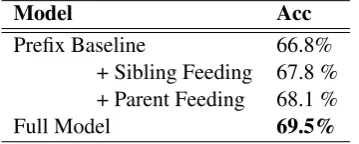
Prefix Baseline 66.8% + Sibling Feeding 67.8 % + Parent Feeding 68.1 % Full Model 69.5%
Table 3: Ablation study on Math23K by removing modules.
Wang et al.(2017) proposed a DNS model, which used seq2seq with SNI to generate an equation template. Wang et al. (2018a) proposed a BiL-STM+Suffix+EN model, which extends the DNS model by decoding the suffix notation and ap-plies equation normalization. Chiang and Chen
(2018) introduced a copy mechanism to generate equation templates in a semantically-aligned man-ner. T-RNN (Wang et al.,2019) extends the BiL-STM+Suffix+EN model by first generating a tem-plate with unknown operators and then filling in the operators with a Recursive Neural Network. The ensemble models use bagging to combine the results of different models.
Our seq2tree model is also a generation-style model. As shown in Table2, we achieve state-of-the-art single model performance on the test set, and even better results than all the previous en-semble models, which can demonstrate the effec-tiveness of our proposed method.
Model Invalid Templates EOS as terminator 1.3%
[image:7.595.93.273.297.369.2]Stack as terminator 0.2%
Table 4: Ablation study on Math23K by using different terminating methods.
5 Analysis and Discussion
5.1 Ablation Study
To get better insight into our seq2tree system, we conduct ablation study on Math23K development set, which is shown in Table3. The prefix base-line denotes the model that removes parent feeding and sibling feeding, but only uses previous token feeding for the input. Thus, this model loses par-ent and sibling information and falls into a linear seq2seq model based on the prefix notation. The prefix baseline performs competitive results com-pared to previous single model SOTA (66.9%), which proves the effectiveness of top-down de-coding. Parent feeding and sibling feeding sep-arately improve the baseline model by 1.1% and 1.0%, demonstrating the importance of informing the model of AST structure information.
Problem A person is taking a trip from A to B. He took a train for n1 of the trip the first day. He took a bus and travelled forn2km the second day. He still needs to travel forn3of the total distance. How far is it from A to B?
[image:8.595.308.525.178.330.2]Gold suffix order: x =n11n2-n3 - / prefix order: x = /n1 - - 1n2n3 PredictionBiLSTM+Suffix+EN:n1n2-n3 / (error) Ours: /n1- - 1n2n3(correct)
Figure 5: One example of our system compared with BiLSTM+Suffix+EN (Wang et al.,2018a).
#Operators Proportion(%) Acc(%)
0 0.1 100.0
1 17.3 82.7
2 52.2 74.5
3 19.1 59.9
4 6.6 42.4
5 3.4 44.1
6 0.9 55.6
7 0.3 0
8 0 0
9 0.1 100.0
Table 5: Accuracy of different template lengths on Math23K.
5.2 Case Study
Here we give an example that is improved by our tree-structured decoding system. As shown in Fig-ure5, in the gold equation of this example, there is a long distance between two pairs of parent-child nodesn1 and/and also1and−. The BiL-STM+Suffix+EN model failed to capture the re-lationship between these two pairs of parent-child nodes and caused an error. Our model has a bet-ter ability to capture the relation between pairs of parent-child nodes even if there is a long distance between them in the notation.
5.3 Error Analysis
In Table 5, we show the results of how the ac-curacy changes as the template becomes longer. We can see that our model’s performance becomes very low when the equation becomes longer. This shows that our model has limitations at predict-ing long templates. This is because longer tem-plates often match with more complex questions which are more difficult to solve. Thus, this model still has room for improvement on reasoning, in-ference and semantic understanding. Meanwhile, only a few examples in Math23K match with complex templates, so introducing data augmenta-tion techniques or constructing a new dataset with more complex examples may further improve the
Domain Proportion(%) Acc(%)
Distance & Speed 20.5 70.2 Tracing 27.0 74.1 Engineering 5.4 64.1 Interval 0.2 50.0 Circle Geometry 1.5 33.3 Plane Geometry 1.1 81.8 Profit 0.5 40.0 Solid Geometry 1.3 46.2 Interest Rate 0.5 80.0 Production 0.4 100.0
Table 6: Accuracy of different question domains on Math23K.
model’s performance.
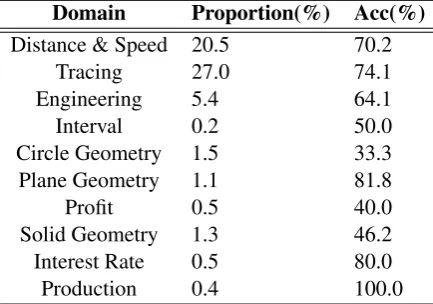
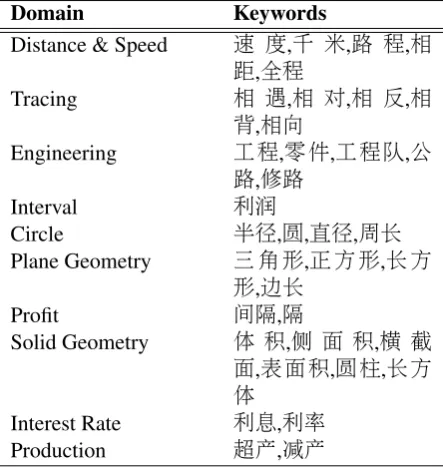
In Table6, we examine the performance of the model in different question domains. MWPs in the same domain usually share similar logic, while there is an obvious difference between questions across different domains. Accurately detecting the question domain is very laborious, so we do this experiment by simply detecting frequent keywords of each domain in the question. We show fur-ther details in the appendix. The results show that the performance of the model has obvious vari-ance among different domains and limitations in some domains such as solid geometry. This is because these domains require complicated exter-nal knowledge for solving these questions, such as
Scircle = πr2. It is difficult for the model to au-tomatically summarize these kinds of information with only supervision of the equation templates. Adding external knowledge for this task may fur-ther improve the model.
6 Conclusion
decoding process can end without any redundant special tokens. Our model achieves state-of-the-art results on the large-scale dataset, Math23k, demonstrating the effectiveness of our approach.
Acknowledgement
This work was supported by JSPS KAKENHI Grant Number JP18H03286.
References
David Alvarez-Melis and Tommi S. Jaakkola. 2017. Tree-structured decoding with doubly-recurrent neural networks. In 5th International Conference on Learning Representations, ICLR 2017, Toulon, France, April 24-26, 2017, Conference Track Pro-ceedings.
Ting-Rui Chiang and Yun-Nung Chen. 2018. Semantically-aligned equation generation for solving and reasoning math word problems. arXiv preprint arXiv:1811.00720.
Li Dong and Mirella Lapata. 2016. Language to logi-cal form with neural attention. InProceedings of the 54th Annual Meeting of the Association for Compu-tational Linguistics (Volume 1: Long Papers), vol-ume 1, pages 33–43.
Mohammad Javad Hosseini, Hannaneh Hajishirzi, Oren Etzioni, and Nate Kushman. 2014. Learning to solve arithmetic word problems with verb catego-rization. InProceedings of the 2014 Conference on Empirical Methods in Natural Language Processing (EMNLP), pages 523–533.
Danqing Huang, Shuming Shi, Chin-Yew Lin, and Jian Yin. 2017. Learning fine-grained expressions to solve math word problems. In Proceedings of the 2017 Conference on Empirical Methods in Natural Language Processing, pages 805–814.
Danqing Huang, Shuming Shi, Chin-Yew Lin, Jian Yin, and Wei-Ying Ma. 2016. How well do comput-ers solve math word problems? large-scale dataset construction and evaluation. In Proceedings of the 54th Annual Meeting of the Association for Compu-tational Linguistics (Volume 1: Long Papers), vol-ume 1, pages 887–896.
Rik Koncel-Kedziorski, Hannaneh Hajishirzi, Ashish Sabharwal, Oren Etzioni, and Siena Dumas Ang. 2015. Parsing algebraic word problems into equa-tions. Transactions of the Association for Computa-tional Linguistics, 3:585–597.
Nate Kushman, Yoav Artzi, Luke Zettlemoyer, and Regina Barzilay. 2014. Learning to automatically solve algebra word problems. InProceedings of the 52nd Annual Meeting of the Association for Compu-tational Linguistics (Volume 1: Long Papers), vol-ume 1, pages 271–281.
Anirban Mukherjee and Utpal Garain. 2008. A review of methods for automatic understanding of natural language mathematical problems. Artificial Intelli-gence Review, 29(2):93–122.
Maxim Rabinovich, Mitchell Stern, and Dan Klein. 2017. Abstract syntax networks for code genera-tion and semantic parsing. In Proceedings of the 55th Annual Meeting of the Association for Compu-tational Linguistics (Volume 1: Long Papers), pages 1139–1149.
Benjamin Robaidek, Rik Koncel-Kedziorski, and Han-naneh Hajishirzi. 2018. Data-driven methods for solving algebra word problems. arXiv preprint arXiv:1804.10718.
Subhro Roy and Dan Roth. 2015. Solving general arithmetic word problems. In Proceedings of the 2015 Conference on Empirical Methods in Natural Language Processing, pages 1743–1752.
Subhro Roy and Dan Roth. 2017. Unit dependency graph and its application to arithmetic word problem solving. InThirty-First AAAI Conference on Artifi-cial Intelligence.
Subhro Roy and Dan Roth. 2018. Mapping to declara-tive knowledge for word problem solving. Transac-tions of the Association of Computational Linguis-tics, 6:159–172.
Shuming Shi, Yuehui Wang, Chin-Yew Lin, Xiaojiang Liu, and Yong Rui. 2015. Automatically solving number word problems by semantic parsing and rea-soning. InProceedings of the 2015 Conference on Empirical Methods in Natural Language Process-ing, pages 1132–1142.
Zeyu Sun, Qihao Zhu, Lili Mou, Yingfei Xiong, Ge Li, and Lu Zhang. 2018. A grammar-based structural cnn decoder for code generation. arXiv preprint arXiv:1811.06837.
Shyam Upadhyay and Ming-Wei Chang. 2017. An-notating derivations: A new evaluation strategy and dataset for algebra word problems. InProceedings of the 15th Conference of the European Chapter of the Association for Computational Linguistics: Vol-ume 1, Long Papers, pages 494–504.
Lei Wang, Yan Wang, Deng Cai, Dongxiang Zhang, and Xiaojiang Liu. 2018a. Translating a math word problem to a expression tree. InProceedings of the 2018 Conference on Empirical Methods in Natural Language Processing, pages 1064–1069.
Lei Wang, Dongxiang Zhang, Lianli Gao, Jingkuan Song, Long Guo, and Heng Tao Shen. 2018b. Math-dqn: Solving arithmetic word problems via deep re-inforcement learning. InThirty-Second AAAI Con-ference on Artificial Intelligence.
Yan Wang, Xiaojiang Liu, and Shuming Shi. 2017. Deep neural solver for math word problems. In Pro-ceedings of the 2017 Conference on Empirical Meth-ods in Natural Language Processing, pages 845– 854.
Pengcheng Yin and Graham Neubig. 2017. A syntactic neural model for general-purpose code generation. In Proceedings of the 55th Annual Meeting of the Association for Computational Linguistics (Volume 1: Long Papers), pages 440–450.
Xingxing Zhang, Liang Lu, and Mirella Lapata. 2016. Top-down tree long short-term memory networks. InProceedings of NAACL-HLT, pages 310–320.
A Prefix Notation Algorithm
Algorithm 2:The algorithm of converting or-dinary equations to its prefix notation.
Input:The Ordinary Equation String
Equa={si}ni=11
Output: The Prefix Notation Equation String
Equap={spi}n2
i=1
12 initialize empty stackS and listEquapinv; 13 fori←n1to1do
14 ifsiis quantitythen 15 Equapinv.append(si); 16 else ifsiis)then
17 S.push(si);
18 else ifsiis operatorthen 19 whileTruedo
20 ifsiis prior toS.top orS.top is) orSis emptythen
21 S.push(si);
22 break;
23 else
24 Equapinv.append(S.top); 25 S.pop();
26 else ifS.topis (then 27 whileS.topis not )do
28 Equapinv.append(S.top); 29 S.pop();
30 S.pop()
31 Equap =Equapinv.inverse()
Here we show the details of the converting al-gorithm. The input is the ordinary equation string and the output is the prefix notation of the equa-tion.
B Domain Keywords
We show the table of the keywords for each do-main. These keywords were manually collected
by observation.
Domain Keywords
Distance & Speed 速 度,千 米,路 程,相 距,全程
Tracing 相 遇,相 对,相 反,相
背,相向
Engineering 工程,零件,工程队,公 路,修路
Interval 利润
Circle 半径,圆,直径,周长
Plane Geometry 三角形,正方形,长方 形,边长
Profit 间隔,隔
Solid Geometry 体 积,侧 面 积,横 截 面,表面积,圆柱,长方 体
[image:10.595.308.530.88.322.2]Interest Rate 利息,利率 Production 超产,减产