Proceedings of the 2019 Conference on Empirical Methods in Natural Language Processing 5175
Open Domain Web Keyphrase Extraction
Beyond Language Modeling
Lee Xiong Chuan Hu Chenyan Xiong Daniel Campos Arnold Overwijk
Microsoft AI and Research Redmond, WA 98052, USA
{lexion, chuah, cxiong, dacamp, arnoldo}@microsoft.com
Abstract
This paper studies keyphrase extraction in real-world scenarios where documents are from diverse domains and have variant con-tent quality. We curate and release OpenKP, a large scale open domain keyphrase extraction dataset with near one hundred thousand web documents and expert keyphrase annotations. To handle the variations of domain and con-tent quality, we develop BLING-KPE, a neu-ral keyphrase extraction model that goes be-yond language understanding using visual pre-sentations of documents and weak supervision from search queries. Experimental results on OpenKP confirm the effectiveness of BLING-KPE and the contributions of its neural archi-tecture, visual features, and search log weak supervision. Zero-shot evaluations on DUC-2001 demonstrate the improved generalization ability of learning from the open domain data compared to a specific domain.
1 Introduction
Automatically extracting keyphrases that are salient to the document meanings is an essential step to semantic document understanding. An effective keyphrase extraction (KPE) system can benefit a wide range of natural language process-ing and information retrieval tasks (Turney,2001; Hasan and Ng, 2014). Recent neural methods formulate the task as a document-to-keyphrase sequence-to-sequence task. These neural KPE models have shown promising results compared to previous systems (Chen et al.,2018;Meng et al., 2017;Ye and Wang,2018).
Noticeably, the recent progress in neural KPE is mostly observed in documents originating from the scientific domain (Meng et al., 2017; Augen-stein et al.,2017). Perhaps because the scientific domain has sufficient training data for these neu-ral methods: Authors are in the practice of
as-signing keyphrases to their publications. In real-world scenarios, most potential applications of KPE deal with diverse documents originating from sparse sources that are rather different from scien-tific papers. They often include a much diverse document structure and reside in various domains whose contents target much wider audiences than scientists. It is unclear how well the neural meth-ods trained in the scientific domain generalize to other domains and in real-world scenarios.
This paper focuses on the task of open domain web keyphrase extraction, which targets KPE for web documents without any restriction of the domain, quality, nor content of the documents. We curate and release a large scale open do-main KPE dataset, OpenKP, which includes about one hundred thousand web documents with ex-pert keyphrase annotations.1 The web documents are randomly sampled from the English fraction of a large web corpus and reflect the characteris-tics of typical web pages, with large variation in their domains and content qualities. To the best of our knowledge, this will be the first publicly avail-able open domain manually annotated keyphrase extraction dataset at this scale.
This paper develops BLING-KPE, Beyond Language UnderstandING KeyPhraseExtraction, that tackles the challenges of KPE in docu-ments from variant domains and content qualities. BLING-KPE uses a convolutional transformer ar-chitecture to model the language properties in the document, while also goes beyond by introduc-ing the visual representation of the document and weak supervision from search user clicks.
The visual presentations of the document, in-cluding the location, size, font, and HTML struc-ture of each text piece in the document, are inte-grated as visual features to the word embeddings
in BLING-KPE. BLING-KPE learns to model the visual representations together with the document language in its network.
Theweak supervision from search clicksis for-mulated as a pre-training task: Query Prediction. It trains the model to predict which phrase in the document has been used as a “click query”, a query that a user issued to search and click on the document. The click queries on a document re-flect the user’s perceptions of the relatedness and importance when searching the document and can be considered as pseudo keyphrases. Pre-training on this weak supervision brings in training signals available at scale in commercial search systems.
Our experiments on OpenKP demonstrate the effectiveness of BLING-KPE. It outperforms stan-dard KPE baselines, recent neural approaches and a highly optimized commercial KPE system by large margins. Ablation studies show the contri-butions of the neural architecture, visual features, and search weak supervision to BLING-KPE; re-moving any of them significantly reduces its accu-racy.
Another advantage of learning from real-world open domain documents is improved generaliza-tion ability. We conduct zero-shot evaluageneraliza-tions on the DUC-2001 news KPE datasets (Wan and Xiao, 2008b), where neural KPE systems are evaluated without seeing any labels from their news articles. BLING-KPE trained on OpenKP is the only neu-ral method that outperforms traditional non-neuneu-ral KPE methods, while neural KPE systems trained on the scientific documents do not generalize well to the news domain due to the domain differences.
2 Related Work
The classic keyphrase extraction systems typically include two components: candidate keyphrase extraction and keyphrase importance estima-tion (Hasan and Ng, 2014). The candidate keyphrases are often extracted by heuristic rules, for example, finding phrases following certain POS tag sequences (Wan and Xiao, 2008b; Liu et al., 2009a; Mihalcea and Tarau, 2004), pre-defined lexical patterns (Nguyen and Phan,2009; Medelyan et al.,2009), or using entities as candi-date phrases (Grineva et al.,2009).
The importance of the candidate keyphrases can be estimated by unsupervised or supervised methods. The unsupervised methods leverage the graph structures between phrases in the
doc-ument (Mihalcea and Tarau,2004;Wan and Xiao, 2008a,b), and topic information from topic mod-eling (Grineva et al., 2009; Liu et al., 2009b, 2010). The supervised keyphrase selection meth-ods formulate a classification or ranking task and combine features from phrase frequencies (Wit-ten et al.,2005), document structures (Chen et al., 2005; Yih et al., 2006), and external resources such as Wikipedia (Medelyan et al., 2009) and query log (Yih et al.,2006).
Recently, neural techniques have been applied to keyphrase tasks. Meng et al. formulate a seq2seq learning task that learns to extract and generate the keyphrase sequence from the docu-ment sequence; they incorporate a copy mecha-nism to the seq2seq RNN to extract phrases in the generation process (CopyRNN) (Meng et al., 2017). Improving this seq2seq setup has been the focus of recent research, for example, adding di-verse constraints to reduce the duplication of pro-duced keyphrases (Yuan et al.,2018;Chen et al., 2018), bringing auxiliary tasks to reduce the needs of training data (Ye and Wang,2018), and adding title information to improve model accuracy (Chen et al.,2019).
The recent neural KPE methods have shown strong performances on the scientific domain, where large scale training data is available from the author assigned keyphrases on papers (Meng et al., 2017). Such specific domain training data limits the model generalization ability. Chen et al. show the seq2seq keyphrase generation mod-els trained on scientific papers do not generalize well to another domain (Chen et al.,2018).
3 Open Domain Keyphrase Benchmark
This section describes the curation of OpenKP and its notable characteristics.
3.1 Data Curation
Documents in OpenKP include about seventy thousand web pages sampled from the index of Bing search engine.2 The sampling is conducted on the pool of pages seen by United State users between Nov 2018 and Feb 2019.
There is no restriction on the domain or type of documents. They can be content-oriented pages like news articles, multi-media pages from video sites, or indexing pages with many hyperlinks. OpenKP is designed to reflect the diverse prop-erties of web documents in the internet.
Keyphrase Labels are generated by our ex-pert annotators. For each document, they exam-ine the rendered web page and manually label 1-3 keyphrases following these definitions:
• Salience: A keyphrase captures the essential meaning of the page with no ambiguity.
• Extraction: The keyphrase has to appear in the document.
• Fine-Grained:The keyphrase cannot be gen-eral topics, such as “Sports” and “Politics”.
• Correct & Succinct: The keyphrase has to form a correct English noun phrase, while also cannot be clauses or sentences.
We use the extraction setting to ensure label-ing consistency and to increase annotation speed, which is around 42 pages per hour.
Expert Agreements. Our annotation experts are trained employees dedicated to providing high-quality annotations on web documents. We fol-low standard practice in generating annotations for production systems, which included regular touch-points to understand the confusion, as well as up-dates on the judgment guidelines to resolve ambi-guities.
To study the task difficulty, we had five judges each annotate the same 50 random URLs. We measure the pairwise agreements between experts at different depths by Exact Match on the whole keyphrase, as well as the overlap between select keyphrases’ unigrams. The agreement between judges is listed in Table1.
[image:3.595.319.513.126.172.2]2A new OpenKP version with 150K documents is avail-able atmsmarco.org.
Table 1: The agreements between pairs of expert judges at different annotation depth. Exact and Unigram show the percentage of judge agreement on exact keyphrases and overlapped unigrams.
Judge Depth Exact Match Unigram Match
Keyphrase@1 64.74% 64.74%
Keyphrase@2 48.30% 63.12%
Keyphrase@3 43.51% 57.66%
The results confirm that open domain keyphrase extraction is not an easy task. When measur-ing agreement for the top 3 keyphrases, our ex-pert judges completely agree on about 43% of keyphrase pairs. Compared to the previous small scale annotations, for example, on DUC-2001’s news articles (Wan and Xiao,2008b), annotating web pages with diverse contents and domains are harder.
We manually examined these annotations and found two sources of disagreement: Chunking Variances and KP Choices.
Chunking Variances we define as two judges pick different boundaries of the same concept. For example, one judge may select “Protein Synthe-sis” as the keyphrase, and others may select “Pro-tein” and “Synthesis” as two separate keyphrases. We found Chunking Variances consist of about 20% of disagreements. As shown in Table1, the judge agreements is substantially higher on Uni-gram overlaps than on Exact matches, indicating that they may select chunks that overlap with each other but not exactly the same.
3.7% 3.4% 2.3%
1.9% 1.5% 1.5% 1.5% 1.2% 1.2% 1.1% 1.1% 1.0% 0.9% 0.8% 0.7%
healthcare automobiles food music movies video games real estate travel programming careers education e-commerce U.S. politics tv series law
[image:4.595.85.275.63.183.2]Open KP Document Topics (Top 15)
[image:4.595.320.513.66.276.2]Figure 1: The most popular topics in OpenKP .
Table 2: Statistics of OpenKP used in our experi-ments. The new version on MSMARCO include 150K documents.
Statistics Mean STD
Doc Length 900.4 1494.4 # of KPs per Doc 1.8 0.8 Keyphrase Length 2.0 0.96 Doc Vocabulary Size 1.5M n.a. KP Vocabulary Size 62K n.a. # of Documents 68K n.a. # of Unique KPs 99.6K n.a.
training deep neural models.
3.2 Data Characteristics
Table2lists the statistics ofOpenKP. The docu-ment length is the length of the text parsed from the HTML of the web page, using a production HTML parser. The parsed texts will be released with the dataset. These statistics reflect the large variations in the document contents; their length varies a lot and share little common keyphrases, as shown by a large number of unique keyphrases. We also leverage a production classifier to clas-sify OpenKP documents into 5K predefined do-mains. The top 15 most popular classes and their distributions are shown in Figure1. As expected, these documents have a large variation in their topic domains. The most popular domain, “health-care”, only covers 3.7% documents; the tenth most popular topic only covers 1% of documents. Moreover, the top 15 classes make up less than 25% of the entire dataset which showcases what a domain diverse datasetOpenKPis.
4 Keyphrase Extraction Model
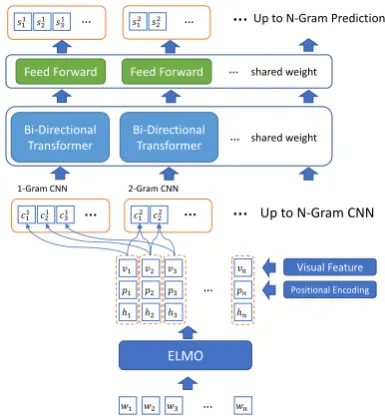
This section describes the architecture, visual fea-tures, and weak supervision of BLING-KPE.
𝑤1 …
ELMO
…
𝑤2 𝑤3 𝑤𝑛 ℎ1 ℎ2 ℎ3 ℎ𝑛 𝑝1 𝑝2 𝑝3 𝑝𝑛 𝑣1 𝑣2 𝑣3 𝑣𝑛 𝑐11 𝑐21 𝑐31 …
Visual Feature
Positional Encoding
𝑐12 𝑐22 … …
1-Gram CNN 2-Gram CNN Bi-Directional
Transformer
Bi-Directional
Transformer … shared weight
Feed Forward Feed Forward … shared weight
𝑠11 𝑠21 𝑠31 … 𝑠12 𝑠22 … …
Up to N-Gram CNN
[image:4.595.101.261.275.362.2]Up to N-Gram Prediction
Figure 2: The BLING-KPE model architecture
4.1 Network Architecture
As shown in Figure2, BLING-KPE is a keyphrase extraction model. It takes the word sequence of the document,d={w1, ...wi, ...wn}, and assigns keyphrase scores to its n-gram:f(wi:i+k, d). This process includes two main components: Hybrid Word Embedding and Convolutional Transformer. Hybrid Word Embedding. BLING-KPE rep-resents each word by its ELMo embedding, posi-tion embedding, and visual features.
The ELMo embedding brings the local contex-tual information:
~hi =ELMo(wi). (1)
The standard pre-trained ELMo is used (Peters et al.,2018).
The position embedding models the location the word in the document content. It uses the standard sinusoidal position embedding (Vaswani et al.,2017):
~
posi(2p) =sin(i/100002p/P), (2)
~
posi(2p+ 1) =cos(i/100002p/P). (3)
The p-th dimension of the position embedding is a function of its position (i) and dimension (p).
The visual features represent the visual presen-tation of each word. We denote the visual feature as~viand will describe its details in§4.2.
The hybrid word embedding is the concatena-tion of the three:
~
Convolutional Transformer. BLING-KPE uses a convolutional transformer architecture to model n-grams and their interactions.
It first composes the hybrid word embeddings to n-gram embeddings using CNNs. The embedding of i-th k-gram is calculated as
~
gik=CNNk(w~i:i+k), (5)
wherekis the length of the n-gram,1 ≤k ≤K.
Kis the maximum length of allowed candidate n-grams. Each k-gram has its own set of convolution filters CNNkwith window sizekand stride 1.
It then models the interactions between k-grams using Transformer (Vaswani et al.,2017).
~tk
i =Transformeri(G~k), (6)
~
Gk=~gk1 _ ... _ ~gik... _ ~gkn−k+1. (7)
The sequence G~k is the concatenations of all k-gram embeddings. The Transformer models the self-attentions between k-grams and fuses them to global contextualized embeddings.
The Transformer is convolutional on all length
kof n-grams; the same parameters are used model the interactions between n-grams at each length, to reduce the parameter size. The intuition is that the interactions between bi-grams and that between tri-grams are not significantly different.
The final score of an n-gram is calculated by a feedforward layer upon the Transformer. Like the Transformer, the same feedforward layer is ap-plied (convolutional) on all n-grams.
f(wi:i+k, d) =softmaxi,k(ski), (8)
ski =Feedforward(~tki). (9)
The softmax is taken over all possible n-grams at each positioniand each lengthk. The model de-cides the span location and length jointly.
Learning.The whole model is trained as a clas-sification problem using cross-entropy loss:
l=Cross-Entropy(yik, f(wi:i+k, d)), (10)
whereyikis the label of whether the phrasewi:i+k is a keyphrase of the document.
4.2 Visual Features
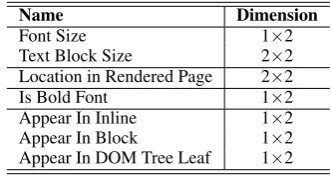
We extract four groups of visual features for each word in the document.
[image:5.595.332.498.126.214.2]• Sizefeatures include the height and width of the text block a word appears in.
Table 3: Visual Features. All features are extracted at per word level and the parent block level (the parent node of the word in the HTML DOM tree).
Name Dimension
Font Size 1×2
Text Block Size 2×2 Location in Rendered Page 2×2
Is Bold Font 1×2
Appear In Inline 1×2 Appear In Block 1×2 Appear In DOM Tree Leaf 1×2
• Locationfeatures include the 2-d location of the word in the rendered web page.
• Font feature includes the font size and whether the word is in Bold.
• DOMfeatures include whether the word ap-pears in “inline” or “block” HTML tags, also whether it is in a leaf node of the DOM tree.
The full feature set is listed in Table3. We double the features by including the same features from the word’s parent block in the DOM tree. The vi-sual features are included in the OpenKP releases.
4.3 Weak Supervisions from Search
An application of keyphrases is information re-trieval. The extracted keyphrases are expected to capture the main topic of the document, thus can provide high quality document index-ing terms (Gutwin et al., 1999) or new semantic ranking features (Xiong et al., 2018). Reversely, user clicks bring the user’s perception of the doc-ument during the search and provide a large num-ber of feedback signals for document understand-ing (Croft et al.,2010).
BLING-KPE leverages the user feedback sig-nals as weak supervision, in the task of Query Prediction. Given the document d, BLING-KPE learns to predict its click queries Q =
{q1, ..., qm}.
This pre-training step uses the same cross en-tropy loss:
lpre =Cross-Entropy(y0i, f(qi, d)), (11)
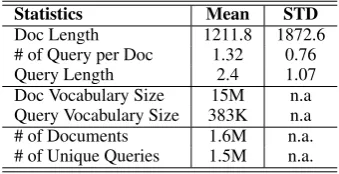
Table 4: Statistics of Query Prediction Dataset. The data is from a sample of Bing search log in on week.
Statistics Mean STD
Doc Length 1211.8 1872.6 # of Query per Doc 1.32 0.76
Query Length 2.4 1.07
Doc Vocabulary Size 15M n.a Query Vocabulary Size 383K n.a # of Documents 1.6M n.a. # of Unique Queries 1.5M n.a.
5 Experimental Methodology
Datasets used in our experiments include OpenKP, as described in §3, Query Prediction, and DUC-2001 (Wan and Xiao,2008b).
The Query Prediction data is sampled from the Bing search log with navigational and offensive queries filtered out. We keep only the click queries that are included as an n-gram in the document to be consistent with OpenKP’s extractive setting. The statistics of the sample is listed in Table4.
DUC-2001 is the KPE extraction dataset on DUC news articles (Wan and Xiao, 2008b). It includes 309 news articles and on average 8 keyphrase per article.
We use random 80%-20% train-test splits on OpenKP and Query Prediction. On OpenKP, BLING-KPE is first pre-trained on Query Predic-tion and then further trained on its manual labels. There is no overlap between the documents in Query Prediction and OpenKP.
DUC-2001 uses the zero-shot evaluation setting from prior research (Meng et al.,2017;Chen et al., 2018); no labels in DUC-2001 are used to train nor validate the neural models. It tests neural models’ generalization ability from the training domain to a different testing domain.
Evaluation Metrics. OpenKP and Query Pre-diction use Precision and Recall@{1, 3, 5}. DUC-2001 uses F1@10, the same as prior re-search (Meng et al.,2017;Chen et al.,2018).
Statistically, significant improvements are eval-uated by permutation test with p<0.05 on OpenKP and Query Prediction. The baselines on DUC-2001 reuse scores from previous results; the sta-tistical significant test is not applicable as per doc-ument results are not shared.
Baselines. OpenKP and Query Prediction ex-periments compareBLING-KPEwith: traditional KPE methods, production systems, and a neural
Table 5: Parameters to learn in BLING-KPE.
Component Dimensions
ELMo pre-trained and frozen Position Embedding 256 Visual Feature 18
N-gram CNN 512 filter, 1-5 window size (ngram) Transformer 8 head, 512 hidden dimension Feedforward 512-relu-512-relu-1
baseline.
Traditional KPE baselines include the follows.
• TFIDF is the unsupervised frequency based KPE system. The IDF scores are calculated on the corresponding corpus.
• TextRank is the popular graph-based unsu-pervised KPE model (Mihalcea and Tarau, 2004). Our in-house implementation is used.
• LeToR is the feature-based KPE model. It use LambdaMart (Burges, 2010) and stan-dard KPE features, i.e. those in KEA (Witten et al.,2005).
The production baselines include two versions.
• PROD is our current feature-based produc-tion KPE system. It uses many carefully en-gineered features and LambdaMart.
• PROD (Body) is the same system but only uses the body text, i.e. the title is not used.
All these unsupervised and feature-based meth-ods use the same keyphrase candidate selection system with PROD.
The neural baseline is CopyRNN (Meng et al., 2017). We use their open-source implementation and focus on the OpenKP dataset which is publicly available.
Table 6: Keyphrase Extraction Accuracy. Bold marks statistically significant improvements over all baselines.
OpenKP Query Prediction
Method P@1 R@1 P@3 R@3 P@5 R@5 P@1 R@1 P@3 R@3 P@5 R@5
TFIDF 0.283 0.150 0.184 0.284 0.137 0.347 0.403 0.332 0.204 0.491 0.133 0.526 TextRank 0.077 0.041 0.062 0.098 0.055 0.142 0.132 0.111 0.089 0.218 0.073 0.295 LeToR 0.301 0.158 0.173 0.268 0.127 0.324 0.328 0.271 0.169 0.406 0.119 0.471 PROD 0.353 0.188 0.195 0.299 0.131 0.331 0.376 0.308 0.197 0.468 0.129 0.505 PROD (Body) 0.214 0.094 0.130 0.196 0.094 0.234 0.353 0.287 0.191 0.454 0.125 0.492 CopyRNN 0.288 0.174 0.185 0.331 0.141 0.413 – – – – – – BLING-KPE 0.404 0.220 0.248 0.390 0.188 0.481 0.540 0.449 0.275 0.654 0.188 0.729
Table 7: Performance of BLING-KPE ablations.Italicmarks statistically significant worse performances than Full Model.
OpenKP Query Prediction
Method P@1 R@1 P@3 R@3 P@5 R@5 P@1 R@1 P@3 R@3 P@5 R@5
No ELMo 0.270 0.145 0.172 0.271 0.132 0.347 0.323 0.274 0.189 0.450 0.136 0.527
No Transformer 0.389 0.211 0.247 0.385 0.189 0.481 0.489 0.407 0.258 0.618 0.178 0.698
No Position 0.394 0.213 0.247 0.386 0.187 0.475 0.543 0.452 0.281 0.666 0.191 0.742 No Visual 0.370 0.201 0.230 0.362 0.176 0.450 0.492 0.409 0.258 0.615 0.178 0.695
No Pretraining 0.369 0.198 0.236 0.367 0.181 0.460 – – – – – – Full Model 0.404 0.220 0.248 0.390 0.188 0.481 0.540 0.449 0.275 0.654 0.188 0.729
6 Evaluation Results
Three experiments are conducted to evaluate the accuracy of BLING-KPE, the source of its effec-tiveness, and its generalization ability.
6.1 Overall Accuracy
The overall extraction accuracy on OpenKP and Query Prediction is shown in Table6.
TFIDF works well on both tasks. Frequency-based methods are often strong baselines in doc-ument representation tasks. LeToR performs bet-ter than its frequency feature TFIDF in OpenKP but worse on Query Prediction. Supervised meth-ods are not necessarily stronger than unsupervised ones in KPE (Hasan and Ng, 2014). TextRank does not work well in our dataset; its word graph is likely misguided by the noisy contents.
PROD, our feature-based production system, outperforms all other baselines by large margins on OpenKP. It is expected as it is highly optimized with a lot of engineering efforts. Nonetheless, adapting a complex feature-based system to a new task/domain requires extra engineering work; di-rectly applying it to the Query Prediction task does not work well. The feature-based Production sys-tem also needs the title information; PROD (Body) performs much worse than PROD.
CopyRNN performs relatively well on OpenKP, especially on later keyphases. The main challenge for CopyRNN is the low-quality and highly
vari-ant contents on the web. Real-world web pages are not cohesive nor well-written articles but include various structures such as lists, media captions, and text fragments. Modeling them as a word sequence is not ideal. The other differences are not as significant: The vocabulary size and train-ing data size on Query Prediction are similar to CopyRNN’s KP 40K dataset; CopyRNN performs better on keyphrase extraction than generation in KP20k (Meng et al.,2017).
BLING-KPE outperforms all other methods by large margins. The improvements are robust and significant on both tasks, both metrics, and on all depths. It achieves 0.404 P@1 on OpenKP and re-covers 72% of clicked queries at depth 5 on Query Prediction. The sources of this effectiveness is studied in the next experiment.
6.2 Ablation Study
Table7 shows ablation results on BLING-KPE’s variations. Each variation removes a component and keeps all others unchanged.
ELMo Embedding. We first verify the effec-tiveness of using ELMo embedding by replacing ELMo with the WordPiece token embedding (Wu et al., 2016). The accuracy of this variation is much lower than the accuracy of the full model and others. The result is shown in the first row of Table7. The context-aware word embedding is a necessary component ofBLING-KPE.
Table 8: Performance on DUC-2001. Neural mod-els are evaluated directly on DUC-2001 without fine-tuning on DUC labels. Results better than TFIDF are markedBold.
Method F1@10 Method F1@10
TFIDF 0.270 TopicRank 0.154 TextRank 0.097 KeyCluster 0.140 SingleRank 0.256 ExpandRank 0.269
Trained by Scientific Papers
CopyRNN 0.164 CorrRNN 0.173
BLING-KPE (No Visual, No Pretraining) 0.267
Trained by Open Domain Documents
BLING-KPE (No Visual, No Pretraining) 0.282
Table 7 studies the contribution of Transformer and position embedding. Transformer contributes significantly to Query Prediction; with a lot of training data, the self-attention layers capture the global contexts between n-grams. But on OpenKP, its effectiveness is mostly observed on the first po-sition. The position embedding barely helps, since real-world web pages are often not one text se-quence.
Beyond Language Understanding. As shown in the second part of Table7, both visual features and search pretraining contribute significantly to BLING-KPE’s effectiveness. Without either of them, the accuracy drops significantly. Visual fea-tures even help on Query Prediction, though users issued the click queries and clicked on the docu-mentsbeforeseeing its full page.
The crucial role of ELMo embeddings confirm the benefits of bringing background knowledge and general language understanding, in the format of pre-trained contextual embedding, in keyphrase extraction. The importance of visual features and search weak supervisions confirms the benefits of going beyond language understanding in modeling real-world web documents.
6.3 Generalization Ability
This experiment studies the generalization ability of BLING-KPE using the zero-shot evaluation on DUC-2001 (Meng et al.,2017;Chen et al.,2018). For fair comparisons, we use KP20K or OpenKP, the two public datasets, to train the No Visual & No Pretraining version of BLING-KPE, and eval-uate on DUC-2001 directly. No labels in DUC are used to fine-tune the neural models.
[image:8.595.80.284.126.221.2]To adjust to DUC’s larger number of keyphrases, we apply the trained BLING-KPE on the 256-length chunks of DUC articles
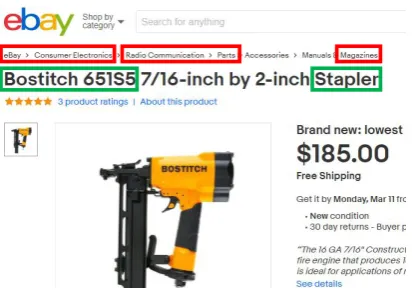
Figure 3: An example of visual feature contribu-tions in BLING-KPE. The big green blocks are the keyphrases extracted with visual features. The small read blocks are those extracted without vi-sual information.
and merge the extracted keyphrases using simple heuristics:
• Weighted Sum: Scores of the same keyphrase from different chunks are summed with weights 0.9p. P is the index of the chunk.
• Deduplication: A keyphrase is discarded if it is a sub-string of a top 1/4 ranked keyphrase.
The results are shown in Table8.BLING-KPE, when trained with OpenKP, is the only neu-ral method that outperforms TFIDF in this zero-shot evaluation. It outperforms previous neu-ral methods by more than 60%, and itself when trained on KP20k, confirming the strong gener-alization ability ofBLING-KPE and the training withOpenKP.
6.4 Discussion
Our manual case studies found many interesting examples that illustrate the advantage of modeling documents with visual information.
7 Conclusion
This paper curates OpenKP, the first public large scale open domain keyphrase extraction bench-mark to facilitate future research keyphrase extrac-tion research in real-world scenarios. It also de-velops BLING-KPE, which leverages visual rep-resentation and search-based weak supervision to model real-world documents with variant con-tents, appearances, and diverse domains.
Our experiments demonstrate the robust im-provements of BLING-KPE compared to previous approaches. Our studies showcase how BLING-KPE’s language understanding, visual features and search weak supervision jointly deliver this ef-fective performance, as well as its generalization ability to an unseen domain in zero-shot setting.
In the future, we plan to extend OpenKP with more annotated documents and connect it with downstream applications.
References
Isabelle Augenstein, Mrinal Das, Sebastian Riedel, Lakshmi Vikraman, and Andrew McCallum. 2017. SemEval 2017 task 10: ScienceIE - extracting keyphrases and relations from scientific publica-tions. InSemEval@ACL.
Chris J.C. Burges. 2010. From RankNet to Lamb-daRank to LambdaMART: An overview. MSR-TR-2010-82.
Jun Chen, Xiaoming Zhang, Yu Wu, Zhao Yan, and Zhoujun Li. 2018. Keyphrase generation with corre-lation constraints. InProceedings of the 2018 Con-ference on Empirical Methods in Natural Language
Processing, EMNLP 2018, pages 4057–4066.
Mo Chen, Jian-Tao Sun, Hua-Jun Zeng, and Kwok-Yan Lam. 2005. A practical system of keyphrase extrac-tion for web pages. InProceedings of the 14th ACM international conference on Information and
knowl-edge management, pages 277–278. ACM.
Wang Chen, Yifan Gao, Jiani Zhang, Irwin King, and Michael R. Lyu. 2019. Title-guided encoding for keyphrase generation. In The Thirty-Third AAAI
Conference on Artificial Intelligence 2019, pages
6268–6275.
W Bruce Croft, Donald Metzler, and Trevor Strohman. 2010. Search Engines: Information Retrieval in
Practice. Addison-Wesley Reading.
Maria P. Grineva, Maxim N. Grinev, and Dmitry Li-zorkin. 2009. Extracting key terms from noisy and multitheme documents. In Proceedings of the 18th International Conference on World Wide Web,
WWW 2009, pages 661–670.
Carl Gutwin, Gordon W. Paynter, Ian H. Wit-ten, Craig G. Nevill-Manning, and Eibe Frank. 1999. Improving browsing in digital libraries with keyphrase indexes. Decision Support Systems, 27:81–104.
Kazi Saidul Hasan and Vincent Ng. 2014. Automatic keyphrase extraction: A survey of the state of the art. InProceedings of the 52nd Annual Meeting of the Association for Computational Linguistics, ACL 2014, pages 1262–1273.
Feifan Liu, Deana Pennell, Fei Liu, and Yang Liu. 2009a. Unsupervised approaches for automatic key-word extraction using meeting transcripts. In
Hu-man Language Technologies: Conference of the
North American Chapter of the Association of Com-putational Linguistics, Proceedings, HLT-NAACL 2009, pages 620–628.
Zhengzhong Liu, Chenyan Xiong, Teruko Mitamura, and Eduard Hovy. 2018. Automatic event salience identification. In Proceedings of the 2018 Confer-ence on Empirical Methods in Natural Language
Processing, EMNLP 2018s, pages 1226–1236.
Zhiyuan Liu, Wenyi Huang, Yabin Zheng, and Maosong Sun. 2010. Automatic keyphrase extrac-tion via topic decomposiextrac-tion. InProceedings of the 2010 Conference on Empirical Methods in Natural
Language Processing, EMNLP 2010, pages 366–
376.
Zhiyuan Liu, Peng Li, Yabin Zheng, and Maosong Sun. 2009b. Clustering to find exemplar terms for keyphrase extraction. In Proceedings of the 2009 Conference on Empirical Methods in Natural
Lan-guage Processing, EMNLP 2009, pages 257–266.
Olena Medelyan, Eibe Frank, and Ian H. Witten. 2009. Human-competitive tagging using automatic keyphrase extraction. In Proceedings of the 2009 Conference on Empirical Methods in Natural
Lan-guage Processing, EMNLP 2009, pages 1318–1327.
Rui Meng, Sanqiang Zhao, Shuguang Han, Daqing He, Peter Brusilovsky, and Yu Chi. 2017. Deep keyphrase generation. In Proceedings of the 55th Annual Meeting of the Association for Computa-tional Linguistics, ACL 2017, pages 582–592.
Rada Mihalcea and Paul Tarau. 2004. TextRank: Bringing order into text. InProceedings of the 2004 Conference on Empirical Methods in Natural
Lan-guage Processing , EMNLP 2004, pages 404–411.
Chau Q. Nguyen and Tuoi T. Phan. 2009. An ontology-based approach for key phrase extraction. InACL 2009, Proceedings of the 47th Annual Meeting of the Association for Computational Linguistics and the 4th International Joint Conference on Natural
Lan-guage Processing of the AFNLP, ACL/IJCNLP 2009,
Matthew E. Peters, Mark Neumann, Mohit Iyyer, Matt Gardner, Christopher Clark, Kenton Lee, and Luke Zettlemoyer. 2018. Deep contextualized word repre-sentations. InProceedings of the 2018 Conference of the North American Chapter of the Association for Computational Linguistics: Human Language
Technologies, NAACL-HLT 2018, pages 2227–2237.
Peter D. Turney. 2001. Mining the web for synonyms: PMI-IR versus LSA on TOEFL. InMachine Learn-ing: EMCL 2001, 12th European Conference on
Machine Learning, 2001, Proceedings, pages 491–
502.
Ashish Vaswani, Noam Shazeer, Niki Parmar, Jakob Uszkoreit, Llion Jones, Aidan N. Gomez, Lukasz Kaiser, and Illia Polosukhin. 2017. Attention is all you need. InAdvances in Neural Information Pro-cessing Systems 30: Annual Conference on Neural
Information Processing Systems, NIPS 2017, pages
5998–6008.
Xiaojun Wan and Jianguo Xiao. 2008a. Col-labRank: Towards a collaborative approach to single-document keyphrase extraction. In22nd In-ternational Conference on Computational
Linguis-tics, Proceedings of the Conference, COLING 2008,
pages 969–976.
Xiaojun Wan and Jianguo Xiao. 2008b. Single document keyphrase extraction using neighborhood knowledge. In Proceedings of the Twenty-Third AAAI Conference on Artificial Intelligence, AAAI 2008, pages 855–860.
Ian H Witten, Gordon W Paynter, Eibe Frank, Carl Gutwin, and Craig G Nevill-Manning. 2005. KEA: Practical automated keyphrase extraction. InDesign
and Usability of Digital Libraries: Case Studies in the Asia Pacific, pages 129–152. IGI Global.
Yonghui Wu, Mike Schuster, Zhifeng Chen, Quoc V. Le, Mohammad Norouzi, Wolfgang Macherey, Maxim Krikun, Yuan Cao, Qin Gao, Klaus Macherey, Jeff Klingner, Apurva Shah, Melvin Johnson, Xiaobing Liu, Lukasz Kaiser, Stephan Gouws, Yoshikiyo Kato, Taku Kudo, Hideto Kazawa, Keith Stevens, George Kurian, Nishant Patil, Wei Wang, Cliff Young, Jason Smith, Jason Riesa, Alex Rudnick, Oriol Vinyals, Greg Corrado, Macduff Hughes, and Jeffrey Dean. 2016. Google’s neural machine translation system: Bridging the gap between human and machine translation. CoRR, abs/1609.08144.
Chenyan Xiong, Zhengzhong Liu, Jamie Callan, and Tie-Yan Liu. 2018. Towards better text understand-ing and retrieval through kernel entity salience mod-eling. InThe 41st International ACM SIGIR Con-ference on Research & Development in Information Retrieval, SIGIR 2018, pages 575–584.
Hai Ye and Lu Wang. 2018. Semi-supervised learning for neural keyphrase generation. InProceedings of the 2018 Conference on Empirical Methods in
Nat-ural Language Processing, pages 4142–4153.
Wen-tau Yih, Joshua Goodman, and Vitor R. Carvalho. 2006. Finding advertising keywords on web pages. InProceedings of the 15th international conference
on World Wide Web, WWW 2006, pages 213–222.
Xingdi Yuan, Tong Wang, Rui Meng, Khushboo Thaker, Daqing He, and Adam Trischler. 2018.
Generating diverse numbers of diverse keyphrases.