A Neural Network for Coordination Boundary Prediction
Jessica Ficler
Computer Science Department Bar-Ilan University
Israel
Yoav Goldberg
Computer Science Department Bar-Ilan University
Israel
Abstract
We propose a neural-network based model for coordination boundary prediction. The net-work is designed to incorporate two signals: the similarity between conjuncts and the ob-servation that replacing the whole coordina-tion phrase with a conjunct tends to produce a coherent sentences. The modeling makes use of several LSTM networks. The model is trained solely on conjunction annotations in a Treebank, without using external resources. We show improvements on predicting coor-dination boundaries on the PTB compared to two state-of-the-art parsers; as well as im-provement over previous coordination bound-ary prediction systems on the Genia corpus.
1 Introduction
Coordination is a common syntactic phenomena, ap-pearing in 38.8% of the sentences in the Penn Tree-bank (PTB) (Marcus et al., 1993), and in 60.71% of the sentences in the Genia Treebank (Ohta et al., 2002). However, predicting the correct conjuncts span remain one of the biggest challenges for state-of-the-art syntactic parsers. Both the Berkeley and Zpar phrase-structure parsers (Petrov et al., 2006; Zhang and Clark, 2011) achieve F1 scores of around 69% when evaluated on their ability to recover coor-dination boundaries on the PTB test set. For exam-ple, in:
“He has the government’s blessing to [build churches] and [spread Unificationism] in that country.”
the conjuncts are incorrectly predicted by both parsers:
Berkeley: “He has the government’s blessing to [build churches] and [spread Unificationism in that country].” Zpar: “He [has the government’s blessing to build churches] and [spread Unificationism in that country].”
In this work we focus on coordination boundary prediction, and suggest a specialized model for this task. We treat it as a ranking task, and learn a scor-ing function over conjuncts candidates such that the correct candidate pair is scored above all other can-didates. The scoring model is a neural network with two LSTM-based components, each modeling a dif-ferent linguistic principle: (1) conjuncts tend to be similar (“symmetry”); and (2) replacing the coor-dination phrase with each of the conjuncts usually result in a coherent sentence (“replacement”). The
symmetry component takes into account the con-juncts’ syntactic structures, allowing to capture sim-ilarities that occur in different levels of the syntac-tic structure. Thereplacementcomponent considers the coherence of the sequence that is produced when connecting the participant parts. Both of these sig-nals are syntactic in nature, and are learned solely based on information in the Penn Treebank. Our model substantially outperforms both the Berkeley and Zpar parsers on the coordination prediction task, while using the exact same training corpus. Seman-tic signals (which are likely to be based on resources external to the treebank) are also relevant for coor-dination disambiguation (Kawahara and Kurohashi, 2008; Hogan, 2007) and provide complementary in-formation. We plan to incorporate such signals in future work.
2 Background
Coordination is a very common syntactic construc-tion in which several sentential elements (called con-juncts) are linked. For example, in:
“The Jon Bon Jovi Soul Foundation [was founded in 2006] and1[exists to combat issues that force (fam-ilies) and2 (individuals) into economic despair].”
The coordinatorand1links the conjuncts surrounded
with square brackets and the coordinatorand2links
the conjuncts surrounded with round brackets. Coordination between NPs and between VPs are the most common, but other grammatical functions can also be coordinated: “[relatively active]ADJP
but [unfocused]ADJP” ; “[in]IN and [out]IN the
market”. While coordination mostly occurs be-tween elements with the same syntactic category, cross-category conjunctions are also possible: ( “Al-ice will visit Earth [tomorrow]N P or [in the next
decade]P P”). Less common coordinations involve
non-constituent elements “[equal to] or [higher than]”, argument clusters (“Alice visited [4 plan-ets] [in 2014] and [3 more] [since then]”), and gap-ping (“[Bob lives on Earth] and [Alice on Saturn]”) (Dowty, 1988).
2.1 Symmetry between conjuncts
Coordinated conjuncts tend to be semantically re-lated and have a similar syntactic structure. For ex-ample, in (a) and (b) the conjuncts include similar words (China/Asia, marks/yen) and have identical syntactic structures.
PP
PP
IN
for NP
NNP
China CC
and PP
IN
for NP
NNP
Asia
(a)
NP
NP
CD
1.8690 NNS
marks CC
and NP
CD
139.75 NNS
yen
(b)
Symmetry holds also in larger conjuncts, such as in:
(c)
NP
NP
NN income
PP
IN of
NP NP QP 429.9 billion
NNS rubles
PRN (US$ 693.4)
CC and
NP
VBZ expenditures
PP
IN of
NP NP QP 489.9 billion
NNS rubles
PRN (US$ 790.2)
Similarity between conjuncts was used as a guiding principle in previous work on coordination disam-biguation (Hogan, 2007; Shimbo and Hara, 2007; Hara et al., 2009).
2.2 Replaceability
Replacing a conjunct with the whole coordination phrase usually produce a coherent sentence (Hud-dleston et al., 2002). For example, in “Ethan has developed [new products] and [a new strategy]”, replacement results in: “Ethan has developed new products”; and “Ethan has developed a new strat-egy”, both valid sentences. Conjuncts replace-ment holds also for conjuncts of different syntac-tic types, e.g.: “inactivation of tumor-suppressor genes, [alone] or [in combination], appears crucial to the development of such scourges as cancer.”.
While both symmetry and replacebility are strong characteristics of coordination, neither principle holds universally. Coordination between syntacti-cally dissimilar conjuncts is possible (“tomorrow and for the entirety of the next decade”), and the replacement principle fails in cases of ellipsis, gap-ping and others (“The bank employs [8,000 people in Spain] and [2,000 abroad]”).
2.3 Coordination in the PTB
domain and much smaller than the PTB. In this work we rely on a version of the PTB released by Ficler and Goldberg (2016) in which the above deficiencies are manually resolved. In particular, coordinating elements, coordination phrases and conjunct bound-aries are explicitly marked with specialized function labels.
2.4 Neural Networks and Notation
We use w1:n to indicate a list of vectors
w1, w2, . . . wnandwn:1to indicate the reversed list.
We use◦for vector concatenation. When a discrete symbol w is used as a neural network’s input, the
corresponding embedding vector is assumed. A multi-layer perceptron (MLP) is a non linear classifier. In this work we take MLP to mean a classifier with a single hidden layer: M LP(x) = V ·g(W x+b) where x is the network’s input, g
is an activation function such as ReLU or Sigmoid, andW,V andbare trainable parameters. Recurrent
Neural Networks (RNNs) (Elman, 1990) allow the representation of arbitrary sized sequences. In this work we use LSTMs (Hochreiter and Schmidhuber, 1997), a variant of RNN that was proven effective in many NLP tasks. LSTM(w1:n)is the outcome
vec-tor resulting from feeding the sequencew1:ninto the
LSTM in order. A bi-directional LSTM (biLSTM) takes into account both the pastw1:i and the future
wi:nwhen representing the element in positioni:
biLST M(w1:n, i) =LST MF(w1:i)◦LST MB(wn:i)
whereLST MF reads the sequence in its regular
or-der andLST MBreads it in reverse.
3 Task Definition and Architecture
Given a coordination word in a sentence, the coor-dination prediction task aims to returns the two con-juncts that are connected by it, or NONEif the word
does not function as a coordinating conjunction of a relevant type.1 Figure 1 provides an example.
Our system works in three phases: first, we deter-mine if the coordinating word is indeed part of a con-junction of a desired type. We then extract a ranked list of candidate conjuncts, where a candidate is a 1We considerand, or,but, noras coordination words. In
case of more than two coordinated elements (conjuncts), we fo-cus on the two conjuncts which are closest to the coordinator.
Sentence:
And1the city decided to treat its guests more
like royalty or2rock stars than factory owners.
Expected output:
and1: NONE
or2: (11-11)royalty; (12-13)rock stars Sentence:
The president is expected to visit Minnesota, New York and1North Dakota by the end of the year.
Expected output:
and1: (9-10)New York; (12-13)North Dakota
Figure 1:The coordination prediction task.
pair of spans of the form ((i, j), (l, m)). The can-didates are then scored and the highest scoring pair is returned. Section 4 describes the scoring model, which is the main contribution of this work. The coordination classification and candidate extraction components are described in Section 5.
4 Candidate Conjunctions Scoring
Our scoring model takes into account two signals, symmetry between conjuncts and the possibility of replacing the whole coordination phrase with its par-ticipating conjuncts.
4.1 The Symmetry Component
As noted in Section 2.1, many conjuncts spans have similar syntactic structure. However, while the sim-ilarity is clear to human readers, it is often not easy to formally define, such as in:
“about/IN half/NN its/PRP$revenue/NN and/CC
more/JJR than/IN half/NN its/PRP$profit/NN”
VP VB cut NP PRP$ their NNS risks VP VB take NP NNS profits R VP VB cut
cut VB VP R
L VP R NP PRP$ their
their PRP$ NP R VP L
VP
L
NP
NNS
risks
risks NNS NP L VP
R VP VB take tak e
VB VP R
L
VP
NP
NNS
profits
[image:4.612.77.537.58.132.2]profits NNS NP VP L Euclidean Distance
Figure 2:Illustration of the symmetry scoring component that takes into account the conjuncts syntactic structures. Each conjunct tree is decomposed into paths that are fed into the path-LSTMs (squares). The resulting vectors are fed into the symmetry LSTM function (circles). The outcome vectors (blue circles) are then fed into the euclidean distance function.
Given two spans of lengths k and m with
cor-responding vector sequences u1:k andv1:m we
en-code each sequences using an LSTM, and take the euclidean distance between the resulting representa-tions:
Sym(u1:k, v1:m) =||LST M(u1:k)−LST M(v1:m)||
The network is trained such that the distance is min-imized for compatible spans and large for incompat-ible ones in order to learn that vectors that represent correct conjuncts are closer than vectors that do not represent conjuncts.
What are the elements in the sequences to be com-pared? One choice is to take the vectors ui to
cor-respond to embeddings of the ith POS in the span.
This approach works reasonably well, but does not consider the conjuncts’ syntactic structure, which may be useful as symmetry often occurs on a higher level than POS tags. For example, in:
NP NP NN tomorrow PP IN at CD 16:00 CC or NP NP NP the day PP after tomorrow PP IN at CD 12:00
the similarity is more substantial in the third level of the tree than in the POS level.
A way to allow the model access to higher levels of syntactic symmetry is to represent each word as the projection of the grammatical functions from the word to the root.2 For example, the projections for the first conjunct in Figure 2 are:
2Similar in spirit to the spines used in Carreras et al. (2008)
and Shen et al. (2003).
VP VB cut VP NP PRP$ their VP NP NNS risks
This decomposition captures the syntactic context of each word, but does not uniquely determine the structure of the tree. To remedy this, we add to the paths special symbols, R and L, which marks
the lowest common ancestors with the right and left words respectively. These are added to the path above the corresponding nodes. For example con-sider the following paths which corresponds to the above syntactic structure:
R VP VB cut L VP R NP PRP$ their VP L NP NNS risks
The lowest common ancestor of“their”and“risks”
is NP. Thus, R is added after NP in the path of
“their” and L is added after NP in the path of “risks”. Similarly,LandRare added after the VP
in the“their”and“cut”paths.
The path for each word is encoded using an LSTM receiving vector embeddings of the elements in the path from the word to the root. We then use the resulting encodings instead of the POS-tag embed-dings as input to the LSTMs in the similarity func-tion. Figure 2 depicts the complete process for the spans “cut their risks” and “take profits”.
Sentence:
Rudolph Agnew, [55 years old] and [former chairman of CGF PLC] ,was named a nonexecutive director.
wi−1 wi wj wk wl wm wm+1
| {z } | {z } | {z } | {z }
P re Conj1 Conj2 P ost
Expansions:
Rudolph Agnew, 55 years old ,was named a nonexecutive director.
[image:5.612.70.540.72.155.2]Rudolph Agnew, former chairman of CGF PLC ,was named a nonexecutive director.
Figure 3:The correct conjuncts spans of the coordinatorandin the sentence and the outcome expansions.
corresponding cell in the CKY chart.3 In both ap-proaches, the POS embeddings are initialized with vectors that are pre-trained by running word2vec (Mikolov et al., 2013) on the POS sequences in PTB training set.
4.2 The Replacement Component
The replacement component is based on the obser-vation that, in many cases, the coordination phrase can be replaced with either one of its conjuncts while still preserving a grammatical and semantically co-herent sentence (Section 2.2)
When attempting such a replacement on incorrect conjuncts, the resulting sentence is likely to be either syntactically or semantically incorrect. For exam-ple, in the following erroneous analysis: “Rudolph Agnew, [55 years old] and [former chairman] of Consolidated Gold Fields PLC”replacing the con-junction with the first conjunct results in the se-mantically incoherent sequence “Rudolph Agnew, 55 years old of Consolidated Golden Fields, PLC”.4 Our goal is to distinguish replacements resulting from correct conjuncts from those resulting from er-roneous ones. To this end, we focus on the connec-tion points. A connection point in a resulting sen-tence is the point where the sensen-tence splits into two sequences that were not connected in the original sentence. For example, consider the sentence in Fig-ure 3. It has four parts, marked asPre,Conj1,Conj2
andPost. Replacing the coordination phraseConj1 and Conj2withConj2results in a connection point
3The parser’s CKY chart did not include a tree for 10% of
the candidate spans, which have inside probability 0 and outside probability>0. For those, we obtained the syntactic structure
by running the parser on the span words only.
4While uncommon, incorrect conjuncts may also result in
valid sentences, e.g.“He paid$7 for cold [drinks] and [pizza] that just came out of the oven.”
betweenPreandConj2. Likewise, replacing the co-ordination phrase with Conj1results in connection point betweenConj1andPost.
In order to model the validity of the connection points, we represent each connection point as the concatenation of a forward and reverse LSTMs cen-tered around that point. Specifically, for the spans in Figure 3 the two connection points are represented as:
LST MF(Rudolph,...,old)◦LST MB(director,...,was,,)
and
LST MF(Rudolph,Agnew,,)◦LST MB(director,...,former)
Formally, assuming wordsw1:nin a sentence with
coordination at position k and conjuncts wi:j and
wl:m,5 the connection points are between w1:j and
wm+1:n; and between w1:i−1 and wl:n. The two
connection points representations are then concate-nated, resulting in areplacement vector:
REPL(w1:n, i, j, l, m) =
CONPOINT(w1:n, i−1, l)◦CONPOINT(w1:n, j, m+ 1)
where:
CONPOINT(w1:n, i, j) =
LST MF(w1:i)◦LST MB(wn:j)
We use two variants of the replacement vectors, corresponding to two levels of representation. The first variant is based on the sentence’s words, while the second is based on its POS-tags.
4.3 Parser based Features
In addition to the symmetry and replacement sig-nals, we also incorporate some scores that are de-rived from the Berkeley parser. As detailed in Sec-tion 5, a list of conjuncts candidates are extracted
5Usuallyj = k
from the CKY chart of the parser. The candidates are then sorted in descending order according to the multiplication of inside and outside scores of the candidate’s spans:6I
(i,j)×O(i,j)×I(l,m)×O(l,m).
Each candidate {(i, j),(l, m)} is assigned two
nu-merical features based on this ranking: its position in the ranking, and the ratio between its score and the score of the adjacent higher-ranked candidate. We add an additional binary feature indicating whether the candidate spans are in the 1-best tree predicted by the parser. These three features are denoted as
F eats(i, j, l, m).
4.4 Final Scoring and Training
Finally, the score of a candidate{(i, j),(l, m)}in a sentence with wordsw1:nand POS tagsp1:nis
com-puted as:
SCORE(w1:n, p1:n,{(i, j),(l, m)}) = M LP(
Sym(vP ath i:j , vP athl:m ) ◦Repl(w1:n, i, j, l, m) ◦Repl(p1:n, i, j, l, m) ◦F eats(i, j, l, m) )
whereviP ath:j andvP athl:m are the vectors resulting from
the path LSTMs, andSym,ReplandF eatsare the
networks defined in Sections 4.1 – 4.3 above. The network is trained jointly, attempting to minimize a pairwise ranking loss function, where the loss for each training case is given by:
loss=max(0,1−(ˆy−yg))
where yˆis the highest scoring candidate and yg is
the correct candidate. The model is trained on all the coordination cases in Section 2–21 in the PTB.
5 Candidates Extraction and Supporting Classifiers
Candidates Extraction We extract candidate spans based on the inside-outside probabilities as-signed by the Berkeley parser. Specifically, to obtain 6Inside-Outside probabilities (Goodman, 1998) represent
the probability of a span with a given non-terminal symbol. The inside probabilityI(N,i,j)is the probability of generating
wordswi, wi+1, ..., wj given that the root is the non-terminal N. The outside probabilityO(N,i,j) is the probability of
gen-erating words w1, w2, ..., wi−1, the non-terminalN and the
wordswj+1, wj+2, ..., wnwith the rootS.
candidates for conjunct span we collect spans that are marked with COORD, are adjacent to the coor-dinating word, and have non-zero inside or outside probabilities. We then take as candidates all possi-ble pairs of collected spans. On the PTB dev set, this method produces 6.25 candidates for each co-ordinating word on average and includes the correct candidates for 94% of the coordinations.
Coordination Classification We decide whether a coordination wordwk in a sentence w1:n functions
as a coordinator by feeding the biLSTM vector cen-tered aroundwkinto a logistic classifier:
σ(v·biLSTM(w1:n, k) +b).
The training examples are all the coordination words (marked with CC) in the PTB training set. The model achieves 99.46 F1 on development set and 99.19 F1 on test set.
NP coordinations amount to about half of the coordination cases in the PTB, and previous work is often evaluated specifically on NP coordination. When evaluating on NP coordination, we depart from the unrealistic scenario used in most previous work where the type of coordination is assumed to be known a-priori, and train a specialized model for predicting the coordination type. For a coordination candidate{(i, j),(l, m)}with a coordinatorwk, we
predict if it is NP coordination or not by feeding a logistic classifier with a biLSTM vector centered around the coordinator and constrained to the candi-date spans:
σ(v·biLSTM(wi:m, k) +b).
The training examples are coordinations in the PTB training set, where where a coordinator is consid-ered of type NP if its head is labeled with NP or NX. Evaluating on gold coordinations results in F1 scores of 95.06 (dev) and 93.89 (test).
6 Experiments
We evaluate our models on their ability to identify conjunction boundaries in the extended Penn bank (Ficler and Goldberg, 2016) and Genia Tree-bank (Ohta et al., 2002)7.
When evaluating on the PTB, we compare to the conjunction boundary predictions of the generative
Dev Test
P R F P R F
Berkeley 70.14 70.72 70.42 68.52 69.33 68.92
Zpar 72.21 72.72 72.46 68.24 69.42 68.82
[image:7.612.80.293.56.109.2]Ours 72.34 72.25 72.29 72.81 72.61 72.7
Table 1:Coordination prediction on PTB (All coordinations).
Dev Test
P R F P R F
Berkeley 67.53 70.93 69.18 69.51 72.61 71.02
Zpar 69.14 72.31 70.68 69.81 72.92 71.33
Ours 75.17 74.82 74.99 76.91 75.31 76.1
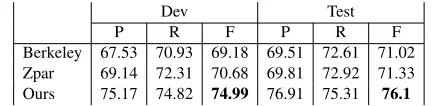
Table 2:Coordination prediction on PTB (NP coordinations).
Berkeley parser (Petrov et al., 2006) and the discrim-inative Zpar parser (Zhang and Clark, 2011). When evaluating on the Genia treebank, we compare to the results of the discriminative coordination-prediction model of Hara et al. (2009).8
6.1 Evaluation on PTB
Baseline Our baseline is the performance of the Berkeley and Zpar parsers on the task presented in Section 3, namely: for a given coordinating word, determine the two spans that are being conjoined by it, and return NONE if the coordinator is not
conjoining spans or conjoins spans that are not of the expected type. We convert predicted trees to conjunction predictions by taking the two phrases that are immediately adjacent to the coordinator on both sides (ignoring phrases that contain solely punctuation). For example, in the following Zpar-predicted parse tree the conjunct prediction is (“Feb. 8, 1990”,“May 10, 1990”).
NP
NP
Feb. 8, 1990 CC
and
NP
May 10, 1990 ,
,
ADJP
respectively
Cases in which the coordination word is the left-most or right-left-most non-punctuation element in its phrase (e.g. (PRN (P -)(CC and)(S it’s been painful)(P -))) are considered as no-coordination (“None”).
8Another relevant model in the literature is (Hanamoto et al.,
2012), however the results are not directly comparable as they use a slightly different definition of conjuncts, and evaluate on a subset of the Genia treebank, containing only trees that were properly converted to an HPSG formalism.
We consider two setups. In the first we are inter-ested in all occurrences of coordination, and in the second we focus on NP coordination. The second scenario requires typed coordinations. We take the type of a parser-predicted coordination to be the type of the phrase immediately dominating the coordina-tion word.
Evaluation Metrics We measure precision and re-call compared to the gold-annotated coordination spans in the extended PTB, where an example is considered correct if both conjunct boundaries match exactly. When focusing on NPs coordina-tions, the type of the phrase above the CC level must match as well, and phrases of type NP/NX are con-sidered as NP coordination.
Results Tables (1) and (2) summarize the results. The Berkeley and Zpar parsers perform similarly on the coordination prediction task. Our proposed model outperforms both parsers, with a test-setF1
score of 72.7 (3.78 F1 points gain over the better
parser) when considering all coordinations, and test-setF1score of 76.1 (4.77F1points gain) when
con-sidering NP coordination.
6.2 Evaluation on Genia
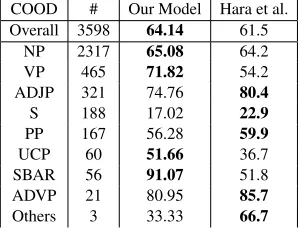
To compare our model to previous work, we evalu-ate also on the Genia treebank (Beta), a collection of constituency trees for 4529 sentences from Med-line abstracts. The Genia treebank coordination an-notation explicitly marks coordination phrases with a special function label (COOD), making the cor-pus an appealing resource for previous work on co-ordination boundary prediction (Shimbo and Hara, 2007; Hara et al., 2009; Hanamoto et al., 2012). Following Hara et al. (2009), we evaluate the mod-els’ ability to predict the span of the entire coordi-nation phrase, disregarding the individual conjuncts. For example, in“My plan is to visit Seychelles, ko Samui and Sardinia by the end of the year”the goal is to recover“Seychelles, ko Samui and Sardinia”. This is a recall measure. We follow the exact proto-col of Hara et al. (2009) and train and evaluate the model on 3598 coordination phrases in Genia Tree-bank Beta and report the micro-averaged results of a five-fold cross validation run.9 As shown by Hara
9We thank Kazuo Hara for providing us with the exact
[image:7.612.77.293.138.191.2]Sym Correct: Retail sales volume was [down 0.5% from the previous three months] and [up 1.2% from a year earlier].
Incorrect: Everyone was concerned about the [general narrowness of the rally] and [failure of the OTC market] to get into plus territory.
Repw Correct:Incorrect: But Robert Showalter said no special [bulletins] or [emergency meetings of the investors’ clubs] are planned .The newsletter said [she is 44 years old] and [she studied at the University of Puerto Rico School of Medicine].
Repp Correct: [On the Big Board floor] and [on trading desks], traders yelped their approval.
[image:8.612.323.530.145.219.2]Incorrect: It suddenly burst upward 7.5 as Goldman, Sachs & Co. [stepped in] and [bought almost] every share offer, traders said.
Figure 4:Correct in incorrect predictions by the individual components.
COOD # Our Model Hara et al.
Overall 3598 64.14 61.5
NP 2317 65.08 64.2 VP 465 71.82 54.2
ADJP 321 74.76 80.4
S 188 17.02 22.9
PP 167 56.28 59.9
UCP 60 51.66 36.7 SBAR 56 91.07 51.8
ADVP 21 80.95 85.7
Others 3 33.33 66.7
Table 3:Recall on the Beta version of Genia corpus. Numbers for Hara et al. are taken from their paper.
et al. (2009), syntactic parsers do not perform well on the Genia treebank. Thus, in our symmetry com-ponent we opted to not rely on predicted tree struc-tures, and instead use the simpler option of repre-senting each conjunct by its sequence of POS tags. To handle coordination phrases with more than two conjuncts, we extract candidates which includes up to 7 spans and integrate the first and the last span in the model features. Like Hara et al., we use gold POS.
Results Table 3 summarizes the results. Our pro-posed model achieves Recall score of 64.14 (2.64 Recall points gain over Hara et al.) and significantly improves the score of several coordination types.
6.3 Technical Details
The neural networks (candidate scoring model and supporting classifiers) are implemented using the pyCNN package.10.
In the supporting models we use words embed-ding of size 50 and the Sigmoid activation function. The LSTMs have a dimension of 50 as well. The models are trained using SGD for 10 iterations over the train-set, where samples are randomly shuffled before each iteration. We choose the model with the highest F1 score on the development set.
All the LSTMs in the candidate scoring model have a dimension of 50. The input vectors for the
10https://github.com/clab/cnn/tree/master/pycnn
All types NPs
P R F P R F
Sym 67.13 67.06 67.09 69.69 72.08 70.86
Repp 69.26 69.18 69.21 69.73 71.16 70.43
Repw 56.97 56.9 56.93 59.78 64.3 61.95
Feats 70.92 70.83 70.87 72.23 73.22 72.72
[image:8.612.112.262.147.261.2]Joint 72.34 72.25 72.29 75.17 74.82 74.99
Table 4: Performance of the individual components on PTB section 22 (dev). Sym: Symmetry. Repp: POS replace-ment. Repw: Word replacement. Feats: features extracted from Berkeley parser. Joint: the complete model.
symmetry LSTM is of size 50 as well. The MLP in the candidate scoring model uses the Relu acti-vation function, and the model is trained using the Adam optimizer. The words and POS embeddings are shared between the symmetry and replacment components. The syntactic label embeddings are for the path-encoding LSTM, We perform grid search with 5 different seeds and the following: [1] MLP hidden layer size (100, 200, 400); [2] input embed-dings size for words, POS and syntactic labels (100, 300). We train for 20 iterations over the train set, randomly shuffling the examples before each itera-tion. We choose the model that achieves the highest F1 score on the dev set.
7 Analysis
8 Related Work
The similarity property between conjuncts was ex-plored in several previous works on coordination disambiguation. Hogan (2007) incorporated this principle in a generative parsing model by changing the generative process of coordinated NPs to condi-tion on properties of the first conjunct when gener-ating the second one. Shimbo and Hara (2007) pro-posed a discriminative sequence alignment model to detect similar conjuncts. They focused on disam-biguation of non-nested coordination based on the learned edit distance between two conjuncts. Their work was extended by Hara et al. (2009) to han-dle nested coordinations as well. The discrimina-tive edit distance model in these works is similar in spirit to our symmetry component, but is restricted to sequences of POS-tags, and makes use of a se-quence alignment algorithm. We compare our re-sults to Hara et al.’s in Section 6.2. Hanamoto et al. (2012) extended the previous method with dual de-composition and HPSG parsing. In contrast to these symmetry-directed efforts, Kawahara et al. (2008) focuses on the dependency relations that surround the conjuncts. This kind of semantic information provides an additional signal which is complemen-tary to the syntactic signals explored in our work. Our neural-network based model easily supports in-corporation of additional signals, and we plan to ex-plore such semantic signals in future work.
9 Conclusions
We presented an neural-network based model for re-solving conjuncts boundaries. Our model is based on the observation that (a) conjuncts tend to be sim-ilar and (b) that replacing the coordination phrase with a conjunct results in a coherent sentence. Our models rely on syntactic information and do not incorporate resources external to the training tree-banks, yet improve over state-of-the-art parsers on the coordination boundary prediction task.
Acknowledgments
This work was supported by The Israeli Science Foundation (grant number 1555/15) as well as the German Research Foundation via the German-Israeli Project Cooperation (DIP, grant DA 1600/1-1).
References
Ann Bies, Mark Ferguson, Karen Katz, Robert Mac-Intyre, Victoria Tredinnick, Grace Kim, Mary Ann Marcinkiewicz, and Britta Schasberger. 1995. Brack-eting guidelines for treebank ii style penn treebank project. University of Pennsylvania, 97:100.
Xavier Carreras, Michael Collins, and Terry Koo. 2008. Tag, dynamic programming, and the perceptron for efficient, feature-rich parsing. InProceedings of the Twelfth Conference on Computational Natural Lan-guage Learning, pages 9–16. Association for Compu-tational Linguistics.
Sumit Chopra, Raia Hadsell, and Yann LeCun. 2005. Learning a similarity metric discriminatively, with ap-plication to face verification. InComputer Vision and Pattern Recognition, 2005. CVPR 2005. IEEE Com-puter Society Conference on, volume 1, pages 539– 546. IEEE.
David Dowty. 1988. Type raising, functional compo-sition, and non-constituent conjunction. In Catego-rial grammars and natural language structures, pages 153–197. Springer.
Jeffrey L Elman. 1990. Finding structure in time. Cog-nitive science, 14(2):179–211.
Jessica Ficler and Yoav Goldberg. 2016. Coordination annotation extension in the penn tree bank. Associa-tion for ComputaAssocia-tional Linguistics.
Joshua Goodman. 1998. Parsing inside-out. arXiv preprint cmp-lg/9805007.
Atsushi Hanamoto, Takuya Matsuzaki, and Jun’ichi Tsu-jii. 2012. Coordination structure analysis using dual decomposition. InProceedings of the 13th Conference of the European Chapter of the Association for Com-putational Linguistics, pages 430–438. Association for Computational Linguistics.
Kazuo Hara, Masashi Shimbo, Hideharu Okuma, and Yuji Matsumoto. 2009. Coordinate structure analysis with global structural constraints and alignment-based local features. InProceedings of the Joint Conference of the 47th Annual Meeting of the ACL and the 4th International Joint Conference on Natural Language Processing of the AFNLP: Volume 2-Volume 2, pages 967–975. Association for Computational Linguistics. Sepp Hochreiter and J¨urgen Schmidhuber. 1997. Long
short-term memory. Neural computation, 9(8):1735– 1780.
Deirdre Hogan. 2007. Coordinate noun phrase disam-biguation in a generative parsing model. Association for Computational Linguistics.
Daisuke Kawahara and Sadao Kurohashi. 2008. Coor-dination disambiguation without any similarities. In Proceedings of the 22nd International Conference on Computational Linguistics-Volume 1, pages 425–432. Association for Computational Linguistics.
Mitchell P Marcus, Mary Ann Marcinkiewicz, and Beat-rice Santorini. 1993. Building a large annotated cor-pus of english: The penn treebank. Computational lin-guistics, 19(2):313–330.
Tomas Mikolov, Kai Chen, Greg Corrado, and Jeffrey Dean. 2013. Efficient estimation of word representa-tions in vector space. arXiv preprint arXiv:1301.3781. Tomoko Ohta, Yuka Tateisi, and Jin-Dong Kim. 2002. The genia corpus: An annotated research abstract cor-pus in molecular biology domain. In Proceedings of the second international conference on Human Lan-guage Technology Research, pages 82–86. Morgan Kaufmann Publishers Inc.
Slav Petrov, Leon Barrett, Romain Thibaux, and Dan Klein. 2006. Learning accurate, compact, and inter-pretable tree annotation. In Proceedings of the 21st International Conference on Computational Linguis-tics and the 44th annual meeting of the Association for Computational Linguistics, pages 433–440. Associa-tion for ComputaAssocia-tional Linguistics.
Libin Shen, Anoop Sarkar, and Aravind K Joshi. 2003. Using ltag based features in parse reranking. In Pro-ceedings of the 2003 conference on Empirical methods in natural language processing, pages 89–96. Associ-ation for ComputAssoci-ational Linguistics.
Masashi Shimbo and Kazuo Hara. 2007. A discrimi-native learning model for coordinate conjunctions. In EMNLP-CoNLL, pages 610–619.